



Abstract
Neoclassical Realism’s (NCR) theoretical relevance is on the line. The structural realist variant of the paradigm, tasked to explain why states react inefficiently to systemic stimuli is threatened with triviality by being assigned to explain a few cases of deviance. This is given the usual lack of ability on the part of those stimuli to point to a single optimal state response. In acknowledgement of the permissiveness of systemic stimuli, a second generation of NCR scholarship has proposed the development of a general theory of explaining foreign policy as the joint result of the limits imposed by them and the function of non-systemic factors – ideas and domestic politics – in selecting outcomes from within those limits. But this endeavour has been charged with the ‘crime’ of striping NCR of its theoretical distinctiveness, based on the argument that both types of causes are prima facie symmetrical. Accepting the view that NCR faces such an impasse, this article points towards a third pathway, termed transitive NCR. What is proposed under the latter is the longitudinal study of policy trends and patterns as the outcome of the transitive interplay between systemic and non-systemic factors; that is, the careful study of the ways in which systemic factors activate a number of non-systemic causal mechanisms, leading to the explained trends and patterns. In this way, the paradigm acquires distinctiveness and sufficient explanatory breadth while building bridges with other paradigms committed to the multicausal study of long-time periods.
Introduction
Since its inception, neoclassical realism (NCR) has been tracking two general developments within the discipline of International Relations (IR). Committed to the promise of grand theory, NCR was first conceptualized as an adjunct to structural realism. 1 Its main task was to explain inefficient or deviant state responses to the clear dictates of anarchy and relative power shifts. To do so, NCR pointed to the constraining effects of unit-level factors which accounted for these rare and surprising cases. A second generation of scholarship, sceptical of the idea that that states are usually faced with a clear systemic imperative, and thus in fear of having to explain only ‘rare and surprising cases of deviance’, proposed a broader study of foreign policy as the joint outcome of systemic constraints and unit-level policy selectors. 2 In this latter sense, NCR embraced IR’s domestic politics turn that stressed deep multicausal explanations. 3 But this move attracted the charge that NCR was becoming indistinguishable from other multicausal models, since there is no way to tell a priori whether systemic constraints are more important than non-systemic selectors. 4 Hence, it has been argued that NCR is facing a theoretical impasse: stuck between being subsumed by structural realism or being indistinguishable from foreign policy analysis toolkits. 5
But is this a real dead-end, and if so does it vindicate those who have proclaimed NCR beyond saving? 6 While acknowledging the seriousness of the paradigm’s present predicament, this article aims to show that an escape route exists. This road, termed transitive NCR, starts with the supposition that a sustainable way out entails re-evaluating what the paradigm’s dependent variable should be and how it should be approached. I argue that NCR is not forced to drive itself into a corner by accounting for structural realism’s outliers. Nor does it have to compete with eclecticist frameworks as a general model of foreign policy analysis, which need to accord no explanatory priority to any single type of causal factor. Instead, NCR should determine its dependent variable based on potential friction with its most important explanatory variable. Since relative power shifts do not happen very often and given that their impact takes a long time to take hold, it makes sense that NCR should study phenomena taking place over medium and long time periods, that is, policy trends and patterns, rather than seeking to account for individual foreign policy choices.
In line with the general insight of second-generation NCR, accounting for these phenomena requires multicausal schemes, comprised of both systemic and non-systemic factors. However, in contrast to existing studies which define this interaction in additive terms, and which therefore preclude their hierarchical ordering, I propose a transitive definition under which variation in the dependent variable is accounted for by non-systemic causal mechanisms, composed of invariant entities and their activities, as initiated by systemic variation. In this way, the former are rendered dependent variables of the latter: systemic factors precipitate non-systemic causal mechanisms which in turn create policy trends and patterns. This transitive approach rests on the view that the domestic sphere is not treated as immune to changes happening at the systemic level: a change in the relative power position of a state is highly likely to impact the balance of power between different sectoral interests or ideational camps within a country. 7 If these latter types of factors are not seen as impervious to change, and if one considers neither as singly sufficient and all as relevant, then transitivity becomes an attractive perspective to explain their interaction. In this way, transitive NCR can escape NCR’s dilemma by acquiring theoretical distinctiveness without sacrificing explanatory leverage: trends and patterns are explained by tracking the hierarchically ordered interplay between system and non-system. 8
Transitive NCR serves three broader functions. First and more directly, it adds to the scarce list of theoretically structured frameworks conducting longitudinal foreign policy analysis. 9 Second, transitivity opens a critical discussion with other mechanistic approaches, 10 while propping up IR’s turn towards scientific realist ontological and epistemological tenets, long-dominant in other disciplines. 11 Finally, transitive NCR allows for the development of theoretically rich historical narratives describing how in the long run, dynamic power differentials cause policy change. 12 Accordingly, the approach adds to the ‘proliferation of reflections’ on the relationship between history and IR 13 while embracing attempts at creating a more historically sensitive realist paradigm. 14 Potential bridges may also exist with international historical sociology, especially the variant preoccupied with the dynamic interaction between the ‘international’ and the ‘domestic’. 15
The following sections are devoted to fleshing out the workings of transitive NCR, illustrated through a brief discussion of Britain’s late 19th century and interwar grand strategies. 16 The article first turns to a discussion of NCR’s present conundrums.
The impasse of neoclassical realism(s)
Type I NCR: a vanishing theory of mistakes
As an adjunct of structural realism, the purpose of first-generation NCR, termed Type I NCR, was to identify why in some cases, states failed to prioritize survival via self-help strategies as determined by the anarchical structure of the international system and their relative power position. To account for these ‘mistakes’, Type I NCR highlighted the presence of unit-level, domestic-political and ideational factors, treated as potent enough to constrain or moderate the impact of anarchy. 17 Given their proximity to structural realism, these studies also hypothesized this potency as limited, relative to systemic imperatives. This is because structural realism already assumes that dysfunctional behaviours are selected out, 18 as units that fail to employ effective self-help strategies are expected to be punished by units whose behaviour corresponds to systemic requirements. 19 As a result of these consequences, dysfunctional patterns of behaviour are in turn predicted to die out as more and more units come to imitate effective survival-seeking strategies. 20 In this way, systemic factors end up holding more causal potency than non-systemic ones since they explain a greater part of unit behaviour by functionally selecting it. 21 This process of punishment and socialization is shown in Figure 1.
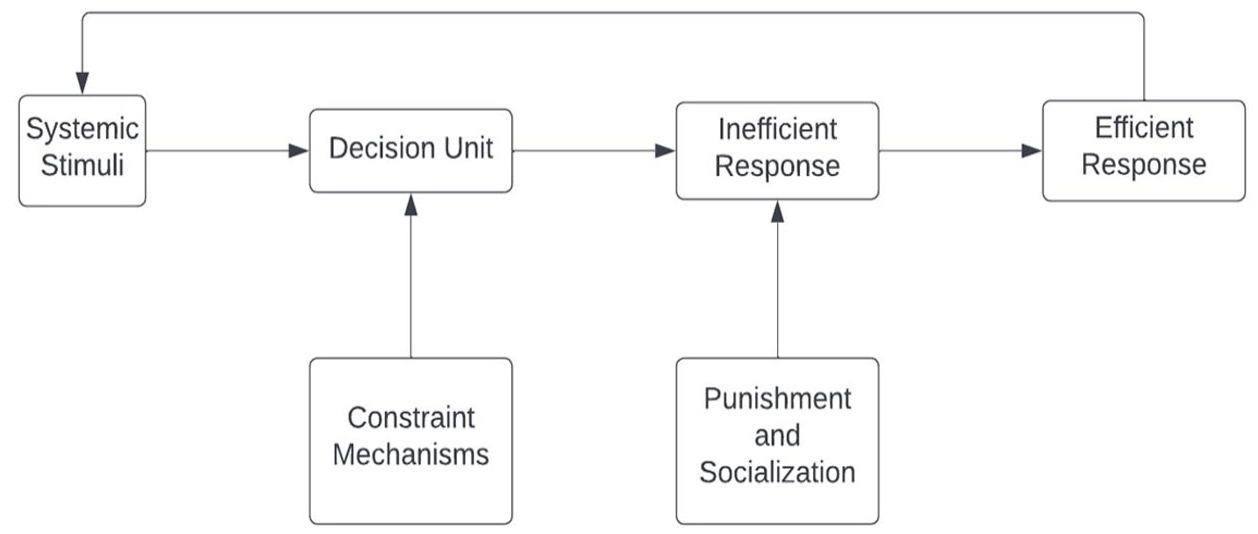
Neoclassical realism I.
Notwithstanding the variant’s internal coherence, Type I NCR falls short of establishing explanatory priority for systemic factors, since systemic stimuli will by and large allow for more than a single unpunishable state response. Consider a great power experiencing mild relative decline. Clearly, the state in question can select from a lengthy list of options, including retrenchment and waging a preventive war. 22 And it is impossible to know which of the options will be punished as all can be said to serve survival. 23 But if states are free to choose from two or more unpunishable options, then the strategic choice is not determined exclusively by systemic stimuli or consequences. If so, then systemic stimuli cannot on their own explain the behaviour in question. Likewise, it makes no sense to argue for the lower potency of non-systemic constraints by virtue of their function in moderating the intensity of a single stimulus, for if states can choose between two or more unpunishable options, then the absence or presence of the constraints is irrelevant. In short, accounting for the choice between systemically permitted options demands adding other types of factors alongside anarchy and relative power shifts. An alternative strategy for Type I NCR would be to confine its scope to those rare cases where systemic pressures are clear enough to highlight a single option. But even this demoted role is unsustainable, as punishment and socialization should deselect those domestic processes behind inefficiency. 24 Type I NCR is thus left in an impossible position between acknowledging systemic permissiveness or being soaked up by its parent theory.
Type II NCR: a toolkit for foreign policy analysis
Second-generation Type II NCR did the former, and acknowledged systemic permissiveness, proposing the conversion of NCR theory into a general model of foreign policy analysis meant to explain ‘a broader range of. . .choices’. 25 This restructuring rested on the assumption that systemic stimuli are rarely sufficient to highlight a single optimal state response, but nonetheless do delimit a certain number of options. In this way, systemic stimuli became contextual constraints, with the lesser ability to set decision units’ range of possible options available, while non-systemic variables were upgraded as factors able to select outcomes from within those limits. 26 This process of choice from a menu of prescribed alternatives is shown in Figure 2.
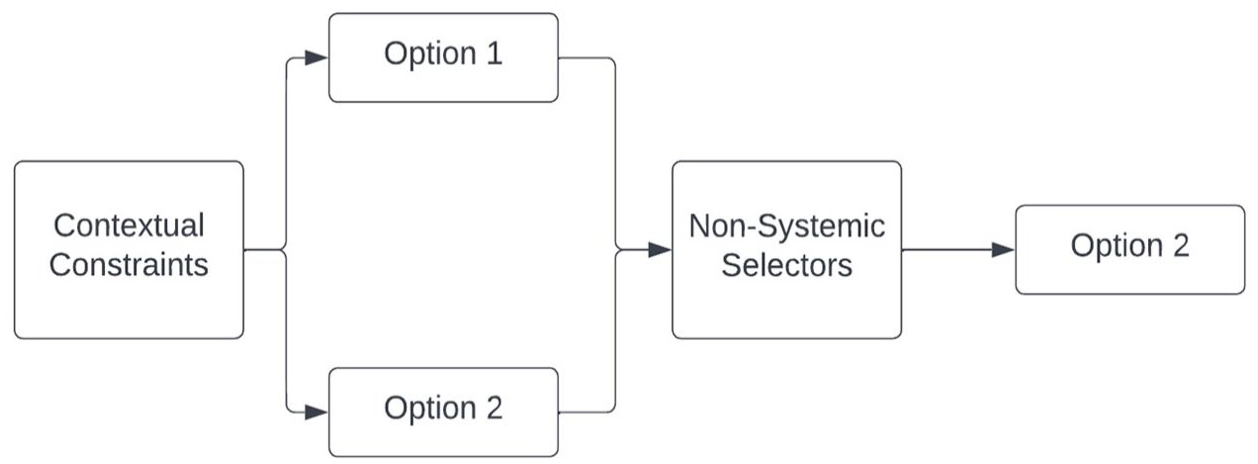
Neoclassical realism II.
However, this creates a new theoretical issue, that Type II NCR offers no analytical way of telling a priori which of the two types of causes – systemic constraints or non-systemic selectors – are more potent. 27 As per Figure 2, the former elicits two options and the latter picks one of the two, and there is nothing inherent in this relation to show that the one function is more important than the other. Accordingly, Type II NCR has been criticized for its failure to set itself apart from other theories and models that also acknowledge systemic constraints. 28
Two lines of defence have been subsequently forwarded as regards this charge. First, is the argument that the theory acquires identity via contextual priority. 29 The idea is that those causes which explain the range of possible outcomes are ipso facto more important than those that select outcomes from within those limits. 30 This is because contextual causes are claimed to explain a larger part of the variation in the dependent variable than selectors by determining the direction of outcomes. 31 Essentially, contextual constraints should be considered more important than non-systemic selectors by virtue of their delimiting function.
The problem with this argument is that their function alone cannot establish that contextual causes are actually more important. Consider an individual choosing a pear from a basket containing two different fruits, in a hypothetical world in which the total number of fruits is thirty. 32 There is simply no way to tell which of the two causes – the individual’s cultural background or the composition of the fruit basket – is more important. It may be that the same individual would have chosen the pear from a basket containing all thirty fruits, in which case the basket’s composition is rendered irrelevant. One may argue that the basket’s composition is more important in a quantitative sense; that is, whenever it is more restrictive than culture. 33 But then contextual priority turns out to be an empirical issue, and since NCR judges that constraints are usually loose enough to allow for a wide range of alternatives, theoretical distinctiveness becomes hard to establish through the idea of contextual priority. 34
A second strategy to give precedence to systemic constraints has been to attribute them temporal priority. 35 Under this line of defence, the relative potency of a cause is measured by their location in temporally ordered sequence. In sequence, where X1 and X2 and X3 → Y, X1 is treated as more potent than X2 and X2 as more potent than X3 because of their closer distance to some assumed ‘origins’ of Y. 36 As a consequence, contextual constraints are considered more important than non-systemic selectors on account of their purported precedence.
But surely, the fact that some cause or condition precedes another says nothing determinative about their relative impact on the dependent variable. If for instance one wanted to order the causes of Hitler’s rise to power according to potency, they for sure would not place his failure to enter the Vienna Art School above the 1919 Versailles Treaty or the 1929 crash by virtue of its temporal position. But as per temporal priority, Hitler’s artistic failure is ipso facto more important. 37 Similarly, the fact that a decision-maker may respond first to an external development does not preclude the subsequent filtration of this response by a domestic or ideational factor of equal or more causal potency. One way out of this dead-end would be to show that the causes that come first lock subsequent processes. But path-dependent explanations cut against the assumption build into Type II NCR that contextual constraints only elicit or constraint pathways. A further issue temporal priority faces is the difficulty of discerning temporal orders. Type II NCR conceptualizes the causal impact of non-systemic selectors as independent and additive alongside contextual constraints, in which case, temporal precedence cannot be assumed a priori. In some cases, a certain strategic culture or the elite beliefs of a decision unit may pre-exist and subsequently filter an external development. And again, whether such a factor will prove to be more causally potent than the external event is not to be decided by its temporal position. In short, neither contextual nor temporal priority is shown to be sufficient in giving explanatory precedence to systemic constraints, hence theoretical distinctiveness remains an elusive target.
Type III NCR: a theory of international politics
But is there a way out? In their 2016 comprehensive study on the progress of NCR, Ripsman et al. proposed a third course for the paradigm. This comprised the study of the aggregate phenomena of unit-level decisions delimited by contextual constraints, and theorizing those phenomena’s impact on the system’s structure. 38 This process of aggregating the decisions of states to constitute international politics is shown in Figure 3.
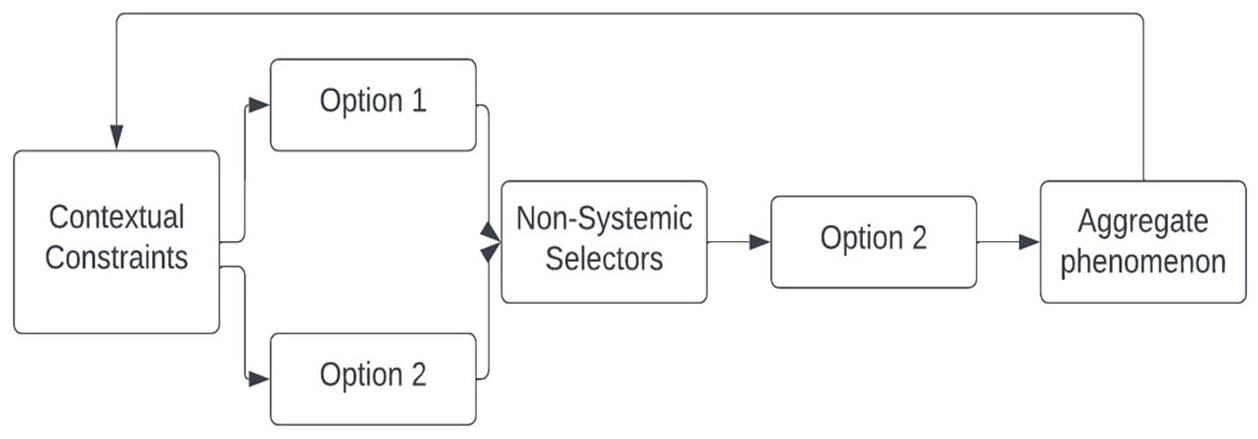
Neoclassical realism III.
Despite enlarging its dependent variable, Type III NCR still suffers from the same problem of theoretical indistinctiveness. This is because the selected options, purportedly causing aggregate phenomena, are themselves the products of the unranked interaction between contextual constraints and non-systemic selectors – the issues that affect Type II NCR have therefore not been resolved. Consider the example of system-wide conflict and WWII. Under a Type III NCR reading, the former is explained by the aggregate impact of the individual decisions of the key states, from choices delimited by the restrictiveness of their strategic environment during the 1930s, but ultimately selected by non-systemic intervening variables. 39 That is, by Germany’s and Japan’s rising trade dependence permitting expansionist ideologies to grow, as well as by London’s and Washington’s inability to balance both in a timely fashion due to low levels of state power or misperception of intentions. Such an account, however, cannot establish explanatory priority for systemic constraints: German and Japanese expansionisms are treated as choices implying the ideologically informed elimination of viable alternatives. If so, then growing trade dependence cannot be regarded as more significant than the ideology it elicited, even if it preceded it, which it did not. And if neither is ipso facto more important in causing expansionism, then system-wide conflict is also rendered the unordered sum of the independent effects of each separate cause. 40 In short, Type III NCR falls shorts of building a distinct identity, having inherited NCR II’s conceptualization of systemic factors as contextual constraints. 41
Transitive NCR
So far, the discussion has shown how NCR is presently wedged between turning into a decreasingly relevant auxiliary assumption of structural realism, or a theoretically indistinguishable toolkit of analysis. This article argues that the way out entails two peripheral but necessary refinement tasks, and a core theoretical development. Respectively, NCR has to determine a fitting dependent variable and a suitable theory of state preferences, permitting the deductive ordering of systemic and non-systemic factors. More importantly, striking a successful balance between theoretical distinctiveness and explanatory leverage necessitates breaking with NCR’s additive conception of the two types of causal factors. In its place, this article proposes a transitive approach to the relationship between the independent and intervening variables, under which what is effectively studied is the impact systemic factors exert upon non-systemic ones. The following sections flesh out such an alternative way of thinking about NCR as a research programme, termed Transitive NCR.
The last Tuesday issue
If NCR is treated as a general theory of foreign policy as Type II NCR suggests, then it risks introducing a potentially limitless number of non-systemic factors to compensate for the inability of systemic factors to determine policy decisions. 42 Moreover, in most cases, power variables may be absent or of secondary importance in the causal chain. In short, the reasons ‘why state X made a certain move last Tuesday’ will always be multi-causal, and while some moves will be primarily determined by relative power distribution, for others systemic conditions will be of no causal importance at all. 43
How then should an ostensibly realist theory approach the scope of its dependent variable in order to avoid losing its focus on prioritizing systemic factors? I argue that the appropriateness of any dependent variable is determined by the level of its interaction with the theory’s independent variable, in this case, the relative distribution of power amongst states. Hence, study variables which hold a loose association with power variables are prima facie placed outside NCR’s scope. To determine association, I use the time-frame formula under which, the shorter the time-frame of phenomena, the less relevance systemic factors hold, since power is expected to remain constant. 44 Accordingly, medium- and long-term policy trends and patterns (grand strategies, trade policy and alliance trends) are chosen, for they are likelier to involve power variables in a higher frequency, thus constituting a more appropriate domain for NCR. 45 An added reason underlying the suitability of such phenomena is that they usually demand the synergy of systemic and non-systemic factors. 46 Note again that with medium- and long-term phenomena what is primarily explained are trends and patterns across policies, rather than single decisions or isolated behaviour. 47 To make this point clearer, consider the following example: Britain’s decision to annex parts of tropical Africa in the late 19th century falls within NCR parameters if considered as an expression of a more general trend of late-Victorian British expansionism. If on the other hand, the purpose of a study is to analyse tropical African annexations as isolated historical events then competing FPA toolkits can offer complete multi-causal explanations without a hitch. 48
Just security?
Having established a theoretically viable scope for NCR’s dependent variable that also exceeds the constrictive task of explaining a few ‘mistakes’, the question that naturally arises is what determines these behavioural patterns? Competing accounts leverage economic interests or ideas: units make decisions in accordance with the interests of a subset of domestic society 49 or as dictated by ideational factors that constitute interests. 50 Returning to the case of British expansionism, 51 liberal accounts usually stress the interests of Britain’s financial class, 52 while constructivist explanations focus on European Imperialism as the dominant ideational frame dictating British expansionism. 53 Respectively, Type II NCR in its current form posits contextual constraints: decision-makers in London were ‘permitted’ to pursue strategies delimited by Britain’s declining power standing and eventually selected expansionism, instead of say, retrenching, due to unit-level factors. But the ‘explanatory priority’ issue persists since the motives behind British expansionism derive from non-systemic factors.
But what if NCR was to stop utilizing the radically simplified neorealist account of state interests and motives stipulating survival as states’ overarching goal? 54 To clarify the question’s significance, consider again the limiting function of Britain’s relative power standing, which permitted a range of options without impacting the country’s survival. In which case, there was no interaction between Britain’s decline and the motivations of the British state in responding to it: the choice of expansionism was equally unrelated to the issue of survival. If, however states were to be treated as power maximizers, then apart from limiting options, Britain’s late Victorian decline would have also impacted decision-makers’ incentives: under this reading, Britain was able to expand given its existing power standing while also having an incentive to expand, triggered by relative decline. What this example shows is that NCR could potentially increase the explanatory power of its independent variable by adopting an account of state preferences which interacts with systemic variation. Such an account could start with the general assumption that as a rule, states pursue power. In this way, the independent variable impacts both opportunities and motives. 55
This power-as-a-preference account should not be thought of as an identical good for all states irrespective of their power differentials. Rather, it is the relative power position 56 of states in the international division of labour which determines the extension of power-as-a-preference, in two ways. 57 First, and most obviously, power’s extension changes 58 whether the state in question is a small, medium or great power, based on conventional metrics such as GDP, level of technological innovation, population and size. 59 For example, in a historical system in which trading and finance are important dimensions of power, a great power would be expected to want to retain its leading trading and/or financial position, whereas a medium or small state would have much more limited interests. Mid-Victorian Britain’s leading power position entailed a widely defined national interest, that involved retaining the country’s industrial and financial preponderance in the face of the ascent of Germany and the US. Concurrently, seeking power for Denmark, given its subordinate power position, meant preserving integration within Britain’s trade and financial bloc. The extension of power-as-a-preference for the two countries differed with respect to their distinct position in the international division of labour.
Second, differently positioned states within the same layer in the division of labour may hold different power-seeking strategies in pursuance of the same extension of power. For instance, a declining hegemon will likely diverge in its power-seeking strategy vis-à-vis followers, since the former has an interest to retain power compared to the latter who seek what the hegemon retains. In short, a state’s power position in the global division of labour determines the extension of power this state will want to pursue or preserve and the same state’s position within the same layer determines the strategy through which the same power extension is attained.
The causal priority of the power motive could still be questioned by arguing that varied power-seeking behaviour is explained through another non-systemic factor. 60 Competing paradigms may explain power-seeking in terms of sectoral interests seeking to maximize profits, or the impact of ideational factors dictated by entrenched strategic cultures or national identity. However, NCR should be able to provide an assumption about the sources of power-seeking behaviour which does not rest on non-systemic factors. 61 If NCR views states’ interests as multifarious, comprising aspects of security, prosperity, prestige, as well as their own political survival, 62 then power is a means uniquely capable of satisfying multiple ends. 63 Of course, pursuing power does not entail policies of equal benefit to all interests: rather, it should be expected that power seeking further the interests of those groups that reflect the preferences implied by the country’s power position, taking into account the fact that not all sectoral interests yield the same power at all times. 64 Under this reading, late-Victorian British expansion was selected as a strategy by London to retain the country’s leading industrial and financial power position, that benefited the corresponding sectoral interests. 65
The additiveness issue
But if states want power as determined by their power position and pursue it through power-seeking strategies reflecting that position, then what is the use of non-systemic factors in explaining variation in the dependent variable? Rational decision-makers seem to be aware of what they can and want to pursue irrespective of the presence of a subset of domestic interests or an entrenched idea pointing towards the same policy direction. This critique would be significant if the translation of a shift in power position into actual policy was straightforward. But the reason variation in power position does not automatically cause change is the presence of existing policy regimes, which may benefit certain domestic groups or attune with specific elite ideas. 66 So, when a state’s power position shifts its behaviour will not automatically adjust given the function of ‘policy stabilizers’ rooted in a past power position. 67 Nonetheless, a new power position should trigger countervailing processes at the domestic and international level that encourage policy change consistent with that new position.
To unpack the latter process, consider the following two examples of British relative decline, one involving an intra-layer shift pointing to different power-seeking strategies and another underlying a cross-layer shift entailing a different power extension. In the first case, as we have seen, London’s reaction to late-Victorian decline was to expand, but this course of action was not the result of a clear and explicit strategic decision taken by the foreign policy executive. Rather, it was the result of a complex process of interaction between ideas, sectoral interests and the foreign policy executive. Britain’s unchallenged power position after the Napoleonic Wars had contributed to the emergence of a bipartisan consensus that formal imperialism and colonial expansion were unnecessary if not counterproductive policies, distorting the positive effects of free trade. 68 As a result, ‘informal empire’ came to be seen by both political parties as a sufficient strategy to retain Britain’s leading power position. 69 Informal empire also appealed to industrial and financial capital at home, whose interests and competitive advantage vis-à-vis foreign competition compelled them to want to preserve the existing free-trade regime. 70 When relative decline transpired in the late 1870s, it gradually incentivized commercial interests to push for anticipatory annexations in tropical Africa, following the exclusion of British products by ‘the often better quality of German and American products, as well as by tariff barriers’. 71 Still, the initial response of both liberal and conservative foreign policy executives in London was to disregard these calls on the basis that they conflicted with informal imperialism, by now Britain’s default strategy. 72 But by the early 1880s the persistence of relative decline had become clearer, both to industrial capital and to decision-makers. 73 The same commercial interests that had been calling for acquisitions in present-day Nigeria and Kenya in the 1870s now started enjoying the support of industrial capital at home 74 and the backing of a new generation of political decision-makers who saw anticipatory expansion as a viable way to preserve Britain’s lead. 75 Accordingly, in the late 1880s and 1890s both Gladstone’s and Rosebery’s liberal administrations as well as Salisbury’s conservative governments approved extensive territorial acquisitions in the foregoing areas, thus bringing an end to informal imperialism.
Moving on to an example involving different power extensions altogether, Britain’s acute decline after WWI vis-à-vis the US precipitated an ongoing industrial decline while restricting the ability of the country’s financial sector to lend and export capital. 76 This new place in the global division of labour, being the result of continuous trade deficits and capital scarcity, pointed to a contracted power extension. Whilst before ‘preserving power’ meant retaining Britain’s industrial and capital export lead, it now meant empowering debtor countries with foreign exchange (i.e. British sterling) to be able to repay British loans. 77 This was better served by a strategy of imperial unity and the imposition of trade preferences within a sterling bloc comprised of trade and debt-dependent countries, as opposed to retaining unilaterally free-trade and keeping the pound pegged to the gold standard. 78 And yet, with the exception of the less influential industrial sector (as per its declining importance for the country’s balance of payments), adapting to these new structural realities in the 1920s was vehemently resisted by the majority of the political elite and by financial capital, at the time Britain’s dominant sector. 79 The main reason was the consistent influence of free-trade orthodoxy among politicians of all stripes and the fact that financial capital’s interests were served by this policy. Still, continuous decline – exacerbated by the 1929 crash – induced the financial sector to shift position and to support protectionism, because relative decline had rendered debt collection both their and the country’s main prospective source of wealth. 80 With the exception of those left in the Labour Party after the party’s split in 1931, the political world subsequently backed the formation of a sterling bloc as ruled by trade preferences. 81
What becomes clearer by looking at the two cases is that variation in state behaviour is the outcome of the effects of relative British decline on sectoral interests and strategic ideas and the respective impact of those on the foreign policy executive. In the first case, decline induced industrial capital and certain policy entrepreneurs to push forward a power-seeking strategy of anticipatory annexations in tropical Africa. Similarly, in the second case, acute relative decline transformed Britain’s objective source of wealth, which forced the financial sector to change stance by supporting protectionism, thus incentivizing the political world en masse to back the formation of a sterling bloc.
Apart from the point that non-systemic factors are involved in the translation of new power extensions or power-seeking strategies into policy, what the discussion further indicates is that non-systemic factors are transitively linked to power shifts: industrial capital and policy entrepreneurs were induced by relative decline to embrace anticipatory annexations in Africa; the objective interests of financial capital were transformed by acute relative decline. This point highlights what constitutes NCR’s major indistinctiveness issue, that current NCR accounts treat the same relation additively, hence precluding any hierarchical theorization about systemic factors, since each type exerts independent causal impact. 82 Additive accounts 83 thus conceive of the causal relation as X1 AND X2 → Y. Still, the discussion of the two cases above shows that non-systemic factors could be treated differently, as intermediary factors that are directly affected by and transmit the causal impact of the independent variable. Under this interpretation, intervening variables play dual analytic roles: they are dependent variables, affected by the independent variable and independent variables affecting the dependent variable. A transitive account thus conceives of the causal relation as X1 → X2 → Y. 84 If the relation between systemic and non-systemic factors is interpreted transitively, then it is also possible to define the relation between the two hierarchically. According to this reading, policy trends and tendencies are seen not as the outcome of the constant conjunction between power and ideas or power and sectoral interests, but as shaped by their transitive interaction, under which non-systemic factors are causally endogenous to systemic factors. 85
The transitive model
The discussion so far raises two further questions of theory: which non-systemic factors should be included in a transitively conceptualized NCR model, and how exactly should they be understood to interact with systemic ones? 86 I first distinguish between factors transmitting the impact of changing power positions, and variables regulating this transmission. I call the first, substantive factors and the second regulative variables. 87
Substantive factors are causal mechanisms triggered by changing power positions. That is, as mechanisms composed of invariant entities compelled by power shifts to undertake activities which transmit systemic impact. 88 Entities can be societal, state and foreign agents, including policy entrepreneurs, representatives of economic sectors, third-country officials and other policy relevant actors. Crucially, to hypothesize them as being impacted by variation in power position, such entities should have some relation to the model’s independent variable. Hence, I distinguish between three types of power-related entities, power generators, power consumers and policy entrepreneurs. Power generators are actors whose regular function associate directly with the production of national power. This group will usually comprise of representative bodies and stakeholders of key economic sectors. 89 In turn, power consumers are entities which make demands and hold expectations about the furtherance of power commitments and the allocation of power externalities. I divide power consumers into external and internal ‘beneficiaries’. The former include the governments of other countries and their expectations of and demands from the state in question, while internal beneficiaries refer to public opinion. Finally, policy entrepreneurs are the key individuals and small groups within bureaucracies and the political elite whose role is to discern power extensions and who design and promote power-seeking strategies. 90
These groups will be differently impacted by variation in power position and undertake distinct activities. Power generators may see their relative performance changing, as in the case of the relative decline of Britain’s industrial capital during the late 19th century, or experience their objective interests transforming all together, which is what happened to Britain’s financial capital in the early 1930s. 91 Such impacts will induce sector representatives to lobby decision-makers, and to push forward new policy ideas congruent to their changing circumstances. Structural change may reshape their relative importance to the national economy, consequently altering their ability to exercise influence: as the post-WWI importance of industrial capital decreased, the government became less reluctant to impose a policy of imperial preferences that were damaging to industry. 92 Turning to external power consumers, power shifts are predicted to affect their expectations and consequently their demands as regards the ability of the state in question to provide power externalities: 93 USSR’s collapse in 1991 rendered the US the most powerful state in the international system, inducing NATO allies and states wishing to gain security and economic guarantees from forging a closer association with Washington to increase their expectations and demands for a more expansive US grand strategy both with respect to US involvement in the Balkans and NATO enlargement. 94 Similarly, power shifts may alter the expectations of the public concerning the unrealized potential of their state’s foreign policy and their attitudes about the domestic distribution of power externalities. 95 Public opinion is in turn assumed to impact decision-makers as it conditions political survival. Finally, power shifts impact the perception of policy entrepreneurs of their country’s power extension or ideal power-seeking strategy. This is done either indirectly, as a result of the activities and relative importance of power generators and power consumers, or directly, as they alter their own policy expectations. 96 Armed with new beliefs of a disruptive nature vis-a-vis an existing policy regime, policy entrepreneurs encourage policy change within the decision-making process. 97 To the extent that they are successful, they may contribute to the formation of more stable ideational constructs as their beliefs come to be shared by larger groups of people. 98 Policy entrepreneurs may be driven by different motives: some will see policy change as a convenient way to rise in their respective hierarchy; others may advocate ideas because they believe in their positive impact. But whatever the motive, their actions will be triggered and enabled by power shifts, which create windows of opportunity, as power generators and consumers come to question existing policy. 99
Regulative variables include state-society relations, elite or societal cohesion, regime type and other factors associated with state power; that is, the ability of a state to extract, mobilize and harness power from society. 100 Their role is to organize systemic impact by determining the relative salience and specific form of substantive factors. For instance, public opinion is likelier to be more potent in liberal democracies than in authoritarian systems. Similarly, the role of policy entrepreneurs depends on how state-society relations are organized. In more centralized states, these entities are likelier to be found within the state apparatuses, whereas in liberal democracies civil society may be more significant. Regulative variables are therefore attributed the ability to select which of the foregoing mechanisms will be more relevant and what form these will take. Note that the impact of these variables, unlike that of substantive factors, is independent of power shifts. This is not to say that they cannot be affected by systemic factors: acute relative decline may in some cases affect decision-makers’ ability to extract resources from society for foreign policy commitments. Still, elite or societal cohesion and state-society relations are factors which are hypothesized as mostly shaped by non-systemic factors.
To summarize, transitive NCR, as shown in Figure 4, proposes the study of trends and patterns of state behaviour, treated as the outcomes of systemic effects transmitted through substantive factors and as organized by regulative variables. 101
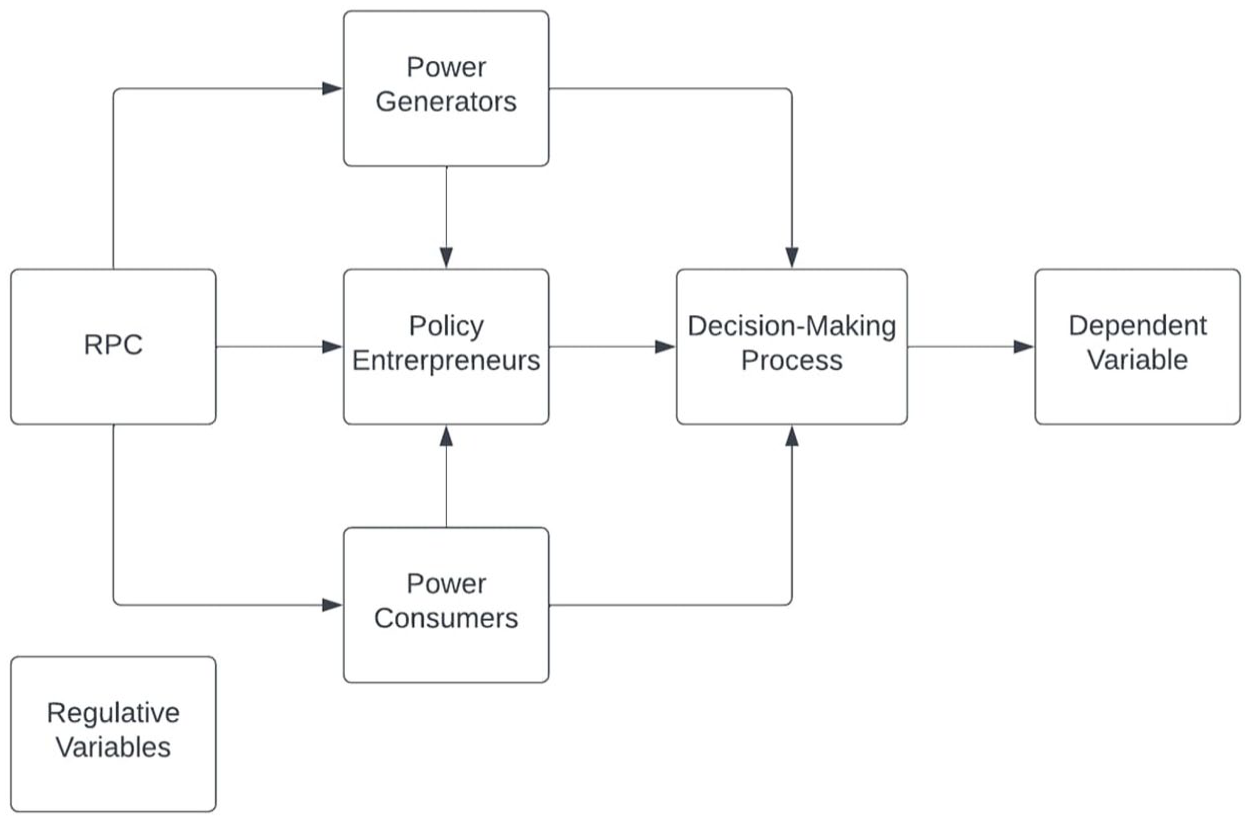
Transitive NCR.
Establishing explanatory priority
Taking the discussion above into account, transitive NCR dodges the ‘explanatory thinness’ issue associated with Type I NCR, by accounting for a great deal of state behaviour. But to successfully strike the balance between explanatory breadth and theoretical distinctiveness, it also needs to demonstrate how it establishes priority for systemic factors over substantive factors and regulative variables.
Starting with regulative variables, these are treated as subordinate because their role is simply to determine which substantive factors will be more salient than others. In this way, they impact the form but not the direction of systemic effects, transmitted through substantive factors. 102 Turning to the systemic-substantive relation, their asymmetry is built on two sub-relations. First, and according to the transitive nature of the interaction, substantive factors are rendered subordinate by being treated as effects of power shifts. For example, the increasing support in the 1880s of industrial capital for a strategy of anticipatory annexations in East Africa was the direct result of relative industrial decline. 103 Similarly, the pressure exerted by financial capital induced Macdonald’s national unity government to opt for protectionism in 1932, but financial capital only came to reject free-trade orthodoxy because relative decline rendered debt-collection the sector’s objective interest. 104 Second, substantive factors can be considered as subordinate since they are less able to account for variation in the dependent variable in the absence of systemic factors. For instance, commercial interests in West and East Africa were calling for anticipatory annexations as early as the 1870s, but their proposals were only approved after the realization in London that France and German intentions to create closed-door orders in the same areas were unacceptable given the relative depression of British exports. 105 Similarly, the newly found protectionist position of financial capital in the early 1930s was embraced by Macdonald’s national unity government not with respect to the source of the position, but because relative decline had rendered debt-collection – which coincided with financial interests – Britain’s main source of wealth. 106 In this second and weaker sense, systemic factors can be said to have priority as they cause the conditions under which substantive factors become effective.
It could be argued that if a substantive factor temporally precedes power-position variation, then it makes sense to claim independent and thus, symmetrical effects of substantive factors alongside power shifts. 107 Going back to the example of West Africa, commercial interests lead by George Goldie were calling for territorial acquisitions for reasons independent of relative decline. 108 Hence annexations in the area could be seen as the result of commercial interests and relative decline. However, the two are causally asymmetrical, for they are not equally as likely to produce sufficient explanations. 109 In the absence of a specific set of substantive factors, power shifts can activate alternative causal mechanisms towards the same end. In contrast, in the absence of variation in power position, substantive factors are less likely to produce variation in the dependent variable. In empirical terms, in the absence of Goldie’s lobbying activities concerning annexations in West Africa, the reality of relative decline would have precipitated some other entity to call for similar territorial acquisitions. Conversely, in the absence of decline neither Goldie’s lobbying attempts nor similar ones would have induced the government to adopt a strategy of anticipatory annexations. 110
One might still challenge explanatory priority through the same asymmetry assumption by accounting for power position or power-as-a-preference based on substantive factors, in which case reverse causality is assumed. But such an argument faces the following shortcomings. 111 As regards power-as-a-motive, the possible claim 112 that it can be subsumed under an ideationally explained desire for power is tautological: to say that all states pursue the same extension of power as per their power position and to say that this pursuance is an expression of an idea are one and the same. Similarly, the liberal claim that the power motive can be reduced to reflect the motives of leading economic sectors 113 faces the issue that frequently enough the two are unrelated or even in conflict: Britain’s Late-Victorian strategy of anticipatory annexations in tropical Africa did not serve the interests of financial capital as exemplified by the absence of relevant sectoral pressure or the subsequent absence of capital exports in the same areas. 114 Finally, the plausibility of treating variation in power position as endogenous to substantive factors is questionable, given the multiplicity and irreducibility of factors behind state decline and rise as per the ‘development economics’ literature. 115 For this reason, the transitive approach adopts a pragmatic stance on the issue by black-boxing the factors behind power shifts: irrespective of why a certain state declines or rises, the latter is expected to trigger certain causal mechanisms producing state behaviour, congruent to a new power position.
Conclusion
The present construction of neoclassical realism rests on the horns of a dilemma, forced to choose between being relegated to an auxiliary premise of structural realism or becoming an FPA toolkit. This article has sought to restructure the paradigm as, Transitive Neoclassical Realism, providing a general framework of studying longitudinally the transitive impact of system upon non-system, accounting for trends and patterns with a long time-span. In this way, NCR can acquire both sufficient explanatory leverage and a distinct theoretical identity.
The broad confines of what has been proposed here open up multiple pathways for future research. Those interested in ideas, could explore policy entrepreneurs’ changing beliefs and the ways in which they subsequently externalize and turn them into salient ideas within the decision-making process or in civil society. Alternatively, the focus could turn on how social ideas alter alongside power shifts and how they subsequently come to delimit the options available to decision-makers. A similar research route could concentrate on interest group advocacy strategies in response to changing material circumstances, or on long-term periods describing power-rebalancing processes amongst such groups, as the outcome of shifting power extensions. In addition to the systemic-domestic nexus, the approach highlights questions on how third states re-evaluate their expectations and demands in line with the changing potency of the discussed state to provide certain public and exclusive goods. Last but not least, the transitive approach provides a relatively clear set of baseline assumptions about state preferences, allowing for the development of middle-range theories on states’ expected power strategies under rise and decline as well as meso-historical accounts of policy adjustments to new power extensions. In view of the number and novelty of the hypothesized developments and so long as these prove progressive, it is possible to argue for the enduring relevance of NCR when transitively structured. In response to those voices calling for neoclassical realism to be abandoned, this article proclaims it alive and well, as per its potential.
Footnotes
Acknowledgements
The author is grateful to Nicholas Kitchen, Anders Wivel and the anonymous reviewers for their comments and advice.
Funding
The author received no financial support for the research, authorship, and/or publication of this article.
