




Abstract
This article reflects on the past, present and future of the BJPIR through a content analysis of all 999 articles that have been published in the journal between its launch in April 1999 and the latest issue in May 2024. By charting ‘core’, ‘secondary’ and ‘peripheral’ pools of scholarship, this reveals a politics of journal content which, in turn, can be used to raise critical questions concerning shifting intellectual boundaries and a changing socio-political context. More specifically, the results of the content analysis focus attention on the twin-themes of flexibility and reflexivity in journal publishing. The central argument emerging from this analysis is that if the BJPIR is to continue along its highly successful trajectory, then it may well need to embrace greater flexibility in terms of reaching beyond political science and international relations, while engaging with greater reflexivity as to societal linkage and relevance.
The primary focus of this article is not on the past 25 years of the BJPIR but on the future of the journal. The results of a content analysis of the 999 articles that were published in the journal between April 1999 and May 2024 are therefore provided as an evidence-based foundation from which to make an argument about intellectual and socio-political change, and the implications of these changes for the strategic future and direction of the journal. The core argument being that although BJPIR has undoubtedly become a major international outlet for the publication of cutting-edge scholarship that advances the field, its continuing success in the future is likely to depend upon the journal’s capacity to adapt and change. It is for exactly this reason that this article looks beyond the emphasis of previous editorial statements on increasing ‘breadth and depth’ towards a richer focus on disciplinary flexibility and intellectual reflexivity. The former provides a focus on range, absorption and the capacity to trespass across disciplinary boundaries (see Epstein, 2019; Hirschman, 1981); the latter provides a focus on the value of knowledge and a sharper emphasis on the nexus between science and society. Both these points of argumentation – flexibility and reflexivity – serve to focus attention on the changing research, development and innovation ‘ecosystem’ within which the discipline(s) of political science and international relations now exist. 1 The significance and originality of this article stem from the way it highlights a potential ‘alignment challenge’ for future editors of the BJPIR. To some extent, this ‘alignment challenge’ between traditional assumptions about what a disciplinary academic journal is for is a challenge for all journals across all disciplines. Excellence in journal publishing in the future may evolve to become very different to how excellence has been defined in the past.
These issues are explored in this article through a focus on four basic research questions (RQ):
Research Question 1 (RQ1): What does a content analysis reveal about the type and range of articles published in the BJPIR?
Research Question 2 (RQ2): How have patterns of publication by sub-field and focus changed throughout the journal’s 25-year history?
Research Question 3 (RQ3): What issues, themes, approaches and perspectives does the content analysis suggest may have been overlooked or under-utilised?
Research Question 4 (RQ4): How do the overall results of the content analysis help promote a discussion about the existence of an ‘alignment challenge’?
To engage with these RQs, this article is divided into four main sections. The opening section focuses on ‘caveats and context’ in order to underline both the limits of the argument presented in this article, and to congratulate the editorial teams that have made the BJPIR such a successful journal. This flows into the second section’s focus on RQ1 and RQ2 (above) and a presentation of the main findings of the content analysis. What this reveals is a pattern of publishing that has broadly managed to reflect the diversity of the discipline, and to excel as a truly ‘omnibus-style’ journal. That said, the third section drills down into the data to explore what approaches, themes and sub-fields do seem to have been under-represented in the journal (RQ3). The fourth and final section focuses not only on the content of the journal (the focus of the second and third sections) but also on a rapidly changing socio-political context in which the expectations of politicians, funders, students and arguably the public are changing in ways that may mean that a journal that is healthy today may not be ‘fit for the future’ in terms of being able to respond to a changing context. This is discussed in terms of an ‘alignment challenge’ (i.e. RQ4). Put slightly differently, there is an opportunity for the BJPIR to demonstrate greater disciplinary flexibility, range and ambition, while also promoting greater basic reflexivity as to why the study of politics and international relations actually matters for society.
Context and caveats
There is a basic and fundamental challenge to reflecting on the evolution of a single academic journal which stems from the need to somehow accommodate an understanding of structural and contextual variables which are likely to have implicitly shaped the journal while being far beyond the direct control of any journal’s editor or editorial team. This matters in the context of this article’s analysis for the simple reason that both academic publishing and academic careers have changed markedly since the BJPIR was first launched in 1999. In the last 25 years, there has been a significant growth not only in the number of academic journals (currently thought to be around 33,000), but also in the number of articles published each year (around two million). Technology has transformed the journal marketplace by breaking the link between physical page limits and publishing capacity. Debates concerning Open Access, ‘publish or perish’, the role of metrics, evaluation and audit systems, the emergence of ‘predatory journals’ and the implications of artificial intelligence – to highlight just a handful of issues – have made the journal publishing world more complex and competitive. Within academe, the pressure to publish is arguably as intense as it has ever been, and especially in the United Kingdom where the assessment of published outputs remains the core focus of the Research Excellence Framework.
It is also important to note origins and evolution. Origins in the sense that the idea for BJPIR emerged out of concern and criticism of the evolution of core journals in the mid-1990s. The British Journal of Political Science was perceived largely as an outlet for quantitative studies, and Political Studies was thought to have side-lined the study of British politics in favour of a stronger focus on political theory, European studies and the ‘new’ institutionalisms. With the number of manuscripts submitted to Political Studies increasing year-on-year, the assumption was that space existed within the journal landscape for the Political Studies Association to launch a new journal, and therefore to increase the publisher-generated revenue accruing to the main learned society for the discipline. The emphasis on re-positioning the study of British politics from what was perceived to be an increasingly peripheral pursuit back to being a core sub-field is reflected in the first issue’s contents page (see Table 1).
BJPIR issue 1, volume 1, 1999.

In terms of evolution, it is also important to acknowledge fundamental shifts in the nature and context of British politics and international relations since 1999. ‘The landscape of British politics looked rather different’ the current editorial team notes with no little under-statement ‘when the BJPIR was first published at the end of the 20th century (Editorial, 2022: 3)’. Brexit, Covid, the global financial crisis, populism, the Russian invasion of Ukraine, the Israel–Hamas war and so on all combine to explain why ‘permacrisis’ was recently selected as ‘word of the year’. Although this backdrop may provide fruitful terrain for students of politics and international relations, launching and sustaining a journal (attracting high-quality submissions, securing reviewers, commissioning pieces, building an active intellectual community etc.) is an incredibly challenging endeavour. Nevertheless, BJPIR’s current ranking of 34th out of 96 journals for international relations and 79th out of 187 journals for political science, plus a 5-year impact factor score of 2.3 reflects the established strength of the journal. The members of the editorial teams who steered the journal to this success – based as they have been at Birmingham (1999–2004), Nottingham (2004–2010), Queens (2010–2016), Edinburgh (2016–2022) and now Leeds (2022–) – deserve huge credit for this achievement and for their broader contribution to the discipline, as do the reviewers, readers and the journal’s publishers.
With this broader context in place, it is necessary to highlight some obvious caveats about this article’s focus on content analysis and its central argument concerning flexibility and reflexivity. First and foremost, the editors have relatively little control over the level, quality and focus of the manuscripts that are submitted to the journal. Special editions can and have been used to commission collections of themed articles (discussed below) but the vast majority of submissions are unsolicited. Authors will weigh up several considerations, especially in relation to whether to submit to a specialised (i.e. sub-field) journal or an omnibus journal (i.e. discipline-wide) such as BJPIR. Each of the 10 disciplinary sub-fields examined below has several dedicated and highly specialised journals, and the Political Studies Association itself publishes a suite of journals in the form of Political Studies, Politics, BJPIR and Political Studies Review. The first caveat that needs to accompany a content analysis of any journal is therefore that the editors do not have full control over the flow of articles they can consider for publication. The link between editorial teams and the emergence of ‘core’, ‘secondary’ or ‘peripheral’ sub-fields in any journal is therefore complex. Authors enjoy an ever-growing number of publishing options.
The second caveat is simply to highlight the role of established norms, conventions and expectations. An ‘academic’ journal is expected to publish scientifically focused content, written by accredited and established scholars on the basis of a credible methodology, as affirmed through processes of peer review. The core discipline(s) of the BJPIR are political science and international relations, and it is therefore to be expected that the journal’s content reflects these fields of scientific endeavour. The core argument of this article does not seek to reject these assumptions but through its focus on flexibility and reflexivity it does attempt to reframe and revitalise what and how and who ‘counts’ in terms of making a credible contribution to academic debates. As the content analysis outlined below demonstrates, the BJPIR has already evolved through several phases and stages (i.e. issues per volume, innovations in article type, relative focus on different sub-fields, editorial teams, publishers etc.). But by focusing on flexibility and reflexivity, this article is attempting to see the 25th anniversary of the journal as a pivotal moment – a potential inflection point – and a transformative opportunity to reframe the journal. The obvious and third qualification is simply that not everyone will agree with the strategic direction and publishing path being suggested. By explicating the notion of an ‘alignment challenge’ and setting this against the content analysis of past issues and volumes, it may well be that this article promotes a choice agenda that is too far from the norm and viewed as equally perilous and problematic. But it is hoped that some benefits may accrue from simply stimulating an open debate about the past, present and future of the BJPIR.
The flows into a fourth and final caveat: journals matter due to the way review and publication processes conspire to implicitly and sub-consciously reward and promote certain ideas, perspectives, methods and theories, while excluding or peripheralising others. There is a distinctive politics of journal content which has in recent years emerged in debates concerning inter alia embedded gender biases in review processes (Grossman, 2020; Teele and Thelen, 2017), systemic inequalities in publishing (Schipper et al., 2021) which affect careers (see Hanretty, 2021), the need to ‘decolonise’ curricula (Begum and Saini, 2019; Moosavi, 2020; Sen, 2023), the ‘silencing’ of contrarian positions (Norris, 2023) and ‘black competency and the imperial academy’ (Shilliam, 2019). Members of the PSA Publications Committee who assessed and approved the idea to establish a second core journal in the mid-1990s could not have imagined that two decades later political science and international relations would be ‘facing an epistemological crisis about its knowledge production and how different kinds of knowledge produced outside and against the white male Eurocentric gaze are largely delegitimised and excluded within the discipline’ (Emejulu, 2019: 202). The outcome being a far sharper focus on the role of journal editors as ‘intellectual gatekeepers’ (Baccini and Re, 2024) which is exactly why debate and discussion about the past, present and future of a journal matters, especially one like BJPIR that is owned by a learned society for the benefit of a disciplinary community. The debate regarding ‘gatekeeping’ reveals how the governance of journals is almost defined by the distribution of ideational, discursive and agenda-setting powers that may serve to either further embed or openly challenge dominant disciplinary assumptions. Sadiya Akram’s (2024) observation ‘Dear British Politics – where is the race and racism?’ – and particularly the deafening silence this questioning has provoked – exemplifies what this section has labelled ‘the politics of journal content’. The next section develops this point by presenting the results of a content analysis of 999 articles, spanning 97 issues published across 26 volumes and totalling more than eight million words.
Content and change
This section focuses on the first two RQs noted above: (1) ‘What does a content analysis reveal about the type and range of articles published in the BJPIR?’ and (2) ‘How have patterns of publication by sub-field and focus changed throughout the journal’s 25-year history?’ Answering these questions is vital to developing the core argument of this article concerning flexibility and reflexivity, and the emergence of a potential ‘alignment challenge’. It is, however, important to highlight two methodological issues. First, the focus of the content analysis was restricted to sub-field area only. Unlike other more expansive analyses of journal content (see, for example, Järvelin and Vakkari, 2022; Stroud et al., 2017), it did not include variables such as primary methods, author location or career stage, or subsequent article metrics. An inductive process of data coding was utilised which began with the four sub-fields – British government and institutions, political thought, comparative and European politics and international relations – that were identified by the journal’s first editorial team as the ‘intellectual territory covered by this journal’ in Vol.1 Issue 1 (Editorial: Studying British Politics, 1999: 2). Articles were coded against these sub-fields, and where articles did not fit new sub-fields were created. This process led to the creation of a 10-part (sub)-disciplinary map (see Table 2), plus two additional thematic topics (discussed below). All forms of article published by BJPIR over the past 25 years were included (i.e. ‘Research Articles’, ‘Review Articles’, ‘State of the Discipline’ articles, contributions to symposia, debate pieces, ‘Controversy’ articles and ‘Policy Matters’) and a three-stage approach to coding reliability was adopted. First, after the first five volumes had been coded, an external robustness check was undertaken whereby five academics were independently asked to undertake a mini-coding exercise in which they categorised the content of a randomly selected issue from volumes 1–5 and were asked to code the content articles against the 10-part sub-field framework (using the title and abstract to mirror the general coding process). The results of this pilot process were then compared with the initial ‘phase 1’ data set for coding consistency and differentiation. This revealed a high reliability score of 82%, while also facilitating the fine-tuning of the sub-field framework vis-à-vis disciplinary boundaries. Subsequent (second) potential issues concerning intercoder reliability were addressed by continuing to use just one researcher to assess and assign each data point (i.e. journal article). The third dimension of coding-robustness revolves around the availability of the full data set (from the author) with every data point identified and tagged in the hope of facilitating future refinement, replication and review.
Content analysis of BJPIR, 1999–2024.

From Vol.1 (1999) to Vol.4 (2002) BJPIR published three volumes a year. The first four issue volume was Vol.5 (2003). 2. The data for 2024 (Vol.26) only covers issues 1 (Feb.) and 2 (May) but has been provided to ensure the data is up to date. 3. Only the data for full volumes (i.e. 1999–2023) have been used for 13691481241284375X.
As the online Journal Article Database Codebook makes clear (see Maliniak et al., 2020), it would have been possible to sub-divide each of the main codes into further issue areas or sub-categories and, through this process, produce a more fine-grained analysis. However, the methodology and coding used in this study broadly reflects the 2022 analysis of journal content in Political Studies by Ginocchio, Hindmoor and Stanley (see also Byrne and Randall, 2024) and, as such, for the purposes of this article, Table 2 provides a robust evidence-based foundation on which to engage with the first and second RQs.
What Table 2 reveals about the type and range of articles published in the BJPIR (i.e. RQ1) is that the journal has broadly fulfilled its ambition to ‘broaden and deepen our understanding of British politics’, especially in relation to locating the study of British politics within a broader account of international debates, themes and challenges. Following on from this, it is possible to break down the journal’s content over the last 25 years with reference to ‘core’, ‘secondary’ and ‘peripheral’ topics, or sub-fields. The journal’s core content has broadly followed the terrain first outlined by the editors in 1999 and is generally concerned with ‘British Government & Institutions’ (221 articles or 21% of content), ‘International Relations, Development and Foreign Policy’ (157, 18%), ‘Elections, Public Opinion & Parties’ (130, 13%), ‘Political Economy’ (119, 12%) and ‘Governance & Public Policy’ (117, 12%). Studies of the power of the prime minister (see, for example, Atkins and Gaffney, 2020; Foley, 2004; Heffernan, 2003), the political economy of globalisation (see, for example, Bruff, 2005; Callaghan, 2002; Hay, 2013), the meaning and emergence of processes of depoliticisation (see, for example, Buller and Flinders, 2005; Kettell and Kerr, 2022; Kuzemko, 2016; Warner, 2019; Wood, 2015), the analysis of New Labour (see, for example, Atkins, 2010; Bevir, 2000; Coates, 2013; Temple, 2000) and the interplay between elections, parties and Brexit (see, for example, Berz, 2020; Goodwin and Milazzo, 2017; Rone, 2023; van Kessel, 2020) provide just a few examples of topics where BJPIR has undoubtedly set new standards for world-class scholarship.
One of the challenges of coding journal articles is that they often span sub-fields and deciding upon a primary category code can be difficult. Daddow’s (2013) work on ‘the Eurosceptic tradition in Britain’, Felicetti and Castelli Gattinara’s (2018) analysis of ‘marginality in democratic systems’ and the 2019 study of ‘the impact of devolution on abortion law’ by Moon et al. (2019) provide examples of this challenge. What’s interesting from the data contained in Table 2, however, is that where coding questions emerged, they tended to be intra-‘core’ in range (e.g. articles sat between ‘British Government & Institutions’ or ‘Governance & Public Policy’, ‘Political Economy’ or ‘International Relations, Development and Foreign Policy’) rather than spanning ‘secondary’ or ‘peripheral’ sub-fields. In fact, one of the noteworthy dimensions of undertaking the content analysis was the degree of consistency in classification and the relative lack of articles that challenged the 10-part sub-field framework outlined in Table 2 (discussed below).
Returning to the distinction between ‘core’, ‘periphery’ and ‘satellite’ streams of scholarship within the BJPIR, it is important to note the existence of two secondary sub-fields in the form of ‘Political Theory or Philosophy’ (88, 9%) and ‘European Politics’ (74, 7%). Two key observations can be made about these ‘peripheral pools’: the first is ‘Political Theory or Philosophy’, which does not seem to have emerged as a central element of the ‘intellectual territory’ of the journal in quite the manner that the founding editors hoped (see Editorial: Studying British Politics, 1999: 4–6). Specific sub-disciplinary norms and cultures may well help explain this, as might the existence of many specialist journals in this sub-field (Political Theory, Comparative Political Theory, European Journal of Political Theory etc.). This might explain why a large proportion of the BJPIR’s content in this area seems to have been published in the form of contributions to commissioned special editions, special sections, book reviews or ‘State of the Discipline’ articles (see Callinicos, 2004; Connolly Symposium: Introduction, 2008; Lamb, 2010; Panagakou, 2005; Runciman, 2001; Schmidt, 2002; Thomassen, 2004).
The second observation is the content score for ‘European Politics’ almost certainly under-states the actual level of attention given to this field. As already acknowledged, the limitation of a methodology which requires a single primary sub-field classification is that it risks minimising the culminative weight of secondary sub-field scores. Therefore, while the articles published within special editions that were explicitly focused on, for example, ‘Constitutionalism, European Integration and British Political Economy’ (see Rosamond and Wincott, 2006) or ‘European Integration and Economic Interests’ (see Sadeh and Howarth, 2008), were relatively easy to categorise within ‘European Politics’ (with ‘Political Economy’ being a clear secondary code), other articles with a clear European politics relevance were tagged under other codes. One example being the special edition on ‘Political Opposition in a Multi-Level Context’ (see McEwen et al., 2012) which contains several articles that discuss the European Union, in general, and Open Method of Coordination, in particular, while predominantly focusing on relationships between devolved authorities and Whitehall (hence their categorisation under ‘British Politics and Institutions’). The point being made is that the BJPIR has published more work on European politics than a strict reading of Table 2 might suggest, but possibly less than might have been expected.
This brings the discussion to a focus on RQ2 and how patterns of publication by sub-field and focus may have changed throughout the journal’s 25-year history. Diagram 1 provides a longitudinal illustration of content by sub-field.
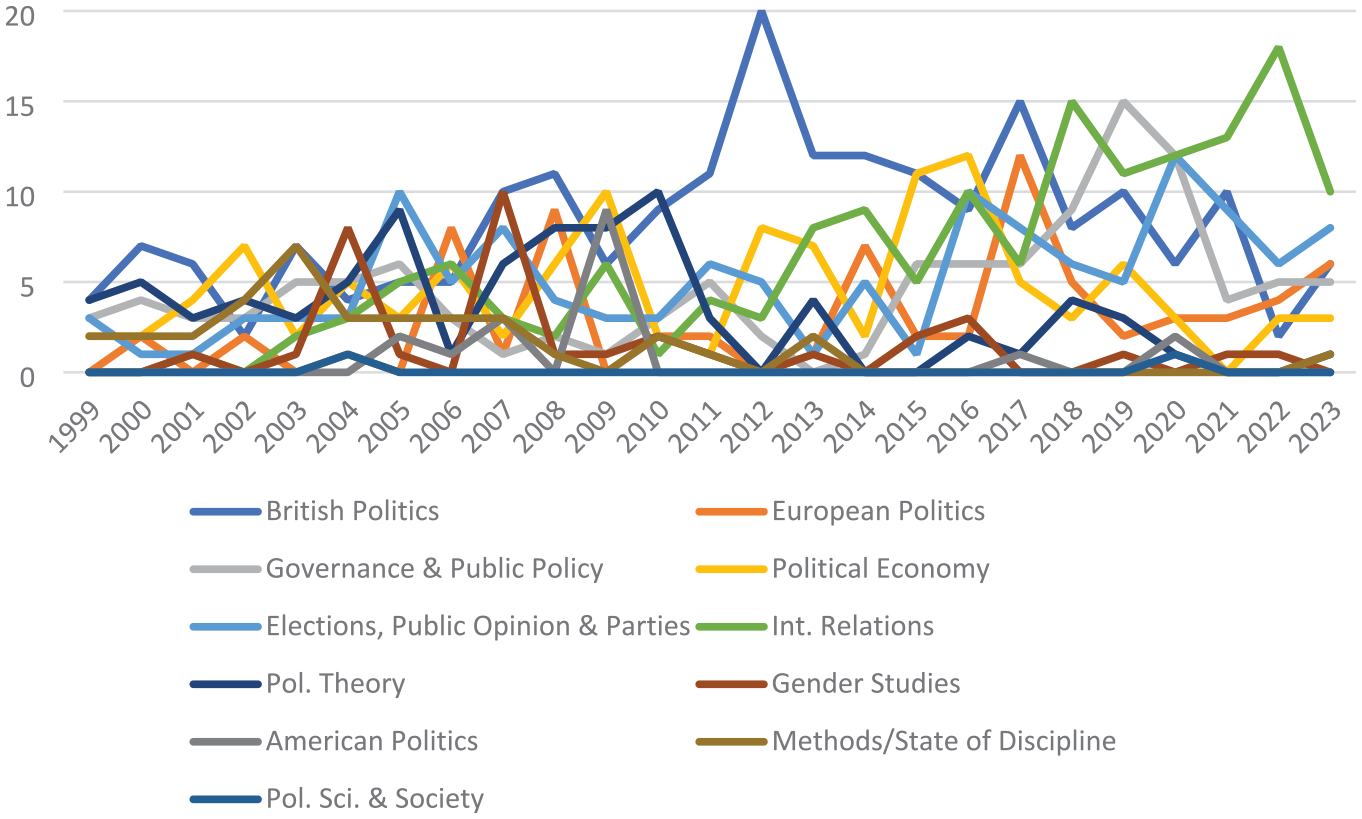
Longitudinal analysis of BJPIR content by sub-field, 1999–2023.
The data suggest a mixed pattern of sub-disciplinary change and evolution vis-à-vis BJPIR content, but in a manner that supports this section’s focus on ‘core’, ‘secondary’ and ‘peripheral’ coverage. What’s also interesting is the way Diagram 1 reflects the impact of new editorial teams who have recognised and attempted to address under-represented sub-fields and inject new editorial priorities (see Table 3).
Evolution by Editorial, 1999–2024.

The ‘core’ position of articles on ‘British Government & Institutions’ is clear from Diagram 1, with a peak period between 2011 and 2017, reflecting the turbulence leading up to and through the Brexit referendum. In line with the 2010 editorial statement (Table 3), the position of ‘International Relations, Development and Foreign Policy’ increased significantly from 2012, as did content on ‘Governance and Public Policy’. The ‘long-view’ perspective is also interesting because the journal begins (1999–2004) with a tight weaving of the sub-fields which reflects greater equality of sub-field representation. By 2018–2023, this pattern has unravelled as certain sub-fields have come to emerge as ‘core’, while others fell back as ‘secondary’ and ‘peripheral’. What’s interesting from Diagram 1 is how political theory, gender studies, American politics and methodologically focused content have flat-lined, or never moved beyond peripheral status (discussed below).
Diagram 1 captures patterns of sub-field specific content over two and a half decades (i.e. RQ2) but there is a second content-related dimension which demands discussion in any consideration of the past, present and future of the BJPIR: forms of content. One of the most interesting insights emerging from a longitudinal content analysis is not just how the journal has responded to publish content on contextually significant issues or events, but also how the various editorial teams have attempted to refresh and renew what the journal publishes and why. This matters for two reasons (one intellectual, the second pragmatic): as already mentioned, intellectually because such innovations often reflect an awareness on the part of editorial teams that certain topics, themes or sub-fields have been under-represented in the journal and innovations provide an opportunity for proactive commissioning; pragmatically such innovations matter because they often reflect publishing pressures and the need for any journal to constantly seek to cement and build a readership. Innovations in content – beyond the standard research article – therefore provide a way of constantly refreshing and revitalising a journal and preventing what might be termed ‘scholarly staleness’.
Reviewing the back catalogue of BJPIR reveals a pattern of attempted innovation – some successful, others less so – that is arguably as, if not more, important than the content analysis provided in Table 2 and Diagram 1. To put the same point slightly differently, the maturation of the journal is reflected in form as well as content, with the appointment of new editorial teams often bringing new ideas in terms of not just content but also publication form (see, for example, Peterson and Convery, 2019). For example, it was not until Vol.3 Issue 1 that the editors noted, ‘The BJPIR is entering its third year and we, as editors, felt that it was well enough established to risk a departure from its normal format’ (Editorial, 2001: 1) with the ‘departure’ taking the form of the journal’s first special issue (see Peters, 2001). Further innovation followed in Vol.4 Issue 1 with Brian Schmidt (2002) contributing the first ‘State of the Discipline’ article on ‘political theory and international relations theory’ (see Table 4), and Andrew Gamble (2002) and Wolfram Kaiser (2002) providing ‘Review Articles’ on ‘political memoirs’ and ‘Britain and Europe’, respectively. 2 Since then, a range of innovations have been introduced including a ‘Controversy’ section (see Bluth, 2005; Flinders and Kelso, 2011; Hoggett, 2005a, 2005b; Preston, 2007), film reviews (see Carver, 2007; Rowley, 2007), ‘Research Notes’ (LSE GV314, 2012), ‘Special Forum’ section (see Birchfield et al., 2017; Kornprobst and Senn, 2016), ‘Breakthrough Works’ symposia (see Peterson and Convery, 2019; Shue, 2019), ‘Breakthrough Articles’ followed by commentaries (see McLaughlin, 2019; Peters, 2019), ‘Breakthrough Commentaries’ (Fioretos, 2019; Savoie, 2019), ‘Symposia’ (Alter and Zürn, 2020; Jeffery and Peterson, 2020) and ‘Special Sections’ (see Thiers & Wehner, 2023).
‘State of the discipline’ articles, 1999–2024.

Keith Dowding (2005) holds a distinctive footnote in BJPIR history as the only author to write a ‘State of the Discipline’ article that stimulated a ‘Controversy’ response (see Parsons, 2006), and Dave Marsh (1999) and Angelia Wilson (2019) deserve similar footnotes for their authorship of once-only innovations in the form of an ‘Obituary’ (dedicated to Jim Bulpitt) and a ‘Letter from the PSA Chair’, respectively.
These innovations (less so the obituary or letter) are relevant to the focus of this article and to the strategic future of the BJPIR due to the way in which they reflect a degree of flexibility and reflexivity vis-à-vis journal content and publication form (discussed below). They reflect an intellectual need to respond to new issues and questions, and a pragmatic need to respond to external contextual drivers. One highly relevant example of this was the announcement in 2012 that ‘the time is right . . . to address the interface between policy and the discipline’ (Editorial: British Politics and International Relations in Times of Change, 2010: 159) and a plan to publish articles under a ‘Policy Matters’ banner that ‘demonstrates the types of impact that our work can have in understanding the various political and international phenomena we deal with’. An article by Len Seabrooke and Eleni Tsingou (2010) launched this new section but what the content analysis reveals – and is highly relevant to thinking about the future of the journal (Part 4, below) – is that the ‘Policy Matters’ initiative appears to have been a limited success. Three years later, no subsequent articles were published under the ‘Policy Matters’ banner and the editors used a 2012 editorial to ‘take this opportunity to issue a renewed call for the submission of pieces to the Policy Matters series’ (Policy Matters — An Editorial Note, 2012: 671). This led to the publication of just three more ‘Policy Matters’ articles (Casey, 2015; see also Allen and Savigny, 2016; Baker and Widmaier, 2015; Christensen et al., 2016) before falling into abeyance.
The main finding of this section has been that the BJPIR has evolved to come a key publishing outlet for world-class scholarship across a significant range of core sub-fields (i.e. ‘core and secondary’, noted above) within the discipline. A key metric of its success and status is the simple growth in published output – from three issues per volume, each containing an average of eight articles, to four issues per year, with some issues containing up to 23 articles (see Vol.22(4), 2020). Technological shifts within the academic publishing sector (pay-per-view, electronic access only etc.) have facilitated this increase but it also reflects the development of a strong intellectual identity and a concomitant flow of high-quality submissions. And yet, the content analysis also reveals two major issues that demand review and discussion. The first issue focuses on ‘peripheral’ content within the journal in the sense of areas and sub-fields that have possibly been overlooked or under-utilised (i.e. RQ3, above). The second issue takes the findings of RQ1, RQ2 and RQ3 as the basis of a strategic discussion about the future content and form of the BJPIR (i.e. RQ4). The next section focuses on the politics of peripheral journal content.
The politics of peripheral content
The role of this section is to reflect upon ‘peripheral’ sub-fields within the BJPIR as a precursor to thinking about the past, present and future of the journal in the next section. Returning to Table 2, the most peripheral or almost completely overlooked sub-fields appear to be gender studies (36 articles, 4% of total content), American politics (19, 2%) and research methods (22, 2%). The methodological caveats noted above – especially the limitation imposed by a model that rests on identifying a primary sub-field without factoring secondary sub-field relevance – are likely to, if anything, deliver an under-estimation of designated content (because strong secondary sub-field connections will not be picked-up). That said, these sub-fields do appear to be significantly under-represented within the journal.
Notwithstanding recent editorial commitments (Editorial, 2022), gender studies appears to have been a peripheral part of the journal. Special issues in 2004 and 2007 (Randall and Lovenduski (2004) on ‘Gender in British Politics’; Squires and Weldes (2007) on ‘Gender and International Relations’, respectively) explain the small spikes in Diagram 1 (above) but did not generate additional subsequent sub-field representation. The reasons for this are complex and contested. Plus numerous sub-specialism journals provide strong alternative outlet opportunities (such as Gender & Society, Hypatia, American Journal of Political Science, Perspectives on Politics, Political Science Research and Methods etc.) but the same argument can (and has) been made about the ‘core’ and ‘secondary’ sub-fields that are well-represented in the BJPIR. The findings of this article support Nicola Smith and Donna Lees’ (2015) argument that studies of gender, sexuality and queer theory tend to be treated as marginal or peripheral concerns, never core (see also Ginocchio et al., 2022).
The opening 1999 editorial and more explicitly the 2001 editorial (Table 3) highlighted a desire on the part of the journal to publish more work on American politics, comparative UK-US scholarship or studies that would showcase the relevance of British political studies to an American audience. It was for this reason that the first ‘State of the Discipline’ article focused on American political science (Blyth and Varghese, 1999) and the first special edition focused on British–American comparative analysis (see Peters, 2001), but the data in Table 2 suggest a surprisingly lack of content in this sub-field, and is to some extent artificially boosted by the curt debate between Alex Danchev (2005) and Warren Kimball (2005) on the existence of a ‘special relationship’. The same can be said for content that is explicitly focused on epistemological and methodological debates or breakthroughs (see Editorial: Studying British Politics, 1999: 2). This is a critical point. Examples of focused and extensive methodological debate such as that between Michael Lister (2007, 2009) and Kai Arzheimer (2008, 2009) are rare, as are articles that drill down into specific methodological challenges. The contributions of Justin Fisher et al. (2010) on the measurement of trust, Tim Ruback (2010) on process-tracing methods, Dave Richards and Helen Mathers (2010) on the use of political memoirs and Christina Boswell et al. (2011) on policy narratives are rare exceptions to this point.
So far, this section has argued that gender studies, American politics and methodological debates have been ‘peripheral’ topics within the BJPIR. This discussion could be extended to highlight a lack of explicit comparative analysis (cf. Bennister, 2007; Menz, 2011; Pautz, 2010), and only a scattering of articles on the global south, the governance of non-democratic regimes (cf. Davies, 2007; Motta, 2008; White et al., 2010) or on small states (cf. Bishop, 2011; Vlcek, 2014). 3 The identification of peripheral pools of research brings the discussion back to the opening section’s acknowledgement that no journal can cover all sub-fields all of the time, and editors have a supply-side challenge in the sense that they can only review and select from the manuscripts the journal receives. That said, for an omnibus-style journal, the dominance and depth dedicated to certain core sub-fields (see Table 2) does seem to be limiting the range of the journal in terms of disciplinary breadth. Journals also develop an identity in the sense that a process of intellectual path dependency tends to emerge as journals become known for publishing on certain topics which, in turn, can serve to narrow the type and range of manuscripts they receive. Creative disruption is often needed to challenge reputational assumptions and demonstrate a desire to genuinely broaden journal content. The latest editorial statement (see Table 3) could be taken as an admission of these issues alongside a commitment to, as far as any editorial team can, address them. But there is a more fundamental and basic argument to be made that moves the discussion away from the BJPIR’s traditional focus on ‘deepening and broadening’ to one that concerns flexibility and reflexivity. This, in turn, prompts a discussion about the notion of a ‘traditional’ academic journal and the existence of an alignment challenge.
Flexibility, reflexivity and futures
The first ever editorial (1999: 1) and most recent editorial (2022: 4) are united by a very clear although arguably not very helpful dynamic: an explicit desire not to become ‘Political Studies 2’. This was an understandable concern when BJPIR was first launched not only because Political Studies had existed since 1954 and held a prominent position as a leading international journal but also because several PSA executive members held doubts as to whether there was ‘space’ for another omnibus journal. Twenty-five years later, BJPIR has carved out a clear and distinctive intellectual identity at the intersection of British politics and international relations. It is a leading journal and any residual concerns about its relationship with Political Studies (itself a journal that has flourished in recent years) need to be jettisoned in favour of a focus on those factors that are likely to define a successful journal in the future. The central argument of this section is that successful journals in the future will have to show a lot more intellectual agility and professional ambition than they have in the past. The implication for the BJPIR, this section suggests, is that an ‘alignment challenge’ exists between how the journal has evolved over the last 25 years as opposed to arguably how it needs to function in the future. Recognising and responding to this challenge explains this article’s emphasis not simply on ‘broadening and deepening’ but on ‘flexibility and reflexivity’.
The BJPIR sits at the intersection of two markets, both of which are undergoing periods of rapid change. The first of these is the academic publishing market where technological shifts and an increase in players (i.e. publishers and journals) have created a need to re-think the traditional publishing ‘offer’ in terms of both content and product. The ‘post-publication’ phase of articles is now critical, with a variety of blogs, vlogs, tweets and podcasts all striving to drive traffic to a particular journal or article. New readers need to be identified, and the academic content packaged and repackaged in ways that fit with subscribers’ needs. This is a major challenge in an increasingly congested market in which ‘info glut’ (see Luker, 2010) is a major challenge, and when – as is the case with the BJPIR – the sale of journal publishing rights represents the primary income stream of the learned society. In short, the journal ‘offer’ needs to go far beyond the publication of eight standard academic articles each issue (hence the various innovations discussed above). At the same time, the intellectual marketplace – the clash and flow of new ideas and insights – is also changing in ways that relate to the ‘broadening and deepening’ strategy that has successfully underpinned the BJPIR’s success but that also goes far beyond the journal’s current boundaries. This is reflected in the changing research, innovation and development ‘ecosystem’, and more specifically in the acknowledgement of different sources of credible knowledge which includes but goes far beyond peer-reviewed scientific research. The changing intellectual marketplace or ‘ecosystem’ is defined by a focus not just on inter-disciplinarity (increasingly as the default) but also on inter-sectoral collaboration (as reflected in the emphasis on the co-design and co-production of knowledge). The emergent intellectual marketplace is increasingly sensitive to the need for viewpoint diversity and productive challenge; it also emphasises – and increasingly invests in – the mobility of people, knowledge and talent across traditional sectoral, disciplinary and institutional boundaries. This is reflected not only in UKRI’s strategic plan but also in the nature of recent major investments – such as the Local Policy and Innovation Partnerships, Evidence and Policy hubs, UKRI Policy Fellows, several new Observatories and at the broadest level in ‘metascience’ – that span disciplines and exist not within academe but at the intersection between politics and practice. The argument being made is not that BJPIR or any journal or learned society should automatically align with UKRI or any major funder’s strategy, but it is that there is arguably a need for greater flexibility and reflexivity in order to if not to close, then at the very least to be aware of a potential ‘alignment challenge’.
Table 5 provides a simple heuristic that seeks to compare and contrast what might be terms a traditional academic journal (Type I) with a more dynamic future-focused journal (Type II).
A two-type ‘present–future’ model of an academic journal.

Although Table 5 is undoubtedly a crude heuristic, it does provide a framework that raises distinctive and evidence-based questions about the past, present and most importantly the future of the BJPIR. The aim of charting a Type I/Type II journal distinction is not to argue that BJPIR should adopt an editorial strategy with a view to moving from the former to the latter type. The aim is simply to outline the existence of a journal choice architecture and to locate those options within an understanding of the evolving socio-political context. The ‘types’ set out in Table 5 are best seen not as zero-sum – ‘either-or’ – alternatives, but as two ends of a spectrum along which any journal might evolve and travel. That said, the core argument of this section and in some ways this article is that the content analysis reveals that the BJPIR is a very traditional and fairly narrow Type I journal. This is not a criticism, and it is an approach that has many benefits in the sense that it possesses a clear brand and identity. Moreover, in an age when interdisciplinary is increasingly promoted but remains – as Catherine Lyall’s Being an Interdisciplinary Academic (2019) illustrates – a relatively risky professional pathway, publishing in a journal like BJPIR provides a signalling effect and a safe academic anchorage within a disciplinary tribe (see Becher and Trowler, 2001). The flipside risk, however, is that it is exactly this type of journal that is likely to struggle as their misalignment with broader external trends and emphases (i.e. an emphasis on the interdisciplinary and inter-sectoral dynamics) becomes more obvious. This is why the 25th anniversary of the journal could provide a useful pivot point towards greater flexibility and reflexivity.
The remainder of this section reviews the evidence and data for BJPIR vis-à-vis the six dimensions in Table 5.
What a longitudinal content analysis of BJPIR reveals is that the journal operates within a fairly narrow disciplinary range (i.e. D1 Flexibility). Where interdisciplinary studies are published, they very rarely move beyond the arts and humanities. Indeed, in just short of one thousand published articles, those utilising genuinely interdisciplinary perspectives number little more than a handful. This would include Stephen Ingle’s (2007) work on politics and literature, John Street et al.’s (2008) analysis of music and political participation, John Street’s (2012) exploration of celebrity culture, Marcus Collins’ (2014) investigation of artistic expression, Stephen Fielding’s (2014) work on the televisual dramatisation of politics, Jonathan Grix and Barrie Houlihan’s (2014) study of sport and soft power, James Brasset and Alex Sutton’s (2017) analysis of satire and everyday politics, Jonathan Dean’s (2017) work on ‘fandom’, Dimitry Marcus Schulzke’s (2017) study of military videogames and ideological warfare, and Chernobrov’s (2022) analysis of strategic humour in public diplomacy. Despite the original 1999 ambitions including a commitment to focusing on the ‘methods by which political scientists study history and link it to the present’, detailed historical analyses remain largely absent from the results of the content analysis. The main exceptions being Mark Brawley’s (2006) work on the repeal of the Corn Laws and Laura Brace’s (2010) article on the importance of civility in the 18th century.
Articles that engage with STEM (science, technology, engineering and mathematics) fields are extremely rare, but when they are published genuinely open up original new terrain for British politics and international relations. Sarah Lieberman and Tim Gray’s (2008) foray into biotechnology, Mike Bourne’s (2011) work on ‘netwar geopolitics’ and Bleddyn Bowen’s (2018) investigation of British strategy and Outer Space provide notable examples of the benefits of ranging widely in disciplinary terms.
The roots of this narrowness are relatively clear. The original 1999 editorial arguably interprets ‘broadening’ not in terms of inter-disciplinarity but as intra-disciplinarity (i.e. as connecting traditional work on British politics and international relations with the other sub-fields set out in Table 2). Pluralism is promoted but within a stark warning (Editorial: Studying British Politics, 1999: 4) that ‘[M]uch is made of the need for interdisciplinary research . . . we must be wary of such trends which lead to the actual dissolution of social science disciplines (including political science and international relations)’. (Sociology, political economy and geography are highlighted as potentially fruitful disciplines to engage with.) This intra-disciplinary emphasis continues through the arguments presented in the 2010 editorial where the case is made for continued broadening but in a fairly restricted sense: ‘It [the new editorial strategy] also means opening-up the journal to and increasing its prominence among those outside the UK, in areas of the discipline as diverse as political thought, comparative politics, electoral and party politics, public policy, political economy and international relations’ (2010: 156). This is opening up the journal to all areas of the discipline(s) but it was not a broad ambition to showcase the value and potential of politics and international relations across the full scientific spectrum, or to reach beyond the social sciences for insights and inspiration (i.e. in the way a more flexible Type II journal might).
Intellectual and pragmatic arguments can be offered to rationalise this approach. The BJPIR is a relatively young journal and therefore cementing an intellectual identity within its core disciplines (and core sub-fields within those) makes sense. This strategy – as this article consistently attests – has been hugely successful and leaves the journal in a strong position and with a clear intellectual identity. But features that were a strength for a journal in the past may emerge as weaknesses in the future, especially in a context which is increasingly emphasising and funding a focus not simply on the nexus between disciplines (i.e. the cross-fertilisation and mobility of knowledge) but also on the utilisation of non-academic but no less significant sources of knowledge and expertise (professional knowledge, tacit knowledge, lived everyday experience etc.).
This brings the discussion to D2 Knowledge (Table 5) and to the existence of an alignment challenge of somehow maintaining a disciplinary focus while accommodating interdisciplinary and inter-sectoral content. This chimes with what Geoff Mulgan (2021) has referred to as a ‘synthesis gap’ which raises the issue of what role a journal might play not simply in terms of publishing research results or reviews but in terms of synthesising inputs and insights from many disciplines and sources. A journal that is ‘fit for the future’ rather than ‘fit for the past’ needs to understand and navigate this challenge. Stay too narrow and a journal risks falling behind the scientific curve in terms of connectivity and academic awareness, go too wide and a journal risks losing a clear identity and haemorrhaging loyal contributors, readers and subscribers. But a focus on flexibility and reflexivity provides ways of identifying an opportunity and not just a challenge.
With a focus on pluralism and the legitimacy of different forms of knowledge in mind, it is worth asking ‘How many non-academic authors have published in the pages of BJPIR over the past 25 years?’
The answer is that out of 999 articles just one was written by a non-academic author (i.e. D3, above). The fact that this was a short book review of little more than a page reduces the value of even this single example (see Widdecombe, 2007). As already acknowledged, the BJPIR is an academic journal and therefore a predominance of contributions from professional researchers is to be expected. But with the contemporary emphasis on the value of different forms of knowledge in mind – of which peer-reviewed scientific knowledge is just one form – there is a case for considering greater breadth in terms of contributors and not just content. Interestingly, the launch editorial of 1999 comes at this issue with a distinctive perspective: In so far as Anthony King, one of the best known students of British politics was right in making the very contentious claim that ‘most of Britain’s best political scientists (Peter Jenkins, Sam Brittan, Peter Riddell) are, for some reason, journalists’ (King, 1989: 97), this is something to regret and remedy, not endorse (King, 1989: 3).
If – and it remains a big ‘IF’ – that most of Britain’s best political scientists were or are journalists then a more inclusive, vibrant and dynamic strategy for the BJPIR may well involve testing that thesis and embracing different forms of knowledge and professional perspective by commissioning content from beyond academe. Indeed, without such engagement and exploration, the discipline(s) risk perpetuating and proving an oft made criticism that academia is too enclosed and academics far too self-referential, ironically an argument most forcefully made by Peter Riddell (2010) in relation to British political studies. Might the inclusion of contributions from non-academics and professional practitioners of politics ‘squeeze out the space’ for academics to publish, and especially for early-career researchers for whom publishing is a gateway to tenure? The answer in an era of largely electronic publishing is ‘no’, and a more sophisticated, creative and future-focused approach might see the commissioning of short response articles by non-academics as powerful boundary spanning tools that could drive traffic to full-form academic content.
There is possibly something in the culture of the BJPIR that understandably views innovation with risk. The opening editorial (1999: 4) was ‘wary of inter-disciplinarity and warned of the ‘dissolution of social science disciplines’; and the introduction of a ‘Policy Matters’ section over a decade latere was accompanied by an acknowledgement from the editors that ‘We understand that some colleagues may have reservations about the introduction of “impact”’ (2010: 159). The point being made, however, is that in the current climate a lack of managed and sensible risk taking in terms of content, form and argument is itself a high-risk strategy. What’s interesting about the content analysis is how few articles challenged the 10-part sub-disciplinary framework presented in Table 2, and therefore sat beyond conventional approaches. This is not to say that the journal has not published unconventional work. Chris Pierson’s (2010) reading of the bible for political effect; Terrell Carver’s (2007) interpretation of Ridley Scott’s film, GI Jane; Christina Rowley’s (2007) review of the Firefly/Serenity (film/series) from a dystopian viewpoint; Kyle Grayson’s (2013) ‘How to Read Paddington Bear’; Victoria Basham and Nick Vaughn-Williams’ (2013) reconceptualisation of borders through the lens of Chris Morris’ comedy Four Lions; and Ronnie Olesker’s (2020) analysis of identity norms in Game of Thrones all provided unexpected and fresh interpretive lenses. But when these examples are set against a quarter of a century of publications, it does support the argument that BJPIR is a fairly conventional Type I journal. The question this section poses is whether ‘conventional’ journals are likely to thrive and flourish in the future. Being too conventional is a risk.
This brings the discussion to D5 and a focus on viewpoint diversity, as a core element of greater flexibility and reflexivity. This is a tricky topic and dangerous terrain for any author to enter but it is hard not to review the content of BJPIR across its 25-year existence and not detect a fairly clear normative positionality which whether viewed in terms of being ‘left-leaning’, ‘cosmopolitan’ or ‘radically progressive’ does produce a certain repetitiveness and uniformity of argument. Defined in broad terms this can be sketched out in terms of a critique of markets, the perpetuation of narratives of crisis, broad support for the European Union, support for all forms of identity politics (race, nationality, religion, gender, sexual orientation etc.) and animosity towards anti-immigrant arguments.
To suggest the existence of a specific normative positionality is not intended to question or challenge any element of what has been summarised by way of a generally implicit political approach to the analysis of most topics. The aim is simply to reintroduce the ‘politics of journal content’ in a way that forms a bridge between the suggested need for greater flexibility with a linked focus on the need for greater reflexivity. The latter term utilised here to denote the value of not only questioning taken-for-granted assumptions but also being willing to expose those culturally determined viewpoints that very often exist as unchallenged and ‘self-evident truths’. Elinor Ostrom (2000) once made a very strong argument about ‘the danger of self-evident truths’ in academe (i.e. that they are often wrong). But the point being made here is more subtle. It focuses on normative challenge, and asks ‘Where is the intellectual space is for publishing views and perspectives that might challenge, confront or seek to disrupt the normative positionality of the BJPIR at the macro-political level?’
The recent launch of the Journal of Controversial Ideas under the editorship of Peter Singer and the creation of a new Centre of Heterodox Social Science at the University of Buckingham reflect a broader recognition of this challenge. But this is a particularly acute challenge for the discipline(s) of political science and international relations, not least when you have UK-based political scientists making representations in the House of Commons arguing in favour of greater state intervention in higher education on the basis that a ‘chilling effect’ prevents viewpoint diversity (Hansard, 13 September 2021; see also Norris, 2023). Moreover, books such as Matthew Goodwin’s Values, Voice and Virtue (2023) explicitly locate political and social scientists as part of ‘a new elite’ which is intolerant of ideological diversity. The implication for BJPIR moving forward is whether a need exists to demonstrate a stronger commitment to ‘broadening and deepening’ in relation to viewpoint diversity as well as disciplinary range.
An emphasis on reflexivity highlights the need for deep reflection beyond a focus on articles and sub-fields. A final element of this reflexive process focuses on the fundamental theme of value (D6, Table 5). Like many traditional Type I journals, the BJPIR has evolved with a focus on publishing self-standing academic articles which themselves seek to make a contribution to specific sub-fields. The value of this contribution to the broader science base or society itself (the ‘So what?’ question) is rarely even acknowledged let alone discussed. This is a critical point. The content analysis of BJPIR arguably reveals a lack of deep disciplinary reflexivity as to how and why any of the articles actually matter, or even how and why the study of political science and international studies matters, or how and why ‘the study of’ these fields has changed over time.
Articles that promote internal disciplinary reflexivity have generally not featured in the BJPIR. Dennis Kavanagh’s (2003) article on British political science in the inter-war years stands as an exception, and Mike Kenny’s (2004) arguments in favour of the importance of disciplinary history remain largely unheeded. If four other articles are noted – James Sloam’s (2008) discussion of the role of political science education in society, Nicholas Allen and Oliver Heath’s (2013) analysis of reputation and research quality in British political science, Foster et al.’s (2013) mapping of which political science departments offer provision in teaching gender and sexuality studies and John Craig’s (2020) work on the emergence of politics as a taught discipline – then a total of six articles represent the total disciplinary reflexive focus of the journal in 25 years. This matters due to the most recent editorial statement’s (Editorial, 2022) explicit commitment to redressing structural inequalities within the academy, in general, and the discipline(s), in particular. Disciplinary reflexivity, including historical awareness, will be necessary to achieve this ambition.
And yet, in the past, discipline-focused articles and research have generally been seen as the domain of a different journal within the PSA ‘family’ of publications (i.e. Political Studies Review). Debates about the future of political science (Flinders and John, 2013), the ideological context of disciplinary impact (Vincent, 2015), decolonising the curriculum (Begum and Saini, 2019), the moral foundation of the discipline (Flinders and Pal, 2020), resource distribution within the discipline (Ginocchio et al., 2022) – to provide just a few examples – have generally been informally channelled towards Political Studies Review. The point being made is that if the BJPIR is to continue its quest in relation to deepening – as well as broadening – the study of British politics and international relations, then greater internal reflexivity about the discipline’s history and particularly how it demonstrates its public relevance and social value, as other discipline(s) and journals have engaged with (see Roberts, 2020), is going to be needed. Critics may quietly express some concern that a journal like BJPIR can realistically publish theoretically sophisticated studies, while also demonstrating policy relevance and at the same time reaching out to broader public audiences. (They might also note that Political Insight was established to fill this latter role.) But the core argument of this article is that those journals which flourish and thrive in the future will develop ways of engaging with ‘multiple audiences in multiple ways’ – to borrow a phrase from Michael Burawoy (2005) – in order to nourish and sustain positive feedback loops between different readerships. The cascading benefits of ‘triple-writing’ (for a discussion, see Flinders, 2023) have clear relevance in this regard and may provide a future starting point for discussion and debate.
