




Abstract
The successes and failures of political leaders and their rise and fall from power are well analysed by academic studies. The roles played by former leaders however are more obscure, particularly if they continue to maintain an institutional presence. This article explores the backbench behaviour of 12 former UK prime ministers following their departure from Downing Street. We find that contemporary former prime ministers display more diverse backbench behaviour in the House of Commons, are more focused on performing constituency representation in the chamber and engage in a form of statecraft focused on real time assessments of their successors. This is significant as it suggests that our traditional assumptions of post leadership careers may need reinterpreting. It also demonstrates an ongoing democratic benefit to the presence of former leaders within legislatures.
Keywords
Introduction
Regardless of the success or failure of their time in power, all leaders will at some point become former political leaders. Political leaders are increasingly well studied in political science, with attention paid to their impact in elections (Bittner, 2011), their policy making style (Nye, 2014), their ability to govern (Bartha et al., 2020) and the way they attempt to garner popularity (Blassnig et al., 2019). Yet there remain important gaps in understanding leadership in its entirety – specifically the avenues former leaders choose to pursue. Compared to the volume of studies of routes to the top of the political career ladder and the work of political leaders during their time at the apex of the political system, research on post-presidential or prime ministerial careers, or what Theakston (2012: 52) describes as the ‘second Act’ is less extensive. It shows, however, that relinquishing political power is very difficult, something de Vries (2003: 708) refers to as ‘retirement syndrome’. While these authors acknowledge that former leaders can ‘do good works for democracy’ (Keane, 2009: 295), existing studies often portray the careers of former leaders in a negative light, using terms such as the ‘afterlife’ (Strangio, 2011), ‘political death’ (Keane, 2009: 295) and ‘political sunsets’ (Theakston and de Vries, 2012). Where analyses of former leaders have been developed, they most typically concentrate on their activities outside political institutions (Belenky, 1999) in speaking out on topics that matter to them, commenting on current political events, or retiring from the limelight.
Studies concentrating on former political leaders inside political institutions (Blondel, 1980; Theakston, 2010, for example), are comparatively limited and unclear in their applicability for contemporary former leaders. For example, Blondel (1980) proposes that former leaders may become leaders once again or serve in the Cabinets of their successors (if they do not leave politics immediately). Theakston (2010) in the case of the United Kingdom refers to former prime ministers (FPMs) entering the Lords, but not to their continued service in the Commons. Yet, this does not reflect the realities of being a contemporary former political leader in the United Kingdom. It has been over 50 years since an FPM last regained their position in Number 10 (Harold Wilson) and almost the same length of time since an FPM served in a later Cabinet while still an MP in the Commons (1970–1974, when Alec Douglas-Home served as Edward Heath’s Foreign Secretary). Only two of the last 10 former Prime Ministers have entered the House of Lords, and it has been a decade since any FPM has held a seat in the Lords. Times have clearly changed, but the literature is yet to catch up. There is, in particular, a lack of attention paid to FPMs who remain within political institutions, but do not aim to hold high office – instead sitting on the backbenches of the House of Commons. This absence is curious given the media attention that their contributions often draw (see Parkinson, 2022, for example). Not all FPMs choose to remain as backbenchers – David Cameron, British Prime Minister between 2010 and 2016, sat on the backbenches for weeks before standing down as an MP, citing the ‘difficult existence being an ex-prime minister in the House of Commons’ (Cameron, 2019: 695). Likewise, while Boris Johnson committed to remaining in Parliament after his resignation as Prime Minister, he stepped down as an MP less than a year later. At time of writing, however, two FPMs (Liz Truss and Theresa May) remain on the backbenches of the Commons.
Although one study (Just, 2004) does offer some limited understanding of FPMs who remain in Parliament, there are substantial gaps in our knowledge of what FPMs do as backbench MPs. This article addresses this gap, providing a detailed and comprehensive understanding of the ways in which former leaders engage in parliamentary activities, focusing on the experience of 12 FPMs in the United Kingdom across almost 70 years, and adding substantially to the existing literature. In doing so, it considers the variety of their contributions, their focus on particular policy areas, their critique of the government’s statecraft, and their representation of their constituents.
Understanding former political leaders
Academic research is increasingly paying attention to the diverse roles and importance of political leaders, including their accumulation of power (Bennister et al., 2015), their ability to manage crises (Boin et al., 2016), their impact on voting behaviour (Barisione, 2009), and their foreign policy leadership styles (Kaarbo, 1997). However, one particular phase of a political leader’s career is comparatively understudied; their post-leadership life. In democracies, as Lipset (1998) discusses, it is democratic to accept political defeat and leave office upon losing an election, but leaders may also choose to step down voluntarily, or be pressured to do so by others. Regardless of the means of their exit, a political leader becomes a former political leader, embarking on a new post-leadership life. The two chief underlying assumptions in the literature are that former political leaders largely remove themselves from formal political institutions or only rotate back into high office (such as becoming a minister). For Blondel (1980) this afterlife has three possible shapes: rotation, where leaders later re-enter politics at a high level – either regaining their leadership position, or serving as a minister; a linear career, in which their career ends shortly afterward losing their leadership position, and a bell-shaped career where other pathways are pursued both before and after their leadership . Blondel is very clear, however, that in a bell-shaped career these other pathways either side of political leadership relate to careers outside of politics. The possibility of a leader remaining in politics but not seeking high office is absent from these three pathways. Other studies often focus on the manner of a leader’s departure, and how their actions in office can impact their legacies (Romero, 2014), but there are relatively few studies that provide a comprehensive understanding of the different roles former leaders adopt, which broadly fall into two categories – those that provide descriptive overviews of former leaders and their actions, and those that attempt to categorise them. In the first category Schaller and Williams (2003) argue that there are now greater opportunities for former US presidents, from Nixon onwards, to influence politics, albeit outside the sphere of institutional politics, by setting up foundations and/or openly giving their opinion. Notable among the latter category are typology based understandings that classify former leaders. These are particularly evident in the US- and UK-based literature, with Belenky (1999) outlining six such post-presidency types: Still Ambitious, Exhausted Volcanoes, Political Dabblers, First Citizens, Embracers of a Cause, and Seekers of Vindication. In the United States, Anderson (2010) classifies the actions of former presidents as actual retirement, engagement with business, return to office and humanitarian action. Theakston (2010) also, although less formally, identifies former UK Prime Ministers who re-enter government, receive honours, seek to set the record straight and make money – all countered by their age and health.
However, more attention needs to be paid to former political leaders who remain in political institutions and serve at a comparatively low level of office. Such behaviour may, as Baturo (2017) suggests, appear more apparent in ‘less democratic and less developed countries’, but also occurs in democracies. While it is comparatively rare in the United States, as Schaller and Williams (2003) observe, Adams (who served in Congress) and Johnson (who served 6 months in Senate), are notable exceptions. As Southall et al. (2006) indicate, however, there are distinct institutional opportunities for former leaders – they note in the case of Africa, former Presidents tend to step away from institutional politics, whereas former Prime Ministers tend to remain more institutionally engaged. Many post-war Japanese prime ministers also continued to serve either in the upper or lower chambers – for example, Toshiki Kaifu, Prime Minister 1989–1991 served in the House of Representatives until 2009 (Dobson and Rose, 2019).
In the case of the United Kingdom, Theakston (2006, 2010, 2012) has tended to follow Blondel’s conceptualisation of rotating leadership, concentrating on FPMs who have re-entered Cabinet rather than serving on the backbenches. As with other modern democracies, staying in the House of Commons after losing a General Election, resigning or removal from office is not the norm for British Prime Ministers. Theakston (2012: 35) found that some prime ministers did play a role in opposition or within their political party after leaving office, something Bynander and ‘t Hart (2006: 716) describe as a ‘delicate affair’. Where the role of FPMs in Parliament is acknowledged, the focus is typically on those who serve as ministers in another Prime Minister’s Cabinet (e.g. Theakston, 2006: 451) or continue as Leader of the Opposition, something which Theakston (2006: 448, 2012: 39) finds is usually an unsuccessful venture or those who move to the House of Lords. Roles within the House of Commons beyond Leader of the Opposition are not discussed, although the length of time spent on the backbenches is mentioned briefly. Theakston (2006: 456) for instance notes that four 20th-century FPMs would go on to become Father of the House, due to their long service as backbench MPs. He also writes that Churchill ‘sat silently’ in the Commons for 9 years (Theakston, 2012: 42) but gives no further indication of what, if any, contribution he made.
In understanding the actions of FPMs, it is helpful to consider changing patterns of how incumbents use the office of Prime Minister. As Dunleavy et al. (1990) and Dunleavy et al. (1993) demonstrate, since 1940 there has been a considerable shift in the ways in which sitting Prime Ministers use the Commons chamber, with a shift towards Prime Minister’s Questions (PMQs) and away from speeches. What remains to be established, however, is whether these shifts in prime ministerial behaviour also represent shifts in the actions of FPMs. Looking at the more specific literature relating to FPMs and their actions in the Commons, one study that has explored former political leaders’ post-leadership parliamentary service is Just’s (2004) piece on former British Prime Ministers. This is a useful overview of post prime ministerial behaviour and legislative activity, highlighting for instance that James Callaghan was the most active FPM in British history. However, it is driven by personality-based dimensions of leadership and is now dated (p. 69). Given that Searing’s (1993) landmark research showed the sheer range of roles undertaken by backbench MPs more generally and recent research (McKay et al., 2019) finding that the roles and therefore types of parliamentary activities undertaken by contemporary backbench MPs have increased, we may anticipate that FPMs will also be engaging with the House of Commons in different ways to their predecessors. This article seeks to better understand the legislative activities of former post war British Prime Ministers who have returned to the backbenches, with a particular focus on the extent to which their parliamentary behaviour is changing over time.
This leads us to our first research question:
Research Question 1 (RQ1). Are former PMs engaging in increasingly diverse forms of parliamentary activity?
There is a diverse range of literature exploring how leadership intersects with policy areas. This includes reflections on the role of gender (Johnson and Williams, 2020; Little et al., 2001), institutions (de Mesquita et al., 2002) and personality (Kaarbo, 1997), among others. More specifically, for political leaders, foreign policy can hold significant attractions – particularly when it comes to war. Winning a war can have debatable benefits for political leaders, both in terms of electoral success (Norporth, 1987), and popularity, particularly where a nation’s reputation is at stake (Feinstein, 2016). Yet a leader’s personality and leadership style, as well as the political context, can shape their policy priorities (Brooke, 1995; Herman, 2005). Perhaps more crucial is the need to respond quickly to a crisis, whether it is domestic or international (Boin and ‘t Hart, 2013), as well as the need to show competence in dealing with policy issues – typically domestic – that matter to the public (Clarke et al., 2009). However, when considering former political leaders, the literature again reveals a gap; specifically that there is a lack of understanding in the different policy areas that former PMs choose to involve themselves in. Our only clues come from some of the literature on former political leader types – specifically Belenky (1999: 160–161), who in her description of ‘embracers of a cause’ refers to a mixture of domestic and foreign policy interests among former US presidents, with no insight into what might shape these differential interests. Discussions of many political legacies, though, focus on the role of foreign policy (see Daddow, 2013; Tiersky, 1995). Dobson and Rose’s (2019) work on Japanese former Prime Ministers shows that they often become special envoys. However, a more systematic understanding of the policy areas that attract FPMs needs to be advanced. Therefore, this article will examine the different policy areas that FPMs choose to engage with from the backbenches, specifically:
Research Question 2 (RQ2). Are FPMs more likely to engage with foreign affairs than domestic policy?
Perhaps the most famous expression of the concept of statecraft comes from Bulpitt’s seminal piece (1986: 22) based on Margaret Thatcher, as ‘being concerned primarily to resolve the electoral and governing problems facing a party at any particular time’. One of the primary functions of statecraft revolves around being successful in winning elections; something that is enabled by the concept’s other dimensions: party management, owning the political argument hegemony and governing competence. In the face of criticism (see Layton-Henry, 1992), statecraft has been refined and developed into a more neo-statecraft approach (James, 2016), that builds on the underpinning theory (Buller, 1999), expands it into empirical applications (Buller and James, 2012; Hayton, 2014) and develops the ability to apply it in non-British contexts (Stacey, 2013). It can also be a powerful measure of successful political leadership (Buller and James, 2012). Statecraft has also been heavily concentrated on the Conservative party (see Convery, 2014; Gamble, 2015; Hayton, 2021) where it is applied qualitatively through the analysis of political leaders’ discourse or rhetoric in major speeches, media interventions and in House of Commons contributions (e.g. Marlow-Stevens and Hayton, 2021: 872). Bulpitt perceives statecraft to be an assessment of active leadership (i.e. something that occurs when a leader is a leader, not a former leader), whether retrospectively or contiguously. However, a former Prime Minister, familiar with statecraft, occupies a unique position among other backbench MPs – even among former Cabinet ministers – in that they are able to assess and critique the statecraft of the incumbent prime minister as a former holder of such power. Just (2004: 73) alludes to this in his discussion of statesmen-type FPMs who, ‘admired for their own conduct as ex-prime ministers, they intervene within the legislature when they believe that someone is behaving, or something is being done, badly, irresponsibly or unwisely’, although the link to Bulpitt is not established. Whether the conduct of the FPM themselves relates to their time as leader or afterwards is also unclear. The former presents an opportunity to examine whether FPMs use their contributions as an instrument to defend their own statecraft. As such, a more systemic understanding of whether FPMs habitually use statecraft in their engagements in the Commons is needed.
Delving deeper into the dimensions underpinning statecraft, Bulpitt (1986) and Buller and James (2012) conceptualise party management as a leader’s relationships with a variety of groups, including backbenchers. While leaders may on the surface prioritise it, their behaviour as leader does not necessarily make a positive difference to their interactions with backbenchers (Buller and James, 2012); dangerous as poor party management can undermine other dimensions of statecraft, such as governing competence (Marlow-Stevens and Hayton, 2021). Yet not all backbenchers are equal – there is a specific party management problem when an FPM speaks out against decisions that the leader is making. By virtue of their former position, FPMs attract attention in their vocal opposition, potentially encouraging further dissent among other backbenchers, in turn making it more difficult for the incumbent prime minister to manage their party. Although Bulpitt suggests incorporating dissenting voices within Cabinet is a way to offset this, as discussed above, it has been over 50 years since an FPM returned to ministerial office. Second, governing competence is one of statecraft’s key dimensions, and is also an area where the actions of an FPM can undermine the current office holder’s ability to govern. As conceptualised by Bulpitt, this relates to parties being able to accomplish policies, linked to valence politics (Buller and James, 2012), but an FPM may exert considerable pressure on the government by undermining specific policies through their contributions in Parliament, therefore hampering the perception of competent governance by their successor. Conversely, they may bolster the statecraft of the incumbent prime minister by supporting their policies, offering approval of their governing competence. What is intriguing here is whether the party affiliation of the FPM might affect their criticism of the incumbent leader. There are indeed instances where FPMs have spoken out against the prime minister, with Theresa May calling out Boris Johnson for either not reading or not understanding his own rules on Covid restrictions (Parkinson, 2022), indicating some support for this. This article will therefore also explore whether statecraft criticisms by FPMs are shaped by the party to which they belong, and whether this varies according to whether the sitting prime minister is from the same party.
Research Question 3 (RQ3). Do former PMs contribute in Parliament on the basis of statecraft?
Research Question 3a (RQ3a). Are former PMs more concerned about the statecraft of their own party?
Research Question 3b (RQ3b). Are former PMs more concerned about the statecraft of their successor as Prime Minister?
Finally, there has been a shift in understandings of representation in many political institutions in recent decades, specifically in the balance between a Burkean-style trustee model of representation, where politicians can act autonomously from their constituents, and a delegate model of representation, where politicians act in accordance with the wishes of their constituents (McCrone and Kuklinski, 1979). There are distinct indications in the United Kingdom that not only are MPs becoming more responsive to their constituents (Hanretty et al., 2017), but the public also have clear expectations that an MP needs to represent their interests (Vivyan and Wagner, 2015). Often examined through scrutiny of parliamentary questions (see Kellermann, 2016), while the general trend of increased constituency attention is observable, it is particularly distinct where MPs are serving marginal constituencies. Naturally, an MP’s ability to focus their parliamentary activity on their constituents intersects with multiple other factors – not only their membership of select committees (Bates et al., 2019) but also their also own expertise (Goodwin, 2015) and even interest group representation (Gava et al., 2017). Evidence of Brexit’s ability to either enhance (Giuliani, 2022) or diminish (Duggan, 2021), the importance of constituents is not conclusive. Willumsen and Goetz (2017) and Middleton (2019) explore the impact of nearing retirement on MP behaviour, and while there are clear variations, many soon-to-retire MPs continue to devote considerable time to constituency matters. We know nothing about FPMs and constituency representation. There appears to be an unwritten assumption that former PMs concentrate their remaining parliamentary time on the construction of their own legacies as great figures of ideology or policy (Just, 2004). However, in an age which seems to place more value on constituents and their opinions, it is plausible that the parliamentary activities of FPMs also reflect this wider trend. As such, Research Question 4 explores:
Research Question 4 (RQ4). Are constituency interests important for former PMs?
In exploring these questions, this article enables a detailed and comprehensive analysis of the behaviour of FPMs as backbenchers, understanding how they use their unique position in the Commons. In doing so, it provides important insights into the nature of contemporary post-leadership and its operation within parliamentary institutions.
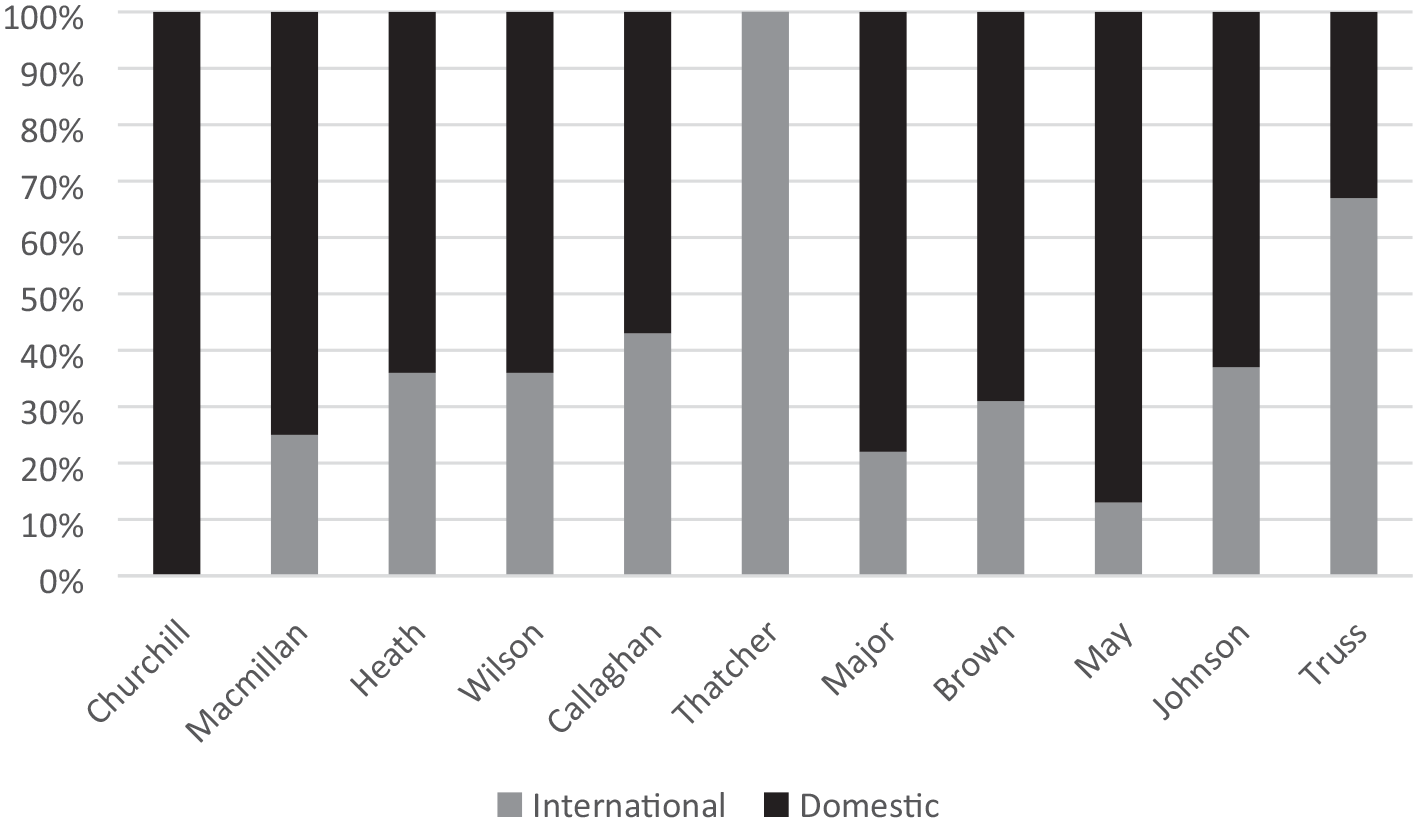
Policy focus of FPM contributions (Domestic or International).
Methodology
We focus here on the UK’s post-war Prime Ministers from Winston Churchill to Liz Truss and their activity in the House of Commons across a period of almost 70 years (1955–2023). Our sample includes 12 FPMs; all those who continued to serve as MPs for a period of time (however short) after their departure from Downing Street. It excludes three prime ministers (Attlee, Eden and Blair) who all resigned as MPs at the same time as resigning from prime ministerial office. It also excludes David Cameron who attended the Commons as a backbencher after leaving Downing Street in July 2016, but who made no oral contributions (see Cameron, 2019: 695) before stepping down as an MP in September that same year. In order to explore the backbench activity of FPMs, we begin by exploring their contributions as recorded in the official Hansard report of parliamentary proceedings. However, our own analysis seeks to be more comprehensive than the approach of Just (2004) who groups all contributions together regardless of type, by examining both the frequency and the type of contribution made. Where relevant some appearances where no speech is made are included in the frequency counts. We therefore further distinguish between full speeches and short interventions, to ensure that patterns of former prime ministerial activity are consistent, detailed and comparable. Relying solely on the frequency of contributions can be misleading, as one full speech may be listed as several different entries in Hansard. Each oral contribution listed on the TheyWorkForYou website 1 was thus hand-coded. We read the full contribution in Hansard rather than simply counting the number of entries for each prime minister.
These entries were then coded together as either a full speech or listed separately as interventions, oral questions etc. For the type of contribution we coded for first speeches, interventions, parliamentary questions (either balloted questions at departmental question time or supplementary questions at question times or following ministerial statements). We secondly coded for occasions where an FPM had taken the chair as Father of the House (e.g. Edward Heath during the elections of Betty Boothroyd and Michael Martin 2 ). As Theakston (2006: 456) notes, such positions of authority are associated with several FPMs, but incorporating these contributions in our frequency count provides a disproportionate reading of backbench parliamentary activity. By coding this separately, we are able to isolate these distinct roles from routine backbench behaviour, ensuring that our counts of backbench activity are truly comparable. We additionally coded the title of the debate, motion or question topic as well as the responding government department. Any questions or debates responded to by the Foreign Office and/or International Development (or historical equivalents) were automatically coded as foreign affairs contributions. Other contributions were coded on a case by case basis, with domestic policy being the default code unless the contribution was specifically focused on international topics, institutions or actors. Examples here would include the large number of contributions made during discussions of the UK’s membership of the European Community in the 1970s and of the UK’s withdrawal from the European Union in the 2015 and 2017 Parliaments as well as the Commons debate marking the death of Nelson Mandela in December 2013, All codes were checked by two coders to ensure reliability. This enabled us to consider whether their contributions were orientated to national or foreign affairs, as well as coding for whether the contribution referenced the constituency. A simple binary (yes/no) code was used to analyse constituency references. This included passing references to a constituency issue as well as extensive contributions or speeches given solely because of constituency concerns.
Studying the statecraft of our FPMs was more challenging given that Bulpitt (1986: 21) himself acknowledges the crude nature of key indicators such as ‘political argument’. We highlighted any explicit interventions in the House of Commons from FPMs which concerned the governing competence (positive or negative) of their own premiership as well as that of the incumbent government. In addition, we noted any demonstrations of political argument in the chamber in which FPMs were overtly supportive or critical of government policy, especially if their interventions were noted by other contributors to debates. Examples here include Theresa May’s acknowledgement that she would be supporting the findings of the Privileges Committee report into Boris Johnson in June 2023 or James Callaghan’s strong opposition to Thatcher’s foreign policy in November 1983 which drew criticism from other MPs. Although we also coded the contributions made by FPMs who served as Leader of the Opposition or in other frontbench roles, we exclude those contributions from this analysis in order to focus solely on backbench activity. In total, our 12 FPMs made a combined 558 backbench contributions to the House of Commons, between 30 November 1959 and 1 July 2023. 3 We additionally searched the remainder of each debate in which a contribution was made, recording any references to the FPM’s contribution by other members of the House. This enabled us to make qualitative assessments of their presence in the House and of the impact or importance of their contribution to the overall parliamentary debate. It also enabled us to locate occasions where two FPMs speak in the same debate. This helps to build a more rigorous and comprehensive picture of FPM contributions in the Commons.
Parliamentary activity by FPMs
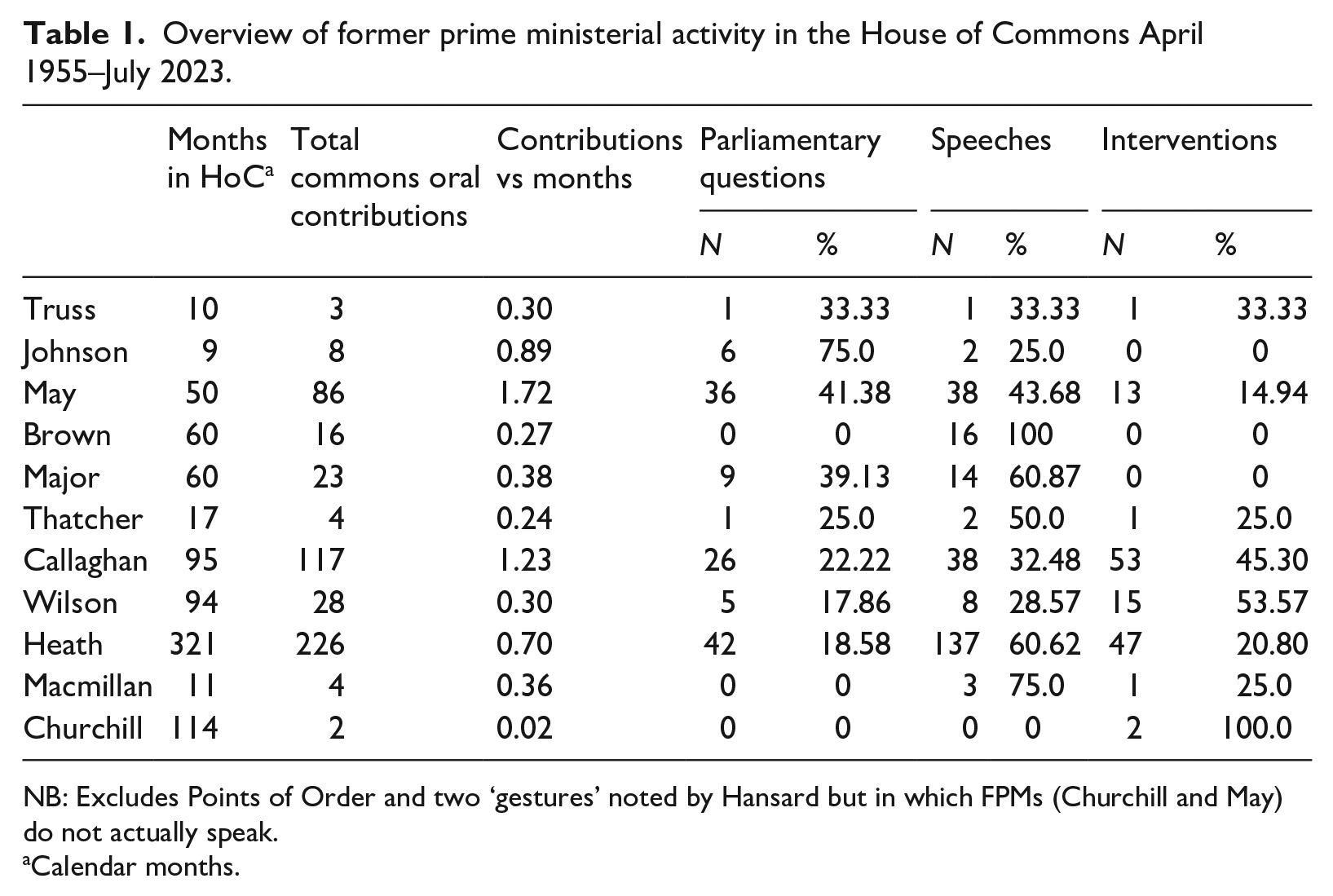
The participation profile of the FPMs in our sample shows much divergence in the overall activity of FPMs when they move to the backbenches. As Table 1 illustrates, former PMs Heath, Callaghan and May made a substantial number of backbench contributions, standing out as the most active parliamentarians among this FPM cohort. Together they account for over three quarters (77%) of all of the contributions in our sample. This is perhaps understandable given their length of service as backbenchers; Heath and Callaghan remained in the Commons for a total of 34 years. Despite his comparatively brief time as a post-prime ministerial backbencher, Boris Johnson makes a proportionally high number of contributions per backbench month, but this is somewhat by virtue of significant events, such as the death of Queen Elizabeth II. Yet long service on the backbenches post Downing Street does not necessarily equate to heavy parliamentary activity. Churchill for example, remained in the Commons for over 9 years, yet did not make a single speech as a backbencher. Across this time Hansard records only 21 words spoken by him from the green benches in the form of two interventions. 4 Despite his lack of formal participation, he is described by others as having ‘affection’ for the House of Commons and praised for remaining there ‘through so many years, through so many elections, through so many turns of Fortune’s wheel . . . and we love him for that’ (Harold Macmillan, HC Debs 28 July 1964, c1247).
Overview of former prime ministerial activity in the House of Commons April 1955–July 2023.
NB: Excludes Points of Order and two ‘gestures’ noted by Hansard but in which FPMs (Churchill and May) do not actually speak.
Calendar months.
When former prime ministers do participate in the House of Commons, they bring with them a sense of authority and privilege. This extends to all, irrespective of their activity level in the chamber. Bernard Weatherill told the House in March 1984 that ‘ex prime ministers, from whichever side of the House, have a very special position’ (HC Debates, 21 March 1984: c1063). Indeed, the Speaker regularly introduces them as a ‘former Prime Minister’ when they are called to speak (e.g. HC Debates, 30 June 2020: c156). MPs themselves usually want to hear FPMs speak too. Conservative MPs were said to have ‘surged’ into the chamber to listen to Edward Heath talk about the problems with British Leyland in 1986 (Norman Atkinson, HC Debates, 5 February 1986: c338). Their speeches are praised heavily by MPs from all sides of the House, who regularly encourage them to contribute further. John Major, for example, is praised by a Labour MP for his contribution to the 2001 budget debate, who tells the House that he hopes ‘that was not the last speech that the right hon. Member for Huntingdon (Mr. Major) will make in the Chamber’ (Jim Cunningham, HC Debates 12 March 2001: c658). Similarly, the then Liberal Democrat leader Paddy Ashdown tells a backbench Margaret Thatcher that ‘we love to hear her expressing her views in the House’ (HC Debates, 20 November 1991: c298). Colleagues recognise their expertise, experience and authority and describe them as having ‘a great deal more to offer’ on political issues (David Steel, HC Debates, 13 December 1976: c1014).
Most of the time, FPMs are given top slots right at the start of parliamentary debates as the first backbench contributors due to their status as both former leaders and privy councillors. Gordon Brown, for instance, is called to speak at the start of a debate on several occasions, including the parliamentary tributes to Nelson Mandela in December 2013. At times, this privileged position disgruntles other backbenchers. Gordon Brown’s speech at the start of the devolution referendum debate on 14 October 2014 prompted complaints from both the SNP and the Conservative Party, with one MP asking whether there was now ‘a convention that those Members of Parliament who attend this place the least often are not subject to backbench time restrictions that apply to all other backbenchers?’ (Graham Stuart, HC Debates, 14 October 2014: cc168-198). When two or more FPMs are on the backbenches, they are often called to speak consecutively. In November 1980 when Heath and Callaghan make speeches one after the other during a debate on industry and the economy, their contributions are described as of ‘enormous authority and great brilliance’ and ‘something the House has not seen for a long time’ (John Silkin, HC Debates 27 November 1980: c645). Callaghan and Heath again spoke one after the other in debates on Libya in April 1986 while Heath and Wilson speak consecutively on Rhodesia in November 1978. If FPMs are from the same party, they can often be found sitting together in the chamber. In February 2023 for instance, Liz Truss and Boris Johnson were thanked for making a ‘strong stance’ during a debate on the Ukraine-Russia conflict (Jim Shannon, HC Debates, 20 February 2023: c89) in which they sat one in front of the other on the Conservative benches.
We can also see differences in terms of the types of parliamentary contribution being made. Gordon Brown stands out here as a former PM who only contributes in full speeches. He makes no interventions and asks no parliamentary questions whatsoever in his 5 years as a backbencher. This could imply that he is an MP who wishes to maximise the privileged position he receives in Commons debates. However, over half of his Commons appearances come during adjournment debates held at the very end of the sitting day, suggesting that perhaps the reverse is true and instead, for most of his parliamentary activity, he wishes to avoid the parliamentary limelight that an oral question to a government minister would bring. It suggests that his activity and attendance in the chamber is more purposeful. Some former PMs make a far greater number of interventions in debates than others; Wilson and Callaghan in particular stand out in this respect. On a number of occasions, these FPMs make only one short intervention in a debate; one which is not followed up by a speech. This is important as it suggests that they attend the chamber for purposes other than speech making. Callaghan, for example, tells the House in January 1987 that he had ‘no intention’ of contributing and only came in ‘to listen to the intellectual stimulation which is always provided by Prime Minister’s Question Time and then to enjoy a quiet cup of tea’ (HC Debates, 27 January 1987: c235). We see this much less frequently with contemporary ex PMs for whom speech-making seems to be the primary motivation for attending the chamber.
While we find little evidence of contemporary FPMs coming to the chamber simply to listen, we see evidence of pre-planned parliamentary contributions. This is done primarily through oral parliamentary questions which are a much stronger feature of contemporary FPM backbench activity. They account for 75% of Johnson’s total contributions, 42% of May’s and 39% of Major’s. Although older prime ministers did ask oral questions, they were not such a prominent feature of an FPM’s parliamentary profile, accounting for less than one quarter of their activity (Churchill–Callaghan). This is perhaps a response to the greater time pressures on modern MPs such as the increases in constituency demands (Norton, 1994) and the rise of select committee work which can restrict their ability to sit in the chamber (Sargeant and Pannell, 2022: 7). As such, in answer to question 1, there have been distinct shifts in the parliamentary activity by FPMs, with a move away from interventions and towards oral questions. There is also something of a tendency towards attendance in the chamber only for set piece speeches and questions rather than for interventions.
Policy focus
While existing literature (Dobson and Rose, 2019) implies that foreign policy contributions may form an important element of FPMs’ focus particularly outside Parliament, we find by contrast that for the vast majority of FPMs, domestic policy is a much greater focus within the Commons. As Table 2 demonstrates, our FPMs speak for just one-third of the time (33%) on international issues. This falls to just 29% if we focus exclusively on speeches in the chamber, thereby suggesting that in answer to question two, FPMs do not tend to concentrate on foreign policy. One obvious exception here is Margaret Thatcher, whose four contributions engaged only with The Gulf and the European Community. She made no contributions from the backbenches on any domestic policy issue after leaving office. Although she had only made a handful of appearances in the chamber by July 2023, Liz Truss has also spoken twice on the Russia–Ukraine conflict. This is perhaps understandable given her involvement with the conflict during her time as Prime Minister and in the years prior to this as Foreign Secretary.
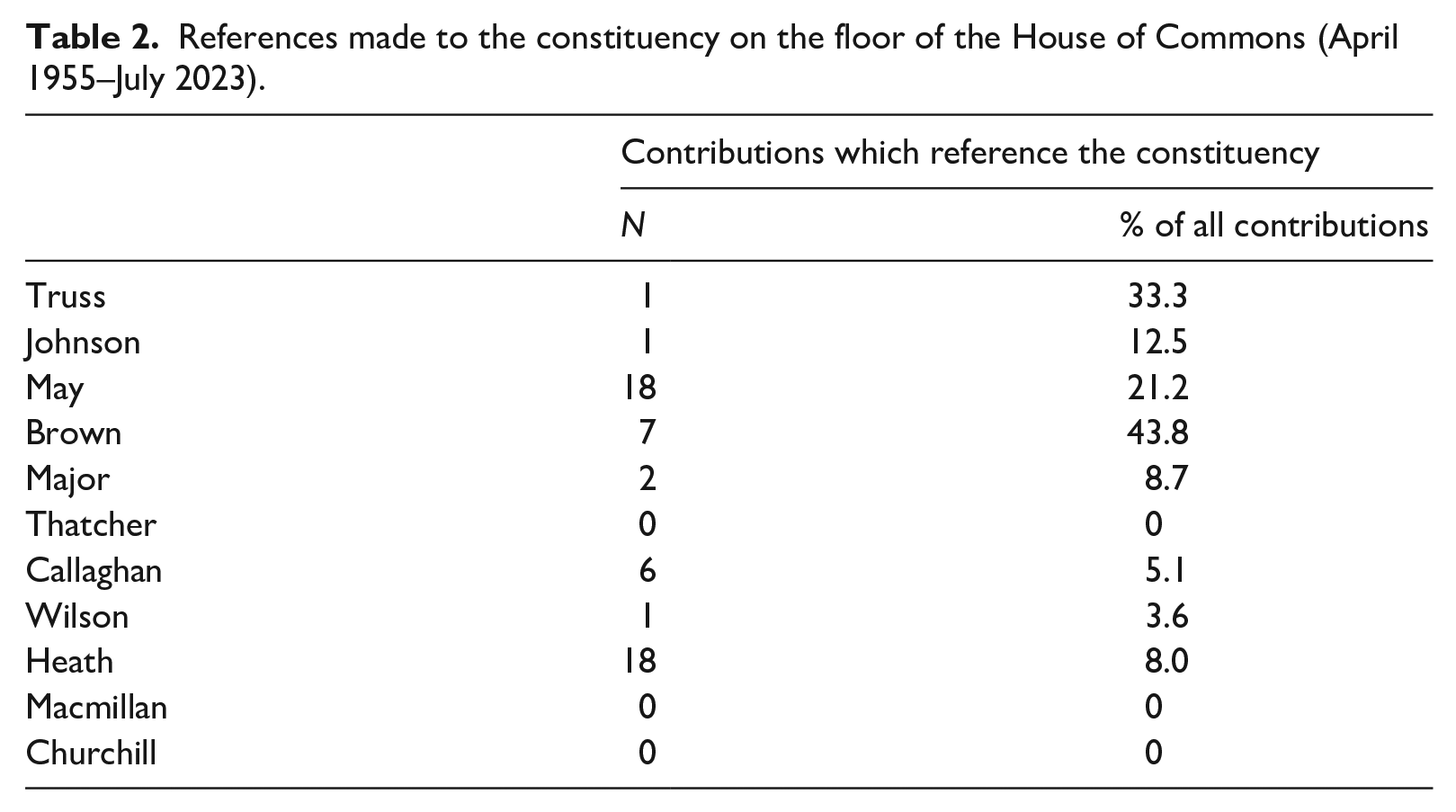
References made to the constituency on the floor of the House of Commons (April 1955–July 2023).
Although foreign affairs does not dominate the parliamentary activity of former premiers, they do typically contribute to key debates in this area, particularly when they focus on a region, country or conflict that dominated their time in government. MPs consistently remark on the importance of hearing from the experience of FPMs during these foreign affairs debates. For instance, during a debate on the European Community in June 1991, Conservative MP Richard Luce reflected on the ‘remarkable role’ played by Heath and Thatcher and the utility of their speeches that day (Richard Luce HC Debates, 26 June 1991: c1064).
More broadly, we can also see that FPMs are regularly present for other formal ceremonial, tributary and/or ‘big ticket’ parliamentary occasions. These include the deaths of key figures such as Queen Elizabeth II in which both May and Johnson spoke, recalls of Parliament such as the August 2021 recall over Afghanistan and the announcement of the divorce of the Prince and Princess of Wales in December 1992 which Edward Heath attended and described as ‘one of the saddest announcements made by any Prime Minister in modern times’ (HC Debates, 9 December 1992: c846). They are also regular contributors to budget debates (e.g. 2021, 2020, 1985, 1984, 1983) and to debates at the start of a parliamentary session following the Queen’s Speech (e.g. 2022, 2021, 1998, 1987, 1986, 1985).
FPMs and statecraft
Considering whether FPMs use the House of Commons chamber to defend their statecraft retrospectively, there is only very limited evidence, which comes from the earlier FPMs in our sample. Only two of our FPMs (Heath and Churchill) had their retirement marked in the Commons chamber. Heath makes a personal statement to the House shortly before he stands down before 2001 General Election in which he makes clear that he wants to be remembered for negotiating the UK’s entry into the European Community, describing it as his ‘proudest achievement’ (HC Debates, 9 March 2011: c116). There is no further discussion of his premiership here, despite the opportunity to cement his achievements. Instead, much of his contribution concentrates on the frontbench positions he undertook before reaching Downing Street. Churchill makes no contribution at all when MPs mark his retirement with congratulatory speeches on 28 July 1964.
Events compel two of the prime ministers in our sample (Wilson and Heath), to defend their own statecraft in the chamber on occasion. Both rise to speak in debates on the supply of oil to Rhodesia in November 1978, giving defensive speeches which other MPs describe as ‘anaemic’ (George Rodgers, HC Debates, 8 November 1978: c1017). Wilson’s speech in this debate lasted an hour, during which time he told the House that it was ‘not one but three Prime Ministers in office . . . [who] were unaware of what had been going on’ (HC Debates, 7 November 1978: c735). It is a strong defence of his own actions but also of the actions of his successors who he says he is ‘perfectly certain’ are innocent of any knowledge of these events (ibid: c735). We see a similar response during Commons debates on soviet spy Anthony Blunt in 1979 in which Heath insists that he took the actions as prime minister that he ‘felt was right’ (HC Debates, HC Debates, 21 November 1979: c466). This defensive discourse is very common in Heath’s speeches, particularly in the first few years after his premiership. We see it expressed also in a debate on the Official Secrets Bill (e.g. HC Debates, 13 February 1989: c1111). However, defending one’s own statecraft does not appear to be a feature of any 21st-century former Prime Ministers’ contributions.
Instead, we see a much stronger contribution from contemporary FPMs in the form of statecraft as an assessment of active leadership. Here, there is strong evidence of the role-played by these figures in commenting on the ‘governing competence’ of the incumbent prime minister (Bulpitt, 1986: 22), something which can in turn give rise to party management issues. There is a strong theme observed with former Conservative Prime Ministers supporting the policy of their successors in relation to Europe. Heath for example tells the House that Thatcher is ‘absolutely right’ in her negotiating position on the EU budget in 1983 (HC Debates, 1 December 1983: c1028). Both go on to vocalise their support for Major’s policy on Europe in 1991 (e.g. HC Debates, 26 June 1991: c1018; HC Debates, 4 November 1992: c339). Similarly, Theresa May stands up to support Boris Johnson’s deal with the European Union during the recall of parliament at the end of 2020 (HC Debates, 30 December 2020: c527).
We see additional camaraderie between Conservative premiers when it comes to confidence motions. Heath strongly supports Major during the March 1991 confidence debate, giving him ‘the fullest possible support’ and insisting that the Conservatives ‘will go away still strongly grasping power’ (HC Debates, 27 March 1991: c985). He offers a similarly supportive stance in July 1993, urging MPs to ‘accept the decision, vote with the Government [and] support the Prime Minister’ over the Maastricht Treaty (HC Debates, 23 July 1993: c704). This is interesting from Heath given his reputation as something of a rebel who is not beholden to the whips (e.g. HC Debates, 20 March 1989: c756; Malcolm Bruce, HC Debates, 30 October 1996: c690) and who is at times heckled by his own party colleagues for his speeches (HC debates, 28 November 1989: c613). Confidence motions put forward in the 21st century have seen no FPM contributions. While May supported Boris Johnson’s government in July 2022, she did not participate in the confidence debate itself. This contrasts however with the intra-party vote of no confidence in Johnson’s leadership where May’s appearance in a ball gown implied to some that she was getting ‘revenge’ on her successor as prime minister (e.g. Duell, 2022).
There is a broad sense of respect for the office of prime minister which runs across all of our sample, as well as the need to maintain the integrity of both the office and its occupants, enhancing perceptions of governing competence. We see this in the respect shown between premiers in conversation in the Commons. Heath for instance, tells the House that Wilson deserves the ‘fullest tributes for his achievements’ as prime minister and Labour Party leader and for the ‘skilful’ way he acted as premier (HC Debates, 16 March 1976: c1127). Similarly, May’s speech during the debate on the Privileges committee’s report on Johnson’s actions as Prime Minister emphasises the need to protect not just the office of PM, but ‘our political life, this Parliament and our democracy’ (HC Debates, 19 June 2023: c596). She underscores that it is ‘doubly important’ for Conservative party MPs to show that ‘we are prepared to act when one of our own, however senior, is found wanting’ (HC Debates, 19 June 2023: c596). Her speech in this debate is applauded by those on all sides of the House as a ‘serious and important speech’ (Harriet Harman, HC Debates, 19 June 2023: c597). Her position on the report is referred to by several of her party colleagues and used as a steer for those who may be reluctant to support it. Tobias Ellwood for instance urges colleagues to ‘follow the former Prime Minister . . . and vote to support the motion today’ (Tobias Ellwood, HC Debates 19 June 2023: c608). This latter example fits well with Just’s (2004: 73) assertion that some intervene in parliamentary debates ‘when they believe that some one is behaving, or something is being done, badly, irresponsibly or unwisely’. Our sample of FPMs brings evidence of this from both a policy and a personal perspective.
More recent FPMs in particular are very vocal in their objections to government at a policy level. Theresa May is the prime example of this, making speeches during the passage of Illegal Migration Bill (HC Debates, 28 March 2021: c886), the Northern Ireland Protocol Bill and the Northern Ireland Protocol Bill (HC Debates, 27 June 2022: c640) and on planned reductions in the international aid budget (HC Debates, 13 July 2021: c181) in which she actively opposes the planned policy. In the case of the international aid budget, she rebels for the first time in her ‘quarter of a century’ as an MP, on a three line whip (HC Debates, 13 July 2011: c2021). She gives the sense that she understands the difficult position of Johnson at this time, noting that she too ‘suffered at the hands of rebels’ while Prime Minister and knows ‘what it is like to see party colleagues’ vote against the government (HC Debates, 13 July 2021: c181). For the most part though, May’s objections to government policy on the floor of the House are not matched by anything that will physically hurt the incumbent Prime Minister. She abstains from the second and third reading votes on the Illegal Migration Bill and the Northern Ireland Protocol Bill (HC Debates, 27 June 2022: c64). This prevents any visible conflict with government, but her actions do not go unnoticed by the media who flag her abstention (Langford, 2023) and describe her as ‘the lead individual backing the backlash in the Conservative party’ (Self, 2023). She also refrains from tabling any amendments to the bill, preferring to try to ‘work with the government’ (HC Debates, 28 March 2023: c886) and ‘sit down with (them) to find a way through that does not damage the Modern Slavery Act’ (HC Debates, 28 March 2023: c886). Her approach is very cooperative. Not only does she want to work with the government, she also commends opposition suggestions such as a delay to the commencement of the bill’s modern slavery provisions until a new Independent Anti-Slavery commissioner is in place (HC Debates, 28 March 2023: c886). We see similar activity on her part in other policy areas too, such as green jobs, where she notes ‘positive meetings’ with the Secretary of State (HC Debates, 27 October 2021: c309). Such activity is not visible during the contributions of 20th-century FPMs.
While May exercises caution and rebels only rarely, Johnson and Truss are very active in their opposition to Sunak through the division lobbies and in their use of amendments from Autumn 2022. They also led Sunak’s largest rebellion during the passage of the Windsor Framework (Division 197, 22 March 2023). Neither spoke during the Commons debate on the statutory instrument, with Johnson preferring to give a statement to The Telegraph instead on the day of the division (Gutteridge and Barnes, 2023) and Truss releasing a statement from her office (McDonald and Bloom, 2023). The pair also publicly supported an amendment to Sunak’s Levelling Up and Regeneration Bill to overturn the ban on new onshore wind farms (Line, 2022).
Constituency work
Our final question referred to the constituency interest shown in Commons contributions. Overall, FPMs refer to their constituencies infrequently. Less than 10% of their parliamentary contributions make any reference at all to their individual constituencies. However, as Table 2 illustrates, we can see constituencies as a much more regular feature of FPM discourse in the 21st century. Theresa May and Gordon Brown in particular are good examples of this, referencing their constituencies in 21.2% and 43.8% of their contributions respectively.
More specifically, we can see two key changes in FPM engagement with constituency issues in the chamber. First, they promote constituency campaign successes much more prominently. Liz Truss and Boris Johnson for instance both thank the government for announcing the rebuild of the Queen Elizabeth Hospital/Hillingdon hospital in their constituencies following ministerial statements to that effect (25 May 2023, 6 December 2022). Truss includes this in her constituency newsletter where she talks about the success ‘after months of intense campaigning’ with neighbouring MPs (Truss, 2023). Second, they show a more active focus in making contributions which focus solely on constituency issues, rather than simply referencing their constituencies. Theresa May (HC Debates, 15 June 2022: c289) for instance made a plea to Prime Minister Boris Johnson to help uncover the whereabouts of British journalist Dom Philips, on behalf of his relatives in her constituency. She also introduces a 10-minute rule bill in June 2020, citing three cases of constituents who had been killed by dangerous drivers (HC Debates, 21 July 2020: c2039). Both her and Brown also secured adjournment debates to raise constituency issues. For May this was a debate on rail services in Maidenhead and Twyford (HC Debates, 5 February 2020: c139WH), while for Brown this was the issue of radiation contamination in Dalgety Bay. These constituency contributions in adjournment debates are the only contributions Brown makes across the whole of 2011–2013, suggesting that constituency concerns have compelled him to come to the House.
This heavy constituency focus contrasts with FPMs such as Edward Heath, who noted in 1986 that ‘it must be more than 35 years’ since he last made a speech ‘solely’ about the constituency (HC Debates, 16 June 1986: c783). Neither Macmillan, Churchill or Thatcher made any references to their constituencies in the House after leaving Downing Street and such contributions constitute only a very small proportion of the total contributions made by Heath, Wilson, Callaghan and Major. This is understandable for the earlier years of our sample given that constituency service was ‘limited or even non-existent’ in the 1950s (Norton and Wood, 1993: 39). Interestingly, the constituency majority seems to have little impact on FPM constituency activity, despite the patterns observed among other backbenchers suggesting that diligent constituency work can ‘amplify’ swings to their party (Cain et al., 1984; Kellermann, 2016). Both Brown and May had substantial majorities in their constituencies at the time they were particularly active on local issues (50.2 and 33.3 percentage points, respectively) and certainly the largest of any other FPMs in the Commons across our sample with the exception of Liz Truss (50.9 percentage points). As senior MPs, FPMs have no need to engage in the high levels of constituency activity normally ascribed to first term MPs seeking to increase their personal vote share (Cain et al., 1984; Norton and Wood, 1993; 126). This may simply be the continuation of the trend noted by Middleton (2019) in which retiring MPs continue to be very responsive to their constituents. However, the very visible nature of this constituency representation in the Commons, combined with the long time of service for several FPMs which extends beyond the length of the Parliament following their exit from Number Ten, suggests other reasons may be at play here. Given the nature of recent prime ministerial departures the use of these formal parliamentary channels for constituency representation could be an indication of the need to preserve or rebuild their personal votes in their constituencies, suggesting that the ‘lifecycle explanation’ of constituency activity in which constituency activity decreases with seniority (Norton and Wood, 1993; 135) is different for FPMs who may feel that they are serving their first term once again. Both Brown and May had only ever spent a small amount of time as backbench MPs, being promoted to a shadow frontbench position very quickly upon entering Parliament. Indeed, they had only four years of combined backbench experience between them.
Conclusion
The termination of political leadership is not necessarily the end of a political leader’s career; indeed many continue contributing to public life, whether from within or outside political institutions. Despite the rapidly expanding literature examining leadership from a multitude of angles, there remains a comparative lack of interest in and understanding of post-leadership careers. Where it exists, it often assumes that the routes available are limited to immediate exits from institutional life, or the regaining of high office (Blondel, 1980; Theakston, 2012). Where this article has contributed is specifically in understanding the behaviour of former British prime ministers who do not stand down and do not re-enter ministerial office, but remain as backbenchers in the Commons after their time as leader is over. The combined activity of former UK prime ministers on the backbenches, totalling 68 years post Downing Street, suggests that the career routes highlighted by Blondel and others are incomplete. Many former leaders retain their institutional role as elected representatives for some time. Even Blondel’s (1980) bell curve career route is insufficient as it assumes a former leader’s post-leadership life will be led outside parliamentary politics. It does not account for FPMs such as Heath, Callaghan or May for whom the performance of backbench activity in the Commons chamber continues at a substantive level.
Unlike most scholars studying post leadership careers, we have not sought to establish new typologies of career routes. Our aim instead is to explore the trends in the legislative activity of FPMs. It is clear that there are some continuities in this activity, primarily the dominance of their parliamentary engagement with domestic rather than foreign policy issues. There have also been some substantial shifts. First, by operationalizing a more rigorous coding framework than Just (2004), we are able to observe that backbench activity by FPMs is more diverse than before. Contemporary FPMs are far more likely to use oral questions compared to their earlier counterparts, who preferred to make interventions. Second, reflecting broader evidence that MPs are increasingly demonstrating their responsiveness to their constituents (Hanretty et al., 2017), contemporary FPMs are more likely to discuss their constituencies in their contributions, at times making the use of formal parliamentary mechanisms such as questions and adjournment debates. Finally, statecraft is an important dimension for FPMs. However, it is mostly used in support of the incumbent prime minister, thereby bolstering the government’s grasp of governing competence (Bulpitt, 1986) and, where FPMs are serving under a government of their own party, it can be seen to ease party management. Yet FPMs do speak out when policies are seen to be insufficient or unworkable, regardless of their political affiliation. The Commons chamber is not the place for ex premiers to firm up their own legacies with defences of their own statecraft, but a place from which to bestow their observations on the incumbent government’s skill in operating it. This suggests that FPMs play an important role in the democratic life of a legislature.
Future research may want to focus in more detail on how statecraft operates in post-leadership contexts. Given that this study concentrates on the House of Commons, future studies may wish to broaden the analysis of statecraft by FPMs, whether this is through analysis of FPM behaviour in the House of Lords or through non institutional activity such as high profile external speeches or media interventions. Extending the examination of parliamentary behaviour beyond FPMs to former party leaders more generally could also add analytical richness. Furthermore, considering post-leadership behaviour beyond Westminster to inclu the devolved legislatures would add a further dimension to analysis, demonstrating whether or not the behaviours identified here are specific to the Westminster political system.
