




Abstract
The theory – and practice – of establishing autonomy from the hegemony of growth is central to the imaginary of degrowth. Yet to envisage pathways towards a degrowth society, scholars need to explain how autonomy coalesces into autonomous institutions. This article addresses this institutional challenge of how to secure autonomy in the provision of collective, affordable and decommodified housing in cities. Building on the tradition of autonomist and (post-)workerist thought, it conceptualises this challenge as one of maintenance. It argues that autonomy occurs through its perpetual reproduction, which is made possible by nesting and federating practices among autonomous communities. Nesting and federating practices allow these communities to avoid becoming enclaves and co-optation by market logics. The article illustrates these arguments through reference to the struggles of de Nieuwe Meent, a recent housing commoning project in Amsterdam.
Introduction
The degrowth critique of contemporary capitalism is premised on the study (and pursuit) of autonomy (for a review, see Asara et al., 2013; Kaika et al., 2023). From a degrowth perspective, autonomy means the emancipation of society from the hegemony of the imperative of growth and its ideology of competition and productivity (Fotopoulos, 2007). The central critique that degrowth scholars advance is that, because the ideology of growth gained autonomy from society, society lost its capacity for self-institution and became heteronomous (Varvarousis, 2019). Within this critique, autonomy entails both the politics and ethics of a degrowth imaginary (Bonaiuti, 2012) because ‘it is hard to imagine any real form of autonomy and self-government without questioning the central imperative of economic growth’ (Deriu, 2015: 57). For Asara et al. (2013: 226), autonomy is the ‘germ’ of new socio-historical formations in that it presupposes the possibility of questioning existing institutions. With regard to degrowth, autonomy is the capacity to define needs and wants oneself, beyond imposed imaginaries and identities (Escobar, 2018). Degrowth understands autonomy as the pathway to material reduction because it enables the possibility of (self-)sufficiency: it breaks the dependency of society – and its individuals – on perpetual economic accumulation.
Degrowth scholarship has conceptualised the pursuit of autonomy primarily according to Cornelius Castoriadis’ work but it has not yet explained how autonomy unfolds within existing socio-economic institutions. Degrowers tend to praise self-organised and horizontal democratic practices’ capacity for producing new imaginaries and institutions (Castoriadis and Cohn-Bendit, 1981). However, whereas it is recognised that autonomy means genuine (self-)government, it is not evident which institutions it would produce or whether these will effectively pursue material reduction (D’Alisa and Kallis, 2020). While it is clear that autonomy is necessary to downscale material demands, research has not yet explained which specific institutional setups can effectively achieve this goal.
To fill this gap, this article questions the institutions that generate and maintain autonomy, focusing on the provision of housing commons. Autonomy and commoning are closely related concepts: commoning is a practice of self-regulation of intentional communities of care and solidarity which organise the provision and management of resources essential for their living. These practices pursue autonomy since they distance themselves from hierarchical state institutions and market logics that push for material and social exploitation (Linebaugh, 2009). As Euler (2019) shows, these practices do not have a built-in growth compulsion and thus can work as everyday pathways towards a degrowth society.
For this reason, commoning is a particularly challenging practice in housing provision. While being an essential resource for individual well-being, housing remains the most valuable commodity in capitalism, the global frontier of urban enclosure and one of the most environmentally impactful urban commodities (Hodkinson, 2012; Savini et al., 2022). Housing is therefore the sector where the trade-off between social and environmental goals is the most challenging (Bohnenberger, 2021). To combine these goals, it is necessary to look at how housing provision is organised and at its property structures. As many have already argued, it is through the decommodification and collectivisation of housing that particular collectives become able to prefigure a degrowth imaginary (Chatterton and Pusey, 2020; Nelson and Schneider, 2018; Savini, 2021). The provision of shared, self-sufficient, cooperative and ecological housing is profoundly connected with projects of political emancipation and democracy inscribed in intentional communities of solidarity (Jarvis, 2019). Nonetheless, despite the affinity between practices of degrowth housing and those of housing commoning, the notion of autonomy has been scarcely explored in this context. This lack makes it hard to explain whether and how housing commoning practices can produce degrowth institutions and what these institutions would look like.
Building on the reading of autonomist and operaist (often referred to as workerist) thought, particularly in Italy, I argue that the challenge for degrowth and autonomy is one of maintenance: autonomy needs institutions that allow communities to resist market co-optation. Autonomous organisations – such as the cooperative illustrated in this article – search for the conditions of their maintenance. My argument is that to achieve this goal they engage in processes of nesting and federating.
To illustrate this argument, I present a concrete case of a housing commons in Amsterdam called de Nieuwe Meent. I focus particularly on how autonomy crystallises into institutional arrangements that allow commoning collectives to remain inclusive and adaptive across time. My analysis refrains from universal prescriptions; instead, I dissect the challenges of undertaking autonomous action in the field of housing provision. After conceptualising the challenge that maintenance poses for autonomist thought in the following section, I then explain why nesting and federating are essential in the context of housing commons. Finally, I reflect on nesting and federating by looking at de Nieuwe Meent.
Autonomy and the challenge of maintenance
The liberal ideology that legitimises endless growth understands autonomy as inscribed in human nature. This individualist perspective – rooted in Kantian metaphysics, Lockean naturalism, the Hobbesian State’s contractualism and Thomson’s phenomenology – conceives autonomy as an absolute value to be protected against intervention by external parties (Christman, 2020). This view, which conflates autonomy with freedom, is politically neutral because it grasps autonomy as the precondition of social relations, not the result of social relations. As such, it also underpins the idea that regulations are legitimate only if agreed between individuals. This libertarian view of autonomy has accompanied the consolidation of the modern State and justified the dominance of private property and the enclosure of land and labour (Linebaugh, 2009).
A relational, dialectical and political understanding of autonomy cuts against this individualist approach. It grasps autonomy as a condition of social relations. Autonomy is not a given, but a condition of particular socio-historical power systems. Autonomy is (re)produced, and maintained, within power systems and emerges through processes of subjectivation (Tovar-Restrepo, 2012).
This is the ontological premise of the autonomist philosophy of practice that circulated in neo-Marxist thought during the early 1960s and 1970s, particularly in France and Italy. The intellectuals behind the journals Socialisme ou Barbarie, Quaderni Rossi and Potere Operaio (among others) presented autonomy as the central challenge of social revolution. These authors feared the co-optation of workers’ struggles by state institutions. They recognised that autonomy from capitalist relations would not come from outside capitalism but had to be achieved through a process of subjectivation from within capitalism (Gentili, 2013). These works pointed out that revolutions occur if the working class – the revolutionary subject at the time – pursues autonomy from its very identity as labour within capitalism.
This understanding of autonomy rejected the linearity of the Marxist orthodoxy of the late 1950s and early 1960s. It questioned established Marxism’s dialectical, objectivist rationalism and mechanical understanding of historical change (Negri, 1991). This critique ascribed autonomy to the political rather than the economic sphere, defining it as the possibility of politics beyond the sphere of production (Tronti, 1966). It interrupted the vicious cycle of negotiations between capital and labour, which, in the 1960s, were founding post-war labour policies. Autonomist thinkers had to deal with capital’s capacity to internalise its own contradictions through the State, institutionalising class divisions and conflict into stable State institutions such as political parties and professional trade unions. These considerations extended to the city. Indeed, autonomist urbanism criticised the limits of large-scale State housing policies and their standardised architectures of living (Aureli, 2016).
These early steps of autonomist thought give essential insights for a degrowth critique of contemporary society. They warn that the ideology of growth is always able to internalise its own critique and devitalise alternative social imaginaries. They recognise that autonomy must be generated from within existing socio-economic institutions, but at the same time it must also generate different institutions that need to be maintained, nurtured and protected.
Castoriadis’ work has been very important to address this institutional challenge. Autonomy, he contends, drives history because the imaginaries that institute society and its structures can be only produced in conditions of autonomy (Castoriadis, 1987). Autonomy enables society to understand itself and generate social norms. Castoriadis attacks the capitalist ideology of competition because it freezes history. The capitalist imaginary of competition has itself become autonomous, detached from society. As such, it has stripped society of its capacity to produce imaginaries, making it heteronomous (Castoriadis, 1987: 132). The social’s subsumption under an autonomous imaginary lays the theoretical foundations of one of the most used, yet under-defined notions in degrowth research: the decolonisation of the social imaginary (Varvarousis, 2019). In Castoriadis’ view, given that autonomy drives historical change, revolution must re-establish the autonomy of the imagination, the very possibility of questioning existing institutions and creating new, radical imaginaries and the significations of society that stem from them. Castoriadis understands autonomy as a condition to be maintained in history, not an end-state for society. As Bonaiuti (2012: 525) puts it: ‘The search for autonomy, as a path that is continually new and never arrives at a destination, is, therefore, in its deepest sense, a search for awareness’.
How, then, can the possibility of autonomy be maintained? The theoretical discourse of the Italian workerist autonomism in the 1960s and post-workerist thought in the 1970s was directly concerned with this question. This literature mobilised the notion of refusal to indicate that autonomy must be generated from within the existing system of economic relations through a rejection of capitalist logics, both state hierarchy and market competition (see Weeks, 2005). Intellectuals associated with these currents argued that autonomy can be pursued by the working class refusing to become labour. The act of refusing work, not the political and bureaucratic negotiations for workers’ compensation, represented the practice of social revolution, for it interrupted the circle of capital’s exploitation of labour (Pizzolato, 2017).
The notion of autonomy through refusal resonates (without being explicitly cited) with recent degrowth thought on the possibility of interrupting capitalism through, for example, value-free time, slowness, uncompetitive behaviour, reclaiming use-values and universal basic incomes (e.g. Feola, 2019). The value of the notion of refusal lies in its capacity to identify the process of autonomy as one that is simultaneously initiated within existing institutions and against those same institutions. While in the past the primary context of focus was the factory with its workers, today it is the operaio sociale, the multitude of groups that enables capital circulation in the post-modern economy (Negri, 2007).
The concept of commoning explains how refusal unfolds under current conditions of post-modern capitalist production. Contemporary capitalism, Hardt and Negri (2009) propose, prospers out of labour’s ability to establish social relations (i.e. the subsumption of circulation by production). In this bio-political production, language, knowledge, transactions and information are the common that is first produced and then enclosed. Under these conditions, refusal becomes an ‘exodus’, which is not the interruption of production through workers’ strikes but the escape from the institutions that corrupt the common. Yet, this is a process that is generated starting from the social relations that contemporary capitalism makes possible. As Hardt and Negri (2009: 153) argue, exodus ‘is possible only based on the common – both access to the common and the ability to make use of it’. It ‘is thus not a refusal of the productivity of biopolitical labour power but rather a refusal of the increasingly restrictive fetters placed on its productive capacities by capital’ (Hardt and Negri, 2009: 152).
Exodus – the contemporary understanding of refusal – is an act of resisting the perpetual enclosure of common resources, including data, housing, public space and information. It is not an escape, but instead the proactive creation of alternative institutions able to protect the commons against the co-optation by capital (Negri, 1996; Virno, 1996). This is a problem of maintenance because once autonomy is generated it requires the creation of new institutions to continue existing beyond market and state. The challenge is to find ‘what would be an institution and a government of the common?’ (Hardt and Negri, 2009: 273–274). This requires that degrowth scholars interested in the commons ‘think constitutionally’ (Linebaugh, 2009: 20): that is, establish the conditions that enable collective self-regulation and ‘provide the mechanism of protection (but with no guarantees) against the two primary challenges of the multitude: externally, the repression of the ruling power, and internally, the destructive conflicts among singularities within the multitude’ (Hardt and Negri, 2009: 359).
As Castoriadis suggests, these institutions must be democratically produced and perpetually disputable. They must embrace political confrontation and be tailored to the communities that build them. They must be clearly other to the state and allow for forms of direct and local democracy. Workerists’ analysis has often referred to ‘leagues’, ‘councils’ and even ‘soviets’ as ways to reappropriate ‘administration […] within a perspective of solidarity’ (Negri, 1996: 220). Yet, contemporary degrowth literature has not yet explained how the commons could be organised to remain autonomous within the existing institutional environment (for a recent exception, see Nelson and Chatterton, 2022). In what follows, I explain the two institutional processes that can enable the maintenance of autonomy.
Maintenance as reproduction through nesting and federating
State hierarchies and market competition keep autonomous organisations that pursue commoning under constant pressure because those organisations operate within existing growth-dependent socio-economic relations. Co-optation occurs, for example, when housing commons are parcelled into an individually tradable property, leading to commodification, or instead become gated communities (Starecheski, 2016). Just as capital incorporated workers’ dissent in the 1960s, today it turns commoning practices into ‘low-cost social reproduction’ processes (Caffentzis and Federici, 2014: i92). Autonomous groups that provide housing also risk longstanding internal conflicts, leading to dissolution and dissatisfaction. More often, long-term conflicts with public authorities lead to marginalisation or, in most cases, violent eviction (Lopez et al., 2014). In many instances, common housing projects mutate into enclaves for their own survival, reproducing exclusive ownership relations (Stavrides, 2016).
Autonomy is, therefore, a fragile quality in housing provision and must be maintained through everyday social work. In the understanding of autonomy presented above, autonomy becomes possible only in the process of trying to establish it. The challenge of autonomous housing is that autonomy exists only in its own reproduction. Commoning practices, then, must always reproduce to maintain their autonomy. Reproduction is not replication. Instead, it means engendering new, autonomous commoning practices that enjoy conditions of autonomy and self-regulation.
While commoning practices stem from within the existing socio-economic institutions – for example a municipal regulatory framework – they immediately operate in tension with them. They build alternative institutions that are under constant pressure from their environment. Reproduction allows commoning practices to resist this tension and to mutate their environment. De Angelis (2017) explained that autonomy is reproduced at two levels: internally (within commoning practices themselves) and externally (between commoner communities and their environment). Internally, autonomy thrives on the recursive reproduction of rules and values and the maintenance of internal coherence. Externally, it emerges through practices of protection from, and exerting influence over, the State and capital. In practice, commoners constantly devise internal forms of organisation to maintain trust, conflict resolution, information flows, participation and solidarity.
Analysing actual practices of commoning shows that these internal and external reproduction processes take the form of nesting and federating. Nesting is the capacity to establish multiple thresholds of engagement in commoning processes. It turns single commoning practices into systems of related yet different commoning practices that sustain the provision of complex essential goods. As I show later, nesting is what turns a housing estate into a multitude of resources held in common. In the case presented in this article, these include shared facilities, a garden, surrounding public space, non-residential spaces, terraces, as well as energy networks. Each of these resources is governed by micro-commons, which individuals can enter and participate in.
Empirical studies on common-pool resources have long identified nesting as the most important variable when it comes to establishing enduring commons, despite neglecting nesting processes’ political dimensions (Ostrom, 1990). Nesting is not a purely administrative solution but produces internal boundaries – what Stavrides (2016) calls threshold spaces – that are essential in enabling participation and, by becoming the subject of deliberation, enlarge and strengthen the commons.
Below I will show how nesting occurs in detail. Yet, practices of urban commoning offer many examples of nesting. For example, the internal organisation of the ex Asilo Filangieri, a cultural commoning project in Naples, is governed through two open assemblies (the assemblea di gestione and assemblea d’indirizzo), allowing newcomers to participate in different thematic tables. The Low Impact Living Affordable Community (LILAC), an ecological co-housing project in Leeds, thrives on sub-groups, which manage its gardens, finances and building maintenance. Many Italian autonomous social centres (centri sociali autogestiti) nurture their autonomy by constantly coordinating thematic laboratories, workgroups, assemblies and networked associations. Through these nested structures, they avoid the formation of hierarchies and individual power. In their need to share information, coordinate and trust each other, they maintain autonomy.
If nesting reproduces autonomy internally, federating does so externally. Con-federationalism is institutionally thick enough to allow for autonomous systems to be structurally coupled: it permits commoning to expand through new interdependencies and thus maintains autonomy without homogenisation.
A federation builds on the value of autonomy. Rejecting the secessionism and independentism of identity-led ideologies (Lluch, 2012), it reiterates the constitutional principle of non-subordinated coordination. This allows common practices to resist constant pressure from the State and markets by establishing protecting mechanisms. Federations become factories of the commons, spaces that reproduce autonomy and extend towards other fields of action. These are not pure coordination mechanisms. Rather, they build ‘institutions of expanding commoning’ that enable common practices to compare and sustain each other, share powers and enable gift-giving practices (Stavrides, 2015: 12). These institutions build upon and further consolidate commons movements’ rhizomatic nature (Varvarousis, 2020).
Confederationalism has a long history – starting from the tradition of social anarchism in the 19th century – but it still remains a challenge for contemporary commoning practices, for it demands the capacity both to link very different practices and to build institutions of shared power. Yet the success of some international experiences in cooperative housing federations testifies to the fact that federations are essential in commoning movements. Germany’s Mietshäuser Syndikat (the apartment house syndicate) is among the best-known federation of radical housing movements. Since 1992, it has protected the autonomy of numerous housing collectives in Germany and has facilitated other projects through networks of support, funding and knowledge sharing (Bernet and Balmer, 2015). It is not a network but a federation because it allows autonomous housing projects to build structural interdependencies. In the syndicate, which is itself a cooperative, each member project co-owns half of every other housing estate. The Habitat federation of cooperatives in Austria and VrijCoop foundation in the Netherlands, which I discuss later, works in the same way.
Nesting and federating are constitutive commoning processes because they enable the maintenance of autonomy. In what follows, I show how this works by looking at an emergent instance of autonomous housing.
Methodological note
This article is based on action-oriented ethnographic research conducted between November 2018 and February 2021 in an ongoing co-housing project. The analysis was inductive: it observed nesting and federating unfolding instead of assessing their long-term efficacy. It analysed these patterns as they emerged in response to the dilemmas, struggles and steps that have characterised the project’s most critical phases. Although the researcher actively contributed to initiating the project, his role was that of an advisor, analyst, supporter and co-producer.
The key research question was: how is autonomy maintained in housing cooperatives? The question was not imposed on the case; it emerged as the most relevant for the collective itself. Empirically, the researcher was tasked with documenting the process, and extrapolating points of conflict and challenges and mapping them in cooperation with project members. To do so, the researcher produced diaries documenting the meetings and analysed minutes and public documentation issued by the municipality. This allowed the production of timelines with key events in the process. These timelines were then used to carry out interviews with individual commoners and representatives of existing co-housing projects. To maintain a close alignment between analysis and action, the resultant analysis has been recursively shared within the group.
This approach had both advantages and limits. On the one hand, the hands-on position of the researcher allowed for a grasp of the everyday challenges of maintaining autonomy. This produced thick descriptions that would allow inference of the two processes of nesting and federating. On the other hand, the research method makes it hard to assess the efficacy of nesting and federating in other institutional contexts. The aim of the research was to observe nesting and federating unfolding in order to dissect the key challenges that degrowth housing cooperatives face within growth-led institutional environments. This analysis also allows a framework of comparison with similar cases of housing cooperatives elsewhere to be devised.
De Nieuwe Meent: A degrowth co-housing cooperative
The ‘de Nieuwe Meent’ (the new commons; henceforth dNM) is a housing cooperative built on the degrowth principles of low-impact living, sufficiency through sharing, conviviality and decommodified housing that seeks to create 35 affordable housing units. It has been set up in explicit contrast to the duality of Amsterdam’s housing market, in which households are torn between long-term indebtedness to access a private property and long-term waiting lists to access a social rental sector that gives tenants little voice (Aalbers et al., 2017; Bossuyt et al., 2018). As an alternative, dNM proposes a collective form of housing premised on the sharing of all resources involved in housing provision, including the time of the dwellers, to be partly dedicated to the community instead of to paid work. Sharing is understood as the way to embrace a mode of living that nurtures democracy and solidarity (De Nieuwe Meent, 2019a). Sharing is also understood as a way to reduce material consumption, through the maximisation of common space, shared appliances and dense living.
The estate lies on a plot of about 2000 m2 (including unbuilt surfaces) and its architecture is organised around ‘collective living groups’ (woongroepen). Although this setup is long established in the Netherlands, it is usually still framed by a Dutch property regime that is dominated by either individual properties or large social housing corporations. In each of dNM’s woongroepen, essential facilities such as bathrooms, the kitchen, the living room and appliances are shared, although dwellers retain a private unit. The project hosts five of these groups, each sharing one floor of 200 m2. One group is exclusively dedicated to those aged 55+. Group sizes vary between four and eight residents. The project also hosts 15 independent social housing units that are accessible to those on low incomes. One is dedicated to undocumented migrants, who stay for relatively short periods of time. The whole building is shared across these groups, which share all of the facilities situated on the ground floor, such as a dining space, library, laundry room and courtyard. The project has an ecological and public space: an internal courtyard, which is open to non-residents. At the time of writing, this shared space is intended to host community-supported agriculture and ecological education for children, particularly those attending the adjacent school. The project includes about 360 m2 of non-residential spaces, which will be dedicated to cooperatives active in education, assisting migrants and food.
In dNM’s perspective, co-housing is a caretaking and caregiving practice. All members devote time to building the estate and its community, maintaining essential services and administering the estate. The project’s financial setup reflects this ambition. dNM strives for affordability, with rents for both social housing and mid-range units at about €700 per month (from which subsidies can be deducted). 1 In 30 years, after the mortgage has been repaid, all rent will be spent on maintenance and a solidarity fund supporting new projects with similar values. Affordability is understood as the possibility of reducing paid work and the fund, at this stage, is seen as one way of compensating for the care work devoted to the project. At the time of writing, the group is also exploring the possibility of further reducing the rent to a minimum after the repayment of the mortgage.
The project responded to a public tender issued by the Municipality of Amsterdam (2018) in late 2018. The city aimed to pilot cooperative forms of self-built housing that would experiment with radically innovative modes of housing provisions beyond social and private ownership (Municipality of Amsterdam, 2020). The tender’s conditions stipulated that the project must be a cooperative with full and permanent ownership of the estate, lay on land owned by the municipality and offer at least 40% of its capacity as social housing units. In exchange, the city would grant a discount on the land lease. dNM finances two-thirds of its €6 m budget through a bank loan (from GLS, a German cooperative) and the remaining third with issue-specific subsidies for energy and material efficiency, and the issuing of bonds. 2
Although dNM is a project that was initiated in accordance with municipal regulations, its mission is to promote autonomy from market- and state-led housing. For the dNM community, autonomy is their capacity to exit the obligations of long-term debt or social rent without democracy. As a legal project, dNM complies with essential regulations on land use but at the same time it strives for full self-management. As I shall show later, it also aims to build a cooperative movement that can affect the city’s housing policy. Here, I propose to understand their seeking of autonomy as an exodus from the capitalist housing market started from within existing institutions; this is the refusal of the obligation to possess individual private property or to rent without ownership.
The development of dNM was riven with doubt and concern. Practising autonomy, the group posed itself a series of challenging questions: How can we establish co-housing without being exclusive? How can we stop a legal cooperative becoming a managerial body? How can we allocate 35 dwellings without being a landlord and without biased preliminary exclusion? How can we maintain a reflexive approach that can democratically enable adaptations to newcomers? These were the institutional challenges involved in maintaining autonomy. In what follows, I dissect the ways in which the group addressed these challenges. I try to balance the need to present a coherent account with the need to do justice to the meanders, conflicts and improvisation that mark all paths towards commoning.
Practising nesting: Workgroups, assemblies and diversity
Between October 2018 and February 2019, as the proposal for the public tender was being prepared, dNM was little more than an idea for a way of living and a building. About 10 people started discussing key values in housing, refraining from developing a detailed plan. Degrowth offered an overall framework within which principles of care, solidarity, affordability, ecology and education could be linked (De Nieuwe Meent, 2019a). At this stage, the group laid down founding principles and defined a trajectory for autonomous development to be taken up by future inhabitants. It was not a blueprint but a compass of values, defined through open meetings held at the same location each Sunday. The group grew progressively until it had about 20 members.
These were properly constitutional steps, establishing the conditions for protecting the project against the risk of managerialism or enclaving. The intention was not to become a cooperative for the happy few. The group formulated the cooperative’s first statute, which refers to consensus-building, direct and collective ownership of the estate, the estate’s inalienability, diversity and inclusive membership (De Nieuwe Meent, 2019b). To ward off co-optation, the cooperative would permanently own the building, members of the cooperative would reside in the building and their decisions – including those about future members – would be taken by consensus. Although the statute stipulated that the community should have a board (including a chair, treasurer and secretary) so as to comply with legal requirements, its power would be limited by a consensus culture among the community of participants.
After the municipality offered the option to build on the plot, the challenge was to produce a realistic business plan within two years, to enlarge the community and to enable this community to plan the estate’s architecture and devise its own internal working processes. Nesting provided a structuring dynamic for inclusively achieving these goals.
The overall group formed six workgroups, dealing with issues relating to design, law, finance, community and media. They would make autonomous decisions on specific aspects of the project but coordinate with each other. Alongside weekly workgroup meetings, a plenary assembly was held each month to allow newcomers to join the project. The workgroups, therefore, became gateways to the project: newcomers were directly involved in taking decisions on concrete matters such as mortgages, architectural facilities and membership formalisation. The community workgroup became essential to ensuring that the dNM community would be diverse and inclusive, and to promoting the initiative’s distinctive culture of sharing and solidarity. At this stage, none of these participants knew whether they would secure a house in the estate.
The workgroups feed into three formal bodies: the general assembly (meetvergadering), spokescouncil and council of the commons (meetraad) (see Figure 1). The general assembly is the space of open deliberation, to which anybody – even non-members – is welcome to provide input on all key aspects of the project, which are introduced by each workgroup in English and Dutch. The spokescouncil includes one representative from each workgroup and ensures that different decisions are taken in synergy and possible conflicts are made explicit and addressed. These conflicts focused, for example, on the tensions between living group size and the placement of common facilities or those between the possibility of lowering rents for poorer households and the overall budget. Finally, the council of the commons, the cooperative’s formal decision-making body, includes all residents of the building and makes decisions through deliberation and consensus.
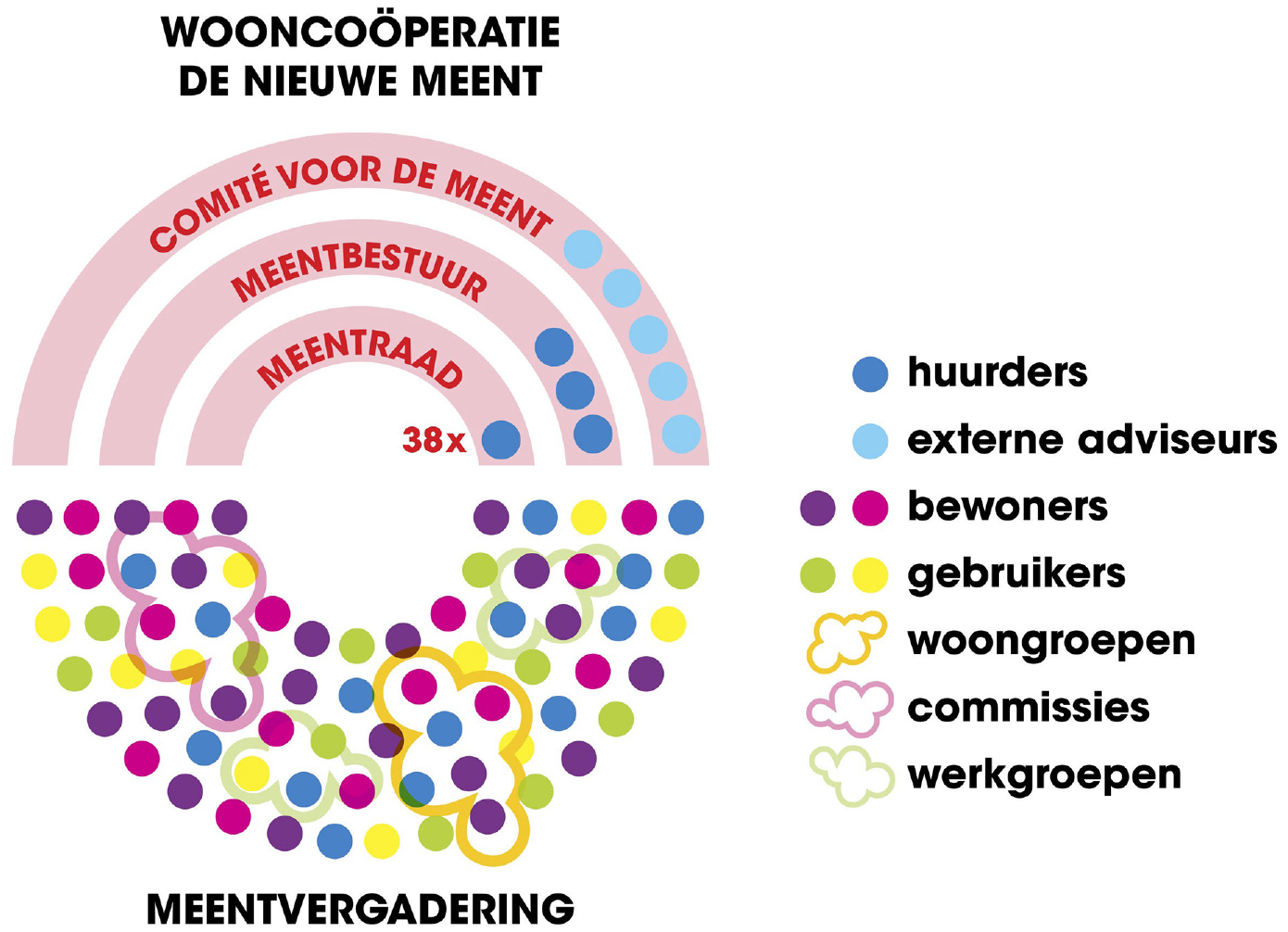
The nested institutional setup of dNM. Translation of legend (from top to bottom): renters, external advisors, dwellers, users, living groups, commissions, workgroups.
Key decisions have been taken through these workgroups and this nested organisation. One of the most challenging concerned how to allocate rights between households in a way that would increase diversity and not favour current members.
The first round of allocating dwellings began in June 2020 and involved about half of the available units. The legal workgroup proposed several procedures for discussion in the assembly, weighting options such as entrance fees, preliminary allocations of apartments and conditions to be met before admittance. The chosen approach allowed groups to apply for housing by answering open, creative questions about how they would interpret and practise the project’s core values. The group agreed to organise community-building events to welcome applicants and inform them about these values. Applications would be evaluated by an architect, an existing group member and an external activist with experience in co-housing.
This procedure enlarged and changed the group of commoners involved in dNM. It made it possible to include new perspectives in the assembly; in turn, this affected the project’s internal organisation. Conflicts emerged around the way in which the project was presented, with some perceiving it as too homogenous and oriented to expert activists. The assembly, therefore, began prioritising diversity and inclusivity, for which two new workgroups were formed. One, the ‘white privilege group’, now deals with diversity across the spectrum of race, class, sex, religion, age, sexual orientation, differently abled bodies and structural marginalisation. The assembly also instituted a ‘safe space’, a group for people of colour to introduce newcomers and discuss possible discrimination that at the moment of writing is actively used by newcomers to learn about the racial challenges of the project. A third made deals with non-residential spaces and sought out cooperatives that might become part of dNM. It focuses specifically on contacting associations that are concerned with sustainable food practices and caring for migrants. These procedures affected the new round of admissions. As the current admission procedure instructions state, at the time of writing the admission process gives priority to dNM diversity goals and approaches this from an intersectional feminist perspective. The aim is to assign 50% of units to non-white people or women.
The project is organised around different groups, and sub-groups, all nested within the collective behind the dNM cooperative. This organisation reportedly makes it possible to constantly adapt the project to its changing community. The assembly’s capacity to institute workgroups is essential for maintaining the possibility of autonomous self-regulation. Neither smooth nor consensual, this process thrives on confrontation between views, dialogue and deliberation. It generates a sense of cooperation and a common goal without levelling differences.
Federating trajectories: Synergy and advocacy
dNM is not (yet) part of a federation, for it is not a member of other collective bodies. Yet the project’s early dynamics indicate notable federative tendencies. The group has recursively confronted the following questions. How can we ensure that the project’s values remain alive in the long run? How do we avoid the possibility that future dwellers might sell and capitalise on the property? Although the nesting process illustrated above makes enlargement and inclusivity towards newcomers possible, it does not provide the necessary protection against market mechanisms or the public government’s changing agendas.
These worries stem from the history of Dutch social housing and squatters’ movements. Amsterdam has a rich history of cooperative housing provision, beginning in the early 1900s (Damsma and Wieling, 1984). In that period, housing associations were small, diverse and closely connected with renters. In the aftermath of the Second World War, though, the social housing sector was progressively institutionalised. Through mergers and enlargements, housing associations became regulated providers of social dwellings. Housing providers mutated into corporations, hybrid organisations operating as social players in the housing market (Blessing, 2012). With the consent of the associates themselves, they had been an associative form of housing provision evolved into a professionalised service. Although this process has been essential for the provision of social dwellings in the Netherlands, today its limits have come to the fore, especially about the democratic engagement of renters, who are increasingly voiceless against centralised rent increases, planned renewals or stock reductions. Autonomous housing also has clear risks. The squatting movement, which reached its peak in the early 1980s, confronted the repressive State’s neoliberal policies. Although it institutionalised important renters’ rights (e.g. regulated rents, central allocation of units), it was unable to build enduring institutions to protect its principles. Today, the squatting movement has almost disappeared in the city (Uitermark, 2004).
Although it positions itself in Amsterdam’s tradition of autonomous housing, dNM belongs to a movement that is in search of a new institutional profile. Federating processes allow creating these institutions in two ways: first, by enabling synergy and solidarity across housing collectives and allowing for the exchange of skills and know-how; second, by creating a network of different commoning practices that can pressure the existing institutional environment.
dNM was conceived in the light of the success of an existing collective in Amsterdam East: de Nieuwland, a co-housing project that emerged from the neighbourhood’s squatting movement. This collective provided both the physical space for gathering and the know-how needed to set up a cooperative, helping dNM group members to formulate the statute and define essential working rules. What is more, SOWETO, the housing association that owns the building in which de Nieuwland resides, offers dNM members the chance to learn from previous autonomous housing experiences and helps them weigh the pros and cons of different ownership models.
dNM also learned a lot from looking at how existing living groups work internally. By visiting four eco-communities – De Groene Gemeenschap, Nautilus and Bajesdorp in Amsterdam, and La Borda in Barcelona – dNM members learnt about the relationships between housing rules (how cohabitation is internally organised) and statutes (the formal rules of ownership) and how co-housing has developed alongside cooperative property rights. These projects not only shared their know-how but actively engaged with individual members working on important steps in the emergence of dNM, such as the evaluation of the first round of admissions and formalisation of the statute. A local association advocating renters’ rights named !WOON offered administrative support, and advised dNM on how to reduce rents through shared units within a feasible overall budget.
dNM’s approach to Amsterdam’s programme for cooperatives underlines the fact that maintaining autonomy demands challenging the institutional environment within which collectives operate. This process encapsulates the inherent tension of commoning: on the one hand, the existing institutional environment allows these projects to exist; on the other hand, these projects become the triggers for changing that same institutional environment. From the beginning, dNM worked to influence recent regulatory frameworks for housing cooperatives, which today are still being experimented with actually existing cooperatives. It built ties with the Vrijcoop, an emerging federation of radical housing cooperatives in Amsterdam, which adopts the Mietshäuser Syndikat’s federational principles. Born in 2015, the Vrijcoop operates as a cooperative of cooperatives that owns and develops housing collectives, which maintain their autonomy while sharing ownership. The federation is organised around core values of solidarity and decommodified living, which it has crystallised in its formal organisation.
Along with dNM and other collectives in the city, the Vrijcoop has addressed some of the shortcomings of Amsterdam’s recently approved programme for housing cooperatives (aan de slag met wooncoöperaties [working towards housing cooperatives] published in June 2020). In their response to the city’s plan, 3 it has urged the local government to push back against the professionalisation of cooperatives. To guarantee democratic engagement, it has stressed the importance of maintaining small plots for cooperatives; giving cooperatives the autonomy to decide on their lifestyles; increasing the discount offered on land leases by forbidding cooperatives to sell their estates; and establishing a solidarity fund to promote further projects.
These are just the initial actions of a rising federative movement of housing cooperatives and the results are still unfolding. Yet, the number of newly formed housing cooperatives is rapidly increasing in Amsterdam, and new plots are being issued, showing the potential of sharing knowledge and mutual support across different projects. The experience of dNM indicates that autonomy is a generative process. Housing commons shape their environment by establishing the conditions for maintaining autonomy. This produces new constitutional entities that, far more than self-help networks, exist in tension with established institutions.
Conclusions
The notion of autonomy is central to the degrowth imaginary because through institutions that are autonomous from the drive to perpetual accumulation it is possible to achieve a downscaling of material demands. In this article, I contend that the pursuit of autonomy is a generative process that permits modes of living that are freed from the goals of productivity and price maximisation that push global housing markets to become socially unjust and environmentally exploitative.
This article took housing commoning practices as a lens through which to dissect how autonomy unfolds in urban areas. Autonomous housing, I contended, becomes an exercise in prefiguring a degrowth way of life in cities because it pursues the ability of housing collectives to self-determine their living conditions beyond the pressure of private property or state rent. In so doing, it challenges the enclosure of essential urban resources and opens a pathway to downscaling material demand through sufficiency.
Autonomy becomes significant in this context because it interrupts the accumulative cycle of urban growth, which prospers out of individual property rights, real-estate development and financialisation. As the case study showed, through the making of autonomy, collectives set the conditions for (self-)sufficiency through practices of care and self-management. They put aside calculations of individual property value maximisation and start to reflect on how to reduce individual spatial requirements. The scope of this article did not allow for an assessment of the overall sustainability of the case. Yet, it shows that through cooperative practices it becomes possible to envision pathways of downscaling material demands while addressing the need for affordable housing in cities. For a degrowth of cities, it is necessary to question how housing property markets are organised instead of exclusively pursuing energy and material efficiency programmes in real-estate production.
I have conceptualised autonomy by going back to the term’s philosophical and political roots in the rich tradition of autonomist thought that emerged in the 1960s and 1970s in Italy and France. This has allowed me to identify the problem of maintaining autonomy. Autonomy is created from within existing socio-economic institutions but it requires new institutions to be maintained. Autonomy is thus not an end-state to be reached but a condition to be constantly nurtured. Building on the (post-)workerist Italian tradition, I have contended that this problem of maintenance involves a generative exodus from capitalist relations and the institutional mechanisms that offer protection against them. Exodus is not an escape but the conscious and organised creation of autonomous spaces that protect essential common resources.
This conception of autonomy poses the problem of how institutions should be re-organised. Degrowth scholarship must tackle this problem directly if it wishes to explain whether and how the many existing prefigurative degrowth practices might crystallise into new institutions. This article has described the inner struggles that attend one such prefigurative project so as to identify two key dynamics through which autonomy is maintained: nesting and federating. Nesting and federating are ways of reproducing autonomy through the production of new institutions. They allow commoning processes to multiply internally, creating nested systems of micro-commons. Yet, they also allow commoning processes to affect their external institutional environment, through federated networks of commons. By reproducing themselves in this way, housing commons can adapt to newcomers, exert influence on their institutional environment and thus maintain their capacity for self-regulation. I dissected these two processes by way of action-oriented research on the dNM co-housing project in Amsterdam.
Instead of a blueprint for autonomy, this article showed that nesting and federating are institutional processes that a housing cooperative can follow if it wishes to maintain its distance from state hierarchies and market logics. Especially when they are fully informed by degrowth principles, cooperatives exist in constant tension with their socio-economic environment. The analysis of dNM shows the value of an institutional perspective, one that questions the rules that cooperatives give themselves to deal with that constant tension. By questioning the institutions that are generated in the practices of autonomous housing, degrowth scholarship can begin to trace paths towards forms of self-governing that do not depend on growth. This article suggests that housing provision could be organised through federations of housing cooperatives instead of only state-led housing programmes or market logics. Moreover, it suggests that to work as nests of degrowth, these cooperatives need to self-regulate in a manner that guarantees inclusivity, solidarity and democracy in their everyday management.
Footnotes
Acknowledgements
A special thanks to Maria Kaika, Angelos Varvarousis, Federico Demaria and Hug March for inviting me to join the Special Issue on ‘urbanizing degrowth’. I am thankful to all activists and dwellers of de Nieuwe Meent for their cooperation and open discussions. A special thanks to Andrea Verdecchia from ‘Time to Access Architects’ for sharing his experience during the process of setting up and designing de Nieuwe Meent.
Declaration of conflicting interests
The author declared no potential conflicts of interest with respect to the research, authorship, and/or publication of this article.
Funding
The author received no financial support for the research, authorship, and/or publication of this article.
