




Abstract
Michael Jacobs and Andrew Hindmoor’s analysis of ‘Labour, left and right’ is a salutary corrective to ‘electoral-ideological’ accounts of party strategy in Britain, and rightly urges scholars to pay more attention to substantive ‘policy reasoning’. Jacobs and Hindmoor’s account of Labour policy is only partly convincing, however, because it is based on a sharp distinction between left-wing ‘structural reform’ and moderate ‘redistributive’ strategies which is difficult to justify historically, and understates the importance of social policy commitments to Labour’s positioning. This article argues that Labour’s policy trajectory since the 1980s is better understood through a fiscal lens, which reflects the importance of costings debates in UK general election campaigns and of Shadow Chancellors in opposition policy-making. Shifts in Labour’s positioning can thus be explained by looking at the interplay between the party’s economic thought, the leadership’s perception of its electoral needs, and the changing budgetary context.
‘British sociology’, Raymond Aron once declared, ‘is essentially an attempt to make intellectual sense of the political problems of the Labour Party’ (quoted in Halsey, 1985: 151). The same thing might be said of much of UK political science, especially when Labour is in opposition. Michael Jacobs and Andrew Hindmoor’s recent analysis of ‘Labour, left and right: On party positioning and policy reasoning’ (Jacobs and Hindmoor, 2022) is an important contribution to the ongoing effort to understand the electoral implications of internal debates over Labour’s policy and strategy.
Jacobs and Hindmoor frame the Labour Party’s post-war history in terms of an oscillation between ‘left-wing’ structural reform agendas (in the 1940s, the 1960s, the early 1980s, and between 2010 and 2019) and a ‘revisionist’ focus on reducing poverty and inequality through redistributive welfare spending. In seeking to explain these shifts, the authors challenge the dominance of ‘electoral-ideological’ accounts, based on Anthony Downs’ model of spatial party competition; instead, they argue that Labour’s spatial movements have largely been driven by substantive ‘policy reasoning’ about the role which the state should play in the UK economy. Inter alia, this means that ‘Labour shifts to the left in periods of perceived and real economic crisis’ and ‘succeeds electorally in such shifts when the public mood has also changed, making voters more conducive to the arguments for structural economic reform’ (Jacobs and Hindmoor, 2022: 10). Despite the crushing 2019 election defeat, the authors point out that ‘[t]he economic conditions which gave rise to the party’s leftward shift after 2010 have not gone away’, and suggest that Sir Keir Starmer and Rachel Reeves should consider retaining many of the interventionist policies developed under Jeremy Corbyn (Jacobs and Hindmoor, 2022: 14).
Jacobs and Hindmoor’s argument is a salutary corrective to the tendency for political scientists to rely on ‘mechanistic models of party positioning’ which elevate strategic incentives above policy goals and ‘ignore the ways in which policy ideas are developed and arguments are won and lost’ in the real world (Jacobs and Hindmoor, 2022: 2, 11). Their call for scholars to pay more attention to ‘substantive debates about the merits of alternative policies’ is highly persuasive, and chimes with Georg Wenzelburger and Reimut Zohlnhöfer’s (2021) recent efforts to put ‘agency back into the study of partisan politics’. The way in which Jacobs and Hindmoor theorise the ‘policy reasoning’ that has taken place within the Labour Party since the 1940s, however, is less convincing. By setting a ‘political economy-policy explanation’ of Labour’s left-right shifts against the ‘electoral-ideological explanation’ offered by Downsian scholars, the authors risk replacing one mechanistic account of policy change with another. Changing views of the UK economy have certainly been one important driver of Labour’s policy movements in the post-war period, but they have not been the only one. It is the interaction between substantive policy debates and electoral considerations that makes party policy-making so complex and so interesting.
Jacobs and Hindmoor (2022) argue that ‘theories of party positioning need to incorporate an understanding of the processes of policy reasoning through which political parties adopt and change policy’ (p. 2). This claim is surely right. In a spirit of constructive criticism, however, I want to suggest that our understanding of Labour’s positioning could be strengthened by refining the concept in a number of ways:
In principle (as I think Jacobs and Hindmoor would accept), parties can engage in policy reasoning in all policy areas. Given the importance of the welfare state in British politics, a party’s left-right position is likely to be shaped by its reasoning about social policy as well as economic policy.
Policy reasoning takes different forms in government and in opposition. When in office, ministers can draw on civil service advice, and there is a feedback loop between policy development and implementation. In opposition, policy reasoning is more purely a ‘party’ matter, and is essentially prospective – usually geared towards the next manifesto.
Since major political parties in the United Kingdom are primarily electoral organisations, the process of policy reasoning is structured by the electoral cycle. As a result, substantive policy reasoning is closely intertwined with political reasoning, as ‘lessons’ drawn from past experience and new developments shape judgements about the party’s electoral needs and the challenges of policy delivery in government. 1
Party structures and power relations determine whose reasoning matters. In the contemporary Labour Party, policy reasoning is largely an elite affair, dominated by the leader, the Shadow Cabinet, and their advisers. Nevertheless, leadership elections, the party conference, the National Policy Forum, and ‘Clause V’ manifesto meetings provide opportunities for the wider membership to influence Labour policy.
The importance of tax and spending in contemporary UK political debate, and the perception that policies are only credible if they are ‘fully costed’, means that policy reasoning in opposition parties largely takes place within a fiscal register. As the journalist Chaminda Jayanetti (2022) has recently put it, ‘Labour’s view of its policy constraints’ under Sir Keir Starmer is ‘driven primarily by “costings”’.
Several of these points are implicit in Jacobs and Hindmoor’s article. Making them explicit, however, will allow us to develop a more precise account of how policy reasoning works in practice.
This article focusses on point 5, and uses the Labour Party’s fiscal politics as a lens to explore how the economic, social, and electoral dimensions of policy reasoning fit together. Drawing on a mixture of archival research, memoirs, and interviews, it argues that Labour’s policy reasoning in opposition has been strongly framed by its perception of fiscal constraints and budgetary trade-offs, especially since the 1980s. Jacobs and Hindmoor’s account of the Labour Party’s changing attitudes to structural economic reform thus needs to be complemented by a more specific story about the leadership’s approach to tax, spending, and borrowing. The use of the public finances as a lens for understanding political change has a long history, dating back to Joseph Schumpeter’s analysis of ‘the crisis of the tax state’ (Schumpeter, 1918) and re-invigorated in recent years by exponents of ‘the new fiscal sociology’, who have argued that tax plays a central role in state formation and in structuring the relationship between the state and its citizens (Martin et al., 2009). Adopting a fiscal perspective on Labour policy-making has ‘interpretive’ value, in that it brings our account of policy reasoning closer to the way politicians and their advisers think and talk about policy development. It also has analytical benefits, because it allows us to develop a more convincing account of the ways in which debates between left and right have played out within the party. As we shall see, many of the shifts in Labour’s policy positions since 2010 have been rooted in changing views of how to handle tax and spending in opposition and of the economic and budgetary outlook which the party is likely to face when it returns to office.
The article is structured as follows. The first two sections explore how ‘costings attacks’ have shaped the Labour Party’s approach to policy-making in opposition, and the particular challenges which this creates for Shadow Chancellors. A third section draws on Manifesto Project data to examine how far the party’s post-war history can be seen as an oscillation between structural reform and redistribution, and argues that it is hard to justify a sharp dichotomy between these two approaches. The fourth and fifth sections show how a fiscal perspective on Labour strategy can help us understand the party’s positioning under Tony Blair, Gordon Brown, Ed Miliband, Jeremy Corbyn, and Sir Keir Starmer. A short conclusion reflects on the contemporary implications as the party prepares for the coming general election.
The Labour Party and the politics of costings
Doubts about the Labour Party’s ability to manage the public finances have plagued the party for much of its history. The unhappy experience of Ramsay MacDonald’s 1929 Labour government – culminating in the Cabinet’s split over unemployment benefit cuts in August 1931 – helped the Conservatives to popularise the notion that Labour politicians were intrinsically profligate (McKibbin, 1990). The 1945, 1964, and 1974 Labour governments all took office with ambitious plans for structural reform and welfare state expansion, but were beset by economic difficulties, and eventually found themselves scaling back some of their spending programmes (Bale, 1999; Hood and Himaz, 2017). Even Gordon Brown, who staked his reputation on fiscal ‘prudence’, eventually found himself castigated for allowing the budget deficit to run out of control. Memories of previous crises – sometimes accurate, sometimes burnished by ‘myths’ – can cast a long shadow over party reputations and ‘common sense’ about the economy (Clarke, 2015). It may be that, as the former Tory MP Matthew Parris put it in June 2022, ‘the first, best, most deep-seated and lasting argument for voting Conservative’ is that ‘Tories won’t wreck the national finances like those socialists will’ (Parris, 2022).
Allegations that Labour’s policy commitments would require higher taxes or higher borrowing have been a staple part of Conservative election tactics since the 1920s. Since the 1955 election, the Conservative Research Department (CRD) has repeatedly sought to ‘cost’ Labour’s spending commitments, often by drawing on analysis carried out in the Treasury and other government departments (Sloman, 2021). Warnings about tax rises and budgetary ‘black holes’ offer a powerful way for incumbent parties to focus voters’ attention on policy trade-offs and exploit well-documented psychological tendencies towards status-quo bias and risk aversion (Chong and Druckman, 2007; Kahneman, 2011). As the former CRD director Daniel Finkelstein (2023) has put it, this is ‘just basic social psychology’. Costings attacks have become particularly salient in Britain since the Thatcher era, as the public framing of economic policy has come to be strongly shaped by fiscal targets, ‘deficit discourse’ (Sinclair, 2000), and household budget analogies (Hopkin and Rosamond, 2018). The Institute for Fiscal Studies (IFS) plays a prominent role in analysing parties’ economic plans, and is treated by much of the media as an authoritative fiscal ‘umpire’ (Akam, 2016; Chadwick et al., 2020). In this discursive environment, the credibility of a party’s fiscal proposals serves as a proxy for broader economic competence. As one former special adviser pointed out in an interview, ‘Rightly or wrongly, the economy and fiscal policy from a political perspective are quite often the same thing: economic competence is “Can you balance the books?”’ (interview, 15 January 2021).
Costings attacks on opposition parties do not always work. When the governing party is flailing, they can seem desperate and trite – the worst form of campaigning-by-numbers. 2 Even when the incumbents are re-elected, the role played by campaign tactics is difficult to quantify. Yet costings attacks often feel effective, especially to those on the receiving end, and can thus shape subsequent party behaviour. 3 In the 1987 election, for instance, Labour’s tax plans unravelled during the final week of the campaign, when Neil Kinnock and Roy Hattersley were forced to admit that changes to National Insurance Contributions and the Married Man’s Allowance would reduce take-home pay for some middle earners (Sloman, 2022). ‘[T]hey got us on tax’, Hattersley told the playwright David Hare, ‘and I’m determined that should never happen again’ (Hare, 1992). The Labour leadership responded by establishing tighter control of spending commitments (Labour Party, 1987) and recruiting the former Treasury official Dan Corry to help make its policies ‘hard to cost’ (Corry, 2023), but John Smith’s careful 1992 ‘Shadow Budget’ did not prevent the Conservatives from bombarding voters with warnings about ‘Labour’s tax bombshell’. As Sam Delaney (2015: 174) has put it, the ubiquitous Saatchi & Saatchi posters claiming that ‘“You’d pay £1,250 more tax a year under Labour” . . . played fast and loose with the facts to deliver a simple, direct message that tapped into existing preconceptions’. The belief that Labour ‘lost the 1992 election . . . in large part because of tax’ (Gould, 1998: 284) thus helped to drive a further policy shift: Tony Blair and Gordon Brown’s ‘strategy of relentless reassurance’ (Gould, 1998: 259), which included promises to match Tory spending plans for 2 years and not to raise income tax rates during the next Parliament.
Money is not, of course, the only constraint that incoming governments face: legislative time, administrative capacity, and real resources are also significant considerations. However, money is probably the easiest constraint for politicians and voters to understand and quantify, and memories of previous costings attacks tend to make it particularly salient to policy-makers. Labour leaders and Shadow Chancellors have long paid close attention to the cost of their pledges (e.g. Labour Party, 1964a) and used internal ‘scorecards’ to assess the financial implications (e.g. Labour Party, 1973; Shore, 1983). This has become particularly pronounced since the 1987 and 1992 defeats: for instance, Gordon Brown (2017) ‘took a tough line with colleagues announcing unfunded spending commitments’ (p. 89) during the 1992 Parliament, and Ed Balls (2016) was determined ‘never to give George Osborne a single opening in terms of unfunded promises or overambitious forecasts’ (p. 336) between 2011 and 2015. Even in the Corbyn years, John McDonnell was ‘adamant’ that the 2017 and 2019 manifestos should be ‘fully costed’ (Cowley and Kavanagh, 2018: 184; interview with James Meadway, 26 May 2021).
Seeing like a Shadow Chancellor
The belief that manifestos need to be ‘fully costed’ means that the guardian/spender dynamic which Aaron Wildavsky (1964) identified in government budgeting also shapes policy debates in opposition. In this framework, shadow ministers act as ‘spenders’, bidding for money, while Shadow Chancellors and Chief Secretaries act as ‘guardians’, seeking to contain their colleagues’ pledges in order to ensure that the overall programme is credible. Internal debates quickly come to revolve around questions of quantity (‘how much?’) and timing (‘how soon?’).
This challenge is hardly unique to Labour, since all opposition parties face a trade-off between mobilising support through attractive ‘retail policies’ and reassuring voters about the costs and risks involved. Over the last 40 years, costings practices have become firmly established in several major democracies, including Australia, Canada, the Republic of Ireland, and the Netherlands, as well as Britain (Bolhuis, 2018; Robson and Jarvis, 2020). In the British case, Duncan Needham (2012) has shown how Sir Geoffrey Howe and his colleagues drew up the Conservatives’ plans for tax reform in the run-up to the 1979 election, and Oliver Letwin (2016: 135–140) has provided a detailed account of the fiscal choices which underpinned the 2005 Tory campaign. The SDP-Liberal Alliance (1987) published a costings document alongside its 1987 manifesto, and the Liberal Democrats have made extensive use of costings as a way of demonstrating the party’s ‘credibility’ (interview with Duncan Brack, 26 August 2020). As one interviewee pointed out, costing is almost always ‘easier for the incumbent party because the opposition has to get their costings from a variety of sources’, whereas the incumbents can draw on Treasury advice: ‘It is inherently easier to cast doubt on costings that are done as internal [party] costings, or indeed by disputed think-tank methodologies’ (interview, 26 February 2021). Opposition parties have often consulted privately with the IFS to try to mitigate this problem (interviews with current and former IFS officials, 26 February 2021 and 4 August 2022).
Despite these commonalities, managing policy costings can be particularly challenging for Labour and other left-wing parties for several reasons. First, many left-wing politicians and activists have long been suspicious of arguments based on financial necessity, which have frequently been used by Conservatives to justify austerity policies. As Arthur Greenwood (1943) put it in the House of Commons debate on the Beveridge Report, wartime experience seemed to show that ‘pounds, shillings and pence’ were just ‘meaningless symbols’: ‘real wealth’ was ‘the production of organisation, executive ability and manual labour’. The fact that key fiscal policy metrics such as the Public Sector Borrowing Requirement are socially constructed (Clift, 2023; Labarca, 2022) naturally plays into this line of argument. In the early 1990s, for instance, Margaret Beckett had to warn shadow ministers not to ‘indulge in exercises redefining the PSBR so as to be of benefit [to] their particular areas’ (Labour Party, 1992).
Second, Labour politicians have often seen increased public spending as a desirable economic stimulus measure during periods of stagnation or recession, reflecting the influence of Keynesian macroeconomics (Toye, 2007). The belief that ‘Tory cuts’ are self-defeating is an article of faith for many on the left, reinforced by memories of mass unemployment in the 1930s and the 1980s, and in some circumstances there may be a strong macroeconomic rationale for higher borrowing. However, spending commitments made early in a period in opposition can become more difficult to justify if economic conditions change. This is especially true if the Conservative government brings the economy back into a ‘boom phase’ by the time of the election, in line with the classic ‘political business cycle’, as in 1959, 1964, 1987, and 1997 (Drazen, 2000). It can also be true if the structural deficit deteriorates, or if rising interest rates push up the cost of government borrowing.
Third, Labour leaders and Shadow Chancellors have had to deal with the effects of internal structures which constrain their policy-making autonomy. Traditionally, this meant the party conference and National Executive Committee, Shadow Cabinet elections, and ‘Clause V’ meetings over the manifesto, which tended to amplify the voices of left-leaning activists, Members of Parliament (MPs), and pressure groups that sought higher public spending (Wickham-Jones, 1996). For much of the 1980s, the CRD’s dossiers of Labour spending commitments practically wrote themselves, as Labour’s Programme 1982 set out plans for up to £20 billion of benefit improvements (Robinson, 1982) and Neil Kinnock’s social security spokesman Michael Meacher became notorious for ‘lining up pledges or aspirations without any coherent idea of how they could be financed – or even whether they are approved by his colleagues’ (True, 1986). Many of the constraints on leaders’ power which existed before the 1990s have now gone, but two new ones have emerged. The first is that the introduction of direct leadership elections – originally through an electoral college and now on the basis of ‘one member, one vote’ – means that new party leaders are often bound by pledges made with party activists in mind (Niendorf, 2022). The second is that the National Policy Forum (NPF) has replaced the party conference as the hub of formal policy development, and provides an opportunity for trade unions, socialist societies, and constituency representatives to canvass support for their spending priorities (Massey, 2020: 205–218). The stronger the political and institutional position of the leader and Shadow Chancellor, the more likely they are to be able to draw up the party’s fiscal plans in a strategic way, on the basis of political judgement and/or substantive policy reasoning.
None of this is to suggest that Labour leaders are necessarily wiser than party activists, or that New Labour’s extreme caution is the best or only way for the party to handle the issue. The communicative nature of costings debates means that ‘the tone and the emotion and the clarity of thought’ are arguably as important as the policy substance (interview with former Labour adviser, 27 January 2023). If Shadow Chancellors tend towards a ‘safety first’ approach, this partly reflects their awareness of the uncertainty involved: as the economist Howard Reed has noted, ‘it’s hard to know how this stuff will play out until the election starts’ (interview, 24 March 2021). As John McDonnell showed in 2017, detailed costings could help the party get through a campaign with a very radical set of tax and borrowing plans, aided (in this case) by the Tories’ failure to launch an effective attack or to cost their own manifesto (Cowley and Kavanagh, 2018: 193). The essential point is that Labour’s policy-making in opposition has largely come to be conceptualised within a fiscal frame, in which the party’s approach to public borrowing and tax sets the parameters for the rest of the manifesto.
Structural reform and redistribution: What’s ‘left’?
The ‘political economy-policy explanation for Labour’s spatial movements’ which Jacobs and Hindmoor develop in their article is premised on the notion that the party has oscillated between ‘redistributive’ and ‘structural reform’ strategies: Labour’s policy positioning shifts as a result of changes in the external economic environment. Labour moves to the right and adopts a redistributive economic strategy (emphasising higher spending on public services and welfare) when the economy is performing reasonably well. It moves to the left and proposes a structural economic reform programme (emphasising government intervention in investment and ownership) when the economy is performing badly. (Jacobs and Hindmoor, 2022: 8)
It is certainly true that redistribution and structural economic reform offer alternative ways for a Labour government to bring about greater equality. It is also true that the Labour left has more overtly hostile to capitalism than the party’s right, more willing to grapple with questions of underlying economic power, and more firmly committed to the expansion of public ownership. What is less clear is that we should see income redistribution as a distinctively revisionist preoccupation, or that the post-war Labour Party has alternated between these two strategies.
Jacobs and Hindmoor’s article uses Labour’s election manifestos as ‘the clearest indication of its policy positioning’, and draws on salience analysis by the Manifesto Project to plot the party’s left-right movements (Jacobs and Hindmoor, 2022: 4). As Kostas Gemenis (2013) has noted, the Manifesto Project data have serious limitations, not least because the project relies on the proportion of text parties devote to different issue areas to estimate their spatial positions. The distribution of text depends partly on the salience of other issues (such as foreign affairs), and the amount of detail is not always a good guide to a policy’s significance: for example, the 1945 Labour manifesto devoted just four sentences to the National Health Service (NHS). 4 Nevertheless, it is possible to use the dataset to trace how far Labour’s emphasis on welfare spending and structural reform has changed over time. Figure 1 compares the proportion of manifesto text which the party has devoted to welfare state expansion and to structural economic reform and planning between 1945 and 2019. 5 The series for welfare state expansion is given with and without education, which has become increasingly important across the period. The series for structural economic reform and planning includes discussions of technology and infrastructure investment, which have also risen in importance relative to issues such as nationalisation.
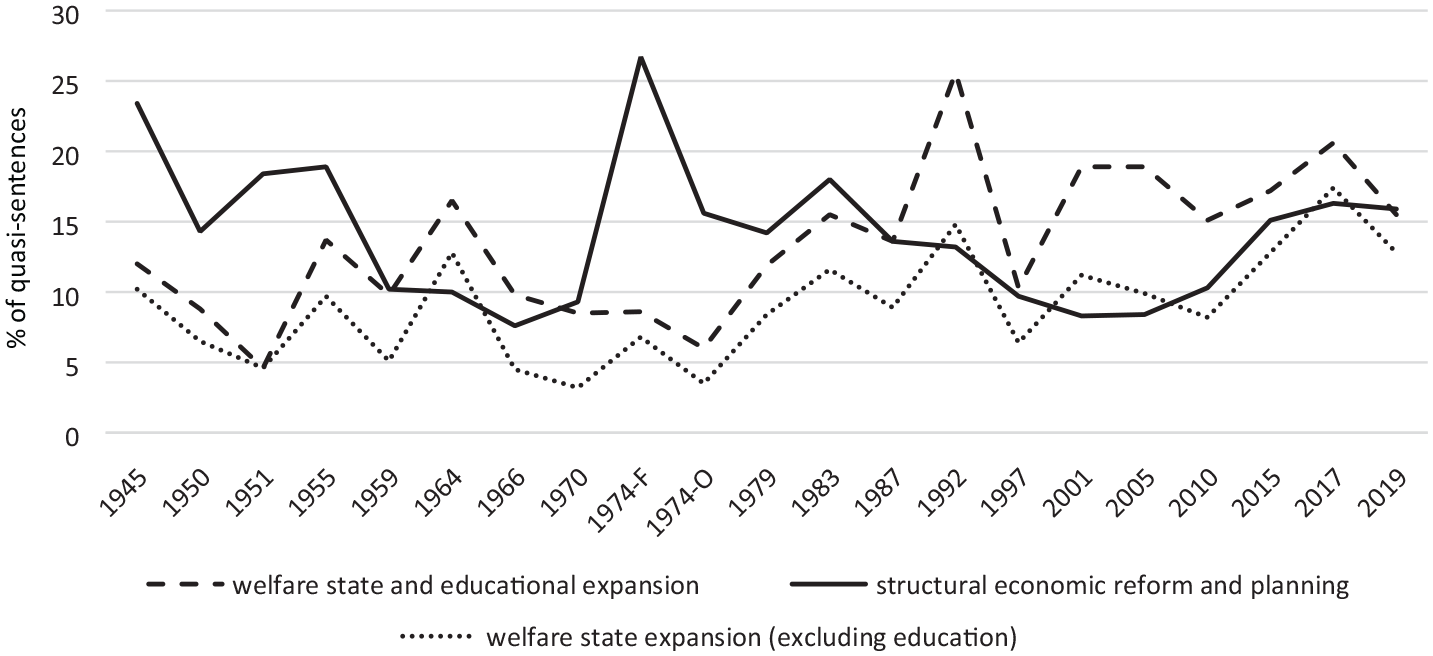
Manifesto Project coding of Labour Party manifestos, 1945–2019.
This decomposition provides some support for Jacobs and Hindmoor’s account of Labour policy shifts. It shows that structural economic reform has been especially prominent in three broad eras: 1945–1955, 1974–1983, and 2015–2019. It also supports the notion that welfare spending increased in prominence during the 1950s and again from the 1980s onwards, when it seemed that ‘Labour could redistribute the proceeds of economic growth through public spending and taxation’ (Jacobs and Hindmoor, 2022: 6). However, proposals for higher spending on welfare and education were also prominent in 1964, 1983, and 2017, which Jacobs and Hindmoor (2022) see as ‘left-of-centre platforms of structural economic reform’ (p. 10). 6 Conversely, the 1997 manifesto devoted less of its text to the welfare state than any Labour manifesto since the 1970s. New Labour may have practised redistribution in office, but it did not present itself as especially redistributive ex ante.
The fact that some manifestos set out ambitious plans for structural reform and redistribution, while others are cautious on both counts, is not particularly surprising. After all, the Labour left has frequently been defined not only by a commitment to public ownership and planning but also by an expansive vision of universal benefits and collective social provision, financed by progressive taxation, which the Labour right has not always shared. Many of the party’s bitterest internal disputes – over benefit cuts in 1931, NHS charges in 1951, child poverty in the late 1960s, and university tuition fees in the 2000s and 2010s – have revolved around social welfare issues. Indeed, as Jake Watts and Tim Bale (2019) have noted, Jeremy Corbyn’s commitment to resisting welfare cuts played a key role in differentiating him from his rivals in the 2015 leadership election. While other Labour MPs abstained, Corbyn used his opposition to the Conservative government’s Welfare Reform and Work Bill to demonstrate that he was uniquely in tune with the values of ‘Labour’s people’ (Watts and Bale, 2019: 103).
Framing fiscal redistribution as a social democratic alternative to socialist economic reform thus risks creating a misunderstanding of the way in which social welfare debates have played out in internal Labour Party politics. Labour leaders and (Shadow) Chancellors have a long history of fighting to contain welfare spending in office but then giving ground to the left when the party returns to opposition, reviving symbolic commitments to universal social provision in the interests of party unity (Bale, 1999). When the Labour left has been in the ascendant (as in 1974, 1983, and 2017), welfare universalism has been the most tangible and consensual part of its agenda. When the party has moved to the right (as in 1959 and 1992), Labour leaders have often used pensions and other spending pledges to maintain a sense of progressive idealism and provide material benefits for voters. In both cases, social welfare policies have helped to unify Labour, but at the cost of leaving the party exposed to Tory attacks over tax and spending.
New Labour’s fiscal politics in perspective
Seen through this lens, the defining feature of New Labour was not just its caution about state intervention but its incremental approach to the welfare state. For most of the 20th century, Labour’s approach to campaigning in opposition was highly ‘programmatic’, as David Thackeray and Richard Toye (2021) have noted: manifestos were built around pledges and policy initiatives and designed to provide a Labour government with a governing ‘mandate’. Between 1945 and 1987, Labour manifestos generally promised improvements in a wide range of social policy areas, including specific increases in pensions and other social benefits; the February 1974 manifesto, which pledged to raise pensions to £10 a week for a single person and £16 for a married couple, to introduce price controls, to abolish prescription charges, and to create a new child benefit, is a classic example. The way in which these spending commitments would be paid for tended to be much less clear. The party generally relied on three main arguments: that a Labour government could bring about faster economic growth; that more revenue could be raised by making the tax system fairer; and that in any case the real constraints on public-sector activity were physical rather than financial (Labour Party, 1964a). Harold Wilson drew on all three arguments in the 1964 and February 1974 campaigns, together with attacks on Tory ‘waste’ on projects such as the TSR-2 jet plane and the proposed Maplin airport (BBC, 1974; Labour Party, 1964b).
During the course of the 1960s and 1970s, however, all three of these arguments became less credible. The Wilson and Callaghan governments struggled to meet the growth targets on which their spending plans were premised, leading – as Bill Rodgers’ special adviser Roger Liddle (1986) later put it – to ‘unplanned borrowing as spending ran ahead of revenue’ and ‘an electoral backlash against public spending’. Labour Chancellors Jim Callaghan, Roy Jenkins, and Denis Healey all found themselves putting up taxes and scrapping or postponing key spending commitments, provoking criticism from both right and left. As Richard Whiting (2000) and Martin Daunton (2002) have shown, the politics of progressive taxation became increasingly complicated as rising real wages drew many of Labour’s working-class supporters into the income tax net, while efforts to extract more revenue from corporations and ‘the rich’ ran into concerns about practicality, profitability, and incentives. Public borrowing also became more difficult as the ‘embedded liberalism’ of the 1950s and 1960s was undermined by cross-border capital flows and the collapse of Bretton Woods, and as policy-makers embraced a ‘new realism’ about fiscal and monetary constraints in the context of rapid inflation and the 1976 International Monetary Fund (IMF) crisis (Buggeln et al., 2017).
Labour’s retreat from programmatic welfare pledges to a strong emphasis on fiscal discipline under Tony Blair and Gordon Brown was thus shaped by a twofold process of political learning. One strand, informed by the experience of the 1983, 1987, and 1992 elections, related to the difficulty of winning support for redistributive tax and spending proposals in opposition (Sloman, 2022); the other, rooted in a ‘neo-revisionist’ approach to political economy which had emerged on the Labour right during the 1970s, focussed on the need to ensure that the party’s policies were sustainable in government (Meredith, 2008). By ‘signaling credibility’ to the financial markets, business groups, and middle-class voters in the run-up to the 1997 election and during his first term as Chancellor, Gordon Brown created the fiscal and political space for sustained increases in public spending (Wickham-Jones, 2005). This allowed the New Labour governments to bring about significant improvements in health and education provision and reductions in child and pensioner poverty over time.
In Jacobs and Hindmoor’s (2022: 8) narrative, the 2008 financial crisis and Labour’s defeat in the 2010 election prompted a ‘shift’ from redistributive politics to ‘a structural reform position’ based on ‘systematic government intervention’. There is an element of truth in this, as Patrick Diamond (2021) has shown: Ed Miliband took up Jacob Hacker’s concept of ‘predistribution’ and stressed the limits of cash transfer policies (such as tax credits), while Jeremy Corbyn and John McDonnell developed ambitious plans for reshaping the economy through public ownership, infrastructure investment, sectoral pay bargaining, and a ‘green industrial strategy’. For Miliband, at least, the possibility of reducing inequality without the need for higher spending was part of what made ‘predistribution’ so attractive (Goes, 2016: 98–100). As Martin O’Neill (2020: 89) has pointed out, however, it is hard to draw a sharp distinction between ‘redistributive’ and ‘predistributive’ policy tools, since ‘taking seriously the state’s role in shaping markets . . . is not . . . something that can be done in isolation from thinking about the role of public services, or the role of the tax system’. It might be more convincing to see Labour policy as undergoing a rebalancing from an approach in which direct interventions played a relatively modest role (for instance, through the introduction of the national minimum wage) to one in which structural reforms were more ambitious and more prominent. 7
From Miliband to Corbyn to Starmer
The importance of tax and spending to New Labour’s political strategy is well known. However, the value of a fiscal perspective can also be seen in explaining Labour’s policy shifts since 2010. Jacobs and Hindmoor rightly note that the 2008 financial crisis undercut the growth model which had underpinned New Labour’s success, forcing the party to rethink how the state could best support economic growth, and that ‘[t]he economic conditions which gave rise to the party’s leftward shift after 2010 have not gone away’ (Jacobs and Hindmoor, 2022: 14) at the time of writing. Yet the United Kingdom’s economic malaise since 2008 does not really explain the sharp left turn which Labour took under Jeremy Corbyn after the 2015 election defeat, or the party’s return to a more cautious centre-left position under Sir Keir Starmer. An integrated model of policy reasoning which combines Labour’s economic thought with reasoning about social policy and electoral strategy in a changing fiscal context offers a more convincing account of these developments.
Labour’s approach to fiscal policy under Ed Miliband’s leadership can be seen as one of constrained radicalism, as Björn Bremer and Sean McDaniel (2020) have shown. Between 2010 and 2015, Labour opposed the Coalition’s austerity programme on both macroeconomic and social grounds, arguing that spending cuts suppressed demand and would lead to rising inequality. However, polling and focus groups suggested that the financial crisis, and the Tories’ vigorous efforts to blame Labour for the deficit, had severely damaged the party’s reputation for economic competence. As Ed Balls (2016) put it in his memoir, ‘whenever Labour talked about public investment and slower deficit reduction, the public just heard more borrowing, more risk and higher taxes’ (p. 335). As a result, the 2015 manifesto carried a ‘Budget Responsibility Lock’ which pledged that Labour would ‘cut the deficit every year’ and ‘get national debt falling and a surplus on the current budget as soon as possible in the next parliament’ (Labour Party, 2015: 9). The manifesto was built around a set of costed retail policies: for instance, a £3000 cut in student fees and a £2.5 billion funding boost for the NHS would be paid for by restricting tax relief on pension contributions, introducing a mansion tax on properties worth over £2 million, imposing a levy on tobacco firms, and clamping down on tax avoidance.
The ambiguous nature of Ed Miliband’s leadership meant that the 2015 defeat was open to multiple interpretations. Some argued that Labour had ‘lost because voters didn’t believe that it would cut the deficit’ and saw it as ‘a “soft touch” on welfare spending’ (Cruddas et al., 2016: 7, 8), but the strong performances by the Scottish National Party (which won 56 out of 59 seats in Scotland) and the Green Party (which took 3.8% of the UK-wide vote) complicated this narrative. It was at least plausible that a more confident campaign designed to mobilise voters around left-wing policies could have achieved a better result. In this context, Corbyn’s robustly anti-austerity stance struck a chord with many Labour members and registered supporters, and was central to his leadership election victory. Alongside the social consequences of austerity, which became increasingly pronounced over time, Corbyn and his colleagues were able to point to growing support for public investment and borrowing from leading economists such as Jonathan Portes and Simon Wren-Lewis (2014). 8 John McDonnell’s Fiscal Credibility Rule, which drew on Portes and Wren-Lewis’ work, reinstated the distinction between current spending and capital investment and allowed Labour to propose a National Transformation Fund, which would ‘take advantage of near-record low interest rates’ to invest £250 billion over 10 years in infrastructure and energy systems (Labour Party, 2017: 5). At the same time, Labour embraced the sense that the economy had become ‘a zero-sum game’ by making a virtue of its plans for tax rises on corporations and the richest 5% of households (Meadway, 2019). This allowed Corbyn to fight the 2017 and 2019 general elections on an expansive set of public spending pledges, including extra funding for the NHS and schools, the abolition of student fees, and the renationalisation of rail and public utilities. This classic programmatic approach, which echoed the February 1974 and 1983 manifestos, seemed to be vindicated by Labour’s gains in 2017, and the party expanded its pledges further in the 2019 manifesto, partly in an attempt to pull the focus of attention away from Brexit (Ford et al., 2020: 207, 212–214). During the 2019 campaign, however, the Conservatives launched a much more vigorous costings attack, and focus groups suggested that many voters believed Labour’s plans were not credible (Kellner and Loughran, 2019).
Under Sir Keir Starmer, Labour has retreated from these radical ambitions, especially in the realm of tax and spending. After signalling continuity with Corbyn-era policies during the 2020 leadership election – for instance, by pledging to abolish student fees, ‘[s]upport public ownership of rail, mail, energy and water’, and ‘[i]ncrease income tax for the top 5% of earners’ (Starmer, 2020) – Starmer has steadily jettisoned these commitments. A high-profile pledge to invest £28 billion a year to support the transition to Net Zero, which Rachel Reeves announced at the 2021 party conference, will now be phased in over time (Pickard, 2023), and plans for moving towards universal free childcare have also been scaled back (Stacey and Mason, 2023). The context for this shift has not been a recovery in the United Kingdom’s economic prospects, but the sharp increases in inflation and interest rates which have followed the COVID pandemic, the Russian invasion of Ukraine, and Liz Truss and Kwasi Kwarteng’s disastrous September 2022 mini-budget. The United Kingdom’s debt interest payments have jumped from £37 billion in 2019/2020 to £115 billion in 2022/2023, and the market turmoil produced by Truss and Kwarteng’s unfunded ‘Growth Plan’ has focussed attention on the risks of higher borrowing. At the same time, the Conservative government has pre-empted some of the tax rises which Labour proposed in 2017 and 2019 (most notably, by increasing corporation tax), and household budgets have been squeezed by energy bills, higher mortgage rates, and a multi-year freeze in income tax thresholds. In this context, the Labour leadership seems to have reverted to a fiscal-cum-political analysis reminiscent of the 1990s, in which the perceived political risks involved in borrowing and tax rises severely constrain the party’s ability to make spending promises.
Nevertheless, Starmer and Reeves’ plans for structural reform remain relatively ambitious, at least compared to the New Labour era. A draft policy handbook prepared for the July 2023 National Policy Forum meeting suggests that the party is still committed to ‘the biggest wave of insourcing of public services in a generation’, the creation of ‘a new home-grown, publicly-owned national champion in clean power generation’ known as GB Energy, ‘a significant expansion of economic devolution in England’, and the introduction of sectoral bargaining through Fair Pay Agreements, beginning in the adult social care sector (LabourList, 2023). The aspects of Labour’s agenda which have been scaled back are mostly those with direct financial implications. This includes public ownership, since – although nationalisation ‘is fiscally neutral by international accounting standards when bonds are exchanged for shares’ (Labour Party, 2019: 6) – it would nevertheless push up the United Kingdom’s debt/gross domestic product (GDP) ratio. The result is an economic strategy which leans more heavily on structural reform than the Blair and Brown governments did, but echoes New Labour’s fiscal and macroeconomic caution and its incremental approach to political time. Like Wilson and Blair before them, Starmer and Reeves have made economic growth central to their strategy, setting out a mission of achieving ‘the highest sustained growth in the G7 – with good jobs and productivity growth in every part of the country making everyone, not just a few, better off’ (Labour Party, 2023). Faster economic growth could significantly improve the United Kingdom’s budgetary position, as Reeves has pointed out in correspondence with the Office for Budget Responsibility (Office for Budget Responsibility, 2022). Even if Labour’s policies succeed, however, there is likely to be a time lag before the government is able to reap the benefit of higher tax revenues.
Conclusion
The politics of debt and deficits has become an enduring source of frustration for many left-wing activists and intellectuals since the 1980s. Both Margaret Thatcher and David Cameron deployed ‘deficit fetishism’ to justify austerity measures, delegitimising public borrowing and distorting public understanding of macroeconomic options (Hopkin and Rosamond, 2018). The prospect of financial markets disciplining elected governments seems to offend against democratic principle (Streeck, 2017), even if the power of ‘bond vigilantes’ has often been exaggerated (Tooze, 2020). Within the British state, the Treasury’s power and institutional conservatism have led to accusations of ‘accountancy-first governance’ (Clark, 2023) which underrates the social and economic benefits of spending on childcare and other progressive policies. After making a sustained effort to break out of this policy paradigm during the Corbyn years, many Labour activists are understandably nervous that the party seems to be reverting to an orthodox approach. Despite holding a large lead in the opinion polls, Starmer and his colleagues appear to be haunted by memories of the 1992 defeat and the governing challenges Labour faced in the 1970s.
Set against the backdrop of Labour’s history, however, Starmer and Reeves’ effort to shrink the party’s spending commitments is hardly surprising. Across the post-war era, and especially for the period since the 1980s, a model of policy reasoning in which Labour’s economic and social thought is mediated by the leadership’s interpretation of the electoral environment and the fiscal context provides a more persuasive account of policy shifts than one that focusses on economic policy alone. Despite the Labour left’s traditional insistence ‘that social democracy is not enough’ (Jackson, 2017: 344), its electoral strategy has come to be defined by the attempt to mobilise voters around ambitious public spending plans: this approach uses the manifesto as a means of aggregation and coalition-building, and is easiest to justify in periods of recession and/or low interest rates. Conversely, Blair and Starmer’s more cautious political strategy takes the government’s fiscal baseline as its starting point, uses costings as a means of prioritisation and reassurance, and is justified by reference to past election defeats and perceived fiscal necessity. Both are compatible, in principle, with a radical approach to structural reform, though nationalisation and public investment are easier to accommodate within an expansive fiscal framework. As Jacobs and Hindmoor suggest, a focus on structural reform is likely to be particularly attractive when the United Kingdom’s economic performance is weak. If a Labour government can manage to deliver faster growth, it can break out of zero-sum fiscal constraints and raise spending without the need for politically contentious tax rises.
Fiscal rules are inescapably performative and communicative (Clift, 2023): the political goal is to look and sound tough while maintaining some freedom of action. Reeves’ (2022) pledge to maintain ‘iron-clad discipline’ in borrowing only to invest and reducing the debt/GDP ratio should be seen in that light. As Chris Wallace has argued in an Australian context, it makes sense for opposition parties to be ‘smart’ about policy, setting out an agenda ‘that can be simply explained, easily understood and which – as far as possible – avoids creating losers’ (Wallace, 2020: 32). If economic growth returns as the world economy recovers from the shocks of the early 2020s, then new possibilities will open up for Labour in office. The risk is that self-denying pledges create a form of budgetary lock-in which significantly constrains the next Labour government’s ability to tackle poverty, decarbonise the economy, and address funding gaps in the NHS and other public services. Although the rationale for Reeves’ caution on borrowing is clear enough, the retreat from Corbyn-era plans to raise taxes on the better off is a more straightforwardly political judgement. If growth does not return and fiscal pressures mount, then Starmer and Reeves may rue the decision not to use the 2024 or 2025 campaign to seek a mandate for a more radical programme.
Footnotes
Acknowledgements
The author is grateful to Colm Murphy and the Journal’s editors and reviewers for valuable comments on earlier versions of this article.
Funding
The author(s) disclosed receipt of the following financial support for the research, authorship, and/or publication of this article: This article draws on research supported by the Keynes Fund for Applied Economics at the University of Cambridge.
