



Abstract
International organisations have become increasingly contested resulting in worries about their decline and termination. While international organisation termination is indeed a regular event in international relations, this article shows that other institutions carry the legacy of terminated international organisations. We develop the novel concept of international organisation afterlife and suggest indicators to systematically assess it. Our analysis of 26 major terminated international organisations reveals legal-institutional and asset continuity in 21 cases. To further illustrate this point, the article zooms in on the afterlife of the International Institute of Agriculture in the Food and Agriculture Organization, the International Refugee Organization in the United Nations High Commissioner for Refugees, and the Western European Union in the European Union. In these three cases, international organisation afterlife inspired and structured the design of their successor institutions. While specific international organisations might be terminated, international cooperation therefore often lives on in other institutions.
Introduction
International organisations (IOs), which constitute the bedrock of the liberal international order, have become increasingly contested during the last 10 years. Various IOs are now politicised in domestic debates, powerful states have withdrawn from key IOs, and rising powers have established challenger institutions. The increasing contestation of IOs is widely assumed to have consequences for IOs – and the multilateral order – with scholars pointing at potential pathways to decline and failure due to contestation. Whether it is Mearsheimer (2019) who notes that IOs and other international institutions are ‘bound to fail’, Zürn (2018) who outlines pathways from IO contestation to ‘decline’, or Lake et al. (2021: 244) who point at the World Trade Organization (WTO) as the global institution ‘most in jeopardy’, the general understanding is that the current crisis of IOs will leave its mark.
The increasing contestation of IOs has given rise to studies on IO termination to understand better the conditions under which we might expect global governance to fail (e.g. Cottrell, 2016; Debre and Dijkstra, 2021; Eilstrup-Sangiovanni, 2020, 2021; Gray, 2018; Pevehouse et al., 2020; but see already Shanks et al., 1996). Researchers find that ‘overall mortality is high among IGOs [Intergovernmental Organisations]’ (Eilstrup-Sangiovanni, 2020: 339), even observe trends of an ‘increased number of IGO deaths’ (Pevehouse et al., 2020: 495), and report a ‘growing defunct’ of ‘a large number of IGOs’ (Eilstrup-Sangiovanni, 2021: 306) or ‘zombie’ IOs among the current IO population (Gray, 2018). According to the often-used Correlates of War Intergovernmental Organizations (COW-IGO) dataset, 200 of the 534 IOs created since 1815 have been terminated. If IOs are dissolved in large numbers, and increasingly so due to higher levels of contestation, the prospects for international cooperation are potentially bleak.
While IO termination constitutes an important event in international relations (IR), we do not know much about what happens to IOs once they are terminated. Does cooperation really break down after IO termination, or can states pick up the pieces and continue cooperation under a different institutional label? Did the termination of 200 IOs over the last two centuries result in large global governance gaps, or has their work been consolidated by other institutions? Or did states only terminate unnecessary institutions that had outlived their intended purpose? Only by better understanding exactly what happens to terminated IOs – to the functions they fulfil and the assets they possess – we can make broader statements about the significance of the crisis of IOs and the prospects of international cooperation.
This is the first article to systematically conceptualise, map, and discuss the ‘afterlife’ of terminated IOs. Drawing on insights from legal and historical scholarship, it starts from the assumption that in many cases IO afterlife is not clear cut. Yet even in the absence of a neat formal transfer of mandate and assets from terminated IOs to successor institutions, there may be continuity of governance. The functions of IOs may simply be taken over by other institutions stepping in without formal succession; the archives, libraries, personnel, institutions, ideas, practices, and ‘souls’ of terminated IOs may equally find a place elsewhere in global governance (e.g. Clavin, 2013; Pedersen, 2007; Wessel, 2011). This particularly applies to major institutions which authoritatively coordinated cooperation between a large number of members in their days. Their termination is likely to leave gaps in global governance that had to be filled, in one way or another, by successor institutions.
To fully capture the continuation of IOs after their termination and the full spectrum of IO afterlife, this article therefore introduces a new conceptualisation of IO afterlife. We argue that IO afterlife can be best considered on a two-dimensional scale: legal-institutional continuity and asset continuity from IOs to other international institutions. Drawing on original data about 26 major terminated IOs, the article finds that no less than 21 IOs developed an afterlife. In 9 out of the 21 cases, IOs were fully replaced by other institutions. In 12 out of 21 cases, parts of the functions and assets were taken over by other institutions, yet various bits and pieces were also left behind. In other words, there is considerable continuity after IO termination and a full breakdown of cooperation is rare: Only in 5 out of 26 cases, we saw an entire dismantlement of the IO.
To illustrate these findings, the article zooms in on the International Institute of Agriculture (IIA), the International Refugee Organization (IRO), and the Western European Union (WEU). These IOs were legally dissolved without formal succession, yet there was nevertheless continuity of governance in their three respective areas (agriculture, refugees, and security) by other institutions: the Food and Agricultural Organization (FAO), United Nations High Commissioner for Refugees (UNHCR), and European Union (EU). The headquarters of the FAO also became eventually based in Rome (like the IIA), the UNHCR soon adopted operational tasks (like the IRO), and the EU took over two agencies from the WEU and modelled its security institutions on the WEU template. Our analyses of these case illustrations therefore confirm that there is considerable continuity after IO termination that goes beyond what IR scholarship currently grasps.
The large majority of IOs therefore develop some form of afterlife after they have been terminated. This new insight into IO afterlife is important for two reasons. First, it requires us to reconsider what we know about the lifecycle of IOs and international cooperation more generally. These findings qualify some of the more alarming accounts on the crisis of IOs and multilateralism (e.g. Lake et al., 2021; Mearsheimer, 2019; Zürn, 2018). While IO termination potentially leaves gaps in global governance and is often considered as the breakdown of cooperation, this article shows that, in most cases, those governance gaps are quickly filled by other institutions. It underlines that, while IOs may fail to effectively supply cooperation, the demand for cooperation often remains strong and requires states to address governance gaps (Dijkstra and Debre, 2022; Klabbers, 2009 [2002]: 327). The article thus adds further evidence about the resilience of international cooperation. Second, even if major IOs are terminated, their heritage substantially shapes future cooperation trajectories. In all three examples studied in this article, functions and assets were not just picked up by other institutions, but these terminated IOs also inspired and structured the design of their successors resulting in a significant degree of path dependence (cf. Fioretos, 2011; Hanrieder, 2014; Rixen et al., 2016). The founders of successor institutions internalised their experiences with the preceding IOs and tried to ‘problem solve’ their way through the oftentimes messy and complex dissolution of IOs (cf. Jupille et al., 2013).
This article first reviews the IR literature on IO afterlife and its limitations. Drawing on insights from legal and historical scholarship, it then introduces a new conceptualisation, distinguishing between formal-institutional continuity and asset continuity. It uncovers the afterlives of 26 major IOs, noting that in 21 cases there was some form of afterlife. By zooming in on three cases of IOs that were neither fully replaced nor dismantled, we show how afterlife matters by inspiring and structuring succeeding institutions. Specifically, we study the IIA’s afterlife in FAO, the IRO’s afterlife in the UNHCR, and the WEU’s afterlife in the EU. The article concludes by summarising its contributions and its implications for future research for the fate of IOs.
A new conceptualisation of IO afterlife
Life beyond the data grid
The life and death of international institutions is a core theme across most IR theories. Yet, IR theories rarely spell out – let alone empirically test – how IOs are terminated (see Eilstrup-Sangiovanni, 2021 for a review). Instead, much of the insights come from compiling and working with key datasets (Pevehouse et al., 2004, 2020; Shanks et al., 1996). Shanks et al. (1996: 593–594), for instance, were surprised to find that the total number of IOs in the Yearbook of International Organizations did not massively increase between 1981 and 1992 even though they knew that many new IOs were created during this period. They deduced that many IOs had also been terminated and empirically studied these data. Pevehouse et al. (2004: 109–110) in compiling the COW-IGO v2.0 dataset found that a third of IOs created since 1815 no longer existed, thereby further underlining the points made previously by Shanks et al. (1996). Various recent publications refine these earlier works and map and explain IO termination based on historical records (e.g. Cottrell, 2016; Debre and Dijkstra, 2021; Dijkstra and Debre, 2022; Eilstrup-Sangiovanni, 2020, 2021; Gray, 2018).
Much of our knowledge about IO termination today is thus structured by major datasets. IOs enter these datasets (when they are established) and at a different point leave these datasets (when they have been terminated). In COW-IGO, for instance, an IO is coded as ‘dead’, if membership drops under three states, no plenary meeting has been reported in the last 10 years, or it no longer has a functioning secretariat (Pevehouse et al., 2020). Termination is therefore defined based on dataset inclusion criteria. 1
To account for the fact that IOs do often not simply cease to exit after their termination, scholars have also tried to approximate IO afterlife. Scholars usually employ a formal-legal definition and identify the afterlife of a terminated IO by assessing whether another IO explicitly refers to it in its constitutional documents (Wessel, 2011). Following this formal-legal approach, the COW-IGO dataset provides information on whether terminated IOs have been ‘replaced’ or ‘integrated’ by other IOs. The Death of Intergovernmental Organizations (DIGO) dataset (Eilstrup-Sangiovanni, 2020) offers no less than five categories of how IOs come to an end: expiry, dissolution, succession, merger/absorption, and desuetude. The categories of succession and merger/absorption mirror the two afterlife categories in COW-IGO. Debre and Dijkstra (2021) similarly distinguish between ‘death’, ‘replacement’, and ‘integration’ and account for these distinct types of termination in their analysis. The existing datasets thus use a formal-legal definition of replacement and integration.
The COW-IGO dataset deals with IOs in general, and these coding decisions are reasonable. However, this is too limiting when specifically focusing on the phenomenon of IO afterlife or trying to understand the role of IOs in IR more generally. In effect, these datasets provide a dichotomous view on IO afterlife (afterlife or no afterlife). Despite including different categories on how IOs are terminated in these datasets, IOs are either ‘dead’ or legally replaced/integrated/merged. The argument of this article is, however, that the empirical reality is more diverse and multifaceted: IOs can, for instance, be partially replaced. IO termination tends to be a messy process, and it is not always straightforward, let alone in the interest of the member states, to negotiate a replacement treaty. Furthermore, member states may only want to take over those parts of the IO that they still consider valuable. The formal-legal threshold is therefore a too strict benchmark to assess IO afterlife. If we account for this, we find much more IO afterlife and continuity.
The multifaceted nature of IO afterlife becomes clear when comparing how datasets code IO afterlife across cases. While these datasets use very similar concepts and employ a formal-legal definition to code IO afterlife and death, a comparison reveals striking divergence in their results. Their coding of afterlife diverges on one-fifth of terminated IOs. 2 Three examples illustrate how thin definitions of formal-legal succession as an indicator for IO afterlife lead to trouble. First, consider the case of the International Office of Public Hygiene (IOPH), for which these datasets provided different values (dead in COW-IGO, replaced in DIGO). Contrary to the definition of formal-legal replacement, the Constitution of the World Health Organization (1946) does not refer to the IOPH. Yet the International Health Conference, which adopted the WHO Constitution on 22 July 1946, adopted on the very same day an IOPH Protocol stating that the duties and functions of the IOPH will now be performed by the WHO (Article 1 as cited in World Health Organization, 1948: 113). The intention of the International Health Conference is therefore clear, which is likely why the IOPH is coded as replaced in DIGO. Yet since the WHO Constitution does not refer to the IOPH, this case falls short of the formal-legal standard, which is likely why IOPH is coded as dead in COW-IGO.
While this coding discrepancy for the individual case of the IOPH can be explained, it becomes more difficult when considering the League of Nations, for which both datasets provide the opposite coding (replaced in COW-IGO, dead in DIGO). Yet the case of the League is comparable. The United Nations (UN) Charter (UN, 1945) does not also refer to the League, but the Resolution for the dissolution of the League (1946) clearly refers to the UN and the remaining assets were transferred to the UN (Resolution for the Dissolution of the League of Nations, 1947). The Palais de Nations in Geneva even became the second UN headquarters. As a third example, it is worth considering the case of the IIA, in which both datasets code as replaced by the FAO. Yet if anything, the replacement of the IIA by the FAO was much less direct than the cases of the IOPH and the League. Again, the Constitution of the FAO (1945) does not refer to the IIA. The IIA Dissolution Protocol does note that ‘Considering it desirable that the Institute . . . be dissolved and that the functions and assets thereof be transferred to the Food and Agriculture Organization of the United Nations’ (International Institute of Agriculture, 1946: preamble). This legal situation seems comparable to the previous two examples. Yet when considering the empirical detail (see below), there is a key difference: The IIA in Rome effectively stopped operating in 1939, while the FAO was set up in the United States in 1943, and after the war, the IIA simply acknowledged the new reality. The FAO headquarters only moved to Rome in 1951. It is thus remarkable that the IIA is coded as replaced in both datasets, but the IOPH and League are not.
What these three examples show is that formal-legal replacement is a very strict benchmark to judge IO afterlife. This conceptualisation also invites for diverging coding decisions that try to accommodate the heterogeneous empirical reality to the dichotomous concept. Clearly, there is continuity between institutions beyond a complete legal transfer. To better understand IO afterlife and how cooperation may continue after IO termination, we therefore need to move beyond the existing binary coding schemes and their narrow, legalistic definitions. There is life beyond the data grid, which we need to uncover.
A two-dimensional concept of IO afterlife
To better understand IO afterlife, this article introduces a two-dimensional concept that considers legal-institutional continuity and asset continuity. This concept is informed by legal and historical scholarship on IO afterlife and a reconsideration of what IO termination entails. Our concept of IO afterlife goes beyond the narrow, legalistic notion of whether terminated IOs had an afterlife or not. While providing a more nuanced picture of IO afterlife, our framework allows for systematic data collection and case comparisons beyond the idiosyncrasies of individual cases that dominate historical and legal scholarship.
The problems with the existing IR datasets do not come as a surprise to legal scholars and historians, who have also considered questions of IO afterlife. For instance, legal scholars explicitly caution against a formal-legal notion of IO afterlife. They note that the very rationale for IO replacement often prevents formal-legal succession (e.g. Klabbers, 2009 [2002]: 327; Wessel, 2011: 348). IOs may, for instance, want to extend their membership, which may entail institutional changes. Changes in membership, however, involve questions about assets and liabilities. It may thus be easier for member states to simply create a new IO that is not legally linked to the predecessor. Similarly, replacement may occur because member states may want to restart cooperation with a new ambition. In such cases, they may not want to be reminded of the previously gridlocked institution. As such, explicit provisions in the constitutive documents of the new IOs are often notably absent (Klabbers, 2009 [2002]: 327; Wessel, 2011: 348). Wessel (2011: 348) therefore, instead, makes the case for also studying informal succession and even talks about the ‘soul’ of IOs that survives. Continuity is not just what is written explicitly in foundational treaties, but also about intent.
Historians make similar points about the continuity of IOs short of formal-legal replacement. The League and the League system, in this respect, provide important inspiration (Clavin, 2013; Pedersen, 2007). Even if the UN did not formally succeed the League, there surely has been a lot of continuity in terms of personnel, institutions, ideas, and practices. Indeed, much of the most recent historical scholarship on the League studies how states in the interbellum experimented with entirely new administrative models for world governance (e.g. Gram-Skjoldager and Ikonomou, 2019a, 2019b). Clavin (2013) has convincingly shown how many League officials fled Geneva to set up shop in Princeton, Montreal, London, and Washington and became involved in the design of the new postwar institutions (cf. Fosse and Fox, 2016: 191–193; Kott, 2014; Walters, 1952: 809). For historians, it is therefore critical to consider how League officials and their ideas ‘survived’ and shaped succeeding institutions. This focus of historians beyond legal texts, with a stronger emphasis on people and ideas, provides equally a deeper perspective on continuity.
A useful way to think about the termination of IOs is to distinguish between a decreasing demand for cooperation and an insufficient supply of cooperation (Dijkstra and Debre, 2022; Klabbers, 2009 [2002]). IOs may be terminated because the underlying cooperation problem has disappeared (demand-side). However, in many cases, IOs are terminated because of supply-side problems. Member states may feel that an organisation fails to address their demands or is no longer fit for purpose in a changing environment (supply-side problems). To address supply-side problems, member states can reform existing institutions (e.g. Barnett and Coleman, 2005; Jupille et al., 2013; Lipscy, 2017), but this may not suffice when there is a need for instance for a new treaty or a wish to restart cooperation under a new heading. Yet as legal scholars emphasise, negotiating a replacement treaty may be fraught with difficulties such as changes in the membership. It may be easier to start from a clean slate and terminate an existing IO, even if the experiences with terminated IOs loom in the background. This also allows states to emulate or cherry-pick the successful bits of the terminated IO while leaving other assets behind. In other words, there are good reasons to replace IOs rather than trying to reform them, and there are also good reasons to do so only informally and partially. When faced with terminated IOs and the messy processes that it might entail, under a condition of bounded rationality, states are likely to ‘problem solve’ their way through resulting in considerable path dependencies (cf. Fioretos, 2011; Hanrieder, 2014; Jupille et al., 2013; Rixen et al., 2016).
To capture the full extent of IO afterlife, this article proposes a two-dimensional concept. The first dimension of IO afterlife is legal-institutional continuity. Beyond the high threshold of formal-legal succession, legal scholars also consider member states’ intent: Whether a similar group of member states wants to govern a certain set of cross-border problems through international institutions. Continuity in governance and how continued cooperation gets legalised and institutionalised is thus at least as important as the formal-legal linkages between preceding and succeeding institutions. In addition, we do not narrowly focus on legal provisions, but we are also interested in whether mandates and institutional structures are replicated in succeeding institutions. We therefore widen the formal-legal concept to also include continuity of functions and institutions besides legal continuity.
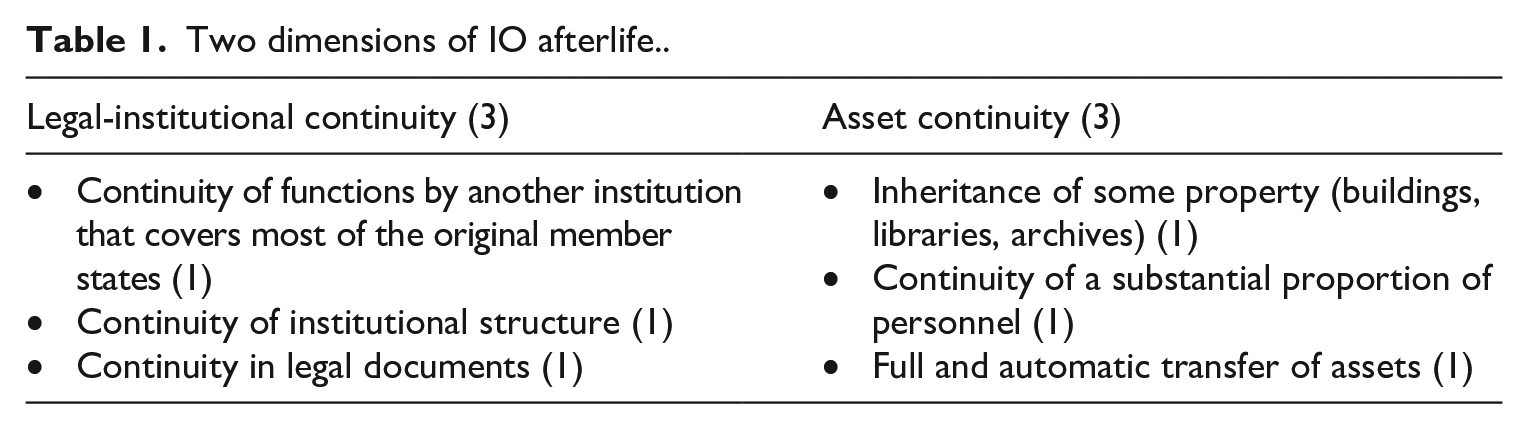
Legal-institutional continuity is measured through three indicators on the continuity of (1) functions, (2) institutions, and (3) legal provisions (see Table 1). A successor institution (not necessarily an IO) can take over the functions (such as mandates or projects) from a terminated IO as long as it covers most of the original member states. New member states may join the new institution, or some old member states may decide against participation, but IOs need to govern similar functions for similar groups of member states to speak of continuity. There may also be a direct continuity of institutional structure or a succeeding institution might take inspiration from the previously existing institutional structure (e.g. Rittberger et al., 2019: Chapter 4). Finally, as noted above, there may be formal-legal succession with an explicit mention in the constitutive documents of the succeeding IO (Wessel, 2011: 348). If we add up all three indicators, we get to a scale of legal-institutional continuity (score: 0–3). 3
Two dimensions of IO afterlife..
The second dimension concerns asset continuity of terminated IOs which is about its capacities. Assets are tangible but can also carry ideational properties, and their transfer from IOs to succeeding institutions creates strong perceptions of continuity. Even if the UN Charter did not make mention of the League, the fact that it inherited the Palais de Nations in Geneva and that 200 League officials started working for the UN was obviously significant for its future development. Taking over IO personnel, after all, means that important ideas, bureaucratic culture, and institutional knowledge become part of the new IO and thus ideational aspects live on. More generally, it is well known that IOs have assets (e.g. Wallander, 2000) and when IOs are terminated it triggers real questions about what to do with those. Does the membership simply liquidate assets and consider them sunk costs, or do they hold value for successor institutions? In the case of the latter, asset continuity becomes an important dimension of IO afterlife.
In this article, the continuity of assets includes three separate indicators: (1) property, (2) personnel, and (3) a full transfer of assets (see Table 1). Property includes immovable and movable assets such as buildings, libraries, and archives. When successor institutions inherent buildings and establish their headquarters in similar locations as the terminated IOs, this naturally creates the impression of continuity. The transfer of libraries and archives is similarly important as it indicates a continuity of work. Personnel may also be transferred. This is significant, as personnel take with them memories, lessons, expertise, networks, norms, and practices. 4 Finally, we should look at whether there has been a full and automatic transfer of assets between institutions, including financial resources, or rather whether successor institutions only cherry-pick what they consider the most valuable assets of terminated IOs. Adding up all three indicators, we again arrive at a scale of asset continuity [score: 0–3].
These two dimensions measure distinct aspects of IO afterlife. Legal-institutional continuity is about mandates, institutions, and formalisation. Asset continuity is about capacities. The two dimensions can correlate, like the population and GDP of countries, but this is not necessarily the case. At the two extremes – full dismantlement (0:0) and full replacement (3:3) – we will see similar scores on both dimensions for the afterlives of terminated IOs. When the General Agreement on Tariffs and Trade (GATT) was replaced by the WTO, there was both full legal continuity and a full transfer of assets. When the Warsaw Treaty Organisation was dissolved, staff officers from the headquarters (had already) returned home. Yet for many IOs, the legal-institutional situation may differ from assets. The UN, as mentioned, inherited assets from the League, despite a lack of formal-legal continuity. The United Nations Educational, Scientific and Cultural Organization (UNESCO) took over the functions of the Intergovernmental Bureau for Informatics but only got a couple of archive boxes in terms of assets. The EU did not take over the staff of the WEU and cherry-picked a few assets, even though there were clear legal references to the WEU in EU treaties and official documents.
Our two-dimensional concept of IO afterlife therefore paints a richer picture than existing IR research. It also uncovers life beyond the data grid, as the empirical section below will show. The remainder of the article shows that many major terminated IOs developed afterlife below the threshold of the narrow, formal-legal definition of succession. This validates the use of our two-dimensional scale of IO afterlife which is richer and more precise at the same time.
Mapping the afterlives of major IOs
To demonstrate the analytical value of our conception of IO afterlife, we study what happens after major IOs are terminated. We focus on major IOs for three reasons: First, these are ‘most-likely’ or ‘crucial cases’ (Gerring and Cojocaru, 2016) where we might find IO afterlife. The termination of large IOs raises questions about potential gaps in global governance and triggers real-world issues about functions, institutions, and assets. If we do not find instances of afterlife in major IOs, we will not find them elsewhere. Second, the termination of major IOs is substantially more important for IR than the termination of minor IOs. By analysing major IOs, we provide data on the IOs that mattered most to international cooperation. Finally, the focus on major IOs also has practical research advantages. Due to their significance, we are in a better position to trace empirically their afterlives. For major IOs, there is often a paper trail and there are also secondary sources we can rely on.
To identify major IOs, we draw on the sample of 534 IOs compiled in the IGO-COW v3.0 dataset (Pevehouse et al., 2020) and include those IOs with a large membership (⩾50% of existing states as members), or high institutionalisation, or substantial administrative resources (⩾ 50 staff members). The termination of an IO with a large membership is more impactful for global governance than an IO with a small membership, all other things being equal. And the termination of an IO with strong institutionalisation and/or administrative capacity is more impactful than minor IOs without competencies or capacity (see further Dijkstra and Debre, 2022 on the identification of major IOs and the need to avoid a post-1945 bias).
Of the 153 out of 534 IOs that fulfil the inclusion criteria of being ‘major’, we focus on those that were terminated. From the 153 major IOs, 29 IOs are coded as ‘dead’, ‘integrated’, or ‘replaced’ in the IGO-COW v3.0 dataset. Having carefully gone through these 29 IOs, we exclude three IOs – the Andean Parliament, the International Commission for the Decennial Revision of the International Lists of Diseases and Causes of Death, and the International Commission for the Protection of the Moselle Against Pollution – on the grounds that they were, respectively, not a separate IO, not governmental, and still alive (see Table B1 in Appendix B). We readily accept that some of the 26 IOs included are perhaps not ‘household names’, yet they carried out important governance functions in their times, such as mapping the world, sharing statistical data on agriculture, or overseeing quarantine rules to prevent the spread of plague and cholera.
For each of these 26 terminated major IOs, we traced their legal-institutional continuity and asset continuity (see Figure 1). We scored all IOs on both dimensions (scores: 0–3). It is typically quite clear, from the secondary literature and official documents, whether there is some continuity from a terminated IO to another institution (see Appendix C for brief summaries on coding decisions). For instance, in the dissolution documents of terminated IOs, it might be noted in the preambular paragraphs that given the creation of a new IO carrying out certain functions, there is no longer a need for the original IO. Or certain responsibilities, such as river dams, maps of the world, satellites, or refugees, might be taken over by other institutions.
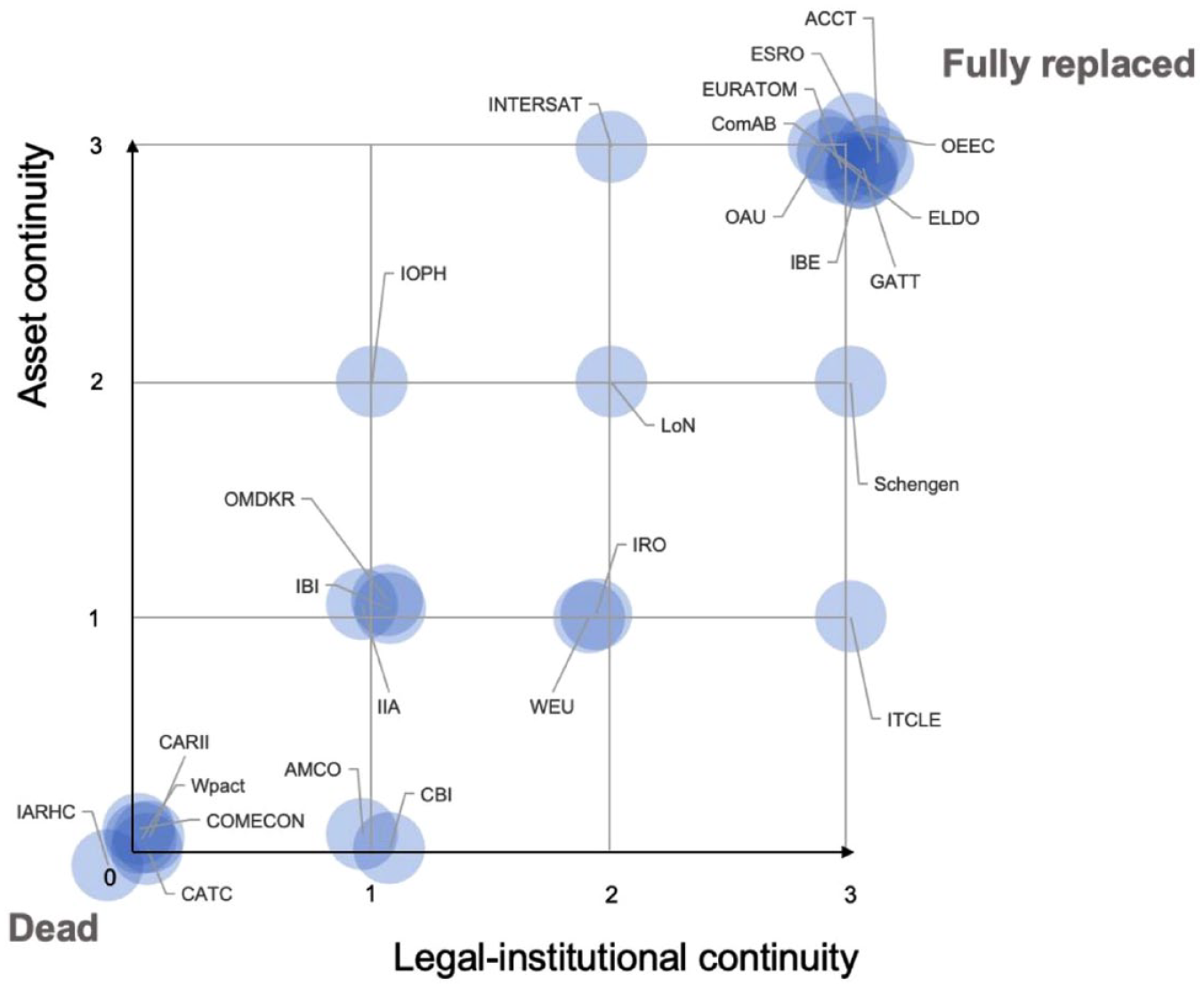
The afterlives of international organisations. Overlapping points jittered for readability.
Regarding legal-institutional continuity, we noted already above that formal-legal succession is comparatively rare. At the same time, we also found cases where there was formal-legal continuity, but where the institutional structure of the succeeding IO differed (for instance, INTERSAT which got privatised). In two cases, we see that functions of the new IO differed to some extent even if there was formal-legal replacement. The 1960 Convention of the OECD, for instance, ‘reconstituted’ the OEEC, gave the OECD an expanded mandate, and included the United States as a new member (Leimgruber and Schmelzer, 2017: 34–36; Hahn, 1962: 543–553). The UNHCR was furthermore meant to have a very different mandate from the IRO but soon faced IRO ‘leftovers’ that needed to be addressed (see below). Overall, we found substantial variation in the legal-institutional dimension.
For the second dimension, asset continuity, we equally started with the legal documents to see whether there has been a full and automatic transfer of assets. Short of a full transfer, we have traced whether buildings, archives, libraries, and other properties, and a substantial number of staff members made their way to new institutions. Since exact buildings are sometimes difficult to identify, we looked at whether IOs kept their headquarters in the same cities. For instance, the IRO and UNHCR were both Geneva-based, though did not necessarily work from the same offices. Archives and libraries are an interesting category as well because if another IO inherits the archives and library from another IO, it signals that at least in the minds of officials making these decisions, there is a linkage between both institutions. IBI and UNESCO as well as IIA and FAO are examples. Finally, for the personnel indicator, we tried to trace substantial transfers.
Figure 1 maps our results for the 26 terminated IOs. We find that some IOs are clearly replaced or integrated (9) or dismantled and/or dead (5). At the same time, we find that 12 IOs develop some sort of afterlife that is not well captured by this narrow, legalistic concept of IO afterlife. These 12 IOs include cases where for political reasons there could not be a formal transfer but where functions clearly needed to be covered including collective security (League to UN), refugees (IRO to UNHCR), health (IOPH to WHO), or agricultural cooperation (IIA to FAO). In other cases, IOs took over responsibility for certain projects or programmes after the work of IOs had been disrupted due to war (OMDKR to NBI; Map of the World to UN). And in yet other cases, IOs were driven out of business by other IOs which took over the functions, but not the liabilities such as buildings, or staff and their pensions (WEU to EU; IBI to UNESCO). In other words, the afterlife of IOs is important even if they are not formally replaced. 5
We note that, in 21 out of 26 cases of terminated major IOs, the demand for cooperation did not disappear with IO termination. Gaps in global governance left by IO termination were (ultimately) filled by other international institutions. The end of the League did not mean the end of cooperation in collective security, the failure of the IIA not the end of cooperation in agriculture, and the dissolution of the IRO not the end of cooperation on refugees. In 5 out of 26 cases where IOs were fully dismantled (0:0), the decreasing demand for cooperation often coincided with a weakening of the patron state. The Warsaw Pact and the COMECON are obvious examples, where both IOs were dissolved along with the dissolution of the Soviet Union. The Central American Research Institute for Industry and the Commonwealth Air Transport Council were also heavily reliant on a dominant member state. The International Allied Rhineland High Commission had an expiry date, but its fate was sealed already before then.
For many of the IOs with a full score on afterlife (3:3), we see a similar membership in the preceding and succeeding IOs, and these are often (regional) general purpose IOs with an underlying community of states (Hooghe et al., 2019). Euratom, ELDO, and ESRO are part of the European integration project. In addition, this includes the African OAU, the Commonwealth Agricultural Bureau, the Francophone ACCT, and the transatlantic OEEC. The GATT and the International Bureau of Education are the exceptions, even though the WTO’s founding member states were largely the same as the GATT members. The symmetrical membership also allowed the assets to be more easily transferred with the succeeding IOs. Two other IOs with a high degree of afterlife are worth noting. INTERSET was privatised which required a different institutional structure. Schengen was integrated into the EU, but this was complicated through the latter’s personnel regulations.
For the IOs positioned between death and full replacement, we find that asymmetrical membership and particularly changes in leading states clearly matter. The Soviet Union and the United States, both of which had a fraught relationship with the League, became the key member states of the UN. This prevented full succession from the League to the UN. The IIA was sponsored by Fascist Italy, whereas the FAO as part of the rest of the UN system was US-led. The WEU was a defence alliance, but the succeeding EU had several neutral member states. The IRO was US-led, whereas the UNHCR would become a universal UN institution. At the same time, we also find that many of the succeeding IOs found it useful to take over various assets. The UN not only inherited many League assets as noted above. In other cases, assets were cherry-picked such as the EU taking over the WEU Satellite Centre and its Institute for Security Studies while leaving the rest behind. UNESCO took possession of the IBI’s archives but refused to take on other liabilities such as its personnel which would have been a considerable budgetary commitment.
Case illustrations
To illustrate further the importance of IO afterlife, we consider three cases in more detail: the IIA’s afterlife in FAO (1:1), the IRO’s afterlife in the UNHCR (2:1), and the WEU’s afterlife in the EU (2:1). Our objective is twofold: First, we want to further validate our conceptualisation to show that there is considerable afterlife beyond the high threshold of formal-legal replacement. Second, we want to show that such forms of IO afterlife matter in that they inspire and structure succeeding institutions, but also that it fell short of full continuity. The three selected cases present, in this respect, typical cases for our argument as they fall short of the narrow notion of formal-legal replacement. 6 At the same time, the three case examples also vary considerably. They were terminated during different eras (prior to the Second World War; during the Cold War; after the Cold War) and had different types of memberships and issue areas, and the underlying reasons for termination varied as well. They are therefore rather different IOs, yet they are similar in that their afterlives mattered for succeeding institutions.
The IIA’s afterlife in the FAO
The IIA was established in Rome in 1905 mainly as a statistical and scientific body with the objective to provide authoritative and trustworthy agricultural information to its member states (Luzzatti, 1906). In 1928, it employed around 135 staff members and was therefore a substantial IO (Hobson, 1931: 98). The IIA operated until around 1939, but there was already a clear decline in the years prior to the war, particularly after the Ethiopian crisis which led to the withdrawal of Italy from the League. The IIA remained dormant during the war and was formally dissolved in 1946. Importantly, the organisation was sponsored by its host state with the close personal involvement of King Victor Emmanuel III who originally gave the IIA a budget and a building. The close involvement of Italy continued until the end, with Benito Mussolini taking an interest. The IIA even became an instrument of international fascism with links to Nazi Germany (Herren, 2017: 203–205).
The United Nations Interim Commission on Food and Agriculture was created in Washington, DC, in 1943. It would eventually lead to the FAO and was a newly founded IO that did not explicitly succeed the IIA (Staples, 2006: 77–79). Given the position of Italy during the war, officials from the Italy-sponsored IIA were not part of the FAO negotiations and had no agency in the postwar institutions. The FAO Constitution of 1945 makes no reference to the (then still-existing) IIA. While this should be seen against the tainted background of the IIA, it is still noteworthy that the functions of the new FAO, as defined in Article 1 of its Constitution, are very similar to the formal functions of the IIA in Article 9 of the IIA Convention of 1905 (sharing information on agriculture and acting as a hub of expertise). Apart from the initial absence of Italy in the FAO, the membership overlapped with the FAO being a universal UN organisation and the IIA having also a substantial worldwide membership.
The Dissolution Protocol of the IIA from 1946 does refer to the newly created FAO in both an indirect and direct way. It notes in the preambular paragraphs that it is ‘desirable that the Institute . . . be dissolved’ without explicitly mentioning the reason for dissolution (the new FAO), but it immediately notes that the ‘functions’ and some of the residual ‘assets’ should be transferred to the FAO, which would also archive the Dissolution Protocol itself (Article VI(2)). More precisely, the Protocol notes that the IIA should ‘pay and satisfy all outstanding debts and claims’ (Article II(b)), ‘discharge the employees’ (Article II(c)), and transfer to the FAO ‘the property in the libraries, archives, records, and all residual assets’ (Article II(d)). The original idea was to locate the new FAO together with the rest of the UN in New York (Abbott, 1991: Chapter 7). Only when Italy, a couple of years after the war, offered an attractive building and generous terms (Staples, 2006: 96), it was decided that the FAO would be based in Rome from 1951. Two-thirds of the then FAO staff, however, decided against moving from Washington, DC, to Rome (Abbott, 1991: Chapter 7). In terms of assets, the inheritance was therefore limited to the library and archives.
What appears from this illustration is that the succession of the IIA to the FAO was by no means automatic. There is a considerable gap in time between the IIA going dormant in Rome in 1939 and the FAO opening its Rome headquarters in 1951. While the succession of functions is recognised, at least from the side of the IIA, the FAO was purposefully put at a legal distance from the IIA and did not recognise its predecessor (which has also happened with other postwar institutions succeeding prewar institutions). The case of the IIA therefore also neatly fits the argument of this article. Even if IOs are terminated, the underlying rationale for cooperation often remains in place. The world needs to be governed and there was a demand for a universal agricultural organisation. Member states, in this respect, dealt relatively pragmatically with the remaining IIA assets (library and archives) while avoiding much more politically and legally difficult discussions on formal-legal replacement. Nevertheless, the fact that Italy felt the need to ultimately host the FAO, and that the rest of the membership agreed to this, also highlights how IO afterlife inspires choices for the succeeding IOs. If it had not been for the IIA, the FAO would clearly not be based in Rome. Indeed that two-thirds of FAO staff did not move to Rome highlights that the choice for Rome as headquarters for the FAO was all but a fully rational choice. Symbolism in the form of path dependency trumped efficiency considerations. The case of the IIA therefore clearly shows that there can be a meaningful IO afterlife in lieu of a formal replacement.
IRO’s afterlife in the UNHCR
The IRO was set up as a temporary IO shortly after the Second World War in 1946 to deal with 1.5 million refugees and displaced persons in Europe. It was closed in 1952 (Holborn, 1956: 559–561). The refugee challenge became pronounced already during the interbellum and resulted in various forms of international cooperation under the League (see Orchard, 2014: Chapter 5), which were stepped up to deal with refugees and displaced persons during and particularly after the Second World War. The scale of the problem was immense with 6.6 million displaced persons outside their countries, 33 million displaced persons inside their countries, and more than 750,000 refugees from German and Soviet territories (Orchard, 2014: Table 6.1). While many were soon repatriated, once the Second World War had ended, there were difficulties with refugees, displaced persons, and prisoners of war from Central and Eastern Europe and the Soviet Union (Ristelhueber, 1951: 177). Particularly the United States objected to forced return based on humanitarian principles (Orchard, 2014: 146–152), whereas the Soviet Union expected all its citizens to come home.
The IRO was created as a temporary UN agency in February 1946. Yet during the negotiations of the IRO states split along East–West lines on the definition and level of support to refugees and displaced persons (Ristelhueber, 1951: 178–180). When finally established, the IRO only had member states from the Western hemisphere. The IRO nevertheless provided refuge through camps and resettlement support to 1.5 million displaced persons until the end of its mandate (see Holborn, 1956; Ristelhueber, 1951; Rucker, 1949 for a discussion of the activities). It employed nearly 2900 international officials in 1949 (Holborn, 1956: 99) and had a total budget of around $400 million during its less than 5 years of existence (Holborn, 1956: 122).
More than half of the budget was paid for by the United States (Holborn, 1956: 122) and the United States soon started behaving like as a dissatisfied customer (Orchard, 2014: 168–170). At the same time, with the emergence of the Cold War, the United States wanted to avoid handing over more responsibilities to the UN where the Soviet Union had a strong position. This tension became critical once negotiations over the dissolution of the IRO started. While the United States could not prevent the establishment of the UN High Commissioner for Refugees in 1949, the role of the High Commissioner was more restricted and the office did not receive any operational funds from the UN. 7 When the IRO disbanded in 1951–1952, it handed over responsibilities mainly to host countries, such as France, Germany, Austria, and Italy (Ristelhueber, 1951: 221–222). The staff had already been reduced dramatically to 1684 officials at the end of 1950 and 677 officials at the end of 1951 (Holborn, 1956: 99). IRO was therefore time-limited and its function in Europe had largely been fulfilled leaving assets (such as temporary refugee) camps without much value.
Yet the dissolution of the IRO was not the end of the story. The UNHCR had been established with a view to the termination of the IRO. This was recognised in formal-legal terms in the UN General Assembly (1949) resolution 319 (IV) of 3 December 1949, which created UNHCR and noted in the preamble that UN members ‘should decide the functions and organisational arrangements, within the framework of the UN, necessary for international protection of refugees after the International Refugee Organization terminates its activities’. For this purpose, IRO case files were handed over to the UNHCR and the IRO provided the funds to keep the Shanghai regional office open for another 6 months. The UNHCR was also located at the UN compound in Geneva, just like the IRO. There was thus some asset continuity.
The UNHCR was established as an office rather than an IO. The first UNHCR noted, for instance, that ‘I should like to emphasize that in setting up my office the United Nations did not wish to create a successor organization to the IRO. The functions of my office are very different from those of the IRO. My office is not an operational organization, as the IRO. . . . it does not run camps or charter ships; its responsibilities are more indirect’ (Van Heuven Goedhart, 1952).
At the same time, it became immediately apparent that the IRO had not ‘solved’ the refugee problem. Indeed, many refugees had remained, and they came under the care of the UNHCR, which as a result was almost immediately forced to develop its own activities and grow into an actual IO employing 99 officials by 1953 (Van Heuven Goedhart, 1953). What the afterlife of the IRO thus illustrates is that succession was all but direct after the termination of IRO. For geopolitical reasons, there was no neat mandate transfer to the UNHCR and the functions of the UNHCR were even restricted. This clearly fell short of full replacement. At the same time, in line with the argument of the article, the demand for a global refugee organisation continued and this demand was met by the UNHCR. Against the wishes of the United States, the UNHCR eventually did grow into a sizable IO inspired by the IRO.
The WEU’s afterlife in the EU
The WEU was the result of the Brussels Pact of 1948, which was a collective defence treaty signed by France, the United Kingdom, and the Benelux countries, and existed until its dissolution in June 2011. Already soon after its creation, the WEU found itself redundant with the establishment of NATO in 1949 and it remained largely dormant during the Cold War. From the late 1980s, however, the member states of the European Communities (now EU) started to develop their joint foreign and security policies and the WEU became a vehicle for these ambitions (Bloed and Wessel, 1994: xviii–xix). With the Maastricht Treaty of 1993, the WEU essentially became the implementing IO for the EU’s security and defence policy. While the Maastricht Treaty considered the WEU as an ‘integral part of the [EU]’ (as cited in Bloed and Wessel, 1994: xxv), both IOs remained legally separate.
The WEU started to implement various activities during the early 1990s, including some modest crisis management missions in the Western Balkans. At the same time, it became increasingly clear that the EU as an emerging global actor needed to develop its own policies. In 1999, the EU established the Common Security and Defence Policy with the implication that the ‘WEU as an organisation would have completed its purpose’ (European Council, 1999: Annex III, §5). The EU took over core functions of the WEU, including the 1992 Petersberg Tasks, armament cooperation through the newly established European Defence Agency in 2004, and collective defence clause through the 2009 Lisbon Treaty. The EU as such has been described as a ‘black widow’ sucking life out of the WEU (Wessel, 2001).
Even though a full integration was formally on the table, the EU ultimately decided not to integrate the WEU into its own structures. It only took over two specialised WEU agencies (the Institute for Security Studies and the Satellite Centre). The rest of the institutional structures were essentially ignored by the EU as it set up new institutions. At the same time, these newly established institutions were clearly inspired by the WEU, such as the EU Military Staff resembling the WEU Military Staff and the EU Interparliamentary Conference resembling the WEU Parliamentary Assembly. To ensure that the WEU would not openly compete with the new EU structures, the member states appointed the EU High Representative, Javier Solana, also as the WEU Secretary-General. WEU secretariat staff was rapidly reduced and only three WEU officials made it into the newly established EU structures (Bailes and Messervy-Whiting, 2011: 47). Almost immediately following the entry-into-force of the 2009 Lisbon Treaty, the United Kingdom announced its withdrawal from the WEU. The remaining member states dissolved the WEU in 2011 after they had figured out a social plan, pension schemes, and what to do with the classified archival documents. The EU thus took over the functions of the WEU yet ignored most of its assets.
The case of the WEU thus presents an instance with a high degree of legal-institutional continuity even if it fell short of full-fledged constitutive replacement by the EU. At the same time, there was only limited asset continuity in terms of some agencies. Personnel was not transferred into the EU, also because of stringent EU personnel regulations requiring competitive recruitment. The WEU was neither fully replaced nor dismantled. Its key functions in European collective defence remained in place and moved to a different institution. At the same time, it is also clear that the WEU inspired and structured the institutional design of the new EU security services. Parliamentarians meeting in the WEU Parliamentary Assembly, for instance, found themselves without a forum and demanded the creation of the EU Interparliamentary Conference. IO afterlife was in this respect significant even if it fell short, for political and legal reasons, of formal replacement or integration.
Conclusion
IOs are regularly terminated. As key institutions for international cooperation, such events are important for how the world is governed. While IR scholarship is increasingly focusing on IO termination and survival (e.g. Debre and Dijkstra, 2021; Dijkstra and Debre, 2022; Eilstrup-Sangiovanni, 2020, 2021; Gray, 2018; Shanks et al., 1996; Strange, 1998), our knowledge of what happens after termination remains limited. We know that some IOs are replaced (e.g. Cottrell, 2016; Debre and Dijkstra, 2021; Eilstrup-Sangiovanni, 2022; Pevehouse et al., 2020) and we also know from legal and historical scholarship that ideas, institutions, people, and practices often make their way into new institutions (e.g. Clavin, 2013; Pedersen, 2007; Wessel, 2011). Building on these insights, this article has been the first attempt to systematically conceptualise, map, and discuss the afterlife for 26 major terminated IOs.
We find that IO afterlife is not easily conceptualised in legalistic terms. IO termination can be messy and fraught with legal and institutional complications. The very reasons why member states may prefer to start anew under a different institutional heading, such as the need to expand the membership or to overcome gridlocks in the existing institutions, may also complicate a formal-legal succession. We therefore introduced a new conceptualisation of IO afterlife based on a two-dimensional scale that includes legal-institutional continuity but also asset continuity. Mapping the trajectories of 26 major terminated IOs revealed that 12 IOs were neither dismantled nor neatly replaced but still developed some form of afterlife. If we add these to the nine fully replaced IOs, we can only conclude that there is significant continuity of cooperation: Only 5 out of 26 terminated major IOs truly died without any afterlife.
This article has not only shown empirically that IO afterlife exists and is much more omnipresent than previously assumed; it also reveals the different ways in which IO afterlife affects successor institutions: The FAO would not have been in Rome if the IIA had not been there; the UNHCR soon adopted operational tasks as the preceding IRO, and the EU took over two agencies from the WEU and modelled its security institutions partially on the WEU template. Such cases resonate well with the historical institutionalist notion that contingent historical choices and pre-existing institutions affect later outcomes (e.g. Fioretos, 2011; Hanrieder, 2014; Rixen et al., 2016). Rather than considering all available institutional design formats, the founders of succeeding IOs, as boundedly rational actors (Jupille et al., 2013), likely internalised their experiences with the terminated IOs and considered these experiences in moving forward. The three cases, in this respect, validate the conceptualisation and argument of this article: When moving beyond formal-legal definitions, we find that there is often considerable and significant continuity in cooperation after IOs have been terminated.
By providing a more nuanced conceptualisation of IO afterlife, this article invites future research along three lines of questioning: First, future research could draw on our two-dimensional conceptualisation to map IO afterlife. How widespread is the phenomenon of IO afterlife beyond major IOs? Relatedly, future research could also expand on our measurement of IO afterlife by gathering more data on immaterial aspects, such as ideas, norms, and practices. Second, future research could unpack the drivers of varying trajectories of terminated IOs. Under which conditions does IO termination give rise to legal-institutional continuity and when to asset continuity? The illustrative case studies suggest that membership, the reasons for termination, and legal liabilities provide promising starting points for explanatory studies. Finally, future research could further examine the implications of different forms of IO afterlife on succeeding institutions. How do legal-institutional continuity and asset continuity affect the working of their successors? What are the intended – and especially unintended – consequences of IO afterlife?
When taking these findings collectively – about the considerable afterlife resulting from terminated major IOs and the path dependency into new IOs – it is worth making three final points of the broader implications. First, we need to reconsider existing accounts of IO death and survival. As noted previously, by their very nature, existing datasets structure data as if IOs follow an ideal-type lifecycle where termination/exclusion mirrors creation/inclusion. Yet if only 5/26 major terminated IOs are fully dismantled, this is no longer convincing. Our results suggest considering IO termination as an instance of (informal) institutional change in global governance, where demand for governance continues but the institutions need to be (partially) reconfigured. Any analysis of IO termination must thus consider inter-institutional dynamics and the broader governance regime (cf. Eilstrup-Sangiovanni, 2022 on the international aviation regime).
Second, our findings also yield important implications for the study of formality and informality in current IO research. Our study contributes to scholarship that stresses the importance of informal aspects of institutions such as norms, ideas, and practices for their functioning and effects (Barnett and Finnemore, 1999; Stone, 2013). If institutions live on not just through formal succession, but through people and libraries, then we need to reassess our – often formalistic – theories of IO death. Previous work has, for instance, already highlighted the important role of IO bureaucracies in survival (Dijkstra et al., 2022; Schuette, 2021) and in shaping successor institutions (Johnson, 2014). Informal IOs might also play a bigger role in understanding IO afterlife: Where formal cooperation breaks down due to conflict between member states, states might try to continue cooperation through informal institutions.
Finally, at a fundamental level, these findings also challenge some of the more alarming accounts on the crisis of IOs and multilateralism (e.g. Lake et al., 2021; Mearsheimer, 2019; Zürn, 2018). Indeed, the article adds further evidence about the actual resilience of international cooperation (cf. Heinkelmann-Wild and Jankauskas, 2022; Hirschmann, 2021; Schuette, 2021; Sommerer et al., 2022). Moreover, recent institutional scholarship has already shown that the termination of major IOs is a less frequent event compared with minor IOs (see Debre and Dijkstra, 2021; Dijkstra and Debre, 2022). We add that even if major IOs are terminated, states may well continue their cooperation with other institutions because the world needs to be governed. Governance abhors a vacuum.
Supplemental Material
sj-docx-1-bpi-10.1177_13691481231202642 – Supplemental material for Governance abhors a vacuum: The afterlives of major international organisations
Supplemental material, sj-docx-1-bpi-10.1177_13691481231202642 for Governance abhors a vacuum: The afterlives of major international organisations by Hylke Dijkstra, Maria J. Debre and Tim Heinkelmann-Wild in The British Journal of Politics and International Relations
Footnotes
Funding
The author(s) disclosed receipt of the following financial support for the research, authorship, and/or publication of this article: This article is part of a project that has received funding from the European Research Council (ERC) under the European Union’s Horizon 2020 research and innovation programme (grant agreement No. 802568).

Supplementary information
Additional supplementary information may be found in the online version of this article.
Appendix A: Comparing datasets on the death and afterlife of IOs. Figure A1. Comparing datasets on the death and afterlife of IOs. Appendix B: The afterlife of 26 major terminated IOs. Table B1. Overview of 26 major terminated IOs. Table B2. Comparison of coding with existing datasets. Appendix C: Brief description of coding of IO afterlife.
Notes
References
Supplementary Material
Please find the following supplemental material available below.
For Open Access articles published under a Creative Commons License, all supplemental material carries the same license as the article it is associated with.
For non-Open Access articles published, all supplemental material carries a non-exclusive license, and permission requests for re-use of supplemental material or any part of supplemental material shall be sent directly to the copyright owner as specified in the copyright notice associated with the article.
