




Abstract
This article addresses the puzzle of why, and under what conditions, international organisations cease to exist. International Relations literature offers rich explanations for the creation, design and effectiveness of international institutions and their organisational embodiments, international organizations (IOs), but surprisingly little effort has gone into studying the dynamics of IO termination. Yet if we want to understand the conditions under which international organisations endure, we must also explain why they frequently fail to do so. The article formulates and tests a theory of ‘IO death’ using a combination of population-wide statistical analysis and detailed historical case studies. My analysis is based on an original dataset covering the period 1815–2016. I find that exogenous shocks are a leading proximate cause of IO terminations since 1815 and that organisations that are newly created, have small memberships, and/or lack centralised structures are most likely to succumb. My analysis leads me to suggest a number of extensions and refinements to existing institutionalist theories.
Keywords
On 14 November 1936, Germany withdrew from the international conventions establishing the International Commissions of the Danube, the Elbe, and the Oder, and the Central Commission for Navigation of the Rhine. Although they were never officially dissolved, the Elbe, Oder and Danube River Commissions never convened again, whereas the Rhine Commission operates to this day, making it the oldest international organisation (IO) in modern history. On 31 March 1991, members of the Warsaw Pact voted to terminate the alliance in light of monumental geopolitical changes following the end of the Cold War. The Pact thus joined the long list of institutionalised multilateral alliances that have been eventually relegated to history. 1 By contrast, its western counterpart, NATO, went on to expand its membership and mission, leading international relations scholars to hail it as an exemplar of the remarkable durability of international institutions (McCalla, 1996; Menon and Welsh, 2011; Wallander, 2000).
Why do IOs (sometimes) die? Why some IOs and not others? From the perspective of existing scholarly literature, IO terminations present a puzzle. An extensive literature in International Relations asserts that international institutions and organisations are the products of costly negotiation and contracting processes that are far too deeply ingrained in wider social and political structures to suddenly nullify (Cotrell, 2016: 21; Strange, 1998). Functionalist theories invoke high negotiating costs and ‘increasing returns’ from institutionalised cooperation to ground the notion that states will maintain existing institutions as long as feasible and – at any rate – ‘long after the original conditions for their creation have disappeared’ (Keohane, 1984: 215; Stein, 1990: 50). Sociological institutionalists emphasise normative and cognitive biases leading to ‘competency traps’ and institutional status quo bias (Finnemore and Sikkink, 1998; March and Olsen, 1998: 964). Historical institutionalists cite positive feedback and institutional lock-in effects (North, 1990: 95; Pierson, 2004), while organisational theorists highlight international secretariats’ strategic use of bureaucratic resources to resist obsolescence (Barnett and Finnemore, 2004; Shanks et al., 1996: 593). While they start from different theoretical assumptions, these perspectives all share in common the assumption that institutional change is predominantly incremental, and institutional deaths rare (Cappoccio and Kelemen, 2007; Cotrell, 2016: 21; North, 1990: 89–94). As Shanks and co-authors (1996: 593) summarise, ‘no-body expects public institutions to die’.
IOs do of course die. Of 561 intergovernmental organisations (IGOs) created between 1815 and 2006, 216 (about two-fifths) have since ceased to exist (Eilstrup-Sangiovanni, 2018). Why, given the high costs of creating international institutions and the lasting benefits they allegedly produce, do states frequently abandon established IOs? Under what specific conditions are IOs most likely to terminate? Existing IR scholarship provides surprisingly limited analytical leverage on these questions. For decades, scholars have focused on explaining patterns of institutional creation and design, and on theorising ‘institutional robustness’ – understood broadly as ‘the ability of international institutions to endure despite exogenous change’ (Hasenclever et al., 1992: 2, my emphasis). 2 This lopsided focus on explaining institutional endurance (rather than termination) has led to widespread selection bias, insofar as scholars have systematically favoured the study of the living over the dead. 3 Thus, many studies of institutional robustness focus rather one-sidedly on a handful of long-lasting IGOs while ignoring prominent organisational failures. For example, the substantial literature focused on explaining NATO’s persistence after the Cold War contains surprisingly few references – let alone focused comparison – to former institutionalised alliances that dissolved once exogenous threats subsided (McCalla, 1996; Menon and Welsh, 2011; Wallander 2000. cf. Lake, 2001). This bias has led scholars to widely overestimate institutional robustness, while downplaying processes that undermine institutionalised cooperation. On the flipside, the comparatively sparse literature on the collapse of international institutions has tended to focus on single cases (Bernholz, 2009) or has concentrated on smaller segments of the population (Cotrell, 2016; Gray, 2018; Panke and Petersohn, 2011; Shanks et al., 1996). 4 Limited by functional specificities and historical contingency, such studies fail to offer a general explanation of IO death that can account for mortality patterns across a wider universe of cases.
This article aims fill to this gap by providing a theory-based analysis of IGO death since 1815. It builds on and extends my earlier statistical analysis of IGO deaths (Eilstrup-Sangiovanni, 2018) by formulating and testing specific theoretical conjectures, and by supplementing population-wide analysis with detailed case studies of organisational terminations during historical ‘high stress’ periods. Previous research has established that IGO terminations correlate with geopolitical shocks and with specific institutional traits such as small membership size (opcit.). Yet, without knowing how these factors contribute to institutional demise in specific cases, we cannot confidently claim to understand what causes organisational termination as opposed to endurance. My ambition in this article is thus to distinguish various factors and processes that may lead to IGO death, to identify the circumstances under which these processes are likely to occur, and to establish, though careful process-tracing analysis, how they unfold in specific cases.
My discussion is structured as follows. `Data and Methods’ introduces the data and methodology underlying my analysis. ‘Key concepts’ outlines central concepts relevant to my study. The following section, ‘IGO mortality 1815–2016: descriptive statistics’, records broad historical patterns of IGO mortality to motivate my research question(s), and to identify historical periods and organisational features of particular interest. In the section ‘Theorising IGO death’, I draw on institutionalist theories to derive hypotheses about the causes of IGO termination. The section titled ‘Empirics: exogenous change and IGO death’ turns to fine-grained empirical analysis, combining medium-n statistical analysis with historical case studies. In conclusion, I discuss implications of my findings for existing institutional theories.
Theoretical contribution
My analysis contributes to several avenues of IO research. First, by moving beyond a focus on single cases of IO failure, this study contributes novel insights regarding when and how international institutions die. Second, in doing so, it also helps to refine existing theories of what allows some IOs to endure. As already discussed, studies of institutional robustness have predominantly focused on highly robust IOs. We are, however, unlikely to discover factors responsible for organisational robustness by examining only long-lived exemplars. Long-lived IOs may share certain features but without carefully examining organisations that did not last, we cannot say whether and specifically how they differed. By bringing to light new data on dissolved IGOs, the present study facilitates testing of extant institutionalist theories against a larger range of cases and generates novel hypotheses about what may account for the remarkable longevity of some IGOs.
Data and methods
My analysis is based on an expanded version of the Dead-IGO (DIGO-2018 5 ) Dataset, which contains information on all IGOs created between 1815 and 2006, tracking their fate until 2016. This dataset includes most IGOs listed in the Correlates of War (COW) IGO-Datasets (version 2.3) plus an additional 36 IGOs not included in the COW Datasets. In addition to listing the fate of each IGO (‘defunct’ or ‘operational’) as of 2016, the dataset codes institutional features including Number of state parties, Scope and Type of mandate, Centralization, 6 organisational Age and Geographic Span (an explanation of coding criteria is in the Codebook).
My analysis relies on an integrated, mixed-methods approach, which combines population-wide statistical analysis with detailed historical case studies. Starting with population-wide analysis is necessary for two reasons. First, it is possible that IGO terminations may be driven by different antecedent conditions in different segments of the population. However, without first observing variation across the entire population, we cannot know for sure what the relevant segments might be. Second, single or small-n studies of IGO death, while useful for allowing observation of discrete causal processes, have distinct liabilities when used as a source of development of concepts and hypotheses about variation in IGO mortality (Lieberman 2004). As Pierson notes (2004: 141), reliance on single cases often leads scholars to focus on immediate sources of institutional change – the ‘catalysts’ – but have a harder time identifying the role of underlying structural factors. Because they present isolated studies of institutional collapse at particular points in time, we cannot be certain what factors are important in generating the observed outcomes (opcit.). Starting with population-wide statistical analysis allows me to identify broad regularities, which may serve as a source of hypothesis development. In a second step, I formulate and test specific theoretical conjectures using a combination of medium-n statistical analysis and detailed case studies designed to establish whether particular causal mechanisms are present in specific cases and produce the expected outcome(s) in the ways predicted by my theoretical conjectures. The synergistic value of treating statistical analysis both as a source of theory development and a guide to case-selection has been widely recognised (Libermann, 2005; Mahoney, 2008; Rohlfing, 2008). As Liebermann notes such a ‘nested analysis’ approach is ‘particularly beneficial when the overall state of theory in cross-national research is relatively thin with respect to the questions being asked’ so that empirical analysis is required both to develop hypotheses and to test them (2005: 438).
Key concepts
Before proceeding, it is necessary to briefly clarify the basic unit of analysis and thus delimit the universe of cases. The international institutions that are the focus of this study are formal IGOs established by charter or treaty, as opposed to looser collections of unwritten rules, norms or conventions. To qualify as an IGO, an international organization must have a written charter, at least three sovereign parties and an independent administrative apparatus, such as a permanent secretariat or staff (Pevehouse et al., 2004). 7
The termination of formal IGOs must be clearly distinguished from situations in which deep-seated informal norms and practices lose their prescriptive status. Such cases have been the focus of previous studies of how norm-contestation may trigger institutional change (Cotrell, 2009, 2016; Panke and Petersohn, 2011). I limit my analysis to formal IGOs for both conceptual and theoretical reasons. First, unlike informal institutions whose norms and principles may gradually cease to inform state behaviour, formal IGOs can be explicitly terminated through legal procedures, making their death relatively easier to ‘diagnose’ (Reus-Smit, 2007). Second, theoretical predictions regarding institutional robustness are generally stronger for formal, ‘parchment’ institutions (Carey, 2000). For example, both rational choice and historical institutionalist theories hold that formal rules and norms make for stronger focal points and generate greater path-dependent effects than their informal counterparts (e.g. Jupille et al. 2013 Pierson, 2004: 143). Being generally forecast to be highly robust, the death of formal IGOs thus presents a promising starting point for learning about causes of institutional death.
Ways to die
In legal terms, IGOs can terminate through five broad processes: their founding treaties can expire; they can be explicitly dissolved by state parties; they can be formally replaced by, or merged with, other organisations; or they can simply fall into disuse for a prolonged period (usually stipulated as 10 years or longer) after which they are no longer considered to have a binding effect on members 8 (for a detailed discussion of mechanisms of IGOs termination, see Eilstrup-Sangiovanni 2018).
IGO mortality 1815–2016: descriptive statistics
While we know a great deal about the processes leading to IGO creation, we know much less about the conditions under which IGOs die. As a starting point for further analysis, this section therefore presents descriptive statistics on IGO deaths during the past two centuries.
Figure 1 depicts rates of IGO creation and termination globally since 1815. It shows that global termination rates increased sharply during decades marked by broad geopolitical upheaval, with the highest death-ratios (deaths in proportion to existing population) recorded during the 1930s and 1940s (coinciding broadly with the Great Depression and World War II), followed by the 1910s and 1990s (coinciding with World War I and the end of the Cold War).
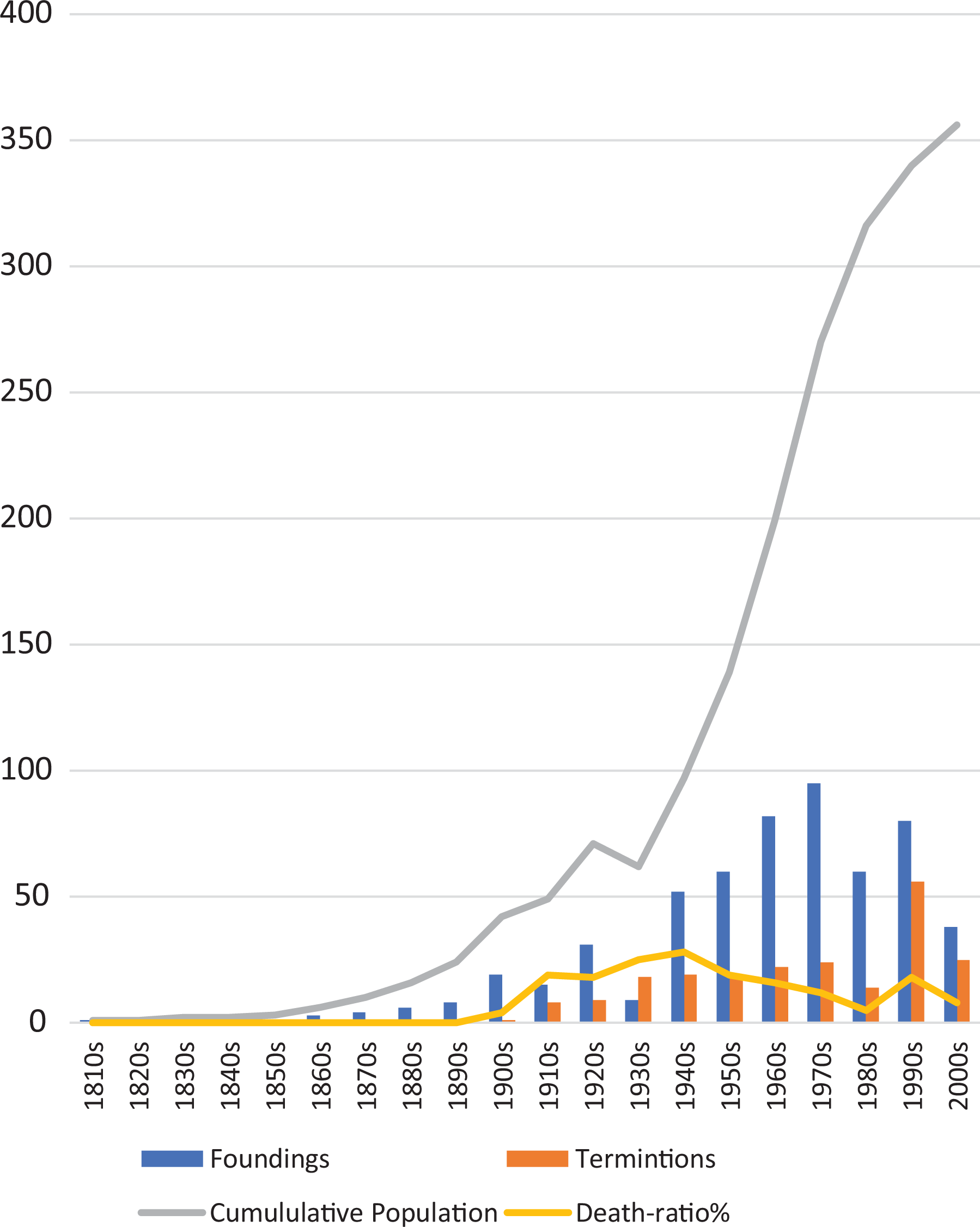
IGO foundings, terminations and population growth, 1815–2006.
Figure 2 shows deaths by geographic region. It shows that whereas death ratios peaked in Europe during the World Wars, and in the Americas between 1910 and 1930, deaths on the African continent climbed sharply between 1950 and 1970 – coinciding with the largest wave of decolonisation.
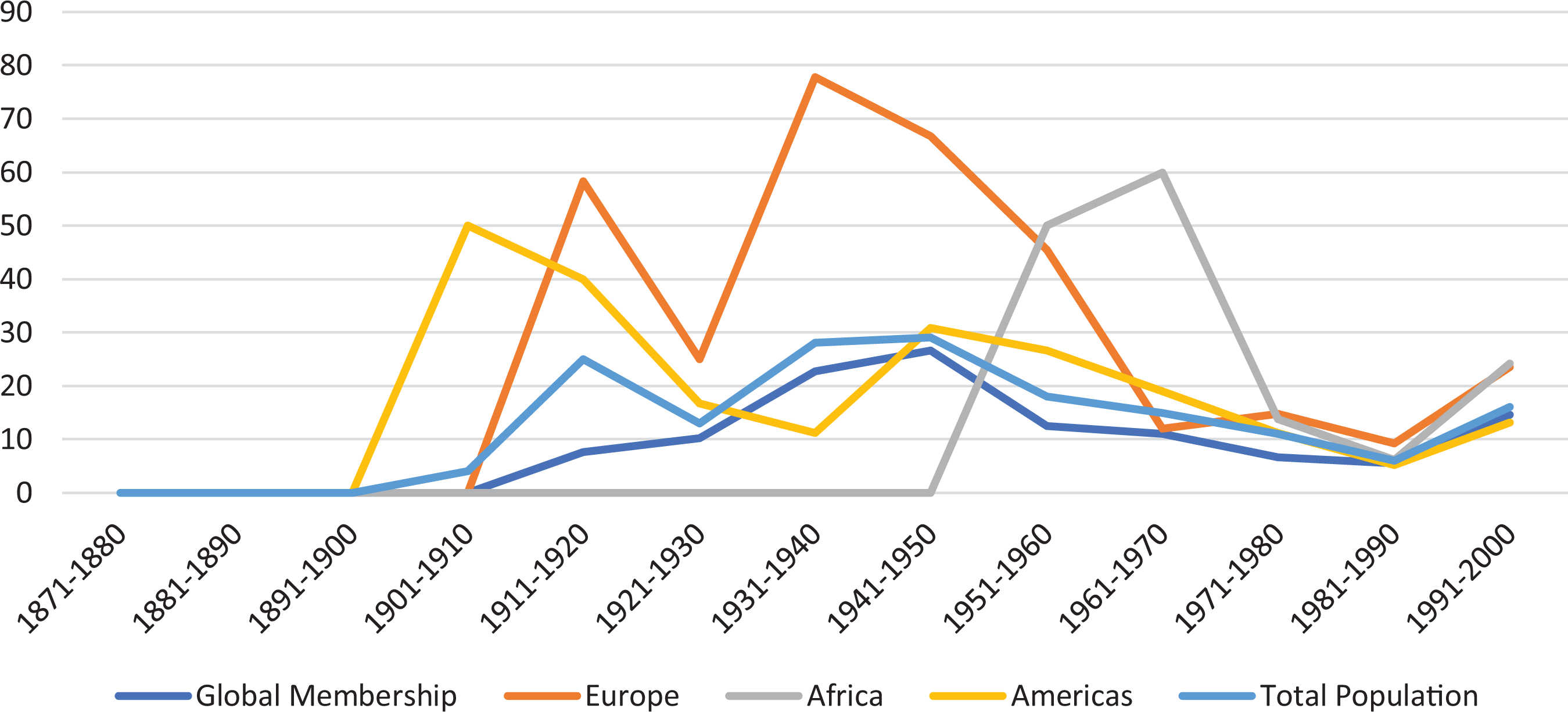
IGO deaths as a proportion (%) of incumbent population (according to geography – selected regions).
Historical and geographic fluctuations in IGO deaths may provide general clues about what causes organisational deaths to spike, but they tell us little about what kinds of IGOs die under what specific circumstances. To provide a more detailed picture, I report results of a Cox proportional hazard analysis, which measures IGO mortality according to organisational features such as membership, function and organisational age (Table 1, Appendix). Using a historical event analysis method, this model measures relative mortality by considering the amount of time an IGO has been in existence before death strikes. 9
The model shows that the size of an IGO’s membership is a statistically strong predictor of death, with an inverse correlation between number of member states and risk of termination. On its own, however, this finding must be treated with caution: IGOs that produce significant benefits for states may attract more members, implying that size may be confounded with other potentially survival enhancing factors, such as organisational ‘effectiveness’.
In terms of function, IGOs focused on security and judicial matters display the highest mortality rates, followed by IGOs focused on trade and economic and social policy, whereas IGOs that handle predominantly technical matters (such as scientific and standard setting bodies) have lower mortality. Across the period, security organisations are more than twice as likely to terminate as ‘technical’ IGOs.
Turning to age, hazard analysis shows that an IGO’s survival chances drop sharply during the first three decades of its existence, then decline at a slower rate between 30 and 50 years, only to stabilise at around 50 years (Figure 3, Appendix). In other words, once an IGO makes it through a perilous youth during which it is highly liable to termination, its immediate termination risk declines.
To summarise, population-wide analyses across two centuries show that IGO death rates vary according to both exogenous factors such as geopolitical upheaval and to intrinsic features such as membership, function and organisational age, which may serve as either independent or intervening causal variables. This raises important questions for further study: how specifically may geopolitical turmoil undermine IGOs? How, and to what extent, may endogenous factors such as a large membership reduce risks of termination? To probe deeper into these questions, we need an explicit theory of IGO death to guide analysis.
Theorising IGO death
Debates in IR about the creation and endurance of international institutions have traditionally been anchored in three main paradigms: power-based (or realist) accounts, interest-based (or ‘functionalist’) accounts and social constructivism (see Cotrell, 2016). These theoretical clusters focus on different variables – geopolitical, economic or social – which generate important institutional outcomes. In recent decades, IR scholars have also increasingly turned to historical institutionalism to examine how temporal processes such as ‘critical junctures’ and path-dependent processes shape international institutions (Fioretos, 2011, 2017; Pierson, 2004; Rixen et al. 2016).
My discussion centres chiefly on three clusters of theoretical arguments: power-based and functionalist accounts and historical institutionalism (HI). As discussed, given a predominant focus on theorising barriers to institutional change, neither cluster of theories offer explicit predictions about when IGOs may be forsaken by their creators. However, this does not imply they cannot potentially explain what ‘kills’ IGOs. By identifying sources of institutional robustness, existing theories implicitly provide a starting point for explaining the opposite outcome: institutional collapse. From the perspective of extant theory, IGO deaths may be simply viewed as theoretically expected events (endurance) that fail to materialise, prompting us to ask whether causal factors believed to underpin institutional robustness are absent in these cases (see van Evera, 1997). Admittedly, this approach has shortcomings. Most obviously, absence of hypothesised ‘robustness-enhancing’ factors is unlikely to be a direct cause IGO death, but may be merely an intervening or contributing factor (in much the same way as immunodeficiency is not a direct cause of death in a biological organism but merely a factor increasing susceptibility to disease). Nevertheless, by theorising sources of institutional robustness, existing institutionalist theories can help to identify specific candidate factors (exogenous or endogenous to institutions) that may serve to disrupt entrenched institutional equilibria, while simultaneously focusing attention on underlying structural factors that may account for systemic variation in organisational survivability.
It is important to clarify that I do not intend my formulation of hypotheses to usher in a competitive test of rival theoretical paradigms. Rather, my aim is to combine insights from major institutionalist theories to build towards an understanding of what causes IGO death. As many scholars have observed (e.g. Fioretos, 2011, 2017; Pierson, 2004), rather than theoretical competitors, functionalist and power-based theories (which stress various degrees of state rationality) and HI approaches are often complementary – each emphasising different aspects of institutional processes that may produce institutional stability or change. For example, by focusing on the utility of institutions to states, both power-based and functionalist theories draw attention to how factors exogenous to institutions (such as war or economic depression) may alter existing balances of power and interests and lead to ‘punctuated equilibria’ (Krasner, 1984) characterised by rapid institutional change. While having less to say about processes exogenous to institutions, HI scholars call attention to temporal processes such as positive feedback, sequencing, duration and timing, which can enrich thinner rationalist conceptualisations of ‘increasing returns’ from institutions. Such temporal processes may result in gradual institutional reinforcement or gradual deterioration, possibly culminating in institutional death (Capoccia and Kelemen, 2007: 344; Fioretos, 2017: 15; Pierson, 2004; Rixen et al., 2016). By combining insights from these perspectives, I thus seek an explanation of IGO death that integrates exogenous forces and intrinsic institutional features.
Exogenous shocks and IGO death
From the perspective of realist, power-based theory, international institutions are created and maintained by powerful states to advance national interests. Since they serve the needs of powerful patrons, institutions are expected to change following major shifts in international power balances. War and economic crisis feature heavily in such accounts (Fioretos, 2017). For example, a large literature examines how abrupt power shifts – such as those triggered by the Napoleonic wars, the World Wars or the Great Depression – create opportunities for newly powerful states to remake the international system in accordance with their own interests by putting in place institutions that increase returns to their power and ‘lock in’ their privileged position (Gilpin, 1981: 36; Gunitsky, 2017; Hanrieder, 2015; Mearsheimer, 1995: 7,13).
Power-based accounts often focus on historical crises or ‘critical junctures’ as starting points rather than end points. Thus, historic power shifts are widely depicted as ‘founding moments’ ushering in new institutional orders from which a range of positive feedbacks flow (e.g. Ikenberry, 2001). In this spirit, scholars have lavished significantly greater attention on the ‘grand institutional bargains’ struck at Versailles (1919) and Bretton Woods (1944) than on pre-existing institutional arrangements that fell by the wayside. If we turn the gaze around, however, a power-based logic suggests that major power shifts will undermine IGOs that privilege the interests of no-longer powerful patrons while leaving intact organisations that accommodate the interests of newly powerful states. A power-based institutional logic also offers a further insight. Since existing institutions presumably favour traditionally powerful states, the push to dismantle existing IGOs can be expected to come from newly powerful states that feel disadvantaged by the institutional status quo (Jupille et al., 2013: 43; Lipscy, 2015).
Whereas realists ask whether institutions serve the needs of powerful states, functionalist theories focus greater attention on collective benefits from institutions (Hanrieder, 2015; Pierson, 2004). Borrowing from new institutional economics, functionalist scholars hold that states create international institutions to reduce the transactions costs of cooperation – chiefly through supply of information and by creating ‘focal points’ for cooperation. A premise of functionalist institutionalism is that designing effective institutions involves high start-up costs, whereas benefits created by institutions increase with continued use thanks to scale economies, coordination and learning effects. Thus, ‘once a given institutional equilibrium has been reached, substantial changes in the environment are necessary to alter it’ (Hanrieder, 2015: 17; Jupille et al., 2013; Keohane, 1984: 101–102). Nevertheless, states are expected to abandon existing institutions if they no longer seem to present efficient solutions to joint cooperation problems (Jupille et al., 2013; Stein, 1990: 50–51).
Observationally, a functionalist or ‘efficiency-based’ logic is difficult to distinguish from a power-based logic at the population-level. Presumably, exogenous shocks in the form of major wars or economic depression that trigger shifts in relative state power may also reduce the expected utility to states individually and collectively of adhering to existing institutional equilibria. Yet by conceiving of institutional efficiency in terms of collective gains rather than ‘private’ benefits to powerful states, functionalism highlights that IGO terminations may reflect changes in state preferences independently of shifts in relative power. Furthermore, functionalists emphasise that institutions – once created – give rise to ‘permanently useful resources’, which facilitate cooperation in a variety of different contexts (Keohane, 1984: 102). This implies that, when faced with new problems, states will usually seek to reform existing institutions rather than discard them (ibid., p.107). Thus, in contrast to a power-based logic, a functionalist logic suggests that the termination of IGOs following exogenous shocks should reflect broad disenchantment (possibly reflecting unsuccessful attempts at reform), rather than (simply) direct power competition. Given that these different rationales may be difficult to discern at the population level, whether an efficiency-based or power-based rationale best explains IGO deaths is best determined through closer examination of smaller sets of cases.
Endogenous factors: adaptability as a function of scope, centralisation and size
Whether one adopts a power-based or efficiency-based rationale for the creation and maintenance of international institutions, a brief historical survey of IGO deaths (see the section, `IGO mortality 1815–2016’ above), suggests that exogenous shocks alone are insufficient to explain variation in IGO terminations. Wars and economic depression may undermine many IGOs, but many more survive. To explain IGO death, we thus need a systemic theory that explains why some organisations cope better with exogenous shocks than others.
A starting point for such a theory is to consider variation in IGOs’ capacity for adaptation. Faced with an exogenous shock, an IGO’s continued utility – whether to powerful states or wider stakeholders – may depend on how easily it can be adapted to changing circumstances. A useful conceptualisation of institutional adaptability is provided by Wallander (2000: 706) who theorises an IO’s adaptability as a function of whether its organisational assets – its principles, rules and procedures – are ‘specific’ or ‘general.’ Specific assets facilitate particular transactions for a specific purpose, and confer efficiency gains for those particular transactions, whereas general assets confer efficiency gains on a variety of different transactions in different contexts (opcit; Keohane, 1984: 90). Although asset specificity may be a function of multiple factors, this logic suggests that IGOs with broad mandates that span several different functions or policy areas will be more adaptable on average than IGOs that serve a narrowly defined purposes for which they may have developed highly specialised routines and expertise.
Adaptability may also depend on centralisation. As Wallander explains, ‘general assets’ are assets that enable states to cooperate efficiently in a variety of contexts by providing information and by establishing clear rules for negotiation, decision-making, monitoring and dispute resolution, which reduce transaction costs and increase transparency (2000: 707). IGOs that offer centralised information provision, decision-making and implementation can thus be said to be rich on ‘general assets’, which confer efficiency gains on a variety of different transactions. From a functionalist perspective, this should enhance their adaptability to environmental change. 10
A third aspect of adaptability is size. Population-wide hazard analysis (Table 1, Appendix) showed an inverse relationship between the size of an IGO’s membership and its termination risk. As discussed, this correlation may be spurious. There are, however, several theoretical reasons to expect that size may affect mortality. The more members an IGO has, the larger the number of patrons to whom its functions are of potential future value, and that have expended resources to create dedicated bureaucratic structures to support its functions. For example, most countries have established permanent diplomatic missions to IOs like the UN, EU and WTO and created national bodies tasked with overseeing implementation of conventions and decrees issued by these organisations, thereby creating strong stakes in their perpetuation at the domestic level (Strange, 1998). All else equal, the more state members an IGO has, the broader interests will be vested in its continued existence. Thus, much like banks, some IOs may be ‘too big to fail’.
Size may also reduce vulnerability to exogenous shocks by ‘spreading risk’ (Ranger-Moore, 1997: 904–905). Whereas IGOs with small membership may be vulnerable to changes in the political situation of a single member-state, IGOs whose membership spans many countries may be able to ‘average outcomes’ across members, thus reducing vulnerability to country- or region-specific shocks (Eilstrup-Sangiovanni, 2018). To illustrate: a global trade organisation with 150 members will not be fatally undermined if a few members become embroiled in conflict or withdraw, whereas an IGO with just three members would cease to exist if one party exited.
It is important to acknowledge that size might be hypothesised to have the opposite effect. More member states tend to imply greater preference heterogeneity, which might reduce organisational flexibility by multiplying veto-points. 11 But whereas large size may diminish organisational capacity to respond flexibly to environmental demands, it may nonetheless increase adaptability understood as ‘resilience.’ Specifically, organisational adaptability does not necessarily require agent-driven strategic flexibility but may simply entail that an IGO holds continued value for a sufficient number of stakeholders despite changed circumstances to attract necessary political and financial support. Thus, while large size may reduce one aspect of adaptability – strategic flexibility – it may nonetheless increase an IGO’s ability to accommodate exogenous change.
From this analysis, we can identify three intrinsic factors – narrow mandate, low centralisation and small size – that are likely to increase IGO mortality by lowering adaptability to change. I hypothesise that death becomes more likely if any of these causes are present, but especially so when they exist in combination. 12 I further hypothesise that these factors will be particularly consequential in conjunction with exogenous shocks. A narrow mandate or small size may not severely penalise an IGO during periods of relative stability. However, such liabilities are likely to prove more decisive in rapidly changing environments when institutions come under strong pressure to adapt.
Reconciling exogenous and endogenous factors: timing and sequencing
I have proposed that IGO deaths are caused by a combination of exogenous shocks and intrinsic institutional features including narrow scope, low centralisation and small size, which reduce organizational capacity to cope with exogenous shocks. An additional aspect of survivability is temporality. Unlike rationalist theories which portray states as free to abandon institutions when they no longer maximise utility (Rixen and Viola, 2014), a core insight of HI is that institutions are subject to strong lock-in effects arising from positive feedback processes and complementarities existing within broader institutional systems. These processes imply that, once a particular institutional path gets established, the cost of reversals increase drastically (North, 1990: 89; Pierson, 2004: 10). From this perspective, institutions may endure, not because they present efficient solutions to collective action problems, ‘but simply because barriers to change grow over time’ (Fioretos, 2017: 9,13).
By emphasising positive feedback processes, HI theories highlight the importance of temporality in that it matters when institutions are introduced, in what order, and how long they have been around – individually and jointly (Pierson, 2004: 1). HI scholarship points to three types of positive feedback processes that strengthen institutional lock-in over time. First, institutions in place for extended periods change the expectations of social actors, leading them to adjust their policy preferences and routines in ways that reinforce initial institutional choices (‘adaptive behaviour’) (Pierson, 2004: 85). Second, institutions tend to accumulate knowledge and expertise, which leads to higher returns from continuing use (‘learning effects’) (North, 1990: 95; Pierson, 2000: 253). Third, institutions over time tend to develop strong exchange relationships that lead to the development of complementary practices among other actors, thereby increasing joint benefits within an institutional system (‘coordination effects’). 13 All else being equal, the longer an IGO is in operation, the greater adaptation, learning and coordination effects it is likely to generate. Newly created IGOs, by contrast, are less likely to benefit from widespread adaptation or learning effects, or to have developed strong exchange relationships that embed them securely in their environments (see Stinchcombe, 1965 on ‘liability of youth’). 14
Not merely the passage of time but also the timing and sequencing of events may affect IGO mortality. As Pierson (2004) notes, a focus on path dependence raises a conundrum: how can we think systematically about causal processes involving the interaction of large systemic shocks (such as the onset of global war or economic depression) and ongoing processes of institutional self-reinforcement, which are quite separate from these shocks, but which embed IGOs more deeply in their environments over time? One answer is to focus on timing. Just as small membership or low centralisation may incur higher penalties during times of crisis, the negative impact of exogenous shocks may be more severe if they hit early in an IGO’s lifespan when it is still relatively weakly established. 15 An HI approach further suggests that when a particular process occurs sequentially matters insofar as ‘early developments become deeply embedded in a particular environment, altering the resources and incentive structures…of social actors, and thus changing subsequent events’ (Pierson, 2004: 64). This implies that, just like early entry into a market can confer a leading market position on firms (Baum and Shipilov, 2006), being first to facilitate cooperation on a given issue may be advantageous for an IGO by triggering strong positive feedback processes (Jupille et al., 2013: 211). Additional to benefits of absolute age, this suggests that IGOs that are older relative to their peers are more likely to weather exogenous shocks thanks to their ‘first-comer status’.
As with size, the notion that age reduces mortality may seem counterintuitive. Older IGOs tend to have more formalised structures, standardised routines and greater accumulation of sunk costs, which may reduce adaptability and discourage organisational change (Levitt and March, 1988; Olson 1965; Ranger-Moore, 1997: 904). Also, since organisations tend to reflect their founding environment, newly created IGOs seem more likely to reflect current state preferences, whereas older IGOs would seem at greater risk of obsolescence. Nevertheless, given some minimum element of periodic institutional updating dynamics of path dependence suggest that such potential ‘liabilities of age’ will often be outweighed by positive feedback processes that anchor IGOs more firmly in their environments over time. This means that the older an IGO is, the older it is likely to grow. Far from tautological, this is precisely what institutional path dependence entails.
Technical versus non-technical IGOs
Results from population-wide hazard analysis (Table 1, Appendix) show that IGOs focused on ‘high politics’ matters such as security, judicial matters and trade have higher mortality than IGOs that address purely technical or scientific matters. One reason might be that ‘technical mandate’ is confounded with other survival enhancing factors such as large size or high centralisation. 16 However, hazard analysis reveals a statistically significant effect for ‘technical mandate’ independent of other features, and comparison across different IGO types does not show technical IGOs as outliers in terms of either membership or centralisation (Table 2, Appendix). This leads me to propose that serving a technical function in itself enhances an IGO’s life prospects. One reason could be that technical IGOs are subject to strong positive feedback processes and thus incur high substitution costs. Once states adopt specific technical standards and procedures as the basis for international exchange (say, common standards for weights and measures, road signs or aviation safety protocols), these become subject to significant coordination and adaptation effects (Kaiser, 2014). Thus, despite having narrow scope, technical IGOs may be subject to strong self-reinforcing effects, which embed them deeply in wider institutional matrixes at both national and international levels and which make it particularly costly for states to abandon them.
A second reason for low mortality among IGOs with technical mandates may be that they often fulfil practical needs (e.g. metrology, meteorology or postal services) for which there is continued demand even in times of crisis. For example, since they typically have fewer direct implications for relative power, IGOs with purely technical mandates may be less vulnerable to abrupt power shifts than IGOs whose functions have direct distributive effects (e.g. IGOs focused on trade, finance or military cooperation). This is not to suggest that technical and scientific IGOs are ‘apolitical’. Some can become focus of fierce distributive battles as illustrated by US President Trump’s threat in 2018 to withdraw from the Universal Postal Union on grounds that its heavily subsidised postal rates favoured Chinese traders. On average, however, IGOs with limited technical mandates are less likely to become embroiled in political power struggles than non-technical IGOs. Instead, technical organisations may be more vulnerable to issue-specific technological shocks, which render their services obsolete. Thus, technical IGOs are likely both to have lower mortality than non-technical IGOs and to display a different pattern of mortality insofar as terminations are less likely to closely track geopolitical upheavals.
Empirics: exogenous change and IGO death
From population-wide statistical analysis, we know that periods of geopolitical and economic instability are broadly associated with higher IGO termination rates. We also know that many IGOs survive wars and economic crises. In the previous section, I identified intrinsic factors that I hypothesise influence IGO termination. These causal factors are separate from, but complementary to, exogenous shocks. Thus, while IGOs with intrinsic ‘liabilities’ such as small membership or young age may incur only slight penalties in stable environments (see Ranger-More, 1997), such features are likely to render organisations particularly vulnerable during periods of rapid exogenous change.
Given the hypothesised interaction of intrinsic and exogenous factors, a good basis for testing my hypotheses is to examine changes in the IGO population during a period of high environmental stress, which affects a large segment of the population. Focusing on a period during which large numbers of IGOs are subject to a similar systemic shock allows me to check for the presence/absence of intrinsic features assumed to help some organisations cope with stress while others succumb. Results can later be refined by examining the incidence and profile of IGO terminations during a period of relative environmental stability (on my theory terminations should be rarer, and the disparity in death rates between IGOs with different features associated with high/low adaptability less pronounced).
Identifying systemic shocks
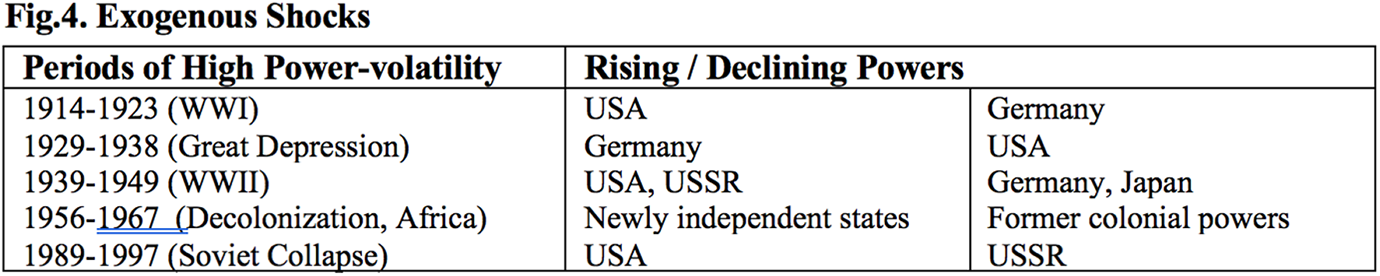
I hypothesise that IGO deaths are caused by exogenous shocks, which alter state preferences and reduce the utility of existing institutions either to powerful states or wider groups. Exogenous shocks may take different forms (a point to which I return later). However, a commonly cited basis for changing preferences regarding international cooperation are sudden shifts in relative power. To observe the impact of power shifts on IGO terminations, I build on Gunitsky’s (2011) measure of ‘power volatility’ reflecting annual changes in relative power among major states. Using Composite Index of National Capabilities scores, Gunitsky identifies two periods of extreme power volatility – 1917–1922 and 1940–1947 – and one period of lesser fluctuation, 1989–1995. However, Gunitsky’s analysis shows power volatility climbing sharply from 1914 and remaining high until 1923 (Gates et al., 2007: 19 have a similar finding). I thus identify three periods of high global power-volatility: 1914–1923, 1939–1949 and 1989–1997. To capture other aspects of geopolitical change (additional to shifts in demographic, military and industrial strength, which are the main components of extant measures), I also include the Great Depression (1929–1938) as a period of economic turmoil, and 1956–1967 as a period of rapid decolonisation across Africa involving significant shifts in political power.
The list of exogenous shocks in Figure 4 is not exhaustive. It omits many shocks at regional or sub-regional level, and sector-specific shocks like the international oil crises during the 1970s. However, by identifying systemic shocks that affect large segments of the IGO population, it provides a good starting point for systematically observing variation in the impact of exogenous shocks on IGO mortality.
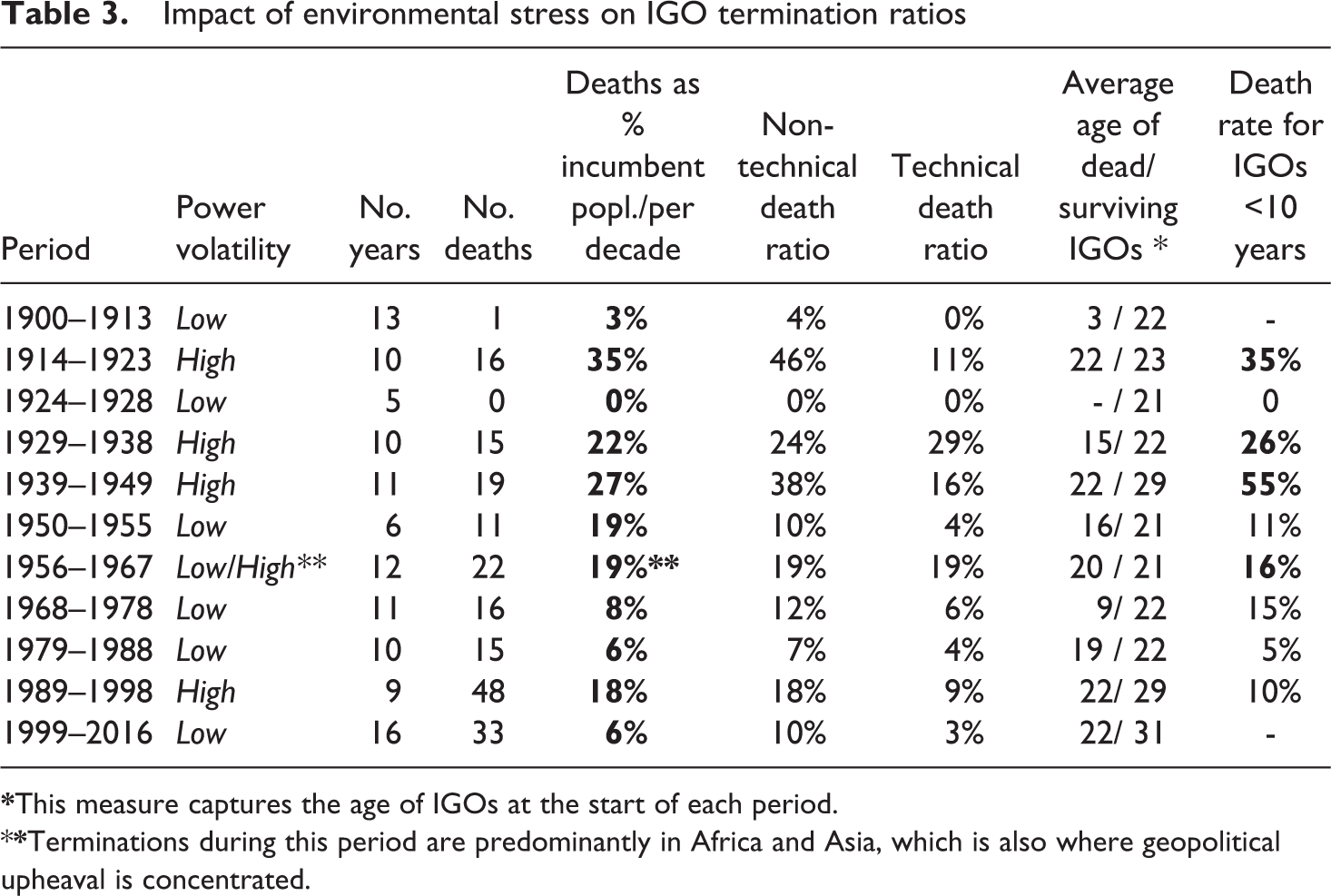
As illustrated in Table 3, periods of high global power-volatility display elevated termination ratios (18%–35% of incumbent population per decade) whereas ‘low stress’ periods have lower mortality rates (0%–19%), supporting both Hypotheses 1a and 1b. To see whether technical IGOs are less vulnerable to systemic power shifts than other organisations, I compare termination ratios for technical/non-technical IGOs. Termination ratios for non-technical IGOs soar as high as 46% and 38% during the World Wars, whereas mortality rates for technical IGOs remain lower (11% and 16%). By contrast, the highest death ratios among technical IGOs are during the Great Depression (29%) and during 1956–1967 (19%). This suggests that technical and non-technical IGOs may be vulnerable to different exogenous shocks (Hypothesis 4) and supports treating the two types as separate sub-populations in further analysis. As predicted (Hypothesis 3), average prior lifespan is higher for surviving IGOs during all periods, but relative death ratios for young IGOs (<10 years) increase significantly during volatile periods, meaning that ‘liability of youth’ is especially pronounced during periods of geopolitical instability.
Impact of environmental stress on IGO termination ratios
*
By isolating periods of high volatility in global power distributions, the analysis in this section confirms that rapid geopolitical change is strongly correlated with IGO death. But without closer scrutiny, we cannot tell how power volatility impacts the mortality of different IGOs. In the remainder of this section, I therefore conduct a structured comparison of the periods 1939–1949 (a period of rapidly shifting power among major powers) and 1968–1978 (a period of relative stability at global level, see Table 3 above). I begin with a brief statistical comparison of the two periods in order to test hypotheses regarding organisational age and adaptability. This analysis also serves to establish parameters for more focused case studies to assess the plausibility of observed statistical relationships between specific variables.
In the previous section, I identified intrinsic factors including small size, narrow scope, low centralisation and young age as likely causes of IGO collapse during crisis. Some of these factors may be correlated. For example, younger IGOs may on average have smaller membership. Yet, hazard analysis shows a statistically significant effect for each factor separately, suggesting the merit of exploring their impact through further medium-n and case-based analysis to tease out their individual and combined effects. Relevant institutional features are operationalised as follows: centralisation is measured on a scale from 0 to 3 according to whether an IGO provides centralised dispute resolution, monitoring and enforcement. To determine the scope of an IGO’s policy portfolio, I build on a list of 26 policy areas set out by Hooghe and co-authors (2017) (see details in Codebook). IGOs whose mandate span more than three policy areas are classified as ‘General-Purpose’. 17 Size of IGO membership and age are both recorded at the beginning of each historical period.
IGO death: 1939–1949
Given high termination rates during the 1930s, just 62 IGOs were in existence worldwide in 1939 (versus 70 a decade earlier). Of these, 17 died between 1939 and 1949. Another two IGOs were founded and terminated during the period, bringing total terminations to 19 (Table 4).
Impact of environmental stress – select periods.
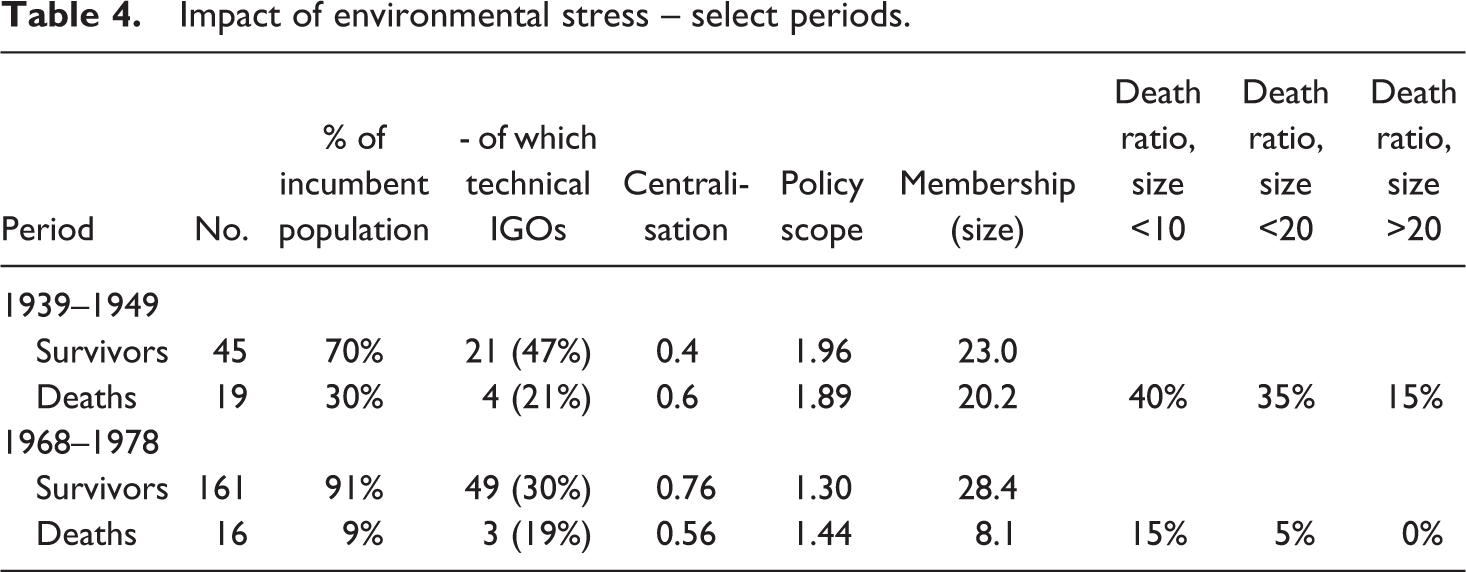
When considering what (if anything) distinguished fatalities from survivors, the most conspicuous factors are geography and function. The majority of IGOs that collapsed had either exclusively European membership or a preponderance of European members. By contrast, regional or inter-regional IGOs in other parts of the world (e.g. the Americas, Africa and the Commonwealth) were less likely to succumb. As reported earlier, technical IGOs had lower death rates (16%) than non-technical IGOs (38%). (see Table 3)
A third striking factor is length of prior lifespan. The average age (as of 1939) of IGOs that terminated was 22 years versus 29 years for survivors, and mortality among IGOs aged <10 years was 55% (versus 27% average death rate), meaning that IGOs that were newly established when war broke out were significantly more likely to perish (Table 3.). IGOs that terminated had on average 20 members versus 23 for survivors (Table 4). Policy scope did not differ markedly between casualties and survivors, and centralisation was higher among terminating IGOs (0.6 versus 0.4) providing mixed support for Hypothesis 2.
In addition to confirming the negative impact of large power shifts on non-technical IGOs specifically and the liability of youth, closer analysis of the period 1939–1949 draws attention to a small group of long-lived IGOs, which should be of particular interest to IO scholars. Nineteen of forty-five IGOs that persisted through the period 1939–1949 were founded prior to 1914. Not only did these organisations survive two World Wars, but fourteen of these ‘double-war-veterans’ are still operative today. When considering what may account for the durability of these organisations despite profound changes in the conditions that gave rise to them, three factors stand out: first, most focus on narrowly technical issues related to standards and measures, scientific research, or postal services. None focus on security or trade (confirming Hypothesis 4). Second, with an average age of 27 years by 1914 (52 years by 1939), these organisations were already firmly established when global conflict broke out (supporting Hypothesis 3). Furthermore, their advanced age – in absolute and relative terms – suggests that these IGOs likely benefitted from ‘first-comer’ status. Organisations such as the International Telecommunication Union (ITU; 1865–present), the Universal Postal Union (1874–present) or the International Bureau of Weights and Measures (1875–present) were all first to facilitate broad international cooperation on specific problems. ‘Pioneer’ status allowed these organisations to shape norms and practices of cooperation in their respective fields and prompted early adaptation by other actors which further reinforced the rules and norms advanced by these organisations and fortified them vis-à-vis competing frameworks. To illustrate, the ITU has been in continuous operation since 1865 whereas later IGOs dealing with telecommunication (e.g. the Radio-Telegraph Union, 1906–1932; the International Telegraph Committee, 1925-1956; the International Long-distance Telephone Council, 1925–1956; the Inter-American Radio Office, 19371–1963) have all had shorter life-spans, eventually ceding their functions to the ITU.
IGO death: 1969–1978
Compared to 1939–1949, the years 1969–1978 featured limited power volatility. The global IGO population in 1969 stood at 177. Of these, 16 died by 1978 (9%) (Table 4). As during other periods, technical IGOs terminated less frequently (Hypothesis 4). Consistent with Hypothesis 2, surviving IGOs had an average of 28 members versus 8 for IGO fatalities, whereas scope and centralisation scores were only slightly higher among surviving IGOs (0.8 versus 0.6), once again providing mixed support for Hypothesis 2. Consistent with Hypothesis 3, surviving IGOs had an average prior lifespan of 22 years versus just 9 years for IGOs that terminated. However, termination ratios for newly founded IGOs remained lower than during 1939–1949 (15%). (Table 3).
It is important to note that although the years 1969–1978 featured relative geopolitical stability globally, this does not rule out significant regional instability. On closer scrutiny, several IGO deaths can be linked directly to local and regional power shifts. For example, the International Red Locust Control Service was dissolved in 1970 due to growing tension between South Africa and Portugal and a group of newly independent African states that withdrew from the organisation to form an independent grouping (Byaruhanga, 1999). Similarly, the Asian & Pacific Council (founded in 1966 to contain the spread of Communism in Asia) and the Southeast Asia Treaty Organization (a US-led collective-defence treaty to ‘counter Communist aggression’) both dissolved after Sino-American rapprochement robbed these organisations of their purpose (Reinalda, 2009: 372). Thus, while low power volatility at global level led to low overall death rates, individual deaths can be linked to local power shifts.
Detailed comparative historical analysis in this section confirms that power volatility takes a greater toll on non-technical IGOs and that ‘liability of youth’ is higher during periods of high environmental stress. It also shows that whereas smaller IGOs are more prone to terminate overall, the ‘protective effects’ of having a large membership may be partly cancelled out by dramatic shifts in power distributions, such as during World War II. As expected, technical IGOs have lower mortality during all periods surveyed, except during the Great Depression and from 1956 to 1967. Looking closer at technical IGOs that terminated in 1956–1967, it emerges that several brought together colonial powers and former colonies to address technical issues such as collection of statistics or agricultural research. Despite their technical mandates, they may have been seen as tools of foreign influence, which may explain their higher termination rates during this time. Further analysis is needed to determine what explains unusually high termination rates among technical IGOs during the Great Depression, but acute lack of funding seems a plausible hypothesis. Contrary to expectation, neither broad scope nor centralisation significantly reduce mortality during the periods under examination. 18
Case studies
Statistical analysis of the global IGO population across time confirms that geopolitical upheaval kills many IGOs. It also confirms that IGOs that terminate are on average younger and smaller than enduring organisations, and more likely to focus on ‘political’ matters, such as security or trade, than on purely technical matters. Yet how precisely this contributes to their undoing remains uncertain. By identifying typical causal effects across a population, statistical analysis relies on a probability-based definition of causality where a ‘cause’ is simply a value on a variable that makes certain outcomes more likely (Mahoney, 2008: 2–4). To gain a deeper understanding of how specific causal factors contribute to IGO death, this section therefore supplements statistical analysis with focused case studies that seek to trace the context and mechanisms through which specific factors – jointly or singly – lead to IGO termination.
My case selection abides by two criteria. First, by including cases of both terminated and enduring IGOs, I provide stronger tests of individual hypotheses. Second, by selecting both cases that are strongly predicted by the statistical model (‘typical survivors’ or typical casualties and seemingly anomalous cases of IGOs that persist despite adverse conditions (‘unlikely survivors’) or that perish despite seemingly favourable conditions (‘unexpected deaths’), I seek to discover potential variables omitted from the large-n study, which may be influencing results, and thereby generate new hypotheses for future research (on use of ‘least likely’ cases to generate new research questions, see Levy, 2007: 202; Rohlfing, 2008). Based on these criteria, I select four cases for in-depth study.
International Bureau of Education, 1929–1969
My first case, the International Bureau of Education (IBE), fits the profile of a ‘typical survivor’. Founded in 1925 as a private organisation by the Institute Rosseau, IBE was constituted as an IGO in 1929, becoming the first IO to facilitate exchange of information and research on education. During the 10 years prior to World War II, IBE was highly active despite a limited budget and staff (Rosselló). In 1934, the Bureau founded the International Conference on Public Education (ICPE) – an annual intergovernmental forum focused on educational development. Thanks to the ICPE’s considerable success, IBE’s membership, which spanned Europe and Latin America, grew rapidly from 12 in 1929 to 15 by 1939, and 20 by the end of the war, providing a broad base of international support.
During the war, as it became impossible to convene the ICPE, IBE’s Secretariat created the Service of Intellectual Assistance to Prisoners of War (SIAP) providing books and intellectual services to prisoners of war. In 1940, as funding grew scarce, IBE began to issue postal stamps to fund the project. By the end of the war, it had distributed more than 600,000 books and organised ‘Internment Universities’ in many prisoner camps. Rather than falling dormant during the war, as it happened to many technical IGOs, IBE thus successfully refocused its activities and adapted its funding model to meet wartime needs.
Besides its operational flexibility, which stemmed from low dependence on state funding, an important factor in IBE’s survival was its apolitical, technical nature, which insulated it from geopolitical strife and distributive conflict. Created to provide a forum ‘neutral from national, political, philosophical and religious point of view in a strictly scientific and objective state of mind’ (IBE Statutes, 1929), and focused primarily on exchange of information, IBE’s activities were politically unobtrusive. This apolitical profile grew increasingly important as IBE’s membership expanded. To meet the challenges of a large, diverse membership, IBE ‘ceaselessly stayed clear of interfering with the educational freedom of partners’. Rather than pushing for standardisation of global educational development, the Bureau sought ‘to take into account the specific needs of each region…in order to shape the worldwide educational movement’, and strove to ‘promote universal education without interfering with local priorities’ (Hofstetter and Schneuwly, 2013: 217; ICPE II, 1934: 158). Internationally, IBE likewise remained politically neutral. In 1963, a group of newly independent African nations sought to use the worldwide platform of the ICPE to protest colonial policies by demanding that Portugal be excluded from the yearly conference. Yet IBE’s directorship emphatically argued that banning a convened member on political grounds would contradict IBE’s ‘technical, scientific and universal features’ and insisted that ‘other organizations could take on that responsibility’ (Hofstetter and Schneuwly, 2013: 228).
A third basis of IBE’s ability to weather geopolitical change lay in its high informational and technical expertise. Before becoming an IGO in 1929, IBE had already organised dozens of international congresses, working closely with the League of Nations, the ILO and several international research associations (Rosselló). Prior to the war, its ‘pedagogical tour of the world’, which collected data on national educational reforms and issued recommendations, reached more than 70 countries 19 and provided a crucial resource for national education reformers. Thus, when UNESCO was created in 1945, IBE helped to develop its education programmes, building on its decade-long experience. By 1952, a permanent joint commission was established to facilitate cooperation between IBE and UNESCO, and in 1969, IBE formally joined UNESCO becoming the first of UNESCO’s independent Category I Institutes, which meant it retained a large degree of operational independence. Thus, consistent with my expectations, IBE’s technical mandate and apolitical profile was key to its survival. The fact that IBE had achieved a relatively settled status by the time war broke out and benefitted from a large and geographically diverse membership further helped its survival, as did close ties to other international institutions to whom its services remained important despite geopolitical conflict.
The European Commission for the Danube, 1856–1939
In contrast to IBE, which survived World War II, the European Commission for the Danube (CED) was an early (and theoretically well-predicted) casualty of the war (a ‘typical death’). Created to keep major European waterways open to traffic and commerce, the European River Commissions were of great economic and militarily importance. The international conventions governing navigation on the Rhine, Elbe and Danube formed integral parts of earlier European peace settlements, starting with the Vienna Peace Treaty of 1815, which guaranteed freedom of navigation in Europe, and extended by the Paris Peace Treaty of 1856 (‘Act of Navigation’). During World War II, navigation on the Danube was controlled by Germany and Austria-Hungary who used the river as a base for warships. Thus, at the Versailles Peace Conference in 1919, ‘in an effort to block the resurgence of German or Russian power’, the Allies’ Supreme Council ruled that membership of the CED should henceforth include riparian states plus Britain, France and Italy in order (to balance German power), while Russia together with Turkey were expelled (Popper, 1943).
During the 1920s and 1930s, the CED undertook important engineering works to improve navigability of the Danube (opcit.). However, as World War II loomed, the Commission’s fate once again grew uncertain. From the spring 1936, German parts of Danube were controlled by Nazi Germany, and on 14 November 1936 Germany announced it would cease cooperation with all the river commissions established by the Versailles Treaty. 20 According to British Foreign Secretary, Anthony Eden, ‘Germany justifies this step on the ground that the Articles in question were dictated to Germany and not freely negotiated…and clarifies that, for the future, national treatment will be accorded on a basis of reciprocity on German waterways to the vessels of all States living at peace with Germany’. 21 Not content to have renounced cooperation, in August 1940 the Reich unilaterally declared the dissolution of the CED noting that ‘this ends the existence of a valuable source of information for the Allies on the economic situation in Danubian territory’ (NYT, 30-Aug-1940).
Once the war ended, the victorious Allies convened to discuss re-establishing freedom of navigation of the Danube. In 1948, negotiations began in Belgrade about resuming operation of the CED. However, new geo-political realities, specifically the onset of Cold War conflict, made agreement impossible. The USSR, which now controlled the votes of all but one riparian state, categorically rejected proposals by France, Britain and the USA to restore freedom of navigation within a revised CED (Reinalda, 2009: 107–109). Eventually a new Convention for the Danube was agreed under Soviet leadership without participation of the Western powers, and the commitment to free navigation soon withered.
Serving a geopolitically important function and having a small and geographically concentrated membership at the heart of a global conflict, the CED’s downfall during World War II seems unsurprising. Its termination fits the model of a rising challenger (Germany before the war; USSR in its aftermath) seeking to overturn an established regime in order to replace it with a new framework that better suits its interests. In this respect, the CED’s demise contrasts sharply with the Central Commission for Navigation of the Rhine (f.1815-) which – thanks to its different geography – remained under control of western Allies and therefore was able to continue its functions after the war. The different fates of the two River Commissions highlight that it is often the narrow interests of powerful states that determine which international institutions survive major wars. However, the long lifespans of both River Commissions also illustrate other aspects of IGO survivability. Both the CED and Rhine Commission had high centralisation. In particular, the CED was unique among 20th-century IGOs in having far-ranging enforcement powers, which included authority to collect tolls and dues from ships, to borrow money on private markets and to issue regulations with binding effect without approval by member-states (Krehbiel, 1918). Although they did not prevent the death of the CED in a geopolitically divided Europe, these autonomous powers helped the CED weather earlier geopolitical crises, as when, in 1866, the Commission found itself close to bankruptcy due to the Austro-Prussian war and raised funds by issuing bonds, offering the river tolls as security (ibid.). The ability to contract private loans also allowed the CED to stay solvent during the 1930s when the Great Depression led to a dramatic reduction in trade-related river transport (Potter, 1943).
International Copyright Organization, 1952–1971
My third case, the International Copyright Organization (ICO), exemplifies an ‘unlikely death’. With 14 member-states spanning four continents, operating during a period of low global power volatility, and addressing a fairly ‘low-politics’ matter, the ICO statistically had good survival chances. Yet closer examination places the organisation at the heart of an impending struggle for a New International Economic Order, which soon made it untenable (Drahos, 2002).
The ICO was founded by Art.11 of the Universal Copyright Convention (UCC) in 1952. The UCC was negotiated within UNESCO as an alternative to the existing International Copyright Convention (Berne Convention, 1886), which was seen by many developing countries to privilege developed, copyright-exporting nations. However, the UCC failed to satisfy developing nations’ concerns, and the push for specific provisions in their favour continued to gain momentum during a series of conferences in the 1960s (Bannerman, 2011; Olian, 1974: 96). Illustrative was the African Study Meeting on Copyright held at Brazzaville, 1963, which declared that ‘international copyright conventions are designed, in their present form, to meet the needs of countries which are exporters of intellectual works; these conventions…require review in the light of the specific needs of the African continent’. 22
The 1963 Brazzaville Declaration encapsulates the growing struggle to rewrite the rules of international copyright governance. The existing system had been shaped by the imperial power of the UK, France, Italy and Spain, and by Switzerland and Germany, which housed major international publishers (Bannerman, 2011). By contrast, most developing countries were net copyright importers, dependent on translation and reproduction of foreign literature. During the 1960s, developing countries called for improved access to educational and scientific knowledge at lower cost, and for mechanisms to support the development of local publishing industries in order to reduce reliance on foreign works (Olian, 1943: 89).
In 1967, the Stockholm Intellectual Property Conference convened to consider reforms to the 1886 Berne Convention. A strong stimulus to reform was a growing sense of rivalry between the UCC and the Berne Convention, which competed for legitimacy and members (Olian, 1943: 81). The Stockholm conference agreed on a ‘Protocol Regarding Developing Countries’, which entitled developing countries to enter reservations to certain terms of copyright protection for a 10-year period, and widened rights of translation and reproduction for educational works. 23 Yet, these concessions failed to resolve the conflict. For developed countries, the Stockholm Protocol represented a threat to copyright governance as it had evolved over the past century, and a confiscation of the rights of individual copyright holders. Thus, many refrained from signing it (Olian, 1943: 102). For developing countries, the Protocol failed to meet their core needs insofar as neither the Berne Convention nor the UCC offered sufficient provisions for reduced royalty payments or financial assistance to developing countries to meet such payments (Bannerman, 2011).
To resolve the impasse, two diplomatic conferences were convened in 1971 aimed to revise both the Berne Convention and the UCC and thereby prevent a breakdown of the international copyright system (opcit.). The result was the creation of the new World Intellectual Property Organization (WIPO), which took over management of both existing conventions. 24 Organisationally WIPO inherited the administrative structures and assets of the International Bureau for the Protection of Intellectual Property, which had administered the Berne Convention since 1893, whereas the smaller and more recently established ICO was dissolved. The ICO thus fits the profile of an IGO, which, although it dealt with a relatively technical matter, was undermined by growing political and distributional struggles in the wake of decolonisation (as such it may provide a model to explain other casualties among African technical IGOs during the 1950s and 1960s). Compared to the older and better-established Bureau of the Berne Convention, the ICO was less able to endure in an inhospitable environment.
Bank for International Settlements, 1930–present
At first sight, the Bank for International Settlements (BIS) seems an ‘unlikely survivor’ of both the Great Depression and the period 1939–1949. Founded in 1930 by Germany, Belgium, France, Britain, Italy, Japan and Switzerland to oversee payment of war reparations imposed on Germany by the Versailles Treaty (Art.3, BIS Statute), the BIS also had a second purpose: to promote cooperation among central banks and to facilitate international financial operations (Art.4-BIS Statute). Created during a period of global financial turmoil, addressing a highly politicised issue (war reparations), and having a narrow membership of mainly European states most of whom would fight on opposite sides as war broke out less than a decade from BIS’ founding, the Bank would seem highly vulnerable to termination. BIS’ survival is the more surprising given that the Bank came under direct attack by the most world’s powerful country, the USA, which specifically demanded its dissolution (Bernholz, 2009). Yet despite these unpromising beginnings, the BIS survived multiple crises and remains operational to this day. How?
The first challenge to the BIS’ existence resulted from the breakdown of the Gold Standard, and the termination of German reparation payments (Lausanne Agreement, July 1932) – both consequences of the Great Depression. These events made the BIS’ main task of facilitating reparation payments obsolete and led to a 50% reduction in net profits between 1932 and 1939 (Bernholz, 2009). Robbed of its chief purpose, the BIS instead focused on its second statutory task; fostering cooperation between central banks. For this purpose, it increased its emphasis on information and research activities (Fabianni and Pattison, 2001). As political tensions deepened in Europe, the BIS was also instrumental in helping European central banks transfer part of their monetary reserves overseas – to London and New York. Its early survival was thus ensured by the broad and flexible range of its tasks (Bernholz, 2009). Indeed, ‘had it not been for Article 3…BIS would have disintegrated in 1932 when the Lausanne Agreement brought war reparations to an end’ (Fratianni and Pattison, 2001: 199).
In September 1939, as war broke out between Britain, France and Germany (all BIS members), BIS’ Board of Directors decided to suspend meetings for the duration of the war but resolved that the Bank would stay open, conducting its operations in a ‘neutral manner’ that ‘advantages neither side’ (BIS.Org, 2019). But as conflict deepened, evidence mounted that the Bank was in fact conducting operations that specifically benefitted Germany and the Axis powers. During the war, BIS’ business declined sharply, and in July 1944 the UN Monetary & Financial Conference at Bretton Woods which established the International Monetary Fund (IMF) and the World Bank adopted ‘Resolution-V’ calling for the liquidation of the BIS at ‘the earliest possible moment’ (opcit.). The chief architects of Bretton Woods, Harry Dexter White of the U.S. Treasury and John Maynard Keynes, strongly opposed the BIS due to its wartime assistance to Germany, and because they saw it as an obstacle to a new international monetary order with the IMF at its centre (Frantianni and Pattison, 2001: 201). Nevertheless, in 1946, the BIS’ Board of Directors held their first post-war meeting to decide how to defend the Bank. Maurice Frere, Governor of the National Bank of Belgium, travelled to Washington to lobby American policymakers (Lebor, 2014), and in May 1948 the Washington Agreement was signed whereby the BIS consented to reimburse looted gold from the German Reich to the Allied Tripartite Commission. 25 Soon after, Resolution-V was set aside. ‘Quietly, carefully, barely noticed by the outside world, the BIS returned to business as usual’ (Lebor, 2014).
Having narrowly survived World War II, the key to BIS’ long-term survival was its significant expertise on European monetary and financial issues. During the 1930s and 1940s, the BIS had established itself as an instrument of European central banks, whereas the IMF and World Bank both had worldwide focus (Bernholz, 2009). After the war, the BIS continued to enjoy strong support among European central bankers who found that, rather than duplicate the functions of the IMF, the BIS facilitated implementation of the Bretton Woods system in a European context (Auboin, 1955: 17). When the Benelux countries, France and Italy struck an Agreement on Multilateral Monetary Compensation in 1947, they invited the BIS to act as technical agent. In 1950, when a European Payments Union was established to restore European currency convertibility within the framework of the Marshall Plan, the BIS was again the managing agent – a role it repeated within the EMU, 1979–1994.
Scrutinising the BIS’ history, two factors seem integral to its ability to weather dramatic environmental change. First, its immediate wartime survival was facilitated by the range of its tasks and, in particular, by the value of its services to different stakeholder groups. Beyond contracting governments, governors of European central banks were keen to maintain an institution where they could cooperate free of political influences, and lobbied strongly for its survival (Bernholz, 2009). A second factor underpinning BIS’ survival was its ability to finance activities independently of governments, which saved it from bankruptcy during World War II (ibid.). This aspect mirrors the narrative of the IBE (and the CED during the 19th century), and contrasts with many IGOs whose work became practically infeasible during the Great Depression and WWII due to lacking funds and resulting inability of representatives to meet (e.g. the International Exchange Service, 1886–1939; the International Institute of Commerce, 1919–1943; the International Commission on Teaching of Mathematics, 1908–1939). Together, these cases suggest that an important aspect of survivability is whether an IGO is financially and operationally autonomous from its member-states. This aspect of adaptability is only partly reflected in the broad measures of centralisation that underlie my large-n analysis but suggest an important theme for future analysis.
Summary and conclusions
IGO deaths are a recurrent theme of international politics. Nevertheless, there have been few scholarly attempts to explain their causes. This article has sought to establish a theoretical and empirical foundation for explaining IGO terminations. Given that IGO deaths are an understudied phenomenon about which few general facts are known, this study has combined population-wide analysis with focused historical case studies to establish a firm empirical ground for analysis. My analysis demonstrates the need to integrate theoretical explanations focused on exogenous factors (such as environmental changes wrought by war or economic depression) with an account focused on intrinsic institutional features. Exogenous shocks undermine many IGOs, but they do not endanger all IGOs equally. Rather, institutional features such as large membership, mature age, or first-comer status can enhance organisational ability to cope with environmental turbulence. My analysis further shows that IGO death or survival often owe to the timing and sequencing of institution-building efforts, a dimension that might remain hidden from view by studying only enduring IGOs as has been the norm in existing scholarship.
Both my statistical and case study findings support my theoretical conjectures regarding the combined role of exogenous shocks and intrinsic liabilities such as ‘high politics’ functions, young age or narrow membership in leading to IGO terminations. However, the case studies also illustrate the diverse paths to IGO death, and thereby underscore the difficulty of formulating a single ‘grand theory’ of IGO death. By providing a longitudinal view of individual organisational trajectories, the case studies illustrate that an IGO with a particular profile may be ‘robust’ in the sense that is immune to most forms of environmental stress and yet be highly vulnerable to one specific disturbance (Young, 2010: 6). This was the case, for example, with the Danube Commission, which survived several armed conflicts between member states before finally succumbing to Europe’s Cold War Division. 26
Historians might seize on such evidence to insist that the specific circumstances surrounding individual IGO deaths render them unique and therefore not subject to general explanation. But although individual paths to termination may vary, population-wide analysis reveals clear historical regularities. Throughout the past two centuries, IGOs that have succumbed to exogenous change have been on average smaller, younger and have served more easily ‘politicised’ functions than surviving counterparts. Combining statistical analysis and historical case studies has thus allowed me to draw a distinction between ‘proximate’ and underlying causes of IGO death: while proximate causes often appear unique, population-wide analysis reveals underlying structural features that make some types of IGOs consistently more vulnerable to termination than others.
Although they reveal strong regularities in historical patterns of IGOs death, my findings suggest that rather than having a single cause, many IGO terminations involve multiple causes. Individually, these causes (or ‘risk factors’) may be neither necessary nor sufficient but work in combination to produce the outcome of organisational death (Mahoney, 2008: 7,13). Furthermore, different combinations of risk factors may lead to the same outcome: termination. Thus, one IGO may succumb to environmental stress due to being newly established and poorly anchored in its environment, whereas another is vulnerable due to small size. The causal significance of multiple risk factors (‘equifinality’) presents a challenge for theory building. Equifinality, however, does not imply that IGO deaths are ‘random’ or beyond general explanation. Rather, the challenge is to identify and determine the relative importance and empirical bounds of different causal drivers. For example, my analysis suggests that whereas intrinsic factors such as small size or young age may matter less for survivability during relatively stable periods, these factors become causally more significant during periods of rapid geopolitical change, when organisations come under strong pressure to adapt.
Overall, my population-wide analysis indicates that the historical development of the global IGO population conforms to a ‘punctuated equilibrium’ model whereby institutional change occurs through sequences of relative continuity and stability, ‘punctuated’ by major crises which rapidly undermine existing institutions (Fioretos, 2017). During the former periods, low environmental volatility allows IGOs to entrench themselves deeply in their environments through positive feedback mechanisms, while during the latter periods, sudden shifts in state power or interests may cause existing institutions to become dislodged. While broadly accurate, this picture is, however, incomplete. As Fioretos (2017) observers, the model of discontinuous change associated with punctuated equilibrium models risks concealing important continuities in institutions across ruptures. Only by paying attention to underlying processes of institutional ‘lock-in’ can we explain why some IGOs terminate during crises while others persist, growing still more robust over time.
An implicit goal of this study has been to draw attention to a large number of IGOs which, due to growing defunct, have slipped out of focus in IO scholarship. There is, I believe, much to be gained from this exercise. First, careful identification of the processes that undermine IGOs can help to explain historical failures of international cooperation. Second, the population of defunct IGOs offers a rich source of historical data against which theoretical conjectures about ‘institutional robustness’ can be systematically tested. This may lead us to reassess prominent theories of institutional endurance and reveal new outcomes of interest, thereby offering opportunities for extending existing theoretical work in new directions.
Supplemental material
Supplemental Material, EJIR_-_Tables_and_Figures_Revised - What kills international organisations? When and why international organisations terminate
Supplemental Material, EJIR_-_Tables_and_Figures_Revised for What kills international organisations? When and why international organisations terminate by Mette Eilstrup-Sangiovanni in European Journal of International Relations
Footnotes
Declaration of conflicting interests
The author(s) report no conflict of interest. The authors alone are responsible for the content and writing of the paper.
Funding
The author(s) received no financial support for the research, authorship, and/or publication of this article.

Notes
Supplemental material
Supplemental material for this article is available online.
References
Supplementary Material
Please find the following supplemental material available below.
For Open Access articles published under a Creative Commons License, all supplemental material carries the same license as the article it is associated with.
For non-Open Access articles published, all supplemental material carries a non-exclusive license, and permission requests for re-use of supplemental material or any part of supplemental material shall be sent directly to the copyright owner as specified in the copyright notice associated with the article.
