




Abstract
Research on the relationship between ideology and affective polarisation highlights ideological disagreement as a key driver of animosity between partisan groups. By operationalising disagreement on the left–right dimension, however, existing studies often overlook voter–party incongruence as a potential determinant of affective evaluations. How does incongruence on policy issues impact affective evaluations of mainstream political parties and their leaders? We tackle this question by analysing data from the British Election Study collected ahead of the 2019 UK General Election using an instrumental variable approach. Consistent with our expectations, we find that voter–party incongruence has a significant causal impact on affective evaluations. Perceived representational gaps between party and voter drive negative evaluations of the in-party and positive evaluations of the opposition, thus lowering affective polarisation overall. The results offer a more nuanced perspective on the role of ideological conflict in driving affective polarisation.
Animosity and dislike across political lines – also known as ‘affective polarisation’ – is increasingly characteristic of Western mass publics (Boxell et al., 2020; Finkel et al., 2020; Gidron et al., 2020; Reiljan, 2019; Wagner, 2021). This is a worrying trend that poses several threats to social cohesion. Previous studies suggest that negative partisan affect may have negative consequences on interpersonal trust (Carlin and Love, 2018), makes citizens less likely to seek diverse perspectives on issues or compromise in political debates (Gervais, 2015; Hetherington and Rudolph, 2015) and more likely to discriminate against out-partisans in hiring (Gift and Gift, 2015) and economic exchanges (McConnell et al., 2018). Partisan rivalry is also a key driver of prejudice (Westwood et al., 2018) which, at its most extreme, can lead to severe forms of dehumanisation (Martherus et al., 2021) and severe forms of aggression (Kalmoe and Mason, 2019).
While its origins are still disputed (Iyengar et al., 2019), a growing number of scholars suggest that interparty animosity is largely explained by voters’ perceived ideological differences between themselves and out-partisans on a wide range of issues (Abramowitz and Webster, 2018; Rogowski and Sutherland, 2016). Drawing on traditional spatial models of party competition, studies in this line of work tend to treat ideology as one dimensional – measuring congruence between parties and voters or between political elites along the left–right ideological dimension (Bougher, 2017; Gidron et al., 2019; Rogowski and Sutherland, 2016). In Europe, however, scholars have long underscored the multidimensional nature of the political space – one that also incorporates social, cultural and value-based cleavages (Albright, 2010; Bornschier, 2010; Kriesi, 2010; Van Der Brug and Van Spanje, 2009). Despite being mostly congruent at the ideological level, Western European parties and their supporters can often find themselves at odds on policy issues that are poorly captured by the general left–right dimension, such as the question of European integration (De Vries and Marks, 2012; Thomassen, 2012), with deleterious consequences for traditional voter–party relationships (Hobolt and Rodon, 2020).
While the impact of ideological disagreement with the out-party on affective polarisation is well established, in contrast we still lack a clear understanding of how dissimilarity in beliefs between oneself and one’s own party may impact affective evaluations of political parties and candidates. Can ‘principled’ dislike extend to one’s own party? Shedding light on this question is important for a couple of reasons. First, it brings nuance to the debate about the micro-foundations of affective partisan polarisation. If perceived ideological disagreement were indeed – as recent scholarship suggests – the main driver of negative political affect, then not seeing eye-to-eye with a party on policy issues should elicit negative evaluations of said party, regardless of partisan allegiance. If the opposite were true, however, this would underscore the primacy of partisan teamism in shaping affective evaluations. Second, teasing out these mechanisms will also inform the most effective strategy to curb political animus within the electorate. Should policy considerations be the primary driver of affective evaluations, then reducing party hostility may be best achieved by emphasising areas of compromise between political parties. If, on the contrary, even in-party disagreement does not impact voters’ affective dispositions, then efforts to depolarise the electorate should put a greater emphasis on moderating partisanship.
This study contributes to these debates by examining how voter–party incongruence impacts affective evaluations of parties and candidates in the United Kingdom. To do so, we leverage data from the 2019 British Election Study (BES) and use an instrumental variable design intended to isolate causal effects. The article is structured as follows. In the following section, we first provide a theoretical overview of affective polarisation and formulate hypotheses about the role that policy incongruence might play in shaping citizens’ affective evaluations. After outlining our research design, we then test how policy incongruence impacts affective evaluations of parties and candidates alongside other demographic factors. Consistent with our expectations, we find that incongruence, especially on issues salient to voters, has a significant impact on affective evaluations. Perceived representational gaps between party and voter have a negative effect on evaluations of the in-party and a positive effect on evaluations of the opposition. Our data show that incongruence over policy preferences is, in fact, causally linked to lower levels of affective polarisation. The results offer a more nuanced perspective on ideological conflict and its role in driving affective polarisation, and suggest some interesting avenues for how to reduce partisan animosity within the electorate.
Ideological disagreement and affective polarisation
Over the last decade, levels of inter-partisan hostility have reached new highs in the United States (Gidron et al., 2020; Iyengar et al., 2012) and across several European democracies (Huddy et al., 2018; Reiljan, 2019). In two-party and multi-party systems alike, partisans increasingly express animosity and distrust towards the opposition while holding favourable views of their political in-group (Knudsen, 2021; Wagner, 2021).
So far, two significant theories have been advanced to explain the mechanisms behind this phenomenon: one grounded in considerations of ideology and another grounded in considerations of identity. For supporters of social identity theory, on the one hand, hostility across party lines follows from partisanship’s role as a social identity. Research shows that merely identifying with a party or political group generates a powerful sense of attachment and allegiance towards that group, leading members to display hostile attitudes towards ‘the other side’ and preferential treatment of their in-group (Mackie et al., 2000; Smith et al., 2007). In this view, partisans are thus more like football fans, rooting for their own team and vilifying competitors (Mason, 2018; Miller and Conover, 2015). Strong partisans, in particular, tend to be more hostile and prejudiced towards the opposition, even when their issue positions are moderate (Bankert et al., 2017; Mason, 2018). This tendency is not just true of partisanship, but also of other subjective political identities, such as those formed around ‘ideological groups’ 1 (Mason, 2015),‘coalitions’ (González et al., 2008) and ‘opinion-based groups’, including those formed in the wake of 2016 referendum on European Union (EU) membership (that is pro-Leave and pro-Remain) (Hobolt et al., 2021a).
Other scholars challenge this position, however, arguing that there is an irreducible ideological component to affective polarisation. Most studies in this area posit that there is a rational basis for voters’ emotional appraisals of political leaders and groups. Accordingly, large ideological differences between parties and candidates drive animosity by raising the stakes associated with electoral choice (Rogowski and Sutherland, 2016; Webster and Abramowitz, 2017). Put differently, endorsing the right party or candidate matters more when they hold increasingly distinct and extreme positions. Several empirical studies provide evidence for this: manipulating the extent to which candidates appear to be more liberal or conservative substantially boosts negative ratings of that candidate (Rogowski and Sutherland, 2016). Likewise, Webster and Abramowitz (2017) demonstrate that people who perceive political parties to be ideologically far apart are the most likely to be affectively polarised and that priming participants about a candidate’s extreme political preferences drives negative evaluations towards that candidate. When being presented with information about a political candidate’s policy preferences or about their party affiliation in experimental vignettes, voters also tend to react more strongly to ideology – especially if the policy positions shown were extreme (Lelkes, 2021). Taken together, this body of evidence suggests that, although relevant, partisan identity may only provide a ‘(noisy) cue’ (Orr and Huber, 2020: 48) for the greater source of partisan animosity: perceived ideological distance (Abramowitz and Webster, 2018; Lelkes, 2021; Orr and Huber, 2020).
The consequences of voter–party incongruence for affective evaluations
Reasonable alignment between parties and voters on policy issues is considered fundamental to good democratic representation (Pitkin, 2004). In the United States, where most of the literature on the drivers of affective polarisation is situated, the last 50 years have seen political parties become increasingly polarised along the liberal–conservative continuum (Bougher, 2017). As political elites increasingly drifted towards the extremes, so did party supporters, with voters progressively sorting themselves into political parties on the basis of their ideological stances and adopting increasingly consistent policy preferences 2 (Dimock et al., 2014; Finkel et al., 2020; Levendusky, 2009, 2010). During that time, American partisans have also come to perceive a growing ideological gap between themselves and the opposition (Levendusky and Malhotra, 2016), while in contrast perceived distance with their own party on key issues such as abortion, social welfare and gay rights remained fairly stable (Webster and Abramowitz, 2017).
In Europe, the picture is somewhat different. While parties and voters are reasonably well aligned in ideological terms (Costello et al., 2012; Mattila and Raunio, 2006), this alignment often breaks down on issues that are high on the political agenda but do not neatly fall on the left–right ideological continuum, such as immigration and European politics (Dalton, 2017). Studies show that parties demonstrate some degree of responsiveness to voters’ attitudes on the question of European integration (Williams and Spoon, 2015). Nevertheless, many scholars find that mainstream European parties typically do a poor job of representing their voting base on the EU dimension (Mattila and Raunio, 2006, 2012; Rohrschneider and Whitefield, 2016; Thomassen and Schmitt, 1997), especially since the 2015 Euro crisis (Rohrschneider and Whitefield, 2016). In the United Kingdom, for instance, high proportions of voters say they feel poorly represented by the major political parties on a wide range of issues (Dommett and Temple, 2019; Hansard Society, 2019) – a sentiment exacerbated by a bitter referendum on EU membership that sparked sharp cleavages within the political class and the country as a whole (Phillips et al., 2018; Schmitt and Loughran, 2017).
There is already substantial evidence that representational gaps between parties and their supporters on multiple issue dimensions can destabilise party systems by disrupting traditional patterns of electoral behaviour. Perceived incongruence on issues of immigration, economic redistribution and European integration, for instance, has been linked to stronger political disaffection with democracy (Stecker and Tausendpfund, 2016) and a higher propensity to switch to anti-establishment and challenger parties during elections (Bakker et al., 2020; Hobolt and Tilley, 2016; Hong, 2015). Despite its prevalence, however, at this point we still lack a clear understanding of how voter–party incongruence shapes affective evaluations of political parties and leaders.
In that respect, early theoretical models from political and social psychology offer some insights on how attitude incongruence might shape political judgements. Attitude theory, in particular, posits that individuals’ evaluations of political objects are strongly determined by their own beliefs about the attributes of these objects and whether they find themselves in alignment or opposition to them (Fishbein and Ajzen, 1975; Heider, 1958; Ottati et al., 1992). From this perspective, if a voter believes a political figure to hold an opinion that they feel negatively towards, this negative sentiment will be transferred onto them. Providing evidence for this, studies show that voters tend to hold more favourable views towards parties and candidates whose issue stance they agree with while negatively evaluating those with whom they disagree (Hetherington, 1996; Ottati et al., 2002), regardless of shared ideology. This is explained by the fact that sharing the same party or ideological label does not necessarily lead voters and candidates to exhibit congruent patterns of policy preferences (Converse, 1964).
Proponents of theories of affective intelligence (AIT) also argue that individuals’ emotional reactions to informational stimuli are key in shaping social evaluations, and the formation of political judgements in particular. In this view, if a voter holds a generally positive disposition towards a particular party or candidate – by virtue of being part of the same political in-group, for instance (Campbell et al., 1960) – being exposed to new information that contravenes this prior expectation will trigger a negative affective response (MacKuen et al., 2007). By the same logic, if good representation is considered normative among most partisans, then failing to meet that standard might be experienced as a violation of that norm and therefore result in negative affect, feelings of disappointment and diminished trust in one’s party. Survey data indeed show that respondents who perceive themselves to be at odds with their political party or representative are more likely to report feeling angry at them (MacKuen et al., 2007; Steenbergen et al., 2001; Wolak et al., 2003). This ambivalence – a disjuncture between one’s partisan identity and one’s feelings towards the party (Lavine et al., 2013a) – also weakens party identification, which may ameliorate feelings towards the opposition by lessening partisans’ tendency to pit themselves again the opposition (Brewer, 2001). Building on this logic, in the context of our study we should therefore expect that high levels of incongruence between party and voter would drive more negative attitudes towards the partisan in-group and more positive attitudes towards the out-group. This leads to the following hypothesis:
H1: Voter–party incongruence (a) increases negative perceptions of the in-party and its leader and (b) increases positive perceptions of the out-party and its leader.
How does this intersect with partisanship? Existing scholarship points in two different directions. A vast literature underscores the power of partisanship in shaping voters’ understanding of political reality (Bartels, 2002). Partisan-motivated reasoning has been shown to distort how individuals process informational cues (Gaines et al., 2007; Goren, 2002; Groenendyk, 2013) and drive biased political evaluations, for example (Jilke, 2018). This could imply that strong partisans will be more reluctant to express dislike towards their own party – despite not seeing eye-to-eye with them on policy. However, even the staunchest supporters of the ‘socio-psychological’ model of party identification – which view partisanship as a deeply-rooted psychological attachment (Campbell et al., 1960) – concede that the primacy of partisanship in shaping individuals’ political attitudes is not entirely independent from considerations of party performance and ideological compatibility (Bartels, 2002; Campbell et al., 1960; Fiorina, 1981). Writing about the possibility of incongruence between voter and party in The American Voter, Campbell et al. (1960: 135) noted that when individuals develop attitudes inconsistent with the party line, these attitudes ‘exert some pressure on the individual’s basic partisan commitment’ acting as ‘potential agents of change’ in their behaviour. This expectation is consistent with spatial theories of electoral behaviour which have long argued that voters readily update their partisan allegiance based on policy shifts (Downs, 1957) and notably whether they think the party they identify with represents their interests in a satisfactory way (Stokes, 1963). In the context of the British public, we might therefore expect voters to be sensitive to perceived disjuncture with their own party’s policy and adjust their evaluations and preferences accordingly. This leads to our second hypothesis:
H2: Partisanship positively moderates the relationship between voter–party incongruence and affective evaluations of parties and leaders.
Finally, we turn our attention to the role of issue salience – the subjective degree of concern that individuals ascribe to specific issues – in shaping the relationship between congruence and evaluations (Dennison, 2019). Different issues matter to different people and how personally important an issue is to someone can exert powerful effects on their cognition. Studies show that citizens are not only more motivated to inform themselves about issues that they personally care about (Jerit, 2008) but that they are also more likely to pick up on policy-relevant information (Bolsen and Leeper, 2013; Ciuk and Yost, 2016) and form stable opinions about them over time (Boninger et al., 1995; Krosnick, 1990). Beyond increasing opinion stability, salience also drives awareness and consideration of party positions on these topics (Plescia and Staniek, 2017; Walgrave and Lefevere, 2013). For that reason, as Krosnick (1990: 63) notes, salient attitudes are ‘especially powerful anchors that cause individuals to see others as falling primarily into one of two groups: those with whom they agree . . . and those with whom they disagree.’ Of most relevance to this study, research also indicates that ideological proximity between voter and party tends to be higher on personally salient issues (Giger and Lefkofridi, 2014) and on issues emphasised by the party during elections (party-level salience) (Costello et al., 2021), with niche parties performing better in both instances. These findings imply that the importance citizens attach to single issues plays a fundamental role in the representational relationship between parties and voters. A large body of research already shows ideological proximity on salient issues to be a powerful determinant of candidate preferences and voting behaviour (Krosnick, 1988, 1990). Similarly, several studies find that voter–party congruence on salient issues is a strong predictor of how positively citizens evaluate government performance and whether they view political candidates as suitable leaders (Fournier et al., 2003; Rabinowitz et al., 1982). Extending these findings about candidate evaluations, finally, some scholars have shown that voters who ascribe a lot of importance to a policy issue readily switch their partisan allegiance if they perceive the party they identify with to be at odds with them on that issue (Carsey and Layman, 2006). Taken together, these findings thus lead us to formulate the following final hypothesis:
H3: Issue salience positively moderates the relationship between voter–party incongruence and affective evaluations of parties and leaders.
Data and methods
To investigate the relationship between voter–party incongruence and affective polarisation, we make use of survey data from the 2019 pre-election wave of the BES 2014–2023 panel (Fieldhouse et al., 2020). Data collected consist of a cross-sectional survey of a sample of the British population conducted in November 2019. Specifically, we focus on a representative subset of respondents who were asked to answer the personal issue salience playground item. In line with other works in the literature, 3 we restrict our focus to voters who identify with one of the two major parties in the UK party systems – namely, the Labour and Conservative Parties – and include party ‘leaners’ (Petrocik, 2009). This brings our total sample size to 4748, covering 63.36% of all respondents and a full 74.21% of all party identifiers in that wave.
One of the disadvantages of working with cross-sectional data is the difficulty of establishing that the variables of interest to our models are not endogenous to the phenomenon being investigated. This is particularly problematic in this case given the potential for projection effects – that is, the fact that respondents could be projecting their own issue preferences onto parties and leaders they like (Merrill et al., 2001). To circumvent this issue, we employ an instrumental variable (IV) approach – specifically, multivariate two-stage least squares (2SLS) regression – to assess the causal relationship between the predictors of interest and affective evaluations of political parties and their leaders. Our instrument in all cases is partisans’ actual incongruence with their in-party (i.e. the gap between their reported issue positions and expert-identified party positions) as opposed to their perceived policy incongruence with the in-party (i.e. the gap between their reported issue positions and perceived party positions). Details of these measures are provided in the next section.
The IV model is defined by three structural assumptions (Pearl, 1995). Let X and Y denote treatment and effect variables, respectively, confounded by some common cause U. Then, Z is an instrumental variable if and only if (A1) X is not independent of Z; (A2) Z is independent of U and (A3) Z is independent of Y given X and U. These relationships can be visualised as a directed acyclic graph (see Figure 1). Note that only A1 is directly testable, since A2 and A3 involve the unobserved latent variable U. We find that A1 is satisfied by our setup, with actual ideological incongruence serving as a strong predictor of perceived ideological incongruence (β = 0.485, p < 0.001), easily exceeding conventional thresholds for instrumental validity (Staiger and Stock, 1997). See Table C of the Appendix for more details. As for A2 and A3, we make the nontrivial assumption that actual incongruence can only impact affective evaluations through respondents’ perceptions. While alternative causal pathways are conceivable, their force is almost certainly negligible compared with this primary pathway. Similar designs, with actual attitudes serving as instruments for perceived attitudes, are employed by Ansolabehere and Jones (2010) and Malhotra and Jessee (2014) to resolve issues of projection among endogenous predictors that would otherwise complicate the interpretation of regression outputs. We adjust for ideological extremity and demographic covariates (age, gender and education) at both stages of our IV design to control for unwanted variation. We further assume that all relationships are linear, a common and convenient approximation that aids interpretability and ensures that causal effects are uniquely identifiability (Angrist et al., 1996).
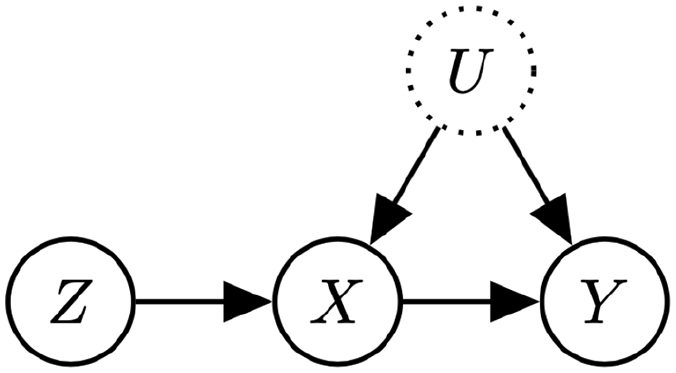
Graphical depiction of the basic IV setting with instrument Z, treatment X, outcome Y and confounder U.
All variables are standardised to unit variance in order to facilitate the interpretation of coefficient estimates. We fix the target false positive rate at
Measures
Party identification
The BES party identification item asked respondents whether they generally think of themselves as ‘Labour, Conservative, Liberal Democrat or what?’ Depending on their answers, respondents were further asked whether they were ‘a little closer to one of the parties than the others.’ Following Bankert et al. (2017), Gidron et al. (2020) and others, we restrict our focus to Labour and Conservative identifiers and include party ‘leaners’ in subsequent analyses.
Strength of partisanship
Strength of party identification was determined by asking respondents to rank how strongly they felt attached to the party they identify with on a 3-point scale ranging from weak (1) to strong (3) (mean = 1.89, SD = 0.69).
Perceived voter–party incongruence
We operationalised perceived voter–party incongruence as the average distance between a respondent’s own position and their estimation of their in-party’s position on all possible sets of issues provided in the BES survey, namely, economic redistribution, immigration, the environment and the issue of the UK’s membership in the EU. For each issue, respondents were asked to evaluate their own as well as the Labour and Conservative parties’ positions on a 0–10 ideological scale (see Table B in the Appendix for exact wording). To measure incongruence, we simply take the absolute difference between respondents’ estimations of their own party’s position and their self-position (mean = 1.43, SD = 1.36). Of all 4748 respondents, 97.9% perceive some degree of incongruence between their averaged policy preferences and that of the party with which they identify.
Actual voter–party incongruence
To determine actual ideological congruence, we calculate the average distance between respondents’ stated positions and their in-party’s actual positions on the same four aforementioned policy issues, as measured by the BES through expert surveys conducted that same year. These independent surveys gather information on ‘objective’ party policy positions by asking members of the Elections Parties and Public Opinion (EPOP) specialist group of the Political Studies Association to place British political parties on a wide range of issues (Prosser, 2020). The issues that experts are asked to place parties on as well as the question wording and response scales all matched those fielded to BES survey respondents. These combined data can thus be used to make party–voter comparisons. Descriptive statistics show that actual incongruence with the in-party on these four policy issues is slightly higher on average than perceived incongruence based on respondents’ estimates (mean = 1.69, SD = 1.32).
Issue salience
To determine which policy issues were selected as personally salient, we collect responses from the BES survey item asking participants to indicate ‘which policy is most important’ to them among a set of six, non-mutually exclusive issues that include the economy, Brexit, immigration and the environment. A full 94.4% of respondents in our sample picked at least one of the aforementioned issues as their most personally important, with the average respondent selecting 2.32 (SD = 1.14) (see Table A in Appendix for full descriptive statistics).
Affective evaluations
Affective polarisation is commonly measured in the literature as the difference between the evaluations given to the partisan in-group and that given to the partisan out-group (Iyengar et al., 2019). Early research from social psychology, however, shows that in-party praise and hostility towards the out-party do not always go hand-in-hand (Allport, 1954; Brewer, 1999) and that they can, in fact, often evolve independently of one another (Webster and Abramowitz, 2017). To gain a more fine-grained understanding of how incongruence impacts affective evaluations, in our analysis we thus disambiguate between evaluations of the in- and out-parties, and their respective leaders. Affective scores are based on the BES 10-point survey item, asking respondents to evaluate political parties and politicians on a scale ranging from 0 for ‘strong dislike’ to 10 for ‘strong like.’ On average, in our sample, respondents give more favourable ratings of their own party (mean = 7.26, SD = 2.18) and its leader (mean = 6.34, SD = 2.96) than of the opposition (mean = 1.51, SD = 2.03) and its leader (mean = 1.31, SD = 2.28) (see Table A in Appendix).
Ideological extremity
To operationalised respondents’ ideological extremity, we take the midpoint of the 10-point ideological self-placement item ranging from ‘left’ to ‘right’ and convert it to a 5-point range where 0 corresponds to the most neutral ideological point and 5 denotes the most ideologically extreme point (mean = 2.14, SD = 1.39). In other words, high scores on the ideological extremity scale indicate strongly left-wing or strongly right-wing views on policy issues, while low scores indicate ideologically moderate positions.
Results
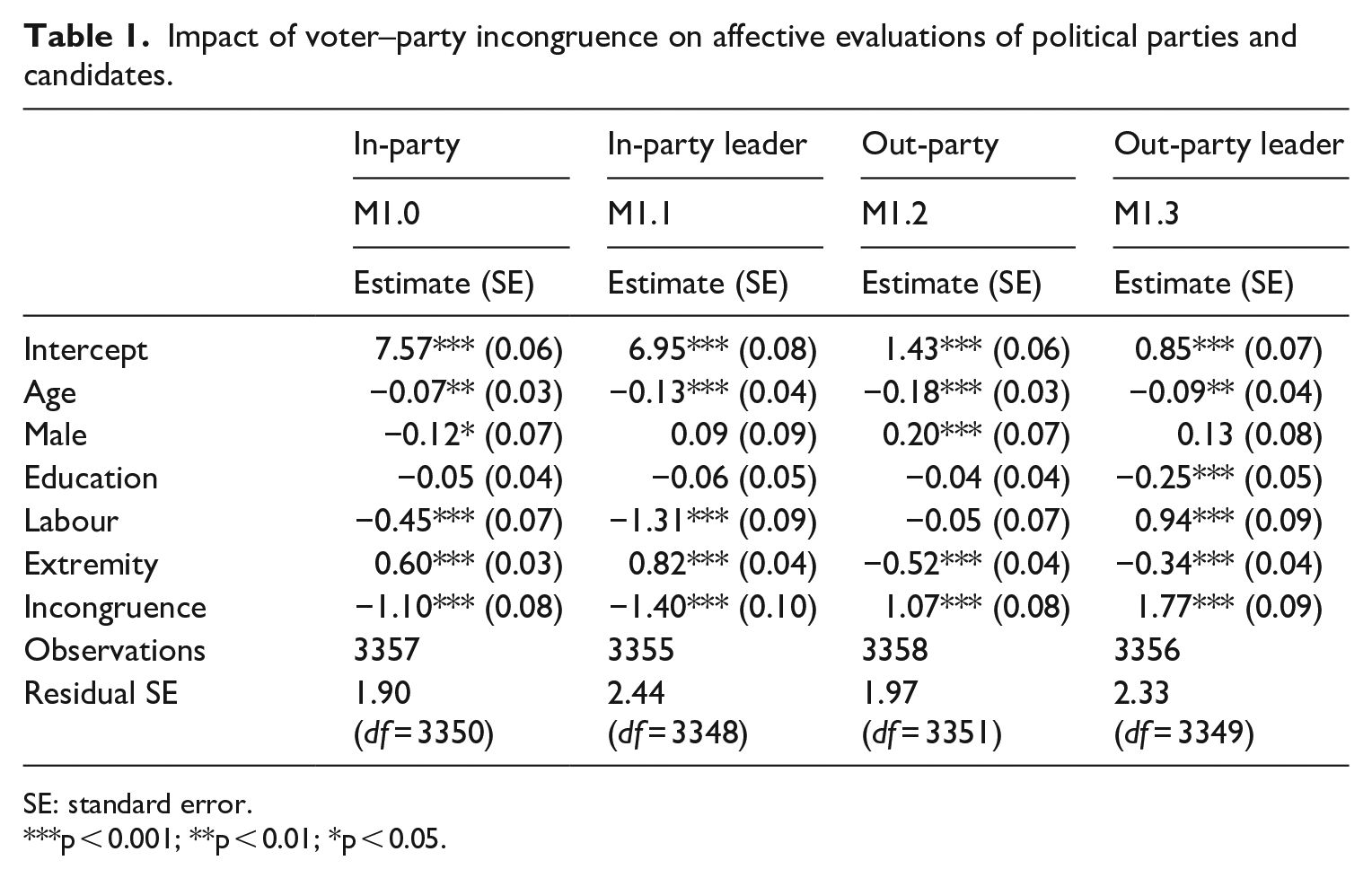
Our first hypothesis was concerned with the effect of voter–party incongruence on perceptions of the in-party, the out-party and their respective leaders. To address it, we fit four separate 2SLS models, estimating effects of voter–party incongruence on affective evaluations of one’s (1) in-party, (2) in-party leader, (3) out-party and (4) out-party leader, respectively. Results are summarised in models M1.0 to M1.3 in Table 1. Similar trends are evident across each pair of models. Specifically, after controlling for all covariates, we find that ideological distance leads to negative evaluations of one’s in-party (β = –1.10, p < 0.001) and its leader (β = –1.40, p < 0.001) while increasing evaluations of one’s out-party (β = 1.07, p < 0.001) and its leader (β = 1.77, p < 0.001). It is interesting to note that in both cases, effects are stronger at the leader level than the party level, suggesting that ideological disagreements with one’s own party may inspire some personal animus towards salient party representatives. Given the uniformity of results across these models, we conclude that both H1a and H1b are corroborated by the evidence.
Impact of voter–party incongruence on affective evaluations of political parties and candidates.
SE: standard error.
p < 0.001; **p < 0.01; *p < 0.05.
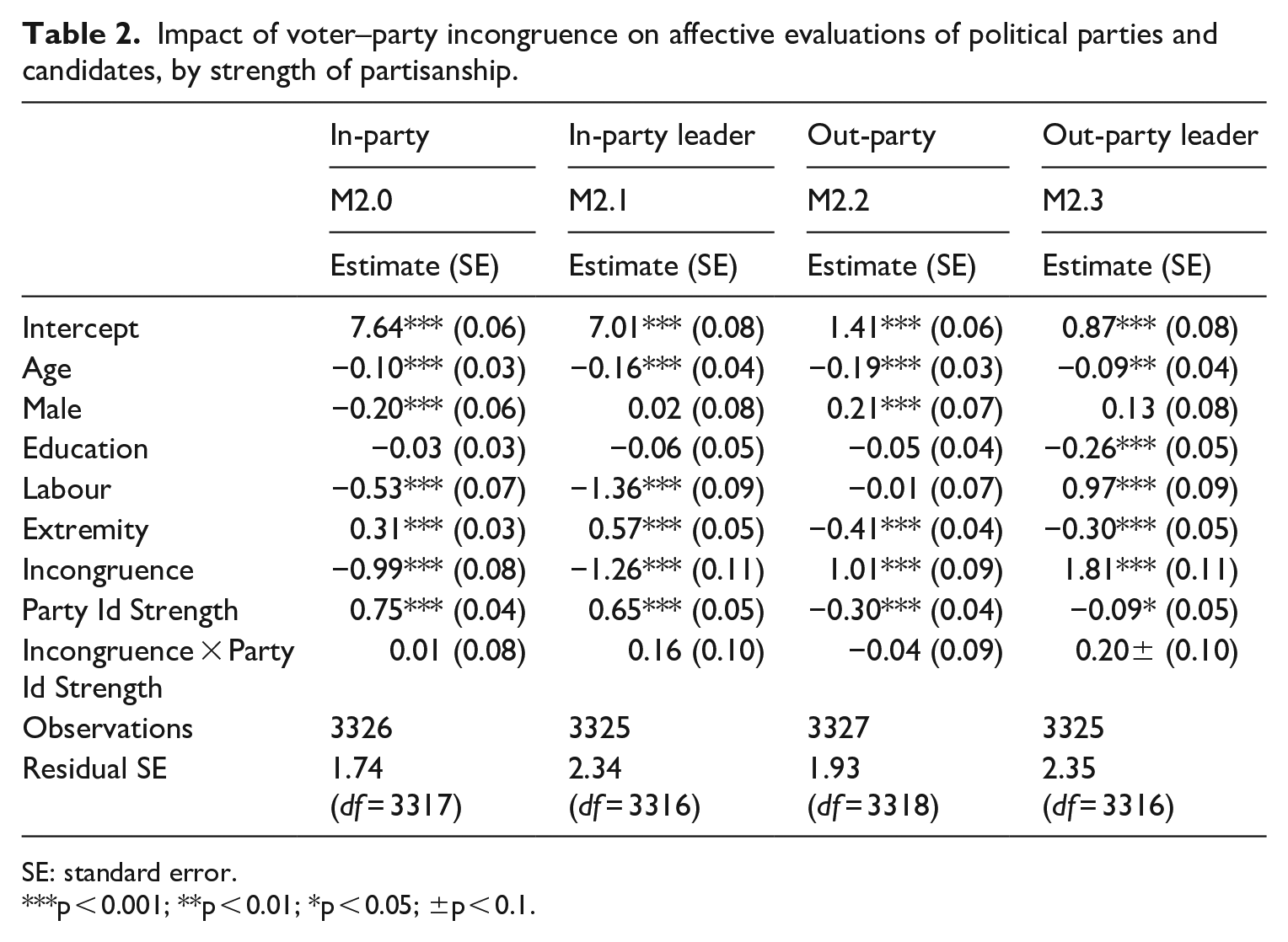
We now move on to our second hypothesis, which posited that the impact of voter–party incongruence on affective evaluations of parties and their representatives is moderated by strength of partisanship. To test this hypothesis, we build upon the models M1.0 to M1.3 adding a covariate for partisan strength as well as an interaction term between this variable and perceived ideological incongruence. Our focus is the interaction term, which, after controlling for covariates, including main effects, represents the moderating impact of partisan strength on the relationship between voter–party incongruence and affective evaluations Results this time were less uniform and effect sizes generally smaller, which makes some sense given that ideological incongruence and partisan strength are inversely correlated (ρ = –0.13, p < 0.001). Results are summarised in models M2.0 to M2.3 in Table 2. Only a single interaction term borders the significance threshold: voter–party incongruence, even among strong partisans, still leads to positive evaluations of one’s out-party leader (β = 0.20, p = 0.055). Therefore, our results do not support our hypothesis that partisan strength positively moderates the relationship between voter–party incongruence and affective evaluations.
Impact of voter–party incongruence on affective evaluations of political parties and candidates, by strength of partisanship.
SE: standard error.
p < 0.001; **p < 0.01; *p < 0.05; ±p < 0.1.
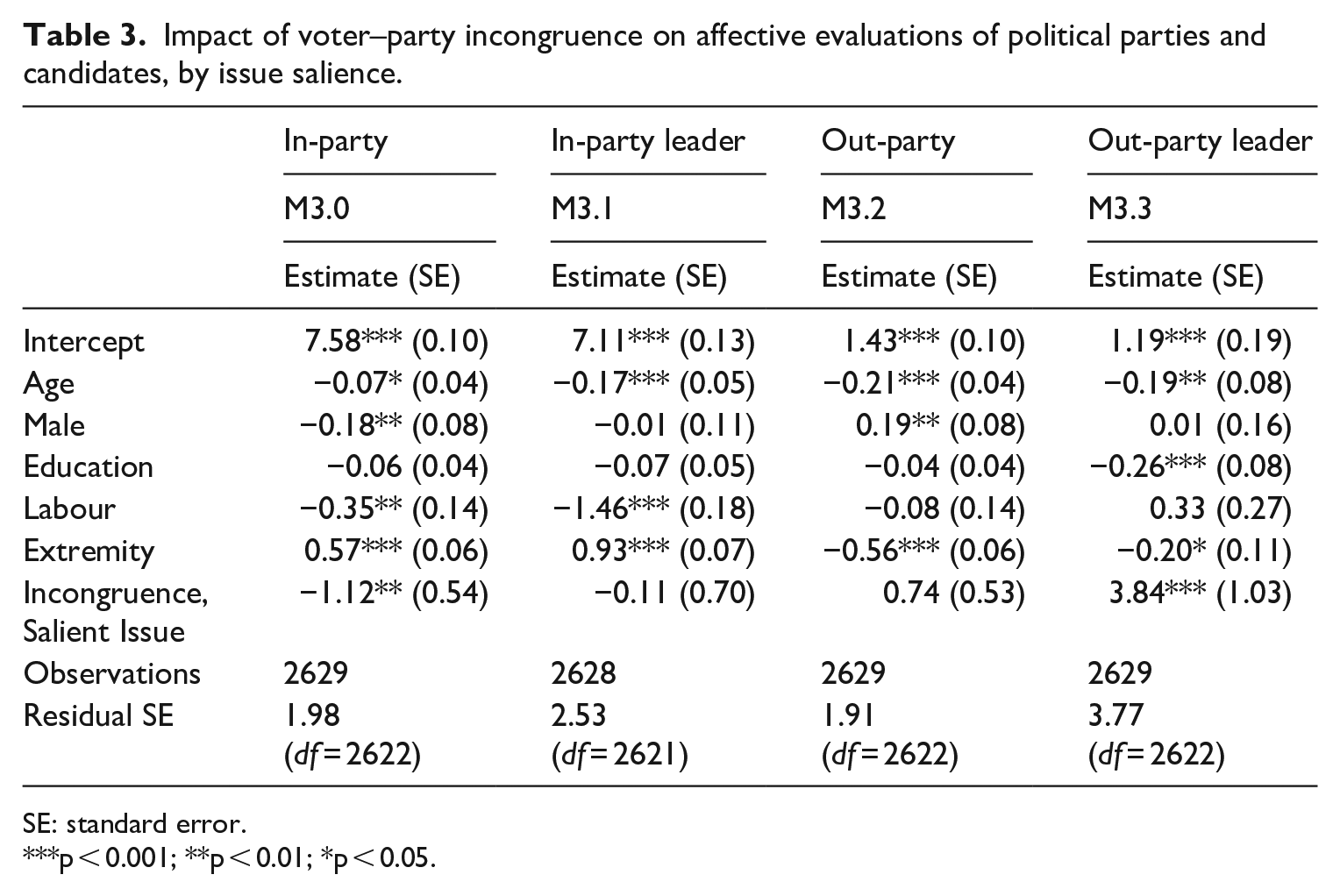
Our final hypothesis concerns the moderating effect of issue salience on the relationship between voter–party incongruence and affective evaluations We adopt the same design as the four M1 models, except this time we replace real and perceived voter–party incongruence with weighted versions of those variables, where weight 1 is given to issues a voter identifies as highly important, and 0 otherwise. Results are summarised in models M3.0 to M3.3 in Table 3. We observe some interesting variation between these results and those for the M1 models. Salience-weighted effects of incongruence on evaluations of one’s in-party are similar to the unweighted results (β = –1.12, p < 0.05), but we observe much stronger effects on positive evaluations of the out-party leader (β = 3.84, p < 0.001). Meanwhile, model M3.2 shows insignificant effects of salience-weighted incongruence on out-party evaluations (β = 0.74, p = 0.161).
Impact of voter–party incongruence on affective evaluations of political parties and candidates, by issue salience.
SE: standard error.
p < 0.001; **p < 0.01; *p < 0.05.
Discussion
This study set out to examine the effect of voter–party incongruence on affective evaluations of political parties and their leaders. Drawing on a large-scale survey of British voters conducted before the 2019 UK General Election, our analysis shows that incongruence with one’s own party – especially on personally salient issues – curbs affective polarisation by driving positive evaluations of the opposition and negative evaluations of the in-party. This finding contradicts Groenendyk’s (2018) proposition that internalised conflicts between partisan identity and policy preferences will drive anger towards the opposition as a form of identity defence. Rather, it validates and extends previous work by Lavine et al. (2013b) on partisan ambivalence, which shows that experiencing this type of disconnect challenges traditional structures of political judgement by making partisans more critical. Our results also confirm the notion that personal issue salience matters for political evaluations, and can function as an extension of individuals’ moral values and sense of self (Duncan and Stewart, 2007) in a way that drives support for parties who ‘own’ these issues (Neundorf and Adams, 2018).
Several findings stand out from our analyses. Across all models, the effects of voter–party incongruence were especially pronounced on evaluations of in- and out-party leaders. British partisans who felt at odds with their own party on issues they had singled out as important were much more likely to view the leader of the opposition favourably while expressing negative feelings towards their own party leader. There could be several explanations for this pattern. One is that feeling at odds with the leader of one’s own party – the very incarnation of the ideals that the party is supposed to uphold – was lived as a personal affront or a betrayal by partisans. Indeed, as politics in general and political campaigning in particular have become more personalised (Bennett, 2012), party leaders have increasingly come to replace political parties themselves as key heuristics for policy positions in partisans’ minds (Berz, 2020). Thus, when representation fails, they bear the brunt of the discontent.
Another plausible explanation for this pattern could be that as European political systems have become increasingly de-aligned (Dalton and Wattenberg, 2003), political parties have had to take stronger stances on wedge issues to compete against rising single-issue parties (such as United Kingdom Independence Party (UKIP)) (Usherwood, 2008). Indeed, while the decoupling of class and partisan identity in post-war Britain brought with it perceptions of ideological ‘decline’ among UK party leaders (Dommett, 2016), over the last few years there has been a resurgence of ideology in political discourse (Cohen and Cohen, 2021). Shifts in the electoral landscape and the introduction of new societal issues such as growing concerns over immigration and the meaning of ‘Britishness’, the environment and the UK’s place within the EU (Sanders, 2017) have all led political elites to adopt more internally homogeneous, programmatic and ideological stances to distinguish themselves from the opposition (Dahlgreen, 2014). This realignment of partisanship and ideology at the elite level could have thus increased respondents’ association of political figures with strong policy stances. Given that voters’ attitudes on issues like Brexit and the environment themselves shifted during that time (Hobolt et al., 2021b), this gap could have, in turn, resulted in higher perceptions of ideological disconnect with party leaders.
Interestingly, our analysis also shows the relationship between partisanship and party evaluations to be more heterogenous than commonly thought. Prior studies in the literature have tried to single out either partisanship or ideological conflict as the true cause of affective polarisation (Orr and Huber, 2020; Rogowski and Sutherland, 2016; Webster and Abramowitz, 2017). What our analysis makes clear, however, is that doing so might be creating a false dichotomy because both policy preferences and partisan attachment impact affective evaluations in subtle ways. Ideological misalignment with one’s own party does exert some pressure on partisan attachments by generating identity-challenging evaluations. The negative in-party evaluations provided by cross-pressured voters in our sample are a clear example of this dynamic. Yet, this does not mean that partisanship does not matter at all. While even the strongest partisans were still likely to ‘betray’ their party by endorsing the leader of the opposition, they were not as prone to criticise their own party. Taken together, these findings thus reinforce the notion that partisans’ evaluations of political parties and candidates are far from static, but instead contingent upon perceptions of parties’ issue stances and performance (Greene, 2004). From a theoretical standpoint, they also inject some nuance into ongoing debates about the drivers of affective polarisation by highlighting that when it comes to affective evaluations, partisanship is neither a purely affective, uncritical bond nor a mere shortcut for congenial views, but instead a dynamic process with both emotional and evaluative elements. Our analysis is, of course, limited in that it focused on a single country at a specific point in time. It will thus be important for future studies to test how these findings travel to other political contexts.
Finally, our study enriches the nascent literature on strategies to mitigate negative partisan affect in the electorate (Huddy and Yair, 2021; Wojcieszak and Warner, 2020). Some scholars, including Orr and Huber (2020: 571), have already suggested that ‘if issue conflict is at the heart of [partisan] animosity, emphasizing . . . areas of common policy agreement may reduce animosity’. Our IV design provides a robust, causal test of the power of perceived intra-party conflict in reducing affective polarisation. We acknowledge that such models rely on a few reasonable but untestable assumptions, an unavoidable limitation of the IV setup. Experimental alternatives, in which party policy is directly manipulated, are difficult to execute in a convincing way (Huddy and Yair, 2021). This, to us, therefore suggests that emphasising partisan ambivalence – through primes strong enough to make voters question their allegiance to their own party 4 – may produce positive results in alleviating partisan discord.
