




Abstract
Why are there so few working-class women in politics? While white-collar representatives dominate legislatures in general, the deficit of working-class members is particularly pronounced among female politicians. To answer this question, this study examines the influence of class and gender in voter evaluation. Through the cross-country comparison of conjoint experiments in the U.S. and the U.K., we find that working-class backgrounds disadvantage women candidates in a way that they do not disadvantage their male counterparts. Voters tend to prefer white-collar candidates to working-class politicians. Such a negative effect of working-class backgrounds is particularly evident for female candidates because the negative traits associated with the lower economic class, such as incompetence and lack of ambition, exacerbate voters' questions about female candidates’ qualifications for political leadership. By contrast, for male candidates, whose qualifications are rarely questioned based on their gender, candidates’ working-class background has a less negative impact.
Keywords
Running for office is a particularly challenging task for women with working-class backgrounds, who are endowed with fewer financial resources than those with elite backgrounds. Unlike women with white-collar occupations, working-class women have severely limited access to the networks that are essential to advancing a political career (Crowder-Meyer 2018; Fulton 2012). At the same time, differences in social roles give women, particularly working-class women, greater caregiving responsibilities, imposing greater constraints on them than on working-class men (Crowder-Meyer 2020; Teele et al., 2018). In addition, working-class women may face yet another challenge stemming from voters’ bias against their gender and class backgrounds. In fact, female politicians from working-class backgrounds have often reported experiences of facing prejudice and negative remarks about their qualifications as they navigate their political career. 1
We examine why women candidates with working-class backgrounds might face a unique set of voter biases that do not apply to white-collar women or working-class men. A growing body of work has documented a global trend of wealthy white-collar individuals dominating legislatures, even though the vast majority of the electorate are working-class (Barnes et al., 2023; Carnes 2020). The deficit of the working-class is particularly pronounced among women representatives (Murray 2021). However, working-class women tend to have different pol-icy goals and interests than those prioritized by white-collar women (Barnes et al., 2020; Morgan-Collins and Natusch 2022). The underrepresentation of working-class women in politics implies that political decision-making is less likely to incorporate the distinct policy interests of working-class women voters. In addition, as black and Latina women are overrepresented in pink-collar occupations, the lack of working-class women could further deepen racial disparities in political representation. 2
Previous research shows that individuals with lower-class backgrounds and women often face public misperceptions of their competence and character. Women politicians are often held against more stringent standards to demonstrate their qualifications for elected positions (Bauer 2020b).
Women politicians are also associated with feminine traits that are considered less suitable for political leadership (Bos 2011; Ditonto et al., 2014). Similarly, working-class people are often (mis)perceived as incompetent and lazy (Durante and Fiske, 2017; Wüest and Pontusson, 2022). Drawing on these lines of research, we contend that the class backgrounds of political candidates affect men and women differently. Less affluent backgrounds disadvantage female candidates by reinforcing voters’ doubts about their qualifications. By contrast, for male candidates, who experience little discrimination based on their gender, traits associated with the lower and working classes such as incompetency have a weak influence on voter evaluation of these male candidates. We conduct a cross-country comparison of the U.S. and the U.K. using conjoint experiments to test our arguments.
Our research makes a vital contribution to the emerging literature on working-class representation (Barnes et al., 2023; Carnes, 2020; Wüest and Pontusson, 2022) by exploring the dynamics of gender and class interconnectedness in candidate evaluation. Most importantly, our findings highlight the importance of a gendered perspective to understanding class representation by showing that voters perceive a working-class background as a red flag particularly when evaluating women candidates. This pattern suggests that even when working-class women manage to run for office despite various obstacles (Crowder-Meyer 2020; Murray 2021), they still have a hard time convincing voters of their qualifications.
Furthermore, our findings carry broad implications for expanding women’s descriptive representation. A large body of work has studied gender stereotypes that voters activate when evaluating female candidates (Bauer 2015; Bos 2011; Holman et al., 2011; Schneider and Bos 2014). While these studies have focused on how gender stereotypes might hurt female candidates universally, our research shows that female candidates with a lower economic status face even more profound voter discrimination. These findings call for diversified campaign strategies for female candidates from various demographic backgrounds.
How do voters evaluate women candidates?
Scholars have uncovered voters’ tendency to activate various gendered stereotypes in candidate evaluations (Bauer 2019; Schneider and Bos 2014; Sweet-Cushman 2022). Voters typically associate feminine traits with female candidates (Bos 2011; Ditonto et al., 2014; Holman et al., 2011), and this tendency leads them to seek out more information about competence (Ditonto 2017; Mo 2015). By contrast, since voters accept male political leaders as a norm, male candidates are less subject to the scrutiny driven by gendered stereotypes (Bauer 2017; Brooks and Jordan, 2013).
The prevalence of gendered standards implies that female candidates run for elections in a vastly different environment than male candidates. When voters are inclined to doubt female candidates’ abilities as leaders (Bauer 2020b; Ditonto et al., 2014), women will have to work harder than their male counterparts to prove their qualifications (Anzia and Berry 2011a; Bauer 2020a). This pattern leads to “the gendered qualification gap” (Bauer 2020a, 4), in which female candidates need to have objectively higher qualifications than their male counterparts in terms of professional and academic accomplishments to overcome gender discrimination in the electoral process (Anzia and Berry 2011b; Fulton 2012; Lazarus and Steigerwalt 2018). Despite being more qualified in many respects, female candidates do not win at higher rates than male candidates (Lawless and Pearson 2008; Pearson and McGhee 2013).
How these gendered stereotypes affect voters’ candidate evaluation and vote choice is not straightforward. Some scholars find little evidence of outright gender-based discrimination (Brooks and Jordan, 2013; Dolan 2014; Teele et al., 2018). Rather, party affiliation appears to play a larger role in candidate evaluations (Dolan 2014) or moderates the effect of gender stereotypes (Ono and Burden 2019; Sanbonmatsu and Dolan 2009). Others reveal that gender stereotypes become influential in certain electoral contexts, such as in low-information settings (Matson and Fine 2006) or during times of security threats (Holman et al., 2016). In addition, expectations specific to female candidates, such as traditional gender roles, pose significant challenges to women in successfully balancing their political career and their care responsibilities (Crowder-Meyer 2020; Teele et al., 2018).
How do voters evaluate working-class candidates?
While women are underrepresented in politics in many democracies, women’s political representation has steadily increased in many countries. By contrast, the changes in politicians’ class backgrounds have been much slower. Many studies examined the link between descriptive and substantive representation based on candidate class backgrounds (Barnes et al., 2020; O’Grady 2019).
Previous research offers mixed answers on how candidate class backgrounds influence voter evaluation. Carnes and Lupu (2016) show that voters find working-class candidates “equally qualified, more relatable, and just as likely to get their votes” (Carnes and Lupu 2016, 833). Some further argue that voters prefer candidates from humble class backgrounds rather than who are financially successful. Working-class candidates could be considered as more warm and relatable (Durante and Fiske 2017; Hoyt and DeShields 2021; Loughnan et al., 2014). Campbell and Cowley (2014), for instance, show that British voters do not reward candidates’ financial success but rather turn against them. Vivyan et al. (2020) also show that voters tend to prefer politicians who grew up in working-class households. This effect is particularly strong among working-class voters. Working-class voters prefer a candidate who shares the class root with them.
Notwithstanding the studies that emphasize the advantages of candidates’ working-class backgrounds, others show the opposite effect of the class backgrounds. According to this line of research, working-class backgrounds have negative impacts on people’s perception of the candidate’s competency, as lower-class people are often considered less competent than upper-class individuals (Durante and Fiske 2017; Loughnan et al., 2014). By contrast, voters might view white-collar candidates’ affluence and social status as a sign of competence, thereby favoring them over less affluent candidates (Fiske et al., 2002; Mackie and Smith 2016). A recent research by Wüest and Pontusson (2022) shows that such bias against working-class candidates is largely driven by the bias against those with routine working-class backgrounds and people tend to be more empathetic towards candidates from skilled working-class backgrounds.
Based on inconclusive findings about the candidate class effect, we draw the following set of hypotheses. Confirming these hypotheses indicate that voters are less favorable towards working-class candidates, while rejecting them would support the studies that emphasize the advantages of candidates’ working-class backgrounds.
Voters evaluate low-skilled working-class candidates’ competencies lower than those of white-collar candidates.
Voters prefer low-skilled working-class candidates less than white-collar candidates.
How working-class background affects male and female candidates differently
Compounding voters’ doubts over female candidates’ abilities as political leaders (Bauer 2020a; Ditonto et al., 2014), class-based stereotypes can disproportionately hurt working-class women candidates. Male candidates are subject to weaker scrutiny regarding their qualifications (Bauer 2017; Brooks 2013). Masculine traits, which are often associated with male politicians, are considered necessary for political leadership (Eagly and Karau 2002; Koening et al., 2011). Due to the prevalence of these masculine traits, there is less doubt about the qualifications of male politicians, solely based on their gender. We thus expect that the negative perceptions associated with working-class backgrounds should have less influence on evaluations of male candidates’ competence.
By contrast, the activation of class-based stereotypes could disadvantage working-class women candidates, as it strengthens their perceived feminine traits. Voters are predisposed to associate women candidates with feminine traits (Bauer 2017) but rarely with masculine qualities (Schneider and Bos 2011). Since political leadership is often associated with masculine qualities (Carpinella et al., 2016), voters do not view women as strong leaders (Bauer 2015; Holman et al., 2016). While women with elite occupations can circumvent such criticism by emphasizing their ambition and professional accomplishments (Oliver and Conroy 2018), voters may view working-class women candidates as still lacking the masculine qualities that are needed for political leaders. Based on this theoretical discussion, we draw the following set of hypotheses:
Voters evaluate low-skilled working-class female candidates’ competencies as lower than those of white-collar female candidates.
Voters prefer low-skilled working-class female candidates less than white-collar female candidates.
Low-skilled working-class background has a greater negative effect on voter evaluation of female candidates’ competencies than that of males’ competencies.
Low-skilled working-class background has a greater negative effect on voters’ preference of female candidates than that of males.
Research design
Conjoint Experiment Design.

After the respondents viewed the candidate profiles, we asked them to choose the candidate they think would be a better advocate for their policy priority to measure their evaluation of the candidate’s competence (competency). We also asked the respondents to choose the candidate that they preferred (candidate preference). Each respondent was asked to complete three sets of tasks. We also included a series of demographic questions.
To examine whether the class of a hypothetical candidate has a significant impact on our out-come variables, we follow the approach proposed by Hainmueller et al. (2014) and estimate the average marginal component effect (AMCEs) using a regression-based estimator. In addition to the effect of the candidate’s class background itself, we are interested in how the effect varies by candidate gender. Thus, we further estimate the two-way causal interaction effect, known as the Average Marginal Interaction Effect (AMIE) using the procedure from Egami and Imai (2018). In our analysis, we cluster standard errors by the respondent to account for potential non-random variance across respondents, as respondents evaluated multiple sets of candidates (Hainmueller et al., 2014). We use a dummy indicator, working-class, by categorizing candidates’ class based on occupations: Retail clerks and janitors are categorized as working-class, while lawyers and business entrepreneurs are categorized as white-collar jobs. 5
For the second study, we conducted the same conjoint experiment in the U.K. The respondents were recruited by Prolific, a U.K.-based online platform for survey research. The purpose of the U.K. study was to test how our theoretical expectations applied to a system where class politics plays a more prominent role than in the U.S. One might argue that the Labour Party’s reputation as a working-class party became tarnished as the party gradually distanced itself from working-class voters to build a broader center-left electoral base (Heath 2018; O’Grady 2019). Nevertheless, there remains a tradition of class-based left-right party competition in British politics, making working-class representation a highly relevant agenda for political parties even today. Our U.K. sample (N = 1141) consists of 362 Conservative supporters, 338 Labour supporters, 97 Liberal Democrats, and 344 respondents who support other minor parties or are not affiliated with any party.
Findings
Study 1: Conjoint experiments in the United States
Figure 1 displays the AMCE estimates from our conjoint experiment of American voters (N = 865). Our results show that voters perceive female candidates more competent and more favorable than male candidates. All else being equal, female candidates are perceived more competent at advocating voters’ priority issue than male candidates. Female candidates are also preferred to male candidates by 5.4 percentage points. This finding is in line with studies that found little evidence of discrimination against female candidates among American voters (Dolan 2004; Teele et al., 2018). AMCE estimates with 95% CIs (U.S. sample).
However, voters exhibit a clear negative bias against working-class candidates. Working-class candidates are favored less than white-collar candidates by 4.6 percentage points. Voters also believe that working-class candidates will perform worse in advocating their priority issue than white-collar candidates. This finding supports the studies that emphasize the disadvantages of politicians’ working-class backgrounds (Fiske et al., 2002; Mackie and Smith, 2016; Wüest and Pontusson, 2022), while contrast the studies that emphasize their positive effects (Campbell and Cowley 2014; Hoyt and DeShields 2021; Vivyan et al., 2020). The variations in the results across the studies might be caused because occupations used in experiments differ by studies. In our pilot study, both janitor and retail clerk were considered by a majority of individuals as working-class occupations. Nevertheless, it might be possible that types of occupations make respondents react differently. Additionally, experiment types might have also influenced the different results across studies. Previous studies that find the positive effects of working-class backgrounds use a vignette experiment that provides more contexts to the class root and mobility of a hypothetical candidate (Campbell and Cowley 2014; Vivyan et al., 2020). By contrast, conjoint experiments preclude those contexts and strictly examine the effect of candidate attributes.
Next, we estimate the AMIEs to examine how the effects of working-class backgrounds vary depending on candidate gender. Figure 2 displays the effect of the candidate’s working-class back-ground conditional on candidate gender, calculated as the sum of AMCE and the AMIE (Egami and Imai 2018, 538). Figure 2 suggests that female candidates face greater working-class dis-advantages than male candidates with the same class backgrounds. First, working-class women candidates are perceived to be less competent than white-collar women candidates. This class-based difference is less pronounced when the candidate is male.
6
Evaluation of candidates with different class background conditional on candidate gender (U.S. sample).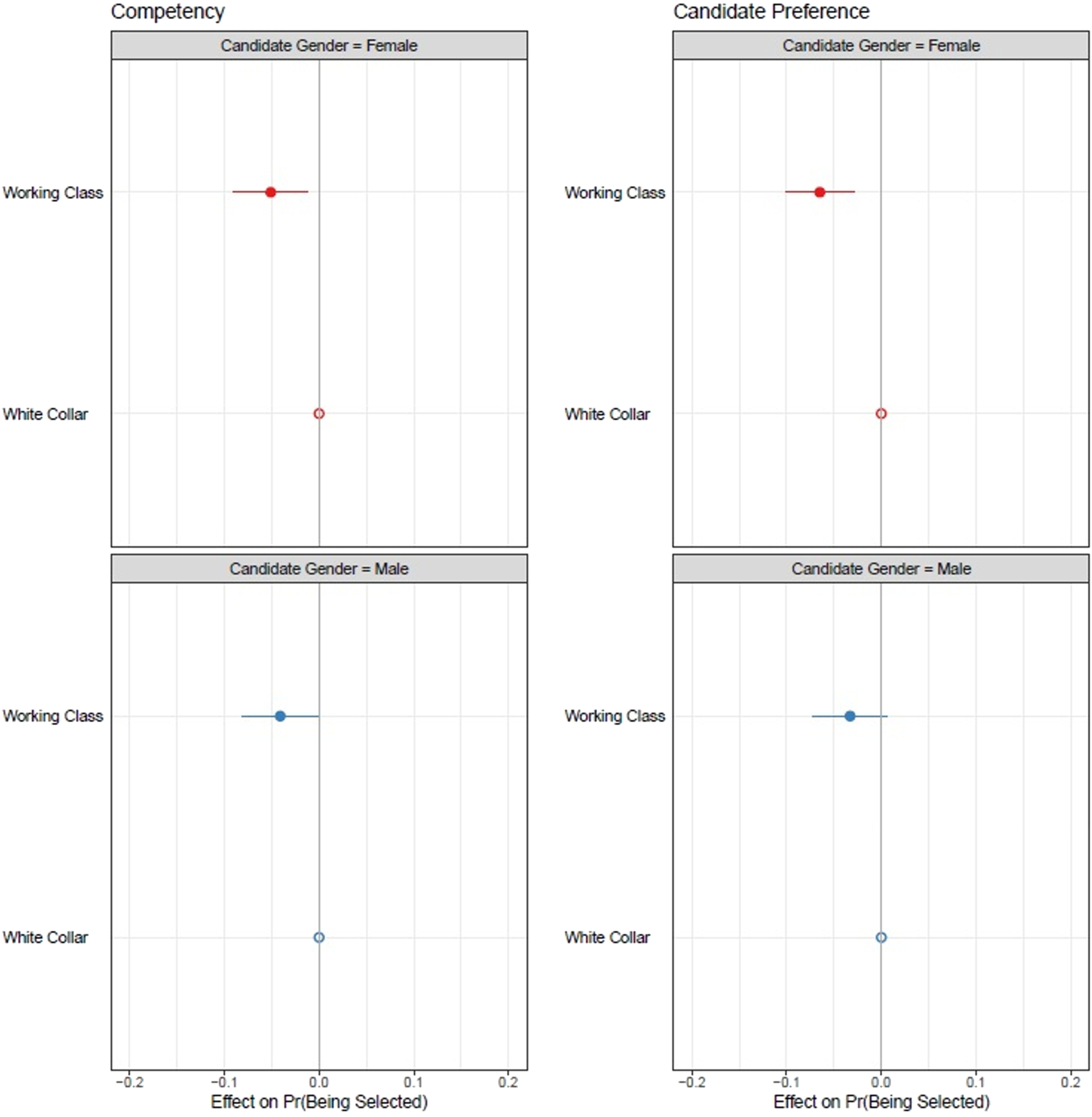
Furthermore, while women candidates who have working-class backgrounds are less favored than their white-collar counterparts by 6.5 percentage points (95% confidence interval [CI]: [−10.1, −2.9]), the estimated difference in the likelihood of supporting working-class and white-collar male candidates decreases to 3.3 percentage points and is not statistically distinguishable from zero. Overall, the findings from our U.S. study confirm our hypotheses that the negative effects of working-class backgrounds will be more pronounced among female candidates than male candidates. 7
Study 2: Conjoint experiments in the United Kingdom
In Figure 3, we first present the results of the conjoint experiment for all respondents. As in our AMCE estimates with 95% CIs (U.K. sample, all respondents).
In addition to the overall effects, we examine how the effect of candidate class background varies by candidate gender. Figure 4 plots the effect of the candidate’s working-class background relative to white-collar background, conditional on the candidate’s gender. It shows that the working-class effect on the evaluation of candidate competency does not vary much by candidate gender. However, consistent with the U.S. experiment, we find that the working-class background negatively affects voter preference for a female candidate, compared to a white-collar candidate of the same gender. As shown in the top-right panel, respondents’ preference for a female candidate with a working-class background is 3.7 percentage points lower than when she is from a white-collar background. This working-class disadvantage is not statistically significant for male candidates, as seen in the bottom-right panel of Figure 4. Effect of working-class background on the evaluation of the candidate, conditional on candidate gender (by respondent party ID). Note. Each point indicates the AMCE estimate of the candidate’s working-class background compared to the white-collar background, conditional on the candidate’s gender. The plot displays 95% confidence intervals.
Figure 4 also displays the effect of a candidate’s working-class background conditional on candidate gender, estimated separately for Conservative and Labour supporters. It shows the presence of a gendered pattern in Labour voters’ evaluation of working-class candidates. In particular, the bottom-left panel shows that Labour supporters think that working-class male candidates are more competent in representing their interests than white-collar males. By contrast, the effect of the working-class background is not statistically significant when the candidate is a woman, as seen in the top-left panel of Figure 4. Also, while Labour supporters are less likely to support a working-class female candidate than a white-collar female candidate, their preference for working-class male candidates is not statistically different from their preference for white-collar male candidates. Figure 4 also shows that Conservative supporters evaluate working-class candidates less favorably than white-collar candidates, regardless of their gender. Taken together, this subgroup analysis suggests that a working-class background of a candidate can appeal to voters who support a party that has a historical link to the working class. However, it only does so when the candidate in consideration is a man.
Discussion and conclusion
This paper theorizes and tests the gendered effect of class backgrounds on candidate evaluation. Combining and expanding on the two traditions of literature on gender and class representation, we hypothesize that lower-class backgrounds disadvantage women in a way that they do not disadvantage men. As many studies have demonstrated, female candidates often struggle with stronger public doubt about their qualifications for political leadership. In this context, we predict that underprivileged backgrounds are likely to raise deeper questions about candidates’ qualifications. By contrast, among male politicians, given that there is little question about their qualifications based on gender, a negative stereotype commonly associated with lower-class backgrounds will have little impact on voter evaluation.
We test our arguments using conjoint experiments conducted in the U.S. and the U.K. The results largely confirm the gendered effect of candidate class backgrounds. Both in the U.S. and the U.K., respondents preferred female to male candidates. While respondents in the U.S. preferred white-collar candidates to working-class candidates, the negative effect of lower-class backgrounds mainly came from evaluating female candidates. In the U.K., where the link between economic class and parties is stronger, the effects differed by respondents’ partisanship. Conservative voters penalized working-class candidates regardless of their gender. However, for Labour supporters, though they preferred working-class candidates, such a working-class advantage was smaller for female candidates. This study suggests that women candidates face particularly strong voter bias against their lower-class backgrounds. As a result, working-class women encounter multifaceted challenges. They not only lack the necessary resources and networks but also have to overcome greater voter bias questioning their competency.
These findings have broader implications for the interconnectedness of marginalized identities and democratic representation in general. We show that for politicians with more than one marginalized identities, the negative stereotypes associated with each marginalized identity tend to have compounding effects, making it even harder for these politicians to garner voter support. This potentially means that working-class penalties can be more pronounced for not just for female politicians, but also for other minority candidates such as people of color. Given that social minorities are overrepresented in working-class occupations, double penalty for working-class candidates with marginalized social identities could result in the even greater underrepresentation of marginalized groups in politics. This, in turn, can cause unequal policy representation of social minorities. To the extent that policy interests of working-class and white-collar women diverge, merely increasing the number of women in political office does not lead to meaningful substantive representation of women from all economic backgrounds. While this study focuses on the class and gender effect, future studies could further examine the interconnectedness of other forms of marginalities such as class and race.
Supplemental Material
Supplemental Material - Double penalty? How candidate class and gender influence voter evaluations
Supplemental Material for Double penalty? How candidate class and gender influence voter evaluations by Jeong Hyun Kim, and Yesola Kweon in Research & Politics
Footnotes
Declaration of conflicting interests
The author(s) declared no potential conflicts of interest with respect to the research, authorship, and/or publication of this article.
Funding
The author(s) received no financial support for the research, authorship, and/or publication of this article.

Supplemental Material
Supplemental material for this article is available online.
Notes
References
Supplementary Material
Please find the following supplemental material available below.
For Open Access articles published under a Creative Commons License, all supplemental material carries the same license as the article it is associated with.
For non-Open Access articles published, all supplemental material carries a non-exclusive license, and permission requests for re-use of supplemental material or any part of supplemental material shall be sent directly to the copyright owner as specified in the copyright notice associated with the article.
