




Abstract
At the 2015 Paris Summit, global leaders agreed a strategy to tackle climate change. Under the agreement, each country must prepare a national plan. What challenges does this pose for politicians? How do they reconcile their representative role with understandings of climate change and measures required to address it? This article analyses interviews with UK politicians, through the framework of the ‘representative claim’ developed by Michael Saward, seeing representation as a dynamic interaction between politicians and those they claim to represent. Thus, politicians need to construct a ‘representative claim’ to justify action on climate. Four different types of claims are identified: a ‘cosmopolitan’ claim, a ‘local prevention’ claim, a ‘co-benefits’ claim and a ‘surrogate’ claim. The analysis shows that it is not straightforward for a politician to argue that action is in the interests of their electorate and that climate advocates need to support efforts to construct and defend claims.
Introduction
The scientific consensus on climate change is strong, and evidence points to the need to take action to drastically reduce emissions of greenhouses gases (Intergovernmental Panel on Climate Change (IPCC), 2014). At the Paris summit in 2015, 195 world leaders agreed to act, with each country committing to a national plan for emission reduction. National politicians, therefore, have responsibility for developing their country’s plan, putting in place the strategies, policies and incentives necessary to facilitate emission reductions.
But how does this political commitment to act on climate change link to democratic representation at the national or local level? The scientific case may be made, but questions remain as to how (or indeed whether) this fits with a politician’s mandate as an elected representative, given that public concern about climate change is low compared to other political issues (Pidgeon, 2012). This article considers action on climate change through the lens of political representation and presents evidence from a set of interviews with Members of the UK Parliament (MPs).
The article begins with a discussion of political representation, particularly the theory of the ‘representative claim’ developed by Michael Saward (2010). Saward sees representation not as a static fact but as a dynamic relationship between a representative and the represented. The politician must put forward a claim, which may be accepted, rejected or ignored by those that he or she represents.
This theoretical lens is used to analyse the way in which politicians reconcile their representative role with their understanding of the need for political action on climate change. Data are taken from 14 interviews carried out in 2016. The interviews show that climate change poses a representation dilemma for politicians. While they acknowledge that action on climate change is necessary, they report little or no pressure from their electorate to speak or act on the issue. Politicians shape the way that they talk about and act on climate, crafting the issue in a way that they feel will be meaningful to those they see themselves as representing, in order to justify their actions and garner support. In other words, they make a ‘representative claim’. Doing this is not straightforward, given the complex nature of the problem and the low levels of public concern.
Among the politicians interviewed, four different types of representative claim were identified. First, some MPs make a cosmopolitan claim, saying that it is in the interests of the human species as a whole to act, and therefore, it should be a concern for all politicians. Second, some frame the issue as a local prevention claim, in which they assert that action is necessary to prevent impacts such as flooding in their local area. Third, some point to the economic or social benefits arising from taking action on climate change, such as jobs created in renewable energy industries. This can be called a co-benefits claim, as politicians are claiming that such action helps towards tackling climate change, as well as bringing other specific local benefits. Last, some politicians judge that they cannot speak out on climate change because a direct claim would be opposed or ignored. Instead, they make what might be called a surrogate claim, in which climate change is not explicitly mentioned. Instead, other reasons are given for measures which the politician privately believes will help to tackle climate change.
The interviews show that politicians feel constrained in acting on climate change, but some nonetheless find ways of building a representative claim. The article concludes with a discussion of the implications of this analysis for the theory of representative claims and suggests ways in which politicians could be better supported to act on climate change.
Although the politics and governance of climate change has been discussed extensively, across the fields of political studies and international relations (see, for example, Giddens, 2009; Underdal, 2017), there has been relatively little attention to the ways in which politicians, as crucial actors within political systems, understand or respond to the issue (Rickards et al., 2014). This article contributes to a greater understanding of the specific role of politicians, supplementing the accounts of governance and political systems described above. In doing so, it tests empirically a contemporary theory of representation, contributing to a greater understanding of the representative role of elected politicians.
Theorising Representation: The Representative Claim
How should an MP, elected by the voters of a geographical constituency, approach their representative role? The meaning of representation has been debated for many centuries (Dobson and Hamilton, 2016; Mansbridge, 2003). Summarising a complex picture, Urbinati and Warren (2008: 388) identify what they term ‘standard accounts of democratic representation, focused primarily on territorially based electoral representation’. However, this ‘standard account’ is under increasing pressure: … territoriality, though historically essential to the evolution of democratic representation, identifies only one set of ways in which individuals are involved in, or affected by, collective structures and decisions. Issues such as migration, global trade, and environment, for example, are extraterritorial; they are not contained by any existing territorially organised polity (Urbinati and Warren, 2008: 389–390).
Neither does territoriality account for issues such as religion, ethnicity or gender identity, or the role of non-elected actors in politics, such as businesses or civil society groups organising around issues rather than places. Meanwhile, the vexed question of whether or how nature and non-human species get a hearing in the democratic process is not solved by standard accounts of representation (Dobson and Hamilton, 2016).
As these standard accounts have come under increasing pressure, Michael Saward has proposed a shift in how representation can be understood. He argues that representation should be seen not as a static fact but as a dynamic exchange between representatives and those being represented, in which a politician (or anyone else seeking a representative role) can make a claim, which in turn is accepted or rejected by others: Political representation is not simply a fact of political life, or an achieved state of affairs, resulting from elections. Rather, at a deeper level, representation is a dynamic process of claim-making and the reception of claims (Saward, 2010: 8).
Thus, the job of the politician is to demonstrate, through words and action, the ways in which they represent: ‘representation is an ongoing process of making and receiving, accepting and rejecting claims – in, between, and outside electoral cycles’ (Saward, 2010: 36). Politicians make and modify their claims, in a dialogue with those they seek to represent, to demonstrate that they are carrying out their role appropriately and effectively.
Saward sets out schematically how a representative claim is constructed. Each claim has a ‘maker’, who sets out the claim; a subject, put forward as the representative; an ‘object’, the group to be represented; a ‘referent’ (the wider pool from which the object is drawn); and an ‘audience’, who, crucially, can accept, reject or ignore the claim. A claim therefore follows this pattern: A maker of representations (‘M’) puts forward a subject (‘S’) which stands for an object (‘O’) that is related to a referent (‘R’) and is offered to an audience (‘A’) (Saward, 2010: 37).
Using this formulation, Saward describes how an MP might make a representative claim: The MP (maker) offers himself or herself (subject) as the embodiment of constituency interests (object) to that constituency (audience). The referent is the actual, flesh-and-blood people of the constituency. The object involves a selective portrayal of constituency interests (Saward, 2010: 37).
The formal electoral process – the winning of an election – is the legal and procedural basis for the MP’s claim to representation, but this only tells part of the story. During the election campaign, and while in office, politicians make claims setting out who they represent and how. The acceptance of these claims is an agreement by the represented that their politician does indeed represent them. The question of what is, or is not, in the interests of those represented is explored and refined through the making and accepting (or rejection, or ignoring) of claims. There is no pre-determined spatial, temporal or other boundary to the claim. Politicians can claim that it is in the interests of the people they represent, to consider the needs of future generations, citizens of distant countries or, indeed, other species. Neither is representation limited to the formal political sphere. Any individual or group can make a claim to representation. Saward gives the example of the singer Bono claiming to represent people in Africa who, Bono asserts, ‘have no voice at all’ (quoted in Saward, 2010: 83; see Montanaro, 2012, for a discussion). These claims to representation interact with, shape and are shaped by the claims made by elected representatives.
Saward’s theory has been used in particular to analyse representation in the European Union, whose institutions work alongside, but do not replace, national legislatures, thereby raising problems of complexity and legitimacy (see, for example, de Wilde, 2013). The UK’s referendum decision to leave the European Union could, at its simplest level, be seen as UK citizens rejecting representative claims made by European institutions.
The theory of the representative claim has much in common with the concept of ‘framing’ discussed in political science, the process by which politicians shape an issue to fit with political ideology, the positions held by voters and other actors and prevailing political norms (Benford and Snow, 2000; Lockwood, 2011). This is discussed further in the conclusion.
Representation and Climate Change
As discussed above, the concept of the representative claim is a useful way of thinking about action on climate change. Climate change is certainly a challenge in representational terms: it is something that affects all humans, and all species, but to differing degrees and over different timescales. Climate change is not immediately ‘knowable’ but is mediated through scientific evidence and modelling and is understood in different ways by different groups (Hulme, 2009). Given the ubiquity of fossil fuel use, agricultural practices and other land use which results in emissions of greenhouse gases, nearly all humans contribute to the issue and will also be affected by any attempts to curb emissions (although causes and effects of climate change are distributed very unevenly in global terms). Climate change is both local and global, both immediate and long-term, both personal and systemic. In representational terms, there is no simple answer to questions about who should represent or act on behalf of whom.
The scientific community stresses that reductions in greenhouse gases are urgently needed to avert the worst effects of climate change (IPCC, 2014). As a result, a high-profile group of scientists is making the case for a new approach to governance, termed ‘planetary stewardship’ (Steffen et al., 2011). They argue that human interference in crucial earth systems, including the climate system, must not go beyond certain boundaries, and advocate for a system of governance which enables humanity to keep within these limits: ‘the need to achieve effective planetary stewardship is urgent’ (Steffen et al., 2011: 739) and ‘can be built around scientifically developed boundaries for critical Earth System processes’ (Steffen et al., 2011: 757).
In advocating this approach to governance, scientists are, in effect, making a representative claim. While they do not explicitly argue against democracy, they contend that ‘planetary stewardship’ is a precondition of human society (and, within that, the political system); thus, it is something that must be done. The question of how it is done is left unspecified, save for generalised references to governance. Andrew Dobson (2010: 765) describes this approach as playing ‘a card that will trump political debate and discussion’. Yet, to the extent that action relies on legislation or policy change, scientists remain dependent on formal political processes to achieve their aims. Scientists can make a claim that they represent humanity’s future, but their claim needs to be accepted, by national legislatures and publics alike, if it is to be successful.
Meanwhile, public concern about climate change has low salience compared to other issues. A recent review of evidence states that: … climate change is invariably not the highest or most important priority for many people … Other global/societal issues (e.g. world poverty, crime, terrorism, and war), environmental issues (e.g. water pollution), or personal issues (e.g. health, finances, and relationships) have a higher expressed importance for them (Pidgeon, 2012: s87).
There is some evidence to suggest that climate change is a ‘valence’ issue, one which voters expect politicians to act on, even though they do not identify it as a priority (Lockwood, 2013). Thus, politicians are faced with generalised concern about climate, but little guidance as to what action voters would like to see. How should a politician respond if scientists call for urgent action, but publics, including those whose votes they depend upon, do not prioritise climate action? How can they develop a strategy that achieves the necessary emission reductions while resonating with publics and building support for further action? In other words, the task is to develop representative claims on climate change. What might such claims look like? This question is examined empirically, below, through analysis of interviews with UK politicians.
Method
The interviews used a narrative approach (Riessman, 2005), aiming to elicit description and storytelling – the politician telling their own story of their work and life. Participants were informed that one of the purposes of the study is to find ways to better support politicians in their work on climate change. Thus, the interviews were presented as a collaborative discussion (Morris, 2009; Oakley, 1988), a joint investigation by the researcher and the researched.
MPs were recruited through an email invitation from the researcher, setting out the collaborative nature of the project, as a joint initiative between Green Alliance and Lancaster University. Basic information was provided about the research question and the interview itself. A total of 22 MPs were approached, to secure the 14 interviews. Given the methodological stance, the number of interviews was limited, to allow detailed qualitative analysis (Kvale and Brinkmann, 2015). Within these constraints, participants were selected to provide a balance of age, gender, political party, and length of time served as an MP (see Table 1). Both current and former MPs took part; some differences were noted between these two groups, with former MPs tending to be more reflective and less focused on the practical difficulties of working life.
Interviewees’ Background and Experience.
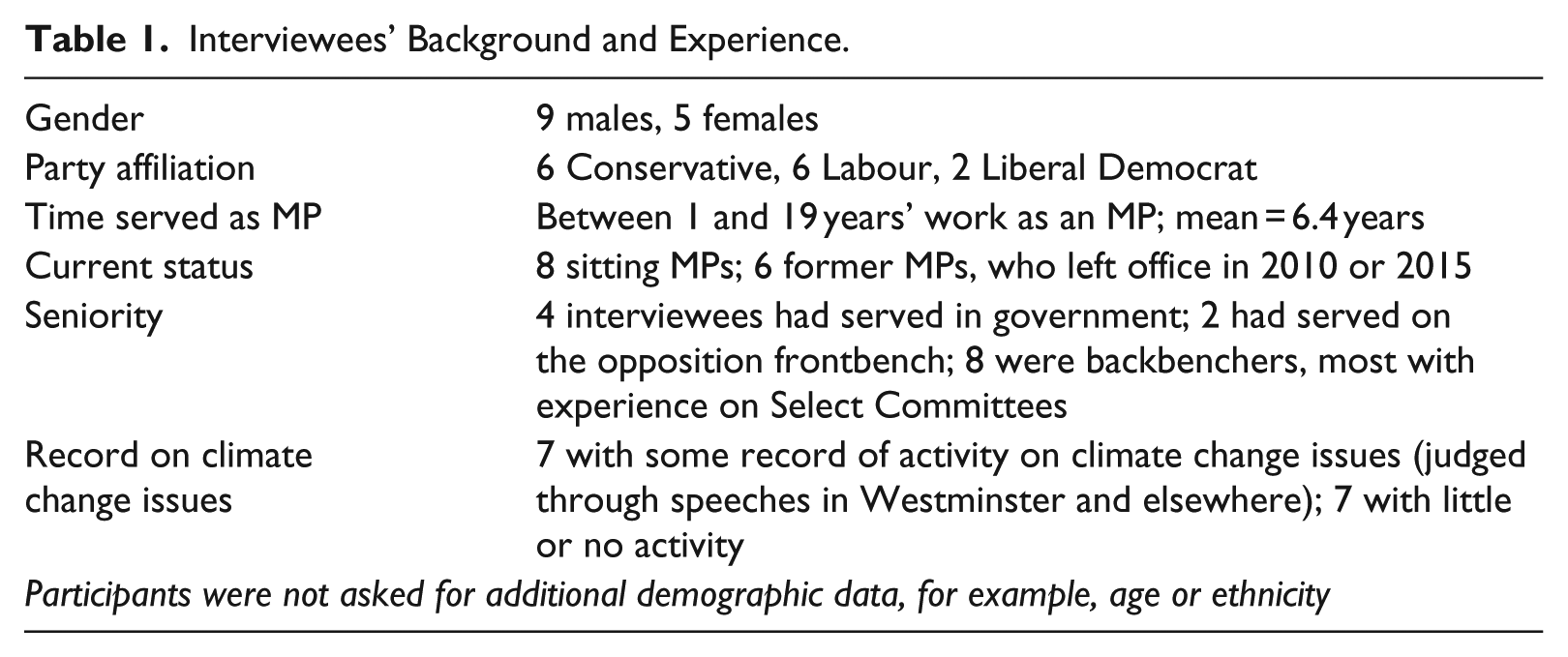
Participants’ previous involvement in the issue of climate change was investigated. There was a wide spectrum of involvement, as evidenced by participation in events or speeches. Known ‘climate sceptic’ MPs (defined as those who publicly state that they do not accept the scientific consensus, as represented by the IPCC (2014)) were not approached. This is because the research question focuses on how MPs try to understand and act on climate change, rather than the reasons for rejecting the issue altogether. A different research strategy would be needed for this group. These ‘climate sceptics’ are influential, although they are small in number. Only five MPs out of 659 voted against the Climate Change Act in 2008, although opposition to climate action has increased in subsequent years (Carter, 2014).
The interviews began with a short description of the study, and discussion of ethical issues including consent and anonymity. Interviews were audio recorded and transcribed by the researcher. Interviews were semi-structured and designed to be informal and conversational. First, participants were asked to reflect on the way that they work and the influences and pressures upon them. Questions were then asked specifically about climate change: the extent to which the issue is discussed in Parliament and how it is discussed, and whether or how they work on the issue. The term ‘climate change’ was deliberately not defined by the interviewer, with interviewees free to interpret it as they wanted, with some talking more about climate science and international co-operation and others discussing action at local level. This basic framework was used for all interviews, although emphasis varied. Most interviews were 30–40 minutes long, but a number were considerably longer, and one lasted only 20 minutes.
Interview data were transcribed and analysed through coding using NVivo software and through critical reading of the scripts. The data showed differences between interviewees, with party affiliation, social background, gender, age and previous experience all playing a part, as can be expected from previous research (see, for example, Carter (2013) on party strategies and research described earlier (McKay, 2011; Puwar, 2004) on gender). Younger MPs, for example, were more likely to be influenced by the positions taken by their seniors (this is discussed further in Willis, 2017a). However, these differences were not clear-cut, and there were many commonalities. The analysis presented below does not categorise according to party, age, gender or other ‘standard’ category, but discusses the different sorts of claims made by the group of MPs as a whole. In the conclusion, some differences based on political ideology are discussed.
The interviews were designed to investigate how MPs address climate change, in general terms. The issue of representation was a subject that was raised by each interviewee, in different ways, as discussed below. Other themes to emerge were questions of identity – how politicians see themselves and their role, and discussion of the pressures of working life. These findings are published elsewhere (Willis, 2017a).
While this study investigates the positions of individual MPs, it is important to note that the stance of a particular government, or political party, is not simply the sum of individual MPs’ stances. In the UK system in particular, the executive has far-reaching powers and influence, memorably dubbed an ‘elective dictatorship’ by Lord Hailsham (Byrne and Weir, 2004), with backbenchers having a limited role in national policy formulation (Norris, 1997). Thus, this study cannot claim to offer a full explanation for the stance of government or particular parties. Studying elected MPs can, however, offer insights into the dilemmas of representation and how this can be reconciled with action on climate change or indeed other issues.
Interviews were held anonymously, and this was crucial in building a picture of their private deliberations. In this context, assuring anonymity for public figures requires a more robust approach than just changing names (Saunders et al., 2015). Therefore, the amount of context given to the data in this article is limited.
MPs’ Representative Claims on Climate Change
This set of interviews shows that climate change poses a dilemma for politicians trying to carry out their representative function. Interviewees acknowledged that action on climate change is necessary (though their understanding of, and commitment to, the issue varies). Yet, they report consistently that they feel little or no pressure from the people they see themselves as representing, to work on climate issues. Thus, if they are to speak or act on the issue, they must work to construct a ‘representative claim’, demonstrating how their work on climate change can be justified in terms of their role as an elected politician.
Below, politicians’ deliberations on climate change and representation are presented in three steps. First, their understandings of the need for political action on climate change are discussed. Second, their attitudes towards their representative role in general are considered. Third, these two elements are joined, to discuss how politicians reconcile representation and climate action and to discuss how they make representative claims on the issue. Four types of claim are identified, each of which portrays climate change, and the responses needed, in a different way.
Understanding the Need for Political Action on Climate Change
All the interviewees in this study stated that action by politicians on climate change is needed, although there were a wide range of views on the importance and urgency of the issue. (Note that, as described above, known ‘climate sceptic’ MPs were not interviewed.) When asked about their awareness of the issue, responses included: It’s just been [there] … I don’t remember not caring about [it]. The first big memory I obviously have of it is Kyoto [the first international climate treaty, signed in 1997] … and then it became an increasing issue rising up the agenda.
Some distanced themselves, saying that they did not understand the issue enough: I’m not an expert on it, it’s still a very complicated subject.
The majority, however, showed what might be termed passive or conditional support. For example, one interviewee explained that she knew it was important, and part of the wider agenda of her party and political outlook, but that it was not something that motivated her: It probably falls into the basket of general progressive issues that sound good to ensure … It’s not why I went into politics.
A minority of interviewees saw climate change as a crucial issue to address, one describing its potential impact graphically as we sat in the House of Commons: Where we’re sat right now might well be underwater, right next to the Thames. I wouldn’t fancy our chances.
Whatever their own views, all interviewees agreed that the issue was not much discussed in parliament. Comments included: It’s not the number one issue that’s talked about here. I don’t really recall it coming up a lot. It’s just not part of the daily discourse, it’s too far away.
Two interviewees made the distinction that it had been talked about more in previous administrations, particularly around the time of the Climate Change Act, passed in 2008: There was a lot of passion, a lot of commitment, a lot of concern … and I feel it has completely disappeared. As a mainstream political issue, your top five, I think it’s died. Which is bizarre given that it’s the greatest challenge facing the planet.
All interviewees reported that the issue was seldom or never raised by the constituents they meet in their surgeries, on the doorstep when campaigning or in day-to-day encounters: I’ve knocked hundreds, literally thousands of doors, and had tens of thousands of conversations with voters … and I just don’t have conversations about climate change. I can’t remember the last time I was asked about climate change. It’s very rare to be asked about it.
Some reported a minority within their constituency who raised climate change, normally as part of a broader set of issues concerning environment and social justice. This was particularly the case for those who represented wealthier constituencies, with a core of what one MP described as ‘articulate, affluent people who have perhaps a particular type of worldview’. Another described this group as a vocal minority: It’s an unusual city, it’s got its Guardian-reading intelligentsia, who are engaged … And yes, we know from the emails they send that climate change is one of the issues of concern, but to be honest, I’m quite interested in the other eighty-seven thousand people, and particularly working class people, who are not going to be engaged in the issues, but are concerned about whether their kids can get to school or whether the hospital is operating.
Politicians are adept at understanding different segments of opinion and social position within their local area, as one explained: I’ve begun to think too much like a market researcher, you know, there’s the segment of the population for whom it [climate change] matters more than others.
Thus, while some MPs felt pressure from a minority of their electorate to act on climate change, none reported a significant mandate from their constituency.
Demonstrating Representativeness
All the interviewees in this study stressed the need to consider their constituency and relate their work to local people. In keeping with Saward’s theory, politicians rely to a certain extent on the formal system of constituency representation to justify their position, but this does not mean that they take their ‘representativeness’ for granted; they feel the need to demonstrate it through words and action. This is in part due to the UK electoral system, in which each politician represents a specific geographical area. Previous research suggests that this constituency role has become more important over time. In the 1950s, MPs rarely visited their constituency (Norton, 1994), whereas all interviewees in this study highlighted their local links. One described ‘the incredibly real emotional pressure you feel from your constituency’. She used metaphors of family to explain this: It is really unbelievably strong. It’s almost like being a parent. It’s got the sort of joys and terror associated with that type of emotional connection. And so you see everything through the prism of how it will go down locally, and if you’re properly connected you will in a sense become your constituency, and you will walk in time to it.
While all felt the need to demonstrate that they were working on behalf of their constituents, they differed in the degree to which this dominated their working life. Newly elected MPs felt a strong need to prove their connection, as one explained: ‘I say my priority is to stand up for my constituency, putting forward things in my constituency, to make it better, to attract funds, to improve productivity’. Those who represented marginal seats, too, felt under a greater degree of pressure. One contrasted the ‘luxury’ of a safe seat with the perils of representing a marginal: [there is] a sort of a luxury that comes with a safer seat … you can say well ok I care about, whatever, and make that your mission in life to change the world on one particular issue. Whereas when you’re in a more marginal seat you don’t feel like that. You feel like you have to be doing a little bit of everything, to prove to everybody that you’re a generalist, not a specialist.
Previous research has suggested differences between parties in the degree to which MPs are led by the electorate’s views. For example, Philip Norton argues that Conservatives are more likely to characterise their role as ‘acting in the best interests of the people’ (Norton, 2012), which, they argue (following Edmund Burke (1774)), requires a degree of autonomy; Labour and the Liberal Democrats are more likely to respond directly to concerns of current voters. This did not hold true for the limited sample of MPs interviewed in this study, with all MPs claiming to represent their constituency in a direct sense, although how they did this differed across parties and is discussed in the conclusion.
While the needs of their constituency influenced all the interviewees, other factors were influential too: their own background, views and values; the priorities of their party, which they must be seen to address; parliamentary business, such as the legislative agenda, and any specific role as a minister, spokesperson or committee member.
A ‘License to Talk’: Building a Representative Claim on Climate Change
As the discussion above shows, if politicians are to address climate change, they must find a strategy which appeals to, or at the very least does not conflict with, the people who they see themselves as representing. In Saward’s language, they must construct a ‘representative claim’.
MPs’ reflections in interviews support Saward’s (2010: 8) description of representation as ‘a dynamic process of claim-making and the reception of claims’. Interviewees spoke explicitly about their efforts to present issues in ways that would appeal to their electorate and serve their interests. One, for example, representing an affluent rural constituency, described how she married her own environmental interests with her constituents’ concerns about planning issues. She said that these concerns ‘gave me a bit of a license to talk about environmental issues’.
On climate change, interviewees discussed the ways in which it was possible to address the issue, despite reporting low levels of interest or awareness: through building a representative claim on climate change and developing an account of how a certain course of action would serve the interests of those they claim to represent. Below, four such claims are analysed. They are presented as separate, static claims, but in practice, as discussed in the conclusion, politicians may use different claims in different circumstances, as part of a dynamic exchange between representative and represented.
A Cosmopolitan Claim
As a global issue, it can be argued that climate change requires a global response; this is the approach taken in the cosmopolitan claim. These MPs argue that it is in the interests of the global community (including, of course, their own country and constituency) to take action. Thus, their representative claim reaches far beyond their local area; they see themselves, alongside others, as representing the global community. In the words of one interviewee, a former MP: I often started off with that sort of fairly internationalist viewpoint … a lot of the impacts of climate change are going to hit other places before they hit here. [My constituency] is not likely to be one of the first places to be hit particularly badly. So what? I just happen to be here.
This is a cosmopolitan claim because it explicitly states that a global viewpoint is needed. In putting forward such a claim, this politician is positioning himself within a wider group of climate advocates, including, for example, politicians in other countries, civil society leaders, and climate scientists. Thus, this claim extends beyond representing the interests of one particular constituency and assumes a more global significance.
While a cosmopolitan claim has the advantage of reflecting the global nature of the issue, if it is to be successful, any claim must be accepted, rather than being rejected or ignored, by its intended audience. The same politician described the limitations of his claim: the audience is limited because in his view, few people think in such abstract, global terms. Such a claim will not appeal to: … people who fundamentally care about themselves, their environment, their friends, their local space. They’ve never been to Bangladesh, they’ve never met a polar bear … We have these sort of massive big things about what will happen in other parts of the world about bits of Africa drying, about these species, and they’re like, ‘yeah, ok, whatever’.
Another interviewee also pointed out the limited appeal of a cosmopolitan claim, contrasting it with an appeal to local interests. In conversation with the interviewer, he stressed the impact that a visit to Bangladesh, to view climate impacts first-hand, had had on him. Yet, he hesitated to use this to make a case with constituents: We’ve got to be able to take people to Birmingham, not just Bangladesh … Bangladesh is going to motivate some people, I actually did go to Bangladesh as well, and it did have an impact on me, but you know, it just feels, it’s just not going to be enough.
As this shows, even those interviewees who put forward a cosmopolitan claim acknowledged its limitations. A further difficulty with this claim is that it is not directly linked to particular strategies or actions. It is difficult to relate a generalised claim of this sort to specific practical initiatives. Because of these drawbacks, all interviewees stressed the need to ground a claim in a local area and make the links to local people and issues. Two strategies were suggested for doing this: a local prevention claim and a co-benefits claim.
A Local Prevention Claim
In this formulation, MPs make the case that acting on climate change is in the interests of their local area because taking action will prevent the worst effects of climate change. This tailors the claim more explicitly to a local setting. One MP described how discussions of climate change are prompted by extreme weather events such as floods: There are peaks of anxiety about climate change when there is severe flooding … people do suddenly say, oh crumbs, you know this climate change thing is really terrible, inevitably the people affected are worried about how they’ve been affected, understandably. So people are like, ‘argh, climate change’, and then everything sort of runs round for a bit, and you can, then its kind of dies away.
In this example, the interviewee is seeing events like floods as a chance to make the claim that action on climate change is necessary and desirable, but she is also pointing out the fleeting nature of such opportunities. Another interviewee explained how he deliberately stresses the risks of flooding, although he himself is more concerned about other impacts, because he saw it as a useful way of making a case: I talk for example quite a bit about … domestic flood risk. I don’t see it as one of the biggest consequences of climate change, in reality, but ‘your house is going to flood if we keep doing this and you will not be able to get insurance for it, so we need to do something about it’ … is a powerful message.
Making a claim based on local impacts, and the need to prevent the worst impacts, has the advantage that it links a global issue directly to the local area, and allows a politician to claim that it is in the interests of the area that he or she represents, to take action on climate. However, as with the cosmopolitan claim, it does not link directly to a case for local action to reduce greenhouse gas emissions, though it bolsters the case for measures to adapt to climate change, such as flood prevention strategies.
A Co-benefits Claim
The most common strategy that interviewees reported was linking climate change to practical, achievable local actions, particularly economic measures, such as encouraging renewable energy generation, or improving transport infrastructure. This has the obvious advantage of relevance to the local area. The politician can claim that they are acting in the interests of the local area while also tackling a global issue. Thus, action on climate change has local co-benefits. Interviewees talked about examples of this: I’ve just been to see a guy in my constituency, a car-related company, they’ve done it [saved energy], and it’s saving them money. So those are the messages, those are the ways of doing it, so it doesn’t seem a negative thing. In [my area], the green economy, the offshore wind, presents an opportunity. I know in my constituency about a community energy company … which is great and interesting and very innovative, and hopefully that will start to generate some interest. I’m happy to use an economic argument if that means that more people will come on side … I change the language to be much, much less extreme.
As the last example shows, presenting climate action as a manageable, locally beneficial initiative is a tactic used by politicians to build support. A co-benefits claim involves promoting a tangible local strategy, in order to represent the interests of the local area, as well as wider interests. The disadvantage of such a claim, though, is that it may reduce the opportunity to discuss the full implications of climate change, focusing on small steps at a local level.
A Surrogate Claim
The co-benefits claim, described above, promotes local benefits while acknowledging the global nature of climate change. It grounds climate action in a particular locality. By contrast, a surrogate claim simply promotes local benefits, without reference to climate change. In this case, although the politician himself or herself is thinking of a particular strategy in terms of its climate benefits, they deliberately do not mention this. Instead, they only talk about local benefits, such as reduced congestion, or cost savings. These MPs, a significant minority among interviewees, think that mentioning climate change or carbon reduction would be unpopular, and therefore counter-productive. They judge that an explicit representative claim on climate change, such as the claims described above, would not be accepted by its intended audience. Two interviewees explained how they articulated their support for local transport schemes which they privately thought would reduce carbon emissions, without mentioning this: I would rather not say a word about climate change and stop the [local road] being ten lanes, than make a really good case about climate change and have a ten lane bloody superhighway next to us. If I had mentioned carbon emissions, I would have been … there would have been a rolling of eyes and saying, ‘oh here he goes again’.
Interviewees explained that they use this strategy because they see it as the only way to bring about the action required. When pushed to explain, one interviewee not only acknowledged the significance of climate change but also stressed the lack of support, within their party and with voters, hence the strategy of pursuing a surrogate claim:
Climate change in my own party is toxic. There’s no need to talk about it.
to look at it from a different perspective, you and I both know the science of climate change, we know that going to two degrees, three degree warming is a really serious thing which affects the whole way we live our lives.
yes
why can’t you talk about that?
because unfortunately, as is always the way in most of these issues which are contentious … you won’t take people with you politically.
The last phrase here is telling: ‘you won’t take people with you politically’ emphasises that, in his judgement, there is no audience for a representative claim which is explicitly about climate change.
Conclusion
Analysis of these interviews shows that it is not straightforward for a politician to make a case for why, as an elected representative, he or she should support action on climate change. As a complex, mediated, global issue, the links with everyday lives of voters are not self-evident. As one interviewee memorably said, ‘you don’t say someone came to my surgery with climate change coming out of their ears’. They found it harder to make a claim on climate than other issues, such as supporting local services or providing job opportunities. However, politicians know that it is an issue requiring political attention, and so they find ways of building a representative claim, constructing a case for why they should be advocating climate action. Table 2 summarises the four contrasting representative claims on climate change, using Saward’s (2010) formulation.
Forms of MPs’ Representative Claim on Climate Change, Following Saward (2010).
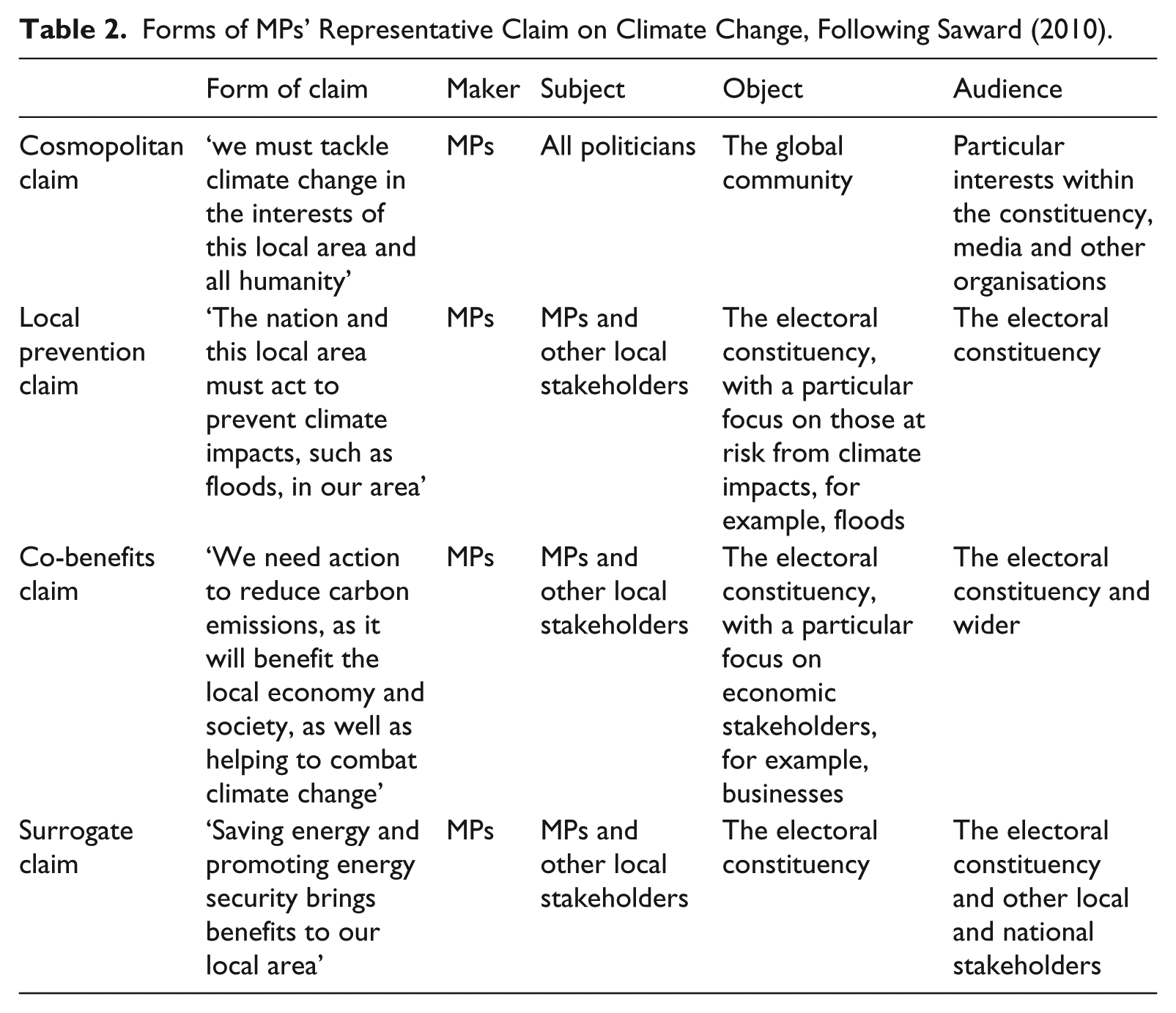
Politicians do not necessarily choose one claim over another; they may use different claims in different circumstances. The cosmopolitan claim appeals to a global community and local people who see their lives within a global context – for example, supporters of development organisations (Desforges, 2004). The local prevention claim has more immediate resonance for local communities and businesses, particularly in areas at risk from extreme weather events such as flooding. A co-benefits claim on climate change is widely used, not just by politicians but by business organisations and other climate advocates; it can be seen as part of the wider framing of environment as a process of ‘ecological modernisation’ (Hajer, 2000). In the UK, the Stern (2007) Review was commissioned by the Labour administration to formalise the economic case for action on climate. The surrogate claim is more likely to appeal to right-of-centre voters who, as other research (Whitmarsh and Corner, 2017) suggests, are most likely to be sceptical of the need for climate action.
Aware of these differences, politicians in this study used different types of claim for different audiences and at different times – such as the interviewee quoted above, who used a flood as an opportunity to discuss climate impacts in his constituency, or other interviewees who said that they would use a ‘co-benefits’ type claim when addressing a business audience. Previous work in political science also highlights this strategy. Richard Fenno’s (1977) classic account of ‘home style’ details how US Members of Congress tailor their presentation according to their audience; Michael Saward (2014) describes the ‘shape-shifting representative’. Whereas it is often assumed that a politician who changes their position or presentation according to the situation is unprincipled, inconsistent or maverick, Fenno, Saward and the evidence from this study would suggest instead that such crafting of claims and positions is part of the everyday job of the representative.
In crafting representative claims, politicians find ways to put climate change onto the political agenda, offering it up in ways that are politically meaningful to the people they represent. However, in doing so, they risk downplaying the nature of the threat, negotiating it into something more acceptable to their audiences. Analysis of parliamentary speech also demonstrates a tendency to ‘tame’ climate change (Willis, 2017b). Yet, climate change, as a planetary phenomenon, cannot be negotiated away. As the US commentator Bill McKibben (2015: 1) puts it, ‘Physics doesn’t negotiate. Physics just does’.
Politicians’ reluctance to confront the more far-reaching implications of climate change may not just be because they do not feel that they can construct a valid representative claim but also because their own life experience, and indeed the development of human societies and political systems over thousands of years, has been carried out against the backdrop of a stable climate (Clark, 2011). The far-reaching changes to earth systems threaten this stability (Steffen et al., 2011). In this context, the task for politicians is to develop representative claims which acknowledge the profound implications of climate change while crafting responses that resonate with those that they represent.
The Theory of the Representative Claim
As this analysis shows, conceptualising representation in terms of the making and accepting of representative claims helps in understanding how politicians can reconcile their representative role with their position on particular issues. It provides an account of the creative ways in which politicians make the case for their agenda, even when, as in the case of climate change, it may not be an issue on which the local electorate is demanding action. It overcomes the vexed questions of whether politicians can or should represent nature or other species, people beyond their constituency and over the long-term rather than a single electoral cycle. The answer is deceptively simple: they can, and should, if they can make a representative claim which is accepted. Implicit in the theory, however, is the idea that some claims are harder than others to sustain; a claim like the cosmopolitan claim identified here, based on the long-term interests of a globalised humanity, will find it more difficult to gain traction than a claim which represents immediate local interests. Thus, the theory provides a nuanced account of the way in which politicians conceptualise their role as a representative.
However, an approach might risk under-emphasising the structures and processes of representation. Electoral systems undoubtedly affect the way in which politicians work. Comparative studies of environmental policy across different legislative systems show the influence of different governance arrangements (e.g. Lachapelle and Paterson, 2013; Schaffer and Bernauer, 2014). As demonstrated by these interviews, the UK’s constituency-based system is an influential factor in politicians’ conceptions of representation. As a study by Lizzeri and Persico (2001) suggests, systems of proportional representation may encourage politicians to appeal to a wider group. It may be that changes to institutional structures or electoral systems might encourage better consideration of complex, global issues; this discussion might be downplayed if too much emphasis is placed on representation as a claims-based construct.
Directions for Research
The research did not set out specifically to examine differences between different political parties and beliefs, though this is undoubtedly of huge significance. For example, a cosmopolitan claim ties closely to liberal conceptions of internationalism and global solidarity, emphasised by Liberal Democrat interviewees in this study; as highlighted above, a surrogate claim is often used with right-of-centre voters. Further research with politicians from different political traditions would help to build a clearer picture of the way in which political ideology shapes representative claims on climate change.
This research has focused on the politicians themselves. However, as Saward points out, politicians do not have a monopoly on representation or, indeed, on politics. Indeed, Bruno Latour draws on the pragmatist tradition in US political thought to focus on attention on the ways in which issues become political. They ask how something becomes a ‘matter of concern’ (Latour, 2004) for certain publics, how the issue is articulated and whether or how it enters the formal political arena. A flood, for example, may just be seen as a weather event, with no attendant politics. However, if local people believe that official agencies could have prevented flood damage through better flood defences or warning systems, flooding may become a ‘matter of concern’, a political issue, as people articulate a problem and advocate solutions (Whatmore and Landström, 2011). This may, in turn, be taken up within the formal political sphere, if politicians support, deny or redefine claims.
Following this, most interviewees pointed to issues which had become ‘political’, thanks to deliberate campaigns by local people, or pressure groups. An example of this is the campaign to protect bees, mounted by Friends of the Earth and other environmental groups. As one interviewee wryly remarked, ‘without in any way undermining the importance of bees, you know we get more letters on bees than on anything else’. Another politician criticised environmental groups for failing to build a public mandate on climate, saying ‘we’re never going to be able to carry this on a sustained basis if we don’t have the public support’, and contrasting with groups supporting overseas development, who, in his view, ensured that ‘there were still cheerleaders for that policy in the public’. There would be merit in research examining the ways in which politicians and other political actors work together, whether in an orchestrated way or informally, to develop and sustain representative claims.
As discussed above, while the analysis here has not focused on processes or institutional considerations, their importance should not be neglected. It may be that more widespread use of deliberative processes, for example, would help politicians to develop their mandate on climate change (Dryzek and Niemeyer, 2008). Reforms which allow long-term considerations to be brought into politics could also be considered (Jacobs, 2011; Urry, 2016). This research was limited to UK MPs, elected through a first-past-the-post constituency-based system. Comparisons could be made to other electoral systems, such as proportional representation, to consider the relationship between claims-making and the formal architecture of electoral systems. Last, backbench MPs, particularly in the UK system, have limited influence on government agendas (Norris, 1997); further research could investigate the representative claims made by governments or political parties.
Supporting Politicians to Speak and Act on Climate Change
This research points to ways in which politicians, individually and collectively, could be supported to develop a comprehensive political response to climate change. First, it is important for climate advocates, including scientists and campaign groups, to acknowledge the complexities of the politician’s role. Politicians must understand the climate issue and its implications, and craft it into an issue, or issues, which they feel will garner support: they must develop representative claims. Scientific evidence in and of itself is not a motivator, as scholars of science and technology studies have long argued (Wynne, 2010). Individual politicians feel constrained in acting on climate change, but some nonetheless find ways of building a claim, a way of legitimising their work in this area.
Second, climate advocates should understand that representation is not a matter for politicians alone. As discussed above, representation stretches far beyond formal politics. Advocates can develop and shape representative claims which politicians can join and modify. Climate advocates could use the typology of representative claims on climate to consider how to support politicians and, indeed, how to develop their own representative claims.
For example, a ‘prevention claim’ could be developed as a time-limited strategy, around the time of extreme weather events such as floods or drought linked to climate change. A co-benefits claim can be used on a local or regional basis; indeed, there are many examples of local areas promoting the benefits of a ‘low-carbon economy’, which in turn helps local politicians to make a case for action. Greater Manchester, for example, has established a ‘Low-Carbon Hub’, which describes its aims as ‘reftrofitting our homes and workplaces, developing more low-carbon skills, building our renewable energy capacity and energy efficiency and helping the low carbon business sector flourish and grow’ (Greater Manchester Low Carbon Hub, 2017).
At the most fundamental level, those holding a moral position that representative democracy is desirable, while also understanding the scientific evidence that urgent action on climate is necessary, must find ways to reconcile representation and climate change. In the words of one politician in this study, ‘the idea that you can somehow ignore the electoral result when setting your expectations of what government might do is profoundly undemocratic’.
Footnotes
Funding
The author(s) disclosed receipt of the following financial support for the research, authorship, and/or publication of this article: This work was funded by the Economic and Social Research Council [grant number ES/J500094/1].
Author Biography
