




Abstract
Like many public service workers, politicians must manage the emotions of others as well as themselves in order to facilitate cooperation or goal accomplishment. Coined by Arlie Hochschild, this type of work is known as emotional labour. This article analyses a unique data set on the emotional labour and occupational wellbeing of over 500 elected politicians in the United Kingdom to understand how this important feature of public service plays out in political office. On one hand, all three facets of emotional labour (emotion work, personal efficacy, and false-face acting) are found to be prevalent among elected politicians, with self-reported levels of emotional labour differing among men and women. On the other hand, emotion work and personal efficacy appear to improve job satisfaction and occupational pride among politicians, but false-face acting increases symptoms of occupational burnout. These findings raise important questions about the nature of political institutions and the sustainability of political work.
Since the 1980s, public administration scholars have taken a progressively more humanist view of service delivery and organisational politics that acknowledges the role and importance of emotions in general (see Mastracci et al., 2006) and Arlie Hochschild’s (1983) concept of ‘emotional labour’ in particular. Hochschild (1983: 7) coined the term emotional labour to describe the key affective pre-requisite of public-facing professions or, put another way, ‘the management of feeling to create a publicly observable facial and bodily display’. Yet, in spite of a burgeoning literature on emotional labour in different service-oriented jobs, there has not been a concerted effort to understand the prevalence, effects, or significance of emotional labour in political office. Like any public service occupation, politics (as a vocation and as an increasingly professionalised job) requires its ‘employees’ to manage the emotions of others. Politicians must care about strangers as well as colleagues, or at least be seen to care, in order to solicit desired responses that facilitate cooperation or goal accomplishment. Their work is, by definition, relational.
At the same time, existing discrepancies in the construction of workplace privileges and norms may differentiate the experience of emotional labour among politicians. To be specific, emotional labour may provide a powerful empirical lens through which to better understand the gendered game of politics from a workplace perspective (see also Childs, 2016; Dahlerup and Leyenaar, 2013). Emotional labour has already been proven to affect women more than men in other service-oriented industries (Cottingham et al., 2015; Johnson and Spector, 2007), but political science is yet to take up the same topic of study in order to analyse the unobservable ways in which legislative bodies and political communities render political work more or less difficult for women. In offering such an analysis in this article, I contribute to a growing body of feminist institutional research that seeks to expose the gendered consequences of masculine norms in organisational settings (e.g. Gains and Lowndes, 2014; Krook and Mackay, 2011).
The importance of this research agenda has as much to do with exploring the effects of emotional labour in democratic politics as it does its existence. In their framework of stressors on politicians’ mental health and wellbeing, Flinders et al. (2018: 3–4) suggest that emotional labour (or what they call ‘political labour’) has become an accepted feature of political office that may have deleterious effects on politicians’ ability to function as representatives and decision-makers. At the same time, the psychological toll of contemporary governance is receiving increasing attention and publicity within political institutions. For example, the UK House of Commons convened its first formal debate on the mental wellbeing of politicians in 2012 (HC Deb 14 June 2012, vol. 546, cc504-76), and in December 2017, the United Kingdom’s Committee on Standards in Public Life published shocking insights about the psychological impact (upon politicians) of online and offline harassment (CSPL, 2017: 29). As such, emotional labour may not only be a pressing feature of political work that requires empirical investigation, but such research may also provide an important step forward in understanding whether and how individuals cope with governing in the twenty-first century.
Taken together, these arguments capture three highly significant research questions underpinning this article: to what extent is emotional labour a feature of political work? To what extent is emotional labour in political office a gendered experience? And to what extent does emotional labour impact legislators’ wellbeing? I explore the relevance and implications of these questions with unique data collected from 455 councillors and 72 Members of Parliament (MPs) in the United Kingdom. I find that all three facets of emotional labour (emotion work, personal efficacy, and false-face acting) are prevalent among elected politicians and that self-reported levels of emotional labour differ between men and women. At the same time, I find that emotion work and personal efficacy positively predict levels of job satisfaction and occupational pride, but false-face acting positively predicts symptoms of occupational burnout such as exhaustion, pessimism, and stress. These are highly significant findings that raise important questions about the nature of political work as well as the sustainability of modern politics and the suitability of current institutional support mechanisms for elected politicians in the United Kingdom and beyond.
What is emotional labour?
Emotional labour is, first and foremost, an affective component of the dynamics shared between two people. Defined across different academic disciplines as verbal judo, compassion fatigue, vicarious traumatisation and emotion management (for an overview, see Guy et al., 2008: 5), emotional labour is a well-researched feature of social exchange in occupational settings that centres on affective sensitivity and flexibility. Beyond this broad canvas, emotional labour can be split into three composite facets: emotion work, personal efficacy, and false-face acting (Hochschild, 1983). Emotion work refers to the nature of the job itself. It characterises the emotional demands required in order for the employee to fulfil his or her job and it is thus regulated to some extent by the employer (see also Tolich, 1993). For example, nurses are required to manage the emotions of patients on their ward, while police officers are required to deal with a range of potentially unfriendly or confrontational people each day. Both are unavoidable aspects of their respective job descriptions, and employees have little choice about whether or not to meet these demands in their occupational lives.
Personal efficacy refers more specifically to individuals’ perceptions of emotion work in their daily working lives and, more importantly, their perceptions of their own competency when performing those tasks. Continuing the example above, nurses may feel more or less competent at making patients feel better about themselves, while police officers may feel more or less competent at calming people down. The third facet of emotional labour, false-face acting, captures the extent to which an employee believes they must (1) pretend to feel one emotion while actually feeling a different one (surface acting) or (2) alter their affective state to internalise and feel a desired emotion (deep acting). This is referred to elsewhere in the literature as acting in ‘bad’ or ‘good’ faith, respectively (see Grandey, 2003). Nurses and police officers may, for example, expend considerable energy to appear artificially pleasant, calm, or professional in the face of situations that evoke quite different personal feelings.
Following Hochschild’s (1983) initial study of ‘always-pleasant’ airline attendants, researchers have now studied these three facets of emotional labour in occupations as diverse as theme parks (Van Maanen and Kunda, 1989) and consumer complaint agencies (Jin and Guy, 2009). A number of in-depth studies of public-sector professions (largely in the United States) have also found particularly high levels of emotional labour among frontline social workers (Hsieh and Guy, 2009), emergency service dispatchers (Guy et al., 2008; Shuler and Sypher, 2000) and police officers (Martin, 1999). More recently, there has been a sharp uptake in comparative research on emotional labour as an organisational construct (e.g. Dijk and Brown, 2006; Mastracci et al., 2006). Building on these theoretical and empirical contributions, I now take this literature a step further by focusing on emotional labour as a feature of holding political office.
Emotional labour and political office
Despite significant advances in the psychological study of political elites and legislative behaviour, there has not, to date, been a systematic empirical investigation of the emotion work required in political office and, subsequently, the effects of emotional labour upon politicians. This is in spite of the fact that (1) politics is a vocation that focuses upon assisting, enabling, or negotiating activities that revolve around the needs of other people; (2) reforms to legislative accountability and transparency have heightened the saliency of emotion work in recent years; and (3) rising public cynicism demands more acutely managed emotional displays from representatives.
To take the first of these arguments, I suggest that the tasks associated with governing – in the broadest sense – are inherently emotional and emotionally labour-intensive. To borrow from Valdimer Orlando Key’s (1942(1958): 181–182) distinction between party functions, elected politicians may be at any one time ‘representatives-in-the-electorate’, ‘representatives-in-the-party’, ‘representatives-in-the-legislature’, and ‘representatives-in-the-government’. Taking these roles as fluid – and thus assuming that politicians must adopt them ad hoc and seriatim – I suggest that political office requires the actor to wear a number of ‘faces’. Therefore, while the activities inherent in any one of these representative roles may relate to ‘things’ that need doing (surgeries to be held, votes to be cast, policy to be scrutinised), the actions associated with them are inveterately relational. Take, for example, the local or national politician who knocks on the door of a constituent’s home while canvassing. Upon seeing the occupant open the door, the representative must intuit the affective state of the citizen (emotive sensing); they must reflect upon their own instinctive emotions in that moment or those emotions that arise when the citizen verbally or physically reacts to their presence (emotive reflexivity); and then they must amend or conceal their own feelings to interact in a way that will ingratiate them with a potential voter (cognitively altered emotional display). This scenario may be repeated dozens of times in any one day, but the politician must be just as emotionally sensitive and flexible with the last citizen that answers a door as the first.
Unlike many occupations, politicians must also work across multiple organisational settings and within many different occupational hierarchies. It is pertinent, therefore, to acknowledge that political institutions – the formal arenas in which legislators must work – have also become more transparent in recent decades in a way that, according to Philip Norton (2017: 198), exposes politicians to the inflated expectations that accompany popular cynicism, a disinterested commercial media, and the immediacy of the Internet. This is particularly noticeable in countries like the United Kingdom, where the public can watch MPs work in real time through the Internet or the BBC Parliament channel. In the process, the expressive function of parliaments, political institutions, and their members has assumed heightened significance. On one hand, this has increased the accountability functions of legislatures. On the other hand, I suggest that these changes may have intensified the performative aspect of politics and thus the emotional labour required of elected officials. The UK House of Commons, for example, now publishes lists of the questions asked by each MP (Young et al., 2003), and the media have even used MPs’ written questions as the basis for league tables that rank representatives on their (pro-)activity (Leapman, 2005).
If modern politicians are constantly on public display, then it is often their affective state that is the subject of scrutiny. As one former Canadian academic-turned-politician recalls:
Once you enter politics, you are always on show. You never jump a queue, you never get impatient with a driver or a waitress or a check-in clerk. You never lose your temper. You never fail to light up when someone comes over for a picture or an autograph. You surrender the entirety of your private life for the duration. People are watching. (Ignatieff, 2013: 53)
Politicians must, therefore, constantly synthesise their own beliefs with the range of expectations they perceive from a plethora of role alters (e.g. party whips, colleagues, voters, journalists) in order to decide upon behavioural choices and emotional displays within their occupational context. Put simply, they must engage in emotion work as a necessary feature of their daily job:
H1. Elected politicians will regularly experience emotion work in their occupational lives.
While I suggest that politics per se is emotionally demanding, and thus replete with emotion work, it is also possible that the manifestation of emotional labour among politicians is exaggerated by the intense anti-political sentiment seen in democracies around the world. In the United Kingdom, the Hansard Society’s (2019: 3) audit of political engagement concluded, ‘[o]pinions of the systems of governing are at their lowest point in the 15-year Audit series – worse now than in the aftermath of the MPs’ expenses scandal’. In this context, I argue that the imperative behind emotional labour for politicians is increasing in a way that privileges political displays and ‘benevolent lying’ (Rubner, 2006). Put another way, it is entirely possible that politicians engage in false-face acting in order to ingratiate themselves with a critical public so as to accrue electoral advantage (or to diminish electoral damage) as much as to placate, support, or encourage that public.
In parallel literatures on blame avoidance behaviour in politics, scholars talk of agency strategies that shift responsibility to colleagues, presentational strategies that distort public perceptions, and depoliticisation strategies that limit formal liability (Hood, 2007; Wenzelburger, 2014). Although overly critical of the humanity of political actors – and more focused on the cognitive than the affective – these arguments are appraisive for unpicking the types of emotional labour required of politicians who must act in ‘good’ or ‘bad’ faith to succeed in a highly critical climate. As such, I argue that politicians may be more inclined than most frontline public officials to engage in false-face acting because the personal costs of not doing are uniquely ever-present:
H2. Elected politicians will regularly engage in false-face acting.
Gender and emotional labour in politics
In this article, I am concerned with questions of not only ‘if’ and ‘how’ emotional labour manifests in elected politics but also ‘why’ it might differ between actors. It seems theoretically reasonable to expect that individual differences may distinguish between those who are more or less skilled at emotion work, more or less required to perform it, and more or less able to cope with its effects. To that end, I focus here on the differentiated experience of emotional labour among male and female politicians on the basis that (1) emotional labour is inherently gendered (see below) and (2) informal norms, expectations, and power hierarchies privilege masculinity in parliaments and legislatures around the world (Lovenduski, 2005).
Drawing on a long literature in social science that theorises the link between gender and emotion, Hochschild (1983) suggested that emotion work was particularly salient in service-based occupations that, in the United States at least, were gendered as feminine. A number of studies have since documented heightened levels of emotional labour and negative side effects thereof among women. For example, Cottingham et al.’s (2015) study of nurses in the United States shows that male nurses perceive fewer emotional expectations than their female colleagues and engage much less in false-face acting (see also Johnson and Spector, 2007). In attempting to make sense of these results, scholars have argued that emotional labour is likely to be gendered because (1) men are held to different emotional norms and display rules (Vaccaro et al., 2011), (2) men remain protected by a ‘status shield’ whereby cultural beliefs about male authority protect them from the emotional demands of the public they serve (Erickson and Ritter, 2001), and (3) cultural conflations of emotion with the feminine alter the within-subject effects of experiencing emotional labour (O’Lynn, 2007).
An important and growing corpus of work on the politics as a workplace perspective provides compelling reasons to expect that these arguments hold in politics (see Dahlerup, 2006: 513). Research on the latter by scholars in political science and cognate disciplines – especially those working within feminist institutionalism – contends that formal and informal institutions can prescribe alternate codes of conduct for men and women in spite of seemingly gender-neutral constructions (Gains and Lowndes, 2014; Krook and Mackay, 2011). In this way, feminist institutionalism reveals and maps the complexities of institutional gender dynamics and highlights, according to Krook and Mackay (2011: 4), ‘the multiple ways in which gendered power relations and inequality are constructed, shaped and maintained through institutional processes, practices and rules’. For example, the Swedish national parliament has been comprised of more than 40% women for over two decades, but Erikson and Josefsson’s (2019: 205) recent study of workplace experiences found that female MPs still experience greater pressures to perform, display higher levels of anxiety, and are subject to more negative treatment, including lower levels of positive feedback and more frequent comments on their appearance, than male MPs.
In comparative contexts, similar studies have shown that feminine styles of politics are granted less legitimacy (Childs, 2004) and women politicians suffer under the pressure of different workplace expectations (Anzia and Berry, 2011). In these myriad ways, informal institutions – defined as the practices, norms, and rhetoric of an organisational setting – can blunt, subvert, or render useless the formal rules of an institution (see Helmke and Levitsky, 2004). As such, the potential occupational benefits of recent moves towards ‘gender sensitive’ parliaments (e.g. Ballington, 2009), including ‘family-friendly’ changes to sitting hours or new childcare facilities within legislatures, may be undermined by entrenched masculine ideals that shape politicians’ discourses and behaviour. It is not surprising, therefore, that studies of such changes to legislative workplace arrangements have found lower levels of satisfaction and impact among female politicians (see Allen et al., 2016).
In this context, it is reasonable to expect that men and women experience their legislative roles in different ways, and that women face greater pressure from informal institutions to alter their cognitive and affective displays in order to ‘fit in’ and succeed in an occupational environment that otherwise privileges masculine qualities and behaviours. While these unobservable pressures may vary in intensity across loci of action – that is, the council chamber, parliamentary committee room, or the constituency doorstep – they are likely to induce higher levels of emotional labour in female politicians. Moreover, given that (1) there remain few legislative institutions worldwide with adequate family-friendly working practices and (2) women remain more likely than men to shoulder childcare and domestic responsibilities (e.g. Kan et al., 2011), female politicians are likely to experience heightened tensions between their working and personal lives. This may, on one hand, increase female politicians’ perceptions of emotion work in the daily occupational lives and, on the other hand, increase their propensity towards masking otherwise real and stressful or negative emotions:
H3. Male politicians will report lower levels of emotional labour than female politicians.
Emotional labour and occupational wellbeing
Theorising the effects of emotional labour for politicians’ occupational wellbeing is not entirely straightforward. On one hand, emotional labour can actually increase feelings of security, self-esteem, and psychological wellbeing (Pugliesi, 1999; Tolich, 1993); it can foster a tighter sense of organisational community (Shuler and Sypher, 2000); it can be particularly empowering for individuals in leadership positions (Leidner, 1999); and it can have positive effects on self-efficacy and satisfaction in contexts of high job autonomy (Wharton, 1993). Job autonomy and leadership are apposite features of political work, insofar as politicians are elected into an occupation where they must legislate for the common good and lead by example, while simultaneously navigating a career that has no formal job description, no specified person description, and few formally enforced obligations.
In this article, I examine positive occupational wellbeing among politicians via job satisfaction and pride in work. The former defines a positive affective state that arises from self-reflection on one’s professional expectations and task performance (see Butler, 1990). The latter defines the intrinsic value of the job itself to the actor in question (Guy et al., 2008: 28). The extrinsic rewards for political service, in the United Kingdom at least, are limited by comparison with other managerial or directorial positions in public- or private-sector organisations, and as such, the opportunity to serve and assist others (i.e. the prosocial aspects of political service) is a powerful and well-researched motivator of candidate emergence (see Weinberg, 2020). I expect, therefore, that emotional labour may share a positive relationship with politicians’ job satisfaction and pride in work, and that both in turn will also share positive relationships with politicians’ self-perceived job autonomy:
H4. Politicians who experience higher levels of emotional labour will be more satisfied with their job and hold more pride in their work.
Emotional labour can also lead to burnout (e.g. Brotheridge and Grandey, 2002). Jin and Guy (2009: 96) argue that the suppression of one’s personal identity (as per false-face acting in particular) is exhausting and can readily become a struggle if it is performed on a daily basis. The result, seen in burnout, is principally comprised of inefficacy or negative self-evaluation, affective exhaustion as defined by high stress levels and depression, and occupational cynicism (see Guy et al., 2008: 33). Crucially, burnout and positive outcomes such as job satisfaction are not mutually exclusive. Employees may find purpose and meaning in meeting the emotional needs of others but, at the same time, suffer negative side effects.
For professionals like politicians who work in human service occupations, there is also a tension between the desire to help others and the (more frequent) inability to do so as well as a lack of tangible success. The majority of politicians have very little individual control over legislative outcomes but still face impossible demands on their time and energy from constituents, party officials, third-sector organisations, and public or private interest groups (e.g. Gay, 2005). Each interaction may induce emotional labour, to varying degrees, but few will result in concrete success:
H5. Politicians who experience higher levels of emotional labour will experience higher levels of burnout.
Methods
In this article, I present the first detailed empirical study of emotional labour among democratically elected representatives with a particular empirical focus on the United Kingdom. To test hypotheses 1–5, I draw on unique survey data collected from UK politicians in the summer of 2019. As part of a larger study of politicians’ attitudes and behaviours, this survey was distributed to all candidates who stood in local (council) elections or national (Westminster Parliament) elections between May 2010 and May 2019, and who made their contact details available to the Electoral Commission at the time of standing. 1 Surveys were distributed electronically using Qualtrics. A subsample of participants – 455 elected councillors and 72 elected MPs – are used in this article (Table 1).
Descriptive characteristics of sample councillors and MPs (percentages rounded to the nearest whole number).
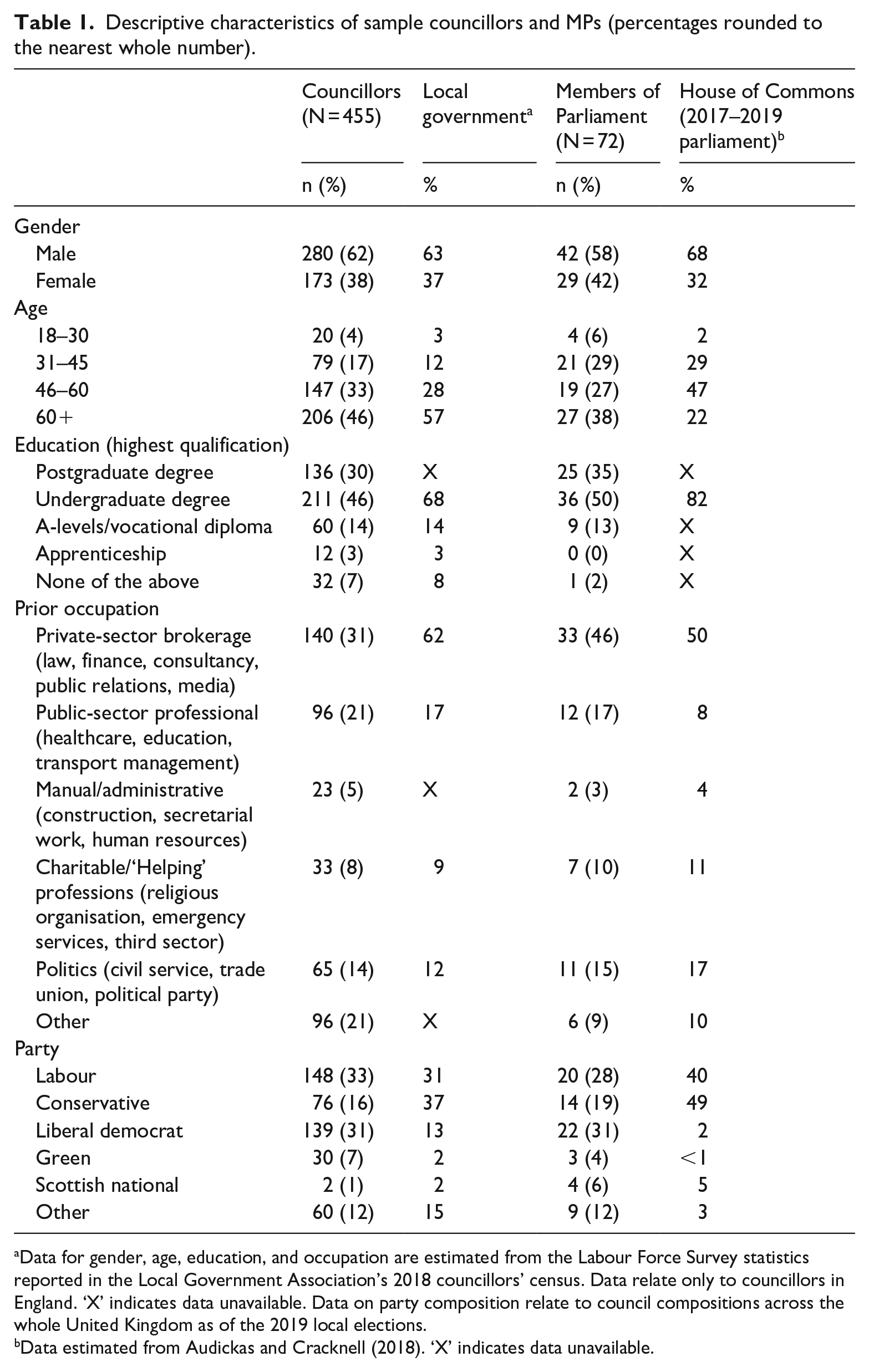
Data for gender, age, education, and occupation are estimated from the Labour Force Survey statistics reported in the Local Government Association’s 2018 councillors’ census. Data relate only to councillors in England. ‘X’ indicates data unavailable. Data on party composition relate to council compositions across the whole United Kingdom as of the 2019 local elections.
Data estimated from Audickas and Cracknell (2018). ‘X’ indicates data unavailable.
It is worth noting that response rates for survey research with political elites in the United Kingdom are notoriously low (e.g. Campbell and Lovenduski, 2015). Participants recruited for this study represent 11% of the all MPs and 2% of all councillors sitting in the United Kingdom at the time of data collection (although the actual response rate for elected councillors who were contactable was nearer 8%). Although these response rates are comparatively favourable for this type of research, it is more appropriate to consider the representativeness of elite samples. In this instance, the sample is both diverse and broadly representative of local and national populations of politicians in the United Kingdom by age, gender, education, and prior occupation (Table 1). 2
Participants completed the GNM Emotional Labour Questionnaire developed by Guy et al. (2008) in their study of 911 dispatchers, child protection officers, and prison correction officials in the United States. Participants respond to statements about the demands and characteristics of their jobs on a Likert-type scale that indicates how often each occurs from 1 (never) to 7 (always). The survey includes batteries of items for emotion work per se (capturing respondents’ perceptions about the emotional requirements of their job), personal efficacy (questioning respondents’ self-perceived competency at managing their own and others’ emotions), and false-face acting (measuring the extent to which respondents feel they must hide their own emotions or display emotions that they do not actually feel). Example items include the following:
My job requires that I display many different emotions when interacting with others (emotion work);
I attempt to keep the peace by calming clashes between co-workers (personal efficacy);
My job requires that I pretend to have emotions that I do not really feel (false-face acting).
Crucially, additional batteries on the GNM measure job satisfaction (the degree to which participants feel stimulated by their work and successful at performing it), pride in work (the extent to which respondents’ find their job exciting, challenging, and meaningful), and burnout (the degree to which participants feel stressed and emotionally blunted by, or apathetic and despondent about, their job). Two items measure participants’ perceptions of their workplace autonomy. Each index variable described above is calculated as the mean score of the items designed to measure it (five per emotional labour facet). 3 Confirmatory factor analysis suggests a strong fit between the theoretical model and the observed data for emotion work (χ2 = 47.30, df = 9, comparative fit index (CFI) = .96, root mean square error of approximation (RMSEA) = .09, standardised root mean residual (SRMR) = .04), personal efficacy (χ2 = 78.48, df = 9, CFI = .89, RMSEA = .10, SRMR = .05), and false-face acting (χ2 = 51.75, df = 9, CFI = .92, RMSEA = .09, SRMR = .04). 4 Cronbach’s alphas for these latent factors are also above .7, indicating high internal validity (Table 2).
Univariate statistics and correlation coefficients for main latent variables.
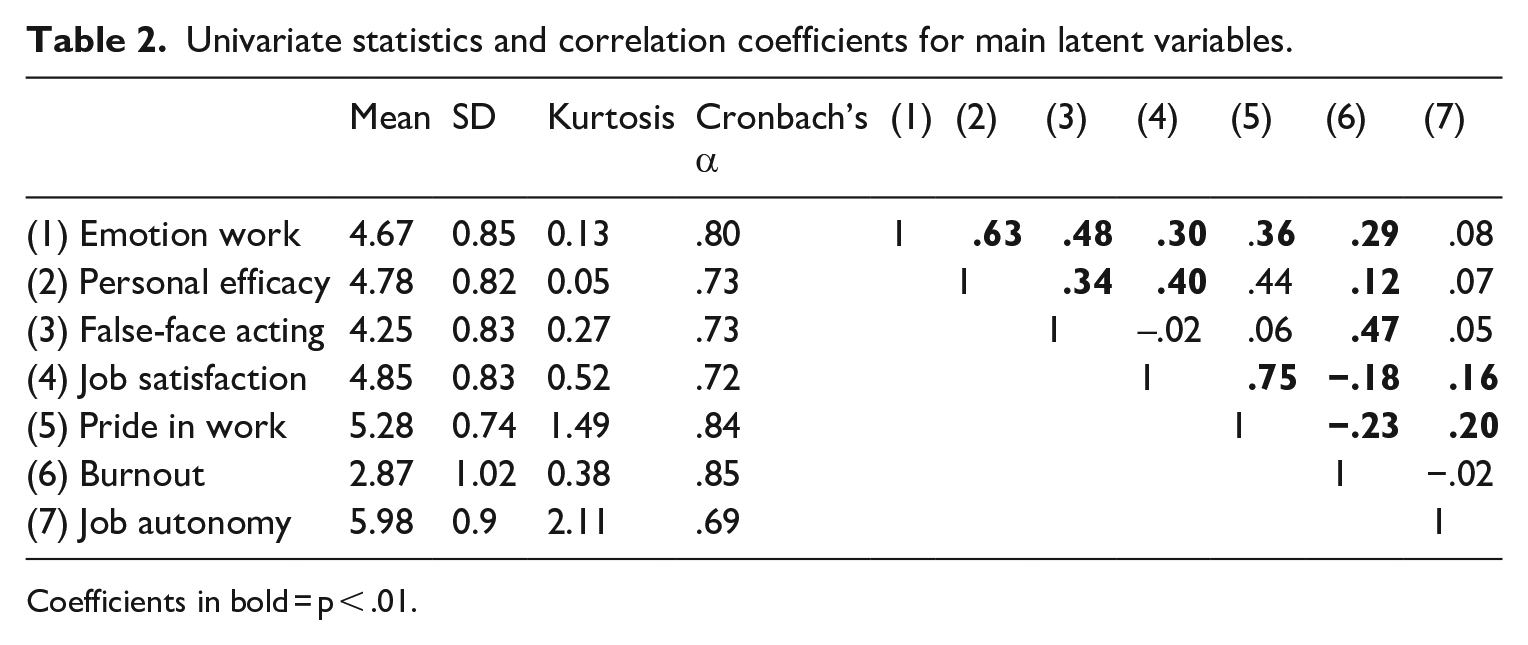
Coefficients in bold = p < .01.
Analysis
The following analysis proceeds in three parts. The first section reports univariate statistics for emotion work, personal efficacy, and false-face acting to assess the prevalence of emotional labour among elected politicians in the United Kingdom. The second section reports a two-way analysis of variance (ANOVA) to evaluate the differentiated experience of emotional labour among men and women holding political office. The third and final section presents multivariate analysis of the association between emotional labour and occupational wellbeing in democratic politics.
Prevalence
Univariate statistics reported in Table 2 (including mean scores above the scale midpoint of four) suggest that emotion work, personal efficacy, and false-face acting are regular features of political work in the United Kingdom (H1 and H2 supported). Bivariate correlations reveal positive relationships between all three facets of emotional labour, although these associations are much stronger between emotion work and personal efficacy than between either and false-face acting. This reinforces existing arguments reviewed earlier in this article about the related but unique nature of false-face acting as a type of emotional labour. To that same end, Table 2 shows positive bivariate associations between false-face acting and burnout. By contrast, emotion work and personal efficacy share stronger relationships with job satisfaction and pride in work (H5 and H6 supported). These findings will be investigated in more detail later.
In order to unpick these aggregate data, Figures 1 to 3 display participants’ responses to items on the GNM. Figure 1 shows the frequency with which UK politicians in this sample are called upon to engage in emotion work. The data support the supposition that the job of being a politician is a necessarily emotional one (H1). For example, 51% of respondents believe that their job as an elected representative requires them to regularly guide people through sensitive emotional issues, and 60% believe that a critical dimension of their job is about dealing with emotionally charged issues (based on item responses ‘always’, ‘usually’, or ‘often’). These responses are comparable with those recorded by Guy et al. (2008: 52–54) among 911 dispatchers, child protection officers, and prison correction officials. For example, 55% of workers in that study stated that their job ‘always’, ‘usually’, or ‘often’ requires them to show many different emotions when interacting with other people. By contrast, 71% of elected politicians in this study gave the same responses.
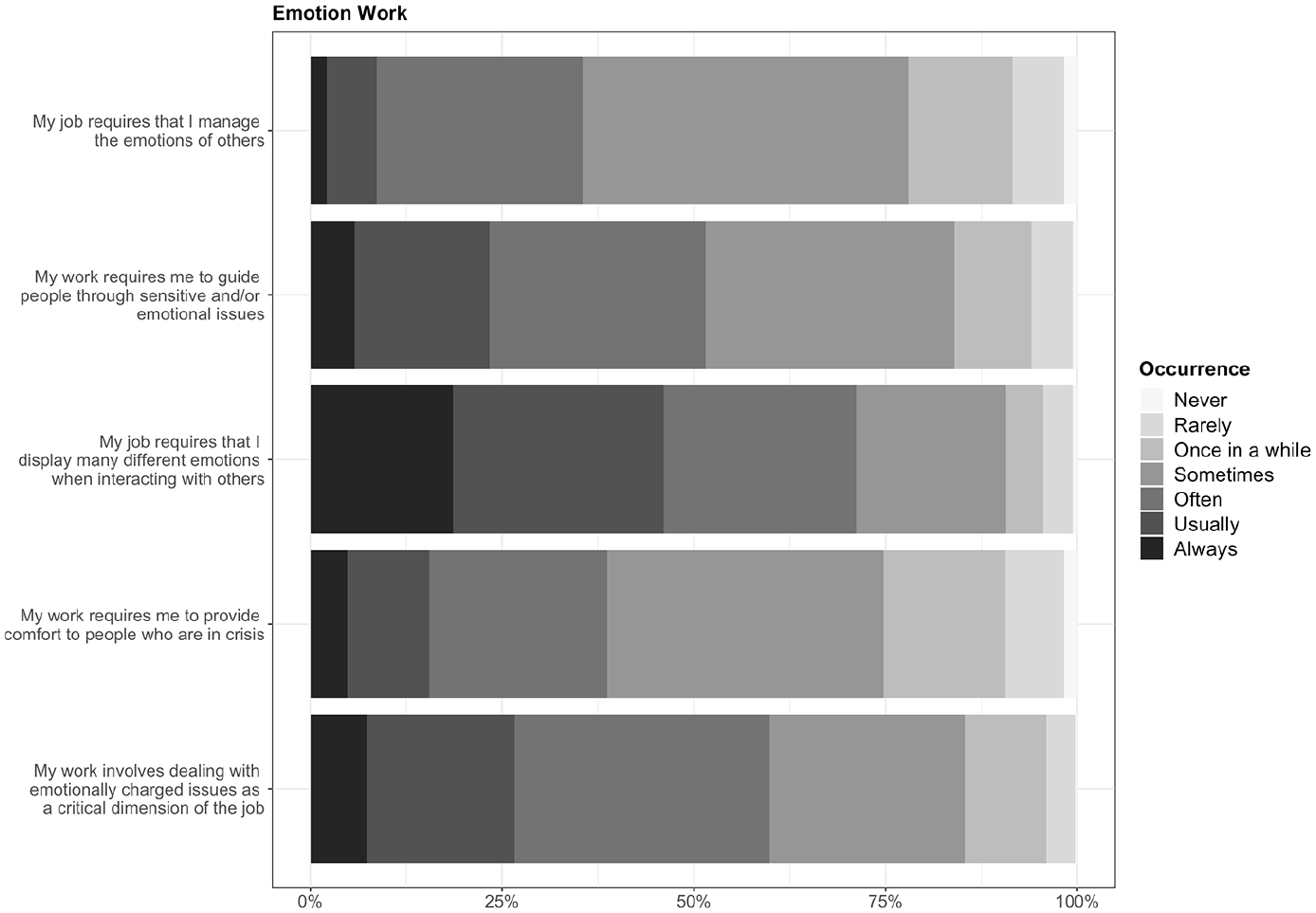
Frequency of emotion work among elected politicians in the United Kingdom.
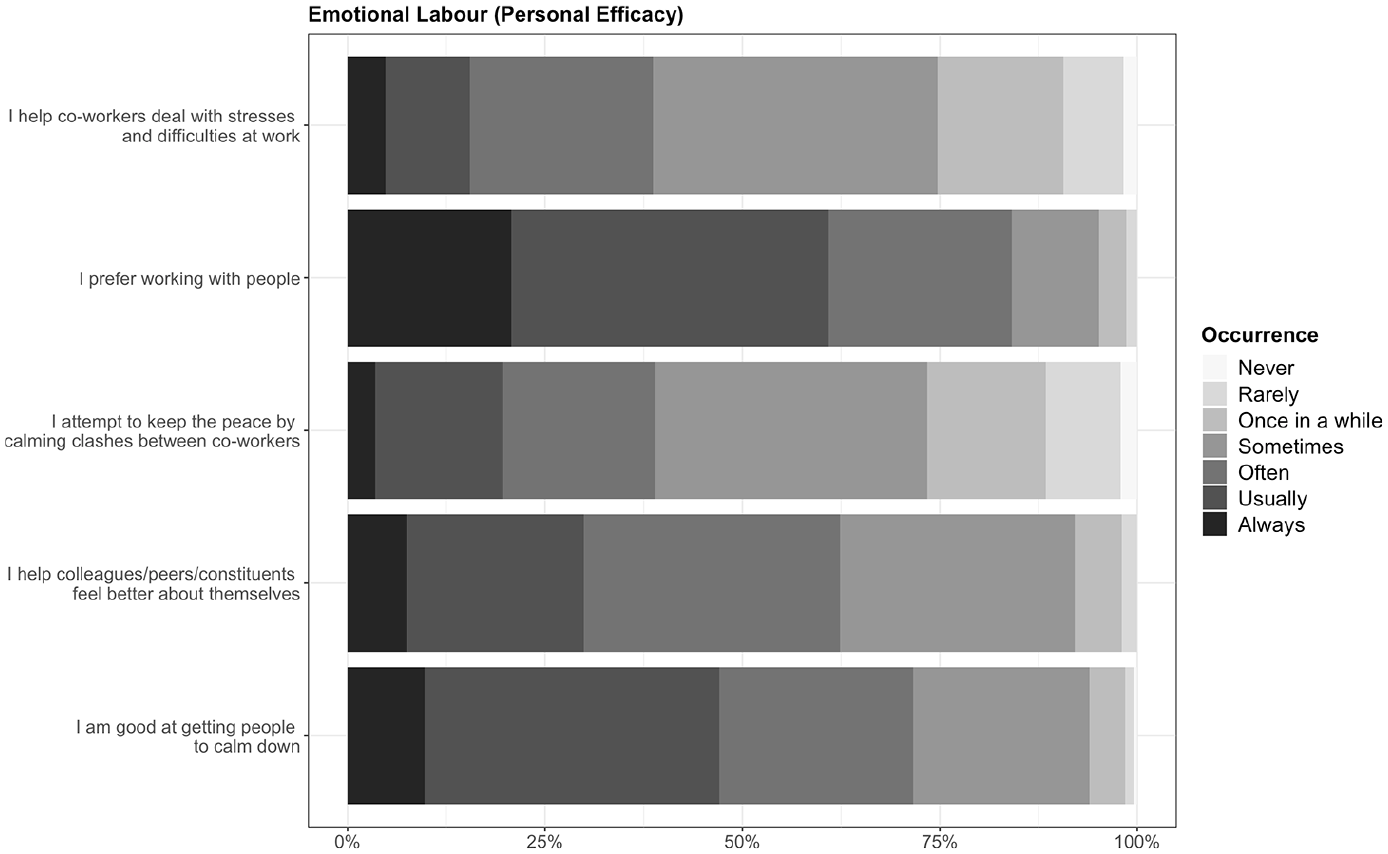
Personal efficacy of elected politicians in the United Kingdom when engaging in emotion work.
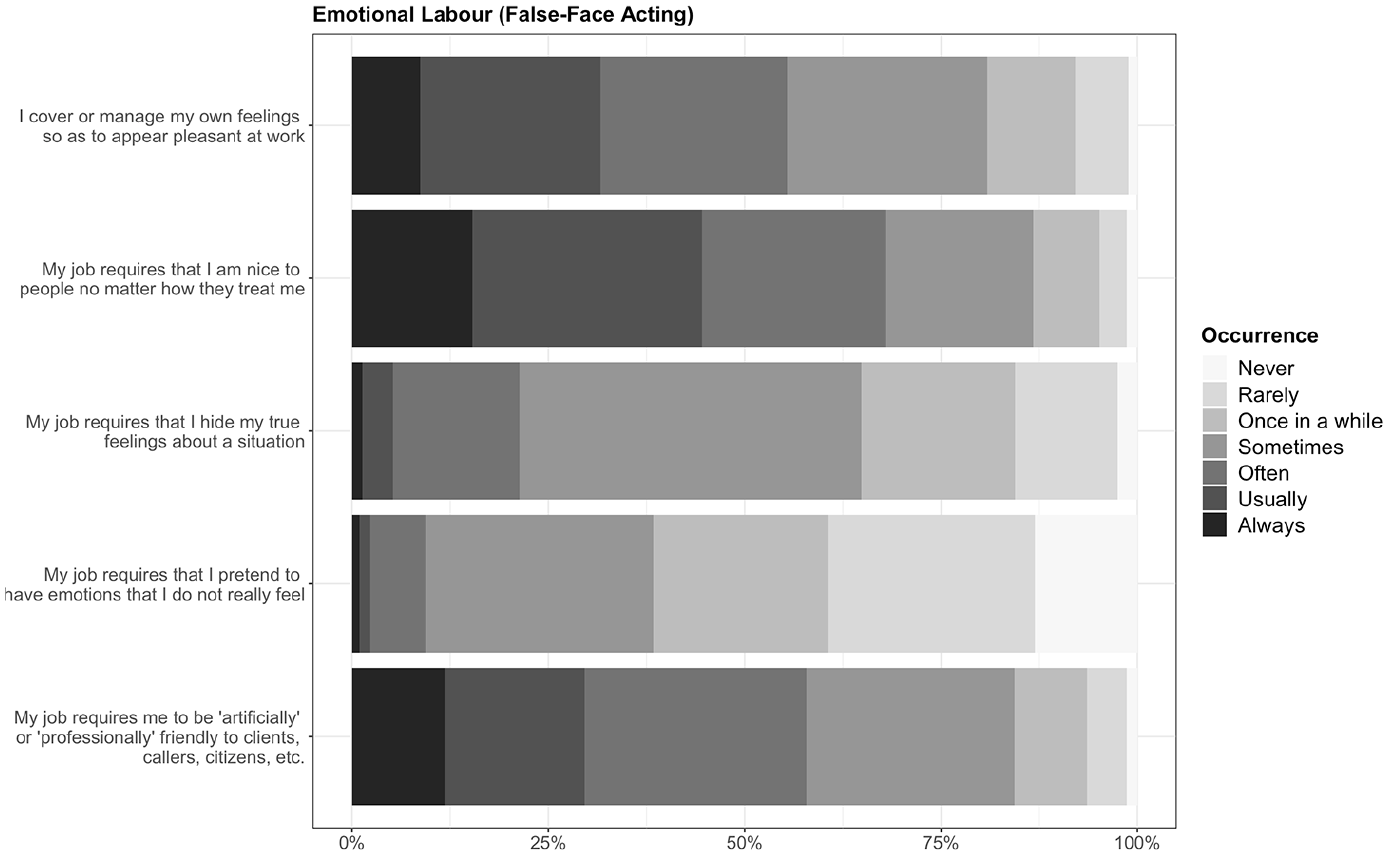
Frequency of false-face acting among elected politicians in the United Kingdom.
Figure 2 shows how politicians rated their own ability to perform emotion work (i.e. personal efficacy). In the present sample, 72% and 62% of participants rated themselves as good at getting others to calm down or feel better about themselves as a regular feature of their work (based on item responses ‘always’, ‘usually’, or ‘often’). Indicative of a natural inclination towards prosocial and relational work, 84% of participants preferred working with people regularly. By contrast, fewer participants reported high levels of personal efficacy in relation to co-workers.
Figure 3 reports the frequency that elected politicians in the United Kingdom must hide, suppress, or alter their own emotions (i.e. engage in false-face acting). A majority of participants claim to regularly engage in most forms of false-face acting (based on item responses ‘always’, ‘usually’, or ‘often’), although these percentages are lower than those recorded by frontline public service workers in Guy et al.’s (2008) study in the United States (H2 partially supported). For example, 58% of politicians in this study feel that they are regularly required to be ‘artificially’ or ‘professionally’ friendly (compared with 74% of frontline workers (Guy et al., 2008: 55)). Interesting in the context of contemporary debates about public abuse towards politicians (as well as the conflictual nature of politics itself), 68% of participants feel that they regularly have to be nice to people regardless of how they are treated by them. Only 9% and 22% of participants, respectively, feel that they regularly needed to hide their true feelings or fake emotional responses. Although these items were also scored lower by frontline workers in Guy et al.’s (2008) study, these responses are at odds with those for other items in this battery. It is possible that the wording of these items invokes negative cognitive dissonance in participants’ reflections on their political work or that the nature of these items taps into common criticisms of politicians and thus stimulates social desirability bias.
Antecedents – gender
I now turn to examine how these experiences of emotional labour in political office might differ for men and women. A two-way ANOVA is used to assess the mean differences between participants by office (MP or councillor) and sex (man or woman). 5 A two-way ANOVA is a suitable method to use in this instance, given that it can capture differences in the outcome variables (emotional labour facets) across multiple groups as well as the interactions between those groups. It is possible, for example, that MPs may experience higher levels of emotional labour than councillors, given the saliency of national political issues in the press and the gravity of their decision-making, and that this will be exacerbated further among sub-groups within that population such as women MPs (Figure 4).
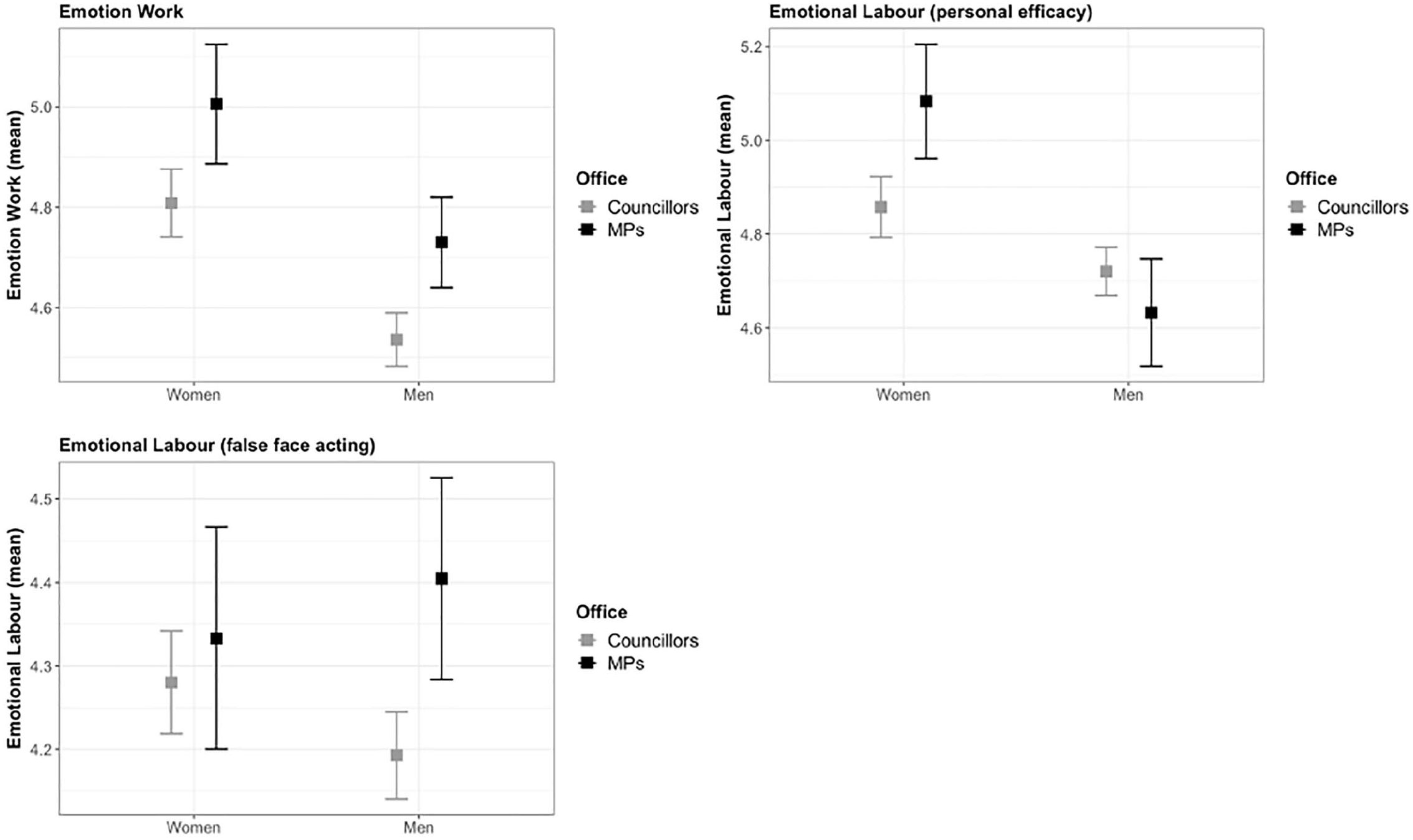
Emotional labour among men and women in elected politics in the United Kingdom.
The main effects of sex are statistically significant for emotion work (F(1, 506) = 12.63, p < .001) and personal efficacy (F(1, 493) = 5.73, p < .05). Neither the main effects of office nor the interactions between office and sex reach statistical significance for any facet, indicating that experiences of emotional labour are equally different for men and women who are elected to both local and national office. Additional t tests with Bonferroni corrections confirm that women MPs score higher for personal efficacy than male MPs (mean difference = 0.450, t(66) = 2.64, p < .01) and the difference for emotion work approaches statistical significance (mean difference = 0.275, t(68) = 1.87, p < .06). Similarly, women councillors score higher for emotion work than male councillors (mean difference = 0.272, t(438) = 3.17, p < .001). These findings suggest that women in politics are both required to engage in emotionally charged work on a more regular basis than men and feel more competent when it comes to meeting those emotional demands. Male MPs did score slightly higher for false-face acting than women MPs, but this result ran in the opposite direction to the difference between male and female councillors and neither difference reached statistical significance. Taken together, these results offer compelling support for hypothesis 3 (H3).
Outcomes – occupational wellbeing
In this subsection, I report three ordinary least squares (OLS) multiple regressions designed to assess the association between emotional labour and occupational wellbeing (specifically job satisfaction, pride in work, and burnout). In each case, I control for job-specific variables such as tier of governance (MP or councillor), party saliency (mainstream or peripheral), and perceived job autonomy (measured in the GNM); socio-demographics (sex and education); ideology (a composite score of participants’ self-reported economic and social ideology on an 11-point Left-Right scale); and participants’ prior occupation (dummy variable where 1 = emotionally charged prior career in the emergency services, charity sector, or frontline public services such as teaching, healthcare, and transport). Marginal effects with 95% confidence intervals are reported in Figure 5. All continuous predictors have been rescaled to show the effects of moving across the full scale of scores within the sample population.
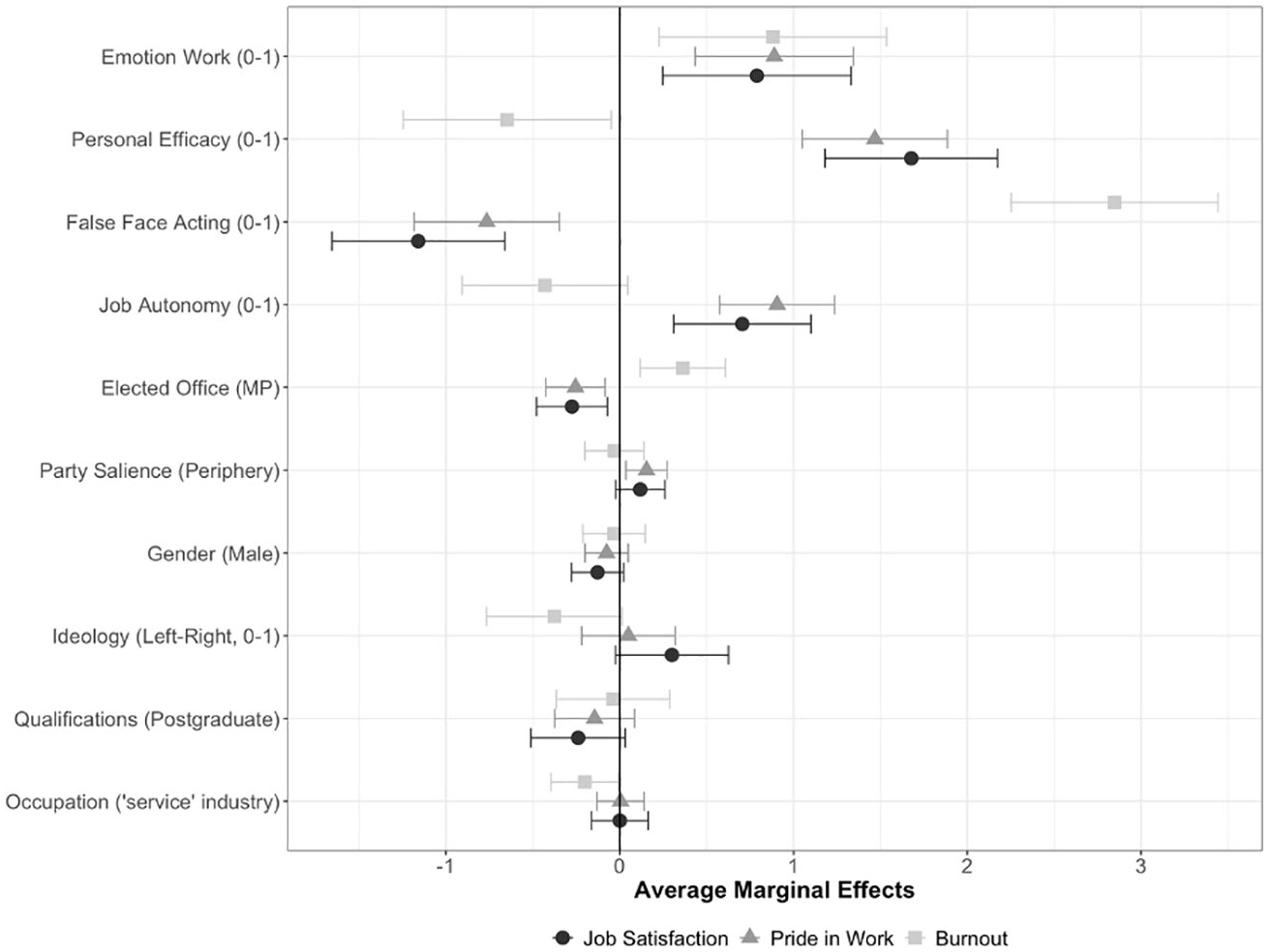
Marginal effects of OLS regressions for job satisfaction, pride in work, and burnout among elected UK politicians.
These tests suggest that all three facets of emotional labour have strong effects on politicians’ occupational wellbeing. Both emotion work per se and personal efficacy are positive predictors of job satisfaction and pride in work (H4 supported), while false-face acting negatively predicts both of those outcomes but positively predicts levels of burnout (H5 supported). In line with prior research in other occupational arenas, perceived job autonomy is also a positive predictor of job satisfaction and pride in work. Interestingly, a politician’s prior occupation exerts a statistically significant, albeit weak, mitigating effect on experiences of burnout. It is possible that individuals with prolonged experiences of intense emotion work may be better adjusted to perform emotional labour in political office and, specifically, to cope with its consequences.
It is worth noting that emotion work is the only facet of emotional labour measured here that positively predicts all three outcomes. By contrast, personal efficacy and false-face acting share inverse relationships with these measures of occupational wellbeing. For example, moving across the full range of participants’ scores for personal efficacy results in an average increase in job satisfaction of 31% and an average decrease in burnout of 12%. By contrast, moving across the full range of participants’ scores for false-face acting results in an average decrease in job satisfaction of 22% and an average increase in symptoms of burnout of 51%. While emotion work per se may be related to both positive and negative occupational wellbeing for elected politicians in the United Kingdom, it seems that the type of emotional labour performed is directly related to one or the other. Politicians who enjoy working with people and feel competent at dealing with affective demands on their time and energy are more likely to find satisfaction, contentment, and optimism in performing emotion work. Those who are frequently required to suppress their own emotions, manage their public displays, or appear artificially pleasant are more likely to suffer symptoms of burnout such as exhaustion, stress, and generalised apathy.
Participants’ tier of governance also exerts consistent and meaningful effects in these models. Holding elected office in national rather than local politics is a negative predictor of occupational health (job satisfaction and pride in work) and a positive predictor of occupational ill-health (burnout). This suggests that a unique set of confounding pressures may exist in national legislatures that negatively impact the wellbeing of representatives. For example, countries like the United Kingdom and the United States have strong traditions and expectations of constituency service, which means that national politicians must (in some cases) travel long distances on a weekly basis. This distance between a legislator’s constituency and the national legislature has been shown to negatively predict satisfaction with working arrangements in that institution (Allen et al., 2016: 566). By contrast, local councillors in the United Kingdom are permanently based in their ‘constituency’ and travel short distances to their town or city hall or county council offices for legislative meetings. Alongside such formal demands, national politicians experience heightened media as well as public scrutiny and accountability that may exacerbate levels of emotion work per se, as well as the transaction costs attached to poor performances of emotional labour.
To a lesser extent, the same arguments apply to politicians, at any tier, who represent the government of the day or the main party of opposition. The results presented in Figure 5 suggest, for example, that representatives in peripheral parties experience slightly higher levels of job satisfaction and pride in work. Subject to further analyses with larger samples that can account for interaction effects, these results may be driven by differences in self-reported emotional labour. Preliminary t-tests show, for example, that councillors representing the two mainstream parties (Labour or Conservative) score higher for emotion work (mean difference = 0.228, t(489) = 2.98, p < .01) and false-face acting (mean difference = 0.155, t(489) = 2.06, p < .05).
Discussion
In this article, I provide the first empirical study of emotional labour among elected politicians. Engaging with a unique data set gathered from over 500 UK politicians, I find evidence that (1) emotional labour is a common feature of ‘working’ as an elected politician; (2) women holding democratic office are required to perform emotionally intensive work more regularly than men (emotion work), but they also feel more competent at conducting emotional labour (personal efficacy); and (3) emotional labour (personal efficacy) can improve occupational wellbeing, but emotional labour (false-face acting) can increase symptoms of burnout. Subject to more comparative work within the UK cultural context as well as other legislatures, the results of this study suggest that politics is similar to other high-intensity service-oriented professions in terms of both the type of labour it extracts from its ‘employees’ and the psychological toll it takes on their occupational wellbeing (cf. Guy et al., 2008).
As a topic of study, emotional labour appears to be especially instructive as a unique reflection on the gendered nature of politics in the United Kingdom. In line with feminist institutionalist studies that take a politics as a workplace perspective, it is highly possible – and borne out by data on emotional labour presented in this article – that the gendered nature of politics provides a climate in which the ‘status shield’ protecting men is intensified, but in which women are exposed to inflated emotional critiques and expectations. As such, women in politics find themselves subject to a higher burden of emotion work than men. Supporting evidence can be found in the institutional fabric of formal and informal UK politics, which remains overwhelmingly masculine (see Campbell et al., 2010), as well as the socio-psychological assumptions about men and women in politics that continue to persist in wider society (e.g. Dolan and Hansen, 2018).
These findings also speak to work in feminist political science and feminist institutionalism on the concept of gender regimes. Developed by Australian sociologist Raewyn Connell (2002), the concept of gender regimes locates gendered patterns of emotions and emotional labour as one of four critical dimensions defining the structure of social relations in an institution. Emotional labour is critical to the concept of gender regimes because it occurs in those interpersonal day-to-day interactions where the continuous performance of gender takes place. It represents the interplay of the political and the social. As such, the evidence and arguments presented in this article not only contribute to our understanding of gendered patterns of work, power, and human relations in the formal environment of legislatures, but they also highlight the significance of emotional labour as a potentially harmful by-product of informal institutions that affect political work. Future research should use more appropriate mediation analyses such as structural equation modelling to interrogate whether or not women also suffer from worse occupational wellbeing as a result of carrying a higher burden of emotion work.
In setting up future research in this area, it is also worth considering issues of reverse causation. Put another way, does the job of being a politician demand high levels of emotional labour or are those individuals most likely to engage in emotional labour also most likely to enter politics in the first place? Recent studies have shown, for example, that politicians in comparative contexts score higher for personality traits and basic values such as agreeableness and benevolence (Nørgaard and Klemmensen, 2018; Weinberg, 2020). The prosocial predispositions inherent in these characteristics may mean that politicians (or those aspiring to political careers) are more sensitive to emotion work per se and more likely to engage in emotional labour for the benefit of others. Similarly, it is possible that politicians may improve the way they cope with emotional labour over time or that the political cycle demands more or less emotional labour from them at different critical junctures (election campaigns might, for example, be particularly intense). Longitudinal data are necessary to develop these lines of inquiry.
While emotional labour may have micro-level repercussions, it may also be a necessary feature at the meso-level where certain emotions (faked or real) are desirable (see also Grandey, 2000). In politics, this is equally if not more relevant than most industries. Politicians must navigate a hostile terrain of public scepticism, personalised media attacks and generalised distrust in order to present affective displays that secure personal support, maintain their party’s credibility, and ultimately build diffuse support for the political institutions and processes that they symbolise. Politicians cannot escape emotion work. The more pertinent question is, therefore, how they cope with it.
Previous research has shown that workers in a range of service-oriented professions use ‘absence behaviour’ and ‘time abuse’ (Nicholson, 1977) – such as longer breaks, earlier home times, and prolonged time spent on mundane administrative tasks – as a way to withdraw from or diminish emotion work (see also Pines and Aronson, 1988). In Guy et al.’s (2008) study, frontline workers in emergency and social services in the United States also talked about the importance of peer support as an outlet for the psychological pressures associated with emotion work. In many ways, neither of these coping mechanisms are available or appropriate for elected politicians. The commitments required of holding political office, particularly in national legislatures, make it impossible to seek longer breaks or to ‘switch off’ from work. Compared with 34% of UK managers, over 92% of MPs in the UK Parliament work in excess of 50 hours per week and 41% work in excess of 70 hours per week (see Weinberg, 2015). At the same time, peer support is a risky business in politics. To share psychologically sensitive experiences or feelings is to invite political vulnerability in an age when politicians with known mental ill-health are still punished at the ballot box (Loewen and Rheault, 2019).
If emotion work is an inevitable feature of democratic politics, and politicians are unable to engage in common informal coping strategies, then political institutions must provide adequate support and training. As it stands, the UK Parliament is not fulfilling this need. On one hand, a culture of deference and harassment (see Cox, 2018) may be directly increasing MPs’ emotion work. On the other hand, transitions into the job for new MPs are known to be confusing and stressful given a lack of appropriate organisational support (Cooper-Thomas and Silvester, 2014). Similar data on the formal and informal support (or lack thereof) provided to local politicians are absent but needed. As Flinders et al. (2018: 9) argue:
A more extensive training programme for all parliamentary staff, organised over the duration of a parliament, would provide the opportunity not only for technical training, but also for the enhancement of soft skills designed to promote an ethical and healthy climate.
Given that participants’ personal efficacy scores in this study are positively related to occupational wellbeing and mitigate burnout, then I suggest there is a strong case to be made for affective training in interpersonal emotion work that may, in turn, protect the individual wellbeing of politicians at all tiers of governance.
Supplemental Material
959044_BJPIR-1929.R1_-_online_appendix – Supplemental material for Emotional labour and occupational wellbeing in political office
Supplemental material, 959044_BJPIR-1929.R1_-_online_appendix for Emotional labour and occupational wellbeing in political office by James Weinberg in The British Journal of Politics and International Relations
Footnotes
Acknowledgements
The author would like to acknowledge the time taken by members of the PACE peer-review group to read and comment on this paper during its development.
Declaration of conflicting interests
The author(s) declared no potential conflicts of interest with respect to the research, authorship, and/or publication of this article.
Funding
The author(s) disclosed receipt of the following financial support for the research, authorship, and/or publication of this article: This research was supported by the Leverhulme Trust (ECF-2019-023).

Supplementary information
Additional supplementary information may be found with the online version of this article.
Contents
Online Appendix: GNM Emotional Labour Questionnaire.
Notes
References
Supplementary Material
Please find the following supplemental material available below.
For Open Access articles published under a Creative Commons License, all supplemental material carries the same license as the article it is associated with.
For non-Open Access articles published, all supplemental material carries a non-exclusive license, and permission requests for re-use of supplemental material or any part of supplemental material shall be sent directly to the copyright owner as specified in the copyright notice associated with the article.
