




Abstract
This short article introduces a novel framework for conceiving of the substantive representation of marginalized groups – in this case, racially minoritized women in the UK House of Commons. I outline a rubric of eight facets of substantive representation. These evaluate the degree to which claims that constitute a group are also substantively representative of that group. In doing so, I contribute a much-needed framework for distinguishing between representative claims which speak on behalf of a group versus those which merely speak about, or even against, that group. I argue that substantive representation must be considered intersectionally, reflecting the multiple structures positioning those represented. Furthermore, all facets of substantive representation can rarely be contributed by a single parliamentary speech, individual, or narrow group of legislators such as descriptive representatives. Therefore, I suggest that empirical studies of substantive representation should include a greater evaluation of the collective work of institutions as a whole.
Introduction
Speaking and acting on behalf of individuals and groups is fundamental to representative democracy. The positive association between what Pitkin (1967) terms ‘descriptive’ and ‘substantive’ representation – or groups’ presence in legislatures and the representation of their interests and perspectives – is well documented. This relationship is neither deterministic nor exempt from the effects of institutions (Mackay et al., 2010). It is robust, however. Conversely, the relationship between constitutive representation (describing a group) and substantive representation (speaking for or on behalf of that group) is under-explored and under-theorized (Siow, Orly, forthcoming, Severs, 2012; Squires, 2008). Likewise, there has been limited interrogation of what precisely constitutes substantive representation.
Empirical scholarship has placed great emphasis on measuring different forms of representation in debates and policy. Yet, it often makes the implicit assumption that mentioning (constitutively representing) groups such as ‘women’ or ‘minorities’ is synonymous with substantively representing those groups’ interests and perspectives. In contrast, I posit that constitutive representations of groups fall into three categories: speaking on behalf of the group, merely speaking about the group, or even speaking against the group. In doing so, I outline a novel rubric of eight facets of substantive representation. This is based on a grounded theory analysis of parliamentary speeches mentioning racially minoritized (hereafter ‘minoritized’) women in the United Kingdom over a 20-year period. Collectively, these facets of substantive representation are rarely observed in a single parliamentary speech, the contributions of a single individual or small groups of legislators such as descriptive representatives or critical actors. Therefore, I suggest that to capture all of these facets of substantive representation, empirical scholarship should include the evaluation of institutions as a whole. The specific institution considered here is the UK House of Commons, but this could extend to parliaments elsewhere, as well as parties, committees, civil society and other representative fora.
The relationship between constitutive and substantive representation is especially fragile for minoritized women in the United Kingdom. The group is descriptively under-represented and therefore afforded few opportunities to speak for themselves. Minoritized women are also stereotyped and instrumentalized by others in political debates (inter alia Joly and Wadia, 2017). This is therefore an extreme case in which to parse out the distinctions between speaking against, about, or on behalf of. In addition, the case highlights the necessity of intersectional approaches, as well as associated methodological challenges. These are detailed below, followed by a new framework for conceiving of substantive representation. Finally, I discuss the importance of evaluating institutions as well as actors.
Measuring Substantive Representation
Existing empirical studies of the substantive representation of marginalized groups have generally approached the topic from one of three starting points: descriptive representatives, critical actors or a priori issues, interests and perspectives. Studies of the contributions and experiences of descriptive representatives are essential. They have contributed immensely to our understanding of the substantive representation of marginalized groups such as minoritized women (inter alia Brown, 2014). However, studies that centre on descriptive representatives place less emphasis on whether or how these groups are also substantively represented (or not) by non-descriptive representatives. Some scholars have also argued that centring descriptive representatives risks essentializing them (Belli, 2013). This can be especially problematic for minoritized women legislators who are often presumed to be symbolic and substantive representatives of racial and gendered constituencies – even when this conflicts with their own stated intents (Bajpai, 2019).
Other scholars emphasize the responsibility of non-descriptive representatives – so-called ‘critical actors’ – to represent the interests and perspectives of marginalized groups (Childs and Krook, 2009). However, to identify critical actors on behalf of minoritized women, we need definitions of minoritized women’s interests, perspectives and issues. This presents several new challenges. First, minoritized women do not share homogeneous interests or perspectives. Second, even if we posit some degree of shared group interests, the dearth of scholarship on the politics of minoritized women in general (Alexander-Floyd, 2014) means that existing definitions of ‘women’s issues’ typically ignore intersectionality and centre the experiences of white women (inter alia Smooth, 2011). Third, the issues that minoritized women are typically mentioned in relation to within political discourse are limited to a narrow and highly stereotypical set of concerns such as Islamic dress (Joly and Wadia, 2017: 2).
Siow, Orly (forthcoming, 2023) provides a partial egress from these challenges. Starting with representations themselves, Siow, Orly employs a novel method to identify parliamentary speeches which explicitly mention (and therefore constitutively represent) minoritized women. Siow, Orly shows that descriptive representatives mention the group most often, and in relation to a wider range of issues than other MPs – including white women and minoritized men. This approach enables analysis of descriptive and non-descriptive representatives without specifying a priori ‘minoritized women’s issues’. However, it only captures limited facets of substantive representation. Here, I aim to develop a more comprehensive framework for evaluating whether and how a group is substantively represented by all members of institutions.
Method
To develop this framework, I used Siow, Orly’s (forthcoming 2023) dataset of 1630 UK House of Commons speeches constitutively representing minoritized women during five parliaments spanning 1997-2017. The detailed qualitative analysis drew on the principles of grounded theory. In particular, data collection (regarding the content of constitutive representations) and analysis (of the relationship between constitutive and substantive representation) were treated as ‘interrelated processes’ conducted ‘systematically and sequentially’ through consideration of the ‘conditions’, ‘interactions’ and ‘consequences’ of the concepts being analysed (Corbin and Strauss, 1990: 419–420). Constant comparisons of the content of constitutive representations alongside analytic memos were used to parse out eight facets of substantively representative claims, outlined below.
Speaking Against, About and on Behalf of
In Table 1, I outline the rubric of eight facets of substantive representation: eight ways in which we can evaluate whether and how constitutive representations speak on behalf of a group (and therefore substantively represent that group). These facets include representing a group without hostility; as an end in itself; in relation to relevant structural factors; as heterogeneous; on its own terms; maintaining agency, making an explicit request and constituting both problems and solutions intersectionally. In contrast, claims that speak against a group are manifestly hostile. Those who merely speak about a group are not explicitly negative but may instrumentalize, stigmatize, or homogenize the group; employ stereotypes; restrict agency; fail to make an explicit request or lack consideration of relevant structures. I provide examples of each below.
To be substantively representative of a group, constitutive representations must
Next, a group must be constituted as
Third, substantively representative claims must
Substantive representation includes
For the group to be constituted
Sixth, substantive representation maintains
The penultimate facet of substantive representation is making
Finally, both the problem and the solution must be
Facets of Substantive Representation.
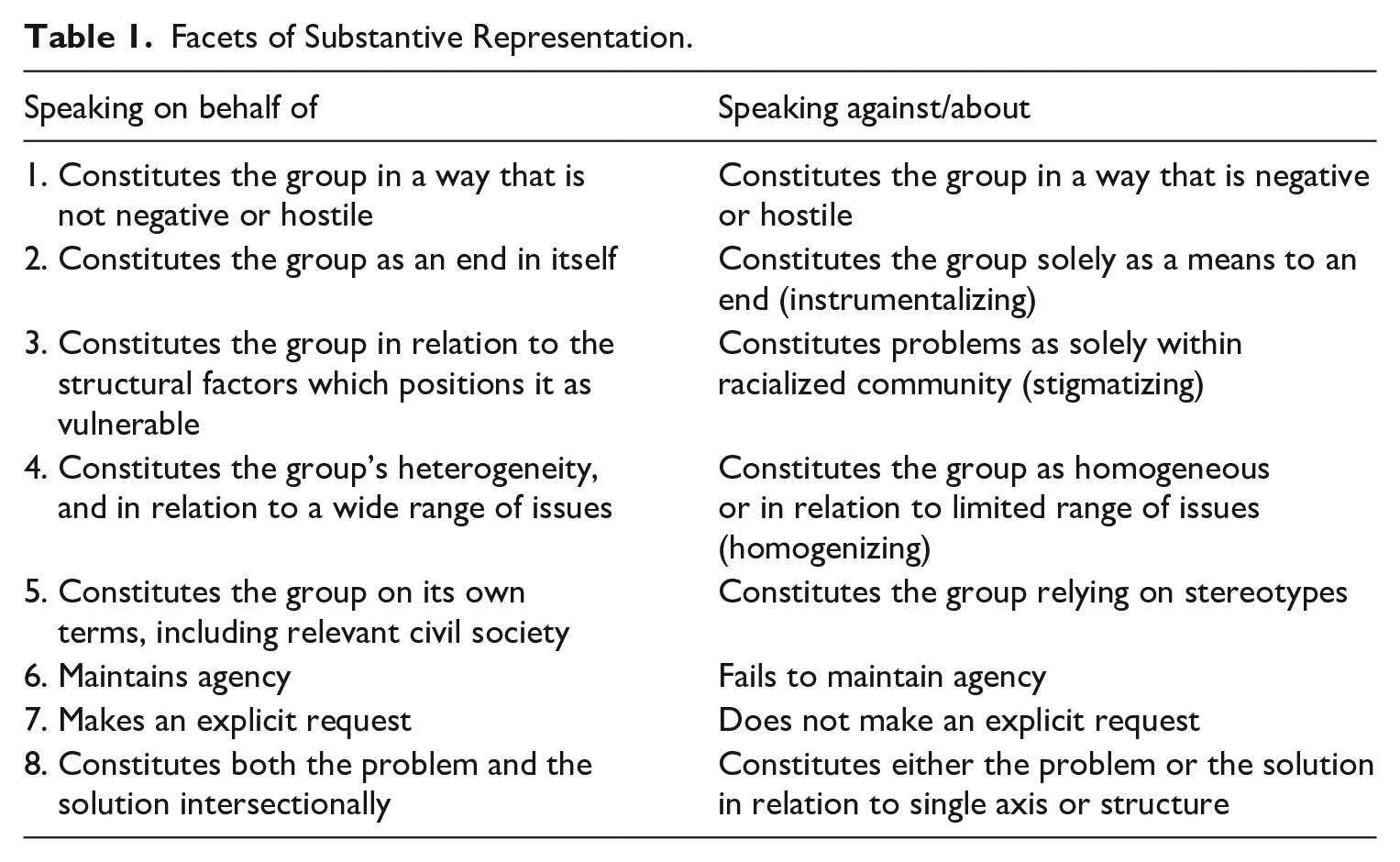
Individual speeches or representatives typically contribute some of these facets of substantive representation, such as constituting a group positively or making an explicit request regarding a particular issue. These contributions are essential and important features of substantive representation; they are also overwhelmingly performed by descriptive representatives. However, it is rare and difficult for other facets – such as a group being constituted heterogeneously – to be contributed by a single speech, an individual legislator or even a small group of representatives. This is partly because institutional constraints such as legislative agendas curtail the space afforded to parliamentarians. In this context, a narrow focus is often an effective, albeit limited, strategy for campaigning MPs. Even the most powerful or highly motivated members do not consistently enjoy opportunities to articulate structural factors beyond (for example) racialized communities, or regarding a wide range of issues. This rubric therefore offers a framework to consider the degree to which multiple facets of substantive representation are present within parliaments. It may also be applied to parties, committees, other parliamentary groupings and civil society. This lays the foundations to evaluate the degree to which marginalized groups are substantively represented by institutions as a whole, and in which ways.
Conclusion
This framework makes two key contributions to existing scholarship. First, fleshing out these facets of substantive representation improves the content and construct validity of the concept while also accounting for intersectional heterogeneity among women. Second, the rubric lays the theoretical groundwork to refine empirical strategies for measuring substantive representation which (a) start with representative claims themselves and (b) evaluate the quality of representation across all the claims made within a variety of institutions. It also has promise for application to other marginalized groups and cross-national comparative analyses.
I suggest shifting focus from individual representatives towards the collective work of institutions because substantive representation is multi-faceted. My intention is neither to critique nor diminish the contributions of descriptive representatives and critical actors. The links between descriptive and substantive representation are clear. Instead, I aim to raise questions regarding the extent to which different facets of substantive representation are (a) present and (b) possible within existing institutions. The example used here is minoritized women in the United Kingdom, for whom constitutive representation often entails homogenization, instrumentalization and a failure to address race and gender as intersecting structures. What features of institutional design might allow for the group to be constituted heterogeneously, on their own terms and in ways that address the intersecting factors which position them as vulnerable? What conditions would enable and motivate representatives to achieve this, both individually and collectively? These are pressing questions for future scholars.
Footnotes
Declaration of conflicting interests
The author(s) declared no potential conflicts of interest with respect to the research, authorship and/or publication of this article.
Funding
The author(s) received no financial support for the research, authorship and/or publication of this article.
