




Abstract
Voters constrain democratic leaders’ foreign policy decisions. Yet, studies show that elite polarisation restricts the choices available to voters, limiting their ability to punish or reward incumbent governments. Building on a comparative elections and accountability perspective, we hypothesise that the governing context moderates the effectiveness of domestic punishment and reward. The rise of elite polarisation in many democracies undermines voters’ ability to sanction leaders through elections. Linking data on international crises to domestic polarisation, we find that leaders are more likely to be involved in the initiation of inter-state disputes, resulting disputes will be more likely to result in prolonged conflict, and ultimately that foreign policy outcomes exhibit greater variance. Results from our analysis and extensive robustness checks demonstrate evidence that increased dispersion of preferences among key actors can lead to extreme and negative foreign policy outcomes as electoral mechanisms fail to reign in and hold governing parties to account.
Keywords
Scholars assume that voters constrain elected leaders’ foreign policy whims. They argue that democratic leaders avoid conflict for fear of electoral punishment. Yet comparative research finds that increased elite polarisation in many democratic countries complicates the accountability mechanism. Polarisation reduces the viability of alternate electoral choices to voters and therefore voters’ ability to punish ideologically close parties. Voters become loath to vote for parties other than the most spatially proximate on the left-right dimension, decreasing foreign policy’s salience. While researchers reveal substantial insight into the relationship between domestic politics and foreign policy, voters regularly fail to hold governments accountable for unpopular foreign policies such as engaging in international conflict. Under some circumstances, domestic groups decline to punish reckless elites. Consequently, context structures the conditions most likely to lead to elite punishment for engaging in international conflict.
We begin to unpack electoral accountability’s role in constraining foreign policy outcomes and conflict by accounting for the ways politicians and citizens prioritise policy. Comparative research highlights contexts in which domestic constituencies offer limited attention and responses on issues. Studies find that voters rarely punish executives directly for policy on many issues. Indeed, relative elite polarisation, the difference in prominent political actors’ preferences on the most important dimension of conflict, matters for the salience of positions on other issues. Increased elite polarisation places greater importance on parties’ positions over the left-right dimension and less prominence on government performance. Polarisation ultimately determines other issues’ importance; issues such as foreign policies and international conflicts (Brandenburg and Johns, 2014; Green and Hobolt, 2008). Consequently, voters weigh relative distances to parties on the left-right dimension more heavily when parties polarise on that dimension (Vegetti, 2014).
Following these insights, we argue elite polarisation leads governments to riskier foreign policy choices as it limits voters’ ability to sanction executives. Voters focused on ideological costs on the primary left-right dimension of conflict pay less attention to lower salience issues such as international militarised disputes. This context enables governments preferring risky foreign policies to engage in conflicts with little concern for future electoral punishment. Consequently, we predict that unconstrained leaders will be more likely to both initiate military disputes, and escalate to full-scale war.
Based on a measure of elite polarisation derived from the Comparative Manifestos Project (CMP), we predict Militarised Interstate Dispute (MID) initiation and escalation (Palmer et al., 2015). Domestic elite polarisation seems to disrupt the accountability mechanism over foreign policy. Results indicate that elites act as if they are free from punishment. The findings are robust to the inclusion of citizen measures of polarisation. 1 Hawkish executives become freer to threaten and initiate conflicts when they believe that voters are unlikely to punish them.
These results hold broad consequences for theories of international conflict and electoral accountability. Citizens hold differential capabilities to challenge executive behaviour. Electoral responsiveness links comparative theories of voting behaviour and policy accountability to international relations theory. It illustrates a distinct linkage between polarisation and government behaviour that undermines policy accountability (Carey, 2008). Studies have shown that polarisation leads to poorer democratic outcomes, but scholars have yet to develop fully foreign policy implications. Our results imply that the vote-to-foreign-policy-linkage diminishes under elite polarisation with possibly deadly consequences.
Domestic politics and conflict
Extensive research examines democracy’s effect on conflict behaviour (Gelpi and Griesdorf, 2001; Koga, 2011; Oneal and Russett, 1999; Siverson and Johnson, 2016; Ward et al. 2007; Wolford and Ritter, 2016). Domestic groups’ ability to hold leaders accountable for past foreign policy statements plays a central role. Groups within democratic regimes constrain governments more than within autocracies. Much like theories of audience costs propose, domestic constraints encourage democratically elected leaders (with larger winning coalitions) to provide public goods to win reelection (Bueno de Mesquita et al., 2005). Linked to theories of international conflict, public goods provision causes leaders to avoid the risk of losing wars. Voters evaluate opposition and incumbents over disagreements on domestic goods provision.
Researchers contend that disagreements in parties’ preferences over economic and social policies structure electoral competition. Core issues constituting the left-right dimension focus on social, economic and political inequality (Mair, 2007), although disagreements on many issues may be organised along this dimension. Preferences over international engagement or military force are not inherently associated with a specific left-right position, even if they often relate (Wagner et al., 2018). Empirically, many democracies exhibit a secondary dimension of disagreement – engagement with foreign policy and institutions (Bakker et al., 2015).
Voters struggle to hold incumbents accountable when multiple dimensions become salient. Multidimensionality enables electorally motivated parties to selectively emphasise issues across dimensions to attract voters (de Vries and Hobolt, 2012). These findings mirror a diversionary war logic where unpopular democratic leaders engage in aggressive international behaviour to distract from domestic issues (Tir, 2010).
Broadly, factors empowering voters to hold governments accountable limit governments’ foreign policies. Democratic competition and institutions determine voters’ ability to evaluate policy success. Systems with more pathways for policy influence or veto points limit the executive’s powers, and decrease the clarity of accountability necessary to hold leaders responsible (Whitten and Palmer, 1999; Wilson and Hobolt, 2015). Hunter and Robbins (2016) find that candidate-centred electoral systems are less conflict prone; they allow voters to hold leaders accountable. Oktay (2018a) demonstrates that governments avoid voters’ blame for foreign policies when institutional and coalition arrangements diffuse policy responsibility across actors. Likewise, Beasley and Kaarbo (2014) show that multi-party coalitions limit voters’ ability to hold specific parties accountable, resulting in more extreme conflict behaviour. Governments with greater parliamentary control yield more moderate foreign policies, whereas coalition governments with divergent ideologies create opportunities for opposition party influence (Oktay, 2018b).
The literature on domestic politics and international conflict concludes that voters’ ability to punish incumbent elected governments helps us understand foreign policy behaviour. In particular, policy accountability requires an opposition capable of controlling government (Przeworski et al., 1999). A credible competitor threatens elected leaders. It also provides citizens crucial information about foreign policy failures (Potter and Baum, 2013). Ultimately, the accountability mechanism acts through a viable opposition and voters willing to support them, to reduce the chances of unpopular wars with other democracies (Goldsmith et al., 2017).
Research on domestic politics and international relations finds that democratic leaders fearing electoral punishment engage differently in conflict behaviours when perceiving greater electoral threat. It complements studies on government ideology and foreign policy behaviour more broadly. Conservative leaders conduct more aggressive foreign policy and create longer-lasting disputes than those emphasising less conservative positions (Bertoli et al., 2017; Koch, 2009). This bears out Kertzer and Brutger’s (2016) findings that voters care about both consistency and content of foreign policy. Yet, a government’s priorities on economic or social dimensions poorly predict foreign policy goals (Greene and Licht, 2017). Ultimately, governmental ideology does not exist in a vacuum, but in the context of the potential alternative.
Punishment and reward for foreign policies under elite polarisation
Representative democracy demands electoral competition. Voters support parties based on their policy goals and past governmental performance. As retrospective voting theories contend, voters evaluate parties on whether they implement policies consistent with their pledges and responsibly manage the state and economy (e.g. Anderson, 2007). From a policy accountability perspective (Carey, 2008), citizens require options to punish or reward governments for foreign policy blunders by voting for the opposition without facing high ideological costs on dominant issues. Yet polarisation makes voters less capable of punishing intransigent incumbents and leaders act less restrained.
Polarisation substantially impacts the character of elections. Polarisation refers to the process in which parties, elites, or voters’ preferences on the most important dimension of conflict become more distant, where elections are characterised by increased ideological dispersion or parties engage in ‘centrifugal competition’ (Calvo and Hellwig, 2011; Ezrow and Xezonakis, 2011). Research on polarisation often focuses on the link between voter and elite preferences. 2
Comparative studies indicate that polarisation has dramatic consequences for voter and elite behaviour. 3 Cross-national evidence illustrates that polarisation leads voters to act in a more partisan manner, less willing to support alternate parties for individual (foreign) policy choices (Dalton, 2008; Tilley and Hobolt, 2011). Polarisation may actually increase party system representativeness of voters’ preferences on the left-right dimension of conflict (Brandenburg and Johns, 2014), but decrease the representativeness on secondary dimensions such as foreign policy. Conversely, when preferences converge on the primary dimension of conflict, voters place greater emphasis on a greater range of issues and policy reputations (Green and Hobolt, 2008).
Substantial research considers the effect of polarisation on the consequences of voter decision-making. For example, Druckman et al. (2013) find that polarisation intensifies the impact of party endorsements; consequently, voters’ factual knowledge decreases as reliance on elite signals increases, yet individuals’ confidence in these opinions increase. Elite polarisation leads voters to consider a narrower, more ideological set of parties (Lachat, 2008; Leimgruber et al., 2010), constraining potential alternative government parties for a voter to support in response to reckless foreign policies.
Elite polarisation affects voters’ perceived benefits and costs associated with alternative governments. When all parties become more distinct on the left-right dimension, voters’ ability to punish a government (otherwise agreeable on economic and social policies) for foreign policy decreases. Alternate options become less palatable. Elites, perceiving positions as safe from electoral threat, act accordingly. The electoral constraint discouraging conflict weakens. Following this logic, elite polarisation holds profound implications for representative democracy and foreign policy choices.
Regardless of citizens’ ideological differences, elite polarisation limits voters’ ability to use elections to punish and reward governments for engaging in international conflicts. Punishing an intransigent government comes with increasing ideological costs, making elections as a mechanism for accountability unrealistic. We predict that governing parties should act as if they are less constrained in the presence of greater polarisation. Given the importance of domestic accountability in constraining conflictual behaviour, we argue that polarisation increases conflict.
When leaders feel unconstrained
We expect that in contexts of high elite polarisation, voters’ ability to punish elite intransigence attenuates, causing leaders to act less constrained. Voters are unlikely to switch support from the government to an opposition party based on policies related to a secondary dimension of conflict when doing so comes with great costs on the primary dimension. Polarisation decreases the likelihood of punishment for poor governmental performance (Green and Hobolt, 2008). Therefore, governments will act as if they are less constrained by the risk of electoral punishment. Voters’ inability to punish intransigence creates the context in which government leaders perceive a breakdown in accountability. Regardless of voters’ behaviour, elite polarisation creates the context in which the governmental leaders perceive that appealing to voters beyond their base offers little benefit. Feeling unconstrained by future electoral punishment, elites can focus attention on potentially risky foreign policy goals.
Studies of voting behaviour show that voters and parties hold complex, multidimensional preferences across dimensions more complicated than traditional, single-dimensional models suggest (Schofield and Sened, 2006). Parties campaign on secondary dimensions to attract supporters (De Vries and Hobolt, 2012). Some scholars show that experts perceive parties’ left-right positions as predictive of governmental positions over military deployments (Wagner et al., 2018). Others find that priorities on their left-right dimension from campaign materials such as manifestos only weakly correlate with positions on issues such as foreign policy on alternate dimensions (Albright, 2010; Bakker et al., 2015; Greene, 2016); this multi-dimensionality influences foreign policy outcomes (Greene and Licht, 2017).
Yet, parties’ preferences on the left-right dimension likely determine the importance of positions on issues such as foreign policy with voters. Scholars find that, like government competence (Van der Brug, 2004; Vegetti, 2014), secondary dimensions become prominent when the largest parties’ positions converge towards a median left-right position (Green and Hobolt, 2008). Conversely, as polarisation on this dimension increases voters prioritise that dimension and downplay others.
This discussion implies that if party polarisation is low, the cost of foreign policy failure increases; voters face little cost on the primary dimension for supporting opposition parties. The increased salience of secondary dimensions leads voters to place greater weight on the secondary, foreign policy dimension. In this context, parties will be ideologically closer and foreign policy failures of sufficient magnitude shift voter choices. In the United Kingdom, for example, a voter might have perceived the difference between Tony Blair’s New Labour and David Cameron’s Conservatives as sufficiently small that some Labour voters could abandon Blair in response to the Iraq war (Green and Hobolt, 2008).
We argue that high polarisation attenuates the linkage between government parties and voter preferences over foreign policy. Under heightened polarisation, voters are unlikely to change support over foreign policy issues; policy sacrifices would be too great on the most important dimension of parties’ ideological conflict. Consider Republican voters’ support for Donald Trump in 2016. Many voted for Trump despite heterodox foreign policy and apparent Russian ties. They were unwilling to support Hillary Clinton. This perspective does not require us to assume that voters will engage in motivated reasoning or adopt misinformation, although psychological perspectives lead to complementary predictions (Bisgaard, 2015; Kertzer and Brutger, 2016). Instead, voters see policy goals of alternative parties as too distant. This leads us to expect that the costs of foreign policy failures inversely correlate with polarisation. This perspective matches studies showing that increased elite polarisation brings parties closer to voters’ preferences on the left-right dimension (Brandenburg and Johns, 2014) and that voters may switch from proximity voting to a more directional, centripetal approach (Leimgruber et al., 2010).
Under this context, voters will be unlikely to switch support to an ideologically distant opposition for any reason. Even under multi-party governments, the regularity of ideologically connected coalitions leaves few options to punish sitting governments. Polarisation, therefore, creates a context in which holding government electorally accountable for their performance on any issue, particularly on a secondary dimension, unlikely.
When leaders expect electoral costs for foreign policy failures, this provides a dampening constraint on behaviour which should limit the initiation of conflict. Scholars find that the electoral accountability mechanism leads democracies to be more selective and effective once they engage in conflicts (Reiter and Stam, 2003). A governing leader in a context with a high likelihood of punishment will use greater restraint in any conflict. However, it is not the actual punishment that constrains elites, but perceived voter retribution. Leaders assess voters’ ability to switch votes to a competitor by observing the opposition’s distance. Polarised parties perceive diminished electoral threat. Likewise, elites will see little reason to compromise on any issue when they expect that here is little likelihood voters will change their votes. Indeed, Spoon and Klüver (2015) show that polarisation increases the likelihood that parties focus attention to issues for non-electoral reasons. Ultimately, leaders that hold latent preferences for international conflict will feel less constrained (Beasley and Kaarbo, 2014). On aggregate, this discussion implies that polarisation’s attenuation of electoral accountability on the primary dimension of conflict will make a state more likely to initiate a dispute.
Hypothesis 1: Democracies with higher levels of domestic polarisation will be more likely to initiate a dispute than democracies with low levels of domestic polarisation.
A similar dynamic characterises the risk that a dispute escalates to war. The choice to engage follows deliberate domestic debates over engaging in conflict. States with the potential for electoral punishment are less likely to resort to high levels of escalation, or be the target of higher levels of escalation (Huth and Allee, 2002). Leaders will perceive less personal risk from escalating conflicts; leaders that succeed attain policy objectives whereas those that fail are unlikely to lose power. 4
Hypothesis 2: If a democracy is involved in a dispute, more polarised democracies are more likely to escalate the dispute to war.
More broadly, increased ideological polarisation holds implications for the volatility of states’ conflict behaviour. We expect that voters constrain leaders of highly polarised democracies less, regardless of realised foreign policy outcomes. When polarisation is low, leaders will face strong pressure to conform to institutional and structural constraints on behaviour and choose policies that appeal to key electoral constituencies. High levels of polarisation allow a leader’s preferences and ideology to set foreign policies. Essentially, we argue that polarisation reduces the constraints on governments, but does not necessarily increase a leader’s demand for conflict.
From this perspective, low polarisation has a dampening effect, reducing the range of potential outcomes. High polarisation reduces potential costs that leaders face, but polarisation alone does not incentivize leaders to engage in international conflict. Preferences for distinct conflictual foreign policies motivate leaders to initiate conflicts under high levels of polarisation, whereas those with dovish policy goals do not face increased incentives. 5 While increased polarisation reduces constraints on initiation and escalation of conflicts, decreased accountability also increases the chance that leaders ignore foreign conflicts. Leaders’ exact foreign policy priorities may mean that they have little interest or face few other contextual incentives to initiate conflicts. 6
Hypothesis 3: Democracies with higher levels of party polarisation will have higher variance in their foreign policy outcomes.
In summary, we connect literature on ideological polarisation and democratic conflict initiation to predict that polarisation reduces the electoral accountability mechanism. This has implications for the potential that voters punish or reward incumbents for foreign policy failures and successes. We hypothesise that leaders freed from domestic voter constraints will increase the likelihood of initiating disputes (H1), allow disputes to escalate to wars (H2), and increase the variance of outcomes (H3) compared to less polarised governments.
Data
We test hypotheses by connecting data on dispute initiation and escalation to the dispersion of elite preferences. We focus our analysis on the available polarisation data over the period 1960 to 2010. We limit cases to those where at least one member of a dyad is included in the polarisation data. In our primary analysis, we focus on fully consolidated democracies (those with Polity scores greater than or equal to 6). 7 This produces a list of 46 countries, which form dyads with any country.
We investigate the effects of domestic polarisation on interstate conflict by studying two related phenomena: (1) when states initiate military disputes and (2) when disputes escalate to war. Our unit of analysis is the directed dyad-year. Our first dependent variable measures whether a democratic state initiates a Militarised Interstate Dispute 8 in a year (Jones et al., 1996). 9 We code the dependent variable as taking on a value of 1 in years where the first state is on side A of a dispute and the second state is on side B, and 0 otherwise. We also examine the escalation of these disputes to war. Following Rasler and Thompson (2006), we take our unit of analysis as dyads where both members were on opposite sides of a Militarised Interstate Dispute, where our dependent variable indicates whether the dispute escalated to war that year, or within 5 years. As our primary interest is in the countries initiating conflict, we remove all countries joining a pre-existing conflict from the analysis, although the inclusion of these cases does not impact the primary results.
We use elite polarisation as the primary independent variable as our theoretical approach prioritises the decision-makers engaging in conflict: government leaders. The theoretical mechanism focuses on contexts in which elites believe that they will be unpunished. We measure party polarisation as it closely represents the theoretical mechanism in the main analyses. We also present results incorporating citizen polarisation (in the Appendix) that lead to substantively similar implications, but demonstrate that elite polarisation is the primary driving factor. 10
We construct a measure of elite polarisation from the CMP (Volkens et al., 2019). The CMP offers the most widely available measure of parties’ ideological placements cross-nationally and over-time. 11 The CMP content analyses parties’ election manifestos following a salience-based approach. It creates directional measures by coding positive and negative statements separately for issues. Although these data have limitations, it allows us to create cross-nationally comparable indicators of polarisation on the primary left-right dimension of conflict for a substantial time-period. 12 This data mark the most direct measures of elite polarisation across countries and over-time, representing most cases for which theories of democratic accountability should apply. The use of party polarisation directly links to the underlying mechanism; parties select government leaders. These actors will be those most likely to consider citizens’ ability to hold them accountable.
We measure polarisation using left-right CMP estimates for each party (the Left–Right (RILE) scale) to create country-level indicators that vary over time. The CMP derives positions on multiple ideological dimensions from content analysis of election manifestos by finding the difference in the percentage left- and right-leaning sentences. Like Lupu (2015), we measure polarisation by measuring the variance of parties’ positions for each country during an election year (estimates are only available in election years), weighted by the party’s resulting seat share following the election (Lupu weights by vote share). For greater explanation of our measurement approach, see the Appendix. The primary independent variable varies both within and between countries: within country variance equals 27.67. Each country’s average level of polarisation across the time-period has a variance of 13.54. As we require polarisation data to evaluate our hypotheses, we exclude cases where CMP data are not available.
We also include commonly used control variables in the analysis. These control variables make our results comparable to common benchmark models explaining dispute initiation and escalation. To simplify the presentation, we present results using the same control variables across models; however, analyses using different controls between models of incidence and escalation to match prominent research on each phenomenon lead to substantively similar results.
For both the initiation and escalation model, we include the higher and lower polity score in a dyad (Marshall et al., 2009). Higher polity scores capture democracies’ tendencies to be involved in more disputes, and lower polity scores capture dynamics of the dyadic democratic peace. To account for material capabilities, we include the ratio of CINC (4.0) scores (Singer et al., 1972). Following Carter and Signorino (2010), we control for temporal independence in dispute initiation using peace-year polynomials. We also include indicator variables for alliances, following Gibler and Sarkees’s (2004) coding, and whether they are noncontiguous (using data from Weidmann and Ward, 2010) coded 1 if the minimum distance between states is greater than 150 miles). Finally, we include the average yearly gross domestic product (GDP) growth for the pair of states (from the World Bank), and the ratio of material capabilities. 13
We also include additional domestic political control variables. We account for the distinction between parliamentary and presidential systems. Presidents often have more latitude to conduct aggressive foreign policy. Second, we look at whether the country has a majoritarian political system. Finally, we include a measure of the left-right position of the largest party in the legislature (based on CMP’s RILE score). We present summary statistics in the Appendix (Tables 4, 5).
Results
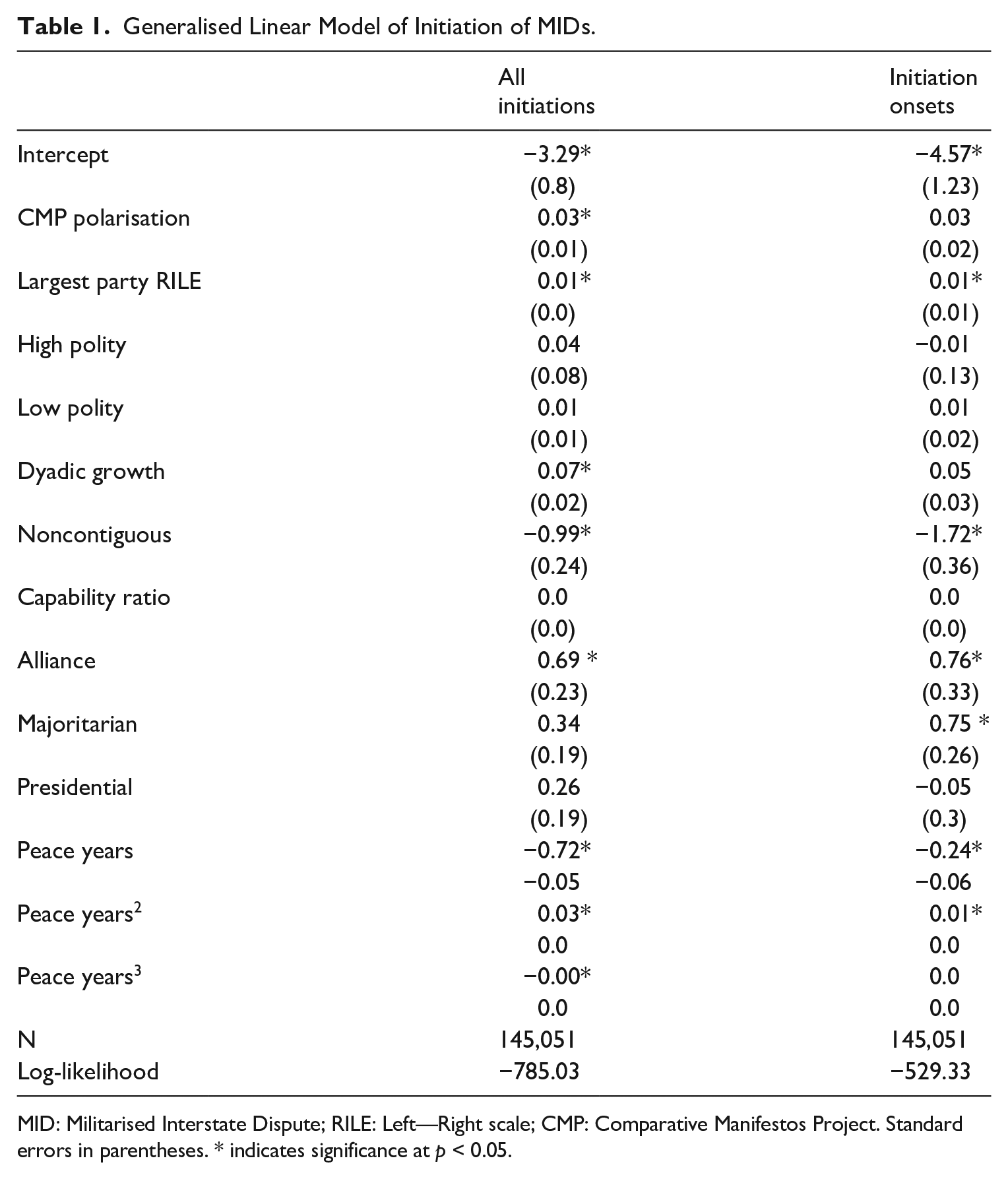
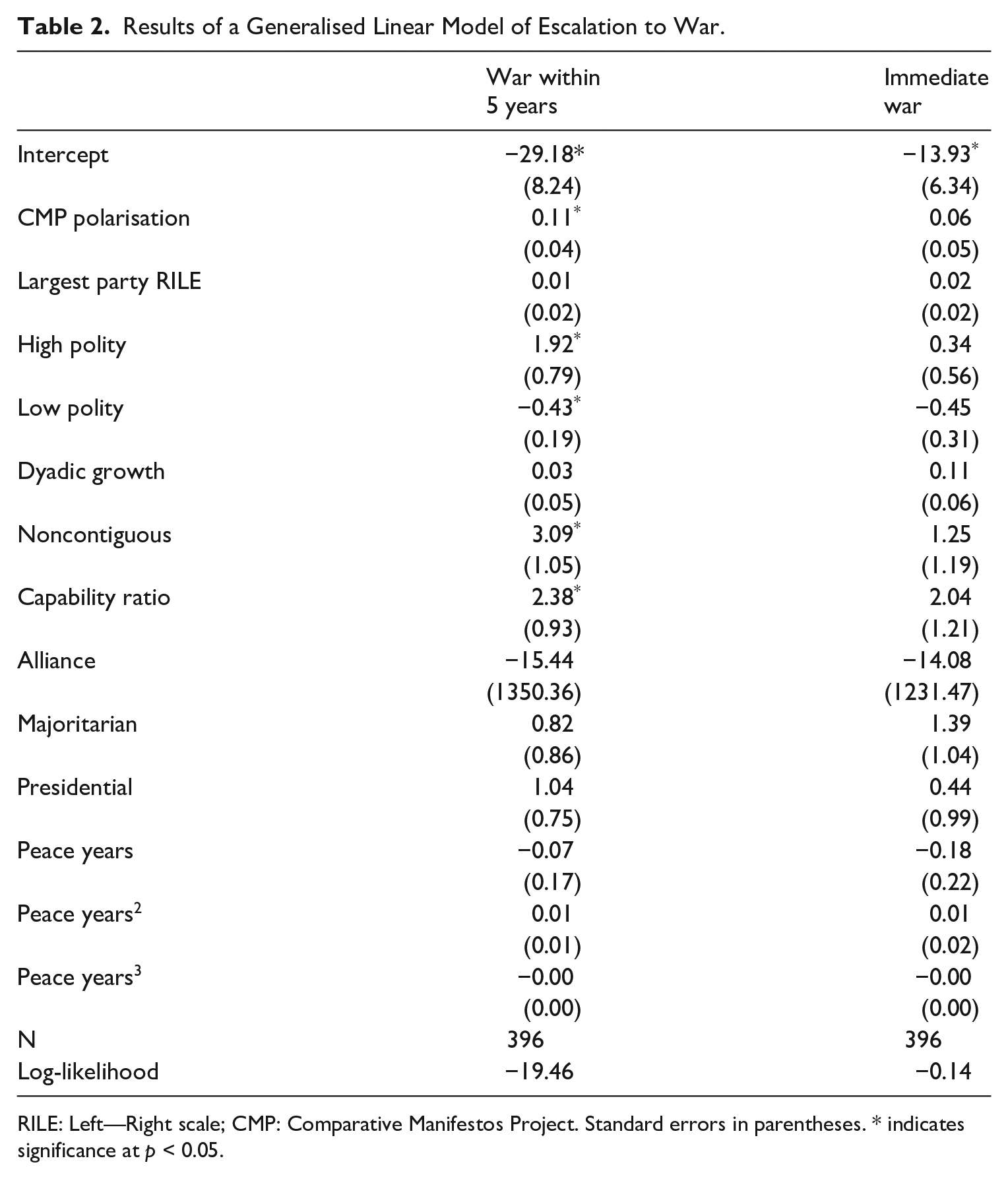
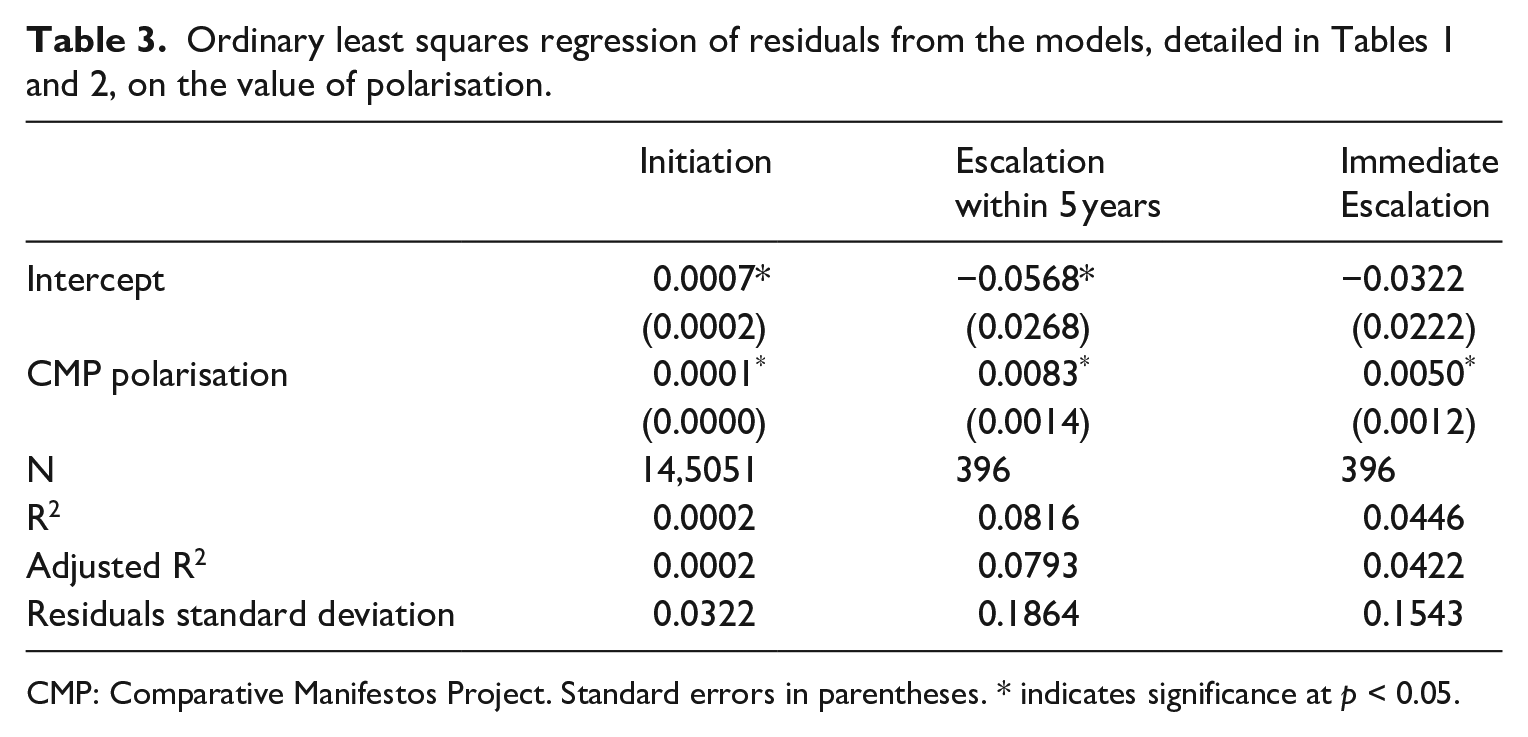
We hypothesise that polarisation impacts dispute incidence, escalation, and the variance of foreign policy outcomes. We present results from these analyses in sections for each hypothesis. We find evidence consistent with our argument; higher levels of elite polarisation associate with increased likelihood of dispute incidence, conflict escalation and variance in each outcome. We present the results of our primary analyses in Tables 1, 2 and 3.
Generalised Linear Model of Initiation of MIDs.
MID: Militarised Interstate Dispute; RILE: Left—Right scale; CMP: Comparative Manifestos Project. Standard errors in parentheses. * indicates significance at p < 0.05.
Results of a Generalised Linear Model of Escalation to War.
RILE: Left—Right scale; CMP: Comparative Manifestos Project. Standard errors in parentheses. * indicates significance at p < 0.05.
CMP: Comparative Manifestos Project. Standard errors in parentheses. * indicates significance at p < 0.05.
Conflict initiation
We predict that elite polarisation increases the likelihood of a state initiating a dispute (H1). We test this hypothesis using a logistic regression with directed country-year dyad as the unit of analysis. 14 Estimates in Table 1 reveal evidence consistent with this perspective. The coefficients associated with elite polarisation are positive and statistically significant.
We present the effect of polarisation on the risk of war in Figure 1 with 95% confidence intervals. As the coefficient suggests, the figure reveals that higher levels of polarisation lead to increased likelihood of dispute incidence. This evidence is consistent with a perspective in which governments in more polarised contexts feel freer to engage in risky conflict behaviour.
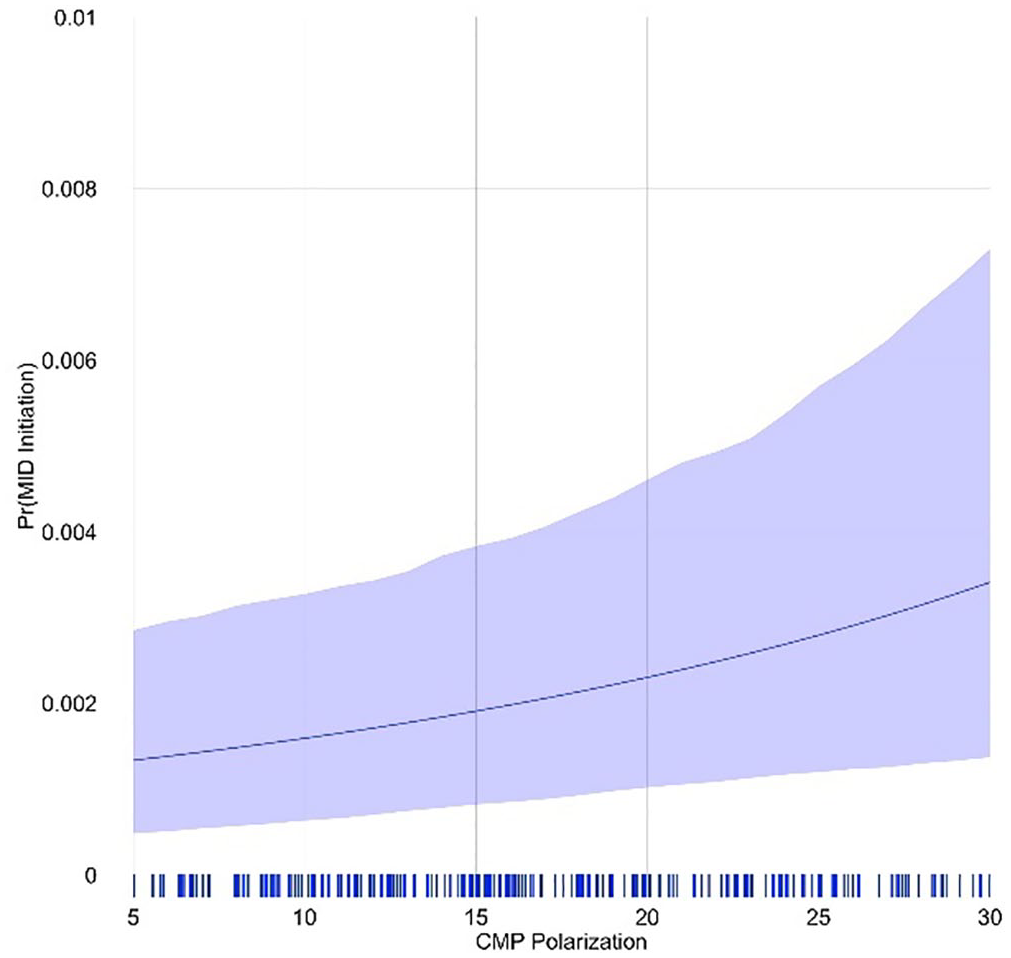
Predicted probability of MID initiation for a dyad with contiguous allies, with all other variables taking on their mean or median value. We present the predicted effect from middle 95 percentile of CMP polarisation. The rug along bottom of the figure shows the observed level of polarisation.
Elite polarisation plays a role in real world examples of conflict escalation. For example, Iceland’s ‘Cod Wars’ with the United Kingdom (1958–1976) occurred in a context of high polarisation according to our data. During this period, Iceland provoked conflict over the rights of UK boats to fish off Iceland’s coast. According to standard models of conflict onset, these interactions were surprising. Both countries were rich consolidated democracies. The states are non-contiguous and Iceland was clearly engaging in risky behaviour as the ratio of capabilities between the UK and Iceland was approximately 1500 to 1 (see Steinsson, 2016 for discussion of the Cod Wars and International Relations theory).
Our perspective suggests that Iceland’s high polarisation enabled elected leaders to engage in risky behaviours. Out of the nine Icelandic governments from 1949 to 1976 seven exhibit polarisation in the top quartile of our sample. Furthermore, the third (and final) conflict occurred during the dataset’s highest observed polarisation (45.42). Following North Atlantic Treaty Organization (NATO)-led negotiations in 1976, Iceland reached a strongly positive outcome that decreased the impetus for future conflicts. Remarkably, the level of polarisation in Iceland following the mediated agreement dramatically decreased. Only 2 of the 10 governments following the 1978 elections showed similarly high levels of polarisation. Conflict between these NATO allies after this period did not reoccur.
In Table 1, the control variables also correspond roughly to our expectations. Power preponderance suppresses the risk of conflict; allies are more likely to get involved in low-level disputes, as are neighbours. Finally, the effect of regime type in general corresponds to recent work on the democratic peace – if the ‘weak link’ in a dyad is a democracy, conflict is quite rare.
Escalation
Our second hypothesis predicts that polarisation also increases the likelihood that disputes escalate to war. We present the estimated impact of polarisation on the likelihood of war within 5 years and immediate escalation to war. Consistent with our second hypothesis, the results reveal that polarisation positively correlates with both immediate escalation to war and the risk of escalation over a longer time-span. The coefficients for polarisation are positive in both models, but only reach conventional statistical significance for the 5-year measure of escalation. 15
We visualise the effect of polarisation on escalation in a modal case in Figure 2. Much like the effect of polarisation on conflict onset, polarisation associates with increased likelihood that conflicts escalate to the level of a war. Consistent with our second hypothesis, these results suggest a dynamic in which governments in more polarised countries are more likely to escalate conflicts.
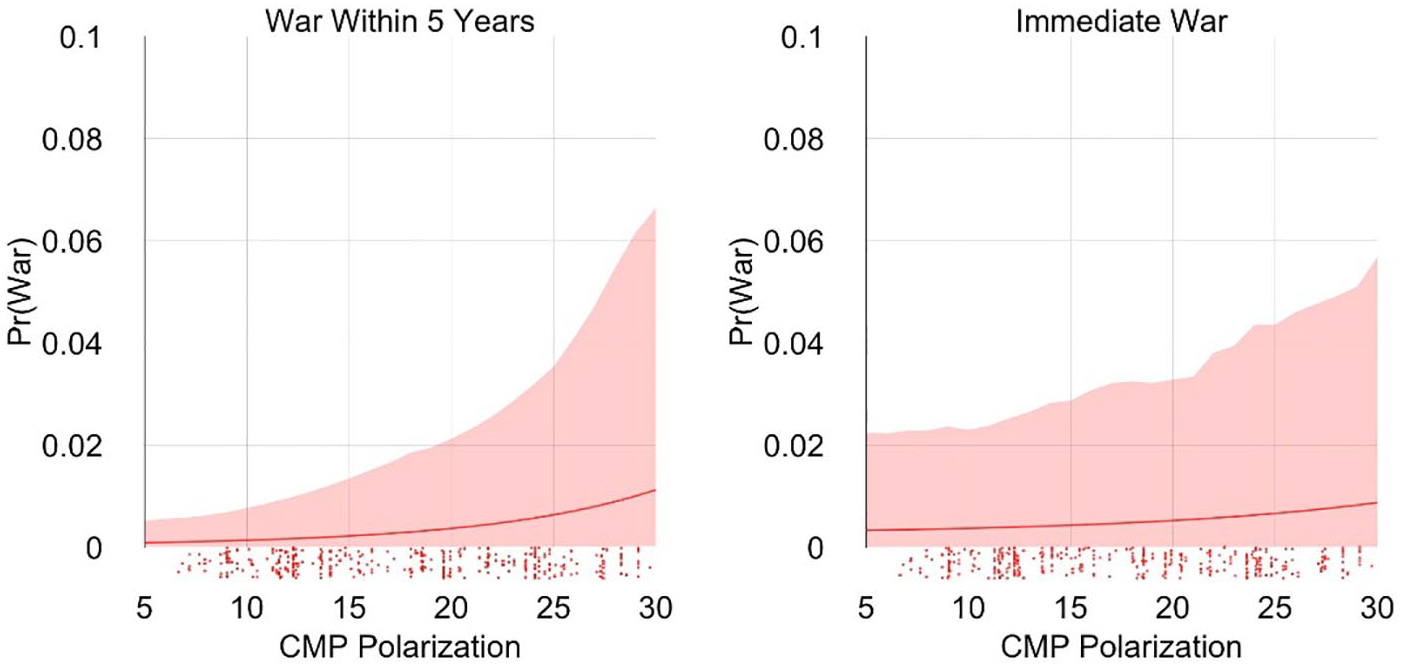
Predicted probability of escalation from an MID to war with all variables other than polarisation at their median or mean.
Dispute variance and polarisation
Consistent with our perspective, we find evidence that polarisation increases the likelihood of dispute onset and escalation. The results of our second analysis indicate that polarisation’s impact is more consistent over a longer time-period (5 years). Indeed, polarisation creates the context in which leaders may make risky decisions. Since leaders may not take advantage of this context immediately after an election, or await other incentives to engage in conflict, polarisation’s effect should increase the variance in outputs from regimes (H3). Therefore, to examine the third hypothesis, we examine the absolute value of the residuals for the models discussed in Tables 1 and 2, and then regress these residuals on the level of polarisation. 16 Higher levels of polarisation associate with higher levels of absolute errors in an ordinary least squares (OLS) regression.
Our third hypothesis holds implications for modelling polarisation’s effect on conflict onset and escalation. These models likely violate assumptions of standard linear models: observations are not identically distributed. Therefore, we present robustness checks accounting for this violation using Huber-White heteroskedastic consistent standard errors (Appendix Tables 14 and 15). The results are consistent with those presented in the main analysis. In a separate model, we also performed an analysis where different levels of polarisation were capable of having differently distributed errors by dividing polarisation into 11 levels and clustering standard errors on levels of polarisation (Appendix). In each case, the coefficients for polarisation remain distinct from 0 regardless of how we estimate the standard errors. Intriguingly, this finding implies that high polarisation leads structural factors to become markedly worse at explaining conflict incidence and escalation.
Sensitivity analyses and cross-validation
We also undertake extensive robustness checks (see the Appendix). In these models, we use alternate specifications, estimators, and operationalizations of the dependent and independent variables. The results are robust to a range of alternative modelling choices.
Some scholars contend that the effect of elite polarisation is dependent on voter polarisation. Although elite polarisation increases the risk of voter polarisation, they are distinct processes. As our mechanism focuses on how party leaders interpret the likelihood of voter punishment, elite level polarisation should have a more consistent effect on state conflict behaviour even when we account for voter polarisation. Models incorporating voter polarisation reveal mixed evidence for the effect of voter, but consistent evidence for elite polarisation. This result adds to a substantial academic literature demonstrating different and independent outcomes from elite versus voter polarisation. Given the disconnect between elite and voter polarisation (Leimgruber et al., 2010), voter polarisation should be less correlated with the outcome of elite decisions than a measure of party polarisation.
Another perspective predicts that ideologically right parties will be more aggressive than left ones (Bertoli et al., 2019; Kertzer and Brutger, 2016). To evaluate this, we re-estimate our initiation model including an interaction between polarisation and the left-right position of the largest party in parliament. We present these in the Appendix, Table 18. We find that in aggregate, right wing parties are associated with marked increases in conflict initiation in low or moderate polarisation environments, but under conditions of high polarisation, are no more aggressive than left wing parties.
Critical scholars might also interpret our results as dependent on the operationalization of key variables. Models distinguishing between the state that initiates a dispute and the target of that dispute find that polarisation increase the likelihood of both. Using data on crises from the International Commercial Bank (ICB) leads to comparable inferences. Likewise, our primary results do not depend on our exact operationalization of elite polarisation. An unweighted measure of the distribution of party preferences from the CMP also support our primary results.
Conflict initiation and rarely occurs. Rare events models account for this inflation of the standard errors caused by the limited variation on the dependent variable. These models also support our primary inferences.
Finally, we also want to consider whether accounting for polarisation actually helps us predict conflict. To evaluate the role of polarisation in predicting conflict incidence and escalation, we turn to an out of sample cross-fold validation exercise. For each case, we find improvements in the model’s explanatory value in out of sample prediction when we include party polarisation measures.
The analyses suggest that varying the operationalization of key variables, the inclusion of diverse control variables, and alternate modelling choices lead to comparable conclusions. We find consistent evidence of elite polarisation’s effect. Under high levels of elite polarisation, we find that governments act as if they will not be held electorally accountable.
Conclusion
We propose that elite polarisation increases the likelihood of inter-state disputes and wars. Under polarisation elites believe that they are less accountable to voters; the threat of electoral punishment becomes an ineffective constraint. We evaluate hypotheses by combining data on MIDs and party polarisation from the CMP. The results suggest a persistent effect. Leaders are both more likely to initiate disputes and these disputes are more likely to lead to wars in the long-run. Residuals analysis indicates that polarisation increases the variability of foreign policy outcomes as the accountability mechanism weakens. Similarly, the effect of foreign policy preferences for elites are conditional on the level of polarisation. Foreign policies under polarised governments are more likely to be violent and driven by eccentricities of individual leaders, as opposed to structural and state level forces. Finally, models incorporating elite polarisation consistently outperform those excluding it in out of sample predictions.
Despite strong evidence for our hypotheses, confounding considerations remain. Although the results support our main predictions, we cannot easily distinguish support for our perspective from predictions emerging from theories of audience costs. The positive support for both initiation and escalation suggest that our perspective better explains the initial initiation, but we do not know if escalation to larger conflicts is determined by audience costs or unconstrained elites. Future analyses focused on unpacking the connection between the causal mechanisms will provide greater clarity for understanding this relationship.
Likewise, differing levels of polarisation likely impact not only the external electoral environment, but also parties’ decision-making processes. There is little research directly exploring polarisation’s effect on intra-party politics, but some evidence indicates that ideological proximity leads ideologically close voters to become more likely to support parties under higher levels of polarisation (Vegetti, 2014). However, parties often select leaders due to their centrality of the party members’ goals, at least in parliamentary systems (Greene and Haber, 2016).
Furthermore, studies emphasising the parties’ elections strategies may reduce the risks of elite polarisation as parties treat their positions as malleable and regularly changing to match the median voter. Although parties’ positions are likely somewhat flexible, models predicting median convergence in parties’ positions rarely match empirical reality. The assumptions required for convergence poorly match most modern democracies (Grofman, 2004). Indeed, elite polarisation may exacerbate voters’ demands for parties’ more extreme policy goals (Green and Hobolt, 2008).
Building on an electoral accountability mechanism, we argue that voters struggle to sanction governments under polarised contexts. Governments consequently act as if they are unconstrained. Given findings on increased and asymmetric party polarisation in the United States, and the outsized role that country plays in international politics, these results are especially troubling for what they imply about the behaviour of the world’s largest military power. Polarisation removes structural constraints and leaves conflict behaviour to the whims of the executive.
Finally, scholars debate positive and negative implications of polarisation for electoral competition. Yet, this evidence suggests that polarisation also leads to the sort of increased political instability that limits democratic reforms across countries (Linz, 1978). Voters’ inability to sanction governments for taking risks such as going to war question representative democracy’s ability to function under high polarisation. Party elites can begin to act as if they are free from representative ties. These results suggest that anti-democratic effects of polarisation may extend beyond democratising countries. The persistence of democracy and peace may depend on developing solutions to elite polarisation.
Supplemental Material
944349_PAC-BJPIR-submission-Appendix – Supplemental material for Polarisation, accountability, and interstate conflict
Supplemental material, 944349_PAC-BJPIR-submission-Appendix for Polarisation, accountability, and interstate conflict by Max Gallop and Zachary Greene in The British Journal of Politics and International Relations
Footnotes

References
Supplementary Material
Please find the following supplemental material available below.
For Open Access articles published under a Creative Commons License, all supplemental material carries the same license as the article it is associated with.
For non-Open Access articles published, all supplemental material carries a non-exclusive license, and permission requests for re-use of supplemental material or any part of supplemental material shall be sent directly to the copyright owner as specified in the copyright notice associated with the article.
