




Abstract
Studies of electoral integrity typically focus on electoral evaluators (expert surveys), electoral consumers (electors) and, occasionally, electoral producers (electoral administrators). Using a unique new data set collected at the British general elections of 2010, 2015 and 2017, this article examines evaluations of electoral integrity among a previously unresearched group of electoral users – the election agents of candidates standing for election. Using measures of both negative and positive electoral integrity, the article models explanations of users’ evaluations, focusing on the agent characteristics, geography and electoral status of the district or constituency. It shows that evaluations of electoral integrity vary significantly and highlights both that questions of electoral integrity are more localised than widespread, and that despite the significant impact of winner/loser effects, issues of electoral integrity are strongly related to the urban characteristics of an electoral district. In so doing, it makes a significant contribution to the literature on electoral integrity.
Keywords
Introduction
A significant international literature has developed on electoral integrity, illustrating importantly that concerns are not only confined to developing democracies, but to mature ones as well (Alvarez et al., 2008; Birch, 2008, 2011; Bowler and Donovan, 2013; Karp et al., 2018; Lehoucq, 2003; Norris, 2014, 2015). Indeed, comparative rankings of electoral integrity reveal not only fairly significant variation between established democracies, but also less established regimes scoring more highly than more mature ones. The United States ranks below Argentina and Chile in the Americas, while the United Kingdom is ranked below Portugal and Spain. Indeed, while the United Kingdom is categorised as having high levels of electoral integrity, only Malta is ranked below it in north-west Europe (Norris et al., 2018: 7). Electoral integrity is clearly a concern. But are concerns merited across the whole of a country at the macro-level, or are issues of electoral integrity localised at the micro-level? This article uses a unique new data set which captures evaluations of electoral integrity at the district or constituency level to analyse this question in the British case.
The rankings described above are based on expert surveys of evaluations of electoral integrity – a group that might be classified as electoral evaluators. Other studies (either comparative or at a national level) typically focus on electoral consumers (electors) (Beaulieu, 2014; Birch, 2008; Karp et al., 2017) or on occasions, electoral producers (election administrators) (Clark, 2017). There is, however, another group that merits attention – electoral users. This group is closer to the production of electoral services than electoral consumers and is likely to have a better understanding of the complexity of electoral service provision – this user group is electoral agents.
All candidates in the UK elections must, by law, have an electoral agent. The electoral agent is legally responsible for the conduct and finances of their candidate’s campaign. Given the work that occurs on a day-to-day basis over the course of a campaign, an agent will almost certainly have a particularly well-informed view of the quality of electoral administration in the constituency as well as in respect of any suggestions of electoral fraud. This article draws on studies of these agents, and in addition to generating data from a key user group, also provides the opportunity for comparison with electoral consumers. We will be able to assess the degree to which the views of electoral consumers and users towards electoral integrity align. Such findings have the potential to have a significant impact on policy.
The focus on election users also further illuminates the study of electoral integrity more broadly. Electoral evaluators offer opinions on a national basis (at the macro-level). Equally, electoral consumers will deliver evaluations that range from the national to the local. Electoral users, however – like electoral producers – are focused at the local or district/constituency level (the micro-level), since their experience and expertise lies there, though unlike electoral producers, electoral users’ perceptions are not based in part on evaluations of their own productive efficiency. This district or constituency-level focus is highly significant, because in the UK case, at least, problems with electoral fraud and electoral integrity may be localised rather than being a national problem (Clark and James, 2015; Electoral Commission, 2014: 3; Stewart, 2006). 1 Equally, as James (2017: 133) shows, the US experience is such that variations in the quality of electoral administration and failings in electoral integrity are frequently attributed to the decentralised management of elections. A similar system operates in the United Kingdom, where despite central guidance being distributed by the Electoral Commission, the administration of elections is managed by local authorities. As Clark (2017: 474) observes, localised standards of electoral administration can vary considerably, with the effect on evaluations being at best variable, but at worst, potentially undermining perceptions of the entire electoral process. Thus, an examination at district or constituency level reveals not only aggregated evaluations of electoral integrity at the macro-level, but also variation that lies beneath the national level (at the micro-level). This unique data set allows us to analyse such variation in evaluations across districts/constituencies and therefore gain an understanding of why those evaluations vary.
Coupled with this, electoral users – agents – possess an important quality in respect of evaluations of electoral integrity that electoral consumers – electors – frequently lack: expertise. As Norris et al. (2017: 5) note, ordinary citizens will often lack the capacity to evaluate elections with any precision because they lack knowledge or correct information, largely because their understanding will be limited to their own interaction at the ballot box. This can lead to more sceptical evaluations of electoral integrity, not least because more accurate evaluations of electoral integrity are influenced by higher levels of education and knowledge, and greater interest in politics (Beaulieu, 2014; Norris et al., 2017: 22). Certainly, the UK Electoral Commission (2014: 14) found that voters rarely have a good understanding of fraud and that their views ‘. . . are rarely influenced by first-hand experience of electoral fraud and are more likely to be based on cases reported by the media and people’s own set of assumptions, some of them unfounded’. Electoral agents, however, may be better placed to provide more accurate evaluations, since like electoral administrators (Clark, 2017: 480) they have much better understanding of how the electoral process works. Therefore, we may expect to see differences between the evaluations of electoral consumers and users. Such a comparison is important, because if there is a suspicion that consumers’ concerns about electoral integrity are inflated, then the analysis of a group that significantly is more knowledgeable about electoral processes (users) provides the opportunity to evaluate the extent to which consumers’ concerns may be exaggerated.
Electoral integrity
The growth of electoral integrity as a field of study has largely mirrored the increase in the number of elections worldwide as more countries have adopted liberal democratic norms, together with a growing recognition in mature democracies – particularly the United States – that there are significant issues associated with electoral maladministration (Norris, 2018). Electoral integrity matters across all democracies, not only emerging ones. It can be conceptualised in a variety of ways. Norris (2018), for example, identifies traditional conceptions: negative (characterised by fraud and malpractice) and positive (characterised by credibility and competitiveness), as well as a more fulsome conceptualisation, inspired by human rights and which seeks to capture (in a positive sense) a wide range of electoral practices. What is very apparent is that any analysis of electoral integrity should not only examine instances and perceptions of malpractice and fraud – negative electoral integrity, but also instances and perceptions of good practice – positive electoral integrity. Election processes will neither be all good or all bad – what is required is an analysis of both. In this article, therefore, we examine both levels of satisfaction with electoral administration (positive), as well as perceptions of electoral fraud (negative). Although the variables are not direct opposites of each other (such that an increase in one would automatically lead to a decrease in the other), our general expectation is that by using these indicators, we would observe that more positive evaluations of electoral integrity would involve higher levels of satisfaction with electoral administration and lower levels of perception of electoral fraud. Equally, those with more negative evaluations of electoral integrity would be expected to have lower levels of satisfaction with electoral administration and higher levels of perception of electoral fraud.
In respect of fraud, there is, however, a need for some definition. Birch (2011: 11–13) identifies four approaches to what she describes as malpractice: legal, perceptual, ‘best practice’ and normative. Legal is a violation of electoral law; perceptual is by definition subjective, and therefore has no agreed boundary in respect of malpractice; ‘best practice’ represents differentiation from international norms; while normative assesses practice against norms in democratic theory. Instances of malpractice can manifest themselves in manipulation of the law (such as gerrymandering and manipulation of voter eligibility), the voter (such as violation and campaign finance laws and inducements to vote in a particular way or not vote at all) and the vote itself (such as manipulation of the voting process and the count) (Birch, 2011: 28–39; Hill et al., 2017: 775; Lehoucq, 2003). In surveys of electoral consumers and users (electors and electoral agents), we are considering perceptual fraud, which by definition may not reflect actual violations of electoral law. However, we may expect to see variation between consumers and users, as users will have a better understanding of electoral processes, and thus, we may expect their perceptions to have a stronger relationship to legal definitions of fraud and malpractice.
The article, therefore, seeks to use measures of both positive and negative electoral integrity to assess variation in evaluations, both over time and between electoral users. There are two research questions:
Have evaluations of electoral integrity as measured by satisfaction levels with election administration and perceptions of fraud changed over time?
What factors help predict evaluations of electoral integrity, as measured by levels of satisfaction with electoral administration and perceptions of electoral fraud?
Predictors of evaluations – Theory
The temporal aspect to satisfaction with electoral administration and perceptions of electoral fraud is a function of two things. First, we might expect that as electoral administration occurs more often, then implementation would be improved, thereby improving levels of satisfaction. In other words, as procedures and practice become more entrenched, there may be fewer problems. This may produce mixed results in the British case. In the first instance, electoral administration has always taken place at the level of the local authority. So – even over a period of three elections, we might not expect to see much change, since most procedures are fully entrenched. Conversely, the national-level Electoral Commission has only existed since 2001. Although the Commission has no formal control over local authorities (James, 2017), it does have reporting oversight and is active in providing guidance to local authorities, candidates and electoral agents. Thus, we may expect to observe some improvement in evaluations over time as the Commission’s guidance is adopted more widely.
Second, and more significantly, we may expect to see variation in evaluations of electoral integrity in respect of the available time for the administration of the election. Clark (2017: 475–476, 486) shows that the quality of electoral administration suffers where there are concurrent elections, through the additional pressure placed on electoral administrators. Thus, if pressure through additional workload were to be an issue, we would expect to see the evaluations of the 2017 election to be lower than those in 2010 and 2015. The reasoning behind this is that while the elections of 2010 and 2015 took place after full 5-year parliamentary terms (thus allowing electoral administrators time to prepare for an election), in 2017, the election was a ‘snap’ one: unexpectedly called just 2 years after the previous election and leaving administrators considerably less time in which to put arrangements in place. That said, there may be reason to suspect that evaluations in 2017 could be higher overall than either 2010 or 2015, since unlike those 2 years, when concurrent local elections took place across large parts of England, there were no concurrent elections in 2017. The general election was held in June of that year, whereas local authority elections took place a month earlier. Thus, our first hypothesis is:
H1. Evaluations of electoral integrity will be negatively affected by the sudden calling of the general election in 2017.
Explaining satisfaction with electoral administration and perceptions of fraud is by necessity, a multivariate exercise. As Alvarez and Boehmke (2008: 104) note, the correlates may include socio-demographic, partisanship and electoral competition. Moreover, in keeping with Clark (2017: 472), analysis on a district or constituency basis (as is the case in this article) suggests considerable variation, which may be explained by a variety of electoral, geographical and socio-demographic factors. Broadly speaking, therefore, there are three clusters of variables, which may affect users’ evaluations: the characteristics of the agent (experience and partisanship), the geographic and socio-demographic structure of the constituency, and the nature of electoral competition in the seat.
The importance of partisan cues is well established in the literature (Beaulieu, 2014; Norris et al., 2017: 8–9), with studies in the United States showing the importance of whether a citizen identifies with the Republicans or the Democrats on whether they perceive electoral fraud – especially where partisanship is stronger. In the context of this study, we would also expect to find variation in evaluations and perceptions depending upon the agent’s party, especially as the level of partisanship of agents will be stronger than the vast majority of voters. Agents make themselves legally responsible for a candidate’s campaign, and apart from being a party member, also display a high level of activity typically associated with stronger partisans. There is no theoretical reason why the partisan cues of some parties should matter more than others or that those cues should be in any particular direction. Our only expectation is that we should expect to have variation by party. That said, it should be noted that in addition to the overall impact of partisan cues, studies of voters’ perceptions suggest that voters for right-wing parties may be more concerned with electoral fraud than voters for left-wing parties (Birch, 2008: 313; Karp et al., 2018: 15–16; Norris et al., 2017: 9).
Agent experience may also help explain levels of satisfaction and perceptions of fraud. Karp et al. (2018) find that greater knowledge of electoral procedures impacts favourably on attitudes towards electoral integrity, and may be a function of a longer experience of elections, which generates better understanding and more accurate judgements (Norris et al., 2017: 18). Equally, Beaulieu (2014) shows that lower levels of education are associated with higher perceptions of fraud. In the context of this article, this will apply to whether agents have previously run an election campaign. Thus, following the logic of studies of electoral consumers, those agents with more experience should be more likely to be satisfied with electoral administration and less likely to perceive electoral fraud. Taken together, our second set of hypotheses are as follows:
H2. Evaluations of electoral integrity will be a function of agents’ party affiliation.
H3. Evaluations of electoral integrity will be negatively affected by agent inexperience.
Geographical factors are a function both of formal structure and more conventional geographic variation, and may be good predictors both of satisfaction with electoral administration and perceptions of fraud. Analyses in the United States and the United Kingdom reveal, for example, that there can be state or country effects in terms of electoral integrity. Thus, Norris et al. (2017: 17) find a significant variation between public and expert evaluations of integrity in different American states, while Clark shows that in the United Kingdom, electoral management is best delivered in Scotland, compared with England and Wales (Clark, 2015: 97–98, 2017: 486–487). We may, therefore, expect to see similar variation in these analyses – both because election administration is conducted at the local authority level rather than at the national level, and because, while the Electoral Commission, which oversees electoral management, is a UK-wide body, it is organised on a semi-federal basis with key offices in each of the countries within the United Kingdom. Overall therefore, we expect only to observe variation by country, but have no expectation in respect of which countries will display more positive evaluations of electoral integrity, bar the findings of Clark (2015, 2017).
A second key geographical variation concerns the urban–rural divide. At a formal level, this is explicitly recognised in British law through the designation of county (rural) and borough (urban) seats, whereby candidates in county seats have higher baseline spending limits than those in borough seats, reflecting the greater expense required to reach a more dispersed electorate. This designation is, however, a little crude for our purposes – what is more significant is the degree of urban characteristics in a district or constituency. Comparative research in the United States and Mexico, for example, shows that instances of electoral fraud and population density are closely correlated (Alvarez and Boehmke, 2008: 106–107; Lehoucq, 2003: 250–251) – though Lehoucq (2003: 250–251) also shows that in Costa Rica, fraud is more likely to be observed in the least populated provinces. Similarly, Clark (2015: 90) highlights that many of the investigations into potential electoral mismanagement at the 2010 general election were in large, densely populated cities. Coupled with this, more densely populated areas present greater challenges for electoral administrators, and it impacts negatively on the completeness and health of the electoral register (Clark, 2017: 475; James and Jervier, 2017: 466).
Population density is, however, only one aspect of the potential geographical variations between constituencies. Two further factors are the levels of ethnic diversity and residential mobility, both of which are associated with more urban environments and issues of electoral integrity. Alvarez and Boehmke (2008: 106–107) show, for example, that electoral fraud is higher in more ethnically diverse parts on California, while the quality of election management in the United Kingdom is challenged in areas of higher ethnic diversity – particularly where groups are hard to reach (Clark, 2017: 477; James and Jervier, 2017: 466). Similarly, Hill et al. (2017: 774) note that of the 18 local authorities areas deemed to be at risk of electoral fraud by the Electoral Commission, all but one were in areas with high ethnic minority populations. Residential mobility may also impact upon electoral integrity. James and Jervier (2017: 465–466), for example, show that the completeness of the electoral register tends to be lower in areas where there is a larger private rental sector, reflecting the lower levels of residential mobility among residents who own their own homes, while the Electoral Commission (2014: 16) notes that areas vulnerable to electoral fraud are often characterised by a transient population and a high number of multiple occupancy houses. Certainly, all three urban characteristics (population density, level of ethnic diversity and size of the rented housing sector) are regularly associated with lower levels of electoral turnout (Denver, 2010, 2015, 2018). Given population density, levels of ethnic diversity and residential mobility are associated more with urban areas, our third set of hypotheses are as follows:
H4. Evaluations of electoral integrity will be a function of the country in which the election takes place.
H5. Evaluations of electoral integrity will be more negative in more urban areas.
The final cluster of key factors influencing satisfaction with electoral administration and perceptions of electoral fraud relates to electoral competition and outcomes. A well-established theme in the literature is the impact of winning and losing on perceptions of electoral fraud. Judgements tend to be a function of the so-called ‘winner–loser’ effect, such that supporters of the winning side tend to be more satisfied with the conduct of the election and more confident in the integrity of the process. At a more abstract level, there is ample comparative evidence that winners or supporters of incumbents tend to display higher levels of trust in government or parties (see Fisher et al., 2010a: 179; Pattie and Johnston, 2001: 204–209) or in terms of satisfaction with democracy (Anderson and Guillory, 1997). As it relates to electoral fraud, there are similar patterns. In a 28-country cross-national analysis, for example, Birch (2008) finds that citizens who identify with electoral losers have consistently lower perceptions of electoral fairness, a finding mirrored by Karp et al. (2018) in Australia and Norris et al. (2017) in the United States. Blais et al. (2017) make similar findings, though also showing that individuals who are more committed to parties, are more likely to perceive electoral unfairness if they lose. Given that electoral agents are, by definition, more committed – at least to the candidate if not the party – than voters, we would expect to see the common pattern of the effect of winning or losing being reflected in both perceptions of fraud, and in satisfaction with electoral administration. Indeed, given the insight from Blais et al. (2017) which highlights the importance of commitment to post-election satisfaction, we would expect such effects to be amplified with electoral agents.
The second electoral factor is the degree of electoral competitiveness. The chances of dissatisfaction in more competitive seats is likely to be higher, both because the contest is likely to be harder fought and because the outcome is uncertain. Certainly, there is clear evidence that the marginality or closeness of an electoral seat increases campaign activity (Fisher et al., 2019) and the amounts spent by candidates (Johnston and Pattie, 2014). And, as Howell and Justwan (2013: 337) suggest, elections that are non-competitive (i.e. they are not marginal and the outcome is clear in advance) are likely to disconnect winners and losers from results, whereas the anxiety produced in a close contest will be more likely to impact upon levels of satisfaction. Howell and Justwan (2013) show that support of a winning party in a close electoral contest has a positive impact on satisfaction with democracy (though not the reverse), and there is some comparative evidence that close electoral races tend be associated with higher levels of fraud (Alvarez and Boehmke, 2008: 109; Eisenstadt, 1999 cited in Lehoucq, 2003: 250). Overall, therefore there is good reason to think that evaluations in relation to electoral administration and electoral fraud will be related to the outcome and competitiveness of an electoral contest. Thus,
H6. Evaluations of electoral integrity will be more negative among electoral losers.
H7. Evaluations of electoral integrity will be more negative in more competitive electoral contests.
Data and method
The data are drawn from unique surveys of electoral agents carried out immediately after the British general elections of 2010, 2015 and 2017. The focus of the article is responses to two questions capturing overall levels of satisfaction with electoral administration and perceptions of electoral fraud. As Birch (2008: 310) notes, reliance on a single survey item is not ideal, so in this study, we use both positive and negative evaluations of electoral integrity. If the findings are robust, we should observe similar patterns across both, with groups that are positive in their assessments of electoral administration being less likely to perceive electoral fraud and vice versa. Furthermore, the robustness of the findings will be enhanced by the fact that there are three separate repeat surveys. Questions relating to electoral administration and perceptions of electoral fraud were co-designed with the UK Electoral Commission and responses used to inform the Commission’s reporting on the conduct of the election (Fisher et al., 2010b, 2015; Fisher and Sällberg, 2017). Agents from the principal parties in Great Britain were surveyed (Conservative, Labour, Liberal Democrats, Scottish National Party and Plaid Cymru) in all the three elections. This article focuses on responses from the three parties fielding candidates across Great Britain in all the three elections (Conservative, Labour and Liberal Democrats) in order to be able to make country comparisons, given that the Scottish National Party and Plaid Cymru only field candidates in their respective countries (Scotland and Wales). Surveys were sent to all agents of candidates from these parties immediately after the elections, and responses were representative of the population based on analyses of the electoral status of the seats from which agents responded. The details of responses are provided in the Appendix. Additional data on agent characteristics were drawn from the wider survey of agents (of which the questions on electoral administration and perceptions of fraud formed a part). Data on constituency demographics were drawn from the census.
Results
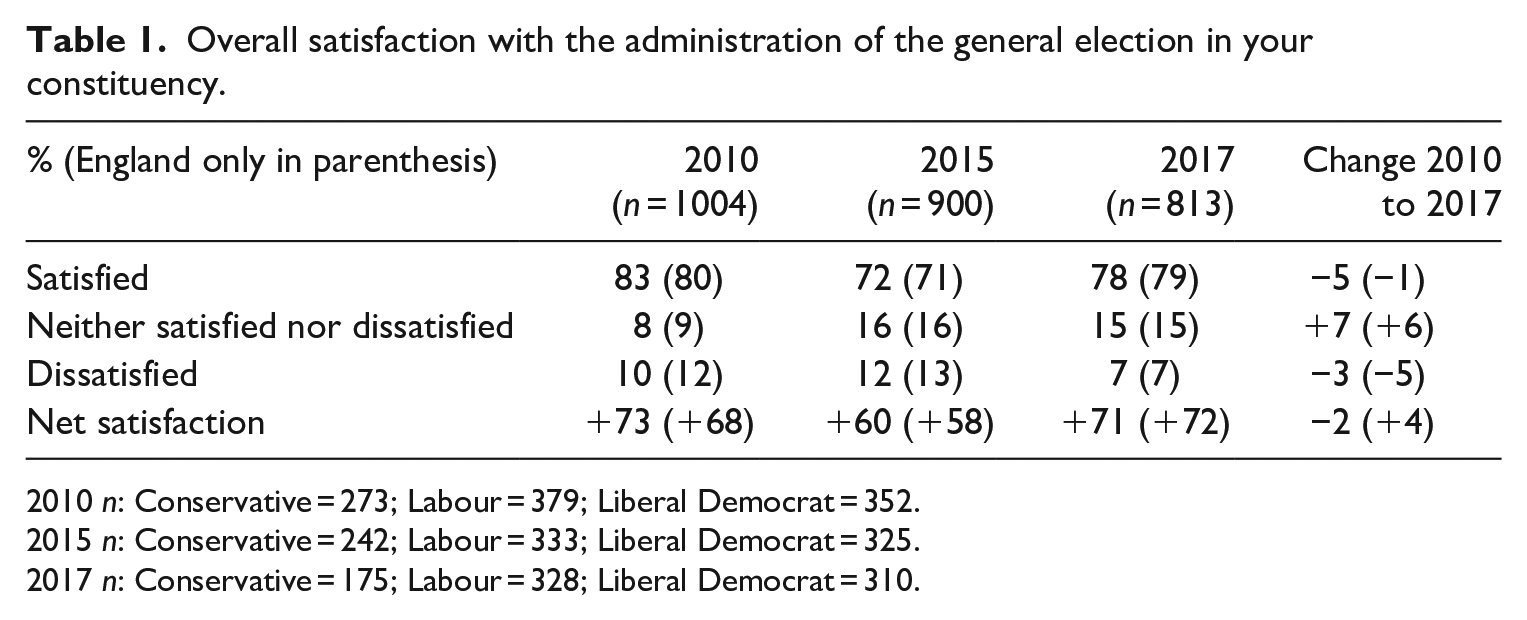
Table 1 illustrates the overall levels of satisfaction with electoral administration at the 2010, 2015 and 2017 elections, together with the net scores (satisfied minus dissatisfied). As a robustness check to establish any impact of concurrent elections, we also show the results from England only (as there were no regular local authority elections in Scotland and Wales in 2010 and 2015). What is apparent first is that the levels of satisfaction are high – around 80% in both 2010 and 2017, despite the fact that non-proportional electoral systems (such as the single member plurality system used in UK general elections) tend to be associated with poorer perceptions of electoral fairness (Birch, 2008: 308). Such evaluations are generally comparable with perceptions of electoral evaluators, which are relevant to and comparable with those made by electoral users. Thus, evaluations of Procedures, Vote Count and Electoral Authorities in the United Kingdom are ranked among the best performing countries. That said, electoral evaluators’ perceptions of Voter Registration in the United Kingdom are notably poor and indeed, declined between 2015 and 2017 – though this decline was ascribed by Norris et al. to national level legislation rather than poor electoral administration per se (Norris et al., 2018: 12, 27–28).
Overall satisfaction with the administration of the general election in your constituency.
2010 n: Conservative = 273; Labour = 379; Liberal Democrat = 352.
2015 n: Conservative = 242; Labour = 333; Liberal Democrat = 325.
2017 n: Conservative = 175; Labour = 328; Liberal Democrat = 310.
For electoral users, there is, however, a dip in 2015, with satisfaction levels and the net score falling by over 10 percentage points. This still represents a satisfaction level of 72%, but is notably lower than both 2010 and 2017, the differences between 2015 and both 2010 and 2017 being statistically significant. The England only results show similar patterns, albeit with a slightly more modest dip in the overall satisfaction in 2015 (though again, the differences between 2015 and both 2010 and 2017 are statistically significant). This means that in respect of satisfaction with electoral administration, H1 is rejected. The levels of satisfaction in 2017 were more comparable with 2010 than 2015 (though the difference between 2010 and 2017 is itself statistically significant), suggesting that the short period in which the 2017 election was organised administratively, had limited (if any) impact on the levels of satisfaction. Rather, the lowest levels of satisfaction were in 2015 after a full 5-year term. The ability of electoral administrators to plan ahead, enabled by full parliamentary terms would appear, therefore, to have no impact on the experience of this user group.
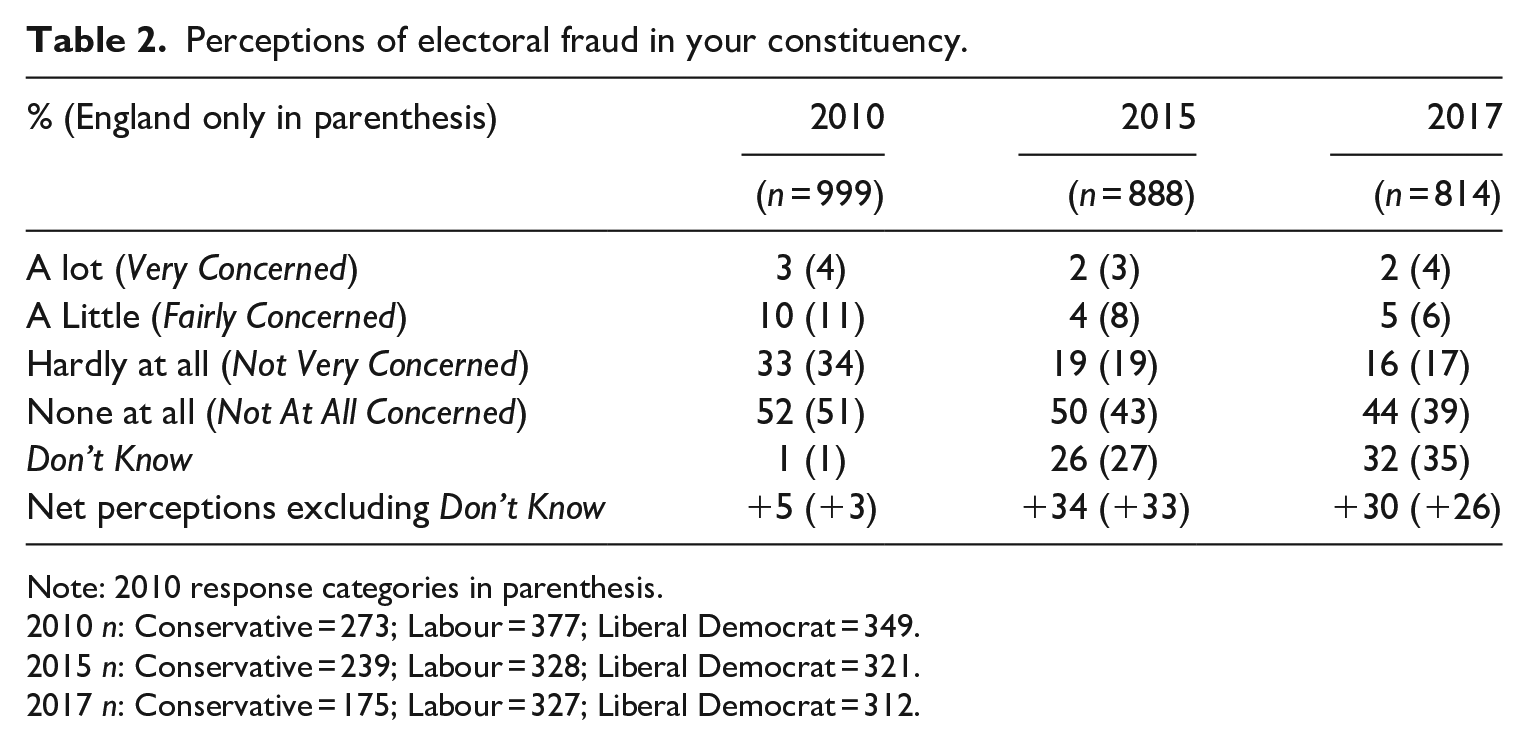
Table 2 examines the overall perceptions of electoral fraud. As with studies of electoral producers (Clark and James, 2015: 4), the proportions suspecting significant levels of fraud are small. For example, the proportion suggesting that there was A Lot or A Little fraud was 6% in 2015 and 7% in 2017, while the proportions for England only are slightly higher – 11% and 10%, respectively. These levels are much smaller than the proportions among electoral consumers (electors), where the comparable percentages perceiving A Lot or A Little fraud in 2015 and 2017 were 35% and 38%, respectively (Electoral Commission, 2017; Ipsos-MORI, 2015). This reflects the argument that citizen evaluations of election quality are likely to be inaccurate, compared with electoral producers (electoral administrators) or more informed electoral users (electoral agents), citizens are less likely to be able to correctly assess the severity of an issue beyond their own personal experience (Electoral Commission, 2014: 14; Norris et al., 2017: 5).
Perceptions of electoral fraud in your constituency.
Note: 2010 response categories in parenthesis.
2010 n: Conservative = 273; Labour = 377; Liberal Democrat = 349.
2015 n: Conservative = 239; Labour = 328; Liberal Democrat = 321.
2017 n: Conservative = 175; Labour = 327; Liberal Democrat = 312.
The question wording in respect of perceptions of fraud in 2010 differs from that in 2015 and 2017, 2 and while there are the same number of response categories, the significant change in the proportion of respondents answering Don’t Know means that comparisons between 2015/2017 and 2010 should be made with significant caution. In addition to the frequencies, we add a net score, which excludes Don’t Know responses on the grounds that the reasoning behind the response was unknown. To ensure that this did not produce any bias, the Don’t Know responses were analysed by agent experience, agent party, country and seat winner. There were no patterns in respect of which agents were most likely to respond Don’t Know, indicating that their exclusion – while regrettable in terms of the impact on sample size – does not bias the results. The net score is calculated by subtracting any perception of fraud (A Lot/A Little/Hardly Any) from None At All. Thus, a positive score indicates a greater perception of probity, while a negative score indicates greater perception of fraud.
At first sight, there would appear to be some support for H1 in respect of perceptions of fraud, when comparing responses to the ‘full-term’ 2015 election with the ‘snap’ 2017 election. The proportion saying that there was no fraud declined from 50% in 2015 to 44% in 2017, and the net score also suggests a modest decline (four points). In England, the decline was slight greater, with a 7-point fall in the net score between 2015 and 2017. However, in neither case is the difference statistically significant. Overall then, while we observe some temporal effects in the levels of satisfaction with electoral administration and perceptions of electoral fraud, there is no support for H1 – the snap election in 2017 did not result in a tangible decline in evaluations of electoral integrity among electoral users. Nor indeed, was there any clear impact of the absence of concurrent elections in England in 2017.
At an aggregated national level, therefore, we observe that overall satisfaction is relatively high and perceptions of fraud relatively low. But an aggregated national analysis only tells us so much. What we do now, therefore, is to move from the macro-level and apply multivariate analyses to explain variation in evaluations at the district or constituency (micro) level. As we have seen, there are broadly three types of explanatory variables to explore: the characteristics of the agent, the geography of the seat and the electoral status of the seat. Agent characteristics are captured by two variables: party and experience. To operationalise party effects, we use dummy variables to denote a Conservative or Labour agent and use Liberal Democrat agents as the reference category. Agent experience is captured by whether the agent had previously organised an election campaign (Yes = 1, No = 0).
The geography of the seat is captured by two measures: the country within Great Britain in which the seat is located and a measure of how urban are the seat’s characteristics. The country variable is operationalised by dummy variables to denote whether the seats sit in Scotland or Wales, with England as the reference category. The urban characteristics are a function of three variables: population density, proportion of non-White residents and proportion in rented accommodation (either public/private or third sector). Given the expected close relationship between these variables, all three were entered into a principal components analysis (PCA) and all loaded on to one component (for solutions see the Appendix). Factor scores were produced from the PCA and used in the modelling, with the variable described as ‘urbanness’.
The electoral status of the seat is captured by two variables: the marginality of the seat and the winner of the seat. Marginality is a function of the result in the seat at the previous election and captures the closeness of the contest, which informs both the level of resource devoted by parties and candidates to the contest and prior perceptions in respect of the outcome. 3 The winner of the seat is a dummy variable, whereby winners of the seat at the election under investigation are coded as 1 and losers as 0.
The dependent variables are calculated as follows. In the analyses of satisfaction with electoral administration, the full 5-point scale of the variable is used, running from Very Dissatisfied (low) through Very Satisfied (high). In respect of perceptions of fraud, there are two analyses. The first analysis uses a 4-point scale running from None at All (low) through A Lot (high) for 2015 and 2017. In 2010, the 4-point scale runs from Not at All Concerned (low) through Very Concerned (high). In all cases, Don’t Know responses were eliminated from the multivariate analysis again, because the reasoning behind the response was unknown and, because, as per the analysis in Table 2, there were no patterns in respect of which agents were most likely to respond Don’t Know. The models were estimated using ordinal regression as the appropriate method, due to the characteristics and distribution of the dependent variables. A second analysis was undertaken on perceptions of fraud using a binary response as the dependent variable. Those expressing any concern about fraud were coded as 1 and those with no concern were coded as 0. As with the other analysis of electoral fraud, Don’t Know responses were excluded. Reflecting the fact that in these analyses the dependent variable was binary, logistic regression was used.
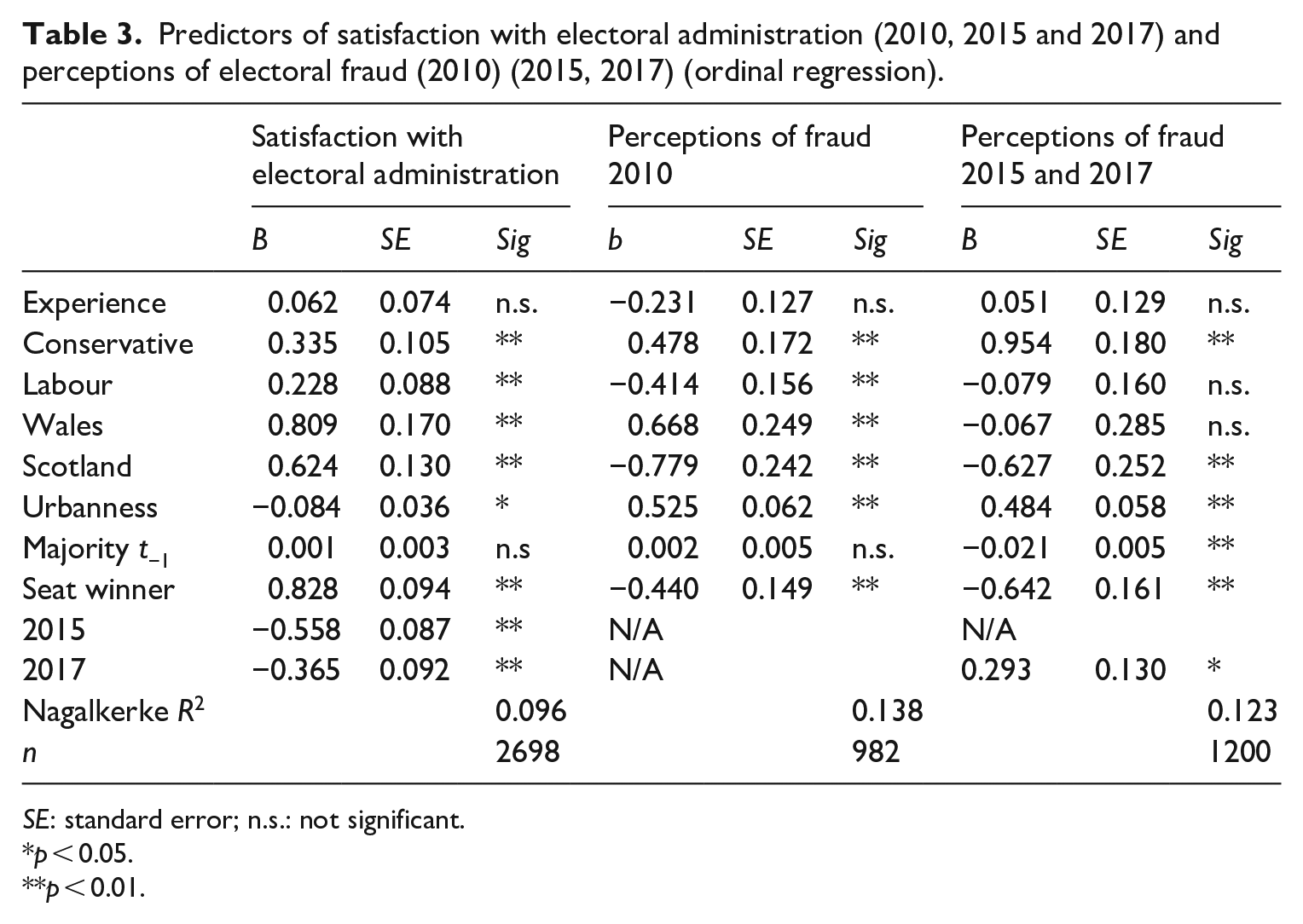
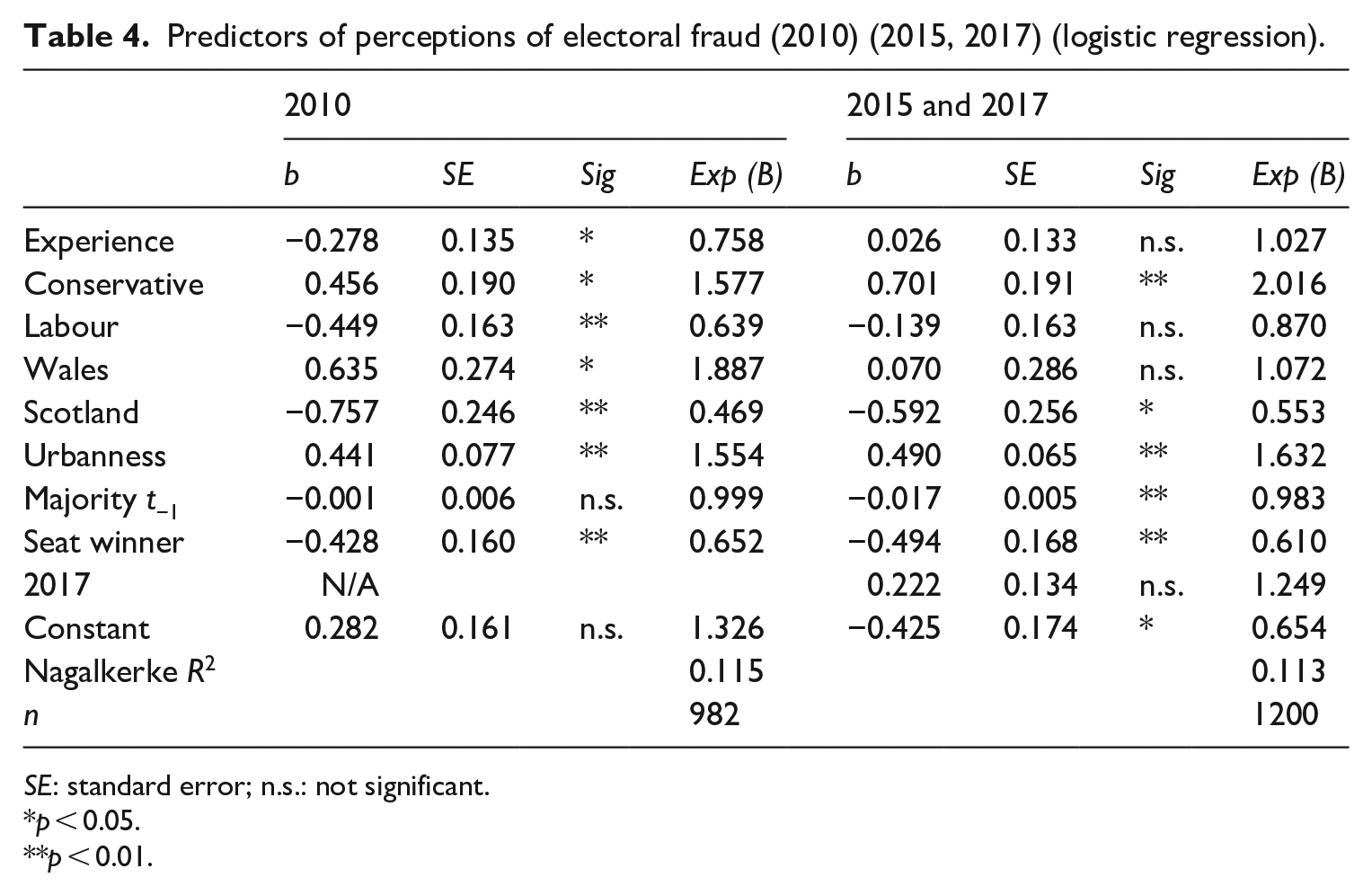
The analyses in Tables 3 and 4 use pooled data with fixed effects for the election year. The analysis of satisfaction with electoral administration uses pooled data across all the three elections (2010, 2015 and 2017). For the analysis of perceptions of electoral fraud, only data from 2015 and 2017 are analysed together due to the question wording difference in 2010. The analyses of perceptions of electoral fraud in 2010 are modelled separately, and are shown alongside the pooled analyses in Tables 3 and 4.
Predictors of satisfaction with electoral administration (2010, 2015 and 2017) and perceptions of electoral fraud (2010) (2015, 2017) (ordinal regression).
SE: standard error; n.s.: not significant.
p < 0.05.
p < 0.01.
Predictors of perceptions of electoral fraud (2010) (2015, 2017) (logistic regression).
SE: standard error; n.s.: not significant.
p < 0.05.
p < 0.01.
There is support (albeit widely varying) for all six hypotheses (H2–H7). Agent experience (H3) registers a statistically significant effect on perceptions of fraud in the 2010 logistic regression (Table 4). As predicted, less experienced agents were more likely to perceive fraud in that election. In all other models, however, agent experience has no statistically significant effect. The other key agent characteristic (party) makes a more significant difference, however (H2). Conservative and Labour agents are more likely to be satisfied with electoral administration than their Liberal Democrat counterparts. However, in respect of perceptions of fraud, in both the ordinal and logistic regressions models, Conservatives are also most likely to perceive fraud, reflecting comparative research, which suggests that perceptions of fraud tend to be greatest among parties on the right (Birch, 2008; Karp et al., 2018; Norris et al., 2017). At first sight, this might be a curious finding, given that like Labour agents, Conservative ones were also positively disposed towards electoral administration. Our expectation is that if a group is positive about electoral integrity, we would expect them to be less likely to perceive fraud. However, it may not necessarily be an odd discovery. While satisfaction with electoral administration captures positive electoral integrity and perceptions of fraud negative electoral integrity, the measures used are not direct opposites of each other. It would be theoretically possible to perceive fraud as being engaged in by competitor parties, while being satisfied by the way in which elections are administered – especially if the administration prevents any fraud benefitting competitors. Nonetheless, as we shall see, for other explanations of variation in electoral integrity, the patterns are more as expected. For Labour, agents were significantly less likely to perceive fraud in 2010, but there was no statistically significant effect of Labour partisanship in the other two elections. Overall, H2 is confirmed in respect of the agent’s party delivering partisan though the direction of the impact varies, depending upon whether positive or negative electoral integrity is being evaluated. The impact of agent experience, however, is only confirmed to a very limited degree (H3).
With respect to geography, we find support for H4 and H5 in all the models. Agents in Wales and Scotland are more likely to be satisfied with electoral administration than agents in England. In respect of perceptions of fraud, however, we see that while agents in Scotland are less likely to perceive fraud, the impact of Wales-based agents in this respect is only statistically significant in 2010, when they were more likely to perceive fraud. Overall, as predicted, the country in which elections are taking place does matter in respect of evaluations of electoral integrity, and as with Clark’s (2015, 2017) analysis, these evaluations are generally higher in Scotland than in the rest of Great Britain (H4). The level of urban characteristics also has clear effects in all models (H5). Agents in more urban seats are less likely to be satisfied with electoral administration and more likely to perceive fraud. This pattern is exactly as predicted, with a lower level of assessment of positive electoral integrity being associated with a higher perception of negative electoral integrity. H4 and H5 are therefore confirmed.
Finally, we examine the impact of the electoral profile of a seat and find some support for both H6 and H7. While marginality has no statistically significant impact on agents’ satisfaction with electoral administration, it does have a clear impact on perceptions of fraud in the pooled analysis of 2015 and 2017. In those election years, agents were more likely to perceive fraud in more marginal seats (H7), reflecting the findings of Alvarez and Boehmke (2008) in the United States and Eisenstadt in Mexico (cited in Lehoucq, 2003: 250). The outcome of elections, however, has a clear and consistent effect in all models. Agents of candidates who won their electoral contest are more likely to be satisfied with electoral administration and less likely to perceive fraud, again reflecting the expected pattern of results – those who had higher evaluations of positive electoral integrity had lower perceptions of negative electoral integrity (H6). H6 is therefore confirmed and there is also partial support for H7.
Conclusion
Evaluations of electoral integrity can be both negative and positive. Perhaps not surprisingly, most attention has tended to be paid to negative perceptions, through as Norris (2018) correctly argues, a better overview is gained by analysing both negative and positive evaluations as well as a range of other indicators. Coupled with this typical focus on negative perceptions, it is arguable that citizens tend to have an inflated view of the degree of electoral malpractice and fraud. Thus, despite the United Kingdom being one of the better performing democracies in Norris et al.’s (2018) ranking, nearly 40% of citizens suspect fraud at general elections (Electoral Commission, 2017; Ipsos-MORI, 2015). Compared with the findings featured in this study derived from a more informed group of electoral users (electoral agents), this would suggest that as with other studies in the United Kingdom and the United States, citizen evaluations of electoral malpractice may be exaggerated (Electoral Commission, 2014; Norris et al., 2017).
But what is also clear is that evaluations of both negative and positive electoral integrity are not uniform among electoral users. What is apparent in both measures is that the impact of electoral victory or defeat informs judgements. Electoral regulators should perhaps consider the electoral status of the accuser (negative electoral integrity) or admirer (positive electoral integrity) when assessing views on the performance of electoral administration. But equally, geography matters. Not only is electoral integrity in Scotland generally higher than in the rest of Great Britain, but dissatisfaction with electoral administration and perceptions of electoral fraud are at their highest in urban environments – characterised by higher population density, higher levels of ethnic diversity and a larger rented housing sector. Regulators, then, should perhaps target their efforts on improving electoral administration and minimising perceptions of fraud in these urban areas. The Electoral Commission (2014: 3) recommended such a strategy in 2014 and this analysis reinforces the wisdom of that approach. Indeed, given the importance of the winner/loser effects, what is remarkable is that these effects endure to such a degree.
Overall, this article analyses a hitherto unresearched group of electoral users in respect of evaluations relating to electoral integrity – election agents, and as with other comprehensive assessments, analyses both negative and positive evaluations. The findings are important because they reveal three key things that significantly enhance the study of electoral integrity. First, it allows for an important comparison with electoral consumers. The finding suggests that the perceptions of informed participants (electoral users) do not reflect the levels of negative perceptions found among electoral consumers (electors). Citizen perceptions matter, of course. But as with other areas of public policy, care should be taken when using citizen perceptions to inform policy-making – especially when those perceptions are seemingly inaccurate (see also VanHeerde-Hudson and Fisher, 2013). Concerns about electoral integrity are clearly justified, but examinations of citizen perceptions alone are likely to paint an exaggerated picture.
Second, the unique data set allows for detailed analysis at the micro (district or constituency) level, rather than just painting an aggregated one at the macro (national) level. This analysis reveals that electoral integrity in Britain is subject to significant variation and that it is more of a localised issue than one that is more widespread. Finally, it reveals that as with electoral consumers, winner/loser effects are also highly significant among electoral users – despite their greater knowledge of electoral processes. But, even if once we take the important winner/loser effects into account, we still observe very significant geographical effects, and in a less predictable way, the impact of partisan cues. In terms of electoral integrity, then, the winner does not take it all. Partisan cues and especially geography also matter a great deal. Overall, questions of electoral integrity are neither uniform, nor divorced from political considerations, geographical variation or electoral outcomes. Both policymakers and scholars should take account of such variation and focus attention accordingly.
Footnotes
Appendix
Funding
The author(s) disclosed receipt of the following financial support for the research, authorship and/or publication of this article: This research was funded by the Economic & Social Research Council (RES-000-22-2762; ES/M007251/1; ES/R005052/1) and the Electoral Commission.
