




Abstract
Amidst concern about declining youth political engagement, it is often suggested that social media can provide a solution to this challenge. In this article, however, we argue that these online tools have not thus far mobilised a new audience to become engaged in either institution-oriented activities or political expression. Instead, we found that some young people are far more engaged in using social media for political purposes than others, and that a substantial proportion of young adults never use social media for this purpose. Using latent class analysis (LCA) of a unique web survey of young Britons aged 22–29, we show that the principal driver of online political engagement is political interest (even after controlling for socio-demographic characteristics). On this basis, we conclude that social media may be providing a new outlet for some young adults; it is not re-engaging the young adults who have already lost interest in politics.
Introduction
Amidst concern about declining youth political engagement, it is often suggested that social media can provide a solution to this challenge. In these debates, social media are seen to serve two functions. First, social media can provide a new medium of communication through which established political institutions and actors can reach out to young citizens. Alternatively, young citizens are using social media to redefine political engagement by finding new ways to express their political preferences outside of the confines of traditional political engagement (e.g. voting or joining a political party). In support of the latter argument, proponents point to the prominent (and often highly effective) use of social media in protest activities such as the Arab Spring, the Occupy movement and the ‘Indignados’ in Spain and Greece (see Theocharis et al., 2015). The political potential of this technology revolution has prompted a flurry of academic studies, but this remains a nascent research area—theoretically, methodically and empirically (see Boulianne, 2015; Gibson and Cantijoch, 2013; Xenos et al., 2014).
This article seeks to contribute to this literature by looking beyond the recent high-profile protests and examining the extent to which young adults are using social media for more ‘routine’ types of political engagement (such as political discussion or joining/following campaigns). Although it assumed that online political engagement is being led by young adults, studies that focus specifically on youth populations are still relatively rare and/or based on university students (Kim and Amna, 2015; Xenos et al., 2014). Young adults also tend to be treated as a homogenous group compared to older groups, and the differences within this age group are often overlooked. This article will therefore examine whether some young adults are more highly engaged in this medium than others, and if so, what the predictors of this differential online engagement are.
To examine these questions, we use latent class analysis (LCA) of online survey data collected from a sample of 22- to 29-year-olds in Britain. Britain is an ideal case in which to examine these themes because young people in Britain exhibit comparatively low levels of turnout for elections, but high levels of engagement in social media (Xenos et al., 2014). This combination has led some to suggest that social media could be harnessed to increase youth political engagement (online and offline). However, we find that social media use for political engagement is far from universal or uniform among British youth; some young adults more highly engaged than others, and a substantial proportion of young adults are not using social media for any type of political engagement (be it to engage with politicians, promote causes, or discuss political issues). Following on from this, we then use conditional LCA (within a structural equation modelling (SEM) framework) to examine why some young adults are more or less likely to engage than others. We focus in particular on socio-demographic characteristics, which previous studies have suggested are predictors of political engagement in general, as well as political engagement online (Schlozman et al., 2012; Verba et al., 1995). What our analysis suggests, however, is that young adults’ participation in online political engagement is driven by their political interest rather than their socio-demographic characteristics. As political interest is still being formed during adolescence and early adulthood, we suggest that future studies should focus on the evolution (and stratification) of political interest during this formative period, rather than on the contemporary socio-demographic characteristics of young adults.
Political engagement and the Internet: A digital revolution or perpetuating the social divide?
Recent research on youth political participation has been a microcosm for a larger debate about the evolution of political engagement in the post-industrial era. It is clear that public participation in the traditional forms of democratic engagement (such as voting, joining political parties, and trade unions) has declined in many developed countries, but the consequences of this are contested. On the one hand, some have expressed deep concern that these developments constitute a devastating blow to our democratic institutions (see, for example, Putnam, 2000). Yet others take a more positive view and argue that rather than declining, democracy is being transformed, and that citizens are looking beyond the established political institutions to find new and creative ways to express their political preferences and to achieve their civic and political goals (Dalton, 2008; Norris, 2002). What counts as an ‘non-institutional’ or expressive form of political engagement continues to be debated, but commonly cited examples include protests, petitions, boycotts and, more recently, online modes of engagement (such as social media campaigns) (Campbell, 2009: 778; Zukin et al., 2006: 57–58).
The technological revolution wrought by the Internet has played a central role in proliferating these new types of political action and expression. For one, the rapid and on-going development of the Internet has transformed the speed and ease of communication and information flows. This has had a knock-on effect on political engagement in several key ways. First, the Internet has increased access to information, thus lowering the cost of (and resources required for) acquiring political information (Schlozman et al., 2012: 487). Second, the range of information available has been diversified and ‘democratised’. The number of news sites and commenters has multiplied, which in turn has increased the number of different viewpoints available to citizens. Information can now be shared rapidly, widely and easily by anyone, and as a result, friends, family and peers are becoming the curators of news and information, and we are no longer (as) reliant on institutionalised (national) media or political parties for political information (Bimber, 2012; Norris and Inglehart, 2009). Third, it has become increasingly easy for individuals to become the creators of web content and not just passive consumers. Through blogs, social media sites, comment forums and the like, individuals can locate like-minded individuals, convey their own message(s) and become directly and actively involved in their fields of interest, should they wish to (Ekström and Östman, 2015). The benefits of this technology are not limited to the political realm, but it means, for example, that individuals can easily and cheaply start a website or petition about a political issue that is important to them, and circulate it widely not only among their friend-group, but also far beyond.
Finally, even when individuals do not wish to become a content creator, it has been suggested that the online sphere can still boost political engagement. The central premise of this argument is that social media can increase an individual’s exposure to political information and social mobilisation when friends and family post links to news stories or express political opinions. This can, in turn, trigger political interest, political information-seeking and/or social pressure to become engaged in political acts and/or political discussions (Theocharis and Quintelier, 2014). For example, a randomised-control trial in the United States found that Facebook users were more likely to vote and more likely to seek out voting-related information if they saw that others in their social media networks had voted (Bond et al., 2012). Indeed, some studies have even suggested that Internet usage can have positive effects on civic and political engagement even when the online activity is apolitical. Kahne et al (2013), for instance, found that non-political online activity can provide a pathway to participation in volunteering, protests and political voice (see also Ekström and Östman, 2015; Xenos et al., 2014).
A new voice for youth?
As a result of these features, proponents of this democratic phoenix thesis argue that the Internet (and indeed other forms of expressive political engagement) can provide a space in which new voices are heard and previously marginalised groups can express their views and lobby for change (in civic, political, cultural or social spheres). Proponents of this view are particularly optimistic about the mobilising and democratising potential of online tools for younger populations (Bennett, 2008; Delli Carpini, 2000 etc.). Contemporary youth have grown up with the Internet, and have become the fastest adopters of new technologies. Variously labelled as the ‘Dotnet generation’, ‘Netizens’ or ‘digital natives’, it is posited that this generation of young adults not only have the digital skills to use new technologies effectively but also that these technologies have become so integrated into their lives that the online realm is the ‘natural’ world in which they will choose to act on or express their views (Kim and Amna, 2015: 224). Indeed, Boulianne (2015: 534) suggests that the transformative potential of social media may only be available to young adults growing up after the Internet revolution, as they both use social media intensively and their political identities and habits are still being formed. This generation of youth may therefore be the first generation to reflect the mobilising potential of social media and the Internet in general.
It has also been posited that the Internet could play a compensatory role for young citizens. It is well established that in their teens and 20s, young adults are less likely to be engaged in institutional political activities (such as voting or joining political parties) as they are preoccupied with completing their education, finding employment and completing the transition to adulthood (Henn et al., 2002; Smets, 2015; Van Deth, 1989). In particular, during this life-stage, young citizens have less of the resources (time, money or mental energy) that are believed to be prerequisites to political engagement (Verba et al., 1995). However, as online participation requires fewer resources (financial or otherwise), it has been suggested that these online tools could help to compensate for the resource limitations that young adults face and provide a low-cost site for engagement. Yet, despite the great potential of these online tools, the evidence to date has been mixed. On the one hand, some studies have found that young adults are more likely to use online tools for political engagement than older generations (see, for example, Jensen and Anduiza, 2012), which lends support to the thesis that online tools can help to address the inter-generational imbalance in political engagement. Feezell (2016), on the other hand, found that age is only a predictor of being an Internet user, and that once this is taken into account, young people are no more or less likely to engage in online political activities than older Internet users. Similarly, the stratification of online political engagement also continues to be contested. Both Oser et al. (2013) and Schlozman et al. (2012: 515) found that online political engagement is stratified by education and socio-economic status (SES), even among young adults; this suggests that online political engagement replicates the inequalities that are apparent in offline participation. By contrast, Feezell’s (2016: 502) analysis found that income was only a predictor of access to the Internet, not of online political engagement itself. She therefore argues that resource-based theories of engagement will become less and less appropriate once Internet access becomes more widespread.
These contrasting findings highlight that there are many unanswered questions about the democratising potential of the online realm, and suggest that we must consider whether online participation is, like offline forms of participation, a ‘weapon of the strong’ (Schlozman et al., 2010) rather than an opportunity for disenfranchised youth to find their voice. One reason for these different interpretations is that research in this area is nascent, and that there are still few youth studies that are able to look at differences within this generation, rather than differences between young adults and their elders (Boulianne, 2015; Kim and Amna, 2015; Xenos et al., 2014). As a result, there is a tendency to imply that all young adults are engaging in online participation. Furthermore, many recent studies look at the effect of social media and/or Internet usage in general, rather than examining the prevalence of usage for activities that could be considered ‘political’ (discussed in more detail below).
In light of these issues, this article hopes to contribute to this literature by examining the different ways in which young adults in Great Britain are using social media for political engagement, and the reasons why some young adults are more highly engaged than others. In this article, we will focus on two possible explanations for the differential levels of engagement. First, we will test the proposition that social media use for political engagement is dominated by youths with educational and/or socio-economic resources, and thus continues to be a ‘weapon of the strong’ (Schlozman et al., 2010). Political engagement as a whole tends to be stratified by education, gender and ethnicity, and we expect that these patterns will be replicated here (H1). As SES is still ‘under-construction’ at this life-stage (Schlozman et al., 2012: 514), we expect that parental resources will also play a role, and that young adults are more likely to use social media for political purposes if their parents have a higher occupational status and/or higher levels of educational qualifications (H2).
In addition to looking at the role of socio-demographic characteristics, we will also examine the role of political interest. The link between political interest and political action is strong and well established (Van Deth, 1989; Verba et al., 1995); we therefore expect that young adults with higher levels of political interest will be more likely to use social media for political engagement (H3). If this hypothesis is confirmed, it will indicate that social media is only being used for political engagement by those who are already predisposed to do so (by their greater interest in politics). As such, it will lend greater support to the idea that social networking sites (SNS) are not mobilising a new audience but rather are merely providing another outlet for groups that are already engaged.
Data and methods
The analysis presented here draws on a unique online survey of civic engagement among young adults in Britain. The Citizenship Education Longitudinal Study (CELS) web survey 1 was conducted in late June/early July 2014 among 2025 young adults aged 22–29 in England, Scotland and Wales. 2 In the past, it has been suggested that web-based surveys are not representative of the population (because they exclude non-users) and that these data may over-estimate the significance and size of the effects (Boulianne, 2009: 204). However, these concerns have abated since Internet access has become ‘ubiquitous’ and Internet usage among British youth is almost universal (Dutton and Blank, 2013). Our sample includes more young women than young men (57.6% vs 42.4% male), but is otherwise broadly representative in terms of ethnicity, qualification levels, current occupation (student/working/young people not in education, employment or training (NEET)) and parental education.
As part of this survey, respondents were asked a series of questions about their use of social media for a range of political activities. What constitutes political engagement continues to be debated, regardless of whether it is offline or online, but defining what is ‘political’ about online engagement is even more challenging (see Ekman and Amna, 2012; Gibson and Cantijoch, 2013; Theocharis and Van Deth, 2016); the opportunities and means for engaging are evolving rapidly as the technology changes, and this space is meant to facilitate the emergence of new and creative modes of engagement (Bimber, 2012: 123; Kim and Amna, 2015). Some have also questioned the extent to which online forms of participation are ‘new’, or whether they are merely an extension of, or new medium for, existing forms of participation that have an offline equivalent (for a theoretical and empirical discussion of this issue, see Gibson and Cantijoch, 2013; Theocharis and Van Deth, 2016).
With the data used in this article, our primary aim was to capture the types of civic and political activities that were most likely to be commonly undertaken online, and to identify how widespread and frequent their use was among young people. In designing the 2014 survey questionnaire, we used the Pew Research (2012) survey as a starting point, and adapted the items to reflect the context of young people’s lives in Britain. The first battery of items asked participants whether they had ever used SNS to join a political campaign group, start a campaign group, ‘follow’ a politician or candidate online, and/or encourage others to vote and volunteer (see Appendix 1 for the full list of items and specific wording). We hypothesised that these types of activities would typically involve intentional and explicit engagement with civic or political institutions or organisations, and that they would be more resource-intensive and less frequent. Because civic or political institutions play a more prominent role in these types of activities, the responses to these items were grouped together for our analysis and considered as expressions of online institution-oriented engagement.
The second battery then focused on activities that Yamamoto et al. (2013) and others have described as online political expression, such as using SNS to ‘like’ or share material with political information (e.g. news stories), to comment on material with political information and/or to raise awareness about an e-petition or a boycott (see Appendix 1). We hypothesised that the focus of these types of activities would be more diffuse, spontaneous and irregular (see Gibson and Cantijoch, 2013). As social media facilitate interactions of this nature to take place easily and with fewer resources, we asked respondents to indicate how frequently they engaged in these types of activities: never, rarely (once a month), sometimes (once a week) or often (most days). There is considerable debate about whether political discussion and expression (online or offline) can be considered a form of political engagement, 3 but we have included these items in our theoretical and empirical analysis for several reasons. First, Amna and Ekman (2014) suggest that during youth, political discussion is an indicator of latent political engagement that can be activated and translated into manifest political action in later life. Second, and perhaps further supporting this claim, several studies have found that online political expression is associated with offline political engagement (Theocharis and Quintelier, 2014; Yamamoto et al., 2013). The direction and causality of this relationship has not been established definitively (Boulianne, 2015), but it nonetheless suggests that engagement in online political expression (or lack thereof) warrants further attention.
We conducted a range of additional analyses and robustness checks to confirm both the utility of using two distinct measures in our analysis and that each measure was internally consistent and valid. Item Response Theory (IRT) models (Lord, 1965; Wilson, 2005) confirmed our theoretical starting point, namely, that a two-factor solution was a better fit to the data than a uni-dimensional measure. According to Hu and Bentler (1999), the optimal solution should have a root mean square error of approximation (RMSEA) with a value below 0.06. In our data, we found that the RMSEA value equalled 0.046 for the two-factor model and 0.067 for the one-factor model; these results thus confirmed that a two-factor solution is a better fit to the data. Furthermore, while Theocharis and Van Deth (2016) suggest that there may be further sub-types within these two measures, our findings below illustrate that the way in which young people engage with the items within our chosen constructs is often very similar, even if they may constitute a different sub-type from a theoretical standpoint. In particular, and as we shall see, there is a high proportion of young people who are not engaging in any form of online political expression, while highly engaged youth are likely to report that they engaged in all of the online activities we asked about.
Descriptive statistics
The CELS web survey indicates that a high proportion (87%) of young adults are using SNS (such as Facebook, Twitter, Instagram, LinkedIn or Google Plus), but only a small proportion of these SNS members are using these tools to engage in institution-oriented types of political engagement. Table 1 below shows that among the 1784 users of SNS who participated in our survey, around 15.7% indicated that they had used SNS to ‘follow’ or ‘like’ a politician, and less than a quarter indicated that they had joined or ‘followed’ a campaigning group or a political group. However, only a very small minority indicated that they had taken proactive steps to start a campaign using SNS tools (3.7%), and over half of current SNS members (57.2%) indicated that they have never used social media to engage in any of the political activities that were listed in this question. By contrast, far higher proportions of these young adults reported engaging in online expressive discussion. As Table 1 illustrates, around half of the sample reported having ‘liked’ and/or re-posted material with civic or political content at some point, 4 and a similar proportion (48.6%) indicated that they had posted materials of this nature themselves (52.8%).
Descriptive statistics.
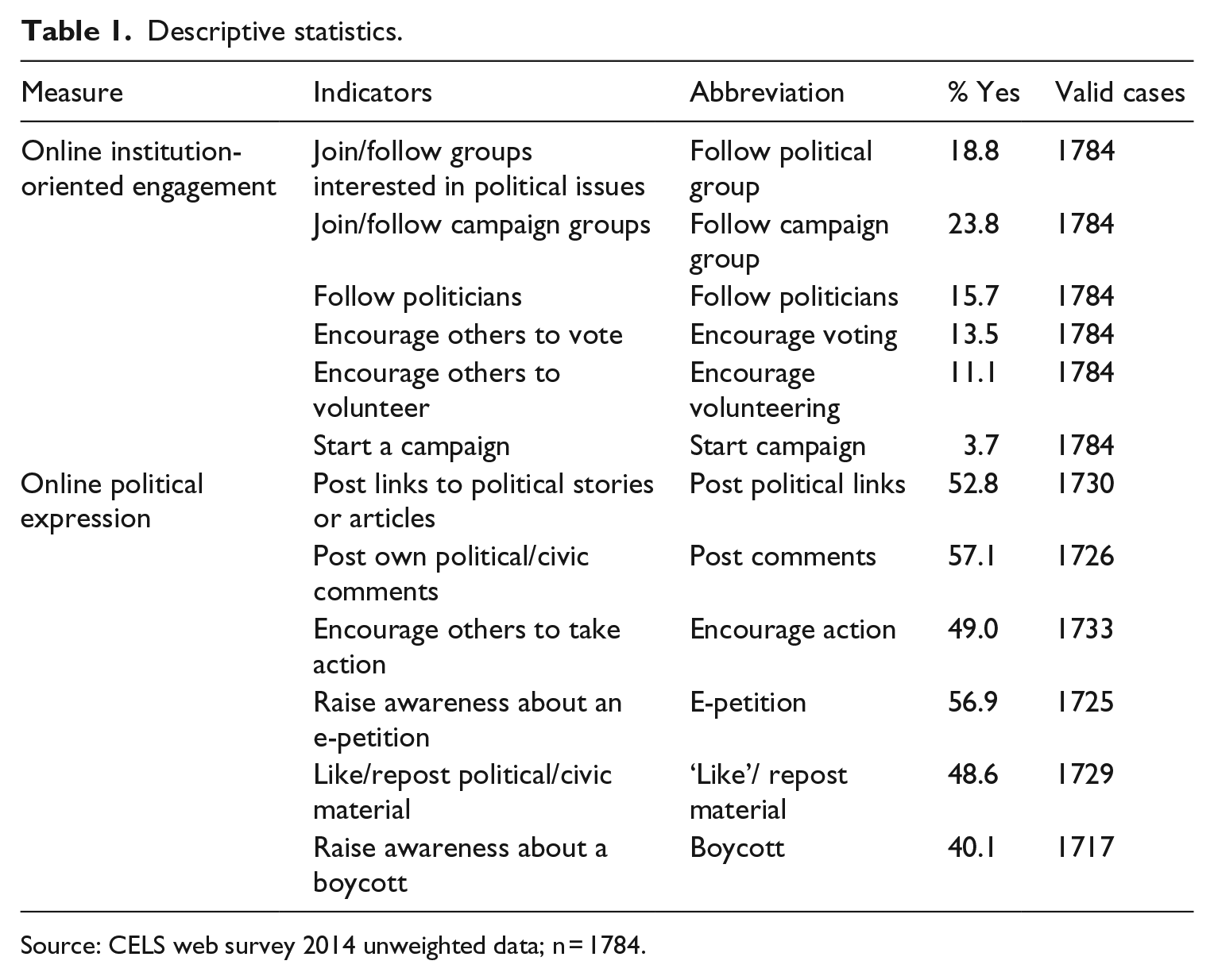
Source: CELS web survey 2014 unweighted data; n = 1784.
Analytical strategy
These descriptive statistics suggest that there are notable differences in the ways young adults are using social media to engage in online political activities. In order to confirm this thesis, and to identify what the different types of online political engagement are, we conducted LCA with these data using Mplus v.7.31 (Muthén and Muthén, 1998). Put simply, LCA helps us to discern patterns in item responses and to identify subgroups in the population of reference (in this case, subgroups who engage in different types of online institution-oriented engagement and online political expression). LCA is particularly beneficial in that it allows us to distinguish subgroups (known as latest classes) whose respondents are internally homogenous in the way they use social media to engage with political matters while maximising the heterogeneity between the latent classes (Bollen, 2002; Collins and Lanza, 2010; Skrondal and Rabe-Hesketh, 2007). We have opted for LCA rather than factor analysis (Brown, 2006; Lohelin, 1987), as we are interested in identifying different types of online political engagement rather than on levels of this phenomenon across the whole population (Magidson and Vermunt, 2003).
LCA comes from the development of Lazarsfeld’s latent structure analysis (Lazarsfeld, 1959), and it is a probabilistic method used to assess the validity of theoretical, non-directly observable classifications and typologies. Each of the unobserved classes obtained through LCA represents a particular response pattern for the set of items under analysis; these patterns help us to identify the prevalence of each class in the population, as well as to characterise the classes on the basis of the probability of a particular answer to a series of categorical items (Collins and Lanza, 2010). In other words, this method ensures that individuals who are likely to respond to items in similar ways are grouped together, and we can start to identify subgroups in the population, as well as to establish what the characteristics of these different groups are. Two main sets of estimates, or parameters, are taken into account to interpret the latent classes: the probability of membership in each latent class (i.e. the prevalence of each class in the population of reference) and the item-response probabilities.
LCA is typically viewed as a confirmatory method, and the number of cases or subgroups that are selected for analysis are supposed to be decided a priori, guided by theoretical reasons. However, any initial hypotheses about the number of classes have to be corroborated and the appropriateness of these hypotheses versus alternative outcomes is assessed using three absolute model fit indices, namely, the log-likelihood (LL) value, the Akaike Information Criterion (AIC) and the sample-adjusted Bayesian Information Criterion (s-BIC). In short, for the first index (the LL), the higher the value, the better the solution, while the opposite is true for the AIC and s-BIC. The other result to consider is the Entropy measure, which is an indicator of the quality of the classification: in this case, values above 0.800 are desirable (Muthén and Muthén, 2007). For this article, separate analyses were conducted for the two sets of items measuring, respectively, online institution-oriented engagement and online political expression (see Table 1). The results of these indices are discussed in the Findings section below, where we also report the p-values for the adjusted Lo–Mendell–Rubin likelihood ratio test (LRT) as well as for the bootstrapped LRT (BLRT), both of which compare the appropriateness of the last estimated model with k classes with the previous one with k − 1 classes (Finch and Bronk, 2011; Nylund et al., 2007).
As we shall see, the unconditional LCA helped us to identify different latent classes in the data for our two sets of items, and that some young adults were more likely than others to be engaged in online institution-oriented engagement and online political expression. The next stage of the analysis, then, was to examine (using conditional LCA) whether belonging to the different classes co-varied with youth political interest (H3) and/or their socio-demographic characteristics. As noted above, for the latter we wanted to distinguish between socio-demographic characteristics at the individual level (i.e. gender, ethnicity and education) (H1) and at the parental level (parental occupation and education) (H2). Despite being in their 20s, we expect that the SES of these young adults is still ‘under-construction’ (Schlozman et al., 2012: 514) and that their use of social media for political purposes will continue to be linked to the educational and occupational resources that their parents possess. To perform the conditional LCA, we applied a three-step approach within a SEM framework. As Asparouhov and Muthén (2014) have illustrated, the three-step method is preferable to the one-step method as the former is able to preserve the stability of findings from the unconditional LCA even after the introduction of predictors.
The unweighted frequencies for the explanatory variables used in the three-step conditional LCA are as follows: Males (the reference category) are 40.36% of the 1784 cases analysed, while White British are 81.54% of the sample, and are compared here to the remaining cases (coded as ‘Other ethnic groups’). The educational qualifications variable included three categories: ‘Few or no qualifications’ (19.31% of the cases, and the reference category for these analyses), upper-secondary or equivalent (27.44% of the cases), and degree or equivalent (53.26% of the cases). In order to measure socio-economic background at the family level, we took into account parents’ highest educational qualification and highest occupation. The parents’ highest educational qualification variable was comprised of three categories: None/low qualifications (the reference category, with 27.36% of cases), upper-secondary or equivalent (31.09% of the cases), and degree or equivalent qualification (41.55% of the cases). The parents’ highest occupation variable distinguishes between Low-skilled occupations (the reference category, making up 56.23% of cases), Skilled occupations (24.39% of cases) and Professionals (19.38% of the analytical sample). Finally, we also included a continuous measure defined as Political Interest, which ranges from ‘none at all’ (8.96%) to ‘a great deal’ (11.16%).
Findings
As noted above, our initial task was to confirm the hypothesis that there are different types or ‘latent classes’ of youth engagement with social media for political purposes. With this in mind, and using unconditional LCA, we first estimated the possibility of participants responding ‘yes’ for all six items that we classified as online institution-oriented engagement (see Appendix 1). As Table 2 illustrates, the p-value of both the adjusted-LRT and of the BLRT suggests the statistical significance of a model with up to five classes. Closer inspection of the three-, four- and five-class solutions indicated that the differences between these solutions were not substantive or easy to interpret. In the three-class solution, the third class constituted only 2.4% of the sample (i.e. 43 cases), leaving 77.5% of respondents in Class 1 and 20.1% in Class 2. The four- and five-class models then identify further sub-types among the 20.1% interviewees that fall into Class 2 in the three-class model. However, by further splitting this group, the results become difficult to interpret and difficult to use for conditional LCA (as we do below). In light of these issues, we opted for the more parsimonious two-class solution. The suitability of doing so was further confirmed by the major decrease in the AIC and BIC values that is associated with this solution, and the corresponding major increase in the LL value. In short, then, the simpler and more parsimonious two-class model seems to provide the better fit, both theoretically and methodologically.
Model comparison for the selection of the number of classes: online institution-oriented engagement.
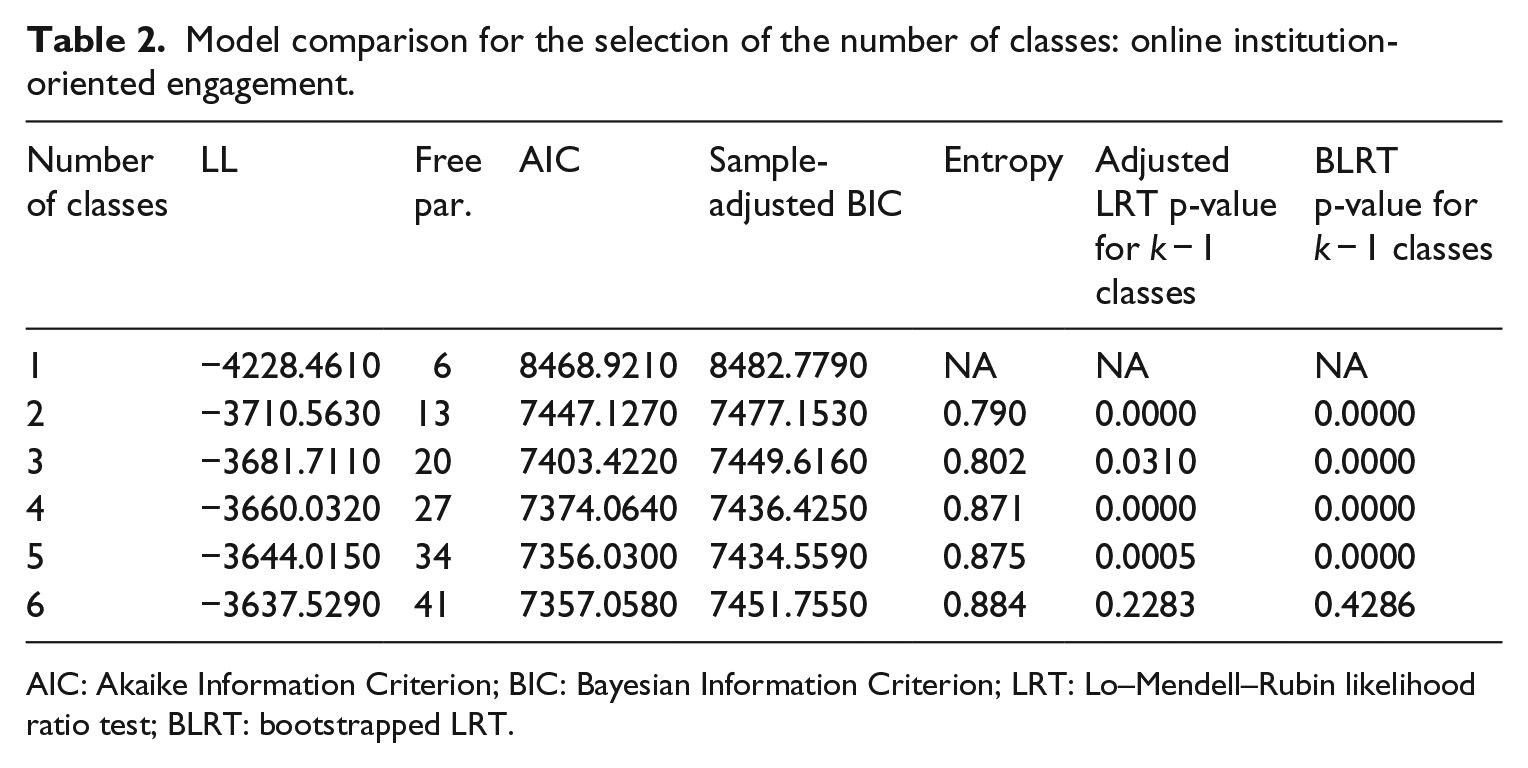
AIC: Akaike Information Criterion; BIC: Bayesian Information Criterion; LRT: Lo–Mendell–Rubin likelihood ratio test; BLRT: bootstrapped LRT.
In this two-class model solution, the first class (who we can consider Non-Engagers) constituted 77.5% of the sample, and as Figure 1 illustrates, the probabilities that the individuals in this group were engaging in any of these activities were consistently low. Indeed, if young adults have never participated in one activity, they are unlikely to have participated in any of these activities.
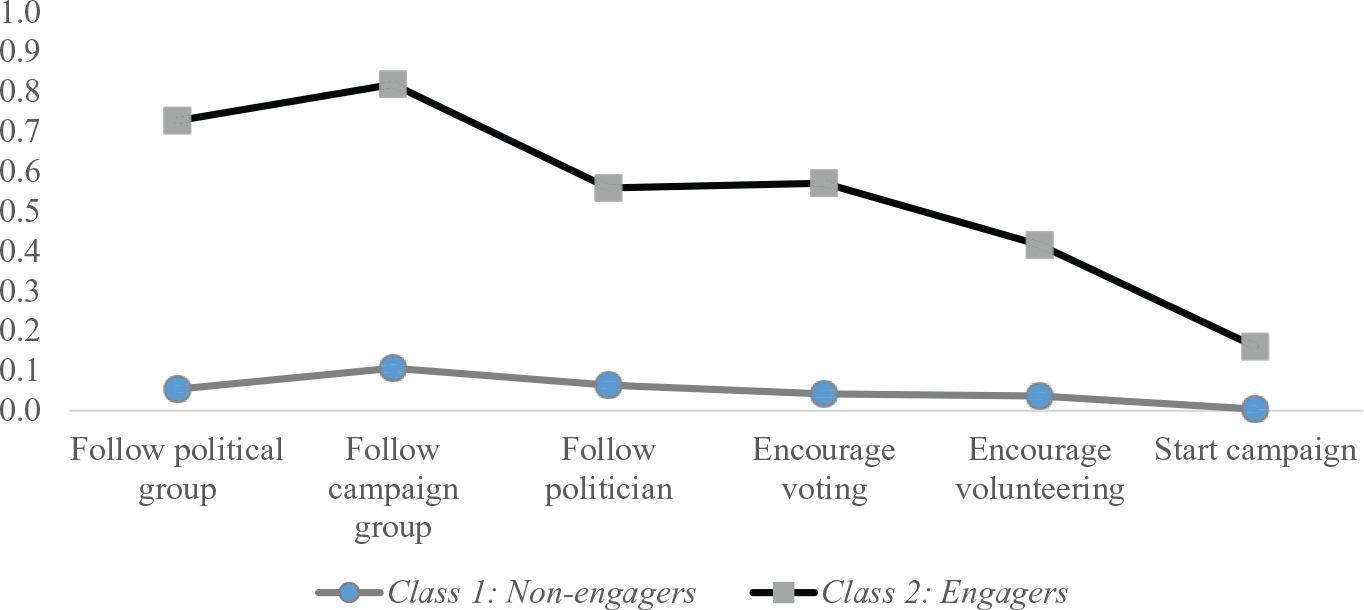
Estimated probabilities of engaging in online institution-oriented activities—comparing Non-Engagers (Class 1) and Engagers (Class 2).
Class 2 constituted 22.5% of the sample, and as Figure 1 illustrates, the respondents in this class had higher probabilities of participating in online institution-oriented activities than non-Engagers. In the Engagers class, following political and campaigning groups were the dominant activities. By contrast, the Engagers are less likely to have started campaigns or encouraged others to vote, and indeed, for the former, there was only a small difference in the estimated probabilities of engagement between Engagers and Non-Engagers. This is in line with the results of our descriptive statistics (see Table 1), which showed that only a small minority of the sample have ever undertaken these activities.
Online political expression
A slightly different pattern emerges from the unconditional LCA of the items associated with Online Political Expression, where we contend that a three-class solution provided the best fit. As Table 3 illustrates, the various indices suggest that a model with up to four classes could be considered statistically significant and with appropriate values on the Entropy index (the p-value for the Adjusted LRT of Class 5 indicates that this class can be excluded). However, a comparison of the three-class to the four-class solutions indicated that there were only small differences in the response patterns captured in these alternative models and that these differences added little to our substantive interpretation of the response probabilities in each class for each item. In light of this, we opted to retain the three-class solution.
Model comparison for the selection of the number of classes: online political expression.
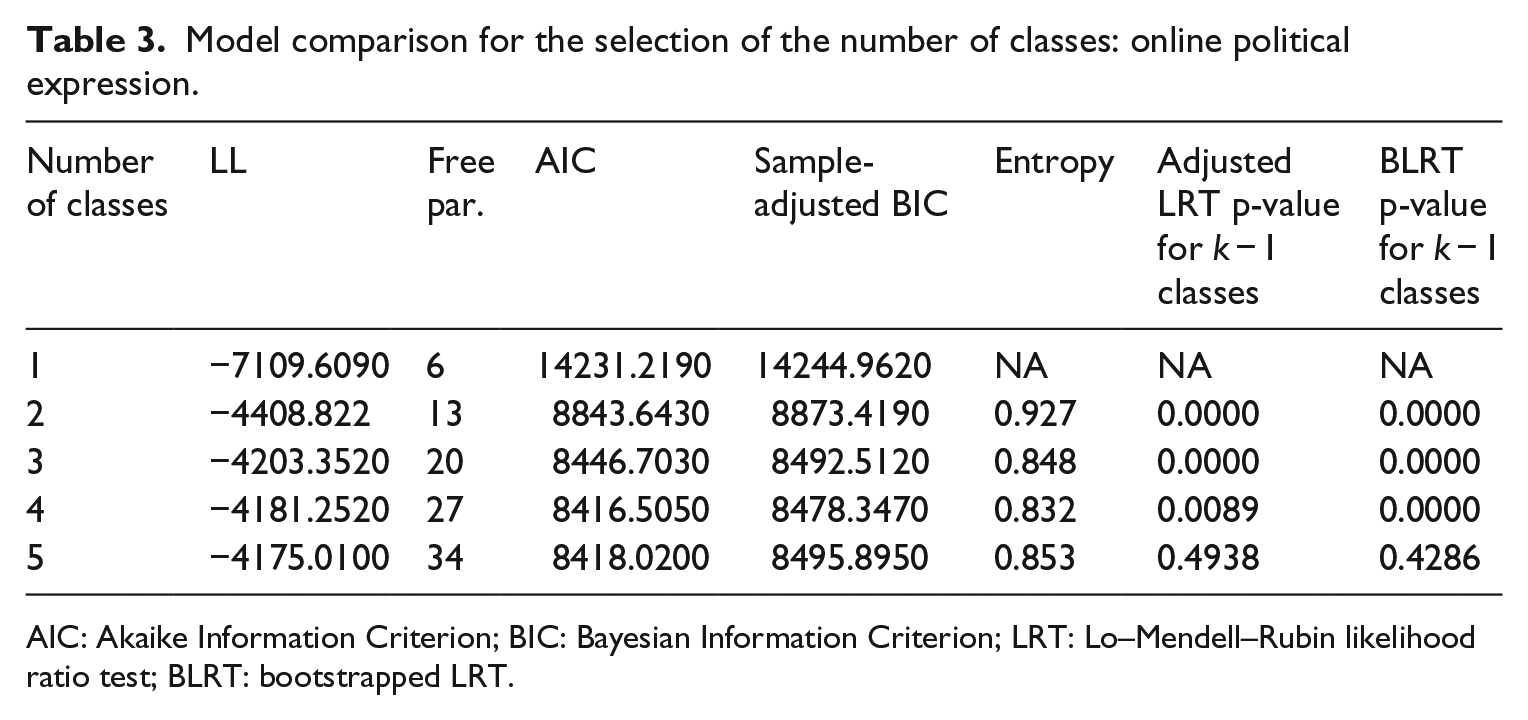
AIC: Akaike Information Criterion; BIC: Bayesian Information Criterion; LRT: Lo–Mendell–Rubin likelihood ratio test; BLRT: bootstrapped LRT.
In this model, 40.6% of the original cases fall into Class 3, and can be considered Non-Engagers, as the estimated probability of engagement with any of the items remains consistently low (and markedly lower than in the other classes) (see Figure 2). The cases in Class 1 demonstrate a similarly consistent pattern across all items, but in this class, there is a very high estimated probability of their engagement in all of the expressive activities we asked about. This highly engaged group comprises 41.4% of all cases.
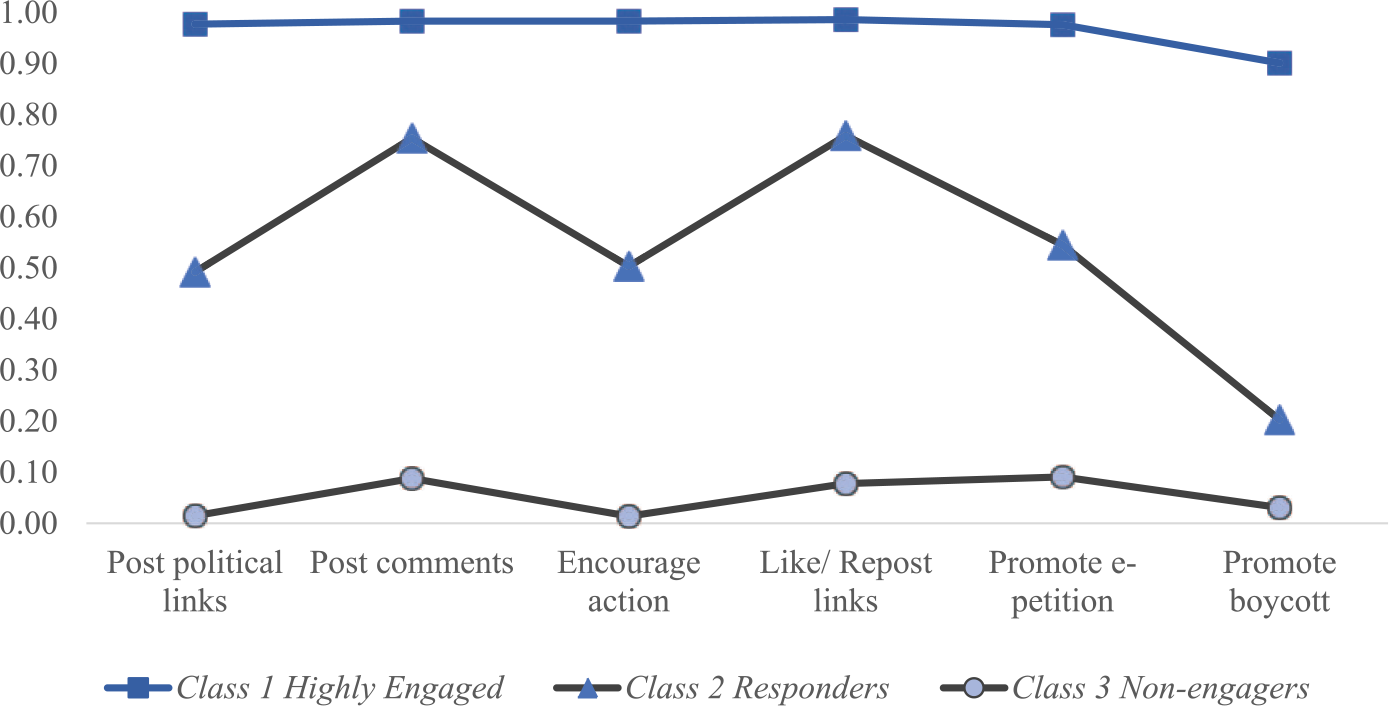
Estimated probabilities of engaging in online political expression—comparing High Engagers (Class 1), Responders (Class 2) and Non-Engagers (Class 3).
The remainder of the cases (18%) clustered in Class 2, and while respondents in this group do participate in online expressive activities, the estimated probabilities of them doing so are lower than the highly engaged users in Class 1. Furthermore, the estimated probabilities in Class 2 reflect a different item-response pattern than either Class 1 (high engagers) or Class 3 (non-engagers) (see Figure 2). In short, the dominant activities among the individuals in Class 2 are commenting on, ‘liking’ or reposting material shared by other SNS users. In comparison, individuals in this class have lower estimated probabilities of posting links to political articles, encouraging others to take action and/or of raising awareness about an e-petition or a boycott. In an effort to explain this response pattern, we surmised that the latter activities may be similar in that they all require an individual to initiate discussion, whereas ‘liking’, re-posting or commenting merely requires individuals’ to respond to others’ initiatives. Based on these results, we have labelled the three classes as Highly Engaged, Responders and Non-Engagers.
Why are some young adults more likely to engage online than others?
Having confirmed that there are different types of youth engagement in both online institution-oriented activities action and online political expression, we then set about using conditional LCA to identify whether the ways in which young adults engage in these activities are linked to their existing dispositions (interest in politics) or their socio-demographic characteristics. Reflecting the three-step strategy discussed above, we included only the young adults’ gender, ethnicity and educational level in the first model; in the second, we added family resources (namely, parental education and occupation); and in the final model, we added youth political interest.
The results of these models are presented in Tables 4 and 5. If we examine socio-demographic characteristics by themselves (as in Models 1 and 2), the conditional LCA for online institution-oriented engagement shows that young males with higher educational levels are more likely to belong to the Engaged class than to the Non-Engagers class. These results then suggest that engagement in institution-oriented activities is linked to young adults’ own characteristics and resources (gender and educational level), but not their parents’ resources (occupation or educational level) (see Model 1 and 2 in Table 4).
Conditional latent class analysis for online institution-oriented engagement.*
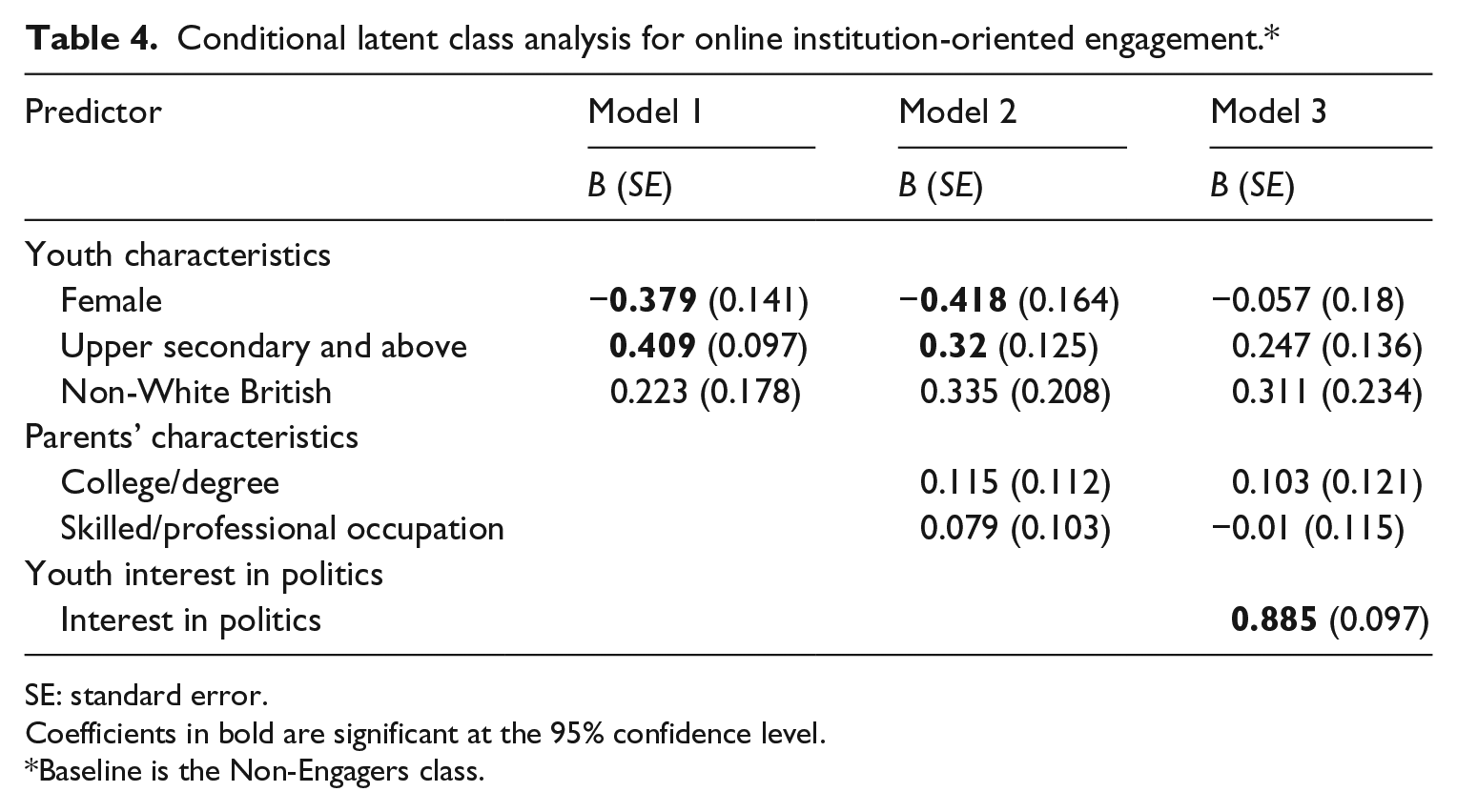
SE: standard error.
Coefficients in bold are significant at the 95% confidence level.
Baseline is the Non-Engagers class.
Conditional latent class analysis for online political expression.*
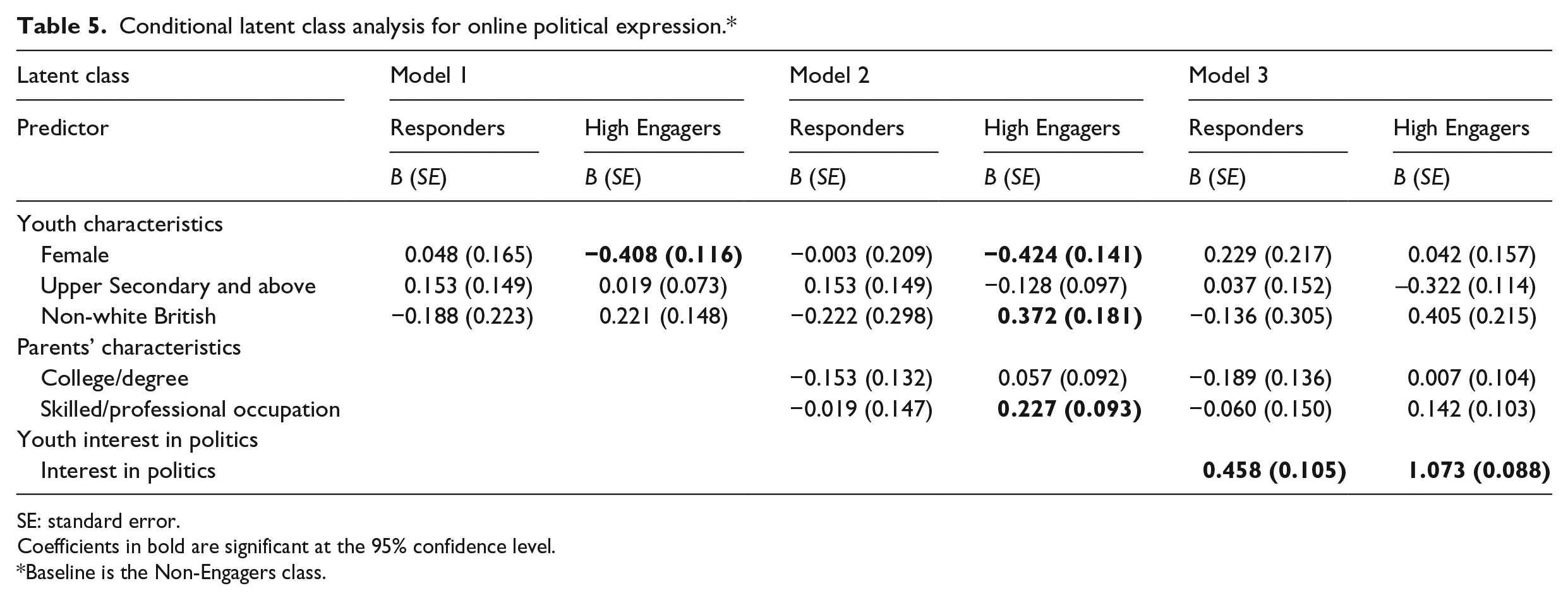
SE: standard error.
Coefficients in bold are significant at the 95% confidence level.
Baseline is the Non-Engagers class.
By contrast, when it comes to online political expression, a slightly different pattern emerges (see Table 5). Here, we distinguished between Low Engagers, Responders and High Engagers, following the results of the unconditional LCA. For the conditional LCA, we focused in the first instance on the young adults’ own socio-demographic characteristics (Model 1); the results of this analysis show that only gender is a predictor of belonging to the High Engager class (Model 1). When we add parental resources to the model, however, we find that young men and non-White British youths are more likely to belong to the High Engagers class. Moreover, in contrast with online institution-oriented engagement, it is parental occupation rather than youths’ own educational resources that predict high levels of engagement.
These results are in line with the findings of previous studies: the young adults who are highly engaged in online political expression are more likely to be young men from families with a high SES. However, the conditional LCA also suggests that the socio-demographic characteristics of Responders are no different from those of Low Engagers. In other words, it is not socio-demographic resources that are driving Responders or Low Engagers, but rather something else. What this might be becomes clearer when we consider the results of Model 3, which includes a measure of youth interest in politics. Critically, once this variable is taken into account, all of the socio-demographic characteristics we included lose their predictive power (see Model 3 in Table 5). Instead, what distinguishes Non-Engagers from Responders and High Engagers is their level of political interest (or lack thereof). 5 What is more, this pattern also applies to online institution-oriented engagement (see Model 3 in Table 4). The implications of this are discussed in the next section.
Discussion and conclusion
In this article, we set out to examine the extent to which young adults in Britain are using social media for online institution-oriented engagement and online political expression, and to explore why some young adults may be using social media for these purposes more than others. As regards our first goal, our analysis found that online political expression is relatively widespread among young adults in Britain, but online institution-oriented engagement (such as following politicians or political campaigns) is considerably less prevalent. We also found that high proportions of young adults are not using social media for any of the forms of political engagement we asked about. Young adults may be more likely than their elders to use social media for political engagement, but it is important to note that there are still notable intra-generational differences in online political engagement.
In order to explain why some young adults are using social media for political engagement while others are not, we then examined whether these differences could be explained by socio-demographic resources or young adults’ political interest. Previous studies had found that online political engagement was stratified by SES, educational level and gender, in much the same way that most forms of offline political engagement are (Schlozman et al., 2013; Oser et al., 2013). In our sample, however, our results are more in line with Feezell’s (2016), in that we found that these socio-demographic characteristics and resources had no predictive power once political interest was taken into account. Instead, these results indicate that it is political interest that is driving online political engagement among young adults, rather than their educational or socio-economic resources, or indeed their gender 6 or ethnicity.
On one level, these findings contradict the claim that online political engagement is a ‘weapon of the strong’ as they suggest that it is not just young men and/or youths with high levels of education and SES who are using social media for political engagement. Yet any such conclusion must be treated with caution. While youth political engagement online is largely driven by political interest, whether (and indeed how) young adults have acquired this disposition in the first place is linked to their socio-demographic characteristics. Political interest develops during childhood and adolescence, and during this formative phase, socio-demographic characteristics play a vital role in the socialisation process and in determining the political attitudes and behaviours that they end up exhibiting in adulthood (Neundorf et al., 2013; Prior, 2010). Our findings thus suggest not that socio-demographic characteristics are not important, but rather that we need to look at their role in shaping (and stratifying) political interest during adolescence if we want to have a greater understanding of young adults’ subsequent political engagement using social media.
A second important implication of these findings is that these new online tools do not appear to be mobilising a new audience or extending the type of young adults who are politically engaged. Instead, young adults are only using social media for political engagement if they are already interested in politics. This suggests these tools are merely providing already-engaged groups of young adults with a new forum for political engagement, and that social media is not addressing the underlying issue: how can we encourage greater numbers (and types) of young adults to become interested in politics? This thorny issue predates the emergence of the Internet, and it is likely that we will need political, educational and cultural solutions to this problem, and not just a technical one.
That said, this is a rapidly developing arena for political action, and there is a great deal of work still to be done to understand the relationship between online and offline engagement, the extent to which online engagement may be distinct (Gibson and Cantijoch, 2013; Theocharis and Van Deth, 2016) and how those who are interested in politics are using this space creatively to redefine political engagement.
Footnotes
Appendix 1
Funding
The author(s) disclosed receipt of the following financial support for the research, authorship and/or publication of this article: This research was funded by the Economic and Social Research Council (ESRC) through grant ref: ES/J019135/1.