




Abstract
Political scientists have long expressed concern about citizens who focus their civic activity on community service, seemingly treating it as a substitute for political involvement. Proposed explanations for this phenomenon portray it as popular among young adults. They also speculate that a politics dominated by two ideologically polarized, uncivil, and chronically gridlocked parties may cause citizens who do not feel they have or want a place on those partisan teams to avoid the arenas in which they fight. Few large and representative studies, however, examine how citizens allocate their civic activity between service and political action. Using the 2016 American National Election Study, I find that signs of alienation from the country’s major political parties increase the likelihood that citizens limit their activity to service, making a substitution scenario plausible. More commonly, however, rising partisan alienation predicts a shift in political involvement from electoral to non-electoral forms. Younger citizens are surprisingly less likely than their elders to specialize in service.
Over two decades of scholarship has noted increasing diversity and fragmentation in the forms of citizens’ civic involvement, including growing interest in tackling public problems outside of conventional political channels—if not outside of politics entirely (e.g., Dalton 2009; Strach 2016; Wuthnow 1998; Youngs 2019; Zukin et al. 2006). Receiving special attention have been signs gleaned from trend data, case studies, polls, focus groups, and other sources that some Americans concentrate their civic work in ostensibly nonpolitical community service, treating it as substitute for meaningful political engagement (Rouse and Ross 2018; Shea 2015; Strama 1998; Theiss-Morse and Hibbing 2005; Walker 2000). Scholars have pondered with concern the idea’s implications for democratic health (Galston and Levine 1998; Shea 2015; Theiss-Morse and Hibbing 2005) and society’s capacity to address structural problems that volunteers and civic associations cannot solve alone (Eliasoph 2013).
Proposed explanations for this phenomenon highlight generational differences (linking it to the youngest citizens) and alienation from a political sphere perceived to be dominated by conflict, gridlock, ideological rigidity, and incivility, especially of a partisan nature (Bennett 1998; Bilous 2014; Chou et al. 2017; Dalton 2020; 2009; Galston and Levine 1998; Loader, Vromen, and Xenos 2014; Macedo et al. 2005; Shea 2015). Surprisingly, however, very little scholarship has systematically and empirically investigated why citizens choose the venues and forms of civic action that they do. Literature also questions whether youth or others have been withdrawing from politics in general, or just from electoral politics (e.g., Dalton 2009).
This paper addresses that gap, using the 2016 American National Election Study (ANES). 1 Its focus is on the prevalence and predictors of Americans I call “service specialists”: people involved in community volunteerism but no “political” activity beyond voting. In a series of models, I estimate how age and indicators of alienation from partisan politics relate to the mixes of political and nonpolitical activities through which Americans participate (or not) in civic life. I consider whether these concepts are associated with people’s likelihood of participating through service rather than politics, and whether their larger impact is instead on how citizens work to influence political outcomes—whether they contribute more than their vote to the typically partisan affairs that elections are, or limit their participation to issue-oriented expressions of voice, such as protesting or contacting government officials.
I find that in 2016, the share of American adults reporting community service but no political action was relatively small, older, and religiously devout. Youth, when considering activities other than voting, predicts higher odds of political participation—even in elections and campaigns. Several correlates of political participation, including education and psychological engagement in politics, predict service over disengagement. But as citizen distance from the country’s two major political parties increases—measured in their combined reluctance to identify, their emotional coolness, and the extent to which they perceive themselves ideologically unrepresented—so does their likelihood of limiting their civic activities to community service. Most Americans, even at high levels of alienation from parties, nonetheless participate politically. To the extent that partisan politics deters participation (a causal claim that this paper admittedly cannot test), the larger shift it appears to precipitate is from electoral to non-electoral forms of political participation, rather than from political participation to service. In both cases, (dis)affect toward the parties relates more directly to Americans’ forms of civic engagement than identity or ideological distance, although I find signs that all three types of alienation contribute.
Narratives of Service Substitution
Speculation that Americans are substituting service for politics, or expressive for electoral political action, contradicts the civic participation literature’s traditional view and considerable empirical findings (Dalton 2009; Oser, Hooghe, and Marien 2013; Rosenstone and Hansen 1993; Strach 2012; Verba, Schlozman, and Brady 1995; Zukin et al. 2006) that these forms of participation are complementary. These forms of participation share several common correlates, with some variation by study and form, including education, income, whiteness, personality dispositions, church attendance or involvement, and even political awareness and interest (e.g., Musick and Wilson 2008; Piatak 2023; Strach 2012; Theiss-Morse and Hibbing 2005; Verba, Schlozman, and Brady 1995; Zukin et al. 2006). Concerns about public problems motivate both (Han 2009; Verba, Schlozman, and Brady 1995). Often, scholars conceive of community volunteerism and involvement as inspiring political participation, by increasing exposure to problems (Eliasoph 2013), or building civic skills, efficacy, social capital, and networks (Theiss-Morse and Hibbing 2005; Verba, Schlozman, and Brady 1995).
Yet various acts of political and nonpolitical civic participation can be associated with each other while a critical mass of citizens concentrates efforts in the nonpolitical (or political) sphere. In a rare study describing with a large national sample how Americans mix different forms of civic participation, Zukin and colleagues observe with 2002 data on Americans aged 15 and older that 16 percent performed nonpolitical civic activities such as volunteer work, active civic group membership, fundraising for charity, and community problem-solving activity while reporting little to no political participation (2006, 64). Scholars know little about such citizens and why they, despite their willingness to civically engage, have confined themselves to ostensibly nonpolitical realms.
Suspicion of a substitution effect comes largely from qualitative or indirect evidence. One type has contrasted what were until recently (American National Election Studies 2021; Candid 2022) stagnant or declining rates of participation in elections and campaigns, political parties, and mass-membership groups with then-high and perhaps increasing rates of volunteerism (Bennett 1998; Macedo et al. 2005; Mann 1999; Shea 2015; Zukin et al. 2006). Qualitative studies have highlighted volunteers and other community participants who frame their action as a route to change that is different from and perhaps superior to political activism (Blackstone 2004; 2007; Bilous 2014; Hussey 2020; Wuthnow 1998; Youngs 2019; Zuckerman 2021)—if not its own “alternative politics” (Longo 2004, 63). Scholars have also identified conditions where voluntary sector participation fails to encourage—and may even undermine—political involvement (Atkinson and Fowler 2014; Eliasoph 2013; Musick and Wilson 2008; Theiss-Morse and Hibbing 2005).
The first of two prominent narratives about why citizens address problems through service and civic associations highlights alienation from politics. Citizens tend to associate politics with conflict and civic associations or service with cooperation, typically preferring the latter to the former (Hays 2007; Hussey 2020; Macedo et al. 2005; Theiss-Morse and Hibbing 2005; Walker 2000). Scholars further observe among volunteers a tendency to associate politics with gridlock and empty or divisive words, while professing to achieve through service greater productivity, fulfillment, and solidarity with fellow citizens (Eliasoph 1998; Hussey 2020; Longo 2004; Wuthnow 1998). Alienated or repelled from the conflict and stalemate they see in politics, citizens seek other outlets for their care about public problems (Chou et al. 2017; Longo 2004; Wuthnow 1998; Zuckerman 2021), finding in the voluntary sector “a refuge from (and alternative to)” politics (Galston and Levine 1998, 36).
Partisan political conflict may bear special blame. Rising levels of partisan polarization, passion, and animosity appear to have excited some citizens (Krupnikov and Ryan 2022; Mason 2018). But a large and perhaps growing portion of the public dislikes and is detached from both major political parties (Dalton 2020; Rouse and Ross 2018; Kull 2016), especially their elites (Krupnikov and Ryan 2022). It distances itself from discussions of partisan differences (Klar, Krupnikov, and Ryan 2018; Krupnikov and Ryan 2022) and prefers compromise to partisan entrenchment; partisan gridlock leads its grievances with Congress (Wolak 2020). Community projects and cause-oriented groups attract participants, Dalton speculates, “precisely because they are distinct from party politics” (Dalton 2020, 75).
A second prominent narrative about service specialization attributes it to the youngest U.S. (and global) citizens, arguing that they define good citizenship differently from their elders. Studies consistently observe helping others in need among young people’s top-ranked citizenship norms (Dalton 2016; Hooghe and Oser 2015; Lane 2020). Scholars have suggested that change-work outside of established political institutions, especially via direct service, is more common among and resonates with a generation that craves solidarity with the less fortunate (Dalton 2009) and is attracted to action and projects (Dalton 2009; Loader, Vromen, and Xenos 2014), in addition to being uniquely disenchanted with political parties (CIRCLE Staff 2016; Chou et al. 2017; Dalton 2016; Shea 2015) and skeptical of government’s relevance (Zukin et al. 2006) and problem-solving capacity, especially relative to what they perceive themselves accomplishing as volunteers (Shea 2015).
The alienation and youth narratives both suggest that service specialization may be a political phenomenon with political determinants—depending on the nature and context of the service activity. Volunteering and other community involvement is not always easily separated from political action (Eikenberry 2019; Evers and von Essen 2019). Some participants treat their effort as instrumental to addressing a political problem or influencing public policy (Musick and Wilson 2008; Verba, Schlozman, and Brady 1995; Zukin et al. 2006). For some cause-oriented volunteers’ claims that their service is not political, scholars have blamed influential ideas about who belongs in politics (Bilous 2014; Blackstone 2004), or which sector should address particular problems (Strach 2016). Even what looks like apolitical charitable work can function as political expression, such as when its performance by marginalized groups counters stereotypes or models an alternative social vision (Braunstein 2017; Gould 2009; Longo 2004; Shepard 2013; Youngs 2019). Paired with abstention from traditional politics, it can express distrust in the established problem-solving order (Zuckerman 2021).
In practice, large and representative studies of participation suggest skepticism about the youth narrative. Recent studies find that younger Americans are not consistently less likely than their elders to report political participation, when asked about activities other than voting (Dalton 2016; 2020; Rouse and Ross 2018), though others observe campaign involvement increasing with age (Huddy, Mason, and Aaroe 2015; Mason 2018; Zukin et al. 2006). Moreover, volunteering and other nonpolitical civic participation is not clearly highest among the young (Piatak 2023; Zukin et al. 2006); its relationship with age appears nonlinear (Musick and Wilson 2008). Some assert that what youth (if not also others) avoid is merely electoral politics, while their citizenship style features expressive political activities that they may pair with volunteering and other problem-solving work (Chou et al. 2017; Dalton 2009; Loader, Vromen, and Xenos 2014; Sloam 2014; Zukin et al. 2006).
More promising, if partial, evidence relates to the partisan alienation narrative. Measures of partisan identity strength strongly predict electoral involvement (Groenendyk and Banks 2014; Huddy, Mason, and Aaroe 2015; Klar and Krupnikov 2016; Mason 2018), while policy attitude incongruence with the Democratic and Republican party platforms negatively predicts it (Carmines, Ensley, and Wagner 2011; Hussey 2012). Empirically supported mechanisms include perceptions of being unrepresented (Hussey 2012) and reluctance to publicly take a partisan side (Klar and Krupnikov 2016). Explanatory volunteering research generally does not consider political attitudes and attachments. 2 Zukin’s team finds general negativity toward government unrelated to indices of nonpolitical civic participation and electoral participation (Zukin et al. 2006). 3 It is positively related, however, to expressive (non-electoral) political participation—consistent with older data showing that general political alienation does not necessarily diminish political participation (Citrin et al. 1975; Schwartz 1973; Southwell 2008).
Neither narrative has been adequately assessed, however, because civic engagement scholarship virtually exclusively models extent of participation in political and nonpolitical civic activity independently of each other, rather than modeling their mixes (e.g., Piatak 2023; Zukin et al. 2006). Explicitly “political” participation research thus groups service specialists with the civically disengaged. To assess whether youth or alienation from political parties predict a preference for community service over political action among people we might expect to be active citizens—as implied by the idea that service substitutes for politics—requires isolating service specialists from the civically disengaged, as well as citizens who blend politics and service. The analysis that follows tests for the covariation that is necessary though not sufficient for these narratives’ plausibility. If they are true, we should expect that traditional predictors of civic involvement differentiate service specialists from the disengaged while the following hypotheses also hold:
As alienation from major political parties increases, the likelihood of specializing in service relative to participating in politics will increase.
As age increases, the likelihood of specializing in service relative to participating in politics will decrease.
Given disagreement over whether these narratives apply to all politics or only electoral politics, this manuscript also tests:
As alienation from major political parties increases, the likelihoods of specializing in service or participating in only expressive political activity will increase relative to participation in electoral political activity—but not relative to each other.
As age increases, the likelihoods of specializing in service or participating in only expressive political activity will decrease relative to participation in electoral political activity—but not relative to each other.
Research Design
This paper tests these hypotheses with data from the 2016 American National Election Study. The survey queried respondents about their participation in multiple political and nonpolitical civic activities, in addition to collecting several viable measures of alienation from the two major political parties. 4 Most analyses in this paper employ all available data from the full sample of ANES respondents, 1181 of whom were interviewed face-to-face and 3090 of whom completed the study online. All analyses are weighted with the standard ANES post-stratified combined sample weight.
Items Used in Civic Engagement Profiles.
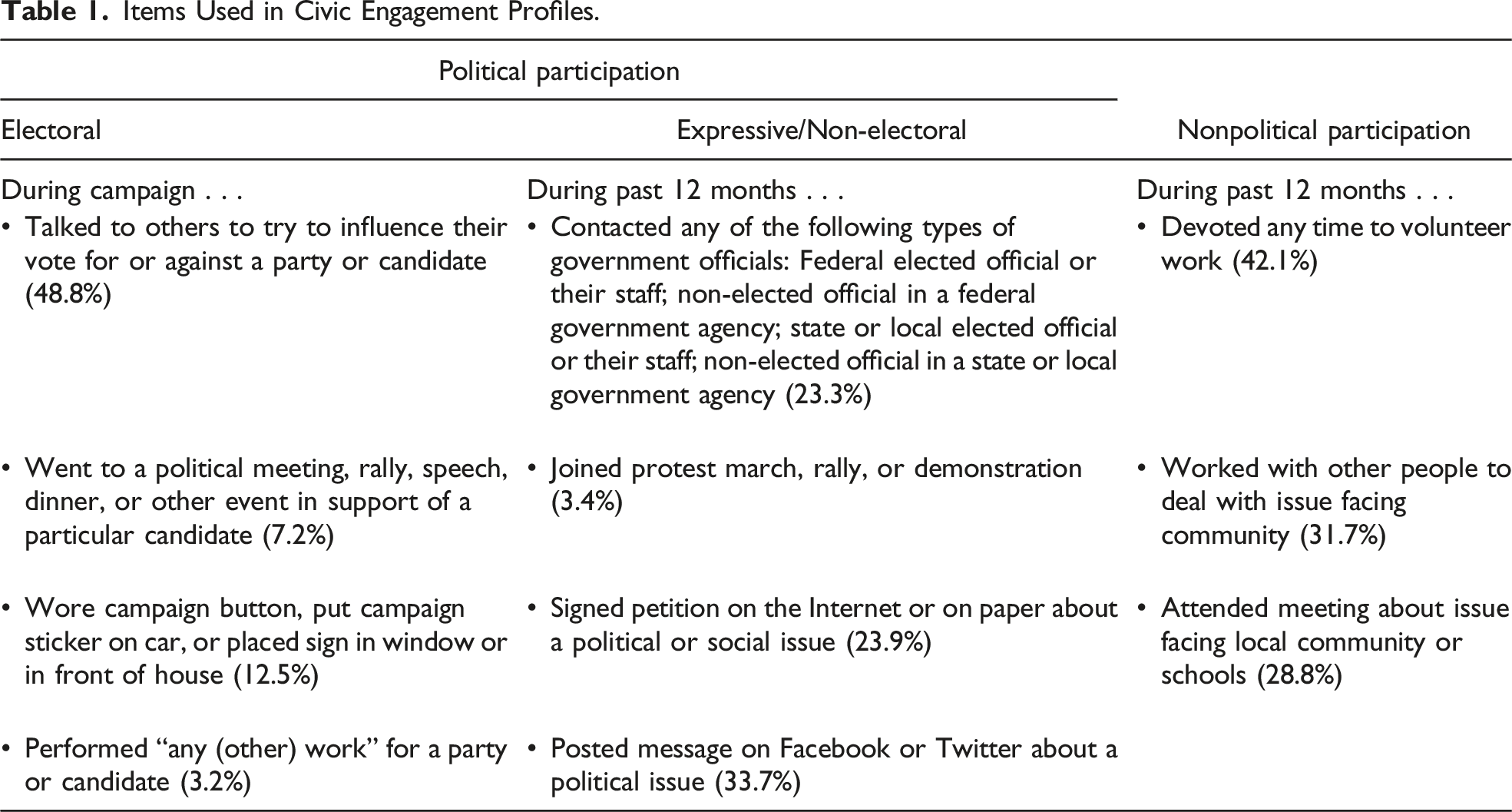
The primary dependent variable is a four-category indicator of whether a respondent participated in (a) none of activities listed in Table 1 (“disengaged”), (b) only nonpolitical activities (“service specialists”), (c) only political activities (“political specialists”), or (d) both nonpolitical and political activities (“dual activists”). 6 Subsequent analyses employ a revised four-category civic engagement typology that differentiates “political” categories not by whether political participation is paired with service, but whether it includes electoral forms. They also model the percentage of total civic activities allocated to service and the percentage of political activities that are non-electoral.
Service specialization, these measures suggest, is uncommon. Weighted for ANES’ complex sampling design, a plurality of Americans (43 percent) reports participation in both political and nonpolitical activities. Political specialists (27 percent) substantially outnumber service specialists (11 percent). The rest (19 percent) are disengaged. Overall, 54 percent report engaging in at least one act of volunteer service or community participation, while 70 percent report at least one act of political participation. Americans averaged 1.0 community participation activities out of a possible three and 1.6 political participation activities out of a possible eight.
A comparable share of Americans reports participating in at least one form of electoral political participation (53 percent) as reports participating in at least one form of what I call “non-electoral” or “expressive” political participation (52 percent). Just 17 percent of Americans represented by the 2016 ANES reported only expressive political activities. The mean numbers of electoral and expressive activities Americans report (out of a possible four in each category) are also similar: 0.72 and 0.84, respectively.
I follow Jack Citrin and co-authors in understanding alienation to involve “feelings of closeness/distance, attachment/separation or identification/rejection. . . . a relatively enduring sense of estrangement from existing political institutions, values and leaders” (Citrin et al. 1975, 3). I adapt this to my narrower “target” of alienation (Citrin et al. 1975, 3), the major parties, by considering what binds citizens to them. Existing scholarship emphasizes shared identity (Green, Palmquist, and Schickler 2002; Mason 2018), ideologies or policy beliefs (Carsey and Layman 2006; Webster and Abramowitz 2017), and affect (Iyengar, Sood, and Lelkes 2012; Iyengar and Westwood 2015; Mason 2013). Low levels of each of these—with respect to both Democrats and Republicans—may signal a psychological sense of separation or “alienation” from party politics.
The first key independent variable is a partisan alienation (principal components factor) score from measures of these three concepts. Partisan identity is measured with a four-point strength of partisanship scale ranging from pure independent to strong Democrat or Republican. A principal components factor score taps citizens’ perceived ideological (mis)representation. Its items are: • Absolute value of the distance between the position respondents assigned to themselves and the closest political party on seven-point ideology scales ranging from strongly liberal to strongly conservative
7
• Whether a respondent answered “no” when asked, “Would you say that any of the parties in the United States represent your views reasonably well?”
8
• Intensity of respondents’ desires for a third-party candidate option, on a five-point scale from “not at all” to “a great deal.”
9
A major party disaffect index represents the mean of as many as five dummy variables with non-missing data: • Whether R reported liking nothing about the Democratic and the Republican parties • Whether R reported liking nothing about the 2016 Democratic and the Republican presidential candidates • Whether R rated both the Democratic and the Republican parties at or below the midpoint, 50 degrees, on ANES’ 0–100 degree “feeling thermometer” • Whether R rated both the 2016 Democratic and the Republican presidential candidates at or below 50 degrees on same feeling thermometer • Whether R denied thinking of himself or herself as “close to” the Democratic or Republican Party.
10
My measures of these three dimensions of partisan alienation loaded onto a single factor (eigenvalue = 1.97).
The second key independent variable is age, measured in years.
Independent Variables.
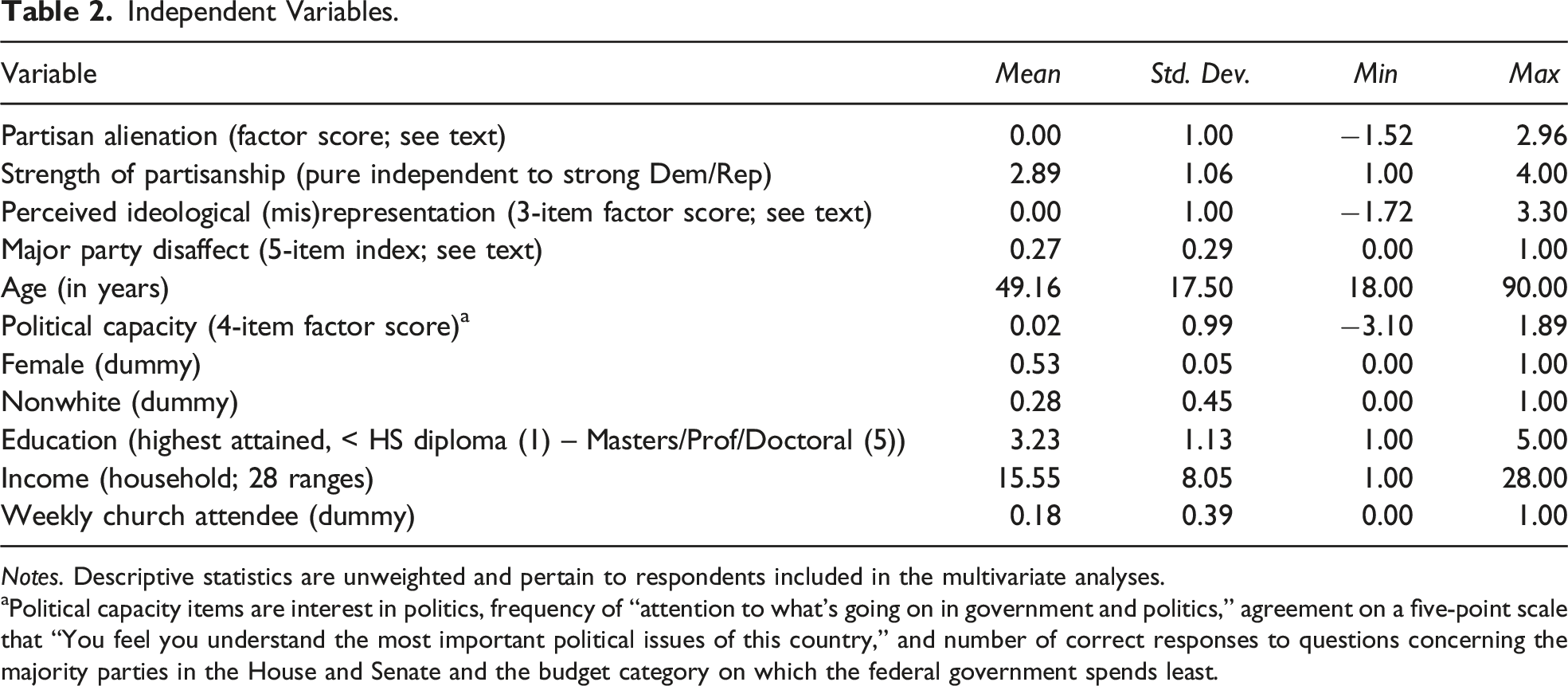
Notes. Descriptive statistics are unweighted and pertain to respondents included in the multivariate analyses.
aPolitical capacity items are interest in politics, frequency of “attention to what’s going on in government and politics,” agreement on a five-point scale that “You feel you understand the most important political issues of this country,” and number of correct responses to questions concerning the majority parties in the House and Senate and the budget category on which the federal government spends least.
Results
Service Versus Politics
Figures 1(a) and 1(b) summarize, from a multinomial logit model, how partisan alienation and age relate to Americans’ civic engagement profiles. They show how predicted probabilities of each profile change as each independent variable increases, with all other covariates held at their means. Error bars in these and all figures mark 83.5 percent confidence intervals, the appropriate size for judging statistical significance through confidence interval comparison when aiming for a type I error probability of 0.05 (Maghsoodloo and Huang 2010; Payton, Greenstone, and Schenker 2003). The supplemental appendix contains all coefficient estimates; these are in Table S1. Predicted probabilities of civic engagement profiles by partisan alienation and age. (a) Civic engagement by partisan alienation and (b) Civic engagement by age.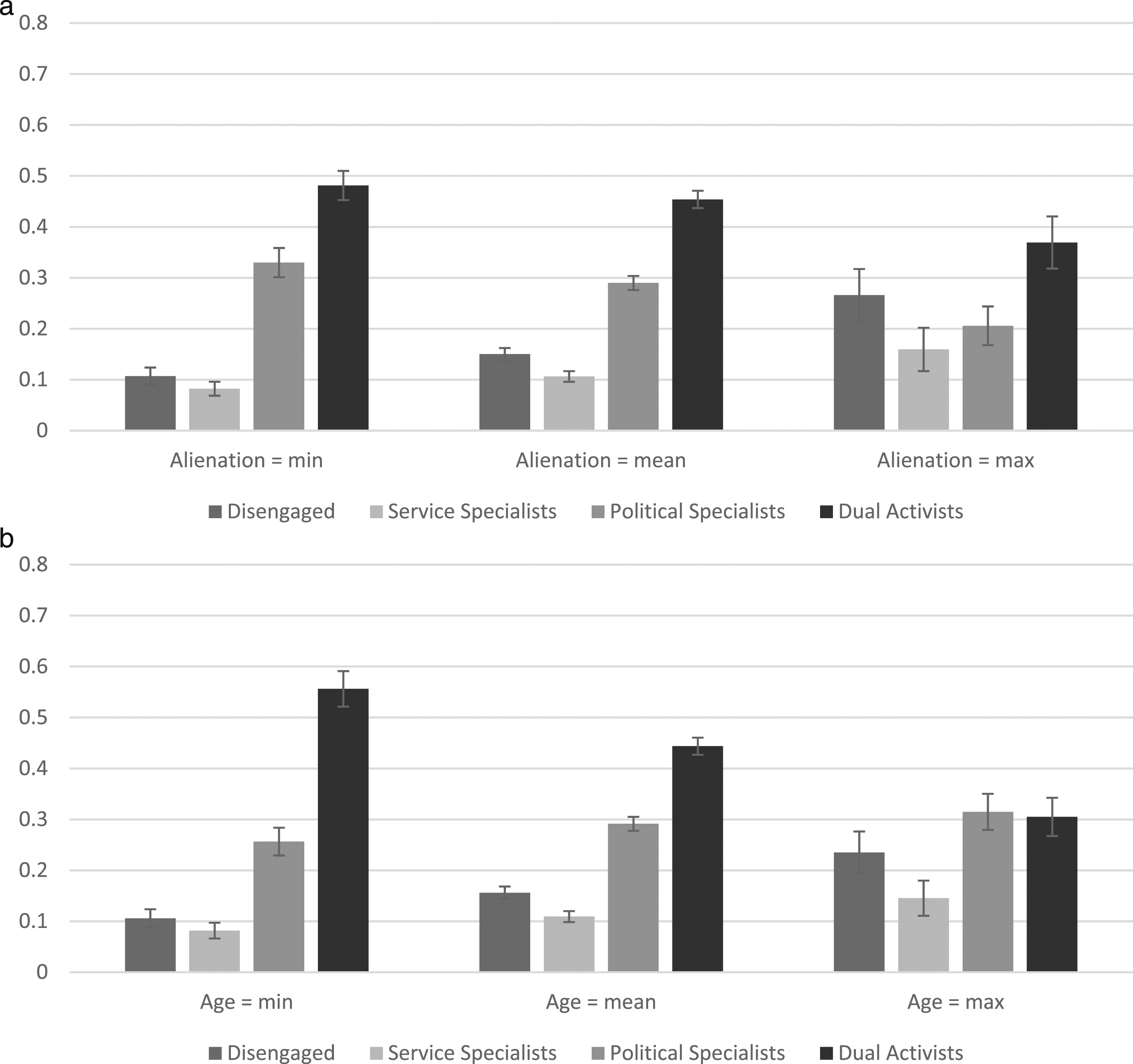
Consistent with H1, increases in the party alienation score are associated with declines in political participation—in other words, increasing, statistically significant likelihoods of civic disengagement or of limiting participation to the realm of community service, rather than participating in politics as a specialist or dual activist. The magnitude is substantial, relative to a low baseline: an increase in the partisan alienation score from its minimum to maximum value, with covariates at their means, nearly doubles the predicted probability of service specialization while increasing the predicted probability of disengagement by a factor of 2.5. Increasing alienation from political parties is not significantly associated with the likelihood of service specialization rather than civic noninvolvement, nor does it differentiate political specialists and dual activists. These results are consistent with the narrative of service as a “refuge from politics,” while also suggesting how limited any flight from politics has been. Even at the maximum value of partisan alienation, the model predicts that the average American will be more likely to participate in politics (59 percent probability of being a political specialist or dual activist) than not.
Results fail to support H2. Age does statistically significantly differentiate service specialists from one of the politically involved groups, dual activists, but in such a way that the likelihood of confining one’s civic involvement to community service increases as age increases. With all covariates at their means, the predicted probability rises by a statistically significant six percentage points across age’s range. The likelihood of political specialization and especially civic disengagement also increase statistically significantly with age in relation to the likelihood of dual activism. The net effect is that the predicted probability of being in one of the two politically active groups at covariates’ mean values falls by 19 percentage points across age’s range. The combination of service and politics, not service alone, appears characteristic of youth.
This does not result from the modeling of age with a single continuous variable. Not shown, substituting age with a dummy variable marking younger Americans (under age 35 in one version and under 25 in another) similarly indicates that youth decreases the likelihood of service specialization relative to dual activism (significant with both dummies) and political specialization (significant with the under 35 dummy). The square of age, when added to the original model, is not statistically significant and decreases goodness-of-fit.
Nor does the association of youth with political participation appear to be driven by a tendency of younger votes to gravitate to “slacktivist” activities like posting online. Supplemental appendix Table S15 displays the percentages of Americans performing each activity in my measures, divided into three age groups. Larger proportions of Americans under age 25 do report sending messages about political issues on Facebook or Twitter than for older Americans—but these young Americans are also at least as (and often more) likely than their elders to report most other civic activities queried, including presumably more time-demanding ones such as working for parties or candidates or attending political events. It is generally only with voting, which my measure excludes, where their engagement exhibits a major deficit.
Regarding control variables, as predicted, increasing political capacity is associated with increased odds of service specialization relative to civic disengagement. Meanwhile, results show that variable raising the likelihood of political specialization and dual activism relative to service specialization. With the present research design, I cannot estimate how much political capacity is a precursor versus a consequence of participation.
The other independent variable that statistically significantly predicts all pairs of civic outcomes is whether an individual attends religious services at least weekly. Regular attendance points consistently toward the two profiles that involve community service over the two that do not. It also, interestingly, points away from political participation. Estimates associate weekly church attendance with an increased likelihood of disengagement relative to political specialization, and with a marginally significant increased likelihood of service specialization relative to dual activism (p < 0.066). With covariates at their means, weekly attendance at religious services nearly doubles the predicted probability of service specialization (from 9.5 to 16.8 percent) while more than halving the predicted probability of political specialization (from 32.8 to 15.4 percent). Modest growth in dual activists mitigates this result so that weekly church attendance nets a 3.3 percentage point drop in the predicted probability of political participation.
Socioeconomic and identity variables are only occasionally associated with Americans’ civic engagement profiles. Increasing educational attainment predicts statistically significant increases in the likelihood of the two profiles involving community service relative to the two that do not, but it does not differentiate service specialists and dual activists from each other, nor political specialists from the civically disengaged. Income is statistically significant only in predicting an increased likelihood of dual activism relative to political specialization. Race and sex matter only so that being nonwhite may increase the odds of disengagement relative to political specialization (p < 0.10) and being female may increase the likelihood of dual activism relative to political specialization (p < 0.063) and civic disengagement (p < 0.08).
Overall, however, the model exhibits low explanatory power. For example, its Pseudo R2 is just 0.089. Wald tests indicate that adding partisan alienation and age to a controls-only version of the model significantly improves it (p < 0.00), but their addition to the more easily interpretable Pseudo R2 is modest (0.008).
Electoral Versus Expressive Politics
Next, I consider the possibility that partisan alienation and age draw brighter lines between political participation that is or isn’t electorally-oriented than between politics and service. A revised dependent variable reshuffles political participants by whether they have promoted a candidate’s or party’s election while leaving service specialists and the civically disengaged in place. Independent variables remain the same.
Table S2 and Figures 2(a) and 2(b) show results from this multinomial logit model. Alienation from political parties, at covariate means, about doubles (statistically significantly) the predicted probability of service specialization as it increases across its full range, while also substantially increasing the predicted probabilities of disengagement and non-electoral participation. Electoral participation plunges (by 37 points at covariate means). Further consistent with H1a, coefficients show alienation is significantly associated with this decreasing likelihood of electoral activity relative to service specialization and expressive political activity, while not significantly altering the odds of service specialization relative to engagement in (only) expressive political activity. Predicted probabilities of revised civic engagement profiles, by partisan alienation and age. (a) Revised civic engagement, by partisan alienation (b) Revised civic engagement, by age.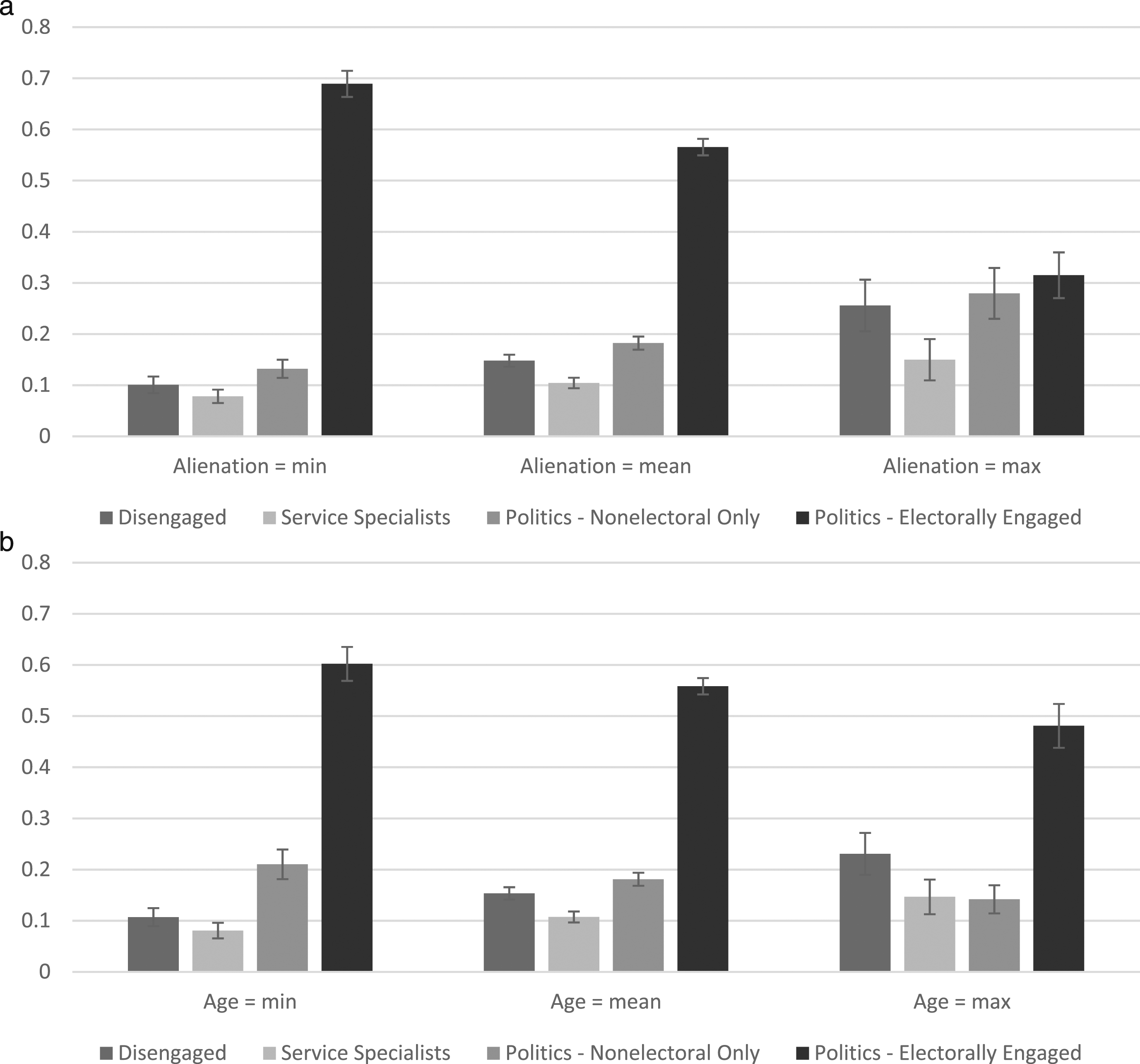
Results for age support some elements of H2a while contradicting some aspects of the alternative youth narrative in which youth have eschewed electoral for expressive politics. The probability of strictly non-electoral political activity is predicted to be somewhat (and significantly) higher at younger ages, and statistically significant coefficients show its likelihood decreasing with age relative to other profiles. This is not because older Americans favor electoral activity: age is not significantly associated with the likelihood of expressive versus electoral political participation. Instead, the likelihood of electoral political activity drops even more than non-electoral political activity with age. Disengagement and service specialization rise, producing statistically significant increases in their odds relative to electoral participation with age.
Overall explanatory power again is weak. Partisan alienation and age in Wald tests jointly significantly improve the model (p < 0.00), but as gauged by Pseudo R2 substantive improvement is modest (from 0.072 to 0.083).
Identity, Ideology, and Affect
Rerunning the two models just presented with partisan alienation broken into its three component measures can suggest the relative responsibility of partisan identity, perceived ideological misrepresentation, and disaffect. Figures 3(a)–(c) present predicted probabilities of disengagement, service specialization, political specialization, and dual activism at the minimum, mean, and maximum of each of these three independent variables. Figures 4(a)–(c) sketch analogous predicted probabilities of the civic profiles differentiating between electoral and non-electoral political activity. Tables S3 and S4 contain all coefficients and standard errors. Predicted probabilities of civic engagement profiles by components of partisan alienation. (a) Civic engagement profiles, by strength of partisanship (b) Civic engagement profiles, by perceived ideological misrepresentation and (c) Civic engagement profiles, by partisan disaffect. Predicted probabilities of revised civic engagement profiles, by component parts of partisan alienation. (a) Revised civic engagement profiles, by strength of partisanship (b) Revised civic engagement profiles, by perceived ideological misrepresentation and (c) Revised civic engagement profiles, by partisan disaffect.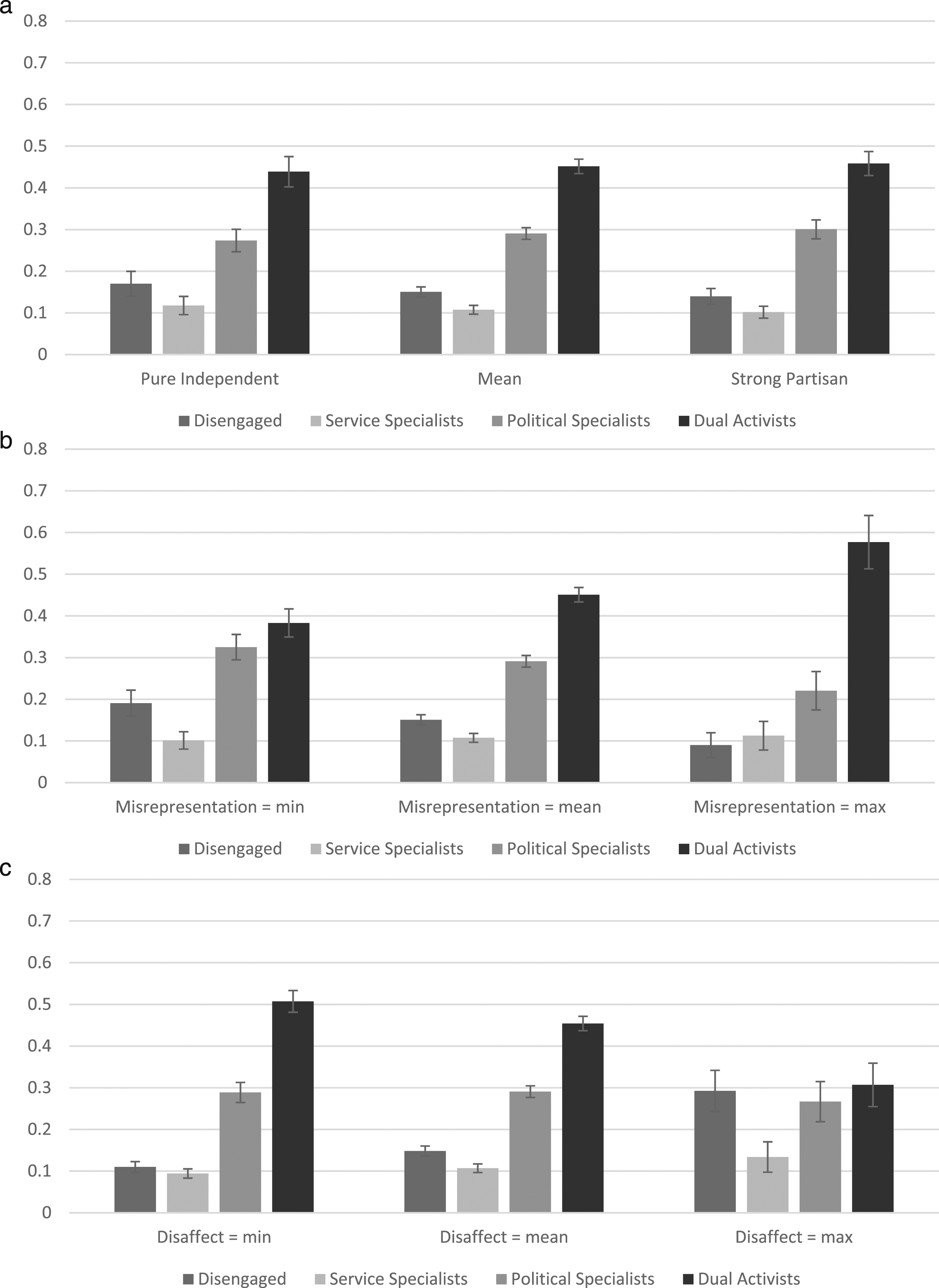
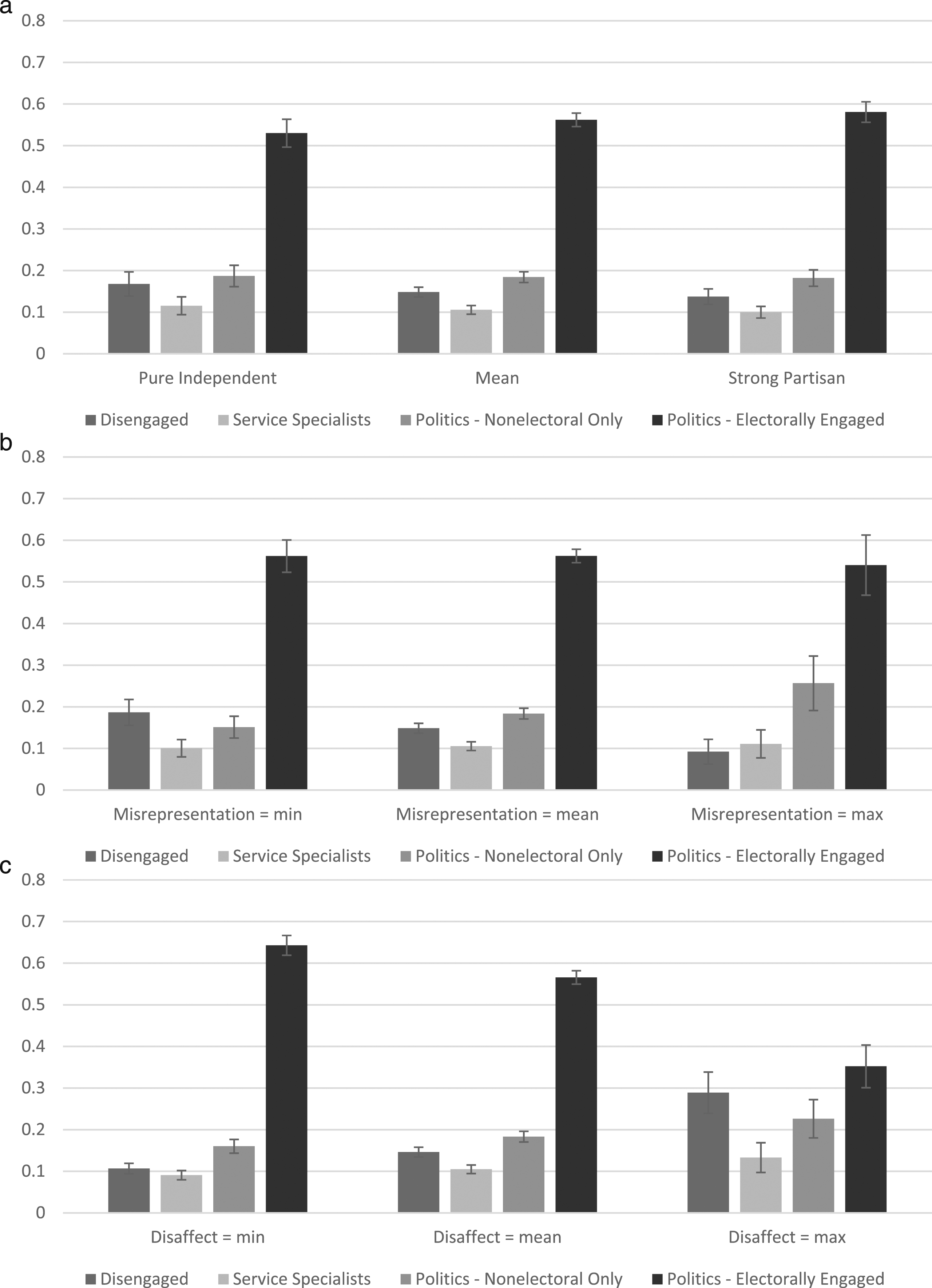
When accounting for covariates, strength of partisanship makes no obvious substantive difference to predicted probabilities within either typology. Its coefficients are never statistically significant.
Increasing perception of ideological or policy distance from both parties barely touches predicted probabilities of service specialization, but does produce some coefficients at p < 0.05 or p < 0.10 that alter service specialization’s likelihood relative to other profiles whose probabilities it appears to affect. Movement of this form of alienation from its minimum to maximum is linked to substantive, statistically significant decreases in the predicted probability of disengagement in both models. Movement across its full range at covariate means is associated with a statistically significant 10-point drop in the probability of political specialization, offset by a 19-point increase in dual activism. In Figure 4(b), it predicts a significant 11-point increase in the predicted probability of non-electoral political participation, while having little association with the probability of electoral participation. This form of alienation, all else being equal, appears to stimulate political participation—when it is strictly expressive.
The affective dimension of alienation appears most directly related to service specialization, although in both models predicted increases in service specialization associated with a min-to-max increase in partisan disaffect are substantively small and not significant at 0.05. Statistically significant coefficients in both models are driven by predicted changes in other profiles that alter their likelihood relative to service specialization. Disengagement increases with partisan disaffect, while dual activism and electoral engagement decrease. The likelihood of non-electoral political participation appears to modestly increase with disaffect.
That the partisan alienation score had a clearer substantive association with service specialization than its individual components do when controlling for each other hints at ways in which these three correlated variables may combine to increase service relative to politics. 11
Approximating Participatory Tradeoffs
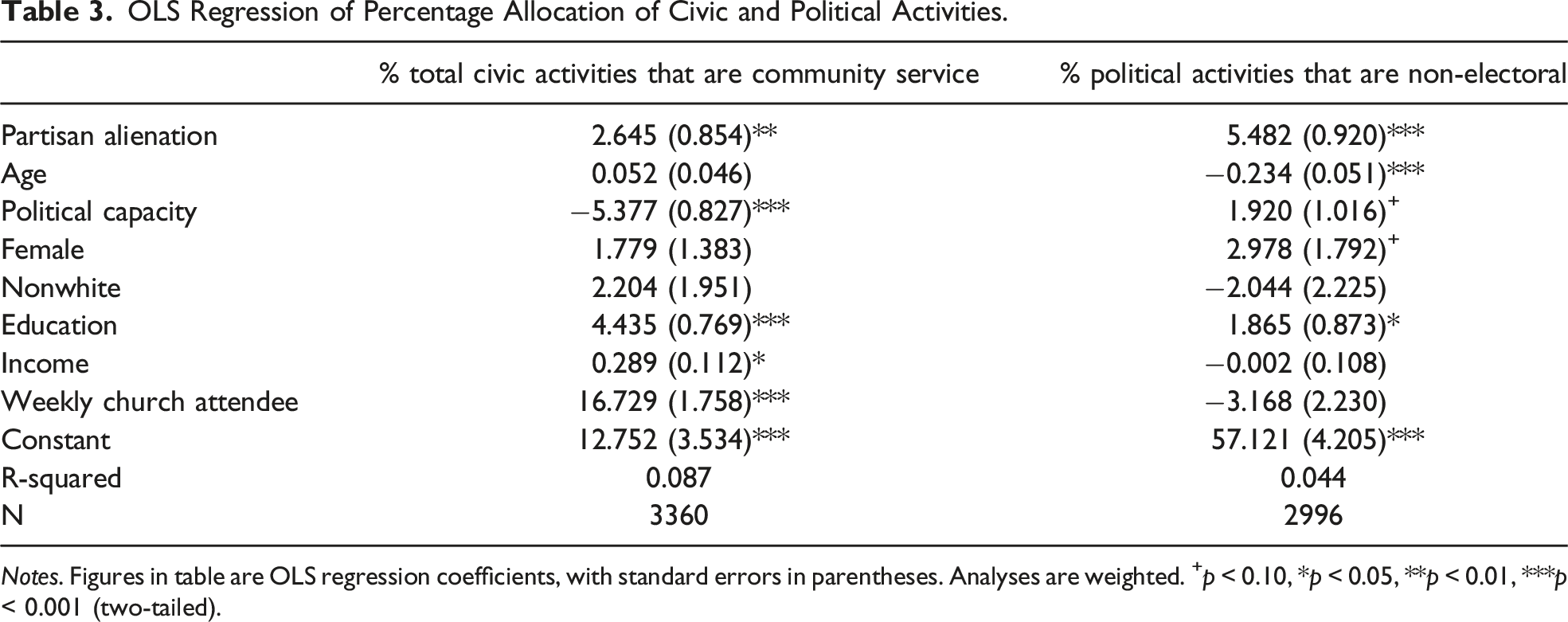
OLS Regression of Percentage Allocation of Civic and Political Activities.
Notes. Figures in table are OLS regression coefficients, with standard errors in parentheses. Analyses are weighted. +p < 0.10, *p < 0.05, **p < 0.01, ***p < 0.001 (two-tailed).
Partisan alienation is significantly associated with both dependent variables. All else being equal, a one-unit increase in its score (its min-max range is about four-and-a-half units) is associated with a 2.6 percentage-point increase in the share of civic activities devoted to service. It is associated with an even larger 5.5 percentage-point increase in the share of political activities that are non-electoral. Age is not significantly associated with Americans’ balance of political and community service activities. Every one-year increase in age is, however, associated with a large and statistically significant decline in the percentage of political activities that are non-electoral, indicating a grain of truth to the association of youth with expressive politics that had not been so clear when modeling the civic mix using an either/or typology.
Results show other variables that may contribute more importantly to how Americans mix service and politics, or different forms of political participation. For the percentage of civic activities devoted to service, the estimated effect of weekly attendance at religious services—nearly 17 percentage points—substantially exceeds that of partisan alienation and again challenges conventional wisdom about how powerfully or consistently churches act as political mobilizers. Increasing educational attainment also greatly and significantly increases the percentage of civic activities devoted to community service while income is positively and political capacity is negatively associated with the share of activities devoted to service.
The model leaves the overwhelming share of variation in the dependent variable unexplained, however, and performs even more poorly in explaining variation in the percentage of political activity that is non-electoral. Increasing educational attainment significantly increases the share of political activity that is non-electoral, even if the coefficient is smaller than when it predicts the service-politics balance. Increases in political capacity and being female are associated with modest, statistically significant increases in the percentage of political activities that are non-electoral. Partisan alienation and age jointly significantly improve models’ explanatory power, although R2 values are low. They raise R2 relative to controls-only models from 0.08 to 0.09 for percent service and from 0.01 to 0.04 for percent non-electoral.
Sensitivity Analyses
Final analyses assess how conclusions are affected by the exclusion of voting from the civic engagement typologies and the use of the 2016 rather than the 2020 ANES, especially considering perceptions of an explosion of youth activism in the wake of George Floyd’s murder. Tables S5–S9 of the supplemental appendix replicate all models with voting used as an instance of (electoral) political participation in constructing the dependent variables, while Tables S10–S14 replicate analyses—with minor changes to some key independent variables 12 —with the 2020 ANES.
Inclusion of voting as political participation drastically changes the distribution of dependent variables’ values. Just three percent of Americans qualify as service specialists (demonstrating that service specialists generally do vote) and just 9 percent count as disengaged. Well over 80 percent count as electorally engaged.
Increasing partisan alienation mostly continues to significantly predict service specialization relative to political profiles, plus increases in the percentage of total activities that are service and the percentage of political activities that are non-electoral. It becomes associated with new, statistically significant increases in the likelihood of service specialization relative to disengagement. I find both similarities and differences in the roles of alienation’s component parts, with differences including strength of partisanship displacing disaffect in predicting the likelihood of service specialization relative to some political profiles. Disaffect now appears more relevant to increasing disengagement relative to service specialization.
The age coefficient changes more dramatically, coming closer to reflecting conventional wisdom according to which older Americans participate politically more than younger ones. Age no longer points as clearly toward service specialization relative to other profiles. Increases in it, when counting voting as (electoral) political participation, now significantly increase the likelihood of political specialization relative to service specialization and the likelihood of electoral participation relative to service specialization and non-electoral political engagement, while decreasing the percentage of activities devoted to community service.
In 2020, unsurprisingly due to the Covid-19 pandemic’s shutdown of much in-person civic life, the percentage of Americans I code as “disengaged” increases. Rates of participation in my three community service activities are especially hard-hit, while political participation falls more modestly, or even rises, especially for protesting. Nonetheless, key findings are largely consistent with what I report in the 2016 data analysis. Aging becomes less strongly associated with service specialization in 2020 and more strongly associated with disengagement—perhaps because of older people’s greater vulnerability to Covid-19—while the association of age with political participation does not change greatly.
Discussion
In 2016, only about 11 percent of Americans actually limited their civic participation to community service, meaning that the percentage treating it as a substitute for political action will be even smaller. This analysis nonetheless identified several attributes associated with service specialization. Increases in interest in, attention to, knowledge about, and confidence in one’s ability to understand politics and government (“political capacity”) increase the likelihood of service specialization relative to civic disengagement, but also decrease the likelihood of service specialization relative to political participation. Education and weekly attendance at religious services increase the likelihood of service specialization by increasing the likelihood of community service generally. There are also signs that weekly church attendance modestly discourages political participation, making it the only variable in the analysis that positively predicts service specialization relative to all other civic profiles. Consistent with some scholars’ portrayal of volunteerism as an outlet for civically inclined citizens who are repelled by partisan politics, the likelihood of service specialization increases with increasing alienation from both political parties. But contradicting another popular narrative, it is aging rather than youth that increases focus on community service—at least controlling for alienation and as long as political participation is defined by activities other than voting. I find some evidence that youth tilts an individual’s mix of activities away from those that are election-related and toward those that involve (non-electoral) expression of political views. Age is not, however, associated with any general tradeoff between community service and political participation.
These perhaps surprising findings regarding age call for further investigation, as does the intriguing emergence of weekly church attendance as a predictor of service specialization. A natural question is whether these relationships are unique to 2016 (and 2020). 2016 featured major party presidential nominees, Hillary Clinton and Donald Trump, who were not only polarizing but that the public disliked far more than any prior pair of contenders (Enten 2016). The 2016 and 2020 Republican nominee, the expected preference of devout Christians, moreover carried serious liabilities in his background and moral character that may have dampened enthusiasm for him among religious and morally traditional (presumably older) Americans. It presents an interesting question for future research whether the religious constituencies that voted overwhelmingly for Trump (Margolis 2020; Rozell 2018) withheld other campaign support, thus decreasing the percentage of them that my measure would have categorized as politically involved. Future research might test for denominational differences in whether weekly church attendance is linked to service specialization, as others have found them in the extent to which church involvement beyond attendance increases the likelihood of other civic participation, including in politics (Campbell 2004) or outside organizations (Beyerlein and Hipp 2006). It also might explore whether church involvement is so consistently strongly predictive of service specialization as attendance. Involvement (or skill developed via involvement) often outperforms attendance at predicting various forms of civic participation (Beyerlein and Hipp 2006; Campbell 2004; Sinha, Greenspan, and Handy 2011; Verba, Schlozman, and Brady 1995).
My findings add to the case against generalizing about young adults’ political participation from voting rates alone. This is consistent with recent research by Holbein and Hillygus (2020) arguing that weak turnout among young voters results not from lack of motivation but lack of follow-through on the series of logistical steps needed to correctly cast a timely ballot. Other ways of participating in politics, even electoral politics, can be accomplished more flexibly. On the other hand, mere inclusion of voting among the items that define my participation typologies moves results closer to the conventional wisdom in which increasing age is associated with an increased likelihood of political participation, and toward the youth narrative of service specialization, albeit with these service specialists making up a much smaller share of the public than they did when not required to be nonvoters.
While my models suggest that alienation from Democrats and Republicans increases the odds that Americans will limit their civic involvement to community service, they offer some qualifying detail to the “refuge from politics” narrative. First, partisan alienation explains just a small share of variation in Americans’ civic engagement mixes. Most importantly, even at very high levels of alienation and despite a presidential election believed to be unusually polarizing, negatively toned, and uncivil, the models predict that the average American was much more likely to participate in politics than not. This is also true specifically for election-related political activity like posting candidates’ signs, attending campaign events, or trying to influence others’ votes, even while rising partisan detachment predicts increased odds of a shift from electoral to expressive political activity such as signing petitions, attending protests, or contacting government officials. Partisan alienation appears to push Americans from electoral to expressive politics more so than from politics to service.
To the extent that parties deter citizens from electoral or all politics, the most direct mechanism appears to be the negative feelings they provoke. I observe signs that perceptions of ideological distance from the parties or that they fail to represent one’s views predict increased propensity to politically participate—specifically in non-electoral political activity, and through a combination of political activity with community service. But more sophisticated data and modeling are needed to separate the direct and indirect effects of alienation’s component parts, and test the possibility that participation in politics or service may increase one’s perception of policy or ideological distance. Future research might also probe the extent to which parties’ combative relations drive citizen disaffection.
This paper heroically assumes that political attitudes precede behavior. ANES’ cross-sectional design and a measurement strategy that asks about participation over the previous 12 months while measuring attitudes at the time of the survey may further undermine this assumption. Zukin and coauthors (2006) leave their focus groups under the impression that most people are unreflective about the reasons for their civic participation or lack thereof. Munson’s (2008) activist interviews similarly suggest that the form activism takes quirkily reflects which invitations individuals receive to participate at a time when their life circumstances leave them open to civic involvement; attitudes rationalizing the chosen form develop later. Eliasoph’s (1998) observation of a volunteer group whose norms and discourse reinforced negative ideas about politics adds caution about the causal direction of the relationship. Such findings underscore the challenge of explaining participatory mixes, and the need for future research to utilize panel data.
We also cannot know how many of the service specialists studied here are substituting that service for politics, in the sense that a different political system or environment would inspire their involvement. Beyond the challenges of hypotheticals and causal inference, one must know more about the nature and context of the service (e.g., the extent to which it is oriented toward changing social conditions). Still, that service specialization is related to alienation from partisan politics makes that substitution effect plausible. This should give democracy’s advocates pause over the possibility that electoral (and sometimes other) political spaces are becoming segregated by attachment to a major party, stimulating a sense of marginalization among the detached. Fortunately for fans of participatory democracy, in 2016 and 2020, narratives of a disenchanted and young segment of the electorate fleeing politics for community service appear overly pessimistic, underestimating Americans’ willingness to engage even a political system they may view critically.
Supplemental Material
Supplemental Material - Who Substitutes Service for Politics? Assessing the Roles of Youth and Partisan Alienation in Americans’ Forms of Civic Engagement
Supplemental Material for Who Substitutes Service for Politics? Assessing the Roles of Youth and Partisan Alienation in Americans’ Forms of Civic Engagement by Laura S. Antkowiak in Political Research Quarterly
Supplemental Material
Supplemental Material - Who Substitutes Service for Politics? Assessing the Roles of Youth and Partisan Alienation in Americans’ Forms of Civic Engagement
Supplemental Material for Who Substitutes Service for Politics? Assessing the Roles of Youth and Partisan Alienation in Americans’ Forms of Civic Engagement by Laura S. Antkowiak in Political Research Quarterly
Footnotes
Acknowledgements
Laura S. Antkowiak previously published as Laura S. Hussey. Many individuals deserve thanks for helpful feedback on earlier drafts of this manuscript, especially PRQ’s anonymous reviewers, Ian Anson, Shanna Pearson-Merkowitz, and participants in the January 2020 National Capitol Area Political Science Association’s American Politics Workshop, including David Barker, Jeff Burnham, Rory Etienne, Matthew Green, Danny Hayes, Mike Helleman, Michael Heseltine, Hans Noel, Rachel Potter, Laura Stoker, Elizabeth Suhay, Jordan Tama, and Jennifer Victor. I thank Brooke Wright for invaluable research assistance.
Declaration of Conflicting Interests
The author(s) declared no potential conflicts of interest with respect to the research, authorship, and/or publication of this article.
Funding
The author(s) received no financial support for the research, authorship, and/or publication of this article.

Supplemental Material
Supplemental material for this article is available online.
Notes
References
Supplementary Material
Please find the following supplemental material available below.
For Open Access articles published under a Creative Commons License, all supplemental material carries the same license as the article it is associated with.
For non-Open Access articles published, all supplemental material carries a non-exclusive license, and permission requests for re-use of supplemental material or any part of supplemental material shall be sent directly to the copyright owner as specified in the copyright notice associated with the article.
