



Abstract
Who do people think are influential in their own community? This question is important for understanding topics such as social networks, political party networks, civic engagement, and local politics. At the same time as research on these topics has grown, measurement of public perceptions of local influence has dried up. Years ago, researchers took active interest in the question of community influence. They found that most ordinary Americans could identify a person who they thought had influence in their community. Respondents usually named business leaders. Where does the public stand today? In three different ways, we ask respondents who has local influence. The vast majority of respondents today cannot think of anyone. Those who do identify someone as influential rarely choose a businessperson. This article aims to reintroduce the public opinion of community influence and situate findings in related scholarship.
Introduction
Who is the most influential person in your community? This question interested social scientists in the post-World War II era but largely faded as a scholarly topic in the subsequent decades. In the 1950s, localized studies showed that about two-thirds of ordinary citizens could identify the name of an individual who they thought was most influential in their community. The name that they came up with tended to be a local business leader (Agger 1956; Fanelli 1956). 1 In this paper, we resurrect this research topic.
For three reasons, we expect to find different results today than in the 1950s. First, the decline in social capital from the generation of post-war “joiners,” well-documented in work such as Putnam (2000), suggests that fewer ordinary people today are able to identify any local influencer at all. Second, when it comes to politics, ordinary citizens who are cognitively engaged in politics are increasingly only attentive to the national level (Hopkins 2018; Hersh 2020; Moskowitz 2021). Third, several features about modern business suggest that survey respondents today, if they can name a local influencer at all, would not choose a business leader. The nationalization and internationalization of corporations mean there are fewer powerful business leaders in long-term positions in a community who are heading up civic and political endeavors (Heying 1995; Hanson et al., 2010; Hersh, 2023).
Recent developments in political science make the study of local leadership worthy of resurrection. In the last few years, there has been a surge of research focused on state and local politics (e.g., Palus 2010; Anzia 2014; Tausanovitch and Warshaw 2014; Einstein and Kogan 2016; Einstein and Glick 2018; Warshaw 2019; Anzia 2020; Schaffner et al. 2020; Sances 2021; Einstein et al., 2022). In a separate research area, political science has long been interested in social networks and political party networks, including local networks, as these networks shape political discussions, vote choice, candidate recruitment, and more (Broockman and Skovron 2018; Broockman et al., 2021; Cohen et al., 2008; Huckfeldt, 2001; Huckfeldt et al. 1993; Tam Cho et al., 2006; Kenny 1998; Beck 2002). 2 In spite of this important research, our collective understanding of local politics is still underdeveloped: Who is in charge in local politics? What are the main ideological cleavages? How do laws get changed? These questions seem basic, but scholars are continuing to shed new light on seemingly simple questions about local politics in the United States.
Why should we care who, if anyone, citizens identify as influential in their communities? Perceptions of power tell us about the nature of representation. Thinking that the most influential person in one’s community is a businessperson versus an elected leader versus a pastor versus a head of a labor union conveys important information about how a citizen understands his or her democracy and how he or she believes that policy change is accomplished. In an era of declining faith in democratic institutions, scholars should be sensitive to who citizens believe is in charge and who is responsible for good and bad outcomes in their community.
Whether a respondent can even name any person as influential (regardless of the role) is important because of its implications for political and civic participation at the local level. Probably not coincidentally, the rate of knowing an influential (about 25%, according to our study) is consistent with the rate of participation in local elections such as mayoral contests in the United States (Holbrook and Weinshenk 2014). The main barriers to participation in local elections are not logistical (e.g., voting access) but rather stem from a lack of information and interest. 3 For scholars studying methods to increase local turnout (e.g., Hajnal and Lewis 2003; Niven 2004; Anzia 2014; Leininger et al. 2018; Huber et al., 2022; Hopkins et al. 2022), our study sheds light on the basic informational barriers to participation. Indeed, as we show, being able to name an influential person in one’s community is strongly correlated with several civic behaviors.
Through original surveys fielded in 2020 and 2021, we asked random samples of U.S. adults who they perceive to be most influential in their communities. Regardless of how we asked the question, few respondents identify someone as the most influential person in their community. This is a stark contrast to the majority of respondents who could do so in the mid-twentieth century. Leaders who are identified as community influentials today differ significantly from those identified in the mid-twentieth century. In the 1950s and 1960s, respondents identified business owners as the most influential people in a community. In contrast, the majority of those selected as community influentials today are government officials.
Literature and theory
In the mid-twentieth century, the study of community power developed into a popular field of research. This research started in the 1930s, when Helen and Robert Lynd published Middletown in Transition (1937) on the power structure of Muncie, Indiana. Hunter’s Community Power Structure (1953), Dahl’s Who Governs? (1961), and Domnhoff’s Who Rules America? (1967) brought the field front and center, leading to research on various aspects of local power. During this period, social scientists sought to identify who the most influential people in a community were. To do so, they mostly relied on the opinions of elites via snowball sampling (Schulze and Blumberg 1957).
However, several studies surveyed the public to determine who could identify influential members of their community. Fanelli (1956) asked a random sample of 304 white adults in an unnamed town in Mississippi (population: approximately 5,000) about whose opinions they respect on local issues. 4 Nearly 90% of respondents could identify someone whose opinions on community affairs they respect. Similarly, Agger (1956) asked a random sample of 260 adults in an unnamed town (population: about 2,000) who they thought were “generally most influential in the community (323).” More than two-thirds of respondents identified influential members of their community.
That such a large percentage of respondents could identify people whose opinions on local affairs they respect and who they view as having influence is, at least in part, a function of the community engagement during this period (Putnam 2000; Skocpol et al. 2005). Citizens attended local political meetings, were members of volunteer associations, and were generally involved in their communities. Indeed, Agger (1956) found that those who had strong social ties and were involved in community affairs were more likely to identify a community influential than those who did not.
With the decline in social capital, we expect today that far fewer Americans will identify community influentials. But in keeping with Agger (1956) and the literature on social ties, networks, and political participation (e.g., Lim 2008; Campbell 2013; Reilly 2017), we expect that respondents’ social ties and civic engagement will be positively associated with the likelihood that they identify community influentials.
Previously, business leaders were viewed as the most influential people in a community. In the Mississippi town, 52% of those who were named as the most influential people were local businessmen (Fanelli 1956). 5 Likewise, the residents of “Valley City” identified a wealthy automobile dealer and property owner (who was also a state lawmaker) as the senior community leader (Agger and Goldrich 1958). Related research found people turned to business professionals for community leadership (Agger and Vincent 1956). 6
That citizens identified business leaders as the most influential people in their community reflects the important role that business leaders played in community affairs during the mid-twentieth century. During this period, CEOs and CEO-led organizations “occup[ied] legendary status as powerbrokers and agenda setters in their communities (Hanson et al., 2010, 2).” Business leaders were stable fixtures of their communities. Compared to today, they had more autonomy from stakeholders and could act in a “statesmanlike manner (Mizruchi and Marshall 2016, 146).”
In the last quarter of the 20th century, the United States economy experienced a major restructuring. Two components of this restructuring—the globalization of firms and globalization of ownership—completely reshaped communities across the country (Paarlberg and Yoshioka 2016). This restructuring drastically reduced the involvement of local business leaders in their community. Local companies were transformed into branches of multinational corporations. Their leadership ranks became composed of managers tied to the company, not the community (Heying 1995, 1997; Hanson et al., 2010).
As a result of these economic changes, business leaders today are less engaged in their community (Hanson et al., 2010). CEOs lack long-standing ties to their community. Business leaders travel more and report having less time to focus on community affairs. As a result, there are fewer civically engaged business leaders than there were previously. Thus, we expect that those respondents who can identify key local leaders today are more likely to identify individuals in politics and government rather than in business.
Data and methods
Data in this article came from two 1,000 respondent modules of the Congressional Election Study (CES). The CES is fielded online by YouGov American using a matched random sample design, with post-stratification weights applied to a range of demographic variables. First, in the fall of 2020, we asked 1,000 respondents: “Thinking about the COMMUNITY where you live, who would you say is the most influential person in your community?”7 Respondents were provided with a textbox where they could enter the first and last name of the most influential person in their community, or they could select a checkbox that said, “I can’t think of anyone.” 8 For simplicity, we refer to respondents who answered this question as having received the “community” condition. The exact format of the questions, as well as human subjects review information, can be found in the Appendix.
In this version of the question, notice that we did not define “community” or “influence” for the respondents. Respondents might have interpreted community to mean a city, a county, a religious community, a neighborhood, etc. In this version, we are agnostic to the respondents’ definition, especially because those in different parts of the country might perceive the term differently from one another. Respondents might also interpret “influence” in different ways, for instance either as personally influential to the respondent’s own views or as influential over civic and political affairs.
In two other question wordings, we are more specific about the meaning of “community” and “influence.” These two alternative versions were asked in a 2021, 1,000-respondent, nationally representative module of the CES. We randomly divided the sample into two. Half of the respondents were asked “Who would you say are the people in your city or town whose opinions on community affairs you respect most? Name up to 3 individuals.” 9 We refer to respondents who received this question as having received the “personal” condition. The other respondents were asked “Who would you say are the people in your city or town who have the most political influence over community affairs? Name up to 3 individuals.” We refer to respondents who received this question as having received the “power” condition. Notice that both of these questions reference a “city or town” rather than “community.” One of them asks about personal influence and the other asks about political influence.
In addition to collecting the names of those identified as influential under these three conditions, we also asked respondents to tell us the role or industry of those identified as influential. 10 Based on a review of all the individuals who respondents identified as leaders, we created a classification system with seven groups. We classified state legislators, mayors, county executives, and other lower government or political officeholders as “local officials.” “Political figures” refer to those holding statewide or federal office, as well as those who recently held such an office, such as Donald Trump in the 2021 study. The remaining categories were businessperson, personal contact (e.g., friend, family member, neighbor, co-worker), religious leader, civic/nonprofit leader, and other.
Results
Figure 1 displays the percentage of respondents who identified someone as influential in their community. Across all three questions, no more than 30% of respondents were able to identify a community influential. This is a stark contrast to the mid-twentieth century, when most respondents could identify a community influential (Agger 1956; Fanelli 1956).
11
Of course, much is different in today’s context compared to the survey context of these mid-century studies, even beyond aggregate levels of civic engagement: the news media was primarily local; the college-educated population was much smaller; local political parties, political leadership, and business leadership were likely all more salient than today. Few people can identify a community influential. Note: Means with 95% confidence intervals are shown. (N = 1,000, N = 488, N = 512).
Few people can identify a community influential no matter their background.

Note
Table 1 shows several variables related to social ties. Homeowners, we find, are just as likely to identify a community influential as those who do not own their current residence. There are no sizeable differences in knowing the name of an influential person between regular church goers and non-church goers, and between long-time residents and shorter-term residents.
Relationship between naming an influential and civic/political engagement.

Note: This table is based on the 2020 community measure (N=1,000). Activist Roles counts up to six self-reported behaviors (local meeting attendance, displaying a political sign, working for a campaign, attending a demonstration, contacting an official, and donating money). Media Last 24 Hours counts up to four self-reported media types (social media, TV news, newspaper, and radio news). Social Media Uses counts up to five acts (posted a political story, commented on a political story, read a political story, followed a political story, forwarded a political story).
Roles of the community influentials
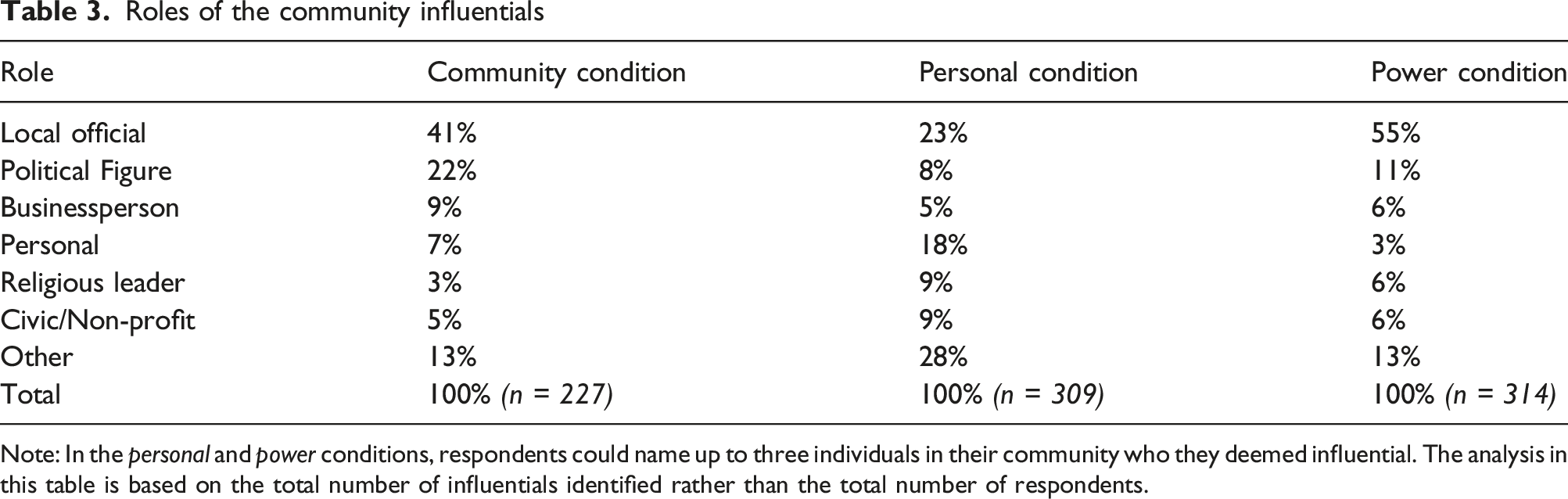
Note: In the personal and power conditions, respondents could name up to three individuals in their community who they deemed influential. The analysis in this table is based on the total number of influentials identified rather than the total number of respondents.
Conclusion
Seventy years ago, studies of local power showed that the majority of respondents (albeit respondents from non-representative samples) could identify influential people in their community. Yet in 2020 and 2021, few could think of someone. Across variations in question-wording, the majority of respondents failed to identify someone. Some of those who identified an influencer only named state-wide or national figures. These responses are consistent with scholarship on the nationalization of politics (Hopkins 2018).
One of the biggest historical changes reflected in these results is that few people today think of business leaders as influential in their community. This result could stem from the decline in actual power of business leaders as the economy has shifted or from a lack of awareness of the power that business leaders still have today. Certainly, the decline in local media makes it harder for respondents to know about local powerbrokers (Schulhofer-Wohl and Garrido 2013; Peterson 2021). It is quite plausible that because of the decline in local media coverage, citizens are unaware of the power and influence of business leaders.
One opportunity for future research is to survey business leaders on their perceptions of who wields power in their community. In the mid-twentieth century, elite surveys found that business leaders often identified other business leaders as influential (e.g., Schulze and Blumberg 1957; Miller 1958; Smith 1960; Form and Sauer 1963). If business leaders are truly no longer influential, then we expect few business leaders will nominate their peers. Alternatively, if they are still influential, but only behind the scenes, then surveying business leaders is one of the few ways to capture this influence. Similarly, we encourage future researchers to survey other elites, such as leaders of civic associations and elected officials, to shed light on who they view as influential in their communities.
While our study incorporates three ways of asking respondents about local leadership and influence, future research would benefit from additional approaches. For example, it is possible that the web-based survey approach used by the CES might have encouraged more people to answer “I can’t think of anyone” than if we utilized a different survey mode. 12 Similarly, we anticipate that the types of people identified as influential vary across localities. To this end, we hope others pick up where we leave off and address these questions. As scholarship continues to develop on subnational politics in the United States, it is especially important for scholars to understand how Americans perceive power dynamics and leadership within their communities.
Footnotes
Acknowledgments
The authors thank the Tufts University Department of Political Science for research support
Declaration of conflicting interests
The author(s) declared no potential conflicts of interest with respect to the research, authorship, and/or publication of this article.
Funding
The author(s) received no financial support for the research, authorship, and/or publication of this article.

Notes
APPENDIX
The 2020 and 2021 modules of the Cooperative Election Study were deemed exempt from review by the Tufts University Institutional Review Board, protocol numbers 1909024 and 00002086, respectively.
2020 Instrument:
2021 Instrument:
Randomly assign 50% of respondents to CES501 and the other 50% to CES502.
Who would you say are the people
For each person, write their name and their role in the community. Their role could be informal (for example, they are a friend of yours) or it could be formal (for example, they are a leader of a political, civic, business, religious, or other organization).
Question Text
First Name Last Name Role in Community
1
2
3
I can't think of anyone.
Who would you say are the people
For each person, write their name and their role in the community. Their role could be informal (for example, they are a friend of yours) or it could be formal (for example, they are a leader of a political, civic, business, religious, or other organization).
Question Text
FIRST NAME LAST NAME ROLE IN COMMUNITY
1.
2.
3.
I can't think of anyone.