



Abstract
We investigated the simultaneous influence of descriptive and injunctive ingroup emotion norms and ingroup identification on group-based emotions triggered by ingroup-relevant events (Experiment 1) and by outgroup targets (Experiment 2). For both studies, we hypothesized that both perceived descriptive and injunctive emotion norms would influence experienced emotions (self-categorization effects), effects that would be moderated by identification (with high identifiers being more influenced by norms than low identifiers). We also expected identification to increase the relative positivity of ingroup-relevant emotions in Experiment 1. In each study, we activated ingroup membership, assessed ingroup identification, and then measured group-based emotions and participants’ perceptions of the ingroup’s descriptive and injunctive emotion norms. Both experiments produced strong evidence for independent effects of both descriptive and injunctive emotion norms on experienced emotion. However, evidence for the moderation of those effects by identification was inconsistent and qualified. Identification increased the relative positivity of ingroup-relevant emotions in Experiment 1 as predicted. We conclude that the role of self-categorization processes in constructing the subjective sense of group membership receives strong support in the group-based emotion domain, and discuss the implications of our results for understanding the role of identification in these studies.
Keywords
Emotions are social phenomena. Interpersonal, group, and cultural contexts and processes influence the production, experience, communication, and consequences of emotion (Kitayama et al., 2006; Matsumoto et al., 2008; Mesquita & Boiger, 2014; Mesquita et al., 2017; Parkinson, 1996; Parkinson et al., 2005; Tsai, 2007; Tsai et al., 2006; Van Kleef, 2009; Van Kleef et al., 2016; Vishkin et al., 2023). Intergroup emotions theory (IET) underlines the social nature of emotions by demonstrating that social identity (the sense of group membership and the psychological importance attached to that membership; Tajfel, 1974) drives group-based emotions (the emotions experienced as, and because of being, a group member; (Mackie et al., 2000; Mackie & Smith, 2018; Smith, 1993, 1999). The current research provides novel evidence for the role of self-categorization processes and group norms in the experience of group-based emotions. We investigate the simultaneous influence of both descriptive and injunctive emotion norms on emotions triggered by group-relevant events (Experiment 1) and by group-relevant targets (Experiment 2), societally consequential emotions that impact intergroup relations.
Intergroup Emotions Theory and Group-Based Emotions
Predicated on theories of social identity (Tajfel, 1974; Tajfel & Turner, 1979) and self-categorization (J. C. Turner et al., 1987), IET assumes that group-based emotions arise from two fundamental antecedents, a subjective sense of group membership (self-categorization) and its psychological significance to the individual (group identification; J. C. Turner et al., 1987). First, self-categorization as a group member occurs through referent informational influence (RII; Hogg & Turner, 1987; J. C. Turner, 1982, 1991; Turner & Oakes, 1989), entailing self-attribution, adoption, or internalization of attributes, attitudes, and actions that define the ingroup and distinguish it from outgroups in a particular context. The perception of these attributes is termed a prototype in the social identity approach and embodies both what group members are like and what good group members should be like (J. C. Turner, 1982, 1991; J. C. Turner et al., 1987). Perceptions of regularities in group attributes and actions are more generally referred to as social norms—cognitive representations of what ingroups are like and should be like (Cialdini et al., 1990; Sherif, 1936; J. C. Turner, 1982). Voluminous evidence demonstrates that views of what groups are and what they should be are often inconsistent (Gelfand et al., 2024; Horne & Mollborn, 2020). Such views are therefore typically conceptualized separately, as descriptive norms (perceptions of what people think, feel, or do; Cialdini et al., 1990; Gelfand & Jackson, 2016) and injunctive norms (or prescriptive norms, perceptions of what people should think, feel, or do; Cialdini et al., 1990). Both types of norms are expected to be internalized during self-categorization (Hogg & Reid, 2006; J. C. Turner, 1982). Such norms can be perceived differently by different individuals and shared to different extents within a group (Hogg & Reid, 2006; Morris et al., 2015; Tankard & Paluck, 2016; Turner, 1991). According to IET, the same process of self-categorization can produce group-based emotions (Mackie & Smith, 2018; Smith, 1993; J. C. Turner, 1982), as group members adopt ingroup emotion norms (perceptions of the emotions that ingroup members experience or should experience in a given situation; Fischer et al., 2004; Frijda & Mesquita, 1994; Gordon, 1990; Rimal & Real, 2003; Vishkin et al., 2023).
Second, the extent to which self-categorization occurs (i.e., the extent to which perceived norms are self-attributed, adopted, or internalized via RII) is moderated by group identification, the psychological importance of the membership to the member (Abrams & Hogg, 2010; Deaux, 1996; Tajfel, 1974). Because group membership contributes to the self-concept, identification moderates self-categorization processes in two different ways. For one thing, identification motivates greater acceptance of perceived ingroup norms, so highly identified members more thoroughly become prototypical or exemplary members of the ingroup (J. C. Turner, 1982), as has been widely shown (Abrams & Hogg, 1990; Christensen et al., 2004; Deaux, 1996; Iacoviello et al., 2017; Roccas et al., 2008; Sassenberg et al., 2011; Terry & Hogg, 1996; Vignoles & Moncaster, 2007). Based on this extensive literature, IET assumes that the impact of perceived emotion norms on experienced emotions will be similarly moderated by group identification, with highly identified members’ emotions being more influenced by perceived ingroup emotion norms. As a second process, identification motivates highly identified group members to create and maintain a favorable image of the ingroup as having positive attributes and characteristics (J. C. Turner, 1982; see also Abrams & Hogg, 2010; Crisp & Beck, 2005; Maitner et al., 2007; Shuman et al., 2018). Again, IET assumes that experienced ingroup-relevant emotions will similarly be moderated by identification, with highly identified group members reporting relatively more positive (ingroup-enhancing), compared to negative, emotions.
Influence of Descriptive and Injunctive Emotion Norms on Group-Based Emotions
Impact of descriptive emotion norms
In social constructivist approaches to emotion (Averill, 1980; Barrett, 2017a, 2017b), what other ingroup members feel has a pervasive influence on what emotion is and how it is experienced. In these theories, emotion emerges when some array of brain and/or body sensations is categorized or interpreted according to the consensual knowledge of a particular group. Thus, the consensual emotional reactions of others (descriptive emotion norms) pervasively impact the emotional experience of individual members of every group, as evidenced by cultural variation in what constitutes emotion as well as in which emotions people experience in particular circumstances (Barrett, 2017a, 2017b).
Mackie et al. (2024) provided both correlational and experimental evidence for such effects. In one study, they activated a range of different ingroup memberships (intimacy, task, and social category groups) and asked individual members of these groups to report what emotions they currently felt as group members. They then calculated descriptive emotion norms (the mathematical average of emotions reported by members of each ingroup) and used this objective descriptive emotion norm to predict the emotions individual group members would report. This descriptive ingroup emotion norm had a strong relation with reported group-based emotions, regardless of the specific ingroup to which participants belonged, even though emotion norms were never explicitly activated or asked about.
In a second study, Mackie et al. (2024) indirectly manipulated perceived ingroup emotion norms by asking members of diverse ingroups to focus on either a positive or negative event impacting the ingroup. Participants then reported the emotions the event made them feel as well as their perceptions of the typical emotions the event made other group members feel. Results showed that these perceived descriptive emotion norms had a strong influence on experienced emotions. In related work, Moons et al. (2009) directly manipulated a descriptive emotion norm, telling participants whose American nationality was made salient that “Americans report very low [or extremely high] levels of anger.” Participants reported significantly lower levels of anger in the low than in the high condition. Similarly, women who were shown information that women on average feel considerable anger reported feeling significantly more anger as a woman, compared to women who saw women’s average anger depicted as rather low (Leonard et al., 2011). These studies converge on the conclusion that group-based emotions are strongly influenced by descriptive emotion norms, reflecting self-categorization processes.
Impact of injunctive emotion norms
Beliefs about the emotions that are seen as appropriate for different groups of people to feel in different situations have been extensively investigated (Gordon, 1990; J. H. Turner, 1988). Heise and Calhan (1995) provided seminal evidence for the impact of injunctive norms on emotions: In the majority of cases, emotions men and women reported experiencing in a wide range of interpersonal situations closely matched the emotions other participants said people should feel in those situations.
Variation in emotion across cultures can similarly be attributed to the influence of culturally specific injunctive emotion norms (Kitayama et al., 2006; Mesquita & Boiger, 2014; Tsai, 2007). Cultures regulate emotion in order to regulate interaction (Hofstede, 2001), and thus value or prioritize some emotions over others for appropriate group interaction and functioning. Interdependent cultures (like many East Asian cultures) that prioritize groups and group membership value engaging emotions (like warmth) that bring people together, while independent cultures (like the dominant U.S. culture) value disengaging emotions (like anger) that can set people apart (Kitayama, 1996; Tsai, 2007; Tsai et al., 2006). The pervasive impact of injunctive emotion norms also contributes to lowered psychological well-being among those who do not experience culturally endorsed emotions (Vishkin et al., 2023). Thus, cultural research provides extensive evidence of the impact of injunctive emotion norms on experienced emotions.
Moderation of the Influence of Descriptive and Injunctive Emotion Norms by Identification
From the social identity perspective, the impact of both descriptive and injunctive norms is expected to be moderated by an individual’s level of identification with the group, as noted earlier. Moons et al. (2009, Experiment 4) showed that group identification moderated the effects of descriptive emotion norms on group-based emotions. Female high identifiers (compared to those lower in identification) reported emotions more similar to manipulated information about other women’s emotions (see also Crisp et al., 2007). Correlational data also reveal that highly identified Americans, Republicans, and Democrats expressed emotions closer to average emotions of their ingroup than their less identified counterparts did (Smith et al., 2007, Experiment 2). However, Mackie et al. (2024, Study 1) found no evidence that high identifiers were more likely to be influenced by actual descriptive emotion norms (in fact, a small significant effect was in the opposite direction), and, in Study 2, high identifiers adhered to perceived descriptive emotion norms more strongly only when reacting to negative ingroup-related events. Thus, despite strong evidence that greater identification strengthens the influence of norms in other domains, evidence for this effect with descriptive emotion norms is mixed.
Does identification moderate the impact of injunctive norms on emotion? Although we know of no research that has explicitly investigated this relation in the emotion domain, we assume that, as in other domains, identification is likely to moderate the impact of injunctive emotion norms on emotional experience.
Moderation of Experienced Emotion Valence by Identification
From the social identity perspective, identification with the ingroup is expected to influence group-based emotions such that high identifiers experience relatively more positive than negative emotions about the ingroup, as found by Mackie et al. (2024) and Smith et al. (2007). Up-regulating positive emotions about group-relevant events presumably serves to maintain a favorable image of the ingroup. Similarly, highly identified members might down-regulate negative emotions that reflect poorly on the group, such as guilt following intergroup aggression (Gordijn et al., 2006), especially when that aggression benefits the ingroup (Maitner et al., 2007).
Current Research and Hypotheses
In this research, we made a current ingroup membership salient, assessed identification with the activated ingroup, and asked participants to report the emotions they were feeling as members of the group about a group-relevant event (Experiment 1) or about a relevant outgroup (Experiment 2). We then assessed members’ perceptions of the ingroup’s descriptive emotion norms (what other group members feel; replicating Mackie et al., 2024) and injunctive emotion norms (what other group members thought group members should feel; theoretically and methodologically novel). We tested three hypotheses.
Hypothesis 1: Reflecting self-categorization processes, the group-based emotions experienced by members of a group about a group-relevant event (Experiment 1) and about outgroup targets (Experiment 2) will be significantly influenced by both (1a) perceptions of the ingroup’s descriptive emotion norms and (1b) perceptions of the ingroup’s injunctive emotion norms.
Hypothesis 2: Reflecting the impact of identification processes on the adoption of norms, the impact of both (2a) perceived descriptive norms and (2b) perceived injunctive norms on group-based emotions will be moderated by identification, such that high identifiers will be more influenced by both types of norms than low identifiers.
Hypothesis 3: Reflecting the impact of identification processes on the positivity of the ingroup, the valence of reported group-based emotions toward the ingroup or ingroup-related events will be moderated by identification, such that high identifiers will experience relatively more positive than negative emotions. (This hypothesis is not relevant to Study 2, which examined emotions toward outgroups rather than toward the ingroup.)
We used the norm and bias analytic model (based on Stern & West, 2018; West & Kenny, 2011; see also Mackie et al., 2024) to examine the strength with which multiple factors uniquely affect group-based emotions. The model is estimated as a multilevel regression, which includes descriptive and injunctive norms as factors predicted to influence reported emotions, with group identification, event valence, and emotion valence as potential moderators, and the appropriate multiplicative terms. The analysis treated participants and specific group-based emotions (within valence) as random factors (given our predictions are about emotion valence, not specific emotions; see Vishkin et al., 2023).
We estimated power for these two studies following Murayama et al. (2022). The estimates are based on results from Mackie et al.’s (2024) Experiment 2, which, like the current studies, involved prediction of reported group-based emotions from perceived descriptive norms as well as group identification and other factors. First, for the predicted Hypothesis 1 effects of descriptive and injunctive norms (and assuming that descriptive and injunctive norms have similarly sized effects), the power analysis yielded estimates of the sample size required for 80% power, N = 24. Second, Hypothesis 2 predicts Norm × Identification interactions. As this interaction was nonsignificant (t = 1.00) in the previous study, the required sample size was estimated as 1,922. We continue to hypothesize these effects based on strong theoretical considerations, but it is clear that if the current experiments yield a similarly weak effect, the power to detect it will be very low. Third, for the predicted Identification × Emotion Valence interaction (Hypothesis 3), the required sample size was estimated as 166. Experiment 1 had N = 402, well above the required sample size for Hypotheses 1 and 3 effects. Experiment 2 had N = 144, well above the required sample size for the norm effects (Hypothesis 3 is not relevant to this study). Both studies are underpowered for the Norm × Identification interactions.
Experiment 1
This study tested Hypotheses 1–3 in the context of group-based emotions experienced in response to specific ingroup-relevant positive and negative events.
Method
Participants and design
Participants were 479 adults recruited from Prolific for a University of California, Santa Barbara Institutional Review Board (IRB) approved study that assessed “the factors that influence people’s emotional responses to events.” Participants were paid $3.75 for completion. They were excluded if they could not recall an event of the required valence (N = 18), if they failed either or both of the attention checks (N = 5), or if they took less than 180 s to complete the survey (N = 54). The final sample (N = 402) was 52% female, 45% male, 2% nonbinary or third gender, with 1% preferring not to say. Participants ranged from 19 to 81 years old (M = 38.3, SD = 12.7). Participants self-identified as American Indian or Alaska Native (1%), Asian/Asian American (6%), Black or African American (3%), Hispanic or Latino/a (8%), Middle Eastern or North African (0.2%), Native Hawaiian or other Pacific Islander (0.2%), White (70%), multiracial (4%), and other (0.5%). Participants were randomly assigned to the two levels (positive or negative event) of a single between-subjects factor.
Procedure
All questions were presented via Qualtrics. After giving consent, participants responded to the question, “Are you an American?” intended to activate ingroup membership. All participants in the final sample responded “yes.”
Group identification
Thinking about themselves as American, participants completed Roccas et al.’s (2008) 16-item measure of how strongly they identified with their American ingroup. Responses were given on a 7-point Likert scale (1 = strongly disagree, 7 = strongly agree). Although the scale has four subscales, we used it as a single measure due to its high reliability (α = .94).
Manipulation of event valence
Again thinking about themselves as American, participants were randomly assigned to think about either “a success Americans had, something good that happened to Americans, or a positive event that occurred for Americans in the last year” or “a failure Americans had, something bad that happened to Americans, or a negative event that occurred for Americans in the last year.” Participants described the event of which they were thinking in a sentence or two.
Group-based emotions
Participants responded to “Now, as an American, to what extent do you feel the following emotions when thinking about this positive [negative] event?” by reporting their experience of five positive (satisfied, proud, happy, grateful, respectful) and five negative (angry, afraid, disgusted, anxious, guilty) randomly presented emotions on 7-point Likert scales with labeled low (1 = not at all) and high (7 = very much) endpoints. An attention check item directing participants to give a particular response randomly appeared among the emotion items.
Perceived descriptive and injunctive emotion norms
Participants reported their perceptions of descriptive ingroup emotion norms about the event in response to the prompt:
Now, we want to ask some questions not about the emotions that you feel, but about how most Americans feel about this positive [negative] event. To what extent do most Americans feel the following emotions when thinking about this positive [negative] event?
Participants reported their perceptions of injunctive ingroup emotion norms about the event in response to the prompt:
Now, we want to ask some questions not about the emotions that you feel, but about emotions most Americans think Americans should feel about this positive [negative] event. To what extent do most Americans think Americans should feel the following emotions about this positive [negative] event?
Participants responded to both questions regarding the same five positive and five negative randomly presented emotions using the same 7-point Likert scales. The order in which participants reported their perceptions of descriptive and injunctive ingroup emotion norms was counterbalanced. A second attention check item directing participants to give a particular response randomly appeared among the perceived descriptive or injunctive norm items.
Finally, participants answered demographic questions and were debriefed and thanked for their participation.
Results and Discussion
Effectiveness of event manipulation
Preliminary analyses of the two norm measures found no main effects or interactions involving the order in which descriptive and injunctive norms were assessed, so the order factor was dropped from further analyses.
Effectiveness of event manipulation on perceived descriptive emotion norms
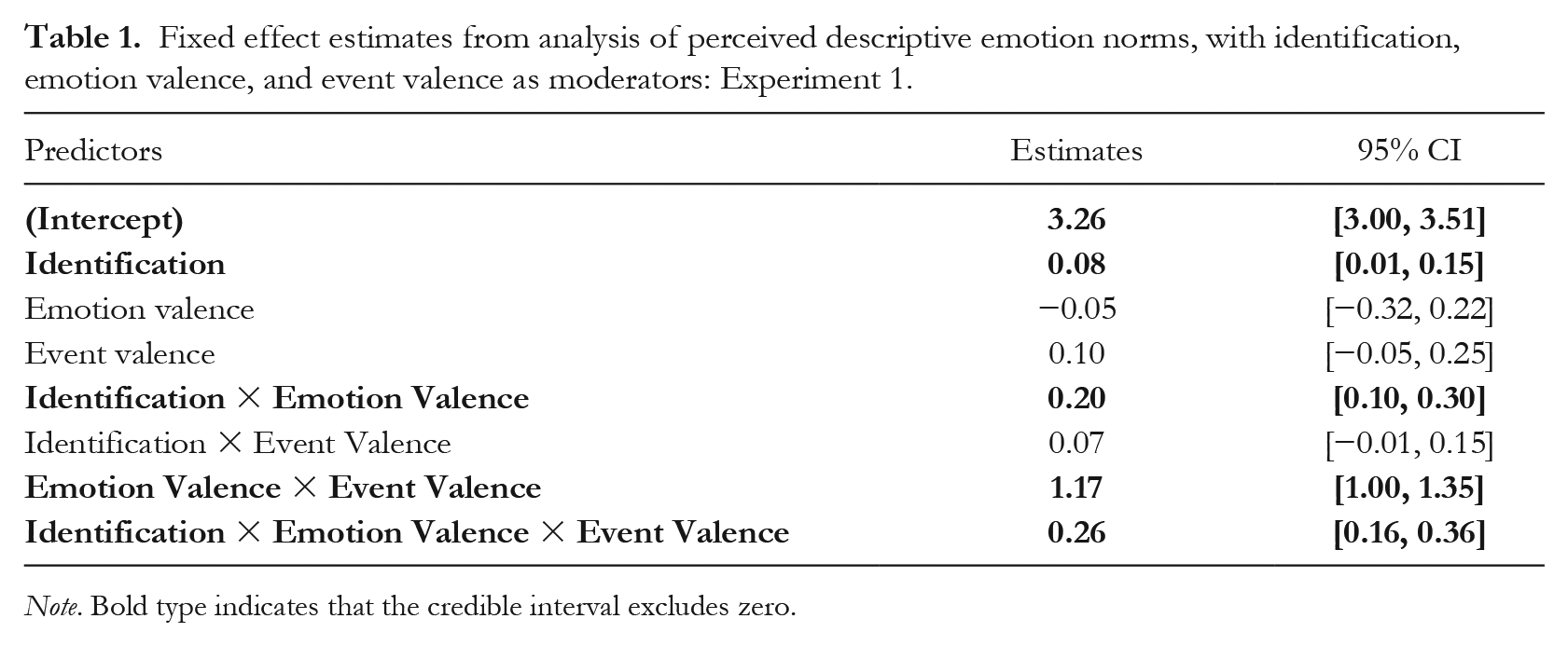
Manipulation of the valence of events to which participants responded was intended to change perceived descriptive emotion norms for their ingroup. Table 1 displays the fixed effect estimates for the multilevel analysis predicting perceived group descriptive emotion norms from manipulated event valence, with centered identification, emotion valence, and event valence as potential moderators. A strong two-way interaction between the manipulated event valence and emotion valence showed that, as expected, the manipulation significantly affected both perceived positive and perceived negative descriptive emotion norms, in opposite directions. For positive events, means for positive and negative descriptive emotion norms were, M = 4.49, 95% CI [4.09, 4.84]; M = 2.23, 95% CI [1.86, 2.61], respectively. For negative events, means for positive and negative descriptive emotion norms were, M = 1.94, 95% CI [1.45, 2.43]; M = 4.38, 95% CI [3.86, 4.85], respectively. The three-way interaction of event valence, emotion valence, and identification indicated that high identifiers (compared to low identifiers) perceived more extreme descriptive emotion norms in the direction appropriate to the event (positive or negative). In addition, identification increased the overall intensity of descriptive norms for both positive and negative emotions (Identification main effect), and also increased the relative positivity of descriptive emotion norms (Identification × Emotion Valence).
Fixed effect estimates from analysis of perceived descriptive emotion norms, with identification, emotion valence, and event valence as moderators: Experiment 1.
Note. Bold type indicates that the credible interval excludes zero.
Effectiveness of event manipulation on perceived injunctive emotion norms
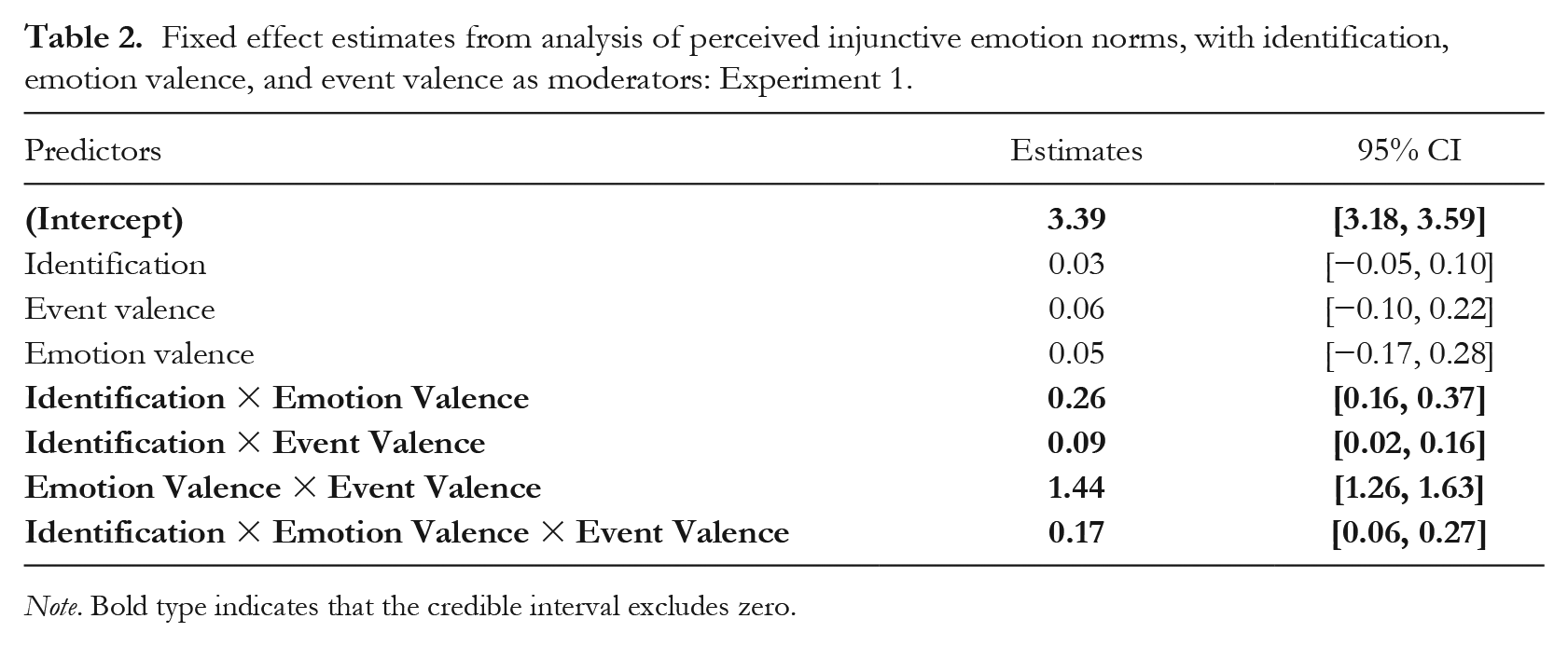
Manipulation of the valence of events to which participants responded was also intended to change perceived injunctive emotion norms in their ingroup. Table 2, like Table 1, shows a strong two-way interaction between the manipulated event valence and emotion valence. As intended, the manipulation significantly affected both perceived positive and perceived negative injunctive emotion norms, in opposite directions. For positive events, means for positive and negative injunctive emotion norms were, M = 4.95, 95% CI [4.64, 5.28]; M = 1.96, 95% CI [1.64, 2.29], respectively. For negative events, positive and negative injunctive emotion norms had the following means: M = 1.94, 95% CI [1.48, 2.40]; M = 4.72, 95% CI [4.26, 5.16], respectively. As above, the significant three-way interaction of event valence, emotion valence, and identification indicated that high identifiers (compared to low identifiers) showed the just-described Event Valence × Emotion Valence interaction to an even greater extent. Identification also increased the level of both positive and negative emotion injunctive norms for positive events (Identification × Event Valence), as well as the relative positivity of perceived injunctive norms (Identification × Emotion Valence).
Fixed effect estimates from analysis of perceived injunctive emotion norms, with identification, emotion valence, and event valence as moderators: Experiment 1.
Note. Bold type indicates that the credible interval excludes zero.
Influence of perceived descriptive and injunctive emotion norms on group-based emotions
We modeled group-based emotions as resulting from the influence of the perceived descriptive norm and the perceived injunctive norm, treated as additive effects because preliminary analyses showed no significant interactions between the two types of norms. Identification, event valence, and emotion valence were treated as moderators, and participant and emotion as random effects. The order in which perceived descriptive and injunctive norms were assessed was not included in the model as group-based emotions were reported before that manipulation occurred.
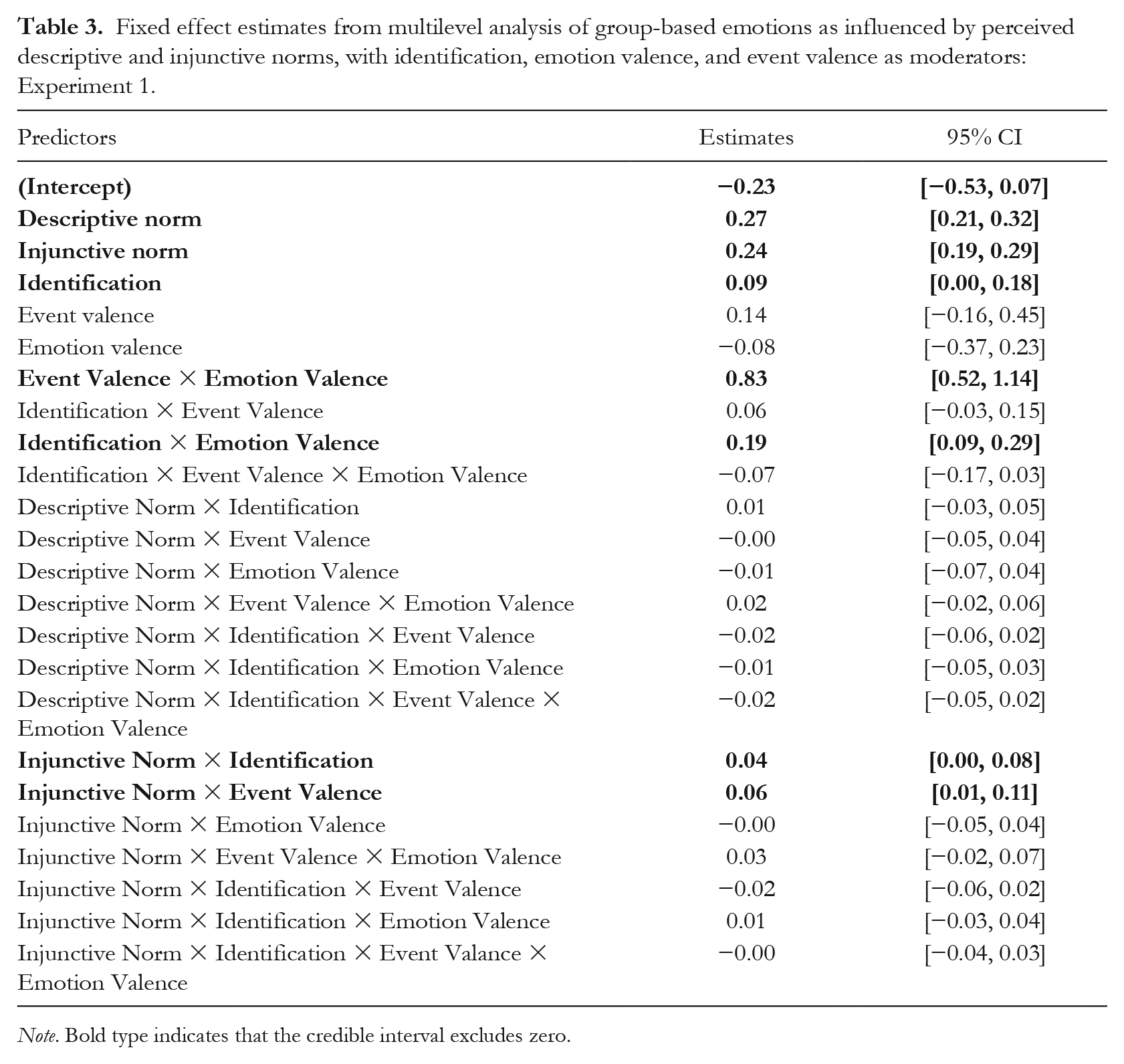
Group-based emotion fixed effect estimates appear in Table 3. The experimental manipulation of event valence strongly affected the valence of reported emotions, as shown by the significant Event Valence × Emotion Valence interaction. As expected, the event valence manipulation affected both positive and negative group-based emotions, in opposite directions. For positive events, means for positive and negative emotions were, M = 3.97, 95% CI [3.36, 4.57]; M = 2.46, 95% CI [1.86, 3.06], respectively. For negative events, positive and negative emotions had the following means: M = 2.01, 95% CI [1.41, 2.61]; M = 3.82, 95% CI [3.21, 4.40], respectively.
Fixed effect estimates from multilevel analysis of group-based emotions as influenced by perceived descriptive and injunctive norms, with identification, emotion valence, and event valence as moderators: Experiment 1.
Note. Bold type indicates that the credible interval excludes zero.
Consistent with Hypothesis 1a and replicating previous findings, there was a strong effect of the perceived descriptive norm. The Event Valence × Emotion Valence effect revealed that the experimental manipulation of event valence had a direct effect on group-based emotions as well as an indirect effect through perceptions of the ingroup descriptive emotion norm. Hypothesis 1b was also supported by the strong effect of the perceived injunctive norm, which was independent of and additive to the descriptive norm effect. As with the descriptive norm, the experimental manipulation of event valence had an indirect effect on emotions through its influence on perceived injunctive norms. Perceptions of injunctive emotion norms had more influence on emotional reactions to positive than to negative events (significant Injunctive Norm × Event Valence interaction).
We had no predictions about the relative strength of descriptive compared to injunctive norms, and estimates of their fixed effects and confidence intervals were very similar.
Hypotheses 2a and 2b predicted moderation of the influence of emotion norms by group identification. Contrary to Hypothesis 2a, identification did not moderate the impact of the perceived descriptive emotion norm on experienced emotions. Consistent with Hypothesis 2b, identification moderated the influence of perceived injunctive norms (the significant Injunctive Norm × Identification interaction). As expected, the group-based emotions of those with higher, relative to lower, identification were more strongly influenced by perceived injunctive norms.
Consistent with Hypothesis 3, a strong interaction between identification and emotion valence indicated that high identification was associated with reports of greater positive, relative to negative, emotions compared to low identification. In addition, higher levels of identification increased the reported intensity of group-based emotions overall.
The results of Experiment 1 provided evidence for the direct causal influence of manipulated event valence as well as an indirect effect of the manipulation, acting through both types of perceived emotion norms, on experienced emotions toward group-relevant events. In addition to replicating Mackie et al. (2024) by showing the significant influence of descriptive emotion norms on group-based emotions, results revealed a novel independent and similarly strong influence of injunctive emotion norms.
Identification processes influenced group-based emotions in two ways. First, high identification increased the influence of injunctive norms as expected, but not the influence of descriptive norms, a mixed result considered further in the General Discussion. Second, identification strongly increased positive, relative to negative, emotions in response to group-relevant events, independent of the influence of descriptive or injunctive norms, replicating previous findings on group-based emotions (Smith et al., 2007).
Experiment 2
In Experiment 2, we examined the impact of descriptive and injunctive emotion norms and the moderating effects of identification on group-based emotions toward members of outgroups as an additional test of our hypotheses. Positive or negative outgroup-directed emotions can reduce or exacerbate (respectively) negative evaluations of and discriminatory actions toward outgroups (Mackie & Smith, 2018). We assessed the group-based emotions of members of three different ingroups (Americans, Democrats, and White people) toward members of two relevant outgroups (Iranians or Russians; Republicans or Libertarians; Black people or Latino(a) people, respectively). We also assessed participants’ perceptions of descriptive and injunctive ingroup norms about emotion toward these outgroups.
We again expected support for Hypotheses 1a and 1b (norm effects on reported emotions) and 2a and 2b (high identifiers more influenced by perceived emotion norms than low identifiers). Because emotions toward the outgroup do not directly implicate the positivity of the ingroup, Hypothesis 3 was not relevant to this experiment.
Method
Participants and design
One hundred fifty-seven self-identified American White Democrat participants were recruited from Prolific to participate in this IRB-approved study for $2.30. One participant provided no data, and two failed to respond to the ingroup membership question, preventing ingroup activation. Ten participants assigned to the Democrat condition responded “no” to the question “Are you a registered Democrat?” and their data were excluded; 51% of the final sample of 144 reported male gender, 46% female gender, with 3% not responding (age data were not collected). As described above, this sample size provides sufficient power to detect norm effects, but inadequate power for the hypothesized Norm × Identification interactions.
Procedure
All study materials were administered through Qualtrics. After agreeing to participate, participants were randomly assigned to the American, White, or Democrat condition, and responded to the question “Are you an American [a White person/a registered Democrat]?” as appropriate for the condition, intended to activate ingroup membership. All participants in the final sample responded “yes.”
Group identification
Participants reported how strongly they identified with their American, White, or Democrat ingroup (Roccas et al., 2008). Reliabilities were high for all groups (.95, .92, .96, respectively). Reported identification was significantly higher for Americans (M = 4.08) and Democrats (M = 4.20; these groups did not differ) than for Whites (M = 3.17), F(2, 141) = 11.39, p < .001.
Outgroup-directed group-based emotions
Participants reported the emotions they felt towards two ingroup-relevant outgroups (presented in random order) by responding to the prompt: “As a(n) [American/White person/Democrat], to what extent do you feel the following emotions toward [Iranians/Russians; Black people/Latino(a) people; Republicans/Libertarians]?”
Participants reported the extent to which they felt seven different randomly ordered pairs of emotions (adapted from Cottrell & Neuberg, 2005; Seger et al., 2017) using 7-point Likert scales (1 = not at all, 7 = very much). Three emotion pairs were positive (admiring and respectful, proud and pleased, warm and close) and four were negative (angry and resentful, afraid and anxious, disgusted and sickened, guilty and ashamed).
Perceived descriptive and injunctive emotion norms
To measure perceived descriptive norms, participants reported: “To what extent do most [Americans/White people/Democrats] feel the following emotions toward [the outgroup]?” To measure injunctive norms, participants reported: “To what extent do most [Americans/White people/ Democrats] think [Americans/White people/Democrats] should feel the following emotions toward [the outgroup]?” Participants responded to these questions using the emotion scales just described.
Finally, participants answered demographic questions and were debriefed and thanked for their participation.
Results and Discussion
Perceived descriptive and injunctive emotion norms for outgroup-directed group-based emotions
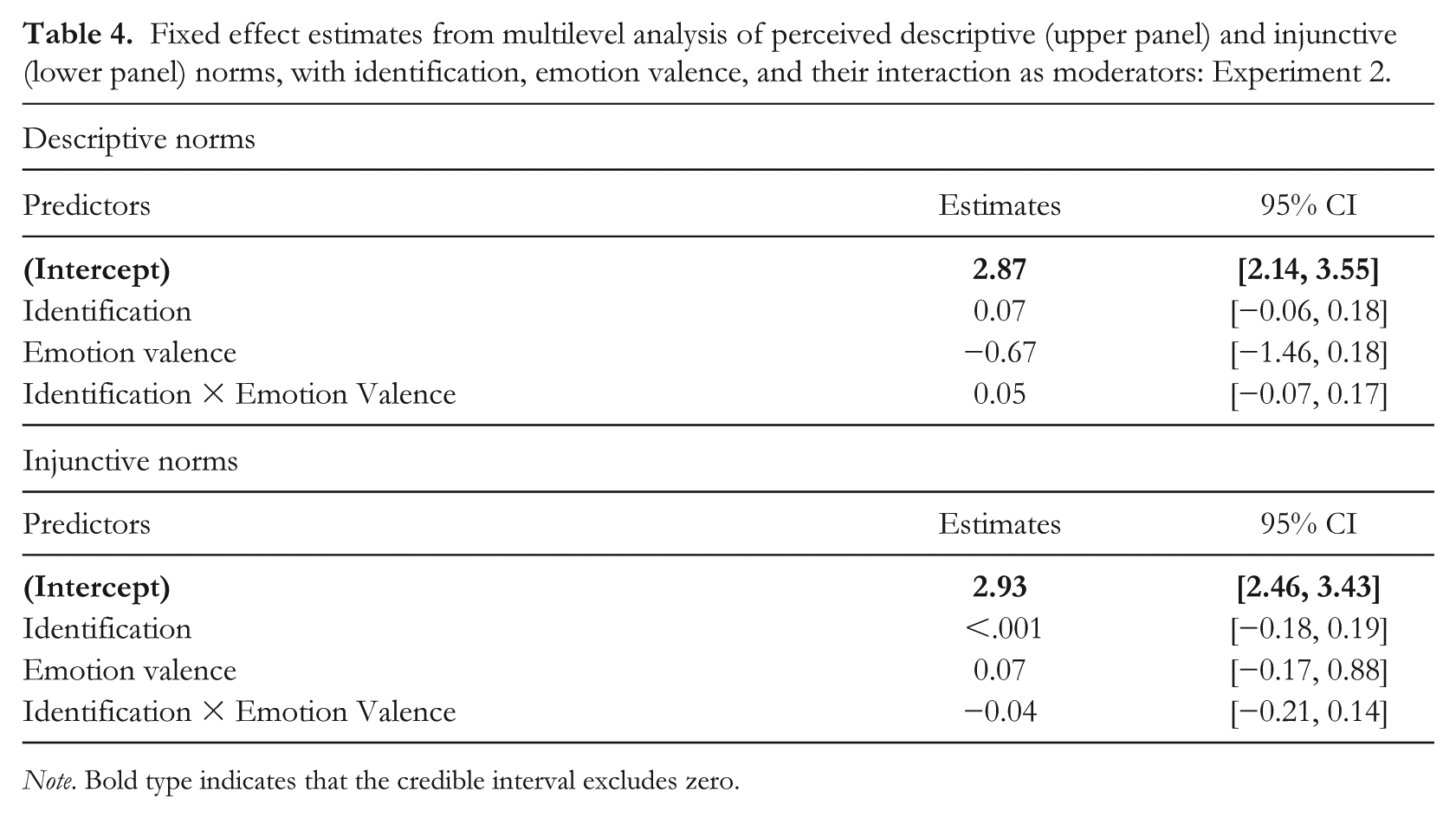
Table 4 displays the fixed effect estimates from multilevel analyses predicting perceived descriptive and injunctive emotion norms regarding outgroup-directed emotions from centered identification, emotion valence, and Identification × Emotion Valence as potential moderators. Unlike in Experiment 1, none of these fixed effects were significant for either type of norm.
Fixed effect estimates from multilevel analysis of perceived descriptive (upper panel) and injunctive (lower panel) norms, with identification, emotion valence, and their interaction as moderators: Experiment 2.
Note. Bold type indicates that the credible interval excludes zero.
Influence of perceived descriptive and injunctive emotion norms on outgroup-directed group-based emotions
As in Experiment 1, initial analyses revealed no interactions between descriptive and injunctive norms. Outgroup-directed group-based emotions were therefore modeled as resulting from the perceived descriptive and injunctive emotion norms (as additive effects), moderated by identification and emotion valence, with participant and emotion as random effects. Outgroup was also included as a random factor, as we sought to show that the impact of descriptive and injunctive norms on group-based emotions toward outgroups generalizes not only across the specific outgroups included in the study but also to other levels of that random factor (the six outgroups used here exceed the recommended number for such an analysis; Kenny & Judd, 2019). Generalization across the six outgroups also entails generalization across the three ingroups.
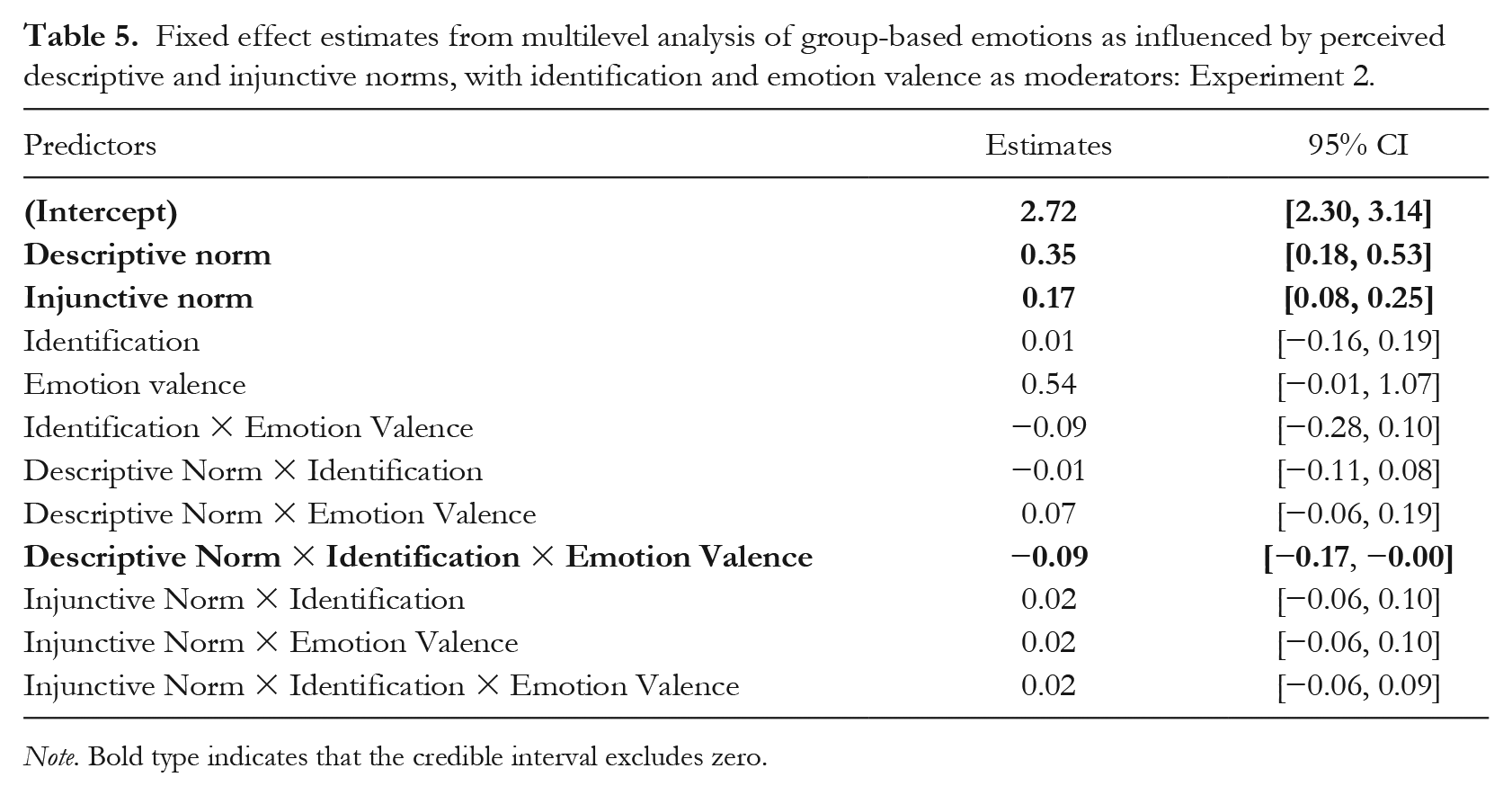
Fixed effect estimates are shown in Table 5. Consistent with Hypotheses 1a and 1b, outgroup-directed group-based emotions were significantly influenced by perceptions of both the ingroup’s descriptive and injunctive emotion norms. Although we made no prediction about the relative strength of these effects (and found little difference in Experiment 1), the influence of the descriptive norm was descriptively twice as large (0.35 vs. 0.17) but not quite significantly stronger than the influence from the injunctive norm (p = .056).
Fixed effect estimates from multilevel analysis of group-based emotions as influenced by perceived descriptive and injunctive norms, with identification and emotion valence as moderators: Experiment 2.
Note. Bold type indicates that the credible interval excludes zero.
Hypotheses 2a and 2b again received only qualified support. The influence of perceived descriptive emotion norms was stronger for those with higher identification as predicted, but only for negative emotions. Identification failed to moderate injunctive influence, inconsistent with predictions and the results of Experiment 1.
Overall, outgroup-directed emotions were (perhaps surprisingly) more positive than negative, as shown by the positive, although not quite significant, emotion valence effect. The means showed that emotion valence differed dramatically across outgroups, being relatively more positive to racial/ethnic outgroups, neutral toward national outgroups and Libertarians, and relatively more negative toward Republicans. Ingroup identification had no significant effect on the valence of emotions toward outgroups, being associated neither with more positivity (as it was for emotions toward ingroup events in Experiment 1, and both studies in Mackie et al., 2024) nor with more negativity, as might have been expected.
Notably, the significant impact of emotion norms held over and above variation across the six different outgroups (and therefore the three different ingroups). To test specifically for the generality of effects across outgroups, we compared the fit of the overall model shown in Table 5 with the fit of restricted models that omitted the respective random effects (for descriptive norm and injunctive norm) by outgroups. With those random effects omitted, the effect of the predictor is constrained to be equal for all six outgroups, rather than varying, and the question is whether the decrease in fit from this restriction is significant (specifically, whether it exceeds 2 times its calculated standard error). For the descriptive norm effect, restricting the model revealed a decrease in fit of 6.79, with standard error of 12.46. For the injunctive norm effect, the decrease was 1.59, with standard error of 11.55. For the Descriptive Norm × Identification × Emotion Valence interaction, the decrease in fit was 1.89, with standard error of 6.29. None of these were significant, showing that all three significant effects generalized well across outgroups. These findings extend the results of Mackie et al. (2024), which showed that effects of descriptive emotion norms and identification on emotions toward ingroups generalized across different types of ingroups. The current finding shows that norm and identification effects on emotions toward outgroups generalized across several distinct outgroups.
General Discussion
Self-Categorization Effects on Experienced Group-Based Emotions
Across two experiments, we found strong support for the simultaneous influence of both descriptive and injunctive norms on experienced group-based emotions (Hypotheses 1a and 1b), whether those emotions were about ingroup-relevant events or about specific outgroups. The results of Experiment 2 further indicated that these influences generalized well across several types of ingroups and outgroups, whether political, ethnic, or national. While replicating the influence of descriptive norms on experienced emotions found in Mackie et al. (2024), these results also provide novel evidence of an independent influence of injunctive emotion norms. The effects are independent in the sense that each of the two norm measures explains unique, statistically significant variance in experienced emotions, which could not happen if the two measures were redundant or if either was pure random error. Although these results confirm the benefit of distinguishing descriptive and injunctive norms, their independence may have been magnified by our “should” operationalization of injunctive norms, consistent with their typical operationalization as reflecting ingroup members’ approval or disapproval (Cialdini et al., 1990). Future research might assess the effect of operationalizations closer to a social categorization perspective on injunctive norms as reflecting the exemplary essence of group membership.
We made no predictions about the comparative strength of descriptive and injunctive norm effects on emotions: Findings on their relative strength in other domains are voluminous but decidedly mixed. In Experiment 1, the two effects were similar in size, but in Experiment 2, the influence of descriptive norms was descriptively, though not significantly, stronger than that of injunctive norms. Dominance of descriptive over injunctive norms is consistent with the view that descriptive norms operate as a kind of “social autopilot,” exerting their direct influence almost automatically. But it has also been suggested that injunctive norms act as a “social radar,” so the inherent sociality of emotion (and particularly group-based emotions) could mean that injunctive norms might dominate over descriptive ones (for a review of both these approaches, see Morris et al., 2015). Because the influence of descriptive and injunctive norms did not statistically differ in either of the current studies, our results provide limited evidence regarding these possibilities.
Moderation of Self-Categorization Effects on Experienced Group-Based Emotions by Identification
Evidence for the hypothesized moderation of the adoption of emotion norms by identification (Hypotheses 2a and 2b) was qualified and inconsistent. In Experiment 1, identification moderated the influence of the injunctive norm as predicted, but not of the descriptive emotion norm. In Experiment 2, identification did not moderate the impact of injunctive norms, and the influence of descriptive emotion norms was greater for those with higher identification as predicted, but only for negative emotions. This result is reminiscent of the finding that identification increased the impact of descriptive norms only on emotions about negative events in Mackie et al. (2024, Experiment 2). Despite evidence across multiple domains that high identifiers are more likely to be influenced by group-defining norms, the current work and the two 2024 studies provide little consistent evidence of such moderation. Of four experiments that assessed descriptive emotion norms, two showed no moderation and two showed moderation for negative events or negative emotions only. The current two studies also measured injunctive norms, and only one showed moderation.
Why might the evidence be so mixed? First, if this is a small effect, as it was in the results of Mackie et al. (2024), neither of the current studies was well powered to find it. However, the small size of such an effect would have troubling implications for this fundamental tenet of the social identity approach.
A second consideration is that either descriptive or injunctive norms might be more relevant in a given situation, so identification may moderate the effect of one norm but not necessarily the other. For example, in Experiment 1, identification moderated the impact of injunctive, but not descriptive, norms on group-based emotions. In Experiment 2, identification influenced the impact of descriptive norms, albeit only for negative emotions about outgroups, but not injunctive norms. Assessment of this possibility would require multiple studies systematically assessing both descriptive and injunctive norms (perhaps using several operationalizations), and measuring emotions directed at various types of group-relevant targets.
A third possibility is that a more motivationally urgent ingroup situation or intergroup threat than participants faced in these studies is necessary to reliably trigger identification moderation effects. We see hints of this in Experiment 2, where identification moderates the influence of descriptive norms but only for negative emotions. Very high salience of a competitive outgroup or identity threat might increase the impact of identification on adherence to either or both descriptive and injunctive emotion norms (Giannakakis & Fritsche, 2011; Hogg & Reid, 2006).
A fourth possibility involves the observation that group members’ perceptions of group emotion norms can themselves be shaped by identification. In Experiment 1, both perceived descriptive norms and perceived injunctive norms showed strong Identification × Emotion Valence × Event Valence three-way interactions. Compared to low identifiers, high identifiers estimated both descriptive and injunctive ingroup emotion norms as significantly more extreme—relatively more positive for positive ingroup events and more negative for negative ingroup events. The same interaction was found for perceived descriptive norms in Mackie et al. (2024, Experiment 2). Consider two options. (A) More highly identified group members perceive norms as more extreme, then conform to those norms to the same extent as less identified members. Statistically, identification would have a mediated effect on emotions, operating through perceived norms. This is the pattern found in Experiment 1 for descriptive norms. (B) Everyone perceives the same norms, but more highly identified group members adhere more strongly to the norms. Statistically, identification would moderate the effect of norms on emotions (an Identification × Norm interaction). This pattern can be seen in Experiment 2 for the effect of the descriptive norms on negative emotions. Importantly, in both situations (A and B), the resulting group-based emotions would appear similar: Higher identification would be associated with more extreme group-based emotions in the direction dictated by the norm. Whether identification affects perceived norms or moderates the strength of norm adherence (or both) can be determined only in further studies that measure perceived norms as well as emotions.
Research from the social identity perspective has assumed Pathway B (and scaffolded our predictions), but has given little consideration to Pathway A. As Tankard and Paluck (2016; see also Hogg & Reid, 2006) make clear, active construction and negotiation of norms through ongoing social communication and interaction is much more common than the availability of objective and accurate norm information. Thus, identification effects on perceived norms might be widespread; for example, motivations triggered by a group membership’s importance to the self might drive constructed perceptions of the group as experiencing extremitized ingroup emotions. When norms are externally given, on the other hand, those motivational forces might result in norms being more strongly adopted, as we predicted (and as found by Moons et al., 2009). Another possibility is that highly identified group members might resist externally given emotion norms that they believe do not represent the best of the ingroup (Goldenberg et al., 2016). Thus, identification may influence the perception or acceptance of emotion norms that then indirectly influence experienced emotion, even if identification does not directly moderate the effect of norms. These different pathways through which identification might affect ingroup-relevant thoughts, feelings, and behaviors of course remain speculative, pending more studies comparing effects of identification when norms are given or constructed. Although the majority of norm–behavior studies assess both norms (either perceived or given) and behavior, the majority lack measures of identification, unless they adopt a specifically social identity approach (Christensen et al., 2004; Iacoviello et al., 2017; Moons et al., 2009; Terry & Hogg, 1996).
Although the evidence for the hypothesized moderation of the influence of both descriptive and injunctive emotion norms on experienced emotion by identification in these studies is variable and unstable, our results suggest that identification may affect self-categorization effects not only by influencing the degree to which norms are adopted, but also by shaping the norms that are perceived in the first place.
Moderation of Valence Effects on Experienced Group-Based Emotions by Identification
In regard to Hypothesis 3, increased identification in Experiment 1 was clearly and strongly associated with greater relative positivity of emotions about group events. This replicated the effect found in Mackie et al. (2024; Smith et al., 2007) for emotions focused on ingroup-relevant events. These results are consistent with highly identified group members’ motivation to maintain and enhance the positive benefits of group membership to the self, consistent with social identity approaches. Interestingly, however, identification also increased the positivity of both perceived descriptive and injunctive norms, and therefore affected group-based emotions indirectly (mediated through norms) as well as directly (the Identification × Emotion Valence interaction for emotions; similar to the two ways in which identification might operate, as discussed in the previous section). These routes may have subtly different effects. A highly identified group member who perceives the norms as more positive and then conforms to them will believe that their emotions are similar to those of most other group members (i.e., to the descriptive norm). In contrast, a highly identified member who feels positive emotions as a direct effect of identification (not mediated by norm perception) is likely to perceive the self as more positive than other group members. This might contribute to individual self-esteem or otherwise affect the individual’s relation to the group, intriguing avenues for further research.
We neither predicted nor found that stronger identification would increase the positivity of emotions directed toward outgroups in Experiment 2. Nor did we observe a different plausible outcome: Highly identified ingroup members might report relatively more negative emotions toward competitive outgroups. More robust associations of identification with negative emotions toward outgroups might be found in situations of intense intergroup conflict or threat that produce more clearly and consistently negative emotions about an outgroup.
Limitations
These experiments (like many studies of the impact of norms on emotion) relied on self-reports of emotion. While self-report may be the best measure of the subjective experience of emotion, self-reported emotions about ingroup- and outgroup-relevant events and targets may be subject to other influences. It is clear that self-reported group-based emotions are accompanied by related cognitive and motivational consequences, such as risk-taking and arousal (Rydell et al., 2008), and identification and behavioral changes (van Zomeren et al., 2004), suggesting the validity of these reports and their consistency with RII. At the same time, the tenets underlying the social construction of emotion are supported by evidence that correlations of appraisal, physiology, and behavioral outcomes are themselves dependent on context, chronology, and culture, including, as Vishkin et al. (2023) point out, norms about the occurrence, longevity, and intensity of the correlates.
Our analyses assume that descriptive and injunctive emotion norms causally influence reported group-based emotions. Three issues relate to this. First, in both experiments we measured emotions before measuring norms. Previous research has shown effects of objective (statistically calculated) emotion norms on group-based emotions in studies where norms were not explicitly activated or assessed (e.g., Mackie et al., 2024, Experiment 1), suggesting that norms are spontaneously activated to some extent when people report their emotions. Asking about norms before emotions would make norms even more salient (Cialdini et al., 1990), artifactually strengthening relations between norms and emotions. In these studies, as in any research involving measurement of closely related constructs (e.g., attitudes and behavior), the order of measurement is always a complex decision for researchers.
Second, as self-categorization assumes, people often match their own thoughts, feelings, or actions to relevant norms (also sometimes called self-stereotyping; Otten & Epstude, 2006). But people can also estimate norms based on their own attributes (termed self-anchoring; e.g., “I am a typical group member, so if I feel this emotion most group members probably do”). In general, there is considerable theoretical support for the causal effect of norms on individual responses, going back to classic attitude theories (Fishbein & Ajzen, 1975). Numberless experiments have manipulated norm information and demonstrated effects on participants’ own responses, including in the domain of emotion norms (Leonard et al., 2011; Moons et al., 2009). In addition, Experiment 1 (and Mackie et al., 2024, Experiment 2) manipulated group norms by assigning the valence of events about which participants reported their emotions. Thus, there is extensive support for the causal direction we assume. However, we cannot rule out the opposite causal effect, that norms were inferred from personal responses. To the extent that this process occurred in these studies, our results may overestimate the strength of the effect of norms on emotions. A fuller picture likely can be gained only from longitudinal studies measuring changes in emotions and norms in a sample followed over time.
Third, studies show that people sometimes infer a descriptive norm based on an injunctive one, or vice versa (Chen et al., 2002; Morris et al., 2015). However, in both Experiments 1 and 2, the descriptive and injunctive norm measures each predict unique, independent variance in reported emotions. Thus, though the norm measures may be somewhat correlated, they are demonstrably not completely redundant.
It is also possible that some of the self-categorization and identification effects that we document here might be particularly strong among the individualist participants recruited in these studies. Generally, members of individualist cultures actually adhere more closely to descriptive emotion norms than do members of interdependent cultures (Vishkin et al., 2023; despite some earlier work suggesting the opposite, e.g., Bond & Smith, 1996; Gelfand et al., 2011). Regarding identification, we know of no research that compares the strength of identification with ingroups, or of the impact of identification on self-categorization effects, among individualist compared to interdependent participants.
Conclusion
This work builds on previous demonstrations that descriptive emotion norms influenced experienced group-based emotions, effects that generalized across multiple intimacy, task, and social category ingroups (Mackie et al., 2024). The current findings extend our understanding of the impact of emotion norms on emotion in multiple ways. First, the current research fills a gap by focusing on emotional consequences of the internalization of norms that is inherent to self-categorization (J. C. Turner, 1982). Second, our approach accounts for the role of injunctive as well as descriptive emotion norms in group-based emotions. Our findings provide novel support for simultaneous, independent effects of both types of norms, confirming the benefits of distinguishing them. Third, we show self-catergorization effects not only for emotions about ingroup-relevant events (Experiment 1) but also emotions about outgroups—which have major potential consequences for intergroup relations and conflict (Experiment 2). Experiment 2 also showed that these effects generalize across multiple ingroups and outgroups. Fourth, Experiment 1 provided further strong evidence for the role of identification in making experienced emotions about ingroup-relevant events relatively more positive. Experiencing positive emotions toward the ingroup itself or group-related events appears to reflect highly identified group members’ motivation to maintain a favorable image of the ingroup. Fifth, our results suggest that identification may affect group-based emotion (or other outcomes) in three distinct ways: By shaping perceived norms, by influencing the degree to which norms are adopted, or by directly influencing emotions (or other outcomes), independent of the group norm. Investigation of which of these effects occurs under what conditions offers promising directions for future research.
Broadly, all these findings provide further support for the role of self-categorization processes (particularly RII) in constructing the subjective sense of group membership. The major puzzle that these and the earlier results pose is the relatively weak and inconsistent evidence for the strong theoretical prediction of moderation of self-categorization processes by group identification. As discussed, several potential explanations for these observations offer avenues for further research.
We attribute the impact of emotion norms on group-based emotions not to some special property of norms regarding emotion but to the fundamental mechanisms underlying the subjective sense of group membership and identification with the group, as described by the social identity approach. These same mechanisms might equally explain the impact of other social contexts on emotions. For example, self-categorization and identification may contribute to the well-documented effect of cultural context on experienced emotion, consistent with recent depictions of cultures as norm-based rather than value-based (Gelfand & Jackson, 2016; Morris et al., 2015). Such models suggest that a cultural group’s characteristic patterns of thought and behavior (and, we would add, emotion) derive not from each individual’s unique personal self but from their sense of a shared context that is subjectively experienced as a group membership or social identity. Similar arguments could be made about the shared experience of dyadic relationships or identity as a couple. When a social relationship defines an identity, emotions experienced in the context of that relationship might well be characterized by the same fundamental processes of group membership examined here.
Footnotes
Acknowledgements
We thank members of the Social Evaluations and Emotions Lab and the Intergroup Lab at University of California, Santa Barbara (UCSB) for their valuable comments and insights.
Authors’ Note
Both experiments were approved by UCSB’s Institutional Review Board (Protocols 173-24-04597, June 27, 2015; 173-21-0608, September 27, 2021). Participants actively agreed to participate after receiving true information about the purpose, procedures, risks, benefits, confidentiality, payment, and right to refuse or withdraw before data collection.
Data Availability Statement

Funding
The author(s) disclosed receipt of the following financial support for the research, authorship, and/or publication of this article: This research was supported by UCSB College of Letters & Sciences grants to Diane Mackie in 2016 and 2021.