



Abstract
We tested three hypotheses derived from intergroup emotions theory: that group-based emotions, emotions felt as a member of a group, (1) are influenced by group norms, (2) especially for highly identified group members, and (3) are relatively more positive for highly identified members. Hypothesis 4 tested the prediction that these self-categorization, normative influence, and identification processes hold across memberships in exemplars of intimacy, task, and social category groups, which differ from one another in structural and functional characteristics. Two studies using three different samples found strong consistent support for Hypotheses 1 and 3, and only partial support for Hypothesis 2 (high identification increased the power of group norms on group-based emotions about only negative events). These findings held across multiple exemplars of the three group types, regardless of whether group-based emotions were targeted or untargeted, and regardless of whether emotion norms were empirically derived or based on group members’ perceptions.
People experience many of their emotions in the context of group memberships (Iyer & Leach, 2008; Mackie & Smith, 2015). For instance, we experience group-based emotions toward specific targets (“As an American, I feel angry toward White supremacists”) or events (“As an environmentalist, I feel satisfaction when subsidies for electric vehicles are announced”). We also feel emotions associated with a particular group identity (feeling anger as a woman, but disappointment as a fan of a losing team, and so forth), which need not have a specific target.
The distinctive nature of such group-based emotions, emotions that one experiences as a group member, is well established. For example, changes in the psychological salience of membership in any of the myriad groups to which people belong change the emotions group members feel about specific events (Dumont et al., 2003; Gordijn et al., 2006) and about objects such as ingroups and outgroups (Mackie & Smith, 2018; Ray et al., 2008; Yzerbyt & Kuppens, 2009). The group-based emotions group members feel can be quite different from the emotions experienced when thinking of themselves as individuals (Smith et al., 2007). Unlike general evaluative measures, such group-based emotions predict distinct behavioral responses toward both ingroups (Barsade & Knight, 2015; Maitner et al., 2007; Mengus & Kilduff, 2015; Smith et al., 2007) and outgroups (Leach et al., 2006; Leonard et al., 2011; Smith et al., 2007; van Zomeren et al., 2004).
Intergroup emotions theory (IET; Mackie & Smith, 2015, 2018; Mackie et al., 2000; Smith, 1993, 1999) assumes that group-based emotions follow from general processes fundamental to group membership. In the current work, we argue that processes fundamental to membership in any psychologically significant group (Turner, 1982) produce group-based emotions. Specifically, we first tested three hypotheses, that group-based emotions are produced by the group-level processes of self-categorization, normative influence, and identification. We also tested a fourth hypothesis, previously unexamined in the group-based emotion literature, that group-based emotions experienced in any type of psychologically significant group depend on the same processes of categorization, normative influence, and identification, despite the many structural differences that distinguish different types of groups.
Group-Based Emotion Processes: Hypotheses 1–3
Based on the social identity approach (Abrams & Hogg, 2010), IET assumes group-based emotions are an inevitable consequence of the processes involved in membership in psychologically important groups: self-categorization, normative influence, and identification (Mackie & Smith, 2015, 2018; Porat et al., 2020; Smith et al., 2007). Self-categorization refers to the perception of oneself as a group member similar to other group members rather than as a unique individual. Normative influence is the mechanism by which this occurs: adoption or internalization of typical or representative thoughts, feelings, behaviors, and attributes associated with group membership (Turner, 1982; Turner et al., 1987). Such descriptive norms (what group members think, feel, or do; Cialdini et al., 1991) may be conveyed explicitly (“Americans generally support U.S. assistance with Ukraine’s war effort”) or inferred from experience with the group (“Lots of people here are flying Ukrainian flags; it seems that Americans support Ukraine’s war efforts”; Tankard & Paluck, 2016). Identification measures the extent to which group membership is psychologically central and important to the group member (Deaux, 1996). Three hypotheses about group-based emotions follow from the role of these three processes characteristic of and distinctive to group membership.
Hypothesis 1: Reflecting group-level processes of self-categorization and normative influence, the group-based emotions experienced by members of a group are significantly influenced by the ingroup’s emotion norms.
As part of the process by which individuals come to see themselves as interchangeable representatives of their group, group members self-stereotype by internalizing group norms (Smith, 1999; Turner et al., 1987). Just as group members adopt the typical or prototypical characteristics and behaviors of the ingroup, group-based emotions are also influenced by the normative or typical emotions of members of the ingroup. For example, participants whose American nationality was made salient and who were explicitly told that “Americans report very low levels of anger” (i.e., low anger is normative for Americans) reported experiencing lower levels of anger than did participants told that “Americans report extremely high levels of anger” (Moons et al., 2009). Similarly, women who were shown information that women on average feel considerable anger (depicted as 6 on a scale where 7 equaled very angry) reported feeling significantly more anger as a woman, compared to women who saw women’s average anger depicted as 2 on the scale where 1 was labeled as very little anger (Leonard et al., 2011). These studies manipulated descriptive emotion norms, representations of the typical or average reported emotional experience of ingroup members.
Hypothesis 2: Reflecting group-level processes of normative influence and identification, the extent to which members identify with their membership group moderates the influence of group norms on group-based emotions, so that high identifiers are more influenced by group norms than low identifiers.
Consistent with other findings that show self-stereotyping to be stronger in high than low identifiers (Leach et al., 2008; Pickett et al., 2002), Moons et al. (2009) found that female high identifiers were more likely than low identifiers to report emotions closer to manipulated information about other women’s emotions. Similarly, Crisp et al. (2007) found highly identified team fans to experience more closely normative group-based emotional reactions to losses versus wins compared to less identified fans. Correlational data also reveal that highly identified Americans, Republicans, and Democrats expressed emotions closer to average ingroup emotions than their less identified counterparts did (Smith et al., 2007, Experiment 2).
Hypothesis 3: Reflecting group-level processes of identification, the extent to which members identify with their membership groups is associated with the relative positivity of group-based emotions.
Previous research documents a positive relation between group identification and the experience of positive group-based emotions (e.g., Smith et al., 2007). Highly identified group members are typically more invested in maintaining a positive image of the ingroup, and doing so is consistent with experiencing positive emotions toward the group itself and in response to events or objects that benefit the group. The relation between identification and negative group-based emotions is more complex. Some studies have demonstrated positive relationships between identification and negative emotions (such as feeling guilt when the ingroup acknowledges wrongdoing, Doosje et al., 2006; or feeling anger when an ingroup is harmed, Gordijn et al., 2006; Yzerbyt et al., 2003). However, other studies find weak, variable, or even negative associations with identification (e.g., guilt following intergroup aggression, Gordijn et al., 2006; especially when it benefits the ingroup, Maitner et al., 2007; see also Smith et al., 2007). Taken together, these findings suggest that identification interacts with the valence of emotion, such that high identification is more strongly associated with the experience of positive emotions than with negative emotions.
Generalization Across Group Types: Hypothesis 4
Most research on the importance of self-categorization, normative influence, and identification for group-based emotions derives from studies focused on membership in social category groups (from nationality, gender, and occupational groups to attitudinal groups and sports fans; Crisp et al., 2007; Doosje et al., 2006; Gordijn et al., 2006; Moons et al., 2009; Smith et al., 2007). Complementing the work in social category groups, research on group-based emotions in work groups (Garcia-Prieto et al., 2007; for a review, see Menges & Kilduff, 2015) and sports teams (Campo et al., 2012, 2019) has increased dramatically in the last decade. Still, there has been no systematic comparison of the impact of categorization-induced normative and identification processes on group-based emotions in the significantly different types of groups in which humans spend much of their lives.
Different group types have been differentiated in terms of perceived structural features (Deaux et al., 1995; Lickel et al., 2000; McGrath, 1984), relationship focus (Prentice et al., 1994), and functional needs (Aharpour & Brown, 2002; Johnson et al., 2006). These classifications converge in distinguishing three types of groups. 1 Intimacy or close groups (such as family or friends), which fulfil affiliation needs, are seen as high in perceived entitativity (being a coherent unit), interaction, duration, and psychological importance, but low in permeability (the ease with which members enter or leave the group) and size. Task groups (such as committees, sports teams, or work groups that come together to achieve some common goal), which fulfil achievement needs, are perceived as high in interaction, moderate in entitativity, permeability, and importance, but as smaller and short-lived. Social category groups (like gender, nationality, and political affiliation), seen as fulfilling identity needs, are high in size, duration, and importance, but lower in entitativity, permeability, and often interaction.
Such distinctions might well suggest differences in the operation of group-based emotions in these different kinds of psychologically important groups. However, even though group emotion norms may be more easily ascertained, spread, and monitored in the face-to-face interactions of intimacy and task groups (Barsade & Knight, 2015; Tanghe et al., 2010), emotion norms can also be conveyed without direct contact in large dispersed social category groups through stereotypes, media, similarities in appraisal, or merely as a consequence of self-categorization (Moons et al., 2009; Smith et al., 2007). Similarly, despite group differences in needs, the functions of identification, including the general motivation to see the ingroup in a positive light, are likely similar across group types (Turner & Onorato, 1999). These considerations led us to test a fourth hypothesis.
Hypothesis 4: Reflecting the fundamental consequences of group membership processes of self-categorization, normative influence, and identification for emotions in any group, Hypotheses 1 to 3 generalize across membership in different groups and group types.
To test these hypotheses about group-based emotions across group types, in three data collections (analyzed here as two studies), we randomly assigned participants to think about their membership in one of six exemplar groups representing close, task, or category groups, and had them report their positive and negative group-based emotions (emotions as a group member) without a specific target (Experiment 1) or toward a specific positive or negative group-relevant target event (Experiment 2). In Experiment 1, we assessed emotion norms as the average emotions reported in a group. In Experiment 2, asking about positive compared to negative events served as a manipulation of group emotion norms, and we directly assessed perceived descriptive emotion norms by asking participants what they thought most other ingroup members felt about those specific events.
Analytic Approach
Testing group-based emotion processes: Norm and bias model
West and Kenny’s (2011; Stern & West, 2018) truth and bias model statistically examines the independent effects of different sources of influence that might affect a judgement. Applied to a data set, the model yields regression coefficients that indicate the strength with which each factor uniquely affects the judgment. The model is estimated by centering all variables (the judgment as well as each source of influence) at the mean of the “truth” variable. The model also allows for potential moderators, variables that are theoretically expected to modify the strength of any effect in the model. Moderation effects are estimated in the usual way, by centering the moderator variable at its own mean and including multiplicative terms in the regression model.
We adapted this model to test our hypotheses; because “truth” is not relevant here, we term our version the norm and bias model. Our dependent variable is participants’ reports of group-based emotions. Our key predicted source of influence is the ingroup emotion norm: a significant effect of the norm on participants’ reported group-based emotions reflects normative influence. One potential source of bias in reports of group-based emotion is respondents’ current individual-level or group-irrelevant emotions, which may nevertheless contaminate group-based judgments (Payne et al., 2010). Smith et al. (2007) found correlations between group-based and individual emotions ranging from .24 to .53. The basic model equation is:

The coefficient of the norm variable (b1) indicates the strength of the norm effect, the normative influence processes that pull the reported emotion toward the norm value. The coefficient b2 indicates the strength of processes that pull reported emotions toward spillover effects of individuals’ current emotional state. The intercept (a) indicates the direction and size of any directional effect. If a is significant and positive, for example, it means that group-based emotion reports are systematically higher than the norm value.
Group identification is the key variable theoretically expected to moderate the power of the norm and the intensity of group-based positive versus negative group-based emotions. By adding appropriate product terms to the basic model equation, we examined potential moderation of norm effects by group identification and by emotion valence, as well as by event valence in Experiment 2 (but omitted theoretically irrelevant interaction effects with individual emotion, after preliminary analyses showed them to be negligible).
Our first three hypotheses map directly onto components of the norm and bias model.
Hypothesis 1: Group-based emotions experienced by people categorized as group members are influenced by ingroup emotion norms, so that members’ group-based emotions will be influenced by (actual or perceived) normative or average emotions of members of the ingroup. This hypothesis corresponds to a significant effect of the ingroup norm (a norm effect).
Hypothesis 2: The extent to which members identify with their membership group moderates the influence of group norms on group-based emotions, so that high identifiers are more influenced by group norms than low identifiers. This hypothesis predicts moderation of the norm effect by identification, an Identification × Norm interaction.
Hypothesis 3: The extent to which members identify with their membership group is associated with the relative positivity of group-based emotions. This hypothesis corresponds to an Identification × Emotion Valence interaction, with highly identified group members expected to report relatively stronger positive than negative group-based emotions.
Assessing generalization across groups and group types: Multilevel analysis
We used a multilevel analysis that treated group exemplars and emotions as well as participants as random factors. We considered groups as a random factor to assess Hypothesis 4 regarding the extent to which the hypotheses hold across different groups and group types. We also considered emotions (within valence) as a random factor because our predictions are not about specific emotions (e.g., pride or guilt) but only about emotion valence.
The multilevel approach allowed us to examine whether the effects predicted in Hypotheses 1 to 3 significantly influenced group-based emotions over and above random variation due to participants, specific emotions, or, particularly important theoretically, the various membership groups to which participants were assigned (Brauer & Curtin, 2017; Kenny & Judd, 2019). The analysis included the norm and bias predictors as fixed effects, as well as random intercepts and random slopes for each predictor by participant, emotion, and group. The fixed effect estimates in the analysis represent results that hold not only across the groups included in the analysis but that are also expected to generalize to other levels of that random factor (i.e., still other groups), just as typical data-analytic approaches identify findings expected to generalize to other participants beyond those included in the analysis. At least five groups are needed for such analyses (Kenny & Judd, 2019), and our analyses adhere to this guideline.
We used a Bayesian approach to estimate the model (OSF.IO project details here, https://osf.io/wb2eu/?view_only=b009abb21ba04c5ca2f0aaab31cc923c), and we interpreted the fixed effects found in the multilevel norm and bias analysis and their posterior 95% credible intervals. For key results, we also present the model-estimated standard deviation of the group random effects (i.e., the variability in the effect across groups) to demonstrate the relative consistency of the results across groups.
No explicit power recommendations are reported for use of the truth and bias model, and estimating power for effects in multilevel models is complex. As an alternative, we adhered to a common rule of thumb for power considerations in regression analyses, ensuring that the number of participants exceeded 10 per predictor plus 50 for Experiment 1 (N = 376, eight predictors) and Experiment 2 (N = 248, 16 predictors).
Experiment 1
To test Hypotheses 1 to 4, we asked participants in two different samples (total N = 376) to report their individual emotions, randomly assigned them to think about membership in one of six exemplar groups representing close, task, or category groups, and had them report their group-based emotions as a group member without a specific target (as in Smith et al., 2007).
Method
Participants
One hundred sixty-five undergraduate students at a large state university (first data collection) received partial course credit, and 211 MTurk participants (second data collection; 343 participants were recruited, data from 66 who could not correctly identify the group to which they were assigned were not analyzed) received US$1.00 for participation. Each data collection was in this study approved by the Institutional Review Board of the university where the data were collected. The first sample was 43.4% female; 33.3% White, 6.8% African American, 5.5% Asian, 46.6% Hispanic/Latinx, 7.8% others; and ranged in age from 18 to 50 years (M = 22.61, SD = 4.33). The second sample was 62% female; 100% White; 2 and ranged in age from 20 to 70 years (M = 43.84, SD = 12.34). The analysis, by including the 12 groups from the two data collections as a random factor, automatically also accounts for any potential differences between samples.
Procedure
After giving informed consent, all participants were told they would be asked about different groups that people may belong to, and how they feel as a member of these groups. Participants received instructions and manipulations, and completed measures online. For all materials, data, code books, and analysis code for both experiments, see the OSF page of the project (https://osf.io/wb2eu/?view_only=b009abb21ba04c5ca2f0aaab31cc923c).
Individual emotions
First, individual emotions were measured by asking participants to report the extent to which they were “feeling right now” six positive (satisfied, hopeful, proud, happy, grateful, and respectful) and six negative (angry, afraid, disgusted, uneasy, guilty, and irritated) emotions, each on 7-point Likert scales (1 = not at all, 7 = a lot). Emotions were presented in randomized order.
Membership manipulation
Participants in each data collection were then randomly assigned to one of six exemplar groups representing three group types.
Participants in the first data collection were assigned by being told “Please indicate to what extent you agree with the following statements that are about you and [exemplar name].” Participants in the second data collection were assigned by being asked to think about themselves “as a member of [exemplar name]. Close groups were represented by the exemplars of “your family” (in both data collections), “your friends” (Data Collection 1), and “your close friends” (Data Collection 2). Task groups were represented by “your class project group” and “your organizational committee” or “sports team” (to ensure that participants would have experience with at least one exemplar of this kind) in the first data collection, and by “your workgroup/committee” and “your competitive group/team you are or have been a member of” in the second. Social category groups were represented by nationality (“Americans”) and gender (“your gender”) in the first data collection, and by nationality (“Americans”) and political affiliation (“Democrats” or “Republicans,” depending on how participants self-identified) in the second. These groups constituted the 12 levels of the group random factor included in the multilevel model.
Exemplar group identification
Participants then reported their identification with the assigned group using a four-item Group Identification Scale (derived from Doosje et al., 1995, used by Smith et al., 2007). The items (“I see myself as a member of this group,” “I am pleased to be a member of this group,” “I feel strong ties with this group,” and “I identify with this group”) were rated on 7-point Likert scales with higher numbers indicating greater agreement. As can be seen in Table 1, membership in all close, intimacy, and social category exemplar groups in both data collections was equally psychologically important to participants, ranging from 5.33 to 6.30, with the exception of class project group (M = 4.59), which differed in identification from family (in both data collections), close friends (in the second data collection), and gender (in the first data collection); all ps < .005, F(11, 361) = 3.32, p < .001.
Mean group identification by exemplar: Experiment 1.
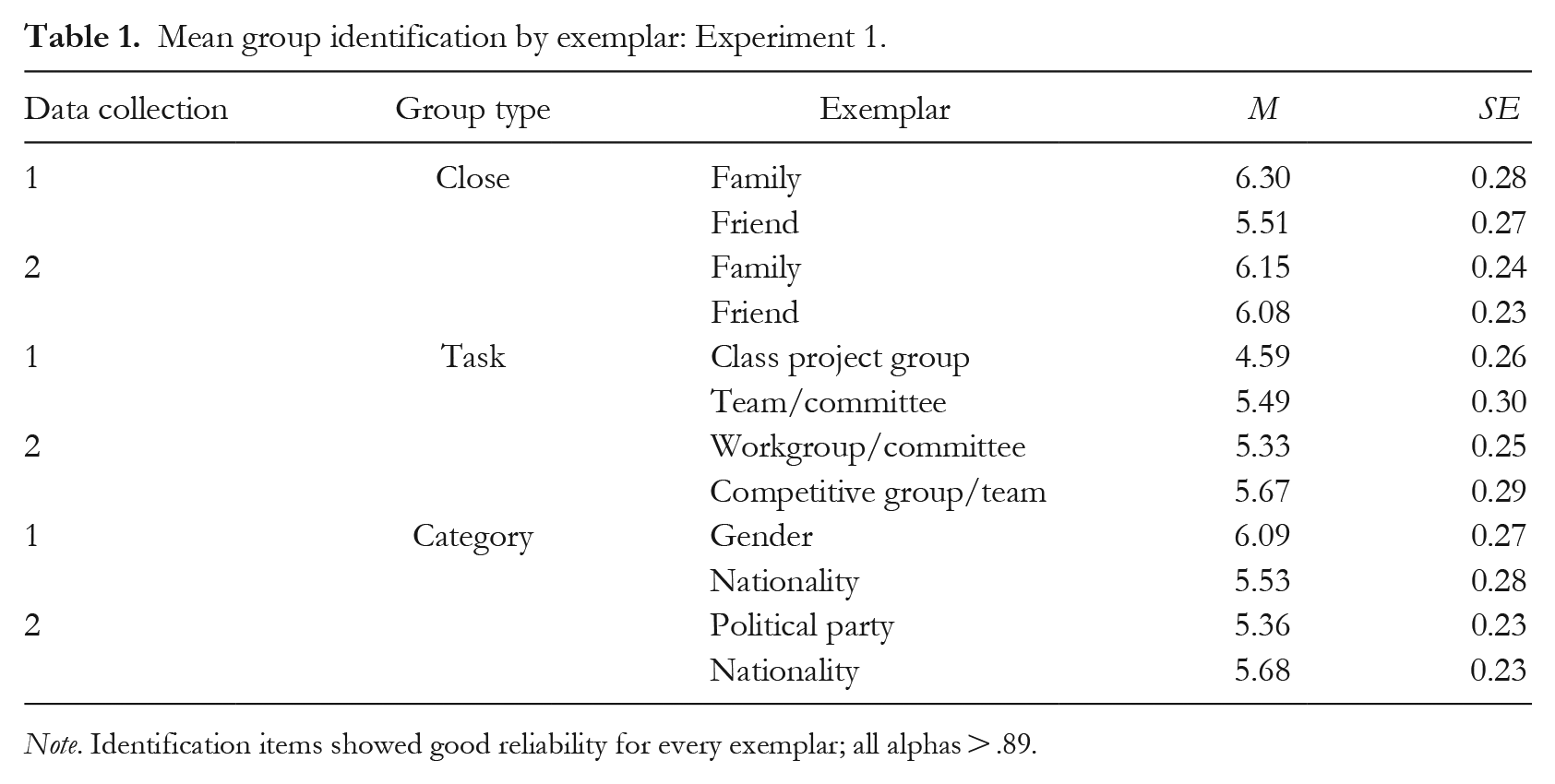
Note. Identification items showed good reliability for every exemplar; all alphas > .89.
Group-based emotions
Participants then read, “This scale consists of a number of words that describe different feelings and emotions. As a member of [exemplar name], to what extent do you feel each of the following emotions?” (Smith et al., 2007). The same set of 12 randomized emotion items and associated response scales used for individual emotions were used for measuring group-based emotions.
Calculation of ingroup emotion norms
For each ingroup, emotion norms were calculated as the mean of each group-based emotion reported by all participants assigned to that ingroup. That is, for the workgroup/committee condition, the pride emotion norm was the mean of responses by all participants in that condition to the question “As a member of your workgroup/committee, to what extent do you feel pride?” This resulted in emotion norm values for each of the 12 emotions (six positive and six negative) for each ingroup. These mean values represent descriptive emotional norms (what other group members do; Cialdini et al., 1991). Note that this assessment of ingroup emotion norms captures the commonalities in members’ emotions as group members within exemplars, despite the fact that individual group members are thinking about different families, different groups of close friends, different committees, and so forth, while retaining differences in emotions across different group types and exemplars.
Finally, participants provided demographic data, and were debriefed and thanked.
Results and Discussion
Test of group-based emotion process hypotheses
Table 2 displays the fixed effect estimates for the key variables and interactions from the multilevel analysis. Supporting Hypothesis 1, there was a significant effect of the norm, indicating that reported group-based emotions were influenced by the descriptive group emotion norm. Regarding Hypothesis 2, there was an interaction of Norm × Group Identification whose credible interval just excluded zero, but in the opposite direction from that predicted. This result indicated that more highly identified members were slightly less influenced by the norm, compared to less identified members. Despite this unpredicted interaction, the norm effect was nevertheless significant and positive for all participants. For participants 1 SD below the mean of group identification (−1.40), the estimated coefficient of the norm was 0.98 (95% CI [0.85, 1.12]), whereas it was 0.76 (95% CI [0.63, 0.90]) for participants 1 SD above the mean (+1.40). In addition, there was a main effect of group identification, indicating that, overall, more highly identified group members reported higher levels of group-based emotions compared to less identified members. Finally, supporting Hypothesis 3, group identification interacted with emotion valence, showing that more highly identified group members reported relatively more positive than negative group-based emotions. The expected influence of current individual emotions, considered a bias in the model, was also present.
Fixed effects estimates from multilevel analysis of group-based emotions, with identification and emotion valence as moderators: Experiment 1.
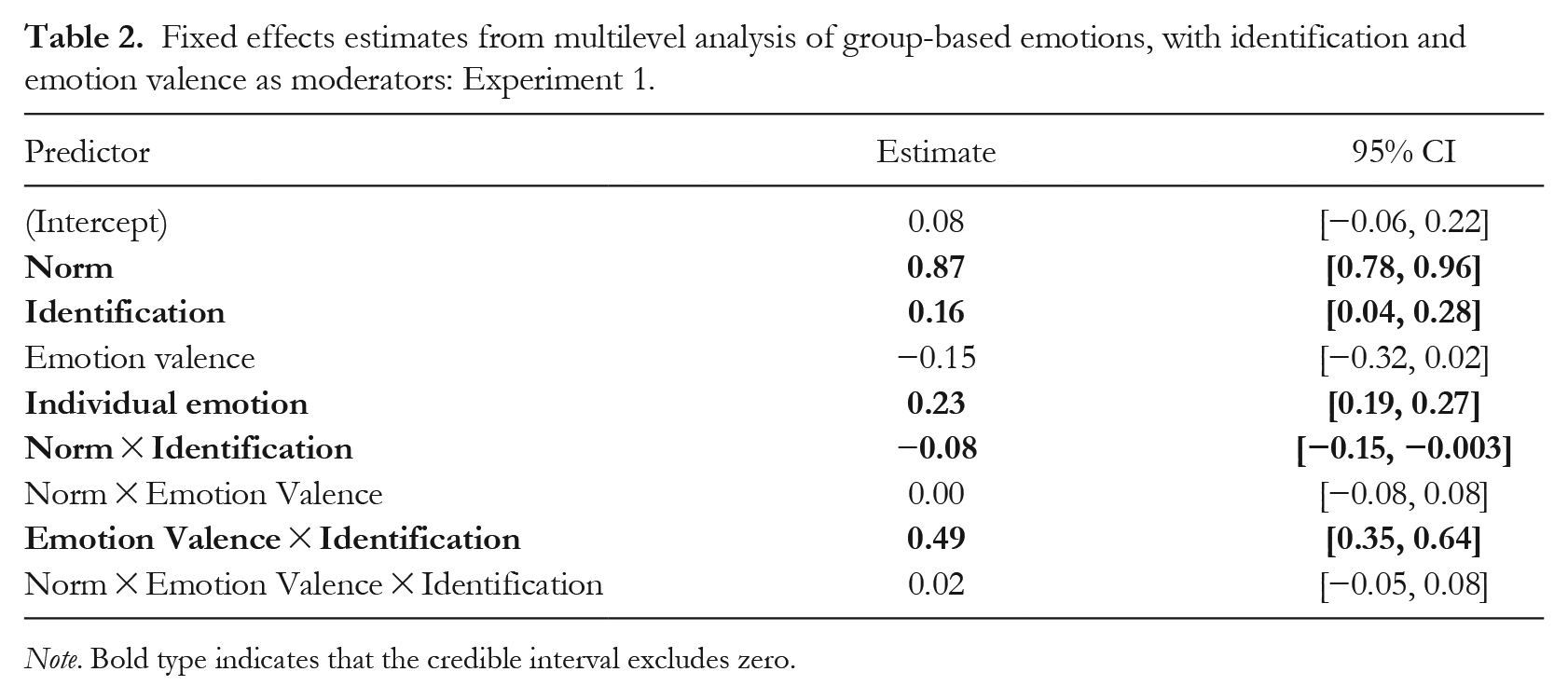
Note. Bold type indicates that the credible interval excludes zero.
Test of generalization across groups
The analytic approach using group as a random effect allowed us to demonstrate that these fixed effects held across all 12 groups in this analysis. First, for the norm effect (Hypothesis 1), the standard deviation of the random effect for groups was 0.035, with estimated coefficients for all 12 groups being extremely close to the overall fixed effect coefficient of 0.88. Thus, the support for Hypothesis 1 was similarly strong across the 12 exemplar groups. For the Valence × Group Identification interaction (Hypothesis 3), where the overall fixed effect was 0.49, the random effect standard deviation for groups was 0.13, and the effects for all groups fell between 0.38 and 0.53.
Another way to assess the consistency of results across groups is to compare the variability in responses due to individual participants with the variability due to group assignment. For example, the standard deviation of the random intercept for participants was 0.37, and for groups was 0.04, indicating that the overall level of group-based emotions varied much more among individual participants than among the specific groups to which participants were assigned. The standard deviation of the random slope of the norm effect (Hypothesis 1) for participants was 0.05, and for groups was 0.04. For the Group Identification × Valence interaction (Hypothesis 3), the random slopes for participants and for groups had similar standard deviations of 0.13. Thus, the variation in results across the diverse groups and group types examined in this analysis was comparable to or smaller than the variation due to participants.
The results of Experiment 1 supported two of the three key predictions about group-based emotions, findings that were consistent across membership in 12 different exemplars spanning three group types. Hypothesis 1, that group-based emotions are influenced by normative or average emotions of members of the ingroup, was supported by the significant effect of the norm variable. Hypothesis 3, that identification is associated with the relative positivity of group-based emotions, was supported by the significant Group Identification × Emotion Valence interaction. Hypothesis 2 predicted that group identification moderates the influence of group norms on group-based emotions, such that high identifiers are more influenced by group norms than low identifiers. Unexpectedly, this group identification by norm coefficient was significant but slightly negative, with high identifiers slightly less influenced by norms. We do not speculate about this unexpected result at this point, pending a replication in Experiment 2.
Consistent with Hypothesis 4, the significant results for Hypotheses 1 and 3 held regardless of the group types (from family to Americans, competitive teams to one’s gender group) and the specific groups within group type exemplars (individuals’ own particular families, close friend groups, committees, and so forth) to which participants were assigned to consider their membership.
Experiment 2
Experiment 1 provided evidence of the effect of ingroup emotion norms on group-based emotions (Hypotheses 1 and 3) using the average of such emotions reported by other members of the ingroup to represent the norm. In Experiment 2, we sought to generalize these effects, provide causal evidence for the role of normative influence, and perhaps find supporting evidence for Hypothesis 2.
Although averaging other ingroup members’ emotions might well be the most accurate statistical representation of the descriptive norm for a group, social perceivers rarely have complete or accurate information about normative thoughts, feelings, or behaviors in a group. Instead, the strongest vehicle of norm-related influences on responses is typically members’ perception of group norms (Prentice & Miller, 1993; Tankard & Paluck, 2016). In Experiment 2, we directly measured each participant’s perception of the relevant descriptive ingroup emotion norm, asking what they thought most other ingroup members feel.
In Experiment 1, participants reported group-based emotions without being provided an explicit target for those emotions. In Experiment 2, we manipulated the valence of a group-relevant event and assessed group members’ perceived emotion norms and their emotions about that event. We expected to see the same processes at work for group-based emotions triggered by a specific target event, providing experimental evidence of normative influence on group-based emotions.
Method
Participants and design
A sample of 302 participants was recruited through MTurk and offered US$1.00 in exchange for their participation. Five participants who failed at least one attention check question, and 49 participants who failed either the group assignment or the event valence manipulation check were dropped from the analysis. Of the final sample (N = 248, all of whom were U.S. citizens), 59.7% were female and 39.1% were male; 73.8% were White, 10.1% Black, 8.1% Asian, 5.6% Latinx, 0.4% Native American, 0.4% Middle Eastern, and 1.6% indicated other or multiple ethnicities. The sample ranged in age from 18 to 72 years (M = 39.21, SD = 13.56). Participants were randomly assigned to one of 12 conditions of a 6 (group membership) × 2 (valence of event) between-subjects design.
Procedure
All participants gave informed consent for this experiment, which was approved by the Instituitonal Review Board of the university where the data were collected.
Individual emotions
Participants reported to what extent they felt “right now” the six positive and six negative emotions presented in Experiment 1, randomly ordered and assessed on the same scales.
Membership manipulation
Participants were then told to think about themselves as a member of one of the randomly assigned six exemplar groups representing three group types: “your family,” “your close friend group” (close groups); “your workgroup/committee,” “your competitive team” (task groups); political party (“Democrats” or “Republicans,” depending on participants’ self-categorization) or nationality (“Americans”; social category groups).
Exemplar group identification
Participants were instructed to answer the following questions while thinking about themselves as a member of their assigned exemplar group. Participants then completed the same four identification items used in Experiment 1. As can be seen in Table 3, identification with all close, task, and category groups was equally high, F(5, 242) = 1.35, p = .246.
Mean group identification by exemplar: Experiment 2.
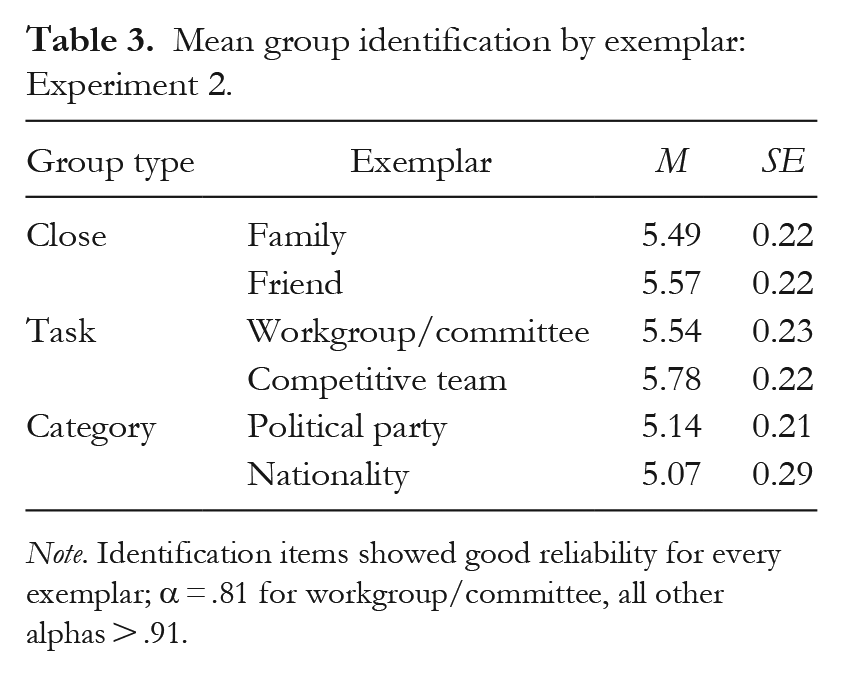
Note. Identification items showed good reliability for every exemplar; α = .81 for workgroup/committee, all other alphas > .91.
Manipulation of perceived emotion norms via ingroup-relevant event valence
Participants were next randomly assigned to either the positive or negative condition. Participants assigned to the positive condition were asked to think about “a success, a good thing, or a positive event” that happened to their group in the last 5 years and describe it in one or two sentences. Participants assigned to the negative condition were asked to think about “a failure, a bad thing, or a negative event” that happened to their group in the last 5 years and write one or two sentences about it. Manipulation of event valence was intended to manipulate participants’ perceptions of the appropriate ingroup emotion norms for such events (see Crisp et al., 2007).
Group-based emotions
Participants were asked to rate the extent to which, as a member of their assigned group, they felt each of the same 12 emotions, randomly presented and assessed as in Experiment 1, when thinking about the positive or negative event.
Perceived group-based emotion norms
Participants then rated the extent to which they believed other members of their group feel the same set of emotions, randomly presented and assessed as in Experiment 1, when thinking about the event. Participants in the positive condition were asked “To what extent do you think other members of your [exemplar group] feel the following emotions when thinking about this positive event?” Participants in the negative condition were asked “To what extent do you think other members of your [exemplar group] feel the following emotions when thinking about this negative event?” Each participant’s perception of the norm for group-based emotions was used as the norm variable for that participant.
Attention and manipulation checks
All participants responded to two attention questions that directed them to respond in a specific way (e.g., “For this question, please choose ‘Very much’”). They also reported the group membership they had been assigned to think about, and provided a few sentences of description of the group as a manipulation check.
Finally, participants reported demographic information and were debriefed and thanked.
Results and Discussion
Effectiveness of event manipulation on perceived group emotion norms
Manipulation of the valence of events to which participants responded was intended to change the emotions that they perceived to be normative in their ingroup. Table 4 displays the fixed effect estimates for the multilevel analysis predicting (centered) perceived group emotion norms from manipulated event valence (and individual emotions as a possible biasing factor), with identification, emotion valence, and event valence as potential moderators. There was a significant effect of the experimental manipulation, a significant effect of emotion valence, and a strong two-way interaction between the two factors. As intended, the manipulation significantly affected both perceived positive and perceived negative emotion norms, in opposite directions (see Figure 1, left panel). In addition, the three-way interaction of event valence, emotion valence, and identification indicated that high identifiers perceived more extreme emotion norms in the appropriate (positive or negative) direction than low identifiers. There was also a small effect of individual emotions.
Fixed effects estimates from multilevel analysis of perceived group emotion norms, with identification, emotion valence, and event valence as moderators: Experiment 2.
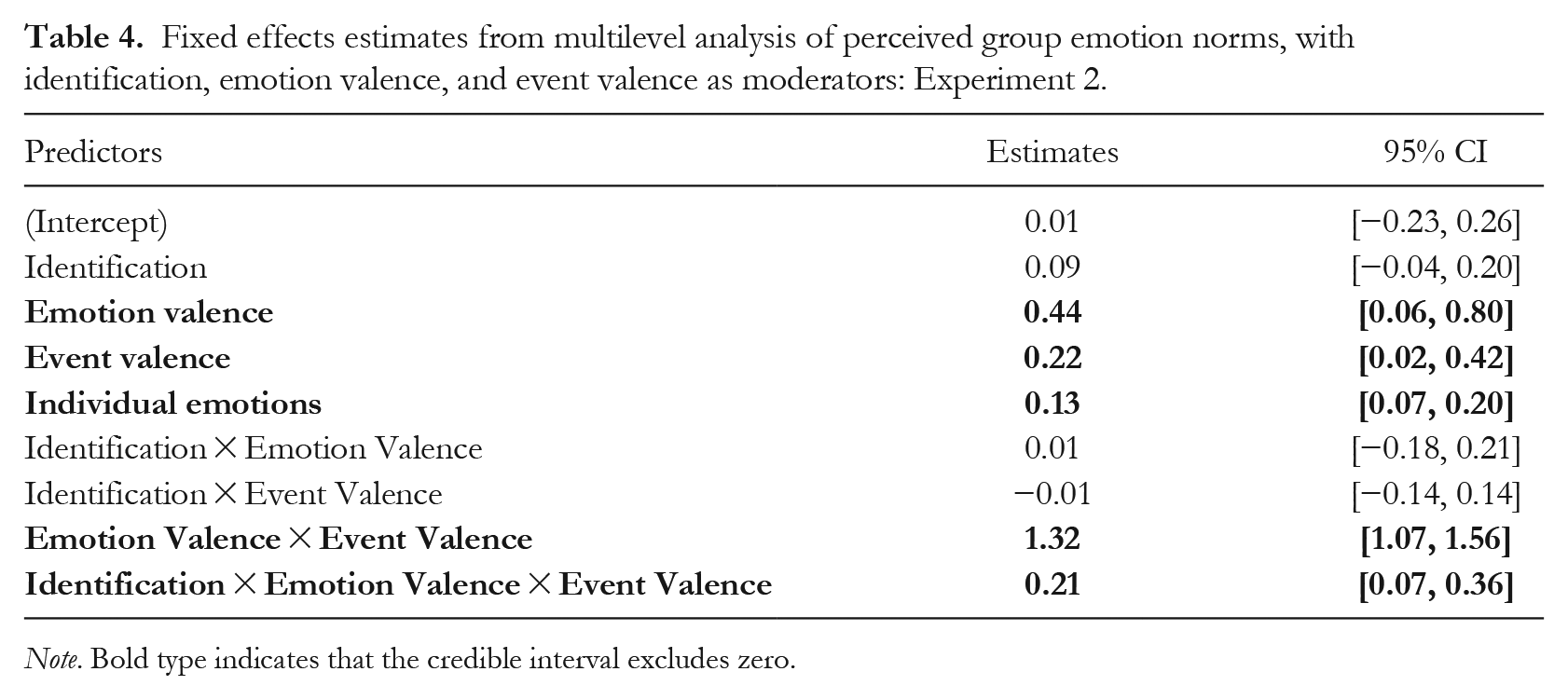
Note. Bold type indicates that the credible interval excludes zero.
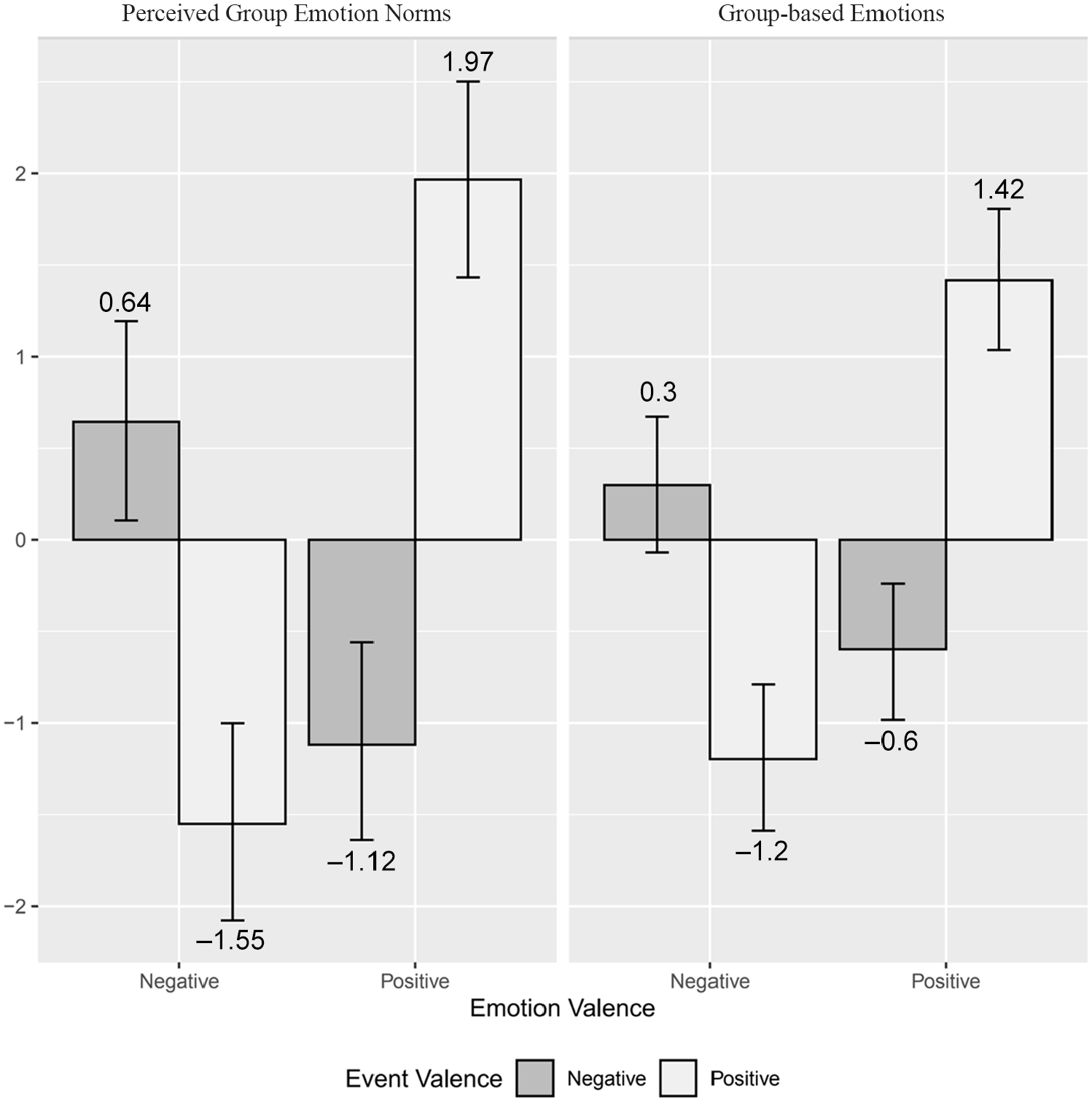
Means of centered perceived group emotion norms (left panel) and centered reported group -based emotions (right panel), by emotion valence and the manipulation of event valence: Experiment 2.
Test of group-based emotion process hypotheses
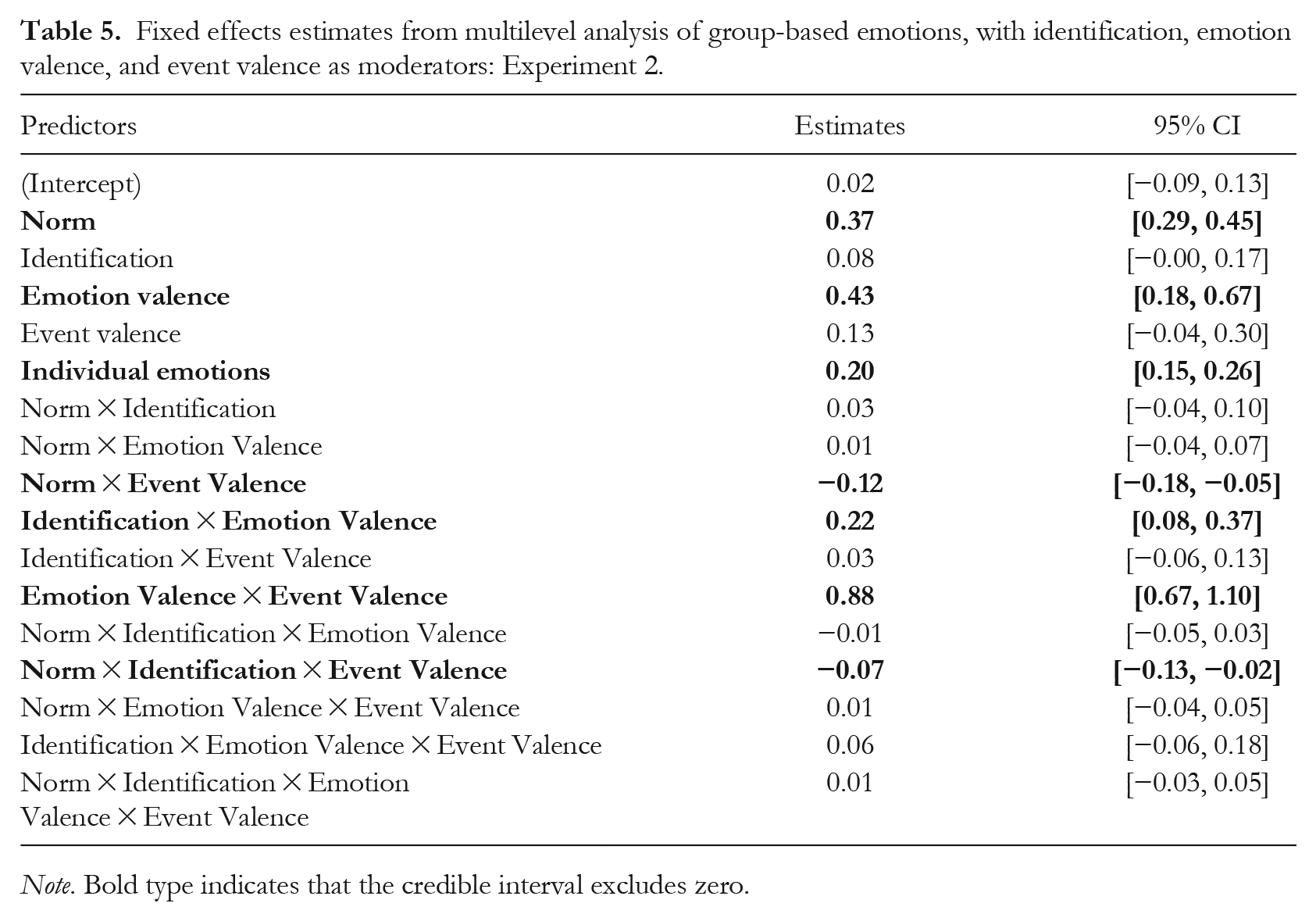
Group-based emotion fixed effect estimates are shown in Table 5 and means are shown in the right panel of Figure 1. Paralleling the analysis of perceived group emotion norms as a dependent variable, there was a strong two-way interaction of Event Valence × Emotion Valence on group-based emotions. As expected, the event valence manipulation affected both positive and negative group-based emotions, in opposite directions. Consistent with Hypothesis 1, there was also a strong effect of the norm. This indicates that the experimental manipulation of event valence had not only a direct effect on the reported group-based emotions, but also an indirect effect mediated through the perception of the emotion norm. The interaction of Norm × Event Valence was also significant and negative, indicating that the indirect effect of the event valence manipulation through the perceived group emotion norm was even stronger for negative events (estimated effect 0.49, 95% CI [0.39, 0.59]) than for positive events (estimated effect 0.25, 95% CI [0.15, 0.36]).
Fixed effects estimates from multilevel analysis of group-based emotions, with identification, emotion valence, and event valence as moderators: Experiment 2.
Note. Bold type indicates that the credible interval excludes zero.
Hypothesis 2 called for moderation of the norm effect by group identification, and this interaction was not significant overall. However, there was a significant interaction of Norm × Identification × Event Valence, with a negative sign. Just as the norm effect was stronger overall for negative than positive events, its moderation by group identification was also stronger for negative events. Specifically, the Norm × Group Identification interaction was significant for negative events (estimated effect 0.10, 95% CI [0.02, 0.19]). Consistent with Hypothesis 2, highly identified group members were more strongly influenced by the emotions they perceived to be normative when reacting emotionally to an ingroup-relevant negative event. However, the Norm × Identification interaction was nonsignificant for positive events (estimated effect −0.04, 95% CI [−0.13, 0.04]). Thus, Hypothesis 2 was partially supported, for negative but not positive events. Consistent with Hypothesis 3 and replicating Experiment 1, the interaction of Emotion Valence × Group Identification was significant, indicating that more highly identified group members reported relatively more positive than negative group-based emotions.
The effect of individual emotions on group-based emotions was also significant. The results also showed a main effect of emotion valence, with positive emotions reported more strongly than negative emotions.
Test of generalization across groups
As in Experiment 1, results were highly consistent across all six groups, regardless of group type or specific exemplar. The norm effect (Hypothesis 1) was 0.37, and the standard deviation of the group random slope was 0.07; estimates of the norm effect for all groups fell between 0.35 and 0.40. For the Group Identification × Emotion Valence interaction (Hypothesis 3), the fixed effect was 0.22, and the random slope standard deviation was 0.12; estimates for every group were between 0.17 and 0.26. Further bolstering the evidence for generalization across group types, results indicated greater variability of the results across participants than across groups. For participants, the standard deviation of the random intercept was 0.27, and that of the random norm effect was 0.13. For groups, the corresponding standard deviations were 0.06 and 0.07, much smaller values. For the Group Identification × Emotion Valence interaction (Hypothesis 3), the standard deviations are 0.01 for participants and 0.02 for groups, both small values. Reported group-based emotions again varied less or at similar levels across assigned membership groups of different types than across individual participants.
The pattern of group members’ emotions about a specific group-relevant event thus yielded strong support for two hypotheses (replicating Study 1) and partial support for the third. The significant norm effect was consistent with Hypothesis 1, group-based emotions are influenced by normative or average emotions of members of the ingroup, with the effect being even stronger for negative than for positive events. Hypothesis 2 stated that group identification moderates the influence of group norms on group-based emotions, so that high identifiers are more influenced by group norms than low identifiers. In this experiment, this predicted effect was found only for negative events, a point we return to in the General Discussion. Hypothesis 3, that identification is associated with the relative positivity of group-based emotions, was supported by the significant Positive Group Identification × Emotion Valence interaction, with high identifiers reporting stronger experiences of positive, but not negative, emotion.
General Discussion
This research was motivated by two goals. First, we tested three hypotheses derived from intergroup emotions theory about the role of processes of self-categorization, normative influence, and identification in shaping group-based emotions. The experiments revealed strong and consistent support for Hypotheses 1 (that group-based emotions are influenced by group emotion norms) and 3 (that group-based norms are moderated by identification such that high identification increases the relative positivity of group-based emotions), and partial, conditional support for Hypothesis 2 (that the influence of norms is especially strong for the highly identified), which occurred only for negative events in Experiment 2. These results held regardless of whether group-based emotions were targeted or untargeted, regardless of how group emotion norms were estimated, and with different participant populations. Second, support for these hypotheses generalized in both experiments across membership in different exemplars of close, task, and social category groups, despite their well-established structural and functional differences.
The consistency of results across groups was even more compelling given that participants considered completely different sets of people for each exemplar—each participant had a unique family and set of friends, unique teams and committees they had served on, political affiliations, and so forth. Given this diversity of specific groups, the strength of average ingroup emotion norms in influencing group-based emotions is consistent with the idea that these norms may also reflect culturally shared proclivities or typically shared experiences that make some emotions more likely than others to be normative for certain groups. For example, although some people no doubt have negative feelings about their family, most people reported feelings of gratitude and respect toward their families, whereas many people reported hope but also irritation toward their political group. This also raises the possibility that the emotion norms we measured, especially in Experiment 1, reflected some influence of injunctive norms, as discussed later.
Test of Group-Based Emotion Process Hypotheses
In regard to Hypothesis 1, these studies provided both correlational and experimental evidence for the fundamental influence of group emotion norms on group-based emotions, whether descriptive norms were operationalized as the average level of group-based emotions expressed by ingroup members or as participants’ own perceptions of ingroup emotion norms. These findings underscore the crucial role of group-level processes in generating group-based emotions, consistent with social identity approaches to group membership, and more specifically, with group-level theories of emotion, like IET, which include normative processes (Mackie & Smith, 2018; Smith, 1993). First, this norm effect was independent of the effect of baseline individual emotions on group-based emotions, consistent with previous findings indicating that, because they are generated by distinct group-level processes, group-based emotions are typically different from individual emotions (Smith et al., 2007). Second, these findings are consistent with earlier demonstrations that members internalize explicitly given emotion norms that they see as defining group membership (Moons et al., 2009; Seger et al., 2009). When emotion norms are explicit, the influence of the norm may facilitate convergence in group-based emotions, as members all internalize the same emotions that they believe define group membership. More typically (and in our experiments) group norms are implicit, so members rely on their perceptions of what emotions define their group to guide their own group-based emotions. Such individually perceived norms often diverge from actual norms or empirical averages, so moving toward perceived norms may not always contribute to convergence in group-based emotions.
Our results yielded only partial support for Hypothesis 2. High identifiers were more likely to be influenced by group emotion norms only when reporting emotions targeted at negative group-relevant events (Experiment 2), and not when emotions were targeted at positive events (Experiment 2) or when emotions were untargeted (Experiment 1). These findings are consistent with motivational accounts of identification processes to the extent that they reveal the special importance of shared emotional responses to negative group events for group belonging. Both the overall main effect of normative processes on group-based emotions and the moderation of the norm effect by group identification were stronger when group members responded to group-relevant negative compared to positive events. We speculate that the absence in Experiment 1 of the moderation effect found in Experiment 2 may be explained by group members’ natural tendency to focus on positive aspects of the group when not explicitly directed to consider negative events. However, the lack of overall support for Hypothesis 2 is surprising. The link between identification and normative influence for many types of thoughts and behaviors (not only for group-based emotions) is well-established in the literature in general, and has been found in previous experiments in which high identifiers adhered to explicit norms more closely in their targeted and untargeted group-based emotions (Moons et al., 2009; Seger et al., 2009; Smith et al., 2007).
Hypothesis 3 received strong and consistent support across targeted and untargeted group-based emotions. In both experiments, higher identification was associated with relatively more positive group-based emotions, replicating many previous studies. This consistent association might reflect the possibility that members of most groups are more likely to express positive than negative emotions, making positive emotions particularly visible as group-defining characteristics to those for whom group membership is important. The amplification of positive emotions for the highly identified might also reflect motivational forces, as positive emotions are often more functional for maintaining group affiliation and performance, and group-associated positive emotions can confer additional positive outcomes of group membership.
In regard to negative emotions, our results are more consistent with previous research demonstrating weak, variable, and more negative correlations between identification and negative emotions (e.g., Smith et al., 2007), and less consistent with previous research showing positive correlations between identification and specific negative emotions (Doosje et al., 2006; Gordijn et al., 2006; Yzerbyt et al., 2003). Although such positive associations can occur when negative emotions reflect well on the ingroup (e.g., anger at injustice) or are definitional of the group (e.g., feeling aggrieved as a member of a political group), negative emotions are perhaps more likely, in general, to be weakly or negatively associated with identification for at least three reasons. First, experiencing negative emotions (such as disappointment or guilt) with regard to a group membership can lead people to disidentify from the group (Kessler & Hollbach, 2005). Second, high identification may increase focus on the group’s successes, events more likely to be accompanied by positive emotions and, correspondingly, low negative emotions. Third, high identification might lead people to reappraise in order to reduce negative emotions and reestablish the positive benefits of group membership (Doosje et al., 1998). Identification was equally high for all but one exemplar across group types, suggesting that membership in these groups had not reduced identification. Therefore, the results are more consistent with the second and third possibilities than with the first.
The powerful influence of descriptive emotion norms—the emotions that other group members feel or are perceived to feel—on group-based emotions is consistent with the role of norms in the constructivist and social constructivist theories of emotion (Averill, 1980; Barrett, 2017) as well as with research showing that in cultures that are particularly tightly bound by normative influence, individuals are more likely to react emotionally to situations as is normatively appropriate rather than idiosyncratically (Matsumoto et al., 2008). However, injunctive emotion norms—the emotions that people believe group members should feel—also affect emotions. For example, cultural theories of emotion such as ideal affect theory (Tsai, 2007) and the doing emotions approach (Mesquita et al., 2017) emphasize the role that culturally distinctive injunctive norms play in the emotions that their members both feel and express. Although these approaches typically focus on individual emotion, future research might well explore the relative influence of both descriptive and injunctive norms on group-based emotion.
Test of Generalization Across Groups
As our fourth hypothesis predicted, the results relevant to the first three hypotheses held consistently across exemplars and types of group memberships, as indicated by the tight clustering of estimates of the fixed effects of the norm effect for all membership groups in the multilevel analyses. Because processes of self-categorization and normative influence are characteristic of belonging in any group, we predicted and observed similar effects of emotion norms on group-based emotions experienced as a member of close, task, and category groups. Furthermore, given that identification processes characteristically moderate self-categorization and normative processes, we expected and observed that highly identified group members experienced relatively more positive emotions regardless of whether they were members of intimacy, task, or category groups. The consistency of these results is underscored by the fact that they held regardless of whether group-based emotions were elicited in general (without a target in Experiment 1) or by a specific event (targeted in Experiment 2). In addition, the limited moderation by identification of targeted group-based emotions to negative events in Experiment 2 also held across groups. Although individual studies based on membership in different types of groups have typically yielded group-based emotion results consistent with one or more of the hypotheses tested in these studies, this is, to our knowledge, the first systematic simultaneous comparison of the operation of these processes at work in multiple exemplars of membership in three different types of groups.
The consistency of results across group types also suggests both the feasibility and potential benefits of integrating research focused on close, task, and category-based groups. For instance, research on prejudice among category-based groups such as race and religion has found that positive and negative group-based emotions play a significant role in exacerbating or reducing prejudice (Islam & Hewstone, 1993; Pauketat et al., 2019; Seger et al., 2017). Given the similarities we found across exemplars, it may be that group-based emotions are also key to understanding positive and negative relations among close and task groups as well. Such new lines of investigation are certainly consistent with recent theorizing and data about the role of group-based emotions in competitive sports performance (Campo et al., 2012).
Limitations
Potential limitations of this research include its reliance on self-reports of emotions. However, evidence indicates that group-based emotions have nonobvious cognitive and motivational consequences similar to individual emotions, such as increased risk-taking (Rydell et al., 2008). This type of evidence suggests that reported group-based emotions (like reported individual emotions) are actually experienced. In addition, our results, and especially any conclusions drawn about different types of groups, may be driven by the specific exemplars we used. However, the use of multilevel analysis with a variety of membership groups suggests that these results generalize to other exemplars of these three types of groups.
Throughout this paper, we assume that group emotion norms causally influence self-reported group-based emotions. However, in Experiment 2, the perceived norm was assessed after group-based emotions, leaving open the possibility that group-based emotions influenced perceptions of norms, rather than perceived norms influencing emotions. This process is not plausible in Experiment 1, where norms were not measured by questionnaire but measured as the average of the reported emotions of others in the ingroup. Such norms still related to reported group emotions, suggesting that norms were spontaneously consulted when emotions were reported, rather than reconstructed to be consistent after the fact. Such a process is more consistent with research showing that reported emotions move toward explicitly communicated group norms (e.g., Moons et al., 2009). If future research elicits reports of emotion norms before participants’ own emotions, theories of norm salience predict that the norms’ influence would be even stronger (Cialdini et al., 1991).
It is possible that the effects of self-categorization, normative influence, and identification processes shown here might be specific to the independent (i.e., American) cultural context of our participants (Markus & Kitayama, 1991). Previous research on individual emotions has consistently found that members of independent cultures tend to report more positive than negative emotions, compared to members of interdependent cultures (e.g., Kitayama et al., 2000; Mesquita & Karasawa, 2002; Scollon et al., 2004). This is likely true for group-based emotions as well. Consequently, the American participants in our experiments report and prefer higher levels of positive compared to negative group-based emotions, especially those participants who particularly care about their ingroups. Systematic cross-cultural research is necessary to elucidate the role of culture in the valence effects so obvious in our data.
Conclusions
Group-based emotions appear to operate similarly for members of close, task, and category groups. Group members experience emotions that normatively define, or that they believe define, their ingroup, and highly invested members feel more positive than negative emotions. These findings hold whether the group they belong to is a close group like a family, a task group like a sports team, or a social category like nationality or gender. They also hold whether the group-based emotions they feel are general and untargeted, or are reactions to specific positive and negative events. In addition, highly identified group members adhere more closely to group emotion norms in their responses to ingroup-relevant negative events, a finding that also held regardless of the type of ingroup to which they belonged.
More generally, our findings show the pervasive influence of group membership, a fundamental aspect of the human condition, on emotional experiences that have sometimes been thought of as hard-wired individual reactions to external events and objects. People’s psychological alignments with others, and the relative importance of those group memberships, powerfully influence their emotional experience toward group-related events and objects. These findings thus add further weight to the claims of social, cultural, and constructionist views of emotion. Given the influence of group-based emotions on both intra- and intergroup behavior (Mackie & Smith, 2017), the fact that norms strongly determine the emotions of group members is of practical importance to parents, managers, committee chairs, coaches, and party leaders—anyone concerned with managing the interactions and performance of group members.
These findings confirm the relevance of intergroup emotions theory and other group-based emotion approaches for understanding emotions in groups beyond the social category groups on which the approaches were originally developed. They also point to several different avenues of investigation that will further our understanding of emotion processes in group contexts in general.
Footnotes
Acknowledgements
We thank Yufang Sun for help with data collection, and Charles Seger, Diana Leonard, Anthony Scroggins, Kimberly Hartson, Janet Pauketat, Batja Mesquita, Sang Hee Park, Ashley Waggoner Denton, Dave Hamilton, and Austin Chapman for their valuable comments and insights.
Correction (August 2023):
Article updated to correct N value in Experiment 1, under- graduate students and MTurk participants number in Methods section.
Funding
The author(s) disclosed receipt of the following financial support for the research, authorship, and/or publication of this article: This research was supported by a National Science Foundation Grant (BCS-0719876) awarded to Eliot R. Smith and Diane M. Mackie.
