



Abstract
Current models of discrimination fail to account for the fact that many people belong to intermediate identity groups, that is, groups that share characteristics with both a low-status minority and a high-status majority group (e.g., biracial, bisexual), and thus do not occupy one clear position on a status hierarchy. We investigated bisexual targets to test whether perceivers rely on perceived status differentials to determine whether someone faced discrimination. As predicted, whether bisexual people were perceived as victims of discrimination depended on contextual cues about their relative status. Participants expected both gay/lesbian and bisexual individuals to face more discrimination than heterosexual individuals. But they were more likely to say that a bisexual woman who had lost out to a heterosexual woman competitor had faced discrimination compared to a bisexual woman who had lost out to a lesbian woman. These results may help make sense of how real-world discrimination claims are adjudicated.
People’s prototype of a discriminatory incident is typically one in which a member of a high-status group (e.g., White, male) unfairly disadvantages a member of a lower status group (e.g., Black, female; Inman & Baron, 1996). Indeed, the same act is more likely to be seen as discrimination when the perpetrator is from a high-status group and the victim is from a low-status group than vice versa (see Major et al., 2002). However, not everyone fits neatly into commonly studied high- or low-status categories. A growing number of people hold intermediate identities—they belong to a group that may share some characteristics with a lower status group and other characteristics with a high-status group (Burke et al., 2023). For example, the US is becoming increasingly biracial and bicultural, with more people than ever identifying with more than one race (Pew Research Center, 2015; Rico et al., 2023). Further, bisexuality is the most commonly held identity in the American LGBTQ+ community (56%), and nearly 1 in 6 people from Generation Z identifies as bisexual (Jones, 2021).
Surprisingly, we know little about how perceivers evaluate people with intermediate identities. Only recently have researchers started to focus on perceptions of people with these identities and how these perceptions may contribute to prejudice and discrimination. Intermediate identity groups are often perceived as not “belonging” in U.S. society (e.g., Skinner et al., 2020), and intermediate social identities (e.g., bisexual and biracial) are seen as less real and legitimate compared to monoracial and monosexual identities (Burke et al., 2023). This may take a toll on people who hold intermediate social identities. For example, bisexual people are often evaluated more negatively than gay/lesbian people (Bostwick & Hequembourg, 2014; Friedman et al., 2014), and excluded from LGBTQ+ spaces (Burleson, 2005; Hemmings, 2002). Bisexual people report facing more sexual violence (Walters et al., 2013) and have worse mental health outcomes, such as higher rates of depression, anxiety, suicidal ideation, and drug abuse (Bostwick et al., 2010; Lindley et al., 2012), relative to both heterosexual people and gay/lesbian people (Feinstein & Dyar, 2017). Relatedly, bisexual people report experiencing high rates of prejudice from both heterosexual and gay/lesbian perpetrators (Dodge et al., 2016; Hequembourg & Brallier, 2009; McLean, 2004, 2008), and are often subjected to having their identity questioned or invalidated (Burke & LaFrance, 2018; Mohr & Rochlen, 1999; Rust, 2000; Worthen, 2011, 2012). Such findings highlight the importance of better understanding perceived discrimination against people with intermediate identities.
The current research asks: when do perceivers think that someone with an intermediate identity has faced discrimination? To address this, we focus on bisexual people as a target group and test hypotheses derived from the prototype model of attributions to discrimination (Inman & Baron, 1996). In particular, we examine whether perceivers’ likelihood of saying that a bisexual person has faced discrimination is higher when the context suggests that the bisexual person has relatively lower status than their competitor.
The Prototype Model of Attributions to Discrimination
Inman and Baron’s (1996) prototype model of attributions to discrimination suggests that people use prototypes—culturally shared representations that guide categorization (Rosch, 1973)—to determine who are most likely to be perpetrators and victims of discrimination. That is, people cognitively organize groups and their members based on overarching prototypes (Cantor & Mischel, 1979; Tajfel & Turner, 1979; Turner et al., 1987), and these prototypes include sets of likely attributes that are contextually based, such as race, appearance, behavior, and beliefs (Hogg, 1993; Medin, 1989). Because prototypes are culturally transmitted and collectively shared by members of a society (Bailey et al., 2019; Eagly & Kite, 1987; Glick & Fiske, 2001), members of that society typically hold relatively similar prototypes of particular groups. For example, both men and women perceive women as more prototypical victims of discrimination than men (Inman & Baron, 1996; O’Brien et al., 2008). In this paper, we operationalize prototypicality of victimhood as the degree to which people (on average) more readily agree that a certain group is likely to be a victim of discrimination.
Past research shows that people are more sensitive to discrimination when the perpetrator is from a group that is perceived as prototypically high-status (Inman & Baron, 1996), and when the victim is from a group that is perceived as prototypically disadvantaged (e.g., low-status racial group). These findings led to the status asymmetry hypothesis—the belief that discrimination is typically perpetrated by members of higher status groups against members of lower status groups (Inman & Baron, 1996; Rodin et al., 1990), rather than the reverse (e.g., a White perpetrator discriminates against a Black victim or a heterosexual person discriminates against a gay person; see Major et al., 2002, for review).
This perceived social status can be based on a variety of factors, such as prestige, power, education, and financial resources, among other things. However, one important indicator of perceived social status is a person’s social identity, for example, whether a person is Black or White, male or female, and heterosexual or gay/lesbian, and accompanying beliefs about the extent to which that social identity is relatively advantaged or disadvantaged in society. That is, White people, men, and heterosexual people, on average, hold higher paid positions and experience lower rates of discrimination than racial minorities, women, and sexual minorities (Chun-Hoon, 2023; Parker & Funk, 2017; Quillian et al., 2017; Sears et al., 2021). Thus, they tend to hold higher objective social status. Furthermore, members of the former groups are also generally perceived to be of higher status than the latter. Perceived social status, however, is not fixed and can change depending on which social identities are salient in a particular situation. Thus, a White woman may be perceived as low status when compared to a White man, because status differences in gender are salient. However, the same White woman may be perceived as high status when compared to a Black woman because of the salience of race. The prototype model of status asymmetry does not address how perceptions of discrimination may vary depending on contextual cues that highlight different aspects of social identity nor does it address perceptions of discrimination against people with “intermediate” social identities.
A Focus on Bisexual Individuals
Bisexuality is an interesting test case because bisexual people have some features in common with heterosexual individuals (opposite-gender attraction), and other features in common with lesbian/gay individuals (own-gender attraction). Bisexual people may be regarded as a high-status group relative to gay and lesbian people because they are seen as able to “pass” as heterosexual, and thereby reap some of the benefits of “heterosexual privilege” (Israel & Mohr, 2004). At the same time, they may be regarded as a low-status group relative to heterosexual people because they are a sexual minority. Thus, bisexual people may be perceived as high status or low status depending on to which group they are being compared. The current prototype model of attributions to discrimination does not address perceptions of discrimination against people with these types of intermediate identities.
We theorize that perceivers rely on contextual cues in order to determine the status of a bisexual individual, and that they are more likely to view a bisexual person as the target of discrimination when contextual cues suggest that the person is relatively lower status. One contextual cue that may influence perceptions of a bisexual individual’s relative status is the social identity of a potential competitor. 1 In particular, because discrimination often occurs in a zero-sum context in which one person gains something at the cost of another person (i.e., a hiring decision), status perceptions may rely on the perceiver’s consideration of the social identity of the person who gains the benefit—the victim’s competitor—in addition to the social identity of the victim. This may be especially important when the victim holds an intermediate identity, as the social identity of the competitor may make salient different aspects of that victim’s identity. For example, a bisexual person losing out on a promotion to a heterosexual competitor may highlight the bisexual person’s lower status relative to the competitor (winner), enhancing the likelihood that the loss will be attributed to discrimination. However, a bisexual person losing out on a promotion to a gay or lesbian competitor may highlight the bisexual person’s perceived higher status relative to the competitor, minimizing the likelihood that the loss will be attributed to discrimination.
Gender as a Moderating Factor
A bisexual person’s perceived prototypicality as a low-status victim may also be influenced by the person’s gender. Whereas bisexual men are often perceived to be gay, bisexual women are often perceived to be heterosexual (Matsick & Rubin, 2018; McGorray & Petsko, 2023). For example, bisexual men are commonly stereotyped as identifying as bisexual in order to avoid “coming out” as gay (Alarie & Gaudet, 2013; Armstrong & Reissing, 2014; Dodge et al., 2016; Matsick & Rubin, 2018). Men, but not women, who express a one-time romantic interest in the same gender are also more likely to be labeled as gay (Flanders & Hatfield, 2014). On the other hand, people sometimes accuse bisexual women as participating in same-gender performativity—engaging in same-gender sexual behaviors for an audience (Fahs, 2009) in order to win the pleasure and/or attention of men (Esterline & Galupo, 2013). People’s tendency to recategorize a bisexual person as heterosexual or gay may also be influenced by essentialist beliefs, that is, the extent to which they see categories as discrete and biologically based (Haslam et al., 2000). Therefore, potentially prejudicial acts may be perceived as discrimination at similar rates when they are perpetrated against bisexual men and gay men (because there is little perceived status asymmetry, with both groups being perceived as low status) but may be more likely to be perceived as discrimination when perpetrated against lesbian women compared to bisexual women (because bisexual women are perceived as holding higher status than lesbians).
Overview of Studies
In three studies, we test whether and when heterosexual people see a negative outcome experienced by a bisexual person as discrimination. We focused on heterosexual people because they tend to hold more negative attitudes toward bisexual people (Roberts et al., 2015). We also used an ambiguous discriminatory act because social norms discourage outward expressions of sexual prejudice, meaning discrimination is often subtle (e.g., being passed up for a promotion with a weak explanation) rather than blatant (e.g., being called a derogatory term; Bobo, 2001; Crandall et al., 2002), and because participants’ biases may be easier to detect in ambiguous situations (Gaertner & Dovidio, 1986). Specifically, we used a vignette (adapted from Eliezer & Major, 2012) in which the target was rejected for a competitive funding opportunity after their boss overheard the target disclose their sexual orientation.
We chose to focus on a workplace scenario in which someone loses out on a promotion (as described above) because this context is highly relevant to bisexual people, who face high levels of workplace discrimination (Tweedy & Yescavage, 2014). Bisexual people report being fired from jobs or given unfair performance reviews due to their sexual orientation, experiencing sexual harassment from colleagues, being the target of biphobic jokes at work, and facing high levels of workplace scrutiny about their relationships (Glazer, 2012; Movement Advancement Project, 2015). Bisexual people (48%) are more likely to report an annual income of less than $30,000, compared to lesbians (39%), gay men (30%), or U.S. adults generally (28%; Pew Research Center, 2013), and are more likely than gay and lesbian people to report living below the poverty line and not having enough money for basic needs (Fredriksen-Goldsen et al., 2013; Gates, 2014).
Despite high levels of reported discrimination, openly bisexual plaintiffs’ lawsuits claiming discrimination are rare, and when brought, are seldom successful. For example, an examination of employment discrimination cases brought by bisexual plaintiffs on WestLaw (a legal research platform) yielded only 11 filed cases, of which, only one was awarded damages (Tweedy & Yescavage, 2014). There are various reasons why bisexual discrimination cases may be rare and unsuccessful (e.g., underreporting, not wanting to be seen as a troublemaker, being categorized as gay, etc.; Kaiser & Miller, 2003). Here, we focus on the possibility that others may be less likely to say that negative outcomes experienced by bisexual people are due to discrimination.
Based on the prototype model of attributions to discrimination, our overarching prediction was that people’s judgments about whether a bisexual individual has experienced discrimination will depend on the relative status they ascribe to the bisexual target in a particular context. We tested four specific hypotheses: First, people will be more likely to say that both gay/lesbian people and bisexual people have faced discrimination compared to heterosexual (higher status) people (Hypothesis 1). Second, to the extent that people believe bisexual people chronically have higher status than gay/lesbian people (due to the belief that the former have some “heterosexual privilege”), they will be less likely to see a bisexual person as a victim of discrimination when they lose out on a funding opportunity to a gay/lesbian competitor (Hypothesis 2). Third, because a comparison highlights people’s assumptions about relative differences in status between bisexual people and gay/lesbian people, participants may be less likely to think that a bisexual person has faced discrimination compared to a lesbian/gay person only when members of these groups are in direct competition (Hypothesis 3). That is, if the status ascribed to a bisexual person varies based on context, then a bisexual person may be seen as a more likely target of discrimination when s/he is perceived as relatively lower status (e.g., when being compared to a heterosexual person) than when s/he is perceived as relatively higher status (e.g., when being compared to a gay/lesbian person).
Our fourth hypothesis was based on past research on beliefs about the “true” sexual identities of bisexual men and women (Matsick & Rubin, 2018). To the extent that bisexual women are presumed to be heterosexual, then they may be viewed as having higher status than lesbian women. Based on this assumption, we predicted a bisexual woman would be less likely to be seen as a victim of discrimination compared to a lesbian competitor, but more likely to be seen as a victim of discrimination compared to a heterosexual competitor (Hypothesis 4a). In contrast, to the extent that bisexual men are presumed to be gay, they may be viewed as having similarly low status as gay men. Based on this assumption, we predicted that bisexual and gay men would be seen as equally likely to be victims of discrimination when compared to a heterosexual competitor (Hypothesis 4b).
Study 1 examined attributions to discrimination based on sexual orientation among people randomly assigned to read about either a bisexual, gay/lesbian, or heterosexual target who was denied law school funding. Studies 2 and 3 examined whether attributions to discrimination against bisexual people would be more or less likely to emerge when the bisexual individual lost to a gay/lesbian individual in a direct competition for funding. This allowed us to test more directly whether status asymmetry played a role in these attributions. Only Study 3 was preregistered, but materials and data for all studies can be found on the Open Science Framework (OSF; https://osf.io/rakge/?view_only=9ca049617ace40e49e535cfcedf2c202).
Study 1
Study 1 tested the hypotheses that participants would make fewer attributions to discrimination for heterosexual targets compared to sexual minority (bisexual and gay/lesbian) targets (Hypothesis 1), and fewer attributions to discrimination for bisexual targets compared to gay/lesbian targets (Hypothesis 2). Finally, we examined whether ratings of discrimination differed based on target gender (Hypothesis 4). In all studies, we report all measures and manipulations used, how we determined our sample size, and why some participants were excluded.
Method
Participants
Participants were 600 English-speaking U.S. adults who identified as heterosexual on a Prolific prescreening (www.prolific.co) in 2021. An a priori power analysis using G*Power (Faul et al., 2007) showed that 600 participants would provide 90% power with an alpha of .05 to detect a small main effect (f = .13) of target sexual orientation. Fourteen participants were excluded for identifying as something other than heterosexual on the survey. This left a total sample size of 586 people (Mage = 34.73, SDage = 14.40), 55% of whom identified as female. Participants identified as White (73%), Asian (10%), Black (5%), Native American (1%), Latino/Latinx/Hispanic (5%), and multiracial (6%). Participants were paid $0.65.
Procedure
Participants were randomly assigned to one of six conditions for this 2 (target gender: male vs. female) x 3 (target sexual orientation: gay/lesbian vs. heterosexual vs. bisexual) between-subjects factorial design. After giving consent, participants read a vignette in which a target
2
—who worked at a law firm—applied for, and was subsequently denied, a competitive law school funding opportunity after their male boss, Steve, overheard them disclose their sexual orientation. For example, in the female bisexual target condition, the manipulation read: Later that day while having lunch in the breakroom with a work friend, Michelle and her friend are discussing the merits of various dating apps on the market. Michelle shows her friend a dating app she joined. Michelle says, “You can set your dating gender preferences here. For example, I’m bisexual so I have it set to both men and women.”
3
Steve overhears this conversation. The following day Michelle learns that Steve did not choose her to receive the law school funding.
Participants answered questions about why the target didn’t get the funding, whether the target was discriminated against, and their opinions about a sexual orientation discrimination lawsuit filed by the target. To measure perceived status asymmetry, participants rated how disadvantaged they thought bisexual, gay/lesbian, and heterosexual people were by their sexual orientation. 4 Finally, participants responded to a manipulation check item and answered demographic questions.
Measures
Discrimination and internal attributions
Participants were told that “there are many factors that could have impacted who was selected for the funding” and were asked to rate how much “each factor led to the decision not to fund [target].” The factors included three internal attributions: “[Target]’s qualifications,” “[Target]’s career ambitions,” and “[Target]’s work record”; and two discrimination attributions: “[Target]’s sexual orientation” and “Steve’s prejudice against [target]’s sexual orientation.” Ratings were assessed on a 7-point scale (1 = not at all, 7 = very much). The two discrimination attributions were averaged into a composite (α = .93), and the three internal attributions were averaged into a composite (α = .94). Higher scores indicated more agreement that those attributions contributed to the target not getting the funding.
Discrimination claim
Participants rated (1 = strongly disagree, 7 = strongly agree) whether “[Target] was discriminated against based on [his/her] sexual orientation.”
Lawsuit legitimacy
Participants were then told that, “[Target] has filed a lawsuit against the company and against Steve alleging sexual orientation discrimination. The lawsuit asserts that [target] was denied law school funding due to discrimination based on [his/her] sexual orientation and seeks compensatory damages.” Participants were asked to rate their agreement with the following four statements regarding the lawsuit: “Is [target]’s lawsuit valid?”; “Do you support [target] in filing this lawsuit?”; “Should [target]’s lawsuit be taken seriously?”; and “Is [target]’s case legitimate?” These questions were adapted from Small et al. (2021) and were assessed on a 7-point scale (1 = not at all, 7 = very much). Items were averaged to create a composite variable (α = .96). Higher scores indicated the target’s lawsuit was seen as more legitimate.
Lawsuit rulings
Next, participants answered two questions about whom they thought “a real judge would rule in favor of in this case” and “If you were allowed to decide the case, who would you likely rule in favor of?” (1 = definitely in favor of [target], 7 = definitely in favor of the firm and Steve). The two items were averaged to create a composite variable (α = .77). Higher scores indicated more agreement that the discrimination suit should fail.
Perceptions of sexual orientation disadvantage
To assess status asymmetry, participants were asked their perceptions of the disadvantage experienced by all three sexual orientation groups. Participants answered two questions adapted from Sanchez and Chavez (2010) on a 7-point scale (1 = strongly disagree, 7 = strongly agree): “[Bisexual/ gay/lesbian/ heterosexual] people do not seem disadvantaged enough by their sexual orientation to be discriminated against” and “[Bisexual/ gay/lesbian /heterosexual] people do not strike me as disadvantaged enough by their sexual orientation to claim discrimination.” Both items were reverse-scored and averaged into a composite for each group (bisexual: α = .95; gay/lesbian: α = .95; heterosexual: α = .93).
Manipulation check
Finally, participants were asked to correctly identify the sexual orientation of the target from a list of options (e.g., bisexual, gay/lesbian, heterosexual).
Results
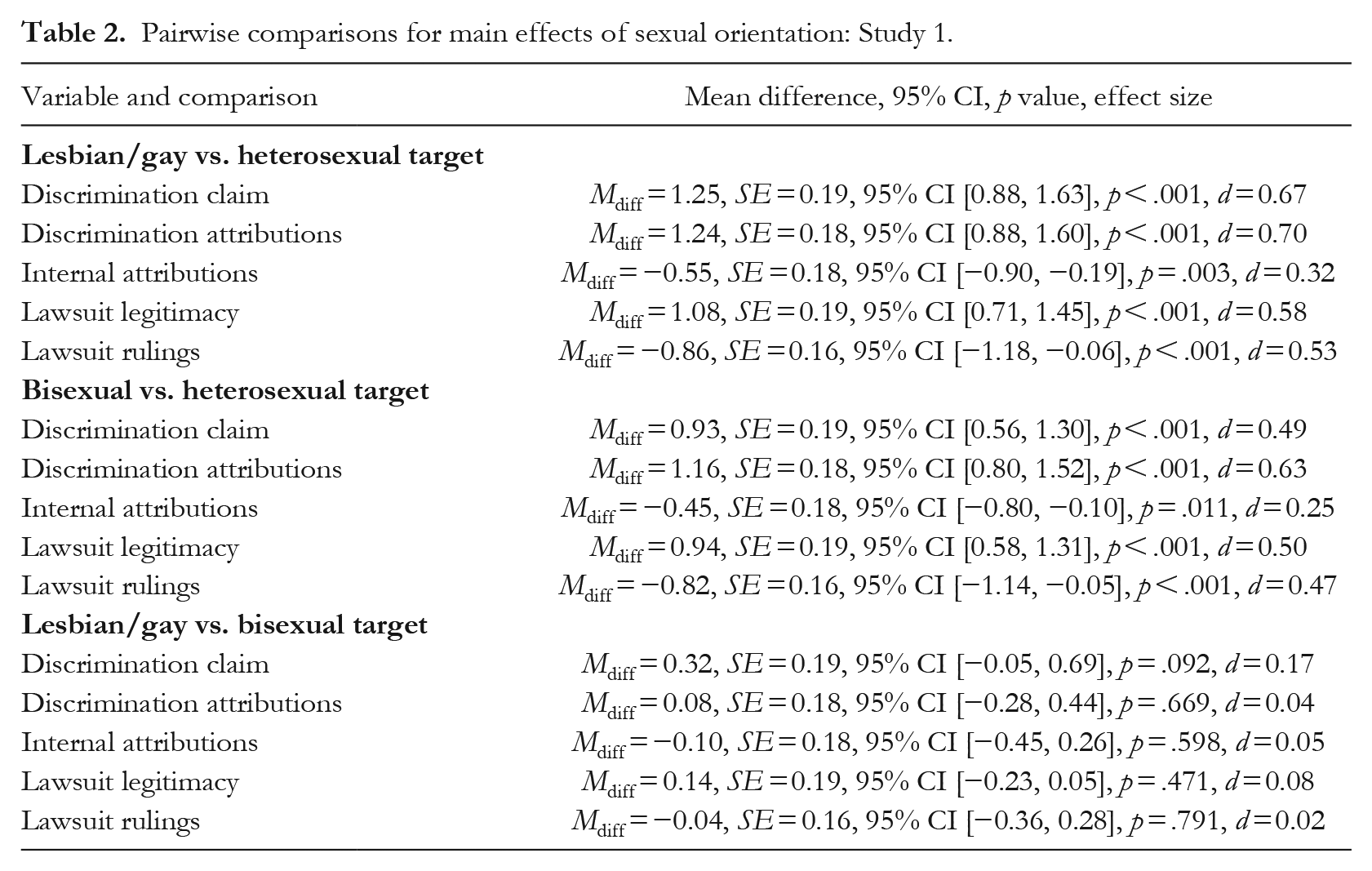
We conducted between-subjects factorial ANOVAs to test our hypotheses, unless noted otherwise. Across measures, there were no significant differences based on target gender (Hypothesis 4, except where specified below), so here we focus on the effects of sexual orientation. See Table 1 for main effect and interaction statistics and Table 2 for pairwise comparisons.
Means, standard deviations, main effects, and interactions.
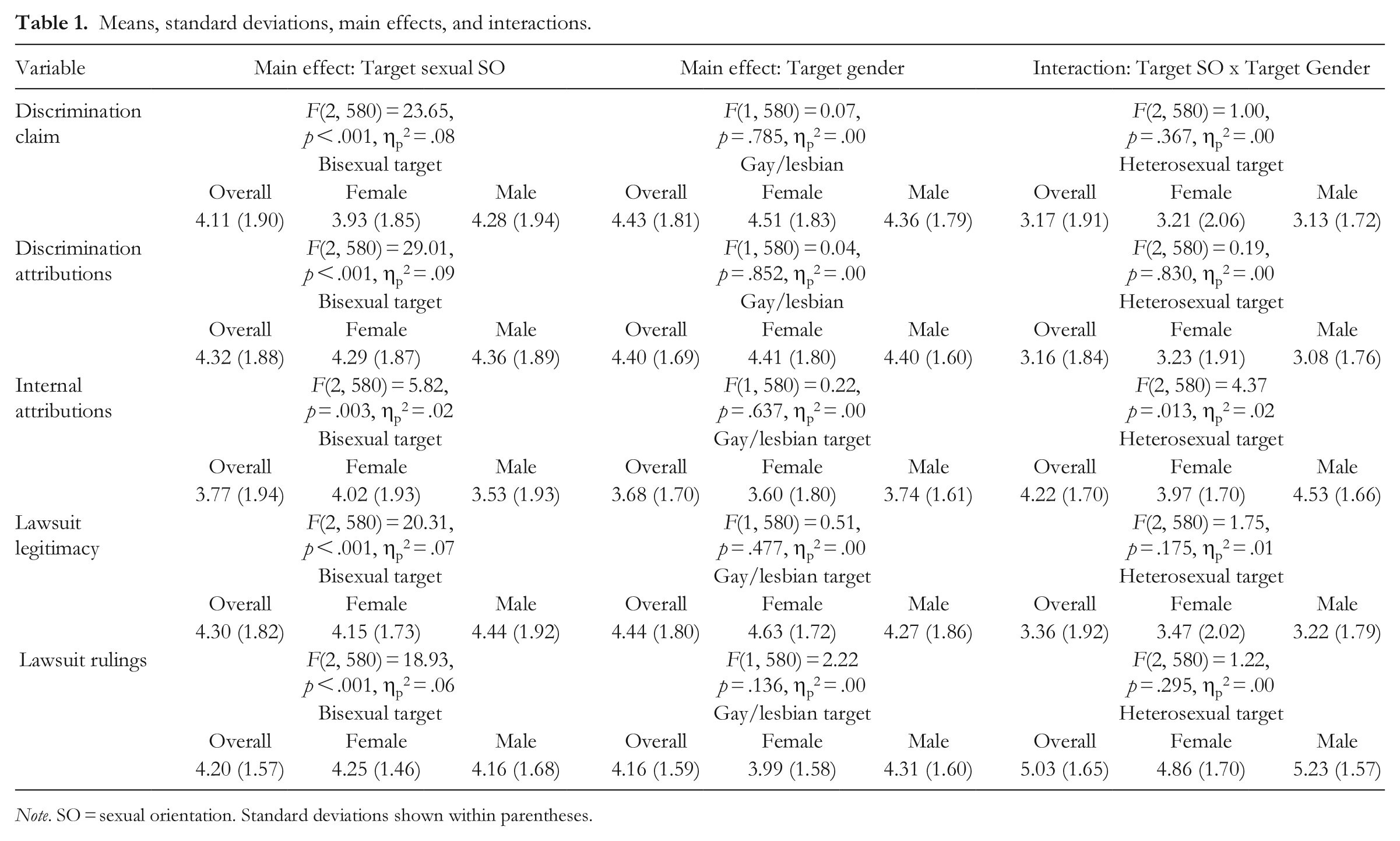
Note. SO = sexual orientation. Standard deviations shown within parentheses.
Pairwise comparisons for main effects of sexual orientation: Study 1.
Discrimination claim and discrimination attributions
Consistent with Hypothesis 1, on both the single-item discrimination claim measure and the two-item discrimination attributions measure, both the gay/lesbian target and the bisexual target were perceived as significantly more likely to have faced sexual orientation discrimination compared to the heterosexual target. Contrary to Hypothesis 2, there was no significant difference between the gay/lesbian target and the bisexual target.
Internal attributions
The effect of sexual orientation on internal attributions patterned in the opposite direction: participants were more likely to attribute the heterosexual target’s denial of funding to internal causes compared to either the bisexual target or the gay/lesbian target. On this measure, there was also a significant interaction of target sexual orientation and target gender (see Table 1), which was due to internal attributions playing a bigger role in perceptions of why a heterosexual man lost out on the funding compared to a heterosexual woman. 5
Lawsuit legitimacy and lawsuit rulings
Mirroring the findings for the discrimination claim measure and the attributions to discrimination measure, and in line with Hypothesis 1, participants also rated the lawsuits filed by the gay/lesbian target and the bisexual target as more legitimate than the lawsuits filed by the heterosexual target. However, in contrast to Hypothesis 2, the perceived legitimacy of the lawsuits brought by the gay/lesbian and bisexual targets did not differ significantly. A similar pattern was observed for rulings: participants said they and a judge would be more likely to rule in favor of gay/lesbian and bisexual plaintiffs compared to a heterosexual plaintiff.
Perceptions of sexual orientation disadvantage
Results for perceptions of disadvantage based on sexual orientation were in line with both Hypotheses 1 and 2. A repeated measures linear ANOVA with a Greenhouse–Geisser correction revealed a significant difference in perceptions of disadvantage between all three groups, F(1.36, 797.93) = 439.17, p < .001. Participants perceived both gay/lesbian (M = 5.33, SD = 1.79) and bisexual (M = 4.89, SD = 1.85) people as more disadvantaged than heterosexual people (M = 2.83, SD = 1.84; gay/lesbian vs. heterosexual: Mdiff = 2.50, SE = 0.11, 95% CI [2.29, 2.71], p < .001, d = 1.38; bisexual vs. heterosexual: Mdiff = 2.06, SE = 0.10, 95% CI [1.86, 2.26], p < .001, d = 1.12; Hypothesis 1). However, participants also rated gay/lesbian people as more disadvantaged by their sexual orientation relative to bisexual people (Mdiff = 0.44, SE = 0.05, 95% CI [0.34, 0.54], p < .001, d = 0.24).
Discussion
In line with Hypothesis 1, participants believed that both bisexual and gay/lesbian targets were more likely to have been discriminated against compared to heterosexual targets. This is consistent with the idea that people view gay/lesbian and bisexual people as having less status than heterosexual people. In contrast to Hypothesis 2, although participants did view bisexual target’s status as somewhat intermediate (e.g., the perceptions of disadvantage measure), we did not find evidence that participants expected bisexual targets to face less discrimination than gay/lesbian targets. This lack of difference may be because each participant only considered one person who applied for the funding, so sexual minority targets were never stated to be in direct competition. Indeed, this might be needed in order to make the perceived status asymmetry relevant to the task. Participants’ judgements regarding the lawsuit mirrored their ratings of discrimination: both bisexual and gay/lesbian targets’ lawsuits were viewed more favorably than the heterosexual target’s lawsuit.
Participants were most likely to expect internal factors to contribute to a target’s lack of promotion for heterosexual male targets. This is consistent with the status asymmetry hypothesis: if heterosexual men are the least likely to experience discrimination, participants may assume that other factors must be responsible for the target not receiving the funding.
Somewhat surprisingly, we did not find main effects or interactions of target gender (Hypothesis 4), except for internal attributions. Again, we speculated this may be due to the fact that targets were all considered in isolation, which does not highlight status differentials (e.g., between bisexual women and lesbians). If participants defaulted to assuming the funding went to a heterosexual person, then any sexual minority candidate could have been seen as relatively low status. Although participants did not differ on their likelihood of saying bisexual versus gay/lesbian targets had faced discrimination, they did generally rate gay/lesbian people as more disadvantaged by their sexual orientation. This perceived status asymmetry may lead to differences in expectations about who has faced discrimination if bisexual and gay/lesbian people directly compete.
Study 2
Study 2 examined the effect of making status asymmetry between bisexual and gay/lesbian people more salient by directly comparing bisexual women to lesbian women. We predicted that if bisexual women are believed to have higher status than lesbian women, then people would be less likely to say that discrimination was the cause when a bisexual woman lost out to a lesbian competitor than when a lesbian woman lost out on funding to a bisexual woman (Hypothesis 3).
Method
Participants
We recruited 600 heterosexual participants via Prolific (www.prolific.co) in 2021. However, 16 participants did not identify as heterosexual on the survey, leaving a sample of 584 (Mage = 36.43, SDage = 13.82). An a priori power analysis using G*Power (Faul et al., 2007) showed that 600 participants would again provide 90% power with an alpha of .05 to detect a main effect (f = .13) of target sexual orientation. Sixty-three percent identified as female, and participants identified as White (73%), Asian (10%), Black (8%), Native American (1%), Latino/Latinx/Hispanic (6%), multiracial (2%), or identity not listed (1%). Participants were paid $0.65.
Procedure and measures
Participants read a vignette about a female target
6
who lost out on a law school funding opportunity to a coworker, Julie, on a competitive funding opportunity. Participants were randomly assigned to one of two conditions (competitor sexual orientation: bisexual vs. lesbian) for this between-subjects design. Participants in the two conditions varied only in terms of the sexual identities of the target and competitor: either a bisexual target lost to a lesbian competitor, or a lesbian target lost to a bisexual competitor (see supplemental material for full vignette). For example, in the bisexual target condition, the manipulation read: After submitting their applications for the law school funding, Michelle and Julie sit down for lunch in the breakroom. They discuss the merits of various dating apps on the market. Michelle shows Julie a dating app she joined. Michelle says, “You can set your dating gender preferences here. For example, I’m bisexual so I have it set to men and women. However, since you’re lesbian, you can set it to just women.” Steve overhears this conversation. The following day Michelle learns that Steve did not choose her to receive the law school funding. Instead, he chose Julie to receive the funding.
Participants then answered the same dependent variables as in Study 1 7 and an additional question about a possible cause of the boss’s funding decision (whether the target did not get the funding due to the conversation she and the competitor had about their sexual orientations). 8
Results
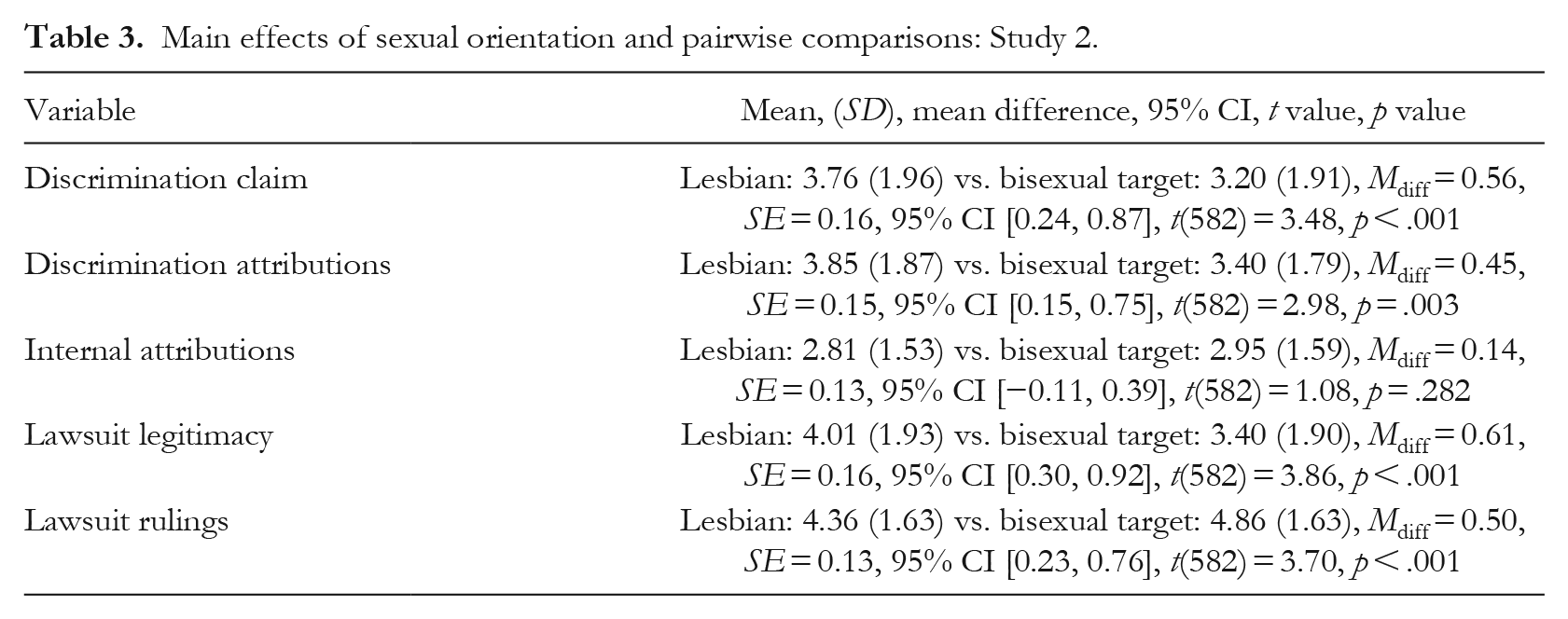
Correlations for all dependent variables can be found in the supplemental material. We conducted independent samples t tests to test our hypotheses. See Table 3 for main effects and pairwise comparisons.
Main effects of sexual orientation and pairwise comparisons: Study 2.
Discrimination claim and discrimination attributions
Consistent with Hypothesis 3, participants reported that a lesbian target who lost to a female bisexual competitor was more likely to have faced discrimination than a bisexual female target who lost to a lesbian competitor on both the discrimination claim measure and the discrimination attributions measure.
Internal attributions
Sexual orientation of target and competitor did not influence participants’ internal attributions for why the target lost out on the funding.
Lawsuit legitimacy and lawsuit rulings
Also supporting Hypothesis 3, on the two-item measure of lawsuit legitimacy (α = .97), participants rated the lesbian’s lawsuit as more legitimate than the bisexual female’s lawsuit. Participants showed the same pattern of responses when asked how they and a real judge (α = .81) would rule: suggesting rulings in favor of the plaintiff would be more likely for lawsuits filed by a lesbian target than a female bisexual target.
Discussion
Consistent with Hypothesis 3, participants were less likely to think that a female bisexual target had faced discrimination when she lost out on funding to a lesbian competitor than they were to think that a lesbian target faced discrimination when she lost out on funding to a female bisexual competitor. We presume that directly comparing a bisexual woman and a lesbian woman enhanced participants’ perception of a status asymmetry (seeing the bisexual woman as relatively higher status than the lesbian woman), leading them to be less likely to say that the bisexual target experienced discrimination. Participants also rated the lesbian target’s lawsuit as more legitimate, which could suggest that bisexual claimants are less successful in the real world due to not being seen as targets of discrimination.
Study 3
Study 3 was a preregistered study designed to further investigate how contextual cues about relative status (e.g., the social identity of a competitor) influence ratings of whether a person has faced discrimination. In particular, we added conditions in which sexual minority targets lost out on a funding opportunity to heterosexual competitors. If participants are attending to status asymmetry, then they should think that a bisexual target who lost out on a funding opportunity to a heterosexual competitor (higher status) was more likely to have faced discrimination than a bisexual target who lost to a lesbian target (perceived lower status). On the other hand, gay/lesbian targets should be seen as likely targets of discrimination regardless of the identity of the competitor (bisexual or heterosexual) since both sexual identities are perceived as relatively higher status than gay/lesbian identities (Hypothesis 3).
We also varied target gender to ask whether gender differences would emerge when status asymmetries were highlighted by knowing the identity of the target’s competitor. We intended to randomly assign participants to see a male or female target, but, due a randomization error, samples evaluating female (Study 3a) and male (Study 3b) targets were collected and reported separately. 9 In addition to the measures from Study 2, we measured perceptions of the target’s disadvantage. In order to explore whether potential gender differences in the bisexual conditions were due to expectations that bisexual women were more likely to be heterosexual (Hypothesis 4a) and bisexual men were more likely to be gay (Hypothesis 4b), we also asked participants to predict the gender of the bisexual target’s future romantic partner. 10
Study 3a
Method
Participants
We recruited 600 participants via Prolific (www.prolific.co) in 2022. Results of an a priori power analysis using G*Power (Faul et al., 2007) showed that recruiting 580 participants would provide 90% power with an alpha of .05 to detect the smallest effect size (d = 0.12) observed in Study 2. Due to the error with randomization, we excluded 299 participants who were presented with male targets, leaving a sample of 301. We also excluded two additional participants who did not identify as heterosexual, making the total sample 299 people (Mage = 39.61, SDage = 14.54), 53% of whom identified as female. Participants identified as White (80%), Asian (6%), Black (6%), Native American (1%), Latino/Latinx/Hispanic (5%), multiracial (1%), or identity not listed (1%). Participants were paid $0.65.
Procedure and measures
This study was a 2 (target sexual orientation: bisexual vs. lesbian) x 2 (competitor sexual orientation: sexual minority vs. heterosexual) between-subjects factorial design. The procedure was identical to that in Study 2, except for the addition of a condition in which the sexual minority target lost to a heterosexual competitor. Specifically, the bisexual target lost out on the funding to either a heterosexual or a lesbian (sexual minority) competitor, whereas the lesbian target lost out on the funding to either a heterosexual or bisexual (sexual minority) female competitor. In addition to the dependent variables from the previous study, exploratory measures were collected and are reported in supplemental material.
Perceptions of target disadvantage
Perception of disadvantage was measured with four items adapted from Sanchez and Chavez (2010). Participants rated their agreement with each of the following items on a 7-point scale (1 = strongly disagree, 7 = strongly agree): “[Target] does not seem disadvantaged enough by her sexual orientation to be discriminated against” (reverse-coded), “[Target] does not strike me as disadvantaged enough by her sexual orientation to claim discrimination” (reverse-coded), “[Target] faces a lot of prejudice because of her sexual orientation,” and “[Target] is disadvantaged because of her sexual orientation.” Items were averaged to create a composite score (α = .89), with higher scores indicating more perceived disadvantage due to sexual orientation.
Bisexual target’s partner’s gender
As a final question, participants in the bisexual target conditions were told, “Imagine you later find out that [target] now has a romantic partner. What gender do you think her partner is?” They were asked to select either male or female.
Results
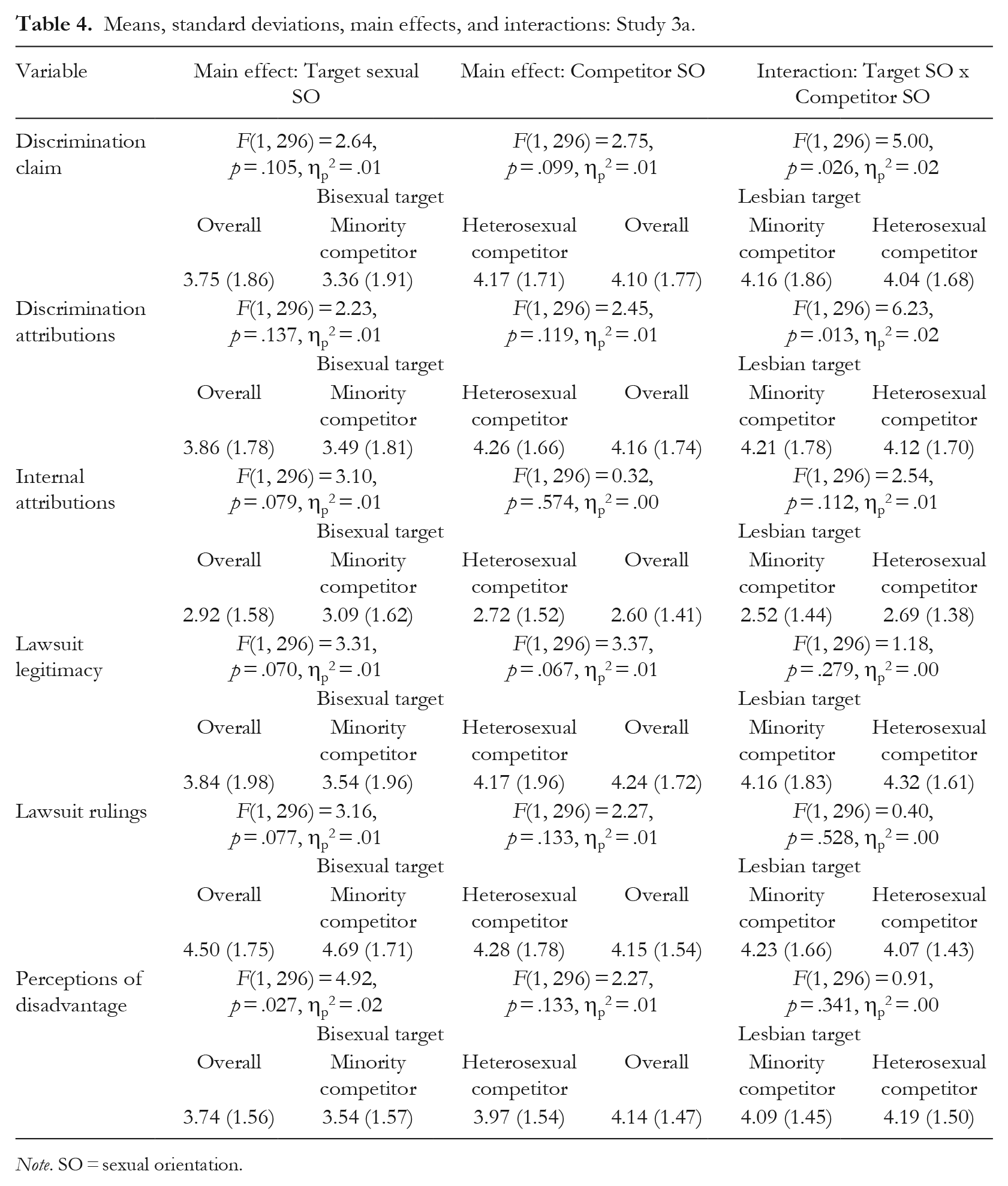
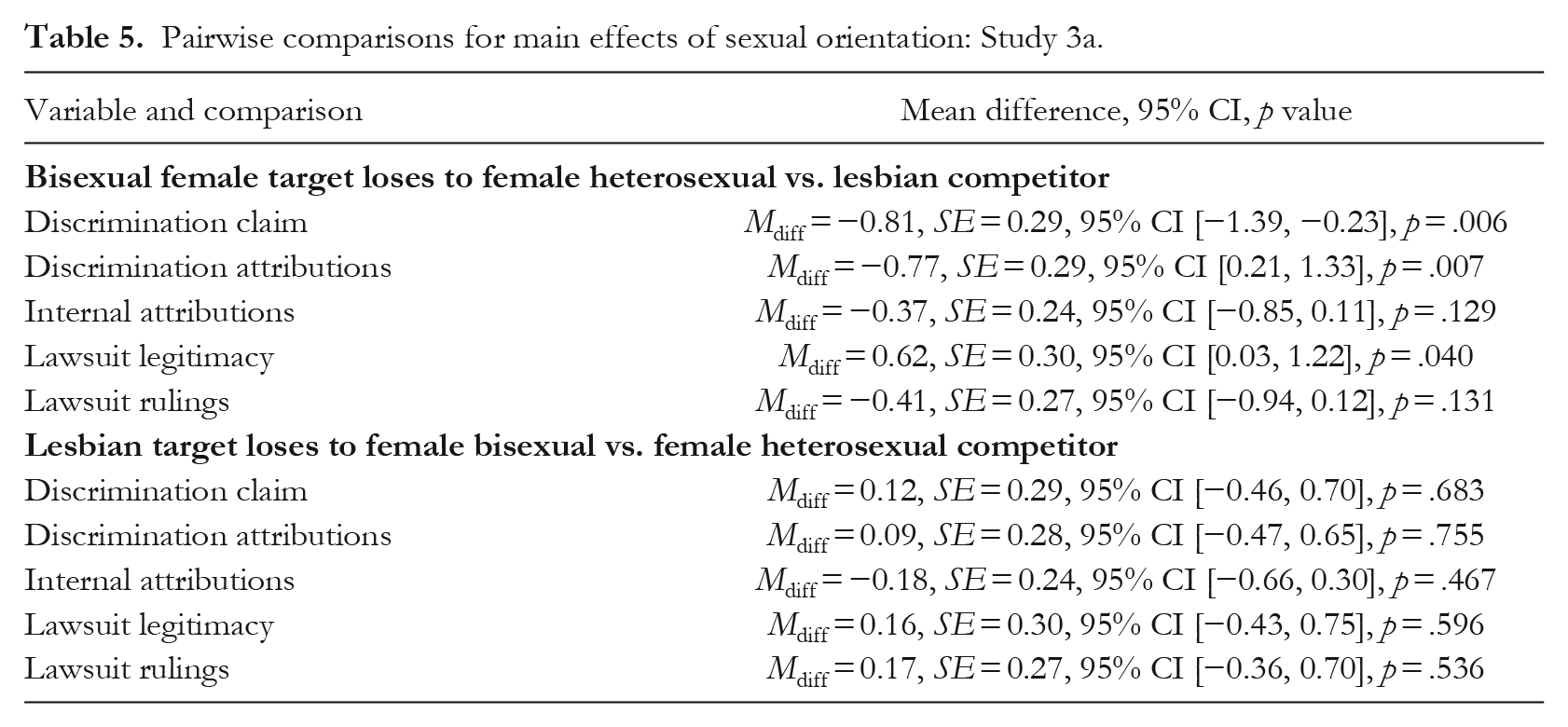
Since our interest was in the interaction of target sexual orientation and competitor sexual orientation, we report main effects only when significant (see Tables 4 and 5 for full analyses). We conducted a between-subjects factorial ANOVA to test our hypotheses, unless noted otherwise.
Means, standard deviations, main effects, and interactions: Study 3a.
Note. SO = sexual orientation.
Pairwise comparisons for main effects of sexual orientation: Study 3a.
Discrimination attributions
For both the single-item discrimination claim measure and the two-item attributions to discrimination measure there was a significant interaction between target sexual orientation and competitor sexual orientation. Consistent with Hypothesis 3, participants were similarly likely to say that the lesbian target had been discriminated against, regardless of whether she lost to a bisexual or a heterosexual competitor. However, participants were more likely to say that the bisexual target had faced discrimination when she lost to a heterosexual competitor compared to a lesbian competitor.
Internal attributions
There was no significant interaction of target and competitor sexual orientation on how likely people were to report that internal factors hindered the target’s getting the funding.
Lawsuit legitimacy and lawsuit rulings
Unlike the discrimination measures, when participants were asked about the legitimacy of a lawsuit, as well as legal rulings (α = .83), there were no significant effects of target sexual orientation, competitor identity, or their interaction.
Perceptions of target disadvantage
Although there was no significant interaction between competitor sexual orientation and target sexual orientation, there was a significant main effect of target sexual orientation. As expected, participants saw the lesbian target as more disadvantaged by her sexual orientation than the bisexual target.
Bisexual target’s partner’s gender
More than half of the participants predicted that the bisexual target’s romantic partner would be male (62%, binomial p = .003).
Study 3b
Study 3b was identical to Study 3a except it had male targets. We had two possible predictions about inferences of discrimination against bisexual men. First, like in Study 3a, the sexual orientation of the competitor might only impact whether participants perceive discrimination against a bisexual man, such that people would perceive discrimination when a gay man lost to a bisexual man, but not the other way around (Hypothesis 3). Alternatively, since bisexual men are often believed to be gay (Matsick & Rubin, 2018), people might see bisexual men and gay men as similarly low status. In this case, both would be perceived as victims of discrimination when losing to a heterosexual competitor, but neither would be perceived as a victim of discrimination when losing to the other (Hypothesis 4b).
Method
Participants
We recruited 300 participants via Prolific (www.prolific.co) in 2022; we excluded four participants who did not identify as heterosexual, resulting in a sample size of 296 (Mage = 39.52, SDage = 14.42). Fifty-eight percent identified as female, and participants identified as White (77%), Asian (5%), Black (8%), Native American (1%), Latino/Latinx/Hispanic (6%), and multiracial (3%). Participants were paid $0.65.
Procedure and measures
We again used a 2 (target sexual orientation: bisexual vs. gay) x 2 (competitor sexual orientation: sexual minority vs. heterosexual) between-subjects factorial design. The procedure and measures were exactly the same as in Study 3a, except that the targets were all male. 11
Results
We again conducted a between-subjects factorial ANOVA to test our hypotheses, unless noted otherwise. No significant interactions of target sexual orientation and competitor sexual orientation were observed on any dependent variable, so we focus on main effects of competitor sexual orientation in the main text. See Table 6 for full analyses.
Means, standard deviations, main effects, and interactions: Study 3b.
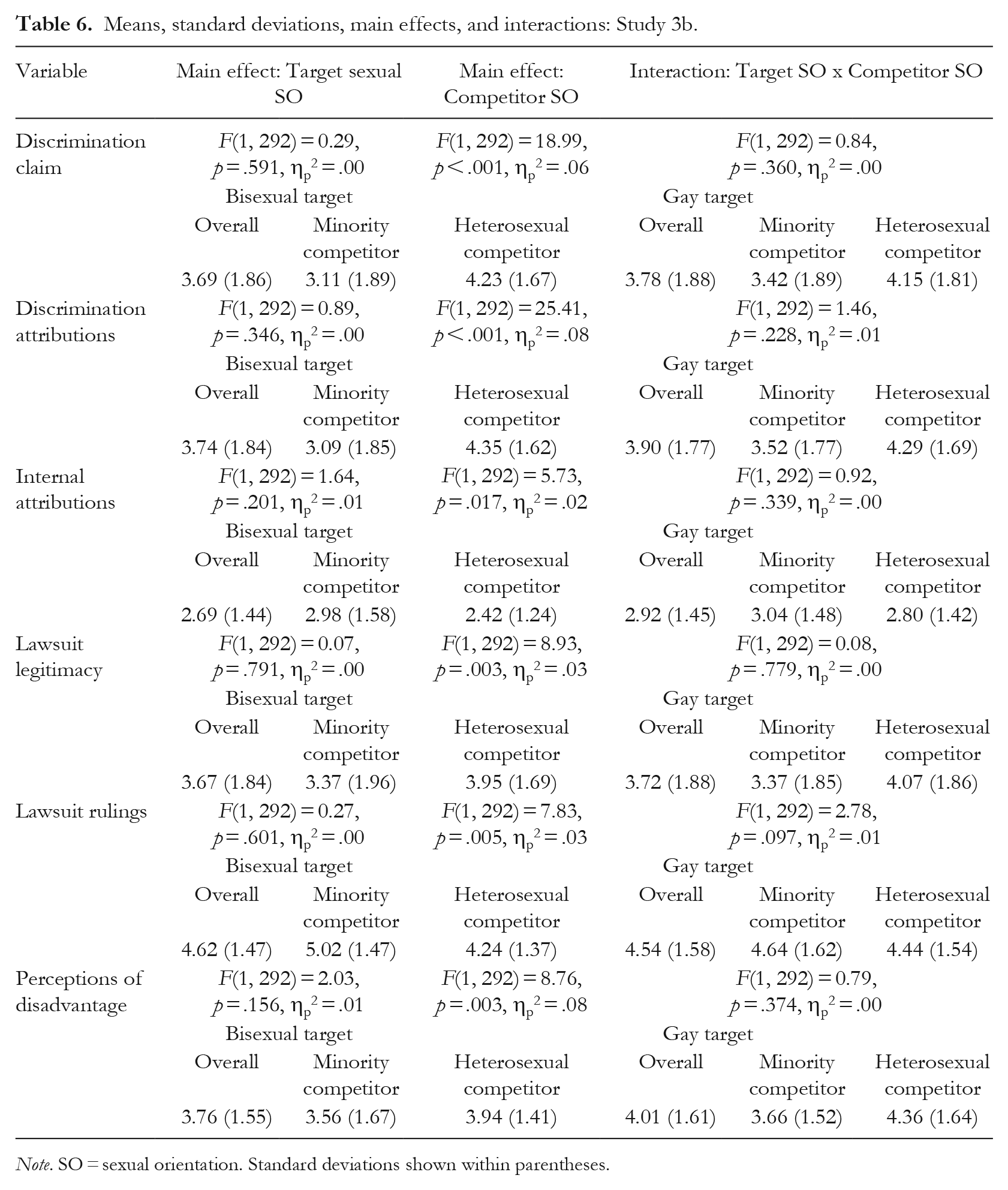
Note. SO = sexual orientation. Standard deviations shown within parentheses.
Discrimination claim and discrimination attributions
For both the single-item discrimination claim measure and the two-item attribution to discrimination measure, participants said that a sexual minority target who lost to a heterosexual competitor was significantly more likely to have faced discrimination than one who lost to the other sexual minority competitor, regardless of whether the target was gay or bisexual.
Internal attributions
Participants were significantly more likely to make internal attributions when a sexual minority target lost to a sexual minority competitor compared to a heterosexual competitor.
Lawsuit legitimacy and lawsuit rulings
We again found support for Hypothesis 4: participants saw a sexual minority target’s lawsuit as significantly more legitimate when he lost to a heterosexual competitor compared to when he lost to the other sexual minority competitor.
Perceptions of target disadvantage
Participants rated a sexual minority target who lost to a heterosexual competitor as more disadvantaged than one who lost to the other sexual minority competitor.
Bisexual target partner gender
More than half of the participants predicted that the bisexual target’s romantic partner would be male (63%, binomial p = .003).
Discussion
Results of Study 3 further demonstrate that people are more likely to make an attribution to discrimination when the target who lost out on a funding opportunity is perceived as lower in status than their competitor (Hypothesis 3). Specifically, lesbian women (who were perceived as lower status than bisexual and heterosexual women) were seen as potential targets of discrimination regardless of whether they lost out on the funding to a bisexual woman or a heterosexual woman. On the other hand, bisexual women were seen as likely to be victims of discrimination when they lost to a higher status competitor (heterosexual coworker), but not when they lost out on funding to a lower status competitor (lesbian coworker). These results suggest that heterosexual people perceive status asymmetry between bisexual and lesbian women and find it less plausible for a bisexual woman applicant to have faced discrimination if she lost out to a lesbian applicant.
Interestingly, participants seemed to view lesbian women’s lawsuits as more valid than bisexual women’s lawsuits, regardless of the sexual orientation of the competitor, although this result did not reach statistical significance like in Study 2. It may be that heterosexual people’s discrimination attributions regarding bisexual targets are not strong enough to inform their inferences about lawsuits.
Participants perceived gay men and bisexual men as equally likely to be disadvantaged (i.e., as equally low status). Correspondingly, they had similar responses when asked about bisexual and gay men: saying that targets from both groups likely faced discrimination if they lost out on the funding to a heterosexual competitor (rather than to another sexual minority competitor). Similarly, participants rated both bisexual men’s and gay men’s lawsuits as more legitimate when they lost to a heterosexual competitor. The lack of difference in participants’ discrimination attributions for bisexual men and gay men is consistent with past research showing that people tend to perceive bisexual men as gay (Matsick & Rubin, 2018). Indeed, participants believed that the bisexual man was most likely to partner with a man, and that the bisexual woman was most likely to partner with a man, providing support for Hypothesis 4. Therefore, future work is needed to more fully understand when (if ever) bisexual men may be seen as having higher status than gay men.
General Discussion
The current studies examined when heterosexual people attribute negative outcomes to discrimination for people with intermediate identities. Using bisexual people as our test case, this research makes the following contributions. First, consistent with past research, we demonstrate that people who are perceived to be higher status are less likely to be seen as victims of discrimination than those with lower perceived status. Second, additional contextual cues beyond just a target’s and a perpetrator’s social identities are necessary in order to understand how perceivers interpret potential acts of discrimination. We show that the social identity of a competitor can influence how likely someone with an intermediate identity is to be seen as a victim of discrimination. That is, in Study 1, when there was no competitor, bisexual and gay/lesbian targets were seen as equally likely to be victims of discrimination. However, in Studies 2 and 3, when we introduced a competitor, bisexual women were less likely to be seen as victims of discrimination compared to lesbian women. Therefore, this research expands our understanding of the prototype model of attributions to discrimination beyond the most conventionally considered advantaged and disadvantaged groups and perpetrator and victim.
We also show the importance of considering the role of multiple social identities (e.g., sexual orientation and gender) for both the target of discrimination and the competitor when making attributions to discrimination. Heterosexual participants perceived a status asymmetry between bisexual and lesbian women, rating lesbian women as more disadvantaged (Studies 1 and 3a). Correspondingly, participants viewed a bisexual woman receiving funding over a lesbian woman as a potentially discriminatory act but did not view it as discriminatory when the reverse was true. Given people’s propensity to view bisexual women as heterosexual (see Matsick & Rubin, 2018; McGorray & Petsko, 2023), 12 they may have seen the bisexual woman as having “heterosexual privilege” (Israel & Mohr, 2004). Furthermore, consistent with past research demonstrating that people tend to view bisexual men as gay (Matsick & Rubin, 2018; McGorray & Petsko, 2023), bisexual men and gay men were seen as equally low status and viewed as equally likely to have faced discrimination.
Heterosexual participants also viewed lesbian plaintiffs’ lawsuits more favorably than bisexual women’s lawsuits (though this comparison was statistically significant in Study 2 but not in Study 3a), which could explain why bisexual individuals’ lawsuits have been unsuccessful. That is, if judges and juries compare a bisexual woman to a more prototypical victim of discrimination, they may find the bisexual person’s case less valid. In fact, alleged bisexual victims are often assessed on whether or not they are “gay enough” to have experienced discrimination (Rehaag, 2009; Sin, 2015), suggesting judges and juries use gay/lesbian people as a standard with which to compare bisexual people and their experiences with discrimination.
This research is also important as issues regarding bisexual people are generally understudied in social psychological research, further contributing to bisexual invisibility (Salvati & Koc, 2022). As noted by Elia and Eliason (2012, p. 4): Although bisexuality studies have grown in prominence as an academic sub-field within sexuality studies over the past several years, it has mostly existed in the shadows of gay and lesbian studies and more recently it has been in the shadow of transgender studies as well.
Indeed, bisexual research is even scarce in journals whose focus is on amplifying research on sexual and gender diverse populations. For example, a content analysis of 223 articles published in the journal Psychology of Sexual Orientation and Gender Diversity (PSOGD) found that less than 1% were focused on bisexual populations (Pollitt et al., 2018).
More broadly, this research opens the door to further examine how other intermediate identities (e.g., biracial, bicultural) fit (or do not fit) into the current prototype model. Although there are notable differences between these social groups, each group can share some characteristics of their identity with a more advantaged group, and other characteristics of their identity with a more disadvantaged group. Also, like bisexual people, many of these groups face prejudice from their end-point identity groups. For example, biracial people are at times excluded from each of their racial communities (King, 2011), are often pressured to pick a single racial identity (Kich, 1992), and, when they have some White ancestry, are seen as holding some “White privilege” (Wilton et al., 2013). It is likely that acts of potential discrimination against biracial people, like those against bisexual people, are viewed differently depending on contextual cues that convey a biracial person’s relative status. For example, a Black-White biracial woman may be seen as less likely to have faced discrimination if she loses an opportunity to a Black individual (possibly perceived as lower status) than if she loses an opportunity to a White individual (higher status). Experimental evidence also supports this hypothesis: research shows that biracial individuals are perceived as less deserving of racial minority scholarships compared to monoracial minority individuals (Sanchez & Bonam, 2009).
Limitations and Future Directions
Although these studies reveal the importance of relative status in perceptions of discrimination towards people with intermediate identities, there are many important open questions. For example, what is the role of the perpetrator’s identity? We did not explicitly state the boss’s sexual orientation, but the majority of participants in Study 3 presumed that the boss was heterosexual (see supplemental material). High-status people are seen as more likely perpetrators of discrimination (heterosexual, in this case; Major et al., 2002), suggesting that participants may have been less likely to infer discrimination if the boss were from a sexual minority group (e.g., gay/lesbian or bisexual). Also, participants might have assumed that a heterosexual male boss might be less likely to discriminate against someone he could conceivably date. We cannot rule out the possibility that participants viewed bisexual men as more likely targets of discrimination than bisexual women in part due to assumptions that the boss was romantically interested in the bisexual woman.
For these initial studies, we only recruited heterosexual participants. However, future research should consider recruiting participants of various sexual identities. Although research suggests that heterosexual people hold more negative attitudes toward bisexual people (Roberts et al., 2015), gay and lesbian people also endorse bisexual stereotypes and exhibit other forms of antibisexual bias (Brewster & Moradi, 2010; Burleson, 2005). Indeed, recruiting a more sexually diverse sample of participants would allow researchers to consider the role of cross-categorization and perceiver’s social identity in judgements of discrimination against those with intermediate social identities. Cross-categorization refers to the crossing of two different dichotomous social identities for the perceiver, resulting in the creation of four different subgroups (Brown & Turner, 1979). For example, if a participant is a heterosexual man, then there are four groups created: the double ingroup (heterosexual, male), a double outgroup (e.g., bisexual, female), and two mixed groups where one identity is part of the ingroup (heterosexual, female; bisexual, male). Considering cross-categorization can potentially reduce the negative effects of intergroup prejudice by reducing ingroup–outgroup distinctions, and may diminish the significance of outgroup comparisons (Brown & Turner, 1979; Doise, 1978; Vanbeselaere, 1991).
Although we did not find any support for the effects of cross-categorization in our sample of heterosexual participants (see supplemental material), it is possible that sexual minority participants may respond differently due to shared experiences with prejudice and discrimination. Although we explored the intersecting role of gender and sexual orientation in our studies, this research could also benefit additional research on intersectionality. For example, how might these findings expand to transgender people? The 2015 U.S. Transgender Survey showed that one third of respondents identified as bisexual (James et al., 2016). Given that transgender people, particularly transgender women, experience high rates of discrimination (Grant et al., 2011), it would be useful to study perceptions of discrimination against transgender targets. Further, it is possible that other intersecting identities, such as race and gender, could influence judgements of discrimination. For example, Asian women may be seen as more likely to be targets of discrimination compared to Asian men, since men are perceived to have more status. However, Asian women may be seen as less likely to be targets of discrimination compared to Black women, since Black Americans are perceived as having less status than Asian Americans.
Additionally, our investigation focused on a common context of discrimination: the workplace. Although workplace discrimination has important societal and financial consequences (Goldman et al., 2006), sexual orientation discrimination occurs in other contexts as well (e.g., housing, health care, religious organizations; Mahowald et al., 2020). Therefore, future work should examine whether there are some contexts in which perceived status is less linked to attributions to discrimination.
Conclusion
The number of people identifying with intermediate identities in the US continues to increase (Pew Research, 2015; Rico et al., 2023). Yet, many social psychological theories do not account for how these groups are perceived and treated. Our work highlights the importance of contextual cues when determining whether a person with an intermediate identity has faced discrimination: attributions to discrimination are more likely if the target is seen as (relatively) low status.
Supplemental Material
sj-docx-1-gpi-10.1177_13684302231219676 – Supplemental material for Was that discrimination? Perceptions of bisexual people’s relative status inform attributions of discrimination
Supplemental material, sj-docx-1-gpi-10.1177_13684302231219676 for Was that discrimination? Perceptions of bisexual people’s relative status inform attributions of discrimination by Elizabeth A. Quinn-Jensen, Sara E. Burke, Brenda Major and Zoe Liberman in Group Processes & Intergroup Relations
Footnotes

References
Supplementary Material
Please find the following supplemental material available below.
For Open Access articles published under a Creative Commons License, all supplemental material carries the same license as the article it is associated with.
For non-Open Access articles published, all supplemental material carries a non-exclusive license, and permission requests for re-use of supplemental material or any part of supplemental material shall be sent directly to the copyright owner as specified in the copyright notice associated with the article.
