




Abstract
Feelings of group-based relative deprivation (GRD) motivate collective responses to defend the ingroup. As such, there may be status-based asymmetries in the associations GRD has with ideologies that perpetuate inequality—namely, right-wing authoritarianism (RWA) and social dominance orientation (SDO). Study 1 examined this hypothesis using a national sample of adults (N = 41,007) and revealed that the correlations GRD had with RWA and SDO were positive among members of a high-status group but negative among members of low-status groups. Study 2 examined these associations longitudinally (N = 22,083) across eight annual assessments. Although a traditional cross-lagged panel analysis identified status-based asymmetries in the longitudinal associations between our variables of interest, analyses partitioning between-person stability from within-person change found no evidence that GRD leads to differences in RWA or SDO (or vice versa). The theoretical and practical implications of these results are discussed.
Keywords
Social inequality is nearly ubiquitous within society, with growing rates of poverty, discrimination, and hardship seen across the globe (Atkinson et al., 2011; Balestra & Tonkin, 2018; Major et al., 2002; for a review, see Osborne et al., 2022). Notably, the impacts of inequality are especially apparent among disadvantaged groups, as ethnic minorities are disproportionally affected by poverty and reduced access to education, healthcare, and employment (Byrne et al., 2020; Stanciole & Huber, 2009). The recent outbreak of COVID-19 has only exacerbated these effects, with ethnic minorities experiencing disproportionally higher rates of infection and COVID-19-related mortality than their ethnic majority counterparts (Mackey et al., 2021; Mathur et al., 2021). Despite these adverse effects of inequality, efforts to change the system are rare (Jost et al., 2017). Some studies even identify majority support for, rather than opposition to, inequality, particularly in Western countries (e.g., Bartels, 2005).
To reconcile the apparent inconsistency between the increased prevalence of inequality and the public’s limited responses to it, relative deprivation theory argues that responses to inequality depend on subjective experiences of injustice rather than objective circumstances (Walker & Smith, 2011). However, because relative deprivation imperfectly mirrors objective circumstances, the former can elicit responses to inequality from people who are structurally advantaged but perceive themselves as victims of injustice (e.g., Tiraboschi & Maass, 1998). Thus, both (objectively) advantaged and disadvantaged groups can feel relatively deprived and—given the asymmetries in power and status between advantaged and disadvantaged groups—may respond to inequality in distinct ways.
We investigate this thesis by examining status-based differences in the relationships group-based relative deprivation (GRD) has with both right-wing authoritarianism (RWA; Altemeyer, 1981) and social dominance orientation (SDO; Pratto et al., 1994)—two core ideological attitudes that underly opposition to social change and support for inequality (Choma et al., 2020; Duckitt & Sibley, 2009; Osborne et al., 2023). Given the structural advantages of high-status group membership, feelings of GRD should motivate members of high-status groups to endorse ideologies that reinforce existing group-based hierarchies. In contrast, the perception that one’s group is deprived relative to others may foster opposition to these same ideologies among low-status groups. Before testing these hypotheses with cross-sectional (Study 1) and longitudinal (Study 2) data, we review the relevant literatures on relative deprivation, RWA and SDO and explain how these ideological attitudes correspond to attitudes towards inequality and social change.
Relative Deprivation Theory
Beginning with Stouffer et al.’s (1949) seminal work, social scientists define relative deprivation as the judgement that one or one’s group is disadvantaged relative to a salient (similar) other. This literature reveals that people’s subjective experiences of deprivation are more predictive than their objective experiences of how they will respond to inequality (Walker & Smith, 2011). Indeed, Stouffer et al. (1949) were the first to identify this phenomenon as a post-hoc explanation for why Air Corps soldiers—despite being promoted at a faster rate—were more dissatisfied with the military promotion processes than those in the military police. The authors argued that their displeasure with the system was due to Air Corps soldiers making relative comparisons within their group rather than assessing their objective status (or status relative to soldiers in different occupations).
Since Stouffer et al.’s initial discovery, several scholars have expanded upon the concept of relative deprivation to increase understanding of how people experience relative deprivation in different contexts. One of the most notable advances to this theory is that different reference points shape how people experience relative deprivation (Runciman, 1966). Namely, Runciman argued that a person can feel personally deprived relative to other individuals (individual-based relative deprivation; IRD) or that the group to which they belong is deprived relative to other groups (group-based relative deprivation; GRD). Critically, IRD and GRD best predict individual and group-based outcomes, respectively (see Smith et al., 2012). As such, one can feel personally advantaged but collectively deprived (or vice versa) and, in doing so, may respond to felt inequalities in different ways.
Importantly, differentiating between IRD and GRD helps to explain when low-status groups will support social change (Osborne, García-Sánchez, & Sibley, 2019). While IRD is a better predictor than GRD of individual-based outcomes to inequality, including increased stress and reduced mental health (e.g., Osborne, Sibley, & Sengupta, 2015; Walker & Mann, 1987), it is often unassociated with collective responses (e.g., Walker, 1999). Conversely, GRD is a better predictor than IRD of collective responses to inequality. For example, Mummendey et al. (1999) showed that increases in GRD correspond with increases in collective action for East Germans (i.e., a disadvantaged group). Notably, this finding replicates across cultures (Smith et al., 2018), with more recent research finding strong associations between GRD and disadvantaged group members’ collective esteem (Walker, 1999), ingroup identification (Zubielevitch et al., 2020), and support for social change (Abrams & Grant, 2012). In short, GRD is a crucial antecedent for social change among disadvantaged groups.
Feelings of relative deprivation are not, however, unique to members of low-status groups; irrespective of one’s objective societal position, individuals can perceive themselves as relatively deprived if (a) they make a comparison (either to other individuals or groups), (b) cognitively appraise themselves or their group as disadvantaged, and (c) deem this (perceived) disadvantage as unfair (Pettigrew, 2016). While feelings of relative deprivation somewhat mirror perceptions of disadvantage or injustice described by social identity theory (see Tajfel & Turner, 1979), relative deprivation ultimately arises from feelings of anger, resentment, and frustration at one’s status and the sense that they deserve more than they have (Crosby, 1976; Mummendey et al., 1999). Thus, relative deprivation theory focuses on affective responses to disadvantage and suggests that people who are objectively advantaged can perceive themselves as relatively deprived should they believe that they deserve more than other individuals or groups (Martin, 1986; Pettigrew, 2016).
Though vastly understudied, the limited work focusing on structurally advantaged groups reveals that relative deprivation correlates positively with opposition to social change and endorsement of policies that support existing social systems among members of advantaged groups (Taylor, 2002). For instance, Taylor found that increases in GRD for White Americans were associated with increased opposition to policies that redress anti-Black discrimination. More recent research likewise demonstrates that GRD correlates positively with opposition to multicultural initiatives in Australia (Leviston et al., 2020). GRD among high-status groups also correlates directly with prejudice and mediates the effects of several predictors of prejudice (Pettigrew & Meertens, 1995; Pettigrew et al., 2008). As such, GRD appears to undermine support for social change and equality among high-status groups, indicating the distinct effects of GRD among the structurally advantaged and disadvantaged.
Right-Wing Authoritarianism and Social Dominance Orientation
In addition to GRD eliciting status-based differences in support for (or opposition to) social change, GRD may differentially correlate with general ideological attitudes that seek to challenge (or reinforce) inequality. According to the dual-process model (DPM; Duckitt, 2001), Right-Wing Authoritarianism (RWA; Altemeyer, 1981) and Social Dominance Orientation (SDO; Pratto et al., 1994) are two differentially motivated ideological attitudes that uniquely predict generalised prejudice (Osborne et al., 2021) and attitudes towards inequality and social change (Duckitt & Sibley, 2016). RWA is motivated by views of a “dangerous” world and perceived risk from those who seek to destabilise the status quo (Altemeyer, 1988). Accordingly, individuals high in RWA tend to express preferences for control, stability, and order and greater respect for existing social systems and traditional norms (Altemeyer, 1981, 1988; Duckitt & Sibley, 2016). In contrast, SDO is motivated by a competitive worldview that fosters competition-driven values of power, group dominance, and a general preference for hierarchies and inequality (Duckitt, 2006; Perry et al., 2013; Pratto et al., 1994). In tandem, RWA and SDO are two of the most studied individual predictors of prejudice (for a recent review, see Duckitt, 2022) and independently predict prejudice (Ho et al., 2012; Osborne et al., 2021), Nationalism (Osborne et al., 2017; Sidanius et al., 1997), and support for right-wing (versus left-wing) politics (Duckitt & Sibley, 2009; Sidanius & Pratto, 1999).
Previous research suggests an association between GRD and right-wing ideologies (e.g., Pettigrew, 2016; Sengupta et al., 2019). Indeed, because feelings of GRD threaten the perception that one’s group has a hierarchical advantage over other groups (see Sengupta et al., 2019; Sidanius & Pratto, 1999; Tajfel & Turner, 1979), members of high-status groups may respond to feelings of disadvantage by increasing their endorsement of existing social systems and hierarchies. Moreover, contexts that elicit social- or group-based threats are integral to understanding the endorsement of RWA and SDO. For example, membership in a high-status group predicts higher SDO scores, particularly when individuals identify strongly with their ingroup or perceive a group threat (Guimond et al., 2003; Morrison et al., 2009). Similarly, Altemeyer (1988) suggests that perceived social threats—for example, a political crisis—increase RWA (Hastings & Shaffer, 2005; Perry et al., 2013). Thus, GRD should correlate positively with RWA and SDO among members of high-status groups to abate these threats (Duckitt & Sibley, 2009).
Although research has yet to test this thesis directly, Doosje et al. (2012) found an indirect association between GRD and the adoption of right-wing ideology among members of high-status groups. Specifically, increases in GRD correlated positively with perceived ingroup superiority, which sequentially increased the endorsement of right-wing belief systems in Dutch youth. Research has also found an indirect association between GRD and right-wing radicalisation through perceptions of group threat and procedural unfairness (Doosje et al., 2013). Experimental research further suggests that GRD can elicit fusion with extreme political leaders, which, in turn, predicts authoritarian attitudes towards various outgroups (Kunst et al., 2019). Combined with work showing that GRD correlates positively with prejudice among members of high-status groups (e.g., Pettigrew et al., 2008), these studies indirectly suggest that GRD can foster endorsement of right-wing ideologies amongst the advantaged.
In contrast to high-status groups, GRD should correlate negatively with RWA and SDO among low-status groups because existing social structures undermine the interests of an objectively disadvantaged group. Indeed, perceiving one’s low-status group as disadvantaged requires recognising the illegitimacy of existing social systems (see Bahamondes, Sibley, & Osborne, 2021; Mummendey et al., 1999). Moreover, the experience of group-based inequities—and thus, feelings of GRD—may also challenge members of low-status groups’ positive beliefs about existing social systems and hierarchies (Osborne, García-Sánchez, & Sibley, 2019). As such, the associations between GRD and these ideologies should be negative among low-status groups.
Research indirectly supports this hypothesis. For example, GRD correlates negatively with conservatism via warmth towards the ingroup amongst members of low-status groups (Osborne & Sibley, 2015). Likewise, given that GRD correlates positively with support for social change among low-status groups (Abrams & Grant, 2012; Mummendey et al., 1999), GRD should also correlate negatively with ideologies that obstruct social change (namely, SDO and RWA; see Choma et al., 2020). That said, research has yet to directly assess the effects of low-status group status on the association between GRD and right-wing belief systems.
Overview of Study 1
Study 1 addresses this oversight by examining the associations GRD has with SDO and RWA using a nationwide random sample of New Zealand adults. Specifically, we test whether these associations vary by group status. We expect GRD to correlate positively with RWA and SDO among members of a high-status group because these ideological attitudes are motivated by preferences for stability, order, and group-based hierarchy that align with the interests of high-status groups (see Duckitt & Sibley, 2016). Conversely, GRD should correlate negatively with RWA and SDO among members of low-status groups because existing social structures undermine the interests of objectively disadvantaged groups. By examining these hypotheses, we elucidate how status critically shapes the relationship between GRD and the endorsement (or rejection) of ideologies that perpetuate inequality and prejudice.
To assess feelings of GRD across ethnic groups, we utilise measures that directly assess how individuals perceive their ethnic group’s status relative to other groups in New Zealand (i.e., the country of the present study). This measure primes participants to think about their ethnic group identity and, thus, elicits responses comparing their ethnic group to other ethnic groups (see Brewer, 1991). Because GRD is the product of upward social comparisons among objectively disadvantaged group members (Smith & Pettigrew, 2014), this measure allows us to assess how low-status groups perceive their status relative to higher-status groups. Among high-status groups, however, any feelings of GRD relative to other groups likely reflect feelings of “losing out” to other ethnic groups in New Zealand. Thus, we also assess how deprived members of high-status groups feel relative to other ethnic groups (see Sengupta et al., 2019).
Identifying when GRD correlates with an ideological motivation to endorse inequality is critical because this information can help to increase understanding of why social change is rare, as well as the increase in right-wing ideology and extremism internationally (Battersby & Ball, 2019; Campion, 2019; Jones et al., 2020). In New Zealand, the resurgence of right-wing ideology is marked by the 2019 terrorist attack in Christchurch, which, while unprecedented in scale, is consistent with growing concerns about right-wing extremism within the country (see Battersby & Ball, 2019). These concerns—coupled with the relationship between right-wing ideology and prejudice more generally (e.g., Duckitt, 2006)—signal a need to understand the conditions that foster right-wing beliefs. As such, the current study aims to elucidate status-specific attitudes towards inequality that may help explain the conditions that give rise to right-wing ideology.
Methodology
Sampling Procedure
Study 1 analysed data from Time 10 of the New Zealand Attitudes and Values Study (NZAVS)—an ongoing longitudinal, nationwide panel study of New Zealand adults that began in 2009. Sampling for Time 10 occurred on six occasions. In 2009 (Time 1), random sampling from the electoral roll yielded 6,518 participants (response rate = 16.6%). By 2011, 3,918 participants remained in the study (retention rate = 60.1%). A non-random booster sample was recruited from a national newspaper website to account for sample attrition, yielding a further 2,966 participants and increasing the sample size at Time 3 to 6,884 participants (including 4 additional unsolicited opt-ins).
Four additional booster samples were conducted by randomly sampling the electoral roll (without replacement) at Time 4 (2012; Nbooster = 5,107), Time 5 (2013; Nbooster = 7,579), Time 8 (2016; Nbooster = 7,667), and Time 10 (2019; Nbooster = 29,293). In total, 61,535 participants completed at least one wave of the study. Sibley (2021) provides further information about the sampling procedure, retention, and ethics approvals for the NZAVS.
Participants
A total of 41,661 participants provided partial or complete responses to our variables of interest at Time 10 (Mage = 49.50, SD = 13.62). Of these participants, most were women (62.5%), employed (80.9%), nonreligious (64.0%), and living in urban areas (81.3%). The majority of participants identified as either New Zealand European (84.0%) or Māori (9.6%), with the remainder of the sample identifying as either Asian (4.7%) or Pasifika (1.7%). Although most participants were born in New Zealand (79%), this differed by ethnic group affiliation. 1 Whereas the majority of Māori (96.7%), European (80.4%), and Pasifika (68.5%) participants were born in New Zealand, most Asian participants were born overseas (78.3%).
Measures
Time 10 of the NZAVS included these measures relevant to the current study: (a) GRD, (b) group status, (c) SDO, (d) RWA, and (e) covariates (including IRD). Unless noted, items were rated on a 1 (strongly disagree) to 7 (strongly agree) scale.
Predictors
Outcome variables
Covariates
Individual-based relative deprivation
To demonstrate the unique effects of GRD, we controlled for IRD (e.g., see Smith et al., 2012). Specifically, these two items adapted from Abrams and Grant (2012) were used to assess IRD: (a) “I’m frustrated by what I earn relative to other people in New Zealand”; and (b) “I generally earn less than other people in New Zealand” (α = .58).
Demographic covariates
We measured age, gender, household income, education, and whether participants were religious, employed, or living in a rural or urban area. Gender (0 = woman, 1 = man), and whether participants were religious (0 = no, 1 = yes), employed (0 = no, 1 = yes), or urban (0 = rural, 1 = urban) were dummy-coded. Household income was measured by asking participants to estimate their total household income (before tax) for the last year and dividing it by NZD $100,000 to account for the high variance in responses. Education was measured by having participants report their “highest level of qualification” and coding responses into an 11-level ordinal variable according to the New Zealand Qualifications Authority (0 = no formal qualification, 10 = doctoral degree or equivalent).
Results and Discussion
To examine potential status-based asymmetries in the relationships GRD had with SDO and RWA, we simultaneously regressed SDO and RWA onto our predictors in two separate regression models. In the first model, SDO and RWA were regressed onto GRD, IRD, group status, and our covariates. In the second model, we included the (a) GRD × Group status and (b) IRD × Group status interaction terms. To account for missing data, we used full information maximum likelihood estimates (FIML; see Enders & Bandalos, 2001).
Descriptive Statistics
Table 1 displays the descriptive statistics and bivariate correlations for the variables included in this study. We first examined the mean scores of relative deprivation, which revealed relatively low scores across groups. That said, members of low-status groups, on average, scored higher on GRD (M = 3.85, SE = 0.02) than members of high-status groups (M = 2.07, SE = 0.01; Mdiff = −1.79, p < .001, Cohen’s d = −1.45). Likewise, members of low-status groups scored higher on IRD (M = 3.71, SE = 0.02) than did their high-status counterparts (M = 3.37, SE = 0.01; Mdiff = –0.34, p < .001, d = −0.22). Thus, low-status groups perceived greater IRD and GRD than high-status groups, mirroring their structurally disadvantaged status.
Descriptive statistics and bivariate correlations between the variables included in our analyses.
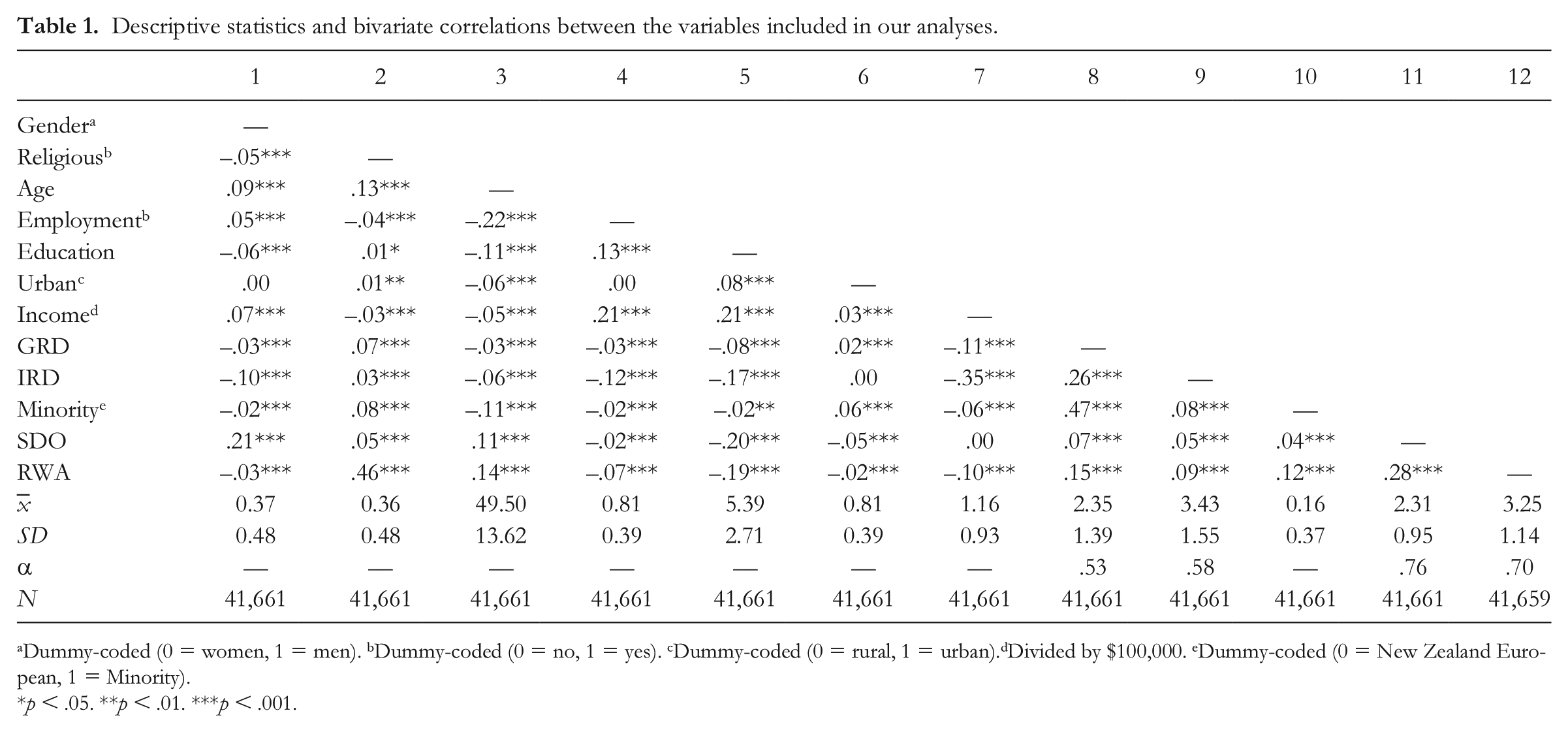
Dummy-coded (0 = women, 1 = men). bDummy-coded (0 = no, 1 = yes). cDummy-coded (0 = rural, 1 = urban).dDivided by $100,000. eDummy-coded (0 = New Zealand European, 1 = Minority).
p < .05. **p < .01. ***p < .001.
Social Dominance Orientation
Table 2 shows that men (b = 0.40, SE = 0.01, p < .001) and those who identified as religious (b = 0.10, SE = 0.01, p < .001) scored higher on SDO than did women and non-religious participants, respectively. Additionally, age (b = 0.01, SE = 0.00, p < .001), IRD (b = 0.03, SE = 0.00, p < .001), and income (b = 0.05, SE = 0.01, p < .001) correlated positively, whereas educational attainment (b = −0.06, SE = 0.00, p < .001) and living in urban areas (b = −0.09, SE = 0.01, p < .001) correlated negatively, with SDO. After adjusting for these reliable associations, both GRD (b = 0.03, SE = 0.00, p < .001) and low-status group membership (b = 0.06, SE = 0.01, p < .001) correlated positively with SDO.
Multiple regression analyses predicting Social Dominance Orientation (SDO) and Right-Wing Authoritarianism (RWA).
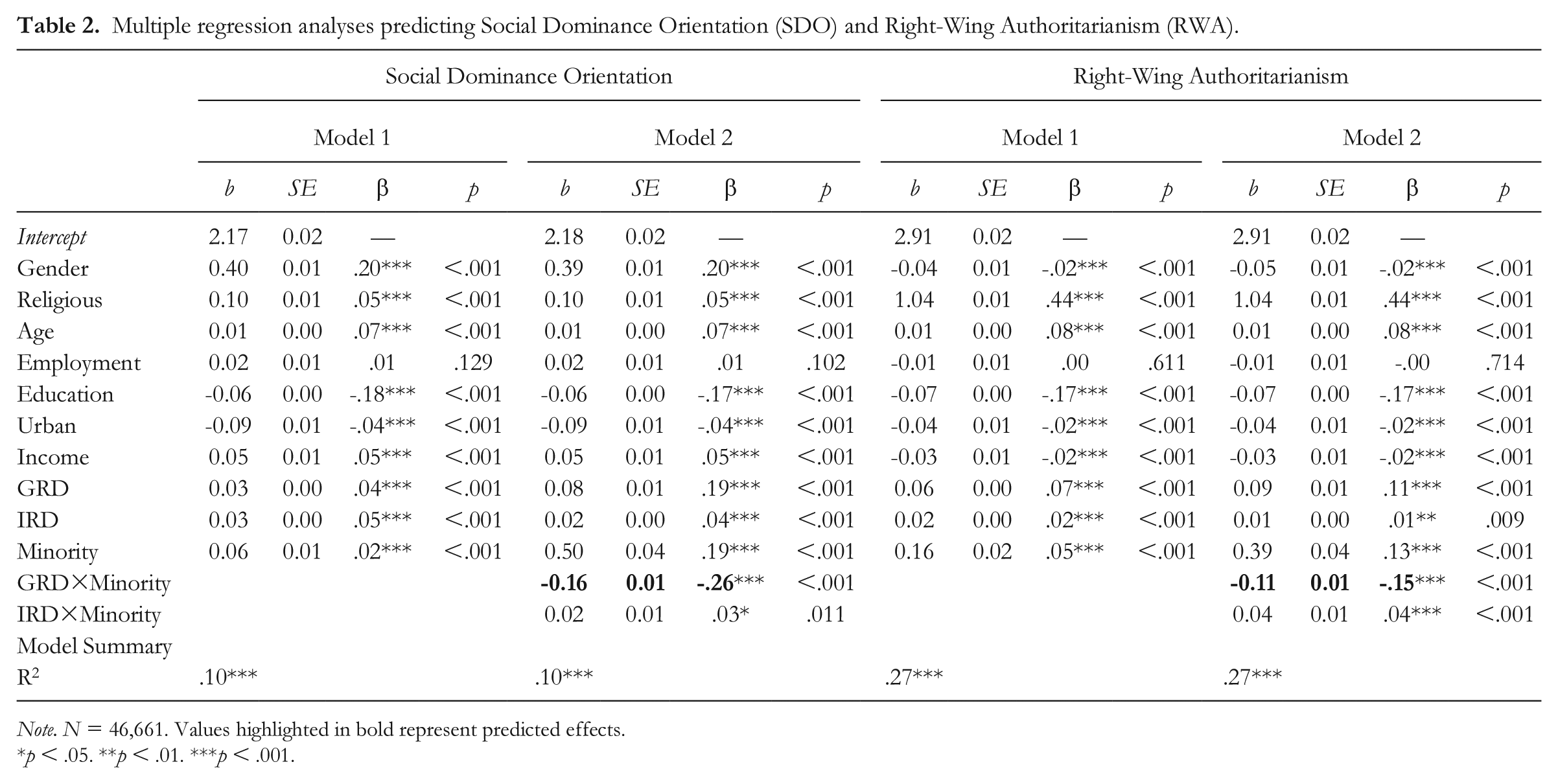
Note. N = 46,661. Values highlighted in bold represent predicted effects.
p < .05. **p < .01. ***p < .001.
Model 2 displays the results for our interaction hypothesis. As shown here, group status moderated the relationship between GRD and SDO (b = −0.16, SE = 0.01, p < .001). This effect was notably stronger than the moderating effect of group status on the association between IRD and SDO (b = 0.02, SE = 0.01, p = .011; bdiff = –0.18, SE = 0.01, p < .001). As expected, simple slope analyses revealed an asymmetry in the association between GRD and SDO for low- and high-status groups (see Figure 1). Specifically, GRD and SDO correlated positively for members of high-status groups (b = 0.08, SE = 0.00, p < .001) but negatively for members of low-status groups (b = –0.08, SE = 0.01, p < .001). Interestingly, simple slope analyses also revealed that the association between IRD and SDO was positive and stronger among members of low-status groups (b = 0.04, SE = 0.01, p < .001) than among members of high-status groups (b = 0.02, SE = 0.00, p < .001; bdiff = 0.02, SE = 0.01, p = .011).
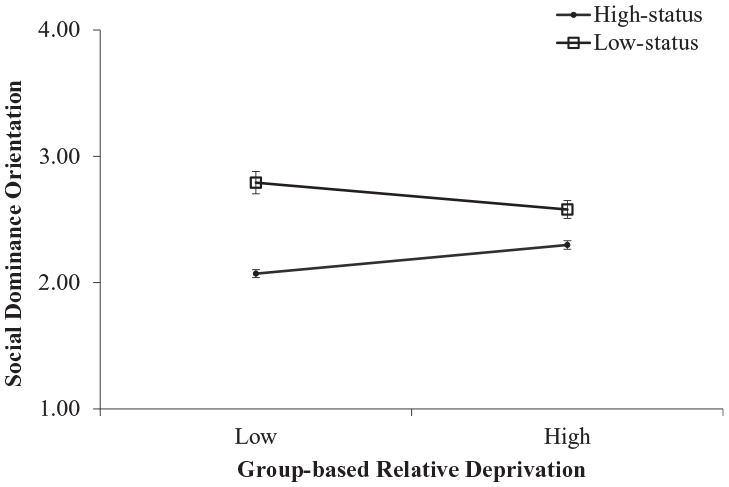
Participants’ level of Social Dominance Orientation (SDO) as a function of Group-based Relative Deprivation (GRD) and group status.
Right-Wing Authoritarianism
Table 2 also displays the correlates of RWA. Specifically, women (b = −0.04, SE = 0.01, p < .001) and those who identified as religious (b = 1.04, SE = 0.01, p < .001) scored higher on RWA than did men and non-religious participants, respectively. Additionally, age (b = 0.01, SE = 0.00, p < .001) and IRD (b = 0.02, SE = 0.00, p < .001) correlated positively, whereas educational attainment (b = −0.07, SE = 0.00, p < .001), income (b = −0.03, SE = 0.01, p < .001), and living in an urban area (b = −0.04, SE = 0.01, p < .001) correlated negatively, with RWA. After adjusting for these associations, both GRD (b = 0.06, SE = 0.00, p < .001) and group status (b = 0.16, SE = 0.02, p < .001) correlated positively with RWA.
Model 2 displays the results for our interaction hypothesis. As shown here, group status moderated the association between GRD and RWA (b = −0.11, SE = 0.01, p < .001). Critically, this interaction effect was stronger than the moderating effect of group status on the association between IRD and RWA (b = 0.04, SE = 0.01, p < .001; bdiff = –0.14, SE = 0.01, p < .001). Consistent with our hypotheses, simple slope analyses revealed a status-based asymmetry in the association between GRD and RWA (see Figure 2). Specifically, the association between GRD and RWA was positive for members of high-status groups (b = 0.09, SE = 0.01, p < .001) but negative for members of low-status groups (b = −0.01, SE = 0.01, p = .042). Additionally, the association between IRD and RWA was positive for both low- and high-status groups (b = 0.05, SE = 0.01, p < .001; b = 0.01, SE = 0.00, p = .009, respectively). Once again, the association was stronger among members of low-status groups (bdiff = 0.04, SE = 0.01, p < .001).
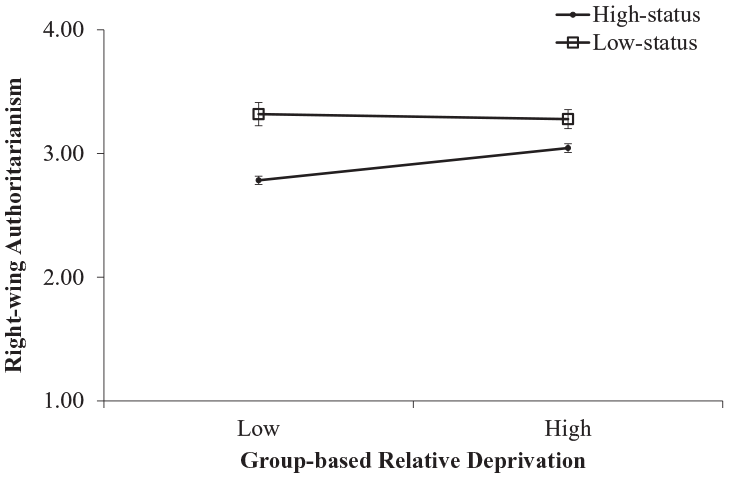
Participants’ level of Right-Wing Authoritarianism (RWA) as a function of Group-based Relative Deprivation (GRD) and group status.
Supplementary Analyses
Our results demonstrate status-based asymmetries in relative deprivation’s associations with SDO and RWA. However, using a pan-ethic minority group may occlude differences between low-status ethnic groups with different socio-political histories. Also, some of our participants were not born in New Zealand, and immigrant status may affect feelings of GRD (e.g., Obaidi et al., 2019). To these ends, we supplement our analyses by examining the moderating effects of Māori, Pacific, and Asian ethnicity (relative to New Zealand Europeans), controlling for whether participants were born in New Zealand. 3
Our additional analyses partially supported our status-asymmetry hypotheses (see the online Supplemental Materials for the full results). As expected, the associations GRD had with SDO and RWA were positive for New Zealand Europeans. Moreover, the association between GRD and SDO was negative for Māori and Pacific participants. However, the association between GRD and SDO was non-significant for Asian participants, suggesting that Asian participants low and high on GRD did not differ in their SDO. Moreover, the associations GRD had with RWA were non-significant for Māori and Pacific participants and positive (rather than negative) among Asian participants. As such, GRD correlated positively with SDO and RWA among members of high-status groups, but GRD only reliably correlated negatively with SDO among Māori and Pacific people.
Our supplementary analyses also revealed that the association between IRD and RWA was stronger among Māori participants relative to New Zealand Europeans. All remaining interactions were non-significant, suggesting that group status does not reliably moderate the associations IRD has with SDO and RWA.
Overview of Study 2
Although Study 1 provides (partial) support for our hypotheses, the cross-sectional nature of these data prevents us from claiming that GRD temporally precedes SDO and RWA (or vice versa). As such, Study 2 leverages eight annual waves of the NZAVS to examine these associations longitudinally. To do so, we present two sets of longitudinal analyses: a) a multigroup cross-lagged panel model (CLPM) and b) a multigroup random-intercept cross-lagged panel model (RI-CLPM; see Mulder & Hamaker, 2021). Traditional CLPMs are often used to examine the temporal ordering of variables and intuitively model longitudinal effects (Zyphur, Voelkle, et al., 2020). However, the CLPM confounds between-person stability with within-person change (Berry & Willoughby, 2017; Zyphur, Allison, et al., 2020). Accordingly, we compare this model to an RI-CLPM, which separates these distinct constructs via the inclusion of correlated random intercepts (Hamaker et al., 2015; Osborne & Little, in press). In doing so, we test whether GRD temporally precedes SDO and RWA within individuals and whether these associations differ by group status.
Participants
We utilised the 22,083 participants who provided partial or complete responses to our focal variables from Time 3 4 (2011) to Time 10 (2018) and who completed at least three waves of the NZAVS by Time 10 (Mwaves = 5.46, SD = 2.20, Range: 3–10). Of these participants, 13.7% completed all eight waves included in our analyses (i.e., 2011–2018). The average age of participants at Time 3 was 45.84 (SD = 14.06), and the majority were women (63.1%) and born in New Zealand (79.5%). In terms of ethnicity, most participants identified as New Zealand European (77.7%) or Māori (14.9%), with the remainder identifying as Asian (4.3%) or Pasifika (3.0%).
Measures
Study 2 used the same measures of GRD (αs = .59–.65), SDO (αs = .69–.79), and RWA (αs = .70–.75) used in Study 1 at each assessment occasion. As in Study 1, we dummy-coded ethnicity by group status (0 = New Zealand European/High status, 1 = Minority/Low status) for our multigroup analyses.
Results and Discussion
Analytic Method
To assess whether GRD predicted changes in SDO and RWA over time (and vice versa), we conducted (a) a multigroup CLPM and (b) a multigroup RI-CLPM. Both models were estimated in Mplus v.8.8 using FIML to account for missing data. Additionally, we estimated bias-corrected (BC) 95% Confidence Intervals (CIs) using 1,000 bootstrapped resamples (with replacement) for both models.
First, we estimated a multigroup CLPM in which the mean scores of GRD, SDO, and RWA at Time 1 were used to predict the same measures the following year across all eight waves of the study. We constrained the congeneric paths to equality to model a stationary process (e.g., the cross-lagged effect of GRD at Time 3 to SDO at Time 4 was constrained to be equal to the cross-lagged effect of GRD at Time 4 to SDO at Time 5, and so on). To assess differences between high- and low-status groups, we compared multiple group versions of the CLPM in which there were no constraints across groups with models where the cross-lagged and autoregressive coefficients were constrained to equality. If the latter significantly reduced model fit, then (some of) the paths differed across groups.
We also estimated an RI-CLPM, which, while conceptually similar to a traditional CLPM, isolates between-person stability from within-person change by including correlated random intercepts (Hamaker et al., 2015). In doing so, the autoregressive coefficients reflect within-person deviations from a person’s mean score on a given variable over time, while the cross-lagged coefficients reflect the extent within-person deviations from a person’s mean score on one variable predict within-person deviations from their score on another variable over time. To estimate the random intercepts, we utilised Osborne and Little’s (in press) phantom rescaling approach and freely estimated (but constrained to equality) the factor loadings of each variable at each assessment occasion. We then constrained their means and variances to 0 and 1, respectively. To model the within-person components of the model, we freely estimated a latent variable for each construct at each measurement occasion but constrained their (residual) variances to 1 (note that this approach does not alter model fit; see Osborne & Little, in press). Like our CLPM model, we estimated our RI-CLPM as a stationary process and compared a multigroup model where the within-person paths were free to differ across groups to a model that constrained these paths to equality across groups to evaluate whether status-based asymmetries emerge longitudinally.
Model 1
The leftmost columns of Table 3 display the results of our stationary multigroup CLPM. 5 First, we estimated a model whereby the autoregressive and cross-lagged paths were free to vary between members of high- and low-status groups (χ2(486) = 43149.58, p < .001; CFI = .83, RMSEA = .09 [0.088, 0.090], p < .001, SRMR = .15). We then estimated a model whereby these paths were constrained to equality across groups (χ2(495) = 45857.14, p < .001; CFI = .82, RMSEA = .09 [0.090, 0.092], p < .001, SRMR = .16). The significant decline in model fit revealed that (some of) the paths in the model differed by ethnic group status (Δχ2(9) = 2707.56, p < .001). As such, we interpret the CLPM where the paths were free to vary across groups.
Path coefficients of the longitudinal associations between GRD, RWA, and SDO.
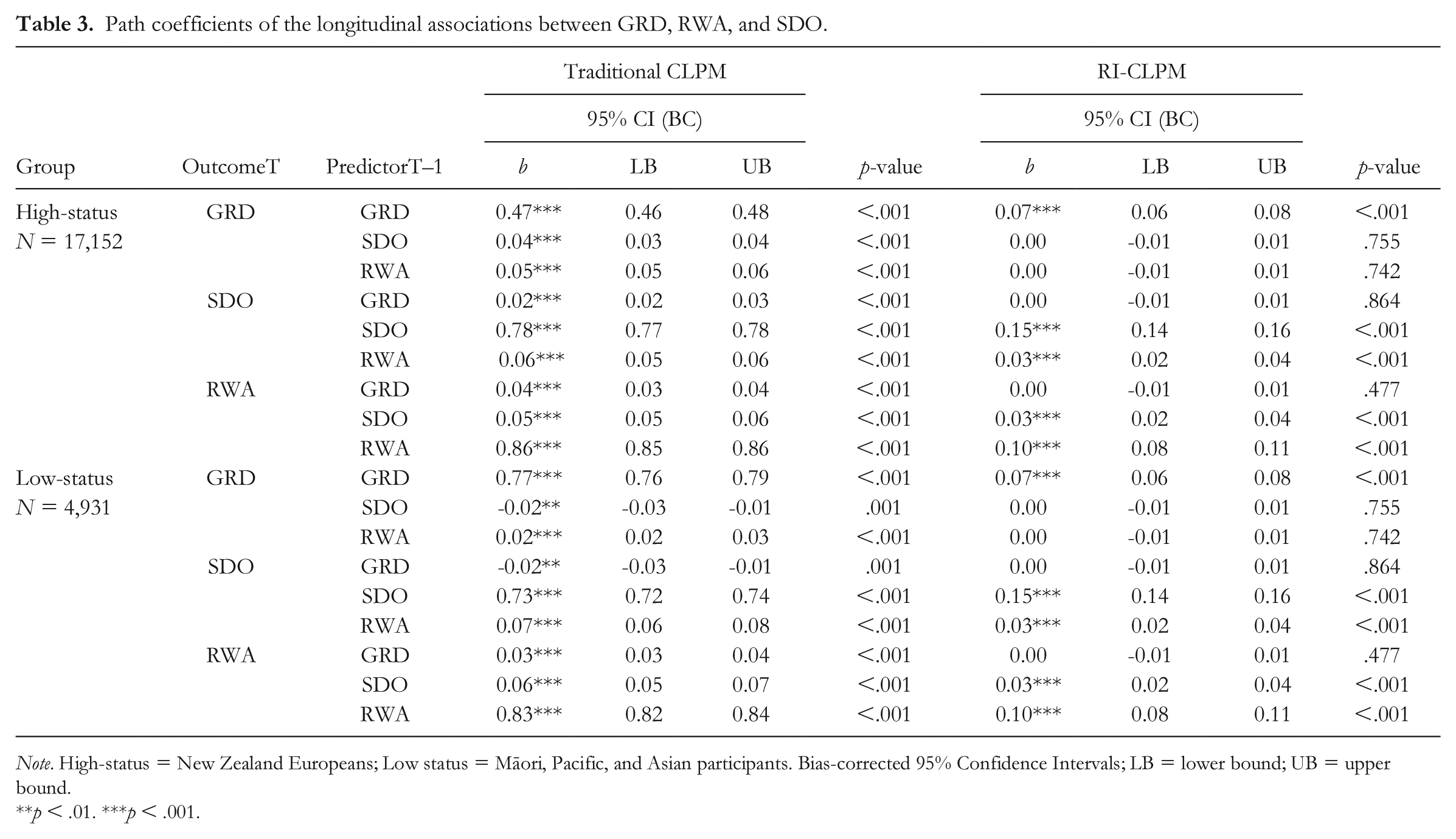
Note. High-status = New Zealand Europeans; Low status = Māori, Pacific, and Asian participants. Bias-corrected 95% Confidence Intervals; LB = lower bound; UB = upper bound.
p < .01. ***p < .001.
Although the model fit of this final model fell below traditional cut-off criteria (i.e., CFI < .90, RMSEA > .06, SRMR > .08), the autoregressive and cross-lagged paths reveal some status-based asymmetries in the associations GRD had with SDO and RWA over time. Turning first to members of high-status groups, the autoregressive paths in Table 3 reveal that GRD (B = 0.47, BC 95% CI = [0.46, 0.48], p < .001), SDO (B = 0.78, BC 95% CI = [0.77, 0.78], p < .001), and RWA (B = 0.86, BC 95% CI = [0.85, 0.86], p < .001) were all stable over time. But as hypothesised, GRD predicted increases in SDO (B = 0.02, BC 95% CI = [0.02, 0.03], p < .001) over time. However, SDO also predicted increases in GRD over time (B = 0.04, BC 95% CI = [0.03, 0.04], p < .001). Comparison of these cross-lagged paths revealed that the latter association was significantly larger than the former (Δχ2(1) = 10.77, p = .001). Likewise, GRD predicted increases in RWA (B = 0.04, BC 95% CI = [0.03, 0.04], p < .001) over time. Similar to SDO, RWA also predicted increases in GRD over time (B = 0.05, BC 95% CI = [0.05, 0.06], p < .001), and this association was stronger than the former association (Δχ2(1) = 14.67, p < .001).
Turning attention to members of low-status groups, Table 3 again reveals stability in GRD (B = 0.77, BC 95% CI = [0.76, 0.79], p < .001), SDO (B = 0.73, BC 95% CI = [0.72, 0.74], p < .001), and RWA (B = 0.83, BC 95% CI = [0.82, 0.84], p < .001) over time. In terms of the cross-lagged paths, GRD predicted decreases in SDO among members of low-status groups (B = −0.02, BC 95% CI = [−0.03, −0.01], p = .001), although SDO also predicted comparable decreases in GRD (B = −0.02, BC 95% CI = [−0.03, −0.01], p = .001; Δχ2(1) = 0.00, p > .999). Unexpectedly (but similar to members of high-status groups), GRD predicted increases in RWA over time among members of low-status groups (B = 0.03, BC 95% CI = [0.03, 0.04], p < .001). Moreover, RWA predicted comparable increases in GRD over time (B = 0.02, BC 95% CI = [0.02, 0.03], p < .001; Δχ2(1) = 2.36, p = .124). Thus, the association between GRD and RWA was bidirectional. While the direction of these associations is similar to those found among members of high-status groups, RWA increased GRD more so among high-status groups (Δχ2(1) = 30.92, p < .001). As such, these findings reveal status-based asymmetries in the associations GRD has with SDO—and, to a lesser extent, RWA—over time.
Model 2
The rightmost columns of Table 3 display the results of our stationary multigroup RI-CLPM. Similar to our CLPM, we first estimated a model whereby the autoregressive and cross-lagged paths were free to vary between members of high- and low-status groups (χ2(474) = 2762.69, p < .001; CFI = .99, RMSEA = .02 [0.020, 0.022], p > .999, SRMR = .03). We then estimated a model whereby these paths were constrained to equality across groups (χ2(483) = 2774.52, p < .001; CFI = .99, RMSEA = .02 [0.020, 0.021], p > .999, SRMR = .03). Contrary to our multigroup CLPM, the differences in model fit were non-significant, suggesting that the within-person paths in the model did not significantly differ by ethnic group status (Δχ2(9) = 12.52, p = .186).
Before inspecting our variables’ average annual within-person associations, we examined the between-person associations between GRD, SDO, and RWA (see Table 4). Corroborating the results from Study 1 and our CLPM, members of the high-status group who were generally higher on GRD were also generally higher on SDO (B = 0.27, BC 95% CI = [0.26, 0.29], p < .001) and RWA (B = 0.30, BC 95% CI = [0.29, 0.32], p < .001). In contrast, members of low-status groups who were generally higher on GRD were generally lower on SDO (B = −0.05, BC 95% CI = [−0.08, 0.01], p = .005) but higher on RWA (B = 0.14, BC 95% CI = [0.11, 0.18], p < .001). Crucially, constraining the associations GRD had with SDO (Δχ2(1) = 304.22, p < .001) and RWA (Δχ2(1) = 86.76, p < .001) across groups resulted in a significant decline in model fit. Thus, status-based differences emerged at the between-person level, particularly for the association between GRD and SDO.
Between-person coefficients between GRD, SDO, and RWA estimated in the RI-CLPM.
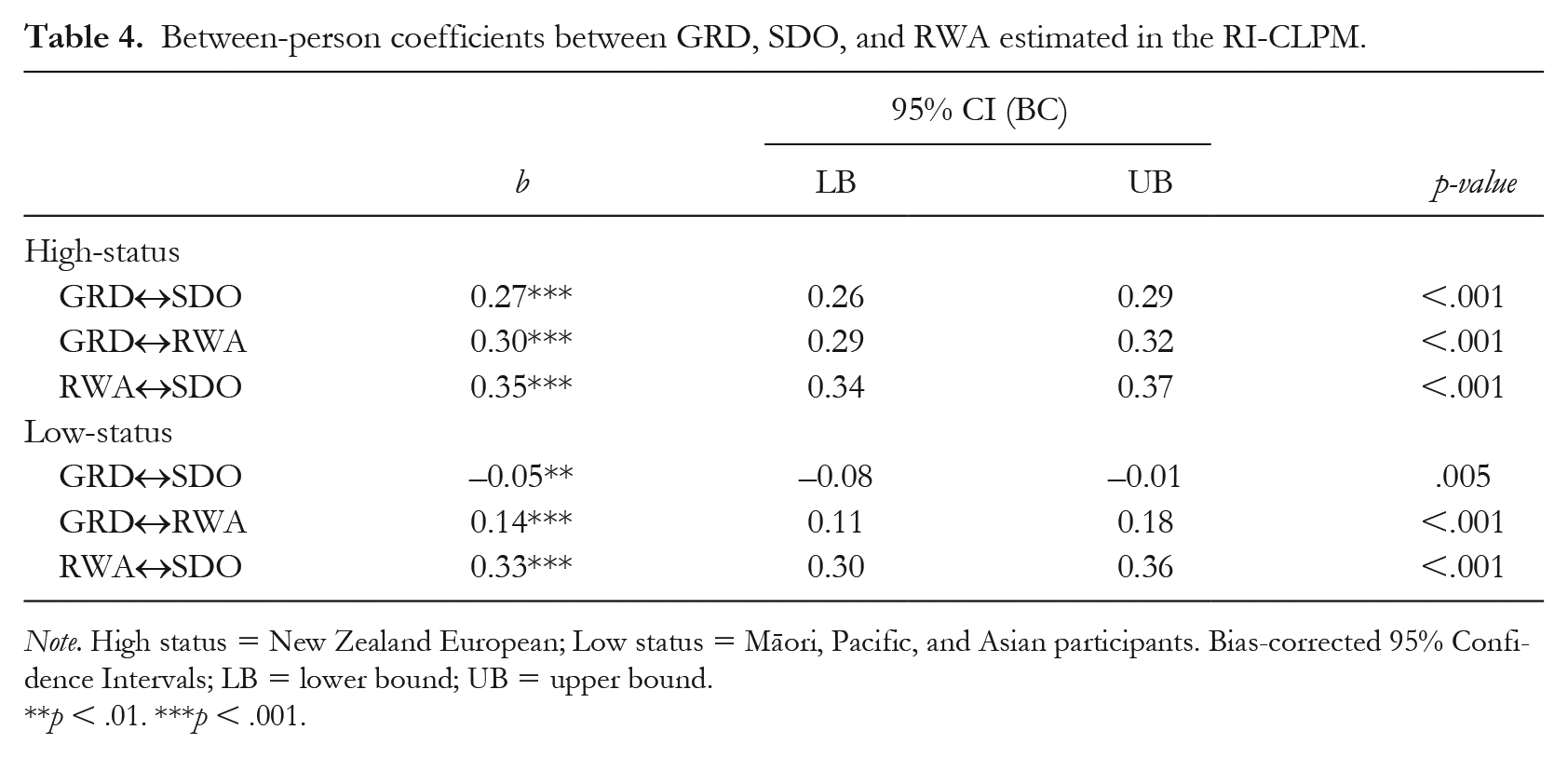
Note. High status = New Zealand European; Low status = Māori, Pacific, and Asian participants. Bias-corrected 95% Confi- dence Intervals; LB = lower bound; UB = upper bound.
p < .01. ***p < .001.
Turning to the within-person associations, we first report the average autoregressive associations (see Table 3). While autoregressive effects in a CLPM reflect stability in a construct over time, autoregressive coefficients in an RI-CLPM reflect the persistence of deviations from one’s trait-level mean of a construct over time. To these ends, GRD (B = 0.07, BC 95% CI = [0.06, 0.08], p < .001), SDO (B = 0.15, BC 95% CI = [0.14, 0.16], p < .001), and RWA (B = 0.10, BC 95% CI = [0.08, 0.11], p < .001) all demonstrated the reliable persistence of within-person deviations over time. However, the within-person cross-lagged associations GRD had with SDO and RWA were unreliable (ps ⩾ .477). Thus, within-person changes in GRD did not reliably predict within-person changes in SDO or RWA over time, nor vice versa, irrespective of one’s ethnic group status. These results suggest that the status-based associations GRD has with SDO and RWA are localised at the between-person level of analysis.
General Discussion
The present studies examined the cross-sectional and longitudinal relationships between GRD, SDO, and RWA, as well as the possibility that these associations differ by group status. Because GRD should threaten one’s perception of hierarchical advantage among high-status groups—and, thus, may enhance a need to endorse the existing social system (e.g., Osborne, Jost, et al., 2019)—we expected GRD would correlate positively with RWA and SDO among high-status groups. Conversely, because GRD elicits a need to challenge the existing social systems that disadvantage minorities (e.g., Abrams & Grant, 2012), we expected GRD to correlate negatively with RWA and SDO among low-status groups.
SDO and RWA in High-status Groups
As hypothesised, Study 1 revealed GRD’s positive associations with SDO and RWA among members of high-status groups. Likewise, Study 2 revealed positive, longitudinal associations between these core constructs, albeit these associations were restricted to the between-person level of analysis. Indeed, adjusting for between-person stability using an RI-CLPM eliminated the cross-lagged associations GRD had with SDO and RWA. That increases in GRD do not necessarily lead to increases in these constructs among advantaged groups is a surprising—but encouraging—finding in a world where group-based social inequalities have risen in tandem with right-wing extremism (see Jones et al., 2020; Kunst & Obaidi, 2020). These results also highlight the limitations of traditional CLPMs (see Hamaker et al., 2015) and the need for longitudinal research that separates between-person stability from within-person change to appropriately examine these two distinct levels of analysis (Osborne & Little, in press).
Nonetheless, both studies did reveal that members of high-status groups generally high on GRD were also high on RWA and SDO. Previous research demonstrates that perceptions of disadvantage—particularly discrimination—are associated with competitive, socially dominant beliefs among high-status groups (e.g., see Bahamondes et al., 2022). Likewise, previous research shows that GRD correlates positively with right-wing extremism (e.g., Doosje et al., 2012, 2013; Kunst & Obaidi, 2020). The current study extends this research by demonstrating direct status-based asymmetries in the associations GRD has with SDO and RWA. While we caution against the claim that GRD causes higher endorsement of SDO or RWA among advantaged groups, these results shed light on potential factors shaping right-wing belief systems in a time of increased group-based inequities.
More broadly, our sample demonstrated generally low mean scores in GRD, particularly among members of high-status groups. However, our study examines GRD, SDO, and RWA levels in a nationwide random sample of adults and, thus, presents mean scores consistent with what we would expect at a broader population level. Indeed, most of the general population does not generally perceive themselves as deprived (Osborne, Sibley, Smith, & Huo, 2015), nor do they endorse high levels of SDO or RWA (Sibley et al., 2019). If our study examined GRD among those who do endorse high levels of these ideologies, we might see a stronger (or, counterintuitively, weaker) association between their perceived disadvantage and support for inequality and the status quo. Nonetheless, that we find an association among a nationwide sample is noteworthy and highlights the need to consider how GRD among advantaged group members may lend itself to greater endorsement of these ideologies.
SDO and RWA in Low-status Groups
While our results for high-status groups replicated across our studies, the associations GRD had with SDO and RWA differed between Studies 1 and 2 for ethnic minorities. For example, while Study 1 revealed GRD was negatively associated with RWA and SDO among low-status groups, supplementary analyses revealed these findings were only reliable among Māori and Pacific participants and only for SDO. Nonetheless, these results demonstrate that GRD is uniquely associated with support for equality and social change among disadvantaged groups and corroborate previous research showing that GRD has differential associations among high- and low-status groups (Abrams & Grant, 2012; Leviston et al., 2020; Osborne, García-Sánchez, & Sibley, 2019).
In addition to our cross-sectional analyses, Study 2 revealed status-based asymmetries in the associations GRD had with RWA and SDO over time. Specifically, members of low-status groups generally high on GRD were generally low on SDO but high on RWA (albeit to a lesser extent than their high-status counterparts). That the between-person association between GRD and RWA was positive for low-status groups was unexpected and suggests that GRD and right-wing ideology may be positively associated regardless of group status, albeit this association is weaker and likely explained by different motivations (see Kunst & Obaidi, 2020). For example, previous research suggests that low-status groups may endorse right-wing ideologies and, in severe cases, extremism to attenuate prevailing status differences (Henry et al., 2005). While we cannot claim that GRD causes higher endorsement of RWA, these results increase understanding of how perceived disadvantage correlates with the endorsement of RWA among disadvantaged groups.
We also note three unexpected findings in the present studies. On average, members of low-status groups were higher on RWA and SDO than members of high-status groups. Additionally, the associations between GRD and RWA were similar among Asian participants and New Zealand Europeans, despite the former’s objectively lower status. Likewise, IRD and RWA were more strongly associated among Māori than New Zealand Europeans. Though unexpected, these results are consistent with previous assertions that low-status groups sometimes endorse higher levels of system-justifying ideologies to counteract the adverse effects of their low status (Bahamondes, Sengupta, et al., 2021; Bahamondes et al., 2019; Henry, 2011; Jost, 2020). There is, however, considerable debate in the literature over the tendency for low-status groups to support the status quo (see Brandt, 2013). As such, our studies highlight the need to further examine when and where low-status groups will be more likely than high-status groups to justify the system.
Strengths, Limitations, and Future Research
In addition to important theoretical and practical implications, a major strength of the current study is its ability to model the cross-sectional and longitudinal relationships between GRD and ideological beliefs using a large, nationwide random sample of adults. As such, our results should generalise to the broader population. Likewise, using covariates strongly associated with our focal variables (e.g., income and education) in Study 1 provides further confidence in our findings, as do our robustness checks examining the roles of specific group membership(s). That status-based asymmetries still emerged after adjusting for these critical covariates speaks to the importance of relative deprivation and objective group status when examining the associations GRD has with ideological proclivities that support (or undermine) equality and social change.
Despite these strengths, the effect sizes in the present study are small and localised at the between-person level of analysis. However, researchers are increasingly recognising that small effects are the norm in the social sciences where complex psychological phenomena are multiply determined (see Götz et al., 2022). Moreover, even small effects can have important practical implications; aggregated across the population, incremental group-based differences in the endorsement of ideologies that justify and promote the existing social order could undermine the motivation to redress inequality and promote social change. Thus, the results from the current studies increase understanding of the factors associated with ideological proclivities that maintain the status quo and are worth further examination.
It is important to note that we only focused on two-item fiscal dimensions of relative deprivation—that is, measures of relative deprivation that focus on economic status relative to others. As such, we cannot generalise these results to other forms of relative deprivation that focus on interpersonal treatment (e.g., see Tyler & Lind, 2002). Additionally, we could not test for measurement invariance over time and across groups, which may attenuate the associations reported in our longitudinal analyses (see Griliches & Hausman, 1986). That said, fiscal dimensions of relative deprivation are a reasonable measure of perceived inequality, given the considerable income inequalities between New Zealand Europeans and ethnic minorities in New Zealand (e.g., McKenzie, 2020). Additionally, affective measures of relative deprivation (e.g., measures of anger, resentment, or frustration) capture a core component of relative deprivation that is often overlooked or mismeasured within the literature (see Smith et al., 2012). As such, we have confidence that our affective and fiscal measures of IRD and GRD accurately reflect their respective constructs. Nonetheless, future research should consider the associations between different forms of relative deprivation and the endorsement of right-wing ideologies among members of low- and high-status groups.
Finally, we note the need for research considering the intersections between different forms of (dis)advantage to understand the effects of relative deprivation. Indeed, individuals have composite identities whereby their social groups or categories vary in levels of privilege and power (or lack thereof), including ethnicity, gender, sexual orientation, class, and so on (see Crenshaw, 1989). Research that appropriately considers the intersections between these different social categories is needed. For example, in the present study, the associations GRD had with SDO and RWA differed between ethnic minorities, with Māori and Pacific participants differing from their Asian counterparts. These results highlight the need to consider one’s socio-political history and present context. We urge future research to consider these nuances when examining how people understand and respond to their societal position.
Conclusion
Research investigating the impacts of GRD suggests that differences in responses to inequality emerge between members of objectively advantaged and disadvantaged groups. As such, the current studies examined whether there are status-based asymmetries in the associations GRD has with RWA and SDO—two ideologies that maintain societal inequalities. Consistent with our hypotheses, GRD correlated positively with RWA and SDO among members of a high-status group but negatively among members of low-status groups. However, after accounting for between-person stability, GRD did not predict within-person changes in RWA or SDO over time (nor vice versa). Thus, our results reveal status-based differences between people that may contribute to support for (or opposition to) social change and equality in the face of group-based inequities. Future research should further examine these associations to determine how one’s objective and relative societal positions interact to reinforce (or oppose) the status quo.
Supplemental Material
sj-docx-1-gpi-10.1177_13684302231185267 – Supplemental material for Asymmetries in responses to group-based relative deprivation: The moderating effects of group status on endorsement of right-wing ideology
Supplemental material, sj-docx-1-gpi-10.1177_13684302231185267 for Asymmetries in responses to group-based relative deprivation: The moderating effects of group status on endorsement of right-wing ideology by Kieren J. Lilly, Chris G. Sibley and Danny Osborne in Group Processes & Intergroup Relations
Footnotes
Data Availability Statement
The data described in this article are part of the New Zealand Attitudes and Values Study (NZAVS). Full copies of the NZAVS data files are held by all members of the NZAVS management team and advisory board. A de-identified dataset containing the variables analysed in this manuscript is available upon request from the corresponding author or any member of the NZAVS advisory board for the purposes of replication or checking of any published study using NZAVS data. The MPlus syntax used to test all models reported in this article is available via the Open Science Framework: ( ).
).
Funding
The author(s) disclosed receipt of the following financial support for the research, authorship, and/or publication of this article: preparation of this manuscript was supported by a University of Auckland Doctoral Scholarship awarded to KJL and a grant from the Templeton Religion Trust (TRT-2021-10418) awarded to the New Zealand Attitudes and Values Study.
Supplemental Material
Supplemental material for this article is available online.
Notes
References
Supplementary Material
Please find the following supplemental material available below.
For Open Access articles published under a Creative Commons License, all supplemental material carries the same license as the article it is associated with.
For non-Open Access articles published, all supplemental material carries a non-exclusive license, and permission requests for re-use of supplemental material or any part of supplemental material shall be sent directly to the copyright owner as specified in the copyright notice associated with the article.
