




Abstract
Recent research argues that authoritarianism exists on the right and left, further positing that both manifestations share core features. We explore this possibility by conducting a latent profile analysis of left-wing authoritarianism (LWA), right-wing authoritarianism (RWA), and social dominance orientation (SDO) in a nationwide random sample of adults (N = 34,101). Five unique profiles emerged: Low Social Dominators (low-to-moderate LWA/RWA, low SDO; 41.8% of the sample), Moderate Right-wing Authoritarians (low LWA, moderate RWA, low-to-moderate SDO; 35.7% of the sample), Moderate-Moderates (low LWA, moderate RWA, moderate SDO; 13.7% of the sample), Left-wing Authoritarians (high LWA, low RWA/SDO; 7.5% of the sample), and High Social Dominators (low LWA, low-to-moderate RWA, high SDO; 1.34% of the sample). Men, people low in agreeableness, and people high in vengeful rumination were more likely to belong to all profiles (compared to the Low Social Dominators), suggesting some similarities across distinct forms of authoritarianism. Left-wing Authoritarians did, however, differ substantively in their demographic characteristics, personality, and social attitudes, undermining claims of a shared authoritarian core. These findings highlight the need to further evaluate how distinct types of authoritarians manifest across the political spectrum and the utility of the common core hypothesis.
Plain language summary
Researchers suggest that (a) authoritarians exist on both the political left and right, and (b) these different “types” of authoritarians are similar in personality and intolerance toward opposing groups. In this paper, we examine these possibilities by examining the prevalence of different forms of authoritarianism in a nationally representative sample of New Zealand adults. We test whether these groups share similar (versus different) demographics (e.g., age and gender), personality traits, trust in institutions, voting intentions, and attitudes toward different social issues. Our results suggest that the majority of the population is low on authoritarianism. However, we identified a small group that scored highly on left-wing authoritarianism (named Left-wing Authoritarians) and another small group that highly endorsed group-based hierarchies and inequality (named High Social Dominators). Younger, non-religious, more liberal people, and people living in deprived areas were more likely to be Left-wing Authoritarians. In contrast, older conservative people were more likely to be High Social Dominators. These groups also differed in personality and attitudes toward institutions, political parties, and social issues. Overall, our study suggests that authoritarians on the left and right are more different than similar. For this reason, it is important to consider different types of authoritarians as distinct from each other in the population rather than two sides of the same coin.
Keywords
Since its inception, authoritarianism has dominated discourse on the maintenance of inequality and prejudice in society (Adorno et al., 1950; Duckitt, 2001; Osborne et al., 2023). Indeed, scholars have consistently identified two important psychological factors underlying the preservation of inequality: Right-wing authoritarianism (RWA; Altemeyer, 1996) and social dominance orientation (SDO; Pratto et al., 1994). RWA is motivated by the belief that the world is dangerous and threatened by “deviants” who disobey societal norms (Altemeyer, 1988). Therefore, those high on RWA adhere to tradition, obey (in-group) authorities, and aggressively enforce social norms (Altemeyer, 1981). Conversely, SDO is motivated by perceptions that the world is ruthlessly competitive and that one can only succeed at the expense of others (see Perry et al., 2013), thereby fostering a preference for group-based hierarchy and inequality (Pratto et al., 1994). Together, RWA and SDO capture authoritarian submission and dominance (respectively) and predict myriad societal outcomes (see Duckitt, 2022; Sibley et al., 2019).
Although RWA and SDO are well-established right-wing predictors of hostile intergroup attitudes (Duckitt, 2022), the existence of left-wing authoritarianism (LWA) is hotly contested. Despite initial suggestions that authoritarianism is an underlying personality syndrome found at either extreme of the left-right-continuum (Adorno et al., 1950; Rokeach, 1956), research has almost exclusively focused on its right-wing manifestations (with a few notable exceptions; see De Regt et al., 2011; McFarland et al., 1992; Van Hiel et al., 2006). Others fail to find evidence of its left-wing counterpart (Altemeyer, 1988, 1996; for a recent review, see Saunders & Jost, 2023). Indeed, Altemeyer (2007) noted that left-wing authoritarians “hardly exist in sufficient numbers to threaten democracy” (p. 20). Thus, many express scepticism of LWA as a construct (Nilsson & Jost, 2020; Stone, 1980).
Despite this scepticism, recent research has sought to revive the concept of LWA in both Western (e.g., Conway III et al., 2018; Costello & Patrick, 2022; Winter et al., 2022) and non-Western (e.g., Pop-Eleches & Tucker, 2020) contexts. Central to this emerging literature is the argument that the core psychological basis of authoritarianism remains undetermined (Duckitt, 2022), particularly given the myriad authoritarian measures across disciplines. As such, Costello and colleagues (2022) developed a data-driven operationalization of LWA comprised of three correlated factors: anti-hierarchal aggression, support for top-down censorship, and anti-conventionalism, which they argue capture left-wing resemblances of authoritarian dominance, submission, and adherence to traditional social norms, respectively (Costello et al., 2022; Costello & Patrick, 2022). Costello and colleagues posit that, while RWA describes habitual adherence to the established order and punitiveness toward social “deviants,” LWA reflects antagonism and aggression toward the established order and status hierarchies, as well as punitiveness toward those who benefit from and uphold these power structures. Thus, RWA and LWA (and, in some instances, SDO and LWA) appear to (superficially) share core features—albeit in the service of discrete political systems and in-group values (Osborne et al., 2023).
This recent research has sparked debates over the conceptualization and study of LWA. Specifically, the assumption that LWA shares a common core with right-wing manifestations of authoritarianism is challenged by evidence of negative associations between liberal/left-wing ideology and authoritarianism (Nilsson & Jost, 2020; Saunders & Jost, 2023). While these debates center on the existence (or lack thereof) of individuals who share an authoritarian core across the political spectrum, research has yet to directly examine the prevalence of discrete “types” of left- and right-wing authoritarians. Moreover, research studying LWA predominantly examines non-representative data (for an exception, see Costello et al., 2022), which limits its ability to identify manifestations of LWA in the general population. Thus, the prevalence of “left-wing authoritarians”—and whether they share common psychological facets with right-wing authoritarians—remains largely unexplored.
We address this oversight by examining different “types” of authoritarians within a nationwide random sample of adults. Specifically, we utilize latent profile analysis (LPA) to elucidate distinct subgroups of the population that vary in their scores on LWA, RWA, and SDO. As a person-centered (instead of variable-centered) analytic approach, LPA identifies unique response patterns underlying people’s attitudes toward two or more items (see Osborne & Sibley, 2017). Critically, this approach allows us to examine (a) the prevalence of support for these ideologies and (b) the predictors and outcomes associated with these distinct response patterns (Asparouhov & Muthén, 2014). Thus, LPA may identify unique subgroups of authoritarians that share core traits (i.e., supporting the shared authoritarian “core” hypothesis) or subgroups with distinct features (i.e., the discrete belief systems hypothesis). We outline the rationale and evidence for these competing hypotheses below.
Evidence of a shared authoritarian “Core”
Recent examinations of the symmetries between left- and right-wing authoritarianism suggest that, while distinct ideologies, individuals high in LWA and RWA may share an underlying authoritarian core. For instance, authoritarians on the left and right both express high levels of moral absolutism (Lane et al., 2021), dogmatism (Costello et al., 2022), cognitive rigidity (Eysenck & Coulter, 1972), and preference for state control (Manson, 2020). Moreover, research identifies similar personality correlates of LWA and RWA, including low openness (Costello et al., 2022). Like their right-leaning counterparts, those who identify with the political left also submit to authorities following existential threats like COVID-19 (see Manson, 2020; Winter et al., 2022). Taken together, these findings suggest that people high on LWA and RWA may share traits related to cognitive rigidity, deference to authority, and desires to “punish” those who violate in-group norms. What differentiates these two types of people is the target of their ire (Conway III et al., 2021) and their goals to progress (vs. regress) social change (Osborne et al., 2023).
Despite their opposite orientations toward the established hierarchy, studies identify similarities between LWA and SDO. Costello et al. (2022) demonstrate that LWA’s anti-hierarchal aggression component is (imperfectly) akin to SDO’s focus on power and dominance. For example, Costello and colleagues revealed that LWA and SDO have similar associations with low openness to experience, agreeableness, and psychopathic disinhibitions, as well as higher conspiracy ideation and dogmatism. Thus, left-wing authoritarians may share common traits with those high in RWA and those high in SDO.
Evidence of discrete belief systems
Although some evidence suggests that authoritarianism occurs on the left, the extant literature demonstrates that authoritarianism exists predominantly on the right, particularly in Western democratic societies (e.g., Aichholzer & Zandonella, 2016). But these results are not limited to Western nations (e.g., see Sprong et al., 2019; Vargas-Salfate et al., 2018), nor are they due to content overlap in measures of authoritarianism and conservatism (Azevedo et al., 2019; Dunwoody & Plane, 2019). Indeed, although there are certainly cases of authoritarian regimes with ostensibly left-wing goals (De Regt et al., 2011; McFarland et al., 1992), researchers argue that ideological asymmetries exist even between left- and right-wing extremists (Altemeyer, 1988; Fromm, 1980/84). Thus, the “hunt” for LWA may be misguided, particularly among the general population (see Saunders & Jost, 2023).
A related literature demonstrates that LWA—if it exists—is distinct from right-wing authoritarianism due to the different motivations and consequences of upholding progressive (vs. conservative) beliefs (e.g., see Badaan & Jost, 2020). For example, RWA correlates negatively with trust in science (Kerr & Wilson, 2021) and environmentalism (Stanley & Wilson, 2019) and positively with the need for social order (Jost et al., 2003) and institutional trust (Costello & Patrick, 2022). Conversely, LWA correlates positively with trust in science, environmentalism, and a need for chaos and negatively with institutional trust (see Costello et al., 2022; Costello & Patrick, 2022). Likewise, left-wing authoritarians hold anti-hierarchical beliefs that undermine the hierarchical nature of SDO (Conway III et al., 2021; Costello et al., 2022; Osborne et al., 2023), which, in turn, foster distinct attitudes toward inequality. Thus, while some argue that left- and right-wing authoritarians share personality characteristics and express intolerance toward outgroups (Conway III et al., 2018), others note that differences in the motivations and societal outcomes of these ideologies belie a proposed “common core” (Nilsson & Jost, 2020).
Despite the intensity of the debate, studies rarely examine whether different types of authoritarians share common traits or are distinct in the general population. Indeed, while contemporary debates center on the existence, prevalence, and function of “types” of authoritarians (e.g., Costello et al., 2022; Nilsson & Jost, 2020; Saunders & Jost, 2023), research has yet to directly examine whether subgroups in the population demonstrate this ideological (a)symmetry. To do so requires a large, nationally representative sample and an analytic approach able to distinguish between subgroups that differ in their scores on these three constructs. In doing so, one can establish (a) the prevalence of different forms of authoritarianism and (b) the extent to which these different subgroups share core features.
Latent profile analysis
Latent profile analysis (LPA) is a type of mixture modelling that groups common response patterns to two or more continuous variables into distinct latent profiles (see Collins & Lanza, 2010). Rather than taking a variable-centered approach that treats variables as units of analysis, LPA is a person-centered approach that distinguishes distinct subgroups within the population who respond similarly to a set of items (see Osborne & Sibley, 2017). Moreover, the latent profiles estimated in an LPA adjust for the uncertainty in participants’ latent profile membership and, accordingly, are preferred over artificially defined categories of people imposed by researchers (MacCallum et al., 2002). Thus, LPA is ideally suited to examine the existence and prevalence of different forms of authoritarianism in the population. Perhaps more importantly, LPA allows us to assess the antecedents and consequences of membership in these subgroups. If authoritarians on the left and right share core features, one would expect to identify subgroups in the population high on LWA and RWA (or SDO), respectively, with comparable antecedents and consequences.
Interestingly, early uses of mixture modelling in social/political psychology aimed to identify subgroups of the population who expressed (in)tolerance toward various stigmatized groups. For example, initial evidence of political symmetry in authoritarianism stems from McCutcheon’s (1985) examination of political tolerance in the United States. McCutcheon found two distinct latent classes of intolerance of the left and right among a representative American sample. Specifically, those intolerant of the political right were more tolerant of homosexuals and Communists but less tolerant of racists. Conversely, those intolerant of the political left were more tolerant of racists and less tolerant of Communists. Although there is a critical distinction between being intolerant and being intolerant of intolerance (see Hodson, 2021; Osborne et al., 2023), this initial evidence of intolerance across the left-right continuum has been used to suggest that subgroups may share some traits of authoritarianism and intolerance regardless of their political ideology.
More recent research uses LPA to identify distinct forms of authoritarianism in the population. For example, Sibley et al. (2019) examined Altemeyer’s (2004) assertion of “double-highs” (i.e., those who score high on both RWA and SDO) using an LPA of a nationwide random sample of New Zealand adults. Contrary to Altemeyer’s hypothesis, Sibley and colleagues (2019) found no evidence of a high-high profile. Instead, most of the population expressed comparable levels of RWA and SDO (in low-low and moderate-moderate profiles). A smaller percentage of the sample did, however, score high on RWA but low on SDO (Authoritarian Followers) or high on SDO but low on RWA (Authoritarian Leaders). A subsequent LPA in the United States found two profiles of “Dark” Republicans and Democrats with comparably high levels of RWA, LWA, and dark personality traits, suggesting that these constructs covary across the American political spectrum (see Bird et al., 2022). Nevertheless, research has yet to examine how all three facets of authoritarianism (namely, LWA, RWA, and SDO) covary in the general population.
Overview of the present study
The present study applies LPA to a large, nationwide random sample of adults to identify unique patterns of authoritarianism amongst the population. In doing so, we aim to identify distinct subgroups of people who differ in their mean levels of LWA, RWA, and SDO. Because the process of identifying these distinct profiles is exploratory, we make no specific predictions about the number or size of latent profiles. However, the extant literature argues that left-wing authoritarians hardly, if at all, exist in Western nations (Saunders & Jost, 2023), and previous research reveals that only a small subset of the general population are high on RWA and SDO (Sibley et al., 2019). Thus, profiles high on LWA or RWA/SDO likely constitute a small subset of the population.
In the present study, we also arbitrate between two distinct possibilities; while some suggest that left- and right-wing authoritarians share an assemblage of personality and cognitive traits (e.g., Conway III et al., 2018; Costello et al., 2022), others argue that left- and right-wing authoritarians notably differ, particularly in their motivations for disrupting and maintaining the conventional social order, respectively (Osborne et al., 2023). To test these assertions, we conduct a multinomial logistic regression using the three-step procedure, allowing us to assess the likelihood of profile membership based on demographic and personality factors (see Asparouhov & Muthén, 2014; Osborne & Sibley, 2017). Specifically, we focus on personality and cognitive constructs with well-established links to authoritarianism in the existing literature: agreeableness, conscientiousness, neuroticism, extraversion, honesty-humility, openness to experience, vengeful rumination, and self-control (see Costello et al., 2022; Perry & Sibley, 2012). We also assess demographic similarities to determine whether particular “types” of people, irrespective of their political leanings, are drawn to authoritarianism.
Finally, we examined the consequences of profile membership in relation to (a) climate change attitudes, (b) institutional trust and voting intentions, and (c) attitudes toward social issues and inequality. LWA, RWA, and SDO are uniquely motivated by different prejudices and reflect different attitudes toward the existing social order (Costello et al., 2022). As such, subgroups within the population should differ in ways that reflect these distinctions. For example, profiles high on LWA (relative to those high on RWA/SDO) should show greater climate change beliefs and concerns, greater trust in science, and more progressive attitudes toward social change and inequality (e.g., see Milfont & Osborne, 2024). However, the shared traits of left- and right-wing authoritarianism may produce more similarities between those high in LWA and RWA/SDO (relative to similarities with the broader population). Examining these different outcomes is essential for elucidating the similarities and differences among left- and right-wing authoritarians in the population.
Method
Sampling procedure and participants
We utilize data from Time 13 (2021) of the New Zealand Attitudes and Values Study (NZAVS)—the first wave to measure all our focal variables. The NZAVS is an ongoing national probability panel study of New Zealand adults that began in 2009 and examines myriad variables, including personality, social attitudes, and health and well-being outcomes. The overall NZAVS project was approved by the University of Auckland Human Ethics Committee and is renewed every three years. Although the data presented here are not publicly available due to restrictions imposed by the Ethics Committee, a de-identified dataset containing the variables analyzed in this article is available upon request from the authors for the purpose of replication. Sibley (2023) provides full details of the sampling and data screening procedure, retention rates, and ethics approvals for the NZAVS (see also https://osf.io/75snb/).
Time 13 contains responses from 34,131 participants, of whom 32,829 were retained from previous waves of the NZAVS. We focus on participants who provided partial or complete responses to our measures of LWA, RWA, and SDO (N = 34,101). Of those analyzed, 63.9% were women, 32.1% identified as religious, and the majority were employed (73.7%) and born in New Zealand (78.6%). The average age of participants was 54.89 (SD = 13.66). With respect to ethnicity, participants identified as New Zealand European (84.4%), Māori (8.9%), Asian (3.3%), or Pasifika (1.4%). The remaining 1.9% either failed to indicate their ethnicity or identified as another ethnic group.
Measures
The Online Supplementary Materials presents full descriptions of the predictor and outcome variables, as well as the descriptive statistics (Table S1) and bivariate correlations (Table S2) between variables used in our analyses. Constructs were embedded within a larger questionnaire and, accordingly, were based on short-form scales due to space constraints. However, all short-form scales included in this study have been validated against their full-form parent counterparts (where applicable), with all measures displaying at least adequate reliability. Full information about scale validation for the NZAVS is available via OSF: https://osf.io/75snb/wiki/Scale_Validation_Study/
Left-wing authoritarianism was measured using the mean of five items from Costello and colleagues’ (2022) LWA Index: (a) “The rich should be stripped of their belongings and status”; (b) “If I could remake society, I would put people who currently have the most privilege at the very bottom”; (c) “New Zealand would be much better off if all of the rich people were at the bottom of the social ladder”; (d) “We need to replace the established order by any means necessary”; and (e) “All political conservatives are fools” (ω = .76; M = 2.38, SD = 1.06; see Table S3 for the distribution of responses to individual items). These items were selected via pilot testing of the full LWA scale in New Zealand which revealed that these items loaded most highly on the overall LWA factor. Note that item (e) was originally included in the Anti-Conventionalism subscale in the original long-form scale, but the AHA subfactor in the shortened scale version was developed using machine learning. Finally, we swapped the original item of this subscale, “When the tables are turned on the oppressors at the top of society, I will enjoy watching them suffer the violence that they have inflicted on so many others,” for item (b), as pilot testing indicated that this item loaded more highly on both the overall LWA factor and the Anti-Hierarchical Aggression (AHA) subfactor proposed by Costello and Patrick (2022).
Right-wing authoritarianism was measured using the mean of six items from Altemeyer’s (1996) 30-item scale: (a) “It is always better to trust the judgment of the proper authorities in government and religion than to listen to the noisy rabble-rousers in our society who are trying to create doubt in people’s minds”; (b) “It would be best for everyone if the proper authorities censored magazines so that people could not get their hands on trashy and disgusting material”; (c) “Our country will be destroyed someday if we do not smash the perversions eating away at our moral fiber and traditional beliefs”; (d) “People should pay less attention to The Bible and other old traditional forms of religious guidance, and instead develop their own personal standards of what is moral and immoral” (reverse-scored); (e) “Atheists and others who have rebelled against established religions are no doubt every bit as good and virtuous as those who attend church regularly” (reverse-scored); and (f) “Some of the best people in our country are those who are challenging our government, criticizing religion, and ignoring the ‘normal way’ things are supposed to be done” (reverse-scored; ω = .60; M = 3.33, SD = 1.06; see Table S3 for the distribution of responses to individual items)
Social dominance orientation was assessed using the mean of six items from Sidanius and Pratto’s (2001) 16-item SDO scale: (a) “It is OK if some groups have more of a chance in life than others”; (b) “Inferior groups should stay in their place”; (c) “To get ahead in life, it is sometimes okay to step on other groups”; (d) “We should have increased social equality” (reverse-scored); (e) “It would be good if groups could be equal” (reverse-scored); and (f) “We should do what we can to equalize conditions for different groups” (reverse-scored; ω = .78; M = 2.21, SD = 0.96; see Table S3 for the distribution of responses to individual items).
Predictors
Demographics
We assessed participants’ gender, age, ethnicity, highest education level, area-level deprivation (Atkinson et al., 2014), political orientation, and whether they identified as religious.
Personality constructs
We assessed participants’ Big Six personality traits (Extraversion, Agreeableness, Conscientiousness, Neuroticism, Openness to Experience, and Honesty-Humility) using the Mini-IPIP6 (Sibley et al., 2011), a short-form adaptation of the Mini-IPIP (Donnellan et al., 2006). We also assessed participants’ reported self-control (Tangney et al., 2018) and vengeful rumination (Berry et al., 2005; Caprara, 1986).
Outcomes
Participants were asked about their climate change beliefs, trust in science (Hartman et al., 2017; Nisbet et al., 2015), police (Tyler, 2005), and politicians (Sibley et al., 2020), voting intentions in the New Zealand 2023 general election, support for Māori political mobilization, support for ethnic-based collective action (Cronin et al., 2012), attitudes toward tall poppies 1 (Feather, 1989), equality positioning (Sibley & Wilson, 2007), and endorsement of free speech and hate speech (Doré et al., 2023).
Analyses and results
The present study aimed to identify subgroups of the population that express different response patterns to measures of LWA, RWA, and SDO. We therefore conducted an LPA in MPlus version 8.8 (Muthén & Muthén, 1998-2023) to estimate both (a) the number of latent profiles underlying people’s responses to our variables of interest and (b) the proportion of the sample who belong to each profile. We then conducted a multinomial logistic regression using the three-step approach to examine the predictors of profile membership (Asparouhov & Muthén, 2014). The three-step approach first estimates the number of distinct response patterns to LWA, RWA, and SDO before assigning participants to the latent profile to which they most likely belong. A multinomial logistic regression then uses participants’ most likely profile membership as the dependent variable (controlling for measurement error). Critically, the three-step approach allows us to estimate the likelihood of profile membership based on key covariates without impacting the estimation of the profiles themselves (Asparouhov & Muthén, 2014). Thus, the three-step approach is preferred over alternative methods of estimating the predictors of profile membership.
Finally, we examined mean levels of (a) climate change beliefs and concerns, (b) institutional trust and voting intentions, and (c) attitudes toward social change and inequality across profiles. To do so, we used a distal three-step approach, which follows a similar process to the three-step approach but uses profile membership to predict outcomes (Asparouhov & Muthén, 2014).
Exploratory factor analysis
Before conducting the LPA, we first sought to examine the factor structure of our measures of LWA, RWA, and SDO. To do so, we conducted an exploratory factor analysis of the 17 items used across the three measures. Factor analysis was performed using direct oblimin rotation and maximum likelihood estimation. Inspection of the scree plot of the eigenvalues and the factor loadings reveals a clear three-factor solution; all items for LWA, RWA, and SDO loaded onto three distinct factors with corresponding factor loadings above 0.30 and low cross-factor loadings (see Figure S1 and Table S4 in the OSM). Thus, we are confident that our items for LWA, RWA, and SDO measure three distinct constructs.
Model estimation
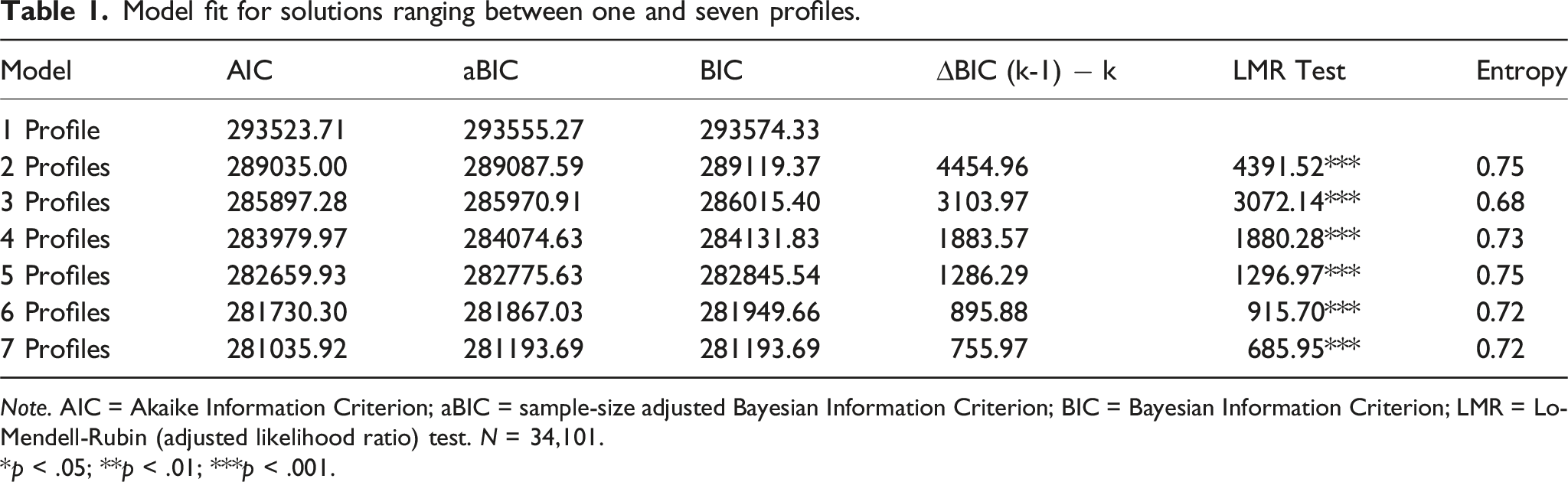
Turning to the LPA, we first estimated a model with one profile to use as a baseline for comparing models with multiple profiles. Solutions ranging from 2 to 7 profiles were then estimated to identify the model that best fit these data while considering model parsimony. To assess model fit, we examined the Akaike Information Criterion (AIC), the Bayesian Information Criterion (BIC), the sample-size adjusted BIC (aBIC), and the entropy for the different solutions. We also examined the Lo-Mendell-Rubin adjusted likelihood ratio test, which indicates whether a given k-profile solution significantly improves model fit relative to the k-1 profile solution (see Lo et al., 2001).
Model fit for solutions ranging between one and seven profiles.
Note. AIC = Akaike Information Criterion; aBIC = sample-size adjusted Bayesian Information Criterion; BIC = Bayesian Information Criterion; LMR = Lo-Mendell-Rubin (adjusted likelihood ratio) test. N = 34,101.
*p < .05; **p < .01; ***p < .001.
Average latent profile probabilities for most likely latent profile membership (row) by latent profile (column).
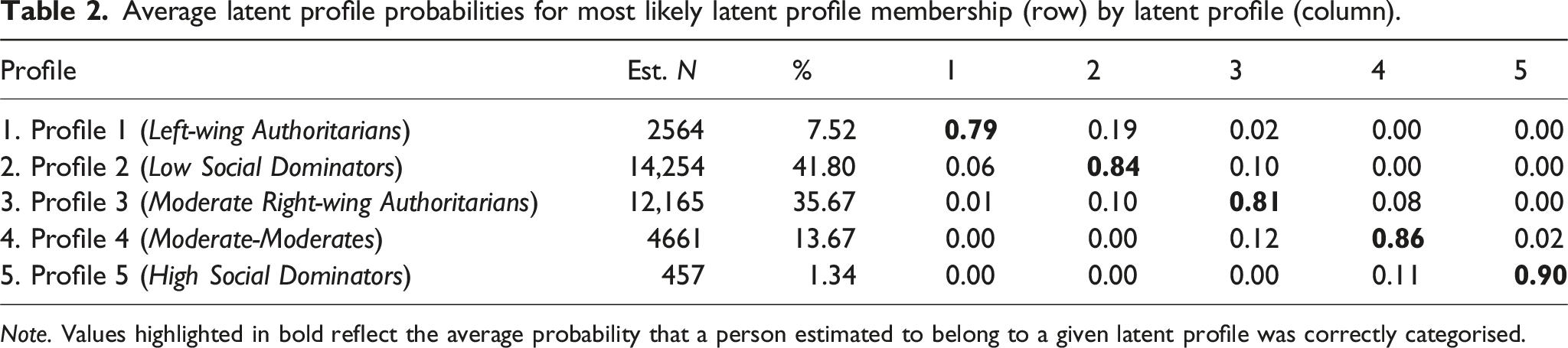
Note. Values highlighted in bold reflect the average probability that a person estimated to belong to a given latent profile was correctly categorised.
As a final validation of our five-profile solution, we estimated models ranging from one to five profiles in two random split halves of our sample (NA = 17,002; NB = 17,099). The five-profile solution was stable across the two random samples and identified analogous means across profiles to those in our full sample, increasing confidence in the validity of the five-profile solution (for full results, see the OSM).
Profiles
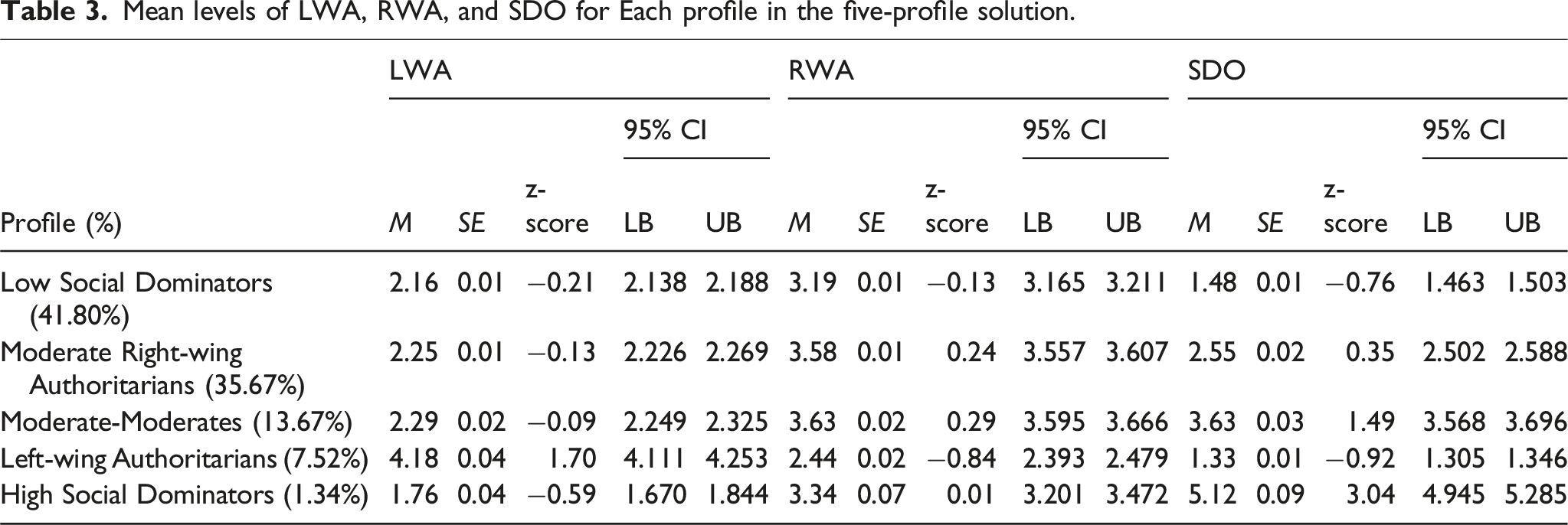
Mean levels of LWA, RWA, and SDO for Each profile in the five-profile solution.
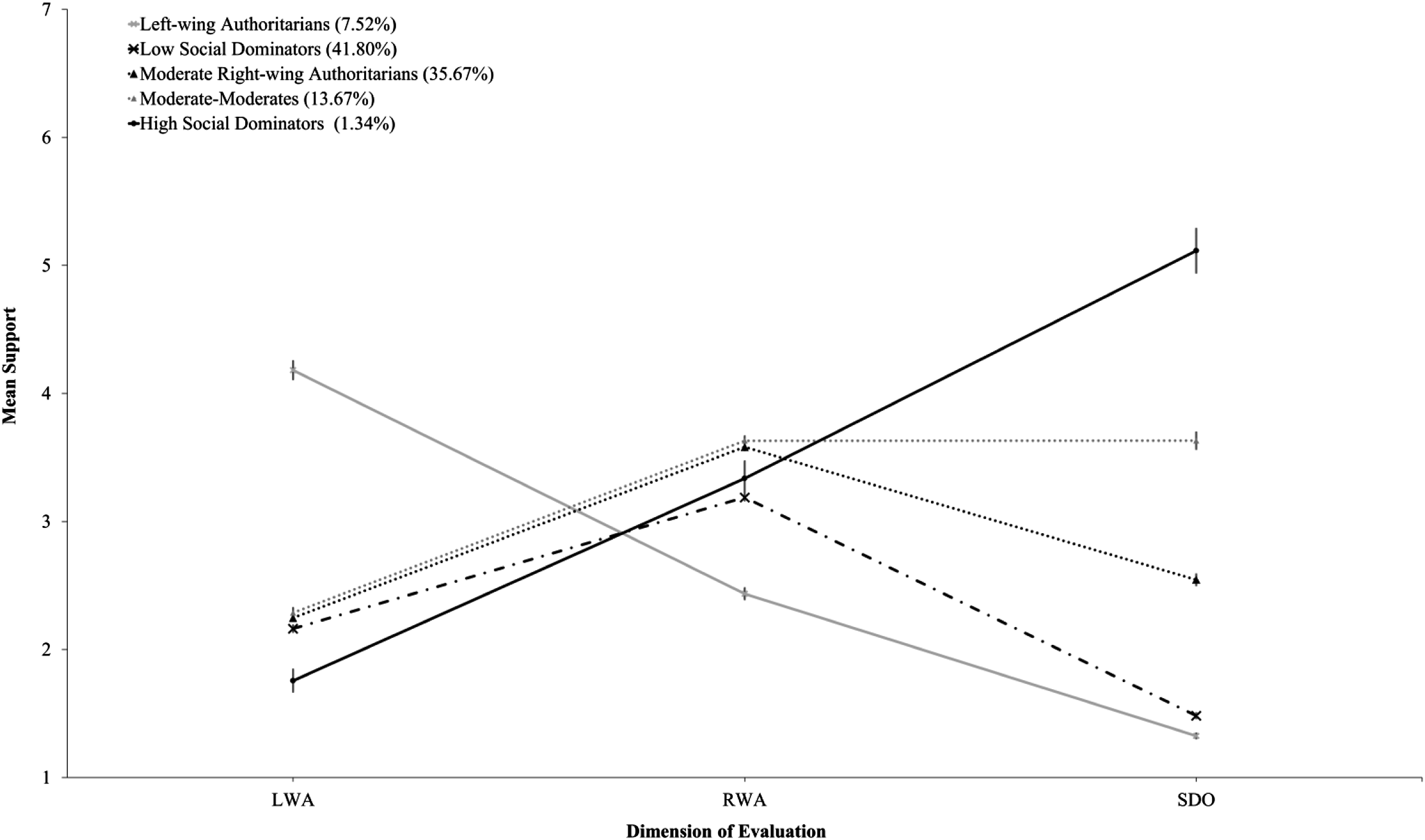
Mean Levels of LWA, RWA, and SDO for each profile. Error bars represent 95% confidence intervals.
Although most profiles were characterized by low-to-moderate levels of all three constructs, respondents in the fourth largest profile (7.52% of the sample) expressed the highest levels of LWA but low levels of RWA and SDO. As such, we labelled this profile the Left-wing Authoritarians. Finally, we labelled the fifth profile High Social Dominators (1.34% of the sample) due to their low levels of LWA, low-to-moderate levels of RWA, and distinctively high levels of SDO.
Demographic and personality differences
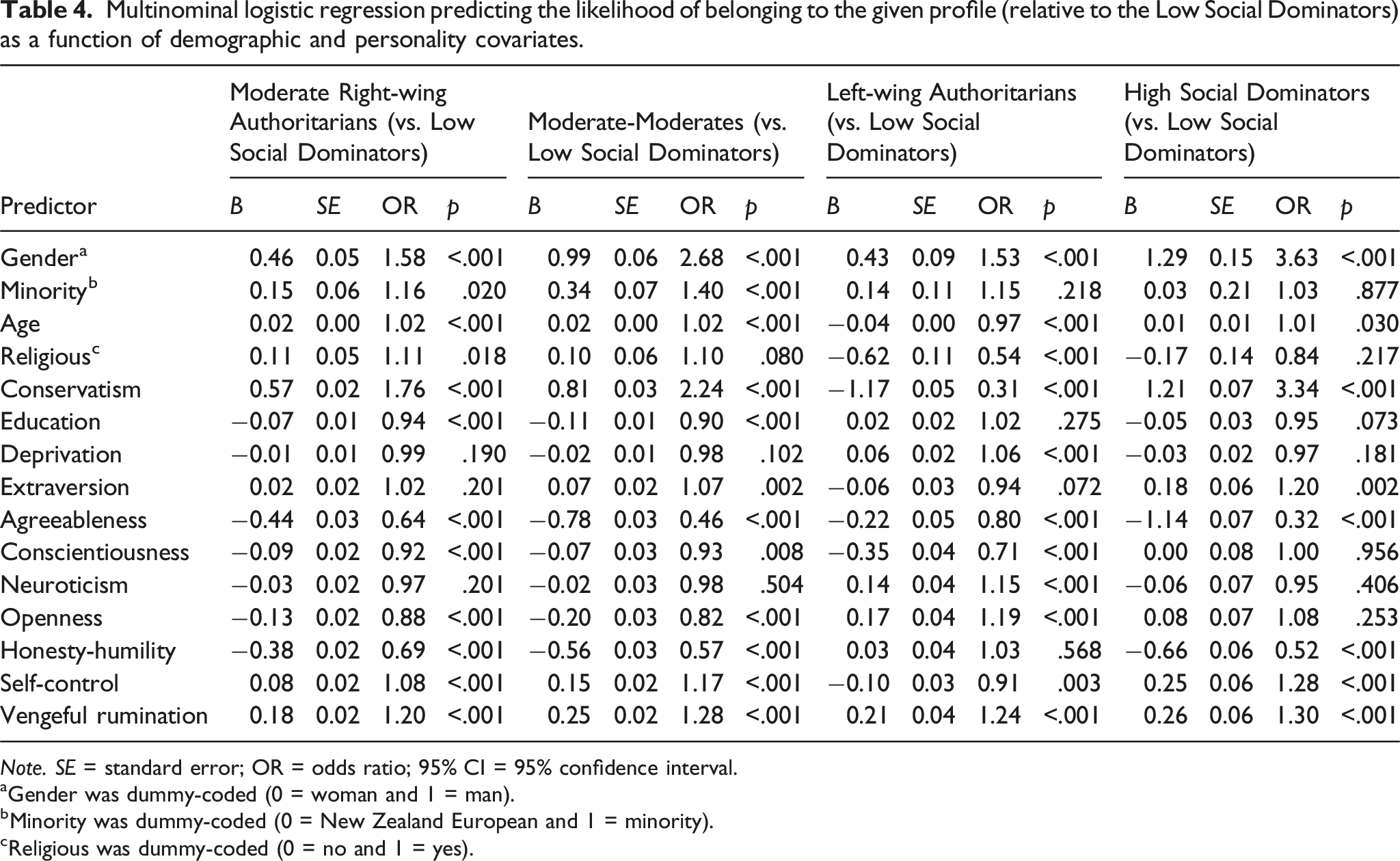
Multinominal logistic regression predicting the likelihood of belonging to the given profile (relative to the Low Social Dominators) as a function of demographic and personality covariates.
Note. SE = standard error; OR = odds ratio; 95% CI = 95% confidence interval.
aGender was dummy-coded (0 = woman and 1 = man).
bMinority was dummy-coded (0 = New Zealand European and 1 = minority).
cReligious was dummy-coded (0 = no and 1 = yes).
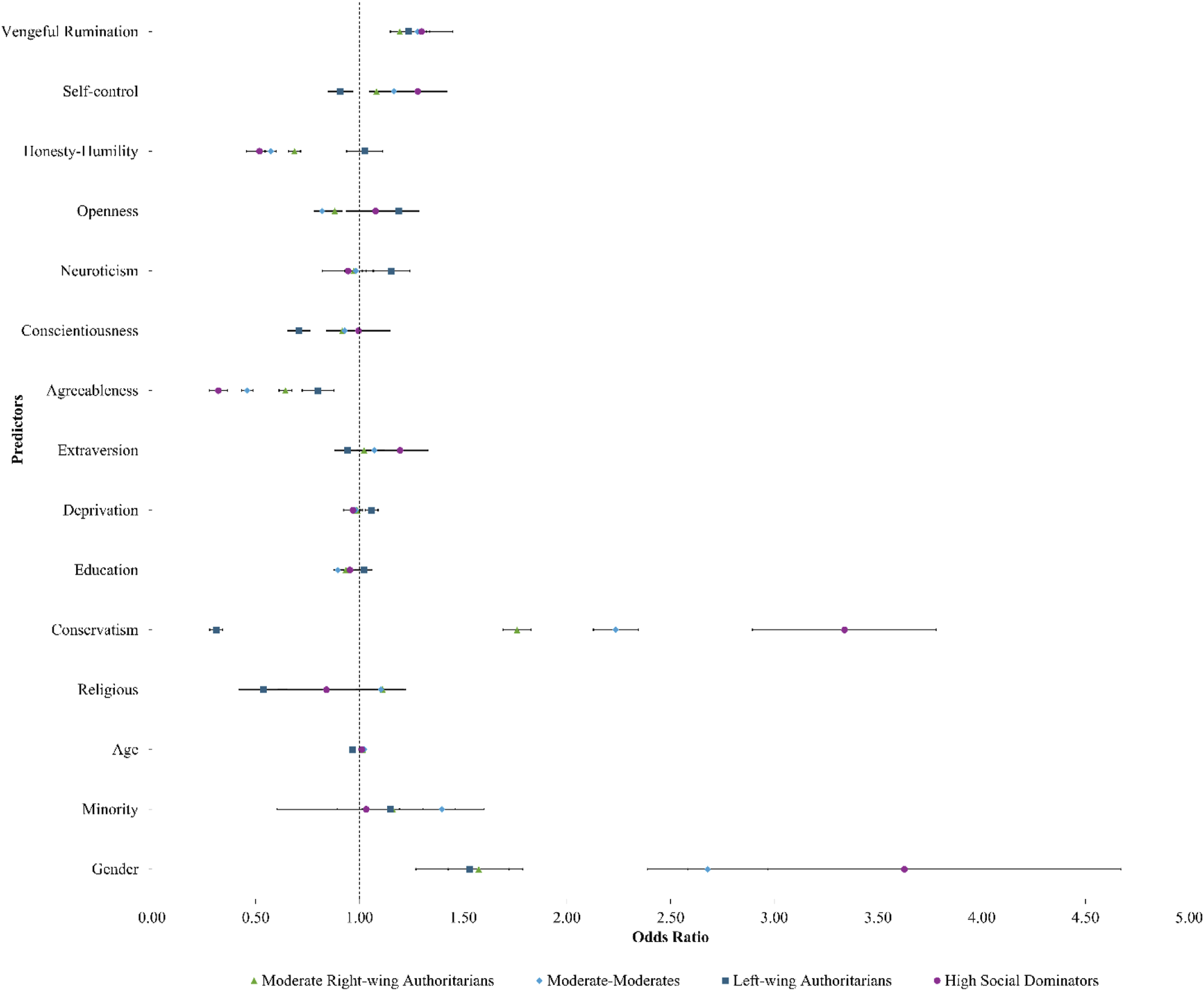
Odds of belonging to a given profile (relative to the Low Social Dominators) as a function of demographic and personality covariates. Odds ratios (ORs) greater than 1.00 indicate that individuals higher on a given construct have a higher probability of belonging to the target profile (compared to the Low Social Dominators). ORs less than 1.00 indicate that individuals higher on a given construct have a higher probability of belonging to the Low Social Dominators profile. Error bars represent 95% confidence intervals.
Moderate Right-wing Authoritarians versus Low Social Dominators
Table 4 shows that men, ethnic minorities, and religious people were more likely than women, New Zealand Europeans, and non-religious people (respectively) to belong to the Moderate Right-wing Authoritarians (vs. Low Social Dominators) profile. Likewise, older participants and participants higher in conservatism, self-control, and vengeful rumination were more likely to belong to the Moderate Right-wing Authoritarians (vs. Low Social Dominators) profile. Conversely, higher levels of education, agreeableness, conscientiousness, openness, and honesty-humility were associated with decreased odds of belonging to the Moderate Right-wing Authoritarians (vs. Low Social Dominators) profile. Deprivation, extraversion, and neuroticism did not, however, differentiate between the likelihood of belonging in the Low Social Dominators and Moderate Right-wing Authoritarians profiles (ps ≥ .190).
Moderate-Moderates versus Low Social Dominators
Similar to the Moderate Right-wing Authoritarians profile, men and ethnic minorities were more likely than women and New Zealand Europeans (respectively) to be in the Moderate-Moderates (vs. Low Social Dominators) profile. Age and conservatism also increased the odds of being in the Moderate-Moderates (vs. Low Social Dominators) profile, as did extraversion, self-control, and vengeful rumination. Conversely, education, agreeableness, conscientiousness, openness, and honesty-humility decreased the odds of being in the Moderate-Moderates profile (relative to the Low Social Dominators) profile. Deprivation, neuroticism, and whether participants identified as religious did not differentiate between membership in the Moderate-Moderates and Low Social Dominators profiles (ps ≥ .080).
Left-wing Authoritarians versus Low Social Dominators
Although men and those who identified as non-religious were more likely than women and those who identified as religious to be in the Left-wing Authoritarians (vs. Low Social Dominators) profile, minority status and education did not distinguish between membership in these two profiles (ps ≥ .218). Nevertheless, deprivation, neuroticism, openness, and vengeful rumination increased the odds of belonging to the Left-wing Authoritarians (vs. Low Social Dominators) profile. Conversely, age, conservatism, agreeableness, conscientiousness, and self-control decreased the odds of being in the Left-wing Authoritarians (vs. Low Social Dominators) profile. Honesty-Humility and extraversion did not differentiate between membership in the Left-wing Authoritarians and Low Social Dominators profiles (ps ≥ .072).
High Social Dominators versus Low Social Dominators
Men were again more likely than women to be in the High Social Dominators (vs. Low Social Dominators) profile. Additionally, age, conservatism, extraversion, self-control, and vengeful rumination increased the odds of belonging in the High Social Dominators (vs. Low Social Dominators) profile. Conversely, agreeableness and honesty-humility were associated with decreased odds of membership in the High Social Dominators (vs. Low Social Dominators) profile. Finally, minority status, education, deprivation, and whether participants identified as religious did not differentiate between membership in the High Social Dominators (vs. Low Social Dominators) profile (ps ≥ .073), nor did conscientiousness, neuroticism, and openness (ps ≥ .253).
Institutional trust and attitudes toward social issues
As a final demonstration of the validity of our five-profile solution, we examined mean levels of (a) climate change beliefs and concerns, (b) institutional trust and voting intent, and (c) social attitudes as a function of profile membership (for full results, see Table S10).
Climate change beliefs
Table S10 presents mean levels of climate change beliefs as a function of profile membership (see also Figure 3). All five profiles differed in their mean (a) belief that climate change is real, (b) belief that climate change is caused by humans, and (c) concern about climate change. Left-wing Authoritarians showed the highest belief in, and concern about, climate change, followed by Low Social Dominators, Moderate Right-wing Authoritarians, and Moderate-Moderates. Conversely, High Social Dominators reported the lowest beliefs in and concern about climate change. Mean climate change beliefs, institutional trust, and social attitudes across profiles.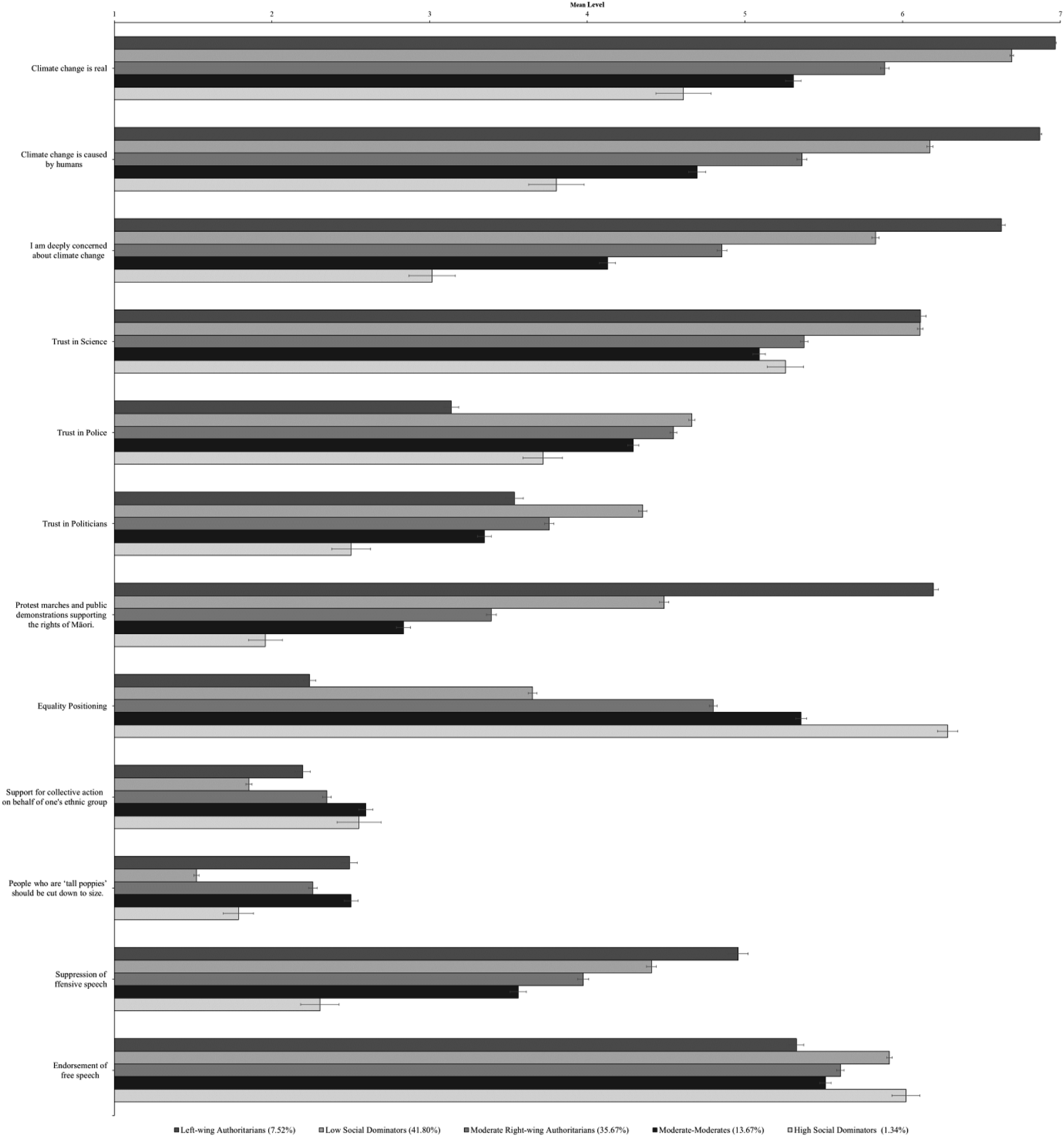
Institutional trust
We assessed institutional trust via mean levels of trust in science, the police, and politicians (see Figure 3). Concerning trust in science, Left-wing Authoritarians and Low Social Dominators showed comparable levels of trust in science (χ2(1) = 0.01, p = .915), as did Moderate Right-wing Authoritarians and High Social Dominators (χ2(1) = 3.81, p = .051). All other paired contrasts across the three constructs were significant (ps < .010). Namely, Left-wing Authoritarians demonstrated the highest trust in science, followed by Low Social Dominators, Moderate Right-wing Authoritarians, High Social Dominators, and, finally, Moderate-Moderates. Conversely, Low Social Dominators demonstrated the highest trust in police, followed by Moderate Right-wing Authoritarians, Moderate-Moderates, High Social Dominators, and Left-wing Authoritarians. Similarly, Low Social Dominators expressed the most trust in politicians, followed by Moderate Right-wing Authoritarians, Left-wing Authoritarians, Moderate-Moderates, and, finally, High Social Dominators. Thus, those in the Low Social Dominators and Moderate Right-wing Authoritarians profiles were generally high in institutional trust, whereas Left-wing Authoritarians were high in trust in science but low in trust in police and only moderately trusting of politicians. Conversely, Moderate-Moderates and High Social Dominators had relatively low institutional trust across all three measures.
Voting intentions
Table S10 also displays differences in voting intentions for New Zealand’s 2023 general election as a function of profile membership (ps < .001; see Figure 4). First, we note that most participants intended to vote in the election. That said, a larger percentage of High Social Dominators and Moderate-Moderates did not intend to vote relative to Left-wing Authoritarians, Moderate Right-wing Authoritarians, and Low Social Dominators. Conversely, the Left-wing Authoritarians contained fewer individuals unsure of their party vote than the High Social Dominators profile and the remaining three profiles. Proportion of intended party support for the 2023 election across profiles.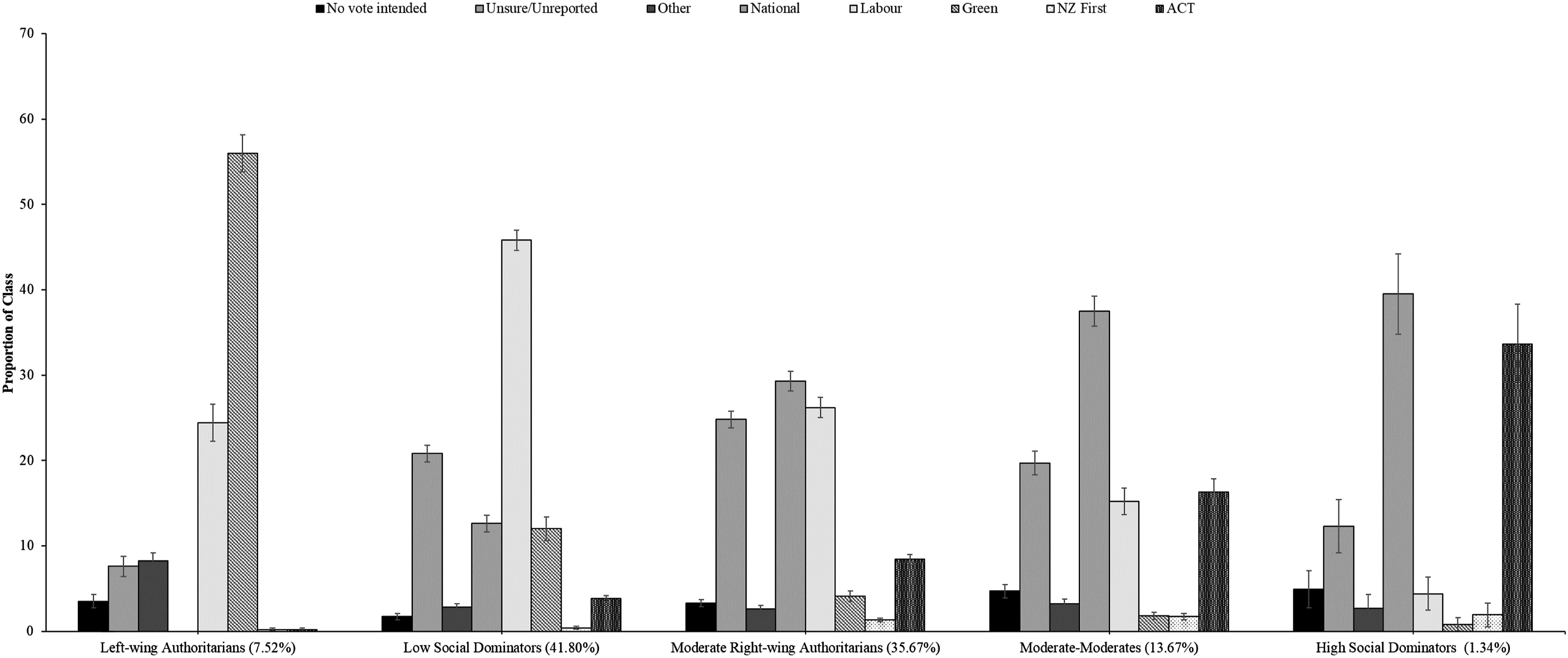
Concerning party votes, the Left-wing Authoritarians profile contained the largest proportion of “other” votes, followed by the Moderate-Moderates, Low Social Dominators, Moderate Right-wing Authoritarians, and, finally, High Social Dominators. Additionally, no members of the Left-wing Authoritarians profile reported an intention to vote for the National Party (i.e., the main center-right party), and only a small percentage intended to vote for NZ First or ACT (i.e., minor parties with populist and libertarian themes, respectively). Instead, Left-wing Authoritarians predominantly intended to vote for the Green Party (i.e., a minor party focused on progressive environmental and social justice issues), with the remainder intending to vote for the Labour Party (i.e., the main center-left party). Conversely, only a small percentage of High Social Dominators intended to vote for either the Green or the Labour parties, as well as NZ First. Instead, High Social Dominators intended to vote for the National Party or ACT. Unsurprisingly, these results reveal predominant support for left-wing and center-left political parties among Left-wing Authoritarians and right-wing and center-right political parties among High Social Dominators.
The three remaining profiles also demonstrated differences in voting intentions. Namely, the Low Social Dominators profile contained the largest proportion of Labour Party voters of any profile, followed by Moderate Right-wing Authoritarians and Moderate-Moderates. Likewise, a larger percentage of Low Social Dominators intended to vote for the Green Party than the Moderate Right-wing Authoritarians and Moderate-Moderates profiles. Conversely, the intention to vote for the National Party, ACT, or NZ First was highest in the Moderate-Moderates profile, followed by Moderate Right-wing Authoritarians, and, finally, Low Social Dominators.
Social attitudes
Table S10 and Figure 3 also display mean levels of (a) support for Māori political mobilization, (b) participants’ equality positioning, (c) support for ethnic-based collective action, (d) attitudes toward “tall poppies,” and (e) support for free speech and banning offensive speech as a function of profile membership. First, these analyses reveal clear differences in support for Māori political mobilization across profiles; Left-wing Authoritarians expressed the most support, followed by Low Social Dominators, Moderate Right-wing Authoritarians, Moderate-Moderates, and High Social Dominators. Clear distinctions also emerged for equality positioning (ps < .001); High Social Dominators expressed the most support for ideologies that position equality as based on individual (vs. group) merit. Conversely, Left-wing Authoritarians expressed the least support for these ideologies.
All profiles scored low on support for collective action on behalf of one’s ethnic group (i.e., below the midpoint of the scale), and Moderate-Moderates and High Social Dominators showed comparable levels of support (χ2(1) = 0.34, p = .561). Moderate-Moderates and High Social Dominators were, however, higher in collective action support on behalf of one’s ethnic group (ps ≤ .005), followed by Moderate Right-wing Authoritarians, Left-wing Authoritarians, and, finally, Low Social Dominators.
Interestingly, mean attitudes toward tall poppies revealed some similarities between the five profiles. All profiles scored low on negative attitudes toward tall poppies, and Left-wing Authoritarians held similar attitudes toward tall poppies to the Moderate-Moderates (χ2(1) = 0.09, p = .769). That said, Moderate-Moderates and Left-wing Authoritarians held more negative attitudes than the rest of the profiles toward tall poppies, followed by Moderate Right-wing Authoritarians, High Social Dominators, and Low Social Dominators.
Finally, mean support for banning offensive speech (ps < .001) and for free speech (ps ≤ .023) differed across profiles. Left-wing Authoritarians scored highest on support for banning offensive speech, followed by Low Social Dominators, Moderate Right-wing Authoritarians, Moderate-Moderates, and, finally, High Social Dominators. Conversely, while all profiles generally supported free speech (i.e., all profiles scored higher than the midpoint of the scale), free speech support was highest among High Social Dominators, followed by Low Social Dominators, Moderate Right-wing Authoritarians, Moderate-Moderates, and, finally, Left-wing Authoritarians.
Discussion
Authoritarianism is primarily understood in social-personality psychology to be comprised of two correlated, but distinct, dimensions (namely, RWA and SDO) which capture ideological proclivities that maintain the status quo and inequality (Duckitt, 2001). However, emerging literature focused on left-wing authoritarianism posits that LWA shares core traits and attitudes with its right-wing counterparts (e.g., Conway III et al., 2021; Costello et al., 2022). Thus, authoritarianism may have a common psychological “core” irrespective of one’s political leanings. That said, research has yet to examine how left- and right-wing authoritarianism presents in the general population, nor whether particular “types” of authoritarians demonstrate a shared authoritarian core. The present study addresses these oversights by using LPA to identify distinct response patterns to LWA, RWA, and SDO in a nationwide random sample of adults. In doing so, we examine how these three ideologies covary in the general population and identify similarities and differences between authoritarian subgroups.
Our results reveal that most of the population (91.1%) express low-to-moderate levels of LWA, RWA, and SDO (i.e., values spanning 1–4 on the 7-point Likert scales) across three profiles. We did, however, detect two small, but theoretically relevant, profiles which fall outside these general trends (namely, Left-wing Authoritarians and High Social Dominators). Left-wing Authoritarians represented 7.5% of the population and scored low on RWA and SDO but high on LWA. Conversely, High Social Dominators represented 1.3% of the population and scored high on SDO but low-to-moderate on RWA and low on LWA. Thus, profiles of authoritarians constitute small subgroups on two “extremes” of the political continuum.
Demographic and personality differences
Our five profiles differed across various demographic and personality factors. Turning first to our three largest profiles, the Low Social Dominators were most likely to be women (vs. men), were highest in agreeableness and honesty-humility, and reported the lowest levels of vengeful rumination of all five profiles. The next largest profiles, the Moderate Right-wing Authoritarians and Moderate-Moderates, were generally middling across all demographic and personality measures but were more likely to be men, ethnic minorities, conservative, and have less formal education than the Low Social Dominators profile. Likewise, several personality traits—including lower agreeableness, openness to experience, and honesty-humility—distinguished membership in these profiles (relative to the Low Social Dominators) and mirror previous personality correlates of RWA and SDO (e.g., Perry & Sibley, 2012; Sibley & Duckitt, 2008). Finally, the Moderate Right-wing Authoritarians and Moderate-Moderates differed from each other in key ways: the Moderate Right-wing Authoritarians reported higher levels of agreeableness, openness and honesty-humility, while the Moderate-Moderates reported higher levels of self-control and vengeful rumination. Taken together, these findings demonstrate theoretically meaningful demographic and personality differences even amongst those with low-to-moderate scores on LWA, RWA, and SDO and suggest that the five-profile solution captures distinct subsets of the population.
Perhaps more importantly, our results highlight differences between the overall sample and profiles of Left-wing Authoritarians and Social Dominators. Indeed, Left-wing Authoritarians were the most educated, lived in the most deprived areas, and reported the highest mean levels of openness, neuroticism, and vengeful rumination compared to any profile. They also were the least religious and reported the lowest levels of self-control. Further validating these differences, our regression analyses revealed that the Left-wing Authoritarians were more likely to be younger, non-religious, more liberal, live in more deprived areas, more neurotic, more open, less agreeable and less conscientious than people in the Low Social Dominators profile. These differences—particularly in openness to experience and conscientiousness—highlight key conceptual differences between LWA and RWA. For example, openness to experience strongly correlates negatively with RWA (e.g., see Perry & Sibley, 2012; Sibley & Duckitt, 2008) but correlated positively with the odds of being in the Left-wing Authoritarians profile. Moreover, prior research suggests that RWA correlates with moral motives such as self-restraint and social order (Janoff-Bulman et al., 2008). That Left-wing Authoritarians scored lower than all other profiles on self-control may reflect another core distinction between left- and right-wing authoritarians. Collectively, these results suggest that the commonalities between people high on LWA and RWA are smaller than proposed by previous research (e.g., Conway III et al., 2018).
Turning to the High Social Dominators, this subgroup was most likely to be men and reported the highest levels of self-control but the lowest levels of agreeableness and honesty-humility. Additionally, High Social Dominators were more likely to be older, more conservative, more extroverted, higher in self-control, higher in vengeful rumination, and lower in honesty-humility than the Low Social Dominators profile. Given the unique personality predictors of the Left-wing Authoritarians and High Social Dominators profiles, these findings further illustrate important distinctions between these two ideologies. These results also highlight critical differences between High Social Dominators and more “traditional” conservatives, corroborating well-established personality differences between those high on SDO and RWA (Desimoni & Leone, 2014; Duckitt, 2022).
Evaluating evidence of a shared authoritarian core
Although our results revealed important differences in the demographic and personality composition of the distinct profiles, some similarities emerged. Namely, all profiles—including Left-wing Authoritarians and High Social Dominators—were more likely to be men than women, lower in agreeableness, and higher in vengeful rumination than the Low Social Dominators. That men were overrepresented in all profiles (relative to Low Social Dominators) supports previous research that suggests, all else being equal, men should prefer group-based hierarchies more than women (Pratto et al., 2006; Sidanius et al., 1994). We extend this literature by showing that men may be higher in authoritarian dominance more broadly (and, thus, both SDO and LWA). That all profiles were lower in agreeableness relative to Low Social Dominators also corroborates research on the personality correlates of SDO and LWA (Costello et al., 2022). Finally, similarities in vengeful rumination may reflect an underlying desire to punish (rather than forgive) transgressors at the heart of authoritarianism, irrespective of one’s political leanings (Costello et al., 2022; Osborne et al., 2023). That said, differences between Left-wing Authoritarians and High Social Dominators in these three factors were more pronounced than the differences between these profiles and the Low Social Dominators (see the OSM). Thus, while these similarities provide some interesting insights into who in the population may most likely endorse authoritarian ideologies, the limited overlap is insufficient to argue a shared authoritarian “core,” particularly for LWA and SDO.
Social outcomes
Finally, profile membership was related to distinct social attitudes and beliefs. As expected, Left-wing Authoritarians had the highest beliefs in, and concerns about, climate change, trust in science, support for protest marches on behalf of Māori, support for banning hate speech, and lowest beliefs that equality is a result of individual (vs. group) merit and support for free speech. Conversely, High Social Dominators had the lowest beliefs in, and concerns about, climate change, trust in science and politicians, support for protest marches on behalf of Māori, and support for banning hate speech, as well as highest support for ethnic-based collective action, support for free speech, and beliefs that attribute equality to individual (vs. group) merit. Additionally, Left-wing Authoritarians and High Social Dominators showed distinct intentions to vote for left- and right-wing political parties, respectively. Thus, these two profiles reflect the distinct attitudes toward climate change, social change, and inequality held by left- and right-wing authoritarians (e.g., Costello et al., 2022; Stanley & Wilson, 2019). These findings further support the assertion that LWA has different societal consequences to that of SDO or RWA (see Milfont & Osborne, 2024; Nilsson & Jost, 2020).
Interestingly, both Left-wing Authoritarians and High Social Dominators were less trusting of the police than the general population (though Left-wing Authoritarians were less trusting than High Social Dominators). Left-wing Authoritarians’ distrust of the police may reflect a general suspicion of hierarchy-enhancing institutions and a preference for overthrowing the established order among the left. However, those high in SDO generally prefer hierarchy-enhancing institutions (e.g., Zubielevitch et al., 2022) and trust the police (e.g., Lowrey-Kinberg et al., 2020). Thus, it is surprising that High Social Dominators were less trusting than the other profiles. This may be due, in part, to right-wing authoritarians considering state-run establishments as untrustworthy in countries with left-leaning governments (Jang et al., 2010). Given that High Social Dominators also expressed the least trust in politicians, future research should consider how this subgroup’s support for hierarchy-enhancing institutions wax and wane with changes in government (see also Satherley et al., 2023).
Left-wing Authoritarians also expressed distrust in politicians and were relatively more negative toward “tall poppies” (albeit still well below the scale’s midpoint). These results again highlight the anti-hierarchical component of LWA (Costello & Patrick, 2022) but illustrate that these punitive attitudes extend to high-status individuals and reveal some similarities with those high in RWA (Duckitt, 2006). That said, these similarities are minor and largely reflect contextual factors rather than core personality or attitudinal similarities between left- and right-wing authoritarians. Thus, our analyses generally identify key differences in the attitudes expressed by these profiles, albeit with some evidence of similarities peripheral to the proposed core components of authoritarianism.
Strengths, caveats, and future research
One of the major strengths of our study is the use of a person-centered approach to identify the prevalence of different subgroups of authoritarians. Indeed, while researchers posit “types” of authoritarians, few studies have assessed whether these types exist and whether they qualitatively differ from other subgroups (for an exception, see Sibley et al., 2019). Using LPA and a large, nationwide random sample allowed us to examine this possibility by identifying subgroups of authoritarians that naturally occur in the general population. Our analyses revealed five profiles that vary across numerous demographic and personality factors and the endorsement of myriad social issues, emphasizing the strength of a person-centered approach for identifying unique response patterns across constructs.
Despite these strengths, one should be cautious in concluding that we identified the “true” number of profiles in a population (see Bauer & Curran, 2004), nor should one assume that one’s personality or demographic traits invariably predict profile membership. Rather, our results identify the most likely profile membership based on key, theoretically relevant predictors. We should also note that the present study is cross-sectional and does not assess the stability of profile membership across time. Indeed, membership in a profile at one timepoint does not necessarily mean that profile membership is stable and consistent over time (see Collins & Lanza, 2010). Moreover, particular subgroups in the population may be more (or less) malleable than other subgroups, and the social attitudes of each subgroup may differ by key contextual factors (e.g., the political leanings of the current government). Our results nevertheless provide the necessary groundwork for future research assessing whether individuals transition into different profiles and, if so, who transitions and how this affects their social attitudes.
Although our use of a large, nationwide random sample has high external validity, the inevitable space constraints in a large national survey meant that we were limited to short-form measures of LWA, RWA, and SDO. Moreover, these scales were heterogeneous in length and phrasing (e.g., the RWA and LWA scales were more emotive than the SDO scale in phrasing), and our LWA measure included only pro-trait items derived from the Anti-Hierarchical Aggression (AHA) subfactor of the full scale (see Costello & Patrick, 2022). While these measures are validated short forms of their respective constructs (Sibley et al., 2024), more complete, analogous scales could capture more nuanced similarities and differences between profiles. Future research should consider this possibility when examining how these constructs covary in the general population.
More broadly, mean levels of RWA (and, to some extent, LWA and SDO) were generally low across profiles, and additional analyses failed to identify a proportion of the sample “high” on RWA. While perhaps surprising, our findings may reflect “baseline” levels of authoritarianism in subgroups of the population. Indeed, studies reveal generally low levels of RWA and SDO among the general population (e.g., see Zubielevitch et al., 2023) but that endorsement of these ideologies increases in response to salient societal and status threats, respectively (Perry et al., 2013). Likewise, research suggests similar threat sensitivity among left-wing authoritarians (e.g., Winter et al., 2022). Thus, higher scores on our focal constructs may only arise in the context of societal threats (e.g., in a pandemic; see Manson, 2020). The use of Altemeyer’s older RWA scale may also explain the low RWA scores; for example, government censorship of magazines may be less relevant in the age of social media. That said, this explanation is tenuous given that high agreement with these items does emerge in other contexts (for a review, see Osborne et al., 2023). Nonetheless, we encourage future research to consider how different subgroups of authoritarians emerge in the population in response to different contexts or periods of sustained threat and whether more recent measures capture a stronger endorsement of RWA in the general population.
It is also important to note that these profiles arose in a WEIRD nation (namely, New Zealand), hindering their generalizability to non-Western contexts. Indeed, research suggests that RWA and SDO vary across cultures (e.g., Mirisola et al., 2007; Vilanova et al., 2020), and correlations between left-wing ideology and authoritarianism typically emerge in countries with histories of Communism (e.g., see De Regt et al., 2011; McFarland et al., 1992; Pentony et al., 2000). Thus, the little evidence of a shared authoritarian “core” in the present study may be a product of New Zealand’s position as a Western democratic nation. Furthermore, New Zealand is a relatively egalitarian nation, and data collection for the present study occurred in the pretext of a left-leaning Labour government. Given that stronger associations between RWA and SDO occur in countries with stark political contrasts (Roccato & Ricolfi, 2005), subgroups of people high on RWA and SDO or LWA and RWA/SDO may emerge in countries with more polarized political systems. Future research should consider these possibilities and utilize person-centered approaches to examine types of authoritarians in non-Western nations, particularly those in the Global South or the Global East that have experienced ostensibly left-wing authoritarian regimes.
Conclusion
While recent research posits similarities between LWA and RWA/SDO that reflect a core underlying authoritarian dimension (e.g., Costello et al., 2022), these claims are highly contentious, and studies have yet to test how LWA, RWA, and SDO covary in the general population. Using LPA of a large, nationwide random sample of adults, we address this oversight and identify five distinct response patterns to LWA, RWA, and SDO. Notably, these profiles qualitatively differed across various demographic and personality factors, as well as their attitudes toward climate change, institutions, inequality, and social change. Nevertheless, we encourage future research to explore typologies of authoritarianism in the population, particularly in countries with ostensibly left-wing regimes. The present study provides the necessary foundations for this endeavor and for developing a comprehensive understanding of how authoritarianism may (or may not) generalize across the political spectrum.
Supplemental Material
Supplemental Material - Identifying “Types” of authoritarians: A latent profile analysis of left- and right-wing authoritarianism and social dominance orientation
Supplemental Material for Identifying “Types” of authoritarians: A latent profile analysis of left- and right-wing authoritarianism and social dominance orientation by Kieren J. Lilly, Thomas H. Costello, Chris G. Sibley, and Danny Osborne in European Journal of Personality
Footnotes
Author contributions
KJL conducted the formal analysis and prepared the original manuscript draft and manuscript revisions. CGS curated the dataset and acquired funding for the study. Both CGS and DO conceptualized the study and provided supervision. THC, CGS, and DO provided feedback and review of the manuscript.
Declaration of conflicting interests
The author(s) declared no potential conflicts of interest with respect to the research, authorship, and/or publication of this article.
Funding
The author(s) disclosed receipt of the following financial support for the research, authorship, and/or publication of this article: Preparation of this manuscript was supported by a Templeton Religion Trust grant (TRT-2021-10418) awarded to the New Zealand Attitudes and Values Study (NZAVS).
Open science statement
The current study was not preregistered. The data described in this paper are part of the NZAVS. The data presented in this study are not publicly available due to restrictions imposed by the Ethics Committee. However, full copies of the NZAVS data files are held by all members of the NZAVS management team and advisory board, and a de-identified dataset containing the variables analyzed in this manuscript is available upon request from the corresponding author, or any member of the NZAVS advisory board for the purposes of replication or checking of any published study using NZAVS data. The Mplus syntax used to test all models reported in this manuscript is available on the Open Science Framework:  .
.
Supplemental Material
Supplemental material for this article is available online.
Notes
References
Supplementary Material
Please find the following supplemental material available below.
For Open Access articles published under a Creative Commons License, all supplemental material carries the same license as the article it is associated with.
For non-Open Access articles published, all supplemental material carries a non-exclusive license, and permission requests for re-use of supplemental material or any part of supplemental material shall be sent directly to the copyright owner as specified in the copyright notice associated with the article.
