




Abstract
Mass migration and COVID-19 represent two converging challenges affecting immigrant-receiving countries. Our understanding of intergroup emotion profiles—positive (happiness, hope, and sympathy) and negative (anger, fear, and disgust)—among members of immigrant destination societies in times of global uncertainty remains limited. Drawing from panel samples from nine countries (N = 13,645), and controlling for relevant covariates, we aimed to extract latent profiles of intergroup emotions and map these profiles onto perceived COVID-19-related threats, immigrant contact, political predispositions, dark triad traits, and prejudice. We identified six latent profiles with patterns suggesting that positive interactions with immigrants are significantly correlated with positive emotional response and lower perceived pandemic threat. Societies facing mass immigration in the wake of COVID-19 may benefit from interventions and policies that promote positive and close experiences with immigrants, thereby reducing negative emotions and fostering positive emotions toward newcomers among citizens.
International realities such as economic hardship, climate-change-related disasters, and authoritarian regimes continue to displace millions of people around the world. By 2022, a record 281 million people had left their home countries (International Organization for Migration, 2022). Research indicates that a large influx of migrants can trigger perceived threat and defensiveness within host communities (Schwartz et al., 2018; Vos et al., 2021). Such tensions may contribute to the emergence of prejudice against migrants and support of xenophobic laws and policies (Cottrell et al., 2010). Simultaneously, the uncertain and rapidly evolving nature of the COVID-19 pandemic introduced additional stress to societies around the world (Van Daalen et al., 2021), which, in convergence with mass migration, may be responsible for increased anti-immigrant sentiments in many receiving communities (Marchi et al., 2022).
In the present study, we sought to extract latent profiles of intergroup emotions—both positive (happiness, sympathy, and hope) and negative (fear, anger, and disgust)—vis-à-vis prior contact with immigrants (frequency of encounters, casual contact, and valence of one’s experiences), and to map these profiles onto perceived COVID-19-related threats (realistic and symbolic), political predispositions (right-wing authoritarianism [RWA], social dominance orientation [SDO], and populism), dark triad traits (Machiavellianism, psychopathy, narcissism), prejudice, and relevant covariates (political ideology and demographic variables). Our panel sample consisted of adult host nationals from seven European countries (i.e., Austria, Belgium, Germany, Hungary, Italy, Spain, and Sweden), the United States, and Colombia.
Intergroup Processes in the Context of Migration
A growing body of scholarly work has examined intergroup processes within contexts of migration. These studies indicate that intergroup contact may reduce prejudice (Pettigrew & Tropp, 2006) and suggest that, although negative intergroup contact is less common than positive intergroup contact (Pettigrew et al., 2011), the former seems to have stronger effects on prejudice (Graf et al., 2014). Similarly, the study of discriminatory behavior toward migrant groups has mostly centered on the link between negative intergroup emotions and perceived intergroup threat (Abeywickrama et al., 2018). Stephan et al. (2009) proposed two main types of perceived threat—realistic (e.g., to the ingroup’s safety or power dynamics) and symbolic (e.g., to the ingroup’s values or beliefs). The perception of migrants as a source of realistic (e.g., labor market competition for ingroup members) and symbolic threat (e.g., outgroup members are perceived as culturally different) has been described as a common host-national reaction in receiving contexts (De Coninck & Meuleman, 2022) such as Europe (De Coninck et al., 2021), the United States (Garand et al., 2022), and Colombia (Holland et al., 2021). Further, research on the links between intergroup emotions, intergroup contact, and prejudice (for a review see Mackie & Smith, 2018) towards migrant groups has consistently demonstrated that intergroup emotions constitute an important aspect of intergroup behavior (Seger et al., 2017).
Intergroup emotions
According to intergroup emotions theory (IET), intergroup emotions are central to understanding intergroup relations (Smith, 1993). In the context of migration, evidence suggests that intergroup emotions are directly associated with intergroup contact, perceptions of threat posed by migrants, and prejudice towards newcomers (Kauff et al., 2017; Miller et al., 2004; Stephan & Stephan, 2000; Visintin et al., 2017). However, much of this research has placed greater emphasis on the link between negative emotions and perceived intergroup threat (Abeywickrama et al., 2018), whereas focus on the role of positive intergroup emotions vis-à-vis intergroup threat remains limited (for exceptions, see Cohen-Chen et al., 2017; Harth et al., 2008; C. Wang et al., 2022). Such literature continues to evolve from the original approach to intergroup emotions (Stephan & Stephan, 2000), where threat was deemed as a form of fear, to a more comprehensive understanding of intergroup threat as linked with a multiplicity of negative intergroup emotions (Stephan et al., 2009; Wamsler et al., 2022) such as anger and disgust (Cottrell & Neuberg, 2005; Hodson et al., 2013).
Intergroup emotions are elicited based on threat appraisals and are a function of the extent to which people identify with the ingroup (Landmann et al., 2019). However, work by Cottrell and Neuberg (2005) suggests that intergroup threat (e.g., symbolic and realistic) does not necessarily elicit intergroup emotions in a similar fashion, nor do all intergroup emotions promote similar action tendencies. That is, different types of threat may be associated with different appraisals and hence elicit distinct intergroup affect responses (Neuberg & Cottrell, 2002). For instance, safety threat may be appraised as an existential danger to one’s own life or to the life of ingroup members and may therefore elicit fear. Similarly, whereas appraisals of realistic threat may elicit anger, appraisals of health threats elicit emotions of disgust (Cottrell & Neuberg, 2005).
Although both fear and anger are considered to be negative emotional responses that may be activated simultaneously in situations of perceived intergroup threat, they represent distinct affective states that can produce different behavioral responses (Wamsler et al., 2022). Anger has been described as a predictor of action tendencies such as aggression (Kauff et al., 2017) and is usually associated with appraisals of injustice (Landmann & Hess, 2017), which may help to explain why angry individuals often respond to threat in a confrontational manner. Fear, on the other hand, predicts action tendencies associated with avoidance (Kauff et al., 2017) and prompts people to seek new perspectives and think twice before acting. This demarcation suggests that fear and anger are based on distinct cognitive systems (Wamsler et al., 2022).
Research during the pandemic found that anger had a stronger effect than fear on perceptions of COVID-19 threat posed by outgroup individuals (Wamsler et al., 2022). Additionally, Freitag and Hofstetter (2022) reported that the perception of threat posed by COVID-19 does not always translate into prejudice, antimigrant attitudes, or negative emotions towards the outgroup. For example, anger related to the pandemic may exacerbate antimigrant attitudes, whereas people reacting to the pandemic with fear may display more migrant-friendly orientations (Freitag & Hofstetter, 2022).
Intergroup disgust, or repulsion toward social outgroups, may be accompanied by negative affective responses to the outgroup or its members on behalf of the ingroup, as well as by a sense of ingroup superiority and purity (Hodson et al., 2013). Evidence also suggests a close association between disgust-eliciting features, such as immorality, and perceptions of health threat posed by the outgroup. Individuals who are perceived by the ingroup as disgust elicitors (e.g., immoral) are often subjected to greater prejudice (Rozin et al., 2009). Moreover, in contexts of disease outbreaks and contamination, evidence indicates that aggressive action tendencies towards, and dehumanizing perceptions of, members of the outgroup are associated with the role of intergroup disgust as a contagion-avoidance mechanism (Luca et al., 2022).
Although the literature on negative intergroup emotions toward migrant groups is more abundant, some work has examined the role of positive emotions as well. For example, Kessler and Hollbach (2005) found that intergroup happiness is positively associated with one’s level of identification with the ingroup, whereas intergroup anger is negatively associated with ingroup identification and positively associated with happiness toward the outgroup. Moreover, intergroup happiness has been identified as a predictor of positive attitudes towards the outgroup (Kauff et al., 2017). C. Wang et al. (2022), in their study of rural to urban migrants in China, found that happiness among rural Chinese emerged as a mediator in the association of positive and negative extended contact with urban Chinese on one hand, and contact intentions toward the latter group, on the other hand.
Similarly, intergroup hope serves as an important emotion in host nationals’ reappraisal of migrants, especially during wartime. For example, Halperin and Gross (2011) examined the mediating role of hope—as a mechanism to regulate ingroups’ negative emotions toward migrants—in the association between outgroup reappraisal and support for providing aid to migrants fleeing war zones. Other studies have identified that intergroup sympathy increases when intergroup contact takes place and when newcomers are perceived as unable to reciprocate the help or support they have received due to reasons outside of their control (e.g., financial constriction; Harth et al., 2008).
The choice to explore both positive and negative intergroup emotions in our study was also guided by evidence indicating that people can experience positive and negative emotions simultaneously (Berrios et al., 2015), and that they represent distinct but compatible states (Larsen & McGraw, 2011). Such experience is what the literature describes as “mixed emotions” (Larsen & McGraw, 2014). That is, the two affects do not constitute a binary structure in which negative emotions represent the antagonistic end of a spectrum and are therefore opposites of positive emotions (Barrett & Bliss-Moreau, 2009). Indeed, given the large degree of independence between positive and negative intergroup emotions, individuals can simultaneously hold positive and negative affect responses, particularly in the face of bittersweet experiences (Larsen & McGraw, 2011).
Intergroup emotions and political predispositions
Large influxes of migrants over short periods of time may exacerbate host nationals’ negative attitudes toward them and increase support for political elites with authoritarian aspirations.
For example, Rozo and Vargas (2021) found that the mass migration of Venezuelans to Colombia shifted the voting behavior in the country toward right-wing political parties, thus increasing the likelihood that extreme right-wing candidates will win elections.
Right-wing authoritarianism (RWA) and social dominance orientation (SDO), or the support for social hierarchies, are often characterized as two distinct dimensions of authoritarian personality (Altemeyer, 2007). Although scholarly work examining the links of RWA and SDO with intergroup emotions remains scarce, a study found a positive association between RWA and feelings of disgust towards migrants, and a negative relationship between SDO and anger towards this group (Levin et al., 2013).
In their study of populism (antiestablishment rhetoric and people-centric messaging) and intergroup emotions, Salmela and von Scheve (2017) identified two mechanisms responsible for the link between motivation to support right-wing populist elites and emotional responses to sociocultural and economic changes. The first mechanism relates to ressentiment and explains how negative emotions (e.g., fear) can transform repressed shame into anger, resentment, and hatred towards outgroup members such as migrants. The second mechanism relates to emotional distancing from outgroup social identities (e.g., migrants’ countries of origin and ethnic group memberships) that frequently evoke negative responses (Salmela & von Scheve, 2017).
Intergroup emotions and the dark triad traits
The dark triad (DT)—Machiavellianism (manipulativeness, cynicism), psychopathy (impulsivity, callousness), and narcissism (sense of entitlement, grandiose self-perception)—has gained much attention in recent years. Although there are many so-called dark personality traits, such dark personality traits represent manifestations of self-interests, either individual or group based, and occur at the expense of other people or groups (Zeigler-Hill & Marcus, 2016). Dark traits tend to be correlated with desire for dominance and a sense of entitlement (Muris et al., 2017), and with negative emotions toward outgroups, such as disgust (Colledani et al., 2018) and perceived outgroup threat (Hodson et al., 2009).
Although studies have generally found that the dark triad traits are associated with greater prejudice (Koehn et al., 2019), few studies have looked at how intergroup emotions may be related to these dark traits (see Hodson et al., 2013). To our knowledge, Colledani et al. (2018) conducted the only study to date that links the dark triad traits to intergroup emotions. In their study on intergroup relations between Italians and the Roma minority in Italy, they found that psychopathy and narcissism were not related to intergroup emotions. Machiavellianism was positively related to disgust and negatively related to empathy. These findings highlight the need to continue distinguishing among the dark triad traits vis-à-vis intergroup emotions.
The Present Study
The present study was designed to (a) identify latent profiles of positive and negative intergroup emotions; (b) test whether these profiles are significantly distinguished by intergroup contact, COVID-19-related threats, political predispositions, and prejudice; and (c) examine whether the latent profiles are meaningfully differentiated by covariates such as demographic variables (sex, age, education, country, type of community) and political ideology (right-wing vs. left-wing). The countries included in the present study were purposefully selected to provide a sampling of countries with long histories of migrant reception (e.g., the United States, Germany, Austria, Sweden), countries with relatively recent experiences with migration (e.g., Italy, Spain, Belgium), and countries that are new to receiving large influxes of migrants (e.g., Hungary and Colombia).
We advanced two primary hypotheses for the present study. First, based on our review of the literature, we hypothesized that latent profiles would emerge reflecting (a) high levels of positive intergroup emotions coupled with low levels of negative intergroup emotions; (b) high levels of positive intergroup emotions coupled with high levels of negative intergroup emotions; (c) low levels of positive intergroup emotions coupled with high levels of negative intergroup emotions; and (d) low levels of positive intergroup emotions coupled with low levels of negative intergroup emotions. Second, we hypothesized that these profiles would be differentiated by intergroup contact, COVID-19-related threat, political predispositions, dark triad traits, and prejudice.
Specifically, profiles defined by high levels of negative intergroup emotions would be expected to score highly on COVID-19-related threats, RWA, SDO, populism, dark triad traits, and prejudice. On the other hand, profiles defined by high levels of positive intergroup emotions would be expected to score highly on casual and high-quality intergroup contact (see Figure 1 for an overview).
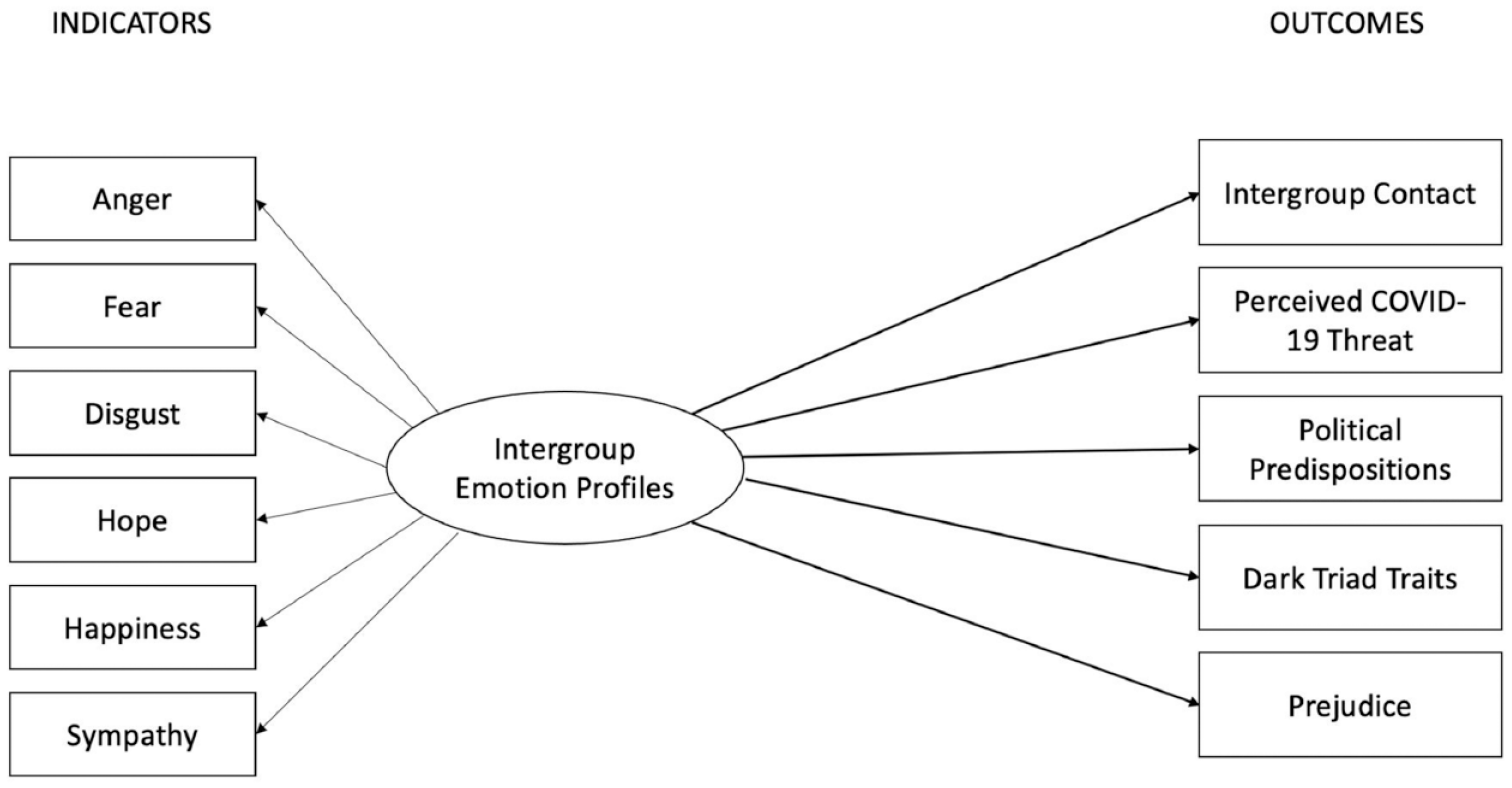
Intergroup emotion profiles, indicators, and outcomes.
Method
Sample and Procedures
This study was approved by the Institutional Review Board at the University of Texas at Austin. The data used for this study were collected by a survey company.1 The survey was distributed through the firm’s own survey tool between May and June 2021, to adults aged 18 and above residing in Austria, Belgium, Germany, Hungary, Italy, Spain, and Sweden, and to adults above the age of 25 in the United States and Colombia (total N = 13,645 respondents; about 1,500 per country). Underage participants (below 18 or 25, depending on country), not residing in any of the countries in the study, and/or not completing all survey questions were not included in the sample. Participants received financial compensation from the survey company directly, in the form of points that can be exchanged for gift cards and other rewards.
The survey firm drew a quota sample out of its available panels with heterogeneity in terms of age and gender. Response rate ranged from 12-31% across countries. Respondents were contacted through e-mail with the invitation to participate in the study in the official language of the country or region where they resided. Translations of the survey were carried out by qualified translators, thus ensuring that the terminology used in the questions was considered “everyday language” by the respondents. There were no attention or invalid-responding checks included in the survey. Participants were unable to skip questions, and therefore there were no intentionally missing data, but some questions did have a “No answer” option. The dataset used in generating our findings is openly accessible at Mendeley Data (https://www.mendeley.com/reference-manager/library/all-references).
Measures
We note here that many of our constructs were assessed using single items or very brief scales. Such practices are common in large panel studies where a wide array of constructs is assessed and when participant burden is an important concern (De Coninck et al., 2021). The single items used in our study were taken from established scales (as noted in the description of each measure below), and the consistency of our results with theoretical expectations may bolsters the validity of our measurement approach.
Intergroup emotions
Using a 7-point scale (1 = not at all, 7 = a lot), we asked respondents how strongly they feel each of the listed emotions (anger, disgust, fear, happiness, hope, and sympathy) when they think about immigrants coming to their country. The intergroup emotion items were adapted from Cottrell and Neuberg (2005) by selecting three primary negative emotions (fear, anger, and disgust) from their scale and adding three positive emotions (hope, happiness, and sympathy) to complement these negative intergroup emotions. To provide evidence for the validity of these intergroup emotion items, we examined intercorrelations both within and between positive and negative items. Across countries, positive intergroup emotions were interrelated at an average of r = .69 (range: .53 to .80); negative intergroup emotions were interrelated at an average of r = .62 (range: .45 to .80); and positive and negative intergroup emotions were interrelated at an average of r = −.11 (range: −.02 to −.19). The positive intercorrelations among positive emotions and among negative emotions support the validity of our intergroup emotion items.
Intergroup contact
Following Miller et al. (2004), we distinguished between three types of intergroup contact: frequency of encounters, casual contact, and valence of contact. We used single-item measures adapted from Miller et al. (2004). Frequency of encounters with immigrants was measured by asking respondents how often they personally encounter immigrants on the bus, street, or train. Participants responded to this item on a 5-point scale (1 = never, 5 = every day). Casual contact was measured by asking respondents how many of their friends or acquaintances are immigrants, with responses recorded on a 5-point scale (1 = none, 5 = all). Additionally, we measured valence of the encounters by asking participants to rate their experiences with immigrants in the present or in the past using a 5-point scale (1 = very negative, 5 = very positive). Items representing different types of intergroup contact were maintained separately and not summed.
Perceived COVID-19 threat
We used the COVID-19 Threat Scale developed and validated by Kachanoff et al. (2021). It consists of 10 items that assess realistic (related to physical well-being) and symbolic (related to sociocultural identity) COVID-19 threat on a 5-point scale (1 = low perceived threat, 5 = high perceived threat). This set of items was preceded by the stem “How much of a threat, if any, is the coronavirus outbreak for . . .” A sample item is, “. . . the rights and freedoms of the [country] population as a whole?” Cronbach’s alpha values for scores on realistic (.81) and symbolic threat (.85) indicated high internal reliability for both subscales.
Political predispositions (SDO, populism, and RWA)
To measure SDO, we used Ho et al. (2015) SDO scale consisting of eight items. A sample item is, “An ideal society requires some groups to be on top and others to be on the bottom.” We asked participants to indicate, using a 7-point scale, the extent to which they favored or opposed each statement (1 = strongly oppose, 7 = strongly favor). Cronbach’s alpha value for SDO was .76. To measure populism, we used three items from Spruyt et al. (2016). A sample item is, “Politicians talk too much and take too little action”; responses were recorded on a 5-point scale (1 = strongly disagree, 5 = strongly agree). Cronbach’s alpha value for populism was .82. We used Bizumic and Duckitt’s (2018) six-item scale to measure RWA. A sample item is, “The facts on crime and the recent public disorders show we have to crack down harder on troublemakers, if we are going preserve law and order.” We asked participants to indicate the extent to which they agreed with each of the six statements on a 7-point scale (1 = strongly disagree, 7 = strongly agree). Cronbach’s alpha value for RWA was .46. Despite the low alpha, RWA correlated above .30 with both SDO and political ideology.
Dark triad personality traits
We used the Dirty Dozen concise measure of dark triad personality traits (Jonason & Webster, 2010). Items include statements such as “I tend to exploit others towards my own end.” We assessed respondents’ degree of Machiavellianism, psychopathy, and narcissism using four items apiece, measured on a 5-point scale (1 = do not agree at all, 5 = fully agree). Scores for each dark triad trait were characterized by high internal consistency reliability (Machiavellianism = .89; psychopathy = .79; narcissism = .86). For each scale, higher scores reflect stronger endorsement of dark personality traits.
Prejudice toward immigrants
Prejudice was assessed using a feeling thermometer (Velasco González et al., 2008). Participants were asked to rate their overall feelings toward immigrants with a continuous rating between 100 degrees (feeling as warm and positive as possible toward immigrants) and zero degrees (feeling as cold and negative as possible toward immigrants). Scores were reverse-coded so that higher scores reflect higher prejudice.
Covariates
Covariates in this study included sociodemographic factors such as age, sex, educational attainment (college graduate: yes/no), type of community (countryside, small town, small city, suburb, or big city), migration background (entered as dummy-coded variables for first and second generation, with third or later generation used as the reference group), political ideology (from very liberal to very conservative), and country of residence (entered as dummy-coded variables, with Belgium as the reference group). To assess political ideology, we asked participants, “When it comes to politics, people sometimes talk of ‘left’ and ‘right.’ Where would you place yourself on the scale below, where 0 stands for the left and 10 for the right?” Responses were recorded on an 11-point scale (0 = far left, 10 = extreme right). Participants were asked to indicate their age (recoded into four categories: under 30 years old, from 30 to 45 years old, from 46 to 60 years old, over 60 years old); sex (0 = male, 1 = female); college educational attainment (0 = no college degree, 1 = college degree); type of community (1 = countryside, 2 = small town, 3 = small city, 4 = suburb, 5 = big city); migration background (0 = first-generation migrant, 1 = second-generation migrant); religious denomination (1 = Roman Catholic, 2 = Protestant, 3 = other Christian, 4 = Muslim, 5 = Jewish, 6 = agnostic/atheist, 7 = other religion); full-time employment (0 = not employed full-time, 1 = employed full-time); and self-reported political ideology (0 = extreme left, 10 = extreme right). To assess participant migration background, we asked them, “Were both your parents born in [country]?” We then created a dummy variable indicating participant migration background (0 = first-generation migrant, 1 = second-generation migrant), with both parents native-born as the reference group. Similarly, because these are international data and not all participating countries share the same education system, we created a dummy variable to analyze college educational attainment (0 = no college degree, 1 = college degree). Religion, socioeconomic status (SES), and employment status were not significantly related to any of our study variables, and thus we did not include these indicators as covariates. Because these are international data and not all participating countries use race as a construct, data for race were not collected.
Data Analysis Plan
Analyses proceeded in three steps. First, we computed descriptive statistics and bivariate correlations for all study variables. Second, we estimated a series of latent profile models to examine the number and content of profiles that emerged from analysis using intergroup emotions as indicator variables, consisting of two to six classes, and used standard fit indices to select the best-fitting profile solution (for a review of these fit indices, see Nylund et al., 2007). These fit indices include the Lo–Mendell–Rubin and Vuong–Lo–Mendell–Rubin likelihood ratio tests, which each provide a p value testing the null hypothesis that a solution with k profiles fits the data equally well compared to a solution with k - 1 profiles. Here, a significant p value suggests that adding another class improves the fit of the solution to the data. Additionally, the entropy value ranges from 0 to 1, where larger entropy values indicate a better fitting solution.
Nylund et al. (2007) suggest that values of .75 or higher indicate the presence of a reliable profile solution. The posterior classification probabilities indicate the likelihood that individuals have been placed into the correct profiles. Further, each profile must represent at least 5% of the sample, and profiles must be sufficiently theoretically distinct such that no profile represents a variation on another profile. Third, the latent profiles were assessed in terms of their relation to intergroup contact, COVID-19-related threat, political predispositions (RWA, SDO, and populism), dark triad traits, prejudice, and covariates. No participants were omitted from any of these analytic steps.
To empirically assess the need to employ a multilevel analysis, we estimated intraclass correlations (ICC) for all six intergroup emotions. These ICC values ranged from .011-.099, with a mean of .053. Zhang et al. (2018) recommend the use of multilevel modeling when ICC values are > .10. Because our ICC values were all < .10, we utilized a standard latent profile analytic approach. We did, however, create dummy-coded variables for all study countries (except Belgium, which we used as the reference group). We used these dummy-coded variables as predictors in all comparisons of outcome variables across latent profiles. Additionally, we conducted latent profile analysis (LPA) separately for each country, and 82.6% of these profile assignments matched the profile assignments from the overall LPA across countries (see Table S1 in the supplemental material).
Results
Step 1: Descriptive Statistics and Bivariate Correlations
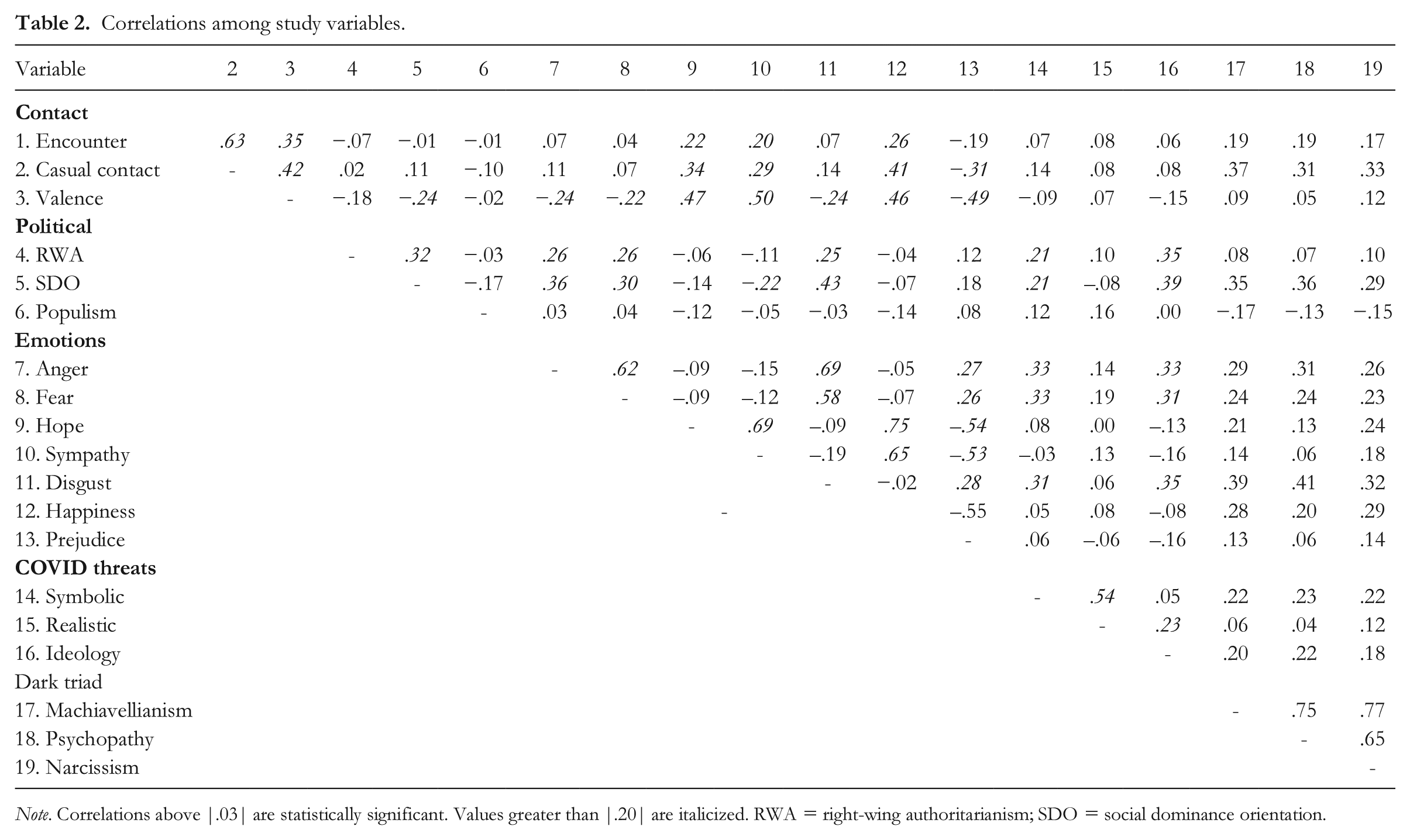
A descriptive overview of the covariates, such as demographic variables per country (i.e., gender, age, and educational attainment) and political ideology, is provided in Table 1. Bivariate correlations among study variables within the sample are provided in Table 2.
Descriptive overview of the control variables.
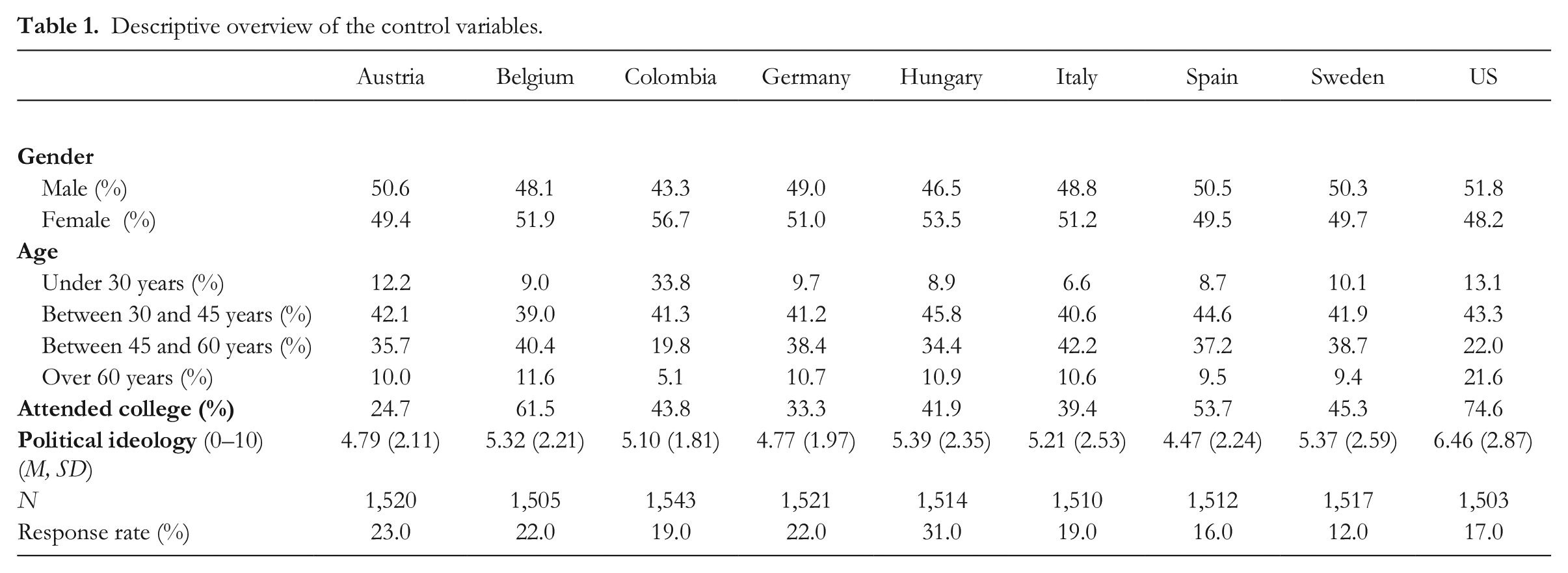
Correlations among study variables.
Note. Correlations above |.03| are statistically significant. Values greater than |.20| are italicized. RWA = right-wing authoritarianism; SDO = social dominance orientation.
Step 2: Estimate Latent Profile Models
In this section, we provide the means for the six intergroup emotions within each of the profiles and, in turn, compare the intergroup contact, COVID-19-related threats, political predispositions, prejudice, and demographic characteristics of class members. Table 3 presents fit statistics for the models with two through six profiles. The Lo–Mendell–Rubin and Vuong–Lo–Mendell–Rubin likelihood ratio tests continued to favor models with more profiles over models with fewer profiles. We stopped at six profiles given recommendations from Collins and Lanza (2010), who advise considering interpretability when deciding the maximum number of profiles to extract. Although the Lo–Mendell–Rubin and Vuong–Lo–Mendell–Rubin likelihood ratio tests continued to provide significant results with solutions with more than six profiles, entropy values did not increase after six profiles. Given the size of our sample, it is likely that differences between adjacent solutions would continue to be statistically significant even if the additional information provided by extra profiles was minimal. As a result, we decided to specify the maximum number of profiles that we would consider extracting, and we selected the six-profile solution based on the fit statistics presented in Table 3. Figure 2 displays the six-profile solution. Profile 1 was low on all six emotions. Profile 2 was low on negative emotions and moderate on positive emotions. Profile 3 was low on negative emotions and high on positive emotions. Profile 4 was high on negative emotions and low on positive emotions. Profile 5 was high on all six emotions, and Profile 6 was moderate on all six emotions. The profiles, in order, were called low, low negative/moderate positive, low negative/high positive, high negative/low positive, high, and moderate.
Fit statistics for the two- to six-profile models.
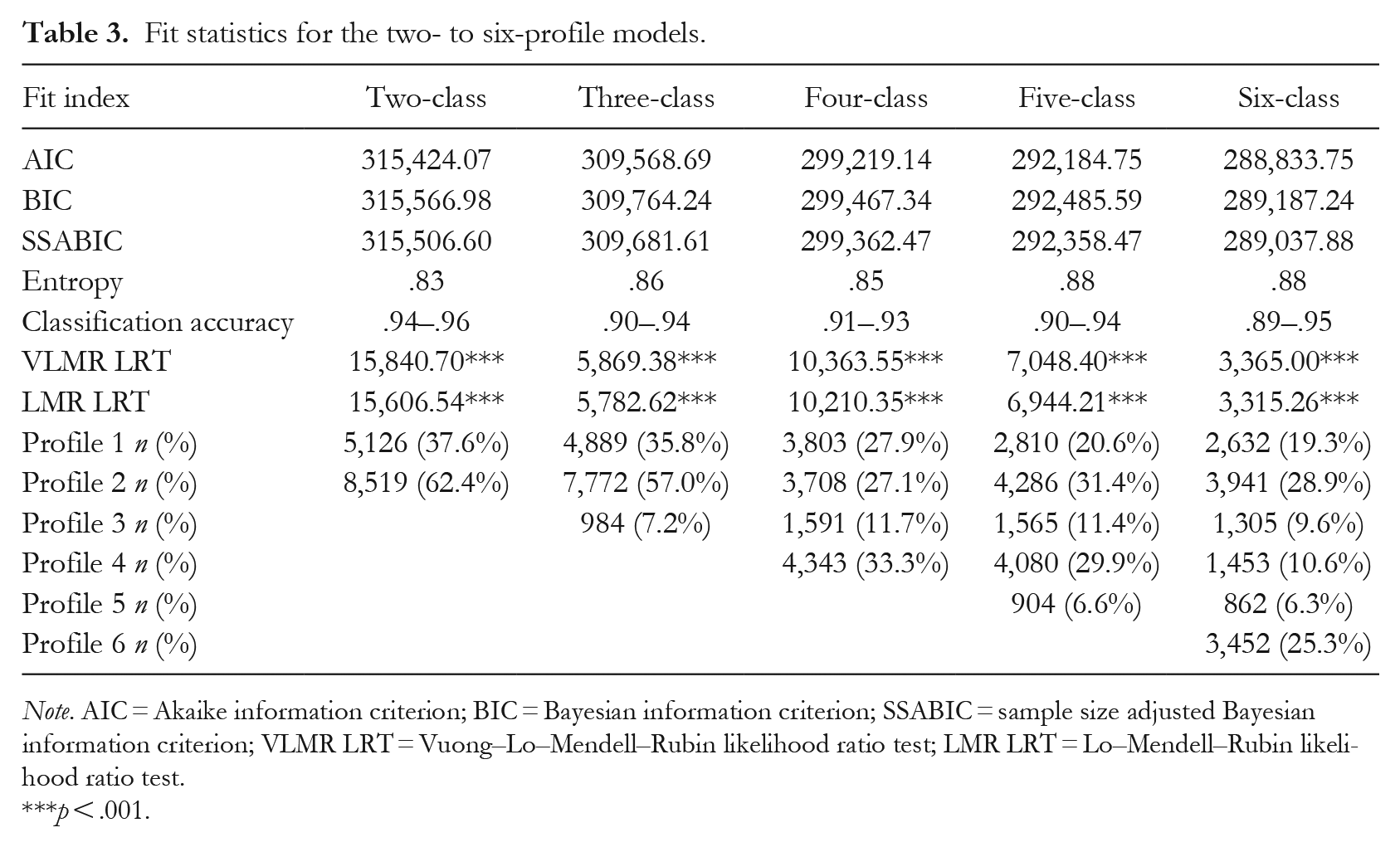
Note. AIC = Akaike information criterion; BIC = Bayesian information criterion; SSABIC = sample size adjusted Bayesian information criterion; VLMR LRT = Vuong–Lo–Mendell–Rubin likelihood ratio test; LMR LRT = Lo–Mendell–Rubin likelihood ratio test.
p < .001.
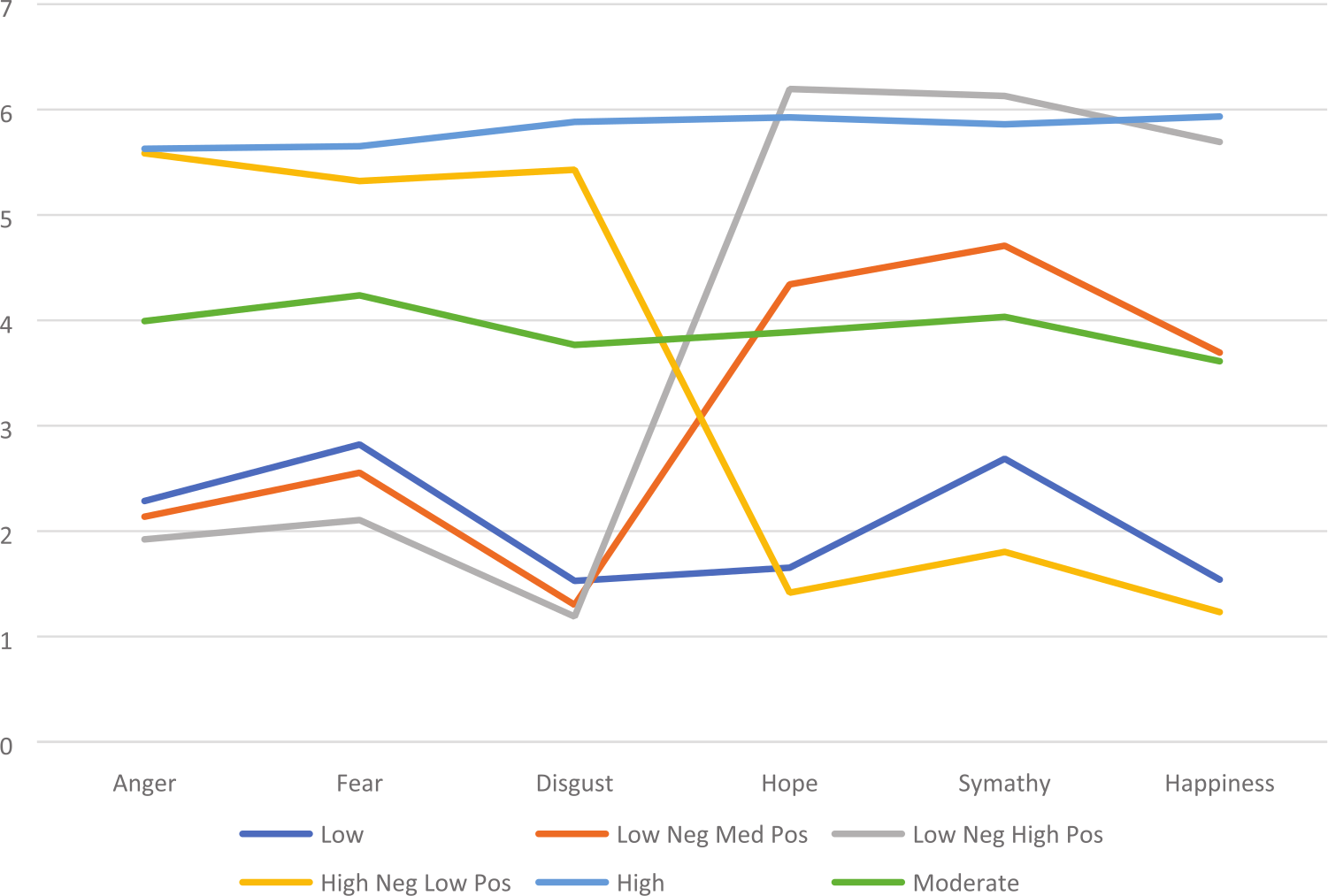
Six-profile intergroup emotion model.
Step 3: Comparison of Extracted Profiles Across Study Variables
As a next step of analysis, we used the Bolck, Croon, & Hagenaars (BCH) method (Asparouhov & Muthén, 2021) to estimate differences in intergroup contact, COVID realistic and symbolic threat, political predispositions, prejudice, and demographic variables. The BCH method conducts pairwise comparisons between each pair of profiles and provides a chi-square and p value for each comparison. To address concerns related to Type I error inflation, and because of our large sample size, only pairwise differences significant at p < .001 were interpreted as statistically significant. These comparisons are analogous to pairwise comparisons following a significant analysis of variance (ANOVA) result, with the added benefit that the BCH method preserves the error in the class solution (i.e., entropy values below 1.0 indicate some degree of error in the classification process). To generate effect sizes for these comparisons, we classified participants into their most likely classes and conducted univariate ANOVAs for each of the outcome variables. We used only the η2 values and not the p values from these ANOVAs because p values were provided by the BCH tests.
Intergroup contact variables
Univariate ANOVAs indicated that the strongest profile difference emerged for valence (η2 = .28), with smaller effects appearing for casual contact (η2 = .20) and for frequency of encounters (η2 = .08). BCH comparisons conducted in Mplus indicated that, for encounters with immigrants, the high profile scored highest, and the low profile and the high negative/low positive profile scored lowest. For casual contact, the high profile scored highest, and the high negative/low positive profile scored lowest, followed by the low profile. For valence of one’s experiences with immigrants, the low negative/high positive profile and the high profile scored highest, and the high negative/low positive profile scored lowest.
COVID-19 realistic and symbolic threat variables
Univariate ANOVAs indicated that the strongest profile difference emerged for COVID-19 symbolic threat (η2 = .10), with a smaller effect appearing for COVID-19 realistic threat (η2 = .02). BCH analyses indicated that, for COVID-19 symbolic threat, the high profile scored highest, and the low negative/high positive profile scored lowest. For COVID-19 realistic threat, the high profile scored highest, and the moderate and low negative/moderate positive profiles scored lowest.
Political predispositions (RWA, SDO, and populism) and dark triad trait variables
For political predispositions, univariate ANOVAs indicated that the strongest profile difference emerged for SDO (η2 = .21), with smaller effects appearing for RWA (η2 = .07) and for populism (η2 = .03). BCH comparisons indicated that, for SDO, the high profile scored highest, and the low negative/high positive profile scored lowest, followed by the low negative/moderate positive profile. For RWA, the high negative/low positive profile scored highest, and the low negative/moderate positive and low negative/high positive profiles scored lowest. For populism, the high negative/low positive profile scored highest, and the high and moderate profiles scored lowest. It should be noted that the means for all profiles were between 3.9 and 4.3, suggesting considerable discontent with the political establishment in participants’ respective countries.
For the dark triad variables, univariate ANOVAs indicated strong profile differences on all three dark triad indicators: Machiavellianism, η2 = .28; psychopathy, η2 = .25; and narcissism, η2 = .22. BCH pairwise comparisons indicated that the high profile provided elevated scores for all three dark triad indicators, the moderate profile and the high negative/low positive profile were intermediate, and the other profiles were lower.
Prejudice
Finally, a univariate ANOVA on prejudice yielded a strong set of group differences, η2 = .38 (see Table 4). As expected, the high negative/low positive profile was by far the most prejudiced group. The low negative/high positive profile and the high profile scored lowest, and the other groups were moderate.
Study variables by latent profile.
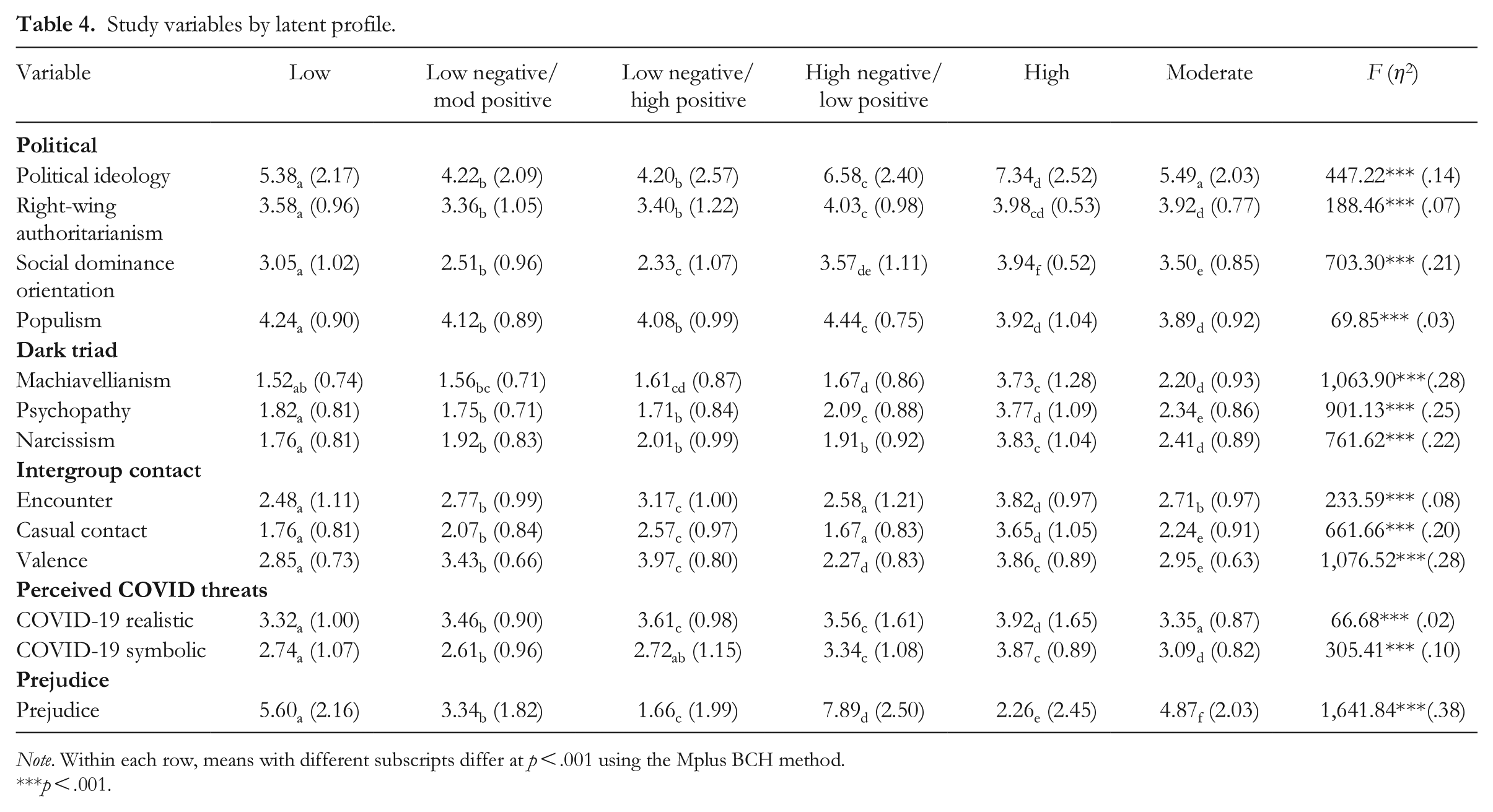
Note. Within each row, means with different subscripts differ at p < .001 using the Mplus BCH method.
p < .001.
Demographic variables and political ideology
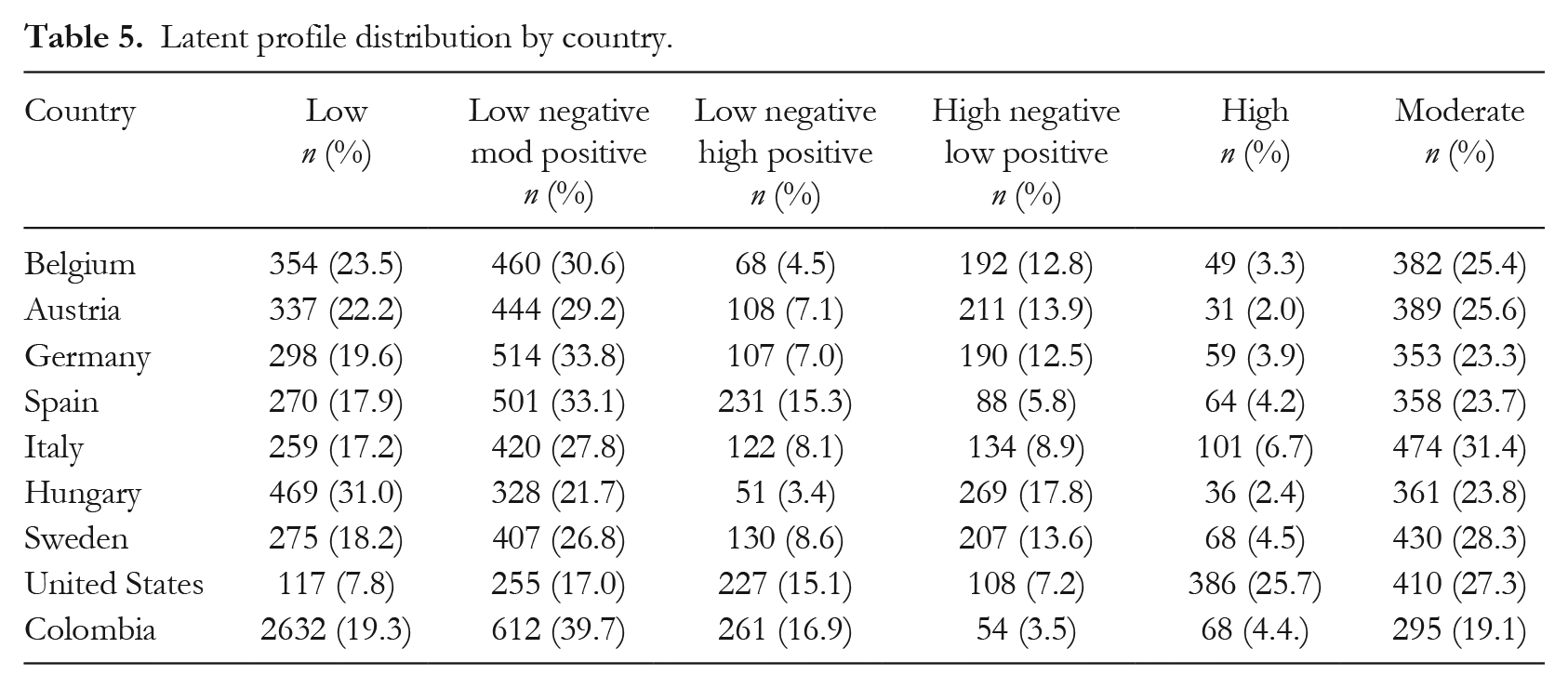
We classified participants into their most likely classes to examine their relations with categorical demographic variables. The country profile cross-tabulation (see Table 5) produced a statistically significant chi-square value, χ2(40) = 2,082.45, p < .001, Cramer’s V = .18. The United States was overrepresented (25.7%) in the high profile and underrepresented in the low profile (7.8%). Spain, the United States, and Colombia were the only countries for which more than 15% of respondents were classified into the high positive/low negative profile. Hungary was overrepresented within the low profile (31.0%).
Latent profile distribution by country.
The Sex x Profile cross-tabulation also produced a statistically significant chi-square value, χ2(5) = 89.71, p < .001, Cramer’s V = .08. Sex differences across classes were generally modest, with the exception of the high profile, which represented 8.0% of the men and 4.7% of the women in our sample.
For age, we created four age groups: below 30, 30 to 45, 46 to 60, and above 60. These age groups were significantly related to profile membership, χ2(15) = 488.68, p < .001, Cramer’s V = .19. The under 30 and 30 to 45 age groups were overrepresented within the high profile (8.3 % and 9.8% vs. 2.8% and 1.7%, respectively), and the 46 to 60 and over 60 age groups were overrepresented within the low profile (22.1% and 20.4% vs. 15.1% and 17.9%, respectively).
For educational attainment, because the study countries have vastly different educational systems, we classified participants into two categories based on whether they had graduated college. This classification was significantly related to profile membership, χ2(5) = 298.20, p < .001, Cramer’s V = .15. Compared to college graduates, individuals who had not finished college were overrepresented within the low (21.5% vs. 16.7%, respectively) and high negative/low positive (13.1% vs. 7.8%, respectively) profiles, and underrepresented within the low negative/moderate positive (31.5% vs. 26.6%, respectively), low negative/high positive (11.3% vs. 8.1%, respectively), and high (8.6% vs. 4.3%, respectively) profiles.
We then compared profiles across type of community (countryside, small town, small city, suburb, or big city). The resulting cross-tabulation was statistically significant, χ2(20) = 259.78, p < .001, Cramer’s V = .07. The greatest differences emerged for the high profile, for which 11.9% lived in the countryside and 42.6% lived in large cities. The low negative/high positive profile was evenly distributed between, on one hand, large cities (43.2%) and, on the other hand, countryside, small towns, and small cities (42.4%). In contrast, the high negative/low positive profile consisted of only 30.0% of large-city residents, and 55.4% of people residing in the countryside, small towns, or small cities.
Finally, a univariate ANOVA on political ideology indicated a moderate set of group differences (η2 = .14). The high profile was the most right-wing profile, and the low negative/moderate positive and low negative/high positive profiles were the most left-wing-leaning. It is important to highlight, however, that despite these statistically significant differences in political ideology across profiles, we did not find profiles with extreme scores on the far left or far right. Instead, all six profiles scored near the middle of the political scale spectrum.
Discussion
The present set of profiles suggests an important set of relationships between intergroup contact and intergroup emotions. For example, the high negative/low positive profile—which represents high levels of anger, fear, and disgust coupled with low levels of happiness, hope, and sympathy—was also characterized by the lowest levels of frequency of encounters and of casual and high-quality contact with immigrants. On the other hand, the low negative/high positive and low negative/moderate positive profiles—which are defined by high or moderate levels of happiness, hope, and sympathy coupled with low levels of anger, fear, and disgust—are characterized by greater levels of higher quality and casual contact with immigrants.
In turn, we might conclude that more frequent and higher quality intergroup contact with immigrants would be associated with more favorable levels of intergroup emotions toward immigrants. The high profile appears to represent a notable exception to this pattern, in that this profile is associated with high levels of both positive and negative intergroup emotions even though individuals in this profile reported high levels of frequency of encounters and of casual and high-quality contact with immigrants. We discuss this profile in greater detail later in this section.
As predicted by our second hypothesis, we found that the profiles were differentiated by intergroup contact, COVID-19-related threats, political predispositions, and prejudice, but less so by demographic variables (i.e., sex, age, education, and type of community). Political ideology and country of residence were the only covariates that appeared to meaningfully differentiate the profiles. Contrary to our third hypothesis, only small to modest profile differences emerged for sex, age group, educational attainment, and type of community in which participants resided.
Latent profiles
High profile
The United States, a country with a long-lasting tradition of receiving immigrants, was overrepresented within this profile with almost 30% of the study sample. The next highest country within this profile was Italy, where less than 7% of participants were classified into the high profile. The high profile was characterized by individuals residing mainly in large urban centers and who tended to be highly educated, aged 45 and younger, and male. Individuals within this profile endorsed all six emotions strongly and reported the highest scores for frequency of encounters with immigrants, casual contact with them, and valence of one’s experiences. This profile was the lowest in prejudice but was the highest in SDO and moderate in RWA, which is not surprising as it has been reported that intergroup contact can reduce prejudice in many situations (Pettigrew & Tropp, 2006). However, prior evidence also suggests that both SDO and RWA may be positively associated with elevated prejudice (Caricati et al., 2017), a finding that did not emerge for the high profile in the present study group. This profile consisted of individuals who perceived the most threat, both symbolic and realistic, from the COVID-19 pandemic, and who scored as the most politically conservative of all profiles.
However, it is important to highlight that this group is only moderately conservative within the full political spectrum (scoring an average of 7 on a 1–11 scale). Although members of the high profile tended to score low on prejudice and high on intergroup contact, their politically conservative tendencies may reflect, at least to some extent, a rightward political shift among some host nationals in response to mass migration. This proposition may be supported by the tendency of members of the high profile to reside in large urban centers, where many immigrants settle, suggesting frequent contact with immigrants but the potential for defensiveness towards them (especially during the COVID-19 pandemic, when xenophobia increased in many immigrant-receiving countries; Reny & Barreto, 2022).
This profile also scored the highest on all three dark triad traits. It is not immediately clear why this would be the case, as studies show that dark traits tend to be correlated with desire for dominance (Muris et al., 2017) and elevated perceived threat (Hodson et al., 2009) from outgroup members, as indicated in our findings, but also with high levels of anti-immigrant prejudice, which is contrary to our results. This combination of mean scores suggests a “law and order” mindset that endorses limited support for immigrants who “did it the right way” and that is in favor of restrictive migration policies. It appears probable that this group does not align with a “black and white” characterization of beliefs about immigrants and their presence during the COVID-19 pandemic, but rather represents a mix of individuals who embrace positive and negative affective responses simultaneously, depending on the context. It is also possible that these scores capture a portion of the host national population that has not been fully described in the literature yet, and therefore remains less understood by the scientific community.
High negative/low positive profile
The high negative/low positive profile was represented by 17.8% of the Hungarian sample and by 13.9 and 13.6% of the Austrian and Swedish samples, respectively. This profile was overrepresented among individuals who lived in the countryside, small towns, or small cities; who had not finished college; who were male; and who were aged 46 or older. This group is characterized by extremely low levels of all three measures of contact with immigrants, and by the highest scores on prejudice, RWA, populism, and both realistic and symbolic threats related to COVID-19. Similarly, this group scored high on SDO and right-wing political ideology. This set of traits has been found to be significantly correlated with strong anti-immigrant sentiments, suggesting that members of the high negative/low positive profile were strongly prejudiced toward immigrants during the pandemic. Somewhat surprisingly, this profile has low scores on all three dark triad traits. One would expect that such high levels of political predispositions, prejudice, perceived threat, and right-wing ideology would be associated with high scores on dark triad traits.
Low negative/moderate positive and low negative/high positive profiles
Individuals in these two profiles were overrepresented particularly in Colombia and Spain. They tended to reside in large cities and to be college graduates, and they were evenly distributed across sex and age brackets (under and over 45). These two profiles were the most politically liberal, with the low negative/high positive being especially so. Theses profiles are also similar to each other in terms of political predispositions—low scores on SDO and dark triad traits—but different in terms of intergroup contact and perceived COVID-19 threats. The low negative/high positive profile scored significantly lower on both symbolic and realistic threats related to COVID-19. Although the two profiles are similar in terms of frequency of encounters and casual contact with immigrants, the low negative/high positive profile reported significantly higher positive experiences with immigrants and significantly lower levels of prejudice.
Moderate profile
The moderate profile was largely evenly represented across countries, with Italy most strongly overrepresented (31.4%), and Colombia least strongly represented (19.1%). This profile was evenly distributed in terms of age and gender. Individuals in this profile scored near the mean on all six intergroup emotions, contact with immigrants, perceived pandemic-related threats, political predispositions, dark triad traits, prejudice, and covariates across all nine countries and type of residential locality.
Low profile
Almost one third of the sample from Hungary—a country not accustomed to receiving immigrants—was classified into this profile. This group was evenly distributed across sexes and there were not notable differences in terms of type of residential location; this profile was overrepresented among those who had not finished college and were over 46 years old. This profile scored low on all six emotions and on dark triad personality traits, moderate on other political predispositions and ideology, and moderate on prejudice. Individuals in this profile also scored fairly high on COVID-19 threats and low on intergroup contact. The low affective response towards immigrants among individuals in this profile may be the result of being uninformed about immigration issues and of experiences with them not being especially impactful.
Covariates
Our results did not provide support for our third hypothesis—we found few profile differences in terms of control variables (other than political ideology and country of residence). Overall, the most notable differences emerged for the high and the low negative/moderate positive profiles in contrast to the high negative/low positive profile. Individuals within the high negative/low positive profile were overrepresented among individuals residing in the countryside, small towns, or small cities, in contrast to those in the high and the low negative/moderate positive profiles, who tended to reside in large cities.
Compared to college graduates, individuals who reported the lowest affective response towards immigrants tended not to have finished college and were overrepresented within the low and the high negative/low positive profiles. In contrast, college graduates were overrepresented within the low negative/moderate positive, low negative/high positive, and high profiles. In terms of age, the under 30 and 30 to 45 age groups were overrepresented within the high profile, and the 46 to 60 and over 60 age groups were overrepresented within the low profile. Finally, women were overrepresented in the low negative/moderate positive profile, and men were overrepresented in the moderate profile.
It is important to note that the demographic differences described appeared to be quite modest, and the six intergroup emotion profiles are better differentiated by contact with immigrants, COVID-19-related realistic and symbolic threats, political predispositions, dark personality traits, and prejudice, but less so by demographic variables. A notable exception are the findings for country of residence in relation to political ideology—the high and high negative/low positive profiles were the most right-wing, whereas the low negative/high positive and low negative/moderate profiles were the most left-wing.
In terms of how individual countries mapped onto intergroup emotion profiles, the United States was overrepresented in the high profile, and Hungary was overrepresented in the low profile. When the present data were collected in the summer of 2021, the United States had recently undergone a contentious presidential election and transition, marked by the January 6 Capitol riot and allegations of election fraud; furthermore, the influx of unauthorized border crossings had begun in February 2021 and was increasing during the summer. Moreover, the death of George Floyd on May 2020 had led to a series of protests and social unrest that continued well into 2021.
These trends may have polarized the country and led some conservative U.S. residents to express extreme discomfort with the state of affairs in the country. This dissatisfaction may be at least somewhat responsible for the overrepresentation of the US within the high profile.
In Hungary, the government of Viktor Orbán maintained a strongly anti-immigrant approach, suggesting that many Hungarians may have not had much contact with immigrants. This lack of contact may have prevented much of the Hungarian public from forming informed attitudes about immigration. In turn, lack of information about immigration and low contact with immigrants in Hungary may have led this country to score highest on prejudice across our sample. Spain (McAuley & Rolfe, 2018), the United States (Budiman, 2020), and Colombia (Padilla et al., 2021) were overrepresented in the high positive/low negative profile.
Recommendations
As mass migration continues to unfold around the world and the pandemic still, in 2023, poses challenges, we believe that interventions and policies designed to reduce negative and increase positive emotions towards migrants are critical. Our findings offer encouraging prospects for local and global interventions and policy efforts aimed at improving intergroup emotions—influence emotions in ourselves or others—and increasing well-being in times of heightened uncertainty due to important global events such as global migration and the pandemic. One way to accomplish this goal might involve online, scalable, and low-cost interventions aimed at reducing negative and increasing positive emotions (K. Wang et al., 2021). Among host nationals, emotion regulation may help them navigate affective experiences that come with the exposure to different cultural ideals and values (De Leersnyder et al., 2013).
Limitations and Future Directions
The present findings should be interpreted in light of some important limitations. One prominent such limitation is the use of a cross-sectional design. Second, all data are based on respondent self-reports. A third potential limitation relates to the inclusion of only Western countries in our sample. We do not know whether similar findings would have emerged from respondents in the Middle East, Asia, or Africa. Fourth, the relatively small number of countries in the sample did not permit us to utilize multilevel techniques that model variation both within and between countries. Future studies can address these limitations by building upon our work in several ways, including a larger and more diverse set of countries, as well as longitudinal data collection methods to examine change over time. A more exhaustive examination of factors related to affective response (e.g., sadness, contempt) beyond the six emotions we measured here is warranted. Additionally, it is critical that more work is done to document the relationships of all three dark triad traits with intergroup emotions, intergroup contact, threat perceptions, political personality, and populism.
Conclusion
Our study findings suggest the presence of multiple configurations of intergroup emotions related to immigration. The existence of these profiles further documents that people in receiving societies can react to the influx of migrants in a variety of ways, and that these affective responses are reliably linked to intergroup contact, political predispositions, dark traits, prejudice, and COVID-19-related realistic and symbolic threats. Proximity to immigrants and frequency of interactions with them are significantly correlated with positive affective response and lower perceived pandemic threat. This is particularly true for high-quality and affectively close interactions. In turn, interventions aimed at reducing negative and increasing positive emotions are paramount for enhancing well-being and preventing migrant-averse reactions within societies facing uncertainty due to major global events such as pandemics and mass migration.
Supplemental Material
sj-docx-1-gpi-10.1177_13684302231179909 – Supplemental material for The emotional citizen: Positive affective response towards immigrants predicts meaningful experiences with them and lower COVID-19 perceived threat in nine countries
Supplemental material, sj-docx-1-gpi-10.1177_13684302231179909 for The emotional citizen: Positive affective response towards immigrants predicts meaningful experiences with them and lower COVID-19 perceived threat in nine countries by Maria Duque, David De Coninck, Cory L. Cobb, Tara Bautista, Jackson D. Anderson, Pablo Montero-Zamora, Patrizia A. Perazzo, Claudia Lopez-Madrigal, Beyhan Ertanir, Maria F. Garcia, Saskia R. Vos, Aigerim Alpysbekova and Seth J. Schwartz in Group Processes & Intergroup Relations
Footnotes
Funding
The author(s) disclosed receipt of the following financial support for the research, authorship, and/or publication of this article: The present study was supported by funding from the European Union’s Horizon 2020 Research and Innovation Programme under grant agreement No 870661 (HumMingBird) and grant agreement No 101004945 (OPPORTUNITIES).

Supplemental material
Supplemental material for this article is available online.
References
Supplementary Material
Please find the following supplemental material available below.
For Open Access articles published under a Creative Commons License, all supplemental material carries the same license as the article it is associated with.
For non-Open Access articles published, all supplemental material carries a non-exclusive license, and permission requests for re-use of supplemental material or any part of supplemental material shall be sent directly to the copyright owner as specified in the copyright notice associated with the article.
