




Abstract
A survey of 340 UK residents was conducted when the COVID-19 virus first reached the UK in February 2020. We measured past experiences of positive and negative intergroup contact with Chinese people as predictors of intergroup threat and emotions in the context of the pandemic; and how these processes in turn predicted support for discriminatory policies designed to restrict the freedom of Chinese people in the UK. We tested a novel threat-matching hypothesis which draws upon models of outgroup-specific social perception to predict that the emotional processes underlying contact effects will depend on the specific threat posed by the outgroup. In the present epidemiological context, Chinese people posed a salient threat to individuals’ physical health and welfare. Accordingly, we show that whilst intergroup contact predicted both fear and anger towards the outgroup, the indirect effect of contact on support for Chinese restriction policies via fear was significantly stronger than the indirect effect via anger. Our findings provide a more nuanced understanding of how specific threat and emotions drive intergroup contact effects, and offer important insights for efforts to maintain positive intergroup relations in the face of the crisis.
COVID-19 Crisis
In December 2019, an outbreak of viral pneumonia was detected in China caused by a novel coronavirus, SARS-CoV-2 (COVID-19). At the time this research was conducted, 50,000 cases of laboratory-confirmed COVID-19 had been detected in China, and the virus had begun to spread beyond its origin with a further 1,200 confirmed cases across 26 countries, including nine in the United Kingdom (World Health Organization [WHO], 2020). The British Foreign and Commonwealth Office advised against all but essential travel to mainland China, but most British lives were uninterrupted. Nevertheless, opinion polls suggested that 1 in 3 Brits already saw the virus as a moderate to high personal threat (Quigley, 2020). In all countries except for China, the source of the disease was foreign. The spread of the virus between nations poses a fundamental intergroup challenge, requiring cross-national understanding and cooperation. This research draws on classic social-psychological theorizing to explore how prior intergroup contact predicts prejudice and discrimination in light of the crisis, focusing on the role of threat-specific intergroup emotions in this process.
Intergroup contact theory has been one of the most influential theories in social psychology since it was first formulated by Gordon Allport in 1954. The theory states that interactions between people from different ethnic, cultural, and social backgrounds are key to reducing prejudice and discrimination. Extensive evidence, including multiple meta-analyses, demonstrates that positive contact is effective in reducing prejudice towards a broad range of stigmatized outgroups (Davies et al., 2011; Lemmer & Wagner, 2015; Pettigrew & Tropp, 2006). More recently, research has shown that while positive contact reduces prejudice, negative contact predicts more negative outgroup beliefs and attitudes (e.g., Barlow et al., 2012; Graf et al., 2014; Paolini et al., 2010).
Intergroup contact research has typically measured people’s generalized liking and disliking for the outgroup as the primary outcome variable (Pettigrew & Tropp, 2011; Stark et al., 2013). This broad focus on prejudice-as-general-attitude potentially conceals a wide range of discrete and functionally distinct emotions felt towards outgroups. Researchers from intergroup emotion traditions have demonstrated that bias towards outgroups can manifest as different emotions (e.g., anger, fear, disgust, pity, guilt), and that these emotions direct and regulate different intergroup behaviours (e.g., Cottrell & Neuberg, 2005; Fiske et al., 2002; Mackie & Smith, 2018). Exploring the emotional consequences of intergroup contact would therefore allow us not only to assess evaluative valence, but also to predict a range of different behavioural reactions to the outgroup (e.g., approach and affiliation, confrontation and attack, or avoidance and separation).
Some recent work has begun to explore the impact of intergroup contact on discrete intergroup emotions. For instance, Seger et al. (2017) found that positive contact was associated with both a decrease in negative emotions (i.e., anger, disgust) and an increase in positive emotions (i.e., admiration) towards the outgroup. Kauff et al. (2017) found that both positive and negative contact were associated with specific positive and negative intergroup emotions (i.e., happiness, anger, and fear). More recently, Barlow et al. (2019) found evidence in support of their affect-matching hypothesis whereby positive contact experiences have a disproportionately strong relationship with positive intergroup emotions, whereas negative contact experiences have a disproportionally strong association with negative intergroup emotions.
In this paper, we further explore the specific emotional consequences of positive and negative intergroup contact within the context of the COVID-19 pandemic. According to the sociofunctional model of intergroup affect (for overviews, see Cottrell & Neuberg, 2005; Neuberg & Cottrell, 2002), the specific emotions felt towards outgroups are determined by the specific threat the outgroup represents to the ingroup. A key distinction can be drawn between physical threats and threats directed at valuable resources. When an outgroup poses a threat to one’s physical welfare, individuals are likely to experience fear prompting an avoidance reaction and self-protective behaviours. On the other hand, when an outgroup poses a threat to economic resources, individuals are more likely to experience anger, instigating confrontational behaviour directed at removing the obstacle to desired outcomes. The emotional response is functional, because it elicits behaviour meant to deal with the problem and the threat at hand.
Evidence consistent with this model has shown that threat–emotion profiles evoked by groups predict policy attitudes (Cottrell et al., 2010) and behavioural intentions towards them (Johnston & Glasford, 2014). Kamans et al. (2011) showed that priming a safety threat concerning a possible military attack made by Iran on Western Europe led participants to react with fear and avoidance behavioural tendencies. Alternatively, when participants read about Iran’s plans to restrict oil exports to Western Europe, they reacted with anger and intentions to confront the outgroup. Similarly, following the 9/11 attacks, Skitka et al. (2006) showed that anger predicted support for expanding the war beyond Afghanistan, while fear predicted support for deporting Arab Americans, Muslims, and first-generation immigrants.
The present research tested a novel threat-matching hypothesis, which predicts that the emotional processes underlying intergroup contact effects will depend on the specific threat posed by the outgroup. Prior research has established that intergroup contact reduces general prejudice, at least in part by reducing threat perceptions (for meta-analysis, see Aberson, 2019). The implication of the sociofunctional approach is that rather than reducing global negative feelings emerging from a global threat, intergroup contact processes will be nuanced and determined by the salient threat posed by the outgroup. At the time this study was conducted, the virus originated in China posed a salient welfare threat. The threat from COVID-19 was already impacting attitudes and behaviour towards Chinese people, with an increase in unwelcoming sentiment and discriminatory behaviour towards Chinese people being reported, including Chinese people being banned from restaurants and hotels (Chung & Li, 2020; Schild et al., 2020). Such acts reflect an avoidant reaction towards presumed carriers of the disease but are ultimately discriminatory, conflating the pandemic with ethnic and national identity. We predicted that past experience of positive contact with Chinese people would be associated with a reduction in negative intergroup emotions and a reduction in support for anti-Chinese policies. Negative contact, meanwhile, was expected to be associated with an increase in negative reactions to Chinese people. Importantly, if our threat-matching hypothesis is supported, fear will serve as the functional emotion that mediates the association between past intergroup contact and policy preferences.
Method
Participants
Three hundred fifty-one participants from the UK were recruited on February 21, 2020 from an online participant panel, Prolific. Although samples recruited through this type of platforms are not fully representative, they typically include respondents who vary more broadly in age, level of education, political ideology, and geographic distribution than those recruited from undergraduate student populations (Huff & Tingley, 2015; Levay et al., 2016). Data were analyzed using structural equational modelling (SEM), and sample size was determined using Soper’s (2019) online tool. We specified an effect size of d = 0.20, and a desired power of 80%. With 15 indicators, a minimum sample size of 288 was recommended. Eleven participants were excluded because they described their ethnicity as Asian. The final sample consisted of 340 participants (202 female) aged between 18 and 75 (M = 38.96, SD = 12.38). The majority of the participants were White (93.5%).
Procedure
We report how we determined our sample size, all data exclusions (if any), all manipulations, and all measures in the study. The study was advertised as a survey exploring opinions about COVID-19. The order of all scales was counterbalanced. Participants indicated their attitudes towards Chinese people as well as towards a range of other social groups (American, Polish, British, Irish, and Spanish) with widely used attitude thermometers ranging from 0 to 10 (Haddock et al., 1993). The attitude thermometers represented a measure of generalized prejudice. Scores were reverse-coded such that higher scores reflected higher prejudice.
To assess discrete intergroup emotions, participants were asked to indicate the extent to which they felt a variety of emotions towards Chinese people (angry, infuriated, fearful, outraged, disgusted, afraid, repulsed, sickened, grossed out) using 7-point Likert scales (1 = not at all, 7 = very much; Giner-Sorolla & Russell, 2019). The emotion items were subjected to a principal components analysis, which revealed the presence of only one component with an eigenvalue exceeding 1 explaining 75.5% of variance. It is not uncommon to have empirical difficulties in separating emotional items for analyses (Neuberg & Cottrell, 2002). As the discrete emotion constructs of fear and anger were theoretically important to our analysis, the decision was taken to proceed with the analysis using the single-item variables “angry” and “fearful.” 1
To measure prior intergroup contact, participants indicated how often they have had positive/good and negative/bad contact with Chinese people on 7-point scales (1 = never, 7 = very often; Barlow et al., 2012). Such single-item measures of positive and negative intergroup contact are commonly used and correlate strongly with longer measures (Hayward et al., 2018).
Perceived threat posed by Chinese people was measured with three items adapted from Cottrell et al. (2010). The items focused on threat to physical welfare, specifically, “Chinese people threaten the health of British people like me,” “Chinese people increase the risk of physical illness to British people like me,” and “Chinese people increase the risk of British people like me contracting an infectious disease” (1 = strongly disagree, 7 = strongly agree; α = .96).
Finally, we asked participants to what extent they supported nine policy measures the UK government could take to stop the spread of coronavirus (see supplemental material). Five items embedded in this scale concerned measures targeted at restricting the activities of Chinese people in the UK, including “Enforce a quarantine of all Chinese nationals in the UK” and “Close all Chinese restaurants” (1 = strongly oppose, 7 = strongly support; α = .70). Four items concerned general restrictions to contain the virus, including, “Ban large public gatherings, such as football matches and concerts” and “Close public transportation in UK cities where coronavirus has been reported” (α = .67). 2 To conclude the study, participants provided demographic information and were thanked and debriefed.
Results
First, we examined the correlations amongst all variables; these are presented in Table 1 along with descriptive statistics. Positive contact had a significant negative relationship with Chinese prejudice, welfare threat, fear, anger, and support for Chinese restriction policies. Negative contact, meanwhile, was significantly positively related to prejudice, welfare threat, fear, anger, and support for Chinese restriction policies.
Descriptive statistics and correlations for all variables.
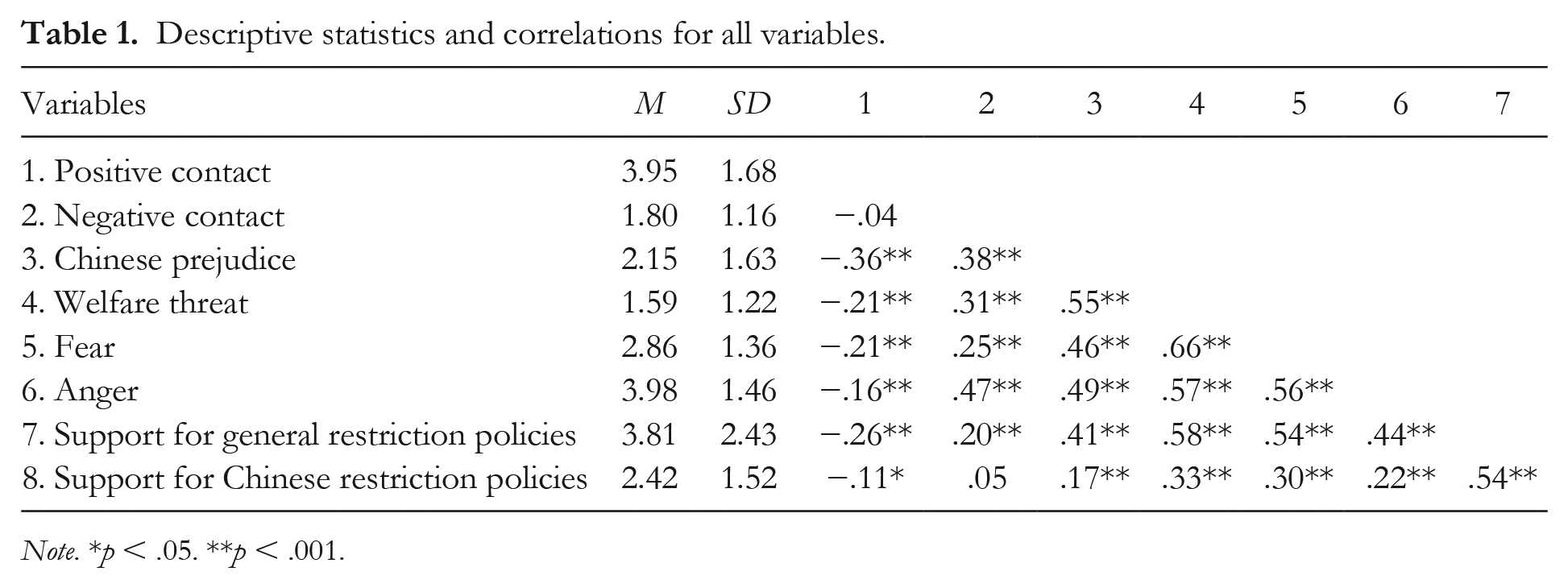
Note. *p < .05. **p < .001.
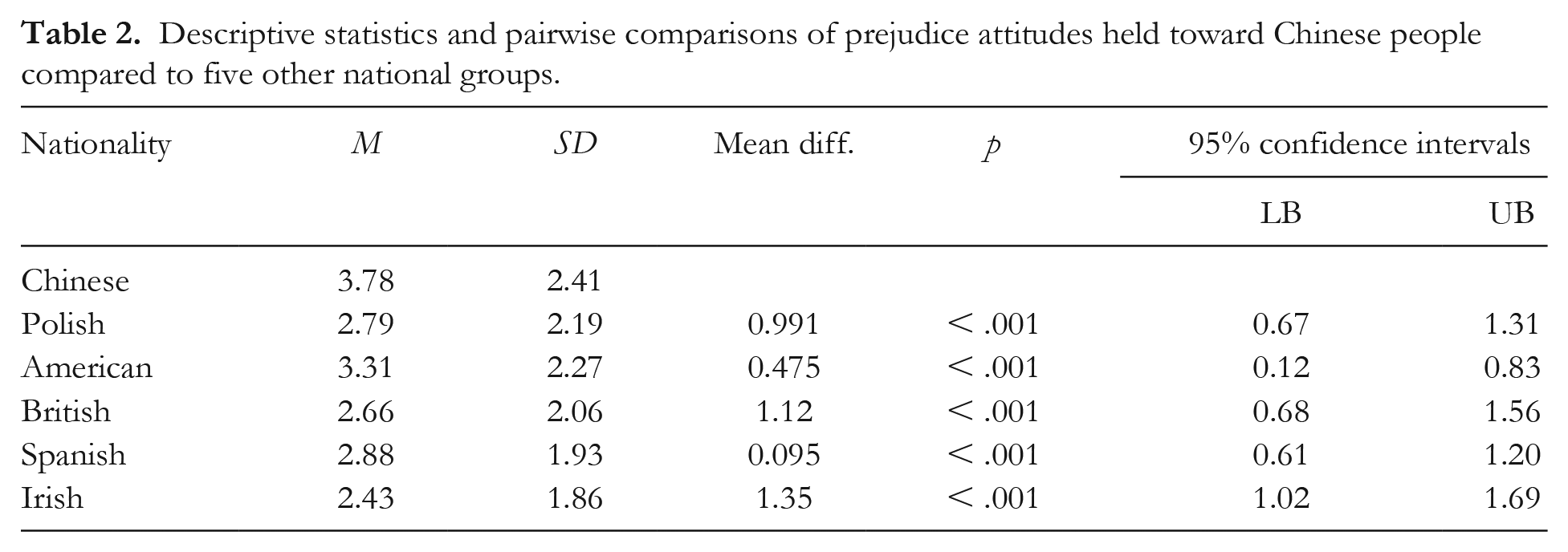
A one-way repeated measures ANOVA revealed a significant difference in prejudice towards the different outgroup targets as measured with attitude thermometers, F(3.92, 1319.09) = 33.73, p < .001, partial η2 = .09. Using post hoc pairwise comparisons, we compared prejudice towards Chinese people to each of the five other national groups with Bonferroni adjustments for multiple comparisons (see Table 2). Results revealed that prejudice was significantly higher towards Chinese people than towards any other group at the time the study was conducted.
Descriptive statistics and pairwise comparisons of prejudice attitudes held toward Chinese people compared to five other national groups.
To test the affect-matching hypothesis, regression analyses were conducted to compare the strength of positive and negative contact effects on fear and anger. Results showed that positive and negative contact were both significant independent predictors of fear and anger towards Chinese people (see Table 3). A comparison of absolute standardized regression coefficients using the equation z = b1 − b2 / SE(b1 − b2) as per Barlow et al. (2019), showed that negative contact was a significantly stronger predictor of increased anger than positive contact was of reduced anger, z = 5.04, p < .001. The difference in strength between the negative and positive contact associations with fear did not reach statistical significance, z = .582, p = .560. Partial support for the affect-matching hypothesis was therefore obtained.
Regression models testing the affect-matching hypothesis by examining the association between positive and negative intergroup contact with Chinese people and fear and anger towards this group.
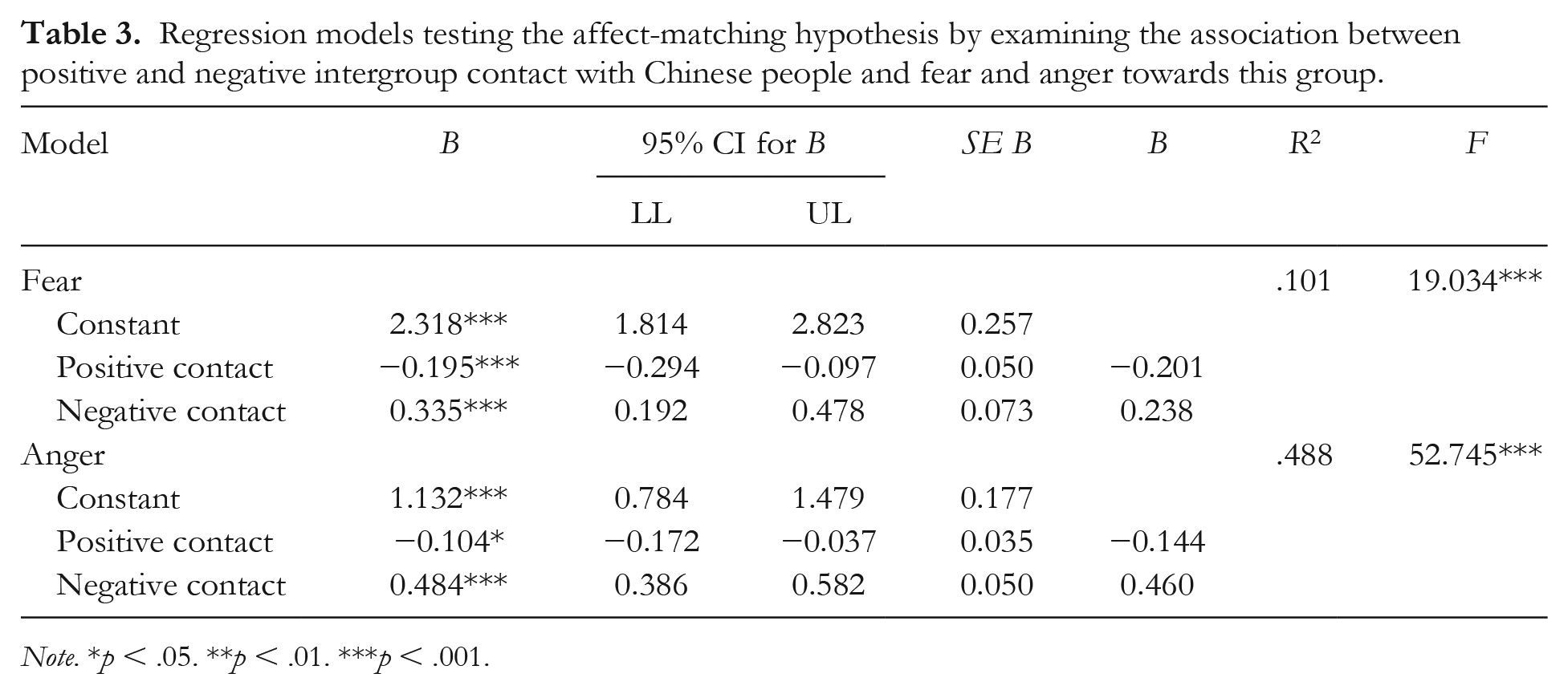
Note. *p < .05. **p < .01. ***p < .001.
We tested our threat-matching mediational model using SEM analysis with latent variables. The analysis was conducted using the lavaan package (Rosseel, 2012) within R (R Core Team, 2018). The latent factor of support for Chinese restriction polices was indicated by five items, and support for general restriction policies was indicated by four items. Positive and negative contact and anger and fear were included as manifest indicators. Anger and fear were not normally distributed, thus robust maximum likelihood estimation was deployed. The measurement model (reported in the supplemental material) showed an acceptable fit to the data: robust χ²(26) = 91.52, p < .001, χ²/df ratio = 3.52, robust RMSEA = .08, 90% CI [0.05, 0.08], SRMR = .05, robust CFI = .94. In the full structural model, we specified a parallel mediation model in which positive contact (X1) and negative contact (X2) predicted perceptions of fear (M1) and anger (M2), with support for Chinese restriction policies (Y1) and general restriction polices (Y2) as the outcome variables. The direct paths from positive and negative contact to policy support were also included. Fear and anger were allowed to correlate, as was support for Chinese restriction polices and support for general restriction policies.
Figure 1 reports the results of this model, which resulted in a good model fit: robust χ²(54) = 134.90, p < .001, χ²/df ratio = 2.50, robust RMSEA = .06, 90% CI [0.52, 0.08], SRMR = .05, robust CFI = .94, N = 340. Tests of the indirect effects indicated that both positive and negative contact have a significant indirect effect on support for Chinese restriction policies via fear (positive contact: b = −0.094, 90% CI [−0.124, −0.033]; negative contact: b = 0.111, 90% CI [0.064, 0.206]). The indirect effect of contact on support for Chinese restriction policies via anger was also significant, though smaller in magnitude (positive contact: b = −0.030, 90% CI [−0.018, −0.001]; negative contact: b = 0.096, 90% CI [0.007, 0.080]). The direct effect of negative contact on Chinese restriction policies was nonsignificant when the indirect paths were included. However, the direct effects of positive contact on Chinese restriction policies remained significant when the emotion variables were introduced to the model. The direct effects of positive (b = −0.058, 90% CI [−0.057, 0.021]) and negative contact (b = −0.004, 90% CI [−0.113, 0.123]) on support for general restriction policies were nonsignificant, demonstrating that intergroup processes are only relevant to predicting support for discriminatory Chinese restriction policies, and not for measures to contain the spread of the virus generally.
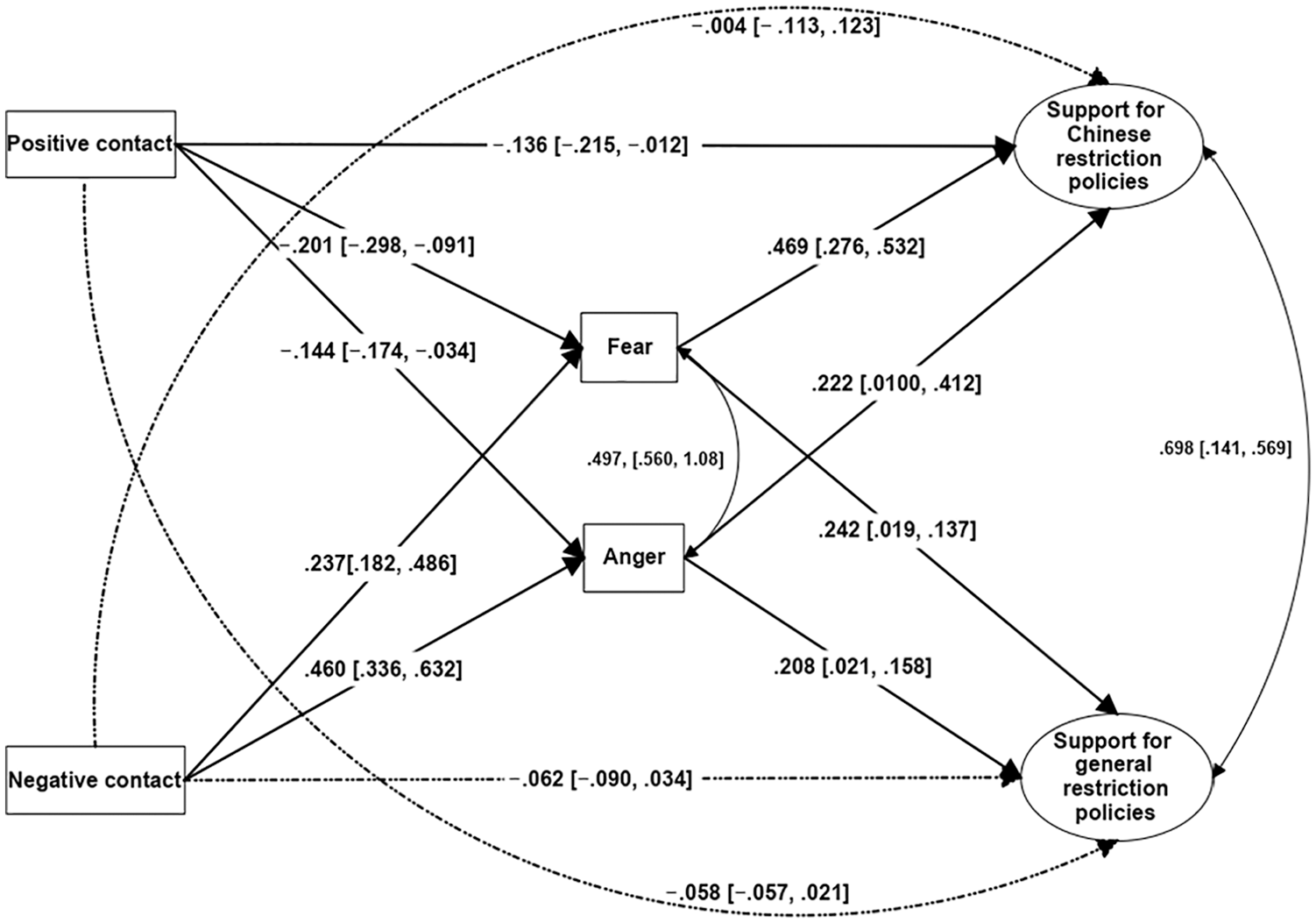
Empirical fit of structural equation model of the associations between contact, emotion, and support for Chinese restriction policies and support for general restriction policies.
We formally tested the null hypothesis that the indirect effects of intergroup contact on support for Chinese restriction policies via fear and anger are equal to each other, by specifying contrasts in lavaan to compare the indirect effects. The results revealed that the indirect effect of positive contact on support for Chinese restriction polices via fear was significantly stronger than the indirect effect of positive contact via anger (b = −0.064, 90% CI [−0.114, −0.025]). The indirect effect of negative contact on support for Chinese restriction polices via fear was also significantly stronger than the indirect effect of negative contact via anger (b = 0.016, 90% CI [0.011, 0.171]). In other words, while both fear and anger significantly mediate the relationship between different types of intergroup contact and support for discriminatory policies to restrict Chinese people in the context of a salient welfare threat, fear is the stronger emotional process underlying these effects.
General Discussion
The present research investigated how past experience of intergroup contact with Chinese people predicted discrete intergroup emotions in the context of the COVID-19 crisis; and how these, in turn, predicted support for anti-Chinese restrictions. While positive contact was associated with lower support for discriminatory Chinese restrictions, negative contact was associated with increased policy support. In line with our threat-matching hypothesis, these effects were more strongly driven by fear than by anger. The present findings illustrate how a novel integration of intergroup contact theory with intergroup emotion approaches can provide a more nuanced understanding of how specific threats and emotions drive intergroup contact effects.
The sociofunctional threat tradition has generally assumed that threats posed by groups are relatively stable, group-level perceptions. The intergroup emotions literature, which is built upon cognitive appraisal theories of emotion, however, has long assumed that specific manifestations of prejudicial emotions are context-dependent (Mackie & Smith, 2018; Scherer, 2009; Smith & Mackie, 2008), and experimental studies have shown that priming different threats elicited by the same outgroup can produce distinct emotional and behavioural responses (e.g., Kamans et al., 2011). The present findings recognize that threat appraisals can be contextual and responsive to events, such as geopolitical events, acts of violence, or a pandemic, which can change which intergroup threats are most salient or relevant in a situation. Importantly, we may not necessarily expect the results we observe here—where anti-Chinese discrimination is driven primarily by fear—to generalize beyond the moment in time and cultural context in which they were found. It is very possible that the salience of the welfare threat posed by Chinese people waned as the virus became severe in other parts of Europe. Indeed, when the financial consequences of COVID-19 become more salient than the health threat, a similar study could focus on Chinese people as a source of economic threat, where we would expect anger to play a more dominant role in driving contact effects and predicting retaliatory behaviours.
Our research comprises a cross-sectional survey, and this naturally limits any capacity to make causal claims. Our threat-matching hypothesis concerns the emotional processes driving contact effects, and while an indirect effect is statistical evidence consistent with causation, it is insufficient to establish it. It should also be noted that the size of the associations between our emotion variables and policy support outcomes is larger than the association between intergroup contact and these outcomes. This is perhaps not surprising given the novel nature of these outcome variables for contact research. Importantly, this study moved beyond the prejudice-as-general-attitude approach and showed that intergroup contact plays an important role predicting functionally distinct emotional and behavioural responses to salient threats.
Future tests of our threat-matching hypothesis should also seek to incorporate multiple outgroups with different threat–emotion profiles. The reliability of the contact–prejudice association means that researchers largely overlook the unique characteristics that define group membership when selecting outgroups for research. However, this generalized approach ignores the fact that individuals may react differently in terms of both affect and behaviour towards different outgroups and in different intergroup contexts. The implication of our findings is that the processes and outcomes of intergroup contact may vary as a function of the target outgroup and the threat context. Simultaneously assessing contact with multiple groups and measuring discrete threats, emotions, and behaviours will be critical to building insight into the complexity of intergroup contact effects.
We also found partial support for the affect-matching hypothesis (Barlow et al., 2019), with negative contact being more strongly related to increased anger than positive contact was of reduced anger. The association between negative contact and fear was also trending larger than the association between positive contact and fear, but the difference did not reach statistical significance. Such results further reinforce the importance of examining discrete intergroup emotions, suggesting that the consequences of intergroup contact may depend both on the type of contact (affect-matching) and the specific threat posed by the outgroup (threat-matching).
Our study focused on a brief moment in the COVID-19 timeline. The epidemiological situation is constantly changing, and worldwide people are adopting avoidance and social distancing measures as “a new normal” to fight the spread of the virus. All of the general restriction policies in the current study received low support from our participants in February, only to be enacted 3 weeks later by the UK government. Avoidance of others has been seen as virtuous since this time. Necessarily, this means a reduction in social contact not just with Chinese people but with other outgroups, as well as ingroups. Future work will need to explore how intergroup contact is rebuilt as threat recedes. It remains to be seen whether long-term recovery from this pandemic will promote a spirit of global cooperation or one of suspicion, threat, and xenophobia. Past contact experiences are likely to predict which path an individual chooses.
Conclusion
In summary, our results suggest that by investigating the structural relationship between positive and negative contact, specific intergroup emotions, and threats, we are ultimately able to identify the fine-grained mechanism(s) responsible for contact effects, thus simultaneously achieving a differentiated and an integrated view of the process and of the outcome of intergroup contact. The focus on intergroup emotions and behavioural tendencies is a welcome complement to studies predicting attitudes from contact, and should remain fruitful even in a future without a global emergency.
Supplemental Material
Figure_4_Structural_Model_Supplementary – Supplemental material for Can past intergroup contact shape support for policies in a pandemic? Processes predicting endorsement of discriminatory Chinese restrictions during the COVID-19 crisis
Supplemental material, Figure_4_Structural_Model_Supplementary for Can past intergroup contact shape support for policies in a pandemic? Processes predicting endorsement of discriminatory Chinese restrictions during the COVID-19 crisis by Lisa Alston, Rose Meleady and Charles R. Seger in Group Processes & Intergroup Relations
Supplemental Material
supplementary_material – Supplemental material for Can past intergroup contact shape support for policies in a pandemic? Processes predicting endorsement of discriminatory Chinese restrictions during the COVID-19 crisis
Supplemental material, supplementary_material for Can past intergroup contact shape support for policies in a pandemic? Processes predicting endorsement of discriminatory Chinese restrictions during the COVID-19 crisis by Lisa Alston, Rose Meleady and Charles R. Seger in Group Processes & Intergroup Relations
Footnotes

References
Supplementary Material
Please find the following supplemental material available below.
For Open Access articles published under a Creative Commons License, all supplemental material carries the same license as the article it is associated with.
For non-Open Access articles published, all supplemental material carries a non-exclusive license, and permission requests for re-use of supplemental material or any part of supplemental material shall be sent directly to the copyright owner as specified in the copyright notice associated with the article.
