




Abstract
Due to their response at the COVID-19 frontline, migrant essential workers became moral exemplars likely to boost emotions such as gratitude or admiration. We examined the effect of moral exemplars on outgroup attitudes, beliefs about the outgroup, intentions and behavior toward the outgroup, as well as the role of self-transcendent emotions in this link. Participants of an online panel-based experimental study (N = 651) were randomly assigned to either watch a video clip with a story about migrant essential workers during the COVID-19 pandemic (i.e., the moral exemplars condition) or to watch a neutral video involving migrants (i.e., the control condition), and were invited to fill in a questionnaire and donate money to an association fighting for immigrants’ rights. Compared to the control condition, participants in the moral exemplars condition manifested more positive outgroup attitudes, beliefs about the outgroup, and were more willing to help the outgroup, also via self-transcendent emotions. The exposure to the moral exemplars narrative was linked with more helping behavior (a donation to an NGO) only indirectly via self-transcendent emotions. Moral exemplars proved useful in promoting positive attitudes and prosociality toward immigrants.
Keywords
The COVID-19 pandemic has brought negative consequences worldwide (e.g., Greene et al., 2021), including increased prejudice towards some cultural groups, blamed for the dissemination of the disease (e.g., Reny & Barreto, 2022), including immigrants (e.g., Esses & Hamilton, 2021). However, the pandemic cuts both ways. According to the contact hypothesis, pursuing common goals is a critical element for prejudice reduction (Allport, 1954); certainly, the COVID-19 pandemic can be considered a common enemy to fight against, and these joint efforts may give room for building bridges across cultural groups. In this context, essential workers (i.e., those whose jobs were deemed necessary)—who belong to different cultural origins—have shown an exemplary response in the COVID-19 frontline, carrying out crucial tasks to keep all citizens safe and fed during the pandemic (Fasani & Mazza, 2020a). Essential workers may thus be considered invisible heroes: everyday heroes that are first responders in emergencies, but remain unnoticed (Kinsella et al., 2017), and the COVID-19 pandemic is a clear example of this (Sumner & Kinsella, 2021).
Migrant individuals made up an important part of these essential workers (Fasani & Mazza, 2020b; Gelatt, 2020; Gencianos, 2021), being 13% of the total of essential workers in the EU (Fasani & Mazza, 2020b). Counter-stereotypical narratives about migrant essential workers can help to improve interethnic relations between host nationals and migrants. We propose that essential workers can be perceived as moral exemplars, which have been argued to enhance positive intergroup relations in the context of conflict and post-conflict societies (Čehajić-Clancy & Bilewicz, 2020, 2021). However, research on the role of outgroup moral exemplars has not tested their effects beyond fomenting intergroup reconciliation and harmony (i.e., intergroup forgiveness, positive feelings towards the outgroup, or contact intentions). And, recent research suggests that contact-based interventions may shape outgroup attitudes differently compared to intergroup relations construals (Burrows et al., 2022). In this study, we thus examine the influence of moral exemplars narratives on a range ot outcomes: a) outgroup attitudes (including positive and negative feelings towards the outgroup, as well as social acceptance of the outgroup), b) perceptions of the outgroup beyond inducing higher perceptions of outgroup morality (i.e., beliefs about outgroup contribution to the local culture and economy), and c) behavioral intentions (i.e., helping intentions) and behavior towards the outgroup (i.e., real donations to an NGO helping immigrants), beyond contact intentions.
We additionally test the role of the experience of discrete, self-transcendent emotions (i.e., admiration, gratitude, feeling moved, and hope) in response to moral exemplars stories as an explanatory mechanism of their intergroup effects. We therefore further expand the moral exemplars framework that introduces generalized positive outgroup emotions as an underlying mechanism of the effects that instances of moral behavior have on behavioral intentions (Čehajić-Clancy & Bilewicz, 2020, 2021). Specifically, we propose that the experience of self-transcendent emotions when being exposed to stories of outgroup moral behavior may further predict generalized outgroup attitudes, beliefs about the outgroup, as well as outgroup-oriented behavioral intentions and behavior.
Moral Exemplars Framework
According to the moral exemplars framework, the exposure to examples of outgroup moral behavior is a powerful tool to improve intergroup relations (Čehajić-Clancy & Bilewicz, 2020, 2021) because morality is the primary dimension on which outgroups are evaluated (Brambilla et al., 2013). We argue that the effects of exposure to instances of a moral act, even by a single outgroup member, could generalize over intergroup relations to the extent that the outgroup member’s group membership is made salient, in line with the idea of salient categorization strategy (Hewstone & Brown, 1986). Confirming this idea, previous research suggests that these effects can be achieved both by exposure to stories about moral acts by an entire outgroup and by a single outgroup member (e.g., Witkowska et al., 2019), and that the effects of moral exemplars are stronger when such moral behavior is perceived as more typical (Beneda et al., 2018).
However, the exposure to outgroup moral exemplars also implies a process of decategorization (Brewer & Miller, 1984) because it shifts the attention from the group membership to personal characteristics disconfirming negative beliefs or stereotypes concerning the outgroup. This idea aligns with the literature suggesting that stereotype-incongruent information is a powerful tool to reduce prejudice (e.g., Blair et al., 2001; Crisp & Nicel, 2004; Dasgupta & Greenwald, 2001; Rudman et al., 2001), especially when this information is provided by a more typical outgroup member (e.g., Brown & Hewstone, 2005; Johnston & Hewstone, 1992). More recently, scholars have proposed a sequential social categorization process in which categorization should precede decategorization for contact to be effective (e.g., Vezzali et al., 2022). We believe that the moral exemplars framework could work in a similar way, with group membership initially being made salient, followed by exposure to instances of atypical, stereotype-inconsistent, and morally admirable outgroup behavior, which leads to decategorization.
Finally, although previous research has indicated that negative experiences with outgroup members might have stronger effects on outgroup attitudes than positive experiences (Barlow et al., 2012; Paolini et al., 2010; Schmid et al., 2008), there is also convincing empirical evidence showing that interpersonal positive attitudes do generalize to positive outgroup attitudes, and these effects are not weaker compared to similar effects in the case of negative attitudes (Stark et al., 2013). Positive emotions, including empathy, but also similar other-oriented emotions, aroused by optimal contact may play a pivotal role in intergroup contact effects.
Moral exemplars and outgroup attitudes
Empirical evidence confirms that exposure to narratives about outgroup moral exemplars, such as outgroup heroic helpers, is an effective strategy to promote reconciliation in post-war situations (Bilewicz & Jaworska, 2013; Čehajić-Clancy & Bilewicz, 2017; Witkowska et al., 2019). More specifically, research has found that individuals exposed to stories about outgroup helping express more positive outgroup feelings, trust, and social acceptance (Witkowska et al., 2019), as well as more intergroup forgiveness and a belief in reconciliation (Beneda et al., 2018; Čehajić-Clancy & Bilewicz, 2017). However, to the best of our knowledge, most of these studies relied on instances of moral behavior by an outgroup as a whole, with only one out of numerous studies using an example of a single outgroup member (Study 2, Witkowska et al., 2019). In addition, we aim to replicate these findings beyond the context of groups affected by past violent conflict, involving examples of heroic help in a relatively distant past. We therefore examine the impact of exposure to instances of moral acts by immigrants during the COVID-19 pandemic. In a pandemic context where hazard and uncertainty have been commonly lived, positive intergroup feelings, including warmth and empathy, would more easily arise towards those outgroup members considered COVID-19 heroes.
Moral exemplars and beliefs about the outgroup
Highlighting outgroup members’ moral value may be instrumental not only in shaping outgroup attitudes but also cognitive judgments about the outgroup. The moral exemplars framework suggests that the instances of moral behaviors can serve to change outgroup perceptions, including judgments about outgroup morality (Čehajić-Clancy & Bilewicz, 2020, 2021). Yet, research has not tested the effects of exposure to outgroup moral exemplars on shaping other dimensions of cognitive judgments about the outgroup. The exposure to migrants’ exemplary behavior may be particularly useful in promoting awareness that immigration is enriching local culture (i.e., identity indispensability) and contributing to a country’s growth (i.e., functional indispensability; Guerra et al., 2016; Mepham & Verkuyten, 2017). The pandemic has provided opportunities to show that many immigrants have joined forces with native inhabitants to fight the global crisis. Special entry permits have been granted by governments to migrants in various countries to compensate for scarce human resources (European Migration Network & Organisation for Economic Cooperation and Development, 2020), implying their contribution to economic and welfare stability. Citizens might have been aware of such contributions.
Moral exemplars and intentions and behavior towards the outgroup
Even less is known about the role of outgroup moral exemplars in promoting prosocial behavioral reactions towards the outgroup. A step forward in intergroup relations implies moving from a less agentic (i.e., positive or warmer attitudes and beliefs) to a more proactive stance towards outgroups (i.e., prosocial intentions and behavior). Psychologists have long argued that moral exemplars and heroes can inspire reciprocal admirable behaviors from others (Engelen et al., 2018; Kafashan et al., 2017). Research confirms that moral exemplars might be relevant in establishing a social norm for behaving prosocially, especially when the examples of moral behavior are attainable and relatable (Han et al., 2017, 2022; Osswald et al., 2010; Thomson & Siegel, 2013). However, the help-eliciting function of moral exemplarity has not been tested in an intergroup setting. While it is more difficult to feel empathy and thus display prosocial attitudes and behavior towards outgroups (e.g., Cikara et al., 2011), interventions that enhance empathy have proven effective in promoting helping behavior (e.g., Batson & Ahmad, 2009; Capozza et al., 2013; Vezzali et al, 2017), including donation intentions towards immigrants (e.g., Bobowik et al., 2023; Malhotra & Liyanage, 2005). Further, contact literature has provided strong evidence that the exposure to positive experiences with less privileged outgroup members is associated with stronger collective action intentions on behalf of the outgroup (Hässler et al., 2020). In this regard, instances of outgroup moral behavior may serve to promote helping intentions and actual help offered to an outgroup. The present study thus investigates how the exposure to stories about migrant essential workers as outgroup moral exemplars may enhance such responses.
The Role of Self-Transcendent Emotions
In our study, we also delve into the role of self-transcendent emotions as an explanatory mechanism in the effects of outgroup moral exemplars on outgroup attitudes, beliefs, and behaviors. Apart from taking care of us, heroes inspire us by being exemplary moral models (Flescher, 2003; Kinsella et al., 2015), and likely elicit self-transcendent emotions, such as gratitude, moral elevation or admiration, as well as feeling moved, or even hope (Algoe & Haidt, 2009). For instance, gratitude has been described as an emotion that functions as a moral barometer that is activated in response to the perception that one has been the beneficiary of another person’s moral actions (McCullough et al., 2001, 2008). Moral elevation, and the related emotion of admiration, is also a discrete emotion stimulated by good or admirable deeds of others (Haidt, 2003). But, beyond gratitude and admiration felt as a direct response to moral acts by others, people exposed to instances of moral, virtuous acts can also experience other self-transcendent emotions, not necessarily oriented at moral exemplars, but at the situation and its implications of the observed moral act more broadly. Emotions literature suggests that in response to intense moral acts people can experience feeling moved or touched (Seibt et al., 2017). Instances of moral behavior can also instill feelings of hope, since others’ prosocial, virtuous acts can make people believe that the world can change for the better (Cohen-Chen et al., 2015, 2017).
Further, the experience of self-transcendent emotions may be useful in reducing prejudice and promoting prosocial behavior towards outgroups (e.g., Van de Vyver & Abrams, 2017), including immigrants (e.g., Bobowik et al., 2023). Self-transcendent emotions, unlike other positive emotions, have the particularity of allowing attention shifting from the self towards the world and to connect with others’ needs and worries (Stellar et al., 2017). Specifically, a bulk of literature in this field has shown that feeling gratitude is a mechanism that boosts prosociality (Dickens, 2017; Ma et al., 2017). More recently, studies conducted during the pandemic have shown the association between feeling gratitude and prosocial intentions (e.g., Oliveira et al., 2021). The link between admiration or moral elevation and lower prejudice or more prosocial intergroup behavior has also been suggested (e.g., Oliver et al., 2015; for a review, see Thomson & Siegel, 2017). Feeling moved (Fiske et al., 2016) and hope (Greenaway et al., 2016; Halperin & Gross, 2011) have also been linked to positive intergroup relations, including providing help or support for social change. However, experimental studies portraying moral exemplars that elicit these emotions with control groups and that provide unequivocal results on the effect of self-transcendent emotions on prosociality—including behavioral intention and actual behavior (donation)—are non-existent.
The Present Study
The present study seeks to fill a gap in the intergroup relations literature by applying the moral exemplars framework (Čehajić-Clancy & Bilewicz, 2020) to examine if audiovisual narratives about immigrant essential workers during the COVID-19 pandemic serve to enhance positive outgroup attitudes, beliefs, and behavioral responses, also indirectly, by inducing self-transcendent emotions towards outgroup moral exemplars. For this purpose, we designed an experimental study, involving a robust online community sample, using both subjective and objective measures of intergroup relations, and relying on an existing awareness-raising campaign implemented in one of the regions in Spain consisting of several videos depicting the experiences of immigrant essential workers, with professions ranging from a hospital doctor to a street-sweeper. We aimed at evaluating the effect of watching videos of migrants considered to be moral exemplars due to their work activity during the COVID-19 lockdown on outgroup attitudes (i.e., warmth and empathy, and positive and negative feelings towards immigrants, as well as acceptance of immigrants to one’s country), beliefs about outgroup (i.e., identity and functional indispensability of immigration), and behavioral responses (prosocial intentions towards immigrants and prosocial behavior, measured as a donation to an NGO helping immigrants). We proposed the following set of specific hypotheses.
We expected that participants exposed to videos of migrant moral exemplars during the COVID-19 lockdown would report higher levels of self-transcendent emotions as compared to those presented videos in the control (neutral) condition (H1). Additionally, we predicted that the videos portraying migrants’ moral exemplars would elicit warmer and more positive attitudes towards (H2), less negative attitudes towards (H3) and higher acceptance of immigrants (H4) than videos in the control condition. We also expected that participants would hold beliefs of higher contribution of immigrants to the society (H5) in the moral exemplars vs. control condition. We hypothesized that participants would show higher prosocial intentions and engage in more prosocial behavior (donation) towards immigrants when exposed to moral exemplars (vs. control) condition (H6). Finally, we anticipated that self-transcendent emotions would mediate the effect of exposure to narratives of moral exemplars on attitudes, beliefs, as well as intentions and behavior towards the outgroup (H7).
Experimental Stimuli Validation Study
Before conducting the main study, we first validated the experimental material to be used to manipulate the exemplary behavior of immigrants. To create the experimental stimuli, we relied on audiovisual materials from a sensitization campaign titled “Essential workers,” developed by the regional Department of Migration Affairs and Justice of Navarre Government, which illustrates experiences and the contribution of migrant essential workers during the COVID-19 lockdown. The campaign included eight different videos of people of different genders, origins, and professions. 1 The logo of the regional government was removed from all the videos. All videos can be found on the Open Science Framework (OSF) project: https://osf.io/58d4b/.
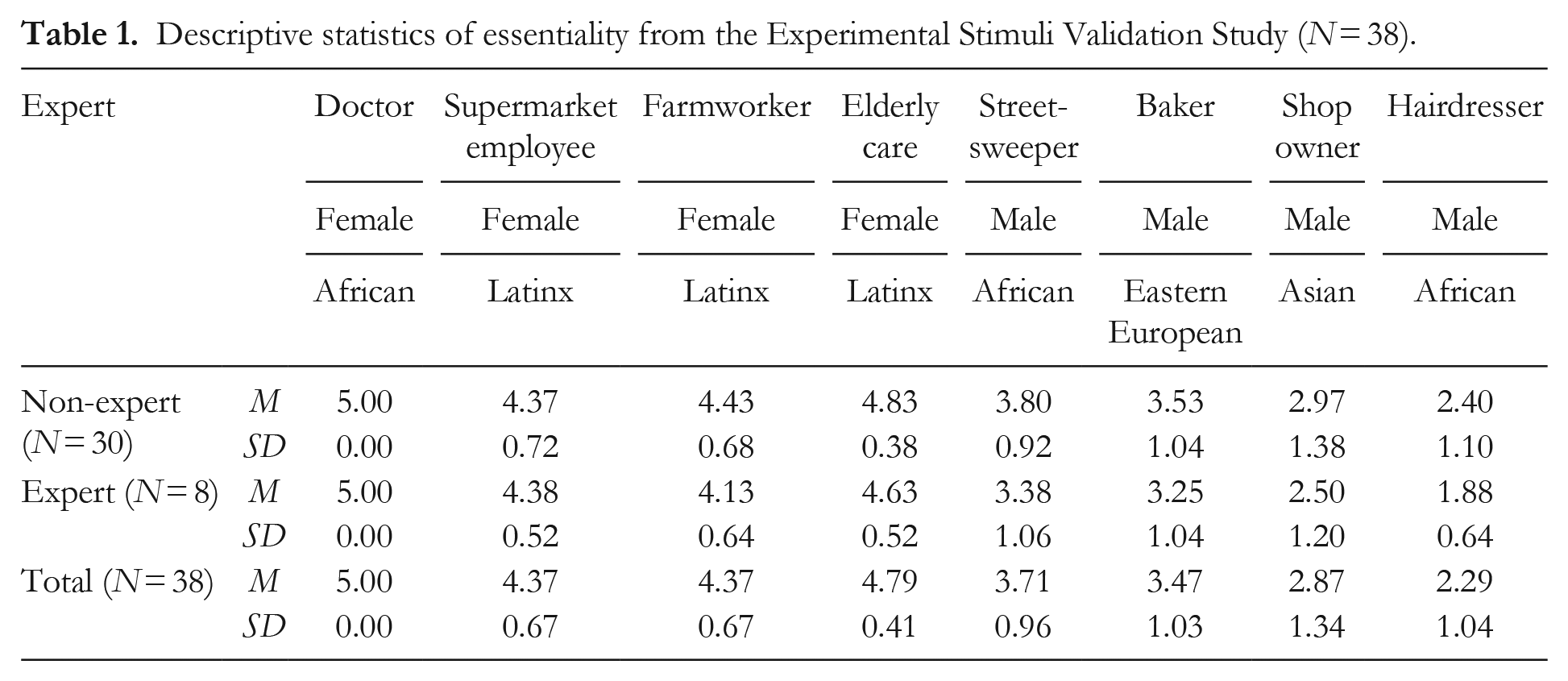
We relied on an expert panel and a pilot study conducted among non-experts to validate the experimental stimuli and thus to confirm that the characters of frontline workers in the campaign could be considered essential workers during the pandemic. An expert panel was made of eight researchers and experts in migration emotions and the pilot study was based on reports of 30 non-expert individuals, who all evaluated each video in terms of the characters’ professional role essentiality on a scale from 1 (not at all essential) to 5 (extremely essential). As a consequence of all evaluations, both experts and non-experts agreed in viewing all characters from the campaign as essential frontline workers with means ranging from M = 3.47 (SD = 1.03) for the baker character to M = 5.00 (SD = 0.00) for the emergency doctor, except for two characters, who were assessed as not essential (i.e., with mean scores below the theoretical midpoint, M = 2.29, SD = 1.04, for the hairdresser/shaver, and M = 2.87, SD = 1.34, for the shop owner). The paired-samples t-test showed that the difference in essentiality evaluations of the baker, the character with relatively lowest evaluations of role essentiality among those considered essential, and the shop owner, t(37) = 3.12, p = .004, d = 1.17, 95% CI [0.76, 1.58], and the hairdresser, t(37) = 7.23, p < .001, d = 0.50, 95% CI [0.16, 0.84], were statistically significant. We therefore classified the six videos with essential characters into the moral exemplars condition, whereas we dropped the two remaining characters (the hairdresser and the shop owner) from the main analyses.
In the Supplemental Online Material (SOM), we also present means and standard deviations for all 10 videos (eight experimental videos and two control ones) and all measures included in the study (see Supplemental Table A1). The analyses comparing the essential characters (i.e., moral exemplars) also versus non-essential characters are shown in Supplemental Tables C1, C2, and C3.
The Main Study
In the main study, we tested our hypothesis that the exposure to narratives about exemplary migrant workers would lead to more positive responses (attitudes, beliefs, behavioral intentions, and behavior) towards immigrants, also indirectly via self-transcendent emotions. For this purpose, participants were exposed to one of the eight videos in total, including the six, previously validated, videos of the essential migrant workers (four females and two males), and the two neutral videos, created for the purpose of the study (with either a male or female immigrant). This experimental set-up allowed us to test the effect of exposure to the moral exemplars condition (vs. the control condition), while considering the effects of the target’s gender. We controlled the analyses, for participants’ age, gender, income, educational level, and political orientation.
Method
Participants
To estimate the required sample size, we relied on existing research using audiovisual material to manipulate the presence of morally elevating acts (Shulman et al., 2021), in which the averaged effect of morally elevating examples on support for humanitarian policies across three studies was d = 0.28. When estimating the sample size, we considered the comparisons between all the videos included in the “Essentials” campaign, since the purpose of this data collection was to provide an assessment of the effectiveness of the complete campaign material. We therefore conducted a power analysis using G*Power 3.1 (Faul et al., 2009), and found that obtaining this effect size (equivalent to Cohen’s f = .14) in an analysis of variance with 10 groups (eight videos from the “Essentials” campaign and the two control conditions), with an alpha of .05 and power of .80, would require 810 participants in total. We stopped the data collections once we reached this number, that is, once we recruited min 80 participants per each group (thus 814 in total). The sensitivity analysis showed that this sample size would allow us to detect main effects and a significant interaction as small as f = .12, equivalent to d = 0.24, in a 2 (moral exemplars vs. control condition) × 2 (female vs. male target) analysis of covariance with 5 covariates, with an alpha of .05 and power of .95.
After dropping the two conditions that were not proven to be valid for our experimental manipulation in the stimuli validation study (n = 162), the valid sample used in the main analyses was composed of 651 native-born participants between the ages of 19 and 81 years (M = 44.38 and SD = 12.31), living in the same province of Spain as the migrant characters of the video. Of the remaining participants, 62.7% were women, 37.2% were men, and there was one person with a non-binary gender identity. Our sample was diverse both in terms of employment status (67.6% were working) and with regard to educational level (36.7% had a university degree or higher). Regarding the exposure to the “Essentials” campaign, 5.2% had previously watched the video in social media.
Procedure
Participants were recruited by a specialized data collection company, Netquest. Panelists received invitations to participate in an online study between May 3 and 13, 2021. The company targeted adult, native-born panelists in Navarre (region of Spain). In total, 976 panelists accessed the survey link. Among them, 184 participants were not considered for the study: 94 did not complete the survey, 65 were not born in Spain, one was not resident of Navarre, four were not able to reproduce video, 13 failed the reCAPTCHA test or had fraudulent ID, four failed an attention check, and three due to other reasons.
Participants were invited to participate in a study titled “Intercultural emotions and attitudes” that examines the relationship between the processing of audiovisual information, emotions, and opinions on different social issues, and were told that participation consisted of watching a short video (lasting less than 1 min) and filling out a questionnaire. All participants were informed about the anonymity and confidential nature of their participation and were asked to give their informed consent. After experimental manipulation, all participants filled out the same questionnaire, in which we measured observers’ self-reported emotions (e.g., self-transcendent emotions), as well as attitudes, intentions, and behavior towards immigrants, among other measures. The study was approved by the Research Ethics Committee of the university to which the first author belongs.
Experimental Materials and Design
We used a between-participant experimental design, in which we manipulated the exposure to a narrative about immigrants’ moral behavior and measured observers’ emotions and perceptions of the target, outgroup attitudes, beliefs about the outgroup, as well as intentions and behavior towards the outgroup. Participants were randomly assigned to watch one of the ten different video clips (duration c. 30 s) and asked to fill out an online questionnaire. The video clips were inserted on the survey platform, hosted by the recruitment company, in a way to prevent participants from skipping or forwarding them. Eight of the videos corresponded to the experimental condition (i.e., moral exemplars condition). These videos were extracted from an existing campaign of the regional Department of Migration Affairs and Justice that illustrates experiences of migrant workers during the COVID19 lockdown in Navarre. In each of these videos, the migrant character is first shown taking off their medical face mask and introducing themselves (“My name is___ and I come from ___. Now, I live in ___, Navarre”). Subsequently, the character is shown performing their professional activity during the COVID-19 pandemic while describing these experiences in the first person. As explained in the Experimental Stimuli Validation Study section, two videos were not considered to represent essential work and thus were dropped from the main analyses. The remaining six videos included four female characters and two male characters, most of Latin American origin (three Latinx, two African, and one Eastern European), and each of them of different professions, as described in detail in the Experimental Stimuli Validation Study section. For the control condition, we created two videos for the purpose of this study. To ensure the comparability of the stimuli used across conditions, we tried to maximize the matching between the stories presented in the experimental condition relying on existing material from a social campaign and the control condition. First, to account for the target’s gender effects in our design, we generated one video with a female and another video with a male migrant. Second, given that the experimental stimuli included videos of migrants with mostly Latin American origin (Bolivia, Guatemala, and Ecuador), migrants shown in control videos were presented as coming from a Latin American country (specifically, Colombia, as an ethnic category that has a relatively neutral social status in Spain). Third, the control videos had the same length and followed a similar sequence as the experimental videos. That is, the migrant character is first shown taking off their medical face mask and introducing themselves (“My name is___ and I come from ___. Now, I live in Navarre”). Subsequently, the character is shown performing an everyday activity while explaining it in first person. Specifically, the character in the video clip is taking out groceries from a bag, describing them, and then continues to prepare a cold sandwich in their kitchen. We chose this activity as a neutral, everyday activity that would not activate positive or negative emotional reactions.
Measures
Complete measures used in this study, in English and Spanish, can be found on the OSF project website: https://osf.io/58d4b/. For exploratory purposes, we also measured other types of emotions, identification with the target, and autonomy-oriented helping intentions (see Supplemental Table D1 in the SOM for findings with these measures). The reliabilities of all scales are presented in Table 2.
Manipulation checks: Perception of moral exemplarity and work essentiality
We used two ad hoc created items to evaluate to what extent participants agreed that the character in the video clip can be considered a moral exemplar (“This person is an exemplar for all people of Navarre” and “We should all follow this person’s example”). Three items were also created to assess the perception of the essential nature of the person’s professional role in the video clip (e.g., “To what extent you agree or disagree that the work of the person in the video clip is essential?”). For all these items, a 5-point Likert scale was used (1 = completely disagree, 5 = completely disagree).
Self-transcendent emotions felt toward the character
Participants also indicated on a 5-point Likert scale ranging from 1 (not at all) to 5 (very much) to what extent they had felt self-transcendent emotions of admiration, gratitude, feeling moved, and hope towards the character, while watching the video clip. The emotion of admiration was composed of three items (“admiration,” “inspiration,” and “fascination”). The emotion of gratitude was covered with four items (“gratitude,” “appreciation,” “thankfulness,” and “recognition”). The emotion of feeling moved was measured with three items (“moved,” “bighearted,” and “touched”). Finally, the emotion of hope was made up of three items (“hope,” “optimism,” and “enthusiasm”). A four-factor confirmatory factor analysis performed with AMOS showed the distinctiveness of these four self-transcendent emotions, χ2(59) = 6.131, p < .001, RMSEA = .79, GFI = .934, TLI = 0.966, CFI = .974, AIC = 425.735, as compared to the one-factor model that would include all self-transcendent emotions, χ2(65) = 31.808, p < .001, RMSEA =.195, GFI = .684, TLI = 0.794, CFI = .828, AIC = 2119.526. 2
Descriptive statistics of essentiality from the Experimental Stimuli Validation Study (N = 38).
Outgroup attitudes
Intergroup empathy
In order to assess intergroup empathy towards immigrants, four items referring to immigrants living in the region were adapted from the Interpersonal Reactivity Index (Davis, 1980). Participants were asked to indicate their agreement with each statement (e.g., “I try to better understand immigrants living in my area by imagining how things are seen from their perspective”) on a 5-point Likert scale (1 = completely disagree, 5 = completely disagree).
Warm feelings towards the outgroup
We also assessed warm feelings towards immigrants with the Feelings Thermometer Scale (Nelson, 2008), a measure that was created for the assessment of prejudice, widely used in the past literature. Specifically, participants were asked to indicate their general feelings towards immigrants in the region on a scale ranging from 0 (very cold attitude) to 100 (very warm attitude), with scorable values of 5 in 5 units.
Positive and negative outgroup attitudes
To evaluate positive intergroup attitudes, we adapted a commonly used measure of attitudes towards immigrants developed by Stephan et al. (1999, 2000, 2005). Participants were asked to indicate on a 5-point Likert-type scale (1 = not at all, 5 = very much) to what extent they felt seven positive emotions towards the immigrants living in the region (“admiration,” “liking,” “respect,” “gratitude,” “acceptance,” “affection,” and “appreciation”). Negative intergroup attitudes were measured with five items (“insecurity,” “distrust,” “anger,” “fear,” and “rejection”).
Outgroup acceptance
Participants were asked to indicate on a 5-point scale (1 = completely disagree, 5 = completely agree) to what extent they agreed or disagreed that immigrants should be allowed to enter Navarre in four different situations: “to work in healthcare,” “to work in agriculture,” “to work in elderly care,” and “to be reunited with their family.”
Beliefs about the outgroup
Identity and functional indispensability of the outgroup
To assess the perception of identity and functional indispensability of immigration in the region, we adapted eight items from Guerra et al. (2016) and Mepham and Verkuyten (2017). Participants were asked to indicate on a 5-point Likert scale (1 = completely disagree, 5 = completely agree) their agreement or disagreement with four items measuring identity indispensability (e.g., “The culture of the immigrants is an indispensable element of the cultural identity of Navarre”) and functional indispensability (e.g., “Immigrants are indispensable for the economic and health strength of Navarre”).
Behavioral intentions and behavior towards the outgroup
Helping intentions towards the outgroup
We used seven items to evaluate the intention of prosocial behavior. Participants were asked to indicate on a 5-point Likert scale (1 = very reluctant, 5 = very willing) the extent to which they would be reluctant or willing to engage in several actions with respect to immigrants in the region (e.g., “Collaborate in the work of a non-profit organization that helps immigrant people”).
Help behavior towards the outgroup
To capture prosocial behavior, participants were offered the opportunity to reassign the points they had earned for participation in the study so that they were converted into money to be donated to a local NGO working in favor of immigrant rights and against racism. Participants could first choose one of the two following options: 1) “I don’t want to donate at this moment” or 2) “Yes, I want to donate (please indicate the specific number of points).” If they chose the second option, they were asked to indicate the number of (earned) points they wanted to offer. Due to both reasons of simplicity and response distribution (i.e., the variability of the donation amount was not high), the dichotomous (Y/N) behavioral answer was taken into account in the analyses.
Sociodemographic data
We also collected sociodemographic data such as gender (coded as 0 male and 1 as female), age (in years), educational level (place on an ordinal scale including eight categories: without studies (or incomplete primary education), primary education, compulsory secondary education, post-compulsory secondary education, incomplete university degree, university degree, master’s degree, PhD degree), political orientation (on a scale with the following categories: far left, left, center left, center, center right, right, far right, prefer not to answer; the last category was considered missing data), employment status, income, place of residence, or parents’ migrant background. Participants were also asked to provide information on the level of their global identification, as well as the number of foreign-born friends they had and how often they usually interacted with people from different cultures (1 = never, 5 = almost always).
Analytical Strategy
All analyses were conducted with IBM SPSS Statistics version 28.0. We calculated Pearson’s bivariate correlations between all variables under analyses, as well as means and standard deviations. To test our main predictions as well as the effectiveness of our experimental manipulation, we conducted 2 × 2 (experimental condition: moral exemplars vs. control condition by target’s gender: female vs. male target) analyses of variance (ANOVAs), to control for possible moderating effects of target’s gender. Our main experimental manipulation was coded in such a way that the six videos representing the moral exemplars condition (n = 488; including four females and two males) were compared against the two control videos (n = 163; one female and one male). We controlled the main analyses for participants’ gender, age, educational level, and political orientation, since there is evidence suggesting that these sociodemographic characteristics can be associated with attitudes towards immigrants (for a review, see Ceobanu & Escandell, 2010). The manipulation check ANOVA analyses were carried out without control variables. As a robustness check, we additionally present these analyses without covariates in the SOM. We used logistic regression to test the effects of experimental manipulation on prosocial behavior (i.e., a monetary donation: either having donated points or not) while controlling for the same sociodemographic characteristics.
To test the significance of the indirect effects, we used the SPSS PROCESS macro for bootstrapping indirect effects (Hayes, 2013), with 10,000 bootstrap estimates for percentile confidence intervals. As an independent variable in our model, we introduced the experimental condition (where the control condition was coded as 0 and the moral exemplars condition as 1). We reported partially standardized indirect effects as a measure of effect size. In the case of helping behavior, indirect effects were calculated based on logistic regression. In these analyses, donation was dummy-coded, where 0 represented no donation and 1 donation. All mediation analyses were also controlled for the target’s gender, as well as participants’ gender, age, income, education, and political orientation. The complete mediation analyses with covariates and without covariates are reported in the SOM.
Results
Descriptive Data
Descriptive data, including means, standard deviations, and bivariate correlations among all main variables in the study are shown in Table 2. Adjusted means and standard deviations across the two conditions for male and female targets, as well as all ANOVA statistics are presented in Tables 3 and 4 respectively. The effect sizes for differences between the moral exemplars and control conditions can be consulted in Supplemental Table C2 in the SOM. The ANOVA results for hypothesis testing without covariates are presented in Supplemental Table B1. The ANOVA results, with contrasts, and indirect effects including the “non-essential workers” condition are presented in Supplemental Tables C1, C2, and C3 in the SOM. The ANOVA results comparing healthcare vs. non-healthcare workers vs. control condition and female vs. male targets are shown in Supplemental Tables E1 and F1, respectively.
Descriptive statistics and bivariate correlations for study variables (N = 651).
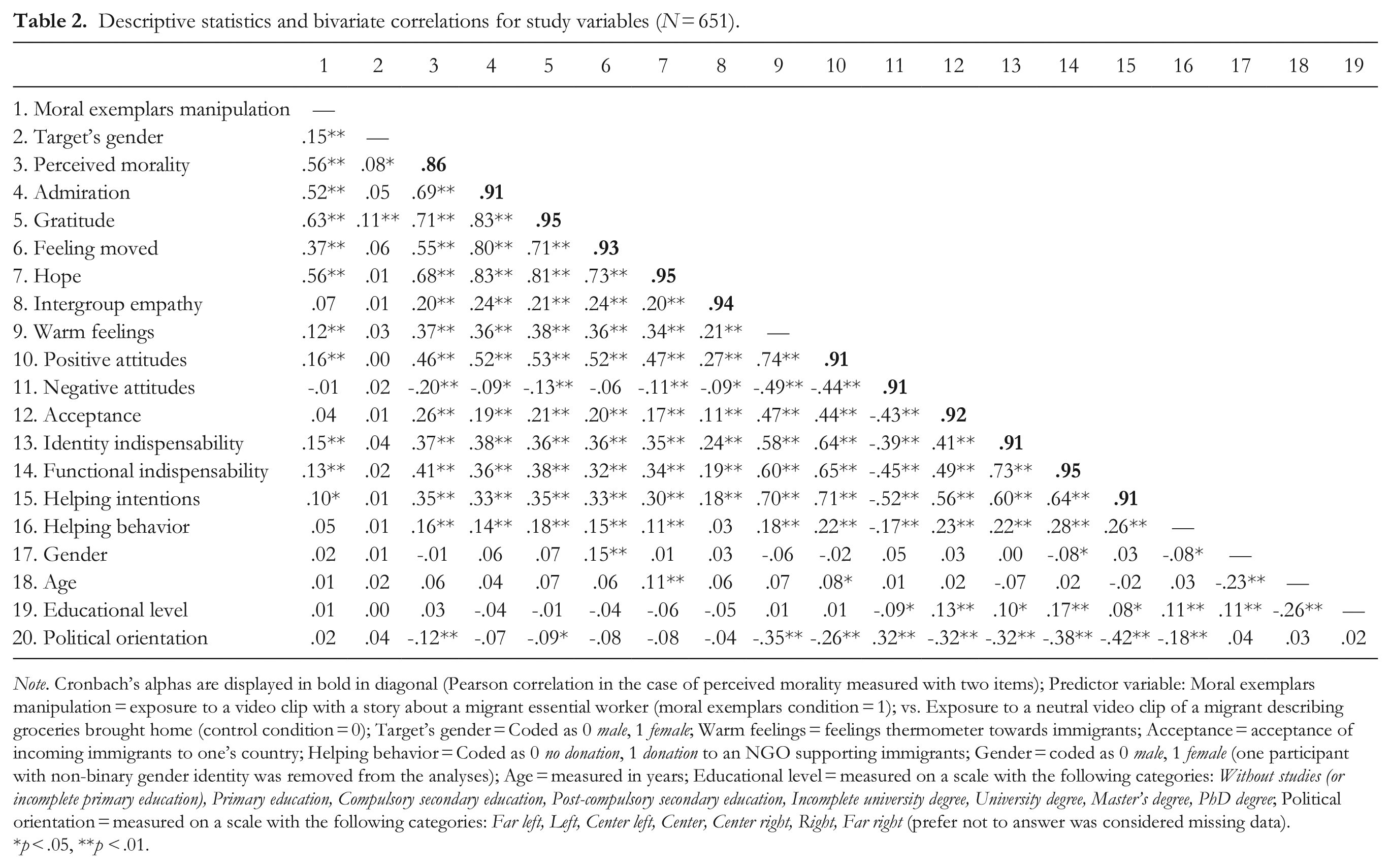
Note. Cronbach’s alphas are displayed in bold in diagonal (Pearson correlation in the case of perceived morality measured with two items); Predictor variable: Moral exemplars manipulation = exposure to a video clip with a story about a migrant essential worker (moral exemplars condition = 1); vs. Exposure to a neutral video clip of a migrant describing groceries brought home (control condition = 0); Target’s gender = Coded as 0 male, 1 female; Warm feelings = feelings thermometer towards immigrants; Acceptance = acceptance of incoming immigrants to one’s country; Helping behavior = Coded as 0 no donation, 1 donation to an NGO supporting immigrants; Gender = coded as 0 male, 1 female (one participant with non-binary gender identity was removed from the analyses); Age = measured in years; Educational level = measured on a scale with the following categories: Without studies (or incomplete primary education), Primary education, Compulsory secondary education, Post-compulsory secondary education, Incomplete university degree, University degree, Master’s degree, PhD degree; Political orientation = measured on a scale with the following categories: Far left, Left, Center left, Center, Center right, Right, Far right (prefer not to answer was considered missing data).
p < .05, **p < .01.
Adjusted means and standard errors across the moral exemplars vs. control condition: Self-transcendent emotions, outgroup attitudes, beliefs about the outgroup, and behavioral intentions (N = 530).
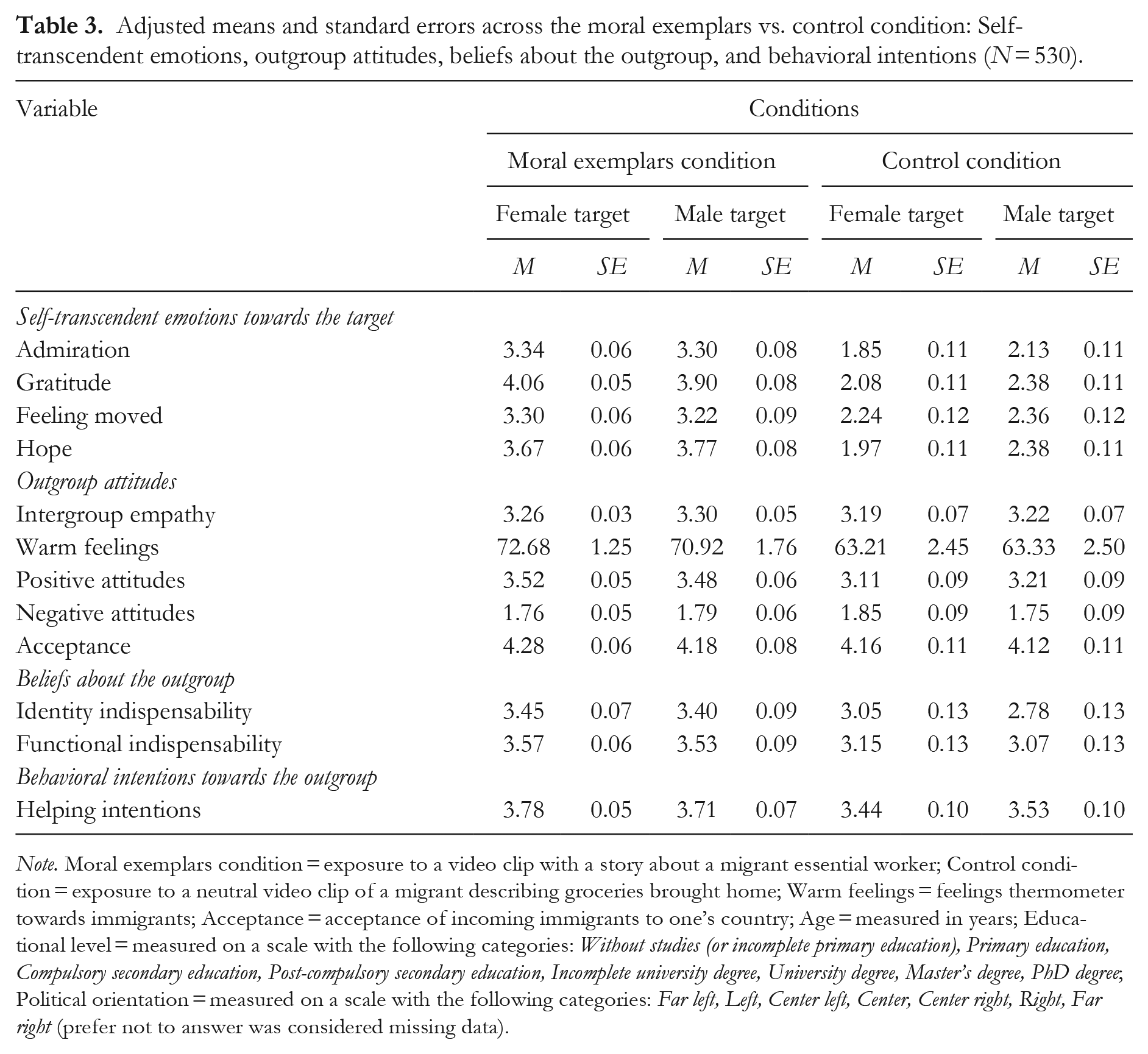
Note. Moral exemplars condition = exposure to a video clip with a story about a migrant essential worker; Control condition = exposure to a neutral video clip of a migrant describing groceries brought home; Warm feelings = feelings thermometer towards immigrants; Acceptance = acceptance of incoming immigrants to one’s country; Age = measured in years; Educational level = measured on a scale with the following categories: Without studies (or incomplete primary education), Primary education, Compulsory secondary education, Post-compulsory secondary education, Incomplete university degree, University degree, Master’s degree, PhD degree; Political orientation = measured on a scale with the following categories: Far left, Left, Center left, Center, Center right, Right, Far right (prefer not to answer was considered missing data).
Factorial ANOVA effects: The effects of moral exemplars vs. control condition on self-transcendent emotions, outgroup attitudes, beliefs about the outgroup, and behavioral intentions (N = 530).
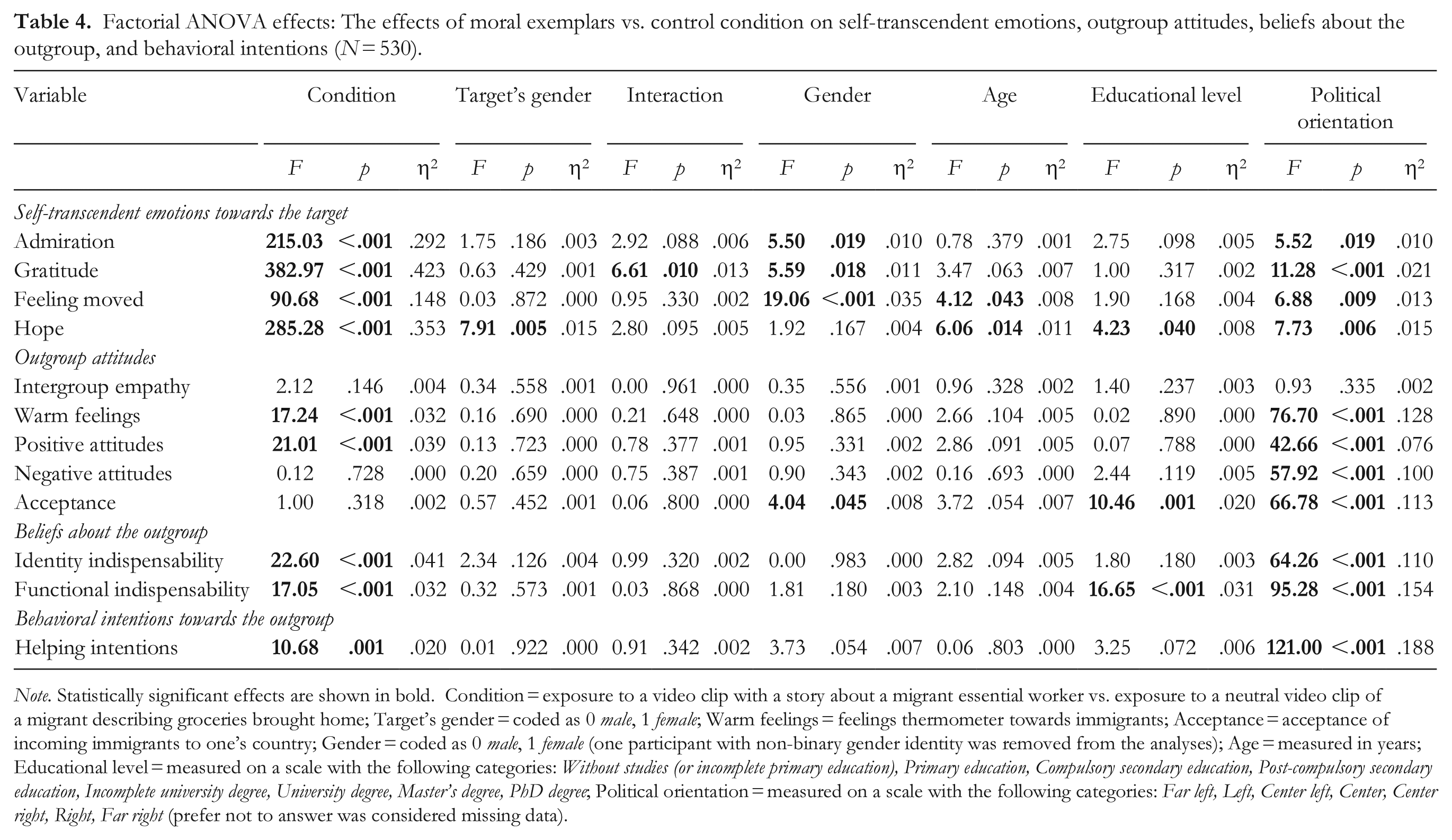
Note. Statistically significant effects are shown in bold. Condition = exposure to a video clip with a story about a migrant essential worker vs. exposure to a neutral video clip of a migrant describing groceries brought home; Target’s gender = coded as 0 male, 1 female; Warm feelings = feelings thermometer towards immigrants; Acceptance = acceptance of incoming immigrants to one’s country; Gender = coded as 0 male, 1 female (one participant with non-binary gender identity was removed from the analyses); Age = measured in years; Educational level = measured on a scale with the following categories: Without studies (or incomplete primary education), Primary education, Compulsory secondary education, Post-compulsory secondary education, Incomplete university degree, University degree, Master’s degree, PhD degree; Political orientation = measured on a scale with the following categories: Far left, Left, Center left, Center, Center right, Right, Far right (prefer not to answer was considered missing data).
Manipulation Checks
We first tested to what extent we successfully manipulated the presence of outgroup exemplary behavior. A 2 × 2 factorial ANOVA showed that participants attributed higher levels of moral exemplarity to immigrant characters when exposed to a video clip featuring an immigrant essential worker (M = 4.06, SE = 0.04) during the COVID-19 pandemic as compared to the control condition (i.e., the neutral video clip matched in gender, M = 2.66, SE = 0.07, F = 285.87, p < .001, ηp2 = .306). There were no significant effects of the target’s gender, F = 0.70, p = .403, ηp2 = .001, or interaction effects, F = 2.50, p = .115, ηp2 = .004. Based on these findings, we considered our experimental manipulation successful.
Effects of Moral Exemplars on Self-transcendent Emotions
Next, we tested our prediction that exposure to narratives featuring outgroup moral exemplars would activate more self-transcendent emotions compared to a neutral control condition. In line with our expectations, we found significant main effects of our experimental manipulation on these emotions. Participants reported feeling more admiration, gratitude, and hope, and being moved in the moral exemplars condition compared to the control condition (see Tables 3 and 4 for all relevant statistics), controlling for participants’ gender, age, income, education, and political orientation. We did not find any significant effects of the target’s gender. We observed only one significant interaction effect in the case of gratitude. The effect of moral exemplars was slightly stronger for male (d = 0.94) than female targets (d = 0.90).
Effects of Moral Exemplars on Outgroup Attitudes
We also expected that exposure to narratives about immigrant moral exemplars would be effective in promoting more favorable attitudes towards immigrants. Confirming our predictions, we found a significant main effect of experimental manipulation on warm and positive attitudes towards immigrants. Specifically, participants showed warmer (on a feeling thermometer) and more positive attitudes towards immigrants (i.e., feelings of admiration, warmth, liking or gratitude towards immigrants) in the moral exemplars condition compared to the control condition, controlling for participants’ gender, age, income, education, and political orientation. However, we did not detect significant differences between the conditions in negative attitudes towards immigrants (i.e., feelings of distrust, anger, fear or rejection towards immigrants), possibly because negative attitudes were low across all conditions. We also did not find significant main effects of experimental manipulation on outgroup empathy, or significant effects of the target’s gender or interaction effects, suggesting that the effects of moral exemplar narratives on outgroup attitudes occur regardless of the target’s gender. Finally, we did not find a main effect of exposure to narratives of immigrant moral exemplars on willingness to welcome immigrants in one’s country or region (i.e., outgroup acceptance).
Effects of Moral Exemplars on Outgroup Beliefs
We also observed significant main effects of exposure to narratives featuring outgroup moral exemplars on beliefs about immigrants’ contribution to society. That is, compared to the neutral control condition, participants in the moral exemplars condition perceived immigrants as a valuable contribution to society both in terms of their culture (i.e., perceived identity indispensability) and in terms of their contribution to the economy (i.e., perceived functional indispensability). Again, we did not detect significant effects of the target’s gender or interaction effects.
Effects of Moral Exemplars on Behavioral Intentions and Behavior towards the Outgroup
We also observed a main effect of exposure to narratives of immigrant moral exemplars on prosocial intentions. Specifically, we found that participants in the moral exemplars condition were more willing to engage in prosocial behavior to help immigrants (e.g., collaborate in the work of a non-profit organization that helps immigrants) than those in the control condition. There were no significant target’s gender or interaction effects.
Finally, we tested the effects of experimental manipulation on prosocial behavior (a monetary donation to an NGO vs. no donation) by means of logistic regression analysis. We did not observe significant effects of exposure to narratives about outgroup moral exemplars on prosocial behavior, B = 0.13, SE = 0.37, p = .726, OR = 1.14. There were no significant effects of the target’s gender, B = −0.13, SE = 0.44, p = .772, OR = 0.88, or interaction effects, B = 0.29, SE = 0.51, p = .573, OR = 1.33. We report the effects of chi square analyses (without covariates) in the SOM (Section B). Therefore, the behavioral aspect of the hypothesis was not confirmed.
Indirect Effects via Self-Transcendent Emotions
We also hypothesized that self-transcendent emotions would explain the effects of moral exemplars on outgroup attitudes, beliefs about the outgroup, as well as prosocial intentions and behavior towards the outgroup. Given that admiration, gratitude, feeling moved, and hope all strongly correlated, we created an average score of self-transcendent emotions (alpha coefficient = .97) and introduced this variable as a single mediator in the model.
The bootstrap analyses showed a significant indirect effect of the moral exemplars condition (compared to the control condition) via self-transcendent emotions on all variables measuring outgroup attitudes, including negative attitudes and intergroup empathy, outgroup beliefs, and prosocial intentions and behavior towards the outgroup, when controlling for participants’ gender, age, income, education, and political orientation. All indirect effects with their bootstrapped confidence intervals and partially standardized indirect effects are reported in Table 5. Complete mediation analyses with covariates (Supplemental Tables G1–G9) and without covariates (Supplemental Tables H1–H9) are reported in the SOM.
The decomposition of indirect effects of moral exemplars vs. control condition on outgroup attitudes, beliefs about the outgroup, behavioral intentions, and behavior via self-transcendent emotions (N = 530).
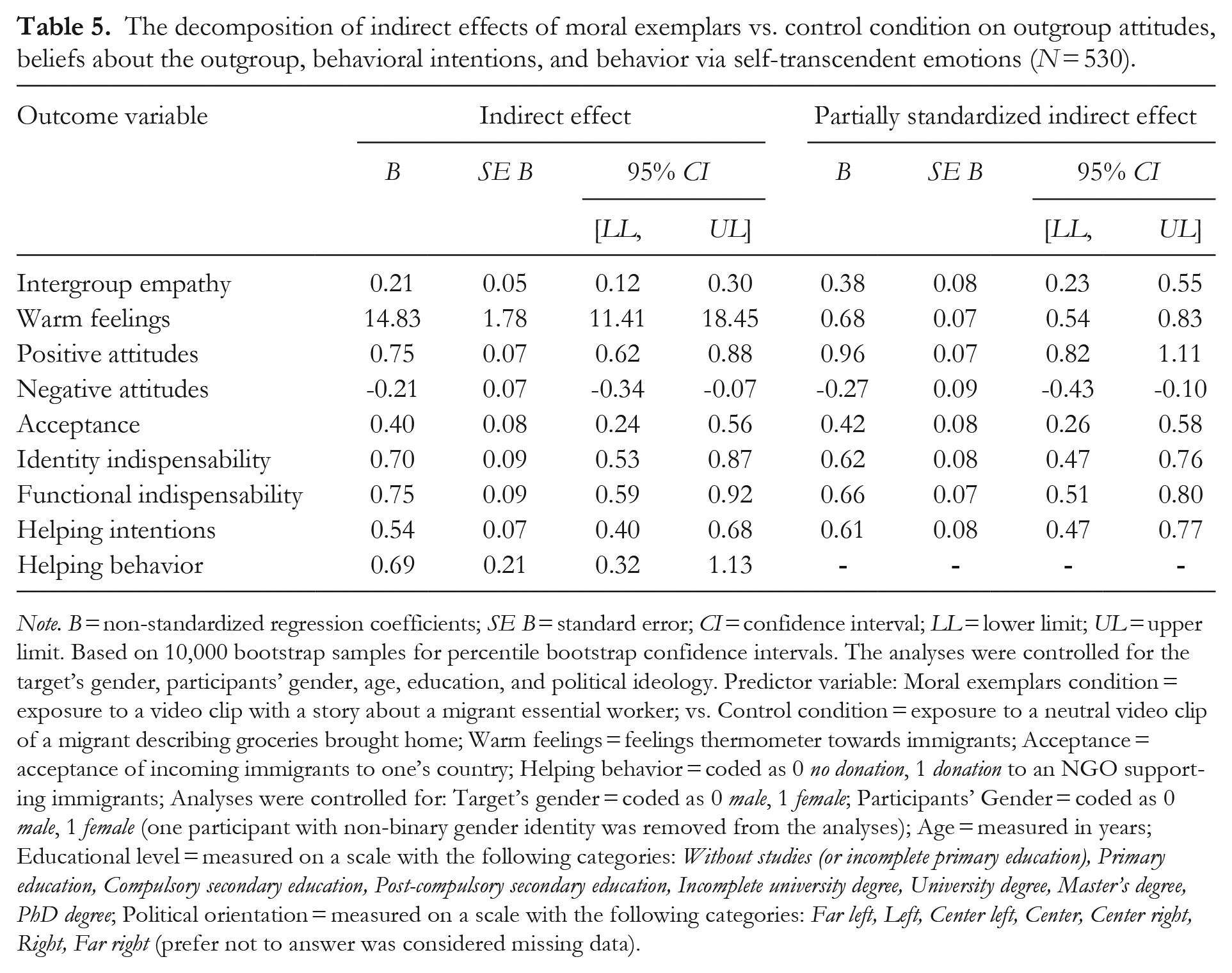
Note. B = non-standardized regression coefficients; SE B = standard error; CI = confidence interval; LL = lower limit; UL = upper limit. Based on 10,000 bootstrap samples for percentile bootstrap confidence intervals. The analyses were controlled for the target’s gender, participants’ gender, age, education, and political ideology. Predictor variable: Moral exemplars condition = exposure to a video clip with a story about a migrant essential worker; vs. Control condition = exposure to a neutral video clip of a migrant describing groceries brought home; Warm feelings = feelings thermometer towards immigrants; Acceptance = acceptance of incoming immigrants to one’s country; Helping behavior = coded as 0 no donation, 1 donation to an NGO supporting immigrants; Analyses were controlled for: Target’s gender = coded as 0 male, 1 female; Participants’ Gender = coded as 0 male, 1 female (one participant with non-binary gender identity was removed from the analyses); Age = measured in years; Educational level = measured on a scale with the following categories: Without studies (or incomplete primary education), Primary education, Compulsory secondary education, Post-compulsory secondary education, Incomplete university degree, University degree, Master’s degree, PhD degree; Political orientation = measured on a scale with the following categories: Far left, Left, Center left, Center, Center right, Right, Far right (prefer not to answer was considered missing data).
Discussion
The present experimental study examined the effects of exposure to outgroup moral exemplars during the COVID-19 pandemic on outgroup attitudes, beliefs about the outgroup, intentions and behaviors toward the outgroup, as well as the indirect effects of self-transcendent emotions in this link. Our study built on the intergroup relations literature, and in particular the novel framework of moral exemplars, resulting in new evidence for the impact that instances of outgroup moral behavior might have on affective, cognitive, and behavioral responses toward outgroups. A key contribution in our research derives from showing that interventions based on narratives about outgroup moral exemplars are useful in promoting not only intergroup harmony (i.e., positive outgroup attitudes) but also more positive perceptions of the outgroup, as well as behavioral reactions such as willingness to offer help. We also extend existing literature by showing that self-transcendent emotions that are activated in response to immigrants’ moral exemplarity are a key mechanism underlying these effects.
The Effects of Moral Exemplars on Outgroup Attitudes
In their model of moral exemplars as a strategy to promote intergroup reconciliation in conflict and post-conflict societies, Čehajić-Clancy and Bilewicz (2020) proposed positive outgroup emotions as an underlying mechanism. The authors mostly draw on Witkowska et al.’s (2019) study in which the exposure to the narrative of an outgroup moral exemplar (a German officer who engaged in several heroic actions) among Polish participants led to higher positive affect towards the outgroup (measured with the feeling thermometer). These results are in line with our findings because warmer feelings and positive attitudes toward migrants were higher in the moral exemplars condition as compared to the control condition.
Regarding negative attitudes towards immigrants, our results did not reflect the expected differences between moral exemplars conditions and the non-exemplar ones. A tentative explanation for this finding lies in the relatively low levels of negative attitudes overall, which may stem from floor effects having occurred due to social desirability; another explanation that cannot be ruled out refers to a possible selection bias. In this regard, participants who hold very negative attitudes toward immigrants could have chosen not to participate (or dropped off) in a study involving being exposed to narratives that disconfirm their views against immigration. Thus, our results referred to low-prejudiced or mid-prejudiced people, but cannot be generalized to high-prejudiced individuals. On warmer attitudes, though, the observed differences in feeling thermometer towards immigrants between moral exemplars and control groups are relevant and more promising for possible generalizability. In fact, the mean scores in the control group (which may indirectly be taken as a “baseline”) were similar to those provided for a large and representative dataset from Spain (De Coninck et al., 2021). Thus, we may only conclude confidently that moral exemplars seem to be important tools to improve positive attitudes and warmer attitudes towards immigrants.
The exposure to outgroup moral exemplars did not stimulate intergroup empathy either. This finding is an additional interesting contribution to the literature; it suggests that specific group-based feelings might be activated in response to specific narratives. In response to outgroup exemplary behavior, people might experience more generalized warm feelings or liking, or even admiration, towards the outgroup, but not necessarily compassionate or empathic feelings that would be rather activated in response to outgroup suffering (Bobowik et al., 2023).
The Effects of Moral Exemplars on Beliefs about the Outgroup
Our findings further broaden the moral exemplars paradigm by providing evidence that stories about outgroup members’ exemplary behavior can enhance more positive intergroup construals. Specifically, the narratives about outgroup moral exemplars proved to be an effective tool in enhancing beliefs that the outgroup (i.e., immigrants) is indispensable to society because of their perceived economic and cultural contributions. These results align well with the research showing that the perceptions of immigrants as warm and competent, which might be explicitly expressed in narratives about exemplary immigrants, were associated with both types of perceived group indispensability (Guerra et al., 2016). In addition, our results raise questions about whether being a moral exemplar inherently implies being someone indispensable for the gains of the group as a whole and whose performance is important for the society’s success (Hertel et al., 2008). Future research could also examine to what extent perceived group indispensability is an explanatory mechanism in behavior and attitude-eliciting effects of moral exemplars, in line with research showing that such beliefs are predictive of positive attitudes and behavioral intentions toward the outgroup (Guerra et al., 2016; Mepham & Verkuyten, 2017).
The Effects of Moral Exemplars on Intentions and Behaviors towards Outgroups
Although some field research has shown the impact of moral roles on prosocial behavior and intentions (Han et al., 2017, 2022; Osswald et al., 2010; Thomson & Siegel, 2013), including blood donation (e.g., Rushton & Campbell, 1977), to the best of our knowledge, our study is novel in providing evidence for the effect of moral exemplars on helping intentions and, indirectly via self-transcendent emotions, helping behavior in an intergroup context. As could be expected in light of the literature in the field (Shulman et al., 2021), the obtained effects using both subjective and objective measures of prosociality were small. More precisely, the effects of instances of morality on helping behavior (a donation to a local NGO helping immigrants) were not observed. Yet, based on results of an exploratory analysis conducted with narratives about healthcare workers (B = 0.18, SE = 0.07, p = .028, OR = 1.18, reported in the SOM, section E), as a specific subtype of moral exemplars during the pandemic, 3 we may speculate that the increased moral exemplarity and/or the intensity of experienced self-transcendent emotions linked to perceived moral exemplarity may be the key in making a difference in prosocial to get effects on prosocial behavior (a donation).
These results need to be interpreted in the scenarios in which a higher probability of donation would be expected. Ma et al.’s (2017) meta-analysis showed that the link between gratitude and subsequent prosocial behavior is weaker when no direct gain is obtained, as compared to reciprocal prosocial behavior. In our study, there was no possibility of gain, either by being helped in the future or for reputation (Nakamura & Masuda, 2011), as the donation was processed automatically by a technological system that did not allow the benefactor’s identitiy to be known. For this reason, the effect of moral exemplarity on prosociality towards migrants obtained in our research is even more significant. Gratitude promotes prosocial behavior in general, and especially toward the benefactor (Bartlett & DeSteno, 2006), but since research participants could not directly express gratitude to the character in the video, they may have chosen to create reciprocity indirectly by extending it to the outgroup. Waters et al. (2021) argued that a feeling of reciprocity was ubiquitous at the beginning of the pandemic, with frontline workers portrayed as heroes (Lipworth, 2020; Waters et al., 2021) —and fundraising actions organized to demonstrate appreciation for their sacrifices. Thus, it could be argued that research participants felt an upstream indirect reciprocity when donating: that is, A (immigrant moral exemplars working in the frontline) helps B (the research participant when confined at home), and B helps C (immigrants living in the same region). This “extended reciprocity” works well with these earthly heroes who were vulnerable to disease despite their moral strength. Prosociality may have been more easily prompted in this context because these moral exemplars were perceived as attainable and closer (e.g., Han et al., 2017, 2022).
The Role of Self-Transcendent Emotions
Our research additionally reveals novel findings that discrete self-transcendent emotions, such as admiration or gratitude, that observers felt about the moral exemplary behavior are a crucial mechanism in understanding the generalization effect of a single-exemplar story on intergroup relations. Thus, a new addition to (or reconceptualization of) Čehajić-Clancy and Bilewicz’s (2020) model may be concluded from our study: it is through the experience of discrete interpersonal emotions towards the moral character presented in the story that provokes changes in affective (attitudes), cognitive (beliefs), and behavioral reactions toward the outgroup as a whole. Appealing to extraordinary aspects of a person’s behavior seem to activate interpersonal emotions (Durkheim, 2012; Engelen et al., 2018). In the case of immigrants, the extraordinary aspects may amplify since they are less often presented in public discourse.
Moreover, and despite the overall effect on self-transcendent emotions, it appears that moral exemplars more strongly elicit gratitude and admiration than feeling moved or hope. This finding is certainly congruent with the appraisal of moral exemplars (Haidt, 2003; Van de Vyver & Abrams, 2017), as this appraisal resembles two defining features of moral exemplars (Lickona, 2004): the capacity to inspire others—likely to prompt admiration; and the willingness to sacrifice self-interest—likely to prompt gratitude. While admiration has been previously linked to moral exemplars (Engelen et al., 2018), the association with gratitude is particulary relevant in a pandemic context, where individuals may feel that they have been recipients of moral exemplars’ aid. However, it is also notable that moral exemplars elicit “feeling moved” with the narrative, an empathy-related reaction, as compared to other narratives of immigrants who had to face the COVID-19 pandemic. This emotional reaction might be one of the crucial drivers of prosociality. Finally, moral exemplars seem to also inspire hope, which has been shown to enhance positive intergroup relations (Cohen-Chen et al., 2014), and which might be relevant in the context of overcoming the COVID-19 pandemic.
Limitations
Despite the value of our study, some limitations should be acknowledged. First, since the experimental groups were derived from an actual governmental campaign, the characters’ ethnic background was not kept constant across the experimental conditions. Yet, the impact of this differential cultural particularity might have not been high. For instance, previous work has shown that induction of emotions varied according to immigrants’ origin for negative emotions, but was invariant for positive emotions (e.g., Igartua et al., 2011). Further designs should elucidate the role that the target’s ethnic origin, as well as gender, might have played in the strength of the observed effects by manipulating these contextual variables. Second, the lack of a baseline measure of prejudice should be mentioned. Although the experimental design (i.e., the random assignment) allows us to attribute the differences across conditions to the moral exemplarity, we cannot claim and/or quantify a prejudice reduction since the levels prior to watching the videos were unknown.
Practical Implications and Conclusions
Our study stemmed from a campaign designed by policymakers to highlight the role of migrants during the pandemic, which has proved its scientific value. However, its actual impact on social media may have been more modest since very few likes and retweets of the actual campaign have been recorded. In this regard, future research studies (or advocacy campaigns) may consider research designs that involve sharing and reposting positive stories on social media as a behavioral response (e.g., Igartua et al., 2017). This is particularly important in the context of messages around immigration that proliferate on social media, where rumors and negative content spread easily (e.g., Ben-David & Matamoros-Fernández, 2016). Moral exemplars may constitute ideal material to spread such positive stories on social media due to likeability and the emotions they elicit. Additionally, although emotions are generally better predictors of behavioral intentions than stereotypes (e.g., Cuddy et al., 2007), previous negative beliefs (stereotypes) held by some individuals may somehow diminish the intensity/experience of self-transcendent emotions elicited by the video stories. Therefore, for a more enduring effect of moral exemplars on prosociality and positive attitudes toward immigrants, future actions may consider using videos complemented with the correction of erroneous beliefs (Moore-Berg et al., 2022).
In conclusion, the results of the present study are undoubtedly relevant in the field of social intervention. Our findings are embedded in a scheme where applied research, policy-making, and advocacy mutually enrich themselves for tackling the issue of migrant discrimination. Highlighting moral exemplarity and creating visual materials that induce self-transcendent emotions have shown its value in increasing prosociality and positive attitudes towards immigrants. Migrant essential workers’ similar examples across the world have been collected and spread (see, for instance: https://migrants-keyworkers-covid-19.odi.digital/). By showcasing how immigrants are contributing in exemplary ways, we can create a positive change towards intercultural understanding and appreciation.
The present study provides initial insights into the role of narratives about immigrant workers’ exemplary behaviors to improve the host society’s attitudes, beliefs, and prosocial responses toward immigration. Self-transcendent emotions induced with visual narratives have proven to be influential mechanisms in explaining such effects. Our findings derive from an experimental methodology that put together both objective and subjective responses to address the research question comprehensively. Overall, this research promisingly gives room for forthcoming studies oriented to better understand and promote positive attitudes and prosociality toward immigrants in light of the moral exemplars framework.
Supplemental Material
sj-pdf-1-gpi-10.1177_13684302231165730 – Supplemental material for Moral exemplars promote positive attitudes, beliefs, intentions, and behaviors toward outgroups during the COVID-19 pandemic: The explanatory role of self-transcendent emotions
Supplemental material, sj-pdf-1-gpi-10.1177_13684302231165730 for Moral exemplars promote positive attitudes, beliefs, intentions, and behaviors toward outgroups during the COVID-19 pandemic: The explanatory role of self-transcendent emotions by Itziar Alonso-Arbiol, Magdalena Bobowik, Aitziber Pascual, Susana Conejero and Sonia Padoan in Group Processes & Intergroup Relations
Footnotes
Authors’ note
Itziar Alonso-Arbiol and Magdalena Bobowik contributed equally to this article.
Data availability statement

Funding
The author(s) disclosed receipt of the following financial support for the research, authorship, and/or publication of this article: the Basque Government (Consolidated Group “Culture, Cognition, and Emotion”; Grant Number: IT1598-22); the Spanish Ministry of Science and Innovation (Grant Number: PID2020-115738GB-I00, funded by MCIN/AEI/10.13039/501100011033/); and Ramón y Cajal Program awarded to M.B. by the Spanish Ministry of Universities (Grant Number: RYC2021-032887-I).
Notes
References
Supplementary Material
Please find the following supplemental material available below.
For Open Access articles published under a Creative Commons License, all supplemental material carries the same license as the article it is associated with.
For non-Open Access articles published, all supplemental material carries a non-exclusive license, and permission requests for re-use of supplemental material or any part of supplemental material shall be sent directly to the copyright owner as specified in the copyright notice associated with the article.
