



Abstract
Members of historically advantaged groups are often unwilling to support actions or policies aimed at reducing inequality between advantaged and disadvantaged groups, even if they generally support the principle of equality. Based on past research, we suggest a self-affirmation intervention (an intervention in which people reflect on a positive trait or value in order to affirm their positive self-image) may be effective for increasing the willingness of advantaged group members to address inequality. Importantly, while self-affirmation has been only operationalized as a written exercise in the past, in this project, we adapt it into video messages for use in public campaigns. In Study 1, we experimentally tested an initial video adaptation of self-affirmation and found that it was effective in increasing the willingness of advantaged group members to address inequality in the context of Jewish–Arab relations in Israel. Based on this study, two NGOs developed a real campaign video and used it in their public campaign, and we tested this applied intervention (in Study 2) and found it to be effective compared to a control condition that only presented information about inequality. Together, these studies represent the first implementation of self-affirmation in real-world campaigns and indicate that it can be an effective way to increase support for action to address inequality.
On July 19, 2018, the Israeli Knesset (Parliament) enacted the “Nation-State” Law that, among other things, defined Israel as the nation state of the Jewish people, stated that within Israel a right to national self-determination exists only for the Jewish people, and demoted Arabic from its status as an official language. The law was seen by many as cementing the second-class status of Arab/Palestinian citizens of Israel, which has long been evident in unequal distribution of state budgets and other discriminatory legislation (Adalah the Legal Center for Arab Minority Rights in Israel, 2011). This is just one example of ongoing inequalities that persist in many modern societies on the basis of certain group identities, including racial, ethnic, gender, religious, or sexual identities. While these inequalities have complex historical, social, and economic causes, one well documented factor in their persistence is that even in societies where support for the general principle of intergroup equality has increased, support for actions and policies that would directly reduce inequality has lagged behind, particularly among members of historically advantaged groups (Dixon et al., 2007, 2017; Tuch & Hughes, 1996).
As a result, both scholars and activists have been interested in ways to increase advantaged group members’ support for policies that advance equality, in order to improve the status of disadvantaged groups. However, past psychological research indicates that advantaged group members are likely to be resistant to such attempts because they enjoy their advantaged status materially and psychologically (Jost et al., 2003; Pratto et al., 2006; Tajfel & Turner, 1979). As a result, efforts to advance equality could be aided by psychological interventions that help overcome this resistance. However, most psychological research has focused on interventions to reduce prejudice among the advantaged, and often through interventions that may not be easily applicable in public campaigns or have not been tested in the field (for reviews, see Dixon et al., 2012; Paluck et al., 2021). Therefore, in the current research, we aim to address both the theoretical (i.e., the focus on prejudice only) and methodological gap (i.e., application in the field) by testing a self-affirmation intervention (an intervention in which people reflect on a positive trait or value in order to affirm their positive self-image) as a means to increase advantaged group members’ support for action to advance equality in the context of a real-world campaign.
Resistance to Equality Among the Advantaged Group
Increasing advantaged group members’ support for actions that would advance equality is especially important as they have access to more power and resources and are often the majority in societies, making them more likely to be able to effect change (Shuman et al., 2020). However, major theories of intergroup relations, such as social identity theory (Tajfel & Turner, 1979), system justification theory (Jost et al., 2003), and social dominance theory (Pratto et al., 2006) demonstrate that advantaged group members often have a basic motivation to preserve their own status, as it confers upon them both psychological and material benefits. As a result, efforts to advance equality between groups may be perceived by advantaged group members as threatening, as they may fear losing their advantaged status or even becoming disadvantaged in a new reversed hierarchy (e.g., “fear of falling”; see Jetten et al., 2015, 2017; Knowles et al., in 2022).
Beyond this more material, status-focused, threat, research has also documented that highlighting inequality can pose additional psychological threats to advantaged group members (Knowles et al., 2014). Many modern liberal societies are characterized by some level of meritocratic ideologies, that is, belief systems that suggest achievement and success can and should be the result of personal hard work and individual merit (Vala et al., 2004; Weber, 2001), which are also important to system-justifying ideologies (Jost et al., 2003). When advantaged group members hold these beliefs, discussion of systematic group-based inequalities can pose a meritocratic threat—that is, it can suggest that one’s achievements are due in part to ingroup privilege rather than being earned through hard work and talent, thus threatening one’s positive self-image (Knowles & Lowery, 2012; Knowles et al., 2014). Similarly, more and more advantaged group members are supporting the principle of equality (Dixon et al., 2017), and for these advantaged group members, inequality can present a moral image threat (Knowles et al., 2014; Lowery et al., 2012). In other words, being associated with a group that benefits from an unjust system can reflect negatively on the group’s and thus the self’s moral image, creating dissonance between how one would like to see the group and how it is actually seen. While all advantaged group members may not experience these threats to the same degree, the issue of inequality and advocacy for change to advance equality is likely to be psychologically threatening for advantaged group members, which can prevent them from supporting change towards equality.
Self-affirmation as a threat reduction intervention
Given this understanding that advantaged group members are likely to experience some level of threat in response to advocacy for action to address inequality, what intervention might best help such appeals to be effective? We suggest that self-affirmation interventions might be particularly useful in this context as their core aim is to help people cope with psychological threats. According to self-affirmation theory (Sherman & Cohen, 2006; Steele, 1988), an important psychological goal is maintaining self-integrity; that is, the overall experience of self as good, consistent, competent, and moral. From this perspective, people can tolerate threats to specific domains if they can maintain a general sense of self-integrity and worth. In other words, people can handle a threat to competence if they can maintain a broad sense of self-integrity based on other domains. This ability of self-affirmation to help people cope with a variety of threats could make it useful for persuasive appeals to the advantaged group to fight against inequality.
The prior research discussed before (for a review, see Knowles et al., 2014) has demonstrated that information or experiences that highlight inequality can pose a number of psychological threats for the advantaged group. For example, they can threaten their competence (meritocratic threat) by highlighting how some of their achievements may be due to group-based privilege and not their own hard work, and/or they can threaten their moral image by implicating them in an unjust system. Thus, engaging in self-affirmation before such threatening information is presented could make advantaged group members more willing to accept such information and act to address the inequality it highlights. In fact, prior research has shown that self-affirmation can sometimes be effective in coping with issues in intergroup relations that are typically threatening and elicit a system-justifying response (Goudarzi et al., 2020; Trump & White, 2018). Čehajić-Clancy et al. (2011) found among Jewish Israelis and Serbs (two advantaged groups in their societies) that a self-affirmation intervention increased willingness to take responsibility for harmdoing committed by one’s group towards an outgroup, thus increasing support for reparative policies. Furthermore, Unzueta and Lowery (2008) and Adams et al. (2006) found that following a self-affirmation intervention, White Americans were more willing to acknowledge structural racism. While none of these studies directly tested self-affirmation’s effectiveness in increasing advantaged group members’ willingness to support actions to address inequality, taken together, they suggest that self-affirmation may be able to help advantaged group members cope with the threats associated with inequality, and thus respond more positively to calls to advance equality.
Self-affirmation interventions
Based on self-affirmation theory, researchers developed a self-affirmation intervention to help people cope with psychological threats whereby they reflect on an important trait, value, or achievement that is unrelated to the domain in which they will experience threat (Cohen et al., 2009; McQueen & Klein, 2006). For example, participants are given a list of different kinds of values to choose from (e.g., theoretical, economic, aesthetic, social, political, and religious; Allport et al., 1960), and then are asked to choose which is most important to them and explain why (Sherman et al., 2000). Alternatively, in other studies, participants are asked to “Write a short description of an area of your life that is both important to you and makes you feel proud. It can be any aspect of your identity, a talent, a relationship, or a basic value” (Blanton et al., 2001, p. 37). Indeed, self-affirmation interventions have been used many times in a wide variety of contexts; thus, there is variation in the exact form of the intervention (which values are used, the exact wording, etc.; for a review of all different forms of self-affirmation interventions, see McQueen & Klein, 2006). Through this process, one’s overall positive self-identity is bolstered, making one more capable of coping with a threat to some aspect of their identity. Self-affirmation interventions have been applied successfully in a number of domains, including closing educational gaps (Cohen et al., 2009) and increasing healthy responses to stress (Sherman et al., 2009).
For example, in Cohen et al. (2006), middle school students were randomly assigned to a control or an affirmation condition. In both conditions, students were presented with a list of values (such as relationships with friends, or family, or being good at art). In the affirmation condition, students were asked to indicate their most important value, while students in the control condition indicated their least important value. Then, students in the affirmation condition wrote about why the value was important to them, while students in the control condition wrote about why the value might be important to someone else. The self-affirmation intervention improved the grades of minority students (who are more likely to experience psychological threats in educational contexts because of negative stereotypes) over both the short and long term (Cohen et al., 2006, 2009). While this intervention aimed to help students cope with the psychological threats resulting from negative stereotypes, as a threat reduction intervention, we suggest that self-affirmation may also be able to help advantaged group members cope with the psychological threats they experience when being presented with information about inequality (for a review, see Knowles et al., 2014).
Since the development of this general self-affirmation intervention, which is thought to buffer against a wide range of threats, some researchers have developed interventions targeting more specific psychological threats. For example, Shnabel et al. (2013) developed a self-affirmation intervention focused specifically on threats to social belonging, while others have developed affirmations specifically aimed at addressing threats to agency in contexts of intergroup conflict (SimanTov-Nachlieli et al., 2017, 2018). While these more specific self-affirmation interventions have shown promise, work on the threats experienced by advantaged group members in response to information about inequality indicates that they may experience a variety of threats, such as status threat, meritocratic threat, and moral image threat (Knowles et al., 2014). Therefore, we chose to focus on the classic self-affirmation intervention, which has been shown to be effective in helping people cope with a wide variety of threats.
Limitations in the applicability of self-affirmation interventions
In addition to expanding research on self-affirmation to test its effectiveness in increasing support for action to advance equality, we also aimed to make important advances in the methodology and applicability of self-affirmation interventions. Until now, almost all self-affirmation interventions have used some variation of the same methodology (Lesick & Zell, 2021; McQueen & Klein, 2006): people are either given a list of, or asked to think of, important values, traits, or achievements, and then they are asked to write about an activity/event in their life that reflects that value/trait/achievement. While this essay method has proven effective, it makes the intervention limited to contexts where people can sit and write an essay (e.g., educational contexts). As a result, it is less relevant for addressing political issues such as inequality, where most campaigns and persuasive appeals are conducted with relatively little contact with the target audience (e.g., through videos, social media posts, etc.). Therefore, we aimed to adapt and test a typical self-affirmation intervention into a brief campaign video to test its effectiveness and relevance in this area. This would expand both the contextual scope and applicability of self-affirmation interventions to public campaigns, indicating that people can go through this psychological process even in a less personal context.
The Current Research
In sum, the goal of this project was to adapt self-affirmation for use in a social media video campaign aimed at increasing the willingness of Jewish-Israelis to address the inequality that exists between Jewish and Arab Israeli citizens. We conducted this project in collaboration with a local Israeli nongovernmental organization (NGO), Givat Haviva, and the Friedrich-Ebert-Stiftung Foundation that carried out a campaign on this issue. This project consisted of two studies: Study 1 aimed to test potential interventions, ultimately leading to the choice of self-affirmation for use in the campaign. The self-affirmation intervention was then further developed into a video suitable for the organization’s online campaign, which was actually used by the NGOs in the campaign. Then, after the campaign, we conducted Study 2 to test the effectiveness of the actual video used by the organization in their campaign. Overall, our main hypothesis was that self-affirmation would be an effective intervention for increasing people’s willingness to act or support policies that would reduce inequality between Jewish and Arab citizens of Israel. While our hypothesis that self-affirmation would be effective was confirmatory, in Study 1, we also explored the relative effectiveness of different interventions. However, Study 2, as a conceptual replication, was wholly confirmatory. We operationalized willingness to support action to address inequality in three main ways: (a) willingness to participate in the campaign on social media (e.g., by liking and sharing the campaign posts), (b) support for specific policies aimed at reducing inequality, and (c) willingness to participate in traditional collective action (e.g., signing petitions, participating in events/demonstrations). These primary outcome variables were chosen by the NGOs with which we were working, as the primary goal of their campaign was to encourage people to engage in some level of action rather than to simply change attitudes. While these were our primary outcome variables, we also measured awareness of inequality, as the intervention would likely increase a general awareness of the issue.
Study 1
Study 1 consisted of two waves conducted with the same participants. Wave 1 served as a baseline and provided initial descriptive data; in Wave 2, we tested the effects of specific interventions on participants’ willingness to engage in and support for actions and policies that address inequality. Following Wave 1, the NGOs selected four interventions to test, we then developed five rough mock campaign videos (one for each intervention and a control video) to do an initial test of the interventions’ effectiveness. Self-affirmation was one of the four interventions tested in an intervention tournament (see e.g., Bruneau et al., 2018; Hameiri & Moore-Berg, 2022), and became the focus of the campaign, and thus of this paper. As a result, we focus this paper on self-affirmation and report results regarding the other interventions in the supplemental material. In Wave 2, about 2 weeks later, we returned to the same participants and randomly assigned them to watch one of the videos, then measured their willingness to act, support for various policies, and attitudes.
Method and Procedure
Participants
In Wave 1, we recruited a nationally representative sample of 1,062 Jewish Israelis (although the final sample for analysis was much smaller [n = 187] due to dropout and the fact that we focus on only two out of five conditions in this paper, which we describe in more detail in what follows) online via an Israeli survey company. Participants were invited to take part in a study on current issues and were not aware of the main topic of the study or the hypotheses. They completed informed consent and then a number of measures regarding Jewish–Arab inequality (see following lines). Fifty-seven participants (5.3% of the original sample) were excluded because they failed an attention check question (i.e., “This is an attention check. Please select strongly disagree for this question”). 1 In addition, we excluded eight participants who spent over 10,000 seconds (almost 3 hours) completing the study (indicating that they were not paying attention). Finally, using the “careless” package in R (Meade & Craig, 2012), we calculated the longest string of consecutive identical responses for each participant in the main survey items, and excluded 27 outliers on this measure (more than 2.5 SDs above the mean). This left a Wave 1 sample of 970 Jewish Israelis (Mage = 47.42, SDage = 17.15, range: 18–86; 51.5% male; 42% rightist, 28% centrist, 30% leftist). Sample size was based on the NGOs’ budget for the research project.
Participants from Wave 1 were invited back to Wave 2 approximately 2 weeks later. As large a sample as possible was collected given the time frame, while using quotas to finish with as close to a nationally representative sample—in terms of age, gender, and political orientation—as possible. Four hundred and ninety-seven participants were initially recruited; however, 14 participants were screened out after failing attention check questions to the manipulation video twice, another three participants were excluded because they reported a different gender across the two time points, and another four because their age was ±5 years different between the two time points. 2 So, this left a sample of 476 Jewish Israelis, which, while not perfectly representative, is similar to the Jewish population in Israel. Participants were paid by the survey company in exchange for their participation. Participants were randomly assigned to one of five conditions: control, self-affirmation, and three other initially developed interventions (for more details regarding these interventions and their effects, see the supplemental material). Since in this paper we focus on the self-affirmation intervention, we report results based only on the self-affirmation condition and the control condition, thus using a final sample of 187 Jewish Israelis (Mage = 45.96, SDage = 15.69, range: 18–72; 50.8% male; 54% rightist, 24% centrist, 22% leftist). While in this case sample size was determined by the budget of the NGOs, we conducted a sensitivity analysis in G*Power, which indicated we had 80% power to detect an effect size of Cohen’s f = .21; that is, slightly smaller than a medium effect size.
Wave 1 measures
At the time the first wave 3 was conducted, the NGOs had not decided on the specific issue that the campaign would focus on. Therefore, we measured the following variables regarding a number of potential issues related to inequality between Jewish and Arab citizens, and the NGOs selected a specific issue based on initial levels of these variables. These variables also served as baseline measures of our dependent variables. Because these variables were measured across nine different issues, they were abbreviated to only one-item measures. All items were repeated across the following issues: government response to civilian health in the COVID-19 crisis; government response to the economic crisis in light of the COVID-19 epidemic; equal distribution of budgets in government ministries to all citizens of the country; dealing with domestic violence; the state’s response to the unemployment crisis; equitable distribution of budgets in the education system: secular, religious, ultra-Orthodox, and Arab; good quality and accessible public transport services; treating the phenomenon of crime and violence; internet and electricity infrastructure accessibility for distance learning for all students.
Importance was measured per issue with the item, “Please rate how important each of the following topics is to you right now” (1 = not important at all, 7 = very important).
Awareness of inequality was measured per issue with the item, “Please rate the extent to which you think there is inequality between Jews and Arabs in each domain” (1 = Jews are discriminated against compared to Arabs, 7 = Arabs are discriminated against compared to Jews, with 4 = full equality).
Willingness to act to address inequality was measured per issue with the item, “Please rate the extent to which you would be willing to do something (e.g., share a post on social media, sign a petition, etc.) in order to address inequality in each domain” (1 = not at all willing, 7 = very willing).
Support for policies to address inequality was measured per issue with the item, “Please rate the extent to which you would be supportive of the government doing more to address inequality in each domain” (1 = not at all supportive, 7 = very supportive).
Based on the descriptive results and their own considerations, the NGOs chose to focus on the issue of distribution of government budgets because it was the issue where most people were aware of the inequality but least willing to act or support policies to address it.
Participants completed a brief demographic questionnaire including age, gender, religiosity, political ideology, education, income, geographic area, level of spoken Arabic, and whether they belonged to another minority in Israel (e.g., Ethiopian Jews, LGBTQ+).
Wave 2 procedure and measures
In Wave 2, participants were invited to participate in a study on current online campaigns; they were unaware that this study was connected in any way to Wave 1. After completing informed consent, they were informed that they would see a campaign video currently being advertised on social media, and that we were interested in their reactions to the video. Participants were then randomly assigned to one of five conditions. In the control condition, participants (n = 91) watched a ~60 s video that presented them with information about inequality in the budgets related to health, education, and economic investment (see https://youtu.be/JAy1OgaAx_k; for translation of the text, see the supplemental material). In the self-affirmation condition, participants (n = 96) watched a ~100 s video (see https://www.youtube.com/watch?v=uLKz2MMnQ1g; for translation of the text, see the supplemental material); in the first part of the video, participants were walked through an adapted version of a typical self-affirmation exercise (see Cohen et al., 2009; McQueen & Klein, 2006). Then, text appeared asking them to think of an “area of life that is especially important to you” and “an important part of who you are”; they were then asked to “think of a meaningful achievement in that area” and consider “how it made you feel.” The text appeared at a slow pace and was all phrased as questions in order to prompt participants to self-reflect on the values that mattered to them and remember a time that they had lived out those values. We hoped that this would mimic the mental process in a typical self-affirmation intervention, even though participants were not writing their thoughts down. Then, as a transition to the next part of the video, they were asked to consider whether every person deserved an equal opportunity to achieve things that were important to them. From there, the exact same video as in the control condition was played. Three other conditions were also developed, one used ideas based on perspective taking, the second drew from cognitive dissonance, and the third from the normative conflict model of dissent. We do not focus on these interventions in this paper; however, we present their results in the supplemental material.
After watching the videos, participants answered two questions to check if they were paying attention. If they failed one of these questions, they were sent back to watch the video a second time (n = 173); if they failed a second time, they were screened out (n = 14). Then participants completed a number of measures examining their reactions to the video and their willingness to address inequality (for all measures, see the supplemental material), including elaborated measures of our primary outcomes now that the study was focused on one clear issue.
Awareness of inequality was measured with the same item as in Wave 1.
Because the NGOs planned to carry out their campaign on social media (primarily Facebook), they were particularly interested in how willing people would be to engage with the videos on Facebook. Thus, participants were asked, “How willing would you be to engage in the following actions on Facebook?”; they then responded on a three-item scale (α = .92) measured as the mean of three items assessing participants’ willingness to like the video (“I would be willing to like the video”), share the video (“I would be willing to share the video”), and share the video with a personal comment (“I would be willing to share the video and write a post with my personal thoughts about it”) on a 7-point scale (1 = not very willing, 7 = very willing).
Support for policies to address inequality was measured as the mean of four items, including the same item as in Wave 1 as well as three additional items: “There should be no inequality between the budgets distributed to Jews and those distributed to Arabs,” “There should be no budgetary inequality between all social groups in Israel,” and “An examination of the budget in terms of potential inequality must be carried out before the budget goes up for a government vote” (α = .81). Participants were asked, “To what extent are you supportive of each of the following policies?”; and responded on a 7-point scale (1 = not at all supportive, 7 = very supportive).
Willingness for collective action was measured as the mean of four items, including the same item as in Wave 1 as well as three additional more traditional collective action items: “I will be willing to participate in social events of civic organizations that oppose inequality in the distribution of budgets in government ministries (for example, to participate in panels, discussion groups, etc.),” “I would be willing to sign a petition or add my name to a group e-mail against inequality in the distribution of budgets in government ministries,” and “I would be willing to take part in street demonstrations against inequality in the distribution of budgets in government ministries” (α = .88). Participants were asked, “How willing would you be to engage in the following actions?”; they responded on a 7-point scale (1 = not at all willing, 7 = very willing).
Results
Analysis strategy
All analyses were conducted in R Version 4.0.2 (R Core Team, 2019), and the relevant data files and code can be found at the Open Science Framework (https://osf.io/ebrmc/). We analyzed the effect of the interventions using ANCOVAs, 4 followed up by planned comparisons contrasting the self-affirmation condition with the control condition. In each analysis, we controlled for Time 1 levels of the relevant variable in order to examine the effect of the condition above and beyond Time 1 levels. We controlled for the baseline rather than examining change over time because our measures were different at Time 2 (as we were limited to one-item measures at Time 1), and thus not directly comparable across times. We present results using only the data from the self-affirmation and control conditions, but analyses that included the other conditions are presented in the supplemental material.
Effects of the self-affirmation intervention
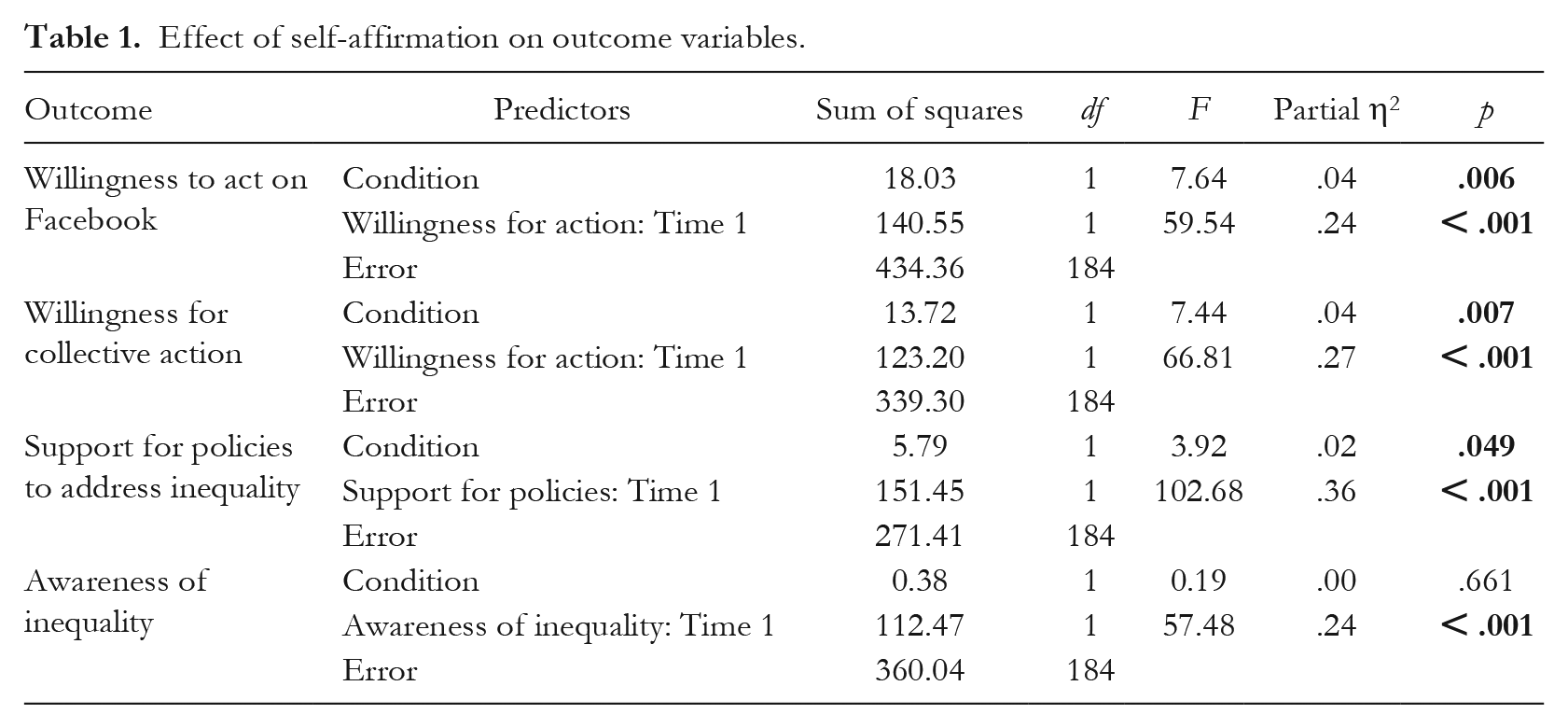
An overview of descriptive statistics and correlations between study variables is presented in the supplemental material. ANCOVAs indicated that the self-affirmation treatment had a significant effect on participants’ willingness to share the video on Facebook, collective action intentions, and support for policies to address inequality, but had no effect on their awareness of inequality (see Table 1 and Figure 1). Planned contrasts 5 revealed that participants in the self-affirmation condition were significantly more willing to share the video on Facebook (M = 3.53, SE = 0.16) than participants in the control condition (M = 2.91, SE = 0.16), t(184) = 2.69, p = .006, Cohen’s f = .20. They were also significantly more willing to engage in collective action (M = 3.23, SE = 0.14) than participants in the control condition (M = 2.91, SE = 0.14), t(184) = 2.73, p = .007, Cohen’s f = .20. Finally, they were more supportive of policies to address inequality (M = 4.87, SE = 0.12) than participants in the control condition (M = 4.52, SE = 0.13), t(184) = 1.98, p = .049, Cohen’s f = .14.
Effect of self-affirmation on outcome variables.
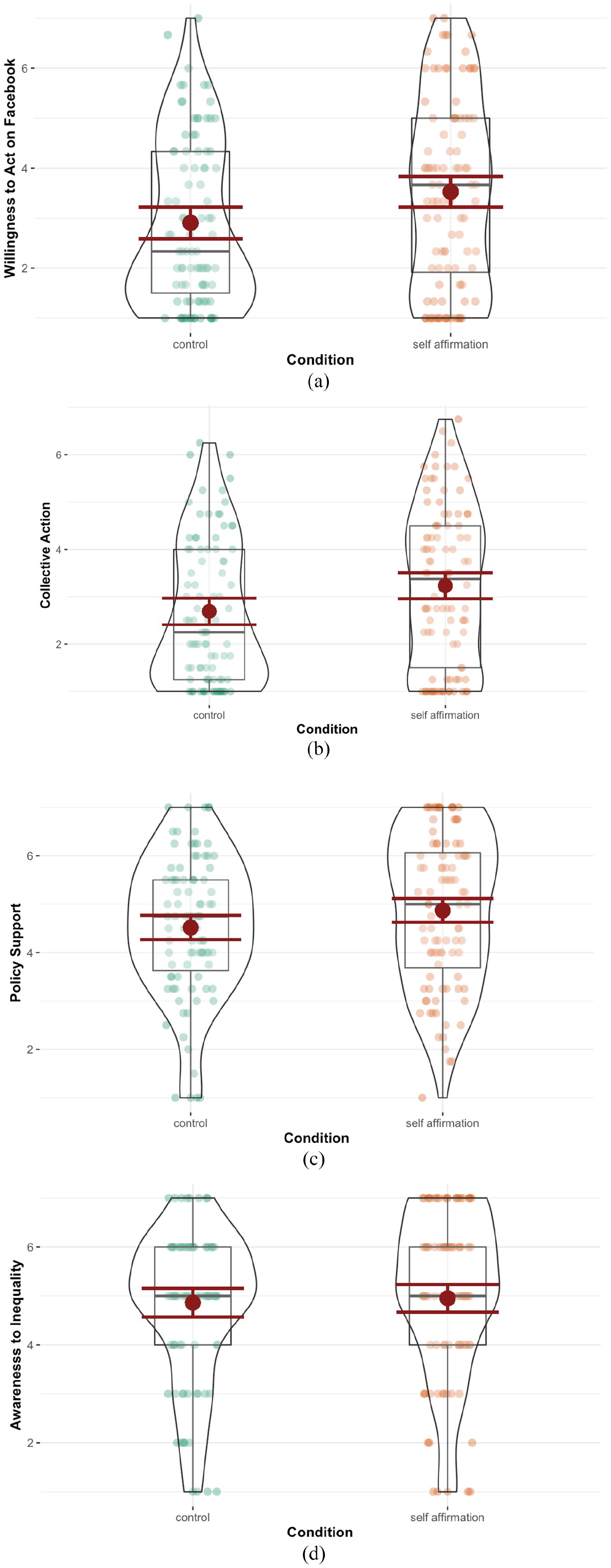
Effect of the self-affirmation intervention (vs. control) on (a) willingness to act on Facebook; (b) willingness for action; (c) support for policies to address inequality; and (d) awareness of inequality.
Discussion
In general, the results of Study 1 supported our hypotheses that a self-affirmation intervention would increase willingness to act to address inequality. 6 Participants in the self-affirmation condition were more likely to like and share the campaign video, support policies to address inequality, and be willing to engage in collective action. However, self-affirmation did not appear to increase participants’ general awareness of inequality as one would have expected. But, based on the distributions in Figure 1d, awareness of inequality was generally high, with a large majority of participants in both conditions agreeing that there is inequality between Jews and Arabs. As a result, it may have been more difficult to detect an effect on this variable.
Importantly, these results represent the first evidence that self-affirmation can be an effective intervention when conducted via a campaign video rather than a written essay. However, these videos were not at the level of real campaign videos—they were developed by the researchers and were longer, contained more text, and were less professionally produced than a real campaign video. Therefore, the NGOs hired a professional campaign video producer to take this initial draft and develop it into a real campaign video for use in their campaign. This then raised the question whether this real-world campaign video retained enough of the key features and effects of self-affirmation to remain effective. Thus, in Study 2, we set out to test the effectiveness of this self-affirmation campaign video.
Study 2
Study 2 aimed to replicate the results of Study 1 but using the final professionally developed self-affirmation video that was actually used in the campaign. Study 2 again consisted of two waves. Our lab was conducting another large-scale survey for another project to which we were able to add a very small number of baseline measures, and thus this survey served as our Wave 1. In Wave 2, we returned to these participants and randomly assigned them to watch one of three intervention conditions: (a) the self-affirmation condition, where they watched the self-affirmation video used in the NGOs’ Facebook campaign (n = 104); (b) a control condition, where they watched exactly the same video except that the self-affirmation exercise had been removed (n = 143); or (c) an empty control condition where they watched no video and continued with the study (n = 159). Then, participants completed scales measuring their willingness to act on Facebook, willingness to engage in collective action, support for various policies, and awareness of inequality. Study 2 was preregistered (see https://osf.io/ebrmc/). In general, we followed the analyses as preregistered and in any place that we deviate from the preregistration, we make note of it in the text.
Method and Procedure
Participants
In Wave 1, we recruited 824 Jewish Israelis online via an Israeli survey company, who were invited to take part in a study on current issues. They completed informed consent and then completed a number of measures regarding Jewish–Arab inequality (for the full list of measures, see the supplemental material; measures relevant to our study are reported in the following lines). Seventy-one participants (8.6% of the original sample) were excluded because they failed an attention check question (i.e., “This is an attention check. Please select strongly disagree for this question”). Additionally, using the “careless” package in R, we calculated the longest string of consecutive identical responses for each participant in the main survey items, and excluded 15 outliers on this measure (more than 2.5 SDs above the mean). This left a final sample of 738 Jewish Israelis (Mage = 44.02, SDage = 16.02, range: 18–85; 46.7% male; 53% rightist, 28% centrist, 19% leftist).
Participants from Wave 1 were invited back to Wave 2 approximately 2 weeks later. In order to detect a small effect (Cohen’s f = .10) 7 at 80% power, a sample size of 485 participants was required, and we aimed to collect slightly more participants in case of potential exclusions. Five hundred and ten participants completed Wave 2, nine participants (1.7% of the original sample) were excluded because they failed an attention check question (i.e., “This is an attention check. Please select strongly disagree for this question”). Additionally, we calculated the longest string of consecutive identical responses for each participant in the main survey items, and excluded 26 outliers on this measure (more than 2.5 SDs above the mean). Finally, as a final manipulation check, at the end of the study, participants were asked to report what they thought about during the video. The self-affirmation video in this study asked participants to remember something they shared on Facebook that was particularly meaningful or expressed who they truly are (see more detailed description in what follows). When we examined the responses to the manipulation check question, a number of respondents (n = 45) reported that they did not have or use Facebook and, as a result, could not think of anything during the video. As this was the key part of the manipulation, we decided to exclude these participants. 8 This left a sample of 406 participants (52.4% women; Mage = 44.5, range: 18–85; 55% rightist, 24% centrist, 21% leftist). Participants were paid by the survey company in exchange for their participation.
Wave 1 measures
Wave 1 measured short baseline measures, including some of the dependent variables as well as a number of other measures included as part of the larger project that was the main purpose of the study. We could not include all or full measures of our variables at Time 1 because the primary purpose of the Time 1 study was for another project and there was no room for the addition of a large number of items. All variables are presented in the supplemental material, but we present the main variables that are relevant to Wave 2 analyses here.
Awareness of inequality was measured with the item, “Please rate the extent to which you think there is inequality between Jews and Arabs in budget distribution” (1 = Jews are discriminated against compared to Arabs, 7 = Arabs are discriminated against compared to Jews, with 4 = full equality).
Willingness to act to address inequality was measured with the item, “Please rate the extent to which you would be willing to do something (e.g., share a post on social media, sign a petition, etc.) in order to address inequality in budget distribution” (1 = not at all willing, 7 = very willing).
Participants completed a brief demographic questionnaire including age, gender, religiosity, political ideology, education, income, and geographic area.
Wave 2 procedure and measures
In Wave 2, participants were invited to participate in a study on current social media campaigns; they were unaware that this study was connected in any way to Wave 1. After completing informed consent, they were informed that they would see a campaign video currently being advertised on Facebook (unless they were in the empty control condition), and that we were interested in their reactions to the video. Participants were then randomly assigned to one of three conditions. In the control condition, participants watched a ~50 s video (see https://youtu.be/qB5UPlLNgHA) that presented them with information about inequality in the budget distribution. In the self-affirmation condition, participants watched a ~60 s video (see https://youtu.be/molYRNNqHDI); in the first part of the video, participants were walked through a typical self-affirmation exercise adapted for the social media campaign video context, in which they were asked to think about a Facebook post they had recently written or shared that “was important to you” and “really showed who you are,” and they were asked to think about “how it [the post] made you feel.” These questions were paired with pictures corresponding to values that often appear in self-affirmation manipulations (e.g., a parent and a child bring to mind the value of family, which is common in the lists of values presented in self-affirmation interventions). We hoped this would help duplicate the mental state of a typical self-affirmation intervention but in video form. From there, the exact same video as in the control condition was played. The third condition was an empty control in which participants did not watch any video.
After watching the videos, participants answered two questions to check if they were paying attention (six participants were immediately excluded during the survey for failing these questions). Then, participants completed a number of measures examining their reactions to the video and their willingness to address inequality (for all measures, see the supplemental material).
Willingness to act on Facebook was measured with the same three-item scale as in Study 1, Wave 2, capturing participants’ willingness to like the video, share it, and share it with a personal comment (α = .93). Participants in the empty control condition did not complete this scale, as it was irrelevant because they did not watch any video.
Awareness of inequality (α = .87), support for policies to address inequality (α = .89), and willingness for collective action (α = .81) were all measured with the same scales as in Study 1, Wave 2.
Results and Discussion
Analysis strategy
We followed the same analysis plan as in Study 1; the preregistration, data file, and code can be found at the OSF (https://osf.io/ebrmc/). We analyzed the effect of the interventions using ANCOVAs, followed up by planned comparisons contrasting the self-affirmation condition with the control conditions. 9 We controlled for the baseline rather than examining change over time because our measures were different at Wave 2 (as we were limited to one-item measures at Wave 1), and thus not directly comparable across times. An overview of descriptive statistics and correlations between study variables is presented in the supplemental material.
Effects of the self-affirmation intervention
The self-affirmation intervention significantly increased participants’ willingness to share the video on Facebook relative to the control condition (this variable was not measured in the empty control, as it was not relevant to them). In addition, support for policies to address inequality was marginally higher in the self-affirmation condition in comparison to the control, but not to the empty control. The results were weaker than those observed in Study 1.
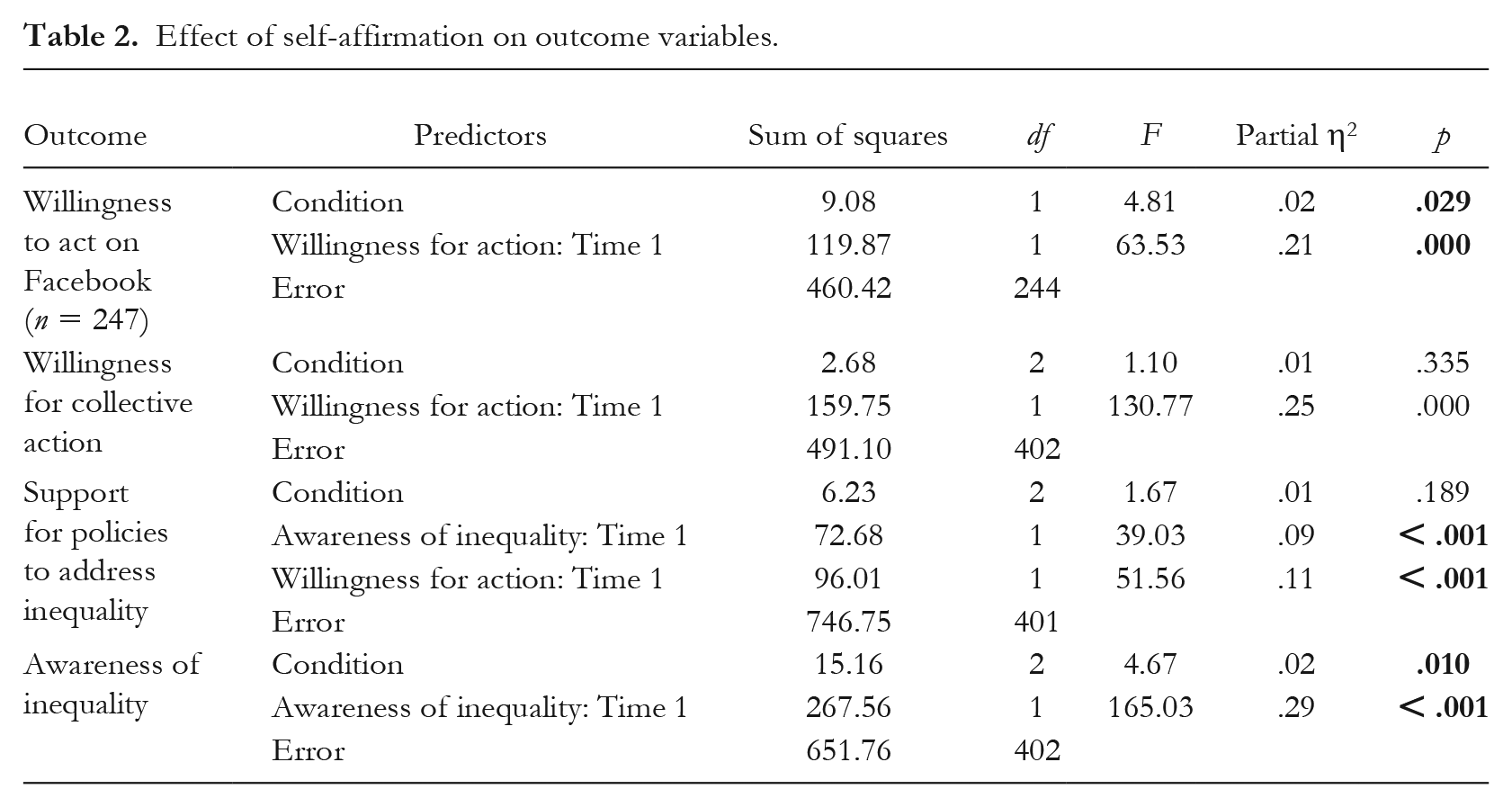
ANCOVAs indicated that the self-affirmation treatment had a significant effect on participants’ willingness to share the video on Facebook, but not on collective action intentions or support for policies to address inequality (see Table 1 and Figure 1). We still conducted all planned contrasts, 10 as a lack of difference between the two control conditions might obscure differences between the self-affirmation and these conditions in the overall ANCOVA. These additional analyses revealed that participants in the self-affirmation condition were significantly more willing to share the video on Facebook (M = 2.91, SE = 0.14) than participants in the control condition (M = 2.52, SE = 0.12), t(244) = 2.19, p = .029, Cohen’s f = .14. In addition, participants in the self-affirmation were marginally significantly more supportive of policies to address inequality (M = 4.48, SE = 0.13) than participants in the control condition (M = 4.16, SE = 0.11), t(401) = 1.82, p = .069, Cohen’s f = .11, but not significantly different from participants in the empty control (M = 4.28, SE = 0.11), t(401) = 0.73, p = .463, Cohen’s f = .08. In this study, there were not significant effects on willingness to engage in collective action relative to the control (p = .141) or empty control (p = .565; see Figure 2). While weaker than Study 1 in general, these analyses supported our hypotheses that the self-affirmation intervention would lead to increased willingness to engage in action to address inequality, particularly on Facebook, which was the target of the campaign video.
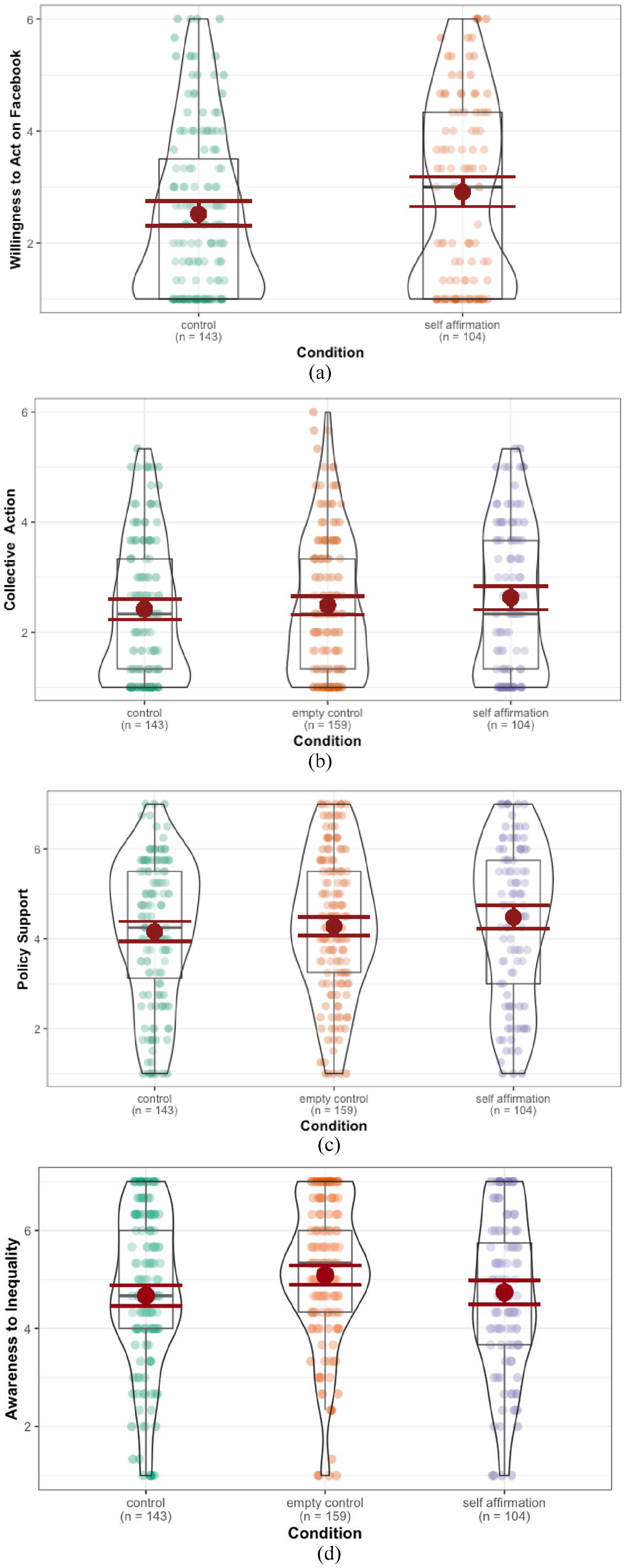
Effect of the self-affirmation intervention (vs. control and empty control) on (a) willingness to act on Facebook; (b) willingness for action; (c) support for policies to address inequality; and (d) awareness of inequality.
Based on the results of Study 1, we did not expect the self-affirmation manipulation to affect awareness of inequality; however, we still checked its effect on this variable. Unexpectedly, the ANCOVA indicated there was an effect of condition on awareness of inequality (see Table 1). Awareness of inequality was lower in the self-affirmation and control conditions compared to the empty control (see Table 2 and Figure 2d). In order to better understand this unexpected finding, we looked at change over time in the single item that appeared in both waves. This analysis is presented in full in the supplemental material, and indicated that awareness of inequality increased over time in both the self-affirmation and empty control conditions, but began at a lower value in the self-affirmation condition.
Effect of self-affirmation on outcome variables.
General Discussion
The main goal of these studies was to develop an effective intervention to motivate advantaged group members to address intergroup inequality. Across two studies, a self-affirmation intervention adapted into a campaign video increased willingness to act to address inequality. In Study 1, the self-affirmation video increased willingness to share the campaign on Facebook, support for policies to address inequality, and willingness to engage in collective action to advance equality; however, it did not raise awareness of inequality compared to a control video. The results of Study 2 largely replicated these findings; however, in this study, the effect on collective action was not significant. Overall, these results indicate that self-affirmation can be an effective intervention for increasing action to advance intergroup equality among advantaged group members, and that it can be effectively applied outside of an essay-writing context, namely in social media campaign videos.
Theoretical and Practical Implications
The current research adds to the growing literature on how to motivate the advantaged to become more supportive of actions that would advance intergroup equality (Dixon et al., 2017; Knowles et al., 2014; Lowery et al., 2012). Thus, this work helps to expand the literature on interventions to improve intergroup relations, from interventions that are more focused on prejudice reduction (Paluck et al., 2021) to include also interventions that aim to affect attitudes and action related to inequality. In addition, it helps support past work (Adams et al., 2006; Čehajić-Clancy et al., 2011; Hideg & Ferris, 2014; Unzueta & Lowery, 2008) indicating that self-affirmation can increase recognition of racism and intergroup wrongdoing, and action to correct these problems. Thus, it can help reduce the general tendency to engage in system justification when presented with evidence of inequality (see Goudarzi et al., 2020; Trump & White, 2018). Together with this literature, our results indicating effectiveness of a self-affirmation intervention suggest that it can help reduce the threats associated with addressing inequality among the advantaged group.
While a recent paper (Lesick & Zell, 2021) failed to replicate previous findings, there was a key difference between the replication and at least some of the prior studies (as well as our current study). Namely, the replication study did not provide participants with any additional information (which might be threatening) but was aimed at changing the participants’ intergroup attitudes and actions following the self-affirmation exercise. Some past research (Čehajić-Clancy et al., 2011; Hideg & Ferris, 2014) included either descriptions of ingroup wrongdoing or arguments for employment equity following the self-affirmation intervention. Similarly, we included information about inequality between the groups and a call to action to address it following the self-affirmation part of the intervention. Taken together, this indicates that this may be a key aspect of an effective use of self-affirmation. This aligns with the broader theory of self-affirmation, which sees self-affirmation as a buffer in the face of threat (Sherman & Cohen, 2006). As a result, it makes sense that, in order for self-affirmation to be effective, it requires a component providing potentially threatening information or experiences aimed at changing a person’s attitudes or behaviors.
Finally, this study represents an important step forward in practical applications of self-affirmation. Until now, self-affirmation has been almost exclusively applied in educational or sometimes health domains due to the fact that conducting a self-affirmation intervention required people to write an essay or engage in a value-ranking task (McQueen & Klein, 2006). This study demonstrates that it is possible to effectively integrate a self-affirmation intervention into a campaign video designed for use on social media. As many public campaigns now focus their efforts on social media, this significantly expands the potential applications of self-affirmation interventions and the ability of researchers and practitioners to scale these interventions up to reach mass audiences.
Limitations and Future Directions
There were some important limitations in the current study. First, neither study found effects of self-affirmation on awareness of inequality. In both studies, awareness of inequality was generally high; thus, it is difficult to determine if this lack of effect was a result of this specific contextual factor (i.e., that awareness in this context was already high) or if it reflects a general lack of efficacy of self-affirmation on this outcome variable. Second, the effects in Study 2 were slightly weaker than in Study 1. 11 To some extent, this makes sense, as we used a briefer intervention and tied it to the specific context of social media, which may have been less relevant for participants who are less frequent social media users. Future research should examine how to strengthen this intervention while maintaining its brief duration, which is key to real-world applicability.
Another limitation concerns the generalizability of these findings. All of these studies were conducted in Israel and in the context of Jewish–Arab relations; thus, there is a need for future studies to examine the generalizability of the results in other contexts. However, advantaged groups should theoretically experience similar psychological threats in response to information about inequality, thus making self-affirmation relevant in other intergroup contexts characterized by structural inequality. In line with this, there are studies that have found self-affirmation interventions increase White Americans’ awareness of racism in the US (Adams et al., 2006). Another potential limitation is that the studies used self-affirmation integrated into video clips; however, the design of video clips as the basis of psychological interventions is by no means an exact science, as can be observed in the weakening of effects from Study 1 to Study 2, when the video design was changed. Thus, we cannot be sure that self-affirmation operationalized into a video in a different manner would have similar effects.
Another potential direction for future research is examining the effectiveness of group affirmation. While we focused on self-affirmation, prior research has also shown that directly affirming people’s group identities can increase the amount of group-based guilt experienced by advantaged group members (Gunn & Wilson, 2011; Spencer-Rodgers et al., 2016). As a result, there is reason to believe it might also be effective in increasing advantaged group members’ willingness to address inequality. Finally, future research should examine this intervention in other contexts, both in other social contexts of intergroup inequality and in other campaign contexts besides a video campaign on social media, in order to see if these effects generalize.
In sum, this research addresses the challenge of motivating advantaged group members, who benefit from intergroup inequality both materially and psychologically, to support action to advance greater equality. We suggest that because action to address inequality is likely to be psychologically threatening for advantaged group members, self-affirmation, an intervention that enhances coping with psychological threats, may be an effective intervention. Indeed, in two studies that used a video-based adaptation of the classic self-affirmation manipulation, we found that self-affirmation increased willingness to address inequality among the advantaged group. Importantly, the second study tested a real campaign video that was used in an actual social media campaign by NGOs, indicating that self-affirmation can be effectively applied in real-world campaigns to advance equality. Thus, the current research offers a new avenue for those working to advance more equal societies.
Supplemental Material
sj-docx-1-gpi-10.1177_13684302221128505 – Supplemental material for Advancing support for intergroup equality via a self-affirmation campaign
Supplemental material, sj-docx-1-gpi-10.1177_13684302221128505 for Advancing support for intergroup equality via a self-affirmation campaign by Eric Shuman, Shira Hebel-Sela, Inbal Zipris, Yossi Hasson, Boaz Hameiri and Eran Halperin in Group Processes & Intergroup Relations
Footnotes
Funding
The author(s) disclosed receipt of the following financial support for the research, authorship, and/or publication of this article: This project was conducted by aChord Center: Social Psychology for Social Change. The first study in this work was part of a project funded by the Givat Haviva Educational Foundation and the Friedrich-Ebert-Stiftung Foundation, and the second study was funded by a European Research Council grant (No. 864347) to the last author.

Supplemental material
Supplemental material for this article is available online.
Notes
References
Supplementary Material
Please find the following supplemental material available below.
For Open Access articles published under a Creative Commons License, all supplemental material carries the same license as the article it is associated with.
For non-Open Access articles published, all supplemental material carries a non-exclusive license, and permission requests for re-use of supplemental material or any part of supplemental material shall be sent directly to the copyright owner as specified in the copyright notice associated with the article.
