




Abstract
In working teams, each member has an individual understanding of the social rules and norms that underlie social relationships in the team, as well as about what behavior is appropriate and what behavior can be expected from others. What happens if the members of a team are not “on the same page” with respect to these social rules and norms? Drawing on relational models theory, which posits four elemental relational models that people use to coordinate their social interactions, we examined the effects of a common understanding of relational models in teams (i.e., “shared relational models”) on various aspects of cooperative and uncooperative behaviors. We hypothesized that a shared understanding of relational models in a team is positively related to justice perception and negatively related to relationship conflict, which are in turn related to helping behavior and knowledge hiding. We conducted a field study, collecting data from 46 work teams (N = 189 total participants) in various organizations, and found support for all proposed hypotheses. Our findings emphasize the importance of a shared understanding of relational models for (un)cooperative behavior in teams, thereby opening a new door for research on relational models in organizations.
Keywords
Imagine a team of several scholars who have been invited to present their latest research findings at an important conference in a beautiful part of the world, but there are only enough financial resources for one person to go. Who should go? The person who would benefit the most from attending the conference? The person who contributed the most to the research project? The project leader? The person whose “turn” it is to go considering attendance at past conferences? Each of these decisions can be regarded as fair or unfair depending on the underlying moral motives and relational rules. Ideally, the members of a team have similar perceptions of these (often unspoken) moral motives and relational rules for relationship regulation. However, what are the consequences if team members are not on the same page about the type of relationships and their inherent social rules within their team?
The present research sheds light on this question. Building upon relational models theory (Fiske, 1992) as a theoretical framework of relationship regulation, we examine the psychological and behavioral consequences of a greater or lesser shared understanding of social rules for relationship regulation (i.e., shared relational models) among team members. Specifically, we examine whether and how this shared understanding is related to cooperative and uncooperative behavior in teams.
Relational models theory provides a theoretical foundation for understanding social behaviors, and offers explanations for the origins and consequences of relational rules and norms. Furthermore, relational models theory makes clear predictions regarding justice perception and relationship conflict when different social rules are applied by the interacting individuals (Fiske, 1992). However, empirical studies testing these predictions are still scarce and their results were often not in alignment with the authors’ expectations (e.g., Poulson, 2005). Thus, more research is needed to gain empirical support for some of the key assumptions of relational models theory. In addition, although relational models theory is receiving increasing attention in organizational psychology, this is mostly taking place at a theoretical level, and empirical studies testing the assumptions of the theory in work contexts are still rare.
In the study presented here, we aim to close this research gap by examining the consequences of the application of different relational models in organizational teams. We propose that team members’ shared understanding of the relational models underlying the social interactions in their team is linked to perceived justice and relationship conflict in teams, which are in turn related to various cooperative and uncooperative behaviors. In this study, we focus on two such behaviors: helping and intentionally withholding knowledge (knowledge hiding).
Helping and knowledge hiding are two variables of particular interest for organizations. On the one hand, cooperative behaviors such as helping have been repeatedly shown to play a substantial role in team performance (N. P. Podsakoff et al., 2009, 2014). On the other hand, uncooperative behaviors such as knowledge hiding not only lack the positive effects of cooperative behaviors but actually have detrimental effects on social relationships (Connelly & Zweig, 2015) and team performance (e.g., Černe et al., 2014).
Relational Models Theory
The key question addressed in relational models theory is quite simple: How do people relate to each other? The theory identifies four fundamental relational models—communal sharing, authority ranking, equality matching, and market pricing—which people use to regulate their social interactions. People use these relational models “to plan and to generate their own action, to understand, remember, and anticipate others, to coordinate the joint production of collective action and institutions, and to evaluate their own and others’ action” (Fiske, 2004, p. 3). In a nutshell, relational models allow people to instantly appraise what is appropriate in a given situation requiring social interaction.
Relational models are also the basis of fairness perceptions and moral judgements within relationships. Each relational model encompasses a distinct fundamental moral motive (Rai & Fiske, 2011). The question of what behavior is perceived as appropriate, of what interaction is perceived as fair—regardless of whether this evaluation refers to the way resources are distributed or the way a decision is made within the group—and of what behavior is perceived as moral or immoral, “right” or “wrong,” largely depends on the relational model the assessor is applying in a specific situation (Simpson & Laham, 2015; Simpson et al., 2016).
The communal sharing model (CS) is based on a perceived common identity. The central motive in this relational model is unity, and relationships based on this model are characterized by feelings of solidarity, affiliation, and conformity. In a communal sharing relationship, people treat each other as the same; individual attributes and differences among group members fade into the background. When decisions have to be made, members strive to reach consensus within the group. Resources are allocated on the basis of need, without keeping track of specific group members’ inputs and outputs. In fact, active accounting of exchanges within the group is perceived as morally reprehensible (Rai & Fiske, 2011).
The authority ranking model (AR) is applied when people perceive each other as in some kind of hierarchical order with respect to a certain dimension (e.g., formal rank, expertise, seniority). Thus, the underlying moral motive is hierarchy. People who are lower in the hierarchical order are expected to show respect and loyalty to people who are higher in the hierarchical order. In turn, higher ranking people are expected to lead and protect people lower in the hierarchy. Thus, it is socially acceptable for higher ranking people to make decisions for the whole group (but they are also expected to bear responsibility for these decisions). When resources have to be allocated in an authority ranking relationship, it tends to be socially accepted that higher ranking people receive more than lower ranking people.
The equality matching model (EM) is based on turn-taking, equality, and reciprocity. Thus, the underlying moral motive is equality. When an equality matching model is applied, people treat each other as equal but distinct individuals, and keep track of the balance of contributions in the relationship. When decisions have to be made, all group members’ voices have the same weight. When resources have to be allocated in an equality matching relationship, each individual is eligible for the same share of these resources.
The market pricing model (MP) is based on the moral motive of proportionality and is characterized by rational economic cost–benefit calculations. When a market pricing model is applied, people’s actions are guided by a consideration of what they put into and get out of a given relationship. When resources have to be allocated, each individual’s share depends on how much this individual has contributed. Thus, the extent of an individual’s participation and engagement in a relationship largely depends on the benefits and payoffs he or she can expect from it.
These four relational models are the basic building blocks of social cognition and form the basis for successful relationship regulation. They are exhaustive in that they cover all possible ways of seeing oneself in interaction with one’s interaction partner in a social relationship (Favre & Sornette, 2015), and they are universal in that they exist in all cultures (Fiske, 2004). According to relational models theory, cultural differences in relationship regulation are only rooted in different implementation rules, which determine how exactly the individual models are put into practice and, to a certain extent, which relational model is appropriate in which social situation or social relationship (Fiske, 1992, 2000). Thus, according to relational models theory, social norms—may they be of explicit or implicit nature (Cialdini, 2012)—can be understood as implementation rules that determine which relational models are appropriate in which relationship or social interaction, and how in detail they are to be put into practice. Put another way, social rules and norms about relationship regulation in teams can be seen as manifestations and combinations of these four relational models, which coordinate and regulate social interactions between team members. The question of what behavior is socially acceptable in team work therefore depends on the relational models that dominate in specific situations and interactions (Simpson & Laham, 2015; Simpson et al., 2016). In other words, in any specific situation in time, one relational model is prevalent; in different situations, different relational models can be prevalent; however, certain relational models are more dominant than others in a given relationship or group.
In the last decade, relational models theory has gained some attention in organizational science. For example, it has been used as a theoretical framework for investigating helping behavior (Mossholder et al., 2011), joint value creation in organizations (Bridoux & Stoelhorst, 2016), leadership emergence (Wellman, 2017), ethical leadership (Giessner & van Quaquebeke, 2010), knowledge sharing (Boer et al., 2011), proactive behavior (Batistič et al., 2016), and interpersonal conflict at work (Frone, 2000; Vodosek, 2000).
The added value of relational models theory as a theoretical framework for examining human social interactive experiences and behavior in organizations lies in its comprehensive description and explanation of different perceptions of fairness and of the appropriateness of social actions in different social situations and relationships. Relational models theory can explain how and why one and the same behavior can be experienced as either fair or unfair depending on the salient relational model. However, a considerable proportion of the research linking relational models theory to organizational research is theoretical in nature (Bridoux & Stoelhorst, 2016; Giessner & van Quaquebeke, 2010; Mossholder et al., 2011; Vodosek, 2000; Wellman, 2017), and the number of empirical studies testing the theoretical assumptions derived from relational models theory in organizational contexts (e.g., Boer et al., 2011; Frone, 2000; Vodosek, 2009) is still very low.
Shared Relational Models in Teams, Justice Perceptions, and Conflict
There is typically a high degree of consensus among interaction partners about which relational model is appropriate in a specific social interactive situation (Fiske, 1992). Applied to the context of a work team, this means that team members ideally have a shared understanding of which relational models are “valid” in their team. In this case, social interactions between team members are regulated by the same relational model and are based on the same moral motive. This does not require team members to explicitly communicate about the nature of relationships in the team; like other forms of team coordination (see Rico et al., 2008), this agreement can take place solely at an implicit level. However, research in recent decades has repeatedly shown that teams can differ in the extent to which they share similar cognitive structures (for an overview, see e.g., Cannon-Bowers & Salas, 2001; Cannon-Bowers et al., 1993; Mohammed et al., 2010; Tindale & Kameda, 2000; Turner et al., 2014). Scholars studying various forms of shared cognitive constructs have looked at both team-focused and task-focused mental models, with the latter receiving significantly more attention in empirical research (Mohammed et al., 2010). In the same way that team members can have a greater or lesser shared understanding of how concrete tasks should be solved, they can have a greater or lesser shared understanding about how fundamental social interaction “works” in their team. In other words, team members can vary in the degree to which they share the same mental model about which social behavior is appropriate, and which social rules and norms underlie the relationships within the team. In terms of relational models theory, they can have a (greater or lesser) shared understanding about which relational models are applied in which situations in their team. We term this degree of sharedness of relational models within teams shared relational models.
Our question of interest is: What is to be expected when team members are not on the same page about which social rules and norms are appropriate in their working team or, more specifically, what happens when interaction partners apply different relational models to the same social interactive situations related to work group functioning?
Fiske (1992) points out that “adherence to one model [of the four theoretically specified models] usually violates the standards of any other” (p. 712). In other words, the principles of fairness and justice contained within the different relational models are usually incommensurable with one another. A social action that is strongly encouraged in one relational model is likely to be viewed as wrong in another relational model.
Revisiting the example presented at the beginning of the paper: Imagine a team of several scholars who have been invited to present their team’s latest research findings at an important conference in a beautiful part of the world, but there are only enough financial resources for one person to go. A team member who sees the communal sharing model as valid for allocating scarce resources would tend to apply the principle of need and propose that the team member who would benefit most from attending the conference should be the one to go. In the context of a communal sharing relationship, this approach is considered fair and appropriate, even if this team member did not contribute very much to the team’s success. However, a team member who applies a market pricing model in such situations is likely to perceive this proposal based on a communal sharing model as unfair. Instead, in a market pricing model, it would be considered fair and consistent for the team member who contributed the most to the team’s success to go to the conference. By contrast, a team member applying an authority ranking model to allocating resources in the team would believe that a fair approach is to send the highest status team member (e.g., the leader or the most experienced member) to the conference. Finally, a team member who perceives an equality matching model as valid in this situation would consider it fair for the decision about who goes to the conference to be made on the basis of turn-taking or drawing lots.
When team members differ in their presumed relational models and thus have fundamentally different moral motives and expect fundamentally different justice principles to be applied (i.e., a low degree of shared relational models), they are highly likely to experience injustice within the team (Connelley & Folger, 2004; Poulson, 2005). Conversely, when team members agree on what relational models to apply, hold the same moral motives in a particular situation, and thus believe that the same justice principles are appropriate (i.e., a high degree of agreement about relational models), they are highly likely to experience justice within the team.
Hypothesis 1a: The degree of sharedness of relational models in teams is positively related to justice perceptions within teams.
In a similar vein, team members’ application of different relational models is likely to lead to relationship conflict in teams. Distinct from task conflict and process conflict, relationship conflict refers to interpersonal, non-task-related disagreements (Jehn, 1995). The more team members see each other as violating the principles underlying the relational models they consider valid for a given aspect of relationship regulation during teamwork, the more tension they are likely to experience (Fiske, 1992), which should also result in more relationship conflict (Vodosek, 2000).
Hypothesis 1b: The degree of sharedness of relational models in teams is negatively related to perceptions of relationship conflict among team members.
Justice, Relationship Conflict, and Helping Behavior
In the hypotheses described before, justice perceptions and relationship conflict are considered consequences of the degree to which relational models are shared among team members. However, they can also serve as antecedents of the quality of subsequent social exchange processes (Cropanzano & Mitchell, 2005).
One form of social exchange that is of particular importance in organizations and thus has been intensively studied in organizational psychology is helping behavior among employees. Helping behavior is typically classified as a form of individual-oriented organizational citizenship behavior (OCBI), defined as behaviors that “immediately benefit specific individuals and indirectly through this means contribute to the organization” (Williams & Anderson, 1991, p. 602). A large body of research has shown positive consequences of helping behavior in organizations (N. P. Podsakoff et al., 2014).
Helping behavior is embedded in the predominant social context and affected by the quality of relationships (Anderson & Williams, 1996). Relationship conflict has been found to be negatively related to various aspects of relationship quality, including trust, cohesion, and positive affect, as well as to team members’ (interpersonal) citizenship behaviors (de Wit et al., 2012). Thus, we predict the following:
Hypothesis 2a: The higher the perceived relationship conflict among team members, the less helping behavior is perceived in teams.
Injustice perceptions among team members are likely to lead to lower levels of helping behavior as well. When team members perceive social interactions as unfair, they may “learn” that other team members are likely to break the relational rules. Taking a classical social exchange perspective, where resources are exchanged between individuals on basis of implicit rules (Cropanzano & Mitchell, 2005), it can be assumed that people may no longer be willing to invest resources (i.e., time, energy, expertise) in helping other teammates when they cannot be sure that their colleagues won’t break the relational rules again. This assumption is supported by empirical findings linking justice perceptions to various forms of cooperative behaviors (e.g., Barclay & Kiefer, 2014; Naumann & Bennett, 2002). Thus, we predict the following:
Hypothesis 2b: The higher the perceived justice in teams, the more helping behavior team members report.
Taken together, this leads to the following prediction:
Hypothesis 2c: The degree of sharedness of relational models in teams is positively and indirectly related to helping behavior in teams via relationship conflict and justice perception.
Justice, Relationship Conflict, and Knowledge Hiding
Justice perception and relationship conflict may not only affect cooperative behaviors in teams but also behaviors which are explicitly of an uncooperative nature. One form of uncooperative behavior that has received growing attention in psychological research in recent years (for an overview, see Rezwan & Takahashi, 2021) is knowledge hiding, defined as “an intentional attempt by an individual to withhold or conceal knowledge that has been requested by another person” (Connelly et al., 2012, p. 65). Although knowledge hiding seems to have some conceptual overlap with related constructs such as knowledge hoarding or counterproductive working behaviors, it is considered to be a distinct construct, largely unrelated to them (for a detailed distinction of knowledge hiding to other constructs, see Connelly et al., 2012). A significant predictor of knowledge hiding is distrust (Černe et al., 2014; Connelly et al., 2012), which often results from broken obligations. Building upon these findings, scholars have explicitly recommended investigating interpersonal justice and (un)fair treatment as antecedents of knowledge hiding (Connelly et al., 2012).
From a social exchange perspective, the sharing of knowledge can be seen as an exchange of resources. Thus, just as in the case of helping, team members who perceive injustice in their team (due to the application of different relational models among team members) may no longer be willing to invest resources in the relationship and thus may intentionally withhold knowledge instead of sharing it with other team members.
Moreover, in reaction to a perceived violation of relational rules, other team members may not only be motivated to withhold resources due to distrust or in expectation that the other person will not reciprocate in the future, but also to punish and harm the transgressor by intentionally withholding knowledge. Generally, people strongly believe that other people should adhere to the relational models they perceive as valid in a social relationship (Fiske, 1992). This concerns not only relationships and interactions in which one is personally involved but also relationships and interactions between third parties one witnesses as an observer. Thus, if a team member perceives a specific relational model (e.g., communal sharing) as valid in his or her team, his or her relationship with another team member who violates this model because he or she is applying another relational model (e.g., market pricing) will be impaired even if the violation does not occur in a direct interaction between these two individuals. Instead, merely witnessing the violation of a relational model perceived as valid in a social interactive situation can be sufficient to harm the relationship between the observer and the actor (Fiske, 1992).
Therefore, the application of different relational models in a team (i.e., a low degree of sharedness of relational models) is likely to promote knowledge hiding by causing relationship conflict and perceived injustice. Conversely, such violations and their consequences are less likely to occur where a shared perception of which relational models to apply in a team exists (i.e., a high degree of sharedness of relational models). Taken together, this leads to the following predictions:
Hypothesis 3a: The higher the perceived relationship conflict among team members, the more knowledge hiding behavior team members report.
Hypothesis 3b: The higher the perceived justice in teams, the less knowledge hiding behavior team members report.
Hypothesis 3c: The degree of sharedness of relational models in teams is negatively and indirectly related to knowledge hiding reported by team members via perceived relationship conflict and justice perception.
Method
Sample and Procedures
To test our hypotheses, we conducted a field study via online questionnaires and collected data from teams working in various organizations and sectors in Germany, Austria, and Switzerland. The sample was a convenience sample, recruited in two different ways: First, individuals from the personal and professional networks of the authors were contacted and asked to participate together with their working teams. Second, the study was advertised in social networks (mainly Linkedin and Xing). Potential participants received an information document in which they were informed about the aim and the procedure of the study. With regard to the research question, they were only informed that the study dealt with cooperation in teams. When they were interested in participating, they received an anonymous link, including an URL parameter that allowed us to match the data of the respective team. Participants had the option to take part in a raffle for €150 and to get informed about the overall results of the study. Altogether, 272 participants from 61 teams participated in the study. However, 49 participants were excluded because they only completed one or two pages of the questionnaire; furthermore, 15 teams (30 individuals) were excluded because fewer than three team members completed the questionnaires. Consequently, 193 individuals nested in 46 teams remained in our sample. Of these 193 individuals, four participants did not fully complete the questionnaires. However, since they broke off their participation close to the end of the questionnaire, and since we deemed their view of the social rules and norms in their team to be valuable, we decided to nevertheless use their data when calculating the degree of sharedness of relational models on the team level. No other data from these participants were included in the study.
Thus, our final sample for hypothesis testing consisted of N =189 individuals nested in 46 teams. The number of participants per team ranged from three to eight (M = 4.48, SD = 1.39). The average age was 36.52 years (SD = 11.15), ranging from 23 to 70 years. Seventy percent of the participants were female and 82% held a university degree. The sample consisted of individuals from Germany (82%), Austria (9%), Switzerland (6%) and other nationalities (3%). The actual team size reported by the participants ranged from three to 31 (M = 7.80, SD = 4.39). Eighteen percent of participants had been working in their current team for less than 1 year, 20% between 1 and 2 years, 32% between 2 and 5 years, 13% between 5 and 10 years, and 17% for more than 10 years.
Measures
Unless stated otherwise, all items were answered on a 5-point agreement scale (1 = strongly disagree, 5 = strongly agree).
Our questionnaire included additional measures which were collected in order to replicate the findings of an earlier study, these variables are reported in Arendt et al. (2018).
Relational models in teams
The participants’ individual perceptions of relational models in their teams, representing the social rules and norms each team member considered valid in their team, were assessed using the Relational Models Scale from Vodosek (2009). It was translated into German by individuals fluent in both German and English. The scale encompasses four subscales, one for each of the four relational models, with four to five items each. A sample item for the Communal Sharing Subscale is, “If one of the group members needs something, other group members give it without expecting anything in return.” All subscales were reliable (CS: α = .72; AR: α = .85; EM: α = .76; MP: α = .70).
To assess the degree to which relational models were shared among team members, we conducted the following calculations: First, we calculated rwg values for each team on each of the four scales representing the four relational models. rwg is a measure assessing inter-rater agreement and reflects “agreement among judges [i.e., team members] by comparing the observed variance to the variance expected when the judges [i.e., team members] respond randomly” (LeBreton & Senter, 2008, pp. 818–819; also see Klein & Kozlowski, 2000; Lindell et al., 1999). In our case, the rwg value was used to specify the amount of agreement among the responding team members regarding their perception of the four relational models in their teams. Second, we summed up the four rwg values for the four relational model scales per team in order to get one overall parameter for the degree of sharedness of relational models within each team. We chose this approach for three reasons: First, the rwg captures the degree of sharedness without being reliant on asking participants directly (e.g., “how similar are the perceptions within your team regarding the way you interact with each other?”), which would entail many problems such as common source, common method, personal biases. Second, the overall index offers the opportunity to compare all teams on the same basis—no matter whether they had more (or less) degree of sharedness in one or the other specific relational model. Third, an overall rwg to measure sharedness was used in the literature before (e.g., Levesque et al., 2001).
Justice perception
Team members’ overall justice perceptions were measured with five items adapted from Ambrose and Schminke (2009). A sample item is, “In our team, team members are treated fairly.” Cronbach’s alpha was α = .89.
Relationship conflict
Relationship conflict in the team was measured with three items from the German version of Jehn’s Intragroup Conflict Scale (Jehn, 1995) taken from Lehmann-Willenbrock et al. (2011). A sample item is, “There is much tension among members in my team.” Cronbach’s alpha was α = .83.
Helping behavior
Team members’ helping behavior was measured with the OCBI subscale from Lee and Allen (2002), translated into German by individuals fluent in both German and English. Since we sought to measure team members’ helping behaviors as comprehensively as possible, the items were included twice in order to obtain both self-reported and peer-reported data: First, individuals were asked to indicate their own level of helping behavior (i.e., individual helping). Second, we asked about the extent to which team members observe helping behavior within their team as a whole (i.e., team helping). Sample items were, “I willingly give my time to help others who have work-related problems” (individual helping) and “Team members willingly give their time to help others who have work-related problems” (team helping). The items were answered on a 7-point agreement scale (1 = strongly disagree, 7 = totally agree). In the Individual Helping Scale, one item exhibited a very low item-total correlation (r = .25) and was thus excluded from the scale. Cronbach’s alpha was α = .75 for individual helping, and α = .86 for team helping.
Knowledge hiding behavior
Individuals’ level of knowledge hiding behavior was measured with a German version of the 12-item scale developed by Connelly et al. (2012) and translated by Knipfer and Schmid (2019). Since knowledge hiding behaviors are not necessarily noticed by others, the construct was only measured on the individual level. A sample item is, “When a coworker requested knowledge from me, I offered him/her some other information instead of what he/she really wanted.” The items were answered on a 7-point frequency scale (1 = never, 7 = always). Cronbach’s alpha was α = .79.
Research Model
Given the hierarchical nature of our data, our research model has two levels: the individual level (Level 1: n = 189 team members) and the team level (Level 2: n = 46 teams). Kozlowski and Klein (2000) have noted that researchers should clearly define their level of theory and the level of measurement in their research models. The independent variable in our model (i.e., shared relational models) is located on the team level, as it is a function of team members’ agreement about relational models in their teams. The other constructs were assigned to the two levels of our research model on the basis of theoretical considerations and the respective scales’ frames of reference (i.e., Do the items refer to the team as a whole, with the team member answering the question serving as an observer, or do they refer to the team member as an individual?). Justice perception and relationship conflict were conceptualized and assessed as team-level constructs because we were interested in team members’ perceptions of the overall justice and general level of relationship conflict in their teams. Therefore, these variables were aggregated to the team level. Since helping behavior was assessed twice, once with reference to each individual’s own helping behavior and once with reference to helping behavior in the team as a whole, this variable was located on both the team level and the individual level. Given that knowledge hiding involves concealed actions and is not necessarily noticed by others, this construct was conceptualized and assessed on the individual level. Figure 1 represents our proposed mediation model.
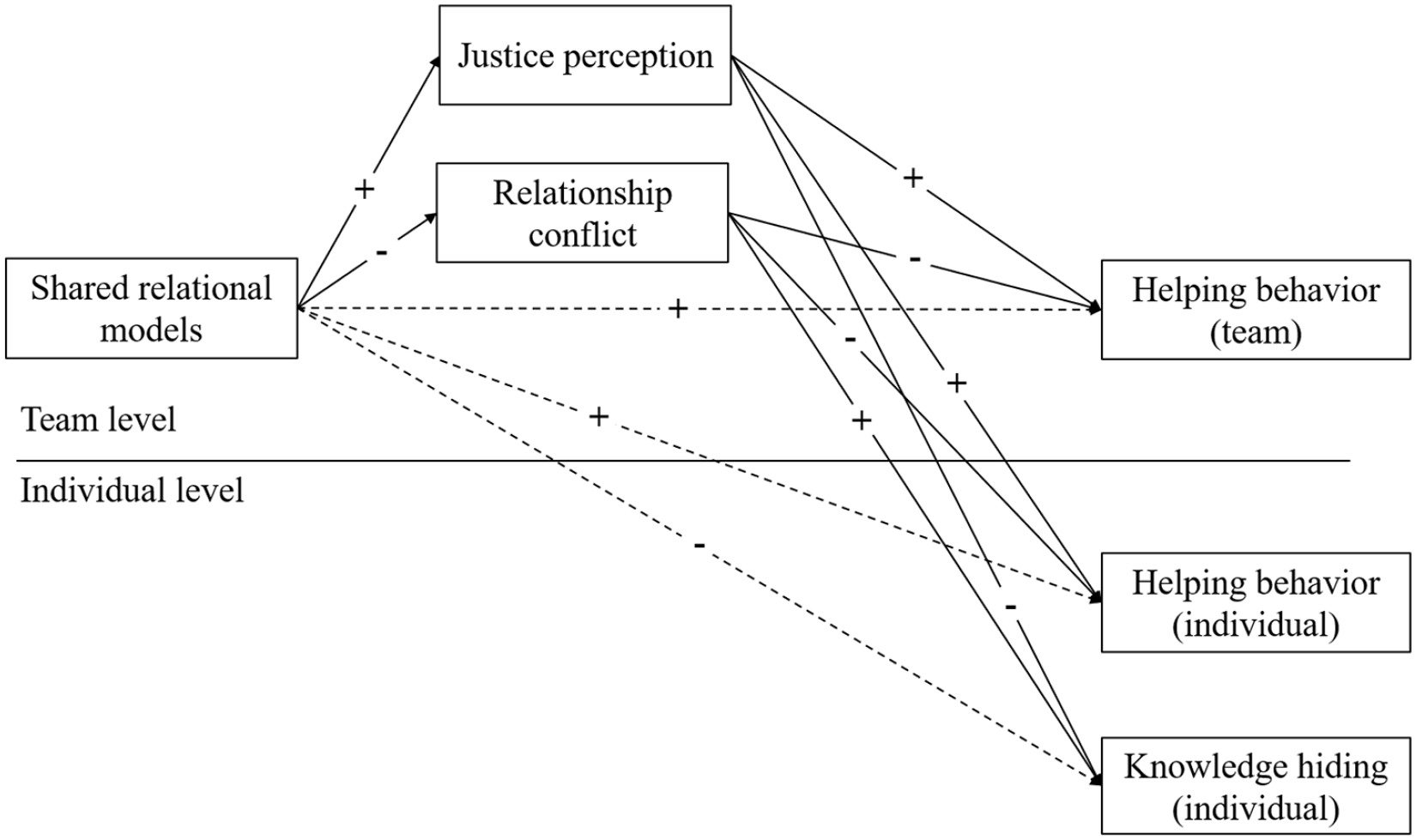
Proposed mediation model.
Results
Data Aggregation and Analysis
In order to assess the appropriateness of aggregating individual-level measures to form our team-level constructs, we calculated intraclass correlation ICC(1) and rwg values for the respective variables. The rwg values ranged from .81 to .92, and all ICC(1) values were statistically significant, indicating that group membership had a substantial effect on individual ratings (LeBreton & Senter, 2008). Hence, we statistically aggregated these scales (i.e., justice perception, relationship conflict, and team helping) to the team level. The calculation of the overall degree of sharedness of the relational models in teams was done as described before in the Measures section. The rwg and ICC values for all our main variables are presented in Table 1.
Means, standard deviations, reliabilities, interrater agreement (rwg), and intraclass correlations (ICC) values.
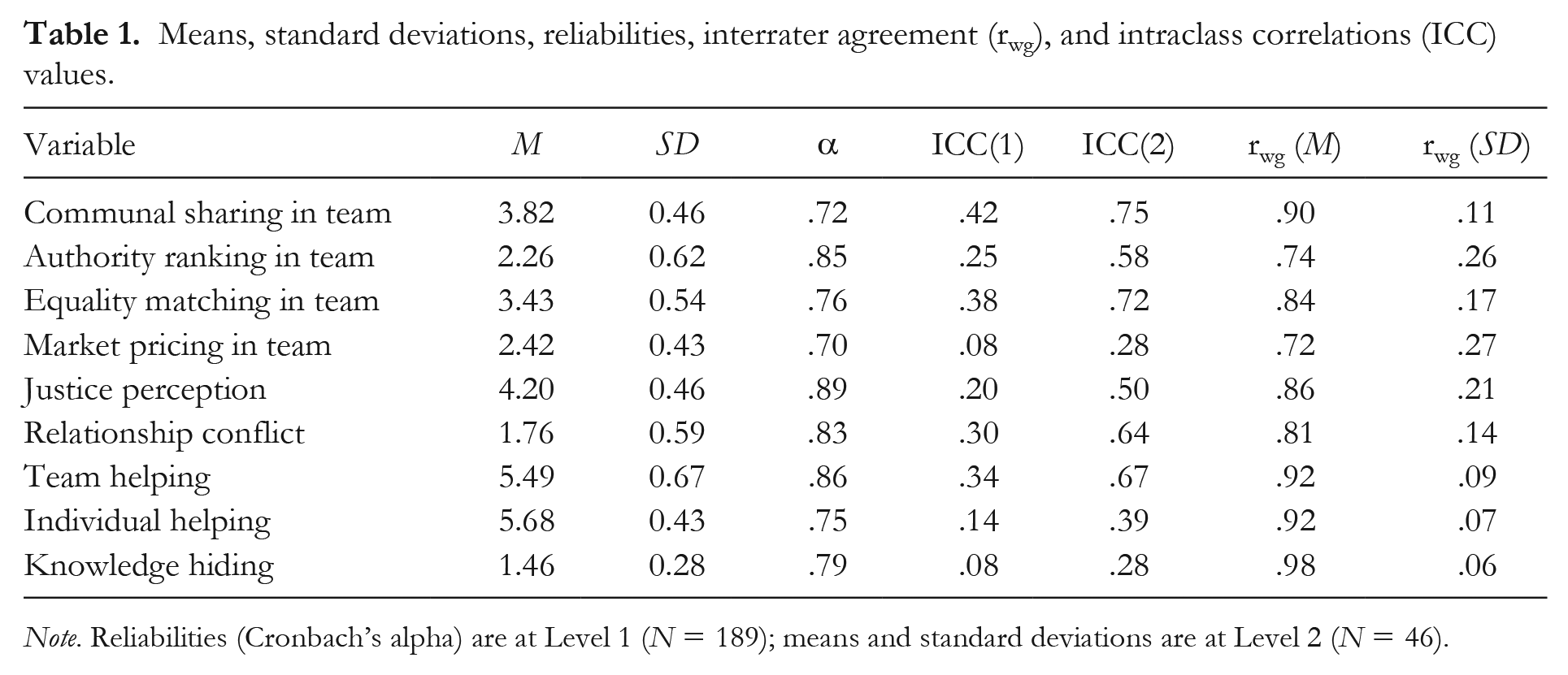
Note. Reliabilities (Cronbach’s alpha) are at Level 1 (N = 189); means and standard deviations are at Level 2 (N = 46).
Following Zhang et al.’s (2009) suggestions for cross-level mediation models, we included our mediator variables on both levels (i.e., group mean-centered on the individual level, and aggregated on the team level) in order to differentiate within-group variance from between-group variance. We analyzed the mediators on the team level because we were interested in the impact on members of different teams and thus the team-level effects. The individual-level mediators representing the effects within teams were treated as control variables.
Our multilevel hypotheses were tested using the hierarchical linear modelling methodology (HLM7; Raudenbush et al., 2011). The team-level hypotheses were tested using IBM SPSS 24 and the SPSS program PROCESS (Hayes, 2013).
Hypothesis Tests
Correlations, means, and standard deviations for all variables are shown in Table 2. Table 3 and Table 4 show the results of our hypothesis tests, which are described in more detail in what follows.
Means, standard deviations, and correlations.
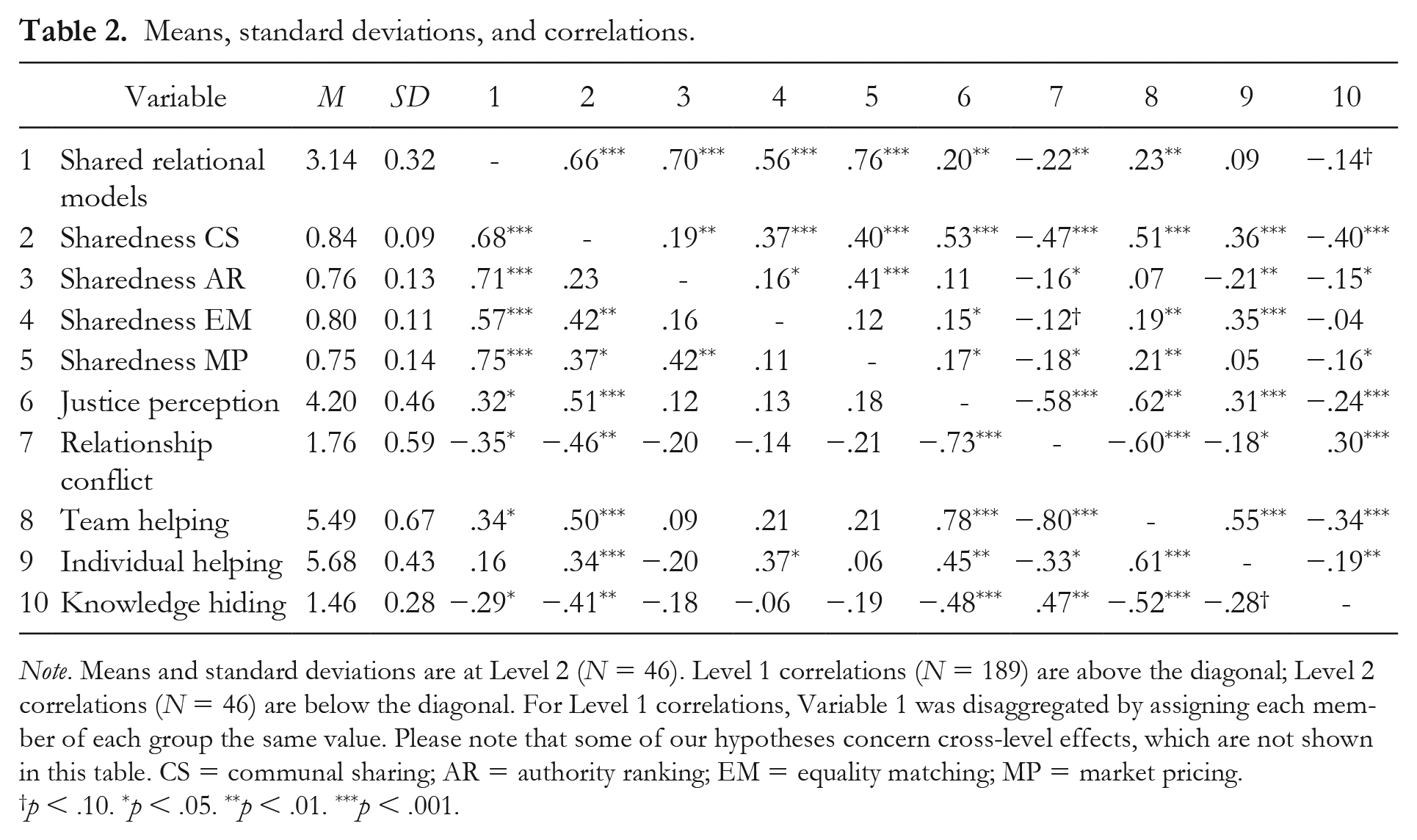
Note. Means and standard deviations are at Level 2 (N = 46). Level 1 correlations (N = 189) are above the diagonal; Level 2 correlations (N = 46) are below the diagonal. For Level 1 correlations, Variable 1 was disaggregated by assigning each member of each group the same value. Please note that some of our hypotheses concern cross-level effects, which are not shown in this table. CS = communal sharing; AR = authority ranking; EM = equality matching; MP = market pricing.
Results of mediation analyses (mediator: justice perception).
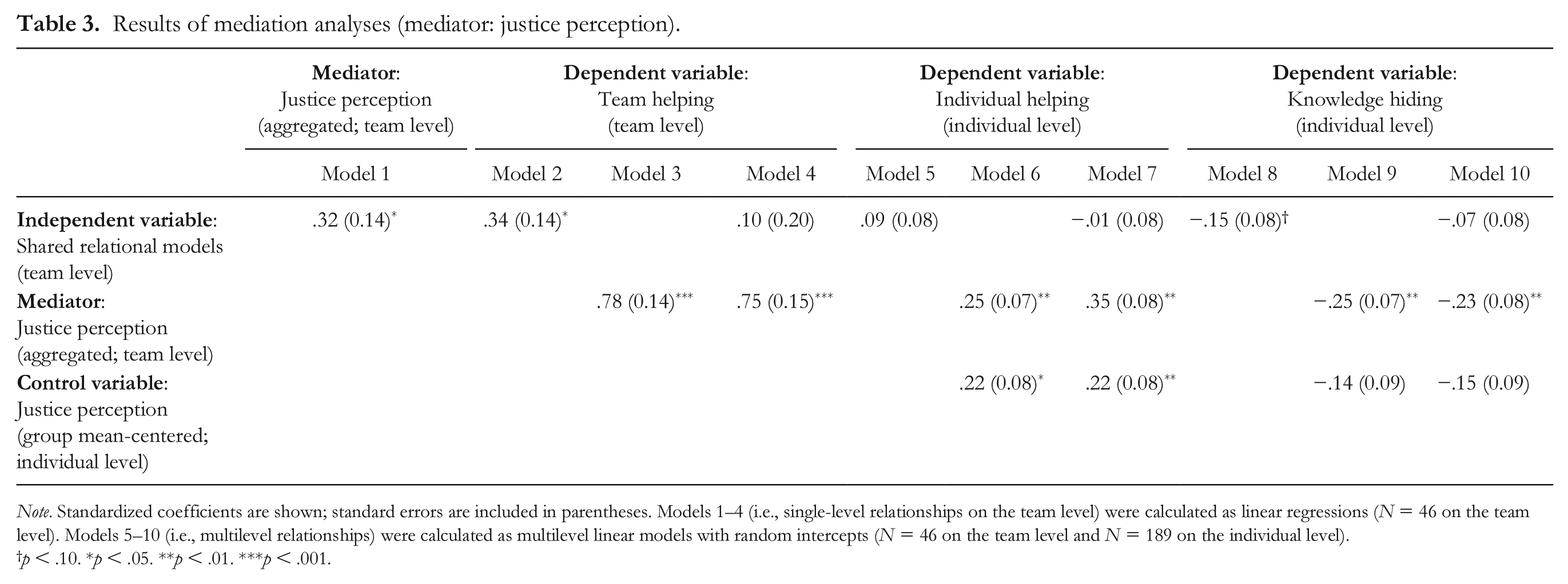
Note. Standardized coefficients are shown; standard errors are included in parentheses. Models 1–4 (i.e., single-level relationships on the team level) were calculated as linear regressions (N = 46 on the team level). Models 5–10 (i.e., multilevel relationships) were calculated as multilevel linear models with random intercepts (N = 46 on the team level and N = 189 on the individual level).
Results of mediation analyses (mediator: relationship conflict).
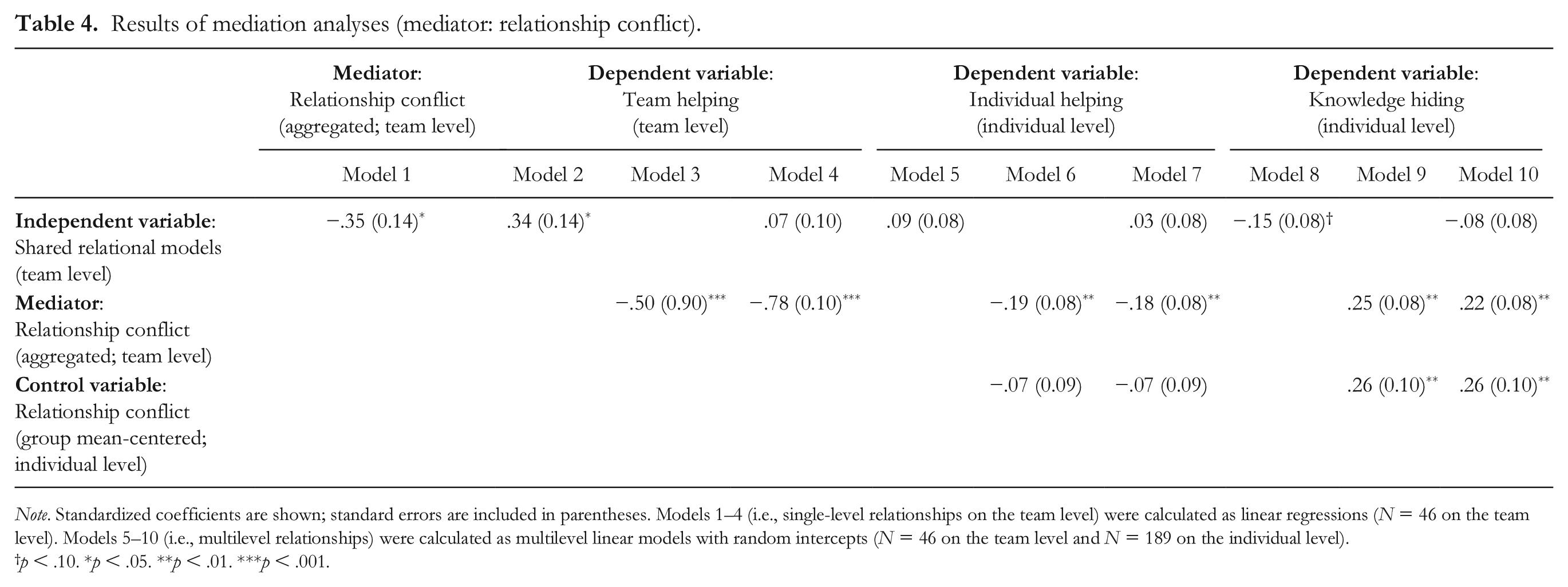
Note. Standardized coefficients are shown; standard errors are included in parentheses. Models 1–4 (i.e., single-level relationships on the team level) were calculated as linear regressions (N = 46 on the team level). Models 5–10 (i.e., multilevel relationships) were calculated as multilevel linear models with random intercepts (N = 46 on the team level and N = 189 on the individual level).
Supporting Hypothesis 1a, we found shared relational models to be positively related to justice perceptions among team members (β = .32, p = .030). Supporting Hypothesis 1b, we found shared relational models to be negatively related to perceived relationship conflict in teams (β = −.35, p = .016). The higher the degree of sharedness of relational models in teams, the more justice and the less relationship conflict were perceived among team members.
Supporting Hypothesis 2a, we found relationship conflict on the team level to be negatively related to helping behavior on the team level (β = −.80, p < .001) as well as on the individual level (β = −.19, p = .019). The more relationship conflict was perceived among team members, the less helping behavior was perceived in teams, and the less individual helping behavior was reported by team members. Supporting Hypothesis 2b, we also found perceived justice on the team level to be positively related to helping behavior on the team level (β = .78, p < .001) as well as on the individual level (β = .25, p < .001). The higher the perceptions of justice in teams, the more helping behavior was perceived in teams, and the more helping behavior was reported by individual team members. Furthermore, using the bootstrapping approach suggested by Hayes (2013) with 20,000 iterations, we found significant indirect team-level effects of sharedness of relational models on helping behavior on the team level via relationship conflict (bias-corrected 95% bootstrap CI [0.08, 0.52]) and justice perception (bias-corrected 95% bootstrap CI [0.04, 0.48]). Using the Monte Carlo method for assessing mediation (cf. Selig & Preacher, 2008) with 20,000 replications, we also found the expected indirect effects of shared relational models on individual-level helping behavior via relationship conflict (bias-corrected 95% bootstrap CI [0.01, 0.37]) and justice perception (bias-corrected 95% bootstrap CI [0.02, 0.43]). Thus, Hypothesis 2c was supported by our data.
Supporting Hypothesis 3a, we found relationship conflict on the team level to be positively related to knowledge hiding on the individual level (β = .25, p = .008). The more relationship conflict was perceived among team members, the more knowledge hiding individual team members reported. Supporting Hypothesis 3b, we found perceived justice to be negatively related to knowledge hiding on the individual level (β = −.25, p = .001). The higher the perceptions of justice in teams, the less knowledge hiding behavior team members reported. Using the Monte Carlo method for assessing mediations (cf. Selig & Preacher, 2008) with 20,000 replications, we found the expected indirect effects of shared relational models in teams on knowledge hiding behaviors via relationship conflict (bias-corrected 95% bootstrap CI [−0.27, −0.02]) and justice perception (bias-corrected 95% bootstrap CI [−0.25, −0.01]). Thus, Hypothesis 3c was also supported.
Additional Analyses
Although our hypotheses were about the overall degree of sharedness of relational models, we additionally investigated to what extent the degree of sharedness of the four individual relational models is related to our other study variables. The results showed that only the degree of sharedness of the communal sharing model in the team had a statistically significant correlation with the other study variables on the team level (justice perception: r = .51***; relationship conflict: r = −.46**; team helping: r = .50***; individual helping: r = .34***; knowledge hiding: r = −.41**; see Table 2 for all correlations). In the case of the degree of sharedness of the other three relational models, the effects were (albeit their direction was consistent with the theory) considerably smaller and statistically nonsignificant; however, the latter may result from the low statistical power given the small sample size of N = 48 teams.
Discussion
Drawing on predictions derived from relational models theory, we hypothesized that team members’ shared perceptions of social rules and norms, operationalized as the degree of sharedness of relational models in teams, are positively related to perceived justice and negatively related to perceived relationship conflict in teams. We further proposed that perceived justice and relationship conflict in teams are related to helping behavior and knowledge hiding behavior among team members. All hypotheses were supported by our data. The higher the degree of sharedness of relational models within teams, the higher the perceptions of justice, the lower the perceptions of relationship conflict, the more helping behavior was perceived within the team as a whole and reported by individual team members, and the less knowledge hiding behavior was reported by team members.
Contribution and Theoretical Implications
The present study makes contributions to several different strands of research, of which, we would like to discuss the following in more depth: relational models theory, shared cognition, and cooperative and uncooperative behavior at work.
First, the present study contributes to general research on relational models theory by providing empirical evidence for some of its core assumptions. In particular, the study indirectly supports the proposition that conflicting relational models are related to injustice perceptions and relationship conflict in teams as well as to (un)cooperative behavior. While it should be noted that in the present study we did not directly observe the use of conflicting relational models in specific interactions but only asked about the relational models experienced as valid by team members, and calculated an index of agreement from this, it stands to reason that a low degree of sharedness of relational models is associated with team members applying different (conflicting) relational models to their social interactions. Note that when participants rated the relational models they considered valid in their team, they reported their individual perceptions of what moral motives underlie the social relationships and interactions in their team, with fundamentally different justice principles inherent in each relational model. Accordingly, the degree of sharedness of relational models reflects the degree of agreement in the team members’ perceptions of what behavior is considered fair and appropriate within their team. In a team with a high degree of sharedness of relational models, social interactive situations in which team members apply different (conflicting) relational models are less likely to occur than in a team with a low degree of sharedness of relational models. Relational models theory proposes that if team members apply different relational models in the same social interactive situation, perceptions of injustice and social conflict are likely to occur because the application of one model usually violates the “moral” standards of the other relational models (Fiske, 1992; Rai & Fiske, 2011). The finding that the sharedness of relational models among team members is related to the justice and relationship conflict they perceive in their teams supports this proposition by relational models theory. The present study’s findings also provide empirical support for theoretical propositions made by Vodosek (2000), who conceptually linked the similarity of relational models among team members to intragroup conflicts in work teams. To our knowledge, this argument by Vodosek (2000) has never before been tested empirically.
By focusing on teams within organizations, this study contributes to the relatively young field of research on relational models in organizations. This field of research is currently dominated by purely conceptual works discussing relational models as antecedents or consequences of various aspects of organizational behavior (e.g., Bridoux & Stoelhorst, 2016; Mossholder et al., 2011; Wellman, 2017). However, there is also a need for studies underlining the potential added value of relational models theory in the organizational work context by empirically explaining organizationally relevant constructs, as was done in the present study.
Second, by shedding light on a shared understanding of the cognitive underpinning of relationship regulation, the present study extends research on team work (Salas et al., 2018) and on shared cognitions in teams (Cannon-Bowers & Salas, 2001; Turner et al., 2014; Wildman et al., 2014). It presents a widely applicable and task-independent type of shared cognition, that is, the “shared relational models” that are applied in all types of teams performing all types of tasks with all types of content. Relational models theory posits that people use the four relational models to regulate all types of social interactions, regardless of task, content, or context. Accordingly, the sharedness of relational models should be relevant in all situations in which team members socially interact and thus in all types of collective tasks, teams, and organizations. By analyzing data from a wide range of teams in different organizations and sectors, the present study supports this claim by providing empirical evidence for the relationship between shared relational models and various aspects of team functioning.
Third, the present study contributes to research on cooperative (i.e., helping behavior) and uncooperative (i.e., knowledge hiding) behaviors at work. Our findings suggest that team members reduce helping behavior and engage in knowledge hiding behavior in reaction to perceived injustice and relationship conflict, which are caused by the application of conflicting relational models resulting from a low degree of sharedness of relational models in teams. This can be interpreted in two ways: From a classical social exchange perspective (Cropanzano & Mitchell, 2005), team members who perceive each other as behaving unfairly may reduce their investments in exchange processes (i.e., helping and sharing knowledge) with other team members because they consider them to be unreliable exchange partners. This is in line with earlier studies linking perceived justice to helping behavior in teams (e.g., Barclay & Kiefer, 2014; Naumann & Bennett, 2002). Furthermore, team members who perceive unfairness and relationship conflict in their team (due to a low degree of sharedness of relational models) may refrain from helping and may hide knowledge from others in order to punish team members whom they perceive as breaking the relational rules. This explanation is in line with relational models theory (Fiske, 1992), which states that people have a strong desire to punish interaction partners who violate the relational models they perceive as valid in a social interactive situation. From this perspective, refraining from helping behavior and engaging in knowledge hiding behavior can be seen as forms of morally motivated relationship regulation with the intention of sanctioning the violation of relational rules.
Limitations and Directions for Future Research
Our study has several limitations that warrant note when interpreting its results. First, the outcome variables were measured using self-report scales, which hold the risk of common method bias (P. M. Podsakoff et al., 2003). However, due to the fact that knowledge hiding behaviors are not necessarily noticed by others (Connelly et al., 2012), self-report scales are currently the dominant approach in the emergent field of knowledge hiding research. In addition, meta-analytic evidence from studies on counterproductive work behaviors (Berry et al., 2012), a construct which has some conceptual overlap with knowledge hiding (Connelly et al., 2012), suggests that self-report scales are a viable approach for measuring such constructs. In the case of helping behavior, we included peer-rated data by asking participants to rate not only their own helping behavior but also helping behavior in their team as a whole. Just like the mediator variables, this team-level helping behavior was aggregated to the team level to reduce individual biases.
Second, due to the cross-sectional design of the study, reverse causality cannot be ruled out. Therefore, future research is needed to establish causality using longitudinal or experimental designs. In particular, future studies would benefit from focusing on the application of conflicting relational models in individual social interaction situations, which we argue result from of a low degree of sharedness of relational models in teams. Such studies could, for example, use experimental vignette methodology or manipulate relational models perceived as “valid” in laboratory settings.
A third potential limitation refers to our conceptualization of shared relational models in teams. The present study only focused on the extent to which the four relational models are perceived as valid in teams in general, without taking into account in which context and how exactly these relational models are implemented in teams’ social interactions. According to relational models theory, specific implementation rules define how exactly a relational model is put into practice (Fiske, 1992). To give an example: A team may agree that resources should be allocated using the principles of a market pricing model and thus by calculating each team member’s contribution, but still disagree about how exactly to measure contributions—in terms of productivity or in terms of effort? In this example, team members apply the same relational model but have a different understanding of how this relational model should be applied in their team. Disagreement on implementation rules is likely to lead to injustice and conflict, not between but within relational models (cf. Poulson, 2005). Thus, future studies could employ more detailed measures of shared relational models that also consider context dependency of relational models and specific implementation rules.
A fourth limitation of our study concerns the characteristics of the teams that participated. Since we used a convenience sample, it was only possible to a limited extent to focus on teams of certain types, industries, or sizes during the acquisition process. One of the consequences of this was that the team sizes reported by participants were in some cases significantly larger than what is considered a classic team in the pertinent literature. Also, the demographic characteristics of the sample, particularly the imbalanced gender distribution, may limit the applicability of the results to all types of teams and industries. Future studies could therefore benefit from setting clearer requirements for teams to participate in the surveys.
In terms of more general directions for future research, there are several other potential avenues for future studies. For instance, it would be promising to explore antecedents for shared relational models in teams. The focus of future studies could be on general team characteristics that may have an effect on the degree of sharedness of relational models, such as the duration of the collaboration (see e.g., Rico et al., 2008), as well as on team processes such as team reflexivity (Konradt et al., 2016; Schippers et al., 2015) that may help a team to get “on the same page” about relational models in their team.
Future studies may also consider the role of perceived similarity between team members regarding the relational models they apply to social interactions in their team. In the present study, the object of our interest was not the subjective degree of sharedness of relational models as it was perceived by the team members, but the objective degree of sharedness of relational models in teams. Accordingly, we did not assess team members’ subjective perceptions of the degree of sharedness of relational models but calculated an index of the objective degree of sharedness based on team members’ general perceptions of what relational models underlie social relationships and social interactions in their team. However, studies have repeatedly shown that the perceived similarity of interaction partners is also important for various aspects of collaboration (e.g., Abele et al., 2014; Chartier & Abele, 2016). Thus, future studies could investigate possible correlations and interaction effects between the objective and subjective degree of sharedness of relational models in teams.
Finally, further research is needed to tease out the differences among the four relational models in terms of the strength of people’s responses to relational model violations. The present work focused on team members’ overall degree of sharedness across all four relational models. Accordingly, in our main analyses, we did not consider the sharedness of the four relational models in isolation but calculated an overall index from them. However, additional analyses in which we looked at the degree of sharedness of the four relational models separately (see Additional Analyses section and Table 2) showed that the correlations with the other study variables were greatest for the degree of sharedness of communal sharing. In the case of the other three relational models, the effects were (albeit their direction was consistent with our theoretical assumptions) considerably smaller and statistically nonsignificant (even though the latter is likely to result from the small sample size). This suggests that a violation of the communal sharing model has particularly strong effects, an assumption that has already been discussed in the literature on a theoretical level (Bridoux & Stoelhorst, 2016). The finding that sharedness seems to be particularly important with regard to the communal sharing model could be due to the fact that social norms often become more important and action guiding when people see themselves as part of a group with a shared identity (Tindale & Kameda, 2000), which is one of the main characteristics of the communal sharing model (Fiske, 1992). Thus, it would be promising to investigate in more detail in future studies how relational model conflicts are perceived and responded to differently depending on the relational model experienced as valid in a specific interaction or a specific relationship.
Practical Implications
Interemployee helping and the transfer of knowledge are crucial for various aspects of organizational performance (Mesmer-Magnus & DeChurch, 2009; N. P. Podsakoff et al., 2014; Wang & Noe, 2010). Moreover, there is ample evidence for the negative effects of relationship conflict in teams (de Wit et al., 2012) and for the positive effects of organizational justice (Colquitt et al., 2013). Thus, from a practitioner’s perspective, our findings suggest that team members should strive for a common understanding of the social rules and norms in their team to avoid disagreements and relationship conflict resulting from the application of conflicting relational models. To achieve this, teams could make use of various forms of team coaching (Hackman & Wageman, 2005), including guided team reflexivity (Tesler et al., 2018), to get a sense of the social processes and structures underlying the relationships among team members.
On a more general level, organizations should pay particular attention to the structure of social relations among their employees when trying to foster cooperative behavior such as interpersonal helping, or vice versa, when trying to prevent uncooperative behaviors such as knowledge hiding.
Footnotes
Author note
Some results reported in the manuscript were presented at the 79th Annual Meeting of the Academy of Management (August, 2019) in Boston, Massachusetts, USA.
Compliance with ethical standards
The authors certify that the research presented in this manuscript was conducted in compliance with the ethical standards of the DGPs (German Psychological Society) regarding research with human participants and scientific integrity. Participants were free to not participate and to terminate participation at any time without any consequence or any loss of they were otherwise entitled to receive. All subjects gave written informed consent in accordance with the Declaration of Helsinki. The study was approved by the ethics committee of the Faculty of Psychology and Educational Sciences at the Ludwig-Maximilians-Universitaet Muenchen.
Data availability

Funding
The author(s) disclosed receipt of the following financial support for the research, authorship, and/or publication of this article: The research was supported by the German Research Foundation (SFB 768, TP A8).