




Abstract
We develop a minority influence approach to multilevel intergroup research and examine whether country-level minority norms shape majority members’ perceptions of discrimination. Defining minority norms via actual minority discrimination and political participation, we hypothesized that in national contexts with greater minority experiences of discrimination and greater minority political participation, majority perceptions of discrimination should be higher. We implemented two cross-national multilevel studies drawing on the European Social Survey and Eurobarometer data with 19,392 participants in 22 countries in Study 1, and with 17,651 participants in 19 countries in Study 2. Higher aggregate levels of minority discrimination were not related to greater acknowledgment of discrimination among majority members. However, higher aggregate minority political participation did relate to higher perceptions of discrimination in Studies 1 and 2. We conclude that country-level minority norms are consequential for majority attitudes, but these norms need to be actively communicated through political participation.
2020 was a year of unprecedented protests against racial discrimination, organized and inspired by the Black Lives Matter movement around the world. Forty-five percent of White Americans expressed at least some support for the movement in surveys (Pew Research Center, 2020), and White people across the US and Europe took to the streets in large numbers as part of these protests led by Black communities. In parallel, the majority of White Americans acknowledge that Black, Hispanic, and Asian Americans face some discrimination in the US (Pew Research Center, 2021). Could such support and awareness signal a shift in how majority members perceive discrimination experienced by minority groups? What can theory and research tell us about how could these shifts come about?
Social psychology scholars have extensively debated whether minority outgroups can influence attitudes. Overall, individual intergroup attitudes are strongly dependent on normative evaluations of social groups. Indeed, a large number of studies show that people’s own attitudes towards ethnic and migrant minorities align almost perfectly with how they perceive other people to evaluate those groups (for a review, see McDonald & Crandall, 2015). At the same time, a line of research in the social identity tradition has demonstrated that, in general, ingroup norms are far more influential than outgroup norms, and in particular when it comes to shaping intergroup attitudes. These studies suggest that people only conform to norms that they see relevant for themselves and their ingroups, especially when they strongly identify with the ingroup (Hogg & Gaffney, 2018; Hogg & Smith, 2007; Spears, 2020). However, a handful of studies have also showed that both outgroup and ingroup norms influence attitudes, though not specifically intergroup attitudes. For example, Anglophones in predominantly French-speaking Quebec were more likely to use English when either the ingroup Anglophone norm or the outgroup Francophone norm supported the use of English (Louis et al., 2005; see also Politi et al., 2017; Souchet et al., 2006). These results were similar when looking at participants’ subjective perception of outgroup norms or when outgroup norms were manipulated experimentally. All in all, according to the social identity tradition, while ingroup norms clearly influence individual intergroup attitudes, outgroup norms are less likely to do so.
In contrast, an influential strand of experimental research on minority influence has shown that it is possible for minority members to change majority attitudes (Butera et al., 2017; Moscovici & Mugny, 1983; Sanchez-Mazas, 2018; Smith et al., 2000). While most of the minority influence studies focused on minority members in a numerical sense, a few studies have shown that ethnic-racial minority group members (who are also a minority in terms of their power and status) can also shift majority attitudes (Pérez & Mugny, 1987). For example, ethnic majority Spanish people had more favourable attitudes towards ethnic minority Roma after reading a text on Roma rights ostensibly written by a Roma person (Quiamzade et al., 2003). Similarly, native Swiss people expressed higher solidarity with refugees after exposure to a text that was presented as written by a Syrian refugee and that appealed for a more welcoming environment for refugees (Politi et al., 2017). However, to the best of our knowledge, no previous studies have investigated instances of ethnic-racial minority outgroup influence outside experimental settings taking a broader normative approach to minority influence.
In the present multi-level research, we focus on the relations between contextual minority norms and majority intergroup attitudes. Contextual norms are formed, for example, by institutions and political parties communicating their views on diversity through mission statements, rules, or political campaign materials. They are also constituted by the attitudinal climate derived from the beliefs, values, and political positions of fellow ingroup members (see Green & Sarrasin, 2018, p. 289). For example, in Swiss municipalities with less conservative climates, natives supported antiracism laws more than in municipalities with more conservative climates (Sarrasin et al., 2012). Similarly, when natives lived in countries with more left-wing climates worldwide or in European regions with more left-wing climates, their attitudes towards immigrants were more positive than in more right-wing climates (van Assche et al., 2017). However, previous studies on contextual norms focused only on normative climates set by majority members and did not consider the potential role of minority members in setting norms. Therefore, in this paper, we make a novel contribution by developing a minority influence approach to multilevel intergroup research and examine whether contextual minority norms contribute to the intergroup attitudes of national majority members. We conceptualize contextual minority norms as the attitudinal climate derived from ethno-racial minority members’ attitudes and behaviour captured through large-scale surveys.
How would minority norms potentially drive majority attitudes toward minority discrimination? Ethnic and racial minority groups experience discrimination in all walks of life (Dancygier & Laitin, 2014; Heath & Brinbaum, 2014; Zschirnt & Ruedin, 2016). Yet, research on racial relations in the United States has shown that perceptions of discrimination often differ between ethno-racial minority and majority group members. Representative surveys from the United States show that White Americans are generally less likely to acknowledge racial discrimination against Black people than Black Americans (Earle & Hodson, 2020). Many White Americans question whether racial prejudice and discrimination still exist despite the contrary experiences of Black Americans (Wilkins & Kaiser, 2013). Moreover, White Americans are far less likely than Black Americans to believe that discrimination is an obstacle to success for Black Americans (Sears & Henry, 2005). Majority acknowledgment of discrimination, in turn, shapes attitudes towards ethno-racial minorities and related policy preferences (Apfelbaum et al., 2017; Valentino & Brader, 2011). Because perceptions of discrimination are highly consequential for intergroup attitudes, we investigate contextual minority norms on discrimination. Norms can be either descriptive norms that provide information on how people generally behave or think when it comes to minorities, or injunctive norms that set rules on how people should think and behave (Cialdini, 2007; McDonald & Crandall, 2015). Thus, the collective experiences of discrimination among minority members in a country would constitute a country-level descriptive norm of minority discrimination. We expect that higher levels of minority experiences of discrimination will relate to higher majority perceptions of discrimination affecting minority members (Hypothesis 1: Minority discrimination hypothesis).
Besides aggregate minority experiences of discrimination, political participation of ethno-racial minorities can be a way to publicly express contextual minority norms and expose majority members to accounts of minority experiences of discrimination (Klandermans et al., 2008; Louis et al., 2020). In general, norms can be communicated and enforced through policies, institutions, mainstream media narratives, or normative attitudes at the societal level (Green & Sarrasin, 2018; Guimond et al., 2014). However, ethno-racial minority members have less access to these norm-setting mechanisms and institutions (Dancygier et al., 2015; Pilati & Morales, 2016; Zapata-Barrero, 2017). In contrast, nonelectoral forms of political participation, for example, protests, boycotts, and petitions are more accessible also to immigrant-origin and ethnic minority members (Bloemraad & Voss, 2019; Martiniello, 2006; Verkuyten, 2016). Nonelectoral political participation can thus be a means to drawing attention to minority discrimination, disadvantage, or other intergroup issues (Jiménez-Moya et al., 2019; Louis, 2009; Sanchez-Mazas, 2018). Still, we know little about the effect of such minority participation on public opinion, especially on the opinion of majority members (but see exceptions in what follows and also in Selvanathan & Lickel, 2019a, 2019b). Though it seems “rather obvious that protest activities raise the awareness of the population over certain political issues” (Giugni, 1998, p. 379), most research on the effects of protest or other forms of political participation has focused on policy changes instead of effects on public opinion (Amenta & Polletta, 2019; Giugni, 1998). As preliminary evidence, research has shown that people search (online) for information regarding issues related to specific protests more often in the cities where those protests took place (Dumas, 2018). Also looking at political participation related to intergroup issues more specifically, local Black Lives Matter protests in the United States were related to reduced anti-Black prejudice among White Americans over time (Sawyer & Gampa, 2018). Moreover, the presence of Black Lives Matter protests was related to reduced prejudice for participants across the political spectrum, though the effects were more pronounced for more liberal participants. Finally, similar effects were found after the Women’s March in 2017, one of the largest demonstrations in U.S. history, which drew attention to the discrimination women experience. Justification of gender inequalities decreased over time among men who were exposed to the march and who did not strongly identify with their gender (Saguy & Szekeres, 2018). This handful of recent studies suggest that minority experiences of discrimination can be conveyed to majority members through minority members’ political participation. Therefore, we expect that higher minority political participation in a given context will relate to higher majority perceptions of discrimination targeting minority members (Hypothesis 2: Minority political participation hypothesis).
We investigate whether aggregate minority experiences of discrimination (H1) and minority political participation (H2) are related to majority perceptions of discrimination over and beyond relevant individual- and country-level factors such as age, gender, education, and minority presence in a country (Apfelbaum et al., 2017; Ceobanu & Escandell, 2010; Valentino & Brader, 2011). Furthermore, in additional analyses, we explore whether the hypotheses hold taking into account further relevant individual- and country-level factors. At the individual level, we test our hypotheses taking into account majority members’ experiences of intergroup contact, their political orientation, and their perceptions of immigrants as threatening. Those majority members who engage in more contact with minority members acknowledge more discrimination (Tropp & Barlow, 2018; Tropp & Uluğ, 2019). In addition, right-wing majority members hold less favourable attitudes towards immigrants than left-wing majority members, and thus may see minority groups’ political participation as threatening (Green & Sarrasin, 2018; Hodson & Dhont, 2015; Kauff et al., 2013). Moreover, majority members who see immigrants as threatening could feel especially menaced by immigrants’ political influence (Brown & Zagefka, 2011; Hindriks et al., 2015; Verkuyten, 2017). 1 At the country level, we examine the robustness of our predictions while controlling for country-level wealth, inequality, unemployment rate, and extent of minorities’ political rights (Ceobanu & Escandell, 2010).
To test our hypotheses, we conducted two cross-sectional studies drawing on publicly available large-scale surveys, and tested the relation between minority contextual norms at the country level (minority discrimination and political participation) and majority members’ perceptions of discrimination at the individual level. Figure 1 displays our hypotheses depicting the relationship between country-level and individual-level concepts. We focused our inquiry on relations between historical ethnic as well as immigrant-origin minorities and ethnic majority natives in Europe. Indeed, ethnic-racial discrimination impacts both immigrant-origin minority members and members of historic ethnic minority groups (e.g., European Roma Rights Center, 2016; Zschirnt & Ruedin, 2016). These groups can experience discrimination based on similar grounds such as race, ethnicity, or religion, but some grounds of discrimination, for example, based on language or nationality can differ. Furthermore, the opportunities for political participation differ among immigrant and ethnic minority groups. Immigrant and immigrant-origin minority members have restricted access to political tools because of their limited rights in many national contexts (Morales, 2011; Vintila & Martiniello, 2021). Newcomers might also be hindered by their limited language skills and knowledge of the political system (González-Ferrer, 2011). Still, recent studies show that immigrants are engaged in nonelectoral politics at comparable levels to majority citizens (Pettinicchio & de Vries, 2017; Vintila & Martiniello, 2021). Similarly, ethnic minority members have comparable levels of political participation to ethnic majority members in Europe (Gallego, 2007). For these reasons, we implemented two studies to explore whether minority discrimination experiences and minority political participation among these different groups relate to majority perceptions of discrimination in a similar manner. Study 1 investigates majority perceptions of discrimination experienced by immigrant-origin and ethnic minority members, while Study 2 specifically asks about acknowledgement of discrimination targeting immigrant minority members. If we find comparable associations between minority contextual norms constituted by these different minority groups and majority perceptions of discrimination (main effects of minority experiences of discrimination and minority political participation on discrimination perceptions), we can conclude with more certainty that our proposed key mechanisms hold across different social contexts.
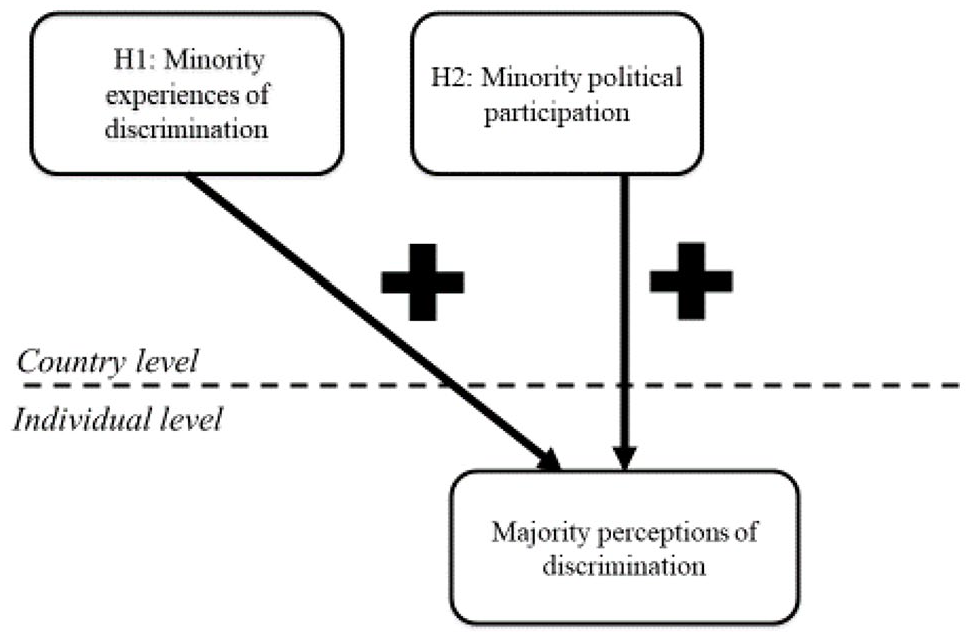
Conceptual figure depicting the hypotheses.
Materials and Methods
Data
We identified suitable surveys through the search engine of the GESIS data archive (https://www.gesis.org/home) and a systematic literature review. For our dependent variables, we selected surveys that included representative samples of majority members across European countries and items assessing perceived discrimination targeting minority members. We selected two surveys with different items on perceived discrimination to provide a conceptual replication of our hypotheses across different measures and samples: one on discrimination targeting immigrant-origin and ethnic minority members, and the other on discrimination affecting only immigrant minority members. To construct our country-level independent variables, we looked for surveys that included representative samples of minority respondents across European countries. To capture minority contextual norms, we computed country-level measures of minority discrimination experiences and political participation (see details in what follows, at the description of each measure). We selected surveys to measure the country-level independent variables that either coincided with or preceded the surveys for our dependent variables, allowing a maximum lag of 3 years between the surveys used to construct the independent and dependent variables. For both studies, we then matched the country-level independent variables of minority discrimination and minority political participation to the individual-level dependent variable of perceived discrimination among majority members. The datasets for both studies are available at the Open Science Framework (https://osf.io/kvbw9/?view_only=8446f1ca2c2d4479a2b9b282ec0205b9).
Participants
Study 1
We used the Eurobarometer 77.4 that included a special module on discrimination (European Commission, 2012). The special module on discrimination was part of a larger survey including questions on the European Parliament, development aid, social climate, and discrimination. A multi-stage random probability sample was drawn among representative samples of residents aged 15 and over in the respective countries in 2012. The questionnaires were administered in the national language of the country through face-to-face interviews by TNS Opinion Social. The complete dataset and technical report are publicly available at the GESIS data archive. The technical report includes detailed information on the sampling design, effective sample sizes per country, and the complete list of variables (European Commission, 2012).
The dependent variable in this study focused on discrimination targeting racial, ethnic and/or religious minority members. Therefore, we selected as majority members those participants who did not belong to these categories, that is, participants that themselves and their parents were born in the country and who did not self-identify as a member of an ethnic minority group. The sample included 19,392 majority members; 54.1% female; Mage = 49.60, SD = 18.44 years. 33% of the participants had primary or secondary education, 37% had tertiary education, and 21% were still studying. The sample consisted of participants from the following 22 countries: Belgium, Bulgaria, Cyprus, Czech Republic, Denmark, Estonia, Finland, France, Germany, Greece, Hungary, Ireland, Italy, Lithuania, the Netherlands, Poland, Portugal, Slovakia, Slovenia, Spain, Sweden, and the United Kingdom. The dataset covered the various regions in Europe (i.e., South, East, North, and West) as well as the most populated countries in Europe (i.e., Germany, UK, 2 France, Italy, and Spain). The sample covers only countries which we could match with available data from the surveys used to construct the independent variables. Table S1 in the supplemental material shows numbers of participants and descriptive statistics by country.
Study 2
We used the Eurobarometer 88.2 that included questions focusing on discrimination or maltreatment of immigrants as obstacles to their integration (European Commission, 2017). This special module was part of a larger survey focusing on the integration of immigrants in the European Union and corruption. A multi-stage random probability sample was drawn among representative samples of residents aged 15 and over in the respective countries in 2017. The questionnaires were administered in the national language of the country through face-to-face interviews by TNS Opinion Social. The complete dataset and list of variables are publicly available at the GESIS data archive. When conducting this research, this dataset edition had not yet passed the complete archive processing and documentation, therefore detailed information on effective sample sizes per country was not available at the time (European Commission, 2017).
Because the dependent variable consisted of items on discrimination targeting immigrants, we selected as majority members participants born in the country of the survey with both parents also born in the country. The final sample included 17,651 majority members; 53.8% women; Mage = 52.86, SD = 18.26 years. 30% of the participants had primary or secondary education, 38% had tertiary education, and 25% were still studying.
The sample included participants from the following 19 countries: Austria, Belgium, Czech Republic, Denmark, Estonia, Finland, France, Germany, Hungary, Ireland, Italy, Lithuania, the Netherlands, Poland, Portugal, Slovenia, Spain, Sweden, and United Kingdom. The sample covers only the countries that could be matched with available data from the surveys used to construct the independent variables. Table S2 in the supplemental material shows number of participants and descriptive statistics by country.
Measures
Individual-level dependent variables
Study 1
The measure of majority perceptions of discrimination was a combination of four items. Participants of the Eurobarometer 77.4 were asked whether “Discrimination based on ethnic origin” and “Discrimination based on religion/beliefs” “. . . is very widespread, fairly widespread, fairly rare, or very rare in [country]?”; and similarly whether “Discrimination based on ethnic origin” and “Discrimination based on religion/beliefs” “. . . outside working life is very widespread, fairly widespread, fairly rare, or very rare in [country]” (α = .82 for the complete sample; α ranging from .66 to .86 per country). We calculated the mean of responses to the four items, higher scores correspond to higher perceptions of discrimination (M = 3.19, SD = 2.25; 1 = nonexistent, 5 = very widespread).
Study 2
Majority perceptions of discrimination was computed from four items in the Eurobarometer 88.2: “Please tell me for each of the following issues if they could be not an obstacle at all, a minor obstacle, or a major obstacle for the successful integration of immigrants in [country]?”: discrimination against immigrants; difficulties in accessing long-term residence permits; difficulties in finding a job; and limited access to education, healthcare, and social protection (α = .77 for the complete sample; α ranging from .59 to .86 per country). The scale was created by calculating the mean of responses to the four questions and ranged from 1 to 3, with higher scores representing larger obstacles and thus higher perceptions of discrimination (M = 2.46, SD = 0.54).
Country-level independent variables for Studies 1 and 2: Contextual minority norms
In Study 1, we drew on the European Social Survey (ESS) Rounds 5 (European Social Survey, 2010) and 6 (European Social Survey, 2012), while in Study 2 we used the ESS Rounds 7 (European Social Survey, 2014) and 8 (European Social Survey, 2016) to calculate our independent variables of country-level minority political participation and minority experiences of discrimination. The ESS is a cross-national survey measuring the attitudes, beliefs, and behavioural patterns of diverse populations across Europe. Every 2 years, face-to-face interviews are conducted with newly selected, cross-sectional samples. We chose the ESS rounds to match the date of the surveys used for our dependent variables. In both studies, we pooled data from two consecutive ESS rounds when there were data available for both rounds to achieve a minimum size of 100 minority members per country for aggregation, and thus a more robust aggregate measure for each country. Please see the technical reports for each ESS round for sampling procedures, effective samples, and complete list of questions asked in that round (see links in references).
In Study 1, the dependent variable assessed majority perceptions of discrimination targeting minority members because of their ethnicity, race, or religion. Therefore, to calculate the country-level independent variables in Study 1, we aggregated responses of minority members who experienced discrimination on these grounds: immigrants or children of immigrants (i.e., respondent and/or at least one parent born outside the country), or those who identified as a member of an ethnic minority. The overall sample used to calculate the independent variables included 13,488 minority participants. In Study 2, in turn, the dependent variable asked about discrimination targeting immigrants. Consequently, to calculate the independent variables, we aggregated responses of minority members who were either immigrants or children of immigrants (Schneider & Heath, 2020). The sample used to calculate the independent variables consisted of 11,557 minority participants. See Tables S1 and S2 in the supplemental material for sample sizes per dataset and country.
Minority discrimination was operationalized as the percentage of minority respondents in each country who indicated in the ESS that they belong to a group that is discriminated against on the basis of either color or race, nationality, ethnic group, language, or religion (Study 1: M = 13.22, SD = 0.07; Study 2: M = 8.59, SD = 4.89). Please note that levels of discrimination differ markedly across samples, presumably because in Study 1 we calculated aggregate minority discrimination among immigrant-origin and ethnic minority members, while in Study 2 we calculated minority discrimination among immigrant-origin minority members only.
Minority political participation was measured using a composite scale of the following seven ESS items: “There are different ways of trying to improve things in [country] or help prevent things from going wrong. During the last 12 months, have you done any of the following?”: “Have you contacted a politician, government or local government official?”; “Have you worked in a political party or action group?”; “Have you worked in another organization or association?”; “Have you worn or displayed a campaign badge/sticker?”; “Have you signed a petition?”; “Have you taken part in a lawful public demonstration?”; “Have you boycotted certain products?” In a first step, we took the sum of affirmative responses to these items per minority respondent, and in a second step, we calculated a country-level mean of these sum scores (Study 1: M = 0.68, SD = 0.34; Study 2: M = 0.90, SD = 0.39).
Control variables
In Study 1, at the individual level, we controlled for gender, age, and level of education of respondents. Thus, we accounted for the most commonly used control variables in studies of discrimination perceptions (e.g., Valentino & Brader, 2011). We also controlled for majority members’ experiences of intergroup contact and their political orientation in additional robustness checks (see supplemental material for detailed description of the measures).
At the country level, we controlled for minority presence, that is, the percentage of the minority population in each country in the models. Since the minority sample used to calculate our independent variables included immigrant-origin and other ethnic minority respondents, we calculated minority percentage by summing the percentage of immigrants and percentage of members of historical ethnic minority groups based on Eurostat and UN data (M = 14.84, SD = 8.68 for the overall sample). Please note that data on ethnic minorities were only available for Bulgaria, Czech Republic, Estonia, Hungary, Ireland, Lithuania, Poland, Slovakia, and UK. Furthermore, we included country-level wealth, inequality, unemployment rate, and minority political rights in the models (see supplemental material for detailed description of the measures).
In Study 2, we again included gender, age, and education as controls. We additionally checked the robustness of our results controlling for intergroup contact, political orientation, and threat perceptions 3 (see supplemental material for detailed description of the measures).
As a country-level control variable, we used immigrant percentage (M = 10.80, SD = 4.67 for the overall sample) based on Eurostat and UN data to measure minority presence. Finally, we again included country-level wealth, inequality, unemployment rate, and minority political rights in additional models (see supplemental material for detailed description of the measures).
Analytic Strategy
In both studies a series of stepwise two-level regressions were conducted to test for hypothetical effects of minority discrimination (H1) and minority political participation (H2) using Mplus 7 (Muthén & Muthén, 2017). Multi-level analysis was required because of the nested data structure of participants (individual level) within countries surveyed (country level). The main analyses in both studies were run in consecutive steps starting from the null model (null models), next including individual-level control variables (i.e., gender and education in one step: “Level 1 control” models), then including country-level control minority presence (i.e., percentage of minority members: “Level 2 control” models), and finally including either country-level minority discrimination or country-level minority political participation in separate models (“minority discrimination” or “minority political participation” models; Hox et al., 2010). We included data only from participants who had valid responses on the dependent and control variables, we did not impute missing values for any of these variables.
Results
Preliminary Results
Tables 1 and 2 display descriptive statistics and correlations between individual-level variables and between country-level variables for Studies 1 and 2, respectively. Note that there were no significant correlations between country-level variables.
Descriptive statistics and correlations for Study 1.
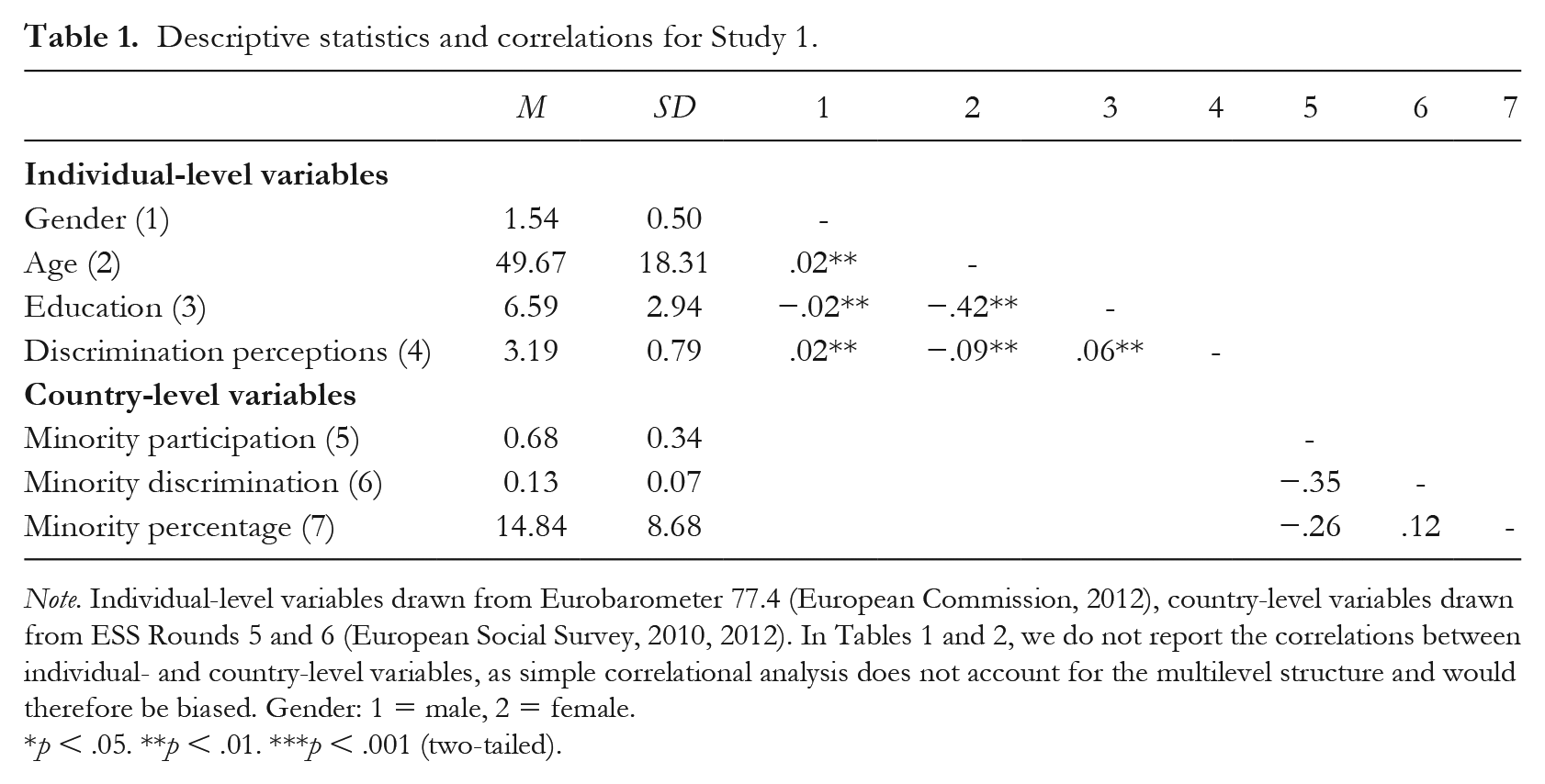
Note. Individual-level variables drawn from Eurobarometer 77.4 (European Commission, 2012), country-level variables drawn from ESS Rounds 5 and 6 (European Social Survey, 2010, 2012). In Tables 1 and 2, we do not report the correlations between individual- and country-level variables, as simple correlational analysis does not account for the multilevel structure and would therefore be biased. Gender: 1 = male, 2 = female.
p < .05. **p < .01. ***p < .001 (two-tailed).
Descriptive statistics and correlations for Study 2.
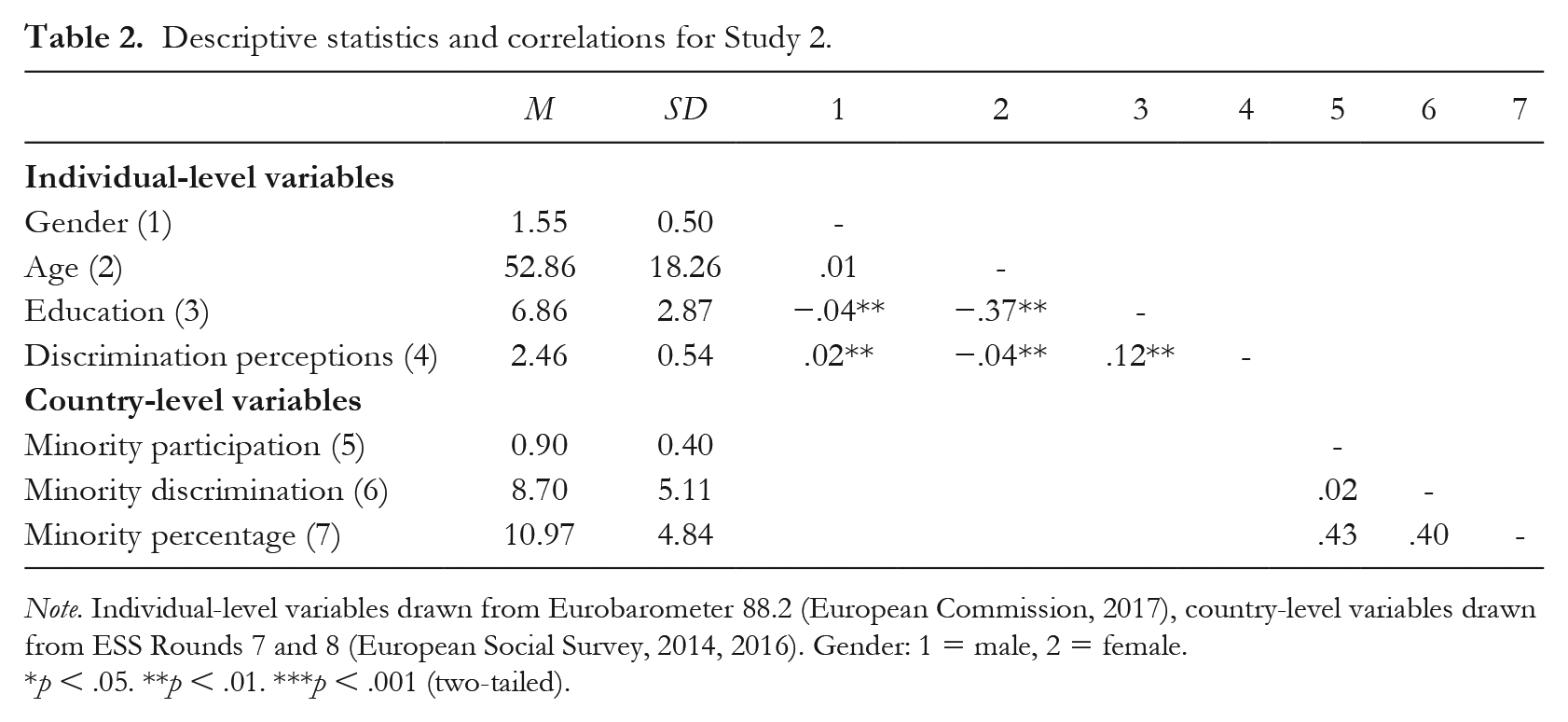
Note. Individual-level variables drawn from Eurobarometer 88.2 (European Commission, 2017), country-level variables drawn from ESS Rounds 7 and 8 (European Social Survey, 2014, 2016). Gender: 1 = male, 2 = female.
p < .05. **p < .01. ***p < .001 (two-tailed).
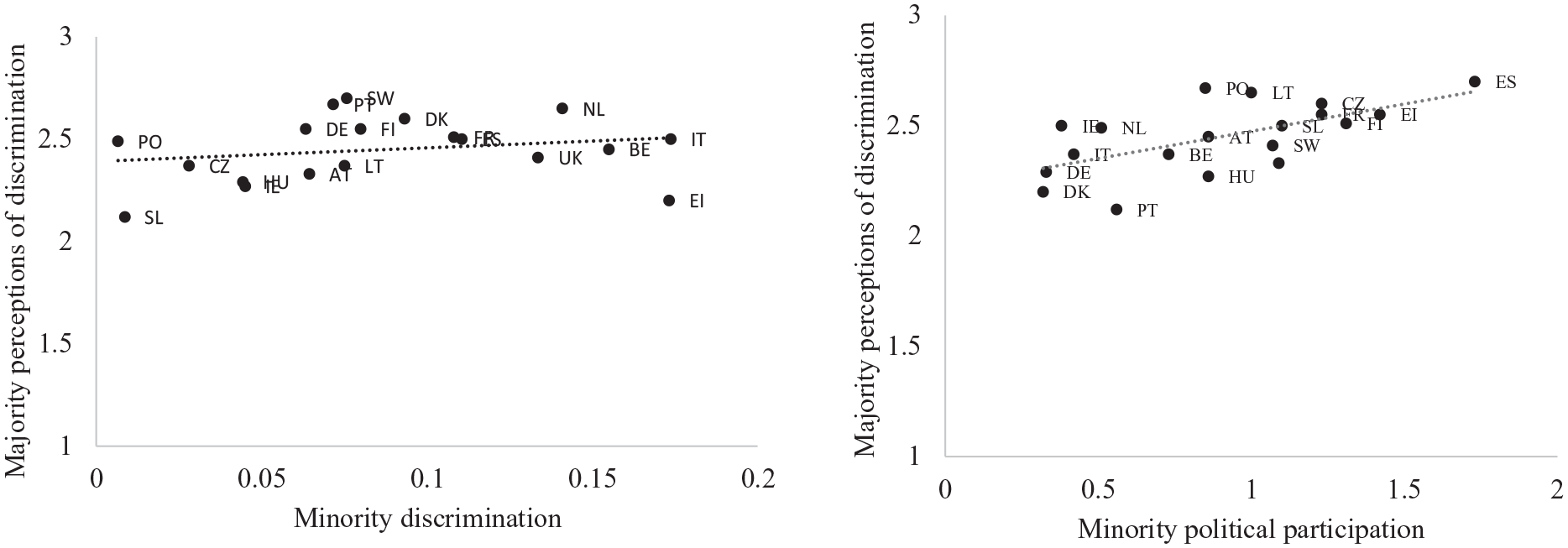
Figure 2 (Panels A and B) displays Study 1 country-level correlations between minority discrimination and majority perceptions of discrimination (Panel A on the left), and between minority political participation and majority perceptions of discrimination (Panel B on the right). Similarly, Figure 3 (Panels A and B) shows Study 2 country-level correlations between minority discrimination and majority perceptions of discrimination (Panel A on the left), and between minority political participation and majority perceptions of discrimination (Panel B on the right). Both figures suggest that there is considerable variation in majority perceptions of discrimination across countries, and that these majority perceptions are related to minority political participation but not to minority discrimination.
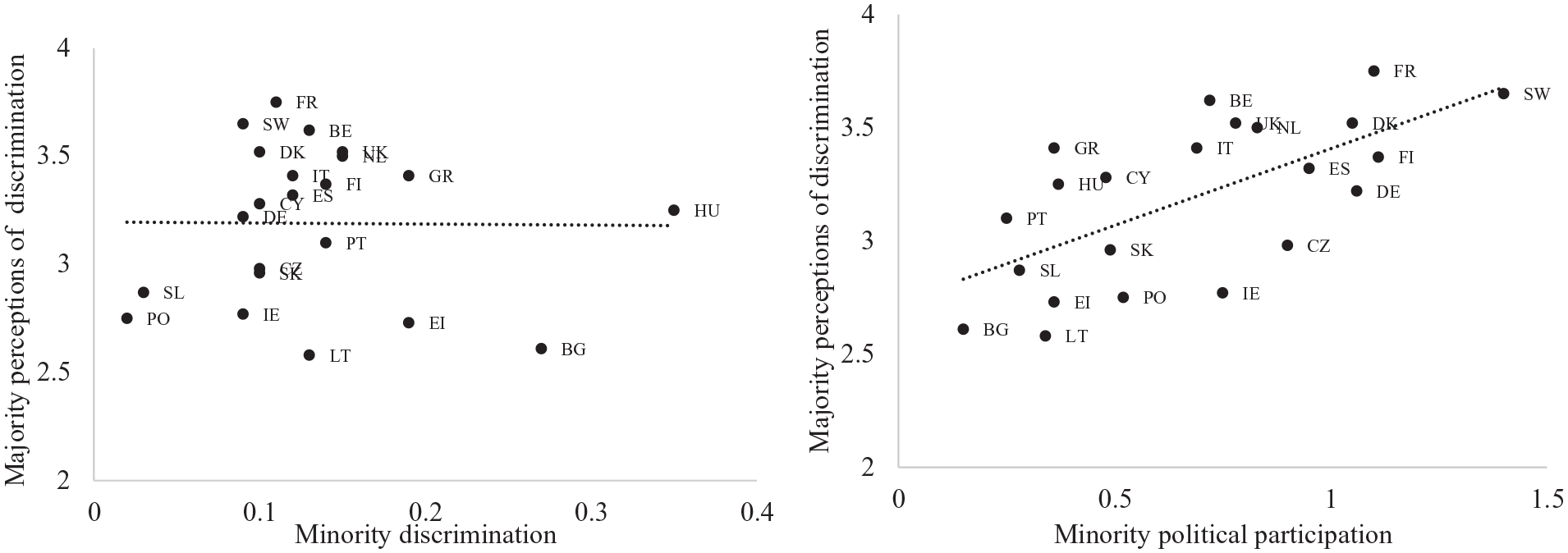
Country-level average scores of majority perceptions of discrimination and minority discrimination (Panel A on the left), and minority political participation (Panel B on the right): Study 1.
Country-level average scores of majority perceptions of discrimination and minority discrimination (Panel A on the left), and minority political participation (Panel B on the right): Study 2.
Study 1
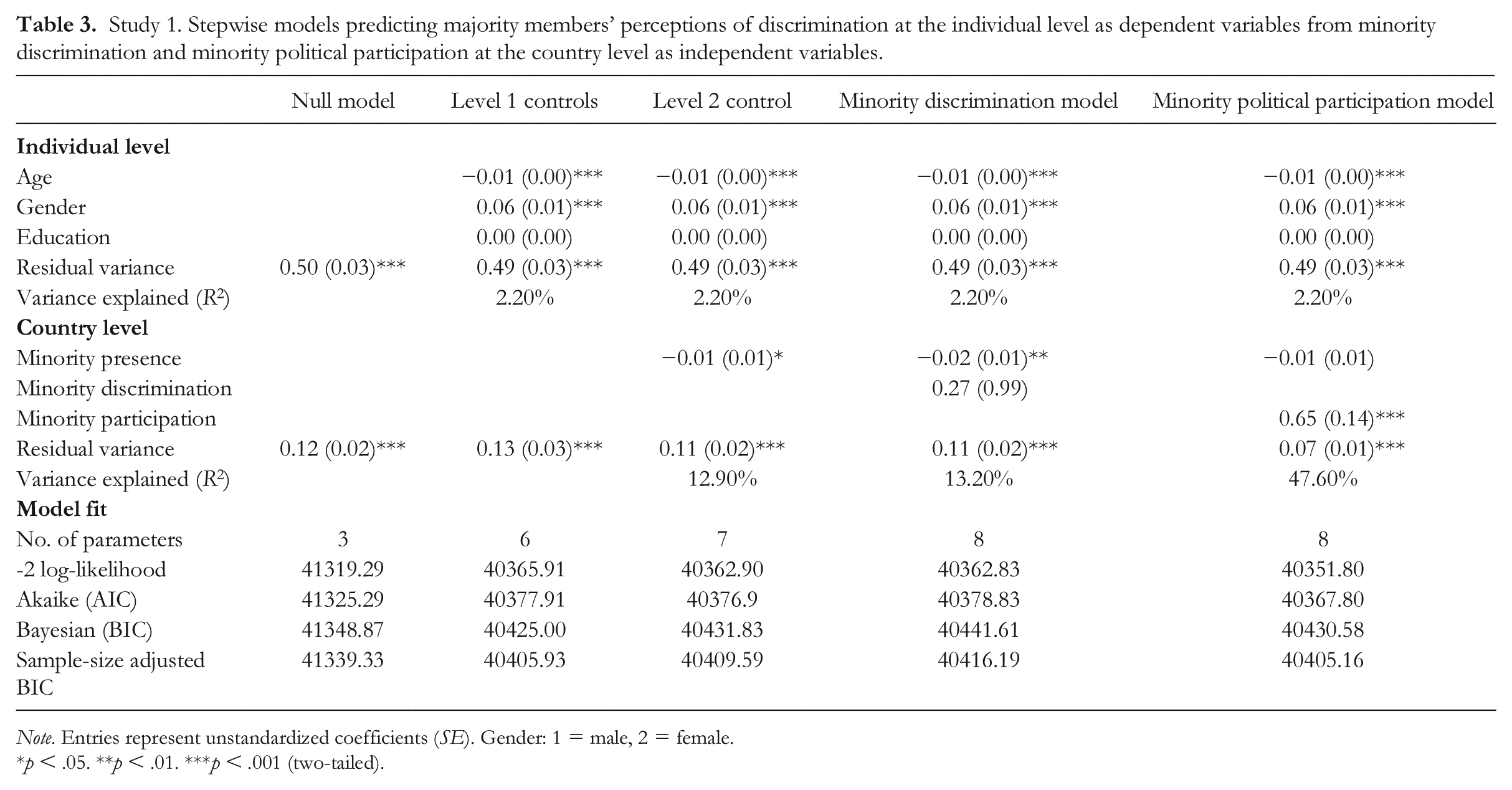
Table 3 displays the results of Study 1. The null model shows the breakdown of the variance in the dependent variable. The partitioning of the variance suggested that both individual- and country-level factors contribute to discrimination perceptions: there was significant variance at both the individual (b = 0.50, SE = 0.03, p < .001) and country levels (b = 0.12, SE = 0.02, p < .001). Intraclass correlation indicated that 19.64% of the variance lay at the country level, suggesting a considerable importance of country-level factors. Including individual controls demonstrated that older people perceive less discrimination (b = −0.01, SE = 0.00, p < .001), and that women perceive more discrimination than men (b = 0.06, SE = 0.01, p < .001), but that education was unrelated to perceptions of discrimination (b = 0.00, SE = 0.00, p = .539). Country-level minority presence was negatively related to perceived discrimination (b = −0.01, SE = 0.01, p = .015).
Study 1. Stepwise models predicting majority members’ perceptions of discrimination at the individual level as dependent variables from minority discrimination and minority political participation at the country level as independent variables.
Note. Entries represent unstandardized coefficients (SE). Gender: 1 = male, 2 = female.
p < .05. **p < .01. ***p < .001 (two-tailed).
We did not find support for Hypothesis 1 on discrimination: minority experiences of discrimination were not related to majority members’ perceptions of discrimination (b = 0.27, SE = 0.99, p = .781). Furthermore, adding minority discrimination to the models did not increase explained variance from 13% of the variance explained at the country level in the models with only minority percentage. In contrast, supporting Hypothesis 2, minority political participation was linked to heightened majority perceptions of discrimination (b = 0.65, SE = 0.14, p < .001). Including minority political participation in the models increased the explained variance to 48%.
Albeit not having prior expectations, we also explored the interaction between country-level variables in additional analyses. First, we tested whether the effect of minority discrimination or political participation was conditional on minority presence. Neither the interaction between minority discrimination and minority presence nor the interaction between minority political participation and minority presence were significant (see Table S3 in the supplemental material). Second, we tested and found that the interaction between minority discrimination and minority political participation was significant and contributed positively to perceptions of discrimination (see Table S3 in the supplemental material). More specifically, at high levels of minority political participation, the link between minority discrimination experiences and majority perceptions of discrimination was stronger than at low levels of minority political participation (see Figure S1).
Study 2
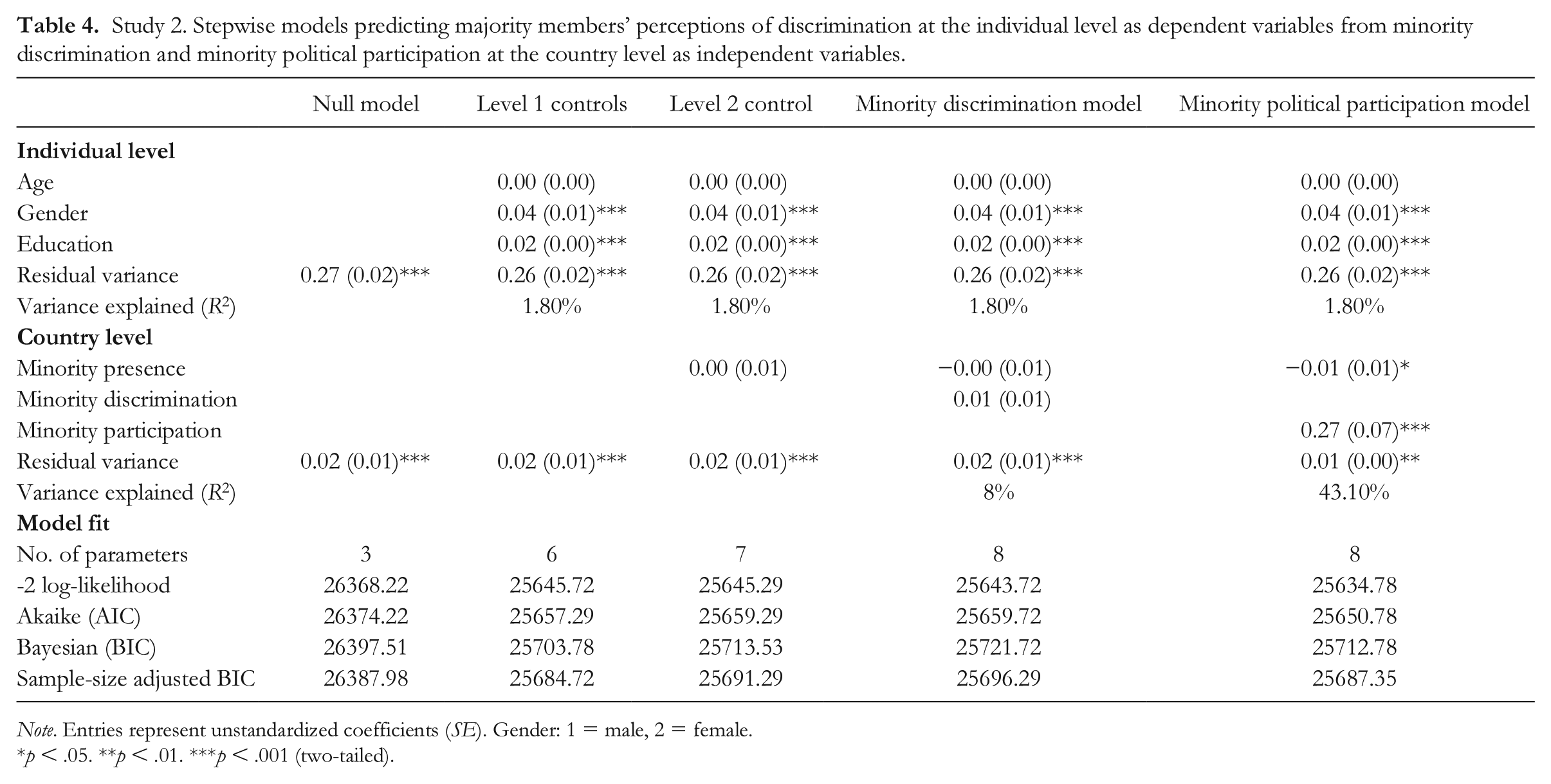
Table 4 displays the results of Study 2. Looking at the null model, the breakdown of the variance in the dependent variable also suggested that, in this analysis, both individual- and country-level factors contribute to discrimination perceptions. There was significant variance at both the individual (b = 0.27, SE = 0.02, p < .001) and country levels (b = 0.02, SE = 0.01, p < .001). 7.63% of the variance in discrimination perception lay at the country level. Including individual controls demonstrated that age was unrelated to perceptions of discrimination (b = 0.00, SE = 0.00, p = .806), that women perceived higher levels of discrimination than men (b = 0.04, SE = 0.01, p = .001), and that higher levels of education related to higher perceptions of discrimination (b = 0.02, SE = 0.00, p < .001***). Country-level immigrant presence was not related to perceived discrimination (b = 0.00, SE = 0.01, p = .995).
Study 2. Stepwise models predicting majority members’ perceptions of discrimination at the individual level as dependent variables from minority discrimination and minority political participation at the country level as independent variables.
Note. Entries represent unstandardized coefficients (SE). Gender: 1 = male, 2 = female.
p < .05. **p < .01. ***p < .001 (two-tailed).
Hypothesis 1 was not confirmed, minorities’ discrimination was unrelated to majority members’ perceptions of discrimination of minorities (b = 0.01, SE = 0.01, p = .259); though the explained between-level variance increased from 0% explained by minority presence in itself to 8% explained by minority presence and minority discrimination. Supporting Hypothesis 2, minority political participation predicted greater discrimination beliefs among national majority group members (b = 0.27, SE = 0.07, p < .001). Including minority political participation in the models increased explained country-level variance to 43%. In this analysis, none of the explored interactions among country-level variables were significant (see Table S4 in the supplemental material).
Robustness Checks
Study 1
We reran the analysis excluding Hungary, as the country-level minority discrimination in Hungary was 2 SD over the mean, and replicated the results. In addition, we replicated the main effects of minority discrimination and political participation controlling for majority members’ individual political orientation, and controlling for individual experiences of intergroup contact with minority members (see Table S5 in the supplemental material). Furthermore, we explored whether political orientation or contact moderate the link between minority discrimination or political participation and perceptions of discrimination, but the interactions were not significant (see Table S6 in the supplemental material). We did not include these individual-level predictors in the main analysis because of the high proportion of missing values on the political orientation variable (19%). In addition, we replicated the main effects controlling for country-level GINI (a measure of income inequality), unemployment rate, and civil political rights, but not when controlling for GDP (see Table S7 in the supplemental material).
Study 2
We replicated the main effects of minority discrimination and political participation controlling for majority members’ individual political orientation, individual experiences of intergroup contact with minority members, and perceptions of material threat (see Table S8 in the supplemental material). In addition, we explored whether political orientation, contact, or threat perceptions moderated the link between minority discrimination or political participation and perceptions of discrimination. First, the cross-level interaction between political orientation and political participation was significant: in countries with higher levels of political participation, the link between political orientation and discrimination perceptions was stronger. More specifically, leftist participants reported higher discrimination perceptions in countries with higher minority political participation than leftist participants in countries with lower minority political participation. Second, the cross-level interaction between intergroup contact and minority discrimination was significant. In countries with low levels of discrimination, contact was not related to higher discrimination perceptions, but in countries with high levels of discrimination, higher levels of contact were related to higher discrimination perceptions. Third, threat perceptions moderated the link between both minority discrimination and political participation and perceptions of discrimination (see Table S9 in the supplemental material). In countries with higher levels of participation or discrimination, the link between threat and discrimination perceptions was stronger. That is, higher threat perceptions were related to lower discrimination perceptions, and this relation was more pronounced in countries with either higher minority political participation or higher minority experiences of discrimination. We did not include these individual-level predictors in the main analysis because of the high proportion of missing values on the variables: 19% missing on political orientation, 41% on contact, and 19% on threat perceptions. Finally, we replicated the main effects controlling for country-level GDP, GINI, unemployment rate, and civil-political rights (see Table S9 in the supplemental materials).
Discussion
Historical ethnic and immigrant-origin minorities find more and more ways to express their political stance in diverse societies (Bloemraad & Voss, 2019; Mora et al., 2018). In the current research, we showed that these minority views are consequential for majority members. Indeed, norms on intergroup issues shape individuals’ attitudes, and ample research has shown that contextual norms—the predominant attitudes or behaviour of people in a context—shape individual intergroup attitudes and policy preferences (Green & Sarrasin, 2018; McDonald & Crandall, 2015). However, in previous research, contextual norms in a region or country were derived only from the individual attitudes of majority members, while the possible contributions of minority members were neglected (Sarrasin et al., 2012; van Assche et al., 2017). We make a novel contribution to multilevel intergroup research, minority influence research, and to studies on the effects of political participation by examining whether minority contextual norms, such as minority experiences of discrimination and minority political participation, contribute to majority members’ perceptions of discrimination. We implemented two cross-national studies with representative samples of 37,000 participants in 23 European countries. We did not find support for Hypothesis 1 on minority norms on discrimination: minority members’ experiences of discrimination in a country were not related to majority members’ perceptions of discrimination. In contrast, supporting Hypothesis 2, higher political participation among minority members was related to higher perceptions of discrimination among majority members in both studies. Our results also showed that minority contextual norms are relevant beyond individual and structural factors. Minority political participation contributed to majority perceptions of discrimination over individual ideological orientations or experiences such as political orientation, intergroup contact, and threat perceptions (Green & Sarrasin, 2018; Hindriks et al., 2015; Kauff et al., 2013; Tropp & Uluğ, 2019). In addition, minority political participation uniquely contributed to perceptions of discrimination over structural factors: we replicated our results over country-level measures of inequality, unemployment, civil-political minority rights, and partially over measures of wealth (Ceobanu & Escandell, 2010). Finally, minority political participation contributed to majority acknowledgement of discrimination regardless of minority group size.
All in all, our results suggest that contextual minority norms can contribute to individual perceptions of discrimination among majority members, but these norms need to be actively and publicly expressed by minority members through political participation. Thus, these results go beyond previous research on normative climates that derived norms from majority members’ attitudes and behaviour, and demonstrate that minority norms also shape majority perceptions (Sarrasin et al., 2012; van Assche et al., 2017; Visintin et al., 2019). Furthermore, the differential effects of minority discrimination and minority political participation simultaneously confirm findings from both the social identity and the minority influence traditions. We found that descriptive norms of minority discrimination were not related to majority acknowledgement of discrimination, unlike majority descriptive norms on intergroup issues (e.g., Sarrasin et al., 2012; van Assche et al., 2017). This suggests that ingroup norms are more influential than outgroup norms when it comes to simple descriptive norms (Hogg & Gaffney, 2018; Hogg & Smith, 2007; Spears, 2020). In contrast, minority political participation was related to majority perceptions of discrimination, as it would be expected following minority influence research that highlights the active role that numerical minorities need to play to influence majority members (Butera et al., 2017; Moscovici & Mugny, 1983; Sanchez-Mazas, 2018). We propose that political participation might be more closely related to majority perceptions of discrimination because it makes minority discrimination or disadvantage visible in the public space through minority members’ collective actions (Jiménez-Moya et al., 2019; Louis, 2009). The finding that the effect of minority political participation is not dependent on minority group size also points in this direction: even smaller but highly visible minority groups can draw the majority group’s attention to discrimination. A handful of previous experimental studies indeed showed that ethnic-racial minorities can shift majority attitudes, and that protests can change attitudes also when it comes to perceptions of intergroup issues (e.g., Politi et al., 2017; Quiamzade et al., 2003; Sawyer & Gampa, 2018). Our results provide ecological validity to this experimental evidence by using contextual minority norms derived from large-scale representative surveys, and complement studies on protest by examining political participation more broadly.
We focused our inquiry on perceptions of discrimination because acknowledgement of discrimination is highly consequential for intergroup attitudes and policy preferences, but we know little about its antecedents (Apfelbaum et al., 2017; Valentino & Brader, 2011). While we found that minority political participation positively contributed to perceptions of discrimination overall, additional analysis suggested that these effects were dampened by majority members’ right-wing political orientation or perceptions of immigrants as threatening. Based on conflict theories, majority group members respond with increased threat and prejudice when they perceive minority members as threatening their economic, cultural, or political positions (Bobo, 1999; Stephan et al., 2016). Thus, especially right-wing majority members and those who feel threatened by immigrants’ political influence can respond to minority political participation with increased prejudice instead of higher awareness of discrimination (Brown & Zagefka, 2011; Hindriks et al., 2015; Verkuyten, 2017). Indeed, a recent study found that racial justice protests on a U.S. university campus were related to more negative attitudes toward racial justice protests as well as lower support for antiracist efforts among those students who believed that racism was not a problem on campus (Selvanathan & Lickel, 2019a). Accordingly, studies on intergroup relations in the US documented in depth how the denial of discrimination forms an integral part of symbolic racism towards Black Americans (Sears & Henry, 2005). Some evidence suggests that the denial of discrimination could relate closely to anti-immigrant attitudes in Europe in a similar manner (Akrami et al., 2000).
Interestingly, in Study 1, we found that higher levels of minority political participation are more closely related to majority members’ perceptions of discrimination when country-level minority discrimination is high, but we did not find a similar interaction effect in Study 2. We speculate that this is due to the fact that the dependent variable in Study 1 asks about the impact of discrimination on minority members, while in Study 2, the dependent variable asks about discrimination as an obstacle to immigrant integration. Because the Study 1 dependent variable is about level of discrimination, more frequent minority experiences of discrimination and stronger minority political participation could have a cumulative effect in the sense that political participation specifically draws attention to the higher extent of discrimination experienced by minority members. In contrast, to acknowledge that discrimination is an obstacle to integration, majority members need not be aware of high levels of discrimination in society, only of the fact that discrimination can disrupt integration.
Notwithstanding the outlined contributions, some caveats must be acknowledged. First, relying on secondary analysis of large-scale surveys presented a limitation: while we could draw on high-quality data on actual political participation of minority members, we had no information on the subject of their political participation. Data on minority-led movements in different countries would allow us to overcome this limitation, but, unfortunately, data is currently only available for a limited number of countries or cities, excluding the possibility for multi-level analyses (e.g., Morales & Giugni, 2011). Therefore, future large-scale studies should include questions on the topics of participation, and cross-country studies on minority political participation should be implemented in a sufficient number of countries to allow for comparative multi-level approaches. Second, large-scale cross-sectional surveys allowed examining these minority contextual norms across European countries assessing actual minority discrimination and political participation, but also limited our ability to draw causal inferences. Future research should investigate the impact of minority contextual norms using longitudinal panel surveys. Third, the level collective discrimination reported by minority members in our survey was rather low. This low level of discrimination is most likely a result of sampling: while the European Social Survey provides high-quality survey data and covers most European countries, it only samples the most integrated ethnic and immigrant-origin minority members (André & Dronkers, 2016). Thus, the ESS does not reach participants who would be especially at risk of discrimination, for example, undocumented immigrants. Future representative surveys should aim to reach a wider sample of ethnic and immigrant-origin minority members.
Despite these limitations, our findings have wider societal and policy implications. Countries widely differed on how far they afforded minority political participation. Previous research showed that immigrant-origin minority members participate more in countries providing more extensive rights to individual immigrants and immigrant groups (Hunger, 2018). Thus, minority members can more successfully convey information about their discrimination experiences or disadvantage to majority members. Ironically, minority participation and majority acknowledgement of discrimination would be especially crucial in those societies where policies limit minority rights and disadvantage minority members. Also for this reason, the fight against discrimination should not depend solely on minority members’ political actions, as dismantling discrimination requires structural changes by a wide group of political actors. Still, as societies around the world are becoming increasingly diverse, our findings offer hope for mutual understanding about intergroup issues such as discrimination, if minority members can voice their concerns.
Supplemental Material
sj-docx-1-gpi-10.1177_13684302221075711 – Supplemental material for The role of minority discrimination and political participation in shaping majority perceptions of discrimination: Two cross-national studies
Supplemental material, sj-docx-1-gpi-10.1177_13684302221075711 for The role of minority discrimination and political participation in shaping majority perceptions of discrimination: Two cross-national studies by Judit Kende, Julia Reiter, Canan Coşkan, Bertjan Doosje, and Eva G. T. Green in Group Processes & Intergroup Relations
Footnotes
Acknowledgements
We would like to thank Prof. Didier Ruedin at the University of Neuchâtel, Dr. Natalia C. Malancu at the University of Geneva, members of the Social Psychology group at the University of Lausanne, and the fellows of Swiss National Science Foundation National Center of Competence in Research nccr – on the move research network for their feedback on earlier versions of this paper.
Author’s Note
Judit Kende is now affiliated to Université libre de Bruxelles, Belgium.
Funding
The author(s) disclosed receipt of the following financial support for the research, authorship, and/or publication of this article: This research was funded by the Swiss National Science Foundation National Center of Competence in Research nccr – on the move. Grant No. 51NF40-182897 awarded to Eva G. T. Green, Juan Manuel Falomir-Pichastor and Anita Manatschal.

Supplemental material
Supplemental material for this article is available online.
Notes
References
Supplementary Material
Please find the following supplemental material available below.
For Open Access articles published under a Creative Commons License, all supplemental material carries the same license as the article it is associated with.
For non-Open Access articles published, all supplemental material carries a non-exclusive license, and permission requests for re-use of supplemental material or any part of supplemental material shall be sent directly to the copyright owner as specified in the copyright notice associated with the article.
