




Abstract
Dislike of political opponents has increased over the past years in the US. This paper presents a preregistered study investigating the effect of kama muta (being moved by sudden closeness) on increasing warmth, social closeness, and trust toward political opponents through including them in a common American identity. Eight hundred forty-one U.S. Americans watched either a moving or a neutral video about the US or a different theme in a full-factorial design. We found main effects of emotion and theme on the increase of warmth, social closeness, and trust toward political opponents through viewing them as fellow Americans. Accordingly, the linear combination of moving U.S. videos showed the largest increase in warmth, social closeness, and trust. Exploratory analyses showed that moving U.S.-themed videos evoked the most kama muta from suddenly increasing one’s identification with the US. This suggests that kama muta is an important, and heretofore largely overlooked, emotional process promoting common in-group identification.
Disliking people who support an opposing political party (i.e., out-partisans) has become a common state in contemporary American society. Over the past decades, Americans have reported increasingly hostile attitudes toward out-partisans (Doherty et al., 2016; Lelkes, 2016), they have become more opposed to the prospect of their child marrying an out-partisan (Iyengar et al., 2012), and are themselves less willing to date out-partisans (Huber & Malhotra, 2017). Political scientists have coined the term affective polarization to describe this form of partisan divide, which they define as dislike and affective animus toward people who support opposing political parties (Iyengar & Krupenkin, 2018; Iyengar et al., 2012). Affective polarization is related to decreased trust in the out-party government in power, where people think that the out-party does not have the best interests of the country at heart (Hetherington, 2015). Thus, political scientists have expressed concern for affective polarization contributing to the weakening of democratic processes, that is, people start accepting actions that undermine democratic processes in order to prevent the opposing political party from gaining power (Levitsky & Ziblatt, 2018; Putnam & Garrett, 2020).
Identifying with a political party has been argued to be a possible underlying mechanism of affective polarization (Iyengar & Krupenkin, 2018; Mason, 2018). Thus, recent research has used identity-based processes to reduce affective polarization. For example, in one set of studies drawing from the common in-group identity model (Gaertner & Dovidio, 2000), partisans’ attention was shifted toward an identity that included both in- and out-partisans, that is, a U.S. American identity, and with this common identity in mind, affective polarization was reduced (Levendusky, 2018).
In the current paper, we are investigating kama muta as an additional, emotional route to forming common in-groups, and thus reducing affective polarization. Kama muta is evoked by a sudden intensification of a communal sharing (CS) relationship (Fiske et al., 2019). CS relationships base interactions on what one has in common, which affords feelings of belonging and closeness (Fiske, 1991; Fiske et al., 2019). We propose that for U.S. Americans, watching depictions of compatriots suddenly getting closer to each other (relating communally) evokes kama muta, experienced as being moved or touched. Kama muta, in turn, will strengthen U.S. Americans’ own communal relationship with America and Americans, who will be categorized as belonging to one group independent of party affiliation. This has the potential to reduce affective polarization and out-party distrust, at least momentarily, by increasing warmth, trust, and closeness felt towards out-partisans. In order to test our hypothesis that kama muta evoked by portrayals of Americans relating communally to each other or to America is an emotional route to reducing affective polarization, we employed a factorial design by manipulating the emotion-evoking content (kama muta vs. neutral) and theme (US vs. neutral) of videos. We investigated the effect of these videos on reducing affective polarization through viewing Democrats and Republicans as members of the same U.S. American group. Thus, in this paper, we investigate the overall effects of emotion and theme. We test if the condition that evokes kama muta and is about the US—where people unite as U.S. Americans—reduces affective polarization more than conditions where U.S. identity is only primed without intensification of CS, and where kama muta is evoked through sudden intensification of CS without references to the US.
We start by outlining the kama muta framework and delineating how kama muta is distinct from, and related to, other emotion constructs. Thereafter, the relational model construct of communal sharing, whose sudden intensification gives rise to kama muta, will be used to explain how kama muta is an emotion that promotes common in-group identification, and reduced affective polarization.
Kama Muta
Kama muta is a Sanskrit term for “moved by love.” The term kama muta is used in order to avoid committing the lexical fallacy of using vernacular labels to identify psychological constructs (Fiske, 2020b), and to avoid misinterpretations of the theoretical construct. The kama muta construct is defined by its five components: (a) When sufficiently intense, physiological signs such as a warm feeling in the chest, tears, goosebumps, a lump in the throat, or exhilaration are experienced; (b) it is experienced as a positive emotion; (c) it is evoked by the appraisal of a sudden intensification of a CS relation; (d) it motivates the development or strengthening of CS relationships; (e) the vernacular labels “moved,” “touched,” and “heart-warming” are often used to denote the emotion, but in specific situations, other vernacular labels are also used, such as “nostalgia,” “being touched by the spirit,” “pride,” “team spirit,” “getting emotional,” etc. (Fiske, 2020a; Fiske et al., 2019; Zickfeld, Schubert, Seibt, Blomster, et al., 2019; Zickfeld, Schubert, Seibt, & Fiske, 2019).
Thus, when people experience kama muta, they might use many different names for their experience, or may be unable to name the experience (Fiske, 2020a, 2020b; Fiske et al., 2019). Kama muta theory therefore implies that the construct should be assessed measuring several components rather than relying on emotion labels alone. A self-report measure comprising subscales for the five components, the KAMMUS-Two, has been used to measure responses to different emotion elicitors across 19 countries (Zickfeld, Schubert, Seibt, Blomster, et al., 2019). The elicitors were either videos or prompts to recall an emotional episode and, for video stimuli, the researchers hypothesized and found that perceiving the protagonists suddenly intensify their CS relation increased participants’ motivation to initiate or strengthen CS relations. The study confirmed that the components co-occur in kama muta episodes: they were highly correlated in every sample and showed higher means for kama muta elicitors than for other emotional stimuli. Specifically, means for the kama muta condition were higher than for stimuli evoking awe, sadness, and amusement (Zickfeld, Schubert, Seibt, Blomster, et al., 2019). A study assessing physiological responses also differentiated well between these four emotions (Zickfeld et al., 2020).
According to Keltner and Haidt (2003), awe is characterized by perceptions of vastness and need for accommodation, whereas kama muta is elicited by perceptions of closeness (Schubert et al., 2018). Similar to kama muta, sadness is associated with the physiological reaction of tears; however, sadness is a negative emotional state, whereas kama muta is a positive emotional state (Zickfeld et al., 2020; Zickfeld, Schubert, Seibt, Blomster, et al., 2019). Furthermore, kama muta is argued to be a distinct kind of joy or happiness, which is evoked by a sudden intensification of a CS relationship (Zickfeld, Schubert, Seibt, & Fiske, 2019).
There is some overlap between elevation (Haidt, 2000) and kama muta as both constructs are measured in part by the label “moved” and self-reports on physical sensations of warmth in the chest. Elevation is conceptualized as a response to perceiving moral beauty (Haidt, 2000), and as motivating the person to emulate moral exemplars (Algoe & Haidt, 2009; Thomson & Siegel, 2017). Elevation and kama muta theories thus posit different elicitors of the respective emotions (Fiske et al., 2019); and although some acts of moral beauty are also sudden intensifications of CS, some are not, and most intensifications of CS are not morally beautiful.
Compassion and sympathy underlie the concept empathic concern, which is defined as feelings that arise as a result of witnessing others in need (Batson, 1990; Davis, 1980, 1983). Studies have shown that kama muta is consistently related to the self-reported trait empathic concern (Zickfeld, Schubert, Seibt, Blomster, et al., 2019; Zickfeld et al., 2017), and it is argued that empathic concern as a state is a specific subtype of kama muta in which one experiences sudden CS intensification toward a person in need (Zickfeld et al., 2017).
Kama Muta and the Reduction of Affective Polarization and Out-Partisan Distrust
The central assumptions about the elicitors and effects of kama muta are derived from relational models theory (RMT; Fiske, 1991, 1992, 2004). RMT proposes that humans coordinate and organize social interactions based on four relational models, with communal sharing (CS) being one of these models. CS relations base sociality on the perception of what people have in common, making them socially equivalent in some respect. This orients their actions, motives, and thoughts to something they have in common. The aspect that makes people socially equivalent is dependent on the situation, where equivalence can be based on kinship, nationality, or common interests, among others (Fiske, 2004). The CS relational model can be implemented in intimate relationships, and among strangers in groups (Fiske & Haslam, 2005).
Relating in a CS way means focusing on commonalities and disregarding the distinct identities of individuals in the relationship (Fiske, 1992). When relating in a CS way to a group, each group member’s needs are as important as one’s own needs, and one therefore shares resources according to need and ability, or, more basically, treats resources as common property (Fiske, 1992). Thus, the level of trust needs to be high, as detecting free-riders is more difficult in a CS relationship than when doing tit for tat (Fiske, 1992, 2004). Lastly, persons relating in a CS way to a group feel love and affection toward other group members (Fiske, 2020a).
The defining features of CS relations overlap with central constructs of social identity theory. First, both CS relations and self-categorization are dependent on the situation. Second, unity and focusing on commonalities with other group members are central to self-categorization (Turner et al., 1987) and for relating in a CS way. Third, interdependence and attachment are important components of social identification (Ashmore et al., 2004; Tajfel et al., 1971) and of CS relationships.
Thus, we propose that kama muta can be evoked by depictions of U.S. Americans relating in a CS way to their country and each other, as exemplified by common rituals and traditions, or acts of social solidarity. In-group members watching this will in turn intensify their own CS relation with the US and their compatriots. In this context, they might report feeling pride of being American. Indeed, pride is an emotion which is often felt when one adopts a national identity (Mackie & Smith, 2015; Smith et al., 2007). When activating a CS relationship with the US, people focus on what they have in common with U.S. Americans, thus also including out-partisans into a common U.S. American CS relation. As the motivational effect of kama muta is devotion to the CS relation that was intensified (Fiske, 2020a; Fiske et al., 2019; Zickfeld, Schubert, Seibt, Blomster, et al., 2019; Blomster Lyshol et al., 2020; for similar effects for pride, see also Harth et al., 2008), people will experience increased warmth, trust, and closeness toward out-partisans, thus reducing affective polarization.
In short, we hypothesize that feeling kama muta due to sudden intensification of CS relations within a superordinate in-group, the US, will increase positive attitudes toward out-partisans, who are also U.S. Americans. Our predictions are in line with research on the common in-group identity model (Gaertner & Dovidio, 2000), where identification with a superordinate identity reduces prejudice. However, we argue that the kama muta emotion of suddenly feeling moved and touched by what Americans have in common and national pride is more efficacious in reducing affective polarization than simply having a U.S. American identity in mind.
Previous research has investigated the mediating effect of emotions directed toward out-groups as a key component of the effect of recategorization on reduced prejudice (Ray et al., 2012). Ray and colleagues showed that increased admiration toward an out-group with an overlapping group membership resulted in reduced prejudice. In contrast, we are predicting that kama muta evoked by intensification of one’s CS relation with an in-group (the US) will reduce affective polarization because that in-group CS relation encompasses out-partisans.
Current Study
With relations between adherents to the two major parties being at an all-time low (Doherty et al., 2016; Lelkes, 2016; Putnam & Garrett, 2020), it is important to investigate ways to reduce affective polarization. Previous research has shown that being primed with a U.S. American identity, which makes people tend to adopt more of a U.S. American superordinate identity, is effective in reducing affective polarization (Levendusky, 2018). In this study, we are investigating the overall effects of kama muta and a U.S. prime on reducing affective polarization, thus introducing kama muta as an emotional route to reducing affective polarization. Furthermore, we also propose kama muta as a beneficial emotion in promoting the adoption of a common U.S. American identity.
We employed a factorial design by manipulating the emotion-eliciting content (kama muta vs. neutral) and theme (US vs. neutral) of videos in order to test the effect of kama muta and U.S. theme independently and together on reducing affective polarization. Thus, we tested which of the three conditions—(a) kama muta without referring to the US, (b) referring to the US without evoking kama muta, or (c) kama muta evoked due to CS intensification with the US—is more efficacious in reducing affective polarization, also employing (d) a neutral control condition. We preregistered that the video with a U.S. theme evoking kama muta would reduce affective polarization and distrust the most through the first-level mediators kama muta and U.S. ratings (serving as manipulation checks) and second-level mediator common in-group identification. Our preregistration, along with all materials, data, and codes, is uploaded on the Open Science Framework (https://osf.io/p4dcw/). We report how we determined our sample size, all data exclusions, all manipulations, and all measures. The study was approved by the Internal Review Board at the Donald P. Bellisario College of Communications at Penn State University.
Method
Participants
We preregistered a sample size of 800 (N = 200 per condition) because structural equation models should have a minimum sample size of N = 200 per between-subjects condition (Barrett, 2007), and we employed four between-subjects conditions. A total of 841 U.S. American participants from the Qualtrics Survey Panel participated and passed the automatic exclusion criteria implemented for quality control. Only persons who self-identified as Republican (N = 420) or as Democrat (N = 421) were allowed to participate. Mean age was 48, range 18 to 89, and 77.60% were female (see supplemental material for further details on the sample and the exclusion criteria).
Procedure and Materials
A 2 (emotion: moving vs. neutral) x 2 (theme: US vs. non-US) factorial between-subjects design was employed (“moving” condition denotes the condition where kama muta is evoked, which makes it easier to distinguish between the video condition and the emotion evoked). Figure 1 shows these conditions are represented as main effects of emotion and theme, along with interaction between emotion and theme. For each condition, two videos were used, totaling eight videos. Participants first provided demographic information, then watched one video and answered questions concerning the video and their attitudes about out-partisans. At the end of the survey, participants were thanked and debriefed.
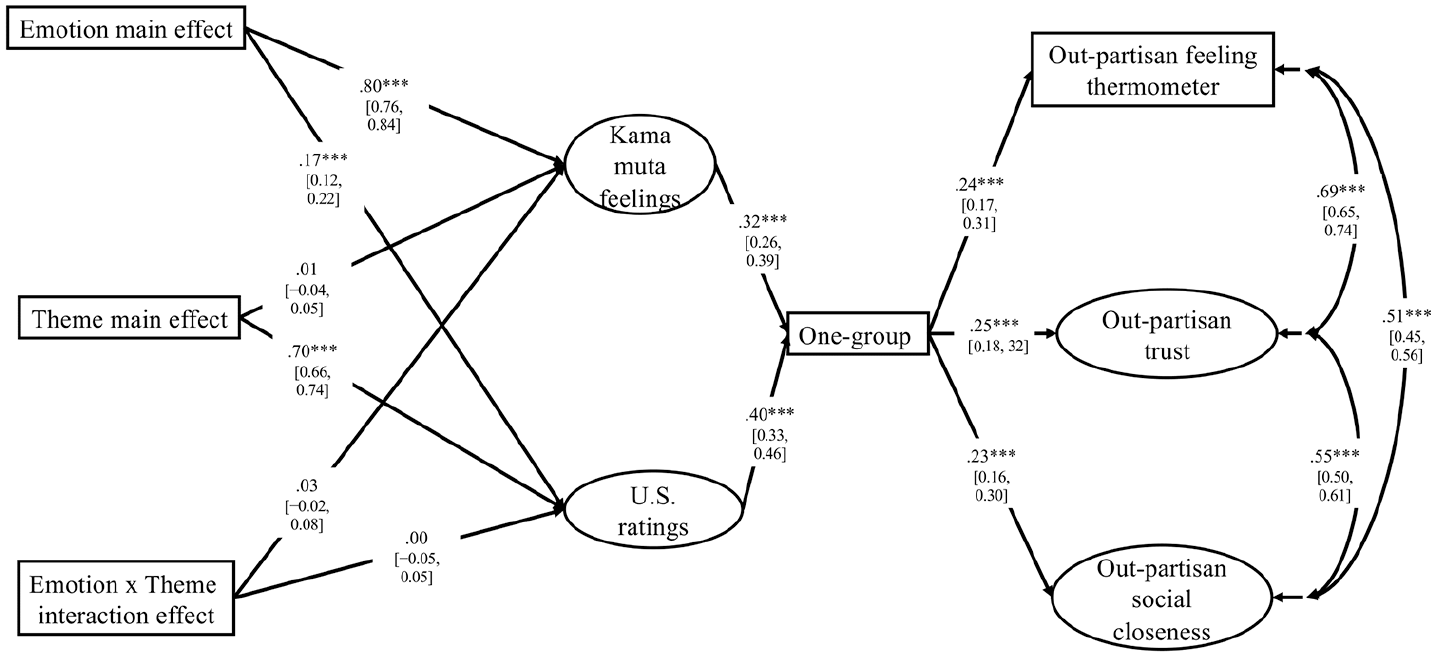
Preregistered model showing path coefficients standardized on the dependent variable.
The videos for this study were selected based on the pretesting of 32 videos, with eight videos per condition. Participants (N = 158) were asked to view one video from a stimulus set corresponding to each condition and respond to a shortened measure of kama muta and two items asking whether the video was about the US, using a 7-point scale (1 = not at all, 7 = a lot). Two videos from each stimulus set were selected based on the rank order of kama muta and U.S. ratings and/or the ratings being above or below the scale midpoint, and that the ratings were not significantly different between Republicans and Democrats (see supplemental material for further details on the selection of videos). The selected videos for the moving U.S. condition were an “On the Road with Steve Hartman” report about how Americans came together and helped each other after Hurricane Harvey (2:51 min), and Ray Charles’s performance of “America the Beautiful” before the World Series a few weeks after 9/11 (4:23 min). The moving non-U.S. videos were a video about blindfolded children still recognizing their mothers from a line of women (2:08 min), and the “Sarah and Juan” video about a couple who meet in high school, and he eventually proposes to her (1:51 min). These videos were ads for Pandora jewellery and Extra gum, respectively, but the logos were edited out of the videos. The neutral U.S. videos were a video that listed facts about U.S. currency (1:56 min), and a video that listed facts about U.S. passports (3 min). Lastly, the neutral non-U.S. videos were a science video about how to unboil an egg (1:53 min), and a crafts video about how to reuse wine corks (2:23 min).
In the current study, independent samples t test (with Bonferroni correction) comparing video versions within each condition on the variables included in the models that follow revealed that ratings of kama muta, US, common in-group, and general CS appraisals significantly differed between video versions within some conditions (see Table S3 in the supplemental material). We estimated the same models presented next but controlling for video versions, which are reported in the supplemental material.
Measures
A subset of measures is reported here, see supplemental material for a description of the additional measures.
Political identification
Party identification and strength of identification items were taken from Mason (2018) “Generally speaking, do you usually think of yourself as a Republican, a Democrat, or an independent?”; 1 = Republican, 2 = Democrat, 3 = independent. As participants who indicated that they identified as independent were automatically excluded from the survey (see Participants section), the party identification variable was dichotomous. The party identification item was used as a grouping variable in order to test if the effects in our preregistered model were the same among Republicans and Democrats.
Kama muta
We preregistered that three components of the cross-culturally validated measure of kama muta, called the KAMMUS Two (Zickfeld, Schubert, Seibt, Blomster, et al., 2019), would be used as a manipulation check in our model; physiological signs (e.g., “Moist eyes”; 11 items, Cronbach’s α = .95); valence (one item: “I had positive feelings”); and labels (e.g., “It was heartwarming”; three items, α = .96). This is because these are thought to reflect the feeling component of kama muta.
To investigate how the stimulus was assessed by participants, two versions of CS intensification appraisals were measured: general CS appraisals (e.g., “I observed an incredible bond”; four items, α = .96) and U.S.-specific CS appraisals (e.g., “I felt closer to the United States”; four items, α = .97). All items were measured using a 7-point scale (0 = not at all, 6 = a lot). The general CS appraisal scale is from the KAMMUS Two (Zickfeld, Schubert, Seibt, Blomster, et al., 2019), while the U.S.-specific CS appraisal scale is adapted to measure CS intensification with the US, specifically. As the moving video conditions differed on the type of CS intensification portrayed, we did not include these appraisal items as manipulation check in the model. Rather, these variables were used to explore differences in appraisals between conditions. All items were measured using a 7-point scale (0 = not at all, 6 = a lot).
Identification was measured through one item: “The video made me identify with the United States” (0 = not at all, 6 = a lot). This item was included in order to explore how identification differed between conditions.
Pride was measured through one item: “When watching the video, I felt proud of being American” (0 = not at all, 6 = a lot). Pride was included in order to explore our contention that moving U.S. videos would have the highest ratings of U.S. pride. Furthermore, we also included the pride item to exploratorily test the notion that pride is a label used for kama muta feelings toward the US.
U.S. ratings
Three items were constructed to assess participants’ perceptions that the video was about the US: “The video made me think about the United States,” “The video was about the United States,” and “The video focused on the United States” (0 = not at all, 6 = a lot; α = .97). The U.S. ratings measure was used as a manipulation check variable.
Common in-group perceptions
Two items were adapted from Gaertner, Mann, Murrell, and Dovidio (1989): “Having seen the video, I feel that, despite their differences, Republicans and Democrats are really one common group; Americans” and “Having seen the video, I feel that Republicans and Democrats are really two separate groups of people” (reverse-scored; 0 = not at all, 6 = very much). The two items did not correlate (r = −.08, Mone group = 2.65, Mtwo groups = 3.17). Therefore, contrary to our preregistration, the first item, which assesses participants’ agreement on Republicans and Democrats being members of one group, was used as a mediator variable.
Feeling thermometer
Feelings of warmth toward out-partisans (i.e., Democrats if the participant was a Republican, and vice versa) were measured through feeling thermometers: “How cold (0 on the scale) or warm (100 on the scale) do you feel towards [Republicans/Democrats]?” The out-partisan feeling thermometer was used as a dependent variable.
Trust
Trust towards out-partisans was measured through a modified version of the three-item Generalized Trust Scale from the European Social Survey (response alternatives in brackets, α = .90): “Generally speaking, would you say that most [Republican/Democratic] voters can be trusted, or one can’t be too careful in dealing with [Republican/Democratic] voters?” (0 = one can’t be too careful, 6 = [Republican/Democratic] voters can be trusted); “Do you think that most [Republican/Democratic] voters would try to take advantage of people if they got the chance, or would they try to be fair?” (0 = most [Republican/Democratic] voters would try to take advantage of people, 6 = most [Republican/Democratic] voters would try to be fair); and “Would you say that most of the time [Republican/Democratic] voters try to be helpful or that they are mostly looking out for themselves?” (0 = [Republican/Democratic] voters mostly look out for themselves, 6 = [Republican/Democratic] voters mostly try to be helpful). Out-partisan trust scores were used as a dependent variable.
Social closeness
The social closeness measure from Iyengar et al. (2012) was used where participants were asked their willingness to (a) marry, (b) be friends with, (c) live next door to, and (d) spend occasional social time with out-partisans, using a 7-point scale (0 = I would definitely not do this, 3 = indifferent, 6 = I would definitely do this; α = .92). Out-partisan social closeness scores were used as a dependent variable.
Results
We first tested the total effects in our model to assess whether the video conditions affected ratings of the variables in our preregistered model. Next, we tested for complete mediation in the preregistered model by estimating both indirect and direct effects from the condition indicators to the manipulation check (U.S. ratings, kama muta feelings), mediator (one group), and dependent variables (out-partisan closeness, warmth, and trust) of the model. We then estimated the preregistered model without direct effects to the mediator and dependent variables, and tested whether this model is similar for both Republicans and Democrats. We exploratorily investigated the difference between video conditions on identification, pride, and on ratings of general CS intensification appraisals and U.S.-specific CS intensification appraisals. Furthermore, we estimated an exploratory model investigating the mediating effect of feeling pride and CS intensification with the US (which we call kama muta US) on increased one-group perceptions and reduction of affective polarization and distrust.
See the supplemental material for the same models described before where video versions were controlled for. The models that included controls for video versions had similar results as the models that did not include controls, with the exception of the model comparing Democrats and Republicans (which is discussed next).
Total Effects of Video Condition on All Variables
We fitted a multivariate analysis of variance (MANOVA) model with kama muta labels, physiological signs, and valence, U.S. ratings, one-group measure, out-partisan feeling thermometer, trust, and social closeness as dependent variables. The video conditions emotion (moving vs. neutral) and theme (US vs. non-US) along with their interaction were added as factors. Table 1 reports means and 95% confidence intervals (CIs) of each dependent variable for each video condition, along with effect sizes, 90% CIs of effect sizes (see Lakens, 2013, p. 8), means, and 95% CIs for each univariate main effect.
Estimated marginal means and 95% confidence intervals for variables in the model depending on condition.
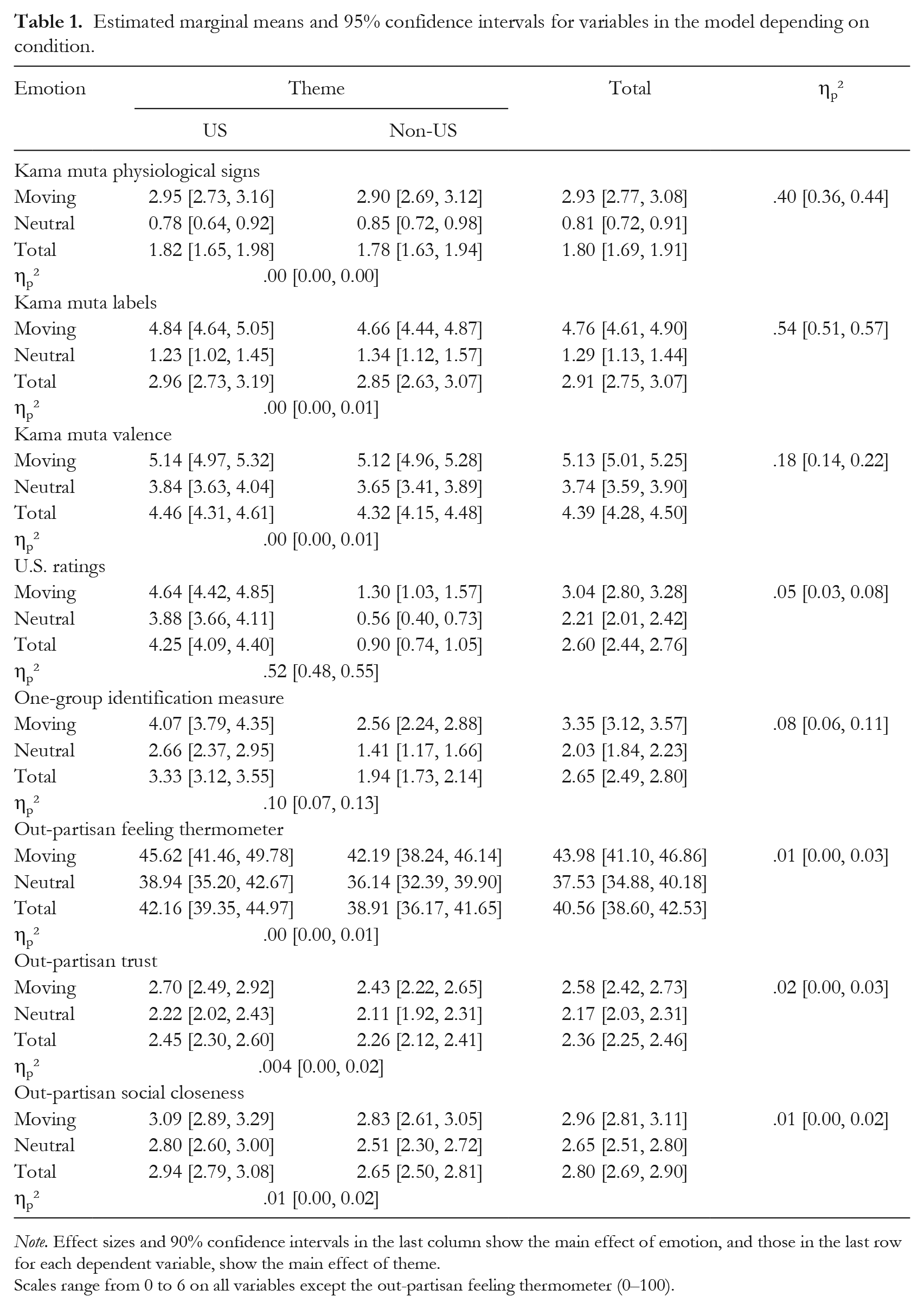
Note. Effect sizes and 90% confidence intervals in the last column show the main effect of emotion, and those in the last row for each dependent variable, show the main effect of theme.
Scales range from 0 to 6 on all variables except the out-partisan feeling thermometer (0–100).
Across all variables, there was a significant main effect of emotion condition, F(8, 816) = 130.03, p < .001, ηp² = .56, 90% CI [0.52, 0.59], and theme condition, F(8, 816) = 125.34, p < .001, ηp² = .55, 90% CI [0.51, 0.58]. However, there was no significant interaction effect of the emotion and theme conditions, F(8, 816) = 0.83, p = .573.
As seen in Table 1, averaged across the theme conditions, participants reported feeling more kama muta in the form of physiological signs, labels, and valence in the moving condition compared to the neutral condition, as seen in the nonoverlapping CIs for the theme main effect. Averaged across the emotion conditions, participants also reported that the videos were more about the US in the U.S. condition than in the non-U.S. condition. Therefore, the manipulations were deemed successful. However, unexpectedly, there was a significant, albeit small, difference in U.S. ratings between moving and neutral conditions.
There was also a significant main effect of both emotion and theme on viewing out-partisans as members of one group, Americans; averaged across the emotion conditions, participants in the U.S. condition had higher one-group ratings compared to participants in the non-U.S. condition. And averaged across the theme conditions, participants in the moving condition reported higher one-group ratings compared to participants in the neutral condition.
Lastly, we found significant main effects of emotion on affective polarization and trust variables; averaged across the theme conditions, participants in the moving condition reported more warmth, trust, and social closeness to out-partisans than participants in the neutral condition. There was only a main effect of theme on out-partisan social closeness; averaged across the emotion conditions, participants in the U.S. condition reported higher feelings of closeness to out-partisans compared to participants in the non-U.S. condition.
Model With Direct and Indirect Effects
We fitted all of the following models using structural equation modelling (SEM), specifically, the maximum likelihood estimation technique in Mplus Version 7 (Muthén & Muthén, 2012). Missing values were handled using full information maximum likelihood (FIML) in Mplus. Criteria for model fit for all models were: RMSEA < .08, and upper bound of 90% CI < 0.10; CFI > .95 (Hoyle, 2013); and SRMR < .08 (Hu & Bentler, 1999).
For all models, we specified a multiple-indicator-multiple-cause (MIMIC; see Breitsohl, 2019) model where weighted effect coding (see te Grotenhuis et al., 2017) was used to create indicators to represent the main effects of emotion and theme, along with an interaction between emotion and theme. Weighted effect coding was used because of unequal cell size between conditions, due to exclusion of cases that did not meet the preregistered inclusion criteria.
The measurement model for kama muta feeling was estimated by using a subset-item parcel approach (as described in Matsunaga, 2008) where we made composite scores of the physiological signs, labels, and valence components by making average scores and loading these on a kama muta feeling factor (α = .85). We selected the parceling approach for our measurement model since our main interest is in the structural relationships among constructs, which then “helps to eliminate theoretically unimportant noises” (Matsunaga, 2008, p. 289). By loading composite scores onto a factor, instead of individual items of the signs, labels, and valence components (which are composed of different numbers of items), we allowed each component to be weighted similarly. Including those three feeling components of kama muta in the model, and not the appraisal components, allowed us to investigate the effect that feeling kama muta after watching a moving CS intensifying (or neutral) video had on affective polarization and out-partisan trust. Furthermore, as the moving video conditions differed on the type of CS intensification portrayed, we did not include these appraisal items as a manipulation check in the model.
The measurement model for the U.S. ratings, out-partisan trust, and social distance variables was estimated by using an all-item parcel approach (as described in Matsunaga, 2008) where we made composite average scores for each measure and loaded these, in addition to measurement error, on to the respective factors. Measurement error was estimated by subtracting 1 from Cronbach’s alpha. Out-partisan feeling thermometer and one-group measures were estimated as observed variables due to their being one-item measures. Out-partisan feeling thermometer scores were transformed by dividing the scores by 10, in order to have similar variance across variables.
In the first model, we estimated direct effects from the video condition indicators to all variables in the model, and paths predicting the dependent variables out-partisan trust, warmth, and social closeness through the manipulation check (kama muta feeling and U.S. ratings) and mediator (one-group identification) variables. The model was identified and showed good model fit in all criteria except for RMSEA, which is a parsimony-adjusted index, χ2(23) = 186.13, p < .001, RMSEA (90% CI) = .09 [0.08, 0.10], CFI = .96, SRMR = .05. All path coefficients predicting the dependent variables directly from video conditions were not significant (ps = .061 to .950). Therefore, these results indicate that the manipulation check (kama muta feeling and U.S. ratings) and mediator (one-group identification) variables account for the effect of video condition on the dependent variables out-partisan warmth, trust, and social closeness. Additionally, neither of the direct effects from video conditions to the one-group measure were significant (ps = .213 to .542), indicating that the manipulation check variables kama muta feeling and U.S. ratings account for the effect of video condition on viewing Republicans and Democrats as belonging to one group.
Preregistered Model
In the second model, which is the model we preregistered, we estimated indirect effects from the video condition indicators to the dependent variables through the manipulation check and mediator variables. We investigated the mediating effect of our manipulation check variables in order to account for the variance in kama muta feelings and U.S. ratings between participants, thus not assuming that the effectiveness of our manipulation is the same across participants (Breitsohl, 2019). See Figure 1 for the structural portion of the model. The model was identified and showed good model fit, χ2(35) = 195.39, p < .001, RMSEA (90% CI) = .07 [0.06, 0.08], CFI = .96, SRMR = .05. A chi-square difference test did not indicate a deterioration in model fit between the first model with direct effects and the second model without direct effects, χ2D (12) = 9.26, p = .681, leading us to retain the model presented in Figure 1.
As seen in Figure 1, there was a main effect of emotion: averaged across theme conditions, the moving condition predicted higher kama muta feelings compared to the neutral condition (B = 1.01, β = .80, 95% CI [0.76, 0.84], p < .001). This shows that the kama muta manipulation was successful. Averaged across emotion conditions, the U.S. condition predicted higher U.S. ratings compared to the non-U.S. condition (B = 1.64, β = .70, 95% CI [0.66, 0.74], p < .001), showing that the U.S. manipulation was also successful. Additionally, across theme conditions, the moving condition predicted higher U.S. ratings compared to the neutral condition (B = 0.40, β = .17, 95% CI [0.12, 0.22], p < .001). However, the interaction of emotion and theme evoked neither higher kama muta nor U.S. ratings.
In turn, both feelings of kama muta (B = 0.53, β = .32, 95% CI [0.26, 0.39], p < .001) and U.S. ratings (B = 0.38, β = .40, 95% CI [0.33, 0.46], p < .001) predicted more agreement to Republicans and Democrats belonging to one group, when controlling for the other. Furthermore, viewing Republicans and Democrats as belonging to one group predicted increased feelings of warmth toward out-partisans (B = 0.31, β = .24, 95% CI [0.17, 0.31], p < .001), increased trust in out-partisans (B = 0.17, β = .25, 95% CI [0.18, 0.32], p < .001), and increased willingness to be socially close to out-partisans (B = 0.16, β = .23, 95% CI [0.16, 0.30], p < .001).
We examined indirect effects of the videos on the dependent variables by employing a bootstrapping analysis with 10,000 resamples and 95% confidence intervals (Hayes & Scharkow, 2013). These analyses showed that across theme conditions, the moving condition, via increased kama muta feelings and viewing Republicans and Democrats as belonging to one group, was indirectly related to warmer feelings toward out-partisans (B = 0.18, 95% CI [0.12, 0.25]), increased trust in out-partisans (B = 0.10, 95% CI [0.06, 0.13]), and increased willingness to be socially close to out-partisans (B = 0.09, 95% CI [0.06, 0.13]). Across emotion conditions, the U.S. condition, via increased U.S. ratings and viewing Republicans and Democrats as belonging to one group, was indirectly related to warmer feelings toward out-partisans (B = 0.19, 95% CI [0.13, 0.26]), increased trust in out-partisans (B = 0.10, 95% CI [0.07, 0.14]), and increased willingness to be socially close to out-partisans (B = 0.10, 95% CI [0.07, 0.13]). Additionally, across theme conditions, the moving condition, through U.S. ratings and also through viewing Republicans and Democrats as belonging to one group, was indirectly related to warmer feelings toward out-partisans (B = 0.05, 95% CI [0.03, 0.07]), increased trust in out-partisans (B = 0.03, 95% CI [0.02, 0.04]), and increased willingness to be socially close to out-partisans (B = 0.02, 95% CI [0.01, 0.04]). However, there were no significant indirect effects from the interaction of emotion and theme indicator.
Comparison Between Republicans and Democrats
A multigroup analysis was conducted where we compared model fit of the preregistered model that constrained the structural path coefficients to be equal between Republicans and Democrats with that of the preregistered model that did not constrain the structural path coefficients between Republicans and Democrats. The chi-square difference test did not indicate a deterioration in model fit between the more constrained model and the less constrained one, χ2D (14) = 21.67, p = .086. However, a chi-square difference test conducted on the same model with the addition of controls for the video versions indicated that the model which constrained the structural path coefficients to be equal across Republicans and Democrats had model fit that was significantly poorer than the model that allowed the structural path coefficients to be freely estimated in the two groups, χ2D (22) = 35.68, p = .033. Inspecting the model that allowed the structural path coefficients to be freely estimated, there were only differences between Democrats and Republicans in the coefficients comparing the video versions within conditions. For example, Democrats gave different kama muta ratings for the two different videos in the moving U.S. condition, whereas Republicans did not (see the supplemental material for a presentation of all four differences). Thus, partisans across party lines were similarly affected by moving and U.S. videos: viewing out-partisans more favorably through viewing Republicans and Democrats as belonging to one group. However, there were differences between Republicans and Democrats in their kama muta and U.S. ratings of the different video stimuli within conditions.
Exploratory Analyses
We exploratorily assessed the general and U.S.-specific CS appraisals, identification, and pride ratings for each video condition. Specifically, we first fitted a MANOVA model with general and U.S.-specific CS appraisals, U.S. pride, and identification as dependent variables. The video conditions emotion (moving vs. neutral) and theme (US vs. non-US) along with their interaction were added as factors. Table 2 reports means and 95% CIs of each dependent variable for each video condition, along with effect sizes and their 90% CIs (see Lakens, 2013, p. 8) for the main and interaction effects.
Estimated marginal means and 95% confidence intervals for kama muta and patriotism components depending on condition.
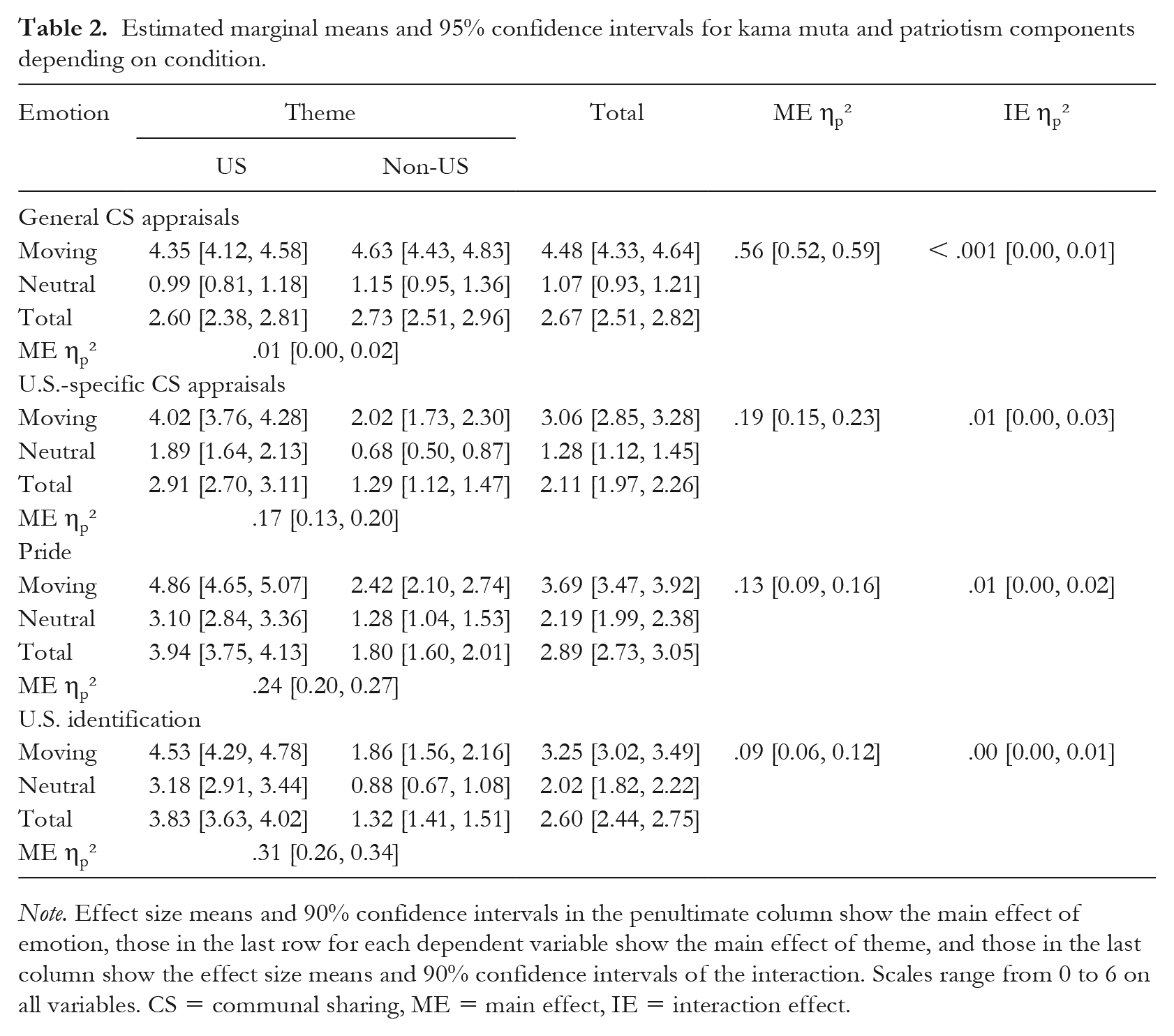
Note. Effect size means and 90% confidence intervals in the penultimate column show the main effect of emotion, those in the last row for each dependent variable show the main effect of theme, and those in the last column show the effect size means and 90% confidence intervals of the interaction. Scales range from 0 to 6 on all variables. CS = communal sharing, ME = main effect, IE = interaction effect.
Across all dependent variables, there were significant main effects of emotion condition, F(4, 834) = 274.63, p < .001, ηp² = .57, 90% CI [0.53, 0.60], and theme condition, F(4, 834) = 129.00, p < .001, ηp² = .38, 90% CI [0.34, 0.42]. Additionally, there was a significant interaction effect of emotion and theme on the variables, F(4, 834) = 6.02, p < .001, ηp² = .03, 90% CI [0.01, 0.05].
As seen in Table 2, all univariate main effects were significant, with the exception of the theme main effect on general CS appraisals. The univariate interaction effect on U.S.-specific CS appraisals was significant, F(1, 837) = 10.39, p = .001, ηp² = .01, 90% CI [0.00, 0.03], meaning that participants in the moving U.S. condition had ratings of increased closeness with the US over and above the combination of the main effects of emotion and theme, that is, having higher ratings than expected from a linear combination of the two main effects. A decomposition of the interaction effect shows that the moving U.S. video (M = 4.02, SD = 1.88) had higher ratings of U.S.-specific CS appraisals than the neutral U.S. video (M = 1.89, SD = 1.89, p < .001, Hedges’s g = 1.13, 90% CI [0.96, 1.30]). Furthermore, the moving non-U.S. video (M = 2.02, SD = 1.98) had higher ratings of U.S.-specific CS appraisals than the neutral non-U.S. video (M = 0.68, SD = 1.43, p < .001, Hedges’s g = 0.79, 90% CI [0.62, 0.96]). The univariate interaction effect on U.S. pride was also significant, F(1, 837) = 5.54, p = .019, ηp² = .01, 90% CI [0.00, 0.02]. This shows that participants in the moving U.S. condition indicated increased pride for the US over and above the combination of the main effects of emotion and theme, that is, having higher ratings than expected from a linear combination of the two main effects. Decomposing the interaction effect shows that the moving U.S. video (M = 4.86, SD = 1.55) had higher ratings of pride than the neutral U.S. video (M = 3.10, SD = 2.00, p < .001, Hedges’s g = 0.98, 90% CI [0.81, 1.15]), and the moving non-U.S. video (M = 2.42, SD = 2.24) had higher ratings of pride than the neutral non-U.S. video (M = 1.28, SD = 1.85, p < .001, Hedges’s g = 0.56, 90% CI [0.39, 0.73]). There were no significant univariate interaction effects for general CS appraisals and U.S. identification.
We fitted a similar model to the preregistered one but we replaced the mediator variables (kama muta and U.S. rating) with a latent variable, kama muta US, which was estimated by loading the four U.S.-specific CS items and the U.S. pride item onto one factor (factor loadings were between .80 and .96, α = .96; see Figure 2 for the structural portion of the model). The model was identified and showed good model fit, χ2(48) = 277.10, p < .001, RMSEA (90% CI) = .08 [0.07, 0.08], CFI = .97, SRMR = .03. As seen in Figure 2, there was a significant interaction effect on kama muta US; the moving U.S. video evoked the most U.S.-specific kama muta (B = 0.20, β = .09, 95% CI [0.04, 0.15], p = .001). Decomposition of the interaction effect shows that the moving U.S. video (M = 4.19, SD = 1.76) had higher ratings of kama muta US than the neutral U.S. video (M = 2.13, SD = 1.80, p < .001, Hedges’s g = 1.16, 90% CI [0.99, 1.33]). The moving non-U.S. video (M = 2.10, SD = 1.94) had higher ratings of kama muta US than the neutral non-U.S. video (M = 0.80, SD = 1.40, p < .001, Hedges’s g = 0.78, 90% CI [0.611, 0.948]). The kama muta US latent variable predicted more agreement to Republicans and Democrats belonging to one group (B = 0.61, β = .56, 95% CI [0.50, 0.61], p < .001).
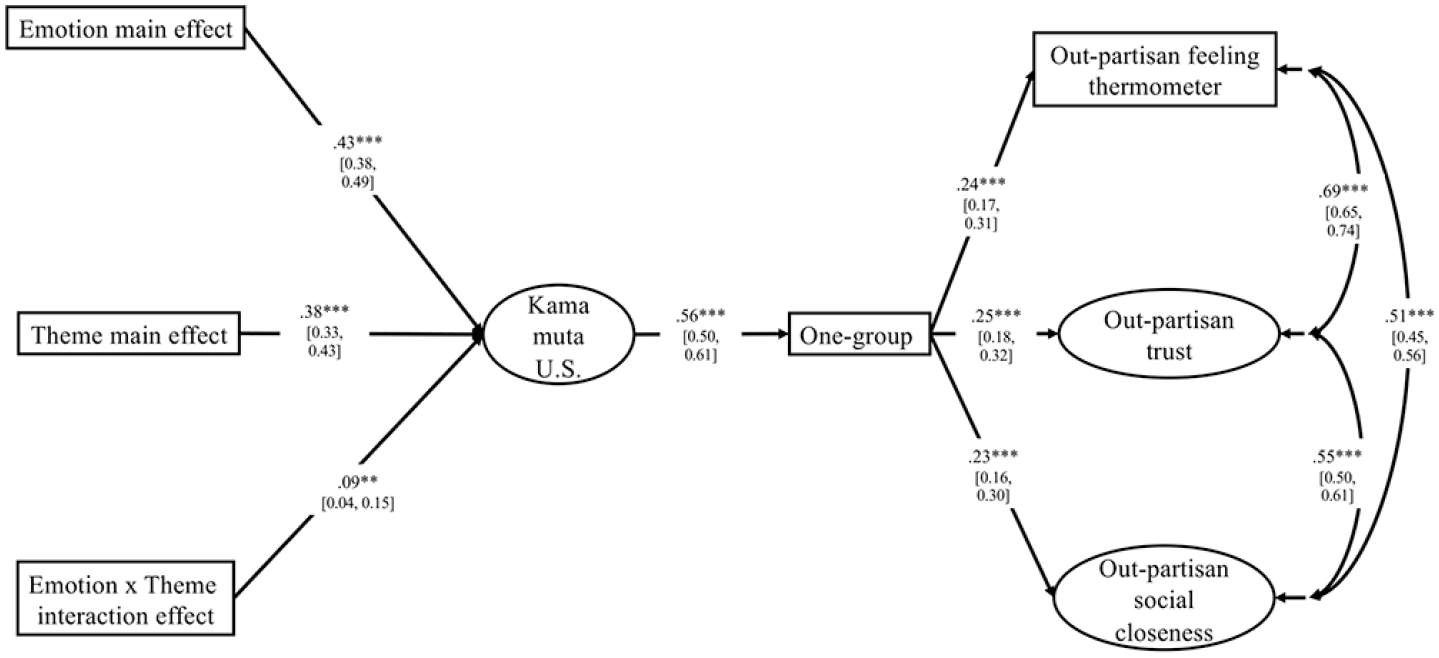
Exploratory model showing path coefficients standardized on the dependent variable.
We examined indirect effects of the videos on the dependent variables by employing a bootstrapping analysis with 10,000 resamples and 95% confidence intervals (Hayes & Scharkow, 2013). These analyses showed that the moving U.S. condition (i.e., the interaction indicator), via increased kama muta US feelings and viewing Republicans and Democrats as belonging to one group, was indirectly related to warmer feelings toward out-partisans (B = 0.04, 95% CI [0.01, 0.06]), increased trust in out-partisans (B = 0.02, 95% CI [0.01, 0.03]), and increased willingness to be socially close to out-partisans (B = 0.02, 95% CI [0.01, 0.03]).
Discussion
The aim of this paper was to investigate the effect of video stimuli on reducing affective polarization and out-partisan distrust in the US through the emotional route of kama muta. We hypothesized that watching a video that evokes kama muta about the US would lead to the strongest reduction in affective polarization as it would increase participants’ identification with Americans as their superordinate identity, thus viewing out-partisans as fellow Americans. This hypothesis was tested by showing participants videos intended to evoke kama muta versus no particular emotion, with some videos having the US as their main theme and other videos not having the US as a theme in a full-factorial design. The design thus could differentiate between the effects of kama muta and the effect of simply making the US cognitively salient on affective polarization and out-partisan distrust.
The interaction effect of emotion and theme was not significant, meaning that the video that evoked kama muta about the US did not reduce affective polarization and distrust over and above the main effects of emotion and theme. However, the moving U.S. video reduced affective polarization and distrust the most due to the linear combination of the two main effects (see Table 1). Thus, our prediction was somewhat supported; the moving U.S. video reduced affective polarization and distrust the most. However, this was due to the combination of two main effects instead of an interaction effect. The variation of warmth, trust, and closeness experienced towards out-partisans after watching a moving U.S. video was thus best explained by the effects of kama muta elicited by the videos (vs. no emotion) and U.S. theme (vs. no theme) independently, and not combined.
Indeed, a wealth of research on the common in-group identity model has provided evidence for the effect of cognitive processes of recategorization on improved out-group attitudes (Schellhaas & Dovidio, 2016). Thus, our study corroborates the independent effect of being primed with the US on reduction of affective polarization through a common U.S. identity (cf. Levendusky, 2018). Contrary to our predictions, we also found an independent effect of the moving condition on reduced affective polarization, mediated through kama muta feelings and further through perceiving Republicans and Democrats as belonging to the same U.S. American group. This indicates that kama muta might have a more general effect than previously thought on adopting a common in-group identity, and thus on improving out-group attitudes (e.g., Blomster Lyshol et al., 2020): Instead of kama muta motivating increased CS devotion to the person/group that was present in the specific kama muta eliciting event, kama muta may motivate increased affective devotion to other groups and persons in general.
However, the preregistered model (see Figure 1) also shows a significant path from emotion main effect to U.S. ratings, meaning that moving videos, whether or not about the US, were rated by participants as having a U.S. theme. This could be due to the effect of positive affect on broader and flexible categorization (Isen & Daubman, 1984): Because of the positive affect associated with kama muta, participants were more willing to rate non-U.S. moving videos as having a U.S. American theme. This willingness could be due to the non-U.S. moving videos being set in a U.S. American high school or with U.S. American actors.
Furthermore, the items assessing U.S. theme could have functioned as a U.S. prime, thus influencing participants to view Democrats and Republicans as members of the same U.S. American in-group. The positive affect from the moving video could have facilitated this (Dovidio et al., 1995). We think the U.S. ratings measure might have contributed to the nonsignificant interaction effect of theme and emotion on the common in-group, affective polarization, and out-partisan trust variables as it might have influenced participants to associate their kama muta feelings with the US in the non-U.S. moving condition.
However, the exploratory model (see Figure 2) shows that the moving U.S. videos evoked significantly higher U.S.-specific CS appraisals and feelings of pride toward the US (which we call kama muta US), as shown in the significant interaction effect. This indicates that kama muta can be a group-level emotion. That is, when kama muta is evoked by viewing fellow Americans coming together in rituals and celebration or in solidarity to overcome adversity, it is felt because of one’s group membership (Smith, 1993). More specifically, kama muta is evoked by suddenly creating a CS bond with the US. This emotion was labelled as pride toward the US by many participants, which corroborates research showing that group-based pride is related to identification (Mackie & Smith, 2015; Smith et al., 2007).
Furthermore, our findings show that kama muta promotes the perception of Republicans and Democrats as belonging to one group: U.S. Americans. Previous research on group-level emotions has focused on the effect of recategorization on emotions directed toward out-groups (Ray et al., 2012). However, Smith and Mackie pointed out the multidirectionality of categorization and group-level emotions (Mackie & Smith, 2018, p. 28). Accordingly, identification does not only predict group-level emotions, but positive affect directed toward one’s in-group also increases in-group identification (Kessler & Hollbach, 2005).
Our study provides evidence that a specific social relational emotion, evoked by suddenly intensifying one’s CS relation with the US, kama muta, is effective in strengthening a common in-group identity. Thus, kama muta did not only increase in-group identification, but also increased the feeling that out-partisans are part of a common U.S. American in-group. This is an important finding as it shows that kama muta is indeed a largely overlooked emotional process promoting common in-group identification that decades of work have demonstrated to have positive effects on intergroup relations (cf. Gaertner & Dovidio, 2000; Schellhaas & Dovidio, 2016).
Limitations and Future Studies
The first limitation regards the finding that our non-U.S. moving videos were viewed by participants as having a U.S. theme. As mentioned before, this could be due to the effect of positive affect on broader and flexible categorization (Isen & Daubman, 1984). An alternative explanation as to why the non-U.S. moving videos were perceived by participants to have more of a U.S. theme than the non-U.S. neutral videos is that the non-U.S. moving videos depicted people, whereas the non-U.S. neutral videos did not; thus, making it easier for participants to view the non-U.S. moving videos to be about the US. The reason why we used videos that did not depict people in the neutral conditions (with and without U.S. theme) was to ensure that no kama muta was evoked from seeing people interacting. Thus, future studies should use non-U.S. moving videos from clearly non-American settings, such as another cultural context with protagonists speaking another language, and use neutral videos depicting people that clearly do not act according to CS. Furthermore, future studies might refrain from asking participants whether the video is about the US, in order to prevent possible priming of common in-group perceptions.
Second, contrary to our preregistration, we only used the one-group item of the superordinate identity measure. This is because the correlation between these two measures across conditions was near zero (r = −.08), indicating very low reliability. This low reliability could have been due to the phrasing of the items where each item started with “Having seen the video.” This phrasing could have confused participants in the non-U.S. conditions especially, which could have contributed to the low reliability of the items. Future studies should use another superordinate identity measure, or use the same measure but not phrase the items in the same manner as in this paper.
Third, we did not ask participants whether they had seen the video before, making us unable to control for previous exposure on kama muta ratings. Indeed, previous exposure might have weakened the experience of kama muta. However, based on informal reports, some people feel kama muta from videos that they have already seen many times. More research should thus investigate the effect of previous exposure on kama muta.
Fourth, we did not include in this study any effort to measure moral elevation (Haidt, 2000). This is because (a) there is no consensual validated measure of moral elevation (Pohling & Diessner, 2016; Zickfeld, Schubert, Seibt, & Fiske, 2019), and (b) even though moral elevation is conceptualized as resulting from perception of moral beauty (Haidt, 2000), studies have found that moral elevation is evoked by films portraying family connectedness and the importance of love and kindness (Janicke & Oliver, 2017), which is more easily explained by the kama muta framework. Therefore, it was difficult to compare kama muta and moral elevation empirically in the current study. This is unfortunate as it would have provided greater conceptual clarity to the literature on these two constructs. When a theoretically well-grounded and consensual measure of moral elevation is available, future studies should empirically compare the effects of kama muta and moral elevation on affective polarization.
Last, and related to the previous point, future studies should assess whether similar effects on promoting common in-group identification and thus reducing affective polarization and out-partisan distrust can be found for other emotions, such as empathy, joy, and awe. Such discriminant validation studies will enable us to understand the unique contribution of kama muta to adopting a common in-group identity, and thus the potential of this emotion to improve intergroup relations. They may also help discover additional emotional processes that may help reduce affective polarization.
Conclusion
Over the past decades, U.S. American politics have seen an increase in affective polarization (Putnam & Garrett, 2020). This increase has been attributed to the establishment of partisan news outlets that strengthen people’s partisan identity by attacking the out-party (Iyengar et al., 2019). Our results suggest that videos that evoke kama muta from perceiving U.S. Americans coming together in rituals and celebration or in solidarity can be used to reduce affective polarization, as watching these videos contributes to viewing out-partisans as fellow Americans. These preliminary results show that kama muta is a so far overlooked emotional response that promotes the adoption of a common in-group identity, thus promoting positive out-group attitudes. These findings can be used to help develop media interventions that aim to improve attitudes, and perhaps reduce discrimination (Dovidio et al., 2018; Kurdi et al., 2019; Talaska et al., 2008) toward out-groups.
Supplemental Material
sj-docx-1-gpi-10.1177_13684302211067152 – Supplemental material for Moving political opponents closer: How kama muta can contribute to reducing the partisan divide in the US
Supplemental material, sj-docx-1-gpi-10.1177_13684302211067152 for Moving political opponents closer: How kama muta can contribute to reducing the partisan divide in the US by Johanna K. Blomster Lyshol, Beate Seibt, Mary Beth Oliver and Lotte Thomsen in Group Processes & Intergroup Relations
Footnotes
Author Note
Johanna K. Blomster Lyshol is now affiliated to Oslo New University College, Norway.
Funding
The author(s) received no financial support for the research, authorship, and/or publication of this article.

Supplemental material
Supplemental material for this article is available online.
References
Supplementary Material
Please find the following supplemental material available below.
For Open Access articles published under a Creative Commons License, all supplemental material carries the same license as the article it is associated with.
For non-Open Access articles published, all supplemental material carries a non-exclusive license, and permission requests for re-use of supplemental material or any part of supplemental material shall be sent directly to the copyright owner as specified in the copyright notice associated with the article.
