




Abstract
Previous work has reported a relation between pathogen-avoidance motivations and prejudice toward various social groups, including gay men and lesbian women. It is currently unknown whether this association is present across cultures, or specific to North America. Analyses of survey data from adult heterosexuals (N = 11,200) from 31 countries showed a small relation between pathogen disgust sensitivity (an individual-difference measure of pathogen-avoidance motivations) and measures of antigay attitudes. Analyses also showed that pathogen disgust sensitivity relates not only to antipathy toward gay men and lesbians, but also to negativity toward other groups, in particular those associated with violations of traditional sexual norms (e.g., prostitutes). These results suggest that the association between pathogen-avoidance motivations and antigay attitudes is relatively stable across cultures and is a manifestation of a more general relation between pathogen-avoidance motivations and prejudice towards groups associated with sexual norm violations.
Pathogens have wreaked havoc on multicellular organisms for millions of years. One result of this recurring challenge is the evolution of the innate and adaptive immune systems, which attack pathogens that have entered the body (e.g., Kimbrell & Beutler, 2001). Humans, like some other animals, have also evolved behavioral adaptations that mitigate pathogen threats, a so-called behavioral immune system (Ackerman et al., 2018; Lieberman & Patrick, 2018; Murray & Schaller, 2016; Schaller & Park, 2011). The behavioral immune system outputs various behaviors and attitudes that motivate pathogen avoidance. Proposed effects of the behavioral immune system include inferences of contamination (Apicella et al., 2018), specialized memory for pathogen threats (Fernandes et al., 2017), preferences for monogamous mating (Murray et al., 2013), and avoidance of individuals who appear contagious (Kurzban & Leary, 2001).
Many of the proposed outputs of the behavioral immune system involve prejudices, including those directed toward immigrants (Aarøe et al., 2017; Faulkner et al., 2004), homeless people (Clifford & Piston, 2017), obese individuals (Lieberman et al., 2012; van Leeuwen et al., 2015), individuals with physical deformities (Ryan et al., 2012), unfamiliar individuals (Aarøe et al., 2016), and, pertinent to this article, gay men and lesbian women (Crawford et al., 2014; Pirlott & Cook, 2018; Terrizzi et al., 2010). The fact that prejudices toward gay men and lesbian women have a deep history (Pickett, 2018) and are present across religiously and economically diverse cultures (Jäckle & Wenzelburger, 2015; Pew Research Center, 2013) suggests that these prejudices might have roots in so-called fundamental motivational systems (Kenrick et al., 2010; Neel et al., 2016), such as those for mating and pathogen avoidance.
One of the primary outputs of the behavioral immune system is disgust, an emotion that seems specialized for neutralizing pathogens (Curtis et al., 2011; Lieberman et al., 2018; Oaten et al., 2009; Tybur et al., 2013). Disgust is triggered by the smells, textures, and colors that reliably correlated with pathogen presence in our ancestral past—the types of cues present in infected wounds, rotting organic matter, and bodily wastes (Tybur et al., 2013). It can also be elicited by objects in the environment that have been associated with pathogen risks (e.g., toilets, foods that have been consumed shortly before bouts of nausea). Such associations can arise via individual learning or social learning, just as acquisition of information regarding physical dangers can (for an example of learning about predators, see e.g., Barrett & Broesch, 2012). Such processes could lead to the type of cross-cultural variation in disgust elicitors observed by Darwin (1872/1965). Some disgust elicitors—such as bodily wastes—appear to be universal across cultures, though (Curtis & Biran, 2001).
Furthermore, individuals vary in the degree to which they experience disgust toward disgust elicitors. This variation, which is typically referred to as disgust sensitivity, is often interpreted as reflecting differences in motivations to avoid pathogen cues (Tybur et al., 2009). Recent work indicates that about 40% of the variation in disgust sensitivity flows from genetic differences between people, and that the remaining variance reflects environmental differences between people and measurement error (Tybur et al., 2018, 2020).
Regardless of what causes individual differences in disgust sensitivity, substantial evidence suggests that people who score higher on disgust sensitivity instruments tend to be more prejudiced toward gay men (Crawford et al., 2014; Inbar et al., 2009; Kam & Estes, 2016; Lai et al., 2014; Olatunji, 2008; Schein et al., 2016; Smith et al., 2011; Terrizzi et al., 2010, 2012). These findings align with experiments reporting that disgust inductions (e.g., with stimuli resembling a pathogen hazard, such as odor of feces or spoiled food) result in increased antigay prejudice (Cunningham et al., 2013; Dasgupta et al., 2009; Inbar et al., 2012). Other experimental evidence suggests that imagined contact with a gay man increases desires to engage in hygiene behavior (Golec de Zavala et al., 2014). Taken together, this evidence has been interpreted as supporting a relation between pathogen-avoidance motivations and prejudice towards gay men (e.g., Pirlott & Cook, 2018).
Reevaluating the Relation Between Disgust Sensitivity and Antigay Prejudice
How should we interpret the relation between disgust sensitivity and antigay attitudes? One possibility is that gay men might now be associated with infectious disease because the HIV/AIDS epidemic has hit the gay community particularly hard since the 1980s (Cottrell & Neuberg, 2005; Kurzban & Leary, 2001). However, antigay prejudice long predates the 20th-century HIV epidemic (Pickett, 2018). Hence, if pathogen-avoidance motivations partially underlie long-standing and cross-culturally robust antigay sentiments, then they likely do not do so only because of the HIV/AIDS epidemic.
Although prejudice toward gay men and lesbian women is widespread across cultures, evidence for an association between pathogen-avoidance motivations and antigay attitudes comes almost entirely from studies that have sampled from North American populations (out of 21 relevant published studies, only three sampled from countries other than the US and Canada; see supplemental material Table S1). Thus, we do not know whether the relation between pathogen-avoidance motivations and antigay attitudes is specific to North American populations, or if it exists across a broader set of cultures. This lack of cross-cultural evidence limits our ability to interpret the relation between pathogen-avoidance motivations and antigay prejudice. If the relation is specific to particular cultures, then it plausibly derives from pathogen-avoidance motivations interacting with culturally specific factors (e.g., particular beliefs about gay men found in specific cultures). If the relation is consistent across cultures, then it more likely derives from factors that are cross-culturally stable. To address this issue, the primary goal of this research was to assess the cross-cultural variability of the association between individual differences in pathogen-avoidance motivations and antigay attitudes.
Pathogen Avoidance and Prejudice Across Groups
In addition to testing whether the relation between pathogen avoidance and antigay attitudes generalizes across societies, the current study also aimed to test the extent to which it is unique to antipathy toward gay men and lesbians. These tests can help us adjudicate between existing candidate explanations for the relation between pathogen avoidance and antigay attitudes, which take four broad forms. The first explanation suggests that pathogen avoidance relates specifically to negative attitudes toward gay men. The second explanation suggests that pathogen avoidance relates to not just negative attitudes toward gay men and lesbians, but also toward other groups associated with violating sexual norms. The third explanation suggests that pathogen avoidance relates to negative attitudes toward outgroups in general. The fourth explanation suggests that disgust sensitivity relates to condemnation of perceived norm violations. We briefly summarize work supporting these four types of explanations.
The first explanation is based on the association between gay men and anal intercourse (Kiss et al., 2020; Morrison et al., 2019), a sexual practice that has been negatively evaluated by some religions at least since Medieval times. One possible reason for this negative evaluation was graphically described by Kiss et al. (2020, p. 678): anal intercourse “involves penetrating the rectum . . . and, thus, may be associated with feces expelled from the anus.” If this association underlies the relation between disgust sensitivity and antigay prejudice, then we would expect that the relation is specific to prejudice towards gay men (who are associated with anal intercourse), but not to prejudice towards lesbian women (who are not associated with this activity).
The second explanation is based on the infection risks inherent in any sexual activities. Just like any act of eating can lead to infection (e.g., via contaminated hands or utensils or via the bacterial contamination of food), an act of sex can transmit infection. These infection costs are accepted by nearly everyone for both eating and sex given the benefits of calories and reproduction. Acts outside of those that are necessary for sustenance and reproduction carry infection costs, but they do not offer such benefits. Promiscuous sex is one example. And, indeed, some evidence suggests that more pathogen-avoidant individuals are more avoidant of promiscuous sex (Murray et al., 2013; Schaller & Murray, 2008). Other sex acts that depart from intercourse with a pair-bonded partner might similarly be interpreted by the behavioral immune system as pathogen risks that do not have offsetting reproductive benefits. Based on this reasoning, more pathogen-avoidant individuals might not only constrain their own sexual behaviors, but also condemn others who depart from monogamous heterosexual activities, for three (not mutually exclusive) reasons. First, individuals who engage in promiscuous sex might pose infection risks to others—even to those who do not engage in promiscuous sex. Hence, more pathogen-avoidant individuals might discourage others from engaging in such behaviors for direct pathogen-avoidance purposes (Bauch & McElreath, 2016; Crawford et al., 2014). Second, traditional norms (e.g., relating to religious ceremonies, greeting and hygiene rituals, food preparation, and sexual behavior) might evolve to provide protection against infectious disease (Murray et al., 2011; van Leeuwen et al., 2012). More pathogen-avoidant individuals might thus be more adherent to traditional norms, and also condemn others for not following traditional norms, including monogamous heterosexuality. Consistent with this perspective, pathogen-avoidance motives relate to traditionalism more strongly than other dimensions of ideology (Tybur et al., 2016), and antigay prejudice relates strongly to traditionalism (Duckitt et al., 2010) and especially to endorsement of traditional gender norms (Bettinsoli et al., 2019). Third, people who restrict themselves to heterosexual monogamy might pay particularly high costs in the event of cuckoldry (for men) and partner loss (for women). That is, fathers who invest heavily in one partner incur more costs from cuckoldry than those who seek multiple partners, and women who rely heavily on a single partner incur greater losses when abandoned (Pinsof & Haselton, 2016). Consequently, individuals invested in heterosexual monogamy might endorse rules that punish individuals for departing from heterosexual monogamy. This possibility also would align with a relation between individual pathogen-avoidance motives and condemnation of departures from heterosexual monogamy (Billingsley et al., 2018; Tybur et al., 2015).
Some evidence is consistent with these proposals. In North American populations, gay men and lesbian women are stereotyped as departing from traditional norms of monogamy; indeed, they are perceived as promiscuous or hyper-sexual (Geiger et al., 2006; Pinsof & Haselton, 2016; Ross, 2002). This perception of gay men and lesbian women as violating or threatening sexually monogamous norms seems to underlie antigay prejudice among Americans (Pinsof & Haselton, 2016). However, little evidence—and no evidence from populations outside of North America—speaks to the prediction that pathogen-avoidance motivations relate to prejudice toward groups associated with sexual norm violations. Out of the 21 published studies with measures of antigay attitudes and pathogen-avoidance motivations (see Table S1), only three included measures of prejudice toward other groups that violate sexual norms, and all used U.S. samples. Crawford et al. (2014) reported that disgust sensitivity relates to negative attitudes toward groups that violate traditional sexual norms (e.g., gays and lesbians, sexually active people, prochoice activists) and to positive attitudes toward groups that uphold traditional sexual norms (e.g., prolife activists, evangelicals). Findings of the two other studies were equivocal. One showed that disgust sensitivity was similarly correlated with prejudice toward individuals with a bisexual orientation, gay men, and lesbian women (Terrizzi et al., 2012). The other suggested that the relation between disgust sensitivity and antigay attitudes is at least partially independent from sexually conservative attitudes (Olatunji, 2008).
The third category of explanations focuses on a broader relation between pathogen-avoidance motives and prejudice. So-called outgroup-avoidance perspectives propose that outgroup members are adapted to and carry pathogens endemic to their ecologies of origin, and are consequently a greater pathogen threat than ingroup members. Hence, individuals who are more pathogen avoidant adopt more socially conservative attitudes, which motivate avoidance of interactions with outgroups (Faulkner et al., 2004; Fincher & Thornhill, 2012; Terrizzi et al., 2010). Recent work has cast doubt upon foreign ecological origin underlying relations between disgust sensitivity and intergroup prejudices (Ji et al., 2019; Karinen et al., 2019; Tybur et al., 2016; van Leeuwen & Petersen, 2018) and suggested that the inclination to associate foreigners with pathogen threats could be a byproduct of general hyper-vigilance against unfamiliar others (Aarøe et al., 2016, 2017). However, little evidence speaks to whether the relation between pathogen avoidance and antigay attitudes can be accounted for by prejudice toward outgroups in general.
The fourth explanation focuses on the relation between disgust sensitivity and moral condemnation. Evidence suggests that disgust sensitivity relates to condemnation of nonsexual norm violations (e.g., those related to harm and fairness). For example, disgust toward pathogen cues correlates with disgust toward moral violations (Tybur et al., 2009) and with objections to both violations of conventions and violations of broad moral norms (Chapman & Anderson, 2014; Karinen & Chapman, 2019). If the relation between pathogen avoidance and antigay prejudice reflects this type of process, then disgust sensitivity should also relate to prejudice toward groups that are perceived to violate nonsexual norms.
Overview of Current Study
The primary goal of the current study was to reassess the relation between pathogen-avoidance motives and antigay attitudes in a large cross-cultural sample. To do so, we performed analyses to answer two related questions: (a) Does disgust sensitivity relate to antigay attitudes? (b) How variable is the relation between disgust sensitivity and antigay attitudes across countries? If the relation between disgust sensitivity and antigay prejudice is relatively stable across countries, then we can better understand that relation by testing whether it is specific to antigay prejudice, generalizes to other outgroups associated with sexual norm violations, or generalizes to outgroups associated with cooperative norm violations. Doing so was the secondary goal of this study. To address this secondary goal, we performed analyses to answer the question: How specific is the relation between disgust sensitivity and antigay attitudes?
Method
We analyzed a unique data set including measures of antigay attitudes and disgust sensitivity in a large sample of adult heterosexuals from 31 countries. Data were collected as part of a large cross-cultural survey (Tybur et al., 2016) that included pathogen disgust sensitivity (a measure of pathogen-avoidance motivations; Tybur et al., 2009) and multiple measures of antipathy toward gay men and lesbians as well as other groups. Surveys were administered in the official or native language in all countries except Sweden (where English fluency is high).
Existing work has uncovered multiple variables that correlate with antigay prejudice. Men express more antigay prejudice than women (Herek, 1988; Pirlott & Neuberg, 2014). Antigay prejudice is also associated with religiosity (Jäckle & Wenzelburger, 2015) and conservative political ideology (Altemeyer, 2002; Duckitt et al., 2010; Pratto et al., 1994). The survey included measures of political ideology (i.e., social dominance orientation and traditionalism), participant sex, and religiosity; hence, we were able to control for these variables.
The total sample included participants from 31 countries (those reported by Tybur et al. [2016] plus an additional sample from Italy: N = 360, 182 female, 178 male). Although 17 of 31 samples were from European countries, there was substantial variation across the samples in the level of antigay prejudice (see following lines). We analyzed only responses from adults reporting romantic interest in members of the opposite sex. After excluding 250 participants for not reporting their sex or their preferred sex for romantic partners, and an additional 620 for indicating attraction to same-sex others, the final sample included 11,200 participants (6,565 women, 4,635 men; Mage = 29.97, SD = 12.54). Recruitment occurred both on and off university campuses, with different sites following different recruitment strategies. Further details of the samples and method are described in Tybur et al. (2016). The final sample size provided excellent power. Assuming ρ = .10 and with α = .05, N = 11,200 yields a power > .99 to observe a significant correlation.
Measures of Antigay Attitudes
Two questions asked participants about relevant policy attitudes: “Should homosexuals have the exact same marriage rights as heterosexuals?” and “Should society accept homosexuality?” (answer options: no, yes; Pew Research Center, 2013). 1 For both items, we coded responses so that higher values reflected opposition to gay and lesbian sexual orientation (no = 1, yes = 0). Responses to these items were strongly correlated (φ = .63). There was substantial cross-national variation in the responses to these items (see Figure 1). For example, approval of both gay marriage and sexual orientation was below 50% in the samples of four countries (Slovakia, Bosnia and Herzegovina, Poland, India), while it was above 90% in the samples of five countries (Argentina, Spain, United Kingdom, Denmark, the Netherlands, Sweden).
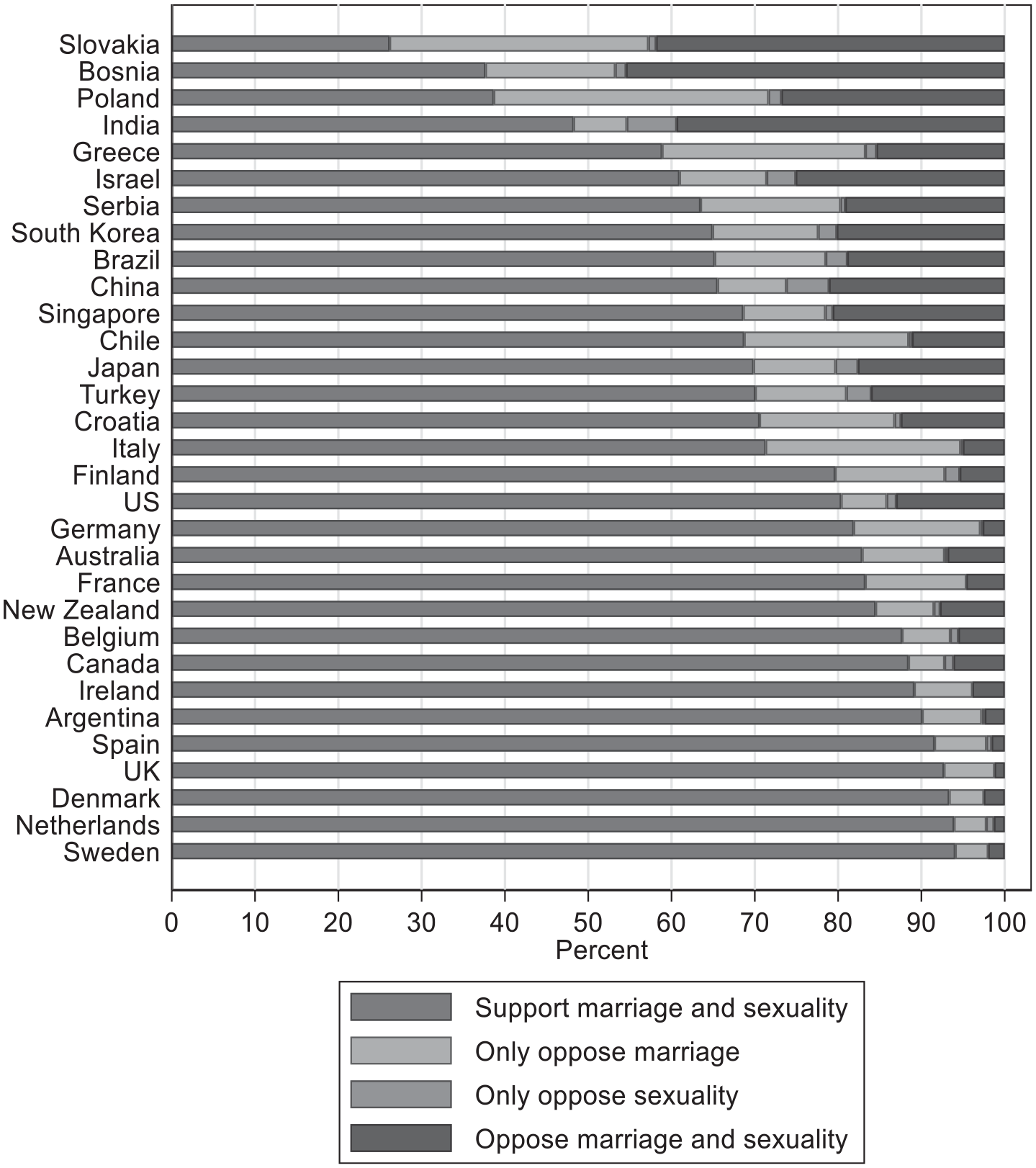
Opposition to gay marriage and gay and lesbian sexual orientation across the 31 samples.
We had initially planned on including the Attitudes Toward Lesbians and Gay Men Scale (Herek, 1988) to gather a finer-grain assessment of sentiments toward gay men and lesbians. However, ethical review concluded that instrument content (e.g., “Male homosexuality is a perversion,” “I think male homosexuals are disgusting”) would be offensive to many participants. We instead assessed attitudes toward gay men and lesbian women using feeling thermometers, which are widely used to study prejudice. Similar single-item measures of attitudes toward groups are ubiquitous in the prejudice literature (Correll et al., 2010), and have been used in cross-national studies about antigay prejudice (e.g., Bettinsoli et al., 2019). Responses to feeling thermometers for gay men and lesbian women have been found to correlate strongly with attitudes towards gay men (r = .83) and lesbian women (r = .82) as measured with the 10-item version of the Attitudes Toward Lesbians and Gay Men Scale (Siebert et al., 2014). For each target group, participants indicated their feelings on a scale from 0 to 100 (0 = cold, 50 = neutral, 100 = warm). Scores on these items were reversed so that higher values indicated greater antipathy. Two social categories referred to gay or lesbian sexual orientation (gay men, lesbian women). Two social categories were associated with sexual promiscuity—but not sexual orientation (prostitutes, sexually promiscuous people). And four categories were not characterized by sexual behavior (lawyers, politicians, farmers, and atheists). Two of these categories—lawyers and politicians—are associated with cooperative norm violations. A 2019 Gallup survey of Americans found that only 22% of participants rated lawyers as high or very high in terms of honesty and ethical standards, and only 13% of participants rated senators as high or very high on the same scale (Gallup, 2019). Data from the European Social Survey (Round 7; see http://nesstar.ess.nsd.uib.no/) show that in most European countries, politicians are perceived as less trustworthy than the police. In some societies, atheists are also perceived as untrustworthy (Gervais, 2013). (For correlations between the feeling thermometers, see Table S2.)
Pathogen-Avoidance Motives
The survey also included the seven pathogen disgust items from the Three-Domain Disgust Scale (α = .75; Tybur et al., 2009). Participants indicated how disgusting they find the activity described in the item (e.g., “Accidentally touching a person’s bloody cut”; 0 = not at all disgusting, 6 = extremely disgusting). The sexual and moral domains of the Three-Domain Disgust Scale were omitted for two reasons. First, given the large scale of data collection and recruitment from community samples, we aimed to keep the survey as brief as possible. Second, collaborators from multiple countries voiced concerns that the sexual disgust items would offend participants.
Ideology and Religiosity
The survey also included measures of traditionalism from the Authoritarianism-Conservatism-Traditionalism scale (six items, α = .77; Duckitt et al., 2010), and social dominance orientation from the Short Social Dominance Orientation scale (four items, α = .60; Pratto et al., 2013). For traditionalism, participants indicated agreement (0 = strongly disagree, 6 = strongly agree) with statements about traditional ways of conduct (e.g., “The ‘old fashioned ways’ and ‘old fashioned values’ still show the best way to live”). For social dominance orientation, participants indicated agreement (0 = extremely oppose, 6 = extremely favor) with items about hierarchical intergroup relations (e.g., “Superior groups should dominate inferior groups”).
The survey contained four items about religious beliefs and practices: “I believe faith in God is important for morality,” “Religion is very important to my life,” and “I pray at least once per day” (answer options for these three items: no, yes; Pew Research Center, 2013). The fourth item asked participants to indicate which label best described their religion (answer options: Buddhist, Christian, Hindu, Jewish, Muslim, non-religious, other). The most common response for religion was nonreligious (39.2%), followed by Christian (36.4%), Muslim (7.4%), other (6.0%), Hindu (4.0%), Buddhist (3.9%), and Jewish (3%). The survey also included questions about age, sex, and sexual orientation. We used responses to the latter two questions to classify participants as gay (i.e., men who are more attracted to men) or lesbian (women who are more attracted to women) versus heterosexual.
Results
Analytic Approach
We estimated the relation between disgust sensitivity and antigay attitudes by analyzing four variables: the two dichotomous items about opposition to gay marriage and gay and lesbian sexual orientation and the two feeling thermometers about gay men and lesbian women. Because the data have a nested structure, with individuals (Level 1) nested within countries (Level 2), we fit multilevel regression models. To compare the magnitude of the effects of the predictors, we scaled all predictors to range from 0 to 1. We followed standard recommendations regarding centering of predictor variables (Enders & Tofighi, 2007). Because the association of primary interest is at Level 1, all predictor variables were centered within countries. 2
For the dichotomous variables measuring opposition to gay marriage and gay and lesbian sexual orientation, we estimated relations with disgust sensitivity by computing multilevel logistic regressions (using the “meqrlogit” command in Stata 15) in which individuals (Level 1) were nested within countries (Level 2). The first model regressed antigay attitudes on disgust sensitivity, age, and sex (all Level 1). Intercepts and the slope for disgust sensitivity were allowed to vary across countries (with random effects estimated using unstructured covariance matrices). Two subsequent models assessed whether the relation between disgust sensitivity and antigay prejudice could be attributed to traditionalism and social dominance orientation by including these variables as Level 1 predictors. In these models, intercepts and slopes for traditionalism and social dominance orientation were allowed to vary across countries (with random effects estimated using unstructured covariance matrices). Models with additional random slopes did not converge.
For the feeling thermometers, we estimated the relation with disgust sensitivity by computing multilevel linear regressions (using the “mixed” command in Stata 15). We computed models that predicted antipathy toward gay men and models that predicted antipathy toward lesbian women. As in the logistic regressions, we first included disgust sensitivity, age, and sex, and then added traditionalism and social dominance orientation. Intercepts and slopes were allowed to vary across countries. Random effects were estimated using an unstructured covariance matrix and, if these models did not converge, we specified an independent covariance matrix. The regression tables in the supplement indicate the type of matrix used for each model.
Subsequently, we performed analyses to assess the cross-cultural variability in the relation between disgust sensitivity and antigay attitudes, and to assess the specificity of this relation. These analyses are detailed in what follows.
Does Disgust Sensitivity Relate to Antigay Attitudes?
We estimated the relation between disgust sensitivity and the four measures of antigay attitudes across all participants (see supplemental material, Tables S3–S6). Disgust sensitivity predicted opposition to gay marriage (b = 0.83, p < .001, 95% CI [0.54, 1.12]), and opposition to gay and lesbian sexual orientation (b = 0.55, p = .011, 95% CI [0.13, 0.98]). To illustrate the magnitude of these relations, we computed predicted probabilities across values of disgust sensitivity (see Figure 2, Panels A and B). These relations remained significant when controlling for traditionalism and social dominance orientation (see Table S3, Model 3 and Table S4, Model 3).
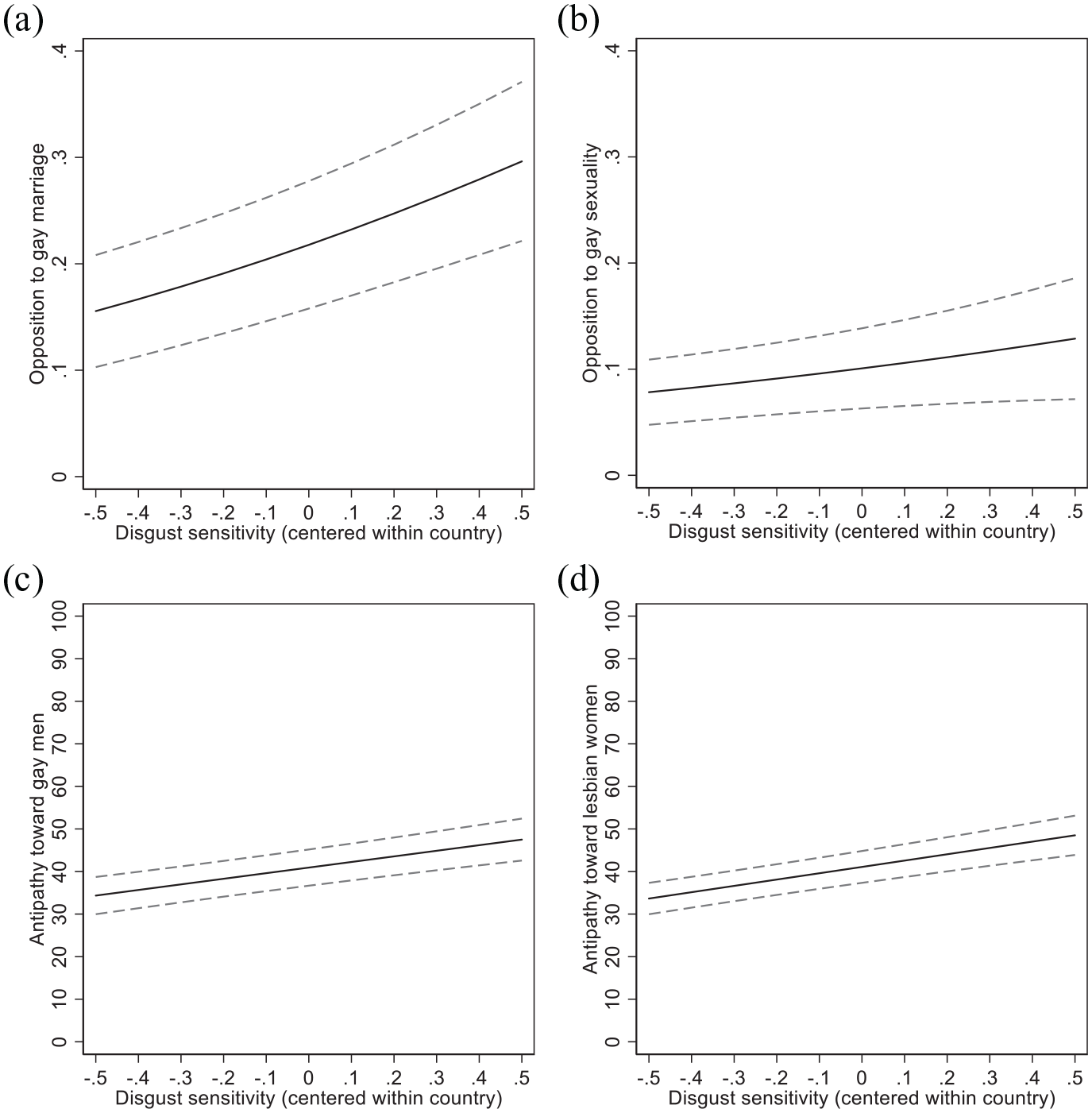
Relations between disgust sensitivity and opposition to gay marriage (Panel A), opposition to gay and lesbian sexual orientation (Panel B), antipathy toward gay men (Panel C), and antipathy toward lesbian women (Panel D).
Disgust sensitivity also predicted negative attitudes toward gay men (b = 13.15, p < .001, 95% CI [9.34, 16.96]) and lesbian women (b = 14.86, p < .001, 95% CI [11.13, 18.58]), as measured by feeling thermometers. Figure 2 (Panels C and D) shows the predicted values for these outcomes. Again, the relation between disgust sensitivity and antigay attitudes remained when controlling for traditionalism and social dominance orientation (see Table S5, Model 3 and Table S6, Model 3).
We further ran models controlling for religiosity, religion, age, and participant sex. For each of the four outcome variables, we computed a model that controlled for religiosity, religion, and the interactions between religiosity and religion (as the effect of religiosity might differ across religions; see Table S7). These models showed that, although religiosity and religion predicted antigay attitudes independently of other variables, the relations between disgust sensitivity and antigay attitudes remained when controlling for both.
The previous analysis assumes that the slopes of disgust sensitivity are not contingent on participant age and sex. To test this assumption, we computed models that included interactions between disgust sensitivity and participant sex, and disgust sensitivity and age, for each of the four outcomes (see Table S8). Interactions with sex varied across the four outcomes. Only the relation between disgust sensitivity and antipathy toward lesbian women was moderated by participant sex, with a steeper slope for women (b = 19.31, p < .001, 95% CI [15.55, 23.08]) than for men (b = 9.12, p < .001, 95% CI [4.90, 13.34]). No significant interactions with age emerged.
In summary, while effects were small, disgust sensitivity related to antigay attitudes across four measures. As an alternative way of estimating the effect size of the relation, we conducted a random-effects meta-analysis of the correlations between disgust sensitivity and antipathy towards gay men and lesbian women (see Tables S10 and S11; correlations were Fisher z-transformed). Because men were on average less disgust sensitive (b = −0.39, 95% CI [−0.43, −0.35]), participant sex might confound the relations with disgust sensitivity. Therefore, average correlations were estimated for men and women separately. The meta-analysis revealed—for both sexes—small correlations between disgust sensitivity and antipathy toward gay men (men: r = .10, 95% CI [0.06, 0.13]; women: r = .08, 95% CI [0.04, 0.11]) and lesbian women (men: r = .07, 95% CI [0.03, 0.10]; women: r = .11, 95% CI [0.08, 0.15]).
How Variable Is the Relation Between Disgust Sensitivity and Antigay Attitudes Across Countries?
The variances of the slopes of disgust sensitivity were nonzero for each of the four outcome variables (see Model 1 in Tables S3–S6). To interpret this variation, we first evaluated the relative magnitude of the slope variance by comparing it to variance of the slopes of other predictors. We compared the variation in the slopes of disgust sensitivity with variability in the slopes of age, sex, traditionalism, and social dominance orientation. Variance in the slope of disgust sensitivity was the second lowest among the five predictors (see Figure 3), with only the slope for participant sex varying less.
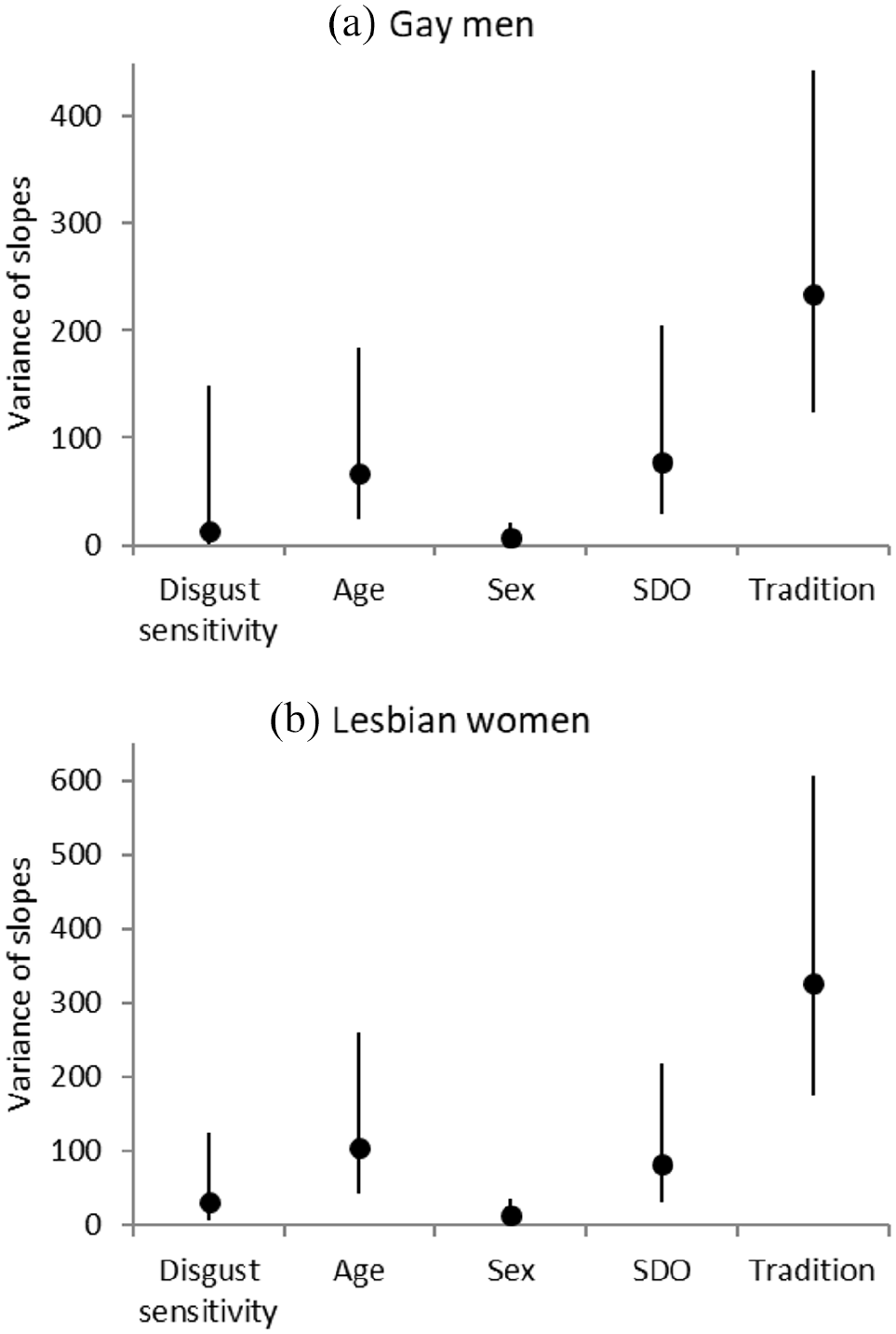
Variances (with 95% CI) for the random slopes of disgust sensitivity, age, sex, social dominance orientation (SDO), and traditionalism (Tradition) when predicting antipathy toward gay men (Panel A) and lesbian women (Panel B).
Second, we evaluated whether variance in the slopes could be attributed to cross-country differences in antigay prejudice, both as observed in each of the samples and as reflected in each country’s sexual orientation laws. To evaluate whether the variability in the slope of disgust sensitivity was related to the level of antigay prejudice in the samples of the 31 countries, we examined the slope–intercept covariance (see Model 1 in Tables S3–S6). This covariance did not differ from zero for any of the four outcome variables, indicating that the slope of disgust sensitivity did not systematically differ across samples with low and high antigay prejudice.
We then examined whether the slope of disgust sensitivity varied as a function of antigay prejudice as reflected in national sexual orientation laws. We used the combined index of sexual orientation laws provided by Henry and Wetherell (2017), which ranges from 0 to 1 and reflects the extent to which a country has laws that allow or recognize same-sex sexual activity, same-sex relationships, same-sex marriage, adoption by same-sex couples, military service by gay men and lesbian women, and includes antidiscrimination laws that protect gay men and lesbian women. Higher values indicate less legal types of discrimination toward same-sex relations. No estimate was available for Bosnia and Herzegovina, to which we gave an estimate of 0.57 based on the approach provided by Henry and Wetherell. Across the 31 countries, values ranged from 0 to 1. To illustrate, the five lowest scores were for India (0), Singapore (0.21), Turkey (0.29), China (0.33), and South Korea (0.36). Ten countries had a score of 1 (Belgium, Canada, Denmark, Finland, France, the Netherlands, New Zealand, Spain, Sweden, and UK). As the combined index is a country-level variable, it was centered around the grand mean (following Enders & Tofighi, 2007). We computed models that included disgust sensitivity, age, participant sex, the index of sexual orientation laws, and the interaction term Disgust Sensitivity × Sexual Orientation Laws. The interaction did not differ from zero in any of the four models (opposition to gay marriage: b = 0.28, SE = 0.49, p = .565; opposition to gay and lesbian sexual orientation: b = −0.52, SE = 0.61, p = .398; antipathy toward gay men: b = −6.22, SE = 6.85, p = .364; antipathy toward lesbian women: b = −3.07, SE = 6.69, p = .646). Hence, the slope of disgust sensitivity did not vary across countries as a function of their sexual orientation laws.
These analyses showed that variance in the slopes of disgust sensitivity was relatively small and could not be attributed to cross-country differences in antigay prejudice. They also indicated that the relation between disgust sensitivity and antigay prejudice was on average small. We therefore examined whether the slope of disgust sensitivity differed across cultural regions with sufficient participants to reliably observe a small correlation. The meta-analysis estimated that the average correlation was near .1. With ρ = .10, at least 783 participants per sample would be required for sufficient power (.80). Only two countries had a sample size that satisfied this criterion. Because most samples of individual countries were underpowered, we categorized countries in cultural regions so that each region had more than 1,000 participants. We estimated the slope of disgust sensitivity for six regions: British and culturally related nations (USA, Canada, United Kingdom, Ireland, Australia, New Zealand), Western Europe and Scandinavia (Germany, the Netherlands, Belgium, Spain, France, Italy, Denmark, Sweden, Finland), postcommunist Europe (Poland, Slovakia, Serbia, Bosnia and Herzegovina, Croatia), East Mediterranean (Greece, Turkey, Israel), Latin America (Brazil, Argentina, Chile), and Asia (China, India, Japan, South Korea, Singapore). We performed this analysis for the reverse-scored feeling thermometers (see Figure 4). In contrast with previous work (e.g., Inbar et al., 2009, 2012), disgust sensitivity was unrelated to antipathy toward gay men in the British cluster (b = 6.16, SE = 3.21, p = .056, 95% CI [−0.15, 12.46]). We tested whether the associations differed across the cultural regions by comparing all slopes with those observed in the British cluster (using dummy codes for cultural regions and including interactions of these dummies with disgust sensitivity). For antipathy toward gay men, compared to the British cluster, the relation was stronger in Eastern European countries (Disgust Sensitivity × Eastern European: b = 9.32, SE = 4.64, p = .044) and Mediterranean countries (Disgust Sensitivity × Mediterranean: b = 16.87, SE = 4.76, p < .001). This was also the case for antipathy toward lesbian women; the relation was stronger in Eastern European countries (Disgust Sensitivity × Eastern European: b = 14.44, SE = 4.78, p = .002) and Mediterranean countries (Disgust Sensitivity × Mediterranean: b = 14.99, SE = 4.90, p = .002). No other comparison with the British cluster was significant. In summary, the relation between disgust sensitivity and antigay attitudes was present across multiple cultural regions (including Eastern European, Latin American, and Asian countries) and was weakest in populations culturally related to Britain.
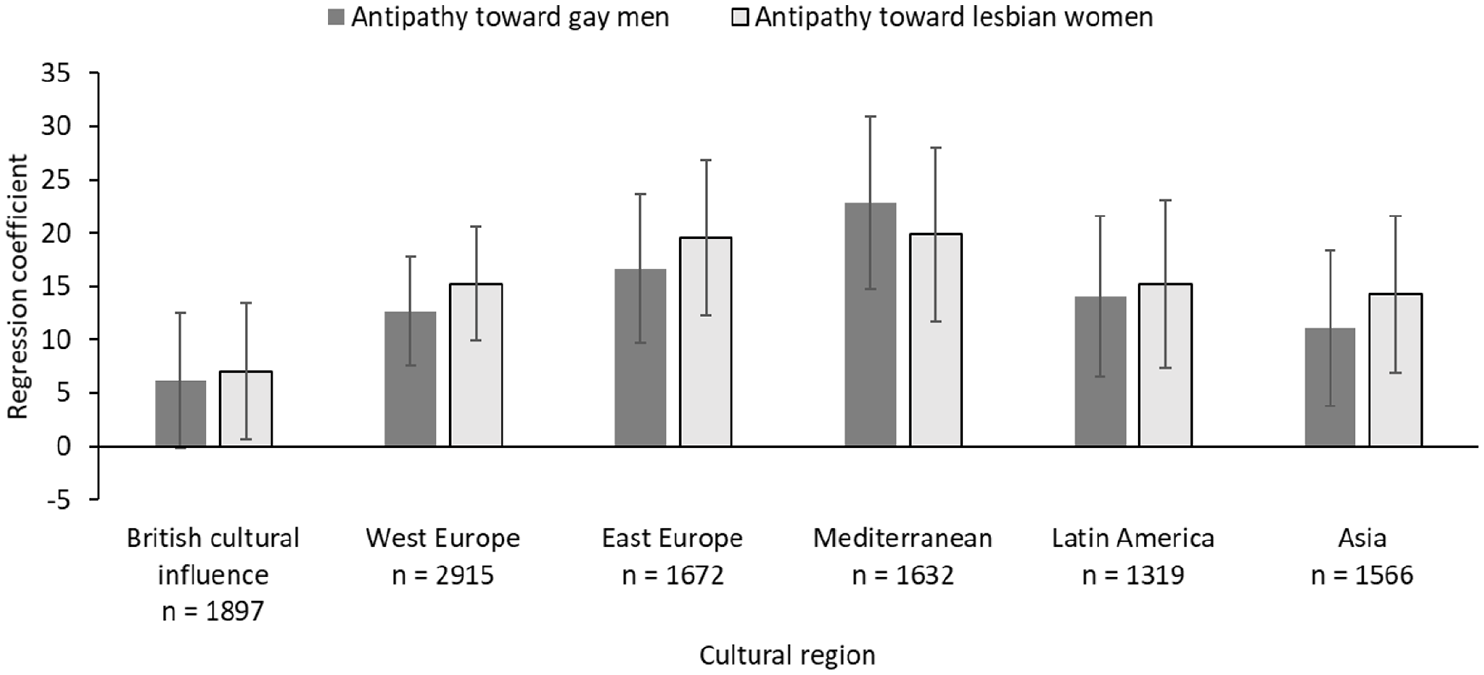
Regression coefficients with 95% confidence intervals for regressing antipathy toward gay men and lesbian women on disgust sensitivity, stratified by cultural region.
How Specific Is the Relation Between Disgust Sensitivity and Antigay Attitudes?
Attitudes toward gay men and lesbian women were strongly correlated (r = .82), 3 and they were moderately correlated with attitudes toward atheists (rs = .50 and .52, respectively), prostitutes (rs = .40 and .46, respectively), and sexually promiscuous people (rs = .41 and .46, respectively). For correlations with attitudes toward farmers, lawyers, and politicians (rs < .20), see Table S2.
We examined the extent to which disgust sensitivity related to antipathy toward the other social groups (see Table S9 for regression models and Tables S10–S17 for correlations by country). Disgust sensitivity had relatively strong relations with antipathy toward groups associated with sexual norm violations (prostitutes: b = 22.64, 95% CI [19.96, 25.31]; sexually promiscuous people: b = 17.11, 95% CI [14.46, 19.76]) and relatively weak relations with antipathy toward politicians (b = 6.46, 95% CI [2.44, 10.49]) and farmers (b = 6.09, 95% CI [3.20, 8.98]). In terms of magnitude of the relation, the relation for antipathy toward atheists was in between these estimates (b = 11.93, 95% CI [7.85, 16.01]), with the CI overlapping with the CIs for sexually promiscuous people, politicians, and farmers. Disgust sensitivity had no relation with antipathy toward lawyers (b = −1.15, 95% CI [−3.86, 1.55]). This analysis also revealed that the relations between disgust sensitivity and attitudes toward prostitutes and sexually promiscuous individuals were stronger among women than among men.
To estimate the effect sizes of these relations, we conducted a random-effects meta-analysis (see Tables S12 and S17), which revealed that disgust sensitivity had small correlations with antipathy toward prostitutes (men: r = .11, 95% CI [0.09, 0.15]; women: r = .19, 95% CI [0.16, 0.22]), sexually promiscuous people (men: r = .08, 95% CI [0.05, 0.12]; women: r = .15, 95% CI [0.12, 0.18]), and atheists (r = .07, 95% CI [0.05, 0.10]), and had negligible correlations with antipathy toward politicians (r = .04, 95% CI [0.01, 0.07]) and farmers (r = .04, 95% CI [0.01, 0.06]).
We used the KHB decomposition method (Kohler et al., 2011) to examine the extent to which antipathy toward the other social groups could account for the relation between disgust sensitivity and antipathy toward gay men and lesbian women. This approach regresses antipathy toward gay men (or lesbian women) on disgust sensitivity, while also including antipathy toward the other social groups as predictors. The decomposition method indicates the degree to which the relation between disgust sensitivity and the outcome variable is reduced by adding each additional predictor. The logic of this decomposition analysis is as follows. If the relation between disgust sensitivity and antigay prejudice is caused by the same process that causes a relation between disgust sensitivity and prejudice toward another group, then we should find that when we control for the relation between disgust sensitivity and prejudice toward that other group, there is no longer a relation between disgust sensitivity and antigay prejudice. The benefit of the decomposition analysis is that it is easy to interpret estimates of the degree to which this is the case for multiple targets of prejudice. As this method does not support the multilevel models computed before, we performed this analysis with OLS regression models that accounted for the nested structure of the data by including the predictors (disgust sensitivity, reverse-scored feeling thermometers, age, and participant sex) centered within countries and including dummies for all countries except one. The regression coefficients estimated in these OLS models were near those estimated in the multilevel models reported before. Figure 5 shows the results of this analysis.
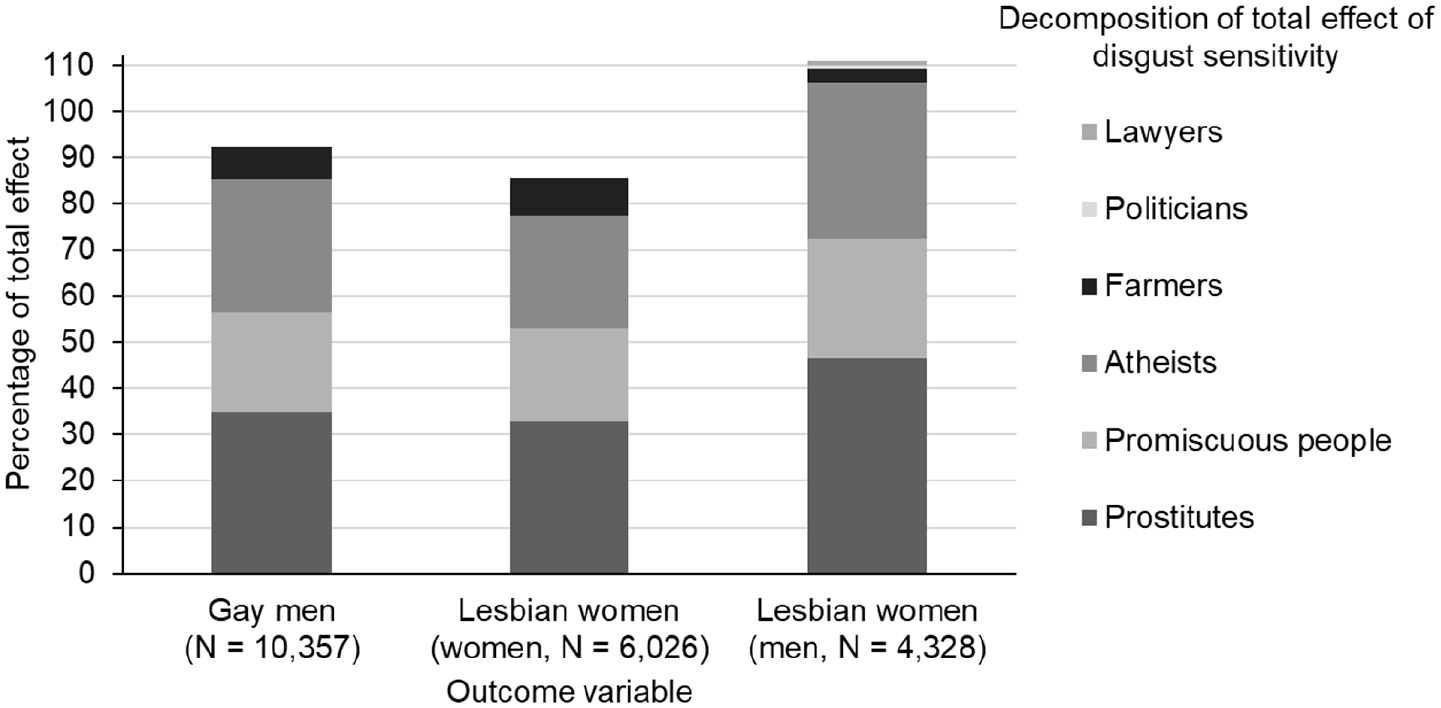
Results of decomposition analyses of the total effect of disgust sensitivity on the outcome variables antipathy toward gay men (across the full sample) and antipathy toward lesbian women (separate analyses for men and women).
Decomposition of the total correlation between disgust sensitivity and antipathy toward gay men showed that 91.94% of the relation could be attributed to antipathy toward the other social groups: prostitutes (34.95%), atheists (28.74%), sexually promiscuous people (21.44%), farmers (7.14%), politicians (−0.18%), 4 and lawyers (−0.15%). The remaining direct effect of disgust sensitivity did not differ from zero (b = 1.02, p = .385, 95% CI [−1.28, 3.31]).
As the results indicated that the relation between disgust sensitivity and antipathy toward lesbians differed for men and women, the decomposition was done separately for men and women. Among women, decomposition of the total correlation between disgust sensitivity and antipathy toward lesbian women showed that 83.96% of the relation could be attributed to antipathy toward the other social groups: prostitutes (32.85%), atheists (24.16%), sexually promiscuous people (20.25%), farmers (8.18%), politicians (−0.98%), and lawyers (−0.50%). The remaining direct relation with disgust sensitivity did not differ from zero (b = 2.93, p = .062, 95% CI [−0.15, 6.00]). Among men, the total correlation could entirely (110.79%) be accounted for by antipathy toward the other social groups: prostitutes (46.51%), atheists (33.75%), sexually promiscuous people (25.78%), farmers (3.32%), politicians (0.70%), and lawyers (0.81%). The remaining direct relation with disgust sensitivity was directionally negative (hence the estimate that more than 100% of the original correlation was accounted for), and did not differ from zero (b = −0.97, p = .578, 95% CI [−4.40, 2.45]).
In summary, the decomposition analysis showed that the relation between disgust sensitivity and antipathy toward gay men and lesbian women could be fully accounted for by shared variance with attitudes toward the other social groups. Most of the relation (> 75%) was accounted for by shared variance with prejudice toward prostitutes, sexually promiscuous people, and atheists, and only a small part of the association (< 9%) was accounted for by shared variance with prejudice toward farmers, politicians, and lawyers.
Sex Differences in Antigay Attitudes
The previous analysis pointed to a relatively stable sex difference in antigay attitudes. We explored this sex difference. Men were more opposed to gay marriage (b = 0.61, 95% CI [0.51, 0.71]) and gay and lesbian sexual orientation (b = 0.63, 95% CI [0.51, 0.76]; see Tables S3–S4). Furthermore, men were more negative toward gay men (b = 15.93, 95% CI [14.22, 17.65]) and lesbian women (b = 6.94, 95% CI [5.02, 8.86]; see Tables S5–S6). Men were also more negative toward lawyers (b = 6.30, 95% CI [5.02, 7.59]), farmers (b = 3.70, 95% CI [2.59, 4.81]), and politicians (b = 1.53, 95% CI [0.06, 3.00]; see Table S9). However, it was not the case that men were more negative toward all social groups. The sex difference was reversed for attitudes toward sexually promiscuous people (b = −5.08, 95% CI [−6.56, −3.60]) and prostitutes (b = −4.72, 95% CI [−6.37, −3.06]), with men being less negative toward these groups. The sexes did not differ on their attitudes toward atheists.
Discussion
We examined the relation between pathogen avoidance and antigay attitudes in a large sample of heterosexual adults across 31 countries. Analyses showed that pathogen disgust sensitivity related to antigay attitudes measured by four variables (opposition to gay marriage, opposition to gay and lesbian sexual orientation, antipathy toward gay men, and antipathy toward lesbian women), and that these relations were small but relatively stable across countries. An analysis that explored how the relation varied across cultural regions showed that it was weakest in countries with a cultural relation to Britain. Overall, these results suggest that the relation between pathogen-avoidance motivations and antigay prejudice does not derive from factors that are particular to some countries (e.g., stereotypes about gay men specific to North American populations), but from factors that are relatively stable across the sampled countries.
Disgust sensitivity was related to both antipathy toward gay men and lesbian women, which is not consistent with the notion that the relation results from the association of gay men with anal intercourse (Kiss et al., 2020). In addition, the analysis revealed that pathogen disgust sensitivity was also related to antipathy toward other groups, in particular prostitutes, sexually promiscuous people, and atheists. A decomposition analysis showed that the relation between disgust sensitivity and antigay prejudice could be mostly accounted for by the relation between disgust sensitivity and antipathy toward these other groups. The correlation between disgust sensitivity and antigay prejudice could not be accounted for by prejudice toward politicians and lawyers, suggesting that the relation was not driven by prejudice toward groups associated with violations of cooperative norms. In addition, the results were only partially consistent with the notion that disgust sensitivity relates to negative attitudes toward outgroups in general. On the one hand, pathogen disgust sensitivity related to prejudice toward all groups except lawyers. On the other hand, for the four groups that were not characterized by sexual norm violations, disgust sensitivity showed relatively small relations with prejudice, and only attitudes toward atheists could account for a substantial part of the association between disgust sensitivity and antigay prejudice. In combination with evidence that prejudice toward atheists might derive from perceptions of promiscuous sexuality (Moon et al., 2019), the current findings provide little support for the notion that pathogen-avoidance motivations relate specifically to antigay prejudice. Instead, they suggest that pathogen-avoidance motivations relate more broadly to prejudice toward groups associated with sexual norm violations (Crawford et al., 2014).
Limitations
We note four limitations that should be taken into account when interpreting these results. First, the current study did not assess the degree to which participants associated gay men and lesbian women with violations of sexual, nonsexual, traditional, or religious norms. Research on opposition to gay marriage suggests that in the US, antigay attitudes vary as a function of associating gay men and lesbian women with violating sexual norms (Pinsof & Haselton, 2016, 2017). The study did, however, include measures of prejudice toward prostitutes and sexually promiscuous individuals who, by definition, depart from heterosexual monogamy. Recent work suggests that negative sentiments toward atheists might also stem from perceptions of promiscuous sexuality (see Moon et al., 2019). In addition, research has reported that sexual prejudice could result from a variety of threats (e.g., loss of status, child development; Pirlott & Cook, 2018), including perceptions of unwanted sexual interest (Pirlott & Neuberg, 2014). Future research may explore how to efficiently measure the extent to which individuals associate a target group (e.g., gay men) with this variety of threats.
Second, for some of the countries, the sampling methods resulted in samples that were more positive toward gay and lesbian sexual orientation relative to their population. For example, in the US sample, 86% of participants indicated that society should accept gay and lesbian sexual orientation, whereas a 2013 Pew survey estimated that 60% of the U.S. population felt this way (Pew Research Center, 2013). Similarly, in the Japanese sample, 79% of participants indicated that society should accept gay and lesbian sexual orientation, whereas only 54% did in the 2013 Pew survey. (That said, there was a strong nation-level correlation between estimates from the 18 nations sampled here and those obtained by Pew’s representative sampling, r = .83.) Reduced variation in antigay attitudes might have attenuated relations between antigay attitudes and the predictor variables. The reduced variation in antigay attitudes may also have resulted in underestimating the cross-cultural variation in the relation between disgust sensitivity and antigay attitudes. Assuming that university communities (which were oversampled) are less variable across nations than are representative samples, the current study could have underestimated cross-cultural variation. Future studies using more ideologically diverse samples might reveal stronger associations between antigay attitudes and disgust sensitivity, and more cross-cultural variation in this relation.
Third, because the study was designed for data collection with a large and culturally diverse sample, it used a small number of self-report items that might be vulnerable to self-presentation biases. Further, attitudes toward each group were measured with single-item feeling thermometers. Although feeling thermometers are widely used measures of prejudice, single-item measures likely have lower reliability than multi-item measures. This low reliability is likely to have attenuated the observed effect sizes. In addition, the study included only four feeling thermometers for groups not characterized by sexual behavior. We included the same groups in all countries and assumed that, across cultures, people would associate politicians and lawyers with violating cooperative norms. However, it is possible that in some countries, these groups were not associated with violating cooperative norms. Furthermore, the survey included no measures of prejudice toward foreign or ethnic outgroups. Hence, the current results are mute on the issue of whether the relation between pathogen-avoidance motivations and antigay prejudice can be accounted for by prejudice toward foreign or ethnic outgroups. Extant research on this issue is mixed. Some work suggests that pathogen-avoidance motivations relate to both sexual prejudice and racial prejudice (Kam & Estes, 2016), while some studies suggest there is a unique relation with sexual prejudice (Inbar et al., 2012; Tapias et al., 2007). Note, however, that recent work has specifically tested the outgroup-avoidance perspective—by assessing the relation between pathogen-avoidance motivations and prejudice toward different kinds of immigrants—and suggests that pathogen avoidance does not relate to prejudice toward foreign immigrants in general, but motivates negative sentiments specifically toward foreign immigrants who do not assimilate to local norms (Karinen et al., 2019).
Sexual and Moral Disgust Sensitivity
The fourth limitation is related to the measurement of individual differences in pathogen-avoidance motivations. The current study used a measure of pathogen disgust sensitivity. While pathogen cues are typical elicitors of disgust, disgust is also evoked by stimuli with little pathogen-relevant information value, such as high-risk or low-value sexual behaviors (e.g., sex with strangers, incest), and violations of moral norms (Tybur et al., 2009, 2013). Thus, individuals vary not only in their tendencies to feel disgust toward pathogen cues (i.e., pathogen disgust sensitivity), but also toward sexual behaviors (i.e., sexual disgust sensitivity) and moral violations (i.e., moral disgust sensitivity). In addition, pathogen, sexual, and moral disgust sensitivity are correlated (Tybur et al., 2009), meaning that the relation between disgust sensitivity and prejudice toward groups associated with violating sexual norms might result from overlap between pathogen disgust sensitivity and sexual and/or moral disgust sensitivity. The survey did not include items measuring sexual or moral disgust sensitivity and was not able to control for these variables. To address this issue, we performed a reanalysis of data of an unpublished study by van Leeuwen et al. (2016) with participants from the USA (n = 462), Brazil (n = 485), South Africa (n = 481), and China (n = 450). These data included items for pathogen, sexual, and moral disgust sensitivity, and items for antigay attitudes. Multilevel regression analysis showed that both pathogen disgust sensitivity (b = 0.45, 95% CI [0.18, 0.72]) and sexual disgust sensitivity (b = 0.90, 95% CI [0.65, 1.14]) related to stronger antigay attitudes, while moral disgust sensitivity related to more progay attitudes (b = −1.38, 95% CI [−1.72, −1.03]). Furthermore, the correlation with pathogen disgust sensitivity did not differ from zero when controlling for sexual disgust sensitivity (b = 0.02, 95% CI [−0.27, 0.31]), but did differ from zero when controlling for both sexual and moral disgust sensitivity (b = 0.38, 95% CI [0.08, 0.68]). (For details, see supplemental analysis S18.) In short, the relation between pathogen disgust sensitivity and antigay attitudes could not be accounted for by moral disgust sensitivity. While sexual disgust sensitivity was also related to antigay attitudes, these data did not clearly show whether sexual disgust sensitivity entirely or partially accounts for the relation between pathogen disgust sensitivity and antigay attitudes.
Further Research
The current findings suggest at least three avenues for further research. As mentioned before, several explanations for the relation between pathogen-avoidance motivations and prejudice towards groups that violate sexual norms have been proposed. Some of these assume that aversion to sexual norm violations functions to reduce the infection risk posed by those perceived as sexually promiscuous. Consistent with this possibility, recent modeling work suggests that, when sexually transmitted infections are endemic, a reproductive strategy of punitive monogamy (i.e., a strategy that combines serial monogamy with punishment of those who are polygynous) performs better than a polygynous reproductive strategy (Bauch & McElreath, 2016). Future research might examine whether the relation between pathogen-avoidance motivation and prejudice towards groups associated with sexual norm violations is tailored specifically to avoiding infection by future mates.
Second, the relation between pathogen avoidance and condemnation of individuals who are perceived to be promiscuous could exist because people who are more disgust sensitive tend to have more monogamous mating strategies, and therefore attempt to reduce others’ sexual promiscuity (Tybur et al., 2015). Monogamous mating protects against the infection risk posed by intimate contact (sexual or otherwise) with multiple conspecifics, so more pathogen-avoidant individuals might favor such strategies. In turn, a monogamous mating strategy poses the risks of cuckoldry and abandonment, which can be averted by promoting and enforcing norms of monogamy (Pinsof & Haselton, 2016). Some existing work is consistent with this idea. Pathogen disgust sensitivity correlates positively with sexual disgust sensitivity—a measure of aversion to sexual activity outside of a pair bond (Tybur et al., 2009). Pathogen disgust sensitivity correlates negatively with number of past sexual partners (Gruijters et al., 2016) and sociosexual orientation (Tybur et al., 2015). Germ aversion—another measure of pathogen-avoidance motivations—is also related to a monogamous orientation (Duncan et al., 2009; Gruijters et al., 2016; Murray et al., 2013). However, some recent findings are inconsistent with the sexual strategies account. Aarøe et al. (2020) found that sociosexual orientation did not mediate the relation between disgust sensitivity and political ideology, and at least two studies have reported no relation between pathogen disgust sensitivity and openness to casual sex (Al-Shawaf et al., 2015; O’Shea et al., 2019). Further research might examine the magnitude, causal direction, and cross-cultural stability of the association between pathogen avoidance and mating strategies.
Third, as mentioned before, sexual prejudice can be partly explained in terms of perceived unwanted sexual interest (Pirlott & Neuberg, 2014). The current study observed substantial and cross-culturally stable relations between participant sex and antipathy toward gay men and lesbian women. This sex difference is consistent with previous reports of stronger antigay prejudice among men than women (Bettinsoli et al., 2019; Kite & Whitley, 1996). At the same time, men showed less antipathy toward prostitutes and sexually promiscuous people. Further research might examine whether these sex differences can be explained in terms of unwanted sexual interest or are related to other causes.
Practical Implications
Finally, these findings suggest two directions for efforts to reduce antigay prejudice. First, the relation between pathogen-avoidance motivations and antigay prejudice seems small in comparison to the effects of other factors such as participant sex and traditionalism. Even though the current findings are consistent with previous work showing a relation between pathogen-avoidance motivations and sexual prejudice, they also suggest that the size of this relation is small. Hence, if causal relations exist, reductions in pathogen-avoidance motivations would lead to only modest reductions in sexual prejudice.
Second, motivations to avoid infection do not seem related to unique features of gay men or lesbian women. Rather, this association is common with other groups associated with sexual norm violations. As condemnation of nonmonogamous individuals seems substantially influenced by processes unrelated to pathogen avoidance (e.g., Pinsof & Haselton, 2016), a focus on monogamy might be more effective. Perhaps antigay prejudice might be reduced by highlighting the prevalence of pair bonding among gay men and lesbian women.
Supplemental Material
sj-docx-1-gpi-10.1177_13684302211067151 – Supplemental material for Disgust sensitivity relates to attitudes toward gay men and lesbian women across 31 nations
Supplemental material, sj-docx-1-gpi-10.1177_13684302211067151 for Disgust sensitivity relates to attitudes toward gay men and lesbian women across 31 nations by Florian van Leeuwen, Yoel Inbar, Michael Bang Petersen, Lene Aarøe, Pat Barclay, Fiona Kate Barlow, Mícheál de Barra, D. Vaughn Becker, Leah Borovoi, Jongan Choi, Nathan S. Consedine, Jane Rebecca Conway, Paul Conway, Vera Cubela Adoric, Dilara Ekin Demirci, Ana María Fernández, Diogo Conque Seco Ferreira, Keiko Ishii, Ivana Jakšić, Tingting Ji, Inga Jonaityte, David M. G. Lewis, Norman P. Li, Jason C. McIntyre, Sumitava Mukherjee, Justin H. Park, Boguslaw Pawlowski, David Pizarro, Pavol Prokop, Gerasimos Prodromitis, Markus J. Rantala, Lisa M. Reynolds, Bonifacio Sandin, Barış Sevi, Narayanan Srinivasan, Shruti Tewari, Jose C. Yong, Iris Žeželj and Joshua M. Tybur in Group Processes & Intergroup Relations
Footnotes
Data availability statement

Funding
The author(s) disclosed receipt of the following financial support for the research, authorship, and/or publication of this article: J.R.C. acknowledges funding from the French National Research Agency (ANR) under Grant ANR-17-EURE-0010 (Investissements d’Avenir program). J.M.T. was supported by Horizon 2020 European Research Council Grant StG-2015 680002-HBIS.
Supplemental material
Supplemental material for this article is available online.
Notes
References
Supplementary Material
Please find the following supplemental material available below.
For Open Access articles published under a Creative Commons License, all supplemental material carries the same license as the article it is associated with.
For non-Open Access articles published, all supplemental material carries a non-exclusive license, and permission requests for re-use of supplemental material or any part of supplemental material shall be sent directly to the copyright owner as specified in the copyright notice associated with the article.
