




Abstract
Previous research shows that positive contact with members of disadvantaged groups can have positive, neutral, or negative effects on advantaged group members’ support of actions for social change towards more equality. The present work provides an experimental test of this effect and introduces two moderators which highlight the fundamental role of (a) communication about perception of the illegitimacy of intergroup inequality and (b) interpersonal connection with the contact partner. In two experiments (N = 88 and N = 192), first-time cross-group contact was initiated between members of two universities that differ on social status. Results revealed that cross-group contact per se did not increase advantaged group members’ solidarity-based action to reduce inequality. However, cross-group contact did increase advantaged group members’ solidarity-based actions when the disadvantaged group partner engaged in inequality-delegitimizing contact by describing the intergroup inequality as illegitimate and when the advantaged group member reported a strong interpersonal connection with the disadvantaged contact partner.
Keywords
Positive cross-group contact has many positive outcomes, such as improved intergroup attitudes and more liking between groups (e.g., Pettigrew & Tropp, 2006). Advantaged group members who have positive contact experiences with a disadvantaged group are often more supportive of this group. However, research also demonstrates that positive contact does not ensure that advantaged group members will be more willing to share resources equally with disadvantaged group members (Saguy et al., 2009), nor does it guarantee that they will engage in solidarity-based actions to reduce inequality. In the present work, we attempt to reconcile this contradiction by experimentally examining two moderators that could determine when cross-group contact will lead advantaged group members to show solidarity-based actions. This research advances our understanding of the circumstances under which high-status groups are willing to support lower status groups in their actions towards social change even when doing so could result in potential loss of ingroup power.
Positive, Neutral, and Negative Effects of Cross-Group Contact
Normally, high-status group members are interested in maintaining social hierarchies to secure their privilege (e.g., Sidanius & Pratto, 1999), in part to strengthen a positive social identity (Tajfel & Turner, 1979). However, not all advantaged group members defend their ingroup’s privilege. Instead, some identify as an ally, that is, as a person who does not belong to the disadvantaged group but supports their actions to establish more social equality (e.g., Iyer & Ryan, 2009; Kutlaca et al., 2020; Mallett et al., 2008; Radke et al., 2020; Reimer et al., 2017; Subašić et al., 2008). One explanation for advantaged group members becoming allies is positive contact with members of the outgroup. However, the relationship between cross-group contact and solidarity-based actions is complicated.
On one hand, positive cross-group contact can not only reduce prejudice, promote perspective taking, and increase positive feelings toward the disadvantaged group (Pettigrew & Tropp, 2011), but has been shown to also predict support for egalitarian policies (Pittinsky & Montoya, 2009) and actions in support of the disadvantaged group (e.g., Cakal et al., 2011). For instance, Hässler et al. (2020) found that, compared to those with less, advantaged group members with more positive cross-group contact were more likely to vote for political candidates who support egalitarian policies and were more willing to work in solidarity with the disadvantaged outgroup to reduce inequality and injustice. Evidence of this positive relationship between contact and solidarity-based actions has been shown, for instance, in endorsement of Roma empowerment among non-Roma (Macedonian, Albanian, and Turkish) in Macedonia (Kamberi et al., 2017), in social change motivation of Italians in favor of immigrants (DiBernardo et al., 2021), in Muslim students’ willingness to participate in joint collective action with the Hindu majority in India (Dixon et al., 2017), and in support for direct action on behalf of ethnic, gender, and sexual minorities in a range of contexts (e.g., Hässler et al., 2020; Reimer et al., 2017).
However, on the other hand, critical voices have spoken against portraying cross-group contact as a panacea for social change (e.g., Dixon et al., 2012; MacInnis & Hodson, 2019; Reicher, 2007; Saguy et al., 2009; Tausch et al., 2015; Vezzali et al., 2017; Wright & Baray, 2012). A growing array of research has shown that positive contact can diminish disadvantaged group members’ interest in collective action to challenge inequality (e.g., Cakal et al., 2011; Dixon et al., 2010; Hässler et al., 2020; Tropp et al., 2012; Wright & Lubensky, 2009). For instance, ostensibly positive cross-group interactions can make disadvantaged group members less likely to recognize group-based hierarchies (e.g., Dixon et al., 2017).
Although possible negative effects of cross-group contact on advantaged group members have received less attention, there are several relevant findings. First, perhaps obviously, research illustrated that negative contact can increase prejudice, at times more than positive contact can reduce prejudice (e.g., Barlow et al., 2012; Dhont & van Hiel, 2009; Meleady et al., 2017). Further, the relation between negative contact and increased prejudice is mediated by symbolic and realistic threat perceptions (e.g., Aberson, 2015; Stephan et al., 2002). Thus, negative contact experiences should not turn advantaged group members into allies.
Second, research by Saguy et al. (2009) on what they have labeled the “irony of harmony” illustrates that positive cross-group contact in which group members focused on their commonalities does not result in more supportive behavior among the advantaged. Specifically, in their study, members of an advantaged group and a disadvantaged group were instructed to discuss either things the groups had in common or things that differed between the groups, and then the advantaged group was allowed to allocate 10 extra research credits to members of the two groups. As expected, the disadvantaged group members expected that they would receive more credits following the commonality-focused discussion compared to the difference-focused discussion. However, advantaged group members allocated the same number of credits to the disadvantaged group after both the commonality- and the difference-focused discussions, and in both cases they allocated the majority of the credits to their own group. Thus, it appears that commonality-focused contact led disadvantaged group members to expect the advantaged group members to act more as allies and to distribute resources more equally, but in fact they did not do so.
In a nutshell, while negative cross-group contact appears unambiguously negative for advantaged group solidarity-based actions, the effect of positive cross-group contact can be mixed. Positive contact appears to be associated with more solidarity-based actions in some situations, but it is clear that this is not necessarily the case even when the contact focuses on group commonalities. We propose two potential moderators that may contribute to explaining when positive contact might (or might not) be helpful in increasing advantaged group members’ solidarity-based actions.
Under What Conditions Might Cross-Group Contact Result in Solidarity-Based Actions?
The first relevant moderator that we propose is perceptions of, and communication about, injustice: only when people perceive group-based inequality to be unfair are they willing to support actions to reduce it (e.g., Di Bernardo et al., 2021; Mikolajczak & Becker, 2019; van Zomeren et al., 2008). However, there is some evidence that positive contact can reduce the perception of group-based inequality (e.g., Wright & Lubensky, 2009). In prior work on the “sedating effects” of cross-group contact for members of disadvantaged groups, Becker et al. (2013) tested whether this effect could be eliminated when people engaging in cross-group contact talked about the illegitimacy of intergroup inequality. Indeed, contact that included communication about the unfairness of intergroup inequality did not reduce disadvantaged group members’ intention to engage in collective action. Thus, this type of inequality-delegitimizing contact seems critical to avoid the demobilizing effects of contact on the disadvantaged, and subsequent work has shown that these discussions may even serve to empower disadvantaged groups to act (Droogendyk et al., 2016).
There is also evidence that perceived injustice may be critical for inspiring advantaged group members’ motivation to support social change, and that cross-group contact may increase this motivation because it can reduce the perception that status differences are legitimate (Di Bernardo et al., 2021). Similarly, cross-group contact can increase motivation for social change among advantaged groups when the contact prioritizes a focus on differences between groups (over commonalities; Vezzali et al., 2017; see also MacInnis & Hodson, 2019). Thus, we propose that when the disadvantaged group member clearly describes the group-based inequality as unfair, this may increase the advantaged group member’s awareness of that inequality and lead them to feel more obliged and committed to supporting the disadvantaged group as an ally.
Importantly, we also propose that the degree to which the advantaged group member feels a sense of interpersonal connection with the contact partner is a crucial second moderator of the effect of contact on solidarity-based actions. Contact theorists have long proposed that the degree to which a cross-group contact situation offers the potential for friendship is a key determinant of whether contact will improve attitudes (see Cook, 1984; Pettigrew, 1998; Wright et al., 2005). Similarly, we propose that forming an interpersonal connection with the contact partner may also be important for inspiring solidarity-based actions in support of the disadvantaged group.
However, these two potential moderators may create a fundamental dilemma for members of disadvantaged groups. If they want the advantaged group member to engage in solidarity-based actions, they must inspire feelings of injustice by speaking out about the unfairness of intergroup inequality. However, there is evidence of backlash when disadvantaged group members openly criticize existing intergroup inequality. The literature on confronting prejudice clearly illustrates that people who complain about inequality are often not liked and are perceived to be oversensitive troublemakers (e.g., Becker & Barreto, 2014; Kaiser & Miller, 2001; Mallett & Monteith, 2019). Thus, when a disadvantaged group member describes intergroup inequality as illegitimate, the advantaged group member might perceive it as a complaint. Being labeled an “outgroup complainer” might undermine the possibility of building an interpersonal connection with their contact partner, perhaps even turning the interaction into a negative contact experience and inhibiting the advantaged group member’s solidarity. Thus, if the disadvantaged group member speaks out about intergroup inequality, they may undermine support for their group by failing to create the interpersonal connection needed to inspire solidarity-based actions. However, if they do not speak out, advantaged group members may continue to minimize the intergroup inequality or to see it as just and, accordingly, not be motivated to support social change. Thus, we expect that advantaged group members will be particularly likely to show solidarity-based actions when their disadvantaged group contact partner is able to manage this dilemma; when they are able to engage in inequality-delegitimizing contact by communicating the unfairness of intergroup inequality but at the same time also being able to form a positive sense of interpersonal connection with the contact partner.
The Present Research
The present work provides an experimental test of the effects of positive cross-group contact on advantaged group members’ willingness to engage in solidarity-based actions, and investigates the interplay of two moderators that highlight the fundamental role of communication about the illegitimacy of intergroup inequality and of forming an interpersonal connection with the contact partner. To test our hypotheses, we conducted two experiments that allow us to confidently eliminate third variables that might offer alternative explanations for the results. Previous studies showing a positive relation between contact and solidarity-based actions are correlational (e.g., Hässler et al., 2020; Reimer et al., 2017). In contrast, in an experimental study (Saguy et al., 2009), contact did not result in a fairer sharing of resources with the disadvantaged group. Thus, it is reasonable that a third variable, such as egalitarian values, might account for the correlational findings: those who are open, tolerant, and hold strong egalitarian values will be both “contact-friendly” and more likely to engage in system-challenging action on behalf of the disadvantaged group (e.g., Jost et al., 2017). To rule out the possible influence of third variables, we ran experimental studies.
In two experiments, we initiate first-time, positive cross-group contact between students (participants) from a higher status teaching university and a partner from a lower status university (a confederate). We compared contact in which the disadvantaged group member makes statements that delegitimize the group-based inequality with three control conditions: two cross-group contact controls and one no-contact control. All conditions included activities designed to produce a positive, friendship-building interaction. In the three cross-group contact conditions, the partner identified herself as a member of the lower status outgroup. In the no-contact control, the partner identified herself as a member of the higher status ingroup.
In the inequality-delegitimizing contact condition, during the otherwise positive interaction, the disadvantaged group member expressed that she perceived the intergroup inequality between the universities to be illegitimate. This was the condition of greatest interest: we expected that, if the advantaged group member felt a sense of interpersonal connection with the contact partner, they would show more solidarity-based actions in this condition compared to the other three conditions. In the no-contact control condition, participants engaged in the same positive interaction but with an ingroup member. In the ambiguous contact condition, participants engaged in the same positive interactions but with no discussion of the intergroup inequality (leaving the attitudes towards intergroup inequality ambiguous). We reasoned that in many real-world cross-group encounters, advantaged group members are given little information about their partner’s perceptions of existing intergroup inequality, and that ambiguity about the contact partner’s feelings would reduce the salience of that inequality (e.g., Wright & Lubensky, 2009), and thus not enhance motivation to act to change it. In the inequality-legitimizing contact control, during the positive interaction, the disadvantaged group member expressed that she perceived the intergroup inequality as legitimate. We added this condition to examine whether an open expression of legitimacy might further undermine outgroup support among advantaged group members—if the disadvantaged group member perceives the inequality to be fair, why should advantaged group members seek to change it? Following the interaction, participants indicated their sense of interpersonal connection with the contact partner (to test the predicted moderation effect), their intentions to show solidarity-based actions, and their willingness to take flyers that support the disadvantaged group. Study 2 offers a replication in a different country and with a larger sample size.
Study 1
In Osnabrueck, Germany, there are two academic schools: the University of Osnabrueck (UOS) and the School of Applied Sciences (SAS). In many respects, UOS is advantaged compared to SAS. The SAS is not allowed to use “university” in its name, the professors are not allowed to have PhD students without cooperation with the university, and there are far fewer research facilities at the SAS compared to UOS. Students cannot receive a bachelor’s degree in psychology from the SAS but a bachelor’s in economic psychology, and they must take additional courses if they want to start a master’s degree at the university. Participants were UOS students, and in the three contact conditions we created a friendly and enjoyable cross-group encounter with a SAS student (a confederate). During the encounter, participants read about the unequal distribution of resources between SAS and UOS. We then manipulated the SAS student’s reported beliefs about this inequality as (a) inequality-delegitimizing, (b) ambiguous, or (c) inequality-legitimizing. In the no-contact control condition, participants read about the inequality between UOS and SAS but the interaction partner was another UOS student.
Method
Participants
Participants were 89 (75% female) German UOS students who received course credit for their participation. One outlier was deleted based on a score greater than 3 SDs below the mean, leaving a final sample of 88 students. They ranged in age from 18 to 34 years (M = 22.60, SD = 3.29). The distribution across conditions was: inequality-delegitimizing contact (n = 21), ambiguous contact (n = 23), inequality-legitimizing contact (n = 23), no-contact control (n = 21).
A power analysis using G*Power suggested that we needed 103 participants to detect a medium effect (f2 = .15) using seven predictors in a regression (α = .05, power = .08). Thus, sample size was somewhat underpowered to run the regression. We conducted this study with 1st-year psychology students in the lab and were not able to increase the sample size due to a lack of student volunteers.
Design and procedure
The study design was similar to the procedure published in Becker et al. (2013, Study 2) but with the completely reversed focus: in Becker et al. (2013), participants were members of the disadvantaged group, whereas in the present study participants were members of the advantaged group.
The female confederate was seated in a waiting area when the participant arrived. Underneath a hoody, she wore a shirt with a large SAS logo (in the three contact conditions) or an UOS logo (in the no-contact condition). The experimenter welcomed both participants and guided them to workstations in opposite corners of a larger room, where they completed demographic measures and a measure of identification with three ingroups: age, gender, and UOS.
The experimenter then explained that they were taking part in a memory study and their task was to read and memorize two short news stories. They were also told that, in order to make the memory task more difficult, before completing the recall test, there would be a delay period during which they would play several games designed to distract them. In fact, these games have been used in previous research to create positive social interactions and build feelings of closeness (see Becker et al., 2013; Wright et al., 2005). Participants then picked one of 10 colored folders, ostensibly containing 10 different sets of two stories about current local issues. In fact, all folders contained the same two stories: about the traffic at the Newmarket and about SAS being disadvantaged relative to UOS (see Appendix A1 in the supplemental material).
After 5 minutes reading and attempting to memorize the stories, participants moved to a central table to play the “distraction games.” At this point, the first piece of the cross-group contact manipulation was introduced. The confederate removed her hoody, revealing her SAS T-shirt (in the three contact conditions) or her UOS T-shirt (in the no-contact condition). The experimenter then introduced the first game in which each participant drew one half of a face and, after 30 seconds, the two halves were connected and participants had another 30 seconds to fix the face together as a team. During the game, the confederate offered standardized compliments (e.g., “good job”) and, when they finished, she again complimented the participant by saying “Yes, that is way better. You are better at this than I am!”
The experimenter then explained that while she was getting the next game, they should use the time “to get to know each other a bit.” To ensure consistency across sessions, the confederate introduced herself first, using a standardized text, and was instructed not to comment on anything the participant said during his/her introduction. If the participant attempted to initiate a conversation after both had introduced themselves, the experimenter entered the room to proceed with the experiment.
The second piece of the experimental manipulation was introduced during the “getting to know each other” period. In the three contact conditions (inequality-delegitimizing, ambiguity, inequality-legitimizing), the confederate indicated that she was a bachelor student from the School of Applied Sciences and explained that she was participating in the experiment because she wanted to do a master’s at the university and needed to take some additional courses in order qualify for it. She added that it was easier to get into the master’s program for people who come from the university compared to people from a school of applied sciences. In the ambiguity condition, she stopped here. In the inequality-legitimizing condition (inequality-delegitimizing contact condition in brackets), she added, I think it is [not] ok that the university has a higher status than the School of Applied Sciences. It is [not] just that you have advantages with a university degree compared to a School of Applied Sciences degree. It is [not] fair that the university has more resources than the School of Applied Sciences.
In the no-contact condition, the confederate was wearing an UOS T-shirt and explained that she was a 4th-year UOS student. Finally, in all four conditions, the confederate ended her introduction by indicating that she also did volunteer work at “Balu and You,” a mentoring program for students.
After the participant introduced her/himself, the experimenter returned and introduced the second game (Jenga), in which participants took turns pulling blocks out of a tower of blocks. The goal was to remove as many blocks as possible without causing the tower to fall. Participants were told they were competing against other pairs and were encouraged to work together to get the highest score possible. During the game, the confederate complimented the participant five times using standardized phrases (e.g., “awesome,” “good teamwork”) and used standardized positive phrases if the participant caused the tower to fall (e.g., “no worries, that’s ok”). After 5 minutes, they stopped and reported their score to the experimenter. The experimenter reported that this was the best score for any pair so far. The confederate raised her hand to give the participant a “high five.”
They then returned to their workstations, completed a questionnaire about the Jenga game, a measure of their impression of the task and their interpersonal connection with their contact partner, a fill-in-the-blank memory test on the two stories, and a measure of solidarity-based action intentions.
Finally, the experimenter introduced the opportunity to engage in direct solidarity-based action. She said, Last, if either of you are interested in getting involved in the issues that you read about, a student action group on campus has prepared a number of flyers that you can take and distribute. Here are the flyers, please circle the number you would like to distribute and I will go and get them for you.
The participant was thanked, probed for suspicion, and debriefed.
Measures
Unless otherwise indicated, all items were measured on 7-point rating scales (1 = strongly disagree, 7 = strongly agree).
Interpersonal connection was measured using four items (e.g., “My partner and I made a good team,” “I like my team partner”; α = .74; see Appendix A3).
Solidarity-based action intentions were measured with six items. Participants indicated how likely they were to take six actions in response to SAS being disadvantaged compared to UOS (e.g., “I would be willing to sign a petition that supports an equal share of research funding between the university and the School of Applied Sciences”; see Appendix A3). Factor analysis supported a one-factor solution (α = .80).
Actual solidarity-based action (taking flyers) was measured on an 11-point scale; participants indicated how many flyers (from zero to 100) describing SAS disadvantaged position compared to UOS they wanted to take (see Appendix A3). 1
Results and Discussion
Solidarity-based action intentions and taking flyers were correlated (r = .31, p = .004), but sense of connectedness was not correlated with solidarity-based action intentions (r = .06) or with taking flyers (r = .14). Means are displayed in Table 1. An ANOVA revealed that interpersonal connection did not differ between conditions, F(3, 84) = 0.12, p = .949. We tested our hypothesis that cross-group contact might increase solidarity-based actions only when the SAS partner (confederate) engaged in inequality-delegitimizing contact and created feelings of interpersonal connection in her contact partner, using a moderated regression analysis. We included the following variables to predict solidarity-based actions: three dummy variables comparing each control condition against inequality-delegitimizing contact, centered interpersonal connection scores, and the three interaction terms for each Dummy Variable x Interpersonal Connection. To test all comparisons in one regression using PROCESS (Hayes, 2018, Model 1), we specified the categorical variable condition (1 = inequality-delegitimizing, 2 = inequality-legitimizing, 3 = ambiguous, 4 = control) as multicategorial using the coding system indicator. This resulted in three dummy variables comparing each of the three control conditions against the inequality-delegitimizing contact condition (inequality-delegitimizing contact: X1 = 0, X2 = 0, X3 = 0; inequality-legitimizing contact: X1 = 1, X2 = 0, X3 = 0; ambiguous contact: X1 = 0, X2 = 1, X3 = 0; no-contact control: X1 = 0, X2 = 0, X3 = 1).
Means (and standard deviations) of all measures as a function of experimental condition: Study 1.
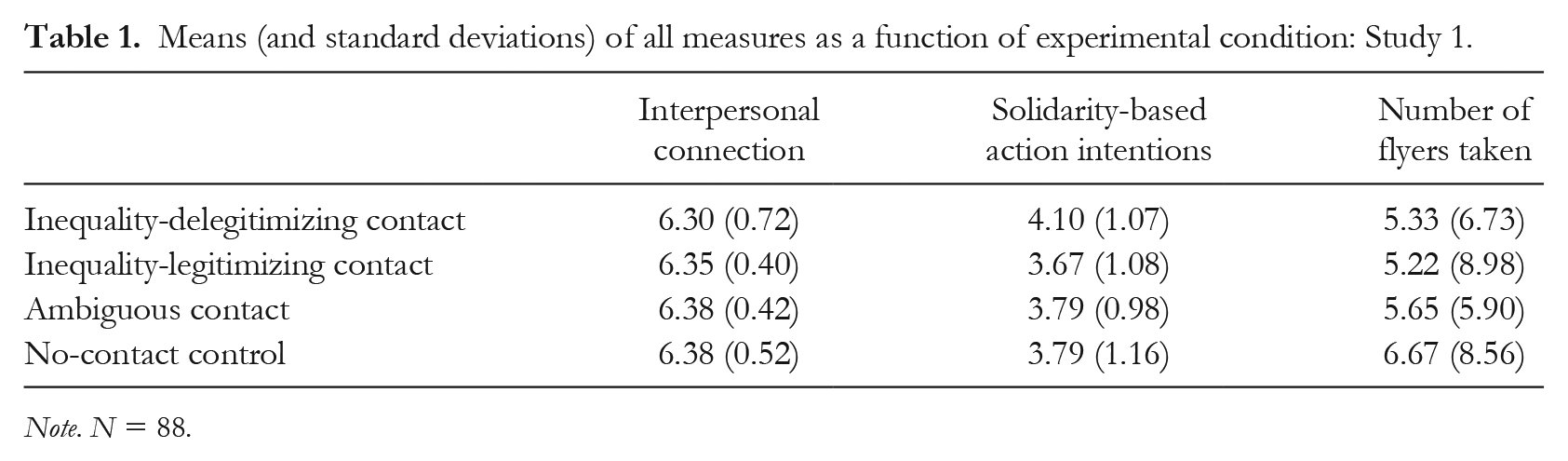
Note. N = 88.
The full regression coefficients are displayed in Table 2. None of the three dummy variables (B = −0.48, SE = 0.32, p = .133; B = −0.33, SE = 0.32, p = .295; B = −0.35, SE = 0.32, p = .287) significantly predicted interest in solidarity-based actions. However, stronger feelings of interpersonal connection were associated with greater interest in solidarity-based actions (B = 0.78, SE = 0.32, p = .019).
Predictors of solidarity-based action intentions (before the slash) and taking flyers (after the slash): Study 1.
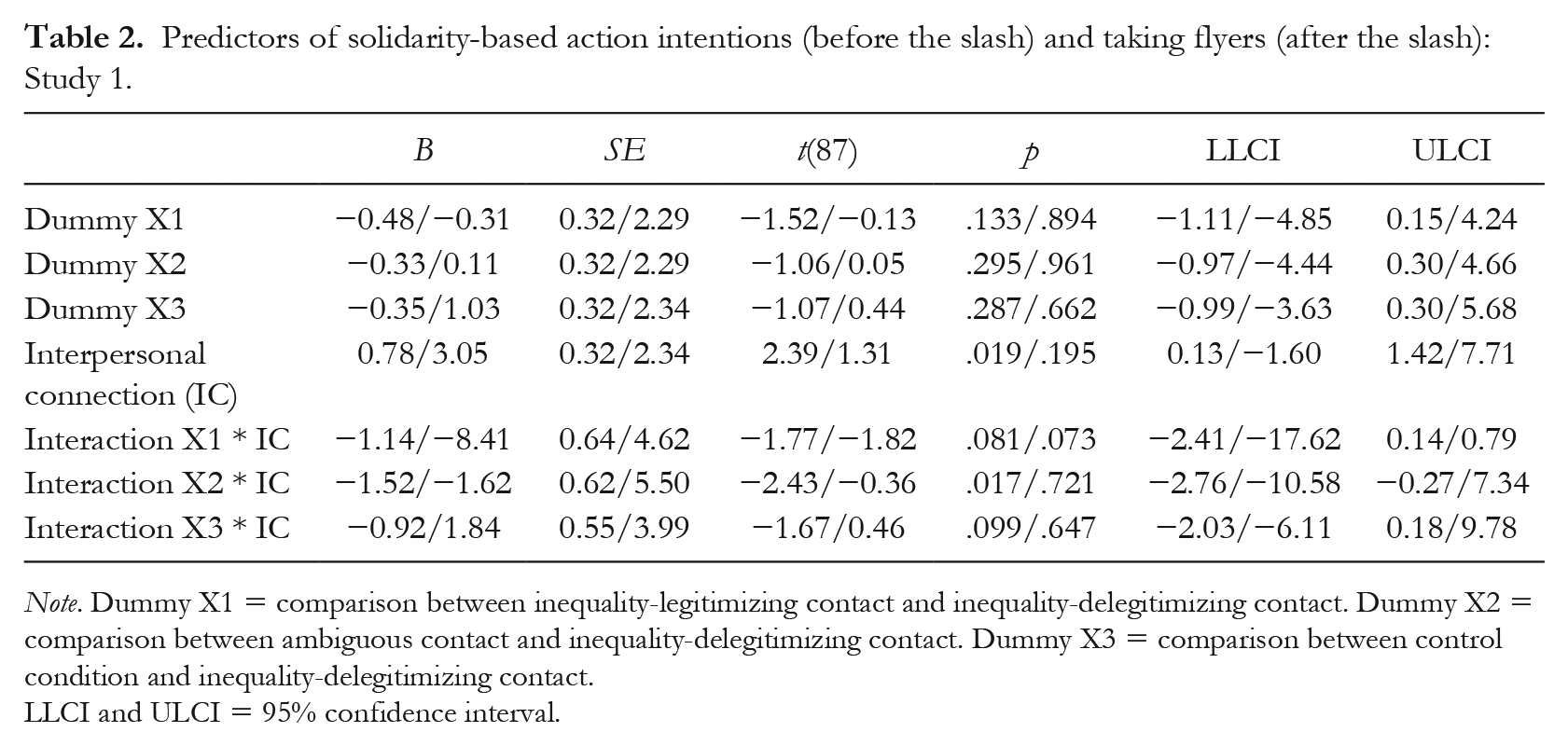
Note. Dummy X1 = comparison between inequality-legitimizing contact and inequality-delegitimizing contact. Dummy X2 = comparison between ambiguous contact and inequality-delegitimizing contact. Dummy X3 = comparison between control condition and inequality-delegitimizing contact.
LLCI and ULCI = 95% confidence interval.
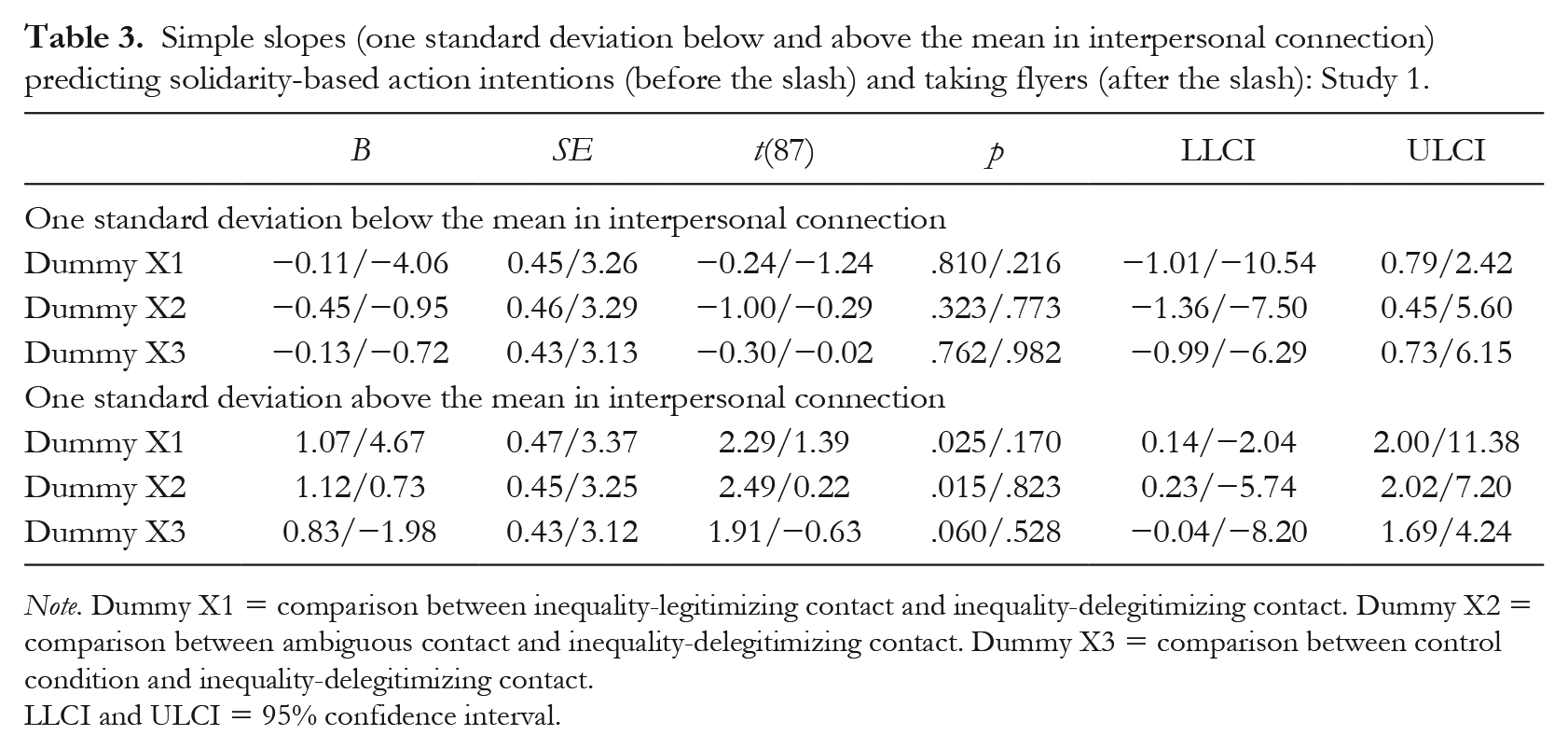
The interaction between inequality-delegitimizing contact versus no-contact control and interpersonal connection approached significance (B = −0.92, SE = 0.55, p = .099). Simple slope analyses produced the expected pattern (for all simple slope analyses, we code the inequality-delegitimizing condition = 1, and the control condition = 0; see Table 3), such that solidarity-based action intentions were higher in the inequality-delegitimizing condition (compared to the no-contact control condition) when participants reported a stronger interpersonal connection (1 SD above the mean; B = 0.83, SE = 0.43, p = .060, approaching significance), but not when the reported interpersonal connection was weaker (1 SD below the mean; B = −0.13, SE = 0.43, p = .762; see Figure 1).
Simple slopes (one standard deviation below and above the mean in interpersonal connection) predicting solidarity-based action intentions (before the slash) and taking flyers (after the slash): Study 1.
Note. Dummy X1 = comparison between inequality-legitimizing contact and inequality-delegitimizing contact. Dummy X2 = comparison between ambiguous contact and inequality-delegitimizing contact. Dummy X3 = comparison between control condition and inequality-delegitimizing contact.
LLCI and ULCI = 95% confidence interval.
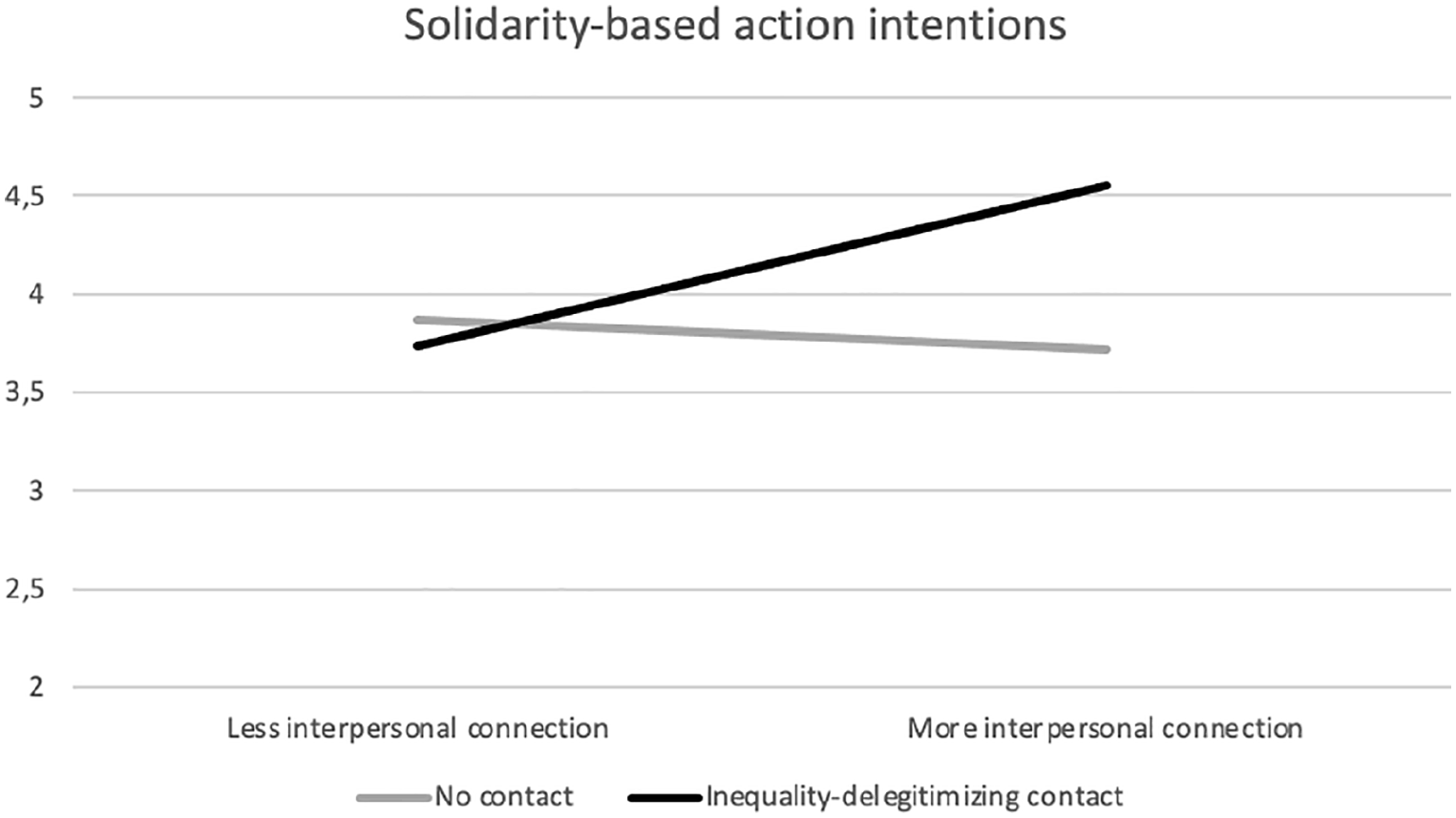
Interaction effect of inequality-delegitimizing contact (vs. no-contact control) and reported interpersonal connection on interest in a variety of solidarity-based actions: Study 1.
The same pattern emerged for the comparison between the inequality-delegitimizing condition and the two control conditions. The interaction between inequality-delegitimizing versus legitimizing and interpersonal connection approached significance (B = −1.14, SE = 0.64, p = .081). Again, simple slope analyses produced the expected pattern: solidarity-based action intentions were higher in the inequality-delegitimizing condition (compared to the inequality-legitimizing condition) when participants reported a stronger interpersonal connection (1 SD above the mean; B = 1.07, SE = 0.47, p = .025), but not when the reported interpersonal connection was weaker (1 SD below the mean; B = −0.11, SE = 0.45, p = .810; the figure is displayed in the supplemental material).
Finally, the interaction between inequality-delegitimizing versus ambiguity and interpersonal connection was significant (B = −1.52, SE = 0.62, p = .017). Simple slopes show that solidarity-based action intentions were higher in the inequality-delegitimizing contact condition (compared to the ambiguous contact condition) when participants reported a stronger interpersonal connection (1 SD above the mean; B = 1.12, SE = 0.45, p = .015), but not when the reported interpersonal connection was weaker (1 SD below the mean; B = −0.45, SE = 0.46, p = .323; the figure is displayed in the supplemental material). 2
A second regression was conducted to predict willingness to take flyers. None of the three dummy variables nor sense of connectedness or the three interactions significantly predicted taking flyers (see Table 2). None of the simple slopes was significant (see Table 3).
We hypothesized that positive cross-group contact would not lead to increases in solidarity-based action intentions among the advantaged group per se. Instead, we expected that it would be necessary to meet two criteria to increase advantaged group members’ solidarity-based action intentions. First, the disadvantaged group member must communicate her perception that the inequality is illegitimate; second, the contact situation needs to be one that leads the advantaged group member to feel a sense of interpersonal connection with their disadvantaged group contact partner. Some of the results for the behavioral intentions measure only approached conventional levels of statistical significance, but the consistent pattern of effects provides preliminary support for our hypothesis. However, we did not find effects on our behavioral measure (taking flyers). This may have resulted from the particular way we made the flyers available to the participants. We offered no option to take between zero and 10 or more flyers.
In addition, the sample size in Study 1 was quite small. Therefore, our second experiment includes a larger sample and a more nuanced, smaller steps scaling of the behavior measure (taking flyers).
Study 2
Study 2 was a replication of Study 1 in a different cultural context—Vancouver, Canada. We initiated cross-group contact between students at the high status, research-intensive Simon Fraser University (SFU) and the lower status, primarily teaching Capilano University (CU). Data were collected at SFU.
Method
Participants
We doubled the sample size to exceed the criteria from the power analysis reported in Study 1. Participants were 192 (73% female) SFU students who received course credit for participation. They ranged in age from 17 to 43 years (M = 19.41, SD = 2.63). The majority identified as Asian (54%) or White (35%), with 5% identifying as Middle Eastern, 3% as Hispanic, 2% as African/Caribbean, and 1% as First Nations/Inuit/Metis. The distribution across conditions was: inequality-delegitimizing contact (n = 43), inequality-legitimizing contact (n = 48), ambiguous contact (n = 59), no-contact control (n = 44).
Design and procedure
The procedures were almost identical as those in Study 1. In this study, the confederate wore a shirt with a large “Cap U” logo (for Capilano University) in the three contact conditions, or an SFU logo in the no-contact control. The wording used to manipulate inequality-delegitimizing/legitimizing contact differed slightly from Study 1. After introducing themselves, the confederate in the inequality-legitimizing contact condition (inequality-delegitimizing contact in brackets) added, You know, I still like going to “Cap” though. But to be honest, I think [don’t think] it is true that a lot of things, like the faculty and the classes at SFU are better than at CU—and SFU probably [does not really] deserves its higher status and some advantages it has.
The ambiguous and the no-contact conditions were the same as in Study 1.
Measures
Unless otherwise indicated, all items were measured on 7-point rating scales (1 = strongly disagree, 7 = strongly agree).
Interpersonal connection was measured using two of the items from Study 1 and, in order to improve the scale, six new items including reverse-coded ones such as “I did not feel comfortable with my team partner during these games” (α = .85; see Appendix A4).
Solidarity-based action intentions was measured with five direct actions that would demonstrate solidarity with teaching universities like Capilano (e.g., “I would be willing to sign a petition supporting a more equal funding of teaching and research universities”; α = .86; see Appendix A4).
Willingness to take flyers was measured using a smaller step scale than in Study 1 (1 = zero flyers, 2 = two flyers, 3 = five flyers, 4 = seven flyers, 5 = 10 flyers, 6 = more than 10 flyers, 7 = more than 20 flyers; see Appendix A4). Participants indicated how many flyers about funding redistribution between teaching and research universities they wanted to take.
Results and Discussion
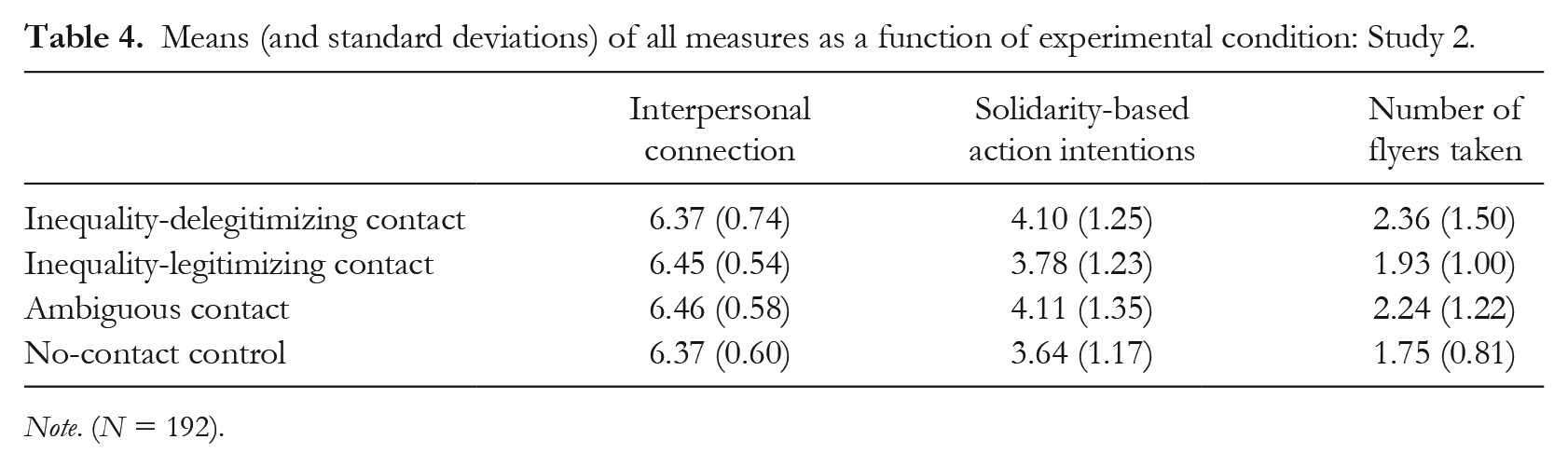
Solidarity-based action intentions and willingness to take flyers were correlated (r = .25, p = .001); interpersonal connection was correlated with solidarity-based action intentions (r = .20, p = .005) and with willingness to take flyers (r = .19, p = .008; means are displayed in Table 4). An ANOVA revealed that interpersonal connection did not differ between conditions, F(3, 188) = 0.35, p = .790. We conducted the same moderated regression analysis as in Study 1, including three dummy variables that compared the inequality-delegitimizing condition against each of the three controls, the effect of interpersonal connection, and the three interaction terms. 2
Means (and standard deviations) of all measures as a function of experimental condition: Study 2.
Note. (N = 192).
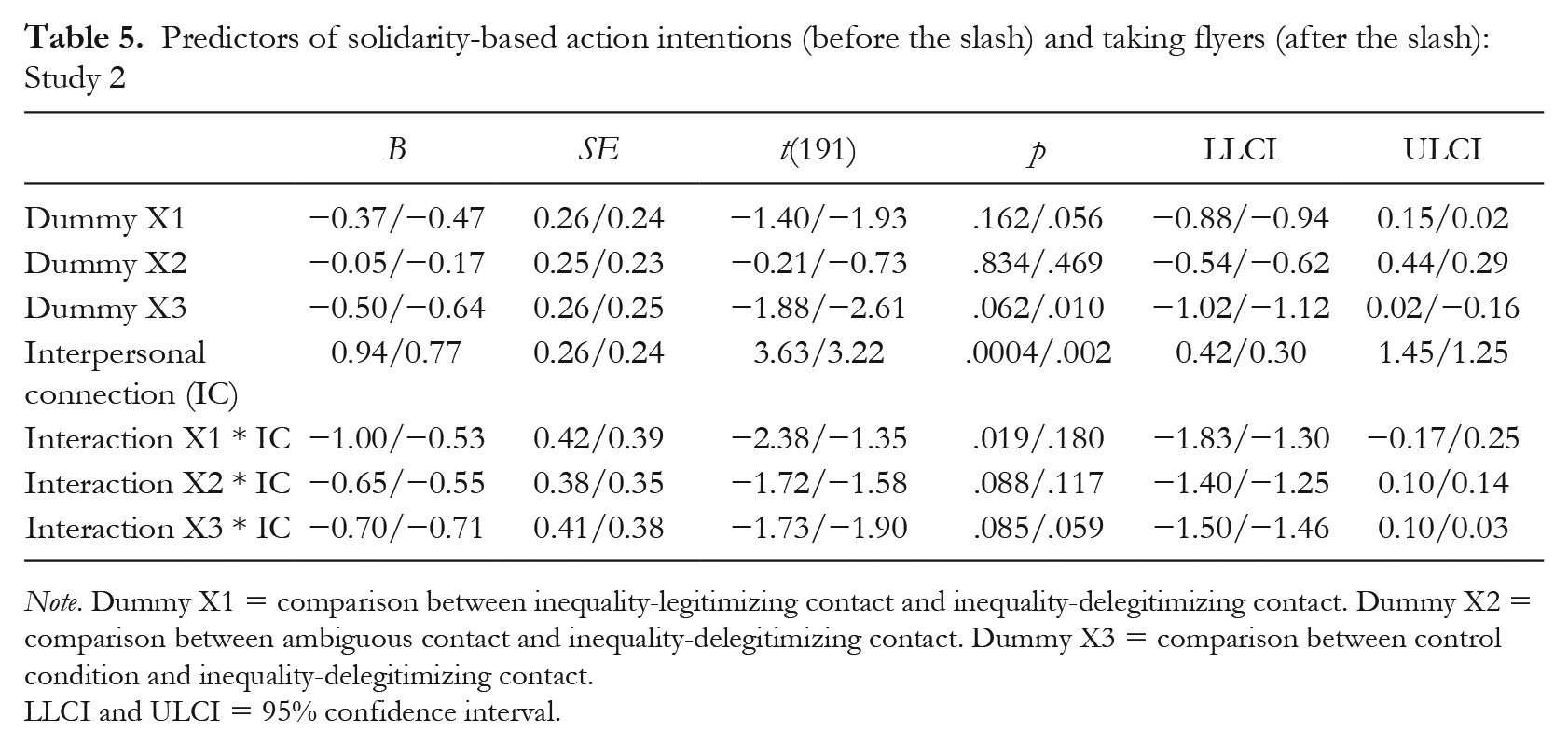
None of the three dummy variables (B = −0.37, SE = 0.26, p = .162; B = −0.05, SE = 0.25, p = .836; B = −0.50, SE = 0.26, p = .062) predicted interest in solidarity-based actions (see Table 5). However, stronger feelings of interpersonal connection were associated with stronger interest in solidarity-based actions (B = 0.94, SE = 0.26, p = .001).
Predictors of solidarity-based action intentions (before the slash) and taking flyers (after the slash): Study 2
Note. Dummy X1 = comparison between inequality-legitimizing contact and inequality-delegitimizing contact. Dummy X2 = comparison between ambiguous contact and inequality-delegitimizing contact. Dummy X3 = comparison between control condition and inequality-delegitimizing contact.
LLCI and ULCI = 95% confidence interval.
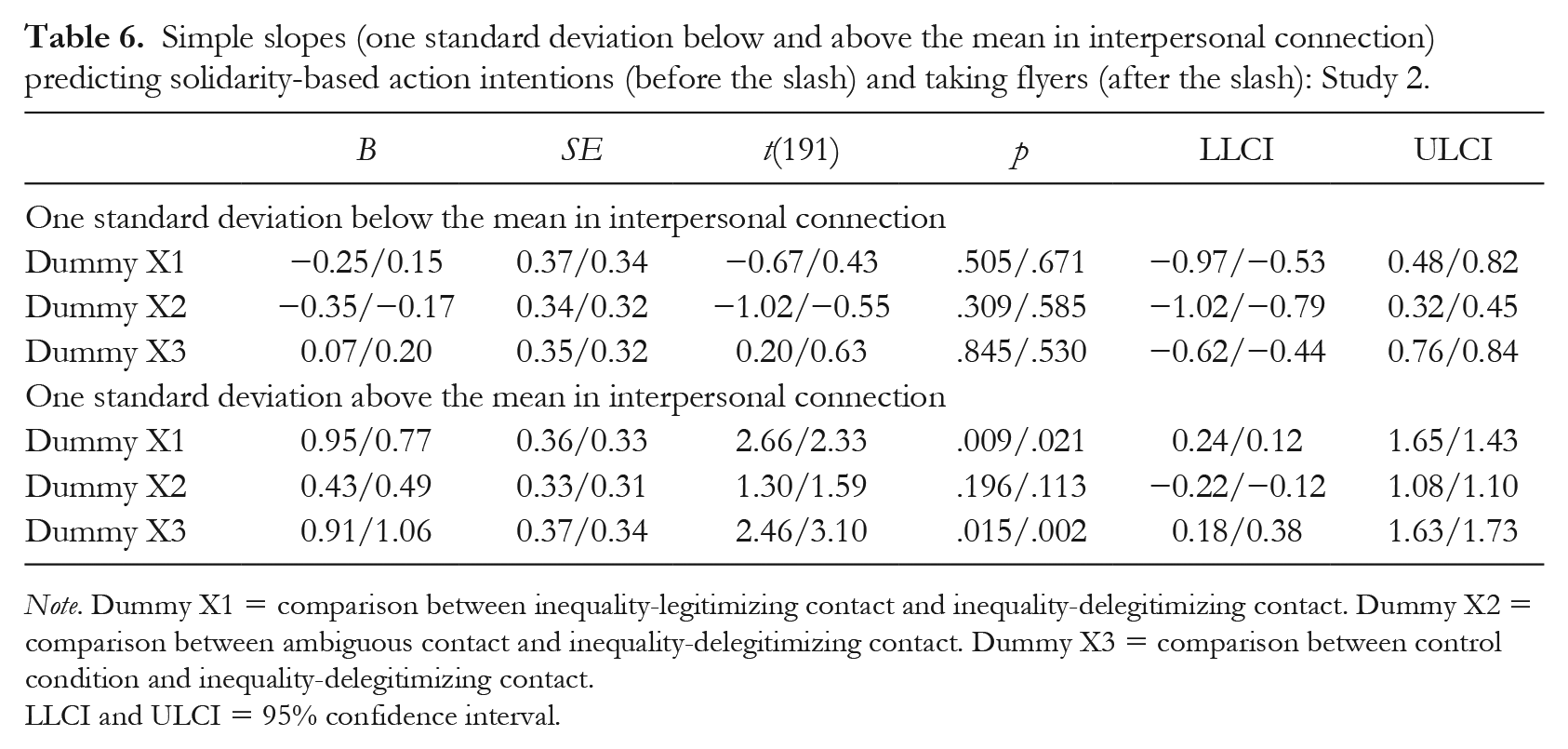
The inequality-delegitimizing contact versus no-contact control by interpersonal connection approached significance (B = −0.70, SE = 0.41, p = .085). Simple slope analyses showed that, as expected, solidarity-based action intentions were higher in the inequality-delegitimizing contact condition (compared to the no-contact control) when interpersonal connection was stronger (1 SD above the mean; B = 0.91, SE = 0.37, p = .015), but not when interpersonal connection was weaker (1 SD below the mean; B = 0.07, SE = 0.35, p = .84; see Figure 2 and Table 6).
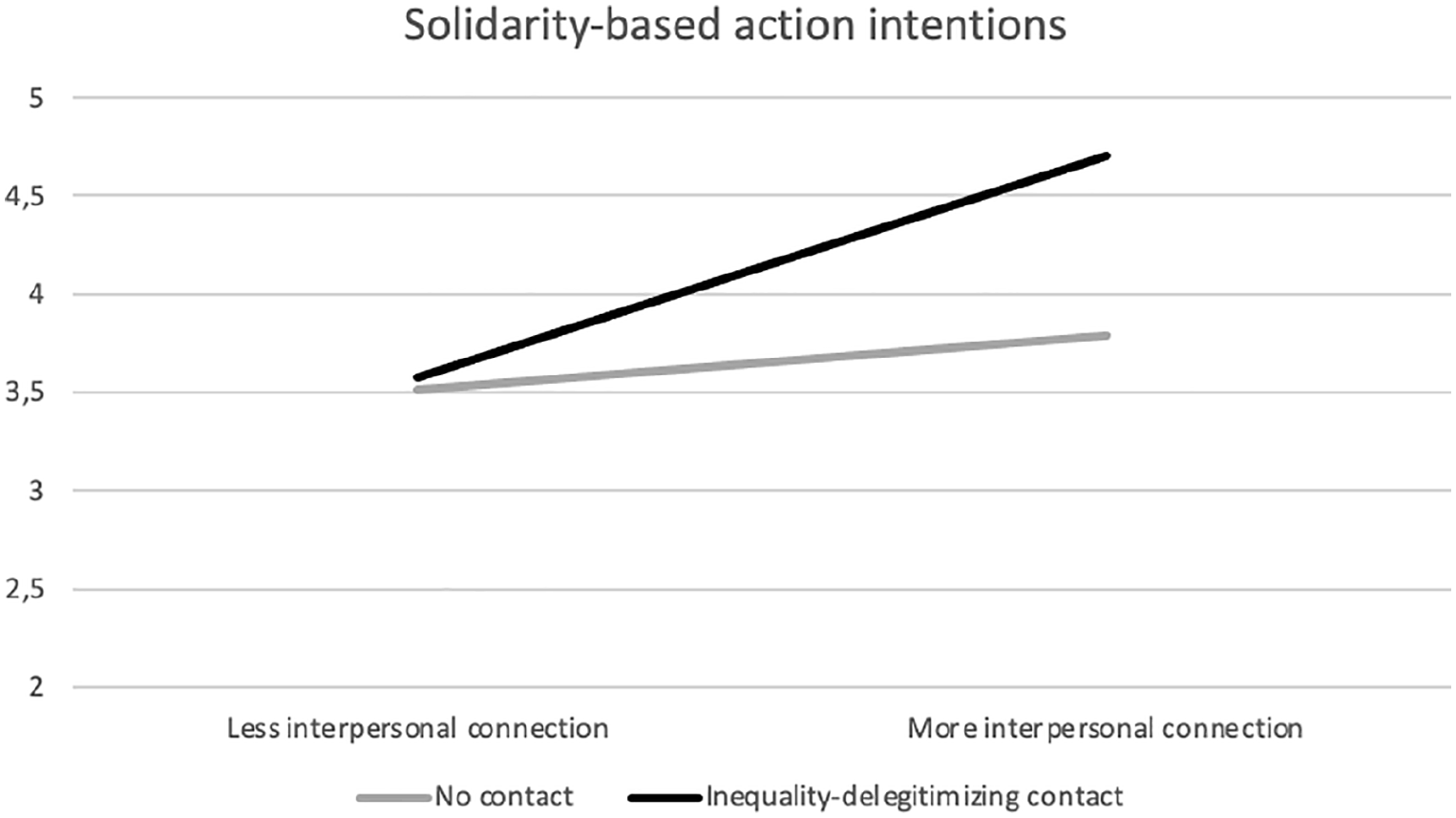
Interaction effect of inequality-delegitimizing contact (vs. no-contact control) and reported interpersonal connection on interest in a variety of solidarity-based actions: Study 2.
Simple slopes (one standard deviation below and above the mean in interpersonal connection) predicting solidarity-based action intentions (before the slash) and taking flyers (after the slash): Study 2.
Note. Dummy X1 = comparison between inequality-legitimizing contact and inequality-delegitimizing contact. Dummy X2 = comparison between ambiguous contact and inequality-delegitimizing contact. Dummy X3 = comparison between control condition and inequality-delegitimizing contact.
LLCI and ULCI = 95% confidence interval.
The interaction between inequality-delegitimizing versus inequality-legitimizing contact and interpersonal connection was significant (B = −1.00, SE = 0.42, p = .019), showing the same pattern of results as reported before (see supplemental material): interest in solidarity-based actions was higher in the inequality-delegitimizing contact condition (compared to the inequality-legitimizing condition) when reported interpersonal connection was high (1 SD above the mean; B = 0.95, SE = 0.36, p = .009), but not when interpersonal connection was weaker (1 SD below the mean; B = −0.25, SE = 0.37, p = .51).
Finally, the interaction between inequality-delegitimizing versus ambiguity contact and interpersonal connection approached significance (B = −0.65, SE = 0.38, p = .088). The simple slopes were not significant (see Table 6) but showed the same pattern as before (the figure is displayed in the supplemental material).
A second regression predicting actual solidarity-based actions (taking flyers) resulted in a similar pattern. First, the interaction between inequality-delegitimizing versus no-contact control and interpersonal connection approached significance (B = −0.71, SE = 0.38, p = .059; see Table 5). Again, simple slope analyses showed that, as expected, participants took more flyers in the inequality-delegitimizing contact condition (compared to the no-contact control) when interpersonal connection was stronger (1 SD above the mean; B = 1.06, SE = 0.34, p = .002), but not when interpersonal connection was weaker (1 SD below the mean; B = 0.20, SE = 0.32, p = .530; see Figure 3 and Table 6).
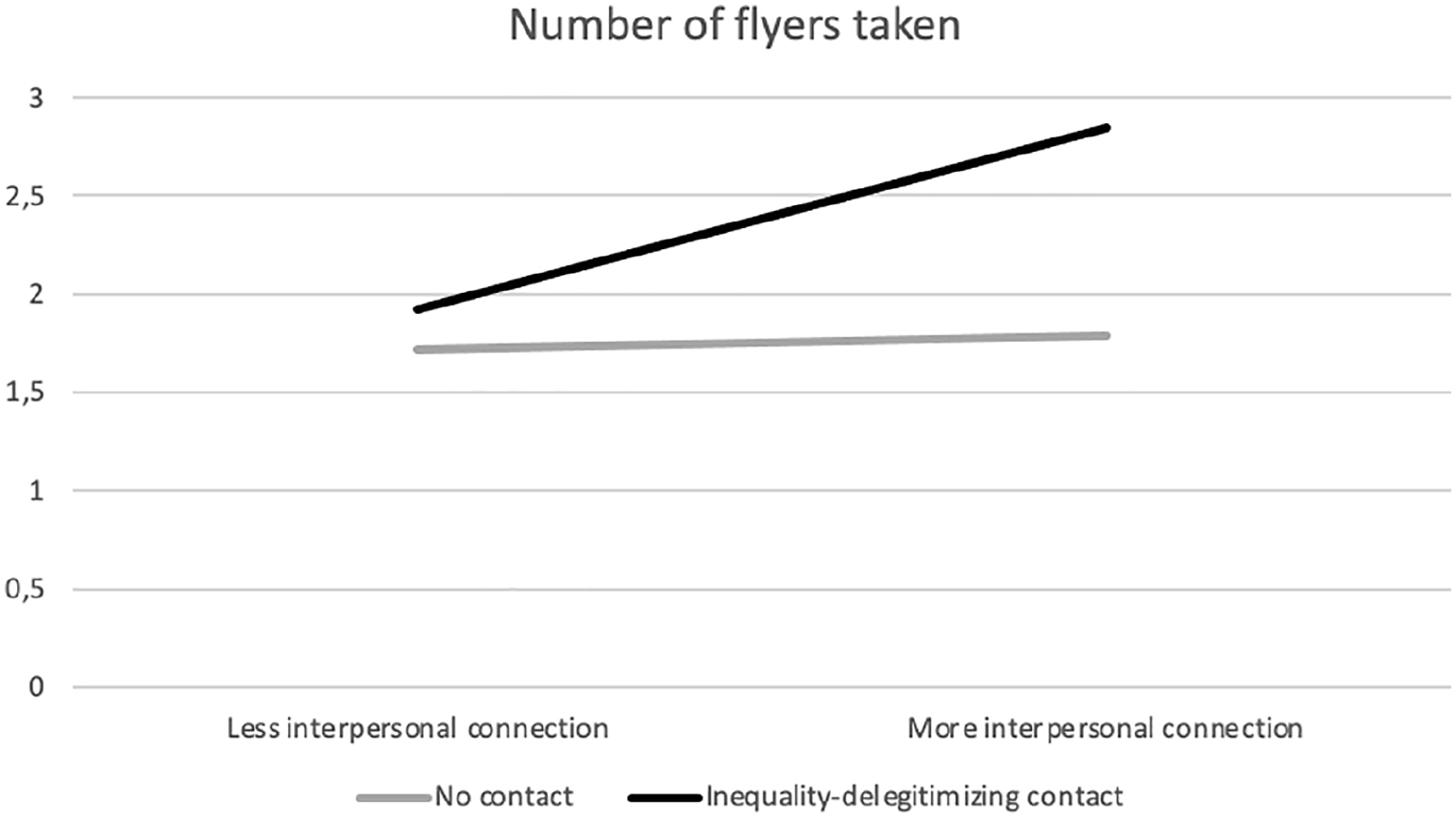
Interaction effect of inequality-delegitimizing contact (vs. no-contact control) and reported interpersonal connection on the number of flyers taken: Study 2.
Second, although the interaction between inequality-delegitimizing contact versus inequality-legitimizing contact and interpersonal connection was not significant (B = −0.53, SE = 0.39, p = .180), the simple slopes again replicated the usual pattern (see supplemental material): participants took more flyers in the inequality-delegitimizing contact condition (compared to the inequality-legitimizing condition) when interpersonal connection was stronger (1 SD above the mean; B = 0.77, SE = 0.33, p = .021), but not when sense of connectedness was lower (1 SD below the mean; B = 0.15, SE = 0.34, p = .671).
Third, the interaction between inequality-delegitimizing versus ambiguity and interpersonal connection was not significant (B = −0.55, SE = 0.35, p = .117). The simple slopes were not significant (see Table 6) but showed the same pattern as in the previous analyses (see supplemental material).
In sum, Study 2 replicated the findings from Study 1. Again, some interactions did not reach conventional levels of statistical significance, but the comparisons of interest (simple slopes analyses) were significant and in the expected direction in the majority of cases. Compared to the no-contact control and to the inequality-legitimizing contact condition, inequality-delegitimizing contact increased interest in solidarity-based actions and the taking of protest flyers only when there was a stronger interpersonal connection with the disadvantaged group contact partner. However, the interaction involving the comparison between ambiguous contact and inequality-delegitimizing contact was not significant in this study. However, although not statistically significant, the pattern of results was, for the most part, consistent with the other interactions of interests. The difference in this case was that SFU students in the ambiguity condition were somewhat more likely to show interest in solidarity-based actions when they experienced a strong interpersonal connection with the Capilano University student. It may be that, although the status difference between these two universities is widely known, the teaching universities in Vancouver have been very active in attempting to undermine these perceptions and to instill pride in their students. Thus, it may be that SFU students understand that the default position of Cap U students is to oppose the existing inequalities, making the ambiguous condition less ambiguous than it might have been in the German case.
General Discussion
Prior correlational research illustrated that positive contact with members of disadvantaged groups can have positive effects on advantaged group members’ support for social change towards more equality. The present work provides an experimental test of this effect. Results of two studies illustrate that first-time contact with a member of a disadvantaged group did not increase solidarity-based actions among members of the advantaged group. However, our findings suggest that positive cross-group contact can turn advantaged group members into allies when two conditions are simultaneously met. First, we demonstrated that the contact needs to help delegitimize intergroup inequalities, and one way this might occur is by the disadvantaged group member clearly communicating that they believe their group’s lower status is unfair. Second, based on work on confronting prejudice, we reasoned that a disadvantaged group member who attempts to describe the group-based inequality as illegitimate may be seen by advantaged group members as a complainer. Given that complainers are often disparaged (e.g., Kaiser & Miller, 2001) and ignored, we predicted that a disadvantaged group member’s effort to politicize intergroup contact by delegitimizing intergroup inequality will only increase the advantaged group partner’s interest in solidarity-based actions if they can avoid being seen as a complainer. To do so, we proposed that the advantaged group member must feel a sense of interpersonal connection with the disadvantaged group contact partner. This prediction received preliminary support in Study 1 and stronger support in Study 2. When the disadvantaged group member stated that intergroup inequality was unfair, and when the advantaged group partner felt a strong sense of interpersonal connectedness with the disadvantaged group member, solidarity-based action intentions among the advantaged group contact partner were higher than in the control conditions. However, when the advantaged group member reported lower interpersonal connection with the disadvantaged group partner, the explicit description of the inequality as illegitimate produced no increase in solidarity-based action intentions.
When disadvantaged group members engage in cross-group contact and hope to receive support for social change, they face a challenge. If they do not talk about intergroup inequality, they will not inspire solidarity-based actions. However, if they talk about the illegitimacy of intergroup inequality, they risk undermining the interpersonal connection also needed to inspire solidarity-based actions. However, results of both studies demonstrated that, on average, when the contact situation includes conditions that allow for high “friendship potential” (see Pettigrew, 1998; Wright et al., 2005), expressing discontent about intergroup inequality may not necessarily undermine feelings of interpersonal connection. However, it is important to remember that, in our research, the expression of discontent occurred within a cross-group contact situation that was very positive—one designed to create feelings of interpersonal closeness. Not all contact situations include these conditions, and future research is needed to test the effects of inequality-delegitimizing messages in contact situations that have the potential for more conflict.
Moreover, much of the research showing the high social costs of confronting discrimination has been conducted in situations that do not involve a meaningful interaction between the participant and the confronting person, let alone interactions explicitly designed to produce interpersonal closeness. Thus, our data may also point to important differences in the costs of confronting inequality when it is done with close others versus strangers. A second difference between research on confronting prejudice (e.g., Mallett & Monteith, 2019) and our work involves the confrontation recipient. In much of the work on confronting prejudice, the recipient is a single perpetrator who did something sexist or racist, whereas in our work, intergroup inequality between two universities was criticized. Thus, confronters might be perceived more negatively when they criticize a specific individual compared to when their criticism is directed at more abstract and structural inequality.
Our findings seem to contradict prior research showing that advantaged group members who report having positive cross-group contact are more likely to show outgroup support (e.g., Cakal et al., 2011; Hässler et al., 2020; Kamberi et al., 2017; Reimer et al., 2017). We argue that the main difference between that prior work and our research is study design. Prior work linking positive contact to solidarity-based actions has been correlational, meaning that the relation could be driven by third variables such as a general endorsement of egalitarian, left-wing, or humanitarian values; or a general openness to new experiences; or a lack of identification with one’s ingroup. In contrast, in our experiment, all participants, independent of their prior attitudes, experienced positive contact with an outgroup contact partner. Perhaps unsurprisingly, our findings are more in line with experimental work by Saguy et al. (2009) suggesting that contact need not lead to more egalitarian sharing of resources by advantaged group members. In addition, our participants had a one-time initial contact, whereas those examined in the correlational studies likely had repeated experiences of positive contact. Given evidence that cross-group contact needs time to show positive effects (e.g., MacInnis & Page-Gould, 2015), future work could observe advantaged and disadvantaged group members who engage in repeated contact, and who either communicate about group-based hierarchies or not. This would offer a persuasive test of whether only those advantaged group members who engage in inequality-delegitimizing contact and develop strong connections with the disadvantaged group member drive the correlation between positive contact and allyship.
Furthermore, one might have expected that when the disadvantaged group member communicated that she believed intergroup inequality was fair, the advantaged group partner would show lower interest in solidarity-based actions. One possible explanation for why we did not find this effect could be that it is difficult for disadvantaged group members to reduce advantaged group members’ concerns about intergroup inequality and injustice. However, this might be different when this message comes from another advantaged group member—this might reduce solidarity-based actions.
Potential Privilege Loss
A closer look at our solidarity-based action measures reveals that some questions do not involve a zero-sum perspective (“I would be willing to attend in a peaceful demonstration against the funding cuts to teaching schools”), whereas other items involve an acceptance that outgroup benefits come at the expense of ingroup privilege (“I would actively lobby for the interests of the School of Applied Sciences even if this leads to restrictions for the university”). The inclusion of explicitly zero-sum items differentiates our research from prior correlational studies where outgroup support usually did not involve a loss of ingroup privilege. If there is no personal or ingroup cost, why should advantaged group members not support their contact partner’s group? However, when allyship will likely lead to a loss of ingroup privilege, we might expect findings more consistent with ours. For instance, Hässler et al. (2020) showed stronger effects of contact on support for social change via low-cost collective actions (e.g., signing a petition) compared to more costly actions (e.g., “When I come into contact with ingroup members, we talk about injustices in society regarding [outgroup]”). Thus, contact may more easily inspire support for low-effort/low-cost actions that are unlikely to undermine the advantaged group’s privilege.
It is possible that participation in low-cost solidarity-based actions will be influenced by interpersonal connection with the contact partner even when the contact is not politicized (basic positive contact), whereas willingness to take costly solidarity-based actions (those that directly threaten ingroup privilege) will require both connectedness with the partner and inequality-delegitimizing contact. This is consistent with recent work on different motives of ally behavior. It is argued that “true” allies would show outgroup support even when this entails a loss of ingroup privilege, whereas outgroup help that is motivated by other reasons (e.g., to feel less guilty) would not be true allyship behavior (Radke et al., 2020). Future research could examine whether the combined impact of different forms of contact and different advantaged group member motives will influence high- versus low-cost solidarity-based actions.
Implications, Limitations, and Future Research
In addition to the theoretical contributions, there are also practical and political implications of the current work. Our findings point to the importance of communication about injustice. Contact with outgroup members is not enough to inspire action for change among disadvantaged group members (see Droogendyk et al., 2016) nor among advantaged group members (e.g., Di Bernardo et al., 2021; MacInnis & Hodson, 2019; Vezzali et al., 2017). It is crucial that contact include conversations about group-based inequality. However, these politicized conversations can be difficult and stressful (see Shelton & Richeson, 2015) and thus are often avoided, and certainly disadvantaged group members have reason to worry that exposing the illegitimacy of inequality may undermine interpersonal liking. However, in our studies, advantaged group members reported the same level of interpersonal connection with their disadvantaged contact partner who made clear statements intended to delegitimize intergroup inequality as they did with a contact partner who did not express such statements. Thus, when contact is positive, both disadvantaged and advantaged group members should be encouraged to talk about the inequalities between their groups in order to strengthen political solidarity by the advantaged and reduce the demobilization effects of contact on the disadvantaged (Becker et al., 2013). This is in line with work showing that difference-focused contact may be more effective than commonality-focused contact in increasing motivation for social change among advantaged group members (Vezzali et al., 2017). We argue that the focus on differences is an important component of politicized communication. However, the present work shows that a focus on difference can also be compatible with building close interpersonal connections. Thus, it should be actively promoted in contact situations. For instance, when disadvantaged and advantaged group members discuss group differences, including group-based inequalities, they may both increase their identification with a movement against social inequalities, and this shared experience may result in a stronger interpersonal connection.
We conducted both studies in the context of inequality between research universities and teaching schools. Although these groups represent important categories for the participants and the inequality in status and resources is well-known, it is true that these groups are not openly hostile towards one another nor do they have a history of direct discrimination or oppression. In addition, the boundaries between the groups are quite permeable and a contact partner from the disadvantaged school (SAS or Cap U) could be a future classmate. Thus, future research could attempt to replicate our findings with groups with a more acrimonious history and less permeable boundaries, (e.g., gender, ethnicity, migrants and nonmigrants, different social classes). Also, our participants were students, and future replications with other populations would be helpful.
Finally, the interactions involving the contrast of inequality-delegitimizing contact and some specific control conditions did not reach conventional levels of statistical significance. The pattern of simple slopes was very consistent and approached statistical significance in the smaller sample of Study 1 (see Figure 1) and was statistically significant in most cases in the larger sample of Study 2 (see Figure 2). It should be noted that we took a conservative analytic approach by comparing all three control conditions separately with the inequality-delegitimizing contact conditions. When the three control conditions were collapsed (see Endnote 2), both results were statistically significant. However, future replications in settings with stronger intergroup conflicts and using larger samples are needed. This future research should also include a manipulation of interpersonal connection with the contact partner in addition to manipulating communication about the illegitimacy of intergroup inequalities, because this important moderator was measured in the present work. This would offer a more compelling test of the causal impact of interpersonal connection.
Conclusion
The present work provides an experimental test of the effect of positive cross-group contact on advantaged group members’ solidarity-based action intentions, and highlights the fundamental importance of two moderators. The first is the need to politicize contact by communicating directly about the illegitimacy of intergroup inequality, the second is to ensure that there are strong feelings of interpersonal connection with the disadvantaged group contact partner. In two experiments, we illustrate that positive cross-group contact per se did not increase advantaged group members’ solidarity-based actions intentions. However, cross-group contact did increase advantaged group members’ solidarity-based actions when the positive contact led to a strong sense of connection with the disadvantaged group partner, and when the disadvantaged group partner politicized the contact by describing intergroup inequality as illegitimate.
Supplemental Material
sj-docx-1-gpi-10.1177_13684302211015273 – Supplemental material for Can cross-group contact turn advantaged group members into allies? The role of inequality-delegitimizing contact and interpersonal connection
Supplemental material, sj-docx-1-gpi-10.1177_13684302211015273 for Can cross-group contact turn advantaged group members into allies? The role of inequality-delegitimizing contact and interpersonal connection by Julia C. Becker and Stephen C. Wright in Group Processes & Intergroup Relations
Footnotes
Funding
The author(s) disclosed receipt of the following financial support for the research, authorship, and/or publication of this article: This research was funded by the German Research Foundation (BE4648/4-2).

Supplemental material
Supplemental material for this article is available online.
Notes
References
Supplementary Material
Please find the following supplemental material available below.
For Open Access articles published under a Creative Commons License, all supplemental material carries the same license as the article it is associated with.
For non-Open Access articles published, all supplemental material carries a non-exclusive license, and permission requests for re-use of supplemental material or any part of supplemental material shall be sent directly to the copyright owner as specified in the copyright notice associated with the article.
