



Abstract
Academic Abstract
In this narrative review, we examined 134 studies of the relationship between intergroup contact and collective action benefiting disadvantaged groups. We aimed to identify whether, when, and why contact has mobilizing effects (promoting collective action) or sedative effects (inhibiting collective action). For both moderators and mediators, factors associated with the intergroup situation (compared with those associated with the out-group or the in-group) emerged as the most important. Group status had important effects. For members of socially advantaged groups (examined in 98 studies, 100 samples), contact had a general mobilizing effect, which was stronger when contact increased awareness of experiences of injustice among members of disadvantaged groups. For members of disadvantaged groups (examined in 49 studies, 58 samples), contact had mixed effects. Contact that increased awareness of injustice mobilized collection action; contact that made the legitimacy of group hierarchy or threat of retaliation more salient produced sedative effects.
Public Abstract
We present a review of existing studies that have investigated the relationship between intergroup contact and collective action aimed at promoting equity for disadvantaged groups. We further consider the influence of contact that is positive or negative and face-to-face or indirect (e.g., through mass or social media), and we distinguish between collective action that involves socially acceptable behaviors or is destructive and violent. We identified 134 studies, considering both advantaged (100 samples) and disadvantaged groups (58 samples). We found that intergroup contact impacts collective action differently depending on group status. Contact generally leads advantaged groups to mobilize in favor of disadvantaged groups. However, contact has variable effects on members of disadvantaged groups: It sometimes promotes their collective action in support of their own group; in other cases, it leads them to be less likely to engage in such action. We examine when and why contact can have these different effects.
Intergroup contact represents one of the most effective strategies for promoting positive intergroup relations (Hodson & Hewstone, 2013; Pettigrew & Tropp, 2006; Vezzali & Stathi, 2021). Although much of the work on intergroup contact has focused on the reduction of prejudice as a measure of movement toward social equity, improving out-group attitudes may in some cases lead (inadvertently) to reinforcing social hierarchies (Kteily & McClanahan, 2020; Saguy et al., 2017) that contribute to inequalities. It is therefore important, both theoretically and practically, to understand whether, how, and under what conditions contact predicts collective action aimed at achieving social equity. In particular, in this review, we define collective action broadly as support for the disadvantaged group, in terms of acts or intentions to benefit disadvantaged group members (e.g., by expanding their rights and opportunities through individual efforts or policies). Collective action thus represents solidarity-based behavior in support of disadvantaged groups aimed at achieving social equity (see also De Lemus & Stroebe, 2015; Vezzali & Stathi, 2021, Chapter 7).
The present work reviews and synthesizes evidence on the relation between contact and collective action to help delineate a state-of-the-art understanding of the research area.
There has been a recent surge of studies investigating the association between contact and collective action, culminating in various theoretical reviews (Dixon & McKeown, 2021; Hassler et al., 2021; MacInnis & Hodson, 2019; McKeown & Dixon, 2017; Saguy et al., 2017; Tropp & Barlow, 2018; Tropp & Dehrone, 2023; Vezzali & Stathi, 2021, Chapter 7). These previous reviews have focused on identifying specific elements of the relationship between contact and collective action (e.g., moderating and/or mediating variables; Vezzali & Stathi, 2021) or on proposing specific conceptual models (Hassler et al., 2021). These works have therefore generally been directed in a top-down way by particular models and hypotheses, producing relatively selective reviews of the relevant literature.
While prior reviews on this topic have been hypothesis-driven and confirmatory in their main objectives, we present a narrative review that adopts a “bottom-up” approach, representing a more comprehensive review of the literature on contact and collective action and identifying themes that emerge from our analysis of that literature. Narrative reviews, which are qualitative in their approach, are particularly appropriate when considering studies that have used diverse methodologies, or that have examined different theoretical conceptualizations, constructs, and/or relationships. . . . They are a particularly useful means of linking together studies on different topics for reinterpretation or interconnection in order to develop or evaluate new theory (Siddaway et al., 2019, p. 775).
We view the current approach as complementary to other, recent systematic, and focused reviews. As distinguished by Siddaway et al. (2019), in contrast to a narrative review, a systematic review represents an analysis of a clearly articulated question that adheres to previously specified methods to identify, select, and critically appraise relevant research around the question that guided the review. Two recent, related reviews have been performed by Hassler et al. (2021) and by Reimer and Sengupta (2021). Hassler et al. (2023) reviewed the literature on contact and collective action structured as systematic evaluation of a specific model, the integrated contact-collective action model (which we subsequently discuss). Reimer and Sengupta (2023) conducted a preregistered “systematic review and meta-analysis” with the goal “to evaluate the evidence for and against the ‘ironic’ effects of intergroup contact” (p. 362).
We build on the literature they consider, integrate many ideas from those and other previous reviews, and organize our review and analysis not with a formal conceptual model but with a graphical representation intended to map the broader landscape of empirical findings in this area. We pursued a narrative, bottom-up approach instead of a meta-analysis to identify promising but under-researched areas relating to what is not yet known about intergroup contact and collective action.
We structured our narrative review around three goals relating to the general relationship of contact to collective action and the factors that shape and underlie that relationship. Our first goal is to answer the question of whether or not intergroup contact promotes collective action—that is, whether it has mobilizing effects (i.e., it promotes collective action) or sedative effects (i.e., it inhibits collective action). The second goal is to identify moderating factors to understand when contact will have a mobilizing or a sedative effect. Our third goal is to illuminate mediating processes that explain the pathway between contact and collective action. To systematize research conducted thus far and with the aim of facilitating future research, we group moderators and mediators into overarching categories related to the intergroup situation, the out-group, and the in-group. In so doing, we consider forms of intergroup contact that are receiving increasing attention, such as negative contact and indirect contact.
In addition, given their potential social impact, we distinguish between normative and non-normative forms of collective action. Whether collective action is normative or non-normative can be a contentious issue that needs a thorough consideration of multiple sociocultural elements. In this review, following the guidance of Wright et al. (1990) and Becker and Tausch (2015), we refer to normative collective action as socially acceptable behaviors (e.g., distributing leaflets) and to non-normative collective action as behavior that is destructive and violent that deviates from prevailing social norms and is often illegal.
In the next section, we present brief overviews of (a) general models of factors motivating collective action, (b) research on intergroup contact and prejudice reduction, and (c) works currently bridging intergroup contact and collective action. After that, we introduce a graphical representation (Figure 1) that organizes previous work in a way that maps our systematic review and analysis of the literature. We not only address the general question of whether intergroup contact promotes or inhibits collective action but also examine relevant moderators and mediators. In our concluding section, we offer suggestions for promising directions for future research.
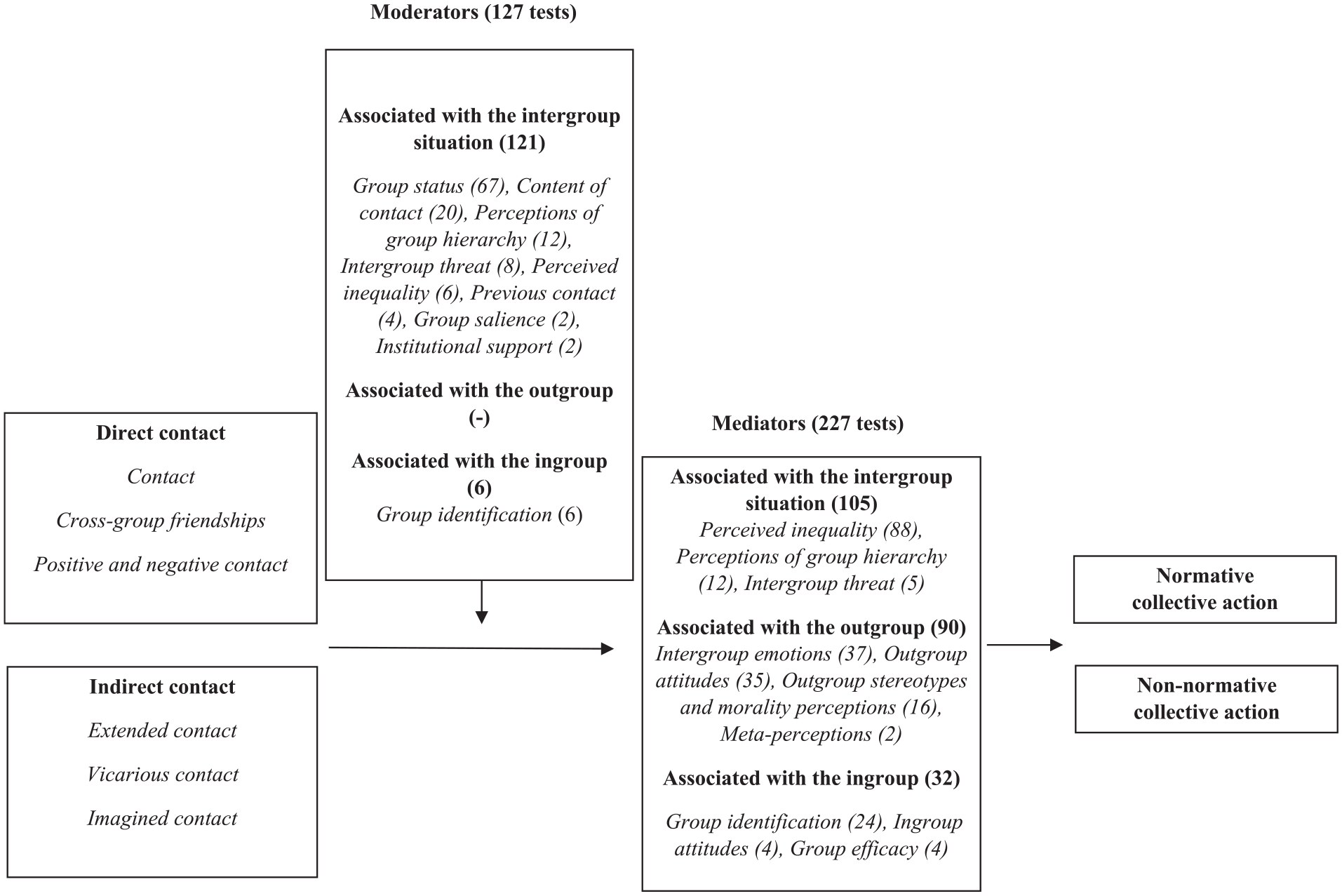
Graphical Representation of the Moderators and Mediators of the Relationship Between Contact and Collective Action.
Collective Action and Intergroup Contact: Overviews
Our primary focus is on the impact of intergroup contact on collective action. In this section, we therefore review some of the most prominent and generative psychological theories of collective action and the processes underlying it. Although research on collective action has traditionally emphasized the mobilization of members of disadvantaged groups (Wright & Lubensky, 2009), there is also currently a substantial literature on collective action by advantaged-group members that benefits a disadvantaged group (e.g., Cakal et al., 2021; Dixon, Durrheim, et al., 2010; Vázquez et al., 2020).
Theoretical Approaches for Understanding the Pathway to Collective Action
Research on collective action has been grounded to varying degrees in three basic processes relating to (a) social identity, (b) perceptions of the causes of disparities, and (c) a group’s capacity to address these disparities. The social identity model of collective action (SIMCA; Van Zomeren et al., 2008), for example, recognizes these processes in terms of group identification, perceived injustice, and perceived efficacy as key instigators of collective action.
These processes rest on three main socio-psychological perspectives. The first theoretical perspective relates to social identity theory (SIT; Tajfel & Turner, 1979), which places a strong emphasis on collective identity and, specifically, on in-group identification. A form of group identity especially relevant to collective action is that of politicized identity, which is identification with a particular social movement (Stürmer & Simon, 2004; Van Zomeren et al., 2008). According to Van Zomeren et al. (2008), social identification (especially, politicized identities) can predict collective action both directly and indirectly through increased perceptions of group efficacy and injustice. The second perspective is relative deprivation theory (Runciman & Runciman, 1966), which proposes that unfavorable intergroup comparisons lead to experiencing injustice and seeking to reduce it by engaging in collective action. Such an experience of injustice has both cognitive (perception that a group is disadvantaged compared with another group) and affective (intergroup emotions, such as anger, frustration, resentment, and outrage) dimensions. The third theoretical perspective that informs SIMCA highlights the role of perceived group efficacy (Bandura, 1997) as a motivating element to engage in collective action (Van Zomeren et al., 2004).
Extending SIMCA, Van Zomeren et al. (2012) directed their attention to the role of moral convictions, defined as “as strong and absolute stances on moral issues” (p. 52). If violated, moral convictions can lead to action to defend them (Van Zomeren & Lodewijkx, 2005). Moral convictions can therefore act as motivators of collective action (Skitka & Bauman, 2008).
Relatedly, Thomas et al. (2009; see also Thomas et al., 2012) proposed the encapsulation model of social identity in collective action (EMSICA), which accords social identity processes a central role in collective action. Unlike SIMCA (Van Zomeren et al., 2008), however, Thomas et al. (2009) considered social identification as an outcome rather than as an antecedent of perceived injustice and group efficacy. Furthermore, the model acknowledges reciprocal paths between group efficacy and perceived injustice, with the two constructs predicting each other.
Becker and Tausch (2015), inspired by SIMCA (Van Zomeren et al., 2008), described a key differentiation between normative and non-normative collective action in their dynamic model of engagement in normative and non-normative collective action. The authors further focused on the role played by emotions in predicting collective action. Specifically, they posited that normative and non-normative collective action are predicted by different emotions: While anger leads to increased normative collective action, non-normative collective action is primarily predicted by contempt. The model suggested by Becker and Tausch (2015) also considers the other relevant constructs hypothesized by SIMCA and specifies when they would be associated with the two forms of collective action. According to that framework, individuals are more likely to engage in normative collective action when they perceive high efficacy, and in non-normative collective action when perceived efficacy is low. Finally, individuals are more likely to opt for normative collective action when they perceive their social identification as strong, and in non-normative collective action when social identification is perceived as weak.
Turning the focus to collective action by advantaged-group members, the political solidarity model of social change (Subašić et al., 2008) aims to understand the perspective of the advantaged group and the conditions that may lead to an alliance between advantaged and disadvantaged groups. This model incorporates two approaches: SIT (Tajfel & Turner, 1979), and self-categorization theory (SCT; J. C. Turner et al., 1987). SIT places importance on the shift from personal to social identity and on the role of social identity in guiding intergroup relations. SCT conceptualizes the self as hierarchically organized, with more abstract categories reflecting higher levels of inclusiveness.
The political solidarity model (Subašić et al., 2008) illuminates how to create political solidarity between groups for the achievement of social equity. The process of political solidarity is explained in a triangular context, where the protagonists are the advantaged group, the disadvantaged group, and the authority. According to the model, the alliance between advantaged and disadvantaged groups is the result of a shared social identity between advantaged and disadvantaged groups, which excludes authority. In this process, the authority loses its legitimacy, increasing the likelihood of being challenged, suggesting that perceived illegitimacy leads to mobilization against social injustice. Importantly, the shared identity between advantaged and disadvantaged groups is not meant to obscure intergroup differences but to provide a meaningful context within which to understand them.
To summarize, research on collective action has traditionally, but not exclusively, focused on the actions of disadvantaged group members. This work has identified the key roles of (a) social identification with a group, with a particular politicized identity, or in relation to authority; (b) perceptions of unfair disadvantage or injustice, (c) feelings of efficacy for making change, and (d) moral convictions. While the research on collective action reveals several common and influential processes, our focus is specifically on the relationship between intergroup contact and intentions for and engagement in collective action.
Intergroup Contact and Prejudice Reduction
Much of the traditional research on intergroup contact has been centered on prejudice reduction as an outcome. Almost seven decades of research have shown that contact is associated with reduced prejudice, even when the optimal conditions originally proposed by Allport (1954) (e.g., equal status, cooperation for common goals, institutional support) are absent (Paluck et al., 2021; Pettigrew & Tropp, 2006). One limitation of research on intergroup contact is that it has focused to a much greater extent on advantaged group members than on disadvantaged group members in terms of how to improve the attitudes of members of advantaged groups toward disadvantaged groups (see Pettigrew & Tropp, 2006). In general, results have shown that contact is more effective at reducing intergroup bias among members of advantaged than disadvantaged groups, with effects among disadvantaged-group members often weaker and sometimes nonsignificant (Tropp & Pettigrew, 2005; Vezzali & Stathi, 2021).
The scope of research on intergroup contact has been expanded in recent years, for instance in terms of considering different forms of direct contact (e.g., showing the detrimental effects of negative contact; Graf & Paolini, 2017; Schafer et al., 2021) and including indirect forms of contact. Types of indirect contact, which do not involve face-to-face interaction, include extended and vicarious contact (respectively, knowing or observing an intergroup relationship; Dovidio et al., 2011; Vezzali et al., 2014; White et al., 2021; Wright et al., 1997; Zhou et al., 2019), and imagined contact (mentally simulating an intergroup interaction; Crisp & Turner, 2012; Miles & Crisp, 2014; see also White et al., 2021).
While there is considerable consensus in the field that positive intergroup contact generally makes intergroup attitudes more favorable, additional questions remain. Some of these involve the underlying processes that account for the reduction in prejudice. Multiple routes appear to be involved, including lessening intergroup anxiety or increasing empathy (Pettigrew & Tropp, 2008) as well as changing the ways members of another group are perceived, such as creating more individuated (Wilder, 1986) or personalized (Miller, 2002) perceptions or a greater sense of shared identity (Gaertner & Dovidio, 2000; Reimer et al., 2022). Other questions involve the durability of the effect of intergroup contact on prejudice reduction (Paluck et al., 2019).
The issues of primary interest in this review are additional ones: how intergroup contact relates to collective action as an outcome, and how many of the processes revealed in the study of contact effects on prejudice reduction reflect or supplement those currently recognized as factors shaping collective action. Although prejudice reduction and collective action may both appear to represent forces promoting intergroup equity, intergroup contact may, at least in some circumstances, produce divergent effects on these two outcomes because of the different ways it influences the dynamics underlying each.
Intergroup Contact and Collective Action
Various scholars have questioned the effectiveness of contact for producing social change and, ultimately, social equity (Dixon et al., 2005). Wright and Lubensky (2009) argued that the mechanisms by which contact improves out-group attitudes (e.g., reducing in-group identification, lowering perceptions of injustice) are the very same ones that may inhibit collective action (a sedative effect). Much of the theorizing of the sedative effects of contact has focused on collective action by members of disadvantaged groups (Dixon, Tropp, et al., 2010; Dovidio et al., 2016), for whom positive contact tends to reduce their focus on inequity and to have greater expectations of being treated fairly in the future (Saguy et al., 2009). However, the sedative effects of contact may also apply to members of advantaged groups in terms of taking actions to benefit disadvantaged groups. The “principle-implementation gap” refers to the finding that positive experiences of contact do not automatically translate into supporting or engaging in collective action (Dixon, Durrheim, et al., 2017; Dixon, Durrheim, et al., 2010). Dixon (2017) explained that increasing positive feelings toward the out-group (a distinctive feature of contact; Pettigrew & Tropp, 2008) reduces the salience of group boundaries and, consequently, the need to redress inequality toward one specific group, leading to sedative effects of contact (see also Cakal et al., 2011, Study 1). We review relevant theoretical and empirical work with the aim of providing a clearer understanding of the relation between contact and collective action, considering the effects separately for members of disadvantaged and advantaged groups.
Understanding how intergroup contact affects collective action is particularly valuable for integrating work within the area of intergroup relations. Although both collective action and prejudice reduction have attracted significant scholarly attention and produced vibrant literature in psychology across many years, as noted by Wright and Lubensky (2009), these lines of research traditionally proceeded largely independently. Also, despite the robustness and empirical evidence in support of the models of collective action we previously discussed, it is important to acknowledge that these models have not systematically considered the role of intergroup contact in the pathway to collective action—the issue that is the specific focus of the current work.
We are not alone in our interest in this issue. Several theoretical perspectives have been recently proposed to better understand the relationship between contact and collective action. Hassler et al. (2021) proposed the integrated contact-collective action model (ICCAM), which focuses on understanding when contact will have mobilizing or sedative effects among advantaged or disadvantaged group members. Among the relevant factors, the authors consider the type of contact (including its valence), perception of (il)legitimacy of group differences, extent to which group-specific needs are satisfied, social categorization, and intergroup ideologies.
Hassler, Ulug, et al.’s model considers important variables identified in contact as well as collective action research, with the aim of proposing relevant factors emerging from the two literatures rather than providing a broad and extensive review of variables specifically identified by research testing the association between contact and collective action. As an example, when discussing social categorization, the authors refer to the general literature on the common in-group identity model (Gaertner & Dovidio, 2000; Gaertner et al., 2016) together with research investigating categorization in the context of collective action but unrelated to contact research (Ufkes et al., 2016). While we view the work by Hassler, Ulug, et al. as complementary to our interests, our goals are both broader empirically—providing a more extensive review of the literature—and more focused conceptually—emphasizing the dynamics of contact more specifically.
MacInnis and Hodson (2019) have theorized about when a disadvantaged group will engage in social change. They focus on the importance of contact that can lead to cross-group friendships (which is an especially effective form of contact; Davies et al., 2011). They also highlight the relevance of the content of contact, in particular the importance of discussing group differences and social inequalities (which represents an important variable in the review and analysis that we present).
Vezzali and Stathi (2021, Chapter 7) proposed a sequential mediation to explain the relation of direct and indirect contact with normative and non-normative collective action. In this model, contact predicts socio-structural variables as posited by SIT (Tajfel & Turner, 1979), which in turn predict morality convictions. Further mediators include social categorization, and a series of variables, such as intergroup emotions, which have been shown to be associated with collective action (Becker & Tausch, 2015). Vezzali and Stathi (2021) also identified several moderators, such as content and valence of contact, social dominance orientation (SDO), and prejudice.
Overall, while the current models involving intergroup contact and collective action address many similar dynamics, they do so in different ways, from various perspectives, and with different primary objectives. These models generally highlight particular constructs, for instance, group identification (Hassler et al., 2021), content of contact (MacInnis & Hodson, 2019), and moral convictions (Vezzali & Stathi, 2021). In addition, the models of Hassler et al. (2021) and of MacInnis and Hodson (2019) represent theoretical elaborations that take literature on contact and collective action into consideration, but they do not focus specifically on findings that have emerged from the contact and collective action literature more broadly (including mediators and moderators). Those models have a broader aim: to understand based on available relevant literature when advantaged and disadvantaged groups will engage in collective action. The model introduced by Vezzali and Stathi (2021, Chapter 7), though more strongly rooted in studies on contact and collective action, is mainly aimed at understanding the complex and sequential mediational chains that can underlie contact effects. The present work presents a more comprehensive review of contact research that has investigated collective action, building on, extending, and synthesizing the literatures considered in previous reviews. Because the objective of a narrative review is to identify emergent themes and important gaps in the existing literature, the approach to identifying studies is broader and with a less prescribed methodology for narrative reviews than that for systematic meta-analytic efforts that test specific hypotheses (see Siddaway et al., 2019). For the present review, we searched for terms broadly related to collective action and social change (e.g., contact, affirmative action, collective action, polic+, social change, activism, critical action, sedative, mobilize, in different combinations) on the Psychinfo database, with October 18, 2021, as the cut-off date.
Building bottom-up from the empirical literature, we identify and classify both moderators and mediators into broad categories. These categories include and help systematize work guided by existing models, which generally focus selectively on moderators and mediators relevant to a specific conceptual position (e.g., Hassler et al., 2021; MacInnis & Hodson, 2019; Vezzali & Stathi, 2021). We integrate specific constructs, including those representing the focus of previous reviews, into broader categories that may favor an understanding of the whole literature on contact and collective action. Next, we introduce a graphical representation of our review and analysis of the literature to help summarize what is known and what is not to identify productive directions for future research in this area.
The Current Work: A Narrative Review
In our review of the literature, we pursue questions about whether, when, and why intergroup contact is associated with collective action distinguishing fundamentally between processes for advantaged and disadvantaged groups. The present review also considers the moderators of contact effects as they may relate to collective action and the mediating processes identified by empirical evidence. When relevant, we further distinguish between contact that is direct versus indirect and positive versus negative, as well as collective action that is normative versus non-normative. This approach offers a more thorough and state-of-the-art understanding of collective action as a function of intergroup contact.
Guided by previous research on intergroup relations (Sidanius & Pratto, 1999; Tajfel & Turner, 1979), one of the main goals of the present review is to understand the factors associated with the alliance between advantaged and disadvantaged groups. In line with previous work (e.g., Tausch et al., 2015), we conceptually define advantaged groups as those relatively high in power and/or status in a given social context and that, as a consequence, enjoy a disproportionate number of privileges and social benefits (e.g., greater wealth). We use the term disadvantaged groups to refer to groups that are relatively low in power and/or status in a particular context and, as a result, suffer a disproportionate amount of resource challenges (e.g., lower wages). Most commonly (in 63% of the studies reviewed), this distinction reflected racial or ethnic group membership. However, it also reflected other types of differences, for example, based on religion or citizenship status (see section “Review Overview”). We note that advantaged and disadvantaged group positions can vary substantially by social context: Relative group position can depend on a variety of factors, such as citizenship status, current socioeconomic position or sociopolitical influence, or the history of intergroup domination or discrimination based, for instance, on ethnicity or political affiliation.
Operationally, to differentiate advantaged from disadvantaged groups, we primarily relied on how the different groups were conceptualized by the authors of each article, that is, whether the groups were described as advantaged or disadvantaged (or as high or low in status and/or power) in each study. In all cases, the way the authors of the study classified groups as advantaged or disadvantaged aligned with how we distinguished the groups as well. To the extent that our focal dependent variable was support for disadvantaged groups, advantaged or disadvantaged group position can also be indirectly inferred from the target benefiting from collective action in each study. For example, in research exploring White participants’ support for Black people’s rights Black people are the disadvantaged group. In the very few cases where study authors did not directly refer to the relative advantage, status, or power of the groups explored, the authors of the present work coded the groups as advantaged or disadvantaged blindly and were in full agreement with the coding.
We selected articles that included at least one measure or manipulation of contact, and at least one measure of collective action. With respect to contact, we included articles that measured or manipulated at the individual-level face-to-face contact, considering different operationalizations of contact, including both quantity and quality as measures of contact, and we distinguish between these two when critical to the interpretation of the findings with respect to collective action. We also included indirect contact measures or manipulations classically used in literature in the form of extended, vicarious, or imagined contact.
For collective action measures, we adopted a broad definition, as specified at the beginning of the review, focusing on collective action aimed at promoting social equity. Therefore, when addressing the stance of the advantaged group, we refer to solidarity-based collective action benefitting the disadvantaged group. We considered a substantial range of measures, including support of (or opposition to) egalitarian policies and the rights for the disadvantaged group, intentions to engage in collective action on behalf of the disadvantaged group, or, when available, behavioral collective action measures. Resting on the distinction between normative and non-normative collective action presented earlier (see also Becker & Tausch, 2015), we considered as normative collective action nonviolent behaviors generally defined as socially acceptable, such as signing petitions, taking part in strikes, supporting egalitarian policies. In contrast, violent and illegal behaviors (like destruction of properties) were included in the category of non-normative collective action. Given that the present review primarily aims to investigate the relationship between contact and collective action, studies that did not include both contact (measured or manipulated) and collective action measures were not considered.
Considering the evaluation of the existing literature on contact and collective action, in line with our bottom-up approach, in Figure 1 we present a graphical representation of our analysis of the literature that strives to produce a state-of-the-art portrait of the field.
We broadly considered mediators and moderators that emerged from the literature. Because of the number and variety of such variables represented in our review of the literature, we then attempted to identify broader categories that could include them to present a more coherent organization for the research. We considered ways to categorize them that were parsimonious but, at the same time, reflect conceptual distinctiveness among constructs. We reasoned that grouping potential moderating and mediating variables into categories would be an instrumental step toward more systematization of the literature. Our proposed classification of moderating and mediating variables in the literature generally aligned with three categories that researchers in the areas of group processes and intergroup relations have distinguished, relating to the relation between the in-group and an out-group in a particular context, perceptions of the out-group, and the dynamics within one’s group (see Dovidio, 2013). Thus, in Figure 1, with the aim of better representing and interpreting the literature, moderators are differentiated into three categories: Moderators associated with the intergroup situation, the out-group, or the in-group. With respect to mediators, paralleling the moderator distinction, we denote factors related to the intergroup situation, the out-group or the in-group. The inclusion of a construct into one of these three categories was based on the agreement of all authors of the present work; discrepancies in interpretation were resolved by discussions among the authors until consensus. Such categorization currently has primarily a descriptive purpose, with the goal of facilitating a broader understanding of the literature and eventually identifying strengths or gaps.
Moderators or mediators concerning perceptions of the intergroup situation refer to constructs rooted in the simultaneous consideration of both the out-group and the in-group. As an example, perceived intergroup inequality implies that some group is advantaged over another group. The relative nature in this example makes perceived inequality an element of the intergroup situation rather than a quality primarily of the out-group or in-group in isolation.
Moderators or mediators in the out-group category involve constructs that primarily can be understood in reference to characteristics of the out-group, while moderators or mediators in the in-group category involve constructs primarily pertaining to the in-group and relatively independent from out-group perceptions. For example, because out-group attitudes are conceptually independent from in-group perceptions (Brewer, 2017), out-group attitudes as a moderator or mediator were considered as part of the out-group category. Similarly, because in-group identification can occur in ways independent of specific out-groups (R. Brown & Zagefka, 2005), it was included in the category of moderators or mediators referring to the in-group.
The research we included is presented in Tables 1 to 3, showing experimental, longitudinal, and correlational studies. In organizing the Tables, we present information relevant to the understanding of the empirical evidence in the research. We provide information about where (i.e., in which country) the studies were conducted. For each study, we also specify the sample, whether this represents advantaged or disadvantaged groups (or, in rare cases, equal status/intermediate status groups), and the relevant out-group (also in this case specifying whether the out-group is an advantaged or a disadvantaged group). In the case of longitudinal studies, we further specify the number of data collection waves and the approximate time between them.
Experimental Studies Evaluating the Relation Between Contact and Collective Action.
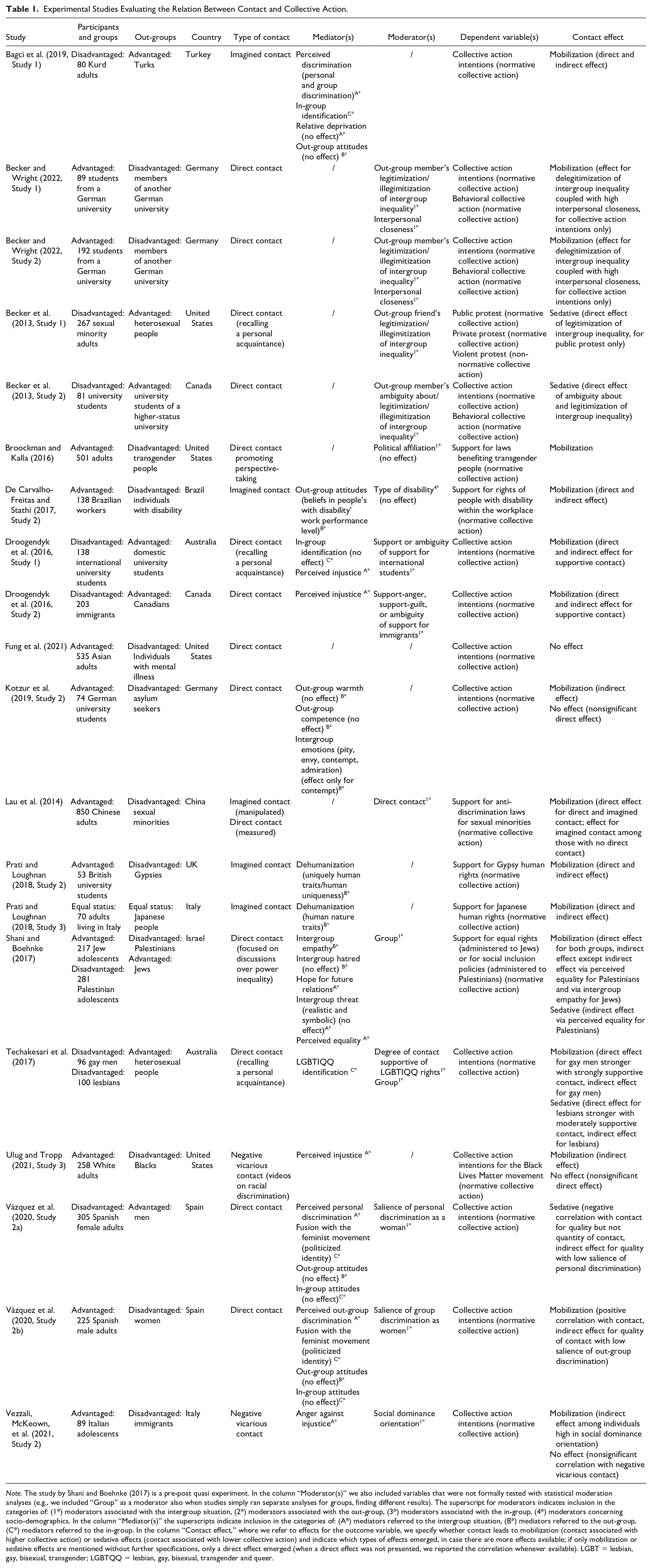
Note. The study by Shani and Boehnke (2017) is a pre-post quasi experiment. In the column “Moderator(s)” we also included variables that were not formally tested with statistical moderation analyses (e.g., we included “Group” as a moderator also when studies simply ran separate analyses for groups, finding different results). The superscript for moderators indicates inclusion in the categories of: (1*) moderators associated with the intergroup situation, (2*) moderators associated with the out-group, (3*) moderators associated with the in-group, (4*) moderators concerning socio-demographics. In the column “Mediator(s)” the superscripts indicate inclusion in the categories of: (A*) mediators referred to the intergroup situation, (B*) mediators referred to the out-group, (C*) mediators referred to the in-group. In the column “Contact effect,” where we refer to effects for the outcome variable, we specify whether contact leads to mobilization (contact associated with higher collective action) or sedative effects (contact associated with lower collective action) and indicate which types of effects emerged, in case there are more effects available; if only mobilization or sedative effects are mentioned without further specifications, only a direct effect emerged (when a direct effect was not presented, we reported the correlation whenever available). LGBT = lesbian, gay, bisexual, transgender; LGBTQQ = lesbian, gay, bisexual, transgender and queer.
Longitudinal Studies Evaluating the Relation Between Contact and Collective Action.
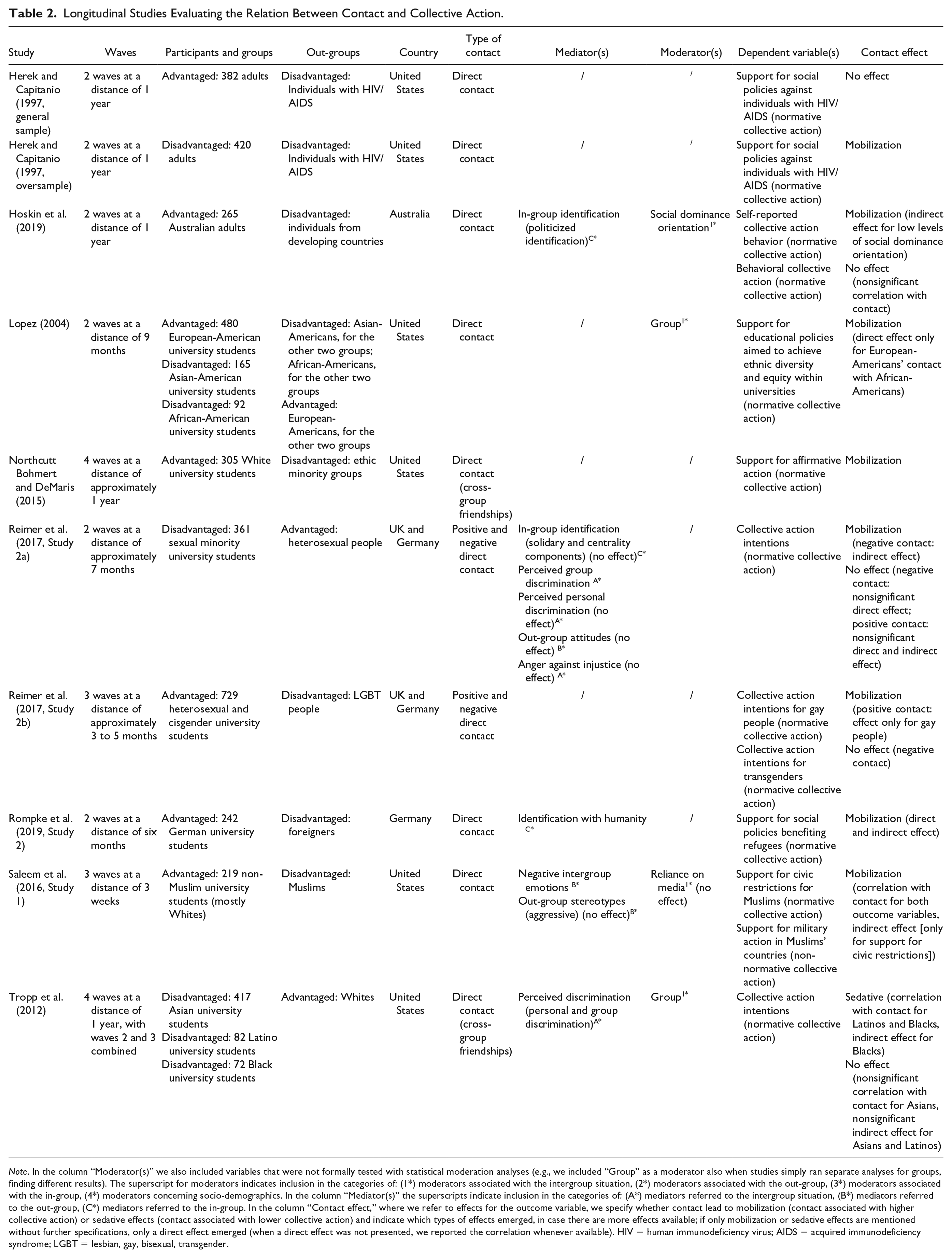
Note. In the column “Moderator(s)” we also included variables that were not formally tested with statistical moderation analyses (e.g., we included “Group” as a moderator also when studies simply ran separate analyses for groups, finding different results). The superscript for moderators indicates inclusion in the categories of: (1*) moderators associated with the intergroup situation, (2*) moderators associated with the out-group, (3*) moderators associated with the in-group, (4*) moderators concerning socio-demographics. In the column “Mediator(s)” the superscripts indicate inclusion in the categories of: (A*) mediators referred to the intergroup situation, (B*) mediators referred to the out-group, (C*) mediators referred to the in-group. In the column “Contact effect,” where we refer to effects for the outcome variable, we specify whether contact lead to mobilization (contact associated with higher collective action) or sedative effects (contact associated with lower collective action) and indicate which types of effects emerged, in case there are more effects available; if only mobilization or sedative effects are mentioned without further specifications, only a direct effect emerged (when a direct effect was not presented, we reported the correlation whenever available). HIV = human immunodeficiency virus; AIDS = acquired immunodeficiency syndrome; LGBT = lesbian, gay, bisexual, transgender.
Correlational Studies Evaluating the Relation Between Contact and Collective Action.

Note. In the column “Moderator(s)” we also included variables that were not formally tested with statistical moderation analyses (e.g., we included “Group” as a moderator also when studies simply ran separate analyses for groups, finding different results). The superscript for moderators indicates inclusion in the categories of: (1*) moderators associated with the intergroup situation, (2*) moderators associated with the out-group, (3*) moderators associated with the in-group, (4*) moderators concerning socio-demographics. In the column “Mediator(s)” the superscripts indicate inclusion in the categories of: (A*) mediators referred to the intergroup situation, (B*) mediators referred to the out-group, (C*) mediators referred to the in-group. In the column “Contact effect,” where we refer to effects for the outcome variable, we specify whether contact lead to mobilization (contact associated with higher collective action) or sedative effects (contact associated with lower collective action) and indicate which types of effects emerged, in case there are more effects available; if only mobilization or sedative effects are mentioned without further specifications, only a direct effect emerged (when a direct effect was not presented, we reported the correlation whenever available). LGBT = lesbian, gay, bisexual, transgender; LGBTIQQ = lesbian, gay, bisexual, transgender, intersexual, queer and questioning; AIDS = acquired immunodeficiency syndrome; NGO = nongovernmental organization.
Tables also indicate the type(s) of contact under consideration, that is whether contact is direct or indirect (and in the latter case, which type of indirect contact), and whether positive versus negative contact was tested. Two additional columns identify moderators and mediators that were tested in the study (categorized according to our distinction, see “The Current Work: A Narrative Review” section). In the column specifying the dependent variable tested, we include information about whether this refers to normative or non-normative collective action. Finally, we include a column reporting whether contact was found to have mobilizing, sedative, or no effects.
In the Tables, we indicated with superscripts the category of each moderator and mediator. This way, the reader can readily navigate the Tables and locate studies using specific categories of moderators and/or mediators.
We also included two summarizing Tables. Table 4 refers to the summary of tests of moderation, differentiated for each moderator category and the specific moderators included in it (one test is reported for each specific moderator and each sample). Specifically, the Table shows the number of tests indicating mobilization, sedative effects, mixed (both mobilization and sedative, for instance in case one study has two or more collective action dependent variables and opposite mobilization and sedative effects for these variables are found), null effects.
Summary of Tests of Moderation for Advantaged and Disadvantaged Groups.
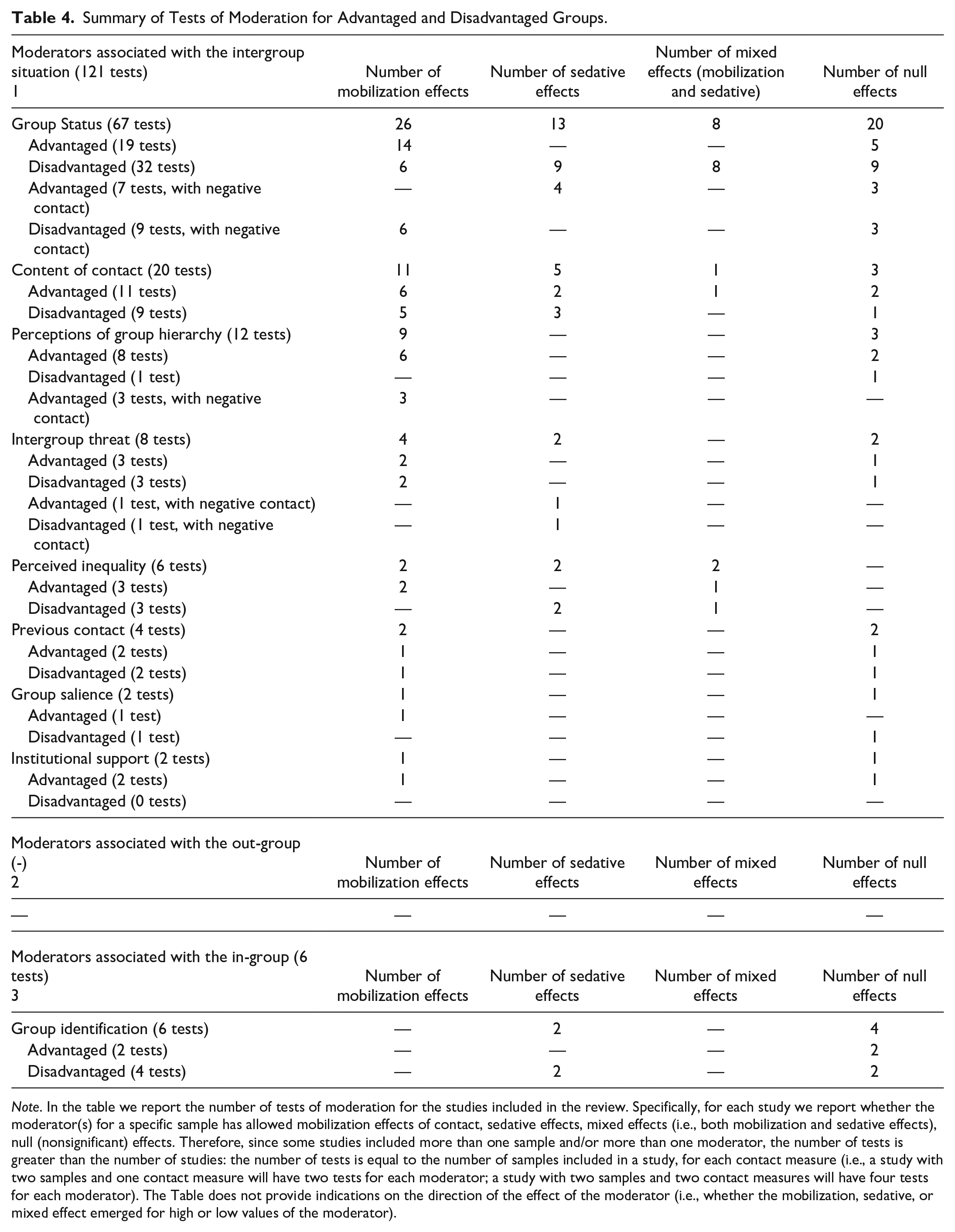
Note. In the table we report the number of tests of moderation for the studies included in the review. Specifically, for each study we report whether the moderator(s) for a specific sample has allowed mobilization effects of contact, sedative effects, mixed effects (i.e., both mobilization and sedative effects), null (nonsignificant) effects. Therefore, since some studies included more than one sample and/or more than one moderator, the number of tests is greater than the number of studies: the number of tests is equal to the number of samples included in a study, for each contact measure (i.e., a study with two samples and one contact measure will have two tests for each moderator; a study with two samples and two contact measures will have four tests for each moderator). The Table does not provide indications on the direction of the effect of the moderator (i.e., whether the mobilization, sedative, or mixed effect emerged for high or low values of the moderator).
Similarly, Table 5 reports tests of mediation, showing the number of tests indicating that each category of mediator and each mediator has been shown to allow mobilization, sedative, mixed, or null effects (one test is reported for each specific mediator and each sample). The number of tests is also reported throughout the text while we present the results of the review. Note that Tables 4 and 5 do not provide indications of the direction of the effect. Specifically, Table 4 indicates the number of tests producing the different effects for each moderator, but not whether these effects were produced by high or low levels of the moderator. For instance, it indicates that of six tests of moderation by in-group identification, two showed sedative effects, but it does not specify whether these effects were found for high or low levels of identification. Similarly, Table 5 does not indicate whether increases or decreases of the mediators produced mobilization, sedative, or mixed effects. For instance, some studies may have found that a decrease in the mediator allowed mobilization, while others may have found that mobilization depended on an increase in the mediator. More detailed information on the direction of the effects can be found in the text and in Tables 1 to 3. The scope of Tables 4 and 5 is therefore to provide a picture of the relative relevance of each moderator and mediator in the literature review. This way, it is possible to know whether, for each study, each moderator or mediator has produced mobilization, sedative, mixed, or nonsignificant effects.
Summary of Tests of Mediation for Advantaged and Disadvantaged Groups.
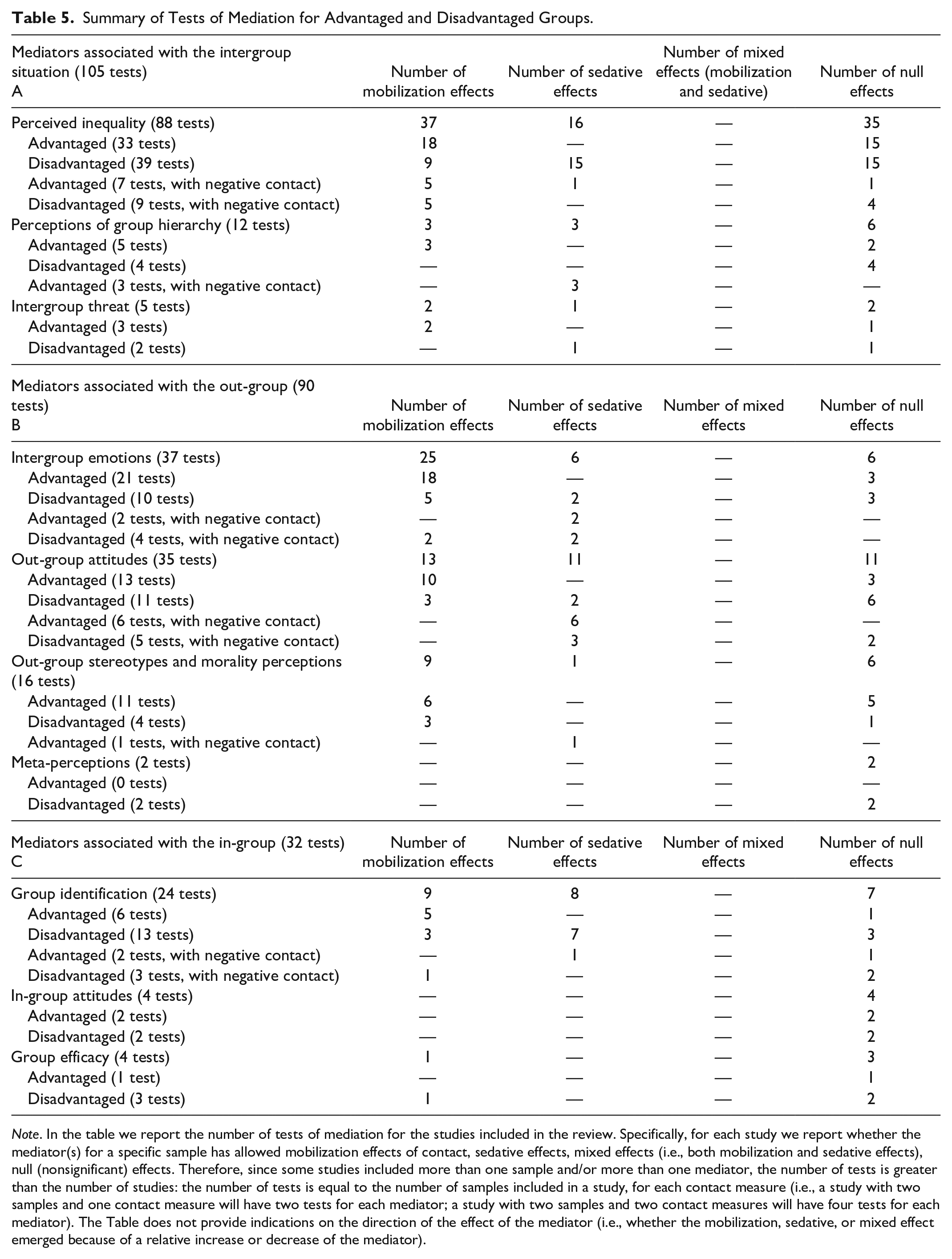
Note. In the table we report the number of tests of mediation for the studies included in the review. Specifically, for each study we report whether the mediator(s) for a specific sample has allowed mobilization effects of contact, sedative effects, mixed effects (i.e., both mobilization and sedative effects), null (nonsignificant) effects. Therefore, since some studies included more than one sample and/or more than one mediator, the number of tests is greater than the number of studies: the number of tests is equal to the number of samples included in a study, for each contact measure (i.e., a study with two samples and one contact measure will have two tests for each mediator; a study with two samples and two contact measures will have four tests for each mediator). The Table does not provide indications on the direction of the effect of the mediator (i.e., whether the mobilization, sedative, or mixed effect emerged because of a relative increase or decrease of the mediator).
Review Overview
In presenting results that emerged from our analysis, we refer to studies, samples, and tests. Studies represent discrete investigations of the relationship between contact and collective action. When referring to studies, for example, we indicate the number of investigations in which a specific effect occurred (e.g., the number out of the 134 studies that we included in which mobilization was observed). Samples are sets of participants sharing a common quality of interest as identified by a study’s authors (e.g., as members of an advantaged group or a disadvantaged group). Tests represent the results for specific samples examined within the context of the studies included. Because many studies examined how a measure of contact relates to collective action for more than one sample of participants, the number of tests overall is higher than the number of studies. In addition, a test for a particular measure of contact may consider the relationship of more than one measure of collective action. In such a case, it is possible that one shows a mobilization effect and the other reflects a sedative effect. In that case, we would characterize the result of the test as mixed. Depending on the finding we aim to highlight, we refer to the number of studies and/or tests. Note that for the number of tests, the exact numbers for all variables are presented in Tables 4 and 5.
We identified 134 studies (many of which represent multiple samples), conducted mostly in Europe (50), North (42) and South America (1), Asia (10), Africa (7), and Oceania (5). An additional 10 studies used samples from both Europe and Asia, 1 from Asia and Oceania, and 8 studies used samples from several continents. Not surprisingly, in line with the broader contact research, the number of correlational studies is higher (104) than that of experimental (20) and longitudinal studies (10). Most of the studies investigated direct contact (125 of the 134), with a portion of them specifically focusing (only or also) on cross-group friendships (27), which is an intimate form of contact especially effective in reducing prejudice (Davies et al., 2011). Also, of the 125 studies of direct contact, 18 included examinations of negative contact. The recent growth in indirect contact research is not reflected in research on contact and collective action. Indeed, only a small number of studies focused on indirect contact (14, of these 7 were only or also on negative contact), and specifically on extended (4), vicarious (5), and imagined contact (5). Based on these preliminary numbers, in the following section, we use the term “contact” to refer to direct contact; we specify accordingly when we refer to positive or negative contact or to indirect contact forms.
Of the 134 studies we reviewed, a greater number investigated members of advantaged groups (100 samples appearing in 98 of the studies) compared to disadvantaged groups (58 samples examined in 49 of the studies). Both advantaged and disadvantaged groups were examined in only 19 of the 134 studies. Equal status groups were examined with 10 samples across 6 studies, and intermediate status groups were investigated in 1 sample (in 1 study, which also included one advantaged and one disadvantaged sample). The sum of studies investigating advantaged, disadvantaged, equal status, and intermediate status samples is greater than 134 because some studies included multiple samples. Most of the studies reviewed included intergroup relations defined by race/ethnicity (85), sexual orientation (26), religion (8), gender (4), disability (4), and other (7). In addition, of the 134 studies, almost all (132) included measures of normative collective action. The number of studies examining non-normative collective action is small. Non-normative collective action was studied exclusively in two studies, and six studies examined both normative and non-normative collective action. Given the limited number of studies examining non-normative collective action, in the following section we refer to normative collective action as “collective action” and specify when we refer to non-normative collective action.
Intergroup Contact and Collective Action: Overall Effects
A primary goal of the current work was to answer the basic question of whether intergroup contact relates to collective action and, more specifically, whether it promotes or inhibits collective action (indicated in the last column in the Tables). As noted, the studies that have addressed this question have varied considerably, for example in the nature of intergroup relations considered, the status of the groups examined (e.g., including both advantaged and disadvantaged groups in the same study), and the ways collective action has been measured.
In general, findings for the advantaged group are consistent in showing that contact is associated with mobilization—that is, with greater support of the disadvantaged group. Specifically, 90 of 98 studies revealed mobilization (of these 90 studies, negative contact produced mobilization in 6 studies), and only 16 studies showed sedative effects (but note that in these studies inhibition was related to negative contact in 10 studies). It should be noted that of these 98 studies, mixed mobilization and sedative effects were found in 14 studies (9 of which also involved negative contact). The results also demonstrated mobilization by contact for non-normative collective action (although evidence is limited to 3 studies).
In contrast, results for the disadvantaged group are mixed. Of the 49 studies examining disadvantaged groups, 27 studies (2 studies for negative contact) revealed sedative effects, while 28 reported mobilization (4 studies for negative contact); of these 49 studies, mixed mobilization and sedative effects were found in 10 studies (4 of which also involved negative contact). A noteworthy finding is that mobilization often emerged as a function of moderators, supporting our choice of conducting a narrative review rather than a meta-analysis, with the aim of understanding the conditions that lead to mobilization or to sedative effects.
For a more detailed account of the effects for advantaged and disadvantaged groups, see the discussion of Group Status in the section on Moderators associated with the intergroup situation.
Moderators
Because contact can both foster and inhibit collective action, a main question we consider is when each effect—the mobilizing versus the inhibiting effect—will emerge. As anticipated, we differentiated three categories to facilitate this: Moderators concerning perceptions of (a) the intergroup situation, (b) the out-group, and (c) the in-group. When empirical evidence is available, we outline the moderating factors as a function of advantaged and disadvantaged group status. (This classification and organization are also reflected in the ways mediators are categorized, which are subsequently discussed.)
In order for the reader to locate relevant studies in the Tables, we refer to whether the studies are experimental (Table 1), longitudinal (Table 2), or correlational (Table 3). As explained in the notes for the Tables, the categories of moderators and mediators are referred to with superscripts.
As shown in detail in the next section, the most influential moderators of the contact-collective action relationship are those associated with the intergroup situation (121 tests), with the main role played by group status (158 tests). Note that moderation by group status was based on the effects for advantaged and/or disadvantaged groups reported by study authors. Only a limited number of studies (19) directly included both advantaged and disadvantaged samples and presented results separately for each of the groups considered. Research has also investigated other potentially relevant moderators, all included in the broad category of moderators associated with the intergroup situation, such as content of contact (20 tests), which is important in determining whether contact will have mobilizing or sedative effects. Surprisingly, we did not find any test for moderators referring to the out-group, like out-group attitudes (which have, however, been extensively tested as moderators of contact effects in the larger contact-prejudice literature; see R. N. Turner et al., 2020). Finally, evidence for a moderator role by factors associated with the in-group is scant and weak: Moderation by group identification was found only in 2 studies conducted among disadvantaged-group members (note that in the Tables we also coded with the superscript “4*” moderation by socio-demographics for completeness; see the section on Limitations and Future Directions in the Discussion).
Moderators Associated With the Intergroup Situation (121 Tests)
The intergroup situation moderators that we examined include group status, which is a distinction that is also integrated into virtually all of the sections in this review and relates to various facets of intergroup relations. Other potential moderating factors include the content of contact, intergroup threat, group salience, perceived inequality, endorsement of perceptions of social hierarchy, previous contact, and institutional support. Moderators included in this category are referred to with the superscript “1*” in the Tables.
Contact and Collective Action Among Advantaged Group Members (26 Tests)
While we found 26 tests from studies including more than one sample (with at least one advantaged group sample), this section broadly refers to 100 tests (corresponding to the 100 advantaged group samples) of the association between contact and collective action that we were able to locate in reviewed studies. As noted earlier, the results of works on contact and collective action among advantaged-group members are extremely consistent: For the 100 advantaged-group tests, mobilization effects emerged in 90 studies. For instance, Rompke et al. (2019, Study 2) found that German university students’ contact with refugees is longitudinally associated (6 months later) with greater agreement with social policies benefiting the out-group. Hassler et al. (2022, Study 3; see also Hassler et al., 2020) found a positive association across different operationalizations of contact and of support for social change in a large sample of ethnic majority adults. Sixteen studies of the contact-collective action relationship showed sedative effects (but of these, 10 refer to negative contact). As an example, a complex pattern of results emerged in the study by Neumann and Moy (2018): While qualitative forms of contact (quality of contact, cross-group friendships) were positively associated with support for inclusive immigration policies, negative associations emerged for quantity of contact. Supportive (although numerically limited) evidence for mobilization effects is also provided by 10 out of 11 studies on indirect contact (of these 5 were related to negative contact). For example, Prati and Loughnan (2018, Study 2) found that British university students imagining positive contact with a Gypsy person (vs. a condition where they imagined an outdoor scene) revealed increased support for granting human rights to Gypsy people.
Of the studies investigating negative (direct) contact among advantaged-group members (11), the majority of studies (10) revealed sedative effects: Not surprisingly, negative contact with a disadvantaged group disrupts the support for its rights. For instance, Reimer et al. (2017, Study 1b) found, in a correlational study among heterosexual university students, that more negative contact was related to lower intentions to engage in actions to promote LGB rights.
Findings also support the role of contact in mobilizing advantaged group members for non-normative collective action. Saleem et al. (2016) found in 2 studies (1 longitudinal and 1 correlational) that direct contact was associated with lower support for military action in Muslim countries among non-Muslim Americans. Cocco et al. (2022) conducted a correlational study that considered both normative and non-normative collective action, further differentiating intentions to engage in (normative and non-normative) collective action from the (less demanding) attitudinal support for such action. These researchers found that more positive contact was positively associated with Italians’ support for non-normative collective action favoring immigrants; however, this effect did not extend to intentions to engage in non-normative collective action.
Cocco et al. (2022) also provided the only evidence that we are aware of concerning advantaged group members’ experiences of negative contact with a disadvantaged group and these advantaged group members’ encouragement of non-normative collective action. These researchers found that higher levels of negative contact were associated with advantaged group members’ greater non-normative collective action intentions (direct engagement in illegal actions, such as damaging public property) and support (agreement with extreme illegal actions perpetrated by the disadvantaged group). Although advantaged group members’ greater non-normative intentions and support for the disadvantaged group associated with more negative contact with disadvantaged group members seems paradoxical, one explanation might be related to strategic issues. Possibly, participants speculated that non-normative collective action would damage the image of the disadvantaged group, ultimately lowering the disadvantaged group’s chances of improving its social position (Teixeira et al., 2019). Another possible explanation involves understanding the content of the interaction that made it a negative experience. For instance, a confrontation that sensitizes members of an advantaged group to inequitable treatment and unfair harm being done to the disadvantaged group may be experienced negatively but still mobilize members of an advantaged group. The finding by Cocco et al. (2022) that higher levels of negative contact are associated with strong non-normative support for a disadvantaged group by advantaged-group members, however, needs replication. Attempts to replicate this result in future research should also be designed to consider the alternative interpretations or other plausible ones.
Contact and Collective Action Among Disadvantaged-Group Members (41 Tests)
While we located 41 tests from studies including more than one sample (with at least one disadvantaged group), as done for advantaged-group members, this section refers to the whole set of tests conducted among disadvantaged-group members (58, corresponding to the 58 disadvantaged group samples). Evidence for the relationship between contact and collective action for the disadvantaged groups (49 studies, 58 samples), as previously mentioned, is mixed. In line with arguments that contact can lower support for collective action (Wright & Lubensky, 2009), evidence for sedative effects emerged in 27 studies. For example, Carter et al. (2019) conducted a correlational study with ethnic minority university students. Their results revealed that cross-group friendships with Whites predicted lower engagement in activism to make their school a more inclusive environment. Similar results were also obtained when considering non-normative collective action (in 3 studies).
However, we also found a substantial number of studies (28) providing evidence of mobilization. For example, Di Bernardo et al. (2022) found in a correlational study an association between positive contact at work with Italians and immigrants’ support for social policies benefitting their own group. Note, however, that in some of these studies (10, e.g., Pereira et al., 2017) both sedative and mobilization effects emerged, confirming the inconsistent role that contact can have for disadvantaged groups. Also, when mobilization emerged, the effect was often driven by other moderators (e.g., Droogendyk et al., 2016; Techakesari et al., 2017; see the other factors included in the section “Moderators associated with the intergroup situation”).
Two studies that examined indirect contact both showed mobilizing effects. Bagci et al. (2019; Study 1) conducted an experimental study in Turkey with the imagined contact paradigm, using Kurd adults as the participants (disadvantaged group), and Turks as the target (advantaged group). Results revealed that imagining a positive conversation with an out-group person (vs. imagining a trekking trip) increased intentions to engage in action to support in-group rights. Hassler et al. (2020) found in a correlational study that disadvantaged group’s (ethnic minority and LGBTIQ+ individuals) positive contact (also in the form of positive extended contact) with the advantaged group was associated with greater intentions to work in solidarity with the out-group (but sedative effects also emerged for other measures of collective action, such as support for social policies empowering disadvantaged groups).
In line with the idea that conflict motivates collective action (Van Zomeren et al., 2008), negative contact was found to be a relatively consistent mobilizing factor among members of disadvantaged groups, associated with greater collective action in four out of eight studies. For instance, Reimer et al.’s (2017, Study 1a) correlational data revealed that negative contact with heterosexual individuals predicted greater LGBT university students’ intentions to support LGB rights and fight LGB discrimination.
Contact and Collective Action Among Advantaged-Group Members (11 Tests)
Content of contact was examined as a moderator of contact effects in 9 studies, 7 of which revealed significant moderation effects. Vezzali, Andrighetto, Capozza, et al. (2017), in a correlational study, investigated with a sample of Italians whether discussing group differences over commonalities would lead to mobilization effects. Previous evidence indicated that a focus on commonalities may produce sedative effects (Saguy et al., 2009). Findings revealed an interaction between cross-group friendships and content of contact: Cross-group friendships were associated with greater collective action intentions supporting immigrants when contact was comparatively more focused on differences than commonalities; when contact was more focused on commonalities than differences, the association between contact and collective action intentions did not reach conventional levels of significance. Becker and Wright (2022) found in two experimental studies that advantaged-group members engaged in mobilization only when an out-group member explicitly delegitimized intergroup inequality and, at the same time, participants felt closer to this out-group member.
Contact and Collective Action Among Disadvantaged-Group Members (9 Tests)
Content of contact was tested as a moderator of contact effects in eight studies, seven of which revealed significant moderation effects. Droogendyk et al. (2016) found in two experimental studies that contact led disadvantaged-group members to greater collective action intentions when advantaged-group members were clearly supporting the disadvantaged group, but not when they were ambiguous about this support. These findings were experimentally replicated by Techakesari et al. (2017) among gay men (but not among lesbians). Complementary results were obtained by Becker et al. (2013) who showed in two studies that contact had sedative effects among disadvantaged-group members when the advantaged-group member legitimizes or is ambiguous about intergroup inequalities (but this effect did not extend to non-normative collective action, Study 1).
Content of contact, in terms of discussing group differences and being supportive of the instances of the disadvantaged group, appears to lead to mobilization among both advantaged- and disadvantaged-group members (see MacInnis & Hodson, 2019; Vezzali & Stathi, 2021, Chapter 7).
Taken together, the results with both advantaged and disadvantaged groups reveal the importance of how the content of intergroup contact frames the nature of disparities between groups on whether contact gas mobilizing or sedative effects.
Contact and Collective Action Among Advantaged-Group Members (11 Tests)
Because of its prominence in the literature and its direct intergroup relevance, in terms of orientation toward social hierarchy, we examined social dominance orientation as a moderator. Social dominance orientation (SDO) is an individual difference variable and an ideological orientation representing preference and support for social hierarchies (Sidanius et al., 2017). People who more strongly endorse this ideology—those higher in SDO—are more committed to maintaining group hierarchies, and they see the world as involving greater zero-sum competition between groups for resources. People who score higher in SDO generally display greater prejudice (Pratto et al., 2006). There is also consistent evidence that contact has stronger prejudice reduction effects for individuals high in SDO (R. N. Turner et al., 2020), although some studies found that contact reduces prejudice when SDO is low (Schmid et al., 2012).
We located only 3 studies, all conducted among advantaged-group members, that tested the moderating role of SDO on contact effects on collective action. Hoskin et al. (2019) and Vezzali, McKeown, et al. (2021; Study 1, considering negative vicarious contact as a strategy to make individuals aware of intergroup inequalities) found that greater contact was associated with greater mobilization among participants who were relatively low in SDO. Specifically, for both studies, indirect effects via greater identification with a politicized identity or via greater anger against injustice, respectively, were only significant at a low, but not at a high, level of SDO. By contrast, Vezzali, McKeown, et al. (2021, Study 2), who introduced an intervention specifically aimed at improving collective action (multiple sessions reading a narrative dealing with collective action from the point of view of disadvantaged-group members vs. a no-reading control condition), found that negative vicarious contact (i.e., negative encounters between the victimized disadvantaged group and the oppressive advantaged group) led to greater collective action intentions only for individuals high in SDO; effects were nonsignificant at low levels of SDO. These studies show that SDO is relevant to collective action but, given the mixed results, future research is needed to understand the dynamics of the moderation and reconcile these seemingly contradictory results.
Inconsistent findings are also observed in studies testing moderation by political orientation. In four studies (Firat & Ataca, 2022; Lewis, 2011; Pearson-Merkowitz et al., 2016; Tropp & Ulug, 2019, Study 1), higher levels of contact were related to greater mobilization among left-wing, compared with right-wing, participants. However, another study found stronger mobilizing effects among right-wing individuals (Graf & Sczesny, 2019).
Contact and Collective Action Among Disadvantaged-Group Members (1 Test)
In the only study that we located, Tropp and Ulug (Study 2) tested political orientation as a moderator of the association between interminority contact (between non-Hispanic adult women who attended the 2017 Woman March and Blacks) and self-reported support of protests for racial justice and equality. Moderation was however nonsignificant.
Contact and Collective Action Among Advantaged-Group Members (4 Tests)
Intergroup threat was tested as a moderator in two studies. Debrosse et al. (2016) showed in a correlational study that threat can disrupt the mobilizing effects of contact. The authors found with a sample of White South Africans an interaction between contact and numerical threat posed by newcomers: The path from contact with newcomers to support for newcomers’ rights was significant under low numerical threat; the association was nonsignificant for high levels of numerical threat. In the study by Ünver et al. (2021), contact between Turkish (advantaged) and Kurd (disadvantaged) university students was associated for both groups with increased support for the rights of Syrian refugees (a further disadvantaged group) to a greater extent when the threat (including realistic and symbolic components) by Syrians was low rather than high.
Contact and Collective Action Among Disadvantaged-Group Members (4 Tests)
Evidence for moderation by group threat is provided by 2 studies. Debrosse et al. (2016) also tested a sample of disadvantaged-group members (Black South Africans) and found that greater contact was associated with more support for the rights of newcomers (a further disadvantaged group) only when the out-group posed a low realistic threat, while the association of contact and support for the rights of newcomers was nonsignificant when realistic threat was high (see also the study by Ünver et al., 2021, described earlier).
Overall, perceived intergroup threat dampens the impact of factors that normally produce mobilizing or sedative effects.
Contact and Collective Action Among Advantaged-Group Members (3 Tests)
Hassler et al. (2022) conducted two correlational studies using large samples to investigate ethnic majorities (Study 3) and cis-heterosexual participants (Study 4). Results revealed that more favorable contact (assessed with different operationalizations tapping into positive contact and cross-group friendships) was more strongly associated with greater support for social change when perceived illegitimacy of status relations was relatively high than when it was low. However, their Study 4 also revealed moderation effects in the opposite direction, such that in some analyses contact had sedative effects with high perceived illegitimacy. Vázquez et al. (2020, Study 2b) found, experimentally, an interaction between self-reported contact and condition (salience vs. no-salience of discrimination against women): Decomposition of the interaction revealed that men’s contact with women was associated with greater collective action intentions only under low salience of discrimination against women. This finding is counterintuitive as making injustice salient should have mobilized the advantaged group to a greater extent (Van Zomeren et al., 2008). The authors reasoned that discrimination salience may have been perceived as threatening, inadvertently raising men’s defensive reactions.
Contact and Collective Action Among Disadvantaged-Group Members (3 Tests)
Hassler et al. (2022) conducted two other correlational studies using large samples of ethnic minorities (Study 1) and sexual/gender minorities (Study 2). Various operationalizations of contact, including positive contact and cross-group friendships, were again used. The results were inconclusive. In Study 1, greater contact was associated with less support for social change when perceived illegitimacy of the status relation was high (nonsignificant associations emerged with low perceived illegitimacy). Study 2 replicated this effect, but it also revealed in some analyses a different direction of moderation, with mobilization effects with high perceived illegitimacy. Vázquez et al. (2020, Study 2a), replicating results obtained with the advantaged group, found an interaction between contact and condition (salience vs. no-salience of personal discrimination): Women’s contact with men led to sedative effects only when the salience of group discrimination was low (in the no-salience condition; in the salience condition, the effect of contact was nonsignificant). This finding is consistent with the relevance of awareness of discrimination to obtain mobilizing effects.
Although perceived inequity has been identified as a critical factor in models of collective action (e.g., Van Zomeren et al., 2008), the evidence on how it affects the nature of the contact-collective action relationship is mixed.
Contact and Collective Action Among Advantaged-Group Members (2 Tests)
Lau et al. (2014), using the imagined contact paradigm, found that the mobilization effect of imagined contact (against a control condition where participants were asked to answer questions about the rights of same-sex couples) on Chinese people’s support for anti-discrimination laws benefiting sexual minorities was only significant for participants with low contact. These findings support the proposition that imagined contact works best for promoting collective action among advantaged-group members when direct contact experiences are relatively infrequent (Paolini et al., 2014, Study 3).
Contact and Collective Action Among Disadvantaged-Group Members (2 Tests)
Dixon, Cakal, et al. (2017) tested with a correlational design the effects of interminority contact, considering Muslims as participants and disadvantaged groups in general in India as out-groups. Results revealed that the indirect association between contact with the disadvantaged groups and collective action intentions via greater group efficacy and shared grievances (indicating mobilization) was only significant among individuals with low direct contact with the Hindu advantaged group. This finding tends to align with the finding for advantaged groups that imagined contact has a greater impact on the responses of people who have had more limited direct contact with the relevant out-group.
Contact and Collective Action Among Advantaged-Group Members (1 Test)
Di Bernardo et al. (2021) conducted a correlational study that found that Italians’ contact (quality) with immigrants was associated with greater collective action intentions via increased perceived legitimacy of group differences only when group salience was high (the effects of contact quantity were unmoderated); the indirect effect of contact was nonsignificant with low group salience. This finding complements the results by Vezzali, Andrighetto, Capozza, et al. (2017) by showing mobilization effects when individuals discuss to a greater extent group differences than commonalities.
Contact and Collective Action Among Disadvantaged-Group Members (1 Test)
Di Bernardo et al. (2021) also considered the perspective of immigrants as the disadvantaged group. Findings revealed mobilization effects, unmoderated by group salience. It should be noted, however, that group salience in this context was moderately high; therefore, mobilization effects could be interpreted as driven by chronic group salience.
Moderators Associated With the Out-Group (No Tests)
We planned to include perceptions of the out-group and emotions felt toward its members as potential moderators. However, we were unable to locate studies testing these variables as moderators.
Moderators Associated With the In-Group (6 Tests)
In this section, we consider moderators associated with the in-group, which are at least partly independent from out-group perceptions. In the Tables, we refer to the moderators included in this category with the superscript “3*” in the Tables (the superscript “2*” had been ideally reserved for moderators associated with the out-group, although no studies were identified for this moderator). Group identification is the main moderator associated with the in-group that has been investigated in multiple studies.
Contact and Collective Action Among Advantaged-Group Members (2 Tests)
Only 1 correlational study tested the moderating role of identification on the contact-collective action relationship among advantaged-group members (Wilson-Daily et al., 2018). This study investigated moderation by two types of identification: national and regional identification. The results indicated that, overall, Spanish adolescents’ greater quantity of contact with individuals with different nationality and religion predicted more support for immigrant rights, therefore providing evidence for mobilization. Group identification (both regional and national) did not moderate this effect.
Contact and Collective Action Among Disadvantaged-Group Members (4 Tests)
Evidence for moderation by group identification was found in 2 studies, both demonstrating that greater contact was related to stronger sedative effects for participants who were low in identification with a superordinate identity shared by the disadvantaged and the advantaged group, while effects were nonsignificant at high levels of identification (Pereira et al., 2017; Politi et al., 2020). For instance, Politi et al. (2020) conducted a correlational study using Kosovo Albanians as the disadvantaged group in Switzerland. Results showed that cross-group friendships (a potent form of intergroup contact) had a negative indirect effect (via reduced ethnic identification) on support for ethnic activism among individuals with low national identification. Note that the effects reported above are not fully consistent with theorizations relating to the sedative effects of identification with the superordinate group, which may reduce the attention to injustice toward the disadvantaged group (Dovidio et al., 2016; Wright & Lubensky, 2009). Further evidence is therefore needed to clarify the moderation role by identification with a superordinate identity.
Mediators
Paralleling the distinctions among moderators, we classified potential mediating mechanisms into three categories (to which we refer to in the Tables 1-3 with the superscript “A*,” “B*,” or “C*,” respectively), representing those associated with the (a) intergroup situation, (b) the out-group, or (c) the in-group. Practically, our decision to distinguish different types of mediators this way is again motivated by the need to be parsimonious in identifying meaningful categories from existing research. Theoretically, these categories highlight three core elements of intergroup relations. Previous research highlights that the dynamics of intergroup relations are significantly influenced by orientations toward the out-group (Kteily et al., 2016) and the in-group (Brewer, 2017), as well as by perceptions of the transactions between the out-group and the in-group.
The appraisal of the intergroup situation is important for understanding how contact shapes perceptions of the broader social system because intergroup relations fundamentally involve exchanges—social, material, and symbolic—between groups. As mediators in this category, we included perceptions of inequality, intergroup threat, and group hierarchy (focusing on broader perceptions of the status hierarchy unrelated to justice concepts). Several models of collective action, described earlier in our review, highlight the importance of injustice to achieve social change (Becker & Tausch, 2015; Thomas et al., 2009; Van Zomeren et al., 2008). Perceptions of intergroup threat consistently shape key aspects of intergroup relations (Stephan & Stephan, 2017) and thus potentially collective action. In addition, preferences for and perceptions of group hierarchy influence a wide range of intergroup responses (Sidanius et al., 2017) and may therefore also mediate the relationship between contact and collective action.
Aligning with the contact literature, we also identified a category of mediators for perceptions of the out-group. These include out-group stereotypes and morality perceptions, meta-perceptions, intergroup emotions elicited by the out-group, and attitudes toward the out-group. These variables involve cognitions and feelings that have been shown to change as a function of intergroup contact (e.g., Brambilla et al., 2013) and include appraisals and affective reactions that may represent pathways concerning how contact influences collective action.
How people think and feel about the in-group affects processes and outcomes related to intergroup contact (Pettigrew, 1998) and are integral elements of intergroup relations (Brewer, 2017). These orientations thus seem directly relevant to understanding the relationship between intergroup contact and collective action. The mediators associated with the in-group that we consider are group identification, group efficacy, and in-group attitudes.
As with the section on moderators, when possible, we outline the mediators with reference to the advantaged and disadvantaged groups separately. This allows us to provide a clearer picture of processes that allow (or inhibit) collective action.
Based on the research evidence we reviewed, and that will be presented in detail in the next sections, mediators that refer to the intergroup situation, such as perceptions of injustice in line with collective action literature, have been frequently investigated (105 tests). Mediators that refer to the out-group largely derive from the larger contact literature but are also consistent with collective action accounts (e.g., Becker & Tausch, 2015), pointing to the important role of intergroup emotions. This category of mediators has also been substantially investigated (90 tests). Although mediators that involved orientations toward the in-group (32 tests) were less numerous, they nonetheless provided critical results, especially when considering the role of group identification.
Our descriptive analysis did not identify different effects (in terms of the direction of the effect) based on the mediator category. Rather, the analysis of mediators shows the mixed effects that improving intergroup relations can have for different groups. The improvement in intergroup relations following contact (which can be inferred by looking at the valence of association between contact and mediator) mobilizes collective action among advantaged-group members. Therefore, although positive contact can hinder attention to inequality (Saguy et al., 2017), it seems nonetheless that positive intergroup relations generally foster motivation to side with the disadvantaged group to achieve greater social equity. However, results also show that the improvement of intergroup relations can be detrimental to the desire to engage in collective action among disadvantaged-group members, a finding that can explain the mixed effects (mobilizing and sedative) shown among disadvantaged-group members.
Mediators Associated With the Intergroup Situation (105 Tests)
Mediators included in the intergroup category are referred to with the superscript “A*” in the Tables 1-3.
Contact and Collective Action Among Advantaged-Group Members (40 Tests)
There is consistent evidence that greater contact among members of advantaged groups with members of disadvantaged groups relates to stronger perceptions of injustice and of system inequality, which in turn predict larger mobilization effects (23 tests, of these 5 were related to negative contact). Similarly, vicarious contact in the form of witnessing discrimination by others against members of a disadvantaged group increases mobilization in support of the disadvantaged group by increasing awareness of unfair differences in opportunities (privileges) between groups (Ulug & Tropp, 2021).
Consistent with the potential mediating role of perceived inequality, contact that is centered more on injustice more strongly elicits mobilization among advantaged-group members. Tropp et al. (2021; see also Ulug & Cohrs, 2017) found in two correlational studies that more contact was associated with greater discussions over injustice and discrimination, which then related to greater collective action. By contrast, in a classic study, Dixon, Durrheim, et al. (2010) found that when a higher level of White South African’s contact with disadvantaged social groups was associated with perceptions of less socioeconomic inequality between groups, members of an advantaged group displayed greater opposition to compensatory policies and policies favoring disadvantaged groups.
Injustice perceptions related to intergroup discrimination can also lead to mobilization: two studies found that, by fostering perceptions that the disadvantaged group is discriminated against, more contact is positively associated with willingness to engage in collective action (Vázquez et al., 2020, Studies 1b and 2b). For example, a correlational study by Vázquez et al. (2020, Study 1b) revealed that Spanish men’s quality of contact with women was associated with stronger perceptions that women are discriminated against in society and, in turn, greater willingness to engage in actions to support women’s rights.
The relationship between greater contact and mobilization by members of advantaged groups appears to occur, at least in part, because of the emotions elicited by contact. Specifically, contact that produces greater anger against injustice is related to stronger mobilization responses (3 studies by Selvanathan et al., 2018, and 2 studies investigating negative vicarious contact by Vezzali, McKeown, et al., 2021). Mobilization effects have also been found to be facilitated by hope for future relations: In the pre-post quasi-experiment by Shani and Boehnke (2017), contact in the form of power discussions between groups (again suggesting the importance of taking the content of contact into account) between Jewish and Palestinian adolescents led to greater hope for future relations and, in turn, more support for equal rights and policies among Jewish adolescents.
Contact and Collective Action Among Disadvantaged-Group Members (48 Tests)
The emerging picture is different with respect to inequality-related mediators when considering the disadvantaged group. Among members of disadvantaged groups, contact hinders perceptions and emotions related to inequality, therefore producing sedative rather than mobilization effects. Sedative effects mediated by lower perceptions of injustice or inequality were found in 15 tests. For instance, in the study by Carter et al. (2019) described earlier, ethnic minority participants who had more cross-group friendships with Whites perceived that marginalized-group members faced less injustice at school and, in turn, these participants were less involved in activism to make school more inclusive. Other research has revealed that greater contact is associated with less endorsement of conflict narratives (i.e., narratives that relate intergroup relations problematic issues to conflicting aspects, like terrorism, low economic development of the disadvantaged group), which then predicts diminished support for social policies benefiting the disadvantaged group (Ulug & Cohrs, 2017).
Relative deprivation, which is another inequity-related factor that can fuel collective action (Van Zomeren et al., 2008), also emerged as a mediator of sedative effects by contact. Relative deprivation involves perceptions of the resources that one or one’s group possesses in relation to comparable others. Research has demonstrated that more contact was associated with lower perceived relative deprivation among members of disadvantaged groups; a lower level of relative deprivation experienced was associated with reduced collective action intentions and less support for social policies benefiting the disadvantaged group (2 studies; Bagci & Turnuklu, 2019; Cakal et al., 2011, Study 1). Another study (Tausch et al., 2015) similarly showed that a reduction in anger against injustice following greater contact led to sedative effects (but see Reimer et al., 2017, Study 2a, who did not find mediation for either positive or negative contact).
There are four studies showing that contact is associated with less perceived personal or group discrimination (another construct indicating perceptions that intergroup relations are unequal), which produces sedative effects on collective action. Among these, Tropp et al. (2012) conducted a four-wave longitudinal investigation using participants from disadvantaged groups in the United States (Blacks, Asians, Latinx people). Findings revealed that more cross-group friendships with Whites in the first year of university attendance were longitudinally associated with lower perceptions of ethnic discrimination in the university campus students’ second and third years; in turn, lower perceived discrimination was associated with lower levels of ethnic activism (among Black and Asian but not among Latinx participants).
However, the nature of the contact-collective action relationship, mediated by inequality-related perceptions, varies by context. Greater contact can sometimes produce mobilization effects associated with perceptions of greater inequality. Mediation by stronger perceptions of personal and group discrimination emerged in 2 studies that found that contact had mobilization effects (direct contact, Dixon, Durrheim, et al., 2010; imagined contact, Bagci et al., 2019, Study 1). In these studies, contact was associated with higher, rather than lower, perceptions of discrimination. For instance, Bagci et al. (2019, Study 1), adopting the imagined contact paradigm, showed that Kurds’ imagined positive contact with a Turkish person (compared to a control condition in which participants imagined an outdoor no-contact scene) was associated with higher levels of personal and group discrimination, which in turn was associated with greater intentions to engage in actions to support own rights. In other words, these findings are consistent in showing that contact leads to sedative effects when it inhibits conflict and to mobilization effects when it exacerbates conflict. Complementing these arguments, three studies found that more contact was indirectly associated with greater collective action (also behaviorally; Hayward et al., 2018) via increased perceptions of group discrimination.
Members of disadvantaged groups are also more likely to engage in action to benefit another disadvantaged group as a function of perceived injustice. More positive contact by members of one disadvantaged group with members of another disadvantaged group produces more collective action in support of the other group when they perceive greater injustices against the other group (Kamberi et al., 2017) or have shared historical grievances with the other group (Dixon, Cakal, et al., 2017).
As discussed in the section on Moderators, how contact is focused influences whether contact produces sedative or mobilization effects (a moderation effect). Perceived inequality appears to play a pivotal role in the effect (mediated moderation). For instance, when the context is one in which advantaged-group members are supportive of addressing inequity, more positive contact with advantaged-group members leads to mobilization among members of disadvantaged groups, which is mediated by stronger perceptions of injustice (2 studies, Droogendyk et al., 2016, Studies 1 and 2). In another study (Shani & Boehnke, 2017), greater contact focused on discussions over power inequality was associated with higher Palestinian adolescents’ hope for future relations between Arabs and Jews, which in turn related to greater support for more inclusive social policies. Across these studies, more positive contact increased rather than decreased perceptions of inequality and consequently fostered collective action. However, by contrast, in a study in which contact was negative, the association between greater contact and relative deprivation was nonsignificant, therefore relative deprivation did not mediate the effect of negative contact (Bagci & Turnuklu, 2019).
Overall, factors related to inequality are central to directing contact effects and determining whether sedative or mobilizing effects will emerge. The study by Shani and Boehnke (2017) exemplifies their role: Contact led the disadvantaged group to sedative effects via perceived equality and to greater mobilization via hope for future intergroup relations.
Contact and Collective Action Among Advantaged-Group Members (8 Tests)
Meleady and Vermue (2019) found mobilization effects mediated by SDO in two correlational studies. Their results showed that more favorable contact was associated with lower SDO, which in turn was associated with greater collective action. These studies also showed parallel sedative effects for negative contact: More negative contact was indirectly associated with lower collective action via higher SDO. Finally, neither perceptions of status stability nor permeability of group boundaries played a mediation role for contact when tested (Di Bernardo et al., 2021).
Despite theorizations that common in-group identity would prevent the emergence of collective action (e.g., Hassler et al., 2021), in a correlational study that directly tested common identity as a mediator of the contact-collective action relationship, Cocco et al. (2022) showed that more contact with immigrants was associated with Italians’ greater collective action intentions (including non-normative forms of collective action) via higher perceptions of belonging to a superordinate group. The authors argued that the way common identity was assessed allowed for the recognition of subgroups, therefore permitting a dual identity (in which both shared identity and distinct subgroup identities are simultaneously salient). Manipulations of group identity directly reveal that whereas a solely superordinate identity can inhibit collective action because it obscures the differential treatment of subgroups, a dual identity can facilitate collective action by maintaining subgroup distinctions while enhancing connections between members of different groups (Banfield & Dovidio, 2013). Because greater contact may make people aware of both commonalities and differences between groups, it is thus likely to foster perceptions of dual identities.
Contact and Collective Action Among Disadvantaged-Group Members (4 Tests)
The evidence of mediation of the relationship between contact and collective action by perceptions of group hierarchy is sparse and inconclusive. Evidence for mediation by perceptions of permeability was not provided by two studies (Di Bernardo et al., 2021; Tausch et al., 2015); intentions for individual mobility as a construct closely related to perceptions of permeability also did not mediate contact effects in Tausch et al.’s (2015) study. Finally, no evidence for mediation of contact effects by status stability emerged in the study by Di Bernardo et al. (2021).
Contact and Collective Action Among Advantaged-Group Members (3 Tests)
Results showed that improving intergroup relations with contact, in this case by lowering threat, enhances the advantaged group’s engagement in collective action. Specifically, more contact was indirectly associated with greater mobilization via reduced intergroup threat (realistic, symbolic, or both) in 2 studies (Dixon, Durrheim, et al., 2010; Sarrasin et al., 2012, using cross-group friendships). In the previously described study by Dixon, Durrheim, et al. (2010), higher quality of contact with disadvantaged racial groups was associated with a lower perception of group threat (a measure including both realistic and symbolic components); lower threat than predicted less opposition to compensatory and preferential policies to benefit disadvantaged groups. Note that similar effects were also found in equal-status groups, showing parallel sedative effects of negative contact following increases in intergroup threat (Dixon, Tredoux, et al., 2020; see also Rupar & Graf, 2019, demonstrating mobilization effects for extended contact). In contrast, in the study conducted by Shani and Boehnke (2017), contact did not change threat perceptions among either the advantaged or disadvantaged group; therefore, threat perceptions did not account for a mediator of contact effects in that study.
Contact and Collective Action Among Disadvantaged-Group Members (2 Tests)
Of the 2 studies that tested mediation by intergroup threat (including both realistic and symbolic components), 1 showed that reduction in intergroup threat following cross-group friendships was associated with less collective action intentions by members of disadvantaged groups. Specifically, Cakal et al. (2016, Study 2) conducted a correlational study with a Kurdish sample in the context of relationships between Turks and Kurds. Greater cross-group friendships were associated with a lower threat (including both realistic and symbolic components); the reduced threat was, in turn, associated with lower intentions to engage in actions to support their own disadvantaged condition. The study by Shani and Boehnke (2017) described earlier did not find evidence of mediation by threat.
It is possible that the inconsistent effects of threat as a mediator for members of disadvantaged groups may be due to the multiple elements associated with threat. For example, when intergroup threat is low, members of disadvantaged groups may perceive greater group efficacy (Van Zomeren et al., 2008) and/or hope for future intergroup relations (Shani & Boehnke, 2017), which predict more collective action but may lead to greater perception of the benevolence of the other group (Saguy et al., 2009), which can contribute to sedative effects. Thus, future research considering intergroup threat as a mediator of the contact-collective action relationship might consider the nature as well as the level of threat in particular intergroup contexts.
Mediators Associated With the Out-Group (90 Tests)
In the Tables 1-3, mediators included in this category have been assigned the superscript “B*.”
Contact and Collective Action Among Advantaged-Group Members (23 Tests)
Consistent with the larger contact literature (Pettigrew & Tropp, 2008; Vezzali & Stathi, 2021), intergroup emotions are among the most investigated mediators in the relationship between contact and collective action. In general, greater positive and/or less negative emotions associated with the out-group mediate the relationship between more contact and mobilization effects among members of advantaged groups. Specifically, the relationship between more contact and greater collective action is mediated by greater empathy (Selvanathan et al., 2018, Studies 1–3), trust (Cakal et al., 2021, Studies 1–3), and other positive intergroup emotions (Kamberi et al., 2017; Visintin et al., 2017), as well as by lower intergroup contempt (Kotzur et al., 2019, Study 2), anxiety (Cakal et al., 2021, Studies 2–3; Turoy-Smith et al., 2013), and other negative emotions (Saleem et al., 2016, Studies 1 and 2, with Study 2 also showing mediation on non-normative collective action; Visintin et al., 2017). Mediation of contact effects leading to mobilization was also found for perspective-taking, representing the cognitive side of empathy, in 4 studies (Cakal et al., 2021, Studies 1–3, Schulz & Taylor, 2018). Conversely, Visintin et al. (2017) found in a correlational study that a reduction in positive and an increase in negative intergroup emotions following negative contact led to sedative effects.
Contact and Collective Action Among Disadvantaged-Group Members (14 Tests)
Results for the disadvantaged group are more mixed and based on a smaller number of studies than is the evidence for the advantaged group. Consistent with theorizations that intergroup harmony created by contact can inhibit collective action among disadvantaged-group members (Wright & Lubensky, 2009), there is some evidence that a sedative effect of contact on collective action occurs because contact reduces negative affect associated with the advantaged group. Hayward et al. (2018) found in a correlational study featuring Black and Latinx people as the disadvantaged groups that lower anger directed at the out-group following greater direct positive contact with Whites was associated with reduced collective action intentions and behavior (self-reported past engagement in actions to support one’s group rights).
However, as we have previously emphasized, the content of contact is an important determinant. In this case, it can influence the out-group emotions experienced, which then predicts orientations toward collective action. Shani and Boehnke (2017) found in a pre-post quasi-experiment that direct contact with Jews focused on discussions over power inequality led to Palestinians’ greater intergroup empathy and, in turn, more support for socially inclusive policies, suggesting mobilization. In addition, when the nature of the contact situation exacerbates conflict, more contact increases anger toward the out-group (Hayward et al., 2018) and other negative intergroup emotions (Visintin et al., 2017) and reduces positive intergroup emotions (Visintin et al., 2017), which account for the mobilization effect of such negative intergroup contact.
Contact and Collective Action Among Advantaged-Group Members (19 Tests)
The studies of advantaged-group members that we reviewed are consistent in showing that more contact improves out-group attitudes, which then leads to mobilization. This effect was obtained in 9 out of 11 studies testing mediation of the contact-collective action relationship by out-group attitudes (1 of which used imagined contact and employed dehumanization as the attitude measure; Prati & Loughnan, 2018). For instance, a correlational study using British participants by Meleady et al. (2017) found that more positive contact was associated with improved attitudes toward immigrants, which related to weaker intentions to vote for Brexit. A complementary finding was that greater negative contact led to less favorable out-group attitudes, and less favorable attitudes predicted less support for and engagement in collective action in 4 studies. As an example, Visintin et al. (2017) showed with correlational data that greater Bulgarian adults’ and Bulgarian Turkish adults’ (high-status disadvantaged group) negative contact with Roma people (a low-status disadvantaged group) was associated with worsened out-group attitudes (via reduced positive and increased negative emotions), which predicted lower support for social policies favoring Roma. Taken together, these findings reveal that a consistent way that contact facilitates the advantaged group’s engagement in actions that support the disadvantaged group is by creating more favorable out-group attitudes.
Contact and Collective Action Among Disadvantaged-Group Members (16 Tests)
The mediating effects of out-group attitudes were less consistent for the disadvantaged group. Specifically, of the 10 studies examining mediation by out-group attitudes, only four revealed significant mediation. Two studies demonstrated that improving out-group attitudes with contact produces sedative effects (Albzour et al., 2019, showing effects on a measure we classified as non-normative collective action; Tausch et al., 2015, using a measure of cross-group friendships). For instance, Tausch et al. (2015) found in a correlational study that Latinx university students who had more cross-group friendships with Whites had more positive out-group attitudes, and more favorable out-group attitudes predicted (via reduced anger referred to their in-group being disadvantaged) lower willingness to engage in actions to change their disadvantaged position. No effects emerged for negative contact (Reimer et al., 2017, Studies 1a and 2a) or indirect contact (imagined contact: Bagci et al., 2019, Study 1). Conversely, though, Visintin et al. (2017) found that the improvement in out-group attitudes led to mobilization when positive contact was the predictor, and sedative effects when the predictor was represented by negative contact. In this study, however, the disadvantaged group (Bulgarian Turkish people in Bulgaria) was considered higher in status in Bulgaria than the minority group (Roma people) that would benefit from their collective action (see Ünver et al., 2021 for another study showing mobilization and sedative effects by positive and negative contact, respectively).
Out-group stereotypes and morality perceptions have been tested as mediators both among advantaged (11 studies) and disadvantaged groups (2 studies). In presenting the studies, we refer to the stereotype dimension when available (the extent to which groups are perceived as competent, warm/sociable, or moral), and their valence (positive or negative).
Contact and Collective Action Among Advantaged-Group Members (12 Tests)
Reflecting the fundamental role of out-group morality on intergroup judgments compared with the roles of sociability and competence (Brambilla & Leach, 2014), Brambilla et al. (2013) showed in a correlational study that greater contact of Italians with immigrants was associated with stronger collective action intentions via higher attributions of morality to the out-group, but not via warmth or competence stereotypes (see also Kotzur et al., 2019, for nonsignificant mediation by warmth or competence stereotypes). Mediation by out-group morality leading to mobilization was also found by Cocco et al. (2022): More positive contact related to greater attribution of moral traits to out-group members, which predicted stronger intentions to engage in collective action on their behalf. This study also found that the mobilizing effects of out-group morality were limited to normative collective action; they did not extend to non-normative collective action. In addition, out-group morality mediated the sedative effects of negative contact, such that negative contact was associated with lower morality attributed to the out-group and, in turn, to lower collective action intentions by advantaged-group members to benefit the disadvantaged group.
In line with the importance of reducing the potential for intergroup conflict, at least from the advantaged group’s perspective, Saleem et al. (2016, Study 2) found in a correlational study that greater contact was associated with lower perceptions that out-group members were aggressive. These perceptions related to greater support for normative collective action and lower support for non-normative collective action against the disadvantaged group (with the latter effect being moderated by reliance on media).
In addition to affecting how it influences the way the out-group is perceived on stereotypic dimensions, greater contact because it can elicit greater personalization (Miller, 2002), can diminish the extent to which members of an out-group are perceived to possess stereotypic traits generally. Evidence for mobilization effects facilitated by higher contact being associated with lower endorsement of more generic stereotypes associated with the out-group was provided by three further studies (Di Bernardo et al., 2022; Kamberi et al., 2017; Vezzali & Giovannini, 2011). For instance, Di Bernardo et al. (2022) showed in a correlational study that more positive contact at work was associated with a reduction in Italians’ negative stereotypes of immigrants; lower negative stereotypes were, in turn, associated with greater support for social policies benefiting the immigrant group.
Contact and Collective Action Among Disadvantaged-Group Members (4 Tests)
Changes in the way members of disadvantaged groups stereotype an advantaged group as a function of contact were shown to facilitate mobilizing effects of contact in two studies (Di Bernardo et al., 2022; Kamberi et al., 2017). In the study by Di Bernardo et al. (2022) presented earlier (where reduction of Italians’ stereotypes of immigrants following contact allowed mobilization effects), more positive workplace contact was indirectly associated, via a reduction in negative stereotypes attributed to Italians, with higher support for social policies promoting the rights of the immigrant group. In Kamberi et al. (2017), who examined inter-minority contact, contact of Albanian and Turkish adolescents (disadvantaged groups) with Roma people (a further disadvantaged group) in the Republic of North Macedonia was associated with a reduction in negative stereotypes toward Roma people, which predicted greater support for social policies benefiting Roma people.
Mediators Associated With the In-group (32 Tests)
We used the superscript “C*” to refer to mediators included in this category in the Tables 1-3.
Contact and Collective Action Among Advantaged-Group Members (8 Tests)
Group identification represents a key variable in collective action models, particularly in terms of how identification is shaped by contact and, in turn, contributes to collective action. It has been proposed that contact is likely to have mobilizing effects when it increases identification with the disadvantaged group and/or produces a politicized identity (Stürmer & Simon, 2004; Van Zomeren et al., 2008). Consistent with this position, four studies found that contact fostered the adoption of a politicized identity, leading to mobilizing effects (Hoskin et al., 2019; Reimer et al., 2017, Study 1b; Vázquez et al., 2020, Studies 1b and 2b). For instance, Reimer et al. (2017, Study 1b), in a study presented earlier, found that more positive contact with LGBT individuals was associated with stronger identification with the LGBT movement, which predicted greater intentions to engage in behaviors to support the LGBT group. Similarly, using a two-wave longitudinal design, Rompke et al. (2019, Study 2) showed that a higher quantity of contact with foreigners was associated with greater identification with humanity (an inclusive in-group identity) 6 months later, which then predicted greater support for social policies benefiting refugees. In a complementary way in Study 1b by Reimer et al. (2017), negative contact had opposite effects compared to positive contact: More negative contact with LGBT individuals was indirectly associated with lower movement identification (sedative effect) via reduced identification with the LGBT movement.
Contact and Collective Action Among Disadvantaged-Group Members (16 Tests)
Confirming the importance of in-group identification for the disadvantaged group members’ willingness to engage in collective action, five studies revealed sedative effects of contact mediated by reduced in-group identification (i.e., with the disadvantaged group). For instance, Tausch et al. (2015) showed that more cross-group friendships among Latinx participants were associated with lower in-group identification with Latinx people as a group, which predicted lower collective action intentions. Two studies also demonstrated sedative effects when greater contact was associated with reduced politicized identification (Vázquez et al., 2020, Studies 1a and 2a). In contrast, Reimer et al. (2017, Study 1a) found that more negative contact of sexual minority university students with heterosexual people was associated with greater identification with the LGBT people, which led to stronger collective action intentions. Contact also showed mobilization effects via in-group identification in three studies (Bagci et al., 2019, Study 1, considering imagined contact; Bagci et al., 2018, considering cross-group friendships and using collective self-esteem as the identification measure; Techakesari et al., 2017): In this case, higher contact was associated with increased identification. Thus, whether contact has mobilizing or sedative effects depends on whether it increases or decreases identification with the disadvantaged group or with a politicized identity.
We only found three studies testing this role of group efficacy (Cakal et al., 2011, Studies 1 and 2; Dixon, Cakal, et al., 2017). Significant mediation of contact effects only emerged in Dixon, Cakal, et al. (2017), who considered Muslim students as the disadvantaged group and tested whether contact with other disadvantaged groups (interminority contact) would lead to support for them. Results revealed that more contact was associated with greater collective action intentions toward these disadvantaged groups via higher perceptions of efficacy deriving from an alliance among disadvantaged groups. In the two studies by Cakal et al. (2011), contact was not associated with group efficacy (Study 1), and group efficacy was not associated with the collective action measure (Study 2).
Discussion
The present review aimed to illuminate whether, when, and how contact may affect collective action. Our analysis is related to previous reviews of intergroup contact and collective action, which included many of the same predictors, moderators, and mediators that we consider. However, our work is distinctive from reviews of these two topic areas in its focus on a particular phenomenon of interest: how contact relates to collective action. We consider a broad range of factors identified by collective action research but that has not necessarily been tested or sufficiently considered in research on contact and collective action (Hassler et al., 2021; MacInnis & Hodson, 2019; Radke et al., 2020; Tropp & Barlow, 2018).
Adopting a bottom-up strategy, in which we summarize the results of relevant research and identify emerging themes, allowed us to describe and synthesize the broad landscape of work on the relationship between intergroup contact (direct and indirect) and collective action (normative and non-normative) and complement more focused reviews evaluating specific models (Hassler et al., 2021) or examining particular subsets of studies (Reimer & Sengupta, 2023). As depicted in Figure 1, we represented this literature by classifying moderators and mediators into distinct categories associated with the intergroup situation, with the out-group, and with the in-group. The most commonly studied moderators in this area were those associated with the intergroup situation rather than with the out-group or in-group specifically (see Figure 1, Table 4). Among the intergroup moderators, although studies testing the relationship between contact and collective action were frequently tested among members of advantaged groups and among members of disadvantaged groups, studies directly testing moderation by group status are still surprisingly limited. Among the mediators, those referring to the intergroup situation and the out-group were most commonly studied (see Figure 1, Table 5).
Main Findings
Our review and analysis revealed several consistent themes and suggested promising new directions of research to fill in key gaps in the literature.
Distinguishing investigations of the effects of contact for advantaged-group and disadvantaged-group members appear to be critical for understanding how contact relates to whether people engage in collective action and the dynamics leading to the decision to engage. Overall, contact has mobilized effects among advantaged-group members: 90 out of the 98 studies (with 14 studies, 9 of which also involved negative contact, revealing mixed effects with both mobilizing and sedative effects) showed that contact produces mobilizing effects (of these 90 studies, 6 also involved negative contact). We believe this result is especially noteworthy.
The collective action literature and social-psychological theories have moved from the traditional implicit assumption that disadvantaged-group members should be primarily motivated to engage in collective action (Tajfel & Turner, 1979; Van Zomeren et al., 2008) to a broader understanding of the important role of advantaged groups in taking action to achieve social equity. In fact, many more studies that we reviewed examined the relationship between contact and collective action among members of advantaged groups (98 studies, 100 samples) than among members of disadvantaged groups (49 studies, 58 samples). To the extent that advantaged-group members have the resources and the power to significantly impact and alleviate social inequalities (Sidanius & Pratto, 1999), they represent a potent force, possibly the most important, to achieve meaningful social change toward equity. Our review suggests that positive contact generally constitutes a motivating factor, leading advantaged-group members to promote the rights of disadvantaged groups. This finding leads to partially optimistic conclusions in terms of the alliance between advantaged and disadvantaged groups toward greater social equity.
However, bringing groups together may be complex, as suggested by the mixed results for the disadvantaged group, revealing that contact has both mobilizing and sedative effects. Of the 49 studies examining disadvantaged samples, about half, 27, revealed evidence of sedative effects (of these 2 were related to negative contact), while 28 reported mobilization (of these 4 were related to negative contact). Mixed effects (both mobilization and inhibition) were found in 10 of these studies 49 studies (4 of these 10 studies also involved negative contact). These results were similar among studies with correlational, longitudinal, or experimental designs (see Tables 1 to 3). In terms of intergroup alliances, it is therefore important to understand the factors and psychological processes associated with contact that can bring advantaged and disadvantaged groups together to align their efforts to promote social justice and achieve change toward social equity.
Although the limited number of studies precludes definitive conclusions, the current evidence suggests that (a) the results for indirect contact are similar to those of direct contact (but the impact of indirect contact is more pronounced when direct contact is lower), (b) the impact of contact is comparable for non-normative and normative collective action, and (c) the results of negative contact are the reverse of those for positive contact: More negative contact relates to greater inhibition of collective action among advantaged-group members, and the majority of studies of negative contact with disadvantaged-group members showed mobilization effects.
The moderators and mediators of the effects of contact for members of advantaged groups implicate in converging ways key processes that underlie the contact-collective action relationship. One core theme is that advantaged-group members are more likely to engage in collective action on behalf of another group when they perceive that members of that group have been unfairly disadvantaged. In terms of moderators, contact that focuses on differences in experiences between members of advantaged and disadvantaged groups and/or draws more attention to injustices that underlie these different experiences relates to stronger mobilization effects among members of advantaged groups. Conversely, mobilization among advantaged-group members as a function of contact tends to be lower among those who perceive group hierarchy as more legitimate (i.e., those higher in SDO). With respect to mediation, contact produces mobilization effects to a greater degree when it leads stronger perceptions of injustice, arouses negative emotions (e.g., anger) associated with perceptions of unfair treatment, or produces views of members of the other group as less deserving of negative treatment (e.g., by reducing negative stereotypes or improving attitudes toward the group or by reducing levels of SDO among advantaged-group members).
A second consistent theme that emerges from research with advantaged-group members is that the more threatening the other group is perceived to be in relation to the advantaged group—in terms of the preexisting level of threat (a moderator) or as a consequence of contact (a mediator)—the less willing advantaged-group members are to engage in collective action to benefit the disadvantaged group. Higher preexisting perceptions of threat dampen the impact of experiences during contact that generally produce mobilization effects, and the greater threat aroused as a function of contact inhibits collective action by advantaged-group members.
The inconsistent effects of contact for members of disadvantaged groups—sometimes showing a mobilizing effect and other times a sedative effect—suggests that this is a fruitful area for investigating additional moderator variables. Identifying relevant moderators can clarify when either of these two patterns will occur. We believe that the content of contact, beyond whether the contact is positive or negative, is an especially relevant variable to consider. Even when an intergroup interaction is positive, the exchange could focus on a range of topics, including discussions about group-based power differences, intergroup injustice, or discrimination. Making factors such as these salient can facilitate collective action not only by disadvantaged-group members but also for advantaged-group members (when in some way the advantaged group recognizes intergroup disparities; Droogendyk et al., 2016, Study 2). For instance, intergroup interactions with a focus on group differences and disparities facilitate collective action more than does a focus on what groups have in common, which can produce sedative effects (Saguy et al., 2009). Carter et al. (2019) found that when disadvantaged-group members had cross-group friendships with members of advantaged groups that produced greater perceptions of intergroup injustice, these perceptions predicted more collective action. Further exploring processes that mediate the relationship between contact and collective action could offer promising insights into the seemingly complex dynamics of the contact-collective action among members of disadvantaged groups.
Our review and analysis of the literature indicate that factors related to intergroup relations may be particularly important. Similar to work on the engagement of members of advantaged groups in collective action, the results of studies of mediation among members of disadvantaged groups show that intergroup contact that increases perceptions of injustice and associated negative emotions facilitates collective action. Perceptions and experiences of intergroup threat that occur in the process of intergroup contact generally inhibit disadvantaged-group members’ engagement in collective action.
However, the results involving perceptions and feelings about the out-group, such as improved out-group attitudes, are less consistent. With respect to out-group attitudes, out of ten studies exploring out-group attitudes as a mediator of the relationship between contact and collective action by members of disadvantaged groups, only four revealed significant effects, with some showing mobilization and other sedative effects (see Table 5).
The research on moderating factors of the contact-collective action relationship also yields less consistent results for disadvantaged-group members than for advantaged-group members. Some authors have argued that the ironic effects of contact, in which contact produces intergroup harmony and leads to sedative effects among members of a disadvantaged group, may characterize historically unequal societies (Dixon, Tropp, et al., 2010). However, our findings point not to differences among societies that vary in level of inequality but rather to the importance of other moderating factors that can determine the direction of contact effects (i.e., in terms of facilitating or inhibiting collective action).
Similar to the effects for advantaged-group members, several studies indicate that structural aspects of the intergroup contact context that highlight intergroup injustice can mobilize members of disadvantaged groups for collective action, whereas aspects that legitimize the intergroup hierarchy produce sedative effects. Along these lines, the content of contact appears to be one of the particularly relevant factors affecting the relationship between contact and collective action. For example, mobilizing effects occurred when the discussion in the interaction was focused on group differences (Vezzali, Andrighetto, Capozza, et al., 2017) or when advantaged-group members expressed support for disadvantaged-group members by not legitimizing their own privileged position (Droogendyk et al., 2016). Other researchers have found that the content of contact is mobilizing when it is focused on the delegitimization of intergroup inequalities (Becker & Wright, 2022), or it involved explicit support for the disadvantaged group (Droogendyk et al., 2016; Techakesari et al., 2017). However, some studies investigating the salience of injustice showed different effects for members of disadvantaged groups than for members of advantaged groups. For instance, Hassler et al. (2022) found that greater contact was associated with less support for social change among ethnic minority group members when the perceived illegitimacy of the status relation was high.
One reason why more inconsistent results may occur for disadvantaged-group members than for advantaged-group members is that members of these groups bring different perspectives to these interactions. Members of disadvantaged groups are more vigilant for cues of duplicity and mistreatment and are particularly attuned to power-related aspects of these exchanges (Demoulin et al., 2009). Thus, a focus on intergroup injustice may cue not only perceptions of injustice but also make salient the power differential between the groups that enforces group hierarchy and therefore elicits threat. As the findings for mediators reveal, while experiences of injustice promote collective action, experiences of intergroup threat inhibit it. Future research can consider how various intergroup contexts or particular elements of contact affect core perceptions and emotional responses in potentially different ways for disadvantaged- and advantaged-group members, which can help illuminate the dynamics of the contact-collective action relationship more fully.
As noted earlier, we chose to review the literature narratively to understand both inconsistent and consistent findings in the literature, using a bottom-up analysis to develop insights for future research from areas that have only limited empirical findings to date and detect important gaps in the current literature. We view our narrative approach as complementary to meta-analytic investigation that tests a limited number of targeted hypotheses. While a quantitative analysis can provide an effect size of contact effects and evaluate specific hypotheses, we sought to understand and systematize a wide range of moderation and mediation processes in a review of areas in which only a few studies, sometimes quite different in methodology, are available. Nevertheless, consistent with our position about the complementary nature of qualitative and quantitative approaches, our review and the work of Reimer and Sengupta (2023), who conducted a meta-analysis considering more than 200,000 disadvantaged-group members, reveal quite variable findings for members of disadvantaged groups. Reimer and Sengupta (2023) found that while the majority of studies of disadvantaged groups showed that greater contact predicted less support for collective action (a sedative effect), almost one third of the studies found positive associations between contact and collective action (a mobilizing effect). They also found, on average, small negative associations of contact with factors considered in the present research, like collective action and support for reparative policies (rs = −.06 and −.07, respectively) and perceived injustice (r = −.07), but also high levels of heterogeneity for each of these relationships.
In the next section, we consider several promising directions for future research, building on robust findings from our analysis and/or others’ reviews of current work on contact and collective action but also directed at filling important gaps in the literature, accounting for heterogeneous findings, and reconciling seemingly contradictory results in the literature.
Limitations and Future Directions
Our analysis, graphically represented in Figure 1 and with the main results summarized in Tables 4 and 5, allowed us to identify several important gaps in the literature on contact and collective action generally and the limitations of our review and analysis more specifically. Recognizing the gaps and acknowledging limitations in the current work can suggest promising directions for future research.
One general issue involves the way group status—a major moderator of the way contact relates to collective action—has traditionally been studied. Currently, the vast majority of work on contact and collective action investigates the relationship for advantaged-group members or for disadvantaged-group members but not for both groups in the same study. Only 19 out of 134 studies concerning contact and collective action that we reviewed simultaneously included advantaged and disadvantaged samples. Intergroup relations involve the ways groups respond relative to each other and the reciprocal reactions they have. This dynamic is of paramount importance in the study of the relation between contact and collective action. Given that an intergroup alliance is often needed to achieve social change, it is of critical importance that moderators and mediators are tested in both types of groups within the same intergroup context to isolate factors that can lead both groups to mobilization in favor of social equity.
Regarding this point, note that our distinction between advantaged and disadvantaged groups largely rests on how groups were conceptualized in each article, with disadvantaged groups being relatively low in power or status and consequently suffering from discriminatory treatment and outcomes (e.g., restricted civil rights). However, the definition of which group is in an advantaged or disadvantaged position can be fluid; it can vary among contexts and also within the same context depending, for instance, on the period in which the study was conducted. In addition, perceptions of advantages or disadvantages can vary based on the perspectives of members of different groups. The principle of social creativity in social identity theory (Tajfel, 1982) suggests that members of different groups often focus on different dimensions when evaluating their relative advantage or disadvantage, typically emphasizing (within realistic constraints) a dimension on which their group has more positive standing. Future reviews may further consider the implications of a contextual definition of social (dis)advantage, for example in situations in which the group’s position can change according to the perspective of the different groups or observers involved.
Another general direction for future research to consider involves the methodologies employed to test the relationship between contact and collective action. Of the studies we reviewed, only 20 employed experimental designs, 10 used longitudinal designs, and the vast majority, 104, had cross-sectional correlational designs. Although the results were generally convergent across these three empirical approaches, greater reliance on experimental designs would be especially informative because of the particular value of testing moderation to reconcile divergent findings of the association of contact with collective action among members of disadvantaged groups. Tighter control over the context of contact can also help disentangle the impact of contact on factors that may promote collective action (e.g., salience of injustice) or inhibit collective action (e.g., intergroup threat), which may vary in salience in ways that cannot be reliably detected when contact is reported retrospectively. It would be especially important to conduct experimental interventions in the field, which though rare in research on contact and collective action (for an exception, see Vezzali, McKeown, et al., 2021; see also Paluck et al., 2019, 2021) are critical for understanding the potential of contact to promote social change.
Also important is the use of longitudinal designs, which can offer valuable insights into how contact experiences shape collective action over time and the durability of these effects across prolonged periods. While experimental designs can illuminate causal factors in ways that longitudinal designs cannot, longitudinal designs provide critical complementary information about the dynamics of change. MacInnis and Page-Gould (2015), for instance, illuminated how while intergroup interactions may initially heighten stress and lead to avoidance, more frequent contact and interpersonally closer interactions (e.g., in relationships that develop over time) reduce intergroup anxiety and promote more positive intergroup relations. Similarly, longitudinal research on the effects of intergroup contact and collective action can identify processes, that may take time to emerge, that can trigger intra-individual change that can critically shape if, when, and how contact affects collective action. Moreover, because key aspects of interpersonal and intergroup relations often develop over time (MacInnis & Page-Gould, 2015), longitudinal designs often have more ecological validity—which is particularly relevant to the study of collective action—than are studies that limit interactions to relatively brief sessions.
While longitudinal designs can be particularly valuable for capturing individual-level changes, multilevel research designs can consider structural factors and variables related to the macro-context that may be important to understand changes toward social equity. Moreover, multilevel modeling analyses can distinguish between individual-level and aggregate-level effects. For instance, in a study of the effects of contact on intergroup attitudes, Christ et al. (2014) found that greater personal intergroup contact related to more positive intergroup attitudes (individual-level) and also that in areas in which there was more positive intergroup contact people had more positive intergroup attitudes (a context-level effect). It is further possible that context-level effects can moderate individual-level effects—an effect implicated by the findings we discussed earlier. Droogendyk et al. (2016) showed that in contexts in which advantaged groups supported actions to reduce inequity, members of disadvantaged groups exhibited higher levels of collective action as contact with members of advantaged groups increased, reducing the sedative effect of contact. This finding shows the importance of considering the macro context as a key element for understanding how members of disadvantaged (or advantaged) groups interpret norms and/or anticipate support for or resistance to collective action. Using research designs that consider both context-level and individual-level factors may be especially valuable for theoretically integrating seemingly divergent findings that currently show that positive contact sometimes facilitates and sometimes inhibits collective action by members of disadvantaged groups.
Related to these methodological considerations, we advocate for more complex designs that can more fully illuminate the dynamics of the relationship between contact and collective action to achieve social equity. As an example, moderated mediation designs involving both advantaged and disadvantaged groups could increase understanding of the reciprocal actions between the groups that could effectively produce an intergroup alliance. While studies have typically focused on one group—an advantaged or a disadvantaged group—at a time, more complex designs could help identify processes and moderators that affect how these groups align in their perspectives and actions. For instance, contact may be shown to be associated with greater collective action via recognition of injustice among both groups primarily when group-based differences are discussed. (For a discussion on the methodological limitations of research on contact and collective action, see also Ulug et al., 2022).
Our review and analysis of the literature also suggest potential shifts in the focus of research to identify novel and particularly potent elements of the contact-collective action relationship specifically. Research on the effects of intergroup contact has traditionally examined out-group attitudes as the main outcome of interest and has generally identified orientations toward the out-group, such as feelings of empathy or anxiety associated with the out-group (e.g., Tropp & Pettigrew, 2005) as mediators. We note that, by contrast, the effects of contact on collective action are generally mediated by perceptions of the intergroup situation (see Figure 1, Table 5). This finding is consistent with the idea that out-group prejudice is conceptually different from collective action, which directly changes the social hierarchy and thereby impacts both advantaged and disadvantaged groups in reciprocal ways and the society more generally. Thus, while further work on the influence of orientations toward the out-group and toward the in-group separately still merits further attention, additional research on intergroup factors that shape the relationship between contact and collective action seems particularly promising.
As discussed earlier, a factor that has emerged as influential in shaping the nature of the relationship between contact and collective action but not comprehensively examined or fully understood is the content of contact. For instance, as we explained, while contact that potentially draws attention to inequities between groups generally mobilizes collective action by advantaged-group members to improve equity for a disadvantaged group (Vezzali, Andrighetto, Capozza, et al., 2017), the impact of this content on members of disadvantaged groups is more mixed. For a more comprehensive understanding of the role of content of contact, further research might thus identify specific elements of content that are key for facilitating collective action (e.g., recognition of unfair treatment, delegitimization calling into play moral rather than cognitive or affective aspects) and for inhibiting collective action (e.g., expectations that such action will be unsuccessful) that may differentially influence the responses of members of advantaged and disadvantaged groups.
Beyond this focus on when and how the content of contact moderates advantaged- and disadvantaged-group members’ separate decisions about whether to engage in collective action, the content of contact qualifies as one of the factors that can lead to the development over time of a true intergroup alliance between advantaged and disadvantaged groups, making them united in action against intergroup inequalities. That is, shared recognition and opposition to injustice may represent a superordinate goal, which requires the cooperation of both groups to fully achieve (Sherif et al., 1961), and can produce a more inclusive identity between the groups that can establish an enduring alliance for change (Gaertner et al., 2000). Currently, work on the dimensions involved in how the content of contact influences collective action is relatively sparse, often employs interventions involving multiple features simultaneously, uses heterogeneous measures of contact, and rarely considers impacts over time. Disentangling critical dimensions in the content of contact, contextual factors that could moderate the effect, and longitudinal effects not only for specific actions but also on the relationship between advantaged and disadvantaged groups can provide important information about the contextual, group, interactional, and developmental influences that can determine whether and how contact has sedative or mobilizing effects on collective action.
Another valuable, underexplored aspect of work on contact and collective action is non-normative collective action. Non-normative collective action does not simply represent a “stronger” form of action compared with normative collective action; it is a qualitatively different form of action. Although we based our distinction between normative and non-normative collective action on definitions in the relevant literature (Becker & Tausch, 2015; Wright et al., 1990), this distinction may benefit from refinement that includes reconsideration of potential key factors. What is normative or non-normative can vary depending not only on the intergroup context but also on the group perspective. Based on the current definition of non-normative collective action as actions that are violent or illegal (recognizing that what is illegal is generally defined by the advantaged group), we categorized “revolutionary resistance” studied by Albzour et al. (2019) as non-normative in our review. However, in the context of that work—the responses of Palestinian participants in the West Bank about Palestinian-Israeli relations—such responses may be viewed as normative. As Alzour et al. explained, In Palestine, revolutionary resistance implies a variety of actions aimed at dismantling the settler colonial structure (i.e., the socio-political and economic institutional structure that underpins the occupation), which can be violent or peaceful, and implemented collectively (e.g., collective protests, institutional boycott) or individually (e.g., internet advocacy, boycotting Israeli products). (p. 979)
Becker and Tausch (2015) identify different predictors of normative and non-normative collective action. Non-normative collective action aims to challenge the existing social system. Importantly, it necessitates arousing at least some degree of conflict with the advantaged, high-status group. For instance, Teixeira et al. (2019) found that engaging in non-normative collective action can damage the in-group’s image, therefore inhibiting its use (see also Stathi et al., 2019). This aspect of non-normative collective action is relevant to a core finding of our review. One of our most robust results was that, among members of advantaged groups, positive orientations toward and relations with members of the disadvantaged group mobilized collective action on their behalf. Also, supporting the potentially important distinction between the types of collective action on the contact-collective action relationship, in our review although in some cases effects for non-normative collective action align with findings obtained for normative collective action (e.g., Albzour et al., 2019; Saleem et al., 2016, Study 1), in other cases results diverge (e.g., Becker et al., 2013, Study 1; Cocco et al., 2022). Understanding more fully the dynamics of non-normative compared to normative collective action in the contact-collective action relationship can thus offer valuable new insights in this area.
With respect to our current review of the literature, we note however that there was only a limited number of studies that had measures that we categorized as non-normative collective action based on the definition that has been traditionally used in the psychological collective action literature. We report these results for descriptive purposes, and we acknowledge that these findings should be interpreted cautiously. In future research, to be more context-sensitive in the classification of collective actions and to provide more insight into roles of cultural context and different group perspectives, we encourage researchers studying the relationship between contact and different forms of collective action to include direct measures assessing respondents’ perceptions of whether particular actions are normative or non-normative as an integral aspect of data collection.
We examined literature that has focused on a particular assumed direction of causality, studying the hypothesized effect of intergroup contact on support for or intended engagement in collective action. We acknowledge, though, that the relationship between contact and collective action is likely bi-directional: Experiences with collective action can affect with whom one has contact and can ultimately influence social identity. Based on the body of literature we reviewed, the measures of collective action typically focused on the actions of individuals (e.g., the degree to which a participant endorsed collective action). However, collective action is a social phenomenon that brings people together; it thus involves immediate and often sustained social contact. This contact associated with participation in collective action, especially when it is successful, can elicit a sense of collective empowerment that reinforces collective identities underlying the movement (Polletta & Jasper, 2001). Once established, a sense of collective identity can stimulate a wide range of responses in the service of the group (Dovidio & Schellhaas, 2017). For instance, collective identity also shapes the quality and intensity of group members’ emotional responses, notably eliciting feelings of anger and moral outrage about shared grievances, such as when important group goals are violated (Simon & Klandermans, 2001). Future research on contact and collective action would therefore benefit by investigating further how collective action can affect contact and social networks. Such research might also directly examine the dynamic, reciprocal relationship between contact and collective action.
For both conceptual and practical reasons, additional work on the effects of indirect versus direct contact on collective action would be informative. Practically, various forms of indirect contact, which are not necessarily constrained geographically or financially, are becoming increasingly prevalent and influential forms of intergroup contact. Theoretically, indirect contact is not a replacement for direct contact; rather, it complements direct contact and has particular characteristics that make it especially relevant for collective action. As we have shown, the relationship between indirect contact and collective action was stronger when direct contact was lower. The indirect contact studies we reviewed also indicated that extended, vicarious, and imagined contact stimulate mobilization effects through factors related to perceived injustice (Ulug & Tropp, 2021).
Because various forms of indirect contact (such as extended or vicarious contact) operate more strongly than direct contact through perceptions of social norms (White et al., 2021), a promising issue to consider in future research is how and when indirect contact changes perceptions of norms about the treatment of disadvantaged groups—particularly in ways that promote responsiveness to social injustices—and its impact (along with associated mediators) on collective action. A similar point was made by Tropp and Dehrone (2023), who noted that because intergroup contact is linked with normative processes and policies, social norms can work in conjunction with contact to foster collective action. Influencing perceptions of social norms via intergroup contact toward condemning social inequalities may thus be a decisive step in motivating both advantaged and disadvantaged groups to engage in efforts that support social change. Note that this argument is consistent with various collective action models (see Vezzali & Stathi, 2021, Chapter 7). For example, Van Zomeren et al. (2018) proposed that violation of moral convictions, rather than moral convictions per se, is key to collective action. Subašić et al. (2008) similarly argued that advantaged-group members should side with the disadvantaged group when the authority (which supports hierarchical distinctions) is perceived as unjust. Particular attention might be devoted to the impact of social media, which affects a range of intergroup orientations (Amichai-Hamburger & McKenna, 2006; Imperato et al., 2021; White et al., 2020), on collective action. As the Black Lives Matter and the #MeToo movements demonstrate, social networks and media communication can have a profound, broad impact in motivating members both of disadvantaged and of advantaged groups to action.
The present review also spotlights the limited research on negative contact and collective action, despite the fact that negative contact is increasingly considered in research on contact more generally (Dixon & McKeown, 2021). We reviewed studies showing that negative contact can inhibit collective action among advantaged-group members while mobilizing collective action among disadvantaged-group members. However, negative and positive contact can interact with one another. For instance, negative contact can enhance the effects of positive contact, and positive contact can buffer the effects of negative contact (Árnadóttir et al., 2018). It may therefore be possible that the combination of positive and negative contact boosts collective action among advantaged-group members. That is, both harmony and conflict may be simultaneously required to promote true allyship. Harmony produced by contact sets the stage for intergroup alliances; conflict that highlights the violation of moral convictions or social norms of justice (Van Zomeren et al., 2018) can then provide a reason for collective action to occur. For instance, within a relationship between in-group and out-group members characterized by positive contact, disadvantaged-group members can feel free to disclose their perceptions and feelings and become in these occasions conflictual, transforming the contact experience from positive to negative in this circumstance (and again, tapping on the relevance of the content of contact). The coexistence of positive and negative contact within the same intergroup relation may increase feelings of injustice for the situation faced by the disadvantaged group but also positive feelings, like intergroup empathy, which can mediate the effects of contact on greater collective action.
It is worth noting that our bottom-up approach was aimed at identifying the most relevant factors in the relation between contact and collective action rather than proposing a new theoretical model. A new model can however benefit from our analysis. As an example, our findings point to the key role played by factors associated with intergroup relations such as the need to maintain intergroup harmony while at the same time highlighting intergroup inequalities. As can be seen from Figure 1 and Tables 4 and 5, factors associated with intergroup relations have been the most frequently investigated factors in the studies reviewed. However, this empirical focus should not translate into downplaying the potential relevance of factors associated with the out-group or the in-group (and therefore to devoting less attention to them in a theoretical model). Rather, our review highlights gaps that can be filled. Amongst these, we believe that fruitful future research might investigate more deeply moderators associated with the out-group, which were totally absent in our review. As an example, while research has investigated the role of initial prejudice, generally finding that contact has stronger effects when initial prejudice is high (R. N. Turner et al., 2020), we were unable to identify such a test with collective action as the outcome. As another example, advantaged-group members with more positive meta-stereotypes may be more willing to consider and react to the disadvantaged situation of the out-group (for evidence of the effects of positive meta-stereotypes, see Vezzali, 2017); in contrast, holding negative meta-stereotypes may raise a barrier against acting on behalf of disadvantaged-group members (Vorauer et al., 2000).
Future research might also explore more fully mediators associated with the in-group. As an example, Pettigrew (1998; see also Lucarini et al., 2023; Verkuyten et al., 2022) introduced the concept of deprovincialization: Contact can lead to a view of the in-group (and out-groups), such that in-group norms and practices can be seen as just one way of many legitimate ways to manage the world. Reconceptualizing how individuals perceive the in-group, not in isolation but within a socio-political context that includes both advantaged and disadvantaged groups, can be valuable for fostering actions that redress intergroup inequalities.
Research on contact and collective action has dedicated only limited attention to the potential effects of sociodemographic factors beyond reflecting advantaged or disadvantaged status in a particular intergroup context. We consider demographics such as age, gender, socioeconomic status, race, and political orientation in Tables 1 to 3 in terms of potential moderating factors. When these variables were included in the analyses of the studies we reviewed, they were generally treated as control variables rather than as independent variables of theoretical significance. While the effects of these demographics were generally nonsignificant, the limited number of studies precluded a definitive interpretation.
In our review, we defined advantaged and disadvantaged groups primarily by differences in power and status as specified by study authors in the research context. However, this distinction typically coincided with racial/ethnic, gender, or other demographic differences. Nevertheless, it is quite possible that demographic factors may have influences beyond their relationship with the advantaged-disadvantaged distinction. We suggest that studying demographic influences that relate to the ways intergroup relations are perceived is a potentially productive direction for future research. For instance, research reveals that both the nature and degree of stigma vary across cultures as a function of national group- or individual-oriented social dimensions (Shin et al., 2013). With respect to political ideology, Graham et al. (2009) reported that individuals who identify as liberal rely particularly on issues of harm/care and fairness/reciprocity in their social judgments, whereas those who identify as conservative also consider in-group/loyalty, authority/respect, and purity/sanctity. To the extent that the association between contact and collective action likely depends upon the socio-political context (as suggested by the relevance of factors associated with the intergroup situation in the present review), political ideology may be a particularly promising factor to consider further, both empirically and as an additional element in theoretical models.
In addition to the specific directions for future research that we identify, we believe that integrating work on collective action and contact with broader theoretical frameworks would help achieve a more comprehensive understanding of intergroup relations. Although research on contact and collective action draws on elements of social identity theory (Tajfel & Turner, 1979), social dominance theory (Pratto et al., 2006; Sidanius et al., 2017), and system justification theory (Jost et al., 2015), these attempts have been generally isolated (e.g., Di Bernardo et al., 2021). Not only would greater consideration of the structural, intergroup, and individual-level processes featured to varying degrees in these broader frameworks expand and enhance research on contact and collective action, but also findings on the contact-collective action relationship can help advance general intergroup theory by highlighting the dynamics of different outcomes. Such work might also expand the perspective of current theory. For instance, while research has used the binary distinction of advantaged-disadvantaged groups, it is important to go beyond relations between two groups and take full advantage of the complexity of the status hierarchy (Caricati, 2018; Dixon, Elcherot, et al., 2020) as well as consider more fully the ways multiple groups relate in social systems (including relations between members of different disadvantaged groups). Action for social change does not happen in a vacuum, and it is only with an examination of the complex vertical and horizontal relations within a social hierarchy that we can fully understand how to promote collective action.
Citations Statement
While our criteria for inclusion of studies in our review were intentionally broad to be representative of the psychological literature on contact and collective action, we note that about two-thirds of the studies that we cited focused on the relationship between intergroup contact and collective action in North America and Europe. About a third investigated the relationship in Asia, Africa, and Oceania, Relatedly, most of the scholars cited in our work are located in North America and Europe, which may affect the nature of the intergroup relations they examined, as well as limit the scholarly perspectives of research in this area of inquiry, and ultimately in our article.
Constraint on Generality Statement
The major proportion of papers studying contact and collective action in North America and Europe also constrains the generalizability of our findings. As noted by Henrich et al. (2010), 80% of psychological research findings are based on responses from WEIRD samples—samples from Western, educated, industrialized, rich, and democratic societies, yet populations from WEIRD regions constitute only 12% of the world’s population. Moreover, even within the studies conducted within WEIRD regions, the frequent reliance on convenience samples (e.g., involving college student participants or participants who “opt-in” using online platforms such as MTurk or Prolific) produces samples that generally are younger and more highly educated than the populations from the national contexts from which these samples are drawn. Non-representativeness, in terms of both the global regions included in the body of psychological research on contact and collective action and the degree to which the samples in the studies considered in this review reflect the population in their national context, limits the generalizability of our findings and interpretations. Future research on this topic would thus benefit from studying contact and collective action in a broader range of contexts, particularly in non-WEIRD regions, and within these contexts by employing representative sampling techniques.
Positionality Statement
The current research was conducted and the article was written by scholars who have studied intergroup relations, generally, and intergroup contact and collective action, more specifically. In past and the current work, we use theory and research in psychology to understand the processes that produce social inequality, and we apply these principles and findings to address unfairness at the level of the individual and society. While there is diversity in age, experience, and nationality among the authors and each of us has multiple identities, we all possess aspects of our identities that represent membership in a socially advantaged group. As our research amply shows, identifying as a member of an advantaged, compared with a disadvantaged, group affects what we perceive, how we interpret it, our motivation, and ultimately our perspective—including our scientific perspective. For example, as we explained, it determines what is defined as normative versus non-normative collective action. We acknowledge these influences and caution readers to consider how they may affect the conduct of our work, our analyses, and our interpretations.
Policy Implications
The research considered in the present review focuses on how intergroup contact influences collective action, which represents support for the disadvantaged group, in terms of actions, intentions, or supportive attitudes for rights or policies that benefit disadvantaged-group members. We believe that our findings also have implications for formal actions involving official policies that also have the goal of achieving social equity through initiatives that benefit disadvantaged groups and their members. Such policies may involve the redistribution of wealth (e.g., tax policies), engagement in specific activities (e.g., gender-equity policies in athletics), and equitable representation in mass media. One prominent example of such a policy is affirmative action, which promotes the equitable inclusion of members of traditionally disadvantaged groups through opportunities in areas such as employment and education. Affirmative action policies or laws currently exist in countries in North America, Europe, Asia, Africa, and South America.
While research in the area of intergroup relations has substantially emphasized that members of advantaged groups generally attempt to maintain and protect their privileged status in a variety of ways, ranging from subtle social forces (e.g., system-justifying ideologies; Jost, 2020) to officially enforced oppression (Sidanius & Pratto, 1999), our findings reveal the critical role of intergroup contact in motivating advantaged-group members to support and engage in actions for social change toward greater equity. One of the major and most consistent findings is that more positive intergroup contact mobilizes members of advantaged groups to take collective action to achieve social equity. With respect to policy implications, we note that more positive intergroup contact also predicts greater support for affirmative action by members of advantaged groups (Reimer et al., 2022).
Our findings about how the content of intergroup contact can critically affect the mobilization of members of the advantaged group for action toward social equality—for instance, by making unfair differences in treatment or outcomes salient—also provide insight into when they may support formal social policies for change. Son Hing et al. (2002) demonstrated that people who more strongly endorsed the principle that rewards and opportunities should be determined by individual merit generally opposed affirmative action more strongly. However, when they perceived that unfair discrimination was a barrier for members of disadvantaged groups, those who more strongly endorsed the merit were more supportive of affirmative action. Of particular relevance for engaging the support of members of advantaged groups to support policies to achieve social equity by benefiting members of disadvantaged groups, we note that positive contact does not necessarily have to involve personal interaction to be effective; it can involve indirect forms of contact (e.g., through various media). Thus, while members of advantaged groups may generally engage in actions to support the status quo of intergroup hierarchy (Sidanius et al., 2017), positive intergroup contact can be an important vehicle for mobilizing their collective action and support for policy aimed at achieving social equity.
Our review of the relationship between intergroup contact and collective action for members of disadvantaged groups also offers insights into the psychological dynamics that have implications for social policy. For instance, because of the influence of self- and group-interest, members of disadvantaged groups generally support policies to achieve social equity, such as affirmative action, more than do members of advantaged groups (DeBell, 2017). Nevertheless, our results concerning collective action suggest that intergroup contact can have complex impacts on support for social policies to achieve equity. Whereas more positive contact predicts greater mobilization for collective action for members of advantaged groups, the relationship between contact and collective action for members of disadvantaged groups was mixed: 55% of the time sedative effects occurred and 57% of the time mobilization effects were observed. Our analyses of moderators and mediators helped reconcile these seemingly divergent effects of contact. These insights can also be applied to understand how, when, and why the existence of diversity-promoting policies in organizations (including affirmative action) can affect the experiences and performances of members of disadvantaged groups in the organization and how inequities within an organization may be obscured or legitimatized (Dover et al., 2020). Moreover, research on the various influences that policies to promote social equity can have on members of disadvantaged groups whom the groups are intended to benefit (e.g., the experience of stereotype threat; Van Laar et al., 2008) can further inform work on contact and collective action. And, as discussed earlier, a more comprehensive understanding of the dynamics underlying the relationship between intergroup contact and collective action (e.g., making injustice more salient) can help guide the development of social policies designed to improve social equity and the way these policies are described to make members of advantaged and disadvantaged groups allies for change to create a society that is fairer and more stable in ways that benefit all its members.
Conclusion
In conclusion, scholars still have a long way to go before understanding how groups can work together to achieve social equity. However, research fuels optimism regarding the potential of intergroup contact to allow and facilitate social equity via collective action. We therefore argue that, building on existing findings, a future ambitious and creative examination of this area is an important endeavor both theoretically and practically.
Footnotes
Correction (April 2024):
Article updated to correct the formatting of table 3.
Declaration of Conflicting Interests
The author(s) declared no potential conflicts of interest with respect to the research, authorship, and/or publication of this article.
Funding
The author(s) disclosed receipt of the following financial support for the research, authorship, and/or publication of this article: The present work has received funding from the project “GlObAL Social inclusion: innovative aCtiOns against gender diffeRencEs and prejudice in general” (acronym: GOALSCORE), in the frame of the program “ERASMUS-SPORT-2021-SCP” under the Grant agreement number 101050008 funded by the European Union. Views and opinions expressed are however those of the Author(s) only and do not necessarily reflect those of the European Union or the European Education and Culture Executive Agency (EACEA). Neither the European Union nor EACEA can be held responsible for them. The work was funded, in part, by National Science Foundation, Grant/Number 1823763 awarded to the last author.