




Abstract
This study explores how people navigate the field of tension between expressing disagreement and maintaining social relationships in text-based online as compared to face-to-face discussions. In face-to-face discussions, differences of opinion are socially regulated by introducing ambiguity in message content coupled with instant responding on a relational level. We hypothesized that online messages are less ambiguous and less responsive, both of which may hinder social regulation. Thirty-six groups of three unacquainted students discussed politically controversial statements via chat, video-chat (nonanonymous), and face-to-face, in a multilevel repeated measures Graeco-Latin square design. Content coding revealed that online discussions were relatively clear and unresponsive. This related to participants experiencing reduced conversational flow, less shared cognition, and less solidarity online. These results suggest that ambiguity and responsiveness enable people to maintain social relationships in the face of disagreement. This emphasizes the key role that subtle microdynamics in interpersonal interaction play in social regulation.
Keywords
In many Western societies, there is growing concern about the increasing divide between the political left and right and its consequences for the effective functioning of democracies (e.g., Pew Research Center, 2014; Sides & Hopkins, 2015). Many scholars, as well as the lay public, have pointed to the uncivil tone in online discussions as one of the instigators of this trend (e.g., Bail et al., 2018; Davis, 2009; Weber Shandwick et al., 2013). This makes it valuable to look at how people actually deal with diverging opinions in political discussions online. How do social groups and communities handle (potential) differences of opinion?
We propose that people engage in social regulation in order to maintain unity in the face of disagreement. Social regulation is the process by which interaction partners express and withhold consent, such that they signal boundaries of what is acceptable or not. Its effect is to allow multiple viewpoints to be expressed whilst maintaining good social relationships. In face-to-face (FtF) interactions, social regulation is achieved through various conversational techniques that often combine a high degree of ambiguity in message content with instant relational feedback.
Arguably, the conversational techniques of social regulation are most needed in situations where politically controversial topics are discussed among relative strangers: when there is a high potential for disagreement in the absence of (conflict-mitigating) preexisting social relationships. In our digitizing world, this type of discussion is becoming more and more common online. However, we propose that text-based online environments may pose a challenge to social regulation for two reasons. One is that people express themselves relatively succinctly and unambiguously online. The second is that online, it is much harder to provide instant relational feedback to other’s comments and conversation appears to be disjointed. The resulting clarity and unresponsiveness make it more difficult to navigate disagreements in a harmonious way, we argue. In this paper, we report an in-depth study of the conversational microdynamics of social regulation. We systematically investigate the qualitative differences between text-based online and FtF discussions in small groups. Our research question is as follows: How do unacquainted individuals handle (potential) disagreements while discussing a controversial topic in a text-based online environment?
Social Regulation FtF
Research suggests that in everyday FtF interactions, the successful navigation of disagreements depends on subtle social cues that maintain or disrupt a smooth conversational coordination, so-called conversational flow (for a review, see Koudenburg et al., 2017). Indeed, people only very rarely use overt signals (e.g., “you should not say/do that!”) to show their disapproval when they perceive socially undesirable behavior (e.g., Holtgraves, 1997; Milgram et al., 1986; Turner, 1973). Instead, disagreement is often conveyed through implicit and intrinsically ambiguous verbal or nonverbal cues, including brief silences, nods, and/or frowns (Brennan & Clark, 1996; Koudenburg et al., 2013b; Reid et al., 2003).
It is in the constant flow of subtle dynamic social cues that these signals act as social regulators in the sense that they signal boundaries of what is acceptable or not whilst maintaining good social relationships (Koudenburg et al., 2017). Disruptions of conversational flow and other nonverbal regulatory utterances signal to interaction partners that there is a problem on the social level: they suggest nonalignment of viewpoints or social discord and thus signal that shared cognition (“we agree and understand each other”) and/or solidarity (“we belong together”) are in peril (Koudenburg et al., 2013a, 2013b). In response, interaction partners can either make amends by being more socially attuned to others, by accommodating and aligning themselves better with social expectations, or both (e.g., Giles & Coupland, 1991; Pickett et al., 2004).
These subtle social regulation techniques are very effective from a community perspective because they allow people to maintain good relationships and keep the conversation going whilst withholding consent. Such social regulation attempts can sometimes steer group members towards greater consensus (without any loss of face), but they are often used to signal that some boundary of acceptability risks being breached without resolving the disagreement itself. Accordingly, we suggest that the achievement of consensus, alignment, or accommodation are not the key objectives of these social regulatory acts. They are also not acts of restoration or repair; rather, their aim is to prevent that social relationships are disturbed. A frown, silence, or “hmmm” are intrinsically ambiguous signals, and communicators can even use them concurrently to send contradictory messages. Moreover, when voicing an opinion they expect to be controversial, communicators are known to preemptively use ambiguity in order to maintain good relationships (Bavelas et al., 1990; see also Brown & Levinson, 1987). Social regulatory acts, therefore, are used to mark the boundaries within which good social relationships can be had.
Social Regulation Online
This research raises questions about how social regulation is achieved in text-based online discussions. Here, subtle social cues are less available, and the conversational flow is likely to be disrupted due to a- or semi-synchronicity (e.g., Friedman & Currall, 2003; Runions et al., 2013; Suler, 2004). At the same time, the social motives of those in the interaction are likely the same (Postmes & Baym, 2005; Walther, 1996). So how do people express and react to diverging opinions in this environment?
The core proposition we seek to test in this paper is that people will compensate for the relative lack of subtle social cues online by disambiguating their messages. Specifically, communicators will express themselves more clearly online, and thus with less ambivalence, disclaimers, and hedges. This is in line with the proposition of social information processing theory (SIP; Tidwell & Walther, 2002; Walther, 1996) that online communicators adapt to the medium by substituting missing nonverbal cues, which are often more ambiguous, with verbal cues, which tend to be clearer.
However, if communicators indeed resort to more clear conversation content in online discussions, they also eliminate some of the ambiguity that is characteristic of verbal FtF interactions. As mentioned before, this ambiguity plays an important role in maintaining a sense of shared cognition and solidarity by masking (potential) disagreements in a cloud of fuzzy wordiness. As a result, we propose, interaction partners may perceive more disagreement and feel less closely connected in text-based online than in FtF discussions. Thus, we suggest that the relative absence of ambiguity, or conversely the abundance of clarity, might make social regulation online more difficult.
This process will be reinforced by a reduced responsiveness online. Responsiveness is defined as the degree to which interaction partners provide immediate feedback to each other’s comments. In FtF interactions, people rely on this instant responding to send relational signals (Koudenburg et al., 2013a). Responsiveness often takes the form of a reference to the previous speaking turn in the start of a new turn, for example starting with “yes, but. . .”. In this way, responsiveness contributes to the smooth transition between speaker turns and communicates acknowledgement (e.g., Beňuš et al., 2011). Just like ambiguity, responsiveness is thus important to the experience of conversational flow: it connects speaking turns and smoothens conversation. In a- or semi-synchronous online interaction, this responsiveness is impeded. Indeed, due to different participants typing and sending messages at the same time (e.g., in an instant chat) or very far apart in time (e.g., in a discussion forum), online messages easily appear disjointed, which can create the impression that people are crosstalking. This inevitable consequence of using a text-based medium results in a conversation resembling a chain of rather isolated expressions; very different from a normal FtF conversation. This might increase the likelihood that interaction partners feel misunderstood or ignored, and maybe even rejected (Koudenburg et al., 2013b; Williams et al., 2000).
Taken together, we propose that online communicators will compensate for the relative lack of subtle social cues by expressing themselves more clearly and that this, combined with the reduced responsiveness in online discussions, might hamper the maintenance of good social relationships in the face of (potential) disagreement.
Media Richness Literature
Comparing these ideas with the larger literature on text-based online communication, shows that they complement the propositions of media richness theory (MRT; Daft & Lengel, 1986). MRT proposes that communication media become less “informationally rich” as the number of social cues they can convey diminishes and the possibility for immediate feedback is reduced (e.g., from FtF to phone to online chat). We agree, in the sense that we also presuppose that certain conversational techniques are unavailable in online chat and that this may have consequences for social dynamics.
However, MRT further predicts that less informationally rich media are ill-suited to transmitting complex messages, because they do not communicate subtleties and might therefore ambiguate the messages (e.g., Daft & Lengel, 1986; Runions et al., 2013). Whether communicating online or FtF, MRT’s starting assumption is that ambiguity is a problem that escalates conflict and therefore should be avoided. Our starting assumption is somewhat different: empirical research suggests that rich media (FtF) tend to be used (with success) to increase ambiguity and to complicate messages in situations in which some form of friction is anticipated. Thus, whereas ambiguity can indeed be dysfunctional as it causes opinions to be communicated less accurately, it can also be very functional in that it fosters perceived shared cognition and solidarity among people. In other words, where MRT suggests that online communication is risky because complex situations require a level of clarity that text-based online media do not afford, we suggest that it is risky because complex situations require a level of ambiguity that text-based online media do not afford.
Online Disinhibition Literature
The ideas set out in this paper can also be contrasted with the idea that being online is disinhibiting and that this leads to more division and conflict. The online disinhibition literature proposes that the reduced availability of social cues and the a- or semi-synchronicity of online interaction will make people feel anonymous, reduce their self-awareness, and thereby remove their capacities to see themselves through the eyes of others and to self-regulate (Casale et al., 2015; Kiesler et al., 1984; Wu et al., 2017). This would result in disinhibited behavior that disregards social norms (Suler, 2004). However, contrary to the online disinhibition assumption, research has found that (pro)social norms and relationships develop relatively straightforwardly in (anonymous) online settings (Postmes et al., 1998; Walther, 1996).
We predict that online communicators do not lose their capacity or motivation for self-regulation—in some sense, the opposite is the case: online communicators tend to devote more thought, time, and effort to formulating their views on the issues they write about precisely and succinctly. However, the ironic side effect of this devotion to expressing one’s views in the most precise and clear manner is that they can come across as unsubtle, blunt, or even extreme. Thus, we believe there is perceived disinhibition due to a failure of social regulation, rather than real disinhibition due to a failure of self-regulation.
In sum, we offer a different perspective on the basic assumptions of two influential perspectives from the literature on text-based online communication. Specifically, we propose that online communicators adapt to the reduced availability of subtle cues for social regulation by formulating their messages more clearly (i.e., less ambiguously; Hypothesis 1). Moreover, due to their a- or semi-synchronous nature, online discussions will have lower levels of responsiveness (Hypothesis 2). We further expect that participants will experience a reduced conversational flow in their online discussions (Hypothesis 3). Finally, we expect participants to experience less shared cognition and less solidarity online (Hypothesis 4). The reason for this is that the lack of ambiguity and the reduced responsiveness will interfere with the social regulation of (potential) disagreements. We thus expect clarity and unresponsiveness in discussion content to predict lower levels of conversational flow, shared cognition, and solidarity as experienced by participants (Hypothesis 5).
Research Overview
In order to test the hypotheses and gain insight into the micro-level dynamics of social regulation in text-based online and FtF discussions, we asked unacquainted participants to discuss politically controversial statements via online chat, video-chat, and FtF. In the video-chat condition, participants communicated via a text-based chat alongside a real-time video connection rendering them nonanonymous. Comparing this condition with the online chat without video connection enabled us to test whether any medium effects could be explained by visual anonymity. We had no reason to expect any differences between the chat and video-chat conditions, as communicators were restricted to text-based expression in both conditions. However, the video-chat condition does more than rendering participants nonanonymous. It also allows them to see the small facial expressions and other nonverbal cues that are part of the social regulation techniques mentioned before. Hence it is possible that the video-chat proves to be more effective for social regulation than the chat condition.
We performed a content coding of the discussions and asked participants to fill out self-report questionnaires about their conversational experiences. Specifically, we tested Hypotheses 1 and 2 by coding the start of all discussions on clarity and responsiveness. We did so because social regulation will be most needed in the first few minutes of a discussion amongst strangers: a stage where opinions are still unknown and relationships are yet to be established. Hypotheses 3 and 4 were tested by asking participants to rate the degree of conversational flow, shared cognition, and solidarity they experienced. Lastly, we examined the correlations between the content codes and questionnaire variables to test Hypothesis 5.
In addition to these a priori formulated hypotheses, this study set out to find additional social regulation techniques that people use in their online discussions. Unfortunately, there is little prior research to inform hypotheses about the exact nature of these techniques. We therefore performed an explorative data-driven content coding on a random sample of the discussions to record the most salient differences between media. We compared these differences to strategies for building shared cognition and solidarity commonly distinguished in the literature on FtF discussions. We only included codes that had at least some occurrence in all conditions (e.g., nonverbal cues were excluded because they cannot occur in a text-based online environment). This analysis suggested four additional social regulation techniques that could be used in both FtF and text-based environments: agreement expression, encouragement (both have also been mentioned as tools for establishing common ground; e.g., Beňuš et al., 2011; Clark, 1996), fun, and definition search (both have also been distinguished as politeness strategies; e.g., Brown & Levinson, 1987; Warner-Garcia, 2014).
We believe that this comprehensive exploration and integration of discussion content and participant experiences will provide a rich insight into the micro-dynamics of social regulation in text-based online and FtF discussions.
Method
Pilot Study
We conducted a pilot study to select topics with a high potential for instigating a controversial discussion among our participants. As input material for the pilot study, we retrieved opinion statements from the repository of a Dutch national news program that puts one topical controversial statement to the vote every day (http://www.nporadio1.nl/standpunt). We selected 70 statements on which website visitors’ opinions were divided and that we deemed relevant to students. As stimulus material for the main study, we chose the nine statements on which a pilot sample of 21 Dutch students was most divided and which had, according to them, the highest potential for instigating an engaged 5-minute discussion. We split these nine statements in three similar sets of three, in which the first statement concerned a policy regarding a typical Dutch issue, the second statement concerned a terrorist threat policy, and the third statement concerned an international policy. 1
Research Design
The main study was an experiment with a multilevel (individuals nested in groups) repeated measures (of condition) design. There were three experimental conditions representing different communication media: chat, video-chat, and FtF. In order to ensure that differences between conditions were caused by the communications through the different media rather than any a priori differences between the groups, each group of three students participated in all three conditions. In each condition, participants consecutively discussed one of the three sets of three discussion statements. To be able to rule out order effects as an explanation for our findings, we based the allocation of groups to combinations of conditions and statement sets on four 3 x 3 Graeco-Latin squares (Walker & Lev, 1953).
Power and sample size
The full design required 36 triads, which came down to a sample size of 108 participants. A power analysis using G*Power (Version 3.1.9.2; Faul et al., 2009) confirmed that the projected sample size would result in adequate power: .91 (at p = .05 and an effect size of f = .25) at the group level (i.e., if group-level ICCs were 1) and .999 at the individual participant level (i.e., if group-level ICCs were 0).
Participant characteristics
Participants 2 were 108 native Dutch students (Mage = 20.69, SDage = 2.55; 58.3% female) who participated either for course credit or monetary compensation. All participants indicated that they did not know their group members before the experiment started. Their self-reported political orientations were 59.3% left wing and 20.3% right wing; 20.4% placed themselves in the middle of the political spectrum. A diversity of study programs and educational levels was represented in the sample, but most participants were first-year psychology students.
Procedure and apparatus
The study was conducted in Dutch (the first language of all participants). Participants were invited into the lab in triads where they were immediately seated in separate cubicles behind a computer. The experimenter provided each of them individually with an introduction to Google Hangouts’ chat and video-chat functions. To keep the chatting as natural as possible, participants were allowed to use emoji. We anonymized participants by giving them fixed pseudonyms (“M. Vis,” “H. Maan,” and “P. Roos”). In both online conditions participants communicated via a text-based chat, but in the video-chat, a real-time video connection allowed them to see each other’s (and their own) face next to it. At the start of each interaction, participants saw a discussion statement on their computer screen. In the FtF condition, participants were seated in a circle in an adjacent room. Here, the three discussion statements were printed on numbered strips of paper and handed over in three envelopes (one for each individual participant).
Below all discussion statements in all conditions, one of the group members read that they had to open the interaction by stating their opinion, while the others were instructed to wait for the opening comment. After this, the participants could continue their discussion freely. Each participant opened one interaction per condition. After approximately 5 minutes, the experimenter told participants to proceed to the next discussion statement. After three discussions via one communication medium, participants filled out a self-report questionnaire on their computers. To enable content coding, the text of all (video-)chat interactions was stored on a computer and all FtF conversations were audio-recorded. Finally, participants provided some demographic details, read a debriefing statement, and were given the opportunity to ask the experimenter questions.
Dependent Measures
Discussion coding
As described before, we devised a coding scheme where some codes were hypothesis- and others were more data-driven. By analyzing the online and FtF discussions of a random sample of groups against our theoretical background, we devised a provisional coding scheme, which we adapted in the process of iterative coding trials, resulting in the coding scheme as described in what follows. 3
To enable direct comparison across media, we restricted the coding to the first six speaking turns of all discussions because this was the length of the shortest (online) interactions. The coding fields started with the first comment that dealt with the content of the provided discussion statement, which usually was an opinion expression or a definition search. Social regulation already starts here as communicators consider (the thoughts and feelings of) their interaction partners in formulatiung their opinion or initiating a search for mutual understanding. To define what counted as a FtF turn, we adapted the classification scheme of Beňuš et al. (2011). Specifically, we defined turns as expressions that were successful in taking the floor and were not completely overlapped by another speaker’s utterance. For the (video-)chats, we designated each discrete comment a turn. Utterances that only consisted of small encouragements (e.g., “hm,” “yes”) or laughing (e.g., “haha”) were not counted as turns.
All conversations were double-coded. Three trained research assistants independently and without knowledge of the hypotheses coded half the discussions. The first author functioned as the fourth coder. Coders coded the untranscribed audio-recordings of the FtF discussions to retain more of the interactions’ character. The codes that were of insufficient reliability were partly recoded by the coders collectively. For the codes that received six ratings per conversation (i.e., scored for each separate turn), we calculated the means per conversation per coder. To assess the interrater reliability of these ordinal codes, we calculated two-way absolute agreement average measures intraclass correlation coefficients (Hallgren, 2012). 4 As index for the interrater reliability of the binary codes, we used Maxwell’s REs (Maxwell, 1977). 5 We calculated the interrater reliability of each code by averaging the reliabilities of both duos using Fisher’s Z-transformation.
The first two codes tested our first two hypotheses. The clarity of each turn was rated on a 5-point scale (1 = very ambiguous, 2 = ambiguous, 3 = neutral, 4 = clear, 5 = very clear; ICC = .81). Generally, the more and the stronger the expressed ambivalence, disclaimers, and hedges (e.g., “I don’t know for sure,” “as far as I know,” “maybe,” “sort of ”), the more ambiguous a statement was considered to be (also see Reid et al., 2003). We assessed responsiveness by indicating for each turn whether or not (0 = no, 1 = yes) it connected to the turn directly preceding it (ICC = .87). Responsiveness reflected whether the current speaker referred back to the previous speaker’s turn, mostly by starting with a transition word (e.g., “yes,” “but”) or by containing a reaction within the turn.
The remaining four codes were more data-driven. First, we indicated for each turn whether it was in (dis)agreement with the preceding turn it referred to (−1 = disagree, 0 = neutral, 1 = agree; ICC = .61). When participants referred to the discussion statement or their own prior speaking turn, this was coded as neutral. Second, we coded instances in which the utterance (utterances can be turns as well as small encouragements) of a participant occurred during or immediately after the turn of another speaker and functioned to encourage this speaker to continue, such as “hmm” or “yes” (0 = absent, 1 = present; RE = .86). Third, we rated the occurrence (0 = absent, 1 = present) of well-meant jokes, laughing (or typing “haha”), and positive emoji (e.g., “,” “;P”; RE = .76). Sarcasm was not included in this counting, but uncomfortably chuckling was. Lastly, to assess participants’ active definition search, we coded the presence (0 = absent, 1 = present; RE = .76) of utterances (turns as well as small encouragements) that contributed to the establishment of a shared definition of the discussion statements (e.g., “what is a burka?,” “yes, I think they mean so too”). 6 Because all codes were of adequate interrater reliability, we performed the analyses on the means of coders’ ratings.
Questionnaire
We tested Hypotheses 3 and 4 using a self-report questionnaire. Participants rated all items on 5-point scales (1 = completely disagree, 5 = completely agree). Perceived conversational flow (Koudenburg et al., 2017) was measured with four items: “The conversation about this topic was [coordinated and smooth/difficult (reverse coded)/pleasant/harmonious]” (ω 7 = .82). 8 To measure perceived shared cognition, participants rated three items adapted from Koudenburg et al. (2013a): “I feel that my group members and I [understood each other/were on the same wavelength]” and “In the conversation, group members were divided about this topic (reverse coded)” (ω = .76). Perceived solidarity was assessed with four items from the Belongingness subscale of the Need Threat Scale (e.g., “I had the feeling that I belonged to the group during the conversations”; van Beest & Williams, 2006), combined with the single-item social identification measure of Postmes et al. (2013): “I identify with the other group members” (ω = .64). 9
Results
Results 10 will be presented in three parts, describing the results of the content coding, the self-report questionnaire, and the links between these two.
Discussion Content
We analyzed the coding data in multilevel models with the lmer function of the R package lme4 (Version 1.1-23; Bates et al., 2015; Bates et al., 2020). Communication medium as fixed-effect predictor (Level 1, repeated measures) was nested within conversations (Level 2) nested within groups (Level 3), the latter were both included as random effects.
As can be seen in Table 1, 95% confidence intervals show that the FtF condition differed significantly from both the chat and the video-chat condition on five out of six codes (|0.35| ⩽ d ⩽ |2.67|). The exception being agreement expression: there was no significant difference in the degree of expressed agreement across conditions. In line with Hypotheses 1 and 2, online expression was rated as relatively clear and unresponsive. We also found that online discussions started out with less small encouragements, fun, and definition searches. All differences between the chat and video-chat conditions were not significant.
Means and 95% confidence intervals of codes per condition, and effect sizes of the differences between conditions.
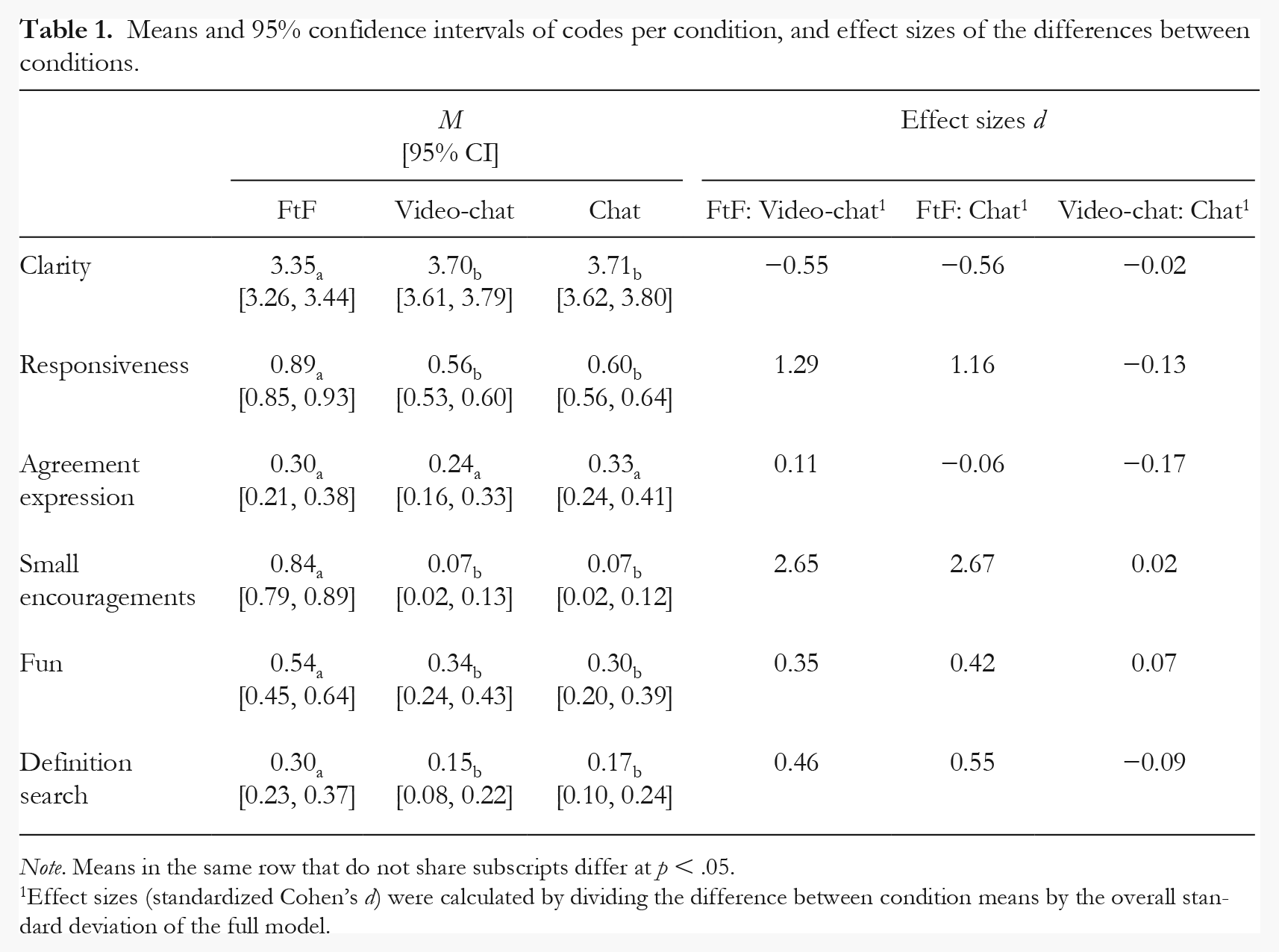
Note. Means in the same row that do not share subscripts differ at p < .05.
Effect sizes (standardized Cohen’s d) were calculated by dividing the difference between condition means by the overall standard deviation of the full model.
The intercorrelations among the codes show how these (potential) social regulation techniques relate to each other (Table 2). First, the expression of agreement correlated positively with clarity (r = .16). This is in line with our theorizing: participants expressing themselves more ambiguously when voicing disagreement. Small encouragements and definition searches related to more ambiguous expression (r = .28 and r = .37, respectively). This was to be expected as small encouragements are primarily used to show that one is listening, and definition searches could be a way to postpone expressing one’s opinion (beating about the bush) and/or to show one’s good intentions by promoting mutual understanding. Further, discussions were more responsive when they included more small encouragements, fun, and definition searches (.11 ⩽ r ⩽ .51). Indeed, encouraging utterances, making jokes, and definition inquiries are often direct reactions to the previous statement.
Pearson’s conversation-level intercorrelations between codes.
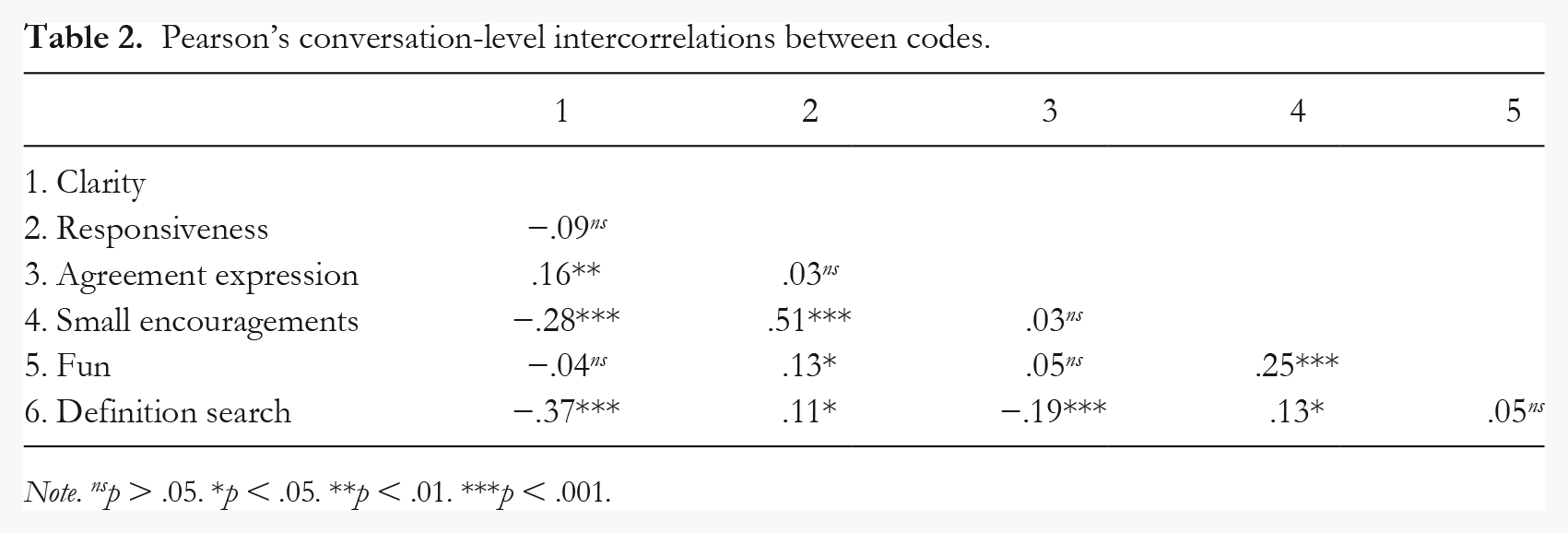
Note. ns p > .05. *p < .05. **p < .01. ***p < .001.
Participants’ Experiences
As we did with the coding data, we analyzed the questionnaire data in multilevel models in R. Communication medium as fixed-effect predictor (Level 1, repeated measures) was nested within individuals (Level 2) nested within groups (Level 3), the latter were both included as random effects. 11
As can be seen in Table 3, 95% confidence intervals show that the FtF condition differed significantly from both the chat and the video-chat condition on all dependent variables (.26 ⩽ d ⩽ .54). Again, the differences between the chat and video-chat conditions were not significant. Supporting Hypotheses 3 and 4, participants experienced less conversational flow, less shared cognition, and less solidarity in the online conditions than they did FtF. In line with earlier research (e.g., Koudenburg et al., 2017), the intercorrelations between these three variables were high (r ranging between .55 and .63).
Means and 95% confidence intervals of the questionnaire variables per condition, and the effect sizes of the differences between conditions.
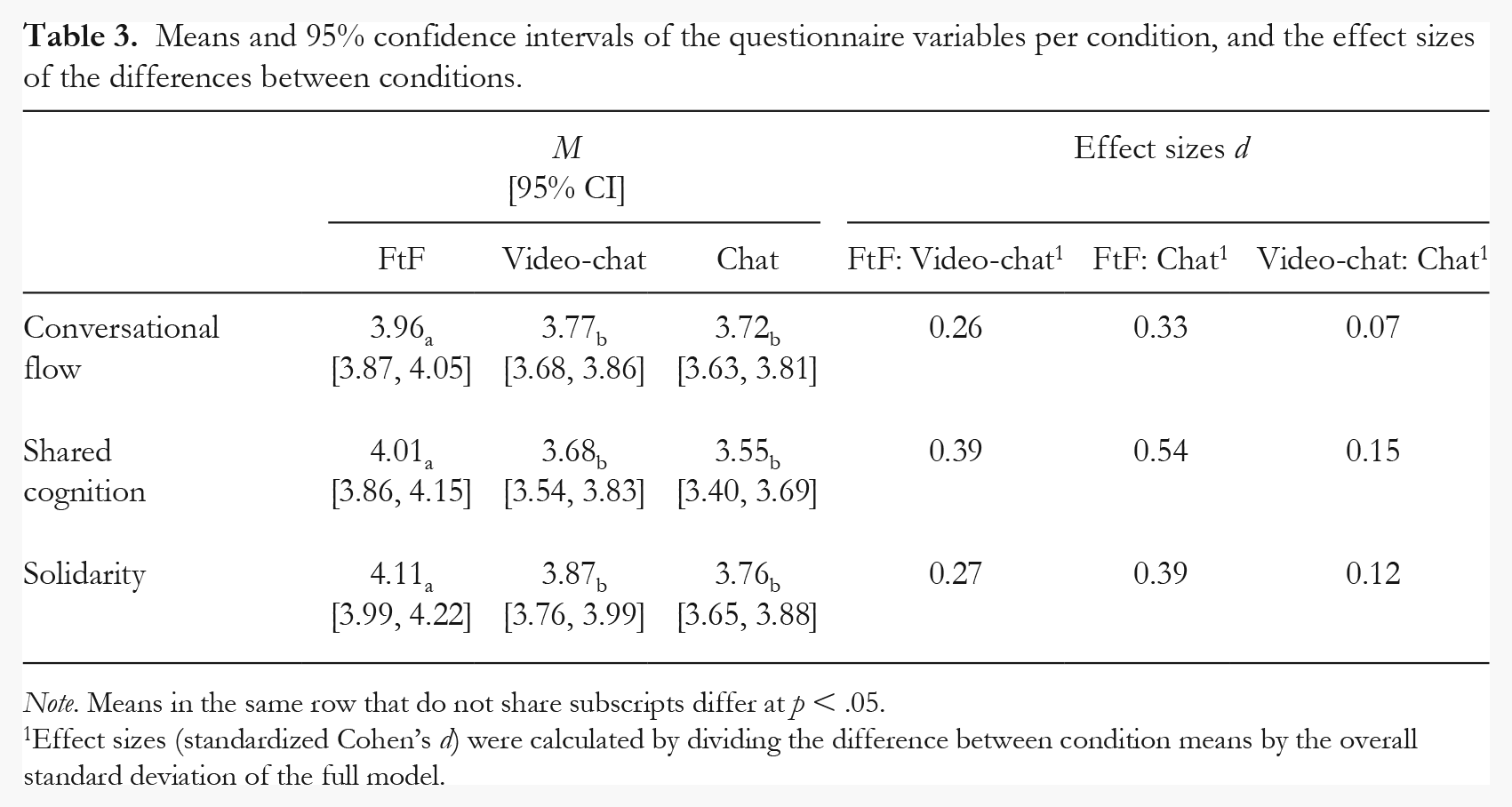
Note. Means in the same row that do not share subscripts differ at p < .05.
Effect sizes (standardized Cohen’s d) were calculated by dividing the difference between condition means by the overall standard deviation of the full model.
Linking Discussion Content With Participants’ Experiences
In order to test Hypothesis 5, we explored the role of differences in discussion content in explaining differences in participants’ experiences observed across media. In order to link the questionnaire results to the content coding, we aggregated both datasets to the group level by averaging over participants and conversations, respectively.
Table 4 contains the group-level repeated measures correlations between the content coding and questionnaire data. 12 Supporting the hypotheses, clarity of expression related to reduced conversational flow, shared cognition, and solidarity as rated by participants (−.37 ⩽ r ⩽ −.20). Further, responsiveness in conversations was accompanied by participants experiencing increased conversational flow, shared cognition, and solidarity (.36 ⩽ r ⩽ .42).
Repeated measures correlations between content coding and questionnaire data at the group level.
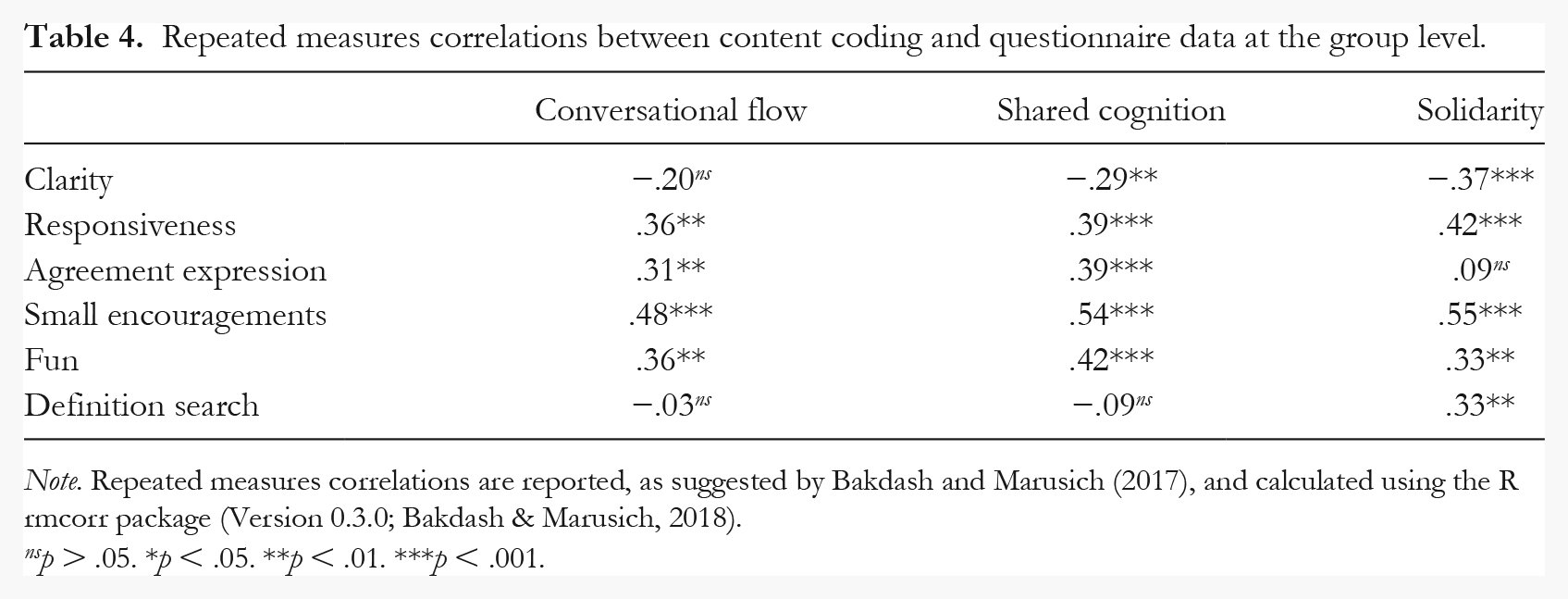
Note. Repeated measures correlations are reported, as suggested by Bakdash and Marusich (2017), and calculated using the R rmcorr package (Version 0.3.0; Bakdash & Marusich, 2018).
p > .05. *p < .05. **p < .01. ***p < .001.
Most of the additional potential social regulation techniques also correlated with participants’ experiences. Agreement expression related to increased experiences of shared cognition (i.e., expressed agreement related to perceived agreement), and, maybe consequently, to conversational flow (r of .39 and .31, respectively). Notably, however, the amount of expressed agreement did not correlate with experienced solidarity (r = .09). In other words, participants’ feelings of relational closeness appeared to be unaffected by the degree of (dis)agreement they expressed. Correlations between small encouragements—which are strongly related to responsiveness—and having fun on the one hand, and experienced conversational flow, shared cognition, and solidarity on the other hand, ranged from moderate to strong (.33 ⩽ r ⩽ .55). The findings for fun attest to the role that joking and laughing together can play in keeping a discussion pleasant and in acting as a proxy for shared cognition and solidarity. Interestingly, definition search did not relate to participants’ experiences of conversational flow (r = −.03) or to shared cognition (r = −.09), but did positively correlate with perceived solidarity (r = .33). The insignificant correlation with shared cognition might be explained by considering that low levels of shared cognition may motivate more definition searches that lead to repairs in shared cognition, leading to a net result of average shared cognition.
In sum, the results support Hypothesis 5: clear expression and unresponsive conversation can undermine experienced conversational flow, shared cognition, and solidarity. Additionally, small encouragements, fun, and, to a lesser extent, agreement expression and definition search could be considered social regulation techniques that promote experienced conversational flow, shared cognition, and/or solidarity. Taking into account that the data were aggregated to the group level and that content coding only covered the start (i.e., first six turns) of the interactions while participants’ evaluations were informed by the course of their entire conversations, makes the fact that we observe consistent (and rather strong) relationships between these two types of data even more notable.
Discussion
The aim of the present study was to gain insight into the social regulation techniques used to maintain social relationships in the face of (potential) disagreement in text-based online and FtF discussions. This manuscript reports the results of an experiment in which unacquainted triads discussed politically controversial statements via three subsequent forms of (non)mediated channels: face-to-face, text-based online chat, and text-based online chat with real-time video connection. The discussion content was analyzed, and participants’ experiences assessed. This approach shed light on social regulation in different communication environments and showed that micro-level characteristics of discussions (e.g., ambiguity, responsiveness) can have a substantial impact on macro-level processes (e.g., the quality of social relationships).
Hypothesis Testing
The current study builds on previous research that demonstrated that subtle social cues are of central importance in the social regulation of FtF interactions (Holtgraves, 1997; Koudenburg et al., 2013b, 2017; Milgram et al., 1986). We reasoned that text-based online environments pose a challenge to social regulation for two reasons: online communicators will adapt to the relative lack of subtle social cues by expressing themselves succinctly and unambiguously, and the a- or semi-synchronicity of the medium will make it harder for them to provide instant relational feedback. The resulting clarity and unresponsiveness in online discussions, we predicted, may undermine perceived consensus and threaten social relationships. As far as we are aware, we are the first to put forward and test these ideas.
The results showed considerable support for the hypotheses outlined in the introduction. First, in line with Hypothesis 1, content coding revealed that participants expressed themselves more clearly in text-based online compared to FtF discussions. Thus, participants appeared to adapt to the restrictions of a text-based medium by using clearer language to compensate for the lack of subtle social cues (see also Tidwell & Walther, 2002; Walther, 1996). Second, in support of Hypothesis 2, content coding showed that the text-based online discussions were less responsive than the FtF conversations. Thus, the lack of synchronicity in the chats made it more likely that participants sent their messages at the same time and therefore included less references to each other’s comments, resulting in more disjointed speaking turns.
As for the social outcomes of these conversational differences, results also confirmed the predictions. In line with Hypothesis 3, questionnaire data showed that participants experienced less conversational flow in their text-based online compared to their FtF discussions. This can be seen as participants’ subjective experience of the relative lack of ambiguity and responsiveness. Further, supporting Hypothesis 4, compared with FtF discussions, online conversations resulted in less perceived shared cognition and solidarity. Thus, while participants discussed with the same partners about equally controversial topics in both contexts, they experienced significantly less consensus and less social connection after conversing online than FtF. Finally, in line with Hypothesis 5, we found that participants’ experiences of reduced conversational flow, shared cognition, and solidarity were related to increased clarity and unresponsiveness in discussion content.
In addition to testing these a priori hypotheses, we performed a literature-embedded explorative content coding aimed at discovering additional conversational techniques that people use for social regulation in both FtF and text-based online discussions. We found four potential techniques: expression of agreement, giving small encouragements, having fun, and searching for definitions of discussed concepts. Most of these techniques were used less in the online conditions. The exception was the expression of agreement: this occurred equally frequently in all conditions. We further observed that these potential social regulation techniques were related to the degree of ambiguity and/or responsiveness of the discussions, and to participants’ experiences of conversational flow, shared cognition, and/or solidarity. Together, these results suggest that the decreased conversational flow, shared cognition, and solidarity experienced by participants online cannot be explained by a lack of expressed agreement, but that small encouragements, fun, and definition searches, by increasing ambiguity and/or responsiveness, may be effective social regulation techniques that are used more in FtF than online discussions.
Revisiting media richness
In some sense, the present findings are inconsistent with media richness theory (Daft & Lengel, 1986). Empirically, we see that online, participants’ expressions are less ambiguous compared to the expressions of those same participants about similar topics in FtF discussions. MRT assumes that FtF conversations are best suited for disambiguating complex issues. However, in our analyses we see the reverse: in FtF interactions, conversational techniques are frequently used to ambiguate simple (but sensitive) conversational acts such as stating one’s opinion. The implication is that the central problem of online discussions may not be that communicators find it hard to disambiguate complex messages, but rather that they have more difficulty (or feel less need) to make relatively straightforward disagreements more ambiguous.
Conceptually, these results question MRT’s starting assumption that ambiguity is a problem (e.g., Runions et al., 2013). Ambiguity can also be the solution to a social regulatory problem that humans often cope with in social relations. The greater ambiguity in FtF conversations creates the kind of context in which disagreements can exist whilst maintaining an overarching sense that “we agree and we get along.” Compared to clear statements, ambiguous opinion expressions leave more room for other people to identify, relate, and integrate their own viewpoints. Participants, receiving vague cues about each other’s opinions, would arguably be tempted to assume that they see things the same (i.e., social projection: Krueger, 1998; confirmation bias: Wason & Johnson-Laird, 1972), leading to perceptions of increased shared cognition, as we found FtF.
We argue that ambiguity could explain the mismatch we observed between real and perceived disagreement: whereas there was no more disagreement in terms of actual discussion content, participants themselves did experience more disagreement online. The lack of ambiguity in online comments might give participants an extreme impression of each other’s opinions, and thereby leave less room for impressions of agreement. These conclusions are in line with previous research showing that the form of conversation is of central importance in shaping the interpretation of content (Koudenburg et al., 2017).
Revisiting online disinhibition
Across the board, the differences between video-chat and chat were not significant, whereas those between video-chat and FtF were. The fact that the addition of a video connection between chatting participants—while removing visual anonymity and likely increasing self-awareness (as participants could see each other and themselves; Carver & Scheier, 1981)—did not remove the observed differences between online chat and FtF discussions argues against the ideas of the online disinhibition literature (Kiesler et al., 1984; Suler, 2004). Moreover, in line with previous studies finding that flaming is far from an inevitable consequence of online discussions (Lea et al., 1992; Papacharissi, 2004), we also observed no instances of this type of disinhibited behavior (e.g., name-calling, offending). We argue that, instead of inducing actual disinhibition, the use of clearer language coupled with the unresponsiveness of online messaging is sufficient to instill in interaction partners the impression of disinhibition, resulting in reduced shared cognition and solidarity. That is, people may not recognize that the lack of ambiguity and unresponsiveness is caused by the restrictions the medium poses on expression and rather attribute it to each other’s strongly held viewpoints and/or self-centeredness (i.e., attribution bias; Heider, 1958), resulting in decreased perceptions of shared cognition and solidarity. Indirectly, our study therefore also suggests that the impression that online discussions are somehow less “social” may have much less to do with individual disinhibition than is often suggested.
The lack of differences between the chat and video-chat conditions is notable for another reason: being able to see others’ (presumably nonnegative) facial expressions while chatting might give interaction partners a more benign impression of each other. The fact that it did not in this study might indicate that these cues can be so subtle that they are easily missed when one needs to combine the tasks of typing and attending to other people’s facial expressions simultaneously. In fact, even when participants did observe these cues, they were still limited in the ways they could respond (relatively clear and unresponsive) due to the restrictions imposed by the text-based medium.
Limitations
Online chatting is slower than verbal talking. Restricting the FtF and chat conditions to the same short time frame, as we did, will result in a relatively small volume of exchange in online chats. Previous research found that limited time (< 20 min) makes online chats more confrontational and less relational (Tidwell & Walther, 2002; Walther, 1996). To increase comparability, we only coded the first six speaking turns of each discussion. The results of this content coding showed that the starts of text-based online and FtF conversations already differed significantly, and that these differences correlated with participants’ perceptions of shared cognition and solidarity. This suggests that the restricted volume of text-based online communication cannot fully explain our results.
More generally, a word of caution about the generalizability of this study seems apt. We looked at a specific situation in which relative strangers, presumably motivated to find consensus, discussed controversial topics via instant text-based online and FtF media. When people are not strangers, are not motivated to find consensus, and/or discuss about noncontroversial topics; conversational processes might play out very differently (e.g., Koudenburg et al., 2014). Nonetheless, we do believe that reduced ambiguity online is a general phenomenon, which will have different consequences depending on the exact situation.
A last point of concern is that FtF and text-based online conversations cannot easily be compared. Specifically, transcripts of chat sessions are an exact replication of what happened in the discussion, but transcripts of FtF interactions ignore a myriad of (nonverbal) communication signals exchanged. However, retaining all information present in FtF interactions would impede the direct comparison with online chats. While it is very difficult to directly compare text-based online and FtF media, we need to do so to learn about online social regulation. By coding audio-recordings instead of transcripts of the FtF discussions, we tried to find the right middle ground.
Conclusion
In a Western world where viewpoints become increasingly divided and online incivility has been considered to be one of the main causes, it is of crucial importance to learn more about the ways in which people deal with the diverging opinions they encounter in online environments. As online communication media keep evolving, it is important to understand the processes that enable online social regulation, as this will help us identify specific tools that could be integrated in online environments to promote social regulation. The social regulation techniques that we uncovered in the present paper can be a starting point for this endeavor.
Most importantly, the present study shows that it is not the ambiguity of online communication that threatens social relationships, but instead that people need a certain level of ambiguity to signal the boundaries of acceptability without disturbing their relationships. As online messages tend to be clearer, such consensualizing behaviors become more difficult. This, combined with a reduced responsiveness online, complicates the maintenance of social relationships in the face of (potential) disagreement. Together, our results emphasize the key role that subtle microdynamics in interpersonal interaction play in social regulation.
Footnotes
Acknowledgements
The authors thank professor Tom Snijders and professor Marieke Timmerman for their statistical advice. The authors thank Clara Springelkamp, Henk Johan Feenstra and Yorrick de Vries for performing the content coding.
Funding
The authors received no financial support for the research, authorship, and/or publication of this article.
