



Abstract
Six studies test whether women who label themselves feminists are judged as warmer and less competent than women who express gender-equality beliefs but do not label themselves. An integrative data analysis shows that women who label themselves feminists are seen as less warm and more competent than women who express gender-equality beliefs but do not label themselves. This difference in evaluations is caused by the fact that women who label themselves feminists are seen as having stronger feminist beliefs than women who belief in gender equality but do not use the feminist label. This idea is confirmed by showing that women with strong feminist beliefs are seen as warmer and less competent than women with weak feminist beliefs. In summary, women who label themselves feminists are seen as warmer and less competent than women who express gender-equality beliefs, because it is inferred that the feminist labeler does not have the same, but stronger gender-equality beliefs.
Imagine someone who mentions that she is a feminist. Do others think she is warm? Or competent? Many studies have shown that feminists generally receive negative evaluations (Ramsey et al., 2007). More specifically, they are seen as aggressive and “whiny” (Houvouras & Carter, 2008). But are these evaluations related to feminists as a group, or to the feminist message? In other words, are women who label themselves feminists judged differently than women who label themselves as someone who believes in gender equality? In this paper, we hypothesize that they are, and we run six studies to test whether this may be the case.
One reason why women who label themselves feminists are judged differently than women who do not label themselves, is because they may be seen as holding stronger gender-equality beliefs, and because having very strong beliefs is seen as negative. Feminist beliefs correlate with engagement in collective action (Nelson et al., 2008; Yoder, Tobias, & Snell, 2011; Zucker, 2004) and people negatively evaluate groups that call for social change (Bashir, Lockwood, Chasteen, Nadolny, & Noyes, 2013). Activism is seen as an attempt at aggressively promoting change and therefore activists, including feminists, are associated with militancy and hostility (Bashir et al., 2013). People have negative stereotypes of activists regardless of the domain of activism, partly because they have negative attitudes towards social change in general; hence, having stronger feminist beliefs is also seen as negative. This impression that women who label themselves feminists have stronger gender-equality beliefs than women who do not label themselves might not be erroneous; some research shows that labeled feminists do indeed have stronger gender-equality beliefs than nonlabelers and nonfeminists (Aronson, 2003; Smith, 1999). When comparing self-identified feminists with women who do not label themselves, but who agree with feminist values, the former group has higher levels of feminist consciousness (Zucker, 2004; but see Liss, O’Connor, Morosky, & Crawford, 2001; Quinn & Radtke, 2006; Roy, Weibust, & Miller, 2009). Because there is a difference between labelers and nonlabelers in strength of feminist beliefs, and perceivers might know this, it could be that negative evaluations of the feminist label are in fact due to perceived differences in strength of gender-equality beliefs.
In the current paper, we focus on how feminist identity affects perceptions of warmth and competence because these are the most important dimensions in person perception (Bakan, 1966; see also Abele & Wojciszke, 2007; Cuddy, Fiske, & Glick, 2008; Eagly & Steffen, 1984; Fiske, Cuddy, & Glick, 2007; Fiske, Cuddy, Glick, & Xu, 2002; Judd, James-Hawkins, Yzerbyt, & Kashima, 2005). Specifically, when forming first impressions, people immediately, and reliably, form judgments of others’ warmth (to know their intentions) and competence (capability to pursue those intentions; Bergmann, Eyssel, & Kopp, 2012; Holoien & Fiske, 2013; Lydon, Jamieson, & Zanna, 1988; Willis & Todorov, 2006). They also do so when judging outgroups; outgroup members are evaluated and stereotyped according to their perceived warmth and competence (Cuddy et al., 2008; Fiske et al., 2007; Fiske et al., 2002; Judd et al., 2005). The stereotype content model (SCM; Fiske et al., 2002) holds that these evaluations are often mixed: Although some groups are seen as low in both warmth and competence (e.g., poor people) or high in both (e.g., the middle class; Fiske et al., 2002), many groups are judged differently on both. In other words, a group that is seen as low in warmth will often be seen as high in competence (and vice versa).
Such impressions can be of great consequence to members of social groups. For example, perceptions of warmth and competence are important factors in hiring decisions, where an increase in warmth (and, presumably, a decrease in competence) is associated with a decrease in hiring chances for women (Cuddy, Fiske, & Glick, 2004; Cuddy, Glick, & Beninger, 2011; MacDonald & Zanna, 1998; Masser, Grass, & Nesic, 2007; Phelan, Moss-Racusin, & Rudman, 2008). Important for the present research, warmth and competence are relevant for the stereotype of feminists (Berryman-Fink & Verderber, 1985; Reid & Purcell, 2004; Suter & Toller, 2006). In particular, feminists are generally seen as high in competence, but low in warmth (Fiske et al., 2002; MacDonald & Zanna, 1998; Twenge & Zucker, 1999).
Research Overview
Many women are reluctant to self-identify as feminist although they agree with at least some tenets of feminism (Robnett, Anderson, & Hunter, 2012). And, for some women, the negative connotations of the feminist stereotype are especially important because they fear being negatively evaluated (Burn, Aboud, & Moyles, 2000; Charter, 2015; McCabe, 2005; Suter & Toller, 2006). It is important to know whether this hesitation is justified by investigating whether explicitly self-labeling as feminist has an effect on evaluations of warmth and competence. In six studies, we test the overall hypothesis that a woman who labels herself feminist will be seen as less warm and more competent than a woman who believes in gender equality but who does not label herself. Study 1 confirms this hypothesis, showing that a woman who self-labels as feminist is seen as higher in competence, and lower in warmth, than a woman who believes in gender equality but does not self-label. Evidence from a manipulation check also shows that the feminist label leads to perceptions of stronger gender-equality beliefs than simply stating one’s belief in gender equality. Therefore, in Studies 2–6 we test whether this strength-of-belief explanation can indeed explain why feminist self-labeling leads to perceptions of lower warmth and higher competence than gender-equality beliefs alone.
Study 1a
In Study 1a we test the hypothesis that a woman applying for a job who labels herself as feminist will be seen as more competent and less warm than a woman who believes in gender equality without using that label. We also measure perceived strength of the target’s feminist beliefs to test whether it is affected by labeling.
Method
Participants and design
Dutch students (N = 169) from Tilburg University (34 male, 135 female, Mage = 19.7 years) participated in return for course credit. A target sample size of 150 was chosen (80% power, d = 0.45, α = .05; we used G*Power 3.1 in this and subsequent studies; Faul, Erdfelder, Buchner, & Lang, 2009). Participants were randomly assigned to one of three conditions (labeling type: feminist-with-label, feminist-without-label, control). No information regarding ethnicity, race, or feminist orientation of participants was collected in this or subsequent studies.
Manipulation of feminist self-label
Participants imagined that they joined a hiring committee to fill the position of psychology lab manager, read a job description, and one of three fictional résumés. Depending on condition, the female applicant either stated having gender-equality beliefs and labeled herself feminist (feminist-with-label), expressed gender-equality beliefs without labeling (feminist-without-label), or did neither (control). Specifically, in the feminist-with-label condition, the applicant listed her research interest as “gender equality” and wrote: “As a feminist, I am fascinated with the link between theories in social psychology and gender research.” Additionally, she listed her academic minor as “women’s studies.” In the feminist-without-label condition, the applicant’s résumé was exactly the same as in the feminist-labeled condition, except that the words “as a feminist” were omitted. In the control condition, the applicant wrote “I am fascinated with the link between theories in social psychology and behavioral economics” and listed “economics” as her academic minor.
Measures
Warmth and competence
After viewing the résumé, participants evaluated the applicant on two factors: first, warmth (concerned with appearance, attractive, fun, likeable, nurturing, and open-minded; α = .76) which included items that were directly related to the concept of warmth (such as nurturing), but also items that are related to people-pleasing, social-oriented traits, and compliance (e.g., concerned with appearance; Brown, 1986; Cuddy et al., 2008; Fiske et al., 2002; Sanders & Ramasubramanian, 2012). The second factor was competence and included items such as ambitious, independent, intelligent, opinionated, and career-oriented (α = .88; Meijs, Ratliff, & Lammers, 2017). The selection of items was based on combining items used earlier to evaluate feminists in studies such as those carried out by Berryman-Fink and Verderber (1985), by Reid and Purcell (2004), and by Suter and Toller (2006). Presentation order was randomized. Ratings were given on a 7-point scale (1 = strongly disagree, 7 = strongly agree). 1
Perceived feminist beliefs
Then, participants indicated the extent to which they perceived the applicant held feminist beliefs on a 5-point scale (1 = not at all, 5 = extremely).
Manipulation check
Finally, as a manipulation check participants indicated whether the applicant identified as a feminist on a 5-point scale (1 = not at all, 5 = extremely). In all studies we measured both perceived identification with feminism and perceived feminist beliefs: Identification with feminism and adoption of feminist beliefs are often conflated although they are not the same construct (Eisele & Stake, 2008; Hurt et al., 2007). There are women who do not identify as feminist because they do not hold feminist beliefs (Zucker, 2004; Zucker & Bay-Cheng, 2010), but it is also possible to hold feminist beliefs yet not identify as feminist (e.g., Meijs et al., 2017). Analysis of perceived feminist beliefs tests whether beliefs are a mediating factor in perceptions of warmth and competence in feminists. Analysis of perceived identification with feminism serves as a manipulation check to test whether our manipulation of feminist identification succeeded. A one-way (labeling type: feminist-with-label, feminist-without-label, control) between-participants ANOVA on identification showed that the manipulation worked, F(2, 167) = 44.13, p < .001, η² = .35. Likelihood of feminist identification was higher in the feminist-with-label condition (M = 4.96, SD = 1.96) than in the feminist-without-label condition (M = 3.25, SD = 1.62), t(107.97) = 5.08, p < .001, d = 0.98, or the control condition (M = 2.23, SD = 0.98), t(111.98) = 8.85, p < .001, d = 1.67. The feminist-without-label and control conditions also differed, t(111) = 4.06, p < .001, d = 0.77.
Results
See Table 1 for all means and standard deviations for the warmth, competence, and feminist belief measures. One-way ANOVAs were conducted to determine differences between the three conditions (labeling type: feminist-with-label, feminist-without-label, control), with simple post hoc comparisons conducted as a follow-up (all data files can be obtained from http://osf.io/ca37h).
Means and standard deviations for all studies.
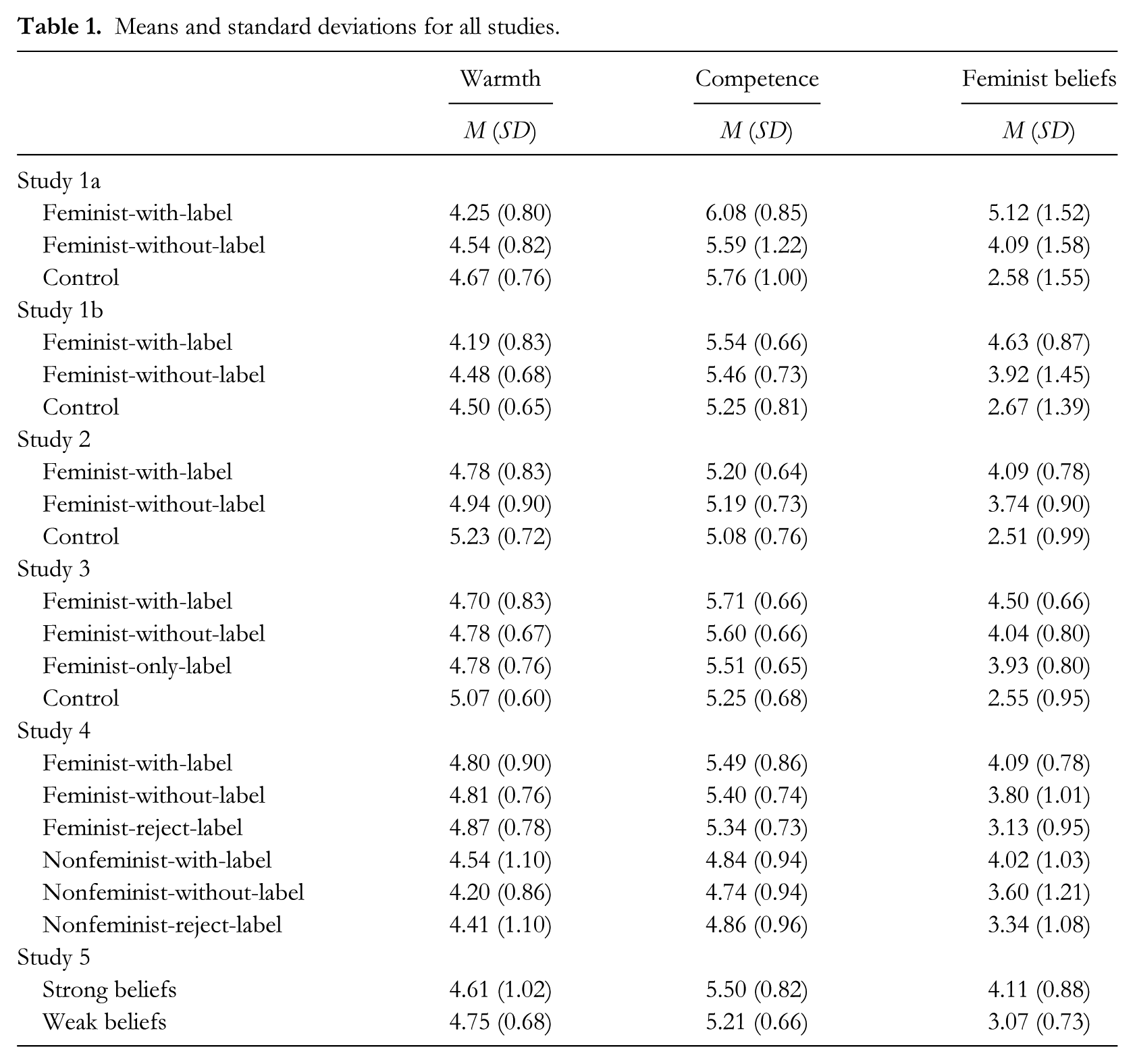
Warmth
Condition impacted perceptions of warmth, F(2, 167) = 4.17, p = .02, η² = .05. Participants thought the feminist-with-label was not less warm compared to the feminist-without-label, t(111) = −1.89, p = .06, d = 0.36, but was significantly less warm than the control target, t(112) = −2.87, p = .005, d = 0.54. The feminist-without-label was seen as equally warm as the control target, t(111) = −0.89, p = .38, d = 0.17.
Competence
A significant main effect of condition was observed, F(2, 167) = 3.38, p = .04, η² = .04. Participants perceived the feminist-with-label as more competent than the feminist-without-label, t(98.54) = 2.52, p = .01, d = 0.51, but not more competent than the control target, t(112) = 1.83, p = .07, d = 0.35. The feminist-without-label was seen as equally competent as the control target, t(111) = −0.86, p = .39, d = 0.16.
Beliefs
Condition impacted perceived beliefs, F(2, 167) = 38.88, p < .001, η² = .32. Participants perceived the feminist-with-label to have stronger feminist beliefs than the feminist-without-label, t(111) = 3.54, p = .001, d = 0.67, who in turn had stronger feminist beliefs than the control target, t(111) = 5.14, p < .001, d = 0.98.
Study 1b
Study 1b replicates Study 1a with a U.S. sample. Although we did not expect any cultural differences given the cultural proximity, we chose to test our question in multiple cultures to increase generalizability.
Method
Participants and design
American Amazon MTurk users (N = 610; 360 male, 250 female, Mage = 32.40) participated in return for $0.30. A target sample size of 600 was chosen in order to have 95% power to find a medium effect (d = 0.30). Participants were randomly assigned to one of three conditions (labeling type: feminist-with-label, feminist-without-label, control) of a between-subjects design. 2
Materials
All materials, measures, and procedure were identical to those presented in Study 1a (αwarmth = .77, αcompetence = .71).
Manipulation check
A one-way (labeling type: feminist-with-label, feminist-without-label, control) between-participants ANOVA on feminist identification showed a main effect of labeling type, F(2, 595) = 178.12, p < .001, η² = .37. Simple post hoc comparisons showed that participants thought the feminist-with-label (M = 4.24, SD = 1.04) would identify more as a feminist than the feminist-without-label (M = 3.35, SD = 1.35), t(377.89) = 7.41, p < .001, d = 0.76, who would identify more as a feminist than the control target (M = 2.10, SD = 0.97), t(365.92) = 10.63, p < .001, d = 1.11.
Results
See Table 1 for all means and standard deviations for the warmth, competence, and feminist belief measures. One-way ANOVAs were conducted to determine differences between the three conditions (labeling type: feminist-with-label, feminist-without-label, control), with simple post hoc comparisons conducted as a follow-up. Where Levene’s test indicated unequal variances (ps < .001) adjusted t statistics are reported.
Warmth
A main effect of condition was observed, F(2, 599) = 11.78, p < .001, η² = .04. Participants rated the feminist-with-label as less warm than the feminist-without-label, t(401) = −3.77, p < .001, d = 0.38, and less warm than the control target, t(376.37) = −4.29, p < .001, d = 0.44. The feminist-without-label and the control target did not significantly differ from each other, t(403) = −0.50, p = .62, d = 0.05.
Competence
Condition impacted competence perceptions, F(2, 600) = 8.31, p < .001, η² = .03. Participants rated the feminist-with-label and the feminist-without-label as equally competent, t(402) = 1.17, p = .24, d = 0.12, and both as more competent than the control target, t(400) = 3.93, p < .001, d = 0.39, and t(404) = 2.73, p = .007, d = 0.27, respectively.
Beliefs
A main effect of condition was observed, F(2, 595) = 123.40, p < .001, η² = .29. Participants thought the feminist-with-label had stronger feminist beliefs than the feminist-without-label, t(330.06) = 5.97, p < .001, d = 0.66, who in turn had stronger feminist beliefs than the control target, t(400.51) = 8.84, p < .001, d = 0.88.
Discussion
These two studies show that women who label themselves feminists are seen as less warm (Study 1b), more competent (Study 1a), and having stronger gender beliefs (Studies 1a, 1b) than women who express those same gender-equality beliefs but do not self-identify as feminists. Further, in Study 1b we also found that women who express gender-equality beliefs are seen as more competent and just as warm as women in the control condition. This strengthens our reasoning that the feminist label cues strength of feminist beliefs which influences perceptions of warmth and competence, as now we find that merely expressing beliefs also influences perceptions of competence.
Study 2
In Study 2 we sought to replicate the results of Studies 1a and 1b with judgments of first impressions in an interpersonal situation rather than from a résumé. In Studies 1a and 1b, as part of the manipulation, we listed the academic major/minor of the vignette applicant in the control condition as “economics”—a field that may be seen as more masculine, which may have affected the results of feminist labeling on perceived warmth and competence. We therefore changed the control condition to “current literature and films.” Moreover, in Studies 1a and 1b, the feminist-with-label condition did not include any explicit reference to being supportive of gender equality. We added this explicit reference in all other studies. Finally, Study 2 tests whether feminist labels increase perceived competence and reduce perceived warmth when applied by another person—or only when self-applied, given that this expresses one’s own identity (Tajfel, 1974; Tajfel & Turner, 1986; Turner, Hogg, Oakes, Reicher, & Wetherell, 1987). If, however, strength of feminist beliefs is conveyed by means of the feminist label, it could be that the strength of the cue is independent of who applies the label.
Method
Participants and design
American Amazon MTurk users (N = 302; 166 male, 136 female, Mage = 33.70, SD = 12.00) participated in return for $0.30. A target sample size of 300 was chosen (power 80%, d = 0.30). Participants were randomly assigned to one of the conditions of a 3 (labeling type: feminist-with-label, feminist-without-label, control) x 2 (introduction method: self-introduction, other-introduction) between-participants design.
Manipulation
Participants imagined having a drink with coworkers after work. When Jenny—a friend of a coworker—is introduced, the topic of Jenny’s blog is discussed. Depending on condition, Jenny either states writing about gender-equality and labels herself feminist (feminist-with-label: “As a feminist, I mostly write about gender equality and other gender issues”) or writes about gender equality without labeling herself feminist (feminist-without-label: “I mostly write about gender equality and other gender issues”), or does not write about gender equality at all (control: “I write about current literature and films”). In the self-introduction condition, Jenny herself discusses her blog and in the other-introduction condition, a coworker discusses the blog.
Measures and procedure
All measures and procedure were identical to those presented in Study 1b (αwarmth = .91, αcompetence = .82).
Manipulation check
A 3 (labeling type: feminist-with-label, feminist-without-label, control) x 2 (introduction method: self-introduction, other-introduction) ANOVA on feminist identification showed that the manipulation worked, F(2, 296) = 91.57, p < .001, η² = .38. Simple post hoc comparisons showed that likelihood of feminist identification was higher in the feminist-with-label condition (M = 5.88, SD = 1.65) than in the feminist-without-label condition (M = 4.97, SD = 1.70), t(198.67) = 3.87, p < .001, d = 0.55, which was higher than the control condition (M = 2.88, SD = 1.51), t(195.96) = 9.21, p < .001, d = 1.32. No other main and interaction effects were significant, ps > .10.
Results
See Table 1 for all means and standard deviations for warmth, competence, and feminist belief measures. A 3 (labeling type: feminist-with-label, feminist-without-label, control) x 2 (introduction method: self-introduction, other-introduction) ANOVA was conducted on each of the dependent measures with simple post hoc comparisons conducted as follow-ups.
Warmth
We found a main effect of labeling type on warmth, F(2, 296) = 7.90, p < .001, η² = .009. Participants thought the feminist-with-label and the feminist-without-label were less warm than the control target, t(200) = −4.11, p < .001, d = 0.58 and t(199) = −2.56, p = .01, d = 0.36. The feminist-with-label was equally warm as the feminist-without-label, t(199) = −1.28, p = .20, d = 0.18. No other main and interaction effects were significant, ps > .10.
Competence
No significant effects of the manipulated variables on competence were observed, ps > .11.
Beliefs
A main effect of labeling on beliefs was observed, F(2, 296) = 86.87, p < .001, η² = .37. Participants thought the feminist-with-label had stronger feminist beliefs than the feminist-without-label, t(194.54) = 2.95, p = .004, d = 0.42, who in turn had stronger feminist beliefs than the control target, t(199) = 9.22, p < .001, d = 1.31. No other main and interaction effects were significant, ps > .33.
Discussion
In contrast to Studies 1a and 1b, women who labelled themselves as feminists and women who expressed the same gender-equality beliefs were seen as less warm than women in the control condition, but no differences were observed in perceptions of competence. This could be due to the fact that we found a weaker effect (d = 0.14) than expected (d = 0.30). Alternatively, it could be that participants in our control condition inferred that Jenny was writing about feminist literature. To address this, the control condition changed in Studies 3 and 4 to “wildlife and nature documentaries.” Women who labelled themselves as feminists were seen as having stronger feminist beliefs than women who merely expressed believing in gender equality. These results imply that it is not merely the feminist label that stands out and causes changes in perceptions of warmth and competence, but that strength of feminist beliefs triggers this. This is endorsed by the fact that this pattern of the strength of feminist beliefs is found in all three studies.
Study 3
In Studies 1a, 1b, and 2, participants judged a woman who labelled herself feminist who also stated that she studies or writes about gender equality. Therefore in Study 3, to more explicitly and strictly test whether the feminist label by itself influences ratings of warmth and competence, we disentangled the feminist label and feminist beliefs by adding a condition in which a woman uses the feminist label, but does not express feminist beliefs.
Method
Participants and design
American MTurk users (N = 403; 244 male, 159 female, Mage = 33.38) participated in return for $0.30. A target sample size of 400 was chosen (95% power, d = 0.35). Participants were randomly assigned to one of four conditions (labeling type: feminist-with-label, feminist-without-label, feminist-only-label, control).
Manipulation
Participants followed the same procedure as in Study 2, but an extra condition was added in which the feminist label was presented, but there was no reference to gender-equality beliefs (feminist-only-label condition). Specifically, Jenny in this condition introduced herself by “Although I am a feminist, I mostly write about wildlife and nature documentaries.” The control condition was changed to “I mostly write about wildlife and nature documentaries.”
Measures and procedure
All measures and procedure were identical to those presented in Study 2 (αwarmth = .76, αcompetence = .71).
Manipulation check
A one-way (labeling type: feminist-with-label, feminist-without-label, feminist-only-label, control) ANOVA on identification as a feminist showed our manipulation worked, F(3, 397) = 131.14, p < .001, η² = .50. Simple post hoc comparisons showed that participants thought the feminist-with-label (M = 4.53, SD = 0.71) identified more as a feminist than the feminist-without-label (M = 4.01, SD = 0.87), the feminist-only-label (M = 4.18, SD = 0.77), and the control condition target (M = 2.40, SD = 0.96), ps < .015, ds = 0.47–2.52. The feminist-without-label and the feminist-only-label were identified equally as a feminist, p = .48, but more than the control target, ps < .001, ds = 2.05– 2.37.
Results
See Table 1 for all means and standard deviations for the warmth, competence, and feminist belief measures. One-way ANOVAs were conducted to determine differences between the four conditions (labeling type: feminist-with-label, feminist-without-label, feminist-only-label, control), with simple post hoc comparisons conducted as a follow-up.
Warmth
An effect of labeling type was demonstrated, F(3, 399) = 5.07, p = .002, η² = .04. Participants rated the feminist-with-label, the feminist-without-label, and the feminist-only-label as equally warm, ps > .46. These three women were all seen as less warm than the control condition target, ps < .004, ds = 0.42–0.51.
Competence
Labeling type impacted perceptions of competence, F(3, 399) = 8.68, p < .001, η² = .06. Participants rated the feminist-with-label and the feminist-without-label as equally competent, t(200) = 1.22, p = .22, d = 0.17. The feminist-with-label was seen as more competent than the feminist-only-label and the control condition target, ps < .03. The feminist-without-label was not seen as more competent than the feminist-only-label, t(195) = 0.97, p = .33, d = 0.14, but was seen as more competent than the control target, t(198) = 3.58, p < .001, d = 0.51. The feminist-only-label and the control target also significantly differed from each other, t(199) = −2.66, p = .009, d = 0.38.
Beliefs
Labeling impacted perceived feminist beliefs, F(3, 397) = 110.84, p < .001, η² = .46. Participants thought the feminist-with-label had stronger feminist beliefs than the feminist-without-label, the feminist-only-label, and the control target, ps < .001, ds = 0.63–2.38. The feminist-without-label and the feminist-only-label were seen as equal in beliefs, p = .77, but as stronger in beliefs than the control condition target, ps < .001, ds = 1.57–1.70.
Discussion
Study 3 confirms that women who label themselves feminists are perceived to have stronger gender-equality beliefs than women who merely express gender-equality beliefs. In contrast to Studies 1a, 1b, and 2, both women are seen as equally warm and competent. Women who merely label themselves feminists but do not express any gender-equality beliefs are seen as equally competent, equally warm, and having equal gender-equality beliefs in comparison to women who express gender-equality beliefs. In this study we thus found evidence that the mere usage of the feminist label implies some adherence to feminist ideology and that the feminist label cues strength of feminist beliefs.
Study 4
Some women actively distance themselves from the feminist label. For example, when singer Katy Perry won the Billboard Women in Music Award 2012, she stated in her acceptance speech: “I am not a feminist, but I do believe in the strength of women” (Hampp, 2012). In Study 4 we explore the idea that denial of the feminist label has a reverse effect on warmth and competence ratings—and thus increases warmth and decreases competence. If endorsing a feminist label affects warmth and competence, then denying that label may produce opposite consequences (Bay-Cheng & Zucker, 2007; Downing & Roush, 1985; Duncan, 2010; Zucker, 2004).
Method
Participants and design
American MTurk users (N = 631; 419 male, 212 female, Mage = 31.39) participated in return for $0.30. A target sample size of 600 was chosen (95% power, d = 0.30). Participants were randomly assigned to one of six conditions in a 3 (labeling type: with-label, without-label, reject-label) x 2 (classification: feminist, nonfeminist) between-participants design.
Manipulation
Participants followed the same procedure and materials as in Study 3. The feminist classification conditions were the same as in Study 3: Jenny either stated believing in gender equality and labeled herself feminist (feminist-with-label) or that she merely believed in gender equality (feminist-without-label). In the added condition, Jenny stated that she believed in gender equality, but did not call herself feminist (feminist-reject-label; “Jenny says she believes in gender equality but does not call herself a feminist.”)
In the nonfeminist classification conditions, Jenny either stated not believing in gender equality and labeled herself nonfeminist (nonfeminist-with-label; “Jenny says she does not believe in gender equality and calls herself a nonfeminist”), that she did not belief in gender equality (nonfeminist-without-label; “Jenny says she does not believe in gender equality”), or that she did not believe in gender equality, but did not call herself nonfeminist (nonfeminist-reject-label; “Jenny says she does not believe in gender equality but does not call herself a nonfeminist”).
Measures
Participants followed the same procedure and used the same materials as in Study 3 (αwarmth = .84, αcompetence = .78).
Manipulation check
A 3 (labeling type: with-label, without-label, reject-label) x 2 (classification: feminist, nonfeminist) ANOVA on feminist identification showed our manipulation worked: There was a main effect of labeling type, F(2, 603) = 144.98, p < .001, η² = .33, no effect of classification, F(1, 603) = 0.78, p = .38, η² = .001, and an interaction effect of labeling type and classification, F(2, 603) = 6.45, p = .002, η² = .02. Simple post hoc comparisons showed that participants thought the feminist-with-label (M = 4.30, SD = 0.79) would identify more as a feminist than the feminist-without-label (M = 3.67, SD = 1.10) who in turn would identify more than the feminist-reject-label (M = 2.11, SD = 1.16), ps < .001, ds = 0.65–1.38. Regarding the nonfeminist classification, participants thought the nonfeminist-with-label (M = 4.17, SD = 1.04) would identify more as a nonfeminist than the nonfeminist-without-label (M = 3.51, SD = 1.50) who in turn would identify more than the nonfeminist-reject-label (M = 2.65, SD = 1.27), ps < .001, ds = 0.89–0.95.
Results
See Table 1 for all means and standard deviations for the warmth, competence, and feminist belief measures. A series of 3 (labeling type: with-label, without-label, reject-label) x 2 (classification: feminist, nonfeminist) between-participants ANOVAs were conducted with simple post hoc comparisons.
Warmth
The ANOVA showed no main effect of labeling type, F(2, 603) = 1.84, p = .16, η² = .006, a main effect of classification, F(1, 603) = 34.45, p < .001, η² = .05, but no interaction effect of labeling type and classification, F(2, 603) = 1.95, p = .14, η² = .006. Participants thought the woman in the feminist classification condition was higher in warmth than the woman in the nonfeminist classification condition.
Competence
The analysis of competence showed no main effect of labeling type, F(2, 603) = 0.64, p = .53, η² = .002, a main effect of classification, F(1, 603) = 73.39, p < .001, η² = .11, but no interaction effect of labeling type and classification, F(2, 603) = 0.78, p = .46, η² = .003. Participants thought the woman in the feminist classification condition was higher in competence than the woman in the nonfeminist classification condition.
Beliefs
Analysis of beliefs showed a main effect of labeling type, F(2, 603) = 32.94, p < .001, η² = .10, no effect of classification, F(1, 603) = 0.06, p = .81, η² < .001, and no interaction effect, F(2, 603) = 2.24, p = .11, η² = .007. Participants thought the (non)feminist-with-label had stronger beliefs than the (non)feminist-without-label who in turn had stronger beliefs than the (non)feminist-reject-label, ps < .001, ds = 0.34–0.43.
Discussion
Study 4 confirms that labelers are seen as having stronger gender-equality beliefs than nonlabelers. Importantly, it did not matter whether the label used was the feminist label or the nonfeminist label: in both cases use of the label cued having stronger beliefs. Furthermore, we found no evidence that rejecting the feminist label has positive consequences: Women who express gender-equality beliefs, but reject the feminist label are seen as equally warm and competent as women who merely express gender-equality beliefs.
Study 5
In Study 5 we directly examined the influence of strength of feminist beliefs on the ratings of warmth and competence. Hence, by means of experimental causal chain design (Spencer, Zanna, & Fong, 2005), which holds that manipulation of not only the independent variable but also of the mediating variable (as a second step) provides particularly strong evidence for the hypothesized causal chain, we manipulated strength of feminist beliefs directly. Therefore, in Study 5 the feminist label was not mentioned, but merely whether the woman had strong or weak feminist beliefs.
Method
Participants and design
American MTurk users (N = 214; 141 male, 73 female, Mage = 32.42) participated in return for $0.30. A target sample size of 200 was chosen (95% power, d = 0.50). Participants were randomly assigned to one of two conditions (beliefs: strong, weak).
Manipulation
In this study no blog was mentioned, because the fact that the person had a blog might cue the strength of her beliefs. Therefore, it was merely mentioned whether Kate had strong beliefs in feminism (“I believe in all tenets of feminism and strongly believe in gender equality”) or weak beliefs in feminism (“I believe in some tenets of feminism, but disagree with other, and to some degree believe in gender equality”).
Measures and procedure
Participants followed the same procedure and used the same materials as in Study 3 (αwarmth = .81, αcompetence = .77).
Manipulation checks
Beliefs
An independent samples t test showed that the woman in the strong-beliefs condition (M = 4.11, SD = 0.88) was seen as having stronger feminist beliefs than the woman in the weak-beliefs condition (M = 3.07, SD = 0.73), t(198) = −9.15, p < .001, d = 1.30.
Identification
An independent samples t test showed that the woman in the strong-beliefs condition (M = 4.12, SD = 0.91) was seen as more likely to identify as a feminist than the woman in the weak-beliefs condition (M = 2.84, SD = 0.92), t(198) = −9.88, p < .001, d = 1.40.
Results
See Table 1 for all means and standard deviations for the warmth, competence, and feminist belief measures.
Warmth
An independent samples t test showed that the woman in the strong-beliefs condition was not seen as less warm than the woman in the weak-beliefs condition, t(198) = 1.09, p = .28, d = 0.15.
Competence
An independent samples t test showed that the woman in the strong-beliefs condition was seen as more competent than the woman in the weak-beliefs condition, t(198) = −2.83, p = .005, d = 0.40.
Discussion
In Study 5 we directly manipulated strength of feminist beliefs instead of cueing this by means of the feminist label. We found that women with strong feminist beliefs are seen as more competent than women with weak feminist beliefs. We did not find that women with strong beliefs are seen as less warm than women with weak feminist beliefs. Given that the effect was smaller than we had expected (d = 0.15 instead of d = 0.50), it could be that we did not detect the effect because it is so small.
Integrative Data Analysis of Studies
Three of the five studies support the idea that women who label themselves as feminists are seen as more competent and less warm than women who express gender-equality beliefs, but Studies 2 and 4 did not support this hypothesis regarding competence (Study 2) or both (Study 4). To resolve this, we performed an integrative data analysis on an aggregated dataset (Curran & Hussong, 2009). We included each study condition that used the same type of manipulation (i.e., we excluded the reject-label conditions of Study 4 and all conditions of Study 5) and dependent measures (warmth and competence), yielding 1,587 participants (nfeminist-with-label = 566, nfeminist-without-label = 559, ncontrol = 462).
Results
Correlations
Table 2 lists correlations between warmth, competence, and feminist beliefs. The integrative data analysis strategy provides us with sufficient statistical power to conduct exploratory analyses of these results with participant gender as an additional between-subjects factor. There was a positive correlation between warmth and competence for both male participants (r = .38, p < .001) and female participants (r = .35, p < .001). These did not differ significantly from one another, Z = 0.68, p = .50. There was a negative correlation between warmth ratings and feminist beliefs for male participants (r = −.22, p < .0001), but not for female participants (r = −.07, p = .05). This difference was statistically significant, Z = −3.02, p = .003. Finally, there was a positive correlation between competence and feminist beliefs for both, male participants (r = .13, p < .001) and female participants (r = .19, p < .001). These did not differ significantly from one another, Z = −0.60, p = .55. There were no differences in correlations among the different conditions.
Correlations among study variables for the integrative data analysis.
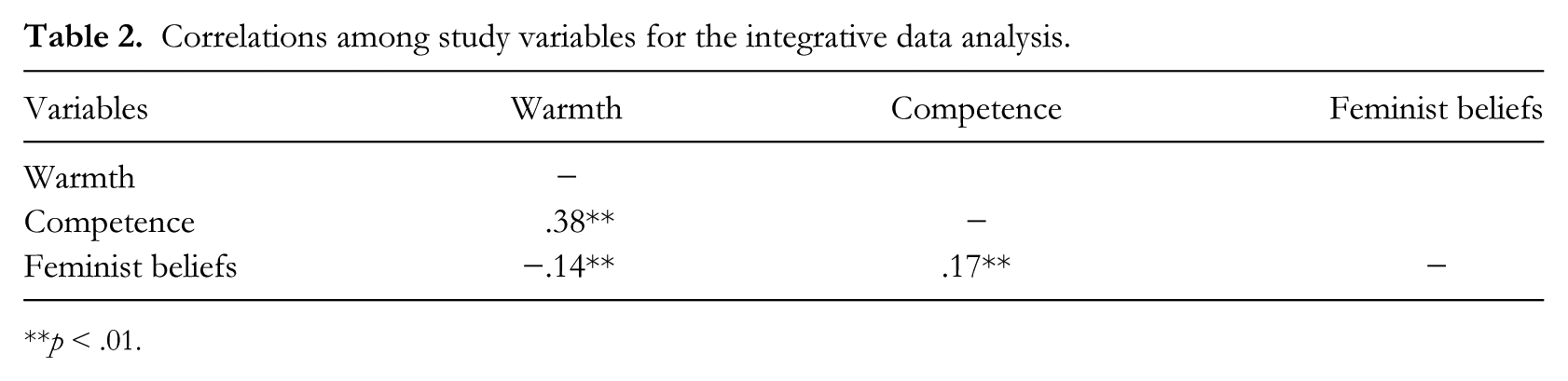
p < .01.
Warmth
A one-way (labeling type: feminist-with-label, feminist-without-label, control) ANOVA on warmth showed a main effect of labeling type, F(2, 1565) = 23.47, p < .001, η² = .03, in which the feminist-with-label (M = 4.51, SD = 0.88) was seen as less warm than the feminist-without-label (M = 4.68, SD = 0.77; p = .001; d = 0.21) who in turn was seen as less warm than the control target (M = 4.81, SD = 0.73; p = .002; d = 0.17).
Competence
An ANOVA on competence showed a main effect of labeling type, F(2, 1565) = 14.53, p < .001, η² = .02, in which the feminist-with-label (M = 5.56, SD = 0.76) was seen as more competent than the feminist-without-label (M = 5.44, SD = 0.79; p = .001; d = 0.15) who in turn was seen as more competent than the control target (M = 5.28, SD = 0.82; p = .04; d = 0.20).
Beliefs
An ANOVA on feminist beliefs showed a main effect of labeling type, F(2, 1570) = 367.85, p < .001, η² = .32, in which the feminist-with-label (M = 4.34, SD = 0.84) was seen as having more feminist beliefs than the feminist-without-label (M = 3.82, SD = 1.16; p < .001; d = 0.51) who in turn was seen as having more feminist beliefs than the control target (M = 2.55, SD = 1.19; p < .001; d = 1.08).
Participant gender
The integrative data analysis strategy provides us with sufficient statistical power to conduct exploratory analyses of these results with participant gender as an additional between-subjects factor. Although there were not any specific a priori predictions about the role of participant gender given the clear implications for gender relations and gender inequality, it could be that feminists are seen as more warm and competent by women because they have a stronger interest in a reversal or dissolution of traditional gender roles than men (Robnett et al., 2012). However, there is also evidence that there are no participant gender differences in the evaluation in a plethora of psychological traits (Hyde, 2005).
The 3 (labeling type: feminist-with-label, feminist-without-label, control) x 2 (participant gender: male, female) between-participants ANOVA on warmth showed a main effect of labeling type, F(2, 1572) = 18.76, p < .001, η² = .02, a main effect of participant gender, F(1, 1572) = 19.82, p < .001, η² = .01, and no interaction effect of labeling type and participant gender, F(2, 1572) = 2.11, p = .12, η² = .003. We found the same pattern as described before for the effect of labeling type on warmth. Furthermore, female participants rated all targets as higher in warmth (M = 4.76, SD = 0.76) than male participants (M = 4.58, SD = 0.84).
For competence, the same 3 x 2 ANOVA showed a main effect of labeling type, F(2, 1573) = 15.67, p < .001, η² = .02, a main effect of participant gender, F(1, 1573) = 42.30, p < .001, η² = .03, and no interaction effect of labeling type and participant gender, F(2, 1573) = 0.44, p = .65, η² = .001. We found the same pattern as described before for the effect of labeling type on competence. Furthermore, female participants rated all targets as higher in competence (M = 5.58, SD = 0.79) than male participants (M = 5.32, SD = 0.77).
Finally, the 3 x 2 ANOVA on strength of beliefs showed a main effect of labeling type, F(2, 1566) = 366.46, p < .001, η² = .32, a main effect of participant gender, F(1, 1566) = 19.24, p < .001, η² = .01, and no interaction effect of labeling type and participant gender, F(2, 1566) = 0.95, p = .39, η² = .001. We found the same pattern as described before for the effect of labeling type on strength of beliefs. Again, female participants rated all targets as higher in feminist beliefs (M = 3.76, SD = 1.24) than male participants (M = 3.52, SD = 1.33).
Mediation
A mediation analysis was conducted to test whether strength of feminist beliefs mediates the effect of labeling as feminist or of believing in gender equality on evaluations of warmth and competence. To test this, a regression analysis according to the specifications of PROCESS for SPSS using Model 4 with 5,000 bootstrap resamples (Hayes, 2013) was employed with labeling type entered as two dummy variables. For direct effects of labeling on warmth and competence without beliefs as a mediator entered into the model, we refer to the Results section on warmth and competence. The analyses for warmth revealed that beliefs indeed mediated the effect of labeling type on warmth, B = −0.06, SE = 0.02, p = .0002, 95% CI [−0.09, −0.03]. This pattern of mediation was only found for the dummy variable differentiating the feminist-without-label condition, of which the direct effect was not significant, B = 0.06, SE = 0.05, p = .23, 95% CI [−0.04, 0.15], but not for the dummy differentiating the control condition, of which the direct effect remained significant, B = 0.12, SE = 0.05, p = .03, 95% CI [0.01, 0.22]. For competence, the analyses revealed that beliefs mediated the effect of labeling type on competence as well, B = 0.09, SE = 0.02, p < .0001, 95% CI [0.06, 0.13]. The direct effect of labeling type on competence was not significant for any of the two dummy variables, B = −0.07, SE = 0.05, p = .14, 95% CI [−0.16, 0.02] and B = −0.05, SE = 0.05, p = .33, 95% CI [−0.15, 0.05].
General Discussion
In this paper we give an answer to the question whether women who label themselves as feminists are judged as warmer and less competent than women who merely express gender-equality beliefs. The integrative data analysis across five studies shows that indeed women who label themselves as feminists are seen as less warm and more competent than women who express gender-equality beliefs but do not label themselves feminists. The effect of labeling on warmth evaluations was mediated by the level of feminist beliefs, but only to distinguish between women who labeled themselves as feminists and women who expressed gender-equality beliefs but did not label themselves as feminists, and not for the target who discussed nature and wildlife. For competence, however, beliefs mediated the effect of labeling in all conditions. This difference in evaluations is thus mediated by the idea that women who label themselves as feminists are seen as having stronger gender-equality beliefs than other women. This is also confirmed in the fifth study that found that women with strong feminist beliefs are seen as more competent than women with weak feminist beliefs. Hence, this research shows that in addition to the negative evaluations of the feminist stereotype (e.g., Houvouras & Carter, 2008; Jenen, Winquist, Arkkelin, & Schuster, 2009; Rudman & Fairchild, 2007), the feminist label might cue strong gender-equality beliefs that in turn are related to differences in evaluations. Our findings are further corroborated by recent findings that both self-labeled feminists and women who actively engage in feminist behavior (e.g., confront sexism at work) are evaluated more negatively than women who do not (Anastosopoulos & Desmarais, 2015). Expressing feminist attitudes thus negatively affects how women are seen.
Limitations and Future Research Directions
There are many definitions of feminists and individuals often define feminists differently. In this paper we made the assumption that participants understood who feminists are regardless of their definition of feminism. One may consider this a limitation of the research, as some participants might have conflated feminist with being a woman (Houvouras & Carter, 2008), being an activist (Houvouras & Carter, 2008; Suter & Toller, 2006), or with negative stereotypes (Houvouras & Carter, 2008; Jenen et al., 2009; Robnett et al., 2012; Rudman & Fairchild, 2007). It could also be that because the egalitarian notion that men and women should be equals has become generally accepted and is now part of the mainstream culture (McCabe, 2005) and because it is generally believed that society is steadily drifting toward such equality, making it superfluous to push the issue of gender equality (Edley & Wetherell, 2001), identifying as a feminist is considered to be symptomatic of other, more radical beliefs (McCabe, 2005). Such hidden assumptions may have been driving the effect on perceptions of warmth and competence. Further research may include measures to test participants’ perceptions and definitions of feminism—in particular whether they consider feminists as people who merely desire and support political, economic, and social equality for women, or whether they infer more radical goals.
In this research as well as in other work on feminism, the focus has been on White women in Western countries (but see Robnett & Anderson, 2017) both as a participant and as a topic of studies of feminism. The ethnic background of participants in these target evaluations is an important factor to take into account in future research: Research has shown that, for example, Latina women appreciate dependent women as a result of Marianismo—the idea that women should not strive for their own status but be dependent on men (Manago, Spears Brown, & Leaper, 2009).
In Study 4 we found no effects of whether targets adopted the feminist label or rejected it on how they were evaluated (feelings of warmth and competence). In fact, although denial of the feminist label lowers the perception of the strength of feminist beliefs, the expected benefits of denial of the feminist label—for example, increase in warmth and decrease in competence ratings—were not found. Consistency principles might play a role in this. People are motivated to predict the world (Schneider, 2004) and seek consistency (Festinger, 1957; Gawronski, Strack, & Bodenhausen, 2009; Heider, 1958). A contradictory statement such as “I believe in gender equality, but I am not a feminist” may undermine such motivations and thus cause negative perceptions. Interestingly, although there are many women who choose to explicitly deny adopting the feminist label (Ellison, 2013; Hampp, 2012; Luscombe, 2013; Setoodeh, 2012), the current research suggests that there is no apparent direct benefit of this.
A limitation of the current research is the use of the first-impression paradigm in Studies 3–6. Self-presentation motives play an important role in first impressions because people generally try to construct a desired, beneficial, and believable identity (Schlenker, 2003). Observers—in this research the participants—are often aware of these self-presentation motives and take them into account when reporting impressions (Schlenker, 2003). Therefore, it could be that our participants took these self-presentation motives into account when evaluating the targets. This might explain the lack in boost of warmth evaluations for the women who reject the feminist label; participants may have simply thought that the target rejected the feminist label to construct a desired identity. However, given that we use the same first-impression paradigm across all conditions, self-presentation motives would be relevant in all and therefore cannot explain the differences in warmth and competence evaluations between the feminists that explicitly use the label and feminists that do not use the label.
On the other hand, self-presentation motives might play a role in shaping participants’ own responses, given that all studies make use of self-reports (Fisher & Katz, 2008; King & Bruner, 2000). However, self-reports are particularly important in sensitive topics such as substance abuse, alcohol consumption, or mental illness (see e.g., Brenner & DeLamater, 2014; Dodou & de Winter, 2014; Krumpal, 2013), and probably much less in topics such as attitudes towards feminists.
The integrative data analysis showed that women consistently rated all targets higher on warmth, competence, and feminist beliefs than men. These higher ratings might be attributed to in-group favoritism (Brewer, 1979; Marques & Yzerbyt, 1988; Tajfel, Billig, Bundy, & Flament, 1971). Alternatively, it could be that feminists are seen as more warm and competent by female participants because women have a stronger interest in a reversal or dissolution of traditional gender roles than men (Robnett et al., 2012) and therefore in fact really see feminists as more warm and competent.
Importantly, this research focuses on perception of feminist women. Further research should investigate whether these findings also apply to feminist men, because feminist men and women are perceived differently. Feminist men are seen favorably, but low in attractiveness and masculinity, whereas feminist women are seen unfavorably and high in masculinity (Anderson, 2009). Moreover, all samples in these studies were convenience samples. Given that there might be generalizability problems with convenience samples (Landers & Behrend, 2015), replication of these findings across different samples is advisable.
Conclusion
Six studies showed that women’s feminist labeling causes negative perceptions (Aronson, 2003; Smith, 1999) because observers infer that these women have stronger feminist beliefs and are therefore less warm (and more competent) than women who merely speak about gender equality. In other words, the use of the feminist label serves as a cue of strength of feminist beliefs, meaning that a woman who labels herself a feminist will be seen as less warm and more competent compared to a woman who merely expresses the same gender-equality beliefs.
Footnotes
Funding
The author(s) received no financial support for the research, authorship, and/or publication of this article.