




Abstract
Even in academic fields dominated by women students (e.g., educational research), academic careers are characterized by vertical gender segregation in favor of men. This clashes with the public understanding of educational research as a women's domain that is more strongly associated with warmth (a stereotypically feminine trait) than competence (a stereotypically masculine trait), as revealed in our first study. We thus conducted an experimental vignette study of 189 adults from the general public to explore how women versus men researchers working in educational research versus physics (as a contrasting domain clearly dominated by men) were perceived on several dimensions of competence and warmth. Whereas the female researcher in physics was rated as more competent than the female researcher in educational research, the woman in physics was penalized for her gender stereotype-incongruent domain choice by being perceived as less warm. However, the male researcher in educational research was perceived as both warmer and more competent than his man counterpart in physics, and as smarter than the female researcher in educational research. These findings suggest rewards instead of penalties for men pursuing academic careers in initially women-dominated domains, likely contributing to the increasing gender gap in academic careers in these domains.
If you walk through the departments of economics or law at German universities, the chances that the next student you meet will be a man or a woman are approximately equal. If you walk through the departments of education, German philology, psychology, physics, computer science, or mechanical engineering, the picture changes. Whereas in the first three domains, more than 70% of all students are women, the share of women in the latter three is below 30% (Federal Statistical Office Germany, 2020). This horizontal segregation is accompanied by a negative relation between the academic career level (e.g., undergraduate student, PhD student, assistant professor, and full professor) and the proportion of women, that is, vertical segregation (e.g., Charles & Bradley, 2002). At German universities, slightly more women (51.7%) than men successfully graduate, but women comprise only 45.4% of those earning a doctorate, 31.9% of those earning a Habilitation (i.e., an even more advanced degree traditionally required to become a professor in Germany), and 25.6% of professors (Federal Statistical Office Germany, 2021). Also in the U.S., the proportion of women decreases from the bachelor to the PhD level, and women have additionally been underrepresented in the most prestigious programs (Weeden et al., 2017). Among U.S. faculty members, there are more women than men lecturers, instructors, and assistant professors, but twice as many men than women full professors (U.S. Department of Education, 2021). This vertical gender segregation in academic careers as well as potential obstacles for women such as stronger care obligations (e.g., Misra et al., 2012) have been studied extensively (for a review on gender differences in faculty members, e.g., Gómez Cama et al., 2016).
Data on academic career trajectories, however, indicate the need to differentiate between domains based on their initial student gender distributions. In the U.S., for instance, the share of women decreases as career levels rise, particularly in women-dominated fields (e.g., psychology and other social sciences) but not so much in fields in which women are underrepresented at the bachelor's level (e.g., Ceci, 2018; Ceci et al., 2014). Men and women doctorates in math-intensive domains (e.g., physics) have also been found to have equivalent access to tenure-track academic jobs and to persist at comparable rates (Ceci et al., 2014). In this vein, roughly 20% of all physics graduates in Germany (including physics doctorates) are women (Düchs & Ingold, 2018), whereas the proportion of women in educational research decreases from around 80% at the student level to around 60% at the doctorate level and 50% at the level of professors (Abs et al., 2020).
For men's steeper career ascendance outside academia in occupations that are initially dominated by women (e.g., nursing; Evans, 1997), Williams (1992) coined the term glass escalator in contrast to the glass ceiling that women in management careers may hit (for a recent discussion, see also Williams, 2013). Illustrating the occupational glass escalator, a Swedish longitudinal study (Hultin, 2003), for instance, found that men in typically women-dominated occupations had greater chances of being promoted than equally qualified women, whereas, in men-dominated occupations, men and women had equal chances of being promoted. However, other studies have revealed backlash effects for men in typically feminine occupations (e.g., Moss-Racusin & Johnson, 2016), such as being perceived as ineffectual and less respected than men working in typically masculine occupations (e.g., Heilman & Wallen, 2010).
So far, women's underrepresentation in math-intensive domains across all academic career levels has received far more attention (e.g., Carli et al., 2016; Cimpian et al., 2020; Diekman et al., 2010; Heyder et al., 2021) than the vertical gender segregation characteristic of academic careers in initially women-dominated domains—an asymmetry that has also been observed regarding careers outside academia (e.g., Block et al., 2019; Croft et al., 2015). The current paper seeks to address this research gap in the field of academia and shifts attention to the specific situation of women and men researchers in initially women-dominated academic domains. We therefore use the example of educational research 1 , a popular domain among German students with a low proportion of men (i.e., 22%), and contrast it with physics which is similar in absolute student numbers (educational research: 60,000; physics: 51,000) but has an opposing gender ratio (29% women; Federal Statistical Office Germany, 2020). More specifically, we applied the stereotype content model (e.g., Fiske et al., 2002) to study the perception of men versus women researchers in educational research versus physics in a sample from the general public in order to identify benefits and costs of being a researcher in a gender stereotype-incongruent field. We did so to better understand the factors that might support men researchers in women-dominated domains, that is, what leads men researchers to stay and climb the academic career ladder in these domains, eventually becoming professors, while women researchers in men-dominated domains are consistently dropping out. Whether glass escalator or backlash effects as found outside academia (e.g., Moss-Racusin & Johnson, 2016) can also be expected in these domains is unclear, because positions in academia such as researcher, scientist, or professor are ascribed different characteristics than typically women-dominated professions outside academia such as teachers or nurses (Fiske & Dupree, 2014).
Competence and Warmth Stereotypes About Women and Men
According to the stereotype content model, social perceptions fall along two basic dimensions, that is, competence and warmth, or “the Big Two” (e.g., Abele & Wojciszke, 2007; Cuddy et al., 2008; Fiske et al., 2002). Competence includes having not only high abilities but also agentic traits (e.g., being ambitious, self-confident, or assertive) and is correlated with high status in society. Warmth refers to a person's orientation toward others and includes communal traits (e.g., friendliness or trustworthiness) and is correlated with a lack of competition. The perception of persons high on warmth and competence elicits admiration, high on competence and low on warmth envy, low on competence and high on warmth pity, and low on both contempt (Cuddy et al., 2008).
Stereotypes about women describe them as usually low(er) in competence and high(er) in warmth, and traits indicating warmth are correspondingly perceived as feminine, thus reflecting the close relationship between warmth and communion (e.g., Abele & Wojciszke, 2007; Eckes, 2002; Fiske et al., 2002; Haines et al., 2016). Men in turn are typically perceived as high(er) in competence and low(er) in warmth, and traits indicating competence are perceived as masculine, thus reflecting the close relationship between competence and agency (e.g., Abele & Wojciszke, 2007; Eckes, 2002; Fiske et al., 2002; Haines et al., 2016). A recent meta-analysis of U.S. public opinion polls (Eagly et al., 2020) indicated some change in explicit gender stereotypes over the last 70 years in that the perceived women's advantage in communion even increased while the men's advantage in agency remained stable. Furthermore, a growing ascription of intelligence to women rather than men over time was found, resulting even in a women's advantage here. Boutyline et al. (2023) explained this surprising finding by an increasing social unacceptability of reporting sexist attitudes about intelligence. Other research using more subtle approaches still finds support for a stronger association between intelligence and men than women (e.g., Bian et al., 2017; Boutyline et al., 2023; Storage et al., 2020).
Competence and Warmth Stereotypes and the Gendered Distribution of Work
According to social role theory (Koenig & Eagly, 2014), competence and warmth gender stereotypes are driven by the different social roles men and women fill, that is, men often being the breadwinner and women often being the caregiver. In other words, seeing many men in agentic roles and many women in nurturing roles leads to the belief that men are more competent and women warmer. Moreover, by selecting social roles individuals seek to pursue their goals related to agency, communion, or both. The goal congruity model predicts that people engage in those roles they believe to afford their valued goal (e.g., Diekman et al., 2010, 2017). In this vein, the perception of physics as not affording communal goals (i.e., not providing the opportunities to affirm warmth stereotypes) is one factor contributing to the underrepresentation of women in this field.
If individuals violate their gender roles, they are at risk of being negatively evaluated or penalized, that is, experiencing backlash (Eagly & Karau, 2002). For instance, a woman in a leadership position is at risk of being perceived as less warm. This risk is reduced or even erased if the person is not seen as neglecting their “primary” (stereotypical) social role (Haines & Stroessner, 2019). For a bread-winning man, it is even considered desirable to show communal behavior such as childcare—as long as he does not prioritize family over work (Neuenswander et al., 2023). Thus, working women becoming mothers trade perceived competence against perceived warmth while working fathers gain warmth and maintain their perceived competence compared to childless working men (Cuddy et al., 2004). Moreover, there is evidence suggesting stronger support for changing the gender imbalance in men-dominated than in women-dominated careers, because the latter are rated as lower in status, and subsequently less deserving of attention and social action toward change than prestigious occupations where women are underrepresented (Block et al., 2019). This is also reflected in an imbalance between the amount of research on women in men-dominated versus men in women-dominated occupations (Croft et al., 2015).
In sum, prominent theories such as social role theory (Koenig & Eagly, 2014), role congruity theory (Eagly & Karau, 2002), goal congruity model (Diekman et al., 2017), and role prioritization model (Haines & Stroessner, 2019) have provided seminal insights into the interplay of gender stereotypes, gendered division of labor, and the barriers to and effects of showing behavior incongruent with stereotypical beliefs about how men and women are and should be. With regard to the perception of researchers—irrespective of their field—previous studies have shown that people associate researchers or scientists with the natural sciences, being male, competence, coldness, agency, and a lack of warmth (e.g., Carli et al., 2016; Fiske & Dupree, 2014; Miller et al., 2018; Nett et al., 2022), thus being more congruent with the masculine than feminine gender role and respective stereotypes. But what happens if the academic domain of the researcher is strongly gender-stereotyped itself? This question lies at the core of this study. In what follows we summarize evidence on (a) the stereotypical perceptions of academic domains and (b) how they might affect the evaluation of men and women researchers in the respective domain.
Competence and Warmth Stereotypes About Physics and Educational Research
Several studies suggest that physics represents competence and educational research warmth. For instance, already in high school, adolescents perceived physics as a difficult subject that one needs talent for, with little room for social interactions, such as an exchange of ideas (Haag & Götz, 2012). Similarly, adults perceived physicists as competent, but unattractive, tech-oriented, awkward, and loners. They also perceived a job in physics as low on opportunities for working with and helping others, but high on opportunities for agency, as requiring innate brilliance and effort to succeed, and as more difficult (Bruun et al., 2018; see also Leslie et al., 2015; Meyer et al., 2015). Describing a field as dominated by men led to its categorization as a difficult “hard science” (Light et al., 2022). This effect was partly driven by the stereotypical perception of men as more competent than women. In another study, undergraduate students considered assertiveness, effort, and intelligence to be more predictive of success in the men-dominated fields of higher education (including physics) than in women-dominated fields (Verniers & Martinot, 2015).
By contrast, educational research is a major that, by definition, deals with people and social interactions providing on the first view ample opportunities to afford communal goals. Importantly, educational research does not prepare an individual to become a teacher, early childhood educator, or social worker in Germany (Federal Employment Agency Germany, 2020), but provides research-based courses on the prerequisites and effects of learning, education, and socialization, including organizational levels of educational institutions or ministries. That is, if graduates enroll in a PhD program or decide to work as a researcher in educational research, they decide on scientific activities striving to systematically extend the knowledge in the field of education. However, whereas physics is a highly prototypical science domain, educational researchers were not even mentioned among the 35 most frequently mentioned scientific occupations (Gligorić et al., 2022). This suggests that the typical scientist attributes, for example, being competent and agentic, are less applied to educational researchers. In this vein, among laypeople (Meyer et al., 2015) as well as researchers (Leslie et al., 2015), educational research was perceived as requiring less brilliance or innate ability for success than other subjects. In general, women-dominated domains have been perceived as requiring compliance rather than, for instance, intelligence for success in comparison with men-dominated domains (Verniers & Martinot, 2015), and presenting a domain as dominated by women led to the perception of that domain as a “soft science,” as less important, difficult, reliable, and prestigious (Light et al., 2022). Correspondingly, individuals working in women-dominated occupations have been ascribed more communal traits, whereas individuals working in men-dominated occupations have been ascribed more agentic traits (Froehlich et al., 2020).
Perceptions of Women and Men Researchers in Gender Stereotype-Incongruent Fields
Crucial for our aim to gain a better understanding of the antecedents of men and women researchers’ domain-specific career trajectories is the question of how researchers working in gender stereotype-incongruent fields (i.e., men in educational research and women in physics) are perceived. Here, gender stereotypes and the theoretically expected image of the domain contradict each other. On the basis of prior research from school and work, we anticipated domain effects and backlash effects on the perception of researchers who disconfirm gender stereotypes with their domain choices.
Domain Effects
Several studies of school students have shown that the image of a subject affects people's perceptions of an individual who is related to this subject (Kessels et al., 2014). For instance, fictitious students who were described as having physics or math as their favorite subject were perceived as less popular, less attractive, less socially competent, less integrated, more intelligent, less creative, and less emotional than students with other favorite subjects, irrespective of their gender (Hannover & Kessels, 2004). Furthermore, typical boys or girls whose favorite subject was physics were perceived as more masculine and less feminine as opposed to those whose favorite subject was music (Kessels, 2005). Similarly, physicists were characterized as high on competence and intelligence, but low on warmth, balanced life, and interpersonal skills (Bruun et al., 2018; see also Gligorić et al., 2022). These findings suggest that because of the image of physics and educational research, researchers in physics should be perceived as more competent and less warm than researchers in educational research.
Backlash Effects
Based on the stereotype content model (e.g., Fiske et al., 2002), role congruity theory (e.g., Eagly & Karau, 2002), and the lack-of-fit model (Heilman, 1983), research in the context of work and organizations has extensively found that individuals who disconfirm gender stereotypes are at risk of experiencing backlash effects. Women who were successful in stereotypically masculine positions (e.g., managers) were perceived as agentic and thus less communal, less likable, less hirable, and at risk of experiencing more hostile reactions than successful men (for a summary, see Rudman & Phelan, 2008). Compared to women in stereotypically feminine positions, they were perceived as more interpersonally hostile and less liked (Heilman & Wallen, 2010). We thus expected women researchers in physics to be perceived as less warm than in educational research.
Some studies also have found men to experience backlash. Successful men in stereotypical women's positions (e.g., employee relations counselor) were perceived as ineffectual and less respected than successful men in stereotypical men's positions (e.g., Heilman & Wallen, 2010). Others, however, revealed positive evaluations for men engaging in communal roles and behaviors, that is, caring for their children (e.g., Cuddy et al., 2004; Neuenswander et al., 2023). What does this imply for the perception of men researchers in educational research? It is not clear whether simply being a male researcher in the field of educational research counts as engaging in communal behavior and thus elicits an evaluative boost compared to being a male researcher in the field of physics. But it is unambiguously a stereotype-inconsistent choice of field for a man. We thus argue that men in educational research like women in physics disconfirm gender stereotypes and are therefore also at risk of experiencing backlash effects, thereby conceptually replicating findings from the context of work outside academia (e.g., Heilman & Wallen, 2010; Rudman & Phelan, 2008). Whether this risk is larger for women researchers—because research as such is considered masculine (e.g., Carli et al., 2016) and men showing stereotype-incongruent behavior under some conditions even receive an evaluative boost (e.g., Cuddy et al., 2004; Haines & Stroessner, 2019)—or for men researchers—because there is more support for including women in men-dominated fields than for including men in women-dominated fields (e.g., Block et al., 2019) —is an open question to be addressed in the present study.
Study Overview
Even in academic domains clearly dominated by women students (e.g., educational research), women's academic careers do not progress as much as men's. Here we explore the interplay of stereotypes associated with a researcher's gender and academic domain in order to better understand potential antecedents of the vertical gender segregation that occurs in initially women-dominated academic fields. More precisely, we focus on the warmth and competence perceptions of men and women researchers in gender stereotype-(in)congruent fields. Such perceptions predict whether a person receives admiration or pity, facilitation, or harm (e.g., Cuddy et al., 2008).
We chose educational research and physics as two fields with approximately proportional but opposite gender distributions of students in Germany (Federal Statistical Office Germany, 2020) and conducted two studies. The first study was developed to empirically test our basic assumption that physics is associated with competence (H1a) and educational research with warmth (H1b). It also served to test whether educational research and physics are perceived as domains with opposing gender distributions. On this basis, we constructed Study 2, a vignette experiment, to test the effects of working in a gender stereotype-incongruent field on participants’ perceptions of men and women researchers. We were most interested in whether domain effects (e.g., Kessels, 2005) and backlash effects (e.g., Rudman & Phelan, 2008) influenced the perception of men researchers in gender stereotype-incongruent fields similar to the perception of women researchers in gender stereotype-incongruent fields. Based on prior research, we expected women researchers in physics to be perceived as more competent but less warm than women researchers in educational research (H2a), and men researchers in educational research to be perceived as less competent but warmer than men researchers in physics (H2b). Because of the stronger association of men with competence than women (e.g., Fiske et al., 2002), we expected men researchers in educational research, however, to still be perceived as more competent than women researchers in educational research (H3).
Study 1
Method
Participants
One hundred eighty-five students from a German university participated in the study. They were 22.19 years old on average (SD = 3.20), mostly bachelor students (n = 153), and in their fourth semester (M = 4.11, SD = 3.05). Of these students, 49 reported majoring in educational research and 14 in physics, 126 indicated their gender as female, 51 as male, and 1 as diverse. Participants were recruited via email distribution lists from the social science department (n = 109) or from the natural science, engineering, and economics departments (n = 76) of one university. In compliance with established ethical principles, participation was voluntary, completely anonymous, and participants’ informed consent was obtained before participation. We aimed to recruit as many participants as possible within three weeks. Participation was not compensated except with partial course credit.
Design and Procedure
In an online survey delivered via LimeSurvey (LimeSurvey GmbH, 2003), a list of 27 skills and characteristics representing competence (i.e., cognitive abilities and agency) or warmth (i.e., social and communication skills, likability, communion, and a rich social life; see, e.g., Cuddy et al., 2008) was shown to the participants. The items were selected to assess different facets of competence and warmth to enable more fine-grained analyses within the “Big Two.” As neutral filler items, we intermixed eight items representing self-organizational skills, which should be important for success in every academic domain, and life satisfaction, which was expected to be unrelated to the academic domain as such.
For each item, participants were instructed to judge the extent to which they personally associated it with educational research or physics. The choices were 1 (clearly Field A), 2 (more Field A), 3 (equal), 4 (more Field B), or 5 (clearly Field B). Whether Field A was educational research or physics (and Field B was physics or educational research) and the order in which the items were presented was randomly determined. Participants were instructed to answer spontaneously and with regard to the domain as such (i.e., not with regard to specific individuals from that field they might know). Furthermore, it was stressed that there were no right or wrong answers and that we were interested in only their subjective associations. In order to avoid demand effects, gender was not mentioned at all. All stimulus items are presented in detail below. The study design and analysis were not pre-registered.
Cognitive Abilities
Cognitive abilities were indicated by four items (“analytical skills,” “problem-solving skills,” “learning the ropes quickly,” and “intelligence”). The first three items were taken from the Hochschul-Informations-System Study (Higher Education Information System [HIS] Study; Jaksztat et al., 2010) on the competencies and careers of (pretenured) researchers in Germany and slightly reworded for this study's purpose. We added intelligence as one of the most powerful predictors of educational success (e.g., Roth et al., 2015) and a common indicator of competence (e.g., Cuddy et al., 2008).
Agency
Agency was represented by the German instrumentality scale (Altstötter-Gleich, 2004) that is based on the Bem Sex Role Inventory (Bem, 1974) and the Extended Personality Questionnaire (Spence et al., 1975) and is well-validated and often used in Germany. It consists of eight stereotypically masculine and socially desirable items (e.g., “assertive,” “willing to take risks,” and “self-reliant”).
Social and Communication Skills
Social and communication skills were represented by three items (“ability to cooperate,” “communication skills,” and “ability to explain well”), also taken from the HIS Study (Jaksztat et al., 2010).
Likability
As in other research (e.g., Kessels & Heyder, 2020), likability was represented by a single item (“likable individual”).
Communion
Communion was represented by the German Expressivity Scale (Altstötter-Gleich, 2004), which is also based on the Bem Sex Role Inventory (Bem, 1974) and the Extended Personality Questionnaire (Spence et al., 1975) and has been extensively validated before. It consists of eight stereotypically feminine and socially desirable items (e.g., “affectionate,” “sensitive,” and “understanding”).
Rich Social Life
As indicators of the richness of a person's social life, we used the items “large circle of friends,” “in a relationship,” and “has kids.”
Filler Items
Self-organizational skills were represented by five items (“time management,” “perseverance,” “organizational skills,” “independent work,” and “ability to adapt quickly”), also taken from the HIS Study (Jaksztat et al., 2010). Life satisfaction was represented by the items “satisfaction with private life,” “satisfaction with work,” and “well-being at work.”
Additional Measures
After participants judged the associations between the items above and physics/educational research, we asked them to estimate the percentage of women physics students and the percentage of men educational research students to test whether they were aware of the gender distributions in the two academic fields in Germany. Finally, participants provided the demographic information reported in the Participants section.
Analytic Strategy
For the following analyses, the two response format versions were combined so that the final scale had the anchors 1 (clearly physics), 2 (more physics), 3 (equal), 4 (more educational research), and 5 (clearly educational research) for all participants. We computed Cronbach's alpha in SPSS 29 (IBM Corp., 2022) and McDonald's ωt (Revelle & Condon, 2019) by the R packages psych (Version 2.3.6) and lavaan (Version 0.6-16) as reliability estimates. We used t-tests in SPSS 29 (IBM Corp., 2022) to compare the item means against the theoretical scale mean of 3 to test Hypotheses 1a and 1b. As a robustness check, we further tested our hypotheses separately for the two subsamples.
Results and Discussion
Participants estimated on average that 23.72% of all educational research students were men (SD = 12.39) and 21.48% of all physics students were women (SD = 12.98). These figures were quite close to the proportions in the population of 22% men in educational research and 29% women in physics in Germany (Federal Statistical Office Germany, 2020) and were more accurate estimates than prior research has revealed for the gender distribution in psychology (Boysen et al., 2021). This indicates that participants were on average aware of the gender imbalance in physics and educational research and confirmed that these two subjects were appropriate choices for our study.
Our findings further supported our first pair of hypotheses (see Table 1): students associated cognitive abilities and agency with physics rather than educational research (H1a), and social and communication skills, likability, communion, and a rich social life with educational research rather than physics (H1b). The largest effects were found for the association between cognitive abilities and physics, and communion and educational research. As expected, self-organizational skills were perceived as neutral. Interestingly, life satisfaction was not neutral but was associated with educational research. All statistically significant effect sizes were moderate to large (see Table 1). Please note that we did not study which beliefs, for instance, about what scientists in each domain do (e.g., Nachtigall et al., 2022), may have formed these associations. This remains a fruitful task for future research.
Mean Ratings, Reliabilities, and t-Tests in Study 1.
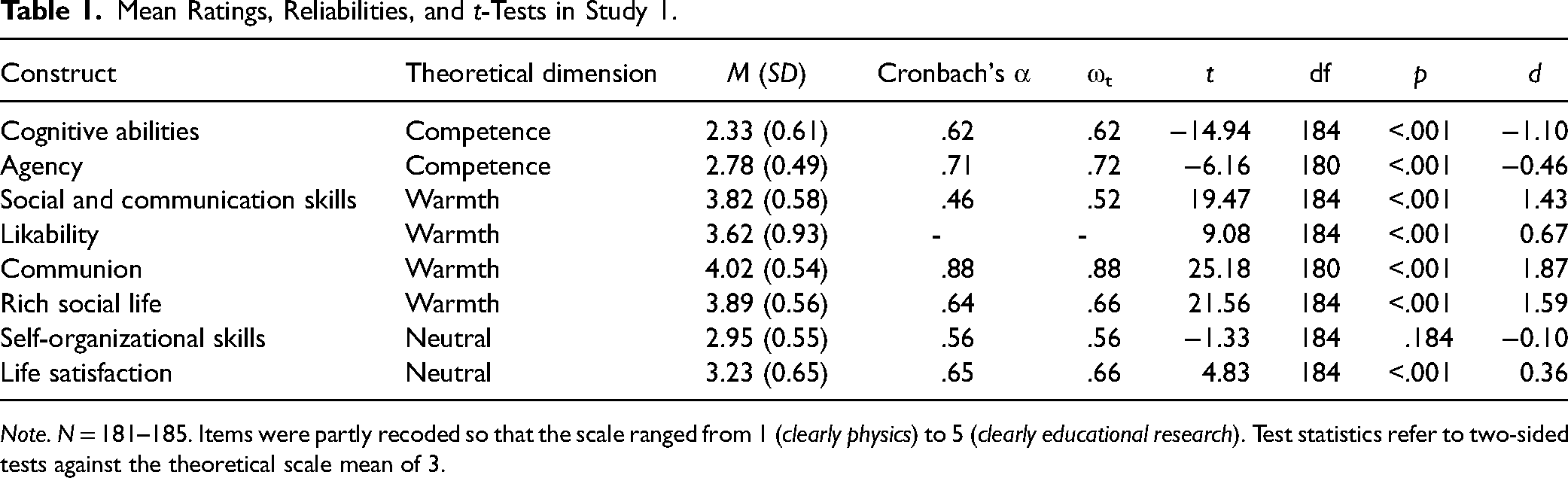
Note. N = 181–185. Items were partly recoded so that the scale ranged from 1 (clearly physics) to 5 (clearly educational research). Test statistics refer to two-sided tests against the theoretical scale mean of 3.
Some of the reliabilities of our target constructs were below the standard threshold of .70 (see Table 1). These modest alpha coefficients reflect the limited number of items (i.e., 3–4 items) and this study's assessment format: participants rated several, heterogeneous characteristics on one scale ranging from clearly physics to clearly educational research. Applying the same items to describe one target person should automatically lead to a higher internal consistency (as done and achieved in Study 2). To test whether the low reliability of the social and communication skill measure, cognitive abilities measure, and social life measure might have affected the results of Study 1, we tested the respective items separately against the theoretical scale mean. All items from the social and communication skill scale (all Ms ≥ 3.34, all ps < .001, and all ds ≥ 0.33) and all items from the social life scale (all Ms ≥ 3.70, all ps < .001, and all ds ≥ 0.95) were significantly larger than 3, suggesting that these skills were more strongly associated with educational research than physics, as hypothesized. Three out of four items from the cognitive abilities scale (all Ms ≤ 2.38, all ps < .001, and all ds ≥ –0.63) were significantly smaller than 3, suggesting that except for “learning the ropes quickly” (M = 2.98, p = .81, d = −0.02) these skills were more strongly associated with physics than educational research, as hypothesized. These analyses on the item level support the validity of our findings despite the partly low-reliability estimates.
As a robustness check, we explored whether the associations between warmth and educational research as well as competence and physics were present in the social science subsample and in the natural science, engineering, and economics subsample. Our hypotheses were supported in both subsamples. Differences occurred only for the theoretically neutral constructs self-organizational skills and life satisfaction (for details, see the supplemental analyses on the OSF).
To conclude, our findings showed a clear association between physics and competence (represented by cognitive abilities and agency) as well as between educational research and warmth (represented by social and communicational skills, communion, likability, and a rich social life). Based on these findings, we designed Study 2 to test how these associations affect participants’ perceptions of women and men researchers working in the gender stereotype-(in)congruent field.
Study 2
Method
Participants
The sample consisted of 189 adults from 19 to 64 years of age (M = 31.04, SD = 10.79). Twenty participants did not report any demographic information. Of the remaining sample, 120 were women and 49 were men, whereas no participant chose “diverse” to indicate their gender. One hundred and forty-one reported that they were previously or currently enrolled at a university, with 35 categorizing their major as humanities, 23 as engineering, 13 as the social sciences, 10 as the natural sciences, six as economics, and four as “other” (e.g., architecture and physiotherapy; 54 missing statements). Only 25 of them indicated that they worked as a researcher after graduating (12 missing statements).
Experimental Design
The experimental study employed a 2 (researcher's gender: female vs. male) × 2 (academic domain: physics vs. educational research) factorial between-subjects design and was also implemented as an online survey via LimeSurvey (LimeSurvey GmbH, 2003). Participants were invited to read one of four vignettes describing a dedicated 30-year-old female/male researcher in physics/educational research. The target researcher corresponds with the “typical” doctoral student in Germany, who is (usually part-time) employed as a “researcher associate” at their university while pursuing their PhD. The target researcher was described as holding a master's degree in the respective domain because a master's degree is usually required to be admitted as a doctoral student in Germany. We chose this age and career level because this is the time in academic careers when vertical segregation begins (see Federal Statistical Office Germany, 2021).
Vignettes were assigned to participants via simple randomization. Researcher's gender was manipulated by the popular German given names “Jana” (women) and “Felix” (men) that have been found to be perceived as equally intelligent and attractive (Rudolph et al., 2007). All characteristics unrelated to researcher's gender and domain (e.g., their surname and engagement) were held constant. To ensure that every participant in each experimental condition had a similar understanding of the gender distribution in the respective domain, we noted in the vignette whether the researcher's colleagues were mostly women (educational research) or men (physics; see also Henningsen et al., 2022). Participants were instructed to try to visualize the presented researcher in more detail, and then indicate how much the pretested items representing dimensions of warmth and competence applied to this person. The study design and analysis were not pre-registered. All study materials are available on the OSF.
Dependent Variables
We used the same items as in Study 1, that is, 27 items representing facets of competence (i.e., cognitive abilities and agency) and warmth (i.e., social and communication skills, likability, communion, and rich social life) and eight items representing life satisfaction and self-organizational skills as neutral filler items. If necessary, items were slightly reworded so that they referred to a person and no longer referred to an abstract trait (e.g., “intelligent” instead of “intelligence”; “has good time management skills” instead of “time management skills”). Participants were asked to rate how likely the items were to apply to the researchers on a 6-point scale ranging from 1 (very unlikely) to 6 (very likely). All measures showed good internal consistencies between .70 and .90 (see Table 2). A principal component analysis with promax rotation conducted in SPSS 29 (IBM Corp., 2022) further supported the theoretically expected clustering in the two overarching dimensions of warmth and competence (for details, see the supplemental analyses on the OSF).
Means, Standard Deviations, Cronbach's Alpha, McDonald's Omega Total, and Bivariate Correlations in Study 2.
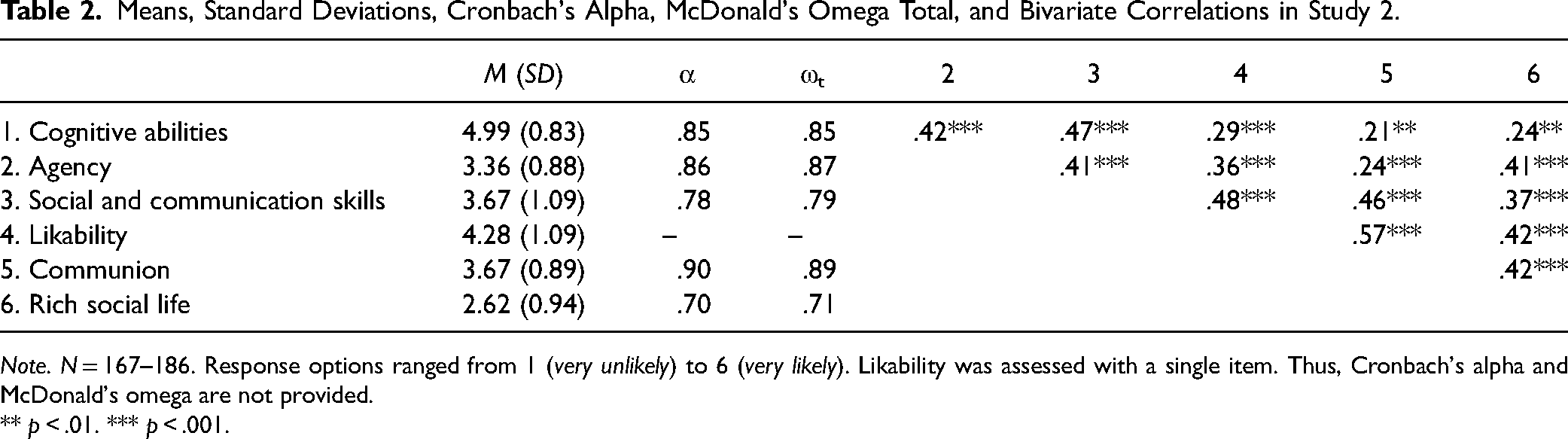
Note. N = 167–186. Response options ranged from 1 (very unlikely) to 6 (very likely). Likability was assessed with a single item. Thus, Cronbach's alpha and McDonald's omega are not provided.
** p < .01. *** p < .001.
Additional Measures
Attitude Toward Women in Science
To gain more insights into the characteristics of the sample, we exploratorily asked the participants to report their general attitudes toward women in science. The Attitude Toward Women in Science Scale (Erb & Smith, 1984; German translation by Dietrich, 2013; Cronbach's α = .85, McDonald's ωt = .90) consists of 27 items that split up into the three factors “characteristics required to succeed in science” (eight items, e.g., “women can be as good in science careers as men can”; Cronbach's α = .60, McDonald's ωt = .74), “compatibility of science career and family” (nine items, e.g., “Both men and women can combine careers with family life”; Cronbach's α = .71, McDonald's ωt = .78), and “equal opportunities for women and men to pursue a science career” (10 items, e.g., “We need more women in science careers”; Cronbach's α = .67, McDonald's ωt = .82). Response options ranged from 1 (not at all true) to 6 (totally true). The measure was presented after participants had evaluated the researcher.
Demographics
Eventually, participants provided demographic information, that is, their age (in years), their gender (female, male, and diverse), whether they study or studied at a university (yes, no), the subject group of their major (if applicable; humanities, engineering, social sciences, natural sciences, economics, or “other”) and if they worked in research after graduating (yes, no). If they were given the physics vignette, they were also asked whether they were currently studying or previously studied physics (yes, no). If they were given the educational research vignette, they were further asked whether they were currently studying or previously studied educational research (yes, no).
Procedure
Participants were recruited from outside academia via social media platforms, personal networks, and with the help of snowball sampling. In compliance with established ethical principles, participation was voluntary, completely anonymous, and participants’ informed consent was obtained before participation. Participation was not compensated. We aimed to recruit as many participants as possible within two weeks—but at least 125 participants—to be able to detect the effects of medium size (f = .25) with a power of .80 and α = .05, as a priori power analysis in G*Power (Faul et al., 2007) suggested. With a power of .80 also the probability of the effect estimate being in the wrong direction (Type S error) and the factor by which the magnitude of an effect might be overestimated (Type M error) should be negligible (Gelman & Carlin, 2014).
Analytic Strategy
If not stated differently, we used SPSS 29 (IBM Corp., 2022) for our analyses. First, we checked whether the participants randomly assigned to the four vignettes differed in important variables. The groups only differed in their gender distribution, χ2(3) = 8.71, p = .03, but not in participants’ age, F(3,165) = 1.20, p = .31, educational background, χ2(3) = 2.64, p = .45, whether they studied educational research, χ2(3) = 0.20, p = .74, or physics, 2 their dropout behavior during the study, χ2(3) = 3.29, p = .39, and their attitude toward women in science, F(1,170) = 1.63, p = .18, indicating that the random assignment was mostly successful. Next, we calculated Cronbach's alpha in SPSS 29 (IBM Corp., 2022) and McDonald's ωt (Revelle & Condon, 2019) by the R packages psych (Version 2.3.6) and lavaan (Version 0.6-16).
Subsequently, we conducted separate 2 (researcher's gender: woman vs. man) × 2 (academic domain: physics vs. educational research) ANOVAs with researcher's ascribed cognitive abilities, agency, social and communication skills, likability, communion, and rich social life as dependent variables. If they revealed statistically significant interaction effects, we tested for simple effects, that is, the effect of one independent variable within one level of the second independent variable. Our second pair of hypotheses would be met by statistically significant domain differences in the expected direction within women researchers (H2a) and men researchers (H2b). Our third hypothesis would be met by statistically significant gender differences in perceived competence in the field of educational research in favor of men.
Moreover, taking into account the distribution of participant's gender across conditions, we conducted additional ANOVAs including participant's gender as a third between-subjects factor. Results were highly similar in terms of statistical significance and effect sizes. Furthermore, no statistically significant main effects of the participant's gender or any interaction effects with it were found, in line with most research on backlash effects (see Rudman & Phelan, 2008). Therefore, we decided to report the result from the originally planned 2 × 2 ANOVAs in the text and those from the additional 2 × 2 × 2 ANOVAs including the participant's gender on the OSF.
Finally, we computed Type M and Type S errors with the help of the retrodesign function in R (Gelman & Carlin, 2014) and tested the robustness of the results by excluding (a) 25 participants who worked in academia after graduating, and (b) 12 participants who had majored in or were currently majoring in educational research and rated an educational research vignette. Because no participants rating a physics vignette reported majoring in physics, there were no corresponding analyses for physics.
Results
General Attitude Toward Women in Science
Participants’ scores ranged from 3.19 to 6 on a theoretical scale ranging from 1 to 6 with higher scores indicating more positive attitudes. On average, they reported a very positive attitude toward women in science in general (M = 5.65, SD = 0.36) as well as on each of the three subscales “characteristics required to succeed in science” (M = 5.66, SD = 0.47), “compatibility of science career and family” (M = 5.70, SD = 0.43), and “equal opportunities for women and men to pursue a science career” (M = 5.61, SD = 0.43). Women participants had significantly higher scores than men participants on the general attitude scale, t(62.82) = 2.14, p = .04, d = 0.44, as well as on the third subscale, t(61.40) = 2.53, p = .01, d = 0.53. Participants who had worked at a university did not differ from those who had not (all ds ≤ 0.17, all ps ≥ .39).
Perceptions of Women and Men Researchers in Physics and Educational Research
The overall means, standard deviations, and correlations are presented in Table 2. All dependent measures were positively correlated, which is in line with the fact that most of the studied traits can be considered positive or socially desirable. Figure 1 shows the boxplots (i.e., the medians and interquartile ranges) for each dependent variable for each experimental condition. The full ANOVA results are summarized in Table 3 (competence dimensions) and Table 4 (warmth dimensions). Results for the theoretically neutral dimensions (i.e., self-organizational skills and life satisfaction) as well as means and standard deviations for each experimental condition are available on the OSF.
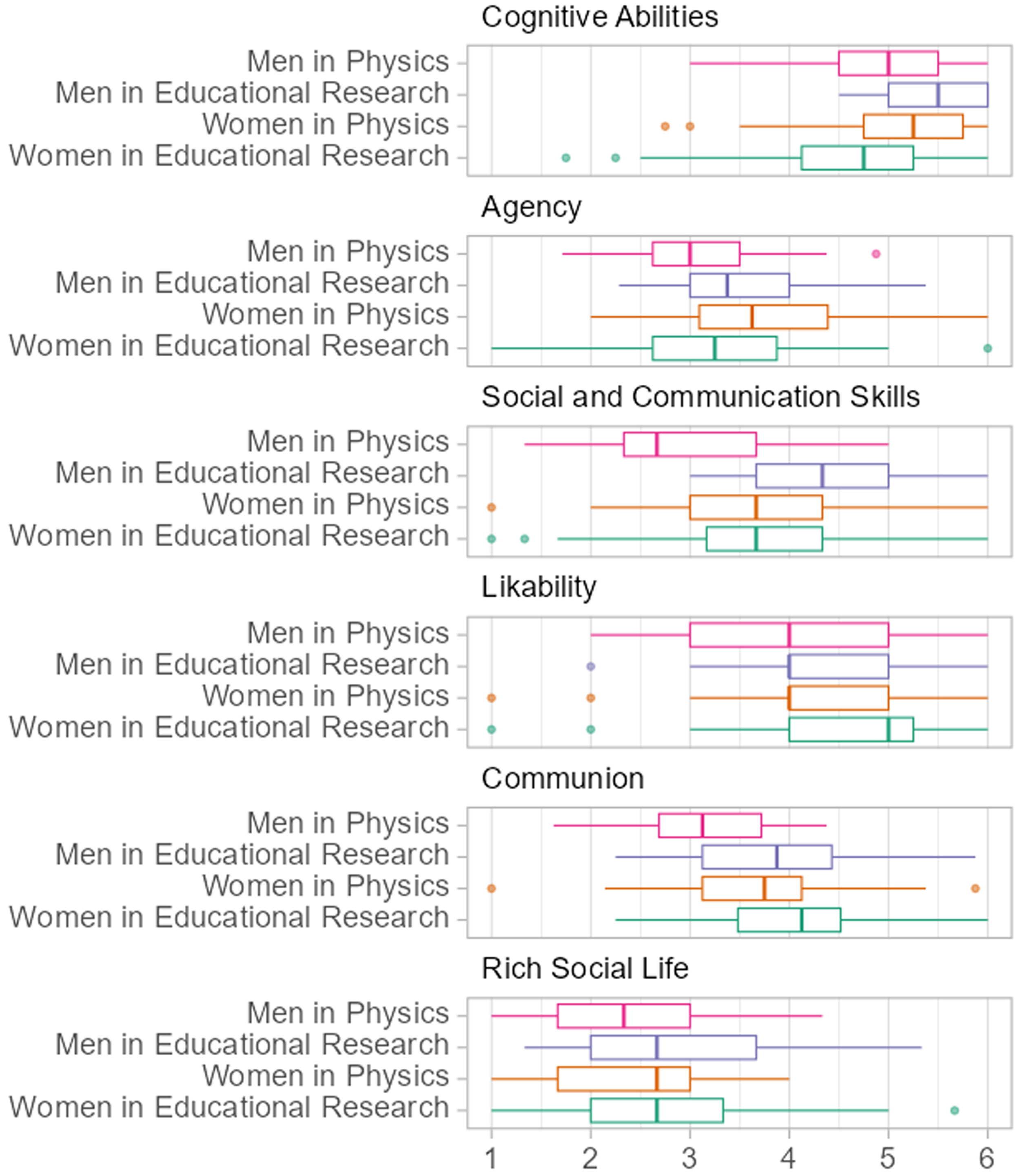
Boxplots for all Dependent Variables and Conditions in Study 2.
Summary of ANOVAs for Competence Dimensions.
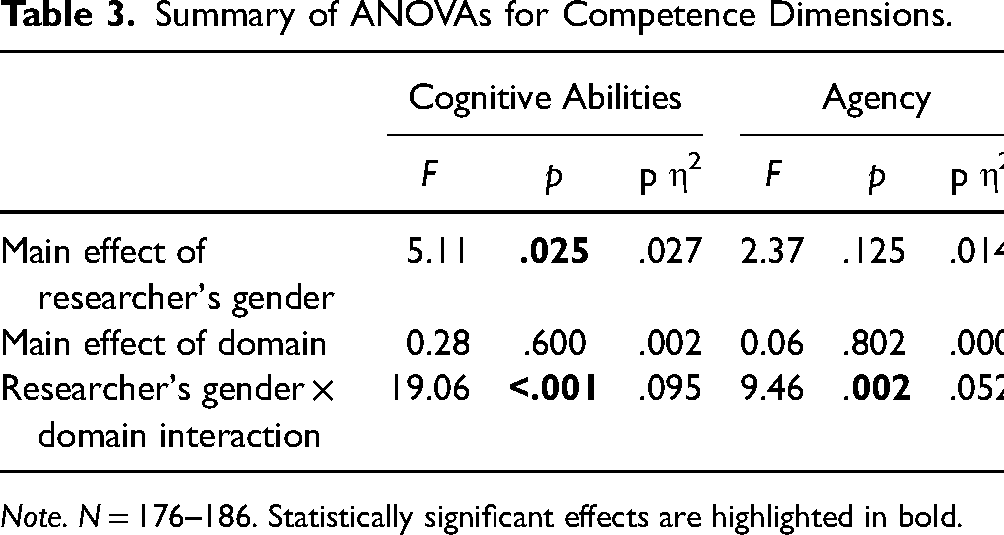
Note. N = 176–186. Statistically significant effects are highlighted in bold.
Summary of ANOVAs for Warmth Dimensions.
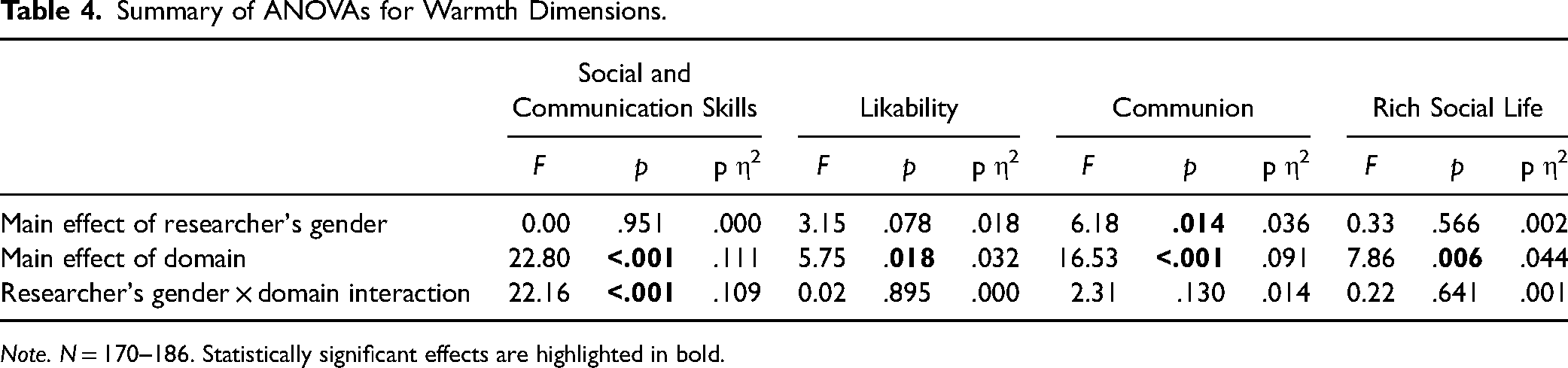
Note. N = 170–186. Statistically significant effects are highlighted in bold.
Cognitive Abilities
The ANOVA revealed a significant main effect of researcher's gender that was qualified by an interaction between researcher's gender and academic domain (see Table 3). The main effect for an academic domain was not statistically significant. Following up on the interaction effect, the female researcher in physics was rated as having higher cognitive abilities (M = 5.15, SE = 0.11) than the female researcher in educational research (M = 4.69, SE = 0.10), F(1,182) = 9.14, p = .003, partial η2 = .05, in line with H2a. Surprisingly, the male researcher in physics was rated as having lower cognitive abilities (M = 4.89, SE = 0.12) than the male researcher in educational research (M = 5.48, SE = 0.14), F(1,182) = 10.03, p = .002, partial η2 = .05. Supporting H3, the male researcher in educational research was further perceived as having higher cognitive abilities than the female researcher in educational research, F(1,182) = 19.99, p < .001, partial η2 = .10, whereas no gender differences were found for the researchers in physics, F(1,182) = 2.46, p = .12, partial η2 = .01.
Agency
The ANOVA revealed no significant main effects but a significant interaction between researcher's gender and academic domain (see Table 3). In line with H2a, the female researcher was ascribed higher agency in physics (M = 3.67, SE = 0.12) than in educational research (M = 3.29, SE = 0.11), F(1,172) = 5.06, p = .03, partial η2 = .03. Again, contradicting our expectations, the male researcher in physics was ascribed lower agency (M = 3.05, SE = 0.13) than the male researcher in educational research (M = 3.49, SE = 0.16), F(1,172) = 4.57, p = .03, partial η2 = .03. Furthermore, statistically significant differences between a male and a female researcher were found in physics, F(1,172) = 11.76, p < .001, partial η2 = .06, but not in educational research, F(1,172) = 1.07, p = .30, partial η2 = .01, partially rejecting H3.
Social and Communication Skills
The ANOVA revealed no significant main effect of researcher's gender but a significant main effect of the academic domain that was qualified by an interaction between researcher's gender and domain (see Table 4). There was no significant difference in the ascribed social and communication skills between the female researcher in physics (M = 3.73, SE = 0.14) and the female researcher in educational research (M = 3.74, SE = 0.13), F(1,182) = 0.00, p = .96, partial η2 = .00. In line with H2b, however, the male researcher in educational research (M = 4.44, SE = 0.18) received higher ratings than the male researcher in physics (M = 3.01, SE = 0.15), F(1,182) = 37.69, p < .001, partial η2 = .17. Furthermore, the differences in social and communication skills between the male and the female researcher were statistically significant in the domain of physics, F(1,182) = 12.61, p < .001, partial η2 = .07, and in the domain of educational research, F(1,182) = 9.83, p = .002, partial η2 = .05.
Likability
The ANOVA revealed that researchers in educational research (M = 4.47, SE = 0.13) were perceived as more likable than researchers in physics (M = 4.07, SE = 0.11; see Table 4), irrespective of their gender, supporting H2a and H2b. The main effect of researcher's gender and the interaction effect were not statistically significant.
Communion
The ANOVA revealed that women researchers were ascribed higher communion (M = 3.83, SE = 0.08) than men researchers were (M = 3.50, SE = 0.11) and that researchers in educational research (M = 3.94, SE = 0.10) were ascribed higher communion than those in physics were (M = 3.39, SE = 0.09; see Table 4), supporting H2a and H2b. The interaction effect was not statistically significant.
Rich Social Life
The ANOVA revealed that researchers in educational research were ascribed a richer social life (M = 2.85, SE = 0.11) than those in physics (M = 2.44, SE = 0.10; see Table 4), irrespective of their gender, supporting H2a and H2b. The main effect of researcher's gender and the interaction effect were not statistically significant.
Estimating Type M and Type S Errors
Given a lack of adequate literature-based true effect size estimates, we used an average theoretical true effect size of d = 0.30 for estimating Type M and Type S error rates (Gelman & Carlin, 2014). Please note that d = 0.30 is a modest estimate given the hypotheses-related effect sizes found in our first study (i.e., all d ≥ |0.46|). Under this assumption and given standard errors between 0.15 and 0.23 (as found in our data), all Type S errors were below 0.2%. The Type M errors ranged from 1.38 to 1.94, speaking against a substantial overestimation of the magnitude of the effect. These findings are in line with the analyses by Gelman and Carlin (2014) showing that given a power of .80 (as this study aimed for) the risk of these errors can be considered very low.
Robustness Checks
For the first robustness check, we excluded all participants who worked in academia after graduating (n = 25). For cognitive abilities, social and communication skills, communion, likability, and rich social life, all ANOVA results remained robust, that is, they did not differ in statistical significance or direction (for details, see the supplemental analyses on the OSF). Only for agency did the tests for simple effects between women researchers in physics (M = 3.62, SE = 0.13) and educational research (M = 3.30, SE = 0.13) barely miss reaching statistical significance, F(1,147) = 3.25, p = .07, partial η2 = .02, as did the tests for simple effects between men researchers in educational research (M = 3.48, SE = 0.17) and physics (M = 3.08, SE = 0.14), F(1,147) = 3.22, p = .08, partial η2 = .02. All other simple effects were robust.
For the second robustness check, we excluded participants who rated an educational research vignette and had previously majored in or were currently majoring in educational research (n = 12). For all dependent variables, the ANOVA results remained robust, that is, they did not differ in statistical significance or direction (for details, see the supplemental analyses on the OSF). Only for agency did the simple effect for women researchers in physics (M = 3.67, SE = 0.12) versus educational research (M = 3.34, SE = 0.12) barely miss reaching statistical significance, F(1,160) = 3.63, p = .06, partial η2 = .02. All other simple effects were robust as well.
Summary of Results
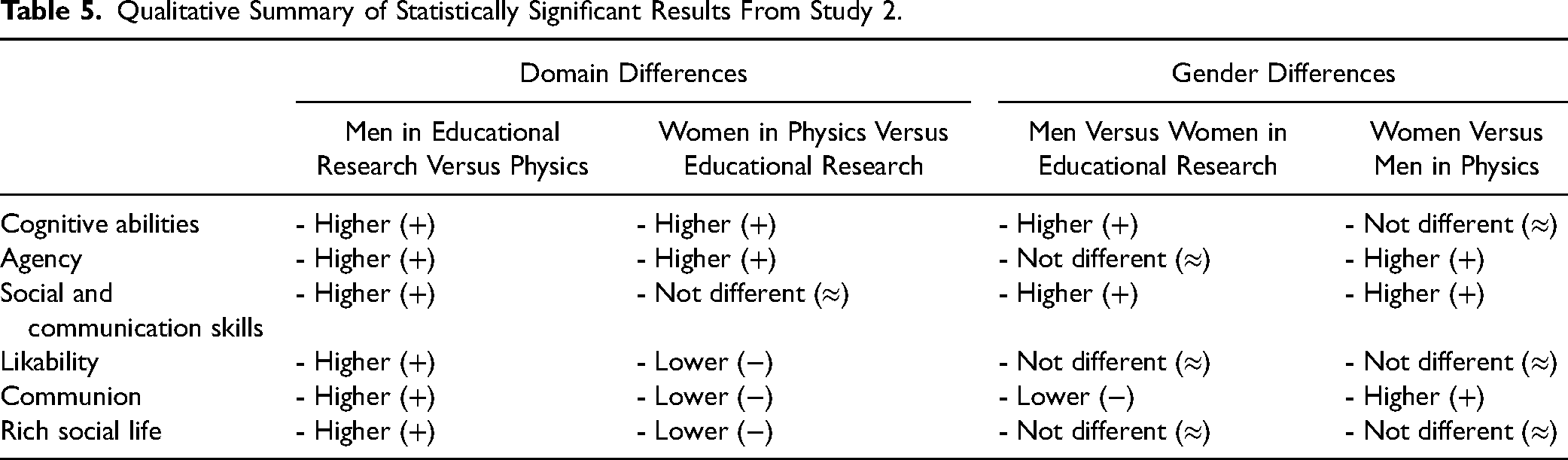
Table 5 shows a qualitative summary of our results, with the first two columns relating to H2a and H2b. Supporting H2a, the female researcher in physics was perceived as more competent (i.e., higher cognitive abilities and more agentic) but less warm (i.e., less likable, less communal, and a poorer social life) than the female researcher in educational research. However, both women did not differ in their ascribed social and communication skills. Partly contradicting H2b, the male researcher in educational research was perceived as warmer (i.e., higher social and communication skills, more likable, more communal, and richer social life) and even more competent (i.e., higher cognitive abilities and more agentic) than the male researcher in physics. The male researcher who disconfirmed gender stereotypes by working in educational research was thus evaluated more positively than his man physics counterpart on all dimensions. He was further perceived as smarter than the women researcher in educational research (partly supporting H3). The female researcher who disconfirmed gender stereotypes by working in physics was ascribed higher cognitive abilities and higher agency, but she was penalized by being perceived as less likable, less communal, and less social. Overall, these findings indicate larger costs for women than men researchers working in gender stereotype-incongruent domains.
Qualitative Summary of Statistically Significant Results From Study 2.
General Discussion
Our first study revealed that educational research was associated with stereotypically feminine characteristics and physics with stereotypically masculine characteristics (see also Bruun et al., 2018). Nonetheless, men researchers persist in women-stereotyped domains (e.g., educational research) and climb the academic career ladder, whereas women researchers drop out more often, leading to the phenomenon of vertical segregation also in academic domains initially dominated by women (e.g., Abs et al., 2020; Ceci, 2018). In order to better understand this phenomenon, we used an experimental vignette study to explore participants’ perceptions of women and men researchers working in domains in which they were outnumbered. On the basis of how academic domains affect perceptions of students related to this domain (e.g., Kessels, 2005) and backlash effects in work and organizations (e.g., Rudman & Phelan, 2008), we expected (a) women researchers in physics to be perceived as more competent but less warm than women researchers in educational research, and (b) men researchers in educational research to be perceived as less competent and warmer than men researchers in physics.
Strikingly, the data from our second study revealed no penalties but only benefits for men researchers working in the gender stereotype-incongruent field, in contrast to women researchers (see first two columns of Table 5). In detail, men researchers in educational research (vs. physics) were ascribed higher cognitive abilities, agency, social and communication skills, and communion; they were ascribed a richer social life; and they were perceived as more likable. These positive evaluations clash with earlier research revealing negative evaluations for men (successful) in women-stereotyped occupations such as being less respected or perceived as ineffectual (e.g., Heilman & Wallen, 2010; Moss-Racusin & Johnson, 2016; but see also Meltzer & McNulty, 2011). Women researchers in physics (vs. educational research) in turn were ascribed higher cognitive abilities and agency, but they were ascribed lower communion and a poorer social life; and they were perceived as less likable, replicating backlash effects as found for women in typically masculine positions, such as managers (e.g., Rudman & Phelan, 2008). The consistency of the effects across the different dimensions of competence and warmth (with the exception of social and communication skills) corroborated the robustness and relevance of our unexpected findings.
Role prioritization model (Haines & Stroessner, 2019) may help speculate about this gender difference in the perception of researchers in gender stereotype-incongruent fields: if men researchers in educational research are perceived as fulfilling their “primary” role, that is, being the breadwinner, and if the field of educational research signals some complementing communal traits, they should be evaluated particularly positive according to the model. Women researchers in physics, in contrast, may be perceived as neglecting their “primary” role as caregivers causing the observed backlash effects. Nonetheless, our findings call for replication studies in order to estimate the risk of Type S errors, that is the risk of finding an effect estimate in the wrong direction (Gelman & Carlin, 2014).
The ascription of agency to women and men researchers in gender stereotype-incongruent fields might be explained by the idea that their professional choice required agentic traits, such as being assertive, bold, and willing to take risks. However, the strongest ascription of cognitive abilities to men researchers in educational research is puzzling. Men researchers in educational research seem to receive some sort of evaluative boost for their atypical academic domain choice compared with men in physics and women in educational research. Such an evaluative boost for men who violate gender stereotypes was already found for men professors described as “particularly nurturing,” a stereotypically feminine trait (Meltzer & McNulty, 2011), working men becoming fathers (Cuddy et al., 2004), men fashion writers (Bettencourt et al., 1997), and men leaders showing a transformational leadership, a style consisting of communal behaviors (Hentschel et al., 2018). Please note that these men violated gender stereotypes but still fulfilled their social role as breadwinners providing a first explanation for the boost effects (Haines & Stroessner, 2019).
Expectancy-violation theory (e.g., Jussim et al., 1987) might provide a second explanation. It predicts that information about a person that unambiguously and positively violates stereotype-based expectations may lead to a more positive evaluation of that person compared to others who were expected to be rated positive all along. In this vein, a man's decision for a feminine-stereotyped academic domain may lead to the assumption that he is particularly good in this feminine-stereotyped domain. However, along the same line of reasoning, women in physics should be perceived as particularly good—and better than men—in physics, an effect we only descriptively found (ascribed cognitive abilities women in physics M = 5.15 vs. men in physics M = 4.89). Thus, further research is needed to understand why men researchers in educational research received this extraordinary and moderate to large boost in ascribed cognitive abilities (in line with expectation–violation theory), whereas women in physics compared with men in physics did not or to a much lesser extent.
Researchers’ warmth ratings were mostly driven by the academic domain. Only for the communion ratings the stereotypical gender difference in favor of women (e.g., Eagly et al., 2020; Haines et al., 2016) was found. However, this effect was less than half (partial η2= .036) the size of the effect of the academic domain (partial η2= .091, see Table 4) corroborating the importance of academic domains for researchers’ perceptions. A significant interaction effect between researcher's gender and domain was only found for the ascribed social and communication skills. It indicated the highest skills rating for men researchers in educational research, again in line with the role prioritization model (Haines & Stroessner, 2019) and expectancy-violation theory (Jussim et al., 1987). Moreover, the main effect of the academic domain on likability revealed that women researchers were most liked if they worked in a gender stereotype-congruent domain while men researchers were most liked if they worked in a gender stereotype-incongruent domain. In contrast with research on the perception of men in childcare work (Sczesny et al., 2022), as preschool teachers or social workers (Halper et al., 2019), we thus found no hints of a gender bias against men or a more favorable evaluation of women. This might be explained by the fact that we focused on prestigious careers inside academia and not less prestigious careers outside academia, or the evaluation of men and women in general (e.g., Dunham et al., 2016; Eagly et al., 1991; Skowronski & Lawrence, 2001). Support for action against gender imbalance in a career has been found to be stronger for high-status than low-status careers (Block et al., 2019).
The unexpectedly positive evaluation of men in educational research but not of women in physics by members of the general public provides a novel possible explanation for why men climb the academic career ladder in women-dominated domains, whereas women in men-dominated domains drop out more often. According to the BIAS map (Cuddy et al., 2008), persons perceived as high on both competence and warmth such as men in educational research are admired and supported in their career, whereas women in physics, who are perceived as competent but less warm, are at risk of being envied instead of promoted. Members of the general public thereby might affect researchers’ career development in their role as friends, family members, neighbors, or simply representatives of society. Against the background of “competing belonging” (Thoman et al., 2014), we might speculate that the feeling of being less liked—and therefore feeling less belonging—might be of particular importance for women when deciding to leave an academic career in a men-dominated domain such as physics. Please note that we did not study researchers’ decision-making process itself or use a sample of faculty members who more directly might speed up a glass escalator for men in women-dominated occupations. Whether the findings can be fully generalized to the latter sample needs to be tested in future research. Earlier research showing similar beliefs and stereotypes about science in academics and members of the general public (e.g., Handley et al., 2015; Leslie et al., 2015; Meyer et al., 2015) as well as the results from our second robustness check support this idea.
In general, participants reported very positive attitudes toward women in science (M = 5.65 on a scale from 1 to 6; see also Dietrich, 2013). Our findings on the perception of researchers, however, indicated a hidden gender bias in ascribed cognitive skills against women in an initially women-stereotyped academic field. This finding is in line with other research that showed that only those who believed that a gender bias was no longer a problem in their field (i.e., veterinary medicine in the UK) produced a gender bias in the competence, worth, and suggested salary ratings of fictitious women versus men vets (Begeny et al., 2020). Simply the representation of women in an academic field as well as an overall positive attitude toward them thus do not seem to protect a field against gender bias (see also Bernstein et al., 2022).
Recent research has identified that the belief that success in a domain requires some innate ability or brilliance functions as a barrier that prevents girls and women from succeeding in these domains (e.g., Hannak et al., 2023; Heyder et al., 2021; Leslie et al., 2015; Muradoglu et al., 2022). Such beliefs are particularly pronounced in physics, math, and philosophy. The relatively constant proportion of women in physics across academic career levels (Düchs & Ingold, 2018; see also Ceci et al., 2014) suggests that such beliefs may be a barrier for women in the early stages of an academic career (e.g., when they must choose their major or decide whether to pursue a doctorate) but not necessarily for those who are already in the system. This thought lines up with our finding that women researchers in physics were perceived to be as smart as their men counterparts. However, our results also indicate that being a female researcher who is successful in a men-dominated domain takes its toll somewhere else. As previously reported in organizational research on managers (e.g., Rudman & Phelan, 2008), these women were perceived as less likable, less communal, and having a poorer social life than women researchers in gender stereotype-congruent domains. Thus, backlash effects for women who disconfirm gender stereotypes also seem to exist in academia.
Limitations and Future Research Directions
Our second study examined the perception of researchers in a sample from the general public. Our robustness check suggested that the effects we found depended very little on whether the participants had worked as researchers themselves. In the sample of participants without personal research experience, the effects were descriptively such as those found in the full sample. However, the subsample with personal research experience (n = 25) was too small for separate analyses, limiting insights that might be specific to this population. Therefore, future research needs to study whether personal research experience reduces the backlash effects for women in physics and the boost for men in educational research, as might be expected because of universities’ affirmative action policies (e.g., Henningsen et al., 2022).
Future research on academic samples is also needed to further explore the practical relevance of the effect in the academic system. The questions to be addressed are whether researchers experience the revealed effects by themselves, whether there are effects on their career choices (as to be expected based on e.g., Diekman et al., 2010 or Thoman et al., 2014) or, if in a senior position, hiring decisions or on how they support and mentor junior researchers who are pursuing an academic career. In this context, it would also be interesting to study which one of the Big Two (i.e., either competence or warmth perception) drives these career-related processes and to what degree. Generally, in comparison with competence information, warmth information is preferentially processed and has a stronger impact on whether to approach a person or not (e.g., Abele & Bruckmüller, 2011). In the academic context, however, perceived competence might be more important than warmth as, for instance, agency is believed to be more strongly associated with success in science than communion (Ramsey, 2017).
Furthermore, we focused on physics and educational research as two domains with approximately opposite gender distributions. Research on other domains with unequal gender distributions is needed to demonstrate the generalizability of our findings. In Germany, it would be interesting to include psychology, for instance, because the proportion of women students in psychology is 75% (Federal Statistical Office Germany, 2020), and excellent grades in high school are simultaneously required for students to gain admission to a psychology program. Thus, psychology might be associated more strongly with competence than educational research, although the two domains have roughly similar proportions of women. This would also allow replicating the effects in countries without a direct equivalent of “educational research.”
Finally, we restricted our experimental design to the comparison of men and women. In future research it seems fruitful to take over an intersectional perspective studying the simultaneous interplay of gender, ethnicity, parental education background, and other social group memberships, that have already been found to influence, for instance, women's experiences in STEM domains (e.g., Ireland et al., 2018; Muradoglu et al., 2022).
Practice Implications
Addressing the research questions above on the practical effects and mechanisms of our findings is an important prerequisite for deriving practical implications. Although future research is still needed to show whether our findings affect researchers’ career choices as well as mentor's behavior and support as to be expected based on the BIAS map (Cuddy et al., 2008), our findings can now already raise awareness of a men's advantage in ascribed cognitive abilities in academic domains that are stereotypically perceived as feminine and initially dominated by women. Because other studies have suggested that gender discrimination is driven by those who do not believe in gender bias (Begeny et al., 2020) or those who justify the gender hierarchy (Rudman et al., 2012), members of these groups might be particularly important for providing information about the effects we revealed here.
For many years, there has been a large effort to attract and keep women in STEM such as changing recruitment strategies or implementing mentoring, networking, and professional development offers (e.g., Casad et al., 2021). With their overrepresentation at the student level, women in typically women-dominated domains might not be perceived as a disadvantaged group and are thus likely not the focus of affirmative action for reducing discrimination in academia (Henningsen et al., 2022). Similarly, public support for action tackling gender imbalance in women-dominated fields has been found to be smaller than for men-dominated fields (Block et al., 2019). Our findings encourage initiatives that strive for at least a constant proportion of women across academic career levels, not only in domains where that proportion is low in early career stages (as it is in physics) but also in those with an initially high portion (as it is in educational research), as the German Research Foundation does (German Research Foundation, 2017).
Conclusion
Our experimental vignette study showed that women researchers in physics were rated as more competent than women researchers in educational research, but women researchers in physics were penalized for their gender stereotype-incongruent choice by being perceived as less warm. However, men researchers in educational research were perceived as both warmer and more competent than their men counterparts in physics, and smarter than women researchers in educational research. These findings suggest rewards instead of penalties for men pursuing academic careers in women-dominated careers, likely contributing to the increasing gender gap in academic careers in stereotypically women domains, too. The findings shift attention to a potential, subtle gender bias against women in academic domains in which they were initially overrepresented.
Footnotes
Author Note

Authors’ Contributions
Anke Heyder conceptualized the studies, performed the analyses for both studies, and collected the data for Study 1. Olivia Kortzak supported in designing Study 2 and performed the material preparation and data collection for Study 2. Anke Heyder drafted and revised the manuscript. Both authors read and approved the final manuscript.
Declaration of Conflicting Interests
The author(s) declared no potential conflicts of interest with respect to the research, authorship, and/or publication of this article.
Funding
The author(s) received no financial support for the research, authorship, and/or publication of this article.