



Abstract
This article analyzes the cultural politics of the vacillating imagination of “us” represented in Black Panther, released in 2018. This popular cultural text centralizes Blackness in that it refers to instances of Black oppression in the early 1990s. Amid the contradiction between the film's Black-centered content and the form of the Hollywood superhero genre, the imagination of “us” in the film expands and shrinks. Drawing on concepts developed by Fredric Jameson and Étienne Balibar, including imaginary resolution, utopian potential, ideological containment, and equaliberty, this article critically examines the ideologies in the text. When it comes to the expansion of “us,” the article explores the utopian potential in the representation of the radical villain. In terms of the shrinkage of “us,” it investigates the function of ideological containment in the Hollywood superhero movie by focusing on the representation of the hero, and the portrait of South Korea as a spectacular background.
Introduction
Black Panther, a Marvel Cinematic Universe film released in 2018, achieved substantial financial success (earning $1.36 billion in worldwide box office revenues). The most remarkable feature of this Hollywood superhero film is that it foregrounds and centralizes Blackness. Most of the actors and production crew members are Black, including director Ryan Kyle Coogler, as well as the principal villain and hero (Bucciferro, 2021).
The main narrative of Black Panther is the battle between the hero, T’Challa, and the villain, Killmonger, who are at odds over the fictional kingdom of Wakanda's throne and the political and diplomatic direction of the state. Having exploited an abundant substance called vibranium that is endowed with superpowers, Wakanda, located on the African continent, is in a position to achieve rapid economic and technological development. With the power to isolate itself from the world, Wakanda has enjoyed prosperity, free from the ups and downs of world history.
Although this movie is set in a fictional kingdom, it evokes the Black American history of racial oppression in the early 1990s. In particular, the movie incorporates the notorious cases of racial discrimination involving Rodney King, a Black man beaten by white police officers in 1991, and Latasha Harlins, a Black girl killed by a South Korean (hereafter Korean) woman in 1991. Additionally, one of the narrative backgrounds is the LA riots, Black people's violent response to racial discrimination and economic oppression in LA in 1992. In other words, the movie presents a particular interpretation of historical events to the audience.
It has been several years since the movie was released, and the popularity of the film itself seems to reflect the progress in the anti-racism movement. A Marvel Cinematic Universe film featuring an East Asian hero and a villain was released in 2021, Shang Chi, likewise indicating the Hollywood film industry's efforts to promote the representation of racial and ethnic minorities. However, Black Panther remains a more critical text to analyze here and now due to race-related crises in recent years, including the murder of George Floyd, the rise of the Black Lives Matter movement, and anti-Asian hate crime perpetrated by not only whites, but also Blacks amid the Covid-19 pandemic in the early 2020s. These events call for a close reinvestigation of the ideologies of racial politics embedded in popular cultural texts.
This article analyzes the cultural politics of the vacillating imagination of “us” represented in Black Panther. Amid the contradiction between the narrative's Black-centered content and its Hollywood superhero genre, the imagination of “us” in the film expands and shrinks at the same time. In analyzing how representation functions in the movie, I find the lenses put forward by Fredric Jameson and Étienne Balibar particularly useful.
Jameson (2002, 2007) provides the theoretical tools necessary for an ideological critique of popular culture. He proposes that popular cultural texts offer imaginary solutions to real contradictions in society. Thus, the texts contain both the ideologies that perpetuate the existing system as well as utopian ideas. Following Jameson's theorizations, this article assumes that Black Panther offers imaginary resolutions to certain cases of racial discrimination in the early 1990s in the US. Additionally, it examines how the movie facilitates the identification of both the utopian dimension of Black-centric racial representation and its ideological containment strategies. Emphasizing that elements of resistance are also inherent in the dominant ideology, Balibar (2014) postulates that “equaliberty” (an articulation between equality and liberty) functions as a privileged value of ideal universality among the masses.
This article combines the theories of Jameson and Balibar to explore how Black Panther's utopian dimension appears as an articulation between liberty and equality. Moreover, it examines the strategies of ideological containment by investigating how certain forms of illiberty and inequality are embedded in the text. By applying these theories to the analysis of the popular cultural text, this article seeks to analyze the working ideologies of racial politics around the construction of “us” in everyday life.
In particular, I explore the expansion of the imagination of “us” by highlighting the utopian potential in the representation of “them,” that is, the villain Killmonger. Next, I examine the reduction of the imagination of “us” by analyzing the function of ideological containment in Hollywood's Black superhero movies, and specifically in the representation of the hero T’Challa. Lastly, I explore the racial representation of those excluded from both “us” and “them” by shedding light on the Korean scenes, wherein Korea is depicted as a spectacular backdrop. But first, I will give a review of the existing literature on Black Panther.
Literature review
Existing studies on the Black Panther movie
Early Black Panther comics introduced the Black Panther character for the first time in issues 52 and 53 of Fantastic Four in 1966, followed by the solo series, Jungle Action Featuring: The Black Panther, in 1973. The existing scholarly inquiries into these comics emphasize their achievements in positively representing Blackness and embracing anti-racism by foregrounding conflicts with racialized supervillains (Peppard, 2018; Posada, 2019; Schulte and Frederick, 2020). However, the comics have also been critiqued for embodying a “tendency to appropriate the Black body in the service of white desires and anxieties” (Peppard, 2018: 62), as well as reinforcing “stereotypes by presenting Blacks as angry, savage, or poorly educated” (Schulte and Frederick, 2020: 312).
The Black Panther comics written by Hudlin from 2005 to 2009 took a different approach compared to the early ones and closely resemble the 2018 Black Panther movie (Schulte and Frederick, 2020). The movie's depiction of Wakanda as a wealthy, resource-rich, high-tech utopia unaffected by foreign power is borrowed from his work. According to Posada (2019), Hudlin's work represents a Black superhero that is less accommodating to the white gaze. His Black Panther character is no longer a victim of institutionalized racism but a symbol of African superiority in the West and a source of power in and of himself. Unlike the early Black Panther comics projecting the perspectives of African American artists and writers, Hudlin's “African, non-American superhero serves as a reminder of the two-ness of the American population still being oppressed” (Posada, 2019: 629).
Given the mixture of African cultural elements and science fiction, Asante and Pindi (2020) maintain that “Afrofuturism” emerges as a key theme in the Black Panther movie. The main language used by the characters is English spoken with Xhosa accents and pronunciations; a mixture of African costumes and rituals, hip-hop culture and virtual high-tech technologies are represented. Thus, the movie projects “Afrofuturistic (re)imagination of an interconnected past by tapping into mythical memory, through the future, for the present” (Asante and Pindi, 2020: 211). In this way, the fictional nation, Wakanda, not only enables viewers to reimagine a “pan-African cultural heritage” (Bucciferro, 2021: 171) but also imaginarily “stands in for this vision as it reflects a Black nation free from the influences of white hegemony” (Johnson and Hoerl, 2020: 271). 1
Black-centered narratives are not uncommon in film history. During the early to mid-1970s, Hollywood produced “blaxploitation” films in response to the demands of the Black community. At this time, African Americans were experiencing significant historical events, like the US civil rights movement, which resulted in the genre's widespread popularity (Lawrence, 2012). Benash (2021) maintains that Black Panther and blaxploitation intersect in three ways: (1) both address Black political weakness, (2) both appeal to white audiences, having been produced with money from white investors, and (3) both give career opportunities for Black talents in the movie industry.
In particular, Robinson's (1998) critique that blaxploitation represents only fantastic, idealized landscapes and conceals actual realities applies to Black Panther. According to Benash (2021), this movie also focuses on the portrayal of selected fictional aspects of Wakanda while masking Wakanda's specific political and economic philosophy, its inner conflicts and its relationship with other African nations. Thus, the film is oriented to the lived experience of Blacks in the US while neglecting the lives of Blacks in Africa by centering this unrealistic African nation.
However, in comparison to its surrender to blaxploitation that provided voyeuristic pleasure by representing women's naked bodies, Black Panther shows progress in gender representation, albeit only in part. Bucciferro maintains that the movie emphasizes women's agency and sisterhood and positively depicts female characters who “fully participate in the technological, military, political, and intelligence fields” (2021: 117), even though it still fails to overcome the dominant values of heteronormativity and heteropatriarchy. Additionally, several existing studies have mentioned that Black political agency in the narrative of this film contributes to Black empowerment by representing visions of Black liberation politics beyond the gaze of whiteness and coloniality (Benash, 2021; White, 2018).
Nevertheless, many studies devote more attention to critical analysis of the text through the lens of postcolonial cultural critique (Asante and Pindi, 2020; Johnson and Hoerl, 2020; Žižek, 2018). For example, Asante and Pindi point out that the movie reduces various languages, cultures and histories of Africa and African diasporic perspectives to a unified fictional visual aesthetic in line with “Western neocolonial and cinematic fantasies of Africa” (2020: 221).
Specifically, a few critical scholars have paid attention to the character of white CIA agent Ross, who restrains radical Black anticolonialist Killmonger and contributes to Wakanda's opening to the world through a close relationship with T’Challa (Johnson and Hoerl, 2020; Žižek, 2018). According to Johnson and Hoerl, “Ross's involvement in the conflict stands in for the history of US-backed coups designed to overthrow governments inimical to the US” (2020: 274). Žižek (2018) also points out that Ross, with whom white viewers can identify, could play a significant role in suturing the tension between African aesthetics and global capitalism. In other words, this film's happy ending tends to sustain the dominant neoliberal capitalist ideology by absorbing Black empowerment into this fictional rewriting of Black history.
Blackness is not a fixed essence but “a space of transnational cultural construction and ongoing formation with multiple axes/intersections in which historical narratives, local politics, and self-identifications are enunciated and debated” (Asante et al., 2016: 368–9). The struggle for hegemony regarding the construction of Blackness occurs within the realm of Black popular culture. In this sense, an analysis of Black popular cultural texts enables us to approach the Blackness-making process and investigate the imaginary construction of “us” in the context of Blackness.
The previous studies on Black Panther introduced above have primarily focused on either praising the anti-racism implications of the film or criticizing its Western or American centricity. In contrast, this article seeks to embrace the ambivalence and contradictions that exist within this popular cultural text. First, the article aims to illuminate the possibility of expanding the imagination of “us” by reinterpreting the film's depiction of inclusive radical Black activists. In doing so, it attempts to capture how the movie maximizes the possibility of expanding the ideal universality of the utopian imagination of “us.”
Like the existing studies, this article also critically analyzes the Western or American centricity of the film. However, it focuses on the reduction of “us” driven by the superhero genre of Disney's global cultural conglomerate by shedding light on the illiberty and inequality embedded in the text. In particular, it offers a very rare exploration of the representation of Korean(ness) in the film. Despite the city of Busan being Black Panther's longest-lasting setting aside from Wakanda, it has received little attention in previous research. Therefore, this study of the movie also offers a critical perspective based on the social position of an East Asian which goes beyond the limitations of previous Western studies. In analyzing the complex and contradictory aspects of this popular text, I now turn to the theories of Jameson and Balibar.
Synthesizing Balibar and Jameson for a new theoretical framework for ideological critique of popular cultural texts
This section will elaborate on the basic theoretical framework for the ideological critique of popular cultural texts. By developing Althusser's concept of ideology “representing individuals’ imaginary relation to their real conditions of existence” (2014: 181), Jameson (2002, 2007) attempts to dialectically renovate the relationship between utopia and ideology. He maintains that literature, art, and cultural artifacts produced in a given historical period under late capitalism can construct a symbolic act as an “imaginary resolution of a real contradiction” (2002: 62). Cultural texts are not solely the products of individual authors or creators’ unique abilities and perspectives; rather, they are constructed through collective class discourses that reflect people's desire for utopian ideals. Thus, popular cultural texts provide imaginary solutions for achieving utopian ideals and managing collective anxieties or fears. To mitigate people's negative affects or feelings that social contradictions can induce, popular cultural artifacts should thus reflect “the deepest and most fundamental hopes and fantasies of the collectivity” (Jameson, 2007: 40). Thus, popular culture functions as “a theater of popular desires, a theater of popular fantasies” (Hall, 1993: 118).
However, the resolution offered in the text is not for the real contradiction. Jameson points out that strategies of ideological containment prevent totality from being fully visible, where containment is defined as that which “allows what can be thought to seem internally coherent in its own terms, while repressing the unthinkable which lies beyond its boundaries” (2002: 38). Accordingly, a variety of contradictions could be condensed into a utopian imagination in a popular cultural text that includes ideological limits that could ironically cover social contradictions.
Jameson (2007) applies his theory to Hollywood films. For example, he argues that the film Jaws (1975) represents a utopian idea that seeks to establish a new political regime in response to the economic uncertainty in the US in the 1970s. The death of Quint, implying personal small business and the US after the Second World War, provides the imaginary resolution by fictionally destroying the traditional American image. Similarly, the rise of a new political-economic union is depicted by the collaborative extermination of Jaws by Hooper and Brod, who represent the bureaucratic technocracy of law and order and multinational corporations, respectively.
At the same time, the narrative functions as a strategy of ideological containment to reconcile social contradictions by promoting the combination of values represented by the two surviving characters, thus transforming class antagonisms between the rich and poor into innocent camaraderie. Following Jameson's framework, this article investigates the imaginary resolution of social contradictions, the utopian dimension, and strategies of ideological containment in Black Panther. To further enhance the analytical framework, I will attempt to undertake a synthesis of Jameson's theory with Balibar's “equaliberty” theory.
According to Balibar (2012), for an ideology to gain dominance, it should fulfill and secure the values and needs of the majority of people. Thus, the dominant or ruling ideology is not produced only by dominators and not immediately delivered to the people. Rather, it is the experience lived not by the ruling class but by people, mixed with their recognitions, approvals of and resistances to the given social order. In this sense, the dominant ideology in a given society always embodies the specific universalization of the imaginary of the oppressed in response to the social reality. Since this universalization cannot be realized without a potential reference to the ideal universality of people, only imaginaries reflecting their conventional wisdom or common sense can construct voluntary obedience to them, leading to subjugation and the (re)production of the existing structure.
This resonates with Jameson's theory that assumes a text filled with the utopian imaginary or potential based on popular utopian impulses against social contradictions. In analyzing the specific universalization of the imaginary of the oppressed, it is worth noting that Balibar (2014) considers “equaliberty” (equality + liberty) to be a privileged signifier of universality (Kang, 2017). While Jameson's theory of ideological critique originated in literary criticism and was later expanded to include popular cultural texts, Balibar's theory of “equaliberty” emerged from a critical interpretation of the 1789 Declaration of the Rights of Man and of the Citizen. Balibar contends that signifiers such as liberty, equality, and fraternity, which galvanized the politics of insurrection of the masses, are inscribed in the declaration. Thus, “equality” and “liberty” are unique signifiers in that they are necessary potential references for ideal universality.
Analogously to the manner in which popular cultural texts have inherent contradictions between their utopian aspirations and their strategies of ideological containment, however, the declaration has contradictions surrounding “liberty and equality.” The pursuit of these values is limited by the overdetermination of social forces, including the prevailing ideologies of the time. In terms of achieving universal social citizenship inscribed as an ideal in the declaration, there have always historically been various interpretations of equality and liberty employed by both the oppressor and the oppressed. Limited and in conflict within a specific historical context, these values do not always align, but instead compete fiercely on hegemonic battlefields.
It is significant that the concept of “equaliberty” can be utilized to generate recurring events where those who have been excluded from social rights assert their claims and achieve universal social citizenship. Balibar (2014) argues that equality and liberty are the same. They must be mutually conditioned and guaranteed. This does not mean that they are essentially and a priori identical, but that the oppression of one necessarily results in the oppression of the other. In other words, liberty is impossible under inequality, just as equality is impossible under illiberty. Liberty established on the condition of economic inequality is bound to be limited liberty only for privileged class groups. The equality that suppresses racial or sexual liberty presupposes limited inequality inclined to the existing normative social order.
“Equaliberty” is constrained by various contradictions in social reality, including those related to nation-state, class, gender, and race. Despite these limitations, the concept of “equaliberty” contributes to incessantly highlighting and discovering the existing inequality and illiberty in a political conjuncture, thus leading to the endless reconstruction of historically given problematic articulations of equality and liberty. In doing so, critical analysis of the value of “equaliberty” embodied in a specific text can provide a condition for the possibility of universal solidarity.
This article assumes that the Black Panther movie advocates for the values of liberty from racial discrimination and economic inequality, as a consequence of the far-reaching discursive effects of the declaration, while also mediating the diverse ideological effects on (il)liberty and (in)equality. In this sense, Balibar's theory could act as a tool for analyzing ideologies within the text as it enables us to explore a specific universalization of the imaginary that is projected onto popular cultural texts. The utopian dimension, a domain of Jameson's theory, can be analyzed by investigating which ideal values of equality and liberty the representation pursues in particular ways. The text's strategies of ideological containment masking or justifying existing oppression can also be explored by examining the embedded inequality and illiberty. Figure 1 provides a simplified visualization of the theoretical framework for ideological critique derived from the combination of Jameson and Balibar theories.
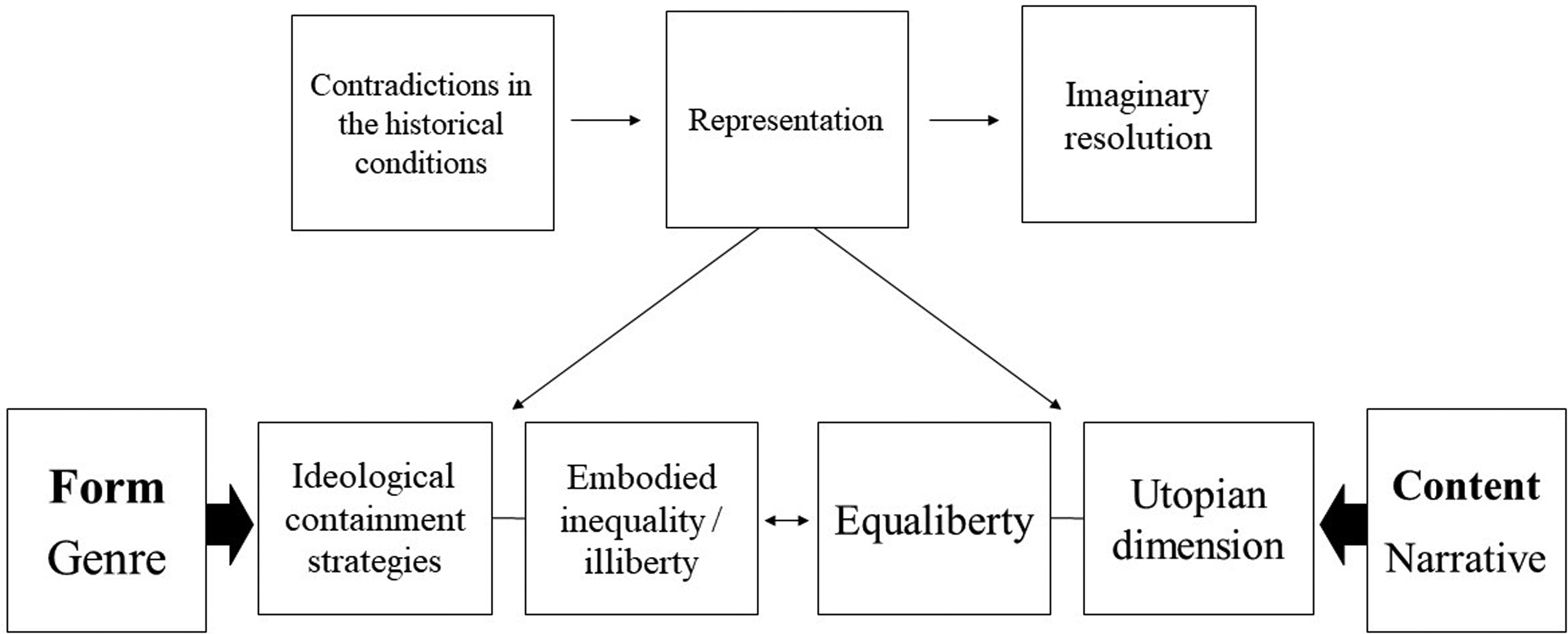
Theoretical framework for ideological critique
The narrative of the movie provides an imaginary solution to racial inequality by problematizing the oppression of Black people in the context of the 1992 LA riots. While this film has a Black-centered narrative on a content level, it is ideologically limited by its form, the genre of superhero movies that is dependent on the enormous capital of the giant Disney conglomerate with its distinctive place in the US cultural industry. The film's portrayal of multiple values of “equaliberty” around the Black centrality allows us to analyze the fluctuating imagination of “us” under the contradiction by examining who is included and excluded.
The narratives of the superhero genre typically include antagonism between the good heroes fighting on “our” side and the malevolent villains opposing us on “their” side, leading the audience to identify with the former's position and orientation as “us” (Brown, 2016). However, based on its Black centrality, this film goes beyond the dichotomy between good and evil by revealing the utopian potential inherent in Black villain characters originally regarded as not “us” but “them.” The next section highlights the utopian dimension of the villain, Killmonger, which pursues a specific “equaliberty” in terms of racial politics, thus expanding the imagination of “us.”
Representation of “them”: the utopian potential of Killmonger
This section will investigate the utopian potentials of Black Panther by exploring the representation of the core villain, Killmonger, considered as “them.” Given that the birth and self-justification of Killmonger as a villain are attributed to the 1992 LA riots, his appearance symbolizes the violent approach to solving the problem of racial oppression. In the second sequence, the film flashes back to 1992. The scene shows N’Jobu's room in Oakland, where the Black Panther Party was founded in 1966, at the time of the riots following the Rodney King case.
N’Jobu is a prince of Wakanda and father of Killmonger. Protesting against Wakanda's King T’Chaka, who attempts to send him to Wakanda under escort for helping the villain Klaue steal vibranium, N’Jobu identifies the situation as a historical conjuncture in which, as he says, Black “leaders have been assassinated, communities flooded with drugs and weapons. They are overly policed and incarcerated.” He is a radical, aiming to overthrow the dominant racist system by means of an armed uprising using vibranium after encountering the harsh and oppressive reality. Killmonger, following the death of his own father, killed by T’Chaka, has realized the hidden truth about Wakanda and has become a Black radical by inheriting the violent political cause of N’Jobu. Having been trained as a US soldier and participated in the war in Afghanistan, he has acquired the skills to carry out an assassination and overthrow a government.
In line with the superhero movie genre, Killmonger, by justifying such a violent solution, is described as an evil villain who must be eradicated. For the sake of his cause, he has killed his girlfriend and is willing to sacrifice children. Accordingly, the end of the narrative, his death and the hero's triumph, provides an imaginary solution to LA riot that erupted in a violent form, thus ideologically opposing violence or a violent political orientation.
However, it is significant that he is not just a villain motivated by pure malice or mental illness, but one with a great cause, thus shedding light on the seriousness and historicity of oppression against Blacks. Killmonger's radical political position is expressed to the council leaders upon his surrender to Wakanda through lines such as: “Y’all sittin’ up here comfortable. Must feel good. It's about two billion people all over the world that looks like us. But their lives are a lot harder.” This is depicted more strongly when he delivers a speech to the council after seizing the Wakandan throne. You know, where I’m from. When Black folks started revolutions, they never had the firepower or the resources to fight their oppressors.… I know how colonizers think. So we’re gonna use their own strategy against ’em. We're gonna send vibranium weapons out to our War Dogs. They’ll arm oppressed people all over the world. So they can finally rise up and kill those in power, and their children. And anyone else who takes their side.… The world's gonna start over and this time, we’re on top. The sun will never set on the Wakandan empire.
Obviously, this pursuit of equality and liberty is problematic. While liberation is regarded as a zero-sum game that inevitably entails the deprivation of freedom for other races, equality relies on an ambiguous identity among Black people based on having Black skin. In other words, his pursuit of “equaliberty” assumes a fixed and essentialist notion of Black identity without addressing the hierarchical order of the complex structure.
Meanwhile, the utopian potential of pursuing radical “equaliberty” that the genre has masked can be excavated in his representation. In several scenes, his radicality includes racial equality beyond the situation in LA in 1992. Looking at African artifacts stolen by the Western Empire and exhibited in the London Museum in the scene where he first appears, he asks the curator, who has an English accent, a symbol of colonialism: “How do you think your ancestors got these? You think they paid a fair price? Or did they take it, like they took everything else?”
In this way, this large-scale Hollywood film funded by industrial capital investments brings the history of African-Black oppression, going beyond the US situation, into the field of popular culture. This scene invokes its orientation toward liberty from universal Black racial oppression beyond the confines of time and place, projecting the “transnational Blackness that resists the cultural dislocation, estrangement, and alienation experienced by Black bodies everywhere” (Asante and Pindi, 2020: 221).
Moreover, the portrayal of Killmonger's death casts “doubt on the film's obvious reading and solicit[s] us to deeper reflection” (Žižek, 2018). After losing his final battle with T’Challa, who says he can heal him, Killmonger refuses, speaking the following lines: “Just bury me in the ocean with my ancestors that jumped from the ships. ’Cause they knew death was better than bondage.” This is an exceptional scene in that it summons the recollection of slavery by identifying Killmonger with the victims of the slave trade. It visualizes Black radicals who violently resisted structural violence or chose to escape the available reality through suicide as understandably resistant subjects, instead of their being seen as mere fanatics.
This representation of Killmonger resonates with Toscano's (2010) scholarly work, which seeks to discover the value of subversion in radical subjects, including slavery abolitionists, who were demonized as irrational “fanatics.” Toscano uncovers the radical potential of those stigmatized as fanatics for their irrational activism, such as their refusal to compromise on the existing order and their steadfast affirmation of ideal principles advocating for equality and liberation, as moments of social transformation.
The other point that deserves attention is the way the hero, representing “us,” treats Killmonger, representing “them.” T’Challa explicitly demonstrates his perception of Killmonger in the line, “He is a monster of our own making.” Although the basic antagonism of the superhero movie, “hero versus villain,” is dominant in the film, T’Challa does not wholeheartedly repel his enemy but emphasizes that Wakanda is responsible for letting him become a villain. Killmonger's presence is a key motivation for T’Challa's critical reflection on Wakanda's isolationism and ultimate decision to engage with the world.
The film as a whole portrays racial and economic oppression as underlying causes that ultimately force Black people to become violent villains or commit crimes. For example, in the scene where T’Challa rescues his ex-girlfriend Nakia from the kidnappers in the Sambisa Forest in Nigeria, he kills adult criminals but lets the boy who was kidnapped and forced to take part in the crime go. Additionally, the film does not negatively depict the children in Oakland, who see T’Challa's aircraft and say they’d like to steal it and sell it on eBay.
Contrary to the majority of the typical superhero genre, in which the protagonist seeks to expel violent evil from the community or society, T’Challa embraces the violent “them” as a part of “us” who have been forced to become violent to combat an unequal social structure in an attempt to liberate them from this. 2 In other words, the film attributes the problem of violent action or expression to racial and economic inequality rather than personal evil.
The sequel, Black Panther: Wakanda Forever, also reiterates the narrative elements of Black Panther by replacing Killmonger with Namor as the villain. Like Killmonger, Namor became a villain in response to a traumatic experience – witnessing the massacre of Aztec tribes by European invaders in the 16th century. He uses his superpowers to overpower the gun-wielding Spaniards, and his resentment towards the surface world fuels his desire to wage war against it. He decides to protect the people of Talokan and their valuable resources, particularly vibranium, from being exploited and stolen, emphasizing his desire to safeguard the interests and well-being of Talokanians. In other words, the sequel enhances the plausibility of Namor's transformation into a villain by providing a clearer motivation.
Furthermore, Killmonger has a more radical line that goes beyond the narrative of Black oppression and the protection of only “us” based on Black identity. To T’Challa, who imagines only Wakandans as the people (“my people”) who have the right to be protected by vibranium, Killmonger says: “But didn’t life start right here on this continent? So ain’t all people your people?” Even though this utterance, including possessives such as “my [people]” or “your [people],” is articulated to justify his violence and centralize the narrative of Black liberation, it reminds the audience of the recent African origin of all modern humans.
Thus, it can push the boundary even of the imagined category of “us,” central to Blackness, with its idea of expanding ownership of a key resource to a transnational level. While transcending national or ethnic identities, Blackness itself is deconstructed in a transnational way. In this scene, Blackness carries a new utopian possibility of being reconstructed into an anti-racial concept that can destroy all premises of racist narratives and racial inequalities. This scene gives a glimpse of a powerful potential utopian element of universal “equaliberty” in that it shines like a flash of light toward liberation from racial economic inequality for everyone, not Black people only. In this sense, liberty from oppression appears as a social right that should be equally exercised by all, thus equating “liberty from oppression” with “equality for all.”
However, “visibility does not mean that certain images are inherently radical or progressive” (hooks, 2009: 48). Despite the universal utopian glimpse, T’Challa accepts the racial issue raised by Killmonger as a serious one, thus deciding to change Wakanda's diplomacy and politics in the direction of global responsibility, but this is also a process in which the utopian potentials of both racial and economic equality are sutured ideologically.
Representation of “us”: ideological containment in the Hollywood superhero movie genre
This section presupposes that the form of the first Black Panther film, in particular the genre of American Hollywood superhero movies, can function to enforce a strategy of ideological containment. Black Panther oppresses the utopian potential of the cultural artifact by embodying the values of illiberty and inequality. Although this movie goes beyond the flat representation of a hero-and-villain narrative, the superhero movie genre, where the hero, identified with “us,” always wins in the end, ideologically supports the political orientation of T’Challa, a symbol of nonviolent resolution of Black oppression. In the context of contrasting his solution with Killmonger's, the ideologies embodied in T’Challa's victory can be analyzed with clarity.
While Killmonger, saying, “I learn from my enemies, beat them at they own game,” aims to take the position of the oppressor in the narrative of Black oppression and thus maintain the hierarchical structure, T’Challa criticizes this violent solution by replying, “You want to see us become just like the people you hate so much. Divide and conquer the land as they did! … You have become them.” Reminding us of Nietzsche's lesson, “Whoever fights monsters should see to it that in the process he does not become a monster,” T’Challa emphasizes that taking the position of a violent conqueror cannot be the ultimate solution. The scene that symbolizes the difference is when he refrains from killing the white villain Klaue, whom Killmonger later kills.
This scene recalls the Rodney King case in 1991, but represents it differently, thus providing an imaginary resolution to the historical trauma. In the movie, the Black T’Challa has the physical power and cause to punish the white Klaue beside his car, but, unlike the white police officers who assaulted Rodney King, he is conscious of the eyes of the world, the smartphones that can observe and record the scene. Accordingly, he leaves Klaue to legal judgment instead of violent punishment. This is different from Killmonger's orientation to achieving racial equality by repaying damage with violence in that T’Challa tries to solve the problem through nonviolent and legitimate legal procedures.
Up until his encounter with Killmonger, T’Challa has followed the old political orientation taken by T’Chaka and his ancestors: that is, isolation from the world outside of Wakanda. Having become king, he agonizes over the change in Wakanda's political position inspired by his ex-lover Nakia, who maintains that Wakanda should establish a foreign-aid and refugee program. After winning the battle with Killmonger and deciding to reform Wakanda's foreign policy by ending its isolation, he uses the sheer power of money to buy buildings in Oakland, where the movie began, in order to contribute to human prosperity by establishing a Wakandan International Outreach Center for social outreach and the exchange of scientific advances and information. His speech at the UN in the last scene explicitly reveals his political direction. We will work to be an example of how we as brothers and sisters on this earth should treat each other. Now, more than ever, the illusions of division threaten our very existence. We all know the truth. More connects us than separates us. But in times of crisis the wise build bridges, while the foolish build barriers. We must find a way to look after one another as if we were one, single tribe.
Considering this more in-depth, the sublimation is not a real solution to the problem but an imaginary one based on the virtual rich country of Wakanda, thus suturing the utopian potential of the presence of totality. It is ironic that great powers, mostly former Western colonial ones, can adopt the political orientation that nonviolence, intervention in international affairs via the UN, and sharing what they have are solutions. In this sense, T’Challa, eager as he is to differentiate himself from colonizers, ironically becomes identified with the position of the former colonial countries.
In effect, he assents not only to the process of opening Wakanda to the world but also to the process of approving the existing system that structures inequality and illiberty. In this cinematic representation, international economic inequality is imagined as a problem of poverty. By pointing out wealthy groups’ and nations’ lack of contribution to this problem, it obligates them simply to share their wealth, knowledge, science and technology. Accordingly, the economic inequality between groups and countries and the global neoliberal structure in the dominant hierarchy centered on US hegemony in international relations become invisible. As Benash put it, “What becomes clear is that Wakanda is not, by the film's end, seeking to upset the current socio-economic order” (2021: 54). Here, liberty is not a liberation from structural oppression, but can only be realized as a gift given by those with many tangible and intangible resources to those with few. Since liberty appears in a form in which racial emancipation naturalizes structural inequality, the possibility of universal “equaliberty” shrinks.
Furthermore, the representation, silent on the causes of global and national economic inequality and emphasizing only nonviolent solutions, is also problematic. The antagonism between Killmonger and T’Challa appears to project a contrast onto the screen that is reminiscent of the differences between Malcolm X, who advocated for violent resistance, and Martin Luther King Jr, who pursued nonviolent direct action in the face of African American oppression in the 1960s. In doing so, the movie illustrates the (old) dilemma of using nonviolent action to resist the violent American slavery within the realm of popular culture.
While T’Challa used “violence to secure [his] ‘civilizing’ mission” (Asante and Pindi, 2020: 225), his approach assumes a dichotomy between violent and nonviolent solutions, advocating for the latter. The representation ignores the fact that the methods of Martin Luther King Jr and Malcolm X in working for liberation were not mutually exclusive, and there existed an inherent potential threat of violence within the peaceful protests in the victory of the Civil Rights Movement, which symbolizes the superiority of nonviolent methods (Kolapo, 2018; Nimtz, 2016). Thus, the justification of nonviolent resistance can conceal the problem of structural violence by taking away the freedom to imagine and choose more diverse political actions and alternatives. In short, as the victory of T’Challa at the end of the movie ideologically absorbs the radical utopian potentials of Killmonger, Disney's giant transnational conglomerate co-opts the radical desire of the audience. 3
Delightfully, this ideological containment is not perfect. We can trace its failure not only from the case of CIA agent Ross but also in the imagined “us” of T’Challa. This “us” is selectively de/reconstructed by his own political interests, denying his enemy inclusion in “us.” For example, there is inconsistency in T’Challa's justification of his right to continue the challenge after Killmonger has taken the throne by winning the ritual combat. He operates outside those rules when, after his defeat, he awakens from his coma with the help of colleagues, including Ross, and his mother, Ramonda, who disregards the result of the combat by saying, “An outsider sits on our throne.” In the scene, liberty appears as the privatization of power by the existing ruling group, while the value of equality is undermined by the failure to provide equal opportunities for everyone. Therefore, T'Challa's demand for a second chance at the ritual combat stands against the universal “equaliberty.”
The contradiction inherent in the behavior of this good hero paradoxically implies that the superhero genre has given T’Challa the power to determine – and even destroy – the rules arbitrarily. In this sense, not Ross, but T’Challa serves as an allegory for the political unconsciousness of the power strategy of the US, which has the power to determine the rules and the boundary of “us” arbitrarily. At this point, where the film itself undermines the value of the “equaliberty” it presents, it can be observed that the Hollywood superhero genre oppresses the radical narrative. In this way, the contradiction is masked at the level of content, but is expressed in a distorted way at the level of form. Thus, the imagination of us shrunk based on T’Challa’s perspective could function as as a reminder that cannot be ideologically sutured, thus reminding the audience of the torsion of the narrative.
Representation of neither “us” nor “them”: backgrounding Korea(n)
This section explores the representation of those excluded from both “us” and “them” by focusing on the Korean scenes. Korea functions as little more than a visual background and is marginalized as a mere backdrop for the film. In particular, the Busan scenes offer an imaginary resolution to another instance of Black collective trauma, the case of Latasha Harlins, who was killed by Soonja Du, a middle-aged Korean female supermarket owner with short hair, in LA in 1991.
In the movie, the case is replayed in a different way in Busan, where T’Challa, with Nakia and General Okoye, tries to catch the white villain Klaue, who had planned to trade vibranium illegally to the CIA. As a stand-in for Soonju Du, Sophia, a middle-aged Korean female merchant character with short hair at Jagalchi market, suspects Black people of being troublemakers, saying “Good for trouble like you?” to the young Black woman Nakia. Unlike the Soonja Du case, in which a teenage Black girl was suspected of robbery and shot to death, Sophia, even with a smile, allows Nakia, who introduces her colleagues as “very deep pockets”, into the casino.
Just as the Black Panther character offers an imaginary resolution to the Rodney King case by replacing the white police officers with the powerful and wealthy hero, this scene substitutes the poor Black girl with a wealthy one. Thus, it reinforces bourgeois ideology by limiting the form of liberation to class mobility, consequently naturalizing the system of racial capitalism that structures inequality among and between Black people and other races.
Moreover, it covers up the complex issues of racial and gender inequality underlying this incident. According to Lee (2014), white supremacist racism, imported to Korea through American popular culture, was prevalent among Koreans even before the 1970s, when they began immigrating to the US in large numbers. Due to the racial marker, after the death of Latasha Harlin, the public discourses, including Korean newspapers published in the US, and even US government documents, dehumanized her by portraying her as a violent aggressor, while characterizing Soonju Du as a kind and home-oriented woman. In referencing this historical event, in short, this scene de-historicizes it by obscuring class, gender, and racial equalities.
Additionally, from a Korean perspective, the Busan scene is filled with elements that convey a sense of heterogeneity. The appearance of Soonju Du is an alienating moment because the actor who plays Sophia is a Korean-American whose Korean is very poor. 4 The noticeably awful Korean pronunciation distances Korean audiences from immersion in the film, underlining for them that this is an American Hollywood movie. It is interesting that Sophia, the only Asian with more than one line in this movie, unconditionally expresses her friendliness to the white Klaue, who is portrayed as a much flatter villain character than Killmonger.
These indicate the role of the characters framed by nationality and race: the oppressed Black characters, the white American colleague (Ross), the white European oppressor (Klaue), and the East Asian conspirator (Sophia). In other words, the pursuit of liberty from racial inequality, with a focus on Blackness, is limited by race and nationality. While it subtly exempts the US from the suspicion of racial discrimination, it ignores anti-Asian racism and attempts to reconcile complex racial conflicts too easily. Therefore, the anti-racism ideal of “equaliberty” portrayed in Black Panther is sealed by the genre-specific characteristics of American Hollywood movies.
Furthermore, the movie represents the background of Busan as a spectacle. Basically, for the most part, two Korean backgrounds are selectively represented. The first location is a Koreanized version of the most typical tourist attraction, the casino, which serves as the backdrop for the battle scene with Klaue. This fictional space is infused with Korean cultural elements, such as a bartender dressed in traditional Korean attire and a banister adorned with a traditional Korean pattern. The other location, featured in the car chase scene, includes real and renowned tourist attractions in Busan, such as Jagalchi market and Gwangan bridge. These Busan landmarks are depicted as spectacles with an emphasis on the contrast between the darkness of night and the lights on bridges and buildings, all in support of the visualization of Afrofuturistic imagination. 5
In this sense, the film portrays the city as only a spectacular backdrop by either visualizing a fictional tourist attraction, like the casino, or selectively adopting actual tourist destinations. The concrete Korean landscape is depicted in splendid detail, but the connection between Korea and the history of Black oppression vanishes in terms of the abstraction of the totality of racial capitalism. Consequently, the distance between Koreanness or Asianness and Blackness becomes even greater in this context.
All in all, while Killmonger, despite being regarded as “them,” is embraced by “us” in the person of T’Challa, Korea and Koreans remain no more than a background for the narrative, thus being excluded even from “them.” This representation implies a rupture of the transnational ideal of “equaliberty” T’Challa pursues in that it fails to make visible the intersectional racial inequality intertwined among races. The possibility of the expansion of Blackness is sutured under the Hollywood film genre, providing the audience with mere spectacles.
Conclusion
In this article, I have explored the cultural politics of the construction of “us” in the representation of the movie Black Panther by applying the approaches of Jameson and Balibar. Through these frameworks, it can be seen that the movie's character of Killmonger offers imaginary solutions to the historical oppression of Black people in the US, despite his role as a villain. Moreover, the film presents a utopian vision of liberty from economic and racial inequality for all, transcending the confines of Black identity.
However, this vision of “equaliberty” is constrained by ideologies that perpetuate class and racial inequalities. The limitations of this imagined community of “us” (or the US) are revealed in the triumph of the hero T’Challa, whose position is ultimately endorsed by this Hollywood superhero film. In addition, the movie makes the social totality connecting Blacks and Koreans (or Africa and Asia) invisible by representing Korea and Koreans as mere background – a “them” even to “them.”
To appropriate Black Panther as a critical and pedagogical mediator rekindling the issues of racial capitalism, it is necessary to re-historicize the real contradictions that the imaginary solutions have concealed. For example, Gilmore highlighted that Rodney King's case can be contextualized within the economic milieu of the decline of the American assembly line by pointing out that King's car was Hyundai and raising the question, “How come that Hyundai beat out the Chevy?” (Gilmore, 1993: 27). As US hegemony declined in the 1970s and 1980s, US companies avoided crises by moving capital to peripheral countries, passing the burden onto American working class (Harvey, 1990).
Meanwhile, Korean car manufacturers including Hyundai entered the US market by taking advantage of government support and lower production costs in the mid-1980s (Lee, 2011). To protest against developmental state policies, poor working conditions, and low wages, the Hyundai Motor Union took up the Great Labor Struggle in 1987 within the context of the Korean labor movement. By linking these historical contradictions, a novel geographic imagination emerges that seeks for international solidarity in the pursuit of liberty from global racial capitalism, while concurrently addressing economic inequality in Korea and racial oppression in the US.
Another social contradiction to note is how the fictional material vibranium relates to the real-world coltan mined in Africa and exported worldwide. As Žižek (2018) points out, people in the Republic of the Congo have been exploited because of the abundance of a real resource, not vibranium, but cobalt: a key material used in modern high-tech products such as smartphones and tablets. In other words, coltan is both a cause and a symptom of the illiberty and inequality of global racial capitalism.
Jameson writes that the genre of science fiction can “de-familiarize and restructure our experience of our own present” (2005: 286). Perhaps, then, recalling these historical facts could serve as a starting point for creating a new conception of “us” that realizes a universal “equaliberty.”
Footnotes
Funding
The author received no financial support for the research, authorship, and/or publication of this article.

Notes
Author Biography
Dongwook Song is a PhD candidate in the School of Communication at Simon Fraser University. His interests encompass a wide array of subjects within media and cultural studies, particularly focusing on popular, digital, and youth culture, the financialization of daily life, and the crisis of social reproduction within the South Korean context.