




Abstract
While there are a few significant studies on the varieties of populism in post-socialist Romania, little scholarly work on populists’ ethos of religious inspiration exists. This article addresses this lacuna from a cultural studies perspective, exploring popular culture’s productions of religious inspiration employed by the radical right populist entrepreneur George Becali, and it argues that the diversity of religiously encumbered cultural productions provide a significant insight into fleshing out the mechanisms of his messianic neo-populism. By employing a critical visual analysis and hermeneutics, this article aims to illuminate how a populist entrepreneur attracts potential supporters by using the rhetoric of nativism and ‘neo-traditional, autochthonous culture and religion’, purporting to reveal a mutual cultural ground between the messianic leader and ‘the people’. His political strategies are oftentimes packaged in cultural formats and discourses emphasising local religious symbolism that turns him into a ‘Saviour of the Nation’. Yet, at the same time, the article demonstrates that popular culture can also constitute a foundation for resisting the populist’s kit of religiously loaded visual rhetoric.
Keywords
A radical right populist entrepreneur and his enemies
Ilvo Diamanti points out that
populists are leaders who tend to invest heavily in direct communication with the people, with their people, reducing to almost zero, or (according other points of view) magnifying the weight and the role of the party and of the institutions. (Stoica, 2013: 199)
Some populist leaders – like Donald Trump or Silvio Berlusconi – flourish not despite but because of their displayed extravagance and scandalous statements. In some cases, religiousness constitutes the common cultural ground between the leaders and their people. Apart from employing religious tropes in their electoral slogans, populists might also support the creation and dissemination of an artistic/cultural production of religious descent into instrumental ends, disregarding aesthetic concerns. Traditional religious culture is oftentimes a fundamental constituent of the national culture. Correspondingly, neo-traditionalist cultures put forth the so-called ‘culturaly popular’ that relies on what ‘the people’ find politically and culturally likeable. In this vein, the populist entrepreneurs employ neo-traditionalist cultural strategies because its political core reveals the mobilisation against progressive, liberal culture. One instance of employing religious representations to populist ends can be analysed in the eccentric businessperson, philanthropist and politician George (‘Gigi’) Becali’s recurrent appearance in the Romanian public sphere as impersonations of Saint George killing the dragon or as Saint John holding the cross, among others. Against this background, this article will analyse an instance of Romanian populist entrepreneurs’ political visual rhetoric that reveals an Eastern Christian Orthodox symbolism infiltrated through popular culture productions.
Although George Becali (known in Romania as Gigi Becali) is mostly notorious for his ownership of the Football Club Sport Bucharest – FCSB (formerly known as ‘Steaua’ Bucharest) and for being convicted of fraud and corruption, his public persona is often also associated with a devotion to Christian Orthodox belief. In this vein, he calls himself ‘The Warrior of Light’, ‘The Bear’ or ‘The Warrior of Christ’. After 2002, the online and offline public space in Romania was populated by religious representations that had him as the main character. By financing and encouraging these visual and musical cultural productions of religious inspiration, George Becali disseminates the message that, just like Saint George, he battles the arrival of the fierce reptilian carnivorous threat in contemporary Romania. This threat – represented as a dragon in the Byzantine iconography – is understood as an amalgamation of evils coming from both the West and the internal enemy (the political and cultural elites of Romania who allegedly ‘have sold the country to the foreigners’ in an attempt to align the country to an imported modernity). For these reasons, other populist entrepreneurs employ a conceptual and visual vocabulary of religious ancestry to persuade ‘the people’ that their victimised nation can be saved from real or imagined external and internal enemies. 1
George Becali – a Macedo-Romanian born in 1958 – is the founder of a populist party that came to the forefront in post-communist Romania (the New Generation – Christian Democratic Party) in 2004. As Roxana Bratu (2018: 70) points out, ‘An outspoken figure with Orthodox beliefs, he donated large sums for church renovation and for Romanian monks at Mount Athos and also built over 300 houses for flood victims’. Yet, these humanitarian actions were not disinterested acts of charity but rather a strategy to emphasise that the New Generation Party was the ‘true’ opposition to the government, which had a very slow reaction to the devastating summer floods from 2005. 2 His televised charity spectacles did not finish with building hundreds of houses for flood victims. Everlastingly present on Romanian TV channels since 2002, he continued to bestow huge amounts of cash on each Christmas Eve to hundreds of people who were waiting for him to return home in front of his luxurious villa in Pipera (a district in Bucharest). The practice of offering cash to the people who came to Bucharest to chant him Christmas carols from all over Romania persisted until recently, and the online media dubbed Becali’s charity acts as ‘The Saint from Pipera’. 3 Television channel Antena 1 reported for its daily newscast Observator on 25 December 2010 that more than 800 people were waiting for Becali in front of his villa shouting his name with enthusiasm and impatience. Some of them came disguised as Santa Claus, while others came dressed up in traditional folk costumes prepared to perform a folkloric dance in front of him. 4 The next year, the same daily newscast of Antena 1 stated that 1000 people – including many children – trampled each other to get some cash. 5 Some of them suffered injuries, but this did not prevent a few interviewed carollers from calling Becali ‘Our Father’ and ‘Our Saint’.
James Frusetta and Anca Glonṭ claim that Becali posed as the supreme redeemer in light of the presidential elections of 2004 when he ran for the presidency of Romania. In his attempt to persuade the electorate to vote for his party, he employed the vocabulary and symbolism of the Fascist Legionary discourse, underlining – during a televised programme on Oglinda TV – that the Orthodox Church of Romania should canonise Corneliu Zelea Codreanu (the leader of the ultra-nationalistic and anti-Semitic Iron Guard funded in 1927) (Frusetta and Glont, 2009: 157–187). Yet, the type of redemption Becali puts forth is different from Codreanu’s:
Where Codreanu constructed himself as a New Man, a Christ-like redeemer planning the eventual spiritual transformation of every Romanian, for Becali the elevation of the country is to be achieved simply through his complete assumption of power: he does not call for a further, spiritual revolution. Becali claims God gave him the wisdom and the strength to lead but he does not mention a revolution of the Romanian soul. (Frusetta and Glont, 2009: 175)
Still, his long-standing employment of populist rhetoric insists on the same familiar topoi according to which ‘national salvation demands a return to religious traditions, isolationism and charismatic leadership – in a word, anti-modernism’ (Popov, cited in Šentevska, 2016: 89). Religiosity and the return to authentic religious values were thus the fundamental messages of George Becali’s electoral campaign.
As noted by Gheorghe Lencan Stoica (2013), he exploited the cultural memories of the ‘national heroes’ of Romania, amalgamating religious conservationism and nationalist discourses for the 2004 election campaign with slogans like ‘I am in the service of the Cross and of the Romanian people’. In a similar vein, Sorina Soare posits that George Becali’s party the New Generation – Christian Democratic Party (NGP-CD) gathered ‘true’ Romanian Christians: ‘In short, the centrepiece of this messianic populism was the exaltation of the people and of Orthodoxy’ (Soare quoted in Momoc, 2017: 72). Other researchers point out Becali’s ‘self-representation as messianic father of the national family’, revealing the gendered nature of his electoral discourses that consolidated his moral superiority and leadership in light of the metaphor of a ‘strict father’ who ‘appeals to protect, discipline and punish the people’ (Norocel, 2010: 705). This metaphor is also employed for understanding ‘Trump phenomenon’ in the United States (Lakoff, 2016).
Unlike his so-called ‘enemies’, Becali presents himself as a simple, ‘average person’, condemning the following:
the elites and everyone trying to get in his way. He says traditional jokes, uses colourful expressions and makes simplistic claims, such as ‘God is on my side’, to distinguish himself from ‘the political class’, thereby cultivating an image of closeness to the people. (Lencan Stoica, 2013: 196)
Unveiling himself as a warrior for the Romanian people’s spiritual and material well-being, Becali emphasises the urgent need to re-establish justice and strength for ‘the people’ and to discipline the corrupted ‘elites’ in his public discourses.
Thus, his populist stance can be defined as a ‘thin-centred ideology which is based not only on the Manichean distinction between “the pure people” and “the corrupt elite” but also on the defence of popular sovereignty at any cost’ (Mudde and Kaltwasser, 2013: 493). Becali’s messianic populism is analysed by Michael Shafir through the lens of neo-populism from below (Shafir, 2008). The label ‘neo-populism’ (from above/from below) refers to the use of media as one of the primary tools of populism (Mazzoleni et al., 2003). Populist entrepreneurs address ‘the people’ directly via media channels. Umberto Eco (2007) also elaborated on how media is a mouthpiece for neo-populisms both from above and from below (Eco, 2007). Neo-populism ‘is not an “in-power” or “out-power” function. It may be found in both government and in opposition’ (Shafir, 2008: 84).
According to Michael Shafir, Becali’s (Romaphobic, anti-Semitic, homophobic, anti-Hungarian and anti-Christians who are not Orthodox) public statements can place his politics in the category of radical right populism whose core constitutive elements are ‘nativism, authoritarianism and populism’ (Shafir, 2008: 463). This understanding of populism has been derived from Cas Mudde’s definition, for whom nativism is ‘an ideology, which holds that states should be inhabited exclusively by members of the native group (“the nation”) and that non-native elements (persons and ideas) are fundamentally threatening to the homogeneous nation state’ (Shafir, 2008: 464).
Despite Becali’s nativist pronouncements that offended many categories of ‘non-native’ Romanians from June 2009 to December 2012, he was elected as a member of the European Union Parliament in Brussels until May 2013, when he was sent to jail for fraud and corruption affairs. Romanian and international media reported that the businessman/politician had been charged of illegal land swaps with the Ministry of National Defence and sentenced to 3.5 years in prison in 2013. However, he was released 18 months before his sentence was supposed to end, and the first thing he did as a free man was to book a religious holiday at Mount Athos in Greece to find peace of mind among the Orthodox monks. During his time in prison, he wrote several books, among which one is entitled Mount Athos, the Country of Orthodoxy (Becali, 2014). ‘The warrior of light’ repeatedly claimed that his life in prison was a spiritual rebirth from which he learned many lessons that needed to be shared with others. In the introduction to his book dedicated to Mount Athos, he pointed out that George Becali (known by Romanians as ‘Gigi’, the diminutive for the more sober first name George) died just to make room for the new, reborn ‘George’, the new man inhabited by Jesus Christ.
This transfiguration of the ‘mundane’ name Gigi into the saintly Christian name ‘George’ epitomises a ritual of purging the soul of past sins for the controversial Romanian politician and entrepreneur. Not many Romanians believed in the authenticity of this conversion of inflammable Gigi – who is also notorious for his racist, anti-Semitic and homophobic remarks uttered in the public space – into George Becali, the pious Christian. As the journalist Emanuel Roṣu points out, it is hard to believe that the owner of the football club ‘Steaua’, who ‘once banned Queen songs from the football players’ training ground because Freddie Mercury was gay’, has really changed into someone who pursues peace, love and tolerance.
Critical visual analysis of popular culture’s artefacts and practices
This article’s main aim is to highlight the religiously inspired tropes employed by the radical right populist George Becali in his political discourses. The argument put forth is that popular cultural productions displayed in the Romanian public sphere after 2002 both keep up and resist his messianic populism from below. To support this argument, in what follows, cultural productions of religious inspiration – that exhibit the Romanian populist entrepreneur – will be examined through the lens of the interdisciplinary method of critical visual analysis. The unit of analysis is the still visual artefact. The first cluster of images mostly reveal Christian Orthodox style portrayals from George Becali’s own art collection (displayed during an entertainment TV show). The other cluster of still images employed as the unit of analysis are online parody memes. I selected three visual units of analysis for each cluster.
The time frame considered for the selection covers a period of about 16 years (2002–2018). The criteria employed to select the visual materials fall into two broad categories: visual artefacts produced via popular culture, and visual artefacts related to the chronology of Becali’s populist trajectory (from his political fandom (2003–2009) to his release from prison in 2015). The selected visual artefacts are all theoretically relevant for the main argument put forth. At the same time, the selection respects the methodological criterion of ‘collection from one point of view only’, relying exclusively on popular culture visual productions (Bauer and Aarts, 2011). The analysis encompasses popular culture’s visual artefacts, respecting the homogeneity criteria.
Correspondingly, popular culture artefacts and practices that have the populist entrepreneur’s kit of religiously loaded visual rhetoric as the main topic will be contextualised and analysed according to Roland Barthes’ linguistically grounded classic semiotic approach for the study of visual communication (Barthes, 1964).
6
Barthes’ interest in understanding what popular culture communicates visually – and how the meanings of what is communicated can change – will guide our analysis of how the meaning and significance of the visual representations of Christian saints can both propagate the values attributed to Becali’s messianic neo-populism from below (Shafir, 2008) and also critically reveal the flaws of this religiously loaded rhetoric. In this framework, the visual texts that display the former politician through the lens of a religious imagination (mostly of Byzantine Christian descent) to both political ends are scrutinised in light of Barthes’s visual significance method that
can be articulated into the two different levels of denotation and connotation. The level of denotation corresponds to the literal meaning of an image, the immediate meaning relating to what is objectively represented the image. The level of connotation corresponds to the symbolic or ideological meaning of an image, which corresponds to the meaning – or range of possible meanings – inscribed by cultural codes. (Aiello, 2006: 94)
On one hand, this article focuses on an instance of messianic populism’s use of religious symbolism through popular culture’s mediation. On the other hand, it zooms in on popular cultural artefacts that employ the same religious tropes for different political ends (criticism). Although we cannot suggest that popular culture and populist culture are coexistent entities, both of them emphasise the dichotomy between ‘the elites’ and ‘the people’, in the sense that the culture of ‘a people’ reflects the values, emotions and ideas of those who produced it outside the professional structures of art (culture) connoisseurs (Williams, 1985). It has to be mentioned that this is a traditional view of popular culture. After the 1950s, the meaning of popular culture was no longer defined in cultural studies in opposition to ‘high’, elitist culture. In a traditional understanding of the term, popular culture (TV entertainment, memes, pop music, stand-up comedy shows, tabloid press, jokes and so on) allegedly speaks on behalf of ‘the people’. Although popular culture is notoriously difficult to define, for the possessors of cultural authority in a certain space, ‘speaking about the “popular” usually involves an illusion of otherness, and a politically dubious will to speak on behalf of “the people,” who, from their viewpoint, lack intelligence, aesthetic sensibility, and erudition’ (Rêgo, 2015: 170). Consequently, these traditional demarcations between ‘cultural elites’ and ‘ordinary people’s culture’ can especially be exploited by populist entrepreneurs like Becali to establish a common folk cultural ground between the messianic leader and his ‘people’.
In the context of the Romanian cultural sphere, the conceptual distinction between ‘popular’ as mass culture and the German meaning (which Herder called Kultur des Volkes, ‘people’s culture’ or ‘folk culture’) is not very sharp (Pugliatti, 2013: 22). Even some academic writings exemplify this aspect. To take just an example, Sabina Ispas elaborates on the ‘Landmarks of Christianity-Related Balkan Traditions’ by referring to the concept of folklore as popular culture (Ispas, 2001). Unlike in the English-speaking world – where ‘folk culture and popular culture ended up by designating different phenomena of a different nature’ 7 – folk culture is synonymous with popular culture (cultură populară) in Romanian parlance. Compared to Western culture, Romanian peasants’ folk culture is also screened on TV and commercialised as any other post-industrial artefact of popular culture. Thus, as David Berry poignantly argues, ‘Regardless of whether the “representation” of folk culture is screened on commercial or state television, the message is the same; association with a rustic tradition equals a moral authority’ (Berry, 2017: 160).
However, going back to Barthes’ semiotic approach of visual communication through popular culture, I claim that religiously inspired images that display the messianic leader Becali denote more than one ideological meaning of each visual artefact. In this vein, the next section explores the visual representations where the populist entrepreneur impersonates various Christian saints. Most of these visuals comply with the Byzantine tradition of icon-making, adhering to the norms of religious art put forth by Herminia (an iconographers’ manual of painting from Mount Athos written in the 18th century). By breaking the cultural codes of Byzantine icons that require preserving the same images and meaning – as well as to convey the same message – the visual artefacts that depict Becali as the impersonation of a Christian saint, saviour or hero are open to multi-layered interpretations concerning both content and the form of these practices of visual communication.
The visual representations of the ‘The Warrior of Light’
Becali calls himself ‘The Warrior of Light’ in the political discourses where he addresses Romanians. This appellative is one of the most common invocations of the religio-cultural vocabulary employed by Becali to communicate his political agenda. He envisions himself as the re-embodiment of the holy warrior (saint) who resisted the persecution of early Christians during the Roman Empire, as well as the reincarnation of Romanian historical leaders and so-called ‘heroes of the nation’. As Adriana Ivonne Marinescu argues, this cultural-political strategy is not unprecedented in Romanian political discourses. She points out the existence of an actual tradition according to which Romanian politicians claim that they are the reincarnation of historical leaders and mythical heroes that allegedly played the role of ‘saviours of the nation’ by eradicating historical and social injustices, as well as ‘the foreign enemies’ (Marinescu, 2009: 92). The hegemonic narrative that emphasises the heroism of the saviours of the country and polarises the historical leaders into friends and enemies of the nation is still prevalent in Romanian schoolbooks (Marinescu, 2009: 92). Against this backdrop, Becali encourages the proliferation of a cultural production that has his persona at the centre stage as instantiations of various Christian saints whose life stories’ main purpose was to record them in hagiographies to edify them. 8
One of these representations is Saint George/George Becali fighting the Dragon (Figure 1). The large canvas is a gift Becali allegedly received from a young artist. The painting reveals the well-known Byzantine icon of Saint George killing the carnivorous enemy with Becali’s head. Scholars of the Byzantine period argue that Saint George was at first represented ‘on a horseback killing a man (the emperor Diocletian?). The earliest picture of Saint George killing a dragon is in the Church of Saint Barbara, Soganli, Cappadocia (1006-1021)’ (Walter, 1995: 320). He is described in hagiographies as a young man who defended the poor living in rural environments. In line with this description, his name, Georgios, means earthworker or farmer in Greek. Among other prerogatives, Saint George is commemorated by the Orthodox Christians as the patron saint of shepherds and farmers.
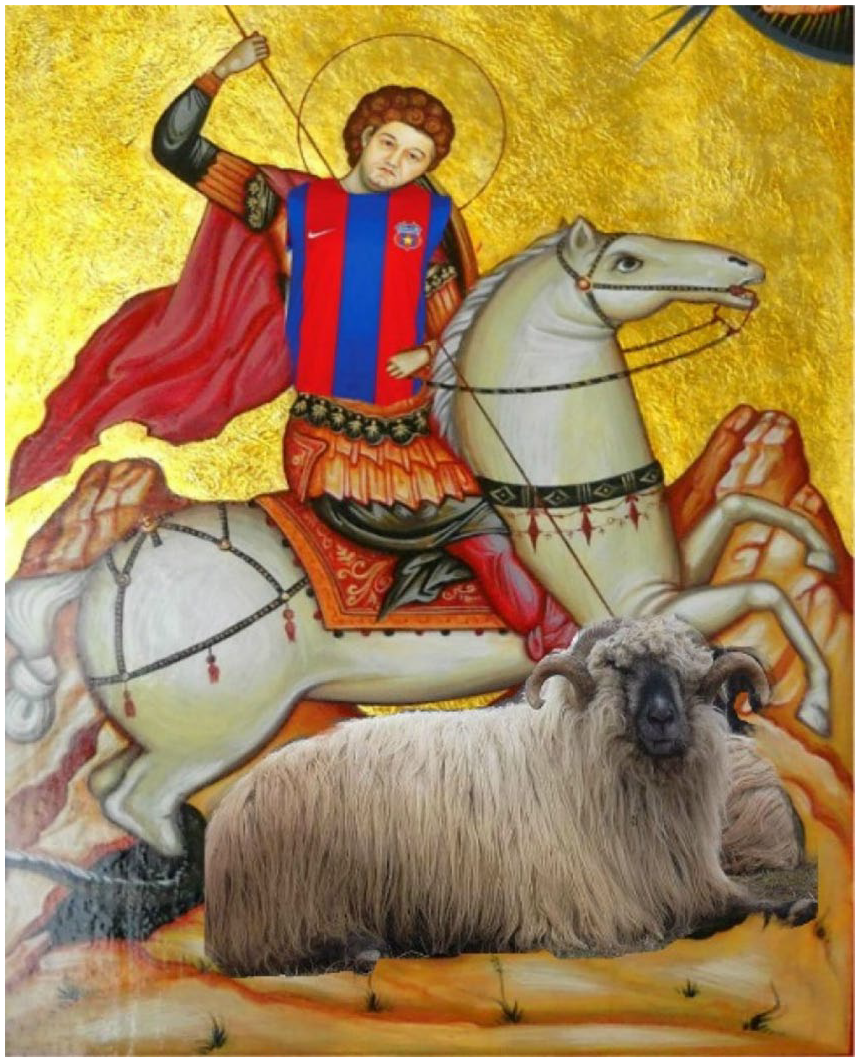
‘Saint Becali Killing the Obese Sheep’ meme.
The cult of Saint George is widespread in Romania because the saint is thought to have intervened ‘favourably in the terrestrial life’ of his devotees. 9 Becali employs his celestial patron’s cultural memory and hagiography to serve his moral political agenda. Like Saint Georgios ‘the Farmer’, Becali also herded hundreds of sheep prior to his political career. As Roxana Bratu points out, Becali inherited a business with sheep from his father, ‘who had established a flourishing trade with cheese, meat and wool under the protection of communist elites’, before the fall of the communist regime in 1989 (Bratu, 2018: 69). The eccentric Romanian billionaire is also proud of his peasant origin, calling himself a ‘son of the people’ (fiu al popoprului). Thus, Saint George, from the visual representations dedicated to the owner of the FCSB is interpreted as a fighter for justice who restores harmony and handles dangerous and threatening beasts (enemies of the people).
Like Saint George, Becali is represented as a beast slayer who is not ‘indulging in the pleasures of the hunt, but heads out expressly to clear the land of a beast devastating the countryside. He is performing a concrete public service on behalf of an anxious community’ (Geffreys and Haarer, 2006: 76). In this light of messianic populism, a hero who is also a man of humble, unpretentious origin (a ‘son of the people’) has the noble mission to defeat the corrupted political elites whose lack of morality and traditional faith threatens the ‘anxious community’ of the innocent people. Becali himself envisions his salvation mission as such, drawing a parallel with Saint George’s apologue: ‘I really want to kill the devil in Romania, and the devil is corruption, dishonesty . . .’ 10 Thus, similar to other employments of religious visual rhetoric in former communist countries from the region, the Saint George killing the Dragon motif exceeds the boundaries of its initial, vernacular representations. According to populist/nativist rhetoric, the ‘enemy’ who has to be slayed by the saviour of the nation is no longer a reptilian beast but the internal and external ‘Other’ who has anthropomorphic features.
Every year, Becali celebrates Saint George’s Day by preaching to his people about love and faith in God. Because he is notorious for donating large sums for Christian Orthodox churches in Romania and Greece, the archbishops of the Romanian Orthodox Church encourage Becali’s messianic rhetoric. In this vein, on Saint George’s Day on 23 April 2012, the Orthodox Archbishop of Tomis, Theodosius Snagovean, compared Becali with Saint George during the liturgy held at the Colilia Monastery in Southern Romania. As the daily newspaper Adevărul reports, Archbishop Theodosius underlined the striking resemblance between Saint George and George Becali. In addition to the fact that the businessman bears the name of the respected Christian martyr, the archbishop also pointed out that he perceives the saint’s ‘spirit of bravery and victory’ in Becali. 11 The owner of the FCSB helped with the entire liturgy and even sang some religious tunes together with the archbishop and other priests present at the Colilia Monastery to commemorate Saint George and his victory over the evil enemy. According to the same newspaper, after the religious service, the priests and officials present at the ceremony entered a tent where food was served. Becali joined them, but not before specifying that he would not go to the referendum for the suspension of the former Romanian President Traian Basescu.
Not only had the Romanian mass media reported on Becali’s celebration of Saint George Day in 2012 but also a short article published in The Guardian reveals that the Romanian businessman and politician called himself ‘A spiritual Messi of the world’ (he was referring to the acclaimed football player Lionel Messi) as well. On Saint George Day, Becali blessed all Romanians and let them know that he was glad because God made him so loving. He added the following:
My ability to love is just like Messi’s talent: I was born like this, full of love for all. I ask only one thing of St. George: that he gives me the strength to inspire a win against Rapid. Please, let me beat those gypsies.
12
This secret request of Saint George goes beyond a desire for the victory of the ‘Steaua’ football team over its reputable adversary ‘Rapid’ football club. Although the religiously inspired imagery of Saint George is habitually construed and understood as an instantiation of spiritual unity in the Kingdom of God against the evils of sin, Becali employs these religious visual signifiers to polarise Romanian society into us (Romanians) versus them (Gypsyes). The report from The Guardian is illustrated with two paintings from Becali’s private art collection that represent him as a Christian saint riding a horse while fighting anonymous enemies and the owner of the FSCB praying in the company of a disproportionately big cross and with a dove above his head. The same religiously inspired paintings of Becali circulated in Romanian online media as well as on Romanian-speaking social media.
The Saint George trope is not the only religiously loaded visual production through which Becali addresses the Romanians. Other art pieces – supposedly donated by amateur artists to the businessman – depict him as Moses, Jesus Christ’s Warrior, ‘God’s bread’, Saint John of the Desert, Napoleon and even as one of Jesus’ disciples from the New Testament. 13 Both amateur and professional visual artists create these artefacts that reveal Becali as a saint and saviour of Romanians. However, the first public display of these works of art occurred during an entertainment TV show on 25 December 2010 when Becali insisted on disclosing his ‘private museum’ to the comedian actor Mihai Bendeac (Figure 2). The popular actor used to impersonate Becali during a popular comedy show entitled Mondenii (The Mundane), broadcasted on the TV channel Antena 1 (whose programmes consisted of football matches, entertainment programmes and soap operas). 14
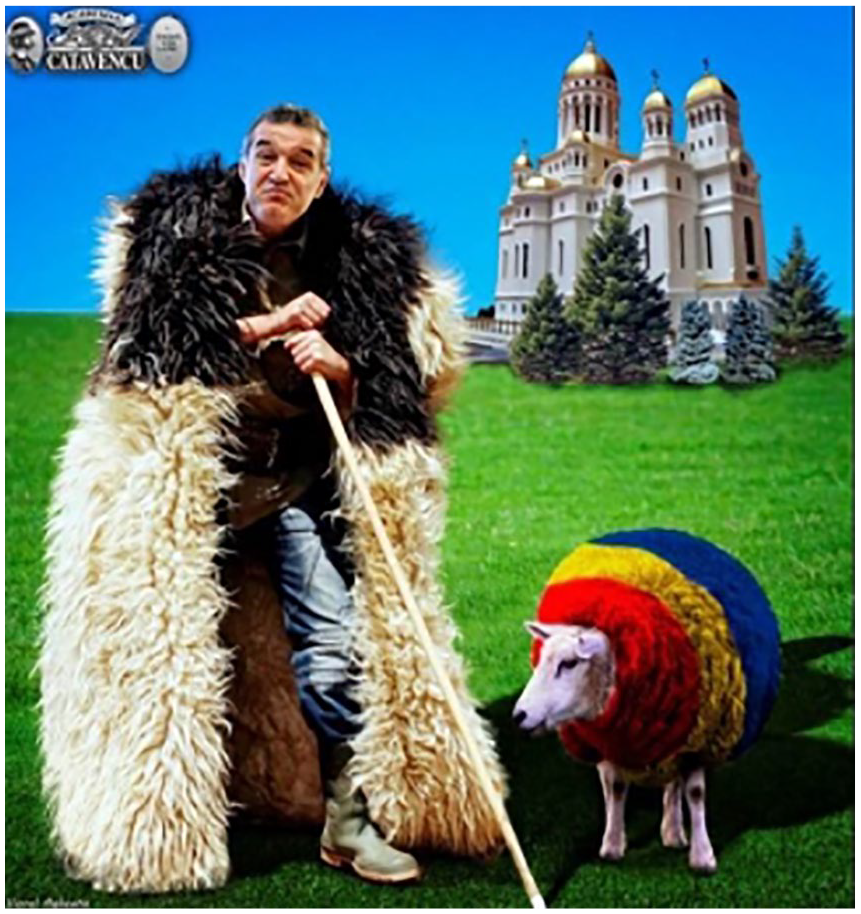
‘Saint Becali the Merciful is In Love with the People’ meme.
The fact that Becali’s private collection of religiously inspired artefacts invaded the offline and online media, as well as the cultural sector of entertainment, is not without significance for the argument put forth in this article. By infiltrating the world of media and entertainment, the cultural artefacts of religious inspiration have become part of popular culture. As Dustin Kidd argues,
Popular culture is the set of practices, beliefs, and objects that embody the most broadly shared meanings of a social system. It includes media objects, entertainment and leisure, fashion and trends, and linguistic conventions, among other things. Popular culture is usually associated with either mass culture or folk culture, and differentiated from high culture and various institutional cultures.
15
Popular culture is still an underexplored field where the values ascribed to populism from below and their attached meanings are negotiated, resisted or embraced. The next section scrutinises popular culture productions that disclose the visual tropes of Becali’s messianic populism in light of the critical metaphor of the gross shepherd who herds the Romanian nation to redemption from economic, political, social and spiritual devastations.
Popular culture and political irreverence to messianic populism
Apart from the cultural productions of religious inspiration that enhance the personality cult of the charismatic populist leader, Becali has been the main subject of many parodies expressed in various media of popular culture, such as memes, photo essays, YouTube videos, entertainment TV shows, jokes and pop songs. One of the visual memes that circulated in Romanian-speaking online media displays Becali as Saint George killing an obese sheep. 16 The humorous image of the alleged Saint Becali reveals a typical Byzantine icon of Saint George killing the Dragon.
However, the metallic armour of the original religious representation has been substituted in Photoshop with the traditional red and blue striped t-short of the ‘Steaua’ football club and an overweight sheep supplants the mythical dragon (a symbol of the enemy that threatens a peaceful Christian community). The Internet users disseminated ‘the Saint Becali killing the obese sheep’ visual meme online, revealing in a humorous tone the mirthful heroism of the owner of the football club when faced with the ‘supreme enemy’ (his notorious and publicly declaimed craving for sheep products). 17 The meme refers to both Becali’s humble origin (he herded sheep before becoming rich and famous) and to his megalomaniac quest to save the Romanian nation from both internal and external enemies. As Bradley Wigging argues, the analysis of visual-based memes can reveal a content that contains an ideological practice (Wigging, 2019). In the example analysed above, the Saint Becali killing the obese sheep meme is not merely ludic and witty but also politically daring. Thus, as Seiffert-Brockmann and Diehl pointed out (2018: 2867), ‘When combined with the notion of games and play, a pattern of meme diffusion should materialize that, although somewhat chaotic, incorporates features of both political expression and irreverence’. Unlike a ‘meme utilizing the mocking religious frame to undermine a religious figure’ – for example, Saint George – the visual meme that reveals Becali’s fight with an obese sheep (Figure 3) incorporates political criticism of the manner in which the owner of the FCSB encourages the exploitation of a religious trope to suit his populist agenda. 18
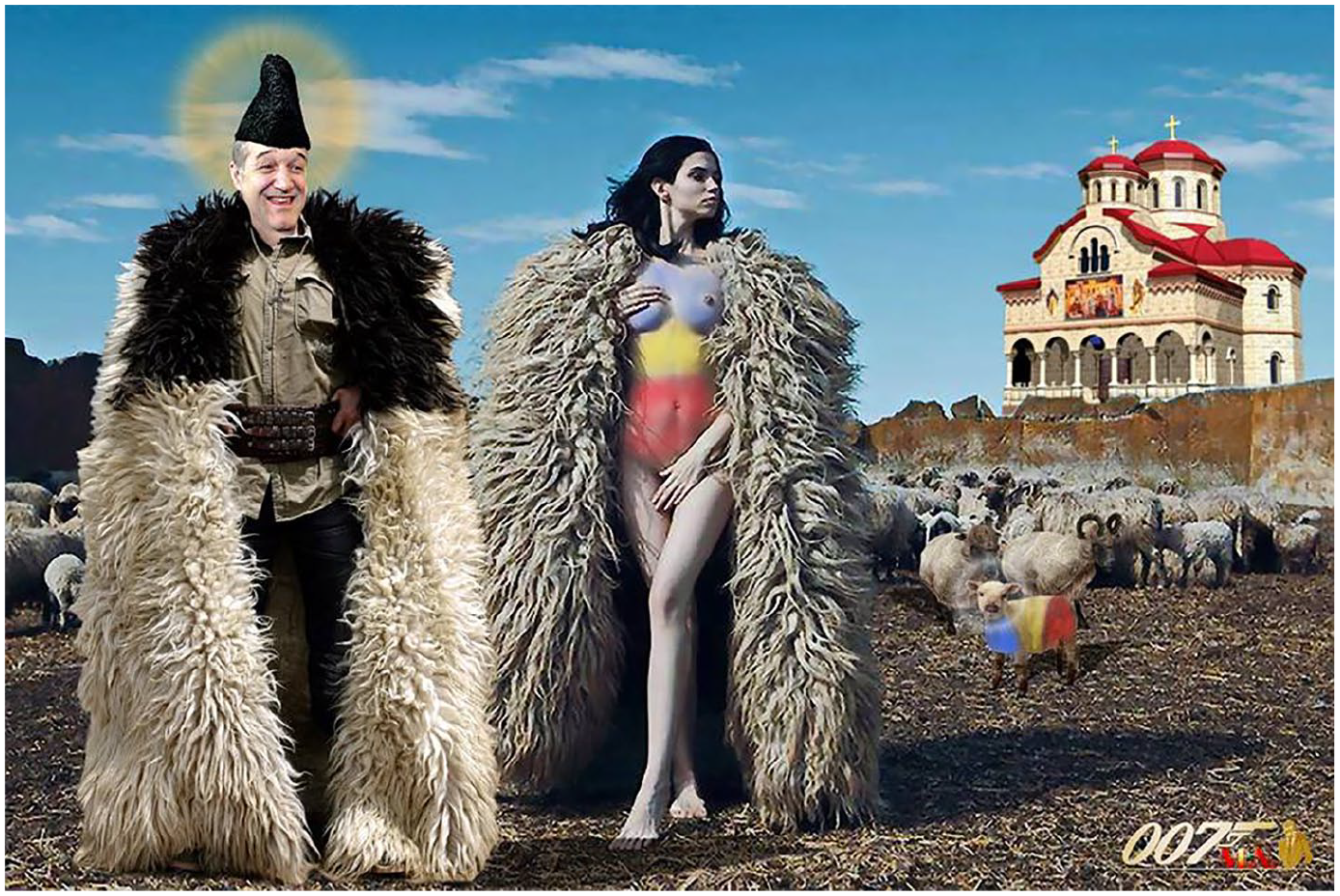
‘Saint Becali the Merci-full and the Carpathian Sheep’ meme.
In this vein, the visual meme of Saint Becali can be interpreted as belonging to the genre of ‘reaction memes’ within the common frames of religious memes theorised by Aguilar et al. 19 The representations of Becali impersonating a Christian saint are part of current popular media visuals that came to be maintained even by the Orthodox Church of Romania. Thus, the visual meme that reveals Becali’s religious affair reacts ‘to “current” news stories, events, or popular media images not part of a stock-character macro or meme template stock’. 20
Another visual meme, dubbed as ‘Saint Becali the Merciful is In Love with the People’, illustrated the article with the same title from the satirical newspaper Academia Caṭavencu. 21 The reaction meme exhibits Becali dressed up in a shepherd’s elongated, fleecy robe. He herds only one sheep that has wool painted in the colours of the Romanian flag (red, yellow and blue). The idyllic scene is foregrounded by the presence of an enormous church or cathedral (perhaps the Romanian Cathedral of National Redemption recently built in Bucharest) in the background. The meme reveals Becali’s aspiration to shepherd the Romanian nation to redemption from economic, political, social and spiritual devastations. His messianic populism is sarcastically juxtaposed with the personification of the nation that takes the shape of an acquiescent sheep. Thus, what the meme ‘Saint Becali the Merciful is In Love with the People’ communicates is the radical right populist entrepreneur’s determination to shepherd a country of obedient and submissive Orthodox Christian people towards national redemption (whatever that entails). The employment of the shepherd visual trope is not accidental. The meme employs an embodied visual analogy with Becali’s impersonation of ‘the Saviour of the Nation’, who like Jesus Christ is a ‘good shepherd’ pasturing his people (sheep). As Ramsey (1983: 375) argues, the image of the Good Shepherd was one the most infamous representations of Jesus Christ in early Christian art, but has been replaced ‘by the images of Christ as teacher and as king-images that had become increasingly important in the iconography of Christ’. The visual meme ‘Saint Becali the Merciful is In Love with the People’ reverts Becali’s moral superiority and guidance by disclosing the didactic content of his self-representations as ‘the good shepherd’ of the nation.
In another meme that circulates online (mostly on social media), the obedient sheep is replaced by a naked, sensual, young woman whose body is painted in the colours of the Romanian flag. Becali is shown smiling benevolently, while a bright aura is depicted around his head evoking the traditional Byzantine depiction of the Christian saints. Both the ‘Warrior of Light’ and the naked woman wear a Romanian shepherd’s traditional robe on their shoulders. The Orthodox Cathedral of National Redemption (sic!) dominates the background of this visual satire together with a sheep herd. This meme circulated in online media after the newspaper Academia Caṭavencu posted it. It appeared on 20 October 2016 on Marius Nitica’s Facebook wall, and it was at first shared by 132 people followed by many other redistributions. 22 The title of the meme that circulated in online media is ‘Saint Becali the Merci-full and the Carpathian Sheep’. The visual trope discloses a self-represented messianic strict father who is not immune to feminine charm. As Cristian Norocel poignantly has argued, Becali’s gendered public discourses put forth his moral superiority and charismatic leadership in light of the metaphor of ‘the strict, messianic father’ of the national family (Norocel, 2010). Thus, while his public discourses emphasise masculinity values and sexist statements about women’s inability to act as leaders, the meme displays a plenteous woman who can also be on a ‘shepherd mission’, exactly like the self-proclaimed messianic leader.
All memes analysed above focus on ‘pastoring’ (guiding and teaching) Romanians. They were triggered and rely upon Becali’s public speeches that emphasise his mission as ‘a good shepherd of the nation’, who, like Jesus Christ, loves, protects and takes care of his flock. Mass media reports cited him positing that ‘In the Byzantine Empire the great kings were shepherds. If you want me to read you from the Bible, Jesus did not say I am your boatman, your boat captain, or your driver. Jesus Christ said, “I am your shepherd”’. 23 As a reaction to this statement, the visual rhetoric of the popular culture productions parodies the messianic populism’s discourse by disclosing the charismatic leader as a mere shepherd, associated in Romanian common parlance with primitivism, inanity and backwardness. The pejorative usage of the word ‘shepherd’ (cioban in Romanian) in everyday communication signposts a semantic degradation of one of the oldest words from Romanian vocabulary. Initially the denomination ‘shepherd’ was employed in folk culture to denote ‘virtuous Romanians’, who were hardworking and goodhearted.
One of the most infamous Romanian folkloric ballads, Mioriṭa (published in 1850 by the poet Vasile Alecsandri), puts forth a virtuous shepherd’s tragic destiny. Babuts summarises the plot of the ballad as follows:
The ballad relates the story of two shepherds who, during the descent from the mountains, plot to kill their companion, a third shepherd, and take his herd. His ewe lamb, who has the power of speech, warns him about the plot. But instead of preparing his defence, as the ewe advises, he asks her to tell the two murderers to bury him near the sheepfold and to place at his head his pipes of beech, bone, and elderwood. (Babuts, 2000: 3)
According to historian of religions Mircea Eliade, ‘Both the folk poets who sang and constantly improved the ballad and the intellectuals who learnt it in school felt a secret affinity between the shepherd’s destiny and the destiny of the Romanian people’ (Eliade quoted in Babuts, 2000: 3). Through this narrative lens, the image and meaning of the notion of ‘shepherd’ evolved into a cultural icon of a virtuous victim who refuses to take revenge against his enemies.
Romanian linguist Rodica Zafiu argues that the origin of the word ‘shepherd’ (cioban) is Turkish and it replaced the autochthonous picurar or păcurar inherited from the Latin pecorarius (2013). This non-Latin legacy disturbed some intellectual patriots. Thus, the word ‘shepherd’ was circumvented by some public figures but others favoured it because of its greater power to attract attention and evoke the picturesque simplicity. 24 Yet, the notion came to be employed derogatorily both in mass media and popular culture productions. The semantic degradation of this name is partly associated with Becali’s recurrent employment of the shepherd metaphor both in political and religious registers. Some bloggers point out that in contemporary Romania, the name George Becali has become synonym with ‘shepherd’. 25 Many jokes about Becali – the Shepherd – had become popular by deriving their humorous effect from a mixture of sarcasm and resistance to religious conservatism. The stereotype of the gross shepherd from contemporary jokes, memes and other segments of popular culture provides a valuable insight into why the word as such acquired derogatory emotional charge and semantic degradation.
Yet, we also should not disregard Becali’s fandom. Apart from several Facebook pages reuniting the businessman’s supporters – the largest one has 31,544 followers – those who admire him erected a statue representing Becali’s bust in Scorniceşti city (2016), while other amateur artists (e.g. M. Gautier 86) composed techno-pop songs to celebrate his release from prison. 26 One of these songs, entitled I Prayed, displays religion-inspired lyrics dedicated to the ‘Warrior of the Light’. The video clip has over half a million views on YouTube. 27 Becali’s appeal to neo-traditional culture (materialised in unsophisticated, vernacular language, religious symbolism, folksy expressions) and his distrust in the elites’ cultural registers (cosmopolitan, multicultural cultural formats) can partly explain his undeniable fandom.
Conclusion
This article has argued that radical right populist entrepreneur George Becali employs a religio-cultural repertoire of Eastern Christian Orthodox descent to political ends. Although the religiously inspired imagery displayed in contemporary popular culture productions is traditionally interpreted as an instantiation of spiritual unity of human beings in the Kingdom of God, the populist entrepreneur employs these visual signifiers to polarise Romanian society into ‘us’ (native Romanians, Orthodox Christians) versus ‘them’ (internal and external real or invented enemies). This radical nationalist message is not unique to the visual representations of religious inspiration that are associated with the paternalistic figure of Becali. Actually, as Draghici-Vasilescu’s (2004) research on the phenomenon of icon painting in Romania demonstrates, starting with the 19th century, ‘national art’ syndrome is present even in icon painting practice. In this ideological framework, icon painting included – in addition to the Herminia canon – folk art decorations, politic-patriotic motifs and naturalistic representations taken from the history of the country.
Some 15th century Byzantine-inspired frescos and icons (e.g. at the Voroneṭ, Plumbuita and Moldoviṭa Monasteries) display scenes of destruction of the country’s invaders (Turk and Tatars). It is not unusual to depict military saints on horseback (such as Saint George Killing the Dragon) in Romanian iconography. Thus, the Saint George Becali trope draws on the enduring tradition of Romanian iconography whose ‘national spirit [is] concretized in the depiction of the country’s enemies as being punished in the afterlife for attacking the iconographer’s country’ (Draghici-Vasilescu, 2004: 115).
Therefore, Becali employed religious symbols and tropes in combination with nativist and neo-traditionalist views on ‘autochthonous’ culture in an attempt to engineer a religious collective identity of Romanians. From the self-proclaimed position of moral authority, Becali’s aspirations to reshape public culture in the light of conservative religious diktats have found a reputable ally in popular culture. If we understand popular culture as ‘culture actually made by the people for themselves’, then religiously infused representations of Becali reflect the so-called popular taste. In this vein, the Balkan’s most popular genre of music known as manele – a controversial pop-folk party music genre criticised by Romanian intellectuals for its simplistic message and kitsch outlook – oftentimes refers to Becali by calling him ‘Our Saint’ or ‘Our Father’.
At the same time, the article has also demonstrated that popular culture is the space where the values attributed to populism and their meanings are both created and disputed. To sum up, popular culture not only disseminates the values attributed to Becali’s messianic neo-populism from below (Shafir, 2008) but also critically reveals the religiously inspired visual tropes in light of what I have called in this article ‘the critical metaphor of the gross shepherd’. The humorous memes that circulated in Romanian online media are cultural initiatives with a critical-political message that reclaim the signifier ‘people’ and dissuade popular culture from radical right populism’s association with it and the supposed juxtaposition with the elites’ culture.
Footnotes
Funding
The author(s) disclosed receipt of the following financial support for the research, authorship, and/or publication of this article: This article has received funding from the European Union’s Horizon 2020 research and innovation programme under grant agreement No 822682. [POPREBEL]. This article reflects only the authors’ view and the European Commission is not responsible for any use that may be made of the information it contains.
