



Abstract
Over the last decade, depictions of characters who obtain abortions onscreen have come closer to representing the reality of abortion seekers, addressing, though not eliminating, documented discrepancies across race, class, and barriers to abortion care. Yet year after year, portrayals of characters parenting at the time of their abortions represent less than 10% of the total characters who have abortions, a striking departure from reality, where most people who have abortions are raising children. This paper is a qualitative content analysis of the twenty-three characters onscreen from 2013 to 2023 shown parenting at the time of their abortions. I incorporate the theory of the abortion imaginary to explore how these representations are materially different from the majority of televisual abortion representations in that they offer a window into the (im)possibilities within motherhood. These portrayals may disrupt some stereotypes about abortion seekers, but they also reinforce conservative ideals about intensive, all-consuming, self-sacrificing motherhood.
Introduction
In her formative book about abortion politics, sociologist Kristen Luker asserts that abortion is “a referendum on the place and meaning of motherhood,” suggesting that examining abortion illuminates broader societal ideas about gender, reproduction, parenthood, and power (Luker 1984, 193). Messages and meanings of abortion and motherhood are conveyed through a broad array of cultural media, including but not limited to social movement messaging (Kretschmer 2014, 893−913), political talking points (Greenlee 2010, 410), and news media (Woodruff 2019, 82−85). While audiences are often aware that these media contain political messages with an agenda, entertainment media serves a different purpose; audiences do not tune in to absorb messages about political issues, and thus may be more susceptible to the messages within these plotlines (Moyer-Gusé 2008, 413). Moreover, fictional televisual representations of political issues, such as abortion, often reflect and contend with broader societal meanings of these issues. Indeed, in a study of television abortion plotlines from the 1980s and 1990s, communications scholar Celeste Conduit noted that abortion “was only sanctioned [for a character] when it did not conflict with the values of family and motherhood” (Condit 1990, 138–9). The entertainment media landscape generally and related to abortion in particular has changed in myriad ways since Condit’s analysis, yet one constant remains: very few characters are depicted parenting at the time of their abortions. This is especially notable considering that majority of U.S. abortion patients are mothers (Jones and Chiu 2023, 82). This paper explores three questions: Who are these fictional mothers who have abortions? Do their plotlines disrupt or reinscribe stereotypes about abortion patients? What do their stories reveal about the intertwined experiences of abortion and motherhood?
Abortion and Motherhood Onscreen
Though contemporary television depictions of abortion have increased in the past decade, this has not corresponded with an increase in the accuracy of these depictions. Today’s abortion depictions often portray abortion as easy to access, obscuring the increasingly common and complex political and logistical barriers to abortion care in the U.S. (Herold and Sisson 2020, 422). Characters who obtain abortions are often white, wealthy, and, importantly for this analysis, not parenting (Herold and Sisson 2020, 422), unlike the majority of contemporary abortion patients, the majority of whom are women of color, struggling to make ends meet, and raising children (Jones and Chiu 2023, 82). Characters who have abortions are often portrayed as doing so for reasons related to self-advancement, such as pursuing career goals or educational aspirations (Sisson and Kimport 2016, 448), whereas real life abortion patients often cite complex life circumstances related to caring for themselves or others, such as financial hardship or caretaking responsibilities (Biggs, Gould, and Foster 2013, 4−11). Another discrepancy between abortion onscreen and abortion in real life is the type of abortion depicted. When the procedure itself is portrayed at all, television often shows in-clinic procedural abortions instead of medication abortion, which now comprises most abortions in the United States (Herold and Sisson 2019, 502−503). When plotlines do include characters having medication abortions, some depict clinicians providing inaccurate instructions for how to take the pills (Freeman 2023, 189).
Portrayals of motherhood on fictional television, though more broadly studied than abortion depictions, are also rife with stereotypes and mischaracterizations. The majority of television’s mothering characters are young and white, not meaningfully contributing to their family’s finances, and have few visible caretaking or housework responsibilities (Meyer et al. 2024, 4−8). The reality of American motherhood is much more complex and diverse across race, class, and caretaking responsibilities. These fictional women are often treated as mothers from the moment they announce a pregnancy, and their impending parenthood, often not emphatically chosen but implicitly accepted, is a sign of an aspiration to live a normative life (Oliver 2012, 11).Though it is beyond the scope of this paper to trace the shape of maternal televisual representations over the decades, much literature covers the transformation of the conservative televisual maternal figure into a more complex character with emotional interiority, career aspirations, and a rich life apart from but often centering on her parenting role (Feasey 2013, 25−42; Heffernan and Wilgus 2018, 3−12). Even with arguably nuanced, modern representations of motherhood, these representations “deliver a watered down version of what gender equity might look like” (Hosey 2021, 16). Media portrayals of mothers distort feminism by conveying that “the only true enlightened choice to make as a woman. . .is to bring to child rearing a combination of selflessness and professionalism,” that is, motherhood is portrayed as a woman’s most meaningful and worthwhile life decision, and it should be pursued with the vigor of competitive professional career (Douglas and Michaels 2005, 12). Indeed, in a study asking mothers to discuss their impressions of their television counterparts, the overwhelming majority commented that they did not see their “maternal choices and motherwork practices depicted onscreen” (Feasey 2015, 108).
Abortion in the Context of Motherhood
Some literature examines the role of motherhood in abortion decision-making, finding that mothers report seeking abortions because of their responsibilities to their existing children and their intimate understanding of the physical, emotional, and financial demands of parenthood (Jones, Frohwirth, and Moore 2008, 79). In this context, having an abortion was not a rejection of motherhood, but instead “the best decision to make to be or remain a good mother” (Jones, Frohwirth, and Moore 2008, 98). Building on these connections between abortion and “good” motherhood, additional literature finds that some mothers “reframe [their] abortion as a health practice to benefit the well-being of children,” managing the stigma of abortion by yoking their decision to accepted notions of idealized, intensive motherhood (Becker 2019, 219). Intensive motherhood, defined as “a gendered model that advises mothers to expend a tremendous amount of time, energy, and money in raising their children,” creates a paradox in which many mothers are expected to prioritize and find emotional fulfillment in child-rearing while also pursuing a rewarding professional career (Hays 1996, x). Gendered, raced, and classed ideals of motherhood take shape in abortion narratives in which “good motherhood” is a euphemism for white, middle class, intensive motherhood, and having an abortion is conceived of, by some, as a method by which mothers of all races and classes can strive to achieve that ideal (Thakkilapati 2019, 63−94).
There is minimal literature analyzing the depictions of mothering characters who obtain abortions. An analysis of six contemporary abortion plotlines focusing on mothers argues that these stories uniquely destigmatize abortion by linking motherhood and abortion as interconnected experiences (Boudreau 2023, 202). An in-depth analysis of the depiction of a mother seeking an abortion on the Hulu television series The Handmaid’s Tale finds that this portrayal reinforces the stigmatization of abortion by invoking motherhood as perhaps the one acceptable reason for having an abortion (Boyle 2024, 138−140).
This paper builds on this scholarship by analyzing a ten-year sample of depictions of characters parenting the time of their abortions, investigating both how these depictions do and do not comport with the experiences of real mothers who have abortions, and how the (fictional) experience of motherhood meaningfully informs these characters’ abortions. These fictionalized depictions complicate and contribute to a national “abortion imaginary,” a set of “enduring narratives about gender, motherhood, race, class, and individualism,” that paint a picture of abortion patients in the United States as “young, unsupported, emotionally fragile, not-yet-mothers in precarious situations” (Bruce et al. 2024, 1−9). Indeed, the abortion imaginary does not envision mothers as abortion patients, but abortion patients as eventual mothers.
The public’s general lack of exposure to abortion patients and the deleterious effects of abortion restrictions creates “a void that gets filled by the imaginary,” which may contribute to broader support for onerous and medically unnecessary abortion regulation (Bruce et al. 2024, 8). Knowing someone who has had an abortion reduces the potency of the abortion imaginary, allowing for nuance and lived experience to influence a person’s conception of abortion and their opinions on abortion regulation (Bruce et al. 2024, 6−8). Given that the broad cultural stigma associated with abortion fuels the limited disclosure of personal experiences with abortion, particularly across political differences (Cowan 2014, 475−483), other mechanisms for disrupting the abortion imaginary must be explored.
Parasocial relationships developed between viewers and fictional characters may serve a similar role to interpersonal contact, decreasing prejudicial attitudes and improving behavioral outcomes (Bond 2021, 573). Though there has been a significant body of literature analyzing if and how television content about other stigmatized groups may influence and interact with societal imaginings of those groups (Alsultany 2013, 161−169; Raley and Lucas 2006, 19−38; Żerebecki et al. 2021, 1−16), little research has examined abortion portrayals in this way. Before understanding if television portrayals of abortion might influence the abortion imaginary, it is crucial to analyze the content of these depictions to see if they reflect or refract stereotypical understandings of abortion.
This paper investigates how depictions of mothers obtaining abortions are in conversation with the abortion imaginary, particularly related to conceptions of intensive motherhood and the inevitability of motherhood. Given that an average abortion patient is imagined to be childfree, one might assume that any depiction of a mother seeking an abortion contradicts the abortion imaginary, but I find that this is not the case. Representations of mothers seeking abortions are likely not a feminist intervention on abortion stigma. Specifically, I find that some elements of the depictions in my sample reinforce the stereotypes within the abortion imaginary, while others challenge it.
Methods
Sample: The sample is from a publicly available database of abortion plotlines on American television (abortiononscreen.org). Details about how the database is maintained and curated are available in Sisson and colleagues’ previous articles (Herold and Sisson 2020, 421). The sample included all scripted English-language television available to U.S. audiences on any network, cable channel, or streaming service. I limited the sample to plotlines airing from January 2013 through December 2023 that included a character obtaining an abortion or disclosing a past abortion. This yielded a sample of 248 total plotlines. I viewed each plotline and coded for whether the character was depicted as parenting at the time of their abortion, using “yes,” “no,” or “unknown” as possible codes. The sample for this paper includes the 23 plotlines that depict characters raising children at the time of their abortion.
Data coding and analysis: I viewed all plotlines from the sample period to determine if they met the inclusion criteria and coded the sample for variables such as type of abortion content (abortion, consideration, discussion), race of character seeking abortion, age of character seeking abortion, barriers to abortion depicted, and main reason given for abortion. All coding and analysis occurred in Microsoft Excel to calculate descriptive statistics. Once I had the sample of 23 plotlines, I viewed each plotline again, taking detailed notes about each depiction, including relevant dialogue about pregnancy decision-making, parenting, and abortion access. I reviewed these notes for themes using grounded theory techniques.
This study did not quire institutional review board approval for this research because it included no human subjects.
Results
Demographics
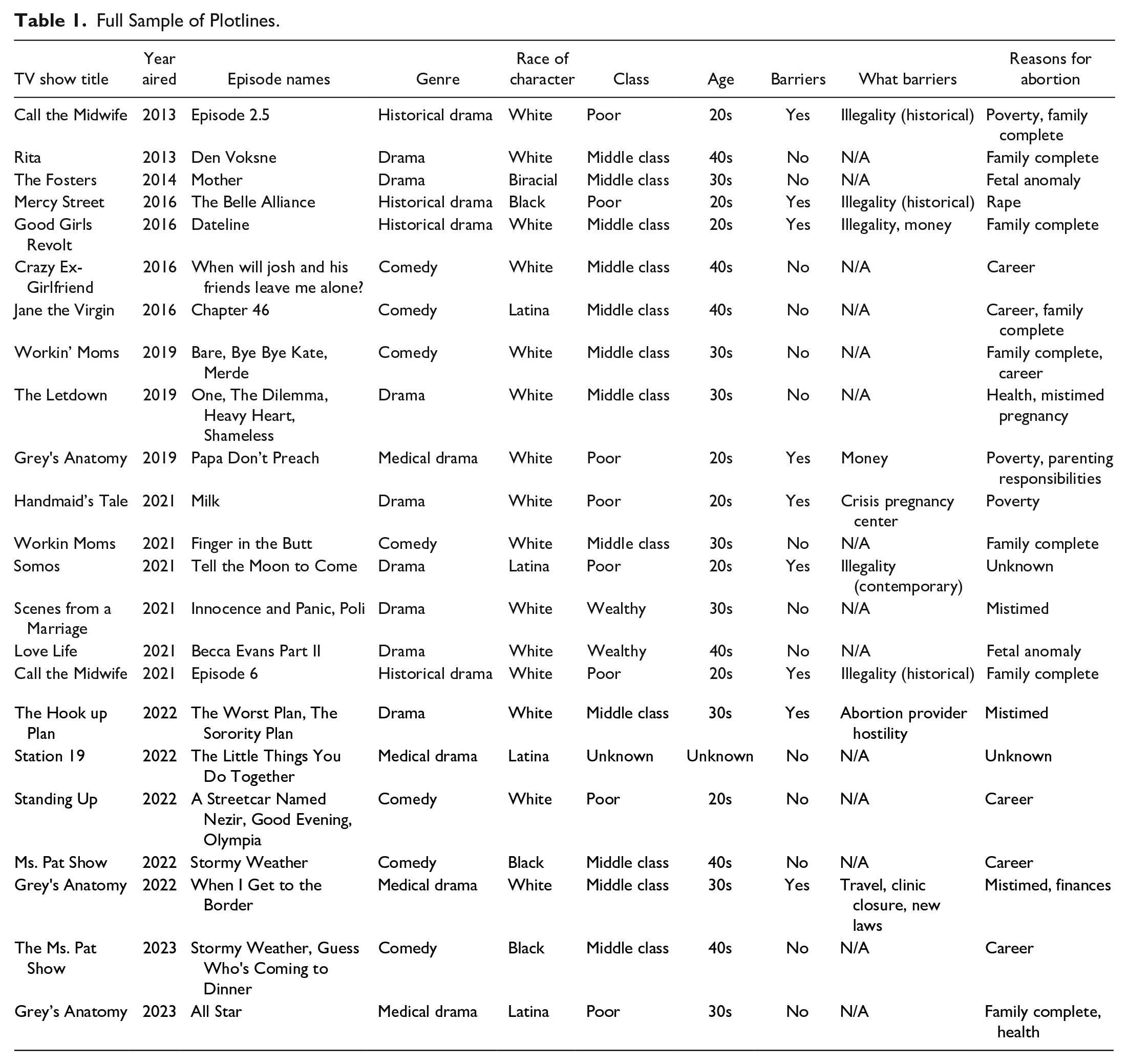
The 23 plotlines included shows across genres, ranging from dramas (eight plotlines), comedies (seven), historical dramas (four), and medical dramas (four). This spread of genres mirrors larger trends in abortion depictions, in which most abortion plotlines occur on dramas (Sisson 2019, 3). These portrayals of abortion seekers mirror larger patterns of televisual depictions of abortion demographically as well. Most of the characters in the sample are white (65%), in their 20s (35%) or 30s (35%), and middle class (52%). The majority (61%) of them encounter no barriers in seeking an abortion. As with genre, these demographic patterns mirror the portrayal of childfree characters seeking abortions, who also tend to be white, young, and middle class, and face few barriers to obtaining their abortions (Herold and Sisson 2020, 422). These demographic patterns seem to comport with elements of the abortion imaginary, providing a televisual representation of the imagined young, childfree woman seeking an abortion. Even when a character is parenting, that is the only major demographic difference and may not significantly disrupt the stereotype created by the imaginary. As previous research documents, this portrayal of abortion patients, whether childfree or parenting, is at odds with the experience of contemporary abortion seekers, most of whom are people of color, living at or below the Federal Poverty Level, and encounter significant, sometimes insurmountable, barriers to abortion care (Jones and Chiu 2023, 82). See Table 1 for further demographic information.
Full Sample of Plotlines.
Reasons for Abortion-Seeking
Yet despite these discrepancies, the reasons that these onscreen mothers obtain abortions often mirror some of the reasons their real life counterparts choose abortions—they cannot financially afford another child, they do not want to be pregnant, and they want to focus on parenting the children they have. These are similar to the most common reasons U.S. abortion patients provide for their abortions, which often span multiple issues including financial concerns, mistimed pregnancies, partner-related concerns, and caretaking responsibilities (Biggs et al. 2013, 4−11). This is especially notable given that the most common reasons childfree characters provide for seeking abortions are markedly different from their parenting counterparts. Their reasons – often related to their age, career aspirations, or educational pursuits – are self-focused (Sisson and Kimport 2016, 448), while mothering characters often provide decision-making context related to their ability to fulfill caretaking responsibilities.
Five plotlines in the sample include characters who contextualize their abortion decision-making in dire economic circumstances. Three are historical fiction, taking place before abortion was broadly legalized. On a 2013 Call the Midwife plotline, a poor mother, Nora, expresses dismay about her current pregnancy, saying to her husband, “we can hardly feed the eight [children] we’ve got.” A pregnant mother on a 2021 Call the Midwife plotline shares similar sentiments with her husband: “You can’t give me a decent place to live, or enough money coming in every week to keep the kids I’ve got.” Set in the same historical period but in the United States, an episode of Good Girls Revolt (2016) features a secretary explaining to a coworker why she needs an abortion: “I can’t have a fourth one. . .We are so strapped.” Later in the episode, her coworkers pass around an envelope to collect money for her abortion, and one brings her to a trusted doctor she’s been to herself. Contemporary abortion plotlines on both Grey’s Anatomy (2019) and The Handmaid’s Tale (2021) include mother characters discussing their finances as relevant to their pregnancy decision-making in more detail. On the former, Cassie discloses to her clinicians that she is struggling to make ends meet while parenting her son, Henry: I already work at two restaurants. They try to give me a flexible schedule but there’s only so much they can do. And another kid - that’s way more money and even more time away from Henry.
In a similar position, Janine in The Handmaid’s Tale shares with her abortion provider: “I have a son and it’s just me, and I have a job but it’s barely enough for the both of us.” These examples, whether from pre-Roe or contemporary plotlines, are notable because of how rare discussions of economic circumstances are in abortion plotlines generally. Most abortion plotlines do not include characters discussing caretaking responsibilities or their financial circumstances as key components of their abortion decision-making (Shabo and Herold 2023, 3). Abortion is a mothering decision that these characters make based on the financial sacrifices it takes to parent children. While some might consider this a feminist intervention in abortion depictions, it also reinscribes motherhood as a class privilege. It is not clear if these characters would choose to have abortions if they had access to more financial resources. Their abortions are constrained choices born from their socioeconomic statuses. Indeed, though these depictions make visible the financial struggles of many abortion patients, they also reinscribe these economic struggles as individual responsibilities of the patient herself, rather than structural inequities. These characters reflect the practice of intensive motherhood, prioritizing their ability to devote all of their financial and emotional resources to their current children.
Seven plotlines included characters contextualizing their abortion decisions in their current parenting responsibilities, sharing why they do not want to be pregnant or parent more children. Many referenced being in a different season in their life, beyond caring for an infant. Facing an unintended pregnancy, Xiomara, a 40-something mother with an adult daughter on Jane the Virgin (2016), remarks matter-of-factly: “At this stage in my life, I don’t want to be pregnant. I don’t want a baby.” On The Ms. Pat Show (2022), the title character, Pat, a mother of four, has worked for years attempting to start a career as a comic, and discovers she’s pregnant the same day she is offered a spot on a comedy tour. She tells her husband she’s having an abortion, saying: “I don’t want to start over, I got a life now, and my career is starting to take off. Fuck them kids. I’m in my late 40s. . .You can only give that kind of love so many times. I’m exhausted. My mind is made up.” On the French show Standing Up (2022), Aïssa, a mother who is also an aspiring comedian, discovers that she’s pregnant and laments to her boyfriend, “I don’t want this child! Do you understand? Thinking again about diapers, bottles, and bronchitis just makes me want to die.” Notably, it is racialized mothers (Xiomara is Latina, Pat and Aïssa are both Black) who are explicit about their desire not to be pregnant. White mom characters convey the same desire in more tempered, ambivalent language. On Workin’ Moms (2019), Anne, a career-driven psychologist with two young children, discusses pregnancy options for a surprise third pregnancy with her husband: “I just don’t know if we could take another kid. I’m sure we could handle it but I don’t know if I want that for us.” Using similarly uncertain language, The Letdown’s Audrey (2019) shares tearfully and almost shamefully with her husband, “If I’m being really honest, I don’t think I was ready for that baby.” On The Hook up Plan (2022), Milou cries to a friend, “I don’t want [this pregnancy], it’s awful, I can’t stop feeling guilty. . . I barely had time to watch the first one grow up and right now. . .I can’t handle it.” These three white moms invoke ambivalence and/or emotionality even if they are certain about their decisions. With language like, “I just don’t know,” “if I’m being honest,” and “I can’t stop feeling guilty,” these moms give the impression of mixed emotions related to their pregnancies. While childfree characters rarely share so bluntly that the main motivation for their abortion is not wanting to be pregnant (Sisson and Kimport 2016, 448), mothering characters are permitted to voice this as a reason for their abortion, perhaps because they already inhabit the societally sanctioned role of mother.
How Motherhood Contextualizes Pregnancy Decisions
Because many of these characters contextualize their abortion decision-making in motherhood, these representations disrupt the conception of abortion patients as “not-yet-mothers.” Many characters recount the challenges of parenting a newborn. Anne and Lionel on Workin’ Moms (2019) make a pro and con list about continuing her third pregnancy, which includes, on the “con” side, “spit up, no sleep, crying, outnumbered, college fund x 3, hair loss, more diapers, more formula.” Mira in Scenes from a Marriage (2021) voices her concerns about continuing an unplanned pregnancy, recalling her first postpartum experience: “You remember those first two years with Ava [their daughter], thinking about jumping back into that nightmare. . .it took so long to feel like myself again. . .I’ve finally returned to my life.” Sierra, a patient on a 2023 Grey’s Anatomy episode, confides in the doctors that she hoped they would confirm a miscarriage for her third pregnancy so she would not have to experience debilitating postpartum depression for a third time. These details about the physical and emotional realities of motherhood, particularly early motherhood, provide specific parenting-related texture and context to these abortion decisions.
Some of these characters do not just make abortion decisions based on their experience of motherhood but have abortions while actively parenting. This is most evident in three separate Grey’s Anatomy plotlines. In “Papa Don’t Preach” (2019), Cassie brings her son to hospital with her, and as she’s about to be discharged, she comforts him by saying, “Doctors made mommy all better. I’m so sorry I scared you. I love you so much and when I’m all better, we’re going to go to the zoo.” On “When I Get to the Border” (2022), the patient is Susan, a 30-something mother who calls her husband on the way to her abortion to rattle off childcare instructions: “Tina’s bringing Emily home so you can pick her up there after work. I canceled the piano lesson. Can you pick up fruit snacks and Pirate’s Booty? It’s our turn to bring snacks to soccer.” She regales her clinicians with stories about her daughter’s upcoming birthday and how they make bracelets together. On “All Star” (2023), Sierra brings her son with her to the hospital, and he covers the hospital room floor with toys before falling asleep on a chair. She specifically asks to have local instead of general anesthesia during her abortion so that she can be awake enough to make dinner for her children, and a clinician takes her son out for ice cream while she has her abortion. Motherhood is central to each of these characters, whose children are present for or discussed during their abortions. If the abortion imaginary constructs a timeline in which a young woman has an abortion to pursue motherhood later in life, these portrayals disrupt that and depict abortion and motherhood as intrinsically interwoven, even simultaneous, experiences.
Some characters directly confront the perceived tension between motherhood and abortion, invoking their understanding of the responsibilities of parenthood, and their love for their children, as undergirding their reasons for abortion. These characters confront the stigmatizing binary between abortion and motherhood, but instead of challenging it, their dialogue often reinforces it. On a 2021 episode of Call the Midwife, a mother seeks clinical intervention after attempting an unsafe illegal abortion herself, and she cries to the doctor, “I love my kids so much, this is not because I don’t.” He replies, “Mrs. Watson, there’s no doubt in my mind that you love your children.” On both The Hook Up Plan (2022) and Standing Up (2022), Milou and Aïssa, respectively, bring up their love for their children in their abortion-decision making. When disclosing her pregnancy, Milou shares with a friend, “I love my husband, I love my son. . .but I can’t handle it [another pregnancy].” Similarly, Aïssa scolds her husband for even suggesting her abortion is related to her feelings about her daughter: “No, Vlad, I love my daughter but I put everything on hold for her for 2 years. Right now, I can direct my energy into something other than making a child.” On a 2019 Grey’s Anatomy episode, Cassie also contextualizes her abortion in her love for her son: “I love Henry, but it’s a lot.” On another Grey’s Anatomy plotline (2023), Sierra tells the clinicians that the pregnancy was unplanned, but quickly follows up with, “Don’t get me wrong, I love the hell out of them [my kids].” These mothers feel the need to justify their abortions, to root their abortions in the love of their current children. While this could be interpreted as an acknowledgement of and repudiation of abortion stigma, I contend that this pattern suggests instead that these mothers feel a kind of pressure to proclaim their love of their children to distance themselves from the assumption that abortion is a repudiation of motherhood. By recasting their abortions as enactments of love and care for their current children, these characters affirm a conservative imagining of motherhood as central to a woman’s identity, so much so that even in rejecting motherhood for one particular pregnancy, she affirms her dedication and devotion to other children. These characters may disrupt the abortion imaginary in their roles as mothers who have abortions, yet they reaffirm their commitment to intensive motherhood by reinscribing motherhood as a meaningful, if not the most meaningful, identity that a woman has.
Supporting Mothers Before, During, and After Abortions
The abortion imaginary envisions a person seeking an abortion as “more often than not, on their own. . .unwed, unstable, single, and alone” (Bruce et al. 2024, 5). Nearly every character in the sample (21, or about 91%) are explicitly not alone, whether in their pregnancy decision-making or during their abortions. This is, perhaps, television’s most profound disruption of the abortion imaginary and intensive motherhood framework; these characters have the love and support of some of their closest friends and family during their abortions, and instead of the abortion indicating relationship peril, it results in heightened emotional intimacy.
A common source of solace for fictional characters was their male partners, who often provided emotional support before and after abortions. On Jane the Virgin (2016), Xiomara tells her boyfriend Rogelio that her mother is making her feel ashamed about not feeling guilty about her abortion. He consoles her by saying, “Get your mother out of your head. If you’re sure about your choice, that’s all that matters.” Audrey’s husband Jeremy on The Letdown (2019), comforts her repeatedly when she asks if they did the right thing in having an abortion for her second pregnancy. Husbands on The Hook Up Plan (2022) and Workin’ Moms (2019), provide similar reassurance, such as “whatever you decide [about the pregnancy], I’m with you” in the former and “I’m so sure [about the abortion decision]. . .You are so beautiful” in the latter. These expressions of support do comport with research that shows that some abortion seekers often rely on and receive emotional support from their male partners during an abortion (Altshuler et al. 2021, 3). Indeed, the power and potential of accompaniment and support during an abortion may serve as an antidote to feelings of shame and loneliness (Altshuler et al. 2021, 5). Showing male characters supporting their partners through an abortion may provide a blueprint for how audiences can support friends and family members seeking an abortion. Though there is limited research on the impact of abortion portrayals, one study found that exposure to an abortion plotline was associated with a higher willingness to support a loved one in seeking an abortion (Herold et al. 2024, 288−289).
Other family members and friends also play a role in providing support for mothers seeking abortions. On The Ms. Pat Show (2022), Pat’s teenage daughters voice their support for their mother seeking an abortion, with one commenting, “I’m always for a women’s right to choose” and another saying, “Not to mention the health aspect. You had a difficult pregnancy with Junebug [their brother], so you should do whatever is safe. . .be glad you still have the choice, that choice is in jeopardy every day.” On The Letdown (2019), Audrey received support from a friend and her mother, both of whom disclose past abortions because of Audrey sharing her own abortion. When she’s concerned that her Catholic mother is judging her, Jane the Virgin’s Xiomara turns to her adult daughter Jane for support. Both Jane and Xiomara’s boyfriend Rogelio, described above, comfort Xiomara as she navigates her mother’s disapproval of her abortion. Those less frequent, two plotlines in the sample (Good Girls Revolt and Workin’ Moms) showcase friends providing logistical and financial support for mothers seeking abortions. These depictions of mothers as having the support of their partners and friends offers a counter narrative to the abortion imaginary’s emotionally fragile and solitary abortion patient. In real life, family members, partners, and friends are often sources of support for abortion seekers (Dickey et al. 2022, 4−5) and placing them into fictional abortion narratives may offer new avenues for audiences to see their own expressions of empathy for abortion reflected and validated.
These twenty-three characters provide important counterexamples to the abortion imaginary’s childfree and unsupported abortion seeker, yet many of them also reinforce conservative ideals inherent in the intensive motherhood framework—that motherhood is a woman’s most important role in life, that the pursuit of career success comes at the cost of expanding a family, and that children’s needs must always be prioritized above a mother’s own self-worth. These tensions, evident in the disparate analyses of portrayals of mothers seeking abortions (Boyle 2024, 138−140; Boudreau 2023, 202), suggest that these plotlines are not intrinsically liberatory or stigmatizing. Instead, they are in open conversation with the abortion imaginary, reflecting some of the more conservative elements about the centrality of motherhood in a woman’s life, while contending that mothers do have abortions and deserve support in the process.
Conclusions
Since the 2022 Supreme Court decision Dobbs v. Jackson Women’s Health Organization revoked federal protections for abortion rights, resulting in a rise in abortion criminalization nationwide, it is more important than ever to understand what constitutes and contributes to public understandings of abortion. Using the framework of the “abortion imaginary” (Bruce, et al. 2024, 1−13), I analyze if and how entertainment media depictions of abortion reinscribe or challenge commonly held myths about abortion in meaningful ways. Given that the American public incorrectly assumes that the average abortion patient is not a parent, investigating the contours of television depictions of mothers obtaining abortions provides an opportunity to understand if these depictions have the potential to correct abortion misinformation.
Previous research finds that of characters portrayed seeking abortions, very few are depicted as raising children (Herold and Sisson 2020, 422). This analysis adds additional context to these data, finding that the limited number of mother characters reflect the demographic disparities of their fictional childfree counterparts. They, too, are most often white, wealthy, and experience few, if any, barriers to obtaining abortion care. The characters in this sample do, however, articulate motherhood-specific reasons and context for their abortions, highlighting both the love and care they have for their children and the hardships, physical, financial, and emotional, that parenting brings. Some of these plotlines invoke elements of intensive motherhood, particularly when characters tie their decision to have an abortion to their ability to devote themselves fully to parenting. Most importantly, perhaps, these mothers are not alone – their partners, friends, and coworkers help them pay for their abortions and drive them to clinics, offering support and affirmation.
It is unknown if and how audiences metabolize this information. That is, when they consume depictions of fictional characters obtaining abortions, do they map that character’s experience onto their previous ideas about abortion seekers? Put another way, are these television depictions of mothers seeking abortions a powerful enough mechanism for disrupting the abortion imaginary?
The literature on the influence of television depictions of abortion on viewers suggests that these plotlines have a limited impact. Accurate depictions of medication abortion are associated with increases in knowledge about medication abortion (Sisson et al. 2021, 18−20) and increased beliefs about the safety of medication abortion (Herold et al. 2024, 4−6). Exposure to portrayals of abortion is not associated with more supportive attitudes towards abortion (Herold et al. 2024, 288; Brooks et al. 2022, 236−238; Sisson et al. 2021, 18−20). The content and context of these portrayals may play a significant role, as some research indicates that plotlines that adhere to more conservative gender roles may result in audiences being less supportive of abortion (Swigger 2017, 123−124). The cultural context in which these plotlines are viewed is a significant variable; we do not know how audiences reconcile the stories they view on screen with the post-Dobbs political reality of abortion criminalization across the United States. Research on abortion attitudes suggests that the more one believes motherhood as a woman’s most important role, the less likely one is to be supportive of abortion (Huang et al. 2016, 975−976). Future research might investigate if depictions of mothers obtaining abortions provide an avenue for audiences to reconsider beliefs about abortion and motherhood as connected instead of disparate experiences, or if they instead reinscribe conservative ideals about the sanctity of motherhood.
Bridging the chasm between cultural representations and political action may take bolder abortion storytelling that goes beyond superficial representations to dramatically re-envision the relationships between gender, power, abortion, and motherhood. Crafting characters and plotlines that offer alternatives to the abortion imaginary may provide audiences with potential pathways out of entrenched abortion attitudes and reshape their willingness to act in support of abortion providers and abortion seekers, a much-needed resource in a post-Dobbs world.
Footnotes
Declaration of Conflicting Interests
The author declared no potential conflicts of interest with respect to the research, authorship, and/or publication of this article.
Funding
The author(s) disclosed receipt of the following financial support for the research, authorship, and/or publication of this article: The author received financial support from an anonymous foundation to support the publication of this article.
