



Abstract
This article extends recent research about the material impact of energy-consuming media technologies by describing the role of oil and its derivatives in the production and consumption of television in the United States after the Second World War. It starts by exploring reasons why the material dimensions of oil have received limited scholarly attention in media history. Then it examines television by describing how the component parts of a TV receiver—the cathode ray tube, the chassis into which it was set, and the cabinet housing the chassis—incorporated elements made with oil. Finally, interpreting prior historiography through the lens of oil, it describes the role these different components played in conflicting discourses about the space of the home, especially the living room, in postwar America.
Keywords
Climate news in 2021 was dominated by stories of drought in the western United States, forest fires across North America, flooding in Europe, and heatwaves the world over. Scientists warned that extreme weather events would become even more common if the world's leaders did not adopt aggressive measures to combat climate change (Brownstein, 2021). At the same time, climate journalists were also writing about blockchain technology, used for producing cryptocurrency such as Bitcoin or for transferring non-fungible tokens, exploring the tremendous amounts of electricity it consumed. The New York Times, for instance, explained, “The process of creating Bitcoin to spend or trade consumes around 91 terawatt-hours of electricity annually, more than is used by Finland, a nation of about 5.5 million” (Huang et al., 2021). Journalists drew links between the stories, showing how “virtual” technologies were not virtual at all and in fact had a material impact on climate change, contributing—indirectly, at least—to the drought, fires, flooding, and heatwaves.
In this they were not alone. Various government agencies sought to raise awareness about the impact of digital media technologies on the climate. France's Agence de la transition écologique, to give one example, published a pamphlet called La Face cachée du numérique: Réduire les impacts du numérique sur l’environnement [Digital's hidden side: Reducing the impact of digital technology on the environment] (2021). Scholars, too, were exploring these links, for instance describing the strategies used by data centers “to reduce, refuse, and redistribute the relations between carbon and data,” obfuscating the carbon they consumed to power their services (Pasek, 2019a: 2; see also Hogan and Vonderau, 2019).
In this article I continue in this vein, but from a historical perspective. I take recent work in the energy humanities as a starting point, in particular Imre Szeman's (2021) call for a critical theory of energy that engages in the dialectic between theorizing and action. To address climate change, Szeman argues, scholars must first hone their conceptual tools, without which they run the risk of acting as if “the social is directly given, as opposed to being produced in a complicated process of nomination and ex-nomination” (2021: 25). Indeed, he says, the goal of a critical theory of energy should be to “unnerve the continuing legibility of the study of history, politics, philosophy, and literary and cultural studies,” an exercise resulting in “a wholesale refashioning of these vocabularies and their presumed objects of study” (2021: 29, original emphasis).
To that end, I work to uncover the hidden role of oil (a term I use metonymically for petroleum and its derivatives) in media history, specifically television in the United States in the years immediately following the Second World War. During this time, the U.S. oil industry had to create new markets as the government's demand for fuel and petroleum-based lubricants fell, not to mention its need for “synthetic rubber for tires and for self-sealing gasoline tanks, toluene for TNT in bombs and shells, fuel for flame throwers, compounds for waterproofing tents and producing artificial fogs, asphalt for airfield runways, and ingredients for healing salves,” all derived from oil (American Petroleum Institute, quoted in Conway and Robertson, 2021: 55). It did so by devising new uses for oil, especially derivatives such as plastic, participating in the development of what Matthew T. Huber (2013) calls “entrepreneurial life,” shaped by the idea that freedom is exercised in individual choice and its value measured in individual success.
The postwar years are interesting for two reasons. First, the 1950s were marked by an accelerated rate of oil production and consumption. To meet demand brought about by demographic shifts from city centers to the suburbs, companies were developing new technologies to extract oil from unconventional sources such as shale and bituminous sands (Conway, 2020; Urquhart, 2018). The results were observable in socioeconomic trends such as increased energy and water use, and in biophysical trends such as expanding rates of carbon dioxide and methane production (Steffen et al., 2015). Second, where television was concerned, it was during the 1950s that it became “a dominant mass medium,” as Lynn Spigel (1992: 2) writes. And yet the connection between these trends remains unexamined. For instance, although Raymond Williams (2003 [1974]) describes the link between the postwar expansion of suburbs and the proliferation of television, he does not ask how oil made that link possible. The word oil appears only twice in his book Television, both times to describe topics discussed by news programs he observed. Related words such as petroleum or plastic do not appear at all. The same is true of Spigel's Make Room for TV (1992): oil, petroleum, and plastic are entirely absent.
In this respect, my attempt to make oil visible holds the potential to “unnerve the continuing legibility” of media history, as Szeman suggests, by showing that the ecological cost of the media is not new but instead inextricably linked to the taken-for-granted ways North Americans have incorporated television into their lives. To this end, I begin by describing the forces that have obscured oil's role within the field of media history, which I then propose to counter by adopting an approach inspired by Ian Bogost's (2012) notion of tiny ontology. Bogost argues that scholars must bracket off their a priori assumptions about objects and ask how they relate not to people but instead to other things. To examine an object, he says, is to see how its component parts fit together and how it, in turn, becomes a component in a larger set of objects. The resulting approach consists in a deliberate, methodical mode of reading that, when applied to media history, reveals oil in its otherwise hidden roles.
I use this approach to describe places where oil and its derivatives became components in early 1950s television receivers, exploring one point where oil influenced the dialectical relationship between how people understood and acted on ideas of home. The first question I ask is material: where was oil a necessary ingredient in the construction of cathode ray tubes, the chassis into which they were set, and the cabinets that housed the chassis? The second is discursive: what role did these objects play in the conflicting discourses about the space of the home in the United States after the Second World War? In moving from a material to a discursive analysis, I describe one dimension of the reorganization of social space and the socially derived meanings attached to it. Although this move is speculative, I contend that in its tight focus, it demonstrates the value of reading oil (back) into media history.
Silence in the archive: oil's invisibility in media history
How have media technologies incorporated different petroleum-based materials? And how has oil provided an infrastructure for the production, distribution, and consumption of media technologies? These questions have received limited scholarly attention. Nadia Bozak (2011) has addressed them the most ambitiously in The Cinematic Footprint, which links the development of film technology to energy consumption. “The image—cinematic, photographic, digital, or analog—is not only materially and economically inseparable from the biophysical environment,” she writes, “it is the environmental movement's primary pedagogical and propagandistic tool” (2011: 3). Related works have explored the ideological dimensions of oil extraction with respect to, for instance, ideas of modernity and freedom as they have been mediated by films produced and screened by representatives of the oil industry (Vonderau and Dahlquist, 2021).
These examples, however, are the exceptions that prove the rule, showing by their rarity the degree to which oil in media history remains invisible, especially as a component of media technologies. The forces shaping this invisibility are multiple. For one thing, oil is hard to represent. It is frequently used up or transformed into something not immediately recognizable as oil, such as plastic, although the challenges go beyond that transformation. In a review of two petronovels in the early 1990s, for instance, Amitav Ghosh famously wondered why the encounters oil has made possible have “proved so imaginatively sterile,” offering that “the history of oil is a matter of embarrassment verging on the unspeakable, the pornographic” (1992: 29–30). Of course, he was talking about literature, not media history, but certain challenges remain. Scholars who talk about oil have been caught in a double bind: they must find ways to represent the massive scale of its production and consumption, but representation at that scale does not prompt people to act, as problems seem either distant or impossible to address (Pasek, 2019b).
Even more fundamentally, however, oil is hard to see, as scholars drawing on Heidegger's tool analysis have shown (for example, Barney, 2017). So long as devices function, Heidegger says, people using them do not notice them. They are “ready-to-hand,” to use Heidegger's term. People notice them only when they break, becoming “present-at-hand” (see Harman, 2010). In the case of oil, so long as the devices incorporating it function, they—and the oil on which they rely—fade into the background, obscured from view. 1 For researchers, this means that oil remains invisible so long as other questions appear more urgent. For members of the Frankfurt School, to give one example, the environment has not been as salient a concern as the “rapidly unfolding development of the cultural industries” (Szeman, 2021: 26). It would seem, however, that the journalists and scholars mentioned in the introduction have begun to turn their attention to oil in the media precisely because climate change—whose effects are observable in floods, fires, and heatwaves—represents an egregious failure of technology.
Antii Salminen and Tere Vadén (2015) extend this analysis by describing the way capital draws attention away from oil. If the logic of capital is efficiency, they write, one result has been a conception of human value based on the instrumental role people play in the capitalist machine. The logic of capital as invested in technology, they contend, is to subordinate people to technology, contrary to the illusion people have of developing technology to serve their needs. Oil, by virtue of its high energy return on energy investment (EROEI), plays a special role: Simply put, the high EROEI of oil and the large amount of oil together intoxicated the human ape so that it started imagining that the effects of oil were due to the ape's own merits. It started to see a combination of virtue and natural determinism as the roots of its prowess. (Salminen and Vadén, 2015: 34)
Paradoxically, oil's very potency obscures it from view.
Oil companies have exploited this fact in advertising campaigns emphasizing the work oil does for consumers. Without oil, they ask, what would modern life look like? And not just oil, but all the things that derive from it, such as plastic and asphalt and synthetic fabric? In the 2010s, ExxonMobil asked questions along these lines in its “Energy Lives Here” campaign, as did Enbridge in its “Life Takes Energy” campaign (McCurdy, 2018). In fact, this approach goes as far back as the 1950s, when Esso (which later became ExxonMobil) asked whether consumers thought about the work oil did to make their lives easier. It provided lists of products that worked reliably thanks to technologies developed by the oil industry, reassuring consumers, “You probably never thought of [what oil does] because you never had to” (quoted in Huber, 2013: 82–3).
Ultimately, historians are faced with what historian Michel-Rolph Trouillot (1995) describes as a silence in the archive. Rare are the archives that gather records of the uses made of oil and its derivatives by the media industries, and rarer still the scholars who have gathered and organized those sources in narrative form (see Damluji, 2021). Consequently, the significance of oil has been obscured. The silences around oil operate at “the moment of fact assembly (the making of archives); the moment of fact retrieval (the making of narrative); and the moment of retrospective significance (the making of history in the final instance)” (Trouillot, 1995: 26).
Television's tiny ontology: cathode ray tube
These silences, however, are not insurmountable. To identify the uses made of oil in postwar television, I employ two strategies outlined by Trouillot, consisting first in the creative use of existing archives and second in the act of “reposition[ing …] evidence to generate a new narrative” (1995: 27). In the first instance, to identify the places where oil shaped postwar television technology, I turn primarily to the World Radio History website, 2 which contains over a thousand scanned, searchable documents published by the broadcasting industry between the 1930s and the 1960s. Although oil is not a central theme, these documents do describe component parts for which oil was necessary, making it possible to make visible what had been overlooked. This approach, in turn, makes it possible, in the second instance, to read social histories of postwar television through a new interpretive lens.
How to identify the points where oil played a role in postwar television, and to identify the nature of that role? Ironically, perhaps, the oil industry's advertisements suggest a useful strategy. These ads suggest that consumers can take the work oil does for granted, but their implied question—what parts of consumers’ lives depend on oil?—can be an instructive analytical starting point. Jennifer Wenzel, for instance, uses it as part of an “oil inventory” exercise she assigns to students, asking them to “trace the presence (or absence) of oil and its history in their own lives” (2016: 32). It also informs the analysis involved in life-cycle assessments, where researchers calculate the materials used in the production and consumption of a commercial product (for example, Hoysal, 2014).
Here is where Bogost's tiny ontology provides useful conceptual tools. In his book Alien Phenomenology (2012), Bogost asks how philosophers might come to understand relationships between objects without at the same time relating them back to human actions, desires, or needs. In response to the idea of a flat ontology developed by Levi Bryant, according to which “things can be many and various, specific and concrete, while their being remains identical,” Bogost proposes the idea of a tiny ontology, according to which objects are constituted by their component parts, while at the same time constituting component parts of greater objects, resulting in a “relationship [that] is fractal—infinite and self-similar” (Bogost, 2012: 12, 22). This conception of being suggests its own analytical method, which Bogost calls ontography, and which I adopt here. It consists in “a general inscriptive strategy, one that uncovers the repleteness of units and their interobjectivity” and can take many forms: lists, litanies, or indeed inventories that emphasize the logic by which objects fit together, showing the nested relationships of their component parts (Bogost, 2012: 38). The key idea is that to “create an ontograph involves cataloging things, but also drawing attention to the couplings of and chasms between them” (Bogost, 2012: 50).
Through this attention to television's component parts and the “couplings and chasms between them,” I identify the places where oil played a role in postwar television. Given the nested nature of the different components, I am interested in multiple scales, first of television as an object, then as an object embedded in a specific sociocultural context. The idea here is to work through the parts of a television receiver step-by-step, moving methodically from one to the next, starting with the cathode ray tube (CRT) that created an image, then the chassis into which the CRT was mounted, then the cabinet that housed the chassis.
Figure 1 shows a diagram of a cathode ray tube from the early 1950s, adapted from a 1953 television repair manual (Anderson, 1953). CRTs consisted of a glass envelope from which the air had been removed, the vacuum allowing electrons, which have negligible mass and inertia, to be accelerated and directed against specific points on the inside of a fluorescent screen (moving from left to right in the diagram in Figure 1). They functioned by heating a filament (point 1) inserted into a cathode cylinder (point 2). The filament was wound in a spiral shape and coated in aluminum oxide, which acted as an insulator. The spiral shape prevented the creation of an electromagnetic field, which would interfere with the cathode cylinder (Helt, 1953: 73–4). Once heated, the cathode cylinder released electrons (represented in the diagram by the intersecting dotted lines) that passed through a small hole in the grid (point 3), which allowed users to control of the brightness and intensity of the image produced on the fluorescent screen (Geppert, 1951: 182–3). The electrons then passed through the accelerating grid, consisting of an anode that sped up the electrons by repelling them (point 4). Collectively, the heater, cathode cylinder, grid, and accelerating grid/first anode constituted the electron gun.
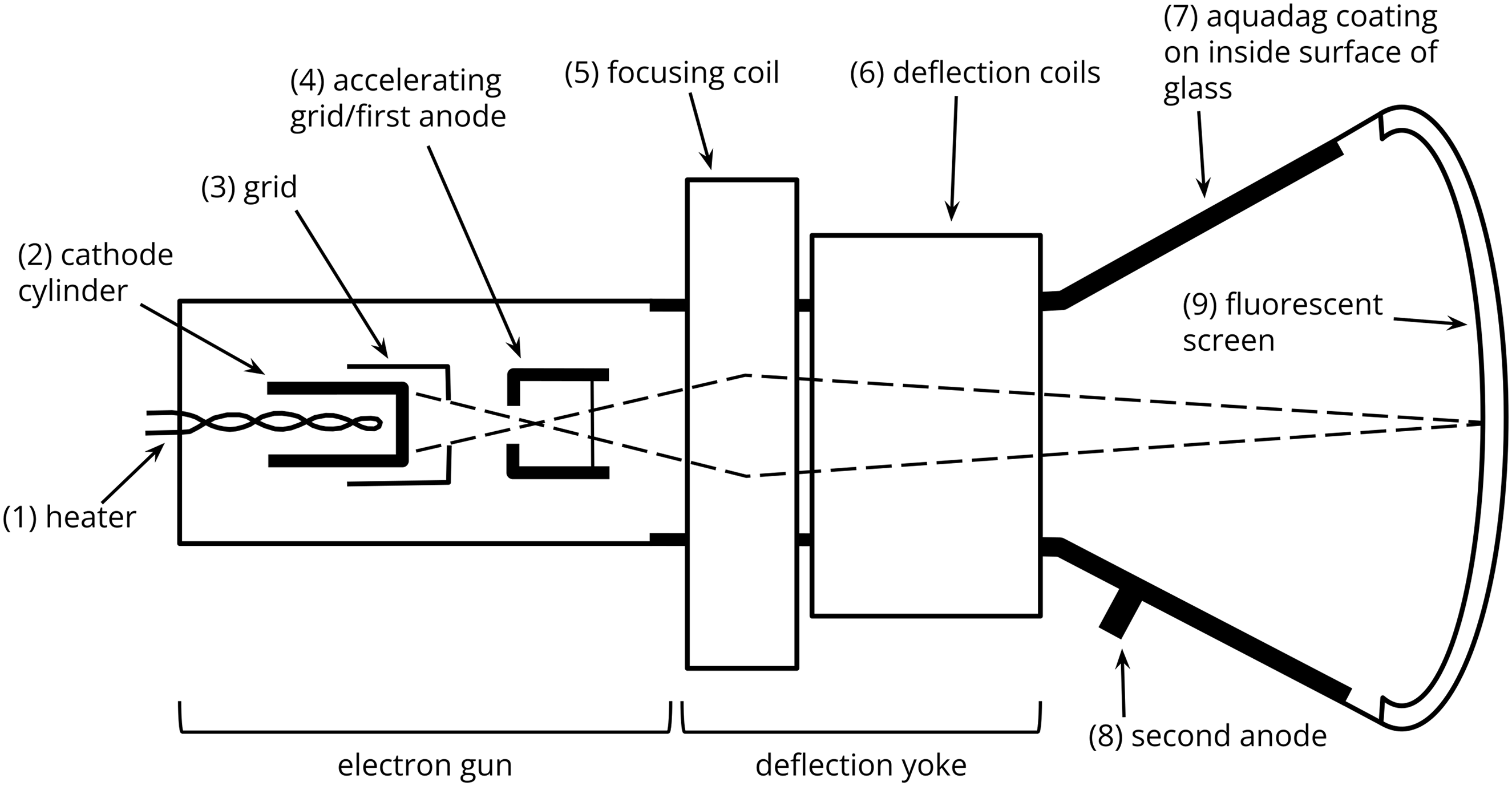
Component parts of a television cathode ray tube using electromagnetic deflection, early 1950s.
Thus generated, the electron beam was focused and aimed by the deflection yoke, which consisted of the focusing coil (point 5) and deflection coils (point 6). 3 Both included wire coils through which current passed, creating an electromagnetic field. The focusing coil worked on a principle analogous to that of an optical lens used to focus light, while the deflection coils controlled the horizontal and vertical position of the beam, directing it toward a specific point and allowing for the process of scanning interlaced lines to produce an image (Anderson, 1953: 220). At this point, the electron stream entered the end of the tube housing the screen, where it was further accelerated by the second anode, created by a graphite-based coating of aquadag on the inside of glass (points 7 and 8). Finally, it struck the luminescent phosphor coating applied to the inside of the screen (point 9), causing the phosphor to glow briefly and display an image for viewers.
Oil in the production of the cathode ray tube
This description gives a sense of the nested nature of the CRT and its component parts: the CRT contained an electron gun and a deflection yoke, which in turn contained their own components, which in turn were made up of more basic elements such as glass, metal, and various chemical coatings. Moving in the other direction, as I write in the next section, the CRT was itself a component in a television set, attached to a chassis that was then housed in a cabinet.
Breaking the CRT into its component parts provides a map for analyzing the role of petroleum and its derivatives in its fabrication. Oil performed two main functions, first as an energy source, second as a solvent. With respect to petroleum as an energy source, consider, first, the glass envelope that housed the electron gun, deflection yoke, and screen. The vacuum inside the tube posed the very real danger of implosion, so much so that the television repair manual from which I adapted Figure 1 warned, “Although the tube face is fairly thick, a fracture of the glass by a blow, or scratch, may cause sudden collapse, and the force of the implosion may throw pieces of glass with dangerous violence in every direction” (Anderson, 1953: 235). In fact, the threat was great enough, according to historian Deborah Chambers (2011: 361) that, until the 1960s, the design of the cabinet in which the tube and chassis were housed was influenced by concerns about the tube's potential implosion.
Producing the shatter-resistant glass needed for CRTs involved heating the glass to 900°C (Gardiner, 2013). Corning, the main supplier of television glass in the 1950s, described the process this way: “In manufacturing television picture tubes, the face plate is pressed, the funnel spun, the neck drawn; all three are hermetically sealed together by gas and/or electric heat” (Corning Glass Works, 1958: 30). The connection with petroleum is clear in the case of gas heat, but even when the heat source was electric, the fuel used to produce the electricity was likely to be carbon-based. In 1949, 68% of the electricity generated in the United States came from coal, natural gas, or another form of petroleum; by 1964, that rate had risen to 81% (U.S. Energy Information Administration, 2012: sheet 32; see Figure 2).
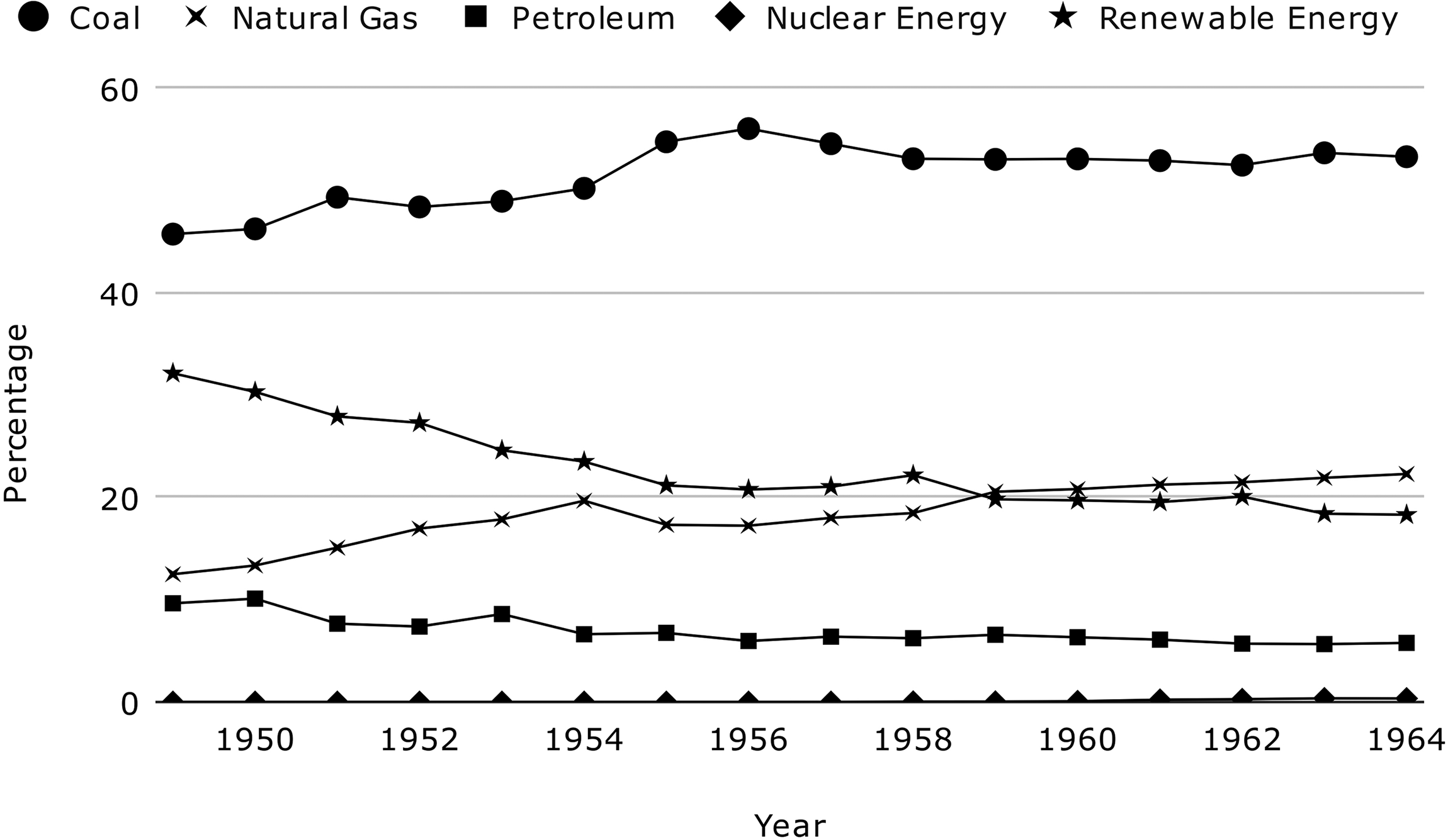
Percentage of annual electricity production in the United States by source, 1949–64.
The glass envelope was not the only component requiring large energy inputs; the production of other CRT components was equally energy intensive. The heating filament, for instance, was made of tungsten coated in aluminum oxide and heated to 1600°C to provide adequate insulation, while the flat end of the cathode cylinder, “usually of pure nickel, [was] coated with a preparation of strontium and barium oxides, the cathode cylinder being electrolytically cleaned and fired in hydrogen at about 700°C” (Helt, 1953: 73–4).
The filament and cathode cylinder coatings were applied through chemical reactions that did not involve petroleum-based chemicals (Wright, 1949). Similarly, the graphite-based aquadag coating making up the second anode was applied using a water-based solution. In contrast, however, the phosphor applied to the inside of the screen to make it fluorescent required petroleum-based compounds. As the magazine Electronics World explained in its December 1959 issue, picture tube phosphors were usually zinc or zinc cadmium sulfides, which had been prepared “by the homogeneous dry mixing of purified constituents in the required proportions, followed by a heat treatment in the range of 1800 to 2000°F,” or 900°C to 1100°C (Fortney, 1959: 98). The phosphor was applied “as a lacquer suspension, from which, after the solvent [had] evaporated, the lacquer [was] baked out, leaving the phosphor adhering to the glass in a smooth, uniform coat” (Fortney, 1959: 98). The solvent consisted of petroleum-based compounds such as xylol and butanol (Bergin and Sylvania Electric Products, 1958).
In this way, postwar CRTs depended on petroleum (and electricity generated by carbon-based fuels) for the energy necessary to construct their component parts and as tools in the manufacturing process. Petroleum and its derivatives, however, were used up in the process, visible only in their effects, rather than their concretized presence. Such was not the case, however, for the objects of which the CRT was a component, namely the chassis and cabinet.
Television's tiny ontology: chassis and cabinet
The cathode ray tube was incorporated into the cabinet by way of a metal chassis. An image of the front and back of an opened chassis is reproduced in Figure 3, which shows the CRT from behind, where wires entered to power the heating element. The screen is facing away from the vantage point of the viewer. Also visible are the wires connecting a series of capacitors, the cylindrical metallized glass components whose purpose was to regulate the flow of current through the CRT by storing and releasing electricity. The front and back of the chassis were held together by a metal bracket, which was in turn bolted to the bottom of the cabinet (Anderson, 1953: 233). The particular model pictured in Figure 3 was a compact “personal” receiver, capable of receiving twelve VHF channels, that was propped up on a four-legged stand and could be “readily moved to any location” (RCA Victor, 1956: 1).
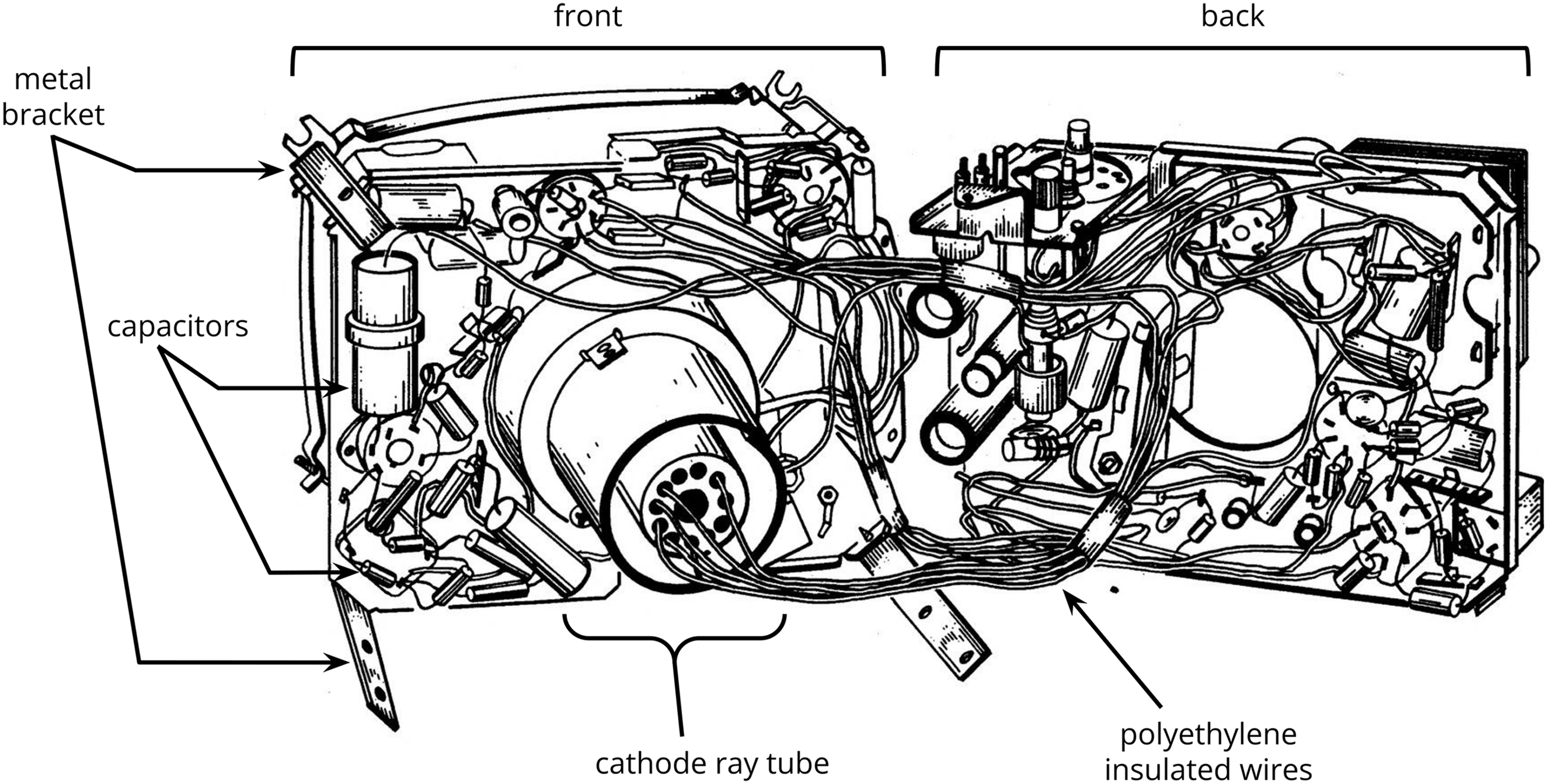
Front and rear chassis sections, with cathode ray tube seen from behind, 1956.
The style of cabinets varied widely in the 1950s. However, researchers are faced here with another silence in the archive, little research having been done about television receivers as material objects. Deborah Chambers is the author of what work there is, and although she focuses on Britain, her observations are valuable for my purposes here, too, given the dialogue that took place between U.S. and British designers. As Chambers (2011: 360) points out, “Television receivers were necessarily shaped by a complex web of factors involving not only engineering, commercial and manufacturing considerations but also contemporaneous public discourses about electrical communications,” an observation echoed by Spigel (1992) in Make Room for TV, focused more squarely on the United States.
To understand the objects into which TV chassis such as the one in Figure 3 were incorporated, consider the technical, social, and industry-related forces shaping cabinet design. As already mentioned, from the development of CRT technology in the 1930s through the 1950s, one concern was to use the cabinet to protect consumers in case the vacuum tube imploded (Chambers, 2011: 361–2). Another was to design cabinets that consumers could incorporate into their living space, a task complicated by the perception many had (especially in TV's early days) of receivers as “one-eyed monsters” they needed to camouflage as furniture. In response to this need, designers worked to incorporate wood into cabinet design, an approach that was also “crucial in signifying aspirational domesticity” (Chambers, 2011: 362). Indeed, as Spigel (1992: 107) writes, furniture manufacturers in the United States saw television receivers as objects around which other purchases could be made, showing how sofas and chairs could make the television-viewing experience more comfortable. Designers also incorporated “metals, glass and plastics with wood and textiles” (Chambers, 2011: 362).
In the postwar years, British manufacturers were about five years behind their U.S. counterparts, production having stopped during the war. As demand and production increased, designers criticized manufacturers for creating cabinets that sacrificed aesthetic or functional ideals for efficiency of production. The increasing use of plastic became one way to achieve efficiency while also producing sets that “would integrate into existing, traditional aesthetics and daily patterns of family life” (Chambers, 2011: 366–7). This was especially true as television receivers became more portable, such as in the example of the chassis depicted in Figure 3. The United States, as Chambers (2011: 367) notes, was in the vanguard for portable television, which relied increasingly on molded plastic shells to house the chassis and, in turn, the CRT.
Oil in the production of the chassis and cabinet
What role did oil and its derivatives play in the production of the chassis and the cabinet? For one thing, they provided the necessary energy for creating different parts, as was the case with the cathode ray tube. Within the chassis, for instance, the metallized glass capacitors were created using techniques and energy inputs similar to those used to create the CRT's glass envelope. As Corning explained: Glass—insulating, protecting, carrying, and storing electric current—is the foundation on which nearly all communication systems are built. […] In addition to its important role in the manufacture of electronic bulb and semiconductor enclosures, glass is used in making electronic components such as capacitors, resistors, metallized components, printed circuit boards, and micro-circuitry wafers. (Corning Glass Works, 1958: 46–7)
4
The metal casing of the chassis required similar energy inputs.
However, in contrast to the CRT, petroleum also served as a raw material that was transformed and remained present in the chassis and cabinet television receiver as a synthetic plastic. Certain petroleum-derived plastics were valued for their flexibility. For 1950s-era television, polyethylene (that is, a polymerization of ethylene) served as an insulator for the wires connecting the CRT to its power source, by way of the capacitors (Mautner and Schade, 1950). Its value lay in its “superior dielectric [that is, insulating] strength, extremely low power factor and dielectric constant, both being stable with temperature and frequency, and flexible” (Falconer, 1951: 20). As an article in a 1951 issue of Electronics World explained, the insulation provided by polyethylene served not only to improve the quality of the television receiver, but also to save companies “many dollars on warranties and guarantees for component replacements through an elimination of difficulties that start elsewhere than in the component, difficulties caused by faulty insulation” (Falconer, 1951: 21).
For parts such as the cabinet that housed the chassis, the value of other plastics was their rigidity and durability. One popular material for television cabinets was Bakelite, the first synthetic plastic, developed in the first decade of the 20th century. 5 In the years immediately following its invention, manufacturers tended to use it for its imitative qualities, mimicking wood or glass. By the 1930s, however, they had begun to devise ways to use it as a material in its own right, incorporating it into an increasing number of consumer goods, where its value lay in products’ “elegant designs (the material was modern and did not require much maintenance) and their long durability in comparison with porcelain, glass, and clayware” (Bijker, 1987: 178). In the broadcasting industry, Bakelite's value was first as an “insulating molding material,” but also as “a versatile plate material that could be sawed, drilled, and filed to provide a mounting frame for electrical parts” (Bijker, 1987: 177). It was especially common in Britain, but it was also a component in receivers manufactured for the U.S. market. Here, however, the silence in the archive with respect to television sets as material objects presents a challenge for historical research. Although Elinor Groom (2020) writes about the British Bush TV22 receiver—“the quintessential ‘vintage television’” known for its Bakelite shell (television restorer Stephen Ostler, quoted in Groom, 2020: 207)—no similar research exists in the U.S. context. Advertisements for 1950s-era TV sets found in the World Radio History archive, however, emphasize the cabinets in which chassis were housed, which were made of a range of materials, including Bakelite (for instance in some RCA Victor models) and wood veneer. They also frequently highlight the different component parts made of rigid plastic, especially knobs and dials.
Television, oil, and the evolution of the private space
The preceding analysis has shown places in the manufacturing process of 1950s-era television sets where oil's role has been overlooked, and it raises one last question I want to address: how did oil shape the ways that North Americans incorporated television into their homes and life routines? The points where oil was invisible are also those where the meaning that consumers made of it—and of the objects and routines it made possible—was contested. As the oil industry worked to create new markets by differentiating between consumers to generate demand, consumers reacted by adopting and adapting the products the industry offered. The oil industry in return adapted its approach in a relationship of mutual influence with consumers.
The analysis in this final section is admittedly speculative, as the question I have posed exceeds the limits of what is possible in a journal article. Therefore I narrow my focus by rereading Spigel's (1992) account of the evolution of the postwar living room through the lens of oil, adopting Trouillot's strategy of “reposition[ing …] evidence to generate a new narrative” (1995: 27). In chapter 4 of Make Room for TV, Spigel describes the ways that the postwar American home, in particular the living room, was “designed to incorporate social space” (1992: 106). New appliances, such as refrigerators and washing machines, meant people no longer had to leave their home to buy food or to do laundry. Likewise, television meant they no longer had to leave their living room for entertainment, leading to a decline in attendance at “spectator amusements” such as movies and sports (Spigel, 1992: 106). The expansion was in this sense physical, with the delivery of gas and electricity to the home, but also architectural or even metaphorical. In the postwar years, for instance, houses in the new suburbs built around U.S. cities “offered their consumers large picture windows or glass walls and continuous dining-living areas,” blurring the distinction between houses’ interiors and exteriors (Spigel, 1992: 104). Following the same logic, the television set itself became a “new window on the world,” as DuMont said in an advertisement for a receiver it produced (quoted in Spigel, 1992: 105). Through its programming, U.S. television promised travel to exotic locales, although it also threatened to let in people who did not conform to the “antiseptic model of space [that] was the reigning aesthetic at the heart of the postwar suburb” (Spigel, 1992: 110).
The tensions between inside and outside give some sense of the way the oil industry, the television industry, and suburban residents negotiated the meanings they made of the space of the living room. In effect, the living room represents another analytical step in television's tiny ontology, that of the space of which TV receivers were components. Here, too, it is possible to observe the configuration of different components and the logic binding one to another. The television repair manual I cite above describes how installers should place a receiver with respect to other elements of the living room. Certain concerns were technical, warnings not to “place the receiver in such a position that direct illumination such as light from a window falls directly on the face of the screen,” nor to “place the cabinet directly against the wall,” so that “adequate ventilation will be assured” (Anderson, 1953: 1). Others were aesthetic: “The room containing the television receiver should be so planned that viewers can enjoy the program without first upsetting and rearranging the room,” but the receiver should “not be so dominant in design or location that viewers have to sit and face it when not in use” (Anderson, 1953: 2–3). Finally, installers were instructed to take the potential for eye strain into account by positioning lamps so they cast an indirect light behind the receiver (Anderson, 1953: 7), observations echoed in the women's magazines examined by Spigel (1992: 107–8).
Oil influenced the incorporation of the television into the postwar living room in multiple ways. On a technical level, of course, it made the technology possible (as the prior sections have shown), in such a way as to prompt concerns about eye strain, for instance, due to its fluorescent screen. But, importantly, its impact was observable at a discursive level, too. After the Second World War, the oil industry had to find new markets to replace the customer it lost when the U.S. government stopped stocking materials. It took a multi-pronged approach. Through lobby groups such as the American Petroleum Institute, it justified itself to consumers (and the government) by arguing that its success was a reward for the willingness of its leaders to take the risks necessary to advance the cause of capitalism (Conway and Robertson, 2021). More subtly, it adopted a strategy of fractionation, or the transformation of crude oil into increasingly refined products that could be sold to an ever wider range of consumers. These strategies were in line with a broader shift taking place around notions of work: “consumption outside the workplace (i.e., social reproduction) began to take on increased social, cultural, and indeed ecological significance as the critical medium through which ‘freedom’ in daily life was imagined and performed” (Huber, 2013: 36). According to Huber (2013), this shift marked the emergence of the entrepreneurial subject, who understood the exercise of freedom as a function of individual choice.
One key site where people negotiated their identity in the context of the broader social structures shaping the entrepreneurial subject was the home: The choice of where to live and work represent[ed] the qualitative (and sometimes quantitative) metric of an individual's entrepreneurial capacities connoting both one's own success in raw material terms and a family's ability to invest in the “human capital” known as children, as the quality of education and schooling came to correlate with the property values (and, thus, fiscal revenues for schools) of a given neighborhood. (Huber, 2013: 75)
Or, as Spigel writes, people “secured a position of meaning in the public sphere through their new-found social identities as private land owners” (1992: 101).
Here is where oil, as incorporated into the components of television and the living room, played a role that the preceding analysis makes it possible to identify. As television became more common, the concern people had about health, evident for instance in instructions about how to avoid eye strain, evolved to include ideas of comfort, too, for instance with respect to indoor climate and humidity control (Spigel, 1992: 108). What Emily Rees writes of the British context was also true in the United States: “The early relationship between technology, comfort and health […] was eventually overtaken by a conception of the comfortable home as contingent upon consumption practices, which were indicative of social status” (2019: 136). Here the provision of utilities, especially electricity and gas, was a necessary component.
In this way, television became one locus in the negotiation of meaning about the space of the living room. On a macroscale, oil and its derivatives were a necessary (but not sufficient) component of television technology, the operation of which required energy, much of it produced through the combustion of carbon-based fuels. On a microscale, early television sets used plastics to mimic wood and thus blend into the décor of the room, addressing consumers’ anxiety about the risks of bringing the outside world into the intimacy of their home. Over the course of the 1950s and into the 1960s, however, as manufacturers came to use plastic as a material in its own right, they made receivers portable and created sleek lines that evoked the “space age” technology symbolic of the forward-looking modernity to which consumers aspired (Chambers, 2011: 367–8). By emphasizing portability and style, they also drew attention away from oil as such.
Conclusion: revealing media's hidden environmental costs
I began this article by evoking the role of digital technologies in the ongoing climate crisis before describing the logics by which the consumption of oil and its derivatives has been hidden from view. To address the paradoxical “disjunctive and binding nature” of oil in modern life (Salminen and Vadén, 2015: 2), I then described the role of oil in 1950s-era television technology, starting with the cathode ray tube and its components, then the chassis and cabinet in which the CRT was housed, and finally the living room where people watched TV. The value of this approach is its capacity to make oil visible in the historically rooted, unspoken principles by which people organize their mediated lives. Even in the narrow case of 1950s-era television, oil and its derivatives played an otherwise unacknowledged role in shaping people's habits, which have continued to evolve and affect the changing climate.
There would be value in expanding this approach, in dialogue with work falling under the heterogeneous banner of media archaeology, with which this approach shares an investment in revealing dimensions of media history overlooked by conventional modes of scholarship (Huhtamo and Parikka, 2011). Making oil visible has the potential to refashion discussions not only of media and their uses, but also of the more abstract terms scholars use to make sense of the implications of those uses, such as public and private. If scholars want to understand the role of media in climate change, as material objects that convey ideological content, they need a greater understanding of their own implication in that relationship. To return to the examples of digital technologies, consider how scholars have discussed the evolution of the public sphere with the advent of the internet or, more recently, social media. These media have contributed to a restructured sense of space, where oil plays an unacknowledged role. A necessary task will be to uncover this role in scholars’ evolving notions of the public in an online environment, showing how the internet, functioning in a carbon-based economy, has allowed citizens to come together to deliberate collectively—and how it has shaped the terms of that deliberation. Viewed through this lens, climate activists’ efforts to organize online, to give only one example, appear considerably more complex. In this way, if the social is produced rather than directly given, as Szeman (2021) suggests, perhaps scholars can find ways to address climate change by producing it differently.
Footnotes
Declaration of Conflicting Interests
The author(s) declared no potential conflicts of interest with respect to the research, authorship, and/or publication of this article.
Funding
The author(s) received no financial support for the research, authorship, and/or publication of this article.
