



Abstract
In 1991, Sheffield was the host city for the XVI Summer Universiade, better known as the World Student Games (WSG). Studies of the 1991 WSG commonly assert that it received little to no television coverage. This article intervenes to demonstrate that the WSG did receive substantial television coverage on Sky Sports and across the ITV network. The article draws on new archival sources to provide perspectives on the negotiations and interactions between the WSG organizers and the broadcasters, focusing on BSkyB. The article serves as an instrumental case study on how newly available television archival collections can be used to reframe perspectives of television history. In particular, the article considers the early history of Sky Sports, its approach to sports acquisition, its relationship with public service broadcasters, and the impact of satellite television on live-sports coverage and a rapidly changing media landscape in the UK in the early 1990s.
Keywords
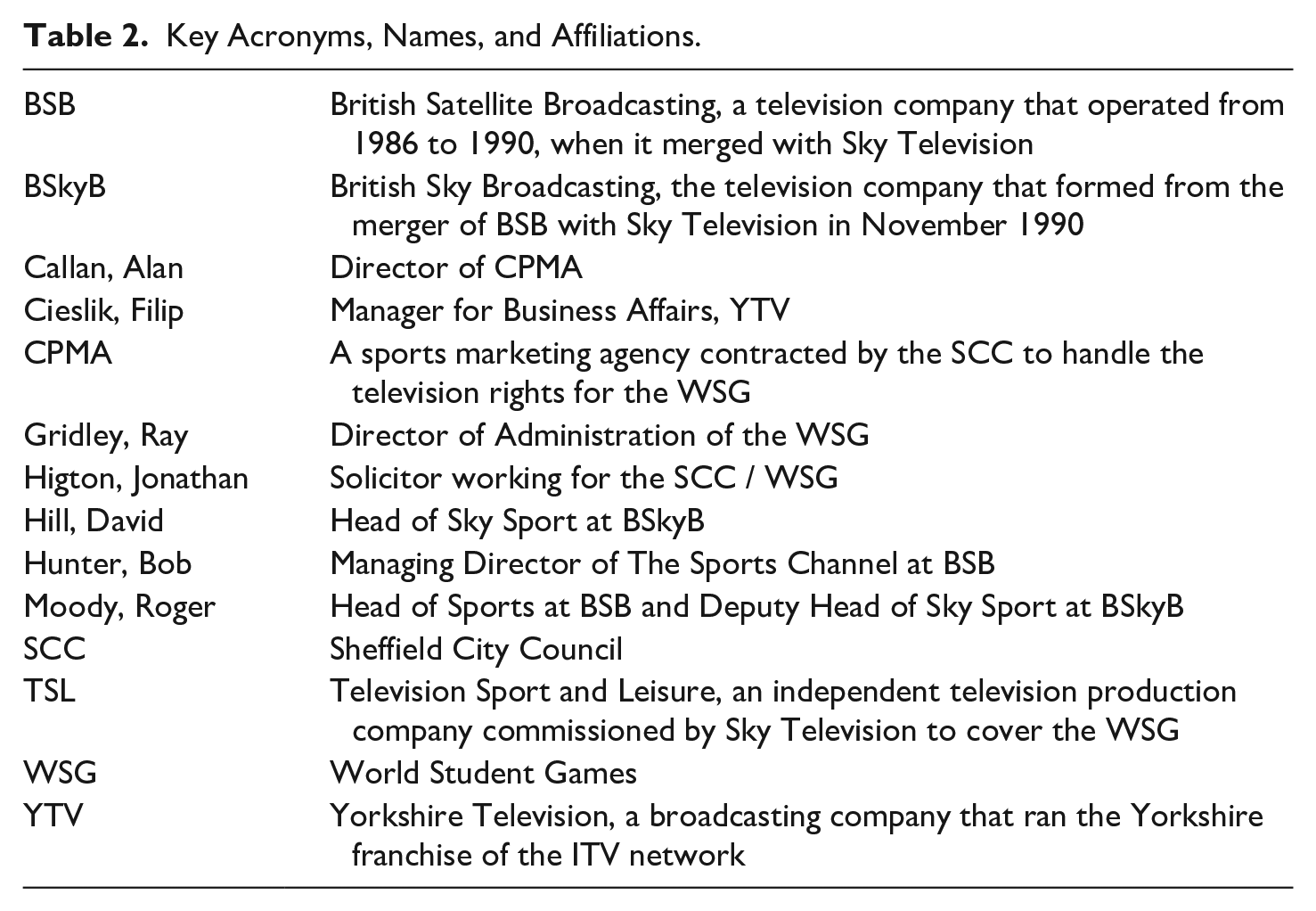
To aid the reader, a table of key acronyms, names, and affiliations has been provided in Table 2 at the end of the article.
The 1991 World Student Games (officially known as the XVI Summer Universiade and henceforth referred to as the WSG) was hosted by the northern British city of Sheffield. The WSG are a biennial multi-sport event for university athletes from across the world, organized by the International University Sports Federation. The Sheffield City Council (SCC) envisaged that the WSG would further the city’s ongoing urban renewal after the collapse of its decades-long dominant steel industry in the 1980s, promoting the city to national and international investors and tourists through the perceived widespread television coverage it would receive. The television rights to the WSG were owned by the SCC as hosts of the event, which aimed to sell them to the UK’s national terrestrial broadcasters—the BBC, ITV, and Channel 4—and to major overseas media broadcasters.
The 1991 WSG have been an object of ongoing scholarly interest, primarily for the way in which they impacted on, and intersected with, Sheffield’s urban renewal. The steel industry had dominated Sheffield’s economic, cultural, and social life for over a century, particularly bulk steel manufacture that stretched from the city center out to the city’s East End and the Lower Don Valley, the area in which most of the WSG would take place in newly built sport venues (Corker and Fenwick Forthcoming). Sheffield’s identity was entirely centered on its steel industry, with an established global brand via monikers such as “Made in Sheffield.” By the start of the 1970s, the city had near full employment, but by the end of the decade there was a steady decline of the steel industry and of the availability of jobs. The rapid deindustrialization of Sheffield intensified throughout the early-to-mid 1980s, as the steel industry moved overseas. Unemployment gripped Sheffield, with the loss of approximately 59,000 jobs between 1978 and 1984, and by the end of the 1980s it was estimated that 77 steel plants had closed in the city (Fenwick 2021, 841). The closure of these plants—massive factories that dominated the skyline and the landscape of the city’s East End—left swathes of empty land as the factories were demolished or left as derelict ruins. The SCC was faced with an economic and social crisis: how to regenerate the city following the collapse of an industry that had defined it and how to renew the landscape that had once been dominated by that industry.
The SCC primarily turned to the cultural industries as a means of regenerating Sheffield’s economy in the immediate wake of the steel industry’s collapse. The cultural industries were broadly defined in a research report commissioned by the SCC as encompassing the arts, music, film, media and broadcasting, and sports (Harvey 1988, 26). New cultural sites were built, such as The Leadmill, a community arts and music venue that was intended to provide “an accessible leisure space for the economically and socially marginalized” (Kenny 2019, 557). The SCC also designated an area of the city center as the Cultural Industries Quarter, with the aim of growing creative businesses and attracting middle-class, university educated professionals to relocate to the city (Fenwick 2022, 12). Extensive rebuilding took place across the city center and in the East End of the city, including a new retail shopping mall, Meadowhall, with the intention of redeveloping the city as an attractive place to not only visit or work, but to live.
The SCC turned to the cultural industries with the hope that they would lead to an economic recovery in Sheffield through business investment, tourism, and the relocation of a new professional class. And the WSG presented the SCC with an ideal opportunity—at least it was hoped—to promote Sheffield’s urban regeneration. The new cultural and sporting venues that were being built for the WSG—built on the sites that had previously been dominated by the steel factories—would be showcased, demonstrating to the world the city’s newfound confidence and identity; a city that was global, forward thinking, vibrant, and creative—a city reborn (Corker and Fenwick forthcoming). The WSG, and the SCC’s desire for national and international television coverage of the WSG, must be seen in this context: a northern, post-industrial British city that was searching for a new identity and a new industrial base.
Academic research on the WSG has primarily focused on the economic failure of the WSG and the legacy on the public finances of Sheffield (Dobson 2000; Foley 1991; Gratton et al. 2005; Henry and Paramio-Salcines 1999; Roche 1994). The SCC struggled to find the appropriate private sponsorship and funding for the games and therefore had to pay for much of the building work and logistical expense through loans, the Sheffield council taxpayer, and government and Sports Council grants. New venues built for the WSG included the Ponds Forge International Sports Centre (based in the city center) and the Sheffield Arena and Don Valley Stadium in the East End of the city (the latter was demolished in 2013 due to the SCC’s inability to carry on funding it), costing over £147 million. The SCC agreed to pay back the loans for these buildings, with interest, over twenty-two years, which subsequently impacted on its ability to fund other basic services in the city (“World Student Games” 1991, 31). The repayment period was later reduced to ten years, with the SCC paying over £20 million per year of debt (Dobson 2000, 63). The economic legacy of the WSG was therefore costly to the SCC and to Sheffield’s citizens. The costs of the WSG were revealed, and heavily criticized, in the build-up to the games (Dobson 2000, 59–60) and the Labour Party, which ran the SCC and had forged ahead with the strategy to host the WSG, was singled out for its “incompetence and politicking” (Dobson 2000, 60).
Given this context, the stakes were high for the SCC and the Labour party to stage a successful WSG. They had to prove that the WSG was worth the cost to the Sheffield taxpayer by having extensive national and international media and television coverage: major broadcasting deals became of the utmost importance to the SCC. As Rodda (1989) noted in the Guardian in 1989, the SCC aimed to secure major sponsorship and broadcast deals to ensure “world-wide exposure” (p. 18). But even though television became such an integral part of the SCC’s strategy, relatively little attention has been given to the broadcasting of the WSG. Most academic studies of the WSG have overlooked the issue of television rights and how they came to dominate the organization of the event. Nigel Dobson, for example, briefly states that, Although a deal was secured with Channel 4 and regional television to screen highlights of the Games, unfortunately for city leaders and the event organisers, the event got little national or international media coverage. (Dobson 2000, 58)
Scholarly oversight of the television rights is in part a result of negative press coverage at the time, which suggested the WSG was receiving little television coverage. Matthew Engel, in the Guardian, suggested the event was a “disaster” (Engel 1991, 16). And in December 1990, just seven months before the start of the games, Granada Television’s World in Action series broadcast the documentary 20 Years Hard Labor, which criticized the organization of the WSG. The documentary noted that previous WSGs in other countries largely relied on state-financing, whereas the SCC was being expected to rely on sponsorship, which would only be forthcoming should the games receive considerable national television coverage. Hugh Herbert, reviewing the World in Action documentary, said that “Neither the BBC nor ITV companies showed any interest in televising games that may be big draws in other countries but here, as one unkind smile put it, looks like school sports for adults” (Herbert 1990, 25). The “other countries” to which Herbert refers were primarily in the former Soviet Union.
The lack of analysis of the television rights is also due to a lack of available archival evidence. However, thirty years on from the WSG, new archival records are now available in the Sheffield Archives. These records span 1989 to 1991 and include correspondence, contracts, notes, reports, minutes, and television schedules. The archival documents show how the SCC was interacting with all forms of broadcasting in the UK at that time, from new television media such as satellite (Sky Television), to public service broadcasters (BBC), to regional television (Yorkshire Television), to the wider ITV network, and indeed secured contracts to broadcast the WSG with all these television broadcasters. Drawing on these documents, this article will set out to provide evidence that the WSG did in fact receive considerable national television coverage and that television rights were at the heart of the SCC’s strategy for the games. By undertaking archival research, the article will investigate how archival documents can reframe scholarly understanding not only of a significant cultural sporting event—the WSG—but also television history. The archival documents will be examined for insights into a new broadcasting medium—satellite television—and new media businesses—BSkyB. The article will consider what the archival documents reveal about BSkyB and how it was transforming the acquisition and broadcasting of live sports events, with a focus on the early history of Sky Sports (BSkyB’s sports channel), its approach to sports acquisition, the politics and tensions between BSkyB and rival media companies, and the SCC’s relationship with BSkyB.
An examination of the WSG television rights and the negotiations that took place between the SCC and BSkyB serves as an insightful case study on the rapidly transforming media landscape in the UK at that time. The SCC’s hopes for extensive television coverage converged with the emergent battle for satellite television subscribers, climaxing with the merger of British Satellite Broadcasting (BSB) and Sky Television in 1991 to form BSkyB. The impact of the merger on sports coverage in the UK and on the television rights to numerous sporting events would be substantial, not least on football with the creation of the Premier League in 1992; the television rights to the latter were bought by BSkyB, significantly contributing to the company’s rapid growth throughout the 1990s (Horsman 1998, 92–105). Live sports provided the means by which satellite television expanded and, as such, a deal with BSkyB would be crucial to the SCC’s plans for the WSG.
The WSG also coincided with the advent of the 1990 Broadcasting Act, implemented by the Conservative government of Margaret Thatcher. The Act allowed for, among other things, a new ITV franchising system, in which all ITV franchises would be put out to competitive tender and the ITV companies allowed to merge (Goodwin 1998, 109–116). The Act encouraged media deregulation and gave Rupert Murdoch—then the Chairman and CEO of News Corporation Limited, which owned numerous British newspapers and had a controlling stake of Sky Television—an advantage over his competitors by exempting Sky from new rules preventing national newspaper owners having more than a 20 percent stake in television companies on the basis that Sky was not a UK service. These changes to the British television landscape coalesced with the SCC’s planning of the WSG and presented a myriad of opportunities and challenges in terms of securing television coverage.
The Television Opportunity
Sheffield was chosen as the host for the WSG in November 1987. In the summer of 1989, the SCC commissioned a report to evaluate the television potential of the WSG. The report’s authors, consisting of three ex-BBC personnel, concluded that, “Generating television coverage for Universiade 91 is possibly the key requirement in securing successful support for the games from outside commercial companies” (“Television Analysis for the World Student Games” 1989). Generating television coverage was also vital to the wider plans to mediate Sheffield’s new identity, and new buildings and venues, to businesses, investors, and tourists (DEED 1990, 3). The report stated that television coverage would cost at least £1,000,000 and concluded that neither the BBC nor ITV would agree to act as host broadcasters for the WSG (“Television Analysis for the World Student Games” 1989). The BBC and ITV believed the WSG lacked national audience appeal (DEED 1990, 39)—after all, the primary audience for the WSG was based in former Eastern Bloc countries or were students attending the games meaning that the SCC was always going to struggle to convince national broadcasters of the significance of the WSG to the wider British public. At best, the BBC and Channel 4 would likely agree to pre-packaged content provided by another host broadcaster or an independent production company. Considering this, the evaluation team suggested two potential routes available to the SCC.
The first recommendation was that the SCC form its own production company called Universiade 91 TV. The company would generate a television signal, providing a live feed of the event, and produce highlight programs that would be sold to the main UK public service broadcasters and to international television companies. For this strategy to work, Universiade 91 TV would have to attend television sales conferences between 1989 and 1991, such as the MIPTV Media Market and the MIPCOM International Market of Communications Programs, both held in Cannes, to “show programme controllers and sports editors our various packages, both sports and cultural” (“Television Analysis for the World Student Games” 1989). The report stated that sponsorship would eventually fund the costs of setting up the independent in-house company and argued that establishing that company had the advantage of not being exclusively contracted to any one distributor or television organization, enabling them to “maximise on our sales” (“Television Analysis for the World Student Games” 1989). But the recommendation of an in-house television company was never really an option given that Sheffield suffered from a lack of media infrastructure (Fenwick 2021, 841–842). A WSG impact report noted, “Sheffield is the largest city in England without any TV networked production capacity” (DEED 1990, 39). The city only had a Yorkshire Television (YTV) Calendar South studio, which was land-linked to YTV’s Leeds headquarters. There were notable independent film producers and independent television companies in the city (Televideo Production, which produced coverage of football league matches, Gogglebox Productions, which produced promotional videos for the SCC, and Sheffield Independent Film). But none of these local companies had the capacity or resources to act as the host broadcaster.
The second recommendation urged the SCC to consider the emerging potential of satellite television. The report stated: Whilst Sky, Super Channel and BSB (by 1991) are not showing enormous audiences at present, it is certainly possible that they will have a good audience where sport is concerned and will be looking for 12-14 hours per day. The World Student Games is the ideal type of programming to fill their schedules. (“Television Analysis for the World Student Games” 1989)
The expansion of satellite television in the UK (and Western Europe) by the end of the 1980s had been substantial. In 1982, Satellite Television became the first satellite channel transmitted across Europe, targeted at cable systems (Goodfriend 2013, chap. 5). The company was bought out by Rupert Murdoch’s News International in 1983 and renamed the Sky Channel. It broadcast a mix of family entertainment, drama, films, and sports and was funded solely through advertising. By 1988, Murdoch announced the launch of Sky Television in the UK, a multi-package satellite offer, which consisted of Sky Channel (to be renamed Sky One), Sky News, Sky Movies, and Eurosport (Holden 1998, 208). The package officially began broadcasting in 1989.
In competition with Murdoch’s Sky Television was British Satellite Broadcasting (BSB), a consortium that was awarded a direct-broadcast satellite license by the Independent Broadcasting Authority in December 1986 (Horsman 1998, 35–37). Initially consisting of Anglia Television, Granada Group, Pearson, Amstrad Consumer Electronics, and the Virgin Group (the latter two would later withdraw), BSB offered a five-channel package consisting of The Movie Channel, Now, Galaxy, The Sports Channel, and The Power Station, which went on air in 1990 (Bonner and Aston 2003, 432–433).
BSB and Sky Television were the two main satellite companies aiming to dominate the UK market and both were engaged in a costly battle for subscribers to their respective packages between 1988 and 1991. BSB and Sky aimed to entice customers through the offer of exclusive movies and sports. Both companies signed up most Hollywood studios to supply their film channels with content, at a cost of £1.2 billion over five years (Horsman 1998, 85). And both companies also secured the rights to a range of live sports events, including test cricket, grand slam tennis, and some minor football matches. By the end of 1990, BSB’s The Sports Channel and Sky’s Eurosport were broadcasting several 1000 hours of sport per year (Vaughan 1990, 10).
The emergence of satellite television and the aggressive competition between BSB and Sky Television needs to be framed within the context of the UK political situation in the 1980s and early 1990s and Thatcherite free market ideology. Margaret Thatcher, prime minister of the UK between 1979 and 1990, and her Conservative government pursued free-market policies designed to reduce “public ownership and expenditure” (Hodgson 2009, 149). This included privatizing swathes of publicly owned companies and assets throughout the 1980s, including Cable and Wireless, British Telecom, British Aerospace, British Airways, British Gas, British Petroleum, and British Steel. Thatcherism aimed to balance government spending, control the labor movement and diminish the power of trade unions, introduce greater competition in business, deregulate the financial markets, and to break up monopolies. These ideas had been formed by the Centre for Policy Studies and “New Right” conservative politicians such as Keith Joseph. What Thatcherite free market ideology stressed was individualism, individual freedom, and responsibility, with Thatcher herself believing that free markets and competition created “robust, self-sufficient, and moral citizens” (Berlinski 2008, 115).
Thatcherite free market ideology was soon applied to British television. Since the 1950s, the UK television landscape had been dominated by the BBC-ITV “duopoly,” (Goodwin 1998, 13–16). To Thatcher and the Conservative party, the BBC and ITV represented, through their public service remit, the values of the paternalistic post-war consensus. Thatcher, in reference to the trade union movements that still dominated the television industry and the ITV companies, is reputed to have said that ITV was the “last bastion of restrictive [trade union] practices” and her Conservative government was fixated on breaking up this broadcasting “duopoly” (Bonner and Aston 1998, 149). Conservative attempts at introducing Thatcherite free-market ideology into British television included the establishment of a fourth channel, Channel 4, in 1982 that would allow independent producers and production companies to create programming and that would instigate a new class of entrepreneurial television makers. One of Thatcher’s final acts as prime minister was the introduction of the 1990 Broadcasting Act, which allowed for the auctioning off of the ITV network’s sixteen franchise companies to the highest bidder and paved the way for the privatization of Channel 4 by forcing it to sell its own advertising time (in April 2022, the Conservative government of Boris Johnson announced plans to begin the privatization of Channel 4).
Thatcherite free market ideology underpinned the development of satellite in the 1980s and 1990s. Favor was given to Murdoch’s Sky Television by the Conservatives for the way it “symbolized a new social formation, which involved the relationship of consumers in new class formations to multinational corporations” (King 1998, 285). Sky Television would eventually monopolize satellite broadcasting in the UK when it merged with BSB in 1991. However, the merger was not referred by the government to the Monopolies and Mergers Commission, despite Murdoch being in breach of ownership rules; News International had a controlling 50 percent stake in BSkyB and had ownership of several newspaper titles in the country, including The Sun, News of the World, The Times, and The Sunday Times (King 1998, 284). Sky Television was promoted as offering consumers greater choice and as a free-market revolution of broadcasting. Yet, despite the central tenet of Thatcherite free-market ideology being competition and the breaking up of monopolies, Sky became an effective broadcasting monopoly following its merger with BSB. Failure to refer the merger facilitated the rapid growth of Sky throughout the 1990s and exposed the hypocrisy of Thatcherite ideology: her own fixation, and that of the Conservative party, was arguably more on the destruction of the BBC-ITV duopoly than it was on promoting competition in British broadcasting.
Sky’s business model was underpinned by audience subscription. And while only one in fifteen households in the UK had bought a satellite dish by the end of 1990 (Horsman 1998, 231), subscription emerged as the third key means of funding television broadcasting in the UK alongside the television license fee (which funded the BBC) and advertising by the mid-1990s. By 1995 to 1996, the license fee had raised £1,820 million, whereas commercial television broadcasters generated a revenue of £4,164 million, of which £1,045 million was raised from subscription (Goodwin 1998, 157). By the mid-1990s, “subscription was the most rapidly growing of the three major television revenue streams,” contributing to the disruption of the long-standing public service broadcasting post-war consensus (Goodwin 1998).
Sky’s main offer to subscribers was film and sports, content that had previously been offered by public service broadcasters. The BBC and ITV had long shared sporting coverage as part of the National Events Agreement (Bonner and Aston 1998, 108). But the costs of television contracts for sports was increasing by the end of the 1980s and Sky, recognizing that it needed to buy up sports content for its channels, drove up the bids for exclusive sports rights (Crisell 2002, 258; Goodwin 1998, 157). Sky was “siphoning off” sports content from the BBC and ITV duopoly and then offering it to consumers at a much higher subscription cost than the license fee (Goodwin 1998, 157). Sky’s business strategy was to acquire as much sports content as possible to fill the schedules of its channels as quickly as possible. For example, it acquired World Wrestling Federation (WWF) weekly matches in 1988 because it was regular programming that was broadcast for three hours at a time, followed by repeats. It was within this context that the SCC was presented with an opportunity to exploit (or be exploited by) new satellite technology to ensure television coverage of the WSG and provide satellite broadcasters with exactly the kind of unique content they needed to attract ever more subscribers.
Initial Deals with BSB and BSkyB
Ray Gridley was the Director of Administration of the WSG and the individual most intimately involved in the television rights negotiations. He was a long-standing senior administrator within the SCC, having previously worked as the council’s Director of Housing. His primary aim, influenced by senior political figures in the council, was to secure a deal with the BBC (Gordon 1990). The initial strategy was to contract a national independent television company to act as the host broadcaster through a tendering process. The chosen company would then produce content that could be broadcast by the BBC. The sports agency CPMA, run by Alan Callan, was hired by the SCC to act as the “sole and exclusive commercial representatives to the games” (Callan 1990). CPMA was expected to fully exploit the television rights for the WSG both nationally and internationally and to contract relevant television production companies and distributors.
A range of independent sports television production companies were considered by the SCC in November 1989: Trans World International, Cheerleader Productions, Sunset and Vine, Chrysalis News and Sport, Television Sport and Leisure (TSL), and Grand Slam Sports. The latter two were given the greatest consideration. TSL was founded by producer Mike Murphy and had specialized in coverage of cycling and badminton for Channel 4. TSL had also secured rights to cover the 1991 Rugby World Cup. Grand Slam Sports was one of the UK’s largest independent sports television producers at that time, producing sports news reports for Channel 4 and having covered major global sporting events, including the Olympics, the FIFA World Cup, the European Football Championships, and the past three World Student Games for overseas broadcasters. On this basis, Grand Slam Sports was chosen in February 1990 to serve as the host broadcaster of the WSG and allocated a budget of £1.5 million (Wilmot 1990). This initial strategy was costly to the SCC though and depended almost exclusively on obtaining extensive sponsorship deals. But sponsorship deals were not forthcoming without the attachment of a notable national broadcaster like the BBC or Channel 4, which the games organizers had still not secured.
By summer 1990, despite the plans initiated with Grand Slam Sports, Ray Gridley was still searching for a deal with a major national television broadcaster. On 7th June 1990, Gridley received a phone call from Bob Hunter, managing director of British Satellite Broadcasting’s (BSB) The Sports Channel, requesting a confidential conversation about being appointed the host broadcaster of the WSG. BSB had launched its satellite package just three months previously and was now searching for unique content. Hunter described the WSG as being “just up our street” (Hunter 1990a). The Sports Channel broadcast an eclectic mix of live sporting events from across the USA and Europe, though primarily showing British sports that had previously received little media coverage, including rugby league and Scottish football (Corrigan 1990, 27). BSB also negotiated a five-year deal with the BBC and the Football Association in early 1990 for coverage of FA Cup matches and England’s international home football games (Smith 1990, 2).
A week after the initial phone call, Gridley met with BSB’s Roger Moody to talk about a “possible co-operation between our two organisations” (Moody 1990a). Moody had previously worked as the BBC’s sports contract manager for twenty years (Corrigan 1990, 27). He joined BSB in June 1990 as the company’s Head of Sports responsible for rights acquisitions. Moody proposed that BSB become the WSG host broadcaster, with the technical coverage provided by its preferred independent production company, TSL. Gridley, keen to secure BSB, particularly given the company was prepared to provide full live coverage of the WSG, agreed to abandon the deal with Grand Slam Sports (Gridley 1990a).
CPMA, in co-ordination with Gridley, put forward a twelve-point draft agreement to BSB on 2nd July 1990. The agreement provided BSB with exclusive satellite rights to the WSG in the UK and Northern Ireland, with CPMA agreeing to oversee the remaining terrestrial and other broadcast rights nationally and internationally (Gridley 1990b). BSB would commission an independent production company to manage the production and technical requirements of the coverage, though CPMA would retain right of approval. Through the appointed independent production company, BSB would provide a broadcast signal to which CPMA would have access to fulfill deals with other third-party broadcasters. As part of the agreement, BSB was prepared to commit a budget of £2 million to the production. Gridley and CPMA also secured BSB’s agreement to, “offer an extensive afternoon broadcast each day of the Games with your evening programme being broadcast from 8pm to 10pm as ‘The main event’” (Gridley 1990b). CPMA would run the sponsorship and marketing plans, but with input and assistance from BSB. BSB would receive 20 percent on the first £3 million of any income generated from the production and sponsorship and 7.5 percent on any income after that. And, finally, the CPMA retained all rights to any official film or videos produced after the WSG, “which may include material created under this agreement and such material including commentaries shall be made available to CPMA at no charge other than for technical material cost” (Gridley 1990b). BSB contracted TSL to provide a broadcast signal and to produce a daily highlights package and a week in review program, all financed by BSB.
The draft agreement was written in favor of the WSG and the SCC. Gridley, perhaps somewhat naively, argued that the “simpler” the agreement “the better” (Gridley 1990b). As he noted in the conclusion to the agreement: “There are probably many things a lawyer would recommend both of us define [. . .] much depends on mutual good will. [. . .] The time has come when we must get on with the work in hand” (Gridley 1990b). The initial agreement with BSB was signed by both parties on 24th July 1990 (Hunter 1990b). But Gridley was overlooking how the new satellite companies were ruthless at sports acquisition. If he thought the agreement would be simple, then he was completely wrong. It would take another year before an agreement would be settled for the satellite television coverage of the WSG. In November 1990, it was announced that BSB had merged with Sky Television to form BSkyB. The status of the WSG television deal was now uncertain. The merger involved Sky selling off its Eurosport channel and renaming The Sports Channel as Sky Sports. Bob Hunter was fired as the managing director of the channel and David Hill was appointed as the Head of Sky Sports, with Roger Moody as his deputy. Described in the press as one of the world’s most “influential” and “innovative” sports broadcasting executives, Hill was hired by Rupert Murdoch from Australia’s Channel Nine to work at Sky Television in 1988 (Hill 2005, 30). He was instrumental in the founding of Eurosport and Sky Sports and later became the president of Fox Sports.
Gridley wanted re-assurance from Moody that the original agreement remained unchanged despite the merger (Gridley 1990c). Publicly, BSkyB agreed that it would continue as the host broadcaster of the WSG and described the games in a press release as “by far the most important multi-sport event in the world [in 1991]” (Press Release n.d.). Privately, however, David Hill forced Gridley into a renegotiation. As Gridley confided to Alan Callan at CPMA, “Dave Hill responded in an attempt at bull dozing me into a cheap & nasty deal. I stood my ground” (Gridley 1990d). Hill described the original agreement with BSB as “totally inadequate” as it did not deal with fundamental issues of concern to BSkyB and said that it was “unenforceable” (Hill 1990). The key problem with the agreement was the lack of clarity around the copyright ownership of the television signal that BSkyB would use as host broadcaster. Hill claimed the agreement was “defective” in that it assumed WSG retained rights over every aspect of the television coverage (Hill 1990). As a result, he requested that renegotiations commence at once. Gridley agreed, bringing in lawyers from both CPMA and the SCC to advise.
BSkyB was also applying pressure to TSL over the production budget and attempting to cut the overall coverage of the WSG. As Gridley told Alan Callan, “I would expect nothing else from a man with David Hill’s reputation” (Gridley n.d.). By January 1991, TSL was reporting to Gridley that BSkyB intended to reduce its budget commitment by 50 percent to £1 million, but wished to receive the same amount of live and highlight broadcast time (120 hours) (Robery 1991). The budget cut would lead to TSL having to reduce its number of outside broadcast units, which in turn would mean it could not provide live coverage of football, hockey, tennis, fencing, or waterpolo (Robery 1991). The highlights programs would only provide goals-only coverage. As TSL concluded, “Sky’s programme content is therefore likely to be rather ‘thin’ on some days. The knock on effect for sponsors exposure time is potentially of greater concern” (Robery 1991). CPMA urged Gridley to be “firm and bullish with Sky,” given the attempts to frustrate the original contract (Snellgrove 1991a). Gridley’s response to Hill was to suggest that the original contract was only inadequate “insofar as it is not unduly weighted in your favour” (Gridley 1991a). Gridley re-emphasized that all rights, including television, resided with the SCC and CPMA regardless and concluded that, “All negotiations in that respect were concluded some time ago and whilst I will always listen and help if I can, the aggressive way in which you have approached what you perceive as problems helps no one” (Gridley 1991a). The latter point was something Alan Callan agreed with, telling David Hill in a letter at the end of January 1991 that, “I find your correspondence obstructive, tedious and insulting. [. . .] I hope to get back to a spirit of mutual commitment and goodwill. Something that has been missing from the day Sky bought BSB” (Callan 1991a). However, the renegotiated agreement now required the SCC to pay £311,000 to BSkyB. In return, BSkyB would allow all “commentary, expert opinion, and interviews” that were produced as part of Sky Sports content to be cleared for onward sale and exploitation by the SCC (Higton 1991a).
Hill’s interventions soured the relationship between the WSG and BSkyB. A distrust can be detected across the correspondence between December 1990 and July 1991, with frequent disparaging remarks being made by David Hill and Roger Moody to Ray Gridley and Alan Callan and vice versa. It was hardly the basis on which to build a mutually agreeable partnership.
Deals with Public Service Broadcasters
Throughout 1991, as renegotiations continued with BSkyB, Gridley maintained the view that a terrestrial public service broadcaster was preferable as a broadcaster of the WSG. It was a view that was obvious to BSkyB, with Roger Moody arguing just days before the WSG in July 1991 that “I have repeatedly stated to you I am amazed that the attitude toward us as host broadcaster seems to be of secondary importance compared to the broadcasting arrangements made elsewhere” (Moody 1991a).
On 31st December 1990, Gridley was approached by Yorkshire Television (YTV). The company was planning its summer 1991 regional schedule and wished to include coverage of the WSG. David Lowen, YTV’s Head of Features, wrote to Gridley requesting permission to produce a minimum of three 30-minute programs summarizing the sports taking place (Lowen 1990). There is no archival evidence that Gridley responded to Lowen. Instead, Gridley wrote to Thames Television and the BBC in April 1991 to offer the exclusive terrestrial broadcast rights to the WSG, indicating how he still hoped to secure substantial national coverage from the BBC-ITV duopoly (Gridley 1991b, 1991c).
The BBC steadfastly refused to take on coverage of the WSG as it did not consider the event to be “sufficiently prestigious” compared to other live sports events in July 1991, not least The Championships (Wimbledon), the cricket Test Match series between England and the West Indies, and Formula 1 racing (Gridley 1991d). But Gridley persisted in asking the BBC to commit to providing some form of television coverage. He suggested that the Grandstand (BBC 1958–2007) sports program cover the WSG in its bulletins. Grandstand had become the country’s leading sports program. Broadcasting on Saturday afternoons, Grandstand was, “prominent within a new leisure weekend: it was devised to give sports enthusiasts ‘a complete picture of the day’s news in sport’” (Briggs 1995, 199). Gridley specifically wanted two 30-minute slots on Grandstand. John Rowlinson, Deputy Head of BBC Sport, responded that, “our sports programs will treat [the WSG] as they would any other sporting festival i.e. on a strict editorial basis” (Rowlinson 1991). But the WSG never received any airtime on Grandstand due to a combination of the BBC having contractual obligations with other sports, creating a tight schedule in July 1991, as well as restrictions imposed on the WSG by BSkyB, which insisted that it retain an exclusive window on the games. It could not allow any highlights to be shown on Grandstand prior to 3.30pm on a Sunday (Higton 1991b). BBC coverage was thereby confined to BBC Radio Sheffield and the BBC’s regional news program in Yorkshire, Look North (1968–).
In contrast, a proposed agreement was forwarded to Gridley by YTV in mid-May 1991 that included a cash contribution to the WSG of £105,000 (Agreement with YTV 1991). In return, the WSG accepted YTV as a main sponsor of the event (YTV Offer n.d). YTV also had to be provided, via TSL, with eleven one-hour daily highlights programs that would be credited as “A TSL/WSG Production for YTV” (Agreement with YTV 1991). YTV would broadcast the programs, presented by Nick Powell (who later joined Sky Sports as a presenter in 1996), after 10pm on 15th to 21st July 1991, after 10.15pm on 22nd July, after 11.15pm on 23rd and 24th July, and after 7pm on 25th July. The broadcasting times were again restricted by BSkyB, which intended to provide coverage of the WSG first. The WSG would also provide YTV access to TSL’s broadcast signal for inserts into the nightly Calendar news and magazine programs and to produce four 30-minute review programs: one of the programs was a special review of the opening ceremony followed by three review and preview programs for 15th, 22nd, and 26th July. YTV’s Calendar program was to be extended to a full thirty minutes for twelve days from 12th July 1991 “to allow extensive local coverage of both sporting and cultural events (this included the parallel Cultural Festival taking place around the city) and act as an important information service for local residents” (Agreement with YTV 1991).
But this was all still just regional coverage. The next step was to try and convince other companies in the ITV network to take up the YTV coverage of the WSG. Gridley had previously contacted Bob Burrows, executive producer for sport at Thames Television but also the Head of ITV Sport, about broadcasting the WSG. Gridley requested that Burrows raise the issue at the next meeting of the ITV network. By 2nd July 1991, a decision was reached: ten of the ITV companies would provide some form of highlights coverage of the WSG. Anglia would broadcast the same daily highlights package as YTV, while Border, Central, Grampian, Granada, HTV, LWT, TSW, Tyne-Tees, and Ulster would air two one-hour late evening highlights programs on 21st July and 28th July. The latter highlights packages would be produced by TSL at a cost of £6,500 to the SCC (Snellgrove 1991b). The coverage by the ten companies was limited and scheduled for late evening broadcast, but the WSG put out a press release that claimed, “Viewers all over Britain—from Wales to Cornwall, from Belfast to London—will now be able to watch the World Student Games [. . .] The potential viewing audience on ITV alone now exceeds 50 million viewers” (News Release 1991). The press release was an attempt at suggesting the WSG was now a national media event.
BSkyB Versus BBC and ITV
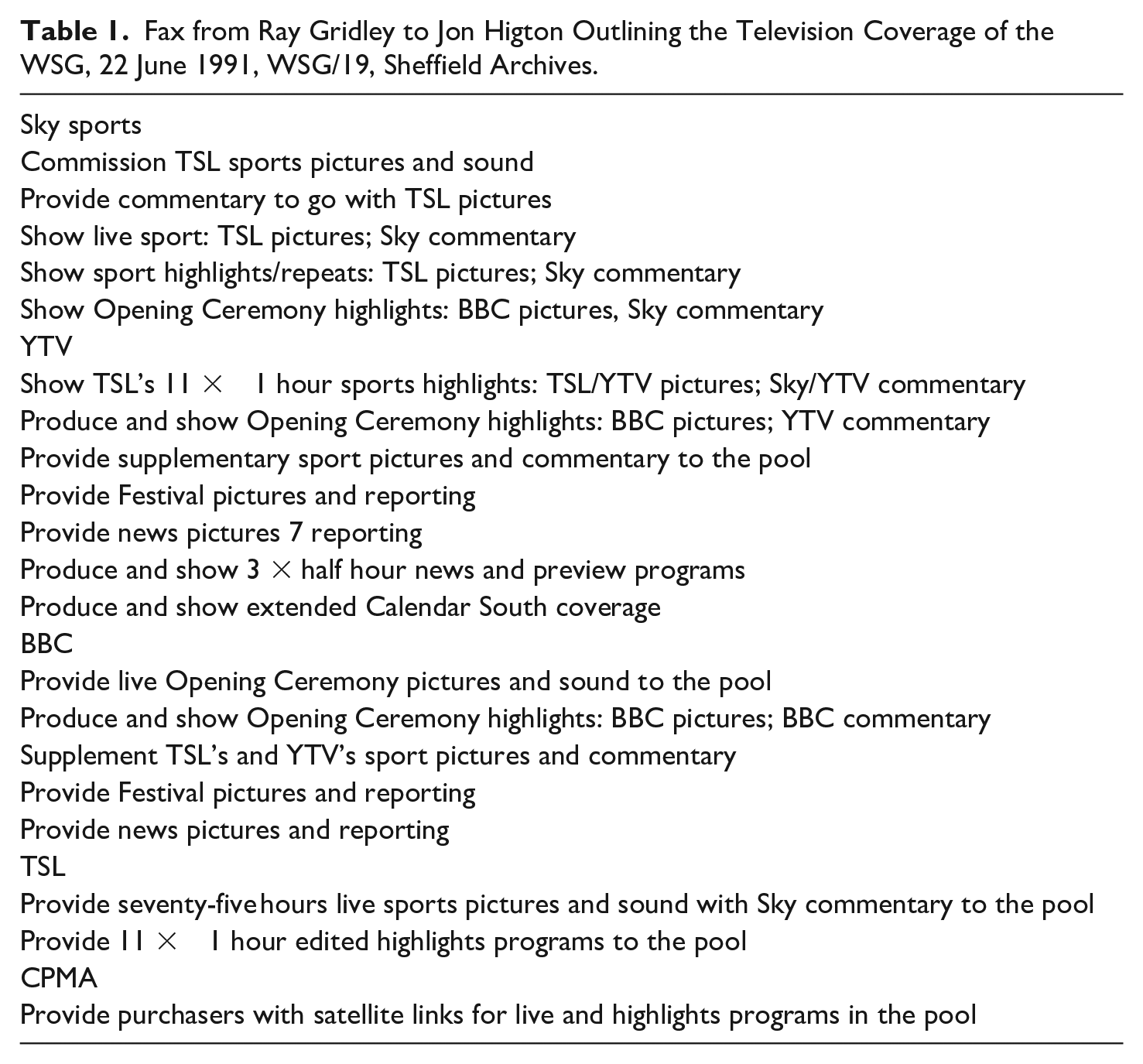
By June 1991, Gridley had a television package in place to broadcast the WSG to the whole of the UK (see Table 1).
Fax from Ray Gridley to Jon Higton Outlining the Television Coverage of the WSG, 22 June 1991, WSG/19, Sheffield Archives.
Key Acronyms, Names, and Affiliations.
However, Gridley conveyed a downbeat tone in a candid letter to BSkyB’s David Hill on 6th June 1991, confessing that “sponsorship is dire” (Gridley 1991e). The main sponsors of the WSG were BSkyB and YTV, which created a problem in the final weeks before the event. In negotiating an agreement with YTV, the WSG had specifically stated that, YTV recognise that such exposure received by YTV as a main sponsor in terms of on-air credits and in stadia advertising in relation to the sporting aspects shall at all times be subject to WSG’s obligations to BSkyB provided always that you will use your reasonable endeavours to ensure that YTV is not confronted with unreasonable restrictions. (Agreement with YTV 1991)
Yet BSkyB now asserted that any material from TSL’s live feed used by YTV in its highlight programs must be credited as “courtesy of Sky Sports,” given that TSL had been commissioned by BSkyB (Moody 1991b). And as host broadcaster, BSkyB also insisted that all material shot by YTV had to be made available to it via TSL (Higton 1991c).
BSkyB’s insistence that YTV credit Sky Sports on its programs was part of maintaining its exclusive window on the coverage of the games. Given BSkyB was the host broadcaster, the company interpreted this to mean it could enforce its will on other broadcasters in terms of credits. BSkyB also wanted to be named in the end credits of any broadcaster’s WSG programming in the form of “Television Presentations—Sky Sports,” wanted the Sky Sports logo to be credited in any independently produced highlights package, and wanted the logo to be given “at least equal prominence with the independent producer” (Higton 1991c).
On 21st June 1991, Filip Cieslik, YTV’s Manager for Business Affairs, raised an objection with TSL about including a Sky Sports logo on highlights programs YTV was to broadcast: I am afraid this is absolutely impossible for us. In our contract with WSG we have provided for the credits we require and it would make a nonsense of the arrangement for the programme to be branded with the logo of a competing service. (Cieslik 1991a)
The WSG contract with BSkyB did not include an obligation for any third-party broadcaster to include the Sky Sports logo in its coverage and, as Gridley was informed, “ITV unlike the BBC do not credit the host broadcaster of sporting events” (Higton 1991d). All the ITV companies refused to show the Sky Sports logo. As Ray Gridley’s solicitors informed him: YTV’s contract places no obligation on them to carry any such credits in the highlights package. If they could be persuaded to give a little ground and allow an end credit in the form described I believe this matter could be resolved amicably. They may be interested in receiving a similar credit for any of their material used by Sky. I have tried and failed to get YTV to relent. (Higton 1991d)
YTV’s Filip Cieslik consulted with his counterparts across the other ITV network companies in early July 1991 and concluded that, apart from incidental banner advertising by Sky in the various sporting venues, it would not be possible to include a logo in any ITV coverage or programs. Cieslik (1991b) stated that, “we do not have a contractual relationship with Sky and the inclusion of a credit for them would be both a major embarrassment for us.” Instead, YTV would include a credit on its highlight programs of “A World Student Games/TSL Production for ITV” (Cieslik 1991b).
Jonathan Higton, a solicitor representing the WSG, became involved in mediating the crisis over credits. Higton pointed out to Moody that “No mention has been made until our meeting last week of the requirement for credits in the form you describe nor, until recently, the use of the Sky Sports logo” (Higton 1991e). Higton explained that the WSG was not contractually obliged to force any other broadcaster to include the Sky Sports logo. As a compromise, Higton assured Moody that CPMA would work to ensure “that Sky receive the maximum and best possible signage available. I hope this is sufficient compensation” (Higton 1991e). Moody believed, however, that BSkyB was being unfairly treated by the WSG and the ITV companies. While it was not a contractual obligation, Moody (1991c) insisted it was “common broadcast practice” for a broadcaster to be credited at the beginning or end of a program. Moody (1991c) offered the following solution: “If this is not to be the case during or after the world student games by any broadcaster using our pictures then we insist that no other credits of any sort appear elsewhere.” Moody also reminded Gridley and the WSG organizers that they needed to be grateful for BSkyB’s role in the coverage of the games, saying: After all it was only a year ago that there was not only not a host broadcaster but that the organisers were expecting to pay for coverage rather than have it given to them as ‘Sky Sports’ is about to do. (Moody 1991c)
BSkyB attempted to pressure the independent producers putting together the YTV/ITV highlights package, TSL, by directly contacting it and telling it to include a Sky Sports logo if any other logo was already present in the highlights package (Moody 1991d). Upon hearing of the pressure that BSkyB was applying, Higton reprimanded Moody in a fax sent on 10th July 1991: Roger, I hate writing in this tone but I feel it must be made clear that anything that WSG are able to secure for you on this issue must be subject to the contractual structures and Sky are not contractually entitled to insist upon the inclusion of the logos/credits in the way you have requested. (Higton 1991f)
Instead, Higton’s solution for increased prominent advertising within the WSG stadia was again offered to BSkyB: It has been arranged inter alia for Sky to have an infield board at the athletics stadium adjacent to the finish line which will give sky excellent exposure. A further excellent board has, I understand, been allocated behind the start of the springs which will also give Sky excellent exposure. (Higton 1991f)
The archival documentation concludes with this solution and the final broadcasts by YTV did not include the Sky Sports logo or credit Sky. But the tensions, and indeed conflict, between the ITV companies (led by YTV in this instance) and BSkyB was palpable, with the tone of correspondence being acrimonious at best and the level of disagreement indicating suspicion toward the intentions of BSkyB and its encroachment on live multi-sports coverage in the UK.
Conclusion
Far from not receiving any television coverage in the UK, the 1991 WSG in fact received extensive coverage across both terrestrial and satellite television. Sky Sports provided full live coverage of the WSG throughout the entire event, the only time that the channel has fully and exclusively broadcast a multi-sport event. YTV broadcast daily highlights packages alongside special preview and review programs. Ten other companies in the ITV network also broadcast either highlights programs or review programs. BBC North provided film crew units for the opening and closing ceremony of the WSG, but the BBC did not provide any national coverage of the WSG. While not within the scope of this journal article, the WSG did secure a variety of international distribution deals, including with China Central Television, the Korean Broadcasting System, TRT Türk, and Trans World Sport (broadcast on Eurosport), which ensured the television coverage of the WSG had some reach beyond the UK.
All this television coverage was achieved despite a lack of sponsorship and because of new satellite channels. Whether further television coverage could have been achieved is doubtful given that BSkyB aimed to maintain its exclusive window on the event and restrict the rights and coverage of terrestrial broadcasters like ITV and the BBC. Indeed, it is arguable that BBC’s Grandstand did not cover the WSG due to the restrictions imposed by Sky Sports on the times that other companies could broadcast coverage of the games. The WSG organizers had come to heavily rely on BSkyB to essentially save the games at a point when it looked highly likely that it would receive no television coverage. The WSG organizers had expected (perhaps naively) that public service media would cover the games because of their intransigent connection to the public good and the social and economic regeneration of Sheffield. But this was not the case. The BBC did not have the desire, or arguably the resources in a busy schedule of summer sport, to cover what it perceived to be a rather parochial event. Sky Sports, however, had the financial resources, desire, and even airtime to cover the WSG in full, requiring content to fill its schedule. Satellite offered the opportunity to cover a range of new, overlooked, or marginal sports events, as had been demonstrated by, up to that point, Eurosports, The Sports Channel, and Screensport. Sky Sports was, therefore, ideally placed to act as a host broadcaster.
As for the conflict and suspicion evident in the archival documentation between BSkyB and YTV/ITV, it must be placed within the wider context of the changing media landscape in the UK between 1990 and 1992. BSkyB’s strategy to increase its subscriber base was centered on films and sport and therefore the company aggressively approached the acquisition of live sports in the UK, an area that had traditionally been dominated by the BBC and ITV. By early 1992, BSkyB was making a concerted effort to secure as many football rights as possible, with ITV being its main rival for these television contracts (Horsman 1998, 91). BSkyB won the rights to the newly formed Premier League in May 1992, at a cost of £304 million for five years, with the BBC joining its bid and being awarded the rights to broadcast highlights on Match of the Day (1964–) (Bonner and Aston 1998, 121–124). Soon after the deal was announced, BSkyB made the decision to turn Sky Sports into a pay-TV service, with subscribers having to pay an additional fee to access the channel. The deal would irrevocably impact on live sports broadcasting in the UK from that point onward, with Sky Sports coming to dominate sports broadcasting and disrupting the traditional public service broadcaster model of sports coverage. The negotiations, and fall outs, over the WSG that can now be studied in the Sheffield Archives serve as an exemplary case study of the early history of Sky Sports, its subsequent rise and near-monopolization of sports coverage in the UK in the 1990s and 2000s, and its approach and relationship to competing broadcasters.
This article also demonstrates the importance of reconsidering historical events and media history through newly available archival collections. Given the impact of Sky Sports on British broadcasting in the years since the WSG, it is timely to reconsider the early history of the company and channel through archival research. Available archival collections relating to Sky are rare, as are empirical scholarly histories of the company, its management, and its wider industrial impact. As such, when sources do become available, even if related to an event that may seem to have a tangential relationship to media history, it is worth utilizing such sources as case studies that illuminate and reframe understanding of the wider histories of television.
Footnotes
Declaration of Conflicting Interests
The author declared no potential conflicts of interest with respect to the research, authorship, and/or publication of this article.
Funding
The author received no financial support for the research, authorship, and/or publication of this article.