



Abstract
Exploring two recent examples of virtual reality (VR) short films designed to produce visceral experiences (on solitary confinement and on seeking asylum), we call into question claims that assign normative value and even transformative power to the VR medium – imagined as so-called ‘empathy machines’. Drawing on a growing body of literature that seeks to contest such claims, we point to and problematise both the manipulative intent of such projects and the liberal-humanitarian logic, which underpins them. Based on such a logic, advocacy through immersive technologies supposes that if only individuals can be made to ‘feel’ something they will be changed by it and so will their behaviour. Whatever progressive motivations of the content producers, the emphasis on empathetic identification threatens to by-pass critical engagement and raises wider questions about the potentially de-politicising effects of seeking technological solutions to effect social change.
This article develops a critique of the ‘immersive turn’ (Rose, 2018) in technological communication and cultural industries. The notion that exposing audiences to vicarious experiences produces ‘pro-social’ effects is now ubiquitous in a range of fields: from museum and trauma studies through to participatory art and socially engaged journalism. The article takes the recent proliferation of virtual reality (VR) applications in campaigning, journalistic and other non-fiction media as a case in point for the development of a critique, less of the specific content of particular films than of the assumptions behind the turn to immersive techniques and technologies.
The academic discussion, across the humanities and social sciences, increasingly centres on the widespread claim that, in allowing us to ‘walk in another’s shoes’ or to ‘see the world through another’s eyes’, the immersive technology of VR offers a route to empathy – ‘the empathy machine’. Proponents suggest that empathy-generating machines offer huge potential benefits and VR experiences are used widely as educational and communication tools. The central claim here revolves around the production and manipulation of an emotional state. The idea is to allow users wearing 3D headsets to enter a virtually constructed, computer-generated world or, in other instances, a 360-degree video film. In many cases, the headset user will be represented by an avatar in a similar way to a computer game. Although the content of these experiences is curated, users have some degree of choice as to where to look or ‘walk’. The participants will have access to 3D images and sounds and, in theory, experience genuine feelings and emotional responses. 1
There is no doubt that immersive virtual environments can facilitate visceral experiences, but we question the ethical and political claims made here. We contend that, if VR advocates who stress the technology’s capacity to trigger pre-cognitive and pre-ideological sensations are right, non-fiction VR could be perceived as highly unethical and manipulative – producing what we refer to as ‘forced empathy’. At the very least, we see no reason to accept that VR non-fiction films have an inherently progressive character.
In the first part of this article, we follow others in a critical reading of the politics of the empathy machine. We argue that the power of forced empathy is not necessarily progressive and rests on the manipulation of affective responses of media audiences. Some readings of the affective turn in the humanities and social sciences, have questioned ‘the separation of affect and emotion within the literature of the affective turn’ (Stenner, 2019: 51). In this view, emotions are not easily defined as personal and conscious feelings in contrast to the corporeal and primordial experience of affect. In short, we cannot draw a clear line between ‘visceral’ and ‘discursive’ modes of knowledge. Following such a reading, we question the separation of visceral experience and ideological disposition in some cultural approaches to VR. There is little to be gained by, nor much conclusive evidence for, elevating affect to a primary place over political deliberation. Rather than blank canvasses upon which to inscribe unconscious impulses towards ‘pro-social’ behaviour and individual character change, VR audiences should be understood as having ideological and socio-cultural predispositions towards the virtual encounters they enter.
In the second part, we turn to the concepts of vicarious trauma and prosthetic memory to explore how claims surrounding the potentials of immersive technology mirror debates in the fields of memory and trauma studies.
In the final part, we apply this conceptual discussion to two 3D films created for the Guardian newspaper and analyse the claims that they generate empathy. Instead of analysing the films’ content, we agree with Kate Nash (2018: 123) that ‘it is crucial to acknowledge the shift from representation [to] simulation’ in virtual technology. More than the traditional journalistic format, these media intend to offer an immersive experience. As one recent commentary aptly put it: ‘the contemporary techno-rhetoric suggests that the goal of VR is to liquidate itself as representation [. . .] to become indistinguishable from experience itself’ (Andrejevic and Volcic, 2019: 9). We are thus interested in immersion as a form of mediation. Our first case study simulates experiences of long-term solitary confinement in the US and is therefore structured by the attempt to reproduce the experiences of space and time. The second invites the participant to explore the temporal uncertainty associated with claiming asylum in the UK. Both films are embedded in wider political-campaigning projects, but, as this article argues, follow the standard liberal-moral-humanitarian narrative of wanting to achieve social change through transforming individual subjectivities. As these examples indicate, the power of VR documentaries is ascribed to its ability to manipulate subjective feelings in an effort to affect human behaviour.
Empathy machining as manipulation
Before writing this piece, we came across the curious claims of an exhibition in the Turbine Hall at the Tate Modern in London. In late 2018, the Hyundai Commission for the Turbine Hall had gone to the Cuban artist-activist Tania Bruguera. On the Tate’s website, the exhibit was advertised as the chance to ‘experience a community-driven response to the global migration crisis’ (Tate, 2018). It explains that Bruguera’s work engages with ‘the role of emotions in politics’ and then describes the main display as such: In the Turbine Hall is a large heat-sensitive floor. By using your body heat and working together with other visitors, you can reveal a hidden portrait of Yousef, a young man who left Syria to come to London. Meanwhile, a low-frequency sound fills the space with an unsettling energy. In a small room nearby, an organic compound in the air induces tears and provokes what the artist describes as ‘forced empathy’. (Tate, 2018)
This notion of forced empathy made us consider the relationship between affective encounters and manipulation. 2 The day that we visited, the vast gallery space was filled with the noise of schoolchildren and so the ‘unsettling’ sound was difficult to perceive. As we entered the small, adjacent empathy room (Figure 1), we were struck by the strong smell of eucalyptus in the air, but also highly suspicious of the idea that a chemical reaction in our bodies could be compared to an emotional connection with the subject of the artwork. The fact that our eyes started to tear up could not be confused with ‘crying’.
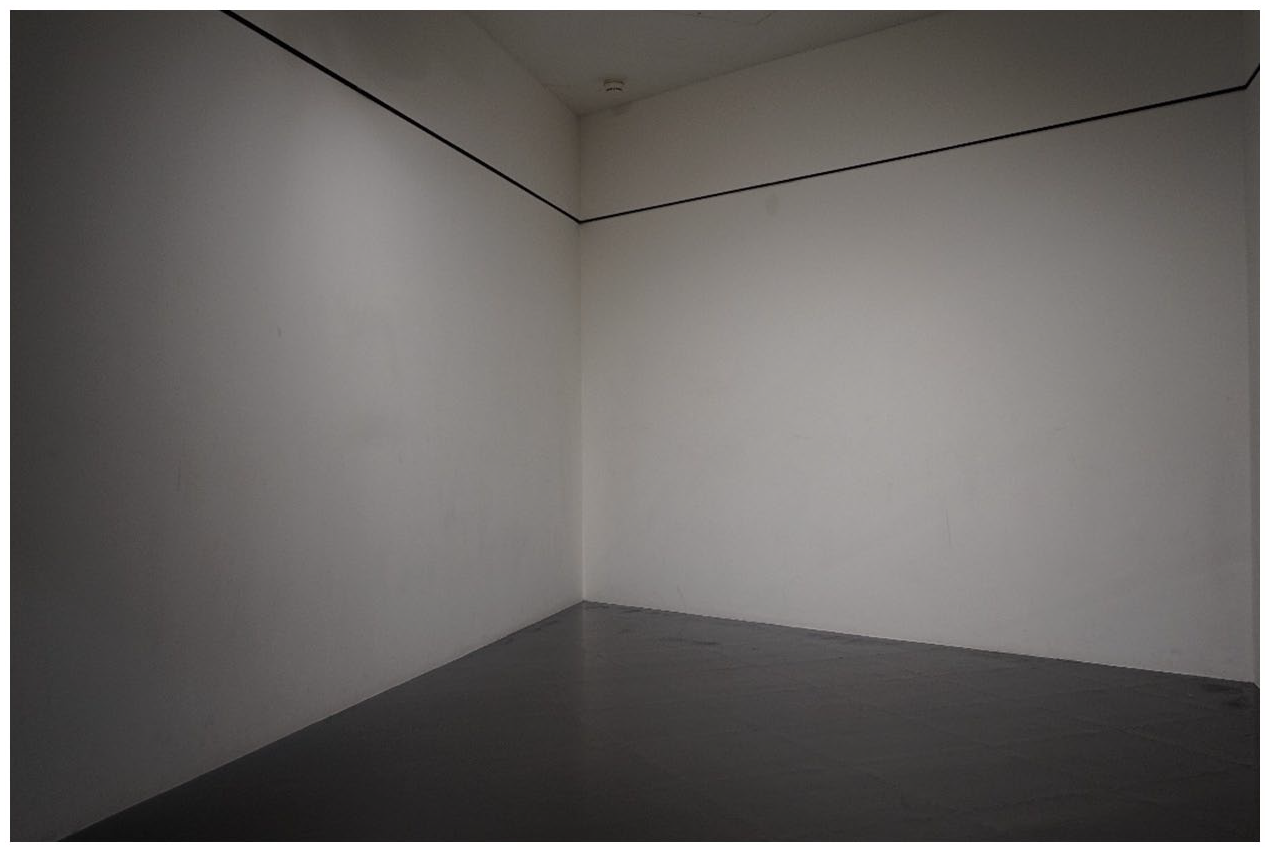
The ‘empathy room’ as part of the Tania Bruguera exhibition in Tate Modern, London
Lisa Nakamura has proposed that what she has termed ‘virtuous virtual reality’ outputs follow similar logics: ‘VR tries to tell our bodies when it is time to cry’ (Nakamura, 2020: 49). Though the advocates of VR non-fiction rarely suggest that immersive technology serves to enforce an emotional state, they often imply that the positive effects of VR work irrespective of user agency. For instance, an important aspect to the two documentaries we consider in this article, as well as countless other 360-degree campaigning films, is that digital immersion can foster feelings of empathy in the VR users beyond their cognitive ability to ‘understand’ or ‘resist’ this process. Despite its potential, therefore, ‘the intensity of its affective involvement also suggests a loss of control of rational judgement’ (Bystrom and Mosse, 2020: 98). There is now a well-trodden path that traces the origins of such a claim to the videographer and tech innovator Chris Milk. Hassan, for example, summarised a 2015 TED talk: Milk claimed that 360 degree VR creates ‘the ultimate empathy machine’ where ‘visceral emotional reactions’ are generated to the point where the participant ‘feels present with the people’ they see within the digital ‘world [you] inhabit’. (Hassan, 2019: 2)
Following the popular success of this talk, a range of critical perspectives on the empathy machine narrative have been published recently (Andrejevic and Volcic, 2019; Bollmer, 2017; Bollmer and Guinness 2020; Bystrom and Mosse, 2020; Clifford and White, 2020; Gruenewald and Witteborn, 2020; Hassan, 2019; Irom, 2018; Nakamura, 2020; Nash, 2018; Rose, 2018). To add to this, our reading of the assertions made by advocates for immersive technologies and their potential to produce empathy rests on a wider engagement with discussions in cultural theory and specifically with what has been termed the ‘turn to affect’ (e.g. Clough, 2008). For purposes of brevity, we cannot offer an in-depth critical reading of the affective in the study of communication and aesthetics. The exposition here is therefore necessarily limited and partial. But suffice to say that we draw on a range of critical engagements with the affective turn to question the specific ethics that underpin its relationship with empathy (e.g. Leys, 2011; Stenner, 2019; Wetherell, 2015).
In some influential accounts, often following the work of Brian Massumi, the role of ‘the virtual’ or ‘the visceral’ is to denote a set of forces, sensations, intensities or atmospheres, as distinct from emotion. This distinction is crucial to some theorisations of affect. One author, for example, remarks: Although it is easy to treat ‘affect’ and ‘emotion’ as identical, they are quite distinct. [. . .] Affect denotes an intensity that connects individuals to the social world in a relation that pre-exists the emotional states to which we give names such as ‘fear’, ‘anger’, ‘pleasure’, ‘outrage’ and so on. Instead, affect marks the moment at which connection to something seen, heard, experienced or thought registers in the body and then demands that it be named or defined. (Young, 2014: 162)
It’s a divide rejected, however, by the political psychologist Paul Stenner. As he writes rather dismissively about Massumi: [T]he key, from [his] perspective, is to articulate an ontology capable of recognizing ‘the virtual’, and granting it a reality, even if that reality is, by definition, not actual. [. . .] Affect, in this sense [. . .] is defined as being in principle inaccessible to discursive articulation. (Stenner, 2019: 49)
Among many advocates of the immersive turn, too, the affective experience generated by immersive VR is first and foremost a non-representational encounter that leaves its mark on the body. Other than an emotional reaction, the idea is that what is produced stands outside of the ideological altogether. If we conceive of the production of affective encounters as attempts to by-pass cognitive faculties, discursive practices or political deliberation, such an effort has a distinctly manipulative side to it.
There are huge variations in the ways that the relationship between emotion and affect is theorised. For our own purposes, we are careful to distinguish between the neuro-psychological research basis that suggests that autonomic processes influence pre-subjective decision-making and the collective action this apparently proscribes. Much of the work that underpins affect theory, at least in parts, has proposed that visible displays of emotion can precede and generate subjective emotional experiences (e.g. Massumi, 1996). While this does not suggest that the physiological display of emotion is an emotional reaction, it nonetheless explains how Bruguera’s public artwork engages in interesting ways with the artificial divide between the visceral and the cognitive. Yet, questions remain about the political action that would follow such an understanding. In particular, we would take issue with the suggestion that the generation of empathy – even if it could be ascribed to an externally generated physiological impetus – could adequately be the basis of a political (and collective) response to the ‘migrant crisis’ that is the subject of this artwork.
And while early work on affect in the humanities and social sciences stressed the pre-cognitive capacities of human subjectivity, it was also aware of the manipulative uses of affect, for example in the development of technologies of control and surveillance. This continues to be a thread running through the debate today (e.g. Clough, 2018). Departing from the way that Bruguera employs her notion of forced empathy, our argument concerning VR non-fiction is not that it should not produce affective encounters, but that it is problematic for such encounters – when they are perceived as pre-ideological, pre-political spaces – to be imbued with ethical value.
Instead, we want to think more critically about the imperative to create empathetic reactions to immersive stimulation. 3 Carolyn Pedwell (2014), for example, asks, ‘is empathy always a good thing?’ Rather than regarding empathy as the obvious solution to social injustice, what other meanings and purposes might be attached to the claim that empathy is lacking in contemporary politics? While not wanting to dismiss political strategies grounded in the production of empathetic affects, we question the, in Pedwell’s words, ‘fetishisation and instrumentalisation’ of affect for such purposes. Empathy can be put to use for progressive effects, but its power is not politically uni-directional. Indeed, context-dependent geopolitical dynamics can lead to the manipulation of empathy by nation-states and international institutions for purposes of political and social control. As Pedwell points out, the political ‘[r]hetorics of care, compassion and empathy have been pivotal to recent American politics’ (Pedwell, 2014: 50), justifying policies from privatisation to military intervention.
Such a perspective also finds recognition in Ben Anderson’s sketch of what he calls ‘neoliberal affects’. Political manipulation has found ways to engage the affective in the production of a self-managed neoliberal subject. For Anderson, this ‘reminds us that “neoliberal subjects” do not equate to the rational subject’ (Anderson, 2016: 738). Instead, ‘affect becomes a material to be manipulated or moulded to form subjects in conformity with neoliberal polices [sic] or programmes’ (Anderson, 2016: 738). What is at stake in what we analyse as belonging to the ‘immersive turn’ in critical theory, therefore, is not just the production of an ethical encounter, but the self-transformation of subjectivity in digital capitalism and its manipulation for a variety of political purposes. A liberal-humanitarian logic is at play here, which seeks to produce empathy in individual viewers of VR apps, in the hope that these individuals would alter their standpoints towards those depicted in the simulations. Notions of collective action and political solidarity are consequently replaced with visions of ‘liberating or transforming the physical, neurological capacities of the brain’ (Bollmer, 2017: 64).
Memory, trauma and forced empathy
To further develop our critical reading of the ‘immersive turn’, we propose to explore the metaphor of forced empathy by making a foray into the field of memory studies, and in particular the concern with the representation of historical atrocities. There are two conceptualisations of ‘experience’ that interest us here; first the notion of prosthetic memory and second that of vicarious trauma.
The term ‘prosthetic memory’ was coined by cultural historian Alison Landsberg to refer to a form of memory which emerges ‘at the interface between a person and a historical narrative about the past, at an experiential site such as a movie theatre or museum’ (Landsberg, 2004: 2). The phrase describes a process in which ‘the person does not simply apprehend a historical narrative but takes on a more personal, deeply felt memory of a past event through which he or she did not live’ (Landsberg, 2004: 2). Focusing on the kinds of historical experiences which destroy the links between families and communities – immigration, slavery and the Holocaust – Landsberg argues that mass culture plays a pivotal role in transmitting these memories to the present: Through technologies of mass culture, it becomes possible for these memories to be acquired by anyone.. . . Prosthetic memories are transportable and therefore challenge more traditional forms of memory that are premised on claims of authenticity, ‘heritage’, and ownership. (Landsberg, 2004: 2–3)
In this sense, prosthetic memory opens up new forms of identification which ‘produce empathy and social responsibility as well as political alliances that transcend race, class and gender’ (Landsberg, 2004: 21–2).
This conceptualisation reflects what Silke Arnold-de Simine (2012: 15) describes as a ‘growing remembrance culture’, which privileges ‘emotional investment rather than historical knowledge’. Traditional forms of historical understanding and political commitment are here regarded as insufficient. The central idea is that historical knowledge is not enough to prompt us to act responsibly or ethically in the present, to ensure that the crimes of the past cannot be repeated. What we need, according to this view, is to become emotionally invested. Interested in the shift toward ‘the experiential as a mode of knowledge’, Landsberg (2004: 130) argues that popular cultural forms are productive of ‘prosthetic memories’ which turn history into embodied memory.
‘Decentering’ the cognitive mode of understanding, which she says is ‘woefully inadequate’, the ‘experiential mode complements the cognitive with affect’ (Landsberg, 2004: 130). Discussing the example of the United States National Holocaust Memorial Museum in precisely these terms, she argues that the experiential museum ‘reflects a change in what counts as knowledge’, providing visitors with ‘an experience that positions their bodies to be better able to understand an otherwise unthinkable event’ (Landsberg, 2004: 131). We are urged, in this way, to consider the development of a different understanding of historical knowledge, one which is concerned less with what we might think than with what we can be made to feel. Though coming from a very different angle, much of the literature put out by VR proponents that we have looked at for this study equally highlights experiential-immersive knowledge as a powerful motivator for action.
Although the claims made by VR non-fiction producers or curators are frequently exaggerated and play on a dualist contradistinction with ‘thinking’ or ‘understanding’, Landsberg clearly guards against such dualism. Responding to critics who might worry that the focus on the affective dimension downplays structural issues and intentional politics, she admits that experiential approaches that rely on identification could potentially create ‘an illusion of unmediated transparency, obscuring the inevitably mediated nature of the present’s relationship with the past’ (Landsberg, 2015: 8). But mediation underpins both traditional, written history as well as popular renderings of the past. As such, reflexive and conscious engagements with historical re-enactments, whether through virtual museum exhibits or popular television shows, can help to avoid unreflective proximity.
We follow Landsberg in her suggestion that affective encounter is to be usefully contrasted with unmediated identification, but we want to point out two central issues with such a position. The first is that there remains a danger here that we mistake the ‘visitor experience’ of a museum or the ‘immersive experience’ of a VR documentary with having in some sense ‘experienced’ the pain and suffering of others, as the examination of our case studies below suggests. The second concerns the potentially manipulative, coercive and authoritative nature of the form of ‘knowledge’ that is advocated. Manipulative, coercive and authoritative, that is, in so far as it is understood to by-pass our cognitive faculties of understanding and judgement.
These issues are present and perhaps even more pronounced when it comes to our second term of analysis, the question of ‘vicarious trauma’. Taking its cue from neurobiological research, the notions of vicarious traumatisation and secondary traumatic distress are frequently linked to ‘compassion fatigue’ in psychotherapy, social work and related professions. Rather than reviewing the vast trauma studies literature here, we are interested in the ways such terms are taken up and used in cultural studies.
E. Ann Kaplan’s work on ‘trauma culture’ (2005) provides a useful example. Reflecting on her own and others’ responses to 9/11, Kaplan is interested in the impact of trauma on individuals and national or cultural collectives, the forms of subjectivity that trauma produces and the difficulty in separating individual from collective trauma. Extending the concept of trauma beyond the ‘classic trauma suffered by victims or survivors’, she argues that there is a spectrum which ranges from ‘the direct trauma victim’ through to ‘a person geographically far away, having no personal connection to the victim’ (Kaplan, 2005: 1–2). Just as for Landsberg cultural forms can generate ‘prosthetic memory’, so Kaplan argues that we can become vicariously traumatised via mediated encounters with traumatic events and experiences.
According to Kaplan, the concept of ‘vicarious trauma’ first emerges in 1995 in a study into the impact of trauma therapy on therapists. The study revealed that in some cases therapists suffered from a painful form of empathetic distress which had a seriously deleterious impact on their own lives with symptoms including nightmares, flashbacks, heavy breathing, gasping for air, shaking, dizziness and tears. Particularly interested in visually mediated trauma, Kaplan argues that viewers can, like therapists, be vicariously traumatised when they ‘experience’ trauma indirectly through broadcast media and film. For her, the question then is whether such media enable or hinder empathy and progressive social change: Arguably, being vicariously traumatized invites members of society to confront, rather than conceal, catastrophes, and in that way might be useful. On the other hand, it might arouse anxiety and trigger defense against further exposure. (Kaplan, 2005: 87)
Kaplan implies that trauma – if correctly dealt with through appropriate forms of ‘mourning’ – can have beneficial effects, that it has the potential to positively transform individual and collective subjectivities.
Building on her earlier work, Kaplan (2008: 4) further distinguishes three possible responses to exposure to traumatic images. First, vicarious trauma can be seen as a viewer response to images of catastrophe that produce states of emotional over-arousal or shock. Second, it could lead to a response that Kaplan describes as ‘empty empathy’, by which she means a short-lived and often meaningless feeling of empathy. The viewer is overcome by the power of emotion so that empathy in fact mitigates against positive behaviour change. And, third, Kaplan’s preferred option is that of ethical witnessing, a response that involves an element of cognitive distance from the vicarious experience of suffering and allows for reflective and empathetic changes in character of the viewers. The claim to something like ‘vicarious trauma’ or ‘prosthetic memory’ lies at the heart of many claims regarding the power of immersive technology. Here, as we shall see in our VR examples, the central thesis is that knowing is not enough, that we must be made to feel and that exposing individuals to emotionally difficult and even distressing representations of victimisation engages them in transformative processes which have a desirable social, ethical and political impact.
We are not so much concerned with the coherence and veracity of ‘vicarious trauma’ and ‘prosthetic memory’ as such. Rather, what is primarily at stake is the ways in which these concepts are mobilised and the philosophical and political implications of their rhetorical power. By offering a departure from existing critiques of the trauma metaphor (e.g. Kansteiner, 2004), we contend that the usefulness of such notions is undermined by the ubiquity of their application to representations of atrocities and injustices, with little empirical evidence. What is more, basing a politics of empathy on the notion that we can, and should, in some way ‘experience’ the suffering of others potentially devalues projects of political solidarity where such commonality is not given. As we suggest, following our VR case studies below, building a politics of empathy out of a sense that traumatic experiences can be shared across time and space raises the danger that such a politics may be put to manipulative and coercive uses as well as having de-politicising effects.
VR and the politics of immersive experience
To illustrate the conceptual discussion so far, the two VR films we’re focusing on are accessible, computer-generated environments, which anyone with a smartphone and head mount display can interact with. More than representations, they set out to offer simulations of experiences with a particular emphasis on the lived experience of space and time.
The documentaries, which were both produced for the Guardian’s VR app, are examples of the immersive turn in documentary making (Rose, 2018). Google has made a mass market addition to smartphone virtual reality, through its own VR platform and head mount, called Google Cardboard. The Cardboard is relatively inexpensive and easy to assemble and use. Responding to such ubiquity, virtual technologies are now a common method in digital learning. Learning advisers, including in higher education institutions, have started recommending Google Cardboard as an immersive educational medium for classroom settings. But, as Rose explains, VR media technology for non-fiction has been a ‘site of claims for the pro-social potential of VR’, while critical interrogations of the hype surrounding such techno-utopian assertions have been marginal at best (Rose, 2018: 132–3).
6×9
The Guardian newspaper has developed a series of VR apps that work with Google Cardboard. The first app we looked at is called 6×9: A Virtual Experience of Solitary Confinement. The app is marketed by Guardian News & Media Ltd and can be downloaded from the Google Play online store. It is described in the following way: Our first VR piece, 6×9 takes you to a virtual cell, telling a story of the psychological damage of extreme isolation. Right now, more than 80,000 people are in solitary confinement in the US. They spend 22–24 hours a day in their cells, with little to no human contact for days or even decades. We invite you into this world. (Guardian News & Media Ltd, 2016)
The story that 6×9 wants to tell is set in a prison cell and is designed to create in the viewer a psychological impact of sensory deprivation. A narrator declares ‘Welcome to your cell. You’re going to be here for 23 hours a day.’ The Google Cardboard user is able to look around the room. There is a bed, a toilet and a sink. Some light shines through a small window but you cannot look outside. The app attempts to recreate psychological effects of long-term segregation by, for example, blurring the images and attempting to represent hallucinations. Audio plays the sounds of prisoners shouting and screaming. Graffiti is scrawled across the walls.
The Guardian connected the VR documentary to its wider reporting on solitary confinement in US prisons. Although intended as a piece of journalism, rather than a campaign, others have pointed out that ‘immersive storytelling project of this ilk tend to underscore the reformist agendas of their collaborators – in 6x9’s case, Solitary Watch, and its attempts to revise the laws and regulations regarding solitary confinement’ (Clifford and White, 2020: 277). It featured interview recordings with seven former inmates talking about their times spent in solitary. A fact sheet written by members of Solitary Watch was also published. This is accompanied by two podcasts, one narrated by journalist and sociologist Gary Younge and another that outlines psychological research on the effects of solitary confinement. The latter contributes to the scientific critique of the practice and is based, in part, on interviews with thousands of solitary confinement prisoners. The psychological damage caused is described in terms of a range of symptoms and reactions to environmental stimuli or their relative absence, from heightened states of anxiety and confusion to panic attacks and hallucinations. Psychologists associated with the project suggested that these are reactions to both physiological and psychological stresses induced by the deprivation of social contact over extended periods of time.
The 6X9 immersive documentary is thoughtfully designed and can certainly leave a stark impression on individual viewers. That said, any claims that the stylistic rendering of such accounts of traumatic experiences engendered by physiological and psychological stresses can faithfully recreate such emotional states are clearly overblown. The VR application was created by The Mill, an outfit that describes itself as ‘artists, technologists and makers for all media, working at the frontiers of visual narrative’. 4 The Mill’s website features an explanation of the 6X9 project and states that ‘The Mill worked from first-person accounts and documentaries as references for both cell design and spatial audio capture’ (The Mill, 2016).
The project’s creative director, Carl Addy, provides further insight into the thinking behind the documentary: How do you build empathy around an issue as contentious as this? The task was to give a sense of what isolation feels like. By giving people a visceral experience of solitary confinement we were able to emotionally connect them to the cause. [. . .] Part of us trying to build empathy was to give a user agency; the ability to make choices and interact with the experience makes you invest emotionally in the narrative and outcome. VR puts you in the cell without any of the safety one gets from the detachment of a screen. This is not like watching a documentary, you are in it. (The Mill, 2016).
Whereas in gaming, VR frequently allows an avatar to move through the computer-generated world, in this non-fiction scenario, the objective has been to reproduce an experience of segregation, enclosure and captivity. Combining the computer-generated imagery with testimony from former prisoners, the project is a classic example of immersive journalism: ‘You will experience what the prisoners have described experiencing,’ the Guardian writer Caroline Davies explains (Davies, 2016). It is the overblown nature of such claims that has informed our conceptual analysis; it seems clear to us that the temporal and spatial aspects of long-term isolation cannot be experienced in a short simulation viewed through Google Cardboard.
Limbo
Limbo: A Virtual Experience of Waiting for Asylum is another VR app produced for the Guardian, in collaboration with ScanLAB Projects, ‘which specialises in creating digital replicas of environments using innovative 3D scanning technology’ (ScanLAB Projects, 2017). The 3D film is introduced like this: There are approximately 31,500 asylum seekers in the UK waiting for a decision about their asylum status. This exclusive Guardian virtual reality film allows you to experience what it is like to live in this period of limbo, waiting for a decision that will affect the rest of your life. (ScanLAB Projects, 2017)
Limbo, in a similar way to 6×9, is not short of factual information. To give a scale of the problem, we are told that due to the slowness in processing asylum applications waiting for an outcome is a defining experience of claiming asylum in the UK, with a large backlog of cases yet to be decided and applicants remaining in a state of limbo.
The app tells us of this temporal uncertainty at first in a rather standard form of campaigning. We are reminded that asylum seekers in the UK find themselves trapped in a lengthy and sometimes Kafkaesque process while ‘they live on £5 a day and are unable to work or choose where they live’ (ScanLAB Projects, 2017). The film is also tied in to the newspaper’s collaborative ‘new arrivals’ project, which follows the lives of refugees as they settle in Europe, with a page on ‘How you can help refugees and asylum seekers in Britain’.
The documentary draws on interviews with asylum seekers and aims to give a sense of their concerns and fears about their asylum application process and Home Office interviews. Introducing the film, ScanLAB Projects describes its attempt to recreate the experiences of its interviewees: In Limbo you step into their shoes and experience their state of mind while you wait for the decision that will determine the rest of your life. The voices in the soundtrack are those of real refugees who guide the viewer through the experience – from arriving in an unfamiliar city to acute worry for loved ones left behind, concern about not being allowed to work, and the Home Office interview on which so much rides. (ScanLAB Projects 2017)
Unlike 6×9, the Limbo app represents an open spatial plain, using a sketch-like aesthetic, which according to the creators immerses the viewer in a dream (or nightmare) world of floating through space and time. Users can ‘move’ across the city. Instead of being spatially bounded, the app’s objective is to simulate an experience of passing time. But stylistically, this is quite different from 6×9. Despite the open plain of the city, the viewer is much less able to control the experience. There is no obvious avatar who can be moved across locations, other than viewing the 360-degree angle. The locations change without the participant’s influence and we follow a much more classical documentary narrative style for the duration of the video.
Forms of ‘immersive journalism’ (Sanchez Laws, 2017), such as the examples discussed here, are then thought of as giving a different dimension to media reporting and to the engagement of audiences on a deeper level. Together with the wider journalistic coverage of the socio-political context in which our two case studies are embedded, the outcome, so it is hoped, would be real changes in behaviour or attitude. It is, however, the VR experience that stands in the centre of such campaigning journalism. The affective encounter produced by media should lead the viewer to think about the legal and political decisions surrounding the injustices that have been depicted.
As we have discussed in relation to memory studies above, part of the appeal of the concept of trauma is the moral authority it confers on those who make claim to it. As Lauren Berlant (1999) has argued in reference to the ‘politics of true feeling’, ‘trauma’ and ‘memory’ seek ‘truth’ in individual emotional responses and privilege victimhood over historical agency. A similar and influential perspective can also be found in Didier Fassin’s critique of what he calls ‘humanitarian government’ (2012), or the deployment of moral sentiments in order to direct attention towards the suffering of others. These authors, however, also point out that humane feelings of compassion or empathy can be put to use in justifying inhumane policies.
Such accounts of the political uses of trauma serve to highlight an underlying liberal-humanitarian logic that is at play. Chouliaraki (2010), diagnosing a shift in humanitarian communication to what she terms post-humanitarianism, argues that the individualisation of responses to mediated suffering has replaced universalising claims to morality. Rather than challenging historical injustice, post-humanitarian communication trains its eye on the subjective witnessing of suffering. We find elements of this shift in our analysis of immersive technology, though claims to morality persist. ‘Trauma’ renders those who make claim to it, or who it is claimed on behalf of, victims – even if the claimant or claimed for may themselves be perpetrators of extreme violence. The status of victimhood confers, somewhat paradoxically, both moral authority (‘I am the victim therefore . . .’) and absolution (‘I am not responsible for what I’ve done’ or ‘I did what I had to do’).
In the appeal to the experience of trauma, then, lies the power and poverty of the moral claims made on the back of being the participant in immersive experiences. In journalism and advocacy, immersive, albeit subjective, experiences are increasingly taking centre stage. Although VR is not a new technology, rapid developments in software and hardware have only recently enabled its mass commercialisation, including in non-fiction settings. Its techno-utopian impulse is apparent, especially where a medium that was hyped in the world of online gaming found some of its most innovative applications in journalism and documentary practices. Kate Nash, a scholar of interactive documentary film, argues that ‘a belief in the connection between immersion, empathy and a moral orientation towards distant others is fundamental to much VR production’ (2018: 120). Her analysis of the VR output by the United Nations is appreciative of this potential, but, as we have done here, points to the risks and limitations associated with the use of VR films for campaigning purposes. Nash (2018: 129) argues that there is: an important moral risk associated with VR by virtue of the fact that it is often deployed as a platform of simulation rather than representation. While much has been written about the moral value of occupying the other’s point of view, it is also necessary to draw attention to the potential for a loss of perspective, an improper distance in which the experience of ‘being in’ VR, a narcissistic reflection on one’s own experience, becomes the foundation for moral response.
Similarly, Bystrom and Mosse (2020) write that VR’s campaigning potential is ‘subsumed by a reliance on empathy as the established narrative trope within human rights campaigns’ (2020: 95). ‘VR technology’, Bystrom and Mosse argue in their analysis of the United Nations’ Clouds Over Sidra film, ‘is portrayed as a revolution in humanitarian assistance because it is the most effective means to create empathy’ (2020: 89; emphasis in the original). Such challenges remind us that such hype has also been subjected to frequent criticism. But despite such warnings, the claim that virtual and augmented reality technology can act as an ‘empathy machine’ continues to find much traction and is a frequently used trope on the business pages of digital media companies. The two thoughtfully designed VR non-fiction documentaries for the Guardian have not been immune to this either.
Conclusion
Immersive media, especially in the form of non-fiction VR documentaries, are increasingly used to inform and influence public debate. Our case study examples, 6×9 and Limbo, were carefully designed and informative 3D films that offered audiences an experimental form of engagement via free-to-download apps and a relatively cheap and ubiquitous cardboard headset. We chose these examples because they stood out to us as specifically ambitious in their attempts to immerse the viewer in experiences of spatial confinement and temporal uncertainty. These short films were accompanied by other journalistic forms of communication, including news articles, written reports and podcasts.
These case studies were not chosen to undermine their message. Nevertheless, the analysis we presented highlighted that some claims about immersive media’s possible application to influence ethical behaviour appear to be overshadowed by techno-utopian fallacies. Advocates propose that immersive technology works directly on the audience’s visceral experience, producing bodily sensations that by-pass intellectual or ideological predispositions, and as such can overcome cognitive resistance to change. The affective encounter with suffering and injustice, so the advocates of VR assert, can be manipulated in such a way that it produces empathy or other positive responses.
This proposition is not unique to the VR industry, but finds wider resonance in cultural theory. For Alison Landsberg, transformations in mass culture and communication have led to occurrences in which we take on memories of events that we have not actually experienced ourselves. For her, such prosthetic memories – while not deterministic – offer new possibilities for progressive politics and the production of empathy. Likewise, E. Ann Kaplan suggests that ‘public feelings’ triggered by viewing images of catastrophe and suffering can translate into positive and ethical behaviour on the part of the viewer. There are risks here of emotional ‘over-arousal’, and vicarious traumatisation that insulates against genuine character change. But witnessing images of catastrophe ‘may also lead directly to productive activism’ (Kaplan, 2008: 21). We have no problem with the empirical grounds that suggest the existence of vicarious traumatisation, nor do we question that images of suffering can plausibly lead some people to engage in political action. Where we differ from such accounts, however, is that we wonder more about the cognitive and ideological context in which images or films are viewed. The most likely audiences for digital simulations of the kind we have analysed have pre-existing political awareness and biographies of political involvements, which quite clearly would shape the way that they perceive VR non-fiction.
Our reason for following this path has not been to undermine the campaigning work that is done with the use of new digital technologies. Nor do we want to cast doubt on the possibility that such documentaries can produce positive, altruistic or empathetic outcomes among those who view them. But we do want to highlight the way that these claims to affect work – they tend to focus on the individual, de-politicised subject and they are manipulative. We could think about it the other way round – if a pre-ideological state exists that can be manipulated to produce a desired emotional or affective state, why is the outcome necessarily empathetic or positive?
To emphasise this point, let us conclude our analysis with a brief look at what we may call a corporate inversion, or perversion, of the empathy machine. In recent years, the fast food company McDonald’s made headlines with its foray into the world of VR for advertising purposes. In 2016, McDonald’s Sweden re-designed its Happy Meal box so that customers of the fast food chain could construct their own cardboard headset (McDonald’s Sverige, 2016). As with the Google Cardboard headsets, the greasy glasses could hold a smartphone to watch VR content. In the same year, McDonald’s UK published its own 360-degree campaign documentary, Follow Our Foodsteps, which traces the burger supply chain from the farms to the restaurant.
In its press release, the company’s Director of Supply Chain said: By bringing together tech developers with farmers and food experts, we have created an immersive virtual reality experience that will allow people to follow in the footsteps of farmers, suppliers and our crew, bringing the best of UK food production from the countryside to communities across the UK. Our hope is that it will help build pride in British and Irish farming, challenge outdated stereotypes and celebrate the best of food and farming in the UK today. (McDonald’s UK, 2016)
Support also came from the then British Environment Secretary, Elizabeth Truss who lauded the project’s positive impact on ‘our farmers’ and ‘our children’: ‘McDonald’s is a fantastic example of the vision, creativity and innovation running through our food and farming industry today. [. . .] By embracing the latest technology we will foster the next generation of entrepreneurs’ (McDonald’s UK, 2016). The relationship between immersive technology, (de-)politicisation and manipulation, it appears, is more complex than the hype around empathy machines suggests.
Footnotes
Acknowledgements
We would like to thank the two anonymous reviewers for their thoughtful and detailed comments on earlier versions of this article.
Funding
The author(s) received no financial support for the research, authorship, and/or publication of this article.