




Abstract
In 2022, Sorella’s Story was launched at the Venice International Film Festival using 360 immersive technologies with the intention to enable empathic responses from viewers as they witnessed the story of a group of Latvian women and a 10-year-old child, Sorella, in their last moments before being killed by Nazi troops and their Latvian collaborators during World War II. This article presents findings of an empathy survey that was completed by viewers of the film at the Venice International Film Festival, the Brisbane International Film Festival and during orientation week at Australia’s largest film schools: the Griffith Film School. The survey was administered to determine whether using 360 immersive storytelling for a film about the Holocaust triggered empathic responses, and if there were different empathic responses in viewers of different ages. Findings indicate that all age groups responded empathically to the experience confirming 360 immersive technologies’ empathy eliciting capacities. Older people scored significantly higher than younger people on empathic responses, indicating the need for more research on generational differences.
Introduction
Since John Grierson’s pioneering work in the early 1900s, film, especially documentary film, has been regarded as a tool for social change (Beveridge, 1978). Indeed, according to Reading (2002) ‘[f]ilmed “memories” . . . now form an important part of how we learn about history’ (p. 77). Part of a film’s capacity for social change comes from audiences’ empathy with the characters in the story and due to the fact that films make events ‘more real’ or ‘bring home’ what is trying to be conveyed (Reading, 2002: 78). Researchers in this project consider empathy building in film audiences as the first step in encouraging positive action. With the advancement of technology, specifically immersive technology, empathy building in audiences has become a key focus and consideration.
Virtual Reality (VR) is usually the term utilised for computer-generated content, while ‘360 immersive’ or ‘360 immersive-experience’ is most often used for projects where a movie is filmed using a 360-camera, which has a 360° field of view, so that it films everything around the sphere. These terms are not used consistently to describe these different types of outputs in research. To avoid any confusion, throughout the article we use the expression 360 immersive technology to refer to research involving either or both types of technologies.
A notable example of the use of such technologies is the highly acclaimed immersive documentary Clouds over Sidra created by Arora and Milk in 2015 (Arora and Pousman, 2015). The story, which follows the life of a Syrian girl in a refugee camp, generated interest in the plight of refugees and large donations for UNICEF, as well as an increased interest by both industry and academia in the use of virtual reality (VR) and 360 immersive technologies to tackle important social issues and raise empathy amongst audiences (Palmer, 2021; Palminteri, 2019). Milk was one of the pioneers of popularising 360 immersive technology amongst filmmakers seeking to explore social justice issues, and at the time of his movie release he referred to 360 immersive technologies in his Ted Talk as an ‘empathy machine’ (Palmer, 2021; Palminteri, 2019). If Milk was considered the godfather of VR, journalist de la Peña was touted as the ‘godmother of VR’, coining the phrase ‘immersive journalism’ (De la Peña, 2015). De la Peña began recreating news stories in VR, and in her 2016 TED Talk, The future of news? Virtual reality, she described the embodied audience experience as a ‘visceral empathy generator. It can make people feel in a way that nothing, no other platform I’ve ever worked in, can successfully do in this way’ (De la Peña, 2015).
Studies by Stanford University’s Virtual Human Interaction Lab (2020) also support this view. In their study on longitudinal empathy, participants experienced homelessness through ‘perspective taking’ tasks in VR, and they concluded that participants demonstrated increased attitudes and behaviours aimed at helping the homeless (Stanford Virtual Human Interaction Lab, 2020).
Research in media and the study of emotions has observed that 360 immersive technologies, due to their immersive environment, give participants a chance to test unique emotional states. This is largely due to 360 immersive experiences activating the parts of the brain that are responsible for internal ‘talk’, emotional processing and empathy (Bohil et al., 2011). Research indicates 360 immersive technologies as very promising in supporting learning in educational settings, with reported improvements in a participant’s performance, motivation and knowledge retention due to increased immersion and presence (Pirker and Dengel, 2021; Konrath et al., 2010). It has also been used extensively as a tool for skills training among people with autism spectrum disorder (ASD) including empathy training (Smith et al., 2015). Studies like these have validated the use of immersive media to promote specific emotional states.
This article presents the findings from research on the potential of the 360 immersive storytelling as typified by the film Sorella’s Story, to generate or amplify empathy among its viewers, considering two different groups, younger and older demographics. Younger people (viewers 18–39 years of age, the groups usually referred to as Generation Z and Millennials) have been noted as having varied levels of interest in the Holocaust (Foster, 2013; Reading, 2002) and often limited knowledge or understanding regarding the topic (Chapman and Hale, 2017; Pettigrew and Karayianni, 2019). If a young person has some knowledge of the Holocaust, their understanding of the impacts and events of the Holocaust is experienced differently depending on their gender and their national/cultural and religious backgrounds (Reading, 2002). For this study, surveys were conducted with viewers who watched the 360 immersive film Sorella’s Story at the Venice International Film Festival and at the Brisbane International Film Festival, as well as during orientation week at the Griffith Film School in Brisbane.
The article begins with an explanation of the 360 immersive film, followed by a reflection on the importance of stories about the Holocaust being shared with new audiences in ways that promote empathy with the victims. The article then discusses extant research that focusses on the use of 360 immersive technologies to elicit or amplify empathy. This scholarship gives context to the research conducted for this article, which comprised a Likert scale survey on empathy. An explanation of the methodology, including the analysis used to test for significance in response differences between 18- and 39-year-olds and older aged groups of participants is provided. This is then followed by a discussion of the findings and a conclusion. In summary, audiences actively engaged with Sorella’s Story immersive storytelling and developed a strong emotional connection and response to the topic and the story, reinforcing the place of 360 immersive experiences to elicit or amplify empathy. When comparing the groups, however, the 18- to 39-year-old group scored lower in all questions but one (question 12) and had statistically significant lower scores in seven of the 12 questions presented. The reasons for these results are discussed within the context of previous research.
Explaining the medium: Sorella’s Story
Sorella’s Story is a 360 immersive film, written and directed by Peter Hegedüs and produced by Peter Hegedüs, Jaclyn McLendon and Bobbi-Lea Dionysius. The motivation for making the film was Hegedüs’ personal history as a descendant of a Holocaust survivor and his subsequent encounter with an atrocity photograph. Further to this, Hegedüs sought to employ innovative screen technologies to counter the increasing sense of Holocaust fatigue he encountered when teaching (Schweber, 2006: 44). The photograph depicted a group of Latvian women and a 10-year-old child taken minutes before their execution as part of the genocide that took place during the Second World War in Latvia in 1941 by German Nazi troops and their Latvian collaborators. The project generated three different but complementary media content that aimed to bring awareness and empathy to a diverse range of audiences engaging with the story. Two of the films were documentaries and the third one was the hybrid immersive film, Sorella’s Story.
Sorella’s Story provides a 360 immersive experience, which is viewed using an Oculus Quest 2 headset. For 15 minutes the audience accompanies the child Sorella alongside local women as they approach their destination on the cold beaches of Latvia. The film ends as the Nazi officer takes the photograph (the one that inspired the story) and as the names of victims are recited by people from all over the world and appearing in writing in the 360-space. The movie experience aimed to elicit specific empathetic responses from its viewers that potentially would not be possible using other mediums.
Motivation for employing 360 immersive technology for Holocaust representation
The malaise around Holocaust awareness and education is well captured by Van Alphen (2002) in his article ‘Toys and Affect: Identifying with the Perpetrator in Contemporary Holocaust Art’ that refers to the works of Katzir, a visual artist based in Amsterdam who attended school in Israel. Katzir openly expressed his concerns and criticised the curriculum around the teaching of the Holocaust. As Van Alphen explains:
Even the most shocking images have been robbed of the power to move or create serious attention by being turned into just another school subject. In response to that education he felt the need to revitalize Nazi photographs by using them as models for a colouring book (Van Alphen, 2002: 167).
Seminal films like Night and Fog by Resnais (1956) and Shoah by Lanzmann (1985) effectively educate and engage viewers about the Holocaust. They were produced at a time when the Holocaust was still in the minds of millions with many people having strong connections to it and with many of the survivors still alive to tell their own stories. These films serve as fundamental building blocks towards our collective understanding of the Holocaust. Furthermore, they also demonstrate some of the most creative and effective ways for Holocaust representation in filmmaking. Rudolf from the Guardian eloquently articulates the creative power of both Night and Fog (1956) and Shoah (1985) in the following way:
Night and Fog was a short and pioneering poetic documentary, but Shoah is a supreme masterpiece of world cinema (2008).
It is important to acknowledge that Holocaust education and awareness have certainly changed in the digital age. With the rise of the Internet, testimonies of survivors have been made available through websites, only a click away no matter where the viewer is located. In her book, Trauma Cinema: Documenting Incest and the Holocaust (1999), Walker (1999) points out that ‘to the date of this writing, the collection the Survivors of the Shoah Visual History Foundation amounts to more than 120,000 hours of videotaped testimony, which, if watched 24 hours a day 7 days per week, would take 14 years to consume’ (p. 125). The Shoah Foundation describes the form of these testimonies as follows: ‘Testimonies average over two hours in length, including personal history before, during and after firsthand experience with genocide’ (Shoah Foundation (USC), 2018). For the younger generation of the 21st century with no direct personal family connections to the Holocaust, it can be argued that material presented this way may be interpreted as overwhelming, even indigestible. Hence, the need to seek new and innovative forms of on-screen representation that can serve to ignite interest and commitment from young people. The Shoah Foundation has made material available online (Rich and Dack, 2022) to increase engagement with young people, including the virtual visitation to the Majdanek concentration camp with a survivor that lost his family in The Last Goodbye (Schultz, 2023).
Landsberg (2004) recognises the ability of new technologies to provide an experiential type of knowledge-acquisition, mediating access to histories lived by others in another time and generating ‘prosthetic memories’. This collective, embodied ‘prosthetic memory’ facilitates the opportunity for reflection, empathy, longer lasting impact, social transformation and cohesiveness beyond the private memory, which is more divisive in nature due to being formed from a personal, familial and cultural lens (Landsberg, 2004). While the concept of prosthetic memory is not without criticism with regards to the role of representation and authenticity, in the context of the Holocaust, where entire family lines were eradicated by systemic genocide, which disrupted the generational transmission and public testimony of family histories and lived experiences, it is important to find ways to share memories and create prosthetic memories. The need for new approaches in sharing and creating memories becomes even more urgent to protect the first-person accounts of those who survived, but who are now elderly and who may not have long to lie. It is critical to capture and preserve these testimonies, and to disseminate mediated experiences in the form of prosthetic memories to ensure that future generations never forget the atrocities committed during the Holocaust. Prosthetic memories assist in remembering, warning, educating and creating a more tolerant, harmonious society (Landsberg, 2004). Reading (2002) also identified in movies and emerging technologies a role to communicate memories and connect emotionally with the experience of the Holocaust, however, highlighting how this intergenerational sharing of knowledge is gendered, as is the new generation’s ability to empathise with those victimised and the content they remember.
Sorella’s Story is situated in the field of Digital Holocaust Memory. Walden in her 2021 book titled Digital Holocaust Memory, Education and Research argues that the interest in the potential of digital media and technologies for Holocaust memory, education and research in the past decade has grown significantly (Walden, 2021). In an increasingly digital world, the term Digital Holocaust Memory also brings together curated exhibits, documentaries and scholarly research, smartphone photos, short videos and online texts that act as windows into the popular consciousness (Evans et al., 2023).
Holocaust institutions across the world recognise the importance of shifting their content into the digital space, particularly since COVID-19, which according to Reading et al. (2021) ‘transformed the relationship between place and Web 2.0’ (p. 607). The USC Shoah Foundation has been a leading force in this space through its Dimensions in Testimony initiative, which makes it possible for audiences to engage with Holocaust survivors through pre-recorded interviews that are responsive to audience’s questions. These digital interactions are innovative in their aim to preserve and relay the stories of survivors given the passing of time (USC Shoah Foundation, 2024) and in transporting visitors to ‘the place where memory was recounted or digitised while also engaging the “place of consumption”’ (Reading et al., 2021: 617). This interactive ‘mnemonic production’ counteracts critiques and assumptions ‘about the disembodied and free-flowing nature of digital memory work’ (Reading et al., 2021: 617). Another major impetus for the generation and further production of Holocaust digital memories is to be able to combat the growing presence of Holocaust denial in the social media space.
In this digital Holocaust memory realm, Sorella’s Story contributes a collection of materials on Holocaust awareness in new technologies with a fresh creative approach aiming to reinvigorate the use of Holocaust photographs in a unique way by addressing some of the predominant arguments about their waning ability to connect us to the past. Hirsch in her journal article ‘Surviving Images’ refers to academic Zelizer that in 1998 argued that ‘photographs have become no more than decontextualized memory cues, energized by an already coded memory, no longer the vehicles that can themselves energize memory’ (quoted in Hirsch, 2001: 7). This key observation is also confirmed by Godfrey (2005) in his article ‘Photography Found and Lost’, where he states, ‘you only know what the photographs show’ (p. 104).
Sorella’s Story aims to plunge its audience into the rich subtext of the archival photographs by the dramatisation of the individuals’ stories. Its objective is to restore the preciousness of the photograph and elevate it from the mundane and oversaturated volume of trillions of photographic materials easily accessible on the Internet. Hirsch provides some encouragement in relation to the creative process undertaken in this project:
Even as the images repeat the trauma of looking, they disable, in themselves, any restorative attempts. It is only when they are redeployed, in new texts and new contexts, that they regain a capacity to enable a postmemorial working through (Hirsch, 2001: 29).
Hirsch’s (2001) ‘postmemory’ theory bears relevance to this article, since it confirms that generations born after the Holocaust recall the trauma experienced by the previous generation via images and stories, manifesting the trauma in the form of imaginative investment, projection and creation. Generations born after the 1940s have therefore engaged with Holocaust memories in different ways, arguably paving the way for digital Holocaust Memory to emerge in shaping these experiences.
We would also argue that Polish artist Libera’s artwork named LEGO Concentration Camp as well MAUS by Spiegelman in 1991 are examples of these Postmemory expressions by generations that were born after the Holocaust but engaged in the process of reimagining and retelling narratives about the Holocaust (Hirsch, 2001).
The authors concur with Walker’s (1999) notion explored in her book Trauma Cinema that experimentalism in Holocaust documentaries has the power to be a particularly productive mode. Walker (1999) states: ‘Our connection to the Holocaust will be marked less by an inherent tangible and personal connection . . . but [rather] by imaginative ones’ (p. 125).
The role of empathy
The definition of empathy varies in literature (Reniers et al., 2011), however, two common forms of empathy identified when witnessing someone’s suffering would be empathic distress and empathic care or concern (Cohen et al., 2021). As the names indicate, empathic distress would be related to people experiencing pain and suffering as a result of empathy, as described by health workers in their experience of secondary traumatisation. Empathic concern would be more closely related to experiencing a worry for the other’s wellbeing, because of empathy. Empathic distress is a neurobiological response, as the suffering prompts the activation of the brain’s emotional and somatic circuits (Cohen et al., 2021). This process explains peoples’ embodied experience of others’ distress (Cohen et al., 2021), for instance, accelerated heartbeat. Empathic care, also known as compassion, would also be a neurobiological evolutionary response to alleviate the suffering of close group members (Cohen et al., 2021). Both, empathic care and empathic concern, despite marked differences can predict pro-social behaviour (Cohen et al., 2021), meaning, the likelihood that someone would act to assist others after experiencing empathy.
Empathic care and empathic concern are permeated by multiple variables and can be understood as encompassing an affective and a cognitive dimension (Dahya et al., 2021). Behavioural aspects of cognitive and affective empathy have been identified in research that aims to assess the presence of empathy. Some of the empathic responses observed and tested for the development of empathy assessments (i.e. surveys) have been perspective taking and simulation (cognitive empathy), and emotion contagion, proximal responsivity and peripheral responsivity (affective empathy; Dahya et al., 2021; Reniers et al., 2011).
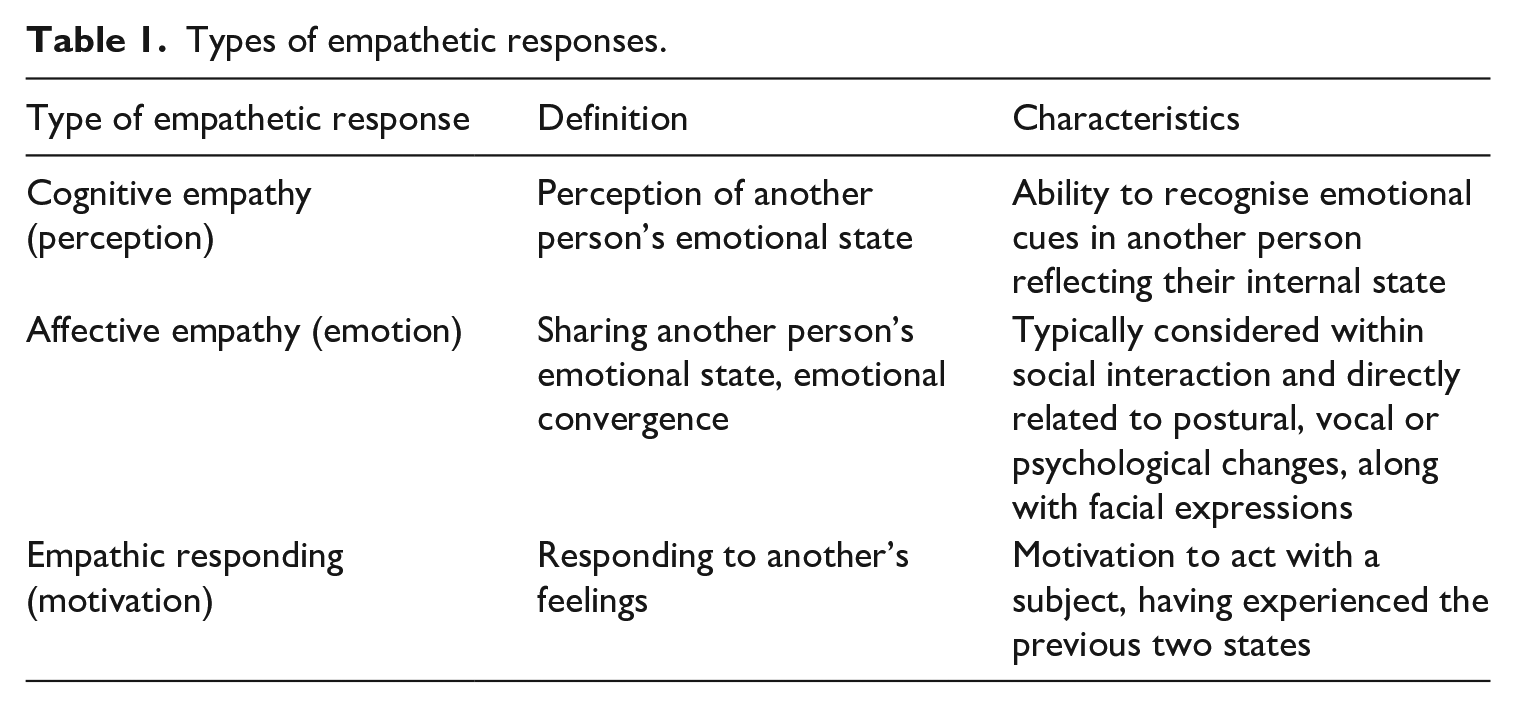
Archer and Finger (2018) simplify the concept and its use in 360 immersive research focussing on the expression of empathy by dividing empathy in perception (cognitive empathy), emotion (affective empathy) and motivation (pro-social behaviour/empathic responding of all forms). The survey utilised for this research engages this simplified formulation from Archer and Finger (2018), as the research question concerned generated or amplified empathy with no need for differentiation between empathic care or concern.
In summary, this research defines empathy as sharing another’s pain and concern for another’s wellbeing when becoming aware of their pain. The presence of empathy is therefore assessed by the presence of perception, emotion or motivation to act as described in Table 1.
Types of empathetic responses.
An important aspect regarding the possibility of something eliciting empathy is relatability and psychological proximity (Archer and Finger, 2018). Important forms of psychological proximity are spatial distance, emotional/cognitive distance, temporal distance and hypothetical distance (Hargrove et al., 2020), with research demonstrating the correlation between psychological proximity and increased empathy of all forms (Archer and Finger, 2018; Hargrove et al., 2020). In Holocaust studies, Landsberg (2004: 130) also observed the close connection new generations would experience with Holocaust events, because of engagement with an ‘experiential mode’ of knowledge or memory transmission. This is particularly relevant as 360 immersive technology would have the potential to reduce or eliminate spatial and emotional/cognitive distance through high immersion and presence. This allows for experiencing multiple emotions while encouraging direct interaction with the subject (Hargrove et al., 2020), highlighting the proximity nexus as a key determining factor in generating empathy.
Using 360 immersive technology in films to foster empathy
Archer and Finger (2018) argue 360 immersive technology is more successful than printed media in eliciting empathy. Jacobs and Maidwell-Smith (2022) reinforced this idea when they researched participants in a health education setting that scored higher motivation, empathy and higher immersion using 360 immersive technologies compared to watching the same video on a 2D screen. Most papers on this topic report positive effects of 360 immersive technologies on users’ presence, perception, engagement, emotions and empathy according to a systematic literature review conducted by Pirker and Dengel (2021) (see also, Nash, 2015). The same research, however, identifies the lack of studies on what they call ‘real VR’, meaning, 360 immersive experiences like Sorella’s Story, instead of 2D material adapted for VR (Pirker and Dengel, 2021). Cohen et al. (2021) identified that the 360 immersive condition enhanced viewers’ empathic care and facial synchrony with the person in the movie, meaning the participants responded to the story through their empathic facial expressions, indicating social connectedness and motivation to help, factors that were absent from the control group watching a 2D movie. However, there was no difference in the emotional responses between the two groups. Nevertheless, when compared to embodied experiences (e.g. role plays), some studies found small or no difference between those and 360 immersive environments (Hargrove et al., 2020). Findings like these recommend the use of 360 immersive technology not to replace all other media, but where face-to-face encounters are not possible (Cohen et al., 2021; Nash, 2015). Bailenson (2018, in Hargrove et al., 2020) goes further and argues for embodied experiences to create empathy with the use of 360 immersive technology being restricted to experiences that meet the DICE criteria – ‘Dangerous, Impossible, Counterproductive or Expensive’ – with analogic embodied experiences being considered for other cases.
Alternatively, James Jenkins, the Coordinator of Digital Pedagogy at Canterbury College has extensively researched 360 immersive technologies to effectively engage students in science classes. He argues that ‘students today are interacting with a variety of rich media outside of school. It makes sense that the more that teachers can utilise similar technology in school to suit their objectives, the greater the chance of student engagement they have’’ (Jenkins, 2016: 1). Further, today many students own smart phones and that makes utilising these new media technologies easier.
Several studies identified a link with using news media technologies such as VR, augmented reality (AR) or 360 immersive film and the affective domain of education, where motivation and empathy are fundamental for building rapport with the other (Donnelly et al., 2020; Jacobs and Maidwell-Smith, 2022). In these educational settings, empathy is important not only when generated but also as a characteristic to be amplified and practiced through 360 immersive technologies (Donnelly et al., 2020; Jacobs and Maidwell-Smith, 2022).
Games for Change is a US based organisation that utilises immersive film to explore critical issues about society. They have been able to reach large audiences with immersive films such as, The morning you wake (To the End of the world) by Brett and colleagues (2022, cited in Plass et al., 2023). Games for Change issued in 2023 a white paper titled Deepening Engagement and Learning Impact through Virtual Reality based on the above-mentioned film strongly arguing that 360 immersive technologies can affect emotions more strongly than flat screens, with participants experiencing more positive emotions in 360 immersive environments than in a 2D experiences (Plass et al., 2023).
There is considerable contemporary research about the use of 360 immersive to promote empathy in audiences, although there is ongoing debate about whether the technology elicits or contributes to the development of empathy (Archer and Finger, 2018; Hargrove et al., 2020), and if it is able to generate empathy on those without a predisposition for empathy in the specified context (Bohil et al., 2011). Archer and Finger (2018) argue against 360 immersive technologies’ ability to create empathy in someone who is not empathetic. Instead, they argue that the technology only magnifies what already exists.
Beyond that divide, 360 immersive technology was observed to not necessarily increase empathy with members of a different group but hostility towards members of the ingroup, promoted by the sense of immersion and engagement in the 360 immersive-experience (Hasler et al., 2021) when members of the group are depicted causing harm to others. In Hasler et al. (2021) Israeli youth became more critical and less accepting of Israeli soldiers’ actions when they experienced their harassment as stepping in the shoes of a Palestinian family in the 360 immersive environment.
Therefore, even if the 360 immersive technology is not the only media with the ability to elicit or increase empathy, the research in the area is positive about its link to empathy and similar emotions, mostly due to its ability to promote immersion and presence (Cummings et al., 2022, Konrath et al., 2010; Kyriakidou, 2015). Some less intensely researched complementary characteristics of audiences and contexts were observed, linking 360 immersive technology and empathy. These characteristics are: the need for space for reflection of the immersive experience to consolidate any uptake in empathy by participants (Konrath et al., 2010; Raij et al., 2009); audiences’ interest for particular topics; trust in the narrator; and the extent of over-saturation of a topic, since less saturation is connected to higher success (Archer and Finger, 2018, Kyriakidou, 2015).
Young people
As explained above, Holocaust studies have identified the importance of utilising experiential technologies to inform young people about the Holocaust and generate embodied and empathic experiences (Reading, 2002) reducing historical and geographical distances (Landsberg, 2004). They have also identified the multiple possibilities of using technology to mediate this experience efficiently. Nevertheless, research in other spaces has identified reduced empathic capacity, overall, among young people.
Concerns regarding young people and empathy have informed research on individualism, community participation, social inclusion and mental health (Ingram et al., 2019; Konrath et al., 2010). A lack of empathy has been associated with diverse psychiatric disorders, dangerous behaviour, violence, aggression and criminal activity, and is related to problems in interpersonal communication, often resulting in fractured relationships (Reniers et al., 2011). A large longitudinal project conducted in American colleges comparing empathy assessments of students between the years 1979 and 2009 concluded that some aspects of empathy were in decline among young people in the 21st century. This result alone highlights the need to reflect on how to promote empathy among young people (Konrath et al., 2010). Empathic concern (worrying for others) was the sharpest drop, followed by perspective taking (‘put yourself in someone’s shoes’) (Konrath et al., 2010). The other two empathy aspects measured in this study (‘fantasy’, which is being able to identify with fictional characters and ‘empathic distress’, which is being emotionally impacted by someone’s misfortune), presented no variation through time (Konrath et al., 2010). While definitions of empathy vary, this research demonstrated reduction in aspects of emotional and cognitive empathy (emotional concern and perspective taking, respectively), components of empathy that are considered in this research. Nevertheless, research in this area is limited.
Diverse 360 immersive experiences have been utilised with young people as a tool to promote empathy for educational and social purposes as described above. It has also contributed to promising results when utilised for bullying prevention based on an idea that it could assist to decrease aggression and increase willingness to intervene as a bystander due to empathy triggering pro-social behaviour (Ingram et al., 2019). Ingram et al. (2019) concluded that after using 360 immersive, young people experienced decreased psychological distance between the one being bullied and self, which has been found to shift an individual’s behaviour towards more attentive and generous actions.
Methodology
To understand if there was any difference in empathetic responses between younger and older participants exposed to the 360 immersive experience Sorella’s Story, a survey was created and administered to participants immediately after the experience to test the impact of the piece within a contemporaneous timeframe to the viewing The principle guiding the choice of research tool was that volunteer participants that self-select to attend the screening outside any research project that would not have any motivation to self-report.
Survey
A 5-point Likert scale was developed considering the conceptualisation of empathy from Archer and Finger (2018). The scale measured agreements with statements presented to the participants in the survey, with the scoring of that agreement as 1 (very low), 2 (low), 3 (moderate), 4 (high) and 5 (very high). It was administered in an individual electronic device to people after they finished the 360 immersive experience.
The survey started with demographic questions followed by the Likert scale with 12 statements (Annexe A). The statements (in order) were:
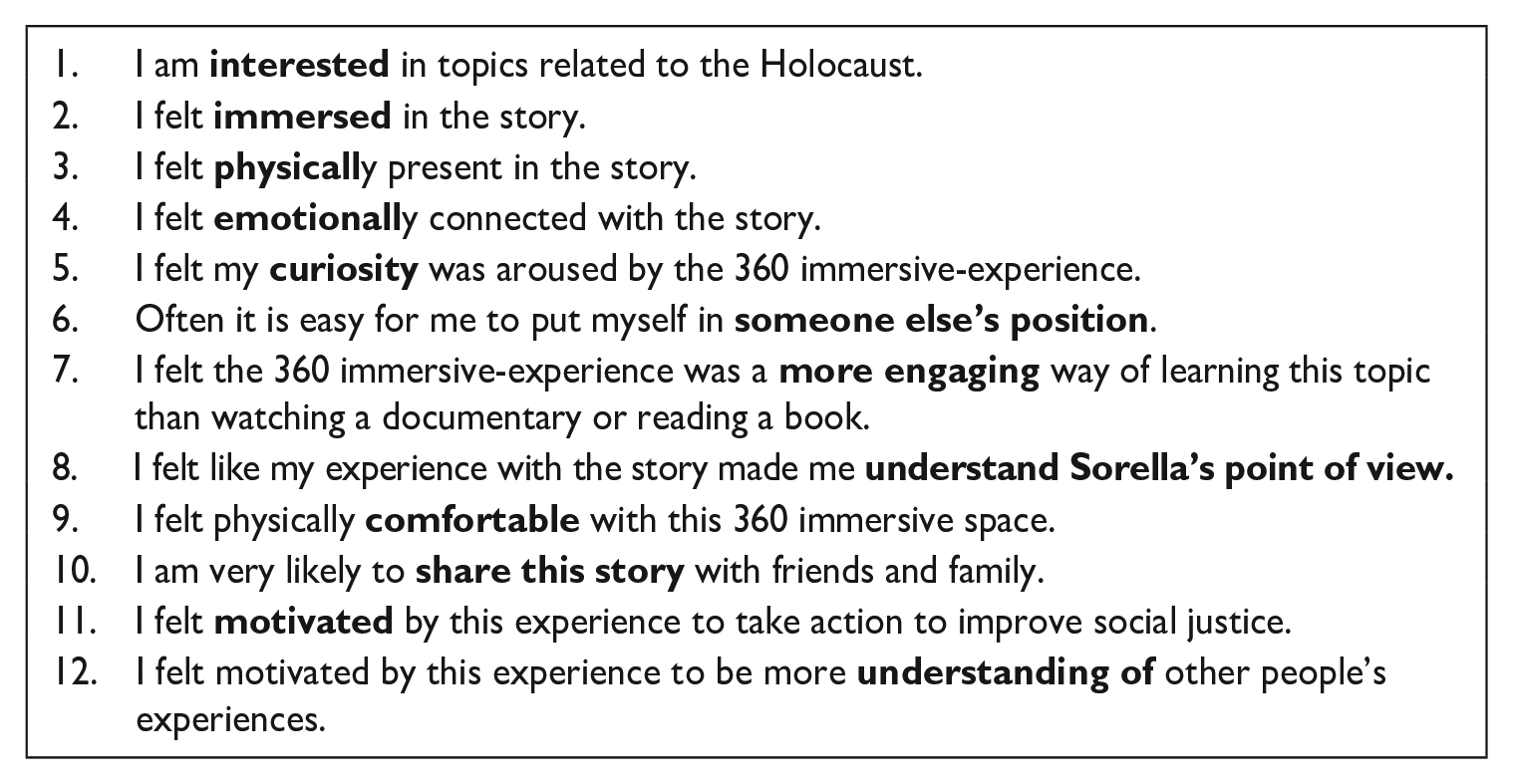
Some questions in the survey were aimed at assessing interest in the topic (question 1), comfort with the technology (question 9) and a baseline of one of the most recognisable experiences of empathy, ‘be in someone else’s shoes’ (question 6).
Questions directly targeting Sorella’s Story and empathy (cognitive and affective) were questions 2, 3, 5, 7 and 8. The last three questions (10, 11 and 12) were directed at empathic responding/ pro-social behaviour.
Questions were adapted from the validated scales, Jefferson Scale of Empathy (Hojat et al., 2018) and the Hargrove et al. (2020) survey on embodied experiences and empathy.
This research received ethics clearance from Griffith University, reference number 2022/555.
Participants
Participants were recruited in three different locations: the Venice Film Festival 2022, in Italy, the Brisbane Film Festival 2022, in Australia and at orientation week 2023, Griffith Film School, Australia.
Participation was voluntary with all people being approached to fill the survey after the Sorella’s Story experience. Participants had chosen to engage in the 360 immersive-experience beforehand and independently. If a person agreed to participate in the survey, they could answer the questions using an electronic tablet at the 360 site.
Only de-identified information was kept in an electronic platform (Lime Survey) for the purpose of this research. Participants had to be 18 years of age or older to respond to the survey.
At the Venice Film Festival, 49 people consented to participate in the research. At the Brisbane Film Festival, 32 people consented to participate, and at the Griffith Film school there were 63 participants (totalling 139 participants). Not all questions were compulsory, and some participants skipped some of the questions. Nevertheless, if the participant answered all compulsory demographic questions and at least one of the questions in the survey, the survey was counted for the purposes of this study. In the end, a total of 119 surveys were used for the analysis.
Results
There was a mix of participants with 54 identifying as male, 57 identifying as female, 7 identifying as non-binary and 1 person identifying as transgender.
The nationality of participants was only recorded at the Brisbane Film Festival and included people from Russia, Canada, South Africa, Sri Lanka, United Kingdom, Hungary, United States, Papua New Guinea and New Zealand. All participants were asked if they spoke English as their first language to capture a measure of cultural diversity, and 64% of the participants spoke English as their first language. Further, 74% of the participants had university degrees or higher education.
Most participants had ‘limited’ (41%) or ‘considerable’ (36%) experience playing videogames and/or using virtual reality only, with a smaller group in the middle.
Therefore, in terms of demographics, the survey participants were mostly a formally educated group of adults that spoke English as their first language. It was, however, an evenly split group in terms of people’s experience using immersive or similar technologies.
Overall, the responses to the questions in the survey were mostly concentrated around high or very high agreement (4–5 in the Likert scale). Most participants indicated that they had a very high (41%) or high (29%) interest in Holocaust stories, potentially explaining their motivation in selecting the experience at the various events. For question 6, 34% and 29% of the participants respectively indicated a very high and high usual capacity to empathise with others. Therefore, it was a group with high levels of self-assessed empathy and interest for stories like Sorella’s Story.
The answers were heavily concentrated on very high and high agreement for most questions. Participants described the 360 immersive experience as one in which they felt comfortable (47% very high, 29% high), immersed in the story (50% very high, 29% high), emotionally connected (45% very high, 31% high), curious to learn more (52% very high, 29% high) and willing to share the story with others (49% very high, 25% high). Participants also believed the 360 immersive experience assisted them to better understand Sorella’s point of view (48% very high, 30% high).
The results were less concentrated on the top of the scale when it came to the other questions, meaning more moderate results but no considerable concentration of answers at the lower end of the scale. The answers for ‘feeling physically present’ were 34% very high and 34% high. The answers for identifying the 360 immersive experience as ‘more engaging than documentaries and books’ were 44% very high and 24% high. Participants’ ‘willingness to be more understanding of others' perspectives’ were 41% very high and 29% high, and finally the participants answered ‘having motivation to engage in social justice’ as 31% very high, 29% high and 24% moderate.
The young people’s segment
Our sample comprised 63 people who were between 18 and 39 years old making them Millennial and Generation Z populations, which are the two younger adult generations, and generations that have been raised with technology and considerable temporal distance from the atrocities of the Holocaust since they were born at least 35 years after the end of the Second World War. Of the 63 participants in the ‘younger people’ category, 38 had a university degree and 43 spoke English as their first language. Twenty-five of the 63 participants had considerable experience with technology and 28 had limited experience.
The younger people’s survey averages were all below the averages for the older group of participants except for the last question, ‘I felt motivated by this experience to be more understanding of other people’s experiences’, which had the closest average for both age groups. Both age groups responded with either ‘very high’ and ‘high’ agreement with that survey question, implying high empathy and relatability to the technology. Older people consisted of people originally from two separate groups, 40–59 years old and people 60 and over.
The highest Mean scores were for the questions ‘feeling immersed’ and ‘understanding Sorella’s point of view’ for older people (M = 4.51 out of 5 for both), with this second question also the highest for the younger people group, M = 4.2. Question number 10, ‘I am very likely to share this story with friends and family’ had the highest difference in score (p = 0.00027) between the older and younger people’s mean scores.
Both groups had their lowest respective scores for question 11 (willingness to promote social justice), with older people’s mean being M = 3.88 and younger people’s mean being M = 3.5. Finally, the closest mean scores were for question 5, ‘I felt my curiosity was aroused by the 360 immersive-experience’, where older people scored M = 4.21 and younger people M = 4.03, with a non-statistically significant p = 0.223342. See Table 2 below for comparison for each question.
Question responses by age.

Significance test – p-value
The difference between older and younger people’s results were tested for significance for each of the 12 questions and 7 of them had statistically significant differences (Q2, Q3, Q4, Q7, Q8, Q10 and Q11). In all these cases, older people scored significantly higher than younger people. See all p values below (Table 3).
Significance – p-value (M = mean, SD = standard deviation).
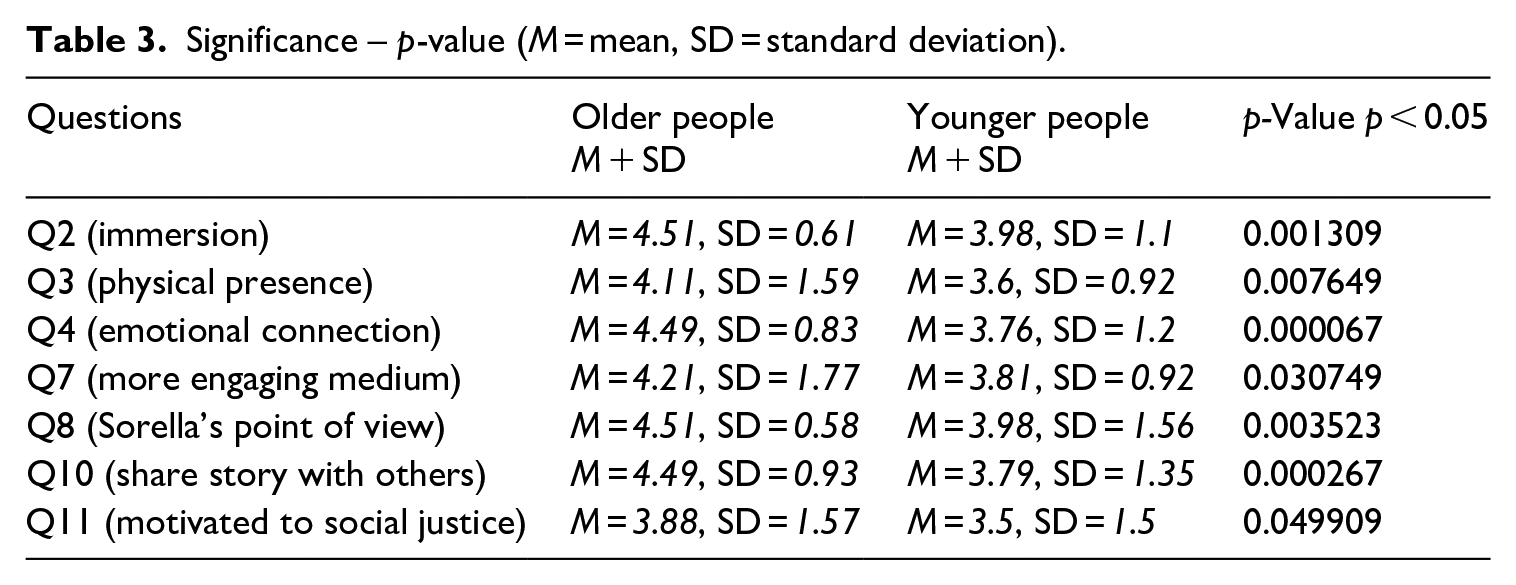
There was no significant difference between the groups for questions Q1, Q5, Q6, Q9 and Q12.
Data analysis
The mean scores for the two comparative groups (younger and older) were close, with no significant difference in how the 360 immersive experience aroused their curiosity (Q5), motivated them to put oneself in someone else’s position (Q6) and motivated them to be more understanding of others (Q12). Therefore, both groups self-evaluate similarly on engagement with the content (Q5), having empathy (Q6) and willingness to practice empathy in the future after experiencing the 360 immersive film (Q12). Surprisingly, there was also no significant difference between questions 1 and 9. Question 1 relates to interest in the topic of the Holocaust. It was hypothesised in this research project that younger people may express less interest in the Holocaust than older people who may be more familiar with the topic. Further, the number of younger people who experienced Sorella’s Story was like that of older people, indicating an interest in the topic for all age brackets. On the other hand, question 9 related to a viewer’s comfort with the 360 immersive technology and the hypothesis was that younger people would be more comfortable than older people with newer technology, but that was not the result found by the study. The lack of significant difference means those hypotheses were not validated, which can be explained by the fact that the participants were self-selecting, meaning the sample group of participants were already interested in the topic of the film and the technology.
Other than questions 5 and 12, the other questions that directly related to aspects of empathy and the 360 immersive experience combined, were questions that produced findings with significant differences between the groups, with younger people scoring lower. These were questions regarding immersion (Q2), presence (Q3), emotional connection (Q4), understanding Sorella’s point of view (Q8) and pro-social behaviour, such as sharing the story with others (Q10) and improve social justice (Q11). While it is not possible to determine if empathy was generated or enhanced, older people expressed significantly higher empathy in all empathic markers except for the willingness to be more understanding of others in the future. This finding can be explained by a possible lower level of empathy overall among younger people, as assessed in previous studies. Alternatively, the participants in the Brisbane Film Festival were also able to write feedback on their surveys. Feedback was received from 17 participants and according to that feedback, younger people reported strong emotions and empathy towards Sorella’s Story. The respondents emphasised two dimensions of this work ‘feeling emotionally and physically impacted and immersed’ and feeling this was ‘beautiful’ and ‘confronting’. The inability to act despite the immersion in the story was highlighted by three participants only, but all others mentioned agency and strong emotional and physical responses. One participant said, ‘it was overwhelmingly good [and] it was a bit traumatic for those who are empaths’ (Australian woman, 18-39), while another said, ‘[s]imply amazing. Couldn't stop the tears’ (South African woman, 18-39). Older people also left messages about their experience of empathy, such as, ‘[a] very successful VR immersive experience with a very organic use of history to create an immersive story that reveals a past that is out of reach for many audiences’ (Australian man, 40-59), and ‘[p]owerful. Emotionally evoking work. You cannot look away and pretend that these atrocities did not happen. We remember. Remembering the past brings hope for our future’ (Australian woman, 40-59).
Younger people indicated significantly less agreement with the statement that 360 immersive technology would be more engaging than other mediums (Q7) and on their feedback reported having their experiences disturbed by strong noises or another sensorial issues in the projection room.
The lowest scores for both groups were in relation to question 11, which asked about taking action to improve social justice. The following participant, who was from the younger age group, may give us a clue as to why action to improve social justice received a lower score, overall:
I mainly felt discomfort at feeling like I was the person that stood by and did nothing while these inhumane acts occurred, which raised questions over how these events in history actually occurred and whether they would again in the future as people who are not the victims just "stand by" (Australian woman, 18-39).
One interpretation of not only the answers to question 11, but also the results overall, is that while all other conditions for enhancing empathy were present in this 360 immersive, there was no ‘space for reflection’ (Konrath et al., 2010; Raij et al., 2009) since the survey was presented just after the 360 immersive-experience. Therefore, to further potentialise this intervention, it should incorporate a space for reflection post 360 experience allowing for the participants to reflect and potentially engage in change. It would also allow participants to reflect or even discuss what is possible in terms of individual action after experiencing an empathetic encounter such as this film. In the context of Sorella’s Story, this space for reflection could contribute to create further psychological proximity and memory mediation that were identified as fundamental in other work empathy and Holocaust memory work (Konrath et al., 2010; Landsberg, 2004; Raij et al., 2009; Reading, 2002).
A confirmatory factor analysis (CFA) was conducted to confirm questions 2, 3, 5, 7 and 8 as variables for the factor ‘cognitive and affective responses’, and questions 10, 11 and 12 as variables for the factor ‘empathic responding and pro-social behaviour’. The data were imported into JASP (Version 0.12.2; JASP Team, 2020) statistical software for analysis. CFA confirmed the hypothesis with appropriate model fit with low Chi-square and p <.001, CFI 0.95, GFI 0.98 and SRMR 0.09 (Rogers, 2024). Therefore, there is a good fit model with appropriate results for standardised measurements for CFA. The groups of older participants scored higher than the younger participants in cognitive and emotional empathy and pro social behaviour.
Limitations
The study was unable to conduct a pre-screening survey to allow a pre and post comparison, and the participants were likely already partial to the topic and technology when they selected to attend the movie screening. Therefore, future research comparing empathy between age groups in the space of Holocaust awareness might consider including a large and random sample of participants with pre-screening measures for comparison and using a control group of participants who do not view the 360 immersive film.
Another limitation is that Sorella’s Story was developed intending to contribute to Holocaust awareness as part of a suit of media accompanied by an education tool kit and guide for teachers to tackle Holocaust Education, not considered in this project. Sorella’s Story is part of an ATOM Guide (Australian Teachers of Media), a teacher’s guide created specifically for Australian schools to match the curriculum and developed by the Melbourne Holocaust Museum with the support of Gandel Foundation in an educational partnership. This study measures the impact of Sorella’s Story only and not the whole package of awareness raising and educational tools.
Conclusion
To claim that 360 immersive filmmaking can routinely or in fact naturally generate empathy in participants would be a bold statement. However, 360 immersive technology has the potential to increase empathy in diverse audiences when employing it to portray critical issues of our time, as demonstrated here. This research also observed that younger people, indeed, reported experiencing less empathy after the 360 immersive film than older people, even though both groups had no significant difference in their average empathy self-assessment score. Having said that, while empathy was significantly less present among younger people, both groups scored high levels of empathy after viewing Sorella’s Story.
Our research in relation to Sorella’s Story, shows a strong connection between going through the 360 immersive experience and enhancing empathic responses, including cognitive and affective empathy. It also enhanced people’s motivation for action, albeit less so. It would be necessary to engage a purposeful sample of people with reduced empathy to assess the impact of this 360 immersive technology on those without empathy overall or empathy for the victims of the Holocaust specifically. A gendered understanding of empathy and memory mediation in Holocaust studies is also necessary (Reading, 2002) to better engage with audiences.
It is also critical to acknowledge that beyond the experience itself, there are other elements that can build on the emotional experience that ought to be considered by screen practitioners aiming to utilise 360 immersive technologies, including promoting participant reflection. The unique nature of 360 immersive filmmaking is that the participative experience is merely the first stage of the immersion. We would argue that the opportunity for the 360 immersive facilitators and/or the filmmakers to engage with participants after they have viewed the film, creating a space for reflection, increases the potential for empathy building and by extension, have the potential to create transformative change. Extending the experience in this way would be worth exploring with general populations and younger groups. It is, however, also clear that whilst empathy was evidently increased in audiences towards the experiences of the victims of the Holocaust and awareness was also generated, they were less inclined to take social action after seeing the film. This applied to both older and younger people. It is, however, important to note that generating direct social action was not an original intention of the film, which is different to some other social change and 360 immersive initiatives (Arora and Pousman, 2015; Palmer, 2021; Palminteri, 2019).
With the rapid advancement of screen technology particularly innovations in Extended Reality that allow viewers more sophisticated and realistic immersions in specific environments, possibilities for Holocaust memory to be mediated and shared with future generations is expanded, as is the opportunity to expand our understanding of how to enhance and generate empathy, particularly among younger people. This study is one step towards comprehending the possibilities of this growing technological space.
Footnotes
Annexe A
Author’s Note
All authors have agreed to this submission and the article is not currently being considered for publication by any other print or electronic journal.
Funding
The author(s) disclosed receipt of the following financial support for the research, authorship, and/or publication of this article: This project has received funding from Screen Australia, Screen Queensland, the Gandel Foundation, and the the Disrupting Violence Beacon (Griffith university).
