



Abstract
This article proposes a media and philosophical analysis of Carne y Arena (2017), an immersive mixed reality installation by Mexican director Alejandro G. Iñárritu. Drawing from Chouliaraki’s notion of the “distant sufferer,” the article compares the medium specificity of television with the characteristics of mixed reality to question whether the gap between spectator and migrant can be bridged. The article analyzes how Carne y Arena positions its users not as spectators but as visitors or participants, thereby turning the “distant” sufferer into a “close and proximate” sufferer. To better understand how this immediacy effect is realized, the article introduces the concept of “intuition,” as theorized by the French philosopher Henri Bergson (1859–1941). In its closing section, the article discusses the ways in which Iñárritu’s work is part of a political intervention that proposes to challenge the limits of mediation and to promote social justice through feeling, acting, and knowing otherwise.
I’m self-taught and I’ve always obeyed and followed my intuition. Intuition is simply knowledge without information or data. It’s pure, it’s pure knowledge; it’s the wisdom that we all have inside us.
Sunset. You are walking barefoot across the Arizona desert sand. All alone in the Mexican–U.S. border area. Until a group of migrants emerges from the dark, led by two “coyotes” or “jackals,” that is, human smugglers. Suddenly everyone is blinded by a helicopter searchlight. Despair reigns supreme. Armed border patrol agents with a menacing barking dog detain the group. At first, you are a silent witness, but later you yourself become a migrant. “Hey, you there, what are you doing? Put your hands up, get down on your knees!” They only change their tone when they figure out the group does not contain any armed smugglers. Women and children are helped, the smugglers arrested. Then all of a sudden, a magical-realist dream world is conjured up lyrically. A long table appears in the desert, upon which floats the specter of a boat full of migrants capsizing at sea. You realize that it makes no difference whether you die as a migrant in the Arizona desert or the Mediterranean. Then the sun rises. Dawn. You are alone again in the landscape as if nothing at all has happened. Then the image turns black.
The above description reflects my personal experience of the mixed reality installation Carne y Arena (Flesh and Sand) by the Mexican director Alejandro González Iñárritu, exhibited in different locations around the world. My analysis is based on my three visits to this work in Washington, D.C., in May and June 2018. 2 Seen by many as “virtual reality” (VR) only, this installation is actually a form of “mixed reality,” the merging of real and virtual worlds. While the VR component consists of a three-dimensional computer-generated simulation, in this case of the Arizona desert, mixed reality combines this VR experience with real-world components, such as sand, wind, and heat, that turns it into a multisensory, bodily immersive experience (Jerald 2015; Kors et al. 2016; Lanier 2017; Uricchio 2018).
Contemporary virtual and mixed reality productions such as The Displaced (2015), Clouds Over Sidra (2015), A Breathtaking Journey (2016), and Carne y Arena (2017) are part of a drastically changing global mediascape. They are increasingly used not only to entertain, but also to create social justice by encouraging understanding and compassion with sufferers, in the above specific cases forced migrants. 3 In this article, I analyze whether Carne y Arena achieves this effect, and if so, how and to what extent. I will do so by taking as a starting point Iñárritu’s characterization of this installation as a “semi-fictionalized ethnography” (Fondazione Prada 2017, 3) that allows users to thoroughly experience a fragment of Mexican and Central-American migrants’ personal journeys and lives. Drawing from Lilie Chouliaraki’s (2006) influential book The Spectatorship of Suffering, I will compare the medium specificity of television with the characteristics of mixed reality. In her work, Chouliaraki analyzes the affordances and limitations of the medium of television in engaging its viewers with the distant sufferer. Elaborating on this, I analyze instead how Carne y Arena positions its users not as spectators but as visitors or participants, thereby turning the “distant” sufferer into a “close and proximate” sufferer. To better understand how this immediacy effect is realized, I will introduce the concept of “intuition,” mentioned by Iñárritu in this article’s opening epigraph, as theorized by the French philosopher Henri Bergson (1859–1941) ([1903] 2007).
Carne y Arena: A Semi-Fictionalized Ethnography
There are no actors here. These are true stories re-enacted by the people who experienced them. (Fondazione Prada 2017, 3)
Carne y Arena is composed of three rooms. The first is a waiting room, the second is the central VR part where you undergo a six-and-a-half-minute solo experience, and the third a room where you are invited to reflect on your experience. I visited this three-act installation in Washington in a vacant church covered on the outside with steel plates that had once been part of the border at Naco, Arizona. First, I entered a waiting room kept at a low temperature of around 8°C, similar to the ones migrants are locked up in. The room is littered with shoes and water bottles found in the desert. On the wall, a message board informs you about the six thousand people who have died over the past seven years trying to cross the Mexican–U.S. border. Before entering the second room, you have to take off your shoes and socks, and place them in a locker. When a warning signal on the wall goes off and a light flashes, a door opens and you are invited to walk through. While the staff helps you to put on the VR gear, you see a large space illuminated by an orange-red light typical of both sunsets and sunrises (see Figure 1), and you feel that the floor is covered in sand.
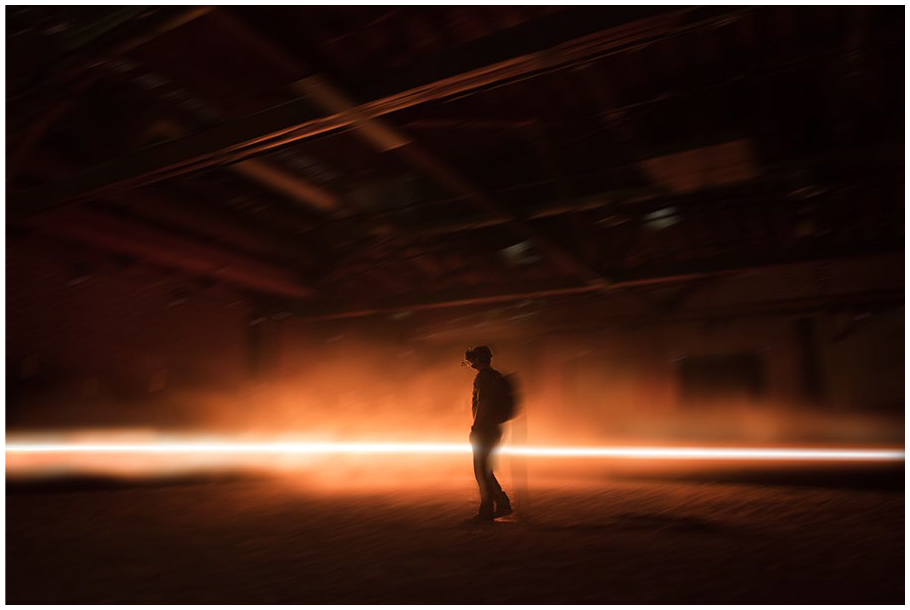
Exploring the Arizona desert in Carne y Arena. © Emmanuel Lubezki.
Carne y Arena literally means “flesh and sand”; it refers to the feeling you get of the sand slowly taking over your entire body when you walk through the desert. This section of Carne y Arena provides you with an immersive experience with realistic sounds, images, and other sensorimotor sensations that replicate the real environment of the Arizona desert. A special feature is the ability to literally enter the character’s bodies, in particular their beating hearts (see Figure 2): When you are going into the body of somebody you see a heart, of real flesh, with red blood. We all have red blood and we define ourselves by our roles and suits. If you are a police officer and I am a Mexican, we all share the same flesh, red blood, heart beating. Being inside the heart of someone is very impressive, the flesh is beating, you can do that with the kid, the police: everybody has the same heart. (Iñárritu 2018)
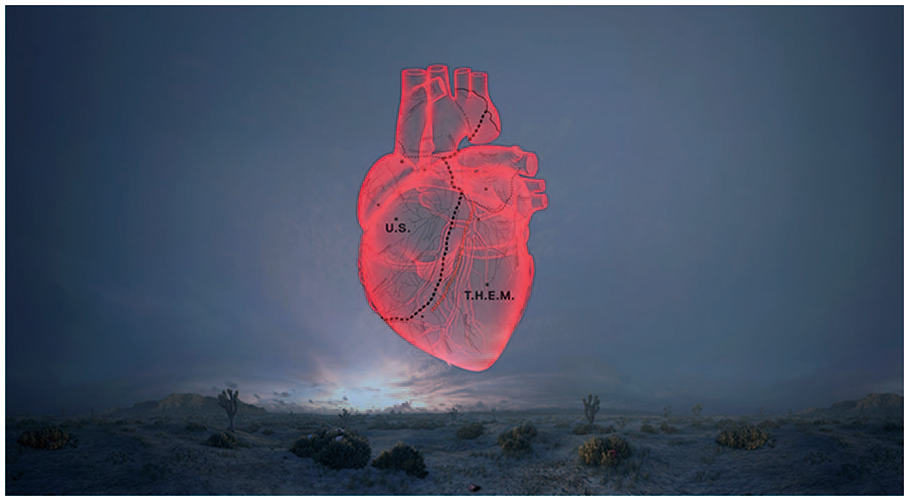
Beating heart in the Arizona desert, Carne y Arena. © Legendary.
After the VR experience, you pick up your shoes and enter the last room. Here you can watch seven monitors with close-ups of the faces of nine migrants and one border patrol agent, with texts telling their moving stories as a form of self-representation. We suddenly realize that what we just experienced in VR is their true-life stories, played by the migrants and border patrol agent themselves.
Spectators versus Visitors and Participants
According to Iñárritu, Carne y Arena challenges the limitations of mediation. To validate this claim, I will make a media-comparative analysis by using Chouliaraki’s insights into the so-called “spectators” and “distant sufferers” of television news. In her work, Chouliaraki (2006, 1) questions “whether or not the media can cultivate a disposition of care for and engagement with the far away other.” Her analysis enables us not only to better understand the similarities and differences between the medium of television and that of mixed reality, but also to characterize Carne y Arena as a specific mode of news. Let’s start with a comparison of the two different media, television and mixed reality. 4
Chouliaraki’s analysis is focused on the way in which both the television viewer and the sufferer are constituted through the specificity of the medium of television itself (see the middle column of Table 1). The television viewer is positioned as a spectator who witnesses the events on the screen, events that have, in the case of live broadcasting, a “non-fixed sequentiality.” The connection between viewer and medium is a volatile one: the viewer is confronted with the news by accident—stumbling upon the news while changing television channels with the remote control—or on purpose, but always able to immediately change channels or switch off if wanted when having had enough of the bombardment of images. The television screen enables the viewer to watch and hear the framed images, sounds, and written and spoken text, and experience rather passively the presented narratives. The basic human senses that are engaged are sight and hearing. Finally, it is common practice that television news is watched in the context of the comfort of the living room and potentially has an enormous reach.
Comparison between TV News and MR (Carne y Arena).
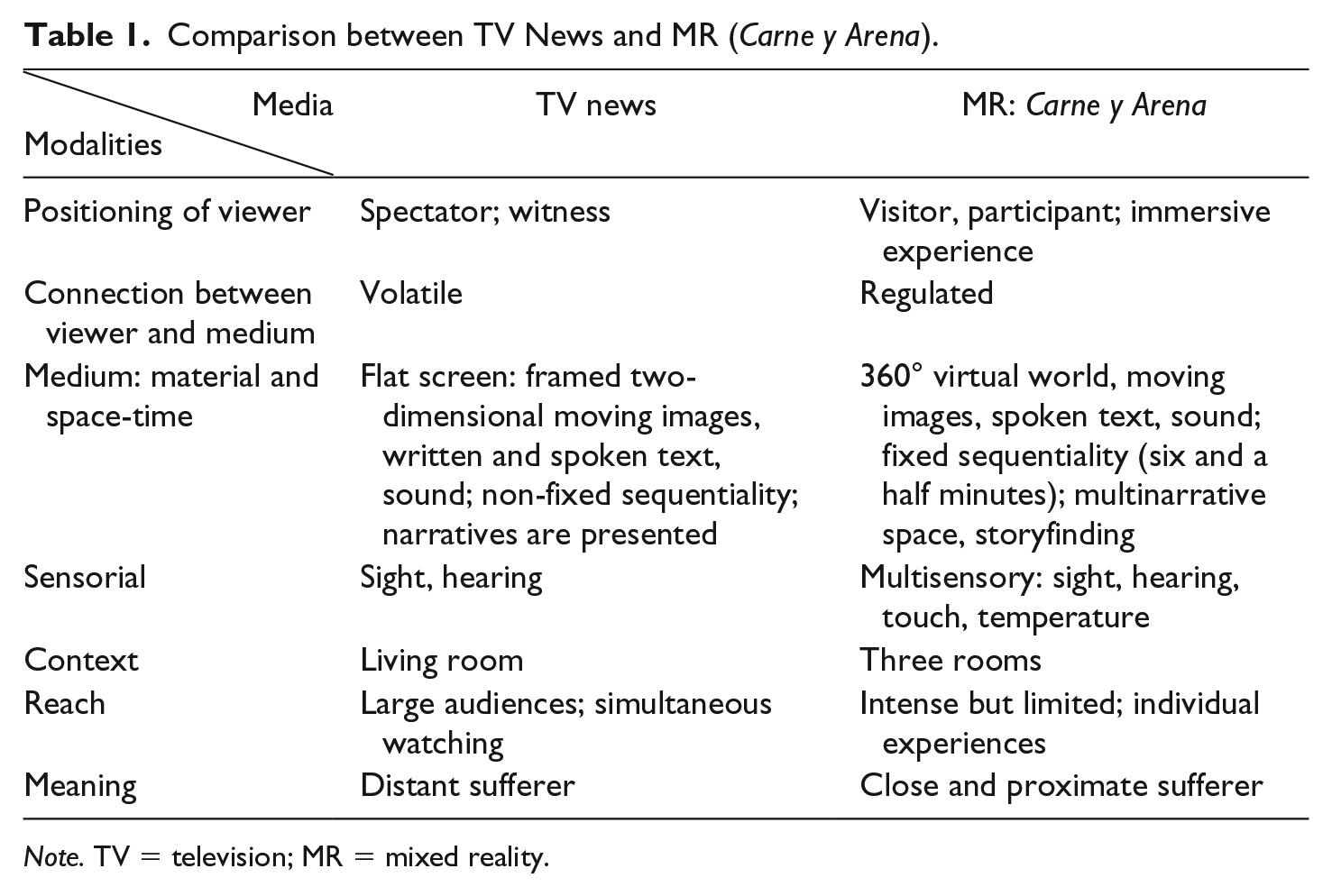
Note. TV = television; MR = mixed reality.
Carne y Arena as an example of mixed reality works differently (see the right column of Table 1). Iñárritu combines two perspectives; it positions the viewer both as a visitor and as a participant, in an ingenious manner. In the beginning of the VR experience, the viewer is just a “fly-on-the-wall,” a bystander unnoticed by the migrants or the border police. The viewer is slowly turned into a participant, for example, whenever their own shadow is cast on a migrant’s body or when they feel the desert wind on their skin or hear the overwhelming noise of a border patrol helicopter. By combining the perspectives of “visitor” and “participant,” Iñárritu ensures that your experience is neither too detached nor too engaged: merely taking the visitor’s perspective would be too voyeuristic and aloof, but a constant first-person perspective—putting yourself in a migrant’s shoes—would be too stressful and make you want to reject the situation. A combination of both is the most important condition for empathy to take place (cf. Davis 2018; Eveleth 2018). Instead of just witnessing the news, the visitor-participant is experiencing the migrants’ situation in an immersive way, making the life of a migrant not only visible, but also tangible.
The connection between viewer and medium is not volatile but strictly regulated: once the participant has entered the building, they have to go through the three different stages of the installation without the possibility of interrupting the experience. And because of the hype surrounding Carne y Arena, the visitor feels privileged to be among the lucky ones to have managed to get a ticket at all.
Carne y Arena has broken with the “dictatorship of the frame” (Iñárritu 2018), as Iñárritu puts it. Instead of just watching and listening to framed two-dimensional images and sound, the visitor-participant has the sensory experience—thanks in part to a positional tracking system—of being fully immersed in a three-dimensional 360° virtual world. This enables you not only to choose during the VR experience where and when to look, but also to choose the position from where you look at the events that take place in the virtual 360° space of the desert. For six and a half minutes of “fixed sequentiality,” you can explore this three-dimensional space and hide from the violence behind the bushes, choose the side of the border patrol agents because you feel threatened, or decide to (virtually) protect and help a migrant mother and her child. This makes Carne y Arena a multinarrative space suited for environmental exploration, or “storyfinding” as Uricchio (2018) describes it.
In addition to sound—so valuable for orienting yourself in a three-dimensional space—the sensorial elements of the sand, wind, and temperature are important. This “virtual” reality is turned into a multisensorial, sensomotoric, and bodily experience of life as a migrant: “The body never lies . . . the body is always true, the senses are always true . . . the body knows much better the truth” (Fondazione Prada 2017, 32; Iñárritu 2017a, 2018).
The safe and comfortable context of the living room is turned into three different spaces where the visitor-participant experiences the same kind of vulnerability as the migrants in the scene. This vulnerability is enhanced by walking barefoot in the sand and reaches a climax when a border patrol agent points a gun at you as illustrated in the opening passage. 5
Whereas television news can attract millions of viewers at the same time, Carne y Arena can only host one person at a time. The six different exhibit locations (Cannes, Milan, Mexico City, Los Angeles, Washington, and Amsterdam) allowed an estimated tens of thousands of visitors.
A provisional conclusion would be that Carne y Arena is a more intense experience than television could ever offer, an intensity that could more easily lead to compassion with and understanding of the “close and proximate” sufferer. To further develop this proposition, I interpret Carne y Arena as a form of docu-journalism and a specific mode of news. 6 For this purpose, we need to move beyond the specificity of both media and introduce Chouliaraki’s (2006) analysis of three modes of television news discourses that provide us with a conceptual framework to analyze our possible reactions to television images of distant sufferers.
Modes of Television News Discourses
These three different (semiotic) modes are “regimes of pity . . . three groups of news texts . . . adventure, emergency and ecstatic news” (Chouliaraki 2006, 8). Adventure news is “news of suffering without pity” (Chouliaraki 2006, 10) which makes the sufferer the “Other” with whom the spectator has no contact. Emergency news is “news of suffering with pity” (Chouliaraki 2006, 10) where the sufferers are still “others” but now within the spectator’s field of interest. Finally, ecstatic news leads to the highest point of pity, where spectators identify themselves with the sufferers, people “like them.”
The ecstatic mode is of relevance for Carne y Arena because it emphasizes the proximity between spectator and sufferer. Just as in ecstatic news, Carne y Arena is based upon raw facts, unstaged reality, showing things as they really are; a local tragedy with global meaning; suffering in the order of lived experience but understood within a political and historical framework; details of the location, and human beings with a face. The installation as a whole makes the user feel, think, and act, and enables them to overcome—if only for a short moment—the “inescapable otherness” of television news by being positioned as a visitor and participant, and, when we enter somebody’s heart, to actually become one of them.
Although Chouliaraki (2006, 190) identifies ecstatic news as the mode that leads to the highest point of pity, she ultimately praises the emergency news as the best mode to convey a “cosmopolitan disposition.” This disposition is missing from both adventure news and ecstatic news as they set the microsphere of Western life central: adventure news blocks “the option of pity for the suffering of people who are not like ‘us,’” whereas ecstatic news expands “globally a demand for action on suffering that is ‘our’ own” (Chouliaraki 2006, 196). In her normative hierarchy, only emergency news represents a possible cosmopolitan citizenship: “spectators engage with distant suffering via a demand for action on ‘others’ who do not readily belong to their own communities” (Chouliaraki 2006, 196).
In my opinion, ecstatic news and a cosmopolitan disposition can be reconciled, maybe not in the medium of television but certainly in Carne y Arena. Here you can, as a visitor-participant, identify with the others, the migrants, who do not belong to your own community by “virtually” becoming them. This means that the “distant” sufferer is turned into a “close and proximate” one. To better understand how this immediacy effect is realized, we have to take a last but crucial theoretical detour, an interpretation of Iñárritu’s reflections in the light of Henri Bergson’s ([1903] 2007) philosophy of intuition.
Understanding is Love’s Other Name
Using technology to express human ideas and reality is very contradictory; to talk about reality, we have to create a virtual reality. We are so degraded, polluted, contaminated, overwhelmed, desensitized that we don’t see reality anymore, or it does not even change us, doesn’t impact us. We read about these problems, we see documentaries, great films and we just check out Instagram on our phones. So it is sad that we have to create virtual reality to do that. (Iñárritu 2017b)
In this section, I will first formulate the problem of mediation. Then, I will introduce the notion of intuition as a central concept of Bergson’s metaphysics. Then, I will present the ways in which we can achieve intuition, and I will finish with the methodological aspects of intuition. In each step, I will show the similarities between Bergson’s ideas and Iñárritu’s ideas about Carne y Arena.
The problem of mediation is introduced by Chouliaraki (2006, 20) in her first chapter: the media attempt to close the distance between users and distant sufferers by eliminating obstacles or improving the possibilities of media technologies. Whereas some characterize these “promises of copresence, experiential immediacy, and transcendence” as “utopian” (Irom 2018, 4269), others claim that VR can actually bridge the gap between real and mediated experiences and arrive at a form of “post-symbolic communication.” 7 To position this debate, I will turn to Henri Bergson, who struggled with the same question, but in the field of metaphysics.
Bergson ([1903] 2007) developed his ideas about intuition in his An Introduction to Metaphysics in reaction and opposition to the upcoming popularity of neo-Kantianism around the turn of the century. 8 In his Critique of Pure Reason (Kant [1781] 2007), the German philosopher Immanuel Kant (1724–1804) claims that our understanding of the external world is restricted by—or to formulate it more positively, is made possible by—a priori concepts, that is, concepts that precede experience. These concepts are to be understood as a pair of glasses through which we look at and know the world. But these glasses cannot be removed, and as a consequence, we cannot know the things—or reality—as they are in themselves. Bergson agrees with Kant that we usually experience reality through those glasses, but—and here he distances himself from Kant—only because we have practical reasons for doing so, for example, to get a better grip on the reality around us. But, and here Bergson distances himself from Kant again, we are able to free ourselves from these restrictions and experience reality as it is in itself. Instead of situating our experience in a conceptual framework, we can place ourselves within the object, to “nest” ourselves in it, to sympathize with and put ourselves in the position or “shoes” of the object we are studying and, in the end, converge with it. Metaphysics, according to Bergson ([1903] 2007), is exactly this, to know reality as it is in itself. Bergson’s ([1903] 2007, B75 86) response to Kant’s claim as stated in his Critique of Pure Reason that “Thoughts without content are empty, intuitions without concepts are blind” would be “intuitions without concepts are not blind,” they are even the source of real knowledge. Intuition is direct experience, a noninterpreted experience. According to Bergson ([1903] 2007, 1–2), there are two different ways of knowing a thing: “The first implies that we move round the object; the second that we enter into it . . . the first kind of knowledge may be said to stop at the relative; the second . . . to attain the absolute.”
The contrast between concepts (cf. Kant) and intuitions (cf. Bergson) is addressed by Iñárritu himself in his acceptance speech for the special Oscar for Carne y Arena (Iñárritu 2017a): “I would like to share some reflections.” In his speech, he rejects the “ideologies that have fucked up the world”; according to Iñárritu (2017a), “the interpretation of reality only through ideas and words inevitably distances, misleads, blinds us, and prevents us from actually seeing reality.” When, for example, immigrants are called “rapists, or illegal aliens,” then a whole community is reduced to an idea, to an impoverished, misleading, and degrading perception of reality. “But no matter how many tweets [cf. Trump] to the right or to the left and all our blah blah blah, true reality will remain unaltered.” At the other end of the spectrum, he places the actual things, places or persons, the complex and true reality. Carne y Arena explores this human condition, expressing and sharing this reality of immigrants: it “virtually gives us a slice of our complex reality, so that we can understand each other and therefore love each other more.” According to Iñárritu (2017b), his installation is exactly what Irom denies VR to be: it leads to “a transcendental experience of things.” Experiencing Carne y Arena enables visitors to “see the real reality first hand, they will understand them [immigrants], and if they understand them, they will love them, because as Master Nhat Hahn said, ‘Understanding is love’s other name.’ If you don’t understand, you can’t love.”
Iñárritu’s critique of ideologies and politics leads to the question if there is still a place left in Iñárritu’s worldview for “thinking the world politically” (cf. Mouffe 2013). A close look at Iñárritu (2018) shows that he is ambivalent toward politics. On one hand, he states that his intention was never political . . . politics now are so simplistic with a magical thinking that things will be solved by saying the good and the bad, or the legal or illegal, or the blacks and the whites, and the poor and the rich, and the left and the right, Democrats and Republicans . . . I did not want to reduce the piece to the vulgarity of the language that is managed now.
But, on the other hand, Iñárritu states, “Nevertheless, I think art is a branch of politics, whether you want it or not.” This political engagement is obvious in his decision to make the complexity of the migrant problem visible as stated in the subtitle of his installation: Virtually Present, Physically Invisible. This political engagement is turned global with the lyrical intermezzo of the capsizing boat in the Mediterranean. According to Iñárritu (2018), this was a moment for him to express the way he feels about the migration problem in the world: “Their oceans are our deserts, and sand or water dissolved them and they are forgotten, they are invisible . . . it is about those that are struggling around the world, millions of people.” The inspiration for the intermezzo came from Iñárritu’s experience in Sicily, Italy—at the invitation of the United Nations—where he was confronted with the reality of one of the many tragedies of a capsized boat, where seven hundred and eighty migrants lost their lives. Iñárritu is equally critical of the politics of Democrats and of Republicans. He started working on the project in 2006, so he worked on it through the presidencies of Bush, Obama, and Trump. But he states that it is with Trump that the migrant issue seriously deteriorated: That’s why I want to invite publicly Donald Trump and all the senators and all the people who will decide about these people’s lives (the DACA guys or kids that were brought back) to have the chance and privilege and blessing to spend six minutes and a half to see in the eyes of a kid that was brought here, the conditions he was in, and that will make them much more stronger to make the right decision, whatever that may be. That’s needed, based upon the complexity of this issue. (Iñárritu 2018)
Another way of understanding “the political” of Carne y Arena is through the work of Chantal Mouffe (2013). According to her, art’s great power lies “in the construction of new forms of subjectivity . . . to reach human beings at the affective level . . . in its capacity to make us see things in a different way, to make us perceive new possibilities . . . through the affects that it can reach the intellect” (Mouffe 2013, 96–97). This last reflection comes close to Bergson ([1903] 2007, 28) when he emphasizes that intuition is a way of thinking that does not exclude but includes scholarly, reflexive ways of thinking: “from intuition one can pass to analysis, but not from analysis to intuition.”
But how can we reach this intuition? “The single aim of the philosopher should be to promote a certain effort” (Bergson [1903] 2007, 10) to come to the act of intuition. Bergson suggests three different ways to make this intuition possible. First, Bergson refers to a novelist introducing his or her hero’s character to the reader. Describing his adventures and character traits and making him speak and act in specific ways will never be “equivalent to the simple and indivisible feeling which I should experience if I were able for an instant to identify myself with the person of the hero himself” (Bergson [1903] 2007, 3). Second, all the photographs taken of a specific town “would never be equivalent to the solid town in which we walk about” (Bergson [1903] 2007, 4). 9 Third, another way of doing this is via images: “many diverse images . . . may . . . direct consciousness to the precise point where there is a certain intuition to be seized” (Bergson [1903] 2007, 4). And this is exactly what Iñárritu is trying to achieve in his installation. Surrounded by images of the Arizona desert, the visitor to Carne y Arena identifies with a migrant position while walking through the desert. And especially at the moment when the visitor enters the heart of one of the characters involved, they may put themselves literally in the shoes of a migrant.
To conclude, I would like to add the aspect of intuition as method. Intuition is characterized by Gilles Deleuze ([1966] 2018, 13) as “the method of Bergsonism . . . a fully developed method, one of the most fully developed methods in philosophy.” In my opinion, Iñárritu, probably inadvertently, follows the three rules of Bergson’s method: ‘‘Condemn false problems . . . rediscover the true differences in kind or articulations of the real . . . state problems and solve them in terms of time rather than of space” (Deleuze [1966] 2018, 15, 21, and 31). Carne y Arena states that in anti-immigrant, xenophobic, populist right-wing discourses, migration is posed as a false problem (Rule 1). On the contrary, migration and mobility have always existed: “since we have started living on this planet, we have been moving . . . so we are a moving and immigrant species” (Iñárritu 2017b): In our DNA we carry, not only our genetic traits, but also the spirit and conscience of our ancestors. We all have an immigrant ancestor embedded. And it is this forgotten immigrant we all carry inside that this installation, which I conceived as a lucid dream, as a ghostly journey inside the conscience of the other, appeals to awake. (Fondazione Prada 2017, 45)
One important strategy for reformulating the problem is to distinguish stigmatizing discourses of immigrants “as animals, rapists” (Iñárritu 2018). These kind of articulations of the “immigrant” as “a symbol of threat” need to be disconnected to define immigrants through other qualifications (Rule 2): “They are so amazingly noble, spiritually, they are superior by their actions, thoughts and by their words . . . but again with a lot of pain and sadness, at the same time courageous” (Iñárritu 2017b).
Finally, in the case of Carne y Arena, we must reject the spatial division of “U.S.” versus “T.H.E.M.” as represented in the map of the poster for Carne y Arena (Rule 3). After stating the problem as a spatial division, we need to believe that we can solve it in time: If somebody who is radically different from what I think, ideologically, if they see it I’m sure that . . . he will understand the problem better, and will understand it on a human level, yes, I do not have any doubt. (Iñárritu 2017b)
Conclusion
Carne y Arena has received an overwhelmingly positive response since its premiere at the Cannes Film Festival on May 17, 2017. Iñárritu received a special Oscar Award at the 9th Annual Governors’ Awards in Hollywood on November 11, 2017. Described by many as a revolution in communication in which seeing is converted into feeling, Carne y Arena was a transformative experience, not only because of its mixed reality component, but also because of its exclusive and restricted access. Tickets were sold out in no time and the possibility of “living the life of a migrant” for six and a half minutes was limited to the lucky few. This privilege, and to a certain extent coincidence, also depended on where and when the exhibit would take place. Furthermore, being an immersive experience, it could not be recorded or transmitted, or experienced in any way other than through direct and personal attendance, creating an amazing aura and buzz around the event. Carne y Arena claims to bridge the gap between the spectator and the sufferer by overruling the interpretative dispositions and backgrounds of the viewer. Yet, the particular audiences’ decisions to ignore or engage with this installation also need to be accounted for (Ong 2014).
A comparative analysis of the medium of television and MR (mixed reality) has shown that Carne y Arena can be characterized as a form of ecstatic news with a clear focus on the global contemporary human condition. Although this installation can of course by no means ever match the actual, life-threatening refugee experience itself, it brings important prerequisites of pure communication a big step closer to becoming a reality. Chouliaraki (2006, 148) argues that sufferers are characterized by an “inescapable ‘otherness,’” something that is “an inevitable effect of mediation, partly because it lacks the trust of face-to-face and the physical certainty of copresence.” Precisely these two characteristics are claimed to be part of the experience of Carne y Arena: standing face-to-face with and experiencing copresence with the migrants and border patrol agents—especially when we enter their hearts—make them feel very close, sometimes even merged with you. Iñárritu’s reference to the notion of “intuition” as a philosophy that inspired his work gave this comparative analysis a philosophical underpinning through the work of Bergson.
Carne y Arena is able to co-construct “new forms of subjectivity” (Mouffe 2013), which involves strengthening or changing the basic dimensions of human experience: feeling (compassion with migrants), knowing (understanding the political causes and possible solutions), and acting (during and after the experience) (Raessens 2015). 10 However, we should be aware that in the process of realizing our desire for pure communication, we not only eliminate obstacles, but also create new ones (cf. de Vries 2012). For example, the availability of MR for a bigger audience is still limited and the production costs of such a complex mixed reality installation are quite prohibitive. Nonetheless Iñárritu (2017b) himself is positive about the possibilities of VR: “Yes I think it [VR] has a great potential to be mainstream.”
This article enabled me to articulate Iñárritu’s take on the role of new media technologies in rethinking the dynamics of migration and globalization. I have done so by animating a dialogue between several communities of scholarship, such as media studies and philosophy. Carne y Arena strengthened and broadened its impact by interacting with other initiatives for social justice: it was produced by the Emerson Collective, an organization dedicated to immigration reform, and in Washington, the project collaborated with local partners such as the Phillips Collection and the Atlas Performing Arts Center, which both have a long history of dealing with the theme of migration. These collaborations made it possible to make intermedial and historical connections between this installation, the visual arts, and theater as well as between different institutions and audiences.
11
Bringing together different scholarly and artistic forms of experiences and languages can make a difference: Anyone can share with everyone else their form of experience and interpretation of a unique way of having lived on the planet in an unrepeatable time and space. Everyone has that originality. And so, the task is how to articulate that experience. Finding the language to share it. (see Note 1)
Footnotes
Acknowledgements
I would like to thank Robin Reck (Director of Public Affairs, Emerson Collective, Washington), Heidi Hawkins (Director of Programming, Atlas Performing Arts Center, Washington), and Katie Calhoon (Executive Producer of Carne y Arena) for taking the time to discuss Carne y Arena. All remaining errors are of course my own. I especially thank Robin Reck and Hayley Barton (Media Relations Manager, Phillips Collection, Washington) for letting me visit Carne y Arena and attend the interview with Iñárritu at the Phillips Collection. I thank Kristen Guiter (Director of Sutton PR, New York City) for providing me with the images of Carne y Arena.
Declaration of Conflicting Interests
The author declared no potential conflicts of interest with respect to the research, authorship, and/or publication of this article.
Funding
The author disclosed receipt of the following financial support for the research, authorship, and/or publication of this article: This article was supported by the Netherlands Organisation for Scientific Research (NWO) under Grant No. 314-99-106 for the project Persuasive Gaming: From Theory-Based Design to Validation and Back.
