




Abstract
This article investigates the manifestation and dissemination of reactionary attitudes and discourses within the British television production community, explicitly and implicitly opposing the equality, diversity and inclusion agenda that has gained prominence in recent years. Utilising anonymous, in-depth qualitative interviews with 14 white, male, able-bodied, neurotypical and heterosexual industry professionals, predominantly from middle- or upper-class backgrounds, working in various production roles around London, the study explores their perspectives on the equality, diversity and inclusion agenda within both the industry and broader society. The research sheds light on pockets within the screen industries where awareness of social and male ‘white privilege’ is lacking. Positioned within the context of increased diversity and inclusion initiatives, the article critically analyses the growing circulation of ‘diversity backlash’ narratives. It aims to contribute to a deeper understanding of resistance to equality, diversity and inclusion initiatives within the industry, advocating for informed challenges to these attitudes. The article explores connections between anti-diversity discourses in the media industry and wider societal discourses on race, gender and identity. By examining links to meritocratic and individualistic narratives around ‘hard work’, individualism and ‘fairness’, the research contributes to the socio-cultural analysis of how equality, diversity and inclusion initiatives are experienced within the screen industries. The study explores diversity fatigue and white privilege framed within the ideology of meritocracy, to investigate the dynamics of resistance and opposition to equality, diversity and inclusion measures. It highlights the need for an understanding of these discourses to successfully embed equality, diversity and inclusion agendas within media institutions and practices, particularly in the face of societal and industry-wide resistance. The research concludes by emphasising the systemic resistance within privileged pockets of the screen industries, calling for a deeper examination of the emergence and circulation of reactionary discourses that may impede the progress of essential equality, diversity and inclusion programmes and activities within the cultural economy.
Introduction
‘To redesign social systems we need first to acknowledge their colossal unseen dimensions. The silences and denials surrounding privilege are the key political tool here. They keep the thinking about equality or equity incomplete, protecting unearned advantage and conferred dominance by making these subject taboo’. (McIntosh, 2001)
This article explores the existence and circulation of reactionary attitudes and discourses in the British television production community that are in both implicit and explicit opposition to the equality, diversity and inclusion (EDI) agenda, which has become central within British media industries policy in recent years (Newsinger and Eikhof, 2020). The findings are based on anonymous in-depth qualitative interviews with 14 participants who identify as white, male, able-bodied, neurotypical and heterosexual who work across the television production industry in a range of roles, from junior entry-level positions (researcher, runner) to more senior management positions, and who all predominantly work in and around London. The interviewees are largely middle or upper class, with two interviewees from working-class backgrounds. 1 The article explores their attitudes towards the EDI agenda within the industry, and in society more generally. It is concerned with shining a spotlight on pockets of the screen industries where there is a lack of awareness of certain modes of privilege, in particular social privilege, and male ‘white privilege’ (McIntosh, 2001). Privileged discourses require our attention, particularly in terms of how they work to reinforce social exclusion in creative occupations (Brook et al., 2021). The focus here is specifically on the British television production sector. 2 It is an important case study for this analysis, as the screen industries have been recipients of a wider number of diversity and inclusion initiatives (Ozimek, 2020).
EDI initiatives in the screen industries have, however, been implemented in the context of a wider social circulation of ‘diversity backlash’ narratives and discourses. The article seeks to understand this backlash as a way of contributing to a wider understanding of how the fight for social justice in the creative and cultural industries might be developed in a way that acknowledges the existence of resistant attitudes towards EDI initiatives within the industry, and seeks to challenge them based on greater knowledge about what they are and what they represent. The media industries have been catalysts for such narratives, but also reflect wider trends within global society, in the wake of the resurgence of populism across the globe and fuelled by a deep distrust of progressive change. Such counter-narratives are rooted in exclusionary and discriminatory politics and ideologies, with significant negative social impacts. However, they require a contextual understanding and analysis, especially if EDI agendas are to become successfully embedded within media institutions and practices. For example, anti-diversity discourses are often framed and positioned through a neoliberal ‘meritocratic’ sensibility and politics (Littler, 2017); therefore, the article seeks to identify and critically destabilise the framing of ‘common-sense’ meritocratic discourses that emanate from within the public sphere, and to see if and how they are circulating within the media production environment. Anti-diversity media industries discourses also connect to wider contemporary populist discourses and narratives around race, gender and identity that are increasingly circulating within British society, particularly in the wake of Brexit, and an increasingly polarised political and social landscape (Krzyżanowski, 2020; Norris and Inglehart, 2019). As such, the article also explores if the politics of race and an antipathy to official discourses and expertise that has underlined the Brexit debate have given a legitimacy to the purveyors of such discourses and the ‘backlash’ against agendas such as EDI. In this way, it seeks to add to the emerging literature providing a socio-cultural analysis of how EDI initiatives within the screen industries are experienced on the ground, and also to how long-term change can occur in the face of resistance (O’Brien et al., 2022).
The research explores concepts of ‘white privilege’ and ‘diversity fatigue’ and their implications for a backlash against EDI initiatives in the media industries. A key theoretical underpinning of this research is the concept of ‘diversity fatigue’. Developed by Sara Ahmed (2007) and initially explored in the workplace by Kecia Thomas (2007), this concept provides an important explanatory framework. It posits that as efforts to promote diversity and inclusion intensify, there can be a reactionary response from some segments of society, particularly those who perceive these initiatives as challenging their existing privileges or disrupting the status quo. Diversity fatigue helps us understand the resistance and opposition faced by EDI agendas within the media. Furthermore, this research leverages recent sociological critiques of meritocracy (Littler, 2017). This is then connected to the concept of ‘white privilege’ (McIntosh, 2001) and the blindness of some social actors to their privileged position. Meritocracy, once heralded as a fair and just system for allocating resources and opportunities, is scrutinised for its potential to legitimise existing hierarchies and justify opposition to EDI measures. By examining how meritocracy may be invoked as a rationale for resisting diversity initiatives, the study delves into the deep-seated justifications for these reactionary positions.
As a powerful contemporary discourse, ‘diversity’ has become something of the ‘mother and apple pie’ mantra of the screen industries and media policy in response to deeply embedded social inequalities within the creative and cultural industries, which reflect much deeper structural inequalities within British society (Malik, 2013; Nwonka and Malik, 2018). Much as media institutions incorporated the language and policies of multiculturalism in the 1990s and 2000s with seemingly little statistical impact (Smith, 2019), so too have they adopted diversity and inclusion as something of a discursive panacea over the previous 10 years. However, digging beneath the surface, have things changed very much? This article indicates systemic resistance to EDI within privileged pockets of the screen industries, echoing wider issues across British society. In doing so, it seeks to contribute to knowledge about the emergence and circulation of reactionary discourses, which could hamper the progress for greater social justice within the cultural economy.
Context of the research: inequality in the screen industries
Research over the last two decades has confirmed that the media industries are highly socially unequal and lack diversity across a range of social indices such as race, class, disability and gender (Wreyford et al., 2021). This is particularly pronounced in the screen industries. The creative diversity network (CDN) reported in 2021 that ethnic minority representation in senior television roles remained stagnant at 9%, while disabled workers stayed below 5% for five years (CDN, 2021). Meanwhile, maternal careers are jeopardised by childcare needs (Wreyford et al., 2021). This inequality and lack of diversity is perpetuated by several key factors, including education and the reproduction of social stratification, which is particularly pronounced in the creative industries. Precarity and the lack of formal recruitment procedures leading to a network culture of employment and career progression working against diversity. Unconscious bias and institutional racism in key organisations also contribute to this systemic lack of diversity (Henry and Ryder, 2021).
In response to this systemic lack of diversity, the British media industries have implemented a series of initiatives and policies over the past two decades to address these issues and provide opportunities for a more diverse range of individuals. The British Film Institute (BFI) has launched several initiatives to promote diversity in the film industry, including its Diversity Standards, and the establishment of the Creative Diversity Network (CDN) (2021) diversity data analysis. Furthermore, research and knowledge exchange funding in the arts and humanities have prioritised work in this area (Wreyford et al., 2021). As such, EDI has become a mainstream element of academic research and media policy debates, and there has been significant policy movement to ensure greater diversity. This period marks a shift in policy from a ‘multiculturalism’ approach (often associated with New Labour in the late 1990s) to an emerging discourse on EDI (Malik, 2013; Newsinger and Eikhof, 2020). 3
In the United Kingdom, a key signifier of multiculturalism as a policy agenda was the publication of the McPherson report in 1999, which was written in the aftermath of the murder of black teenager Stephen Lawrence and criticised the Metropolitan Police as institutionally racist (REF). Following this, media institutions were also criticised for their poor record on labour diversity. Greg Dyke, then Director-General of the BBC, famously referred to the BBC as ‘hideously white’ and called for changes in recruitment policies and practices to ensure greater diversity and equality within the national broadcaster (Born, 2011). However, this approach had limited success as it failed to address broader systemic issues related to attitudes towards media labour markets and aspirational barriers within black and minority ethnic (BAME) communities. Nevertheless, some progress was made. Other initiatives during this time included Skillset’s programme to support BAME entrants into independent screen production. Critics of such programmes argued that they failed to consider the social background of applicants, thereby perpetuating inequities by supporting individuals from privileged backgrounds based solely on their racial background (Saha, 2018).
The history of the policy and discursive shift from multiculturalism to EDI is complex, and there is no space to cover it fully here (see Ozimek (2020) for a useful overview applied to the screen industries). However, it is important to note that it was driven by a number of inter-related issues. First, as noted above, ‘multiculturalism’ as a political project was widely perceived to have failed in producing greater diversity, especially in the workplace. While representation of race had certainly improved in British society and in the media, statements in the late 1990s and early 2000s such as Greg Dyke’s comment that the BBC was ‘hideously white’ and that the Metropolitan Police was ‘institutionally racist’ reflected a wider discourse that drew attention to structural conditions within British society (including the labour market), which were not being tackled under the auspices of a dominant multicultural political discourse.
In terms of media production and consumption, EDI emerged partly as a response to multiculturalism’s limitations, emphasising the need for equitable representation and inclusivity. Unlike multiculturalism, EDI at its best seeks to dismantle systemic barriers that hinder the access and advancement of underrepresented groups in the media industry (Smith, 2019): viewed in a positive light, the transition from multiculturalism to EDI within the media industry represents a significant policy shift driven by a response to persistent inequality. On the contrary, EDI can also be seen as a business-friendly discourse involving the implementation of measures and policies in organisations that evade historical and deep-seated questions of racism, sexism and disablism (Nwonka, 2020). In terms of race, multiculturalism at least named the problem – racism – while EDI too often displaces confronting such language in favour of ‘diversity’. In a similar manner, Rosalind Gill (2014) shows how discourse of anti-sexism changed and became less radical and more easily accommodated by business from the 1990s onwards. The accompanying policy shift was one from multiculturalism (highly associated in the United Kingdom with Britain’s New Labour party) to a much more non-confrontational language of diversity (although of course EDI is in itself at times an evasion of underlying modes of discrimination such as racism). So EDI is both a response to multiculturalism’s failures and an anodyne displacement of the language of anti-racism, anti-sexism and inequality into a more business palatable and policy friendly language of ‘diversity’.
At the same time, as there has been a discursive shift towards EDI, activism and critical academic research has drawn sharp attention to structural issues of social exclusion, including racism, sexism and class barriers among others. Movements such as #metoo and #blacklivesmatter have sharpened the focus on inequality and capitalism, providing a catalyst for strident calls for greater diversity within media industries production (CAMEo, 2018). Simultaneously, there has been a growing academic recognition of wider institutional racialised, classed and gendered discrimination during the 2010s and 2020s: for example, in Louise Ashley’s (2022) work on the City of London and the failure of ‘diversity’ policies, and the work of Clive Nwonka and Sarita Malik (2018) in their critique of diversity in the media industries. Class is also increasingly recognised as a structural factor inhibiting access to elite careers and institutions in the United Kingdom (Savage, 2015). The move to EDI was also, therefore, driven by a recognition of the intersectional and complex pattern of discrimination and inequality, beyond the focus on race that typified multiculturalism.
It is important to note that this transformation towards EDI and greater social justice, while to some extent rooted in progressive politics, has encountered significant resistance from various quarters, including privileged actors within the industry and prospective entrants who perceive EDI as contrary to their interests, as well as anti-racist and anti-sexist campaigners and academics who see the EDI discourse as problematic in itself, for some of the reasons detailed above. At the same time, public attitudes towards EDI have become polarised, reflecting the broader ‘culture wars’ seen in contemporary democratic societies (Smith et al., 2020).
(White) privilege, place and ‘diversity fatigue’
As the media industry works to implement EDI initiatives, public resistance has arisen from individuals occupying privileged positions within the industry. 4 Some view EDI as a threat to their established status and influence, fearing that promoting diversity could diminish their own opportunities (Harris and Jackson, 2021). This resistance can manifest in various forms, such as reluctance to support EDI efforts or overt opposition. However, there is a crucial lack of research into whether such discourses are moving from the public media sphere and infiltrating pockets of the media industry itself. This article seeks to investigate the existence of such attitudes at senior levels within the industry, also explore concerns that some potential entrants to the media industry may have about EDI policies, echoing public discourses that such policies could favour specific groups at the expense of others, leading to fears of reverse discrimination and contributing to a polarised landscape where EDI is perceived as a hindrance rather than a solution to historical disparities (Smith et al., 2020).
At the heart of much resistance to EDI moves generally, and specifically within the screen industries, lies a context of privilege. But what is privilege – how has it been theorised? For García (2018),
‘“Privilege” refers to certain social advantages, benefits, or degrees of prestige and respect that an individual has by virtue of belonging to certain social identity groups. Within American and other Western societies, these privileged social identities – of people who have historically occupied positions of dominance over others – include whites, males, heterosexuals, Christians, and the wealthy, among others’.
White privilege, also known as white skin privilege, refers to the societal advantages that individuals identified as white receive in certain countries, surpassing the typical experiences of non-white individuals facing similar social, political or economic conditions (Rothenberg, 2001). As McIntosh argues, such privilege is deeply connected to the ‘myth of meritocracy’, which is explored in the interview data below – whereby meritocracy is used to justify power relations and the status quo:
It seems to me that obliviousness about white advantage, like obliviousness about male advantage, is kept strongly inculturated in the United States so as to maintain the myth of meritocracy, the myth that democratic choice is equally available to all. Keeping most people unaware that freedom of confident action is there for just a small number of people props up those in power and serves to keep power in the hands of the same groups that have most of it already.
The relationship between privilege, social attitudes and place is also critically important for this research project. As all the interviewees are based in London and majority of them come from London or the South East, it is important to recognise the rampant regional inequalities in the United Kingdom, which are particularly heightened in the media industries (Dorling, 2023; Oakley, 2004; Lee et al., 2014). Therefore, it was important for this research to consider the impact that place and privilege has on the respondents’ social attitudes.
The polarisation of public attitudes regarding EDI and its relationship to privilege reflects broader societal ‘culture wars’ where contentious debates over social and cultural issues have led to deep divisions within democratic societies (Hetherington and Weiler, 2018). Within this landscape, EDI becomes a focal point for ideological clashes, as the values of inclusivity and equity are juxtaposed against perceived threats to individual liberties or established norms. Understanding the attitudinal barriers to change within the industry is critically important in order to ensure that progressive and long-term change succeeds, even in the face of intense pockets of hidden resistance.
Methodology
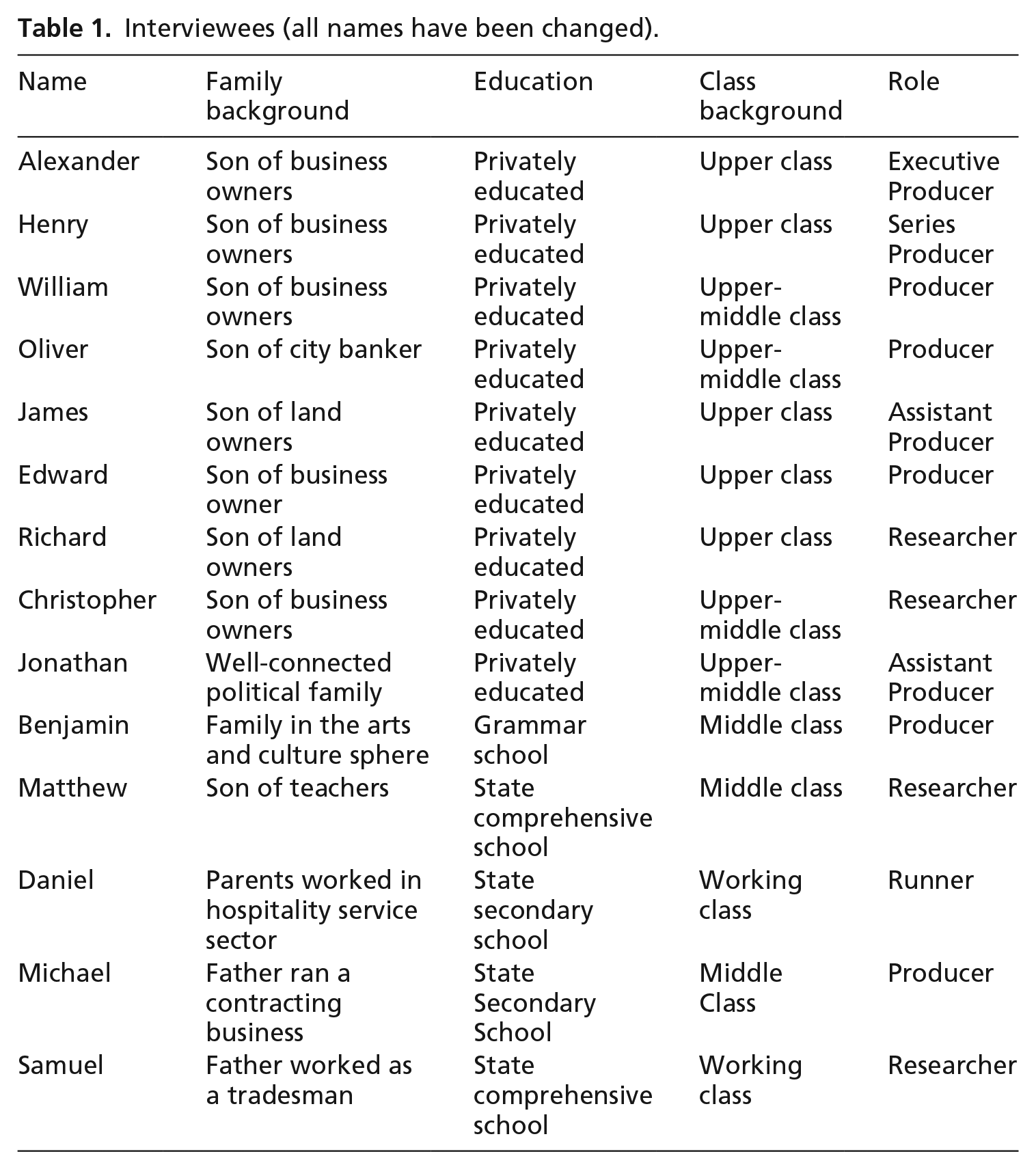
This research project employed a methodology centred on conducting and analysing qualitative interviews with 14 research participants to discuss their attitudes and experiences of the EDI agenda in the screen industries of United Kingdom (see Table 1). All interviews were carried out between 2022 and 2023. The interviewees were found through a mixture of personal contacts and snowballing, which is noted to be a purposive method when samples with the desired characteristics are not easily available (Naderifar et al., 2017). Importantly, most of the interviewees are either highly or relatively socially privileged: they are all white, male, heterosexual, able, neurotypical and largely come from middle to upper class backgrounds, although two came from working-class backgrounds (determined by their family background). Most of them (10) were born in the South of England or London, and they all work predominantly within the United Kingdom’s acknowledged creative centre – London. The interviews were specifically chosen in order to investigate attitudes towards EDI from those within relatively privileged positions in the industry.
Interviewees (all names have been changed).
As the research was focused on white male privilege, the sample is reflective of the desire to explore that terrain, empirically, through qualitative interviews. London remains the dominant centre for independent television production in the United Kingdom, although there is certainly increasing regionalisation (McElroy and Noonan, 2019; Spicer, 2019). The location of the interviews reflects that – in television production powerful cliques of production remain located within London, while there are genre specific hotspots elsewhere in the United Kingdom, such as Bristol, Cardiff and Manchester. However, London remains the centre for media production in terms of where much of the networking takes place, where careers are formed and where key media organisations retain powerful centres and industry players (Lee et al., 2014). In this sense, while the push towards regionalisation of television production is certainly a pull factor away from the capital, at a reputational level many of the interviewees shared a wider industry belief that London – despite its very high cost of living and rampant inequalities – was still the place to be to forge a fast track career, especially in the independent sector.
The interviewees discussed their beliefs and attitudes towards EDI, generally, and specifically within the screen industries. All interviewees were given anonymity, which is standard methodological practice within qualitative research, and particularly important in this instance so that they felt able to be open and frank about their positions, experiences and thoughts about the industry, given the controversial nature of the topic. My own positionality was important in this research – as someone with prior experience of working in the industry, and with extensive contacts into these (often closed) echelons of production, the participants felt relaxed and trusting to discuss sensitive topics – and crucially to share controversial views.
Thematic content analysis was employed to identify recurring themes, topics and arguments within the collected data. This method facilitated the discernment of prevailing narratives and ideas regarding EDI issues, as well as the articulations of positions by both proponents and opponents of EDI initiatives. Throughout the research, ethical considerations were rigorously adhered to, with a focus on responsible and respectful use of the data.
Unmasking privilege and discrimination within the screen industries
The interviews uncovered a wide range of revealing attitudes towards EDI. There were divergences in attitudes towards related concepts such as meritocracy, race, gender, class and disability. However, there were clear and strong commonalities within the sample around key topics including: (1) resistance to EDI discourses and values; (2) justificatory positions towards reactionary attitudes; (3) a relationship between place and privilege; (4) diversity fatigue; and (5) gendered, racialised and classed discriminatory attitudes, often justified through the lens of meritocracy (Littler, 2017).
Resistance to EDI and the meritocratic myth
As a starting point, the interviews explored their inherent positions towards EDI initiatives and policies within the television industry. While there were some contradictory positions displayed, the over-arching theme of the majority of the respondents was one of scepticism, frustration and antipathy. Meritocratic ideas around ‘talent’ and ‘hard work’ underlay much of this discourse. This was espoused both by Alexander (from an upper class background) and Samuel who hails from a working class background:
I believe in talent and you know . . . graft. This whole diversity thing feels like we’re sacrificing quality for the sake of ticking boxes. I’ve earned my place, and so should everyone else. (Alexander) I appreciate the need for change, but it [diversity] shouldn’t mean side-lining those who have worked hard. I mean, I think we need a fair playing field without discriminating against anyone, regardless of their background. (Samuel)
‘Talent’ was elevated as a key justificatory marker, as a justification for an ideological position that can be set in opposition to diversity discourse:
Alright, look, I’m all for everyone getting a fair go, but you know, come on. You can’t just ignore the fact that some people are just more talented than others. It’s getting a bit ridiculous, really – the industry’s more fussed about how things look than people’s actual skills. (Henry) I don’t know . . . to me it’s about whether you can do the job, how creative you are, how hard-working you are, yeah? I’m fed up with hearing about these diversity quotas. We should be hiring the best people for the job, you know, regardless of their skin colour, whatever. Just ’cos you can tick a box doesn’t mean you can make great telly. (Richard) I come from an artistic family background . . . I appreciate creativity. However, EDI, whatever you want to call it, it seems a bit obsessive to me . . . We ought to be putting our energy into what we’re producing, not constantly checking boxes to see if someone meets I don’t know some kind of criteria. (Benjamin)
One interviewee expressed the notion that EDI was a fashionable trend that should be rejected – a ‘common sense’ positioning, generating a normative position, where skills are positioned against a supposed overblown EDI agenda. In this sense, ‘diversity’ is supported superficially, but also undermined within the same sentence:
I’m all for diversity, yeah, ’course I am. But, I don’t know, I mean it seems to me it’s more of a trend than anything else at the moment. I want to be recognised for my skills, because I helped make a brilliant documentary, a great drama, whatever . . . it all feels to me like it’s about political correctness, that’s what I see a lot of. (Christopher)
The ways in which the values of meritocracy work against some of the more socially challenging aspects of EDI is interesting to note – EDI is both seen as something ‘tokenistic’ by these interviewees and also as something to be in opposition to. Concepts of the neoliberal self function against ‘diversity’ quotas – reminding us how untenable it is to combine a linkage between equality and diversity within a framework of neoliberal ‘choice’ and market rationalism (Archer, 2007). Meritocracy acts as a justification for some of the very worst behaviours, in the same way that common-sense evocations of workplace pressures (schedules, long hours, mental and physical exhaustion) and ‘putting in the work’ are used to justify the maintenance of a privileged, able-bodied status quo. This quote reflects that, and this justificatory discourse is evident across a number of the interviews further below in the article:
I lost out on a job a while ago to someone less qualified because they needed to ‘balance’ the team. I mean, you know, of course I’m in favour of fairness, but then again it’s not fair to us who’ve put in the work . . . who’ve earned their place. (Matthew)
Experiences of EDI policies and discourses on their working lives
The research interviews also explored specific experiences that they perceived that they have had with EDI agendas and policies in their workplace and industry. This covered instances of ‘diversity seminars’ that some of them had experienced in their workplaces, diversity ‘quotas’ (both on-screen and off-screen) as well as experiences of individuals coming in to work in the industry from ‘diverse’ backgrounds, which some of them perceived in a negative manner.
For example, Alexander expressed the idea of a prevailing diversity discourse as ‘bullshit’:
So . . . like last month, they pulled in this consultant to preach to us all about diversity. The guy had absolutely no clue about the industry. It’s like, we’re here busting our guts on projects – you know what TV’s like – and they bring in someone to lecture us on diversity and inclusion? It’s such bullshit.
Similarly, William described a diversity meeting, which he felt forced to attend, with unfair advantage being given to someone from a diverse background:
I had a meeting where they were pushing all this diversity stuff. Fine, yeah, whatever. But then I hear they’re fast-tracking someone in the company just because they fit a certain profile. How’s that fair to the rest of us who’ve put in the grind?
Note again the use of the discourse of hard work, ‘the grind’, to justify an anti-diversity agenda.
The term ‘woke’ has become widely disseminated and mobilised across alt.right and mainstream media platforms (Rhodes, 2021) and it was instructive to see that this term – which originated in the United States – had made its way into the discourse within the British media production space:
I had a proposal rejected because it didn’t have enough ‘woke’ elements. I mean, seriously? Shouldn’t we be judged on our ideas, not whether we’re fitting some political agenda? It’s a total joke. (James)
As Davies and MacRae (2023) argue, the term ‘woke’ is closely linked to right-wing racist attitudes, intensified by social media. Here we see how particular terms can circulate from within the spheres of media and politics, and become a ‘common-sense’ ideology for some social actors (Gramsci, 1971).
A deep anger can also be seen to fuel some of the interviewees’ statements, emanating from a sense that they feel they are being ‘forced’ to adhere to an EDI agenda that they have little choice about, or agency over. For example, Oliver indicates a culture of expected performativity around diversity within his company, which had alienated him:
So like yeah, I mean, I got called out in a meeting for not being positive enough about diversity, that kind of thing. I’m just trying to make good TV, not be a bloody activist . . . . it’s like they expect us to drop everything and start preaching.
Richard also expressed a feeling that EDI values and practices were somehow damaging the creative production process, and the practicalities (‘real work’) of filming:
Our project got delayed because we needed more ‘diverse’ voices. So, yeah, like I get it, I get that it matters, but surely not at the expense of deadlines . . . in my mind it’s virtue signalling yeah, and it’s is getting in the way of real work.
Experiences of hiring practices in favour of diverse candidates also emerged as a topic fuelling their anger and frustration, as this quote illustrates:
Right, so recently I applied for a promotion, and they sort of said they’re prioritising ‘underrepresented’ voices . . . . it’s like they’re telling me I can’t move up just because I don’t fit some sort of checklist, I’m a white man forget it. It’s ridiculous. (Samuel)
Understanding ‘white privilege’ and meritocracy in the screen industries
Underpinning the research findings is a strong sense of ‘white male privilege’ (McIntosh, 2001), which I wanted to explore through the interviews. This was not a term that was used directly in the interviewing, of course (ait would have been alienating), but something that was approached by digging deeper into their positions around meritocracy, value and reward, and exploring the connection between meritocratic beliefs and this mode of privilege. As outlined above, meritocratic principles were dominant for all the interviewees, as this quote from Alexander shows:
I’ve come from a family that worked really fucking hard for success you know, we believe in hard work. Now they want us to attend diversity training courses, learn about unconscious bias, blah blah blah, you know? [sighs] I’d rather be out there working, making good programmes, doing the work that, well, that sort of got me here in the first place.
This was particularly heightened when they were probed about EDI training programmes or seminars that they had attended:
I come from a working-class background. I know the value of getting stuck in. Working the hours. Putting in the . . . I don’t know . . . the time to get good. Now it’s all about these quotas right, I think it’s really making people feel angry. I’ve not had it easy, but who’s talking about class – that sort of thing–about coming from outside of London or the South-East? It’s hard, really hard sometimes, but I’d rather get over things because I’m good, because I work and put in the hours – because I’m better than everyone else. . . not because someone thinks someone like me is needed to tick a box. (Samuel) I’ve always believed in diversity, and it’s good to have people with different ideas on a team, from different places, but I really think it should happen naturally. Now they’re pushing all these training schemes, all this sort of stuff. In my view, and I probably shouldn’t say this, but I think we should be hiring people who bring something unique to the table, not because they attended a seminar. (Christopher)
Again, we can see the way in which hard work, ‘getting stuck in . . . working the hours’, enabled a discursive normalisation of perpetuating inequality.
Quotas, therefore, were unsurprisingly seen as problematic by some of the interviewees, despite the important work that they do in tackling inequalities:
I think we should really earn our stripes based on hard work, on ability, you know? And, um, I’m not sure if this [EDI] is the answer. I’d rather, like, see real schemes in the industry that promote fairness without, you know, compromising the value of hard work and skill, I guess, you know what I mean? (Matthew)
When challenged about their views as white, male and relatively privileged members of a production sector, it was instructive to see the responses. Some were highly indignant about this, and it seemed they felt a sense of being victimised for their social and racial privileged position:
Privileged? Give me a break? I’ve, like, really busted a gut for what I’ve got. Don’t make it sound like I haven’t earned it . . . . Um, I won’t be made out to be the bad guy just because of where I come from, I’m so sick of it. It’s like you have to be ashamed about who you are these days. (Alexander) What? For god’s sake, that’s just such a convenient way to put us on the spot. I’ve worked hard, and now I’m supposed to feel guilty? It’s absurd. I won’t go around saying sorry, like feeling bad for any success I’ve had. (Edward)
However, others did take on board wider concerns about privilege, access and exclusion from the industry’s inner circles and agreed that something needed to change:
Look, I see what you mean, yeah like of course some of us . . . we’ve had our advantages, and the industry’s been a bit posh, maybe too white yeah. I’m not blind to that. But is it my fault that’s the case? Why should I suffer? I think it’s more complicated that just blaming ‘whiteness’ or whatever. (Henry)
So, on the one hand raising the concept of ‘whiteness’ was difficult for them to deal with, as it was something that they had come to associate as an inherent ‘problem’ in the industry. This led to feelings of internalised anger, even shame, at being seen as the problem.
To me, talking about ‘whiteness’ or whatever, it feels like an attack. It’s not something I can control. I’ve had opportunities, yeah, but I can’t see what I can do about all the you know the unfairness we’re talking about. (William)
On the other hand, there were statements very antipathetic to any sense that this privilege should be a problem or that it even existed:
I’ve faced challenges, just like anyone else. But are you saying that I should feel guilty about where I come from, about my background? The industry needs to change for sure, I agree with that, but making me the scapegoat won’t fix anything. (Oliver)
Gender attitudes
The research also revealed some mixed attitudes towards gender equality, especially in relation to the idea that women might somehow be getting ‘preferential treatment’ or ‘positive discrimination’ as a result of their sex. As with other areas of this research, some attitudes around this were hostile, some more ambivalent, while some respondents were in favour of greater gender equality. Alexander, for example, was fairly ambivalent on this issue, prepared to take on board some of the concerns:
So yeah, I mean of course women should get the chances just like guys do. I’m not some kind of dinosaur for god’s sake. But to me it’s not just about being a man . . . this idea of fairness should be for everyone, not just one group. (Alexander)
Henry and Oliver, however, were much more supportive of gender equality:
The industry’s been a bit of an old boys’ club, and that’s not good is it? Like of course, I want those barriers to be broken down. (Henry)
Similarly, Oliver agreed the industry ‘should be more open’. But other respondents were more resistant to change, expressing scepticism and defensiveness around a ‘tick box’ culture:
I’ve worked hard for what I have, do you know what I mean? It’s not easy getting on in television, this industry is tough. But you know, I go back to what I said before – I really believe that we should focus on talent, not just ticking boxes, race, gender whatever. And I also think that the best people do make I, they do get through – I’ve seen it myself. (William) I’m wary of quotas. It’s not about being against gender equality; it’s about doing it right. The focus should be on skills, passion, on ability, yeah . . . not just meeting some sort of checklist. (James)
Just because I’m a white man doesn’t mean I’ve had it easy . . . . I’m so sick of it. (Edward)
Future of the industry
Looking to the future, it was interesting to note that despite the resistance to, and anger at, diversity policies and initiatives within the television industry from some respondents, there was a strong sense of inevitability of change, and even for some the need for change. James talked about ‘forced diversity’, suggesting a deep resistance at EDI:
Yeah, you know, change is inevitable, but I’m kind of wary about this whole forced diversity kind of thing, you know?
Samuel positioned his wariness and resistance to EDI in relation to global competitiveness, connecting the EDI agenda in his mind to a decline in quality:
I think the future’s really bloody uncertain . . . I don’t know. I mean, are we still going to have that cutting edge, it’s made this industry so great, globally, do you know what I mean?
Again, this idea of the industry being at a turning point was very instructive, setting the need for change against a discourse that was perceived by some participants as being tokenistic and performative:
I mean the industry is at a crossroads for sure, I think. Some kind of change, yes it’s needed, sure, but I reckon we’ve got to be careful it doesn’t become all about virtue signalling. It should be more genuine, more real. (Edward)
Conclusion: understanding the backlash and looking forward
The research reveals a disturbing disjuncture between the official values of EDI in the British television industry, and the attitudes of pockets of disaffected and/or privileged actors within it. It reveals an antipathy to diversity talk, policy and practices within a particular privileged milieu of British television production. The article builds on theoretical work on the impact of meritocracy as a key ideology in neoliberal culture (Littler, 2017), revealing how in this context notions of ‘hard work’, ‘grind’ and ‘working the hours’ are used as individualised narratives to justify reactionary, racist and sexist attitudes. That this takes place in the United Kingdom within a wider context of divisive ‘culture wars’ between different groups is an important factor – culture battles that are fuelled and intensified by a right-wing reactionary press and an increasingly polarised digital public sphere (Fuchs, 2018; Krzyżanowski, 2020). Exploring these connections in relation to culture work would require further research, but certainly this research indicates how public discourses of meritocracy shape private, internalised logics within a production culture.
Taken as a whole, there is obviously much to be concerned about in this research. There is a certain amount of optimism and important lessons to be learned for those on the side of progressive change in society and in the media industries, in terms of how ‘diversity’ might be meaningfully and structurally embedded moving forward, in a way that takes on board the powerful criticisms of EDI logics from scholars such as Saha (2018) and Nwonka and Malik (2018) among others. On the one hand, the research highlights some of the fundamental problems with ‘diversity’ talk, not only does it not trouble the status quo radically at a structural level in the industry, but it also can be seen to fuel reactionary positions, or subaltern politics, within pockets of the industry. Privileged actors can quite easily maintain their position and status, while giving lip service to it, or while working in an environment where it is a highly visible discourse. The research suggests that EDI therefore cannot be ignored, but it can be mocked, dismissed or side-lined. The intense and historic focus on individuals, ‘creativity’, quotas and ‘talent’ in the industry serve to undermine the diversity drive, as the focus on individualistic and meritocratic measures of success actually ideologically undermine the need for structural systemic reform. This echoes other research on problematic conditions in the television industry such as bullying (Van Raalte et al., 2023), exploitation (Lee, 2018), ableism (Randle and Hardy, 2017) and gender discrimination (Percival, 2019), which shows how entrenched certain toxic attitudes and practices are in the sector. It also stands alongside recent research on entry-level training programmes, which show how EDI agendas in the industry are often performative and somewhat tokenistic, rather than offering deep means for accommodating difference (Lee et al., 2024).
On the other hand, the underlying sense that change is perhaps inevitable among the interview cohort is to some extent a positive finding, and one that can play into meaningful structural diversity drives in the industry. This finding needs treating with great caution; however, it is clear that this ‘inevitability’ of change is both resisted, and also highly precarious. Diversity as framed by EDI does not fundamentally challenge the political economy and working practices of media organisations, echoing Gray’s (2021 [2016]) research on the ineffectiveness of mainstream uses of ‘diversity’ in media industries practice and research, noting diversity’s ‘precarity’. Furthermore, as Archer (2007) notes, a neoliberal, largely economic understanding of ‘diversity’ can also operate as a moral discourse that silences other competing and critical accounts of participation that are rooted in politics of race, class, gender and disability. Therefore, it is perhaps unsurprising that a culture of racism, sexism, ableism and other forms of discrimination discovered in this research can exist quite happily within a culture of ‘diversity’ as framed within contemporary policy discourse and organisational language.
White male privilege is difficult for individuals to see, but the recognition that some participants had when pushed on this matter (and on specific inequalities in the industry) is important. When pushed on specific aspects of discrimination in the industry such as gender, the respondents were generally far more thoughtful and open to change. More work can be done in this area, to understand social actors with reactionary beliefs, and to work with them in dialogue for greater positive change. This connects to the heart of many pressing issues in contemporary society where there is a need to find connections between the politics of recognition and the politics of redistribution that Nancy Fraser (2020) has outlined. In addition, this raises the question: how can we generate systemic, radical and sustained change while acknowledging and working through the identity politics at the heart of much EDI work and resistance to it? The research highlights the importance of understanding groups we disagree with, or with views that we find offensive. How else can we generate meaningful change without listening to individuals and gaining insight into positions that we do not agree with?
Footnotes
Declaration of conflicting interests
The author(s) declared no potential conflicts of interest with respect to the research, authorship, and/or publication of this article.
Funding
The author(s) received no financial support for the research, authorship, and/or publication of this article.

Data availability statement
Data sharing not applicable to this article as no datasets were generated or analysed during this study.