




Abstract
Research is key to supporting diversity and inclusion practices in media and creative industries because it articulates the structural and cultural barriers to participation by workers with a broad range of underrepresented social identities. However, currently there is a lack of research that problematises how change happens with regard to equality, diversity and inclusion in creative industries. Very little research looks beyond specific initiatives, particular employers or individual organisations to explore how change is adopted more broadly within the sector. This article seeks to address that gap by applying a number of literatures on policy and organisational or cultural change to generate a schema that allows the complexity of change to be understood through a unified model of a policy regime. This article adopts a qualitative case study methodology to examine equality, diversity and inclusion regime change in the film and television industries in Ireland from 2015 to 2021. Key findings map how policy goal changes, paradigm shifts in thinking on equality, organisational coalitions and a change in power arrangements all combined resulting in significant change in the gender and equality regime in Irish film and television work. This framework is valuable because it provokes questions about how equality, diversity and inclusion initiatives can be more effective, how various cases of change compare with each other and how some efforts at change ultimately fail.
Introduction
Until 2015, the Irish film and television sectors were largely disengaged on questions of gender equality, diversity and inclusion (EDI) in the workforce. This changed radically over a subsequent 5-year period, which saw the introduction of numerous initiatives concerned with equality and inclusion, resulting in sectoral changes by 2021. Those changes preceded but also resonated with international movements towards addressing gender inequality and sexual harassment in film and television work, such as the Weinstein case in 2017 and the #MeToo campaign. Efforts to diversify the media workforce in Ireland were mirrored elsewhere over a similar timeframe, in Scotland (Berridge, 2020), in the United Kingdom (Newsinger and Eikhof, 2020; Nwonka, 2015) and in the United States (Duffy, 2017; Warner, 2016). However, research on the Creative Industries (CI) workforce during that period of change mainly offers accounts of the structural and cultural barriers to diversity and inclusion, or examines exclusion on the grounds of different aspects of workers’ identities, or explores how individual initiatives in recruitment, or leadership, or training can make a contribution to change. All of that research makes a vital contribution to understanding and addressing aspects of inequality in CI. Some of that research outlines what works most effectively to generate positive EDI outcomes at an organisational level.
However, research has yet to offer any socio-cultural conceptualisation of how change happens in the cultural industries sector. There is little analysis currently of how CI made a shift through activism, ideas and organisational change, from exclusivity towards greater inclusivity. This is not to say that the problem of inequality and homogeneity in the CI is solved. Ongoing research constantly points to the contrary. However, there are cases of positive change and movements towards inclusion, but very little analysis has sought to understand how change happens in those cases. It is to that gap in knowledge that this article is addressed. It seeks to examine how in the case of the Irish film and television industries there was a definite move towards problematizing and seeking to address inequality in the sector, with some success. The article uses a social policy framework of policy regime change (Wilson, 2000) to map how that change came about, and makes a case for the importance of conceptualising the socialisation of tools and measures for change in the CI.
Understanding how EDI change happens in CI is important because it allows analysts to better conceptualise the scale and nature of the challenges facing EDI activists at the sectoral level. A sectoral-level departure point prompts researchers and analysts to adopt an overarching perspective on how EDI change might progress or be derailed within a sector, rather than within an individual company or organisation. This analysis argues that improving EDI requires multiple engagements at various levels throughout the industry, multiple strategies to shift perspectives on the challenges, and multiple policy initiatives to constantly reinforce action for change. This analysis deflects attention away from singular interventions, such as policy statements, standard creation, leadership actions, training initiatives, sponsorships or mentorships and recruitment as the solution to the EDI challenge. Instead, the article notes that change comes about when these multiple interventions are combined to create a social regime of people and organisations collectively focused on change.
Literature review
Typically, research on EDI in the CI has either documented the ongoing inequalities in the workforce (Banks and Hesmondhalgh, 2009; Oakley, 2013; Wing-Fai et al., 2015 Banks, 2017) or focused on various identity-dimensions of the experience of inequality (Brook et al., 2016; Cobb and Wreyford, 2021; Dent, 2019; Raising Films, 2017; O’ Brien & Kerrigan, 2020; Nwonka and Malik, 2018; Randle and Hardy, 2017; Wilkes et al., 2020). Research has looked at specific interventions needed for recruitment, (Wreyford, 2015) leadership (Steiner, 2015) training (Cobb, 2020) or employment progression (Brook et al., 2016), or it has proposed ways in which diversity can be improved at a more macro level (Henry and Ryder, 2021; Wreyford et al., 2021). However, research on EDI in the CIs rarely conceptualises or theorises how change actually happens at a sectoral level to improve diversity among media workers.
Studies describe approaches that are effective but generally do not describe how they were operationalised. The socialisation of change goes largely unarticulated. For example, Dixon-Fyle et al. (2020) note that the business case for diversity remains strong and describes data and approaches that contribute to financial performance, but the study does not explain how approaches are designed or implemented. Stephens et al. (2020) offer a multi-level model for reducing bias, but the study does not look at outcomes or change beyond addressing change in bias. Similarly, Smith and Turner (2015) examine EDI change at work and describe it as an outcome of generational changes of perspective, but do not examine what causes that change in perspective. Kalev et al. (2006) note that the best hope for remedying inequalities lies in practices that assign organisational responsibility for change, but they only examine change undertaken by employers generally rather than examining change within a sector. The study does not examine change beyond the boundaries of a particular organisation’s initiatives. Priest et al. (2015) more usefully summarise, in the context of health workers, evidence which shows that success in promoting diversity depends on leadership, multiple strategies at various levels and mandated targets and actions. Similarly, Dobbin and Kalev (2016) address useful tools for ‘getting managers on board’ and note that engagement, contact and social accountability are valuable ways of improving diversity. The ‘Creative Majority’ report outlines very valuable, coherent and effective guiding principles for improving diversity and inclusion, those being ‘ambition, allyship, accessibility, adaptability and accountability’ (Wreyford et al., 2021). But none of these studies map how factors that contribute towards change come to be adopted, or not, by social actors across a sector to bring about broad and lasting change. While a number of factors that contribute to change are discussed in the literature, to date less attention has been paid to date to how such factors interact together, or become socialised by workers in a sector to promote change. Many studies outline effective principles or tools for progress but few describe how the tools can be operationalised or socialised to generate change.
There is currently a lack of theorisation of processes of change within the literature on CI that problematises how change happens beyond specific initiatives, particular employers or individual organisations, and maps how change is adopted or happens within a sector. Research has not fully tracked whether or how EDI campaigns start, how they can begin to generate change, how they support progress towards greater equality or how campaigns can ultimately be derailed in their attempts to create a more inclusive industry. While some studies explain the failure of specific policy initiatives or instruments, and other studies track data that indicate improvements or deteriorations, there is a dearth of studies that problematise the process of change itself to explore what works best and how it works. Relatively little is known about the bigger-picture question of how change happens at a sectoral level with regard to EDI campaigns in CI. This article aims to begin to explore that gap by using theorisations of change from the policy analysis field, which can aid better understanding of how change occurs within the creative sector. This conceptualisation is applied to a small scale case study of change in the Irish film and television sector from 2015 to 2021. Changes occurred across policy outputs, through the formation of new organisations and through changes to the culture and values of the sector. To begin to conceptualise how change happened across these combined dimensions, a number of literatures on policy and organisational or cultural change are useful for generating a schema that allows the complexity of change to be understood through a unified model.
EDI change as regime change
Policy analysts have in recent years departed from heavily schematic analyses of policy ‘structure’ in order to explore the more ‘complex, diffuse and non-rational nature of the policy process’ (Pforr, 2005: 334). However, few current models go beyond examining how policy is made to focus adequately on how policy is implemented or ‘how exactly the political system transfers inputs into outputs’ (Pforr, 2005: 338). To move beyond that limitation and to better conceptualise how change happened to diversify film and television work, this analysis does not treat change within the film and television sectors as resulting only from the creation of policy statements. Instead, it looks in addition at the organisational coalition that came together to lobby for change, but which also crucially changed attitudes towards gender, diversity and inclusion in creative work. One theoretical framing of how policy and change occur is offered in Wilson’s (2000) analysis of policy regimes. Wilson’s model brings together four dimensions: power arrangements, policy paradigms, organisations and policy goals, which together offer a way of understanding change.
The first dimension, power arrangements, describes ‘the presence of one or more powerful interest groups supporting the policy regime’ which occur in many different patterns (Wilson, 2000: 257). For instance, power arrangements may include single interest groups, such as Women in Film and Television Ireland, professional groups or associations such as the Writers and Directors Guilds, or competing coalitions, but may also involve the state acting as either power broker or major actor, such as the Broadcasting Authority of Ireland (BAI) 1 or the film board, Screen Ireland 2 (Wilson, 2000: 257). The second dimension of policy regimes is the policy paradigm, which is the ideology or set of assumptions that shapes the way that problems are perceived or defined, the types of solutions offered and the kinds of policy proposed. The third dimension in Wilson’s schema is the organisation surrounding policy, as it exists within government, within policymaking arrangements and within the implementation structure (Wilson, 2000: 258). The final dimension of policy regimes for Wilson (2000) is policy itself, which embodies statements on the goals of the policy regime and which entails the ‘rules and routines of the implementing agency’ (p. 258).
Wilson notes that each dimension of a regime contributes to its stability over time. Power arrangements tend towards stability, a tendency that ‘comes from a form of incremental policy making that emphasises bargaining and compromise . . .’ (Wilson, 2000: 259). Similarly, organisations incorporate rules, regulations and routines for the implementation of policy and organisational culture operates to maintain stability (Wilson, 2000: 259). Policy paradigm also plays a role in producing long-term stability, by structuring ‘perception in ways that obstruct the emergence of alternative policy definitions and solutions’. Thus, existing arrangements are constantly legitimised as alternatives are presented as ‘irrational or impossible’ (Wilson, 2000: 259). However, the policy regime model may also offer the basis for generating a new explanatory framework to account for the key changes that occur between one policy regime and another. Wilson argues that change comes about when stressors or enablers enhance the possibility of change by stimulating paradigm shifts. In turn paradigm shifts only occur when ‘events or situations arise that are inconsistent with the dominant policy paradigm’ leading to the discrediting of that paradigm and the introduction of an alternative (Wilson, 2000: 263). Stressors or trigger events and paradigm shifts often interact to produce a legitimacy crisis which occurs ‘when people lose confidence in the old regime and when political leaders committed to policy change exploit stressors’ (Wilson, 2000: 264). As a result, power shifts occur when oppositional groups gain in leadership skills, knowledge and organisational resources resulting in a reorganisation of the policy implementation structure (Wilson, 2000: 264). For Wilson, policy regime change occurs when an old policy regime disintegrates through changes in the policy paradigm, alterations in patterns of power and shifts in organisational arrangements and a new regime emerges with new patterns of power, new organisational arrangements and a new policy paradigm. This is a useful way of examining regime change in the Irish CI because it accounts for the various factors and forces that were needed for change to be initiated in 2015. This article will examine how one regime, characterised by inequality and gender ‘neutrality’ in the sector, came under stress quite suddenly in 2015 and how the subsequent changes can be conceptualised as a regime change, that led to a new, more diversity-oriented model of inclusion in the Irish film and television workforce. The analysis of the stressor that initiated change and its impact on the four dimensions of the Irish work regime are examined in detail below, but first the article offers an account of the methodology of the study.
Methodology
A qualitative case study approach was adopted where the film and television industries were treated as a case of regime change. Various sources of data were included in the study. All policy documents issued by any individuals or organisations in the sector from 2015 to 2021 were examined. Interviews were conducted with key players across broadcasters, independent production companies, professional organisations as well as with individual activists between 2017 and 2018. Some of the main organisations referred to in this analysis below include Women in Film and Television Ireland, which is the Irish branch of the international organisation Women in Film and Television, a voluntary foundation promoting representation of women on screen and behind the camera; the Writers and Directors Guilds are the representative bodies for screen writers and directors, respectively; the Broadcasting Authority of Ireland (BAI) is the regulator of broadcasting in Ireland; TG4 is the Irish language public service broadcaster; Radio Telifís Éireann (RTÉ) is the Irish public service broadcaster, VMTV is the only commercial Irish broadcaster; Screen Producers Ireland is the representative organisation for independent production companies and Screen Ireland is the national development agency for the Irish film, television and animation industry.
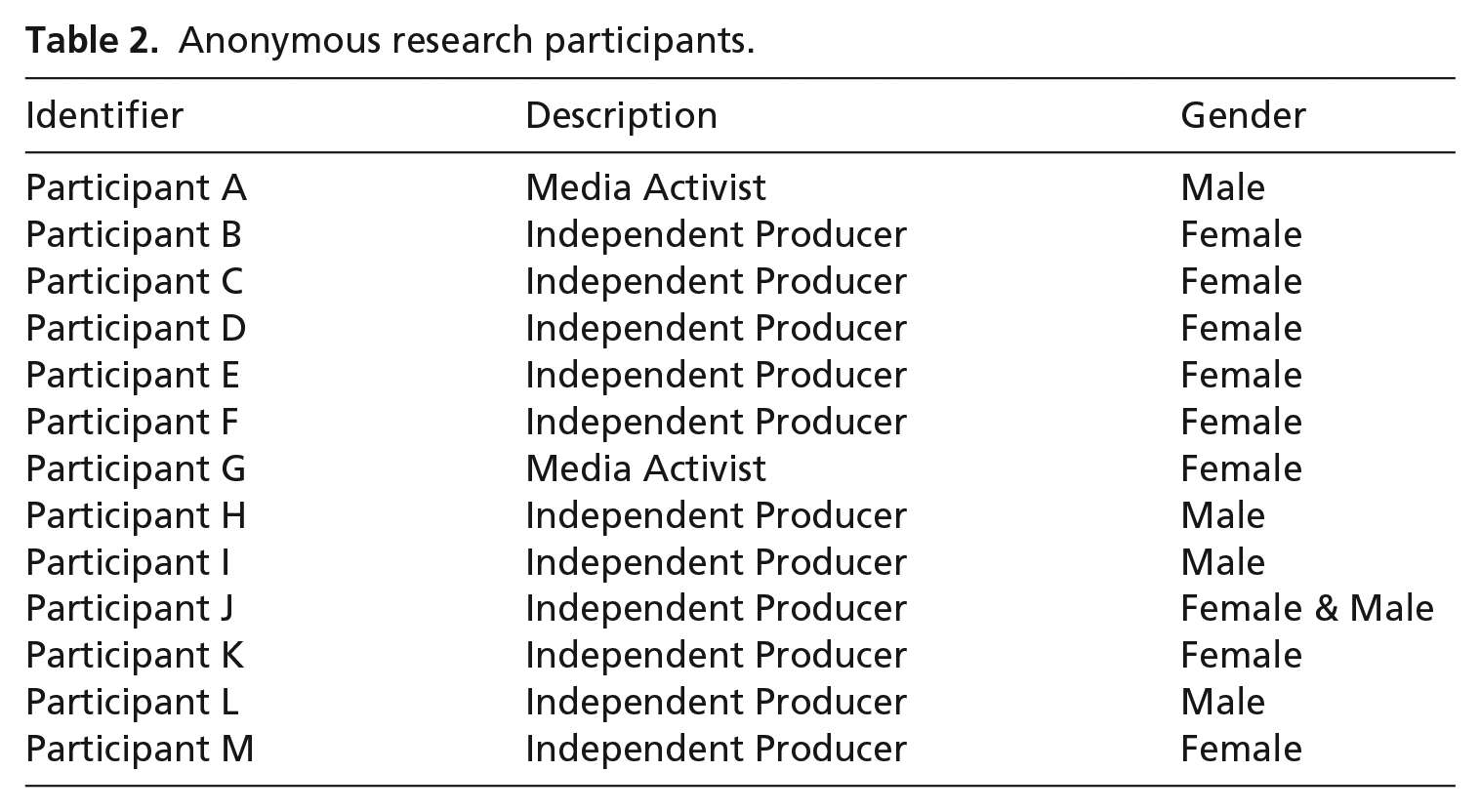
Interviewees were asked about their position on equality diversity and inclusion pre-2015, and post Waking The Feminists. They were asked to document key moments and interventions that led to change. Further interviews were undertaken as part of a research project for the BAI (Kerrigan, Liddy & O’ Brien, 2021) to audit attitudes and approaches to equality and diversity in 2020–2021. Data were gathered through semi-structured, in-depth interviews done by the authors as described in Tables 1 and 2.
Named research participants.
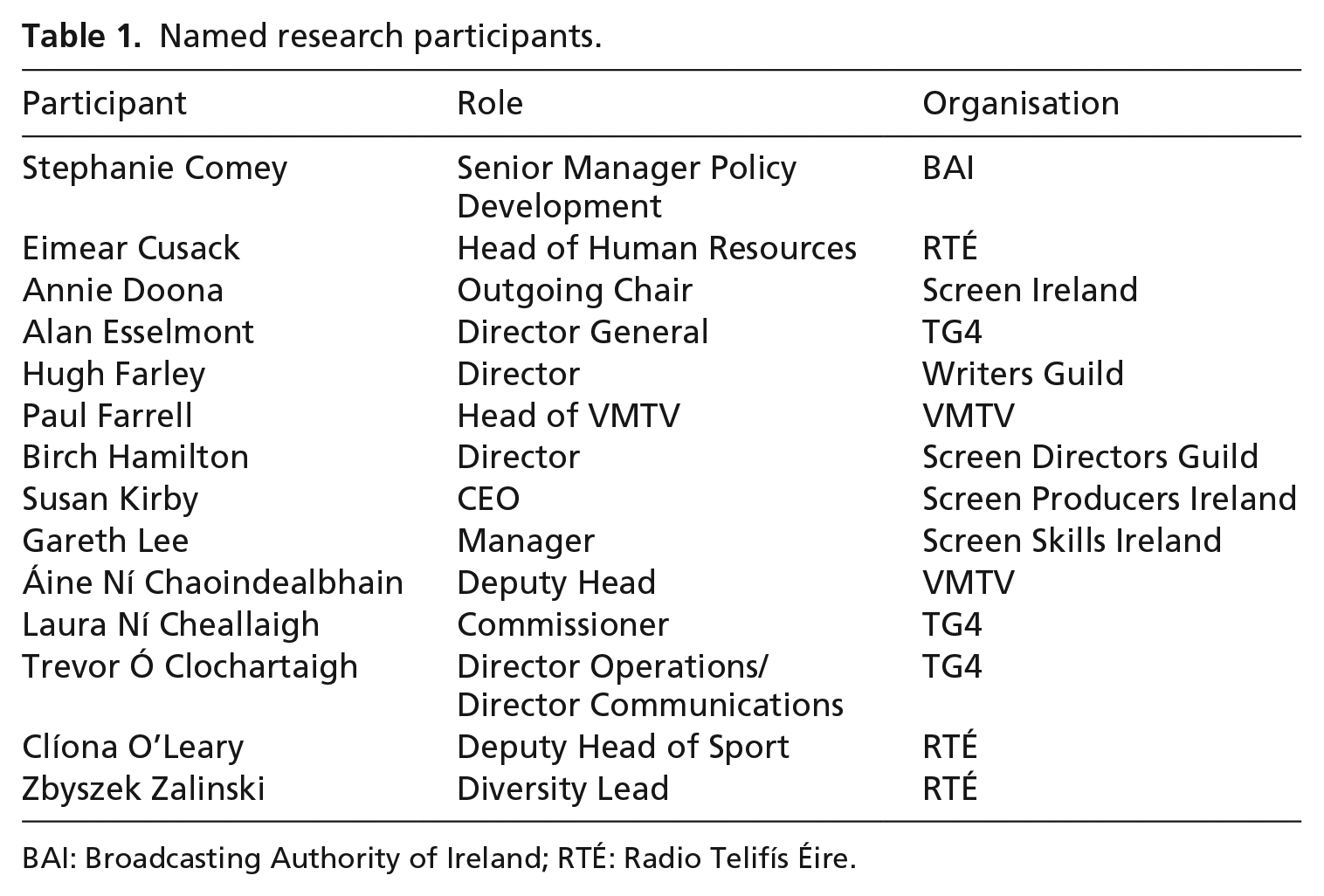
BAI: Broadcasting Authority of Ireland; RTÉ: Radio Telifís Éire.
Anonymous research participants.
Open-ended questions addressed topics such as attitudes to equality, development of policy, engagement of organisations and leadership on change in the sector. All interviews were recorded and transcribed. The data were coded with categories derived from the literature and codes were analysed to generate themes and findings. The data on all contributions towards EDI changes in the Irish film and television production sector from 2015 to 2021 were analysed in light of Wilson’s framework on policy regime change. The analysis tracked whether or how EDI campaigns started, how they began to propose change, how they developed supportive constituencies that worked together to progress greater equality in the sector. The research suffers the usual limitations of small scale qualitative studies, and findings cannot necessarily be extrapolated beyond the boundaries of the case examined. The Irish case study of change is a small-scale example of the application of EDI in a limited sector of the CI, but nonetheless the case study offers key insights into how a stressor initiated change in a regime and led to some transformation towards greater diversity and inclusion in film and television production over a relatively short space of time.
Findings
The stressor
Irish screen production for much of the 2000s and early 2010s noted a demonstrable lack of engagement on issues pertaining to gender equality, and to diversity and inclusion more broadly. Liddy’s 2016 study of the Irish Film Board (IFB, 2016) noted that no data on the allocation of funding to women, or data on female-authored work were gathered at that time. The film board struggled to explain the omission of women writers and directors from their funding allocations, but nonetheless claimed that the organisation was ‘gender neutral’ and open to all comers (Liddy, 2016:912). Up until 2016, the film board, and the television regulator the BAI, had not gathered any data pertaining to the gender, sexuality, disability, race, ethnic or class identities of their funding recipients, despite the fact that the funding awarded was public money. This status quo came under sudden and close public scrutiny however, late in 2015, when the Irish State planned cultural events for 2016 to celebrate a centenary of national Independence. The National Theatre of Ireland, the Abbey, as part of its contribution, proposed a slate of 10 plays titled ‘Waking the Nation’, only one of which was written by a woman.
This sparked a response on social media coining the #WakingTheFeminists, which in turn led to a public meeting in November 2015 at the Abbey. More than 30 women creatives documented both their work and their simultaneous exclusion from the cultural sector. This meeting and the subsequent formation of a grassroots campaign entitled Waking The Feminists constituted a major stressor on the masculinist dimensions of the CI regime in Ireland at that time. This stress was felt directly in the film and television sectors. In a letter to The Irish Times Liddy (2015) connected the failures of the theatre to similar failures in the film industry. Just as had been the case with the theatre sector, Ireland’s leading film organisations responded publicly to the challenge of gender discrimination. The film board, which only a year previously had claimed to be gender ‘neutral’, issued a statement that recognised ‘and accepts that major under representation of women exists in Irish film . . . (and that) the IFB is concerned enough to act and indeed to take a lead on this issue’ and that it was ‘currently developing a new strategy which will declare its strong and heartfelt commitment to gender equality and diversity as a strategic priority’ (IFB, 2015). The film board moreover named a number of other sectoral organisations with which it intended to collaborate, including the public service broadcasters (RTÉ and TG4) and the BAI’s Sound and Vision Fund, which is dedicated to productions from the independent production sector. Concrete actions were promised within a month. These actions were forthcoming and heralded the start of a very significant shift in the gender equality regime in the sector which would subsequently see the introduction of a broader diversity and inclusion focus that would aim to better include diverse workers in the film and television sectors. By 2019, the most recent data available, of 12 Irish feature projects 8 had female producers, 5 had female writers, 4 had female directors and 6 projects had a female protagonist (Screen Ireland, 2019).
Policy goal changes
From the departure point of 2015 a number of policy changes occurred. In December 2015, the Irish Film Board launched a ‘Gender Equality Six Point Plan’. It included a commitment to publish gender statistics on funding and role allocations, to stimulate applications for funding with female talent attached, to engage in training and mentorship, to intervene early in formal education settings, to work on an entrepreneurship start-up scheme and to work with industry partners to embed gender equality ‘within the decision-making process in screen content which is publicly funded’ (IFB, 2015). By 2017 some progress had been made but Screen Ireland introduced more funding initiatives, and a Gender Equality and Diversity subcommittee was also started in 2017 to establish ongoing policies and guidelines in relation to funding and applications as well as to consult with external bodies. Funding was further increased in February 2018, with the ‘Point Of View’ (POV) Production & Training Scheme where gender balance in terms of crew was explicitly mentioned as an expectation. Policy changes in film were followed by changes in the television sector. The BAI launched its ‘Strategy Statement 2017–2019’ in February 2017, with a focus on diversity and a mission to ‘promote a plurality of voices, viewpoints, outlets and sources in Irish media’ (BAI, 2017: 1). In April 2018, the BAI launched its Gender Action Plan. The plan was informed by a recommendation to the Council of Europe, issued in 2017, which had sought to ‘encourage the relevant audiovisual sector organisations (including . . . the relevant regulatory authorities) to prepare, or revise, regulatory and self-regulatory strategies, collective bargaining agreements and codes of conduct or other frameworks for implementation, taking into account a gender equality perspective’ (CM/Rec(2017)9).
The BAI (2018) Plan is committed to producing accurate data on numbers of women involved in the sector and in decision-making positions in the industry (p. 3). Assessment criteria for Sound and Vision funding included a new category of gender balance in key production personnel. The BAI committed to undertaking gender research on access and representation, and also proposed to expand its sectoral development agenda through gender awareness training, and addressed accountability by publishing the Gender Action Plan. The BAI’s (2019) Annual Report further noted that ‘additional areas of diversity will be prioritized in future years’ (p. 26). Beyond the regulator’s measures to increase gender equality the national broadcaster, RTÉ also took policy action. Their 2018–2022 Strategy was published in March 2017, wherein the Chair’s Statement articulated RTÉ’s (2018) determination to ‘Create content that reflects the diversity of an ever-evolving nation’ (p. 6). The broadcaster had engaged with ‘external diversity specialists’ and clearly acknowledged a requirement for change, which in turn would involve measuring on air diversity and developing a ‘deep understanding of audiences in Ireland’ (RTÉ, 2018: 35). In October 2018, however, RTÉ (2018) launched their Diversity and Inclusion Charter, which contained a commitment to ‘ensure that there is fair and authentic representation of gender . . .’ within the workforce (p. 4). The goals attached to that objective included ‘a 50/50 gender balance across RTÉ (2018) as a whole and, where possible, within key levels of management’ (p. 6). However, RTÉ (2017) had already claimed in its 2017 Review of Role and Gender Equality that ‘the gender distribution of employees is almost a 50/50 split in overall numerical terms’ (p. 9). The charter committed to a minimum 5 percent rising to 10 percent of persons from a non-Irish background and 5 percent rising to 8 percent of persons with a disability as well as ‘a minimum preliminary goal of 4 percent of persons who identify themselves as members of the LGBTQI community’ (RTÉ, 2018: 6). The Charter also committed to educate the workforce on diversity and inclusion and to capture staff experiences through surveys. Diversity and inclusion was to be fully integrated into workplace policies and practices. RTÉ stated an objective of acting as a leader in championing diversity and inclusion and promoting strategies to address inequality in the creative and media industries in Ireland. In the more detailed action plan that accompanied the Charter, RTÉ committed to appointing diversity and inclusion champions as well as a Diversity and Inclusion Lead, and key actions to implement the objectives were set out under each of the four key objectives. In sum, significant changes to the statement of policy goals across the film and television sectors occurred as a response to the Waking The Feminists stressor, which damaged the masculinist regime and caused policy makers to rapidly integrate first gender and later diversity agendas into policy statements. As well as changes to policy goals, there was a fundamental shift in the discourses or thinking that underpinned ideas of participation and inclusion in Irish film and television work.
Paradigm change
As noted above, prior to 2015 there was a dearth of concern for gender EDI in the Irish screen production sector, given that it was virtually absent in discourses on development or future strategy. Findings from interviews conducted in 2021, however, note that key players in the sector had radically changed their paradigm or perspective on the importance and centrality of EDI. These changes were instigated in response to the Waking The Feminists movement, when the Film Board reacted swiftly to public protest with policy changes but also and crucially with a radical change in mindset regarding EDI. The organisation acknowledged its failure to address gender equality, committed to monitoring funding awards and introduced ambitious targets to achieve gender parity in funding within a 3-year period. The organisation acted consistently and ambitiously to address gender change from 2016, and for the subsequent few years. As outgoing chair Annie Doona put it, ‘I think there is a much greater awareness now amongst production companies of gender and indeed broader diversity issues’ (Interview with authors, Dublin, November 2018). While the word ‘diversity’ was included in their strategy in 2016 a broader move towards a more integrated approach to race, ethnicity, class, sexuality and disability in their considerations around gender is ongoing. As outgoing chair, Annie Doona commented ‘we certainly think the whole intersectionality agenda is really, really important . . . telling the stories of communities that haven’t had a voice’ (Interview with authors, Dublin, November 2018). As important as the changes were within the Film Board it also provoked changes in thinking among independent producers and within the broadcast sector, which was determined to keep up with the paradigm shift that was happening in the film sector.
The vast majority of independent production companies acknowledged the importance of creating a more gender equal and diverse industry and accepted that production companies themselves had a role to play. As one independent producer put it, ‘it’s not diverse, and it’s something that we are conscious of ourselves . . . the only way this is going to happen is if we are much more proactive’. Some companies were proactive and communicated their position clearly ‘We have a production pack that goes out for every production and every member of crew gets it. It has our gender diversity policy, it has our bullying and harassment policy’ (Participant B). In other cases, independent companies commented ‘We work very hard to make sure that (we are) diverse and representative of gender and people of other ethnicities as well and that comes down to the projects that we work on . . .’ (Participant M). Small companies were constrained financially in making changes but still acknowledged the importance of diversity in hiring and creative output. The paradigm shift that permeated the independent sector was summarised by one producer: You would have spent 15 years without thinking about that, of going – who’s available and who has the most experience and who you could get for the right deal . . . (Since 2015) It’s been an interesting journey on some of the projects we’ve had where we’ve been really desperate to get women directors on board. We don’t have a diversity task force per se (but) we would usually work with the production manager and the production coordinator to go through and see what our crew is looking like. (Participant E)
Many interviewees described how they now put a positive value on diversity, which they had not done previously. One producer observed that diversity was part of the ‘integrity and the DNA of the company’ (Participant I).
In interviews conducted in 2020–2021, broadcasters TG4, RTÉ and Virgin Media and the renamed film board, Screen Ireland, all articulated a desire to achieve diversity in their workforce and output. For TG4 the adoption of a new point of view on EDI had begun in 2019 with their Code of Conduct for Employees, in which TG4 stated their ‘commitment to equality and pluralism with regard to gender, sexuality, race, religion, age, disability or membership of the travelling community’. Director General, Alan Esslemont, stressed the importance of formally collecting and monitoring EDI data to identify ‘where the weak points are and where we can bring in change’. The organisation was developing a ‘champions forum’ to further evaluate and progress diversity and inclusion among the workforce at the broadcaster. In a similar way, there is evidence that the national broadcaster RTÉ underwent a fundamental change in its paradigm on EDI since 2015. In particular, the Deputy Head of Sport, Cliona O’ Leary, described the work that had been undertaken in that Department in late 2018 to address gender equality. The creation of a steering committee, a sports gender strategy and a commitment to publicly reporting on progress were pledged. Data gathering on participation and representation were formalised and a target of a 20 percent increase in women’s representation by 2020 was established. In the organisation, more broadly data were gathered, training organised and in 2019 a Diversity and Inclusion Lead was appointed and tasked with implementing an EDI strategy. The paradigm adopted by staff in RTÉ towards EDI was positive, as the Lead noted, he was ‘impressed about the level of engagement, the depth of thinking, asking questions, and really wanting to do as much as people can in all parts of the organisation’. Support for diversity initiatives in RTÉ was fully endorsed by the most senior manager the Director General, who worked closely with the EDI Lead and with Human Resource (HR) to ensure increased focus on diversity on and off air. While financial constraints and very low attrition among its staff constrained RTÉ in recruiting more diverse workers, nonetheless there was a clear paradigm shift in the vision and strategy pursued by the organisation. That shift can be traced back to changes initiated by the film board in 2015 and which subsequently moved out into the broadcast sector more broadly.
In a similar way the commercial station, Virgin Media’s goal for 2020, according to the organisation’s action plan, was encapsulated by the ambition to be ‘more inclusive’ and the broadcaster was focused specifically on creating a more gender balanced workforce and one in which people with disabilities could thrive. The Managing Director (MD) was invested in the EDI agenda: ‘it is definitely the right thing to do . . . so let’s take ownership of it, do it ourselves and do it for the right reasons’. A number of Virgin Media executives stressed that their approach to diversity was much broader than just gender equality. The MD noted some diversity practices that they had engaged with, such as increasing diversity among ‘the pool of continuity announcers and promo people’, offering opportunities to female directors of drama and ‘on the screen side of things . . . I think we would be ahead of most people’. However, he agreed that while Corporately we have all the various kind of pieces in terms of gender, socio-economic, ethnicity, and disability but I would be kind of lying to you if I thought we were anywhere close to best in class across those broader measures.
Despite the fact that more work remained to be done, nonetheless, Virgin Media TV had also undergone a fundamental paradigm shift in terms of its thinking on EDI in a relatively short period of time.
Overall, with regard to changes in the paradigm on gender EDI, the unproblematic acceptance of a (white) male dominated industry, in evidence just a few years previously, was absent among key industry informants by 2020. Instead, a heightened awareness of the value and desirability of achieving diversity had percolated through the industry. This change in perspective was evidenced among all the broadcasters, in Screen Ireland and among independent production companies all of which had perspectives on EDI that were well informed. Interviewees described efforts to review recruitment practices, scrutinise company output and discuss openness to change as well as adopting a degree of accountability for improving diversity in the sector. As well as a paradigm shift in thinking around diversity and inclusion, the third dimension of regime change that Wilson (2000) outlines as important, that of organisations creating coalitions for change to the dominant regime, was also in evidence in Ireland post-2015 when a number of sectoral organisations and professional bodies collaborated and engaged around the EDI agenda.
Organisational coalitions for change
In terms of generating an organisational coalition for change, Screen Ireland were central because they had pre-existing relationships with most professional or advocacy organisations. As the chair of the film board noted, ‘Relationships have always been good . . . we work with the Directors Guild, the Writers Guild and Screen Producers Ireland and have frequent meetings, and with the BAI’ (Doona, Interview with Author, Dublin, November 2018). The groups all collaborated with Screen Ireland on the gender policy. As Doona (Interview with Author, Dublin, November 2018) notes, ‘we were telling them that this is what we’re doing (preparing the six-point plan) and what do you think?’ Women in Film and Television Ireland had been in existence for over a year when Waking the Feminists transpired. The Equality Action Committee (EAC) of the Writers and Screen Directors Guilds was founded in late 2015. Both groups, in different ways, began to challenge the film board on matters relating to gender equality. The public challenge was underpinned by private ties through interconnections between both organisations. As Doona (Interview with Author, Dublin, November 2018) documents, There were many activists for change who shared memberships of a number of organizations . . . There was a lot of crossover, a number of us on the Film Board are also members of Women in Film and Television Ireland and the Equality Action Committee.
These relationships of trust helped with bringing together a coalition focused on change and determined to sustain the effort needed to drive the new policy. As Doona (Interview with Author, Dublin, November 2018) describes, I think having people involved in WFTI . . . that really helped to build that trust and with the Equality Action Committee for the Guilds . . . I think having people moving outwards and saying they were involved in this organization but were also interested in this other one over here, I think that did build trust.
In terms of its impact on other organisations, the film board impacted on the television regulator and influenced gender equality measures there as well.
The BAI was also prompted to take a more direct look at gender equality through engaging with the Irish Film Board about developing policy plans. As the BAI’s Senior Manager of Policy Development, Stephanie Comey (Interview with Authors, Dublin, November 2018) puts it: ‘We had had meetings with them . . . and we were happy to collaborate and coordinate’. The BAI also engaged with a lot of other organisations in the drafting of their plan. As Comey (Interview with Authors, Dublin, November 2018) describes: ‘I spent 18 months engaging with various events and seminars across the country’. She (Interview with Authors, Dublin, November 2018) observes, I went to writers, and producers and directors and to WFTI and SPI and the Directors Guild and the National Women’s Council of Ireland and asked them all what were the key issues and what should be in a plan.
Comey notes that the organisational coalition built an impetus for change, To say there was external pressure was undeniable, but personally I didn’t see it as pressure. I saw it as more of a collaboration and incentive to allow these really experienced women to share their insights and to have their vision materialised in a way. (Comey, Interview with Authors, Dublin, November 2018)
Once the BAI introduced change, equality and diversity came increasingly on the radar of the broadcasters that it regulated. As the Head of Content at RTÉ Niamh O’ Connor put it ‘There’s nothing like the BAI saying, “This is what you have to do” in order to get focused’.
Reflecting in 2021 on organisational changes in the industry around diversity and inclusion, key informants noted that there was considerable willingness to collaborate on change. RTÉ, Virgin and TG4 explicitly stated that they were willing to work together to develop training and supports to bring new workers into the industry. SPI observed that the ‘entire ecology’ of the sector could ‘embrace the concept at the same time and agree a roadmap . . . the infrastructures are there’. Independent producers were equally supportive of the idea of an inter-organisational approach and the development of a ‘really long term plan’ (E) to include more people from diverse backgrounds. As Gareth Lee, manager of Screen Skills Ireland, put it, ‘it’s a kind of a cultural change that is what you’re trying to achieve’. That cultural change was understood to require the vision but also the organisational capacity to achieve that change. Most respondents saw the BAI as well positioned to offer leadership. One independent producer summarised how well organisations had come together to act to improve diversity: ‘It’s been great the way that RTÉ and Screen Ireland and TG4 and Virgin have all actually reacted . . . in general kind of going “okay something has to be done, this is something we can do better”’ (J). As Comey concludes regarding the organisational alliance for EDI change, from the BAI point of view, ‘I would look at it as a partnership and a collaboration. And that collaboration was really good, a really good way of getting change done’ (Comey, Interview with Authors, Dublin, November 2018). In short, change was socialised and operationalised through a network of interconnected organisations that all acted cohesively to embrace the idea of change for inclusion, not just around gender equality but also for wider categories of diverse participants. To effect change however, as well as needing a paradigm shift on EDI, clear policy goals and an organisational coalition to support a new regime on equality in industry, there is also the question of whether these parties have the power to make change happen and to sustain it when it does. It is to the power arrangements that underpin change that the analysis now turns.
Power arrangements
The initial response by the film board to Waking The Feminists was facilitated by a change in their own internal power structures. Doona had recently been appointed as acting Chair of the Board and so she was able to commit the board to acting. Similarly, a request to the BAI for data on gender in funding saw a response from their senior policy manager who reported directly to the Chief Executive Officer (CEO) of the BAI. In a similar way, RTÉ had made appointments to its board of activists on gender equality, Margaret Ward, in particular, pushed for diversity and inclusion initiatives in RTÉ’s 2018–2022 Strategy. In these ways, women held positions within organisations that facilitated their organisations to focus on change and to implement new directions in strategy and policy. These organisations were subsequently able to tie the allocation of public funding to gender inclusion initiatives, which the film board did in the Six Point Plan and which the BAI did through Sound and Vision and which RTÉ did through the appointment of a diversity lead. At a broader level there was a response from central government to equality initiatives in September 2020 in the form of an independent Future of Media Commission that reported directly to the Department of an Taoiseach (Prime Minister). The commission was tasked with examining changes that the media faced. A key thematic dialogue held by the Commission questioned how media output reflected diverse audiences and how careers in media could be made more accessible to diverse participants. In addition, the Department of Children, Equality, Disability, Integration and Youth established an Anti-Racism Committee in 2020, which hosted a public consultation in 2021 aimed devising racial inclusion in the Irish media industry.
Alongside the changes within government power arrangements, the 2015–2021 period also saw the formation of a number of activist groups focused on EDI change in terms of on screen representation and participation in the Irish media workforce. These groups include Black Irish Media, Gorm Media, Beyond Representation and Unsilencing Black Voices. These activist groups emerged to address both the paucity of people of colour on Irish screens and also the lack of people of colour among media workers. The groups have had a direct impact on the screen industry and power arrangements underpinning to EDI issues in Ireland. For example, in 2020, RTÉ launched the Black and Irish podcast, featuring prominent activists from the Black Irish Media group. In 2021, Gorm Media partnered with Film in Limerick, with the support of Screen Skills Ireland, to launch a diversity initiative called ‘Diverse Screen’ to attract new workers to the film and television industry. Similarly, other organisations such as the Independent Living Movement Ireland (ILMI), a group representing disabled people, have held conferences and talks relating to media representation and disability. Through submissions to the Future of Media Commission in Ireland, various minority groups, including those mentioned above, but also groups like the Irish Traveller Movement, have offered proposals for how Irish media can be more inclusive. The emergence of these media activist groups during this period indicates how coalitions or groups can work effectively towards developing a meaningful diversity agenda that can potentially shift power structures. The centrality of diversity at the core of governance structures and reflected in a broader public-activism agenda will decide the future of EDI in Irish media industries. Furthermore, this demonstrates how much the diversity, equality and inclusion regime had changed in Irish film and television from a departure point in 2015, where equality simply did not feature, to an endpoint in 2021 where diversity was a core concern of the independent commission and the government department tasked with responding to their findings. The power that has accrued to the diversity agenda is significant.
Conclusion
Research can make a valuable contribution to supporting greater diversity and inclusion in media and CI. It does this by tracking data on under-representation and by highlighting the structural and cultural impediments to greater participation by workers with a broad range of social identities. However, a major gap in research is the dearth of conceptualisations of how change happens for EDI. This article is one of the first to set out a case study of EDI regime change in Ireland which maps how policy goals, paradigm shifts, organisational coalitions and a change in power arrangements all combined to see significant change in the gender and equality regime in Irish film and television work. It innovatively focuses on the various intersecting mechanisms beyond policy that brought about change. This framework is valuable because it helps to highlight how initiatives can be more effective, how various cases of change compare with each other, and how some efforts at change fail. In addition the factors that are needed to support change and retain hard-won improvements are more clearly understood when EDI is examined as a case of a policy regime change that created a film and television sector that is more representative of the diverse populations it claims to represent. This framework can be applied to other nation states such as Sweden, which underwent rapid transformation on gender equality in film (Jannson et al., 2021), to explain how change happened or why it was resisted. Similarly the framework can shed light on the UK case and explain why the EDI agenda has stalled with power arrangements too focused on central government. These offer rich areas for further study. In conclusion, it is important to see improving EDI as a regime change, that does not hinge on any single mandated or non-mandated, top-down or bottom-up strategy, but rather to see it as an intrinsically social process. It is in the creation of a supportive coalition with a shared agenda for change, as well as in the generation of policy and instruments that structural and cultural inequalities can be addressed. It is in the interaction of changes to beliefs and values, changes to goals and changes to how people collaborate with each other to promote EDI, that change comes about. This social change perspective is a point of view that is not often adopted in analysis of EDI in CI, but it is one that needs to be explored more fully so that the urgent challenge of improving inclusion and equality in the sector can be better addressed.
Footnotes
Declaration of conflicting interests
The author(s) declared no potential conflicts of interest with respect to the research, authorship and/or publication of this article.
Funding
The author(s) disclosed receipt of the following financial support for the research, authorship, and/or publication of this article: This article is based on research commissioned and funded by the Broadcasting Authority of Ireland. The views expressed are the authors’ own and do not necessarily reflect the views and opinions of the Broadcasting Authority of Ireland.
