




Abstract
This article examines how gratitude influences the practice of British television production workers. It does so through a case study which asked television production workers to consider their work through the prism of gratitude: were they grateful for their work? Using semi-structured interviews, the data revealed that yes, workers were grateful but still identified many punitive working practices. These practices have simultaneously been identified by the industry itself, and there is an improvement discourse through the equity, diversity and inclusivity agendas. I argue here that equity, diversity and inclusivity measures are ineffective – as they have been proven to be elsewhere – because they do not consider the feeling(s), such as gratitude, of working in television. In failing to make this a consideration, equity, diversity and inclusivity work cannot address the inequalities it is there to resolve. This is because understanding the felt experience illuminates the fuller encounter of working in a particular environment. This includes the potential inhibition that gratitude can catalyse through indebtedness. In understanding what these feelings catalyse when cooperating in what they know to be an unfair system, equity, diversity and inclusivity work can be progressed beyond a model predicated on assimilation, to something that achieves substantive change.
Introduction
You know, I think about some of the times when, working Christmas Day, literally wiping the arse of [reality star’s] kids for a hundred quid for the day [. . .]. But actually thinking, God, I’m just so lucky that I get to work in television. (Interview with Freelance Series Producer, 6 March 2020) It is a privilege to work for the BBC. (Kearney, 2022)
Over 20 years ago, Gillian Ursell (2000), in her examination of exploitation within television work asked, ‘Why do they do it?’. She saw, then, a crisis of wellbeing in the television workplace. This article addresses Ursell’s question by positing that television workers feel gratitude for their inclusion in the industry, and this entrenches known inequalities to the point of allowing the understood exploitation. There are interlinked concerns in this examination: that an examination of the feeling of working in TV can bring better understanding of the sustenance of exploitative conditions; that examining feeling in the cultural and creative industries (CCI) more broadly is useful to address the known structural inequalities; and that an inclusion of such considerations would help progress the equity, diversity and inclusivity (EDI) agendas, developed to address these inequalities, and which now form the context in which the television industry (and the CCIs more broadly) operates. Answering these questions fully is a project far bigger than this article. Instead this article is a scoping exercise, bringin to bear an initial attempt to understand the interconnection between feeling and television work and how that has the potential to impede EDI. The narrower focus here, therefore, is on how one feeling – that of gratitude – is present in television work, and what its effects are.
In the years since Ursell posed her query, the television industry has shifted, recognising the ways in which the industry fails its workers: it now operates within the EDI context (Aust, 2022; Newsinger and Eikhof, 2020). This, it might be thought, would have ameliorated the exploitation Ursell identified; except, the very continuation of EDI and its increased visibility suggests that it has not. It is, instead, a discursive context that fails to address the inequalities highlighted by Ursell and others (Paterson, 2001; Ursell, 1998). Here, I make the argument that EDI has been looking the wrong way, and has failed to account for the feeling of working in TV – that in understanding work as a ‘privilege’ or career advancement through a discourse of ‘luck’ (Brook et al., 2020; Kearney, 2022), gratitude for work becomes inevitable, and allows the industry to address EDI through obviously visible variables such as gender and race while avoiding the messy subjectivities of feeling. Throughout, gratitude is understood in Ngai’s terms, as ‘render[ing] visible different registers of problem’, inducing a ‘situation of passivity, [an] ignoble feeling’ (explicitly not noble, as I elaborate below) (Ngai, 2005: 3). This work also responds to Gill and Kanai’s call for increased examination of affect and emotion regarding how feeling can amplify the subjective, iniquitous conditions of work. They argue for understanding the ‘psychic and affective life of neoliberalism’ (Gill and Kanai, 2018: 324) through its media outputs, which are shown to entrench inequalities and amplify the neoliberal regime of individualisation. Here, I argue that working inside media production while also consuming it – alongside the possibilities of consumption being increased due to the multitude of screens, meaning media is a persistent surrounding context – amplifies the effects of the work. This recalls Holdsworth’s ‘loop[ing] through forms of cultural inheritance and reproduction’, as a worker remains within and consuming of the programmes they are part of, persistently renegotiating their place within the cultural inheritance of TV in a way they are told should be gratifying but is in fact deeply iniquitous and unstable (Holdsworth, 2022: 40) . These sensory assaults result in a sensory precarity that works to disable modes of connection such as collectivity. Sensory precarity, a notion outlined in greater detail later in this article, is caused by a hyper-individuated, unstable state, and gratitude for that state is one of its results.
Gratitude therefore is entrenching of inequalities. I evidence this argument partly through the Currency of Gratitude Project: Care and Television Work in Britain, and partly through interviews I completed that preceded this project. The project focused on the ways in which gratitude operates as an emotional driver and negotiating mechanism of television work and explores the results of this felt experience. In this way it responds to previous work on the necessary pursuit of ‘good working relations’, how these ‘working relations produced were felt’ and the usefulness of this understanding within the frame of the ‘socio-psychological dynamics of cultural work’ (Hesmondhalgh and Baker, 2008), in this case spcifically addressing television production.
Gratitude, meanwhile, is a good thing – is it not? Children are taught to say thank you; giving thanks exists across many traditions, promoting inter-generational bonding and an understanding of cultural heritage; the recognition of acts, small and large, bring a mutually beneficial sense of wellbeing and with a history that is both biblical and an Enlightenment sentiment (Emmons and McCullough, 2004). Gratitude is ‘the moral memory of mankind’, motivating ‘permanent faithfulness and obligation’ and ‘promoting prosocial behaviour’ (McCullough et al., 2001: 250–251). More recently, however, gratitude has developed a different contemporary currency. Social media has publicised gratitude in a very particular way, as supermodels, yoga teachers and Insta-mums use these platforms to express gratitude for their (one might argue structurally-inherited) good fortune (Gill and Orgad, 2018), simultaneously embodying, acknowledging and publicising ‘conscious luxury’, which is ‘privileged, young and beautiful, but [. . .] also healthy, spiritual, peaceful and ethically and morally correct’ (Mora et al., 2018: 179). #blessed indeed, and a shift from a pre-social media era where gratitude was deemed ‘out of fashion in modern life’ into a space where gratitude can improve one’s lot, if only enough of it is shown (McAdams and Bauer, 2004: 81). It is also found as ‘uniquely associated with a reappraisal of the benefactor’s positive qualities and promoted relationship-enhancing motivations towards the benefactor’ (Algoe et al., 2008: 2) – but what if the benefactor is not entirely invested in the benefactive’s wellbeing, or if there is an imbalance in the relationship that gratitude can amplify? Gratitude can be transactional and instigate indebtedness; as Ngai characterises anxiety as an ‘expectant emotion’, gratitude’s similar outward trajectory into the anticipatory hope of reciprocity can be disrupted by an uneven power dynamic – those in power cannot be made to care (Ngai, 2005). In 2020, locked down Britain clapped in gratitude for carers, even if nothing was done to deconstruct the monetisation of the care we were inadvertently yet simultaneously applauding (Wood and Skeggs, 2020). Gratitude can, therefore, obscure and conceal; it can stymy and inhibit action and entrench inequity.
In doing so, gratitude functions to mitigate the good work that EDI is attempting to do. But what exactly is the purpose of EDI? The 2021 Creative Majority report, inclusive of television production in its remit, frames EDI as a redress of imbalance: Straight, able-bodied, white men living in London are only 3.5 per cent of the UK population (Henry and Ryder, 2021). Nevertheless, this small minority still dominates the creative sector, and in particular occupy a vast number of the most senior creative roles. This report is about everyone else: the creative majority, or those who currently occupy a smaller percentage of roles in the creative sector than their number in the population as a whole. (Wreyford et al., 2021b)
This is a state that has sustained, as the report evidences: Despite enormous goodwill, good intentions and decades of work by activists and EDI leads, the UK’s creative and cultural workforces still do not reflect the diversity of the UK population. Indeed, the most powerful positions in the creative economy are still some of the least diverse. (Wreyford et al., 2021b)
The details and measurements of the failure of EDI measures, despite the ‘decades of work’ noted, are not the subject of this article – such attention has been given already, for example, in the way EDI has historically been an industrial rather than an ethical policy (Nwonka, 2015). But, the fact of the missing moral purpose is also exactly the point: EDI cannot progress as an agenda unless it is moral, unless it shifts away from an industrial address, and this article argues that this should be done through an address to the feeling of working in TV. By analysing that, an understanding is reached of how the purpose of EDI has failed to materialise.
Most obviously, EDI is a project of diversity; a means to diversify the television production workforce to better and more accurately reflect the literal, quantified diversity of the audience. EDI can also be seen as an awareness by broadcasters of the needs of its audience: to see itself within its media consumption, and this has a far longer history than quantitative diversity. Briggs notes Empire programming was designed to appeal to a certain ‘class’ of listener, ‘an executive class’ in whose hands ‘the destinies of their countries must lie for some time to come’ (Briggs, 1985: 138–145). There is a very different intent of course, but nonetheless a consideration of audience needs, and the way audiences see and hear themselves reflected in programming. More akin to the contemporary, quantitative understanding of diversity can be found in the original commissioning team of Channel 4, where Sue Woodford, a woman of colour, was ‘commissioning editor for multi-cultural programmes’ with two protected slots in the weekly schedule, demonstrating the channel’s commitment towards equity and diversity on and off screen from its earliest days (Lambert, 1982: 144–145). EDI speaks to the ‘interactive, dynamic relationship between television and its viewers’ (Black, 2005: 549) but more recently, this work has attempted to represent the audience among the workforce making the programmes, as well as those who appear in them (Aust, 2022; BBC, 2021; Channel 4 Creative Diversity, 2021; Henry and Ryder, 2021; ITV, 2021; Malik and Nwonka, 2021). Data specific to the television industry reiterates the Creative Majority report quoted above – that these moves are failing – the industry is failing to diversify (Block, 2020b; Ofcom, 2021).
Why might such work, such extensive effort, over so many years, be so ineffective? It is worth noting the experience of one woman inducted into the BBC through an (outside, not internal) EDI programme as indicative of the feeling of these measures. This is not supposed to summarise the experiences of all the people who have entered the television industry through EDI schemes, but instead be indicative of the way EDI has yet to change the structures of inequity that such schemes are there to address. This woman recalled her experience in the early 2000s: [it was] a training programme for graduates [from] ethnic minorities, to address the fact that although there was a high percentage of ethnic minority graduates, their employment statistics were terrible. [. . .] they took us away for seminars, and they taught us things like how to do presentations, give and receive feedback, interview skills, they even took us to a formal dinner and taught us how to use cutlery. Because if you’re from an Asian or an ethnic background, you may not know things like that, right. (Interview with ex-Producer, 27 July 2020)
Though this experience was approximately two decades ago (at a similar time to that which Ursell was examining the television workforce), an assimilatory intent is clear, as is the implication: understand and adhere to the bounds of a specific mode of behaviour and one may ascend to an elite profession such as television. In such schemes, a worker is subject to the disciplining force of such instructed expectations through the ‘deficit model’, where a worker is expected ‘to make good [a] shortfall in order to have access to work and employment’ (Newsinger and Eikhof, 2020: 54). Gratitude becomes transactional; a worker must demonstrate their thanks by adhering to these assimilative behaviours for fear of being ejected, just as they were invited in. The short-term nature of EDI schemes also inducts a culture of scrutiny without catalysing the longitudinal change it calls for, because the schemes themselves rarely include longer-term evaluation. This lack amplifies the discourse of potential but does nothing to support participants beyond the tenure of their ‘inclusion’, so marginalised workers, having been given the ‘chance’, are ejected from the industry if they cannot create, during the tenure of their placement, a network equivalent to the structural support gifted by fortune of birth to those who come from privileged positions. To address this lack, I argue that an address to the feelings of work – in this project gratitude – can illuminate the ways in which (often marginalised) workers remain unable to negotiate the industry despite the EDI mechanisms in place, because they are built on a falsity of behaviours. This is because EDI as it has developed and currently exists – and of which the quote above is an example – is an assimilative project, which works in opposition to affinity. It asks that anyone previously excluded must adhere to existing codes of behaviour to achieve success in the workplace. This is a point also illuminated by Industry Voices, a series of films which asked participants, taken from underrepresented groups, to describe how they have felt while working in TV, and which suggests the industry still induces the experiences described by the above contributor (Johnson and Productions, 2021). EDI currently misses the point of requiring affinity, where progression can be made based on politics of affinity that embraces difference as opposed to promoting assimilation (McRobbie, 2009).
EDI therefore should not be an adjunct; it cannot be achieved through programmes, schemes and initiatives but should be an ethical policy that works towards the moral obligation of equity. EDI should be an attack on the underpinning exclusionary practices inherent to the screen industries. It should be an introduction and integration of care. Care is defined here using Joan Tronto’s summation of recognition, action, giving and receiving of care (Tronto, 1993); care becomes continuous and unending in this model. The idea of care has significant currency in the TV industry, with the commissioning organisations developing duty of care guidelines. 1 However, these frameworks do not apply to the freelancers who make up the body of the workforce 2 – freelancers are untethered from employment regulations and employer responsibility. Care practice in these cases remains largely performative. The significant, contemporary body of work across the TV industry and academia lends itself to Tronto’s model because it recognises the problems of the current EDI approach through its impact (or substantive lack of) on the people it is supposed to address. This includes: EDI’s overemphasis on data and the lack of a qualitative lens (Block, 2020a; Malik and Nwonka, 2021); the aforementioned deficit model (Newsinger and Eikhof, 2020); the failures and consequences of poor management practices (Swords et al., 2022; Wallis and Van Raalte, 2021; Wilkes et al., 2020; Wreyford et al., 2021a) or the specificities of these failures through the prisms of race, gender and disability (Bectu, 2020; Van Raalte et al., 2021; Wreyford et al., 2021a). 3 The commonality of this work is that it all recognises the ways in which EDI needs to be reimagined to include an address to the detrimental feelings of working in TV – if taken in accumulation it is an irrefutable argument for introducing EDI based on Tronto’s continuous care model. In this model, gratitude and its consequences could be, along with other emotions, considered and incorporated into understanding what makes equitable work.
Methodology
The Gratitude Project involved two case studies of small, well established production companies, alongside additional contextual interviews. The project design passed ethical review at the Screen Industry Growth Network (SIGN, based at the University of York), which funded this research. The case study model was used due to the purpose of SIGN, which was to identify best practice across the screen industries (SIGN, 2020). That the companies were established, with reputational heft, was important because it suggested their practice was embedded. A shortlist of companies was drawn up using Broadcast’s ‘Best Places to Work’ annual survey (Best Places to Work 2020, 2020). This was cross referenced with research undertaken through my snowball sampling based on networks that utilised my ‘insider status’ (Stauff and Caldwell, 2015), and particularly my pre-existing television production network. 4 The criteria also included website-based declarative statements suggesting care practices, emphasising words such as ‘happy’, ‘together’ or citing specific EDI employee programmes designed to advance marginalised workers in their careers. These public, declarative statements were considered recognitional (particularly in the context of Tronto’s ‘recognition’ phase of care) and demonstrative of an awareness of the need to care for staff. Given my pre-existing interest in gendered care / exclusionary practices (Aust, 2021), I further selected on the basis of a prominence of women in management teams, on the hypothesis they might be more likely to be involved in progressive practices such as job-sharing, part-time work and accommodations around childcare, which remains highly gendered (Dent, 2020). In the final selection, both were companies with returning formats that ensured a steady income stream, lessening the inherent precarity of production companies which function on a commission-by-commission basis (the gratitude of production company senior leaders towards commissioning organisations for their work is another prism through which to understand the acceptance of budgets that may not be sufficient for the completion of a project and in turn sustain exploitative conditions within the television production supply chain). This relative stability is not unconnected to the companies’ reputations as ‘good’ places to work, because freelance employees were able to return to them in a manner that simulates a staff contract; the question then became whether these employees were grateful for this semi-continuing work. 5
The companies were approached directly; introductions to the study and an invitation to individuals to take part were disseminated by managing directors. Interviewees then self-selected; more volunteered after colleagues who had taken part subsequently contacted them. People in a variety of jobs, from editorial, production management and crew, were deliberately selected to bring a variety of views across creative, management and variously located areas of the businesses. A variety of grades were interviewed, from company founders to production assistants. Staff, freelancers and long-term returning freelancers (those who considered the companies their ‘homes’) were included.
Nine interviews took place at the first production company and eight interviews took place at the second. To contextualise the findings, an additional eleven interviews were conducted with industry workers, again across the spectrum of grades. The aim of these interviews was to invite comparison with the context-specific company-based interviewees. Interviews were completed on Zoom, under the assurance of anonymous use. They were analysed using close reading and the quotes used are exemplary of themes that have emerged by accumulation and ‘crystallisation’ (Tracy, 2010). Quotes are not verbatim as repetition and identifying slang or colloquialisms have been deleted, but they retain the meaning intended by the speaker. Interviews focused on the lived experiences of subjects; on that basis, examinations of HR policies or contracts were not made. In this way, there is a deliberate attempt to articulate the feeling of being in TV, as opposed to the working practices regulated by HR, which are always peculiar to specific companies because there is no pan-industry regulation (Ofcom holds limited powers over the treatment of staff at the broadcasters, but not over freelancers, who make up the majority of the television workforce).
A previously published report from the Gratitude Project concluded that television workers feel grateful for working in television on projects that give them a relative level of comfort and security, and that the relativity baseline is one of abuse (Aust, 2022). This article therefore outlines in more detail the actuality of television work discussed in the case study and how gratitude could be better addressed by EDI. To do this I have also used the contextual interviews referenced above, as well as previous interviews (used with permission) undertaken throughout my research exploring (failures of) care practices in the TV industry (Aust, 2020a, 2020b, 2021). Using reflections and responses of workers allows people to talk more deeply about their work experiences, an opportunity generally denied to them because of television production being such a pressured environment (Swords et al., 2022); meanwhile, EDI has been identified elsewhere as requiring more qualitative work (Malik and Nwonka, 2021). Therefore, the interviews gathered here can be seen as a pause in a work cycle that is more inclusive of abuse than it is of equity, and as an attempt to understand why workers continue to tolerate such conditions.
Where is gratitude located in television work?
[working in] . . .the TV industry is the equivalent to two-timing people and beating them. But they stay. (Interview with News Executive, 11 May 2021) I think that whenever you are offered a job, people think that you should be thankful [. . .] for getting an opportunity, maybe it’s working for another company, with a certain presenter or in another country. I feel that you’re even supposed to even feel grateful that you are being paid, even if you’re working 20 hours a day, you’re supposed to feel grateful that you are working 20 hours a day, even though your pay is going down [. . .] but you’re supposed to be grateful that you’ve got that opportunity and that someone is actually giving you the chance. (Interview with freelance Director, 5 March 2021)
The emotional life of ‘being in TV’ was described in 2000 as: ‘Acclaim, reward, recognition characterise the top end of the television labour market and, arguably, it is the attractiveness of such attributes which helps keep the bottom end entranced and enlisted’ (Ursell, 2000: 818). It is found here that those conditions continue to exist. Television production is a ‘wealthy and glittering establishment profession’ (Born, 2005: 70), a working space that goes beyond the work itself: even if the work is grim, it is better, somehow, than the potential elsewhere. The idea of TV hangs over the work of it, and is an idea that envelops life beyond work, as we live with the rhythms and currents of television texts which seep into all our quotidian existence (Holdsworth, 2022). To work in TV is to have this idea amplified across the social, domestic and work lives: the glamour and gloss, the transformative experience of studios and cameras, of applause, of entering the elite space and seeing behind the curtain: being an insider. It is, as Born states, ‘glittering’. Where then might this glitter land, and why does its promise hold such appeal? What are the effects of this promise, and how does this promise manifest in ways which reveal a value system that works to entrap some people in positions where they risk, or withstand, abuse?
The potential for glitter is very real, and to achieve it in television work is to receive enormous plaudits and potential riches, whether in the receipt of Baftas or the level of executive pay (BBC, 2022b). This is well illuminated – the television industry is often its own subject and a topic for the press. This applies across the industry, whether through the off-screen lives of presenters (Tonks, 2022) or the mechanics of a royal interview being part of the frame as below:
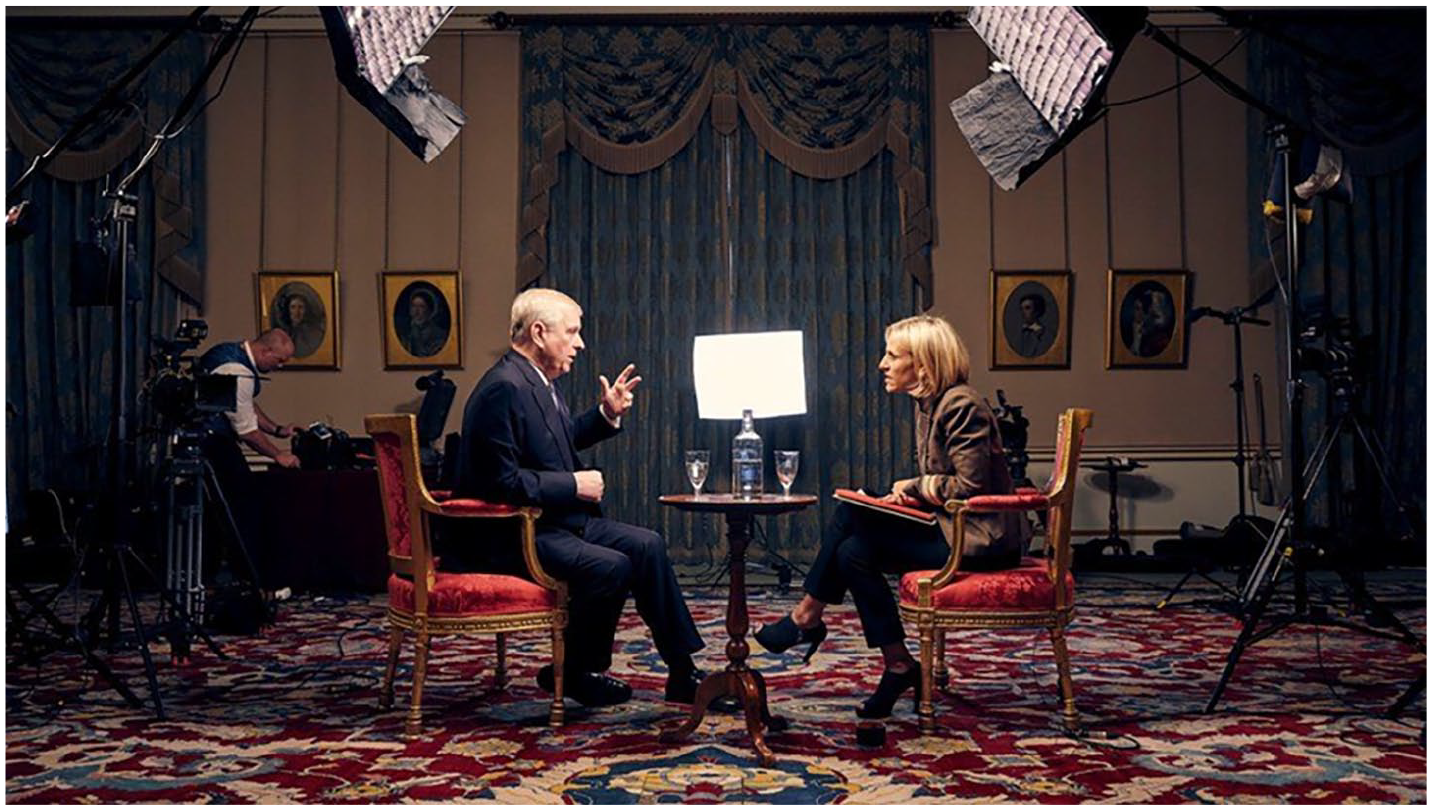
Social media feeds circulate text, behind-the-scenes footage, extra-textual elements such as additional clips unshown during broadcast, and publicise discrete-but-connected media feeds such as podcasts (BBCStrictly, 2022). Television work also has the power to make social change. As a retired executive said, . . . when it’s going well. It is absolutely wonderful. [. . .] it’s exciting. It’s interesting. You meet fascinating people, and you make a difference. [. . .] the first programme that I produced was about rape in marriage and it contributed to the law being changed. [. . .] I believe programmes and journalism, campaigning women and MPs working together contribute to change. (Interview with News Executive, 11 May 2021)
The privileges – the ‘promise’ – of working in such a space are made manifest, but most television work is not like this. For most, it becomes an issue of perceived privilege, of the possibilities reserved for the ‘other’. All the above excerpts refer to editorial work, the department that decides what is seen on screen and where the plaudits are most often received. Editorial is where the creatives reside: from Researchers up to Channel Controllers – the chain of people who decide what and who is seen on TV is the controlling factor of content. There is no official taxonomy of job roles in television, but there are over 200
6
. Most of them are not in editorial, but they all work to support the decisions made in editorial. Every aspect of television work is done in service of decisions made in editorial. The phrase ‘in service’ is crucial because this is care work. As one Production Manager (PM) put it: you’re looking after the whole thing on quite a few levels, on an emotional level, practical level, financial level, scheduling, all of those things. But it is, underlying it’s looking after people. (Interview with Production Manager, 7 November 2019)
A PM’s role is one of a hub, the centralised position that everything on a production travels through, so everyone else’s job – lighting, camera, on screen and behind the screen – is accounted for. In Tronto’s terms of recognition, action, giving and receiving care, the PM is the hub of care in television work, where the multiple levels of care take place so the creative work can be extracted and place so the creative made into something that will then appear on screen. This care is a transaction: labour for the immediate work, but also the deferred, mostly never met, gratification, because most of the work in TV is not about anyone’s name in lights. My interviews revealed that the long-documented social cachet of TV work remains (Gill, 2002; Ursell, 2000), but there is now an awareness of the punishing nature of receiving such cachet: . . . obviously there’s status attached to all of it, because of the status attached to everything in the media industry, [but] it’s like a double sided coin really, if you’re that type of person that feeds off, if you want to be out, and if you’re quite extrovert, and you’re up for travelling at the drop of a hat, really giving your all to something, then it can be wonderful. But I left because I was burnt out. (Interview with News Executive, 18 September 2021)
The promise of television work continues to travel along this service chain. The woman quoted below was promised her first hour as a director if she worked with a particular presenter, performing her gratitude so she could progress, which necessitated a job that placed unacceptable pressures on her: I was the only woman on a crew consisting of a male director/presenter in the 60s and then four men in their 50s [. . .] I had to sort of tell everybody what to do, but then also be everybody’s skivvy. So you’re both mother and wife, basically you’re everything. The best one on that was when the director/presenter asked me to get him some cheese on toast. But make sure the cheese was properly melted this time. Make sure the cheese was melted because last time, the cheese wasn’t melted enough. So when I got it from the cafe, could I make sure they melt the cheese first before they put it on the bread and put it under the grill. And he told me this I was holding a camera, holding a lens, had a camera card in my teeth because the cameraman said, ‘I don’t know anything about rushes you’re going to have to back it up. I usually work on set so somebody does that for me’. The camera assistant, he said, ‘I’ve never used these lenses before, can you show me how it attaches to the camera?’ [. . .]. But my role as a woman on that shoot was to do that, to get everybody coffee, to look after everyone, but also to solve all the problems, set the cameras up, back up the rushes, explain how music clearance works, etc. (Interview with Producer / Director, 17 April 2021)
The gendered aspect of this work is also demonstrated in the following quote, as the idea of the ‘star’ is replicated – above the ‘star’ is the presenter, while below the ‘star’ is a fellow, male director. Both women express a sense of indebtedness in the inability to negotiate equivalent status, in experiences where men were understood as having greater validity. The reticence this induces is demonstrated: . . .he was the star. And so actually, through the project, he would just say, no, no. Whereas I, if me [and other female director] said it [no], that was more problematic. It was interesting he just thought ‘No, I’m not going below [that rate]’. And they beat us down way below that, and were happy to. Yeah, there’s things that he just wouldn’t accept, and we were probably prepared to. I guess you always have to feel grateful that you’re a) being paid, b) got a job. My guess is because, I don’t know if this is TV in general, do you feel that people have your back and that [it is] going to be reasonable when you ask for something? And my feeling is not always. I guess maybe they [men] have better experiences when they’ve asked more money or something [but] you’re made to feel really bad about it. [. . .] I guess you’d be told there’s not enough money in the budget. (Interview with Producer / Director, 1 May 2021)
These accounts articulate a sense of gratitude, even within the context of quite punitive practices, where care – whether in terms of staffing, overwork, rates or being afforded the status and equity these women were denied – is lacking. Here, gratitude upholds poor practice at the expense of care for certain people, while care is fulfilled for (male) others. It illuminates the ways in which ‘women bear [the] meaning of care into the public domain of the workplace’ (Franzway, 2000), and how they accept this additional load as an inevitable part of the work – even when it inhibits a request for care for themselves. Class and internalised responsibility come into play as the below woman illuminates when she says: I am very grateful for my job. Especially because, having that [negative] experience really taught me that there are a lot of people that want to work in this industry, it’s very competitive. And so coming from, you know, a small town with two parents that are teachers, I was very proud and grateful to experience some of the things that I’ve experienced, and know that there are lots and lots of other people who would like this experience. And so, yeah, I’m definitely grateful. I think having had really bad experiences always also makes you grateful for current, less bad experiences. (Interview with Production Coordinator, 18 September 2021)
Throughout the excerpts runs the notion of status coercion, explained as ‘labour is not really labour, but a privilege’ (Jaffe, 2021: 208). Work here has multiple spectral potentials to it: the potential of something worse and of the unknown misstep that might take a worker there, versus the potential of increased status and the unknown beneficiary or encounter that could elevate a career. It is these unknowns that EDI purports to address in its attempts to open up the industry but does not because it does not shift the conditions of the work – and it is these conditions that catalyse the feeling.
EDI and the potential for care
The EDI discourse as part of the working life of television production has opened up the possibility of care through the prism of diversity and equity (Aust, 2022). It has complicated the idea of the ‘somatic norm’ as television screens are seemingly populated beyond the white, middle-class male (Brook et al., 2020: 198). But, it has been demonstrated that the EDI agendas are not working and there remains a paucity of representation across the protected characteristics (CDN, 2021; Ofcom, 2021; Wreyford et al., 2021b). EDI as it is, is not working. The problems of inequity and disparate representations are not being solved. Decades of work has not addressed inequity; the interviewees quoted above demonstrate the ways in which subjects cooperate in inequity, even to their detriment; in Ursell’s (2000) account, the ways in which some people command and mobilise advantages, often as much material as personal and ideational, to build and maintain structures which serve their interests while acting as determinations for others who, if not initially less advantaged, certainly become so (p. 820).
More substantial, substantive work is required; as a contributor put it: I’d restructure, so that we can give people programme budgets that enable and you can make conditions of commissioning that you take people on, and you give them continuity of employment and mentoring, and all those things. But you know, we’re in a situation where our programme budgets, if we are lucky, cover the things you absolutely have to do. You know, there’s no 3% for training, or, you know, 5%, for tiding people over, they get paid on the first day in production, and they stop being paid. And you have to account for every penny. [. . .] I think if the head of ITV and head of Channel Four, and the head of the BBC and head of etc, if they all got together and said, ‘How are we going to solve this?’ they would have solved it by four o’clock. (Former Channel Controller, 19 March 2021)
The EDI context has been shown elsewhere as equating to a ‘turn to care’ but having failed to enact substantive change to working conditions (Aust, 2020b). The value system of intense, individuated competitiveness and its potential rewards has been outlined above, as have the ways in which EDI measures, as they are, do nothing to address this. This value system is also subjective, as out of the project emerged an alternative value system where subjects simultaneously do three things: lament their insecurity and proclaim the freedoms of it, while also understanding stability as something invalid in a TV career. This subjectivity must be situated within the freelance context, the punitive aspects of which have also been documented in television work and other cultural industries (Gill, 2010; Lee, 2011; Wing-Fai et al., 2015); the ways in which freelancing mitigates communal value must also be borne in mind. The specificities of subjective value in television work appear when gratitude is discussed in the context of ambition and hierarchy; contributors articulate the trade-off between comfort, ease and the feeling of not doing ‘proper’ TV (a comparable alienating unease, of being outside one’s originating habitus, is articulated elsewhere in the frame of social mobility (Friedman, 2016)). Structural precarity, in this subjective regime, shifts into sensory precarity. Structural precarity is understood here workers being penalised, often invisibly, because of their inherent characteristics, and no measure of assimilation can protect them from this (Gill, 2014). Sensory precarity expands upon this through the specificities of television work, where a freelance worker will labour under short-term contracts with ill-defined conditions and porous roles,
7
with no industry-based regulatory powers to protect them.
8
There are no clear career trajectories, often presented as beneficial as one is not tethered to a corporate life, but which manifests in intense insecurity (Gill, 2010). Workers are left completely untethered when there are no fixed conceptual points to a working life, and instead understand their disposability over their worth, meaning the worker is kept passive (Percival, 2019). Insecurity and passivity accumulate into fearful stasis: this is sensory precarity. Such fear can be seen in the below quote, where the insecurity of freelancing morphs into a rivalry between the different statuses of staffed versus freelance, as opposed to an understanding that they are all being penalised: I’m still there [at a broadcaster], institutionalised, too scared to leave. [. . .] Now I work with some really amazing staff, technical, camera, lighting, sound, floor managers. Because they’re in a staff position it’s slightly frowned upon. [. . .] I don’t know, it’s just a sort of, you’ve got a staff job, so you’re not quite out there, at the coalface or you’ve settled or I don’t know, but there is a subtle sense of feeling that, I think, of maybe jealousy [. . .] it might be just a sensation of feeling threatened. Being a freelancer, it’s hard. And if a load of staffers turned up, it’s like, encroaching on my land, thank you. (Interview with Staff Crew, 17 December 2020)
This ‘subtle sense of feeling’ recalls Williams’s ‘structure of feeling’, as the interviewee describes the ‘particular living result of all the elements in the general organisation’ (Williams, 1961: 48) as being the ‘sensation of feeling threatened’. In this account, these elements, felt by the various actors, are in competition with each other and the actors themselves left disparate, with no unifying structure at all. Instead, competition, engendered through sensory precarity and hierarchy, individualises and inhibits solidarity. Gratitude for inclusion into the organisation, despite the fear it activates, is what keeps this interviewee in place (and ‘knowing their place’). In an alternative perspective on the notion of sensory precarity, where comfort is discomforting, a long-term freelancer describes the shift in her attitude towards work as she has got older as a dimming of her ambitions. She says that early in her career she ‘travelled two hours each way for six months just so I could get a history programme on my CV’, but now I’m grateful for the fact that I feel comfortable, and I don’t feel worry, or stress very often. And I think that that is something I really value. [. . .] I don’t feel out of my comfort zone [. . .] And I think that’s what I’m grateful for. (Interview with Producer/Director, 20 November 2020).
What is not apparent in reading rather than listening to the quote is the apology in her voice as she said this – relative comfort and stability elicits shame in the context of ambition. Precarity, structural and sensory, echoes throughout this world, and gratitude supports and amplifies it.
Conclusion
If comfort elicits shame, how can care – where advocation and acceptance of comfort is central, as per Tronto’s giving / receiving model – be effectively introduced? First, the care work of television production needs to be elevated from its currently devalued position, where editorial work is at the top of a long-tail hierarchy. Understating the value system revealed here, the ways in which television workers sublimate poor conditions and instead ally themselves with the values that television, particularly freelance television work, propels the following as positive: individualism, choice and independence from supporting structures that bind them to a particular employer. There are avenues of exploration to mitigate this, such as renewing the British Film Institute (BFI)’s longitudinal career trajectory work of the 1990s (BFI, 1994–1999; Paterson, 2001). This has the potential to contribute towards reversing the failure of EDI to build, let alone maintain, a workforce structured on the basis of equity.
Care also has the potential to challenge and interrupt the toxic competitiveness of television, based on notions of ‘stars’ and failures, of inevitable winners and losers. It could be that television work is reimagined as something pleasurable but not extraordinary, where workers deserve good conditions, as opposed to being grateful for inclusion within any conditions. There are positive changes occurring in places: the advent of Intimacy Coordinators and Wellbeing Coordinators speaks to a disruption of the shooting schedule, where consideration must be made of the health of cast and crew, interrupting their assumed purpose as agents of profit for their employers. The WonderWorks system of childcare provision offers flexibility to freelancer parents, in a recognition of the attrition rate of mothers in TV work. Share My Telly Job runs job-sharing programmes that ameliorate the punishing working hours that are currently standard. 9 These advances all centre care, but to be fully adopted, there needs to be a shift away from gratitude into a mind-set of (perfectly reasonable) expectation that work does not need to be punitive.
Using gratitude and extending to other aspects of the lived experience, such as hope (Gross, 2021), is generative. While in some contexts gratitude may be generative of sympathetic bonds, used in relation to one another, in the freelance context it becomes punitive, and induces a debt that inhibits conditions that could encompass adequate care, because care cannot be completed without a structuring discourse around it, and no free discourse can be created, let alone be activated, within the confines of inhibition. Gratitude functions to uphold poor practice in television work, although it does not function alone – the ways in which it is interconnected with the myriad sensations of television work and inhibits an EDI agenda based on moral, rather than industrial motivations, is an area requiring further study.
Ultimately however, care in television work needs to be an address to how the industry operates at an on-the-ground-level. There have been industry-based interventions around excessive working hours (Evans and Green, 2017; Swords et al., 2022) and the punishing effects of such conditions (Creamer, 2021; Wallis and Van Raalte, 2021; Wilkes et al., 2020), but reports cannot be effective within an industry that operates on multiple levels of structural and sensory precarity, supported by a working culture that makes excessive demands on its participants. These multiple precarities result in the experience of work as described here, where comfort and security is invalidated so discomfort is the norm: sensory precarity. Meanwhile, the ‘promise’ of the industry remains unfulfilled but for a very, albeit highly visible, few. Working fewer hours would allow an ethic of care to be inducted and maintained, because there would be the – quite literal – time to do it. There is, as well, a pressing industry need to understand the feeling of working in television because the failure to recruit and retain personnel has resulted in a skills gap that threatens to halt the industry (ScreenSkills, 2022a, 2022c). Workers in television production are operating in a field of sensory precarity which current EDI measures are not mitigating and as a result they are leaving. There needs instead to be an acknowledgement and definition of how the feeling of TV work induces precarity through sensory states such as gratitude. Only by introducing an address to feeling in EDI work can a holistic approach to the identified issues be made.
Footnotes
Acknowledgements
With additional thanks to SIGN for funding this research and to Dr Jon Swords, Professor Catherine Johnson, Dr Jack Newsinger and Dr Christa Van Raalte for their ongoing encouragement.
Funding
The author(s) disclosed receipt of the following financial support for the research, authorship, and/or publication of this article: This project was funded by the Screen Industry Growth Network (SIGN) at the University of York.
