




Abstract
The television industry has deep-rooted neoliberal employment structures, and this article explores how the non-fiction television director negotiates this contingent working environment. Research has established that creative workers adapt themselves to the demands of a post-Fordist ‘gig economy’, characterised by casual, non-permanent work, with little security or accountability. However, relatively little is known about how non-fiction television directors respond to that context, especially in the Irish case. In-depth interviews were conducted with a purposeful sample of 12 freelance television directors. Key findings note the layers of control wielded by broadcasters over the working life of the director. Identifying the negative effect of broadcasters’ dominance in the sector, they revealed a three-line whip of control through budget, creative direction, and a risk-averse approach to programming, which effectively constrained the directors and reduced their autonomy. The directors described how broadcasters’ control over budgets means that the sector is run at their command, a situation that is further aggravated by Ireland’s lack of trade union representation, stagnant pay rates and the absence of intellectual property rights accruing to directors’ work. Respondents proposed that their status was reduced from creative auteur to operational functionaries, reporting the negative impact of the industry work culture and practices on their self-esteem, because their creativity and work were undervalued. This article breaks new ground to explore directors’ responses to the conditions of the gig economy and link the alienation of labour to the loss of creativity in content. There was an acceptance by non-fiction directors of the status quo, which was seen as the ‘price’ of a non-routine life, with the freedom to indulge the passion and the pleasure inherent to making television. Moreover, respondents also revealed how they maintained their creative identity despite their circumstances, through the pursuit of their own work and through the support of peers. Crucially, respondents argued for a repositioning of the television director to reflect their status and role in the origination and creation of novel content, and proposed such recognition might better serve the television viewer.
Introduction
Over the last 40 years, in light of the global shift towards individualisation (Deuze, 2009: 28), academic interest in the labouring lives of the creative worker has grown significantly (O’Brien, 2019: 8). A substantial body of literature has provided empirical and critical analyses of cultural production (Lee, 2013: 4). This body of work details the normalisation of post-Fordist, neoliberal work practices under advanced capitalism. The labourer is a contingent worker, self-employed or freelance, operating in a project-based ‘gig’ economy (Woodcock and Graham, 2020), one that has been impacted by dwindling resources and rising costs (Deuze, 2016: 18). At the same time, the success of these practices has given companies increased flexibility and control by employing the rhetoric of entrepreneurship and individualism (Beck, 2000: 53). Consequently, the industry is predicated on short-term contracts that are typified by low pay, long hours, with employment responsibilities devolved to workers (Deuze, 2007: 3), freeing capital from business risk (Menger, 2006: 805). Literature on Creative Industries has further identified systemic gender, class and racial inequality (Gill, 2002; Nwonka, 2020; O’Brien and Liddy, 2021), along with limited insurance, health protection and pension benefits for workers within the regime (Banks and Hesmondhalgh, 2009: 1). Some work has focused on the specific ways that small nations experience these dynamics (Genders, 2022). Small production ecologies lead to dense network sociality (Noonan and McElroy, 2019) and higher rates of concern for reputational damage (O’ Brien, 2019). Scholarly work relating to the non-fiction television director has been limited and mainly focused on the historic origins of the director (Corcoran, 2004; Doolan et al., 1969) or analyses of documentary practice (Nichols, 2001; Rabiger and Hermann, 2020). Relatively little attention has been paid to the work of the non-fiction television director in the context of contemporary Creative Industries. It is to that gap in knowledge that this article is directed to explore how the director, as a creative worker, negotiates their contingent working environment.
The work of the non-fiction director
In contemporary television production, the director remains the key worker responsible for all stages of production from casting, to filming, to delivery of a final product. An audit of their role reveals a skill set that is both unique and broad; they must excel at communication, managing crew, contributors and talent; they must (Mayer et al., 2009) have storytelling skills; be excellent interviewers and sharp listeners; possess a good eye for photography and understand the skills of visual storytelling; be knowledgeable regarding technological developments within the industry; be agile problem solvers and work well in challenging environments; they must be conscious of the crew’s well-being, taking responsibility for health and safety; be cognisant of both media law and broadcaster journalistic policy (RTÉ, 2020b); and when the programme is finished and the script is written, they must manage the expectations and demands of both the production company and the broadcaster (Doolan et al., 1969; ScreenSkills, 2022). Above all, the director must possess two key intangible skills crucial for success in factual television, a form that depends entirely on engagement with people to harness the ‘potent power’ embedded within their stories (Hahn, 2013). One skill is emotional intelligence, or ‘social intelligence’, the verbal language and non-verbal cues (Salovey and Mayer, 1990) that facilitate empathy or ‘feeling an emotion’ with another being (Snow, 2000: 66). The other skill, creativity, is inherent within the person but also something that must be honed (Negus and Pickering, 2004), and many years are spent developing skills, learning crafts, conventions and techniques of creativity (Ryan, 1992: 49). Creativity constitutes perceptions of style, originality, ideation, imagination and, in essence, is constituted in the director’s televisual voice. Ryan (1992) identifies intangible creative skills as ‘problematic for capitalists’ (p. 48), but Williams notes that the artist shares their ‘creative imagination’ with their labour being ‘the actual work of transmission’ (Williams, 1965: 42). Yet the creative ‘product’ of imagination appears to be ‘free’, eminently exploitable, and therefore becomes an ‘ideal form of production’ (Wolff, 1993: 17). Creative work is accounted for ‘above the line’, while craft, materials and technical labour sit ‘below the line’, giving a distinct separation between ‘creative’ and ‘technical’ workers (Mayer et al., 2009). However, both sides of this line ply their trade in a highly negotiated fashion (Lee, 2013: 6), having to adapt themselves to the unwritten rules (Deuze, 2009: 34) of a post-Fordist world. A ‘gig economy’ that is characterised by casual, non-permanent work, with little security or accountability (Woodcock and Graham, 2020: 10) and predicated upon an excess of raw material that tie workers to labour just long enough to deliver a finished production (Siciliano, 2021: 25). For the non-fiction director, work and life merge into a ‘workstyle’ (Beck, 2000) that emphasises a ‘mythologized version’ of media labour, with the external image of an industry that is ‘cool, creative and egalitarian’ (Gill, 2002: 69), which only serves to distract from the ‘soft control’ workers experience in the sector (McRobbie, 2016: 13). The creative worker is pitched as an entrepreneur, flexible (Beck, 2000: 3) and free to create their ‘portfolio career’ (Gill, 2002: 71). However, the director finds themselves in a contradictory position where a ‘good reputation’ does not carry economic advantage (Ursell, 2000: 818). Securing work requires contacts, a
Precarity or precariousness has entered the director’s lexicon as part of ‘labour and life’ (Gill and Pratt, 2008: 27). Being ‘forced to beg and pray’ for work (Ross, 2009: 34) has become emblematic of the freelance director’s experience, with freelance equating to being almost unemployed (Mitchell, 2005: 12). Running ‘Me & Co.’ (Beck, 2000: 3) means that directors not only have to create original and engaging content, they must also maintain their personal business. This includes running accounts and submitting tax returns in addition to making accommodations for sick pay, pensions and maternity leave (McRobbie, 2016). Work payment is affected by the labour indeterminacy built into the system. Wilson sees late payment as a contributory factor to financial distress (Wilson, 2008: 6) that can wreak havoc on long-term plans (Lorey, 2015: 104); only remediated by the buffering of income by others, such as family, spouse or even loans (Mitchell, 2005). Moreover, given the unpredictability of creative work, the exact quantity of labour-effort required of directors is difficult to lock down (Smith, 2006: 390). Without industry guidelines for pay and conditions, many directors are effectively ‘gifting’ labour through overruns, use of personal equipment, using their own cars and upskilling without remuneration (Ross, 2009: 6). Above all, the antiphon of the industry is that the project comes first, any notion of ‘flexibility’ is determined by the production, rather than the worker (Gill, 2002: 83). This unwritten law is impacted further by the workers’ passion for their job, resulting in self-exploitation as creatives push themselves beyond reasonable labour expectations (Ross, 2009: 12) for love of their craft. All this begs the question, who gets to work in television directing and to what effect on them as individuals?
The main pipeline for directing work, according to Hesmondhalgh and Baker (2011), is the educated middle-classes but McRobbie (2016) notes a ‘failure to foreground gender’ (p. 93) and O’ Brien and Liddy identify a systemic bias against mothers (2021: 1997). Age, too, is another negative, ‘as experience increases it loses value’ (Sennett, 2006: 108–109). Vulnerability limits bargaining power (Mitchell, 2005) and the sole-trading non-fiction television director appears to have few allies. Unlike the film (drama & commercials) sector, which enjoys negotiated pay and conditions (Irish Screen, 2020), the Irish television director lacks control over employment and is powerless to the manipulation of an ‘impersonal system’. This can result in meaninglessness, isolation and self-estrangement (Blauner, 1964: 16). Added to this, the endless chase for employment in an ‘always on’ environment gives rise to ‘workaholism’ and ‘obsessive behaviour’, threatening ‘the core of life’ and impacting both the individual and their family (Delecta, 2011). The Creative Industries literature presents the dichotomy at the core of the television director’s working life. The ‘vampire’ of television production provides a seductive environment (Ursell, 2000: 821), a career filled with opportunities for self-realisation but where notions of creative freedom and expression are dominated by late capitalism’s imperative for profit that only seeks to enslave (Banks, 2007: 6). What is evident from this literature is that the television direction industry has deep-rooted neoliberal employment structures and adopts controlling practices. What is less evident is how directors respond to that context. This article offers new analysis of how creative workers negotiate a contingent environment. Before the key findings are outlined, the methodology of the study is explained below.
Method
A purposeful sample of 12 non-fiction television directors was selected from all directors working in the Irish freelance industry. The small size of the sample limits the generalisability of the findings, but they are nonetheless valuable for the depth and nuance presented. Currently, there is a dearth of data exploring the experiences of directors in Ireland. While there are studies of directors from other nation states (Jarvis, 1998), they largely document or describe the role and do not critically problematise the working lives of directors. In the sample, television drama directors were excluded, as this sector benefits from collective bargaining (The Irish Film & Television Network (IFTN), 2022). The purposive sample also included criteria such as a minimum of 10 years of experience in directing, working on projects with significant budgets, a permanent work base in Ireland and, notwithstanding the underrepresentation of women in the field, close to a gender balance in respondents. The freelance television sector in Ireland is small, fragmented and without a representative body. The contemporary Irish television industry comprises public service broadcasters, Raidió Teilifís Éireann (RTÉ) and TG4, both dual-funded by State and commercial ventures, and the commercial channel Virgin Media. In a small television ecosystem such as Ireland, channels act as gatekeepers, exerting power over production by determining output (Siciliano, 2021). Employing a work structure similar to the ‘indie’ industry of the United Kingdom, Irish broadcasters act in part as publishers, with producers pitching for commissions (Ursell, 2000: 810). The independent sector of the television industry is small, with approximately 140 small-to-medium-sized companies vying for work (O’ Brien, 2019). Channel commissioners carry responsibility for a slate of programmes (Hesmondhalgh and Baker, 2011) and proposals (treatment pitches) are made in answer to commissioning briefs (RTÉ, 2022a; VMTV, 2022). Total spend for independent productions in 2022 amounted to €74.8 m (RTÉ, 2022b). Budgets for 1 h of factual television ranges from €90,000 to €120,000, while Factual Entertainment ranges from €70,000 to €90,000 per hour (RTÉ, 2022a).
Access to the population of potential informants was gained primarily by word of mouth utilising one of the researcher’s ‘weak tie’ networks, derived from his work as a non-fiction television director. Ryan (1992) notes that the media can be ‘suspicious of academic researchers’ (p. 16) and so the status of one of the authors as a non-fiction television director offered alternative ‘insider’ status, allowing for a ‘collaborative experience’ (Clandinin and Connelly, 2000: 20) of data gathering, which increased the depth and quality of the interview data. A range of open-ended questions were posed, television directors’ understandings of creativity were examined, alongside their views on their own labour and terms and conditions. Interviews were recorded and transcribed and all data were anonymised with codes ascribed. Universal Guiding Ethical Principles and University Ethical Guidelines were observed (Gauthier, 2008) to ensure confidentiality and anonymity. Respondents (Table 1) were attuned to concerns about reputational damage resulting from participation, so as well as anonymising data any detailed descriptions of programmes or contexts that could indirectly lead to identification of participants were changed.
The directors.
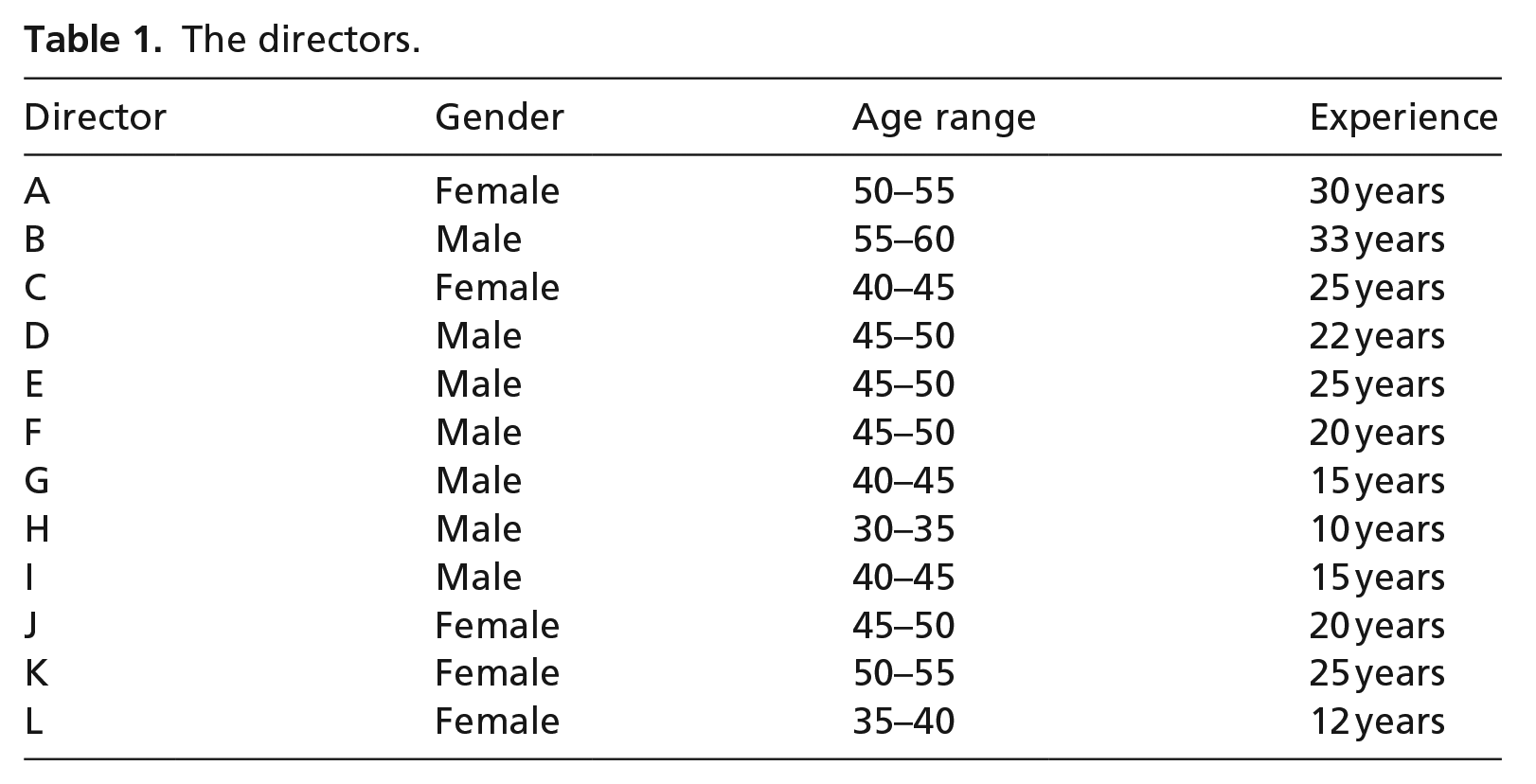
Holding fast to constructivist principles, to reveal individual experience and constructed context-dependent insights, this investigation allowed for the discovery of multiple realities and perspectives. There was no mention in data of the rise of platforms or subscription videos on demand (SVODs) and so findings mainly relate to broadcast output. There was relatively little diversity in the responses from participants, but this may be due to the small sample size, and further research is needed to expand on findings. Data analysis followed an emergent strategy, to reveal themes, issues and beliefs pertinent to the work of the television director. Ever aware that data doesn’t fall into neat categories, the first analysis of transcripts explored the general tone, key ideas, detail of response and recognised significant statements. Subsequent line-by-line readings revealed the full scope of the data as it related to the research questions. Data were coded and clustered into themes and those themes were analysed in light of the literature with the key findings set out in detail below.
Findings
Respondents first offered key insights into what it is to be a non-fiction television director; they outlined the skills, talents, creativity and emotional intelligence that are needed to facilitate their work. Second, non-fiction directors offered insights into the layers of control wielded by broadcasters over the working life of the director. Identifying the negative effect of RTÉ’s monopoly position, the directors spoke of control through budget, creative direction and a risk-averse approach to programming, which effectively constrained the non-fiction directors and reduced their autonomy. A constant was the directors’ commitment to Public Service Broadcasting (PBS), identifying the negative impact controls have on original indigenous content and how control over budgets means that the sector is run at broadcasters’ command, a situation that is further aggravated by Ireland’s lack of trade union representation, stagnant pay rates and the absence of intellectual property rights accruing to non-fiction directors’ work. Third, the directors proposed that their status was reduced from auteur to functionaries. The group reported the negative impact of industry work culture and practices on their self-esteem, on how they valued their creativity and their work. The data revealed an acceptance by non-fiction directors of the status quo, which was seen as the ‘price’ of a non-routine life, with the freedom to indulge the passion and the pleasure inherent to making television. Nonetheless, respondents also revealed, fourth, how they maintained their creative identity despite their circumstances through the pursuit of their own work and the support of peers. Finally, they concluded that repositioning the television director as a named and celebrated creator could go some way to ameliorate the negative impacts of broadcast control.
Being a television director
When asked what it meant to be a non-fiction television director, respondents began by describing how they entered the field and then outlined the key talent and skill required to do the job. They did not see the job as something one was inherently born to do but rather as a role with acquired skills that was heavily enmeshed in the remit of broadcasting to educate and entertain. However, their skills are fundamentally immaterial, creative and emotional, and this immateriality leaves them open to exploitation, because the work is not visible. Respondents suggested that entry into the field of television directing is non-routine. As one put it ‘A lot of people in television have kind of fallen into it’ (I). Directing was not something that the subjects believed they were born to do, ‘I didn’t come from a family of creatives. I had no idea where to start’ (H). For some, becoming a non-fiction director resulted by chance ‘I was, 27 and . . . I was thinking of doing this documentary, and I got a massive break’ (F). For the majority becoming a non-fiction director was a process of evolution or discovery. One director entered the industry as a researcher and moved to directing ‘It just comes out naturally, doesn’t it? If you’ve got a creative urge to tell a story’ (F). There was a strong auto-heuristic approach among the group ‘There’s no better way to learn then by doing’ (H).
Respondents noted that the skill set required for the job was equally atypical. Here the intangibles of creativity and emotional intelligence were revealed as the cornerstones of the director’s work, along with skills in ideation, aesthetics, storytelling, and managing cast and crew (Doolan et al., 1969; ScreenSkills, 2022). Creativity was presented in ways that reinforced the doxa of creative work as not real work, rather done for fun or pleasure (Banks, 2007: 8). Director G admitted that creative work can often look like very little is happening: ‘There’s a lot of staring out windows . . . it can feel like you’re just trying to magic stuff up out of the air’. Working without the safety net of a prewritten script, factual television requires the capture and interpretation of the world as it happens. The director must conjure up a story using elements from their subject’s life, including their own words. Director G observed: ‘Words aren’t even really half the battle. What are the images that you’re going to put alongside that?’. It is through this fusion of images, symbols, signs and sounds that the non-fiction director, at times working alone, at times leading a crew, fashions a television programme, a cultural commodity composed of intelligence, imagination, and emotions (Ursell, 2000: 821). But at its core the work is somewhat invisible because it is creative. In a similar way ‘getting the story’ was largely dependent on emotional but also invisible work. Directors elaborated that getting the story out of a subject can be the hardest part of the job. To harness the ‘potent power’ of human stories (Hahn, 2013) the director must tune into the emotional cues emerging from the subject to create an atmosphere that helps ‘people feel comfortable to talk about themselves and about their innermost parts’ (E). A fundamental is ‘feeling an emotion’ (Snow, 2000: 66) or having empathy. As Director K put it, ‘part of your job is your intuition, your sense, and your gut’. Another non-fiction director agreed, ‘[You’ve] learned to deal with people at their most vulnerable and you’ve learned to eke out a story where sometimes it’s not necessarily there right in front of you’. By employing their skills, the directors help ‘the audience feel emotions’ (G), delivering a story that creates awe, wonder, coaxes tears or forces the hairs on the back of viewers’ necks to stand up. An empathetic understanding of the subject is central to conveying to the viewer the impression of authenticity and this requires a deep personal investment of ‘emotional labour’ (Hochschild, 2012: 7). Director L described being ‘absolutely drawn into people’s lives . . . there’s huge personal demands’. Director G concurred: ‘It’s impossible not to get fully emotionally involved’. The non-fiction director’s art requires balance of creativity and of emotional commitment to their subject. But the blend of the aesthetic and ethical parts of the director’s work are essentially immaterial labour, which may appear not as a skill but rather as ‘not work’, which leaves the work of the director open to exploitation by broadcasters.
Television directors spoke of the precarity of their working lives, sourcing work appeared problematic and the perennial, ‘You are only as good as your last job’ (Blair, 2001) resonated strongly. ‘You’ll be judged on it and . . . if I don’t do a fucking good job, then I’m never gonna get hired by this company again’ (G). This fear was confirmed by Director C: ‘Every job has to be your best one, you’re expected to give it your all’. Respondents also reported the regular ‘gifting of free labour’ (Ursell, 2000: 805) whereby they supplied work for no extra pay, just to get the job done. ‘I can direct. I can produce, I can shoot. I can sit in an edit suite and drive a narrative . . . five jobs you’re doing but you only get paid once’ (I). In addition, Director C described the expectation of long hours of work, a peripatetic existence, without overtime, ‘Frequently, a production will schedule for a full shooting day, knowing that you’re away from home and not factoring in the 3, 4, 5 hour drive home’. Director K added: ‘We don’t do five-day weeks we do 24/7. You’re a Jack of all trades doing everything’.
Precarity was described by respondents as being built into the job (Gill and Pratt, 2008: 27). Director D accepted that insecurity ‘never goes away. I don’t feel any more secure than my first day’ but added that ‘you get comfortable feeling your life is precarious’. Many respondents spoke of the anxiety associated with running ‘Me & Co’. (Beck, 2000: 3), ‘. . . which is challenging, dealing with your own accountancy and invoicing and chasing payments, that’s hugely time-consuming’ (L). Director B described his ‘problems with the taxman and with the vatman’, while Director C noted the need for familial assistance: ‘My spouse helps me out . . . when I get a letter from the Revenue threatening me’. The buffering of income by others (Mitchell, 2005) was confirmed by Director B: ‘I’m lucky that my wife works . . . and gets paid more than I do’. Director F encapsulated the pressure inherent in running a business as ‘a colossal source of stress, anxiety and poor mental health’. Compounding this, the always-on environment appeared to be the most pernicious aspect of the job: ‘There’s no downtime . . . nobody in a normal job works really hard all of the time . . . always giving 150%’ (C). All commented on the impact on work-life balance, especially regarding family. ‘You have to shoot 12 hours a day 12 days in a row . . . The creche doesn’t stay open till nine at night’ (J). Director C supported Author’s identification of a systemic bias against mothers (O’ Brien and Liddy, 2021: 1997) ‘When I was pregnant, I was asked to do extraordinarily long days, there was no accommodation in the fact that I was really pregnant’. In addition, Director E noted that bias extended to ‘family men’ and Director C recalled people being ‘subtly side-lined’ during the child rearing years because they were ‘probably not going to be able to do that additional work’. These pressures brought with them much negativity and mental anguish, self-exploitation was observable in ‘workaholism’ and ‘obsessive behaviours’ that threatened ‘the core of life’ (Delecta, 2011). Director G spoke of ‘the toll that is taken on you and on your family . . . working late and then drinking whiskey to kind of get yourself through that, you find yourself having an argument and you realise it’s just because you’re exhausted’ (G). The plight of the non-fiction director was well summed up as ‘one of perpetual risk and perpetual uncertainty’ (L).
Broadcasters controlling directors
In addition to corroborating previous research on creative workers, respondents were also clear that broadcasters leveraged their position to govern all aspects of programme production controlling budget, creative approach and avoiding risk. In their comments, the non-fiction directors focused primarily on RTÉ as the main commissioner. However, broadcasters did not directly manage budgets and content or risk but rather delegated that control to independent production companies who effectively work as managers for the broadcaster. Production companies had contractual obligations to deliver a finished product, to a fixed low-risk brief, on time and on budget, irrespective of circumstances or changing contexts and how those might impact the programme. This is not an aspect of creative work that has been widely researched to date.
The most immediate and impactful form of control began with budget: ‘Everything has to fall into those budgets’ (E). What has emerged are productions ‘led by budgets and accountancy first’ (E) with producers managing the creative ambitions of non-fiction directors to meet the restrictions of budgets. For the director, budget constraints are first felt during the pre-production period. The non-fiction directors reported that this research and preparation period had been reduced from months to weeks to free labour. ‘My last job . . . they hard-balled me on rates and wouldn’t give me any time for prep’ (D). As directors petition for a budget to give them time to ‘try create ideas’, they find they are battling the parsimony of the producer, which is ‘frustrating’ (C). The non-fiction directors further noted that production companies often expanded their sphere of control beyond the budget to include all creative inputs to the programme. Control of the creative approach was operationalised by ‘constant meetings’ and ‘questioning’, with the production company managing ‘every little micro decision that you make, which stifles you completely and it’s absolutely suffocating’ (C). Director G suggested that company executives feign interest in the director’s artistry, ‘they say that they want creative . . . But they obviously don’t . . . they’ll be deferential to my creativity but then will refuse to give me prep days to do my job’. Instead, what is celebrated by producers is the ‘safe pair of hands’ (B). Director G explained, ‘really, it means that you’re gonna deliver’. This ‘safe pair of hands’ is the antithesis of creativity, as without time to experiment the non-fiction directors admitted to self-censorship, going ‘for the things that are 100% guaranteed to work’ (C). The subjugation of the creative self was articulated by Director G: ‘You can have a fucking wild idea, but you kind of go . . . I’m never gonna get away with that’. Directors noted that production companies do not bear full responsibility for this system. Independent Producers are themselves dependent on the broadcaster for commissions, payment and creative support and so the companies are also supplicants in the process, equally pressurised to be a ‘safe pair of hands’ that delivers.
Creative control of the non-fiction director’s work was frequently described as occurring in the post-production or editing phase of production. Among all the respondents, the importance of the edit phase could not be overstated, as a programme is ‘crafted once when you’re filming it, but then it’s crafted all over again when you’re in the edit’ (G). Ostensibly the edit is when the non-fiction director puts their creative stamp on the work but instead the findings reveal a battle for authorship. Post-production facilitated the broadcaster to exert control in two ways. Budgetary concerns, manifested in the amount of time allocated to the process, ‘at the moment for an hour, you’ll be lucky to get five weeks’ (B). Reduced time in the edit suite does not make for good programmes, particularly if benchmarked against streaming services. ‘If you look at the Netflix hour, they’ll run for 30 [weeks] in the edit’ (I).
Overt creative control, expressed as content or narrative control, brings the hand of the broadcaster directly to the programme. Commissioned programmes are subject to ‘Pre-arranged editorial and stylistic requirements’ (RTÉ, 2022b) and the broadcaster ensures productions meet their approval through viewing notes, given by the commissioning editor or channel executive. This practice is not limited to RTÉ, or Ireland. Hesmondhalgh and Baker (2011) write of (UK) commissioning editors’ ‘vision’ being paramount to what they believe the time slot demands, but they also identify that this comes at the cost of the directors ‘creative edge’. The non-fiction directors interviewed largely accepted this system, partly due to their commitment to public service broadcasting and to the potential for ‘notes’ to make a better programme. On this point Director B was emphatic, ‘if RTÉ decided to spend €120,000 of taxpayers money on something, they have every right to have an opinion on what I do’. ‘Absolutely’, Director K concurred, ‘bring on the criticism . . . I’m always open to criticism, always open to discussion’. The broadcasters right to critique notwithstanding, the reduced time in edit requires the director to turn around programmes in a short timeframe, as ‘you would show them something about week 3 ½’ (B). However, this gives the non-fiction director little chance to present a finished, or nearly finished, piece. Director I spoke of the risks associated with a short lead-in time: ‘You gotta get it right . . . before that first viewing. Because if you don’t, you’ve lost it, and you’ll never get it back’.
The non-fiction directors reported suspicions that not all notes from the broadcaster are delivered for the betterment of the programme, ‘I don’t think it is just financial control, to be honest . . . I think there can be a bit of a tug of war over authorship’ (L). Director B observed, ‘Most RTÉ Commissioners have never actually made a programme. They’ve been producers but not directors’ and the directors find themselves working under the control of ‘commissioning editors who regard themselves as program makers’ (L). Furthermore, the group identified an internal hierarchy occurring specifically within the RTÉ executive stratum that they believe negatively impacted programme output. ‘I’m not an RTÉ hater’, Director F emphasised, but ‘they have a set of commissioning editors who then have to get past another person who’s up the chain from them, and that’s a real disaster’. With the commissioning editor of a programme having their authority superseded by another more senior executive, the non-fiction director is caught in the middle, subject to two sets of notes, with one countermanding the other ‘without vision or craft’ (F). The impact of such internal wrangling where budget, creative control and risk minimisation are all in play is immense and can have a demoralising effect. ‘If you get completely batshit notes, does that not kick you in the bollocks?’ (B). Budget and creative control thus combine to make the channel executive the effective ‘author of the film’ (G) diminishing the ability of a director to create anything unique or powerful. Ultimately, this system serves to undermine the non-fiction director. ‘Now that to me does not in any way value our work’ (K).
A further layer of control exerted is to remove risk from programming. This is most frequently done by formatting television programmes, essentially creating templates for television (Ross, 2009: 8). Formats minimise the need for creative expression by focusing on a low risk, high volume business model (Ross, 2009: 8). Director C suggested that formats are devoid of creative input from the non-fiction director and are just ‘driven by a capitalist idea, everything’s about the bottom line and money making’ (C). Director L described formatting as the genre most dismissive of the director’s skills, ‘the closest to . . . commodification of the director’. Director K felt that formatting ran counter to the director’s core value system and identified an engrained falseness, as ‘everyone’s fighting against you, to cheapen it or lighten it, or make it faster or more jeopardy’. Director D maintained that with increased use of formats Irish television was becoming ‘a copy of UK television’ (D). The impact of such commercially oriented television is most noticeable in the field of documentary-making, where the divergence of ideals between broadcaster and non-fiction director is most visible. As Director K stated, ‘I’m interested in subjects that [are] part of a bigger dialogue’. However, the ‘prototype nature’ of the documentary genre brings financial ‘risk’ associated with making films with and about real people, requiring high levels of labour, including emotional labour. In contrast, the format removes all risk and represents the erosion of the non-fiction director’s creative input, ‘it’s not art, it’s hoovering’ (A).
From auteur to functionary
The broadcasters’ control of non-fiction directors through budget, creative guidance and risk avoidance in formatting of genres has seen the television director downgraded from auteur to functionary or ‘gun for hire’ (A). The television director was not seen by broadcasters as a creative specialist but rather a generalist who is expected to direct any kind of ‘product’. ‘It could be Dancing with the Stars one day and it could be a doco the other day. Your role is to direct what you’re given’ (K). The director is ‘completely disposable, dispensable’ (C). Yet, despite being little prized at the executive level, the fact remains that the director ultimately makes the television programme. It is the director’s creativity that takes words from a page, the treatment, and turns them into a creative product, the programme. This raises questions regarding the intellectual property input of the non-fiction director. As a labourer in the pay of a client, copyright law indicates ownership of creative work vests with the payer (gov.ie, 2022). Thus, as a ‘worker for hire’ this removes any notion of authorship for the director and copper fastens authorship with the employer (Mayer et al., 2009: 56). However, directors frequently noted that the treatments they work from are often patchy and not always workable. So, the intellectual input of the non-fiction director was vital, despite the fact that it is work that is rendered invisible. Director D described ‘dozens of projects where there has been a beautifully written BAI application [but] it’s completely fabricated. It’s just make believe . . . doesn’t really work in reality’. To turn incomplete work into a finished programme requires all of the skill and experience of the non-fiction director, and they see their labour as an unrecognised investment in the finished product. ‘What you end up developing along the way is completely different and all that comes from you’ (C). Yet, as Director C adds: ‘You’ve absolutely no ownership over it. No financial rewards. You don’t get any kind of percentage of the production fee or any percentage of sales afterwards’. As a worker for hire, directors are alienated from their own creativity, labour and intellectual property by being denied access to the ‘magic circle of authorship’ (Mayer et al., 2009). This unrewarded labour is problematised further as non-fiction directors often work without the protection of a contract. ‘I’ve worked on dozens of projects where there’s no contract . . . I rarely get a contract’ (D). Directors recognised the resulting alienation. ‘You just never value yourself . . . because you’re not valued by those at the top’ (K). It is, as Director E described, ‘nuanced in how it permeates into your self-worth’. To add insult to injury, the cost of the ‘gun for hire’ did not always reflect the expertise and experience that was being purchased. Track record and the centrality of the non-fiction director’s role in productions should be reflected in remuneration. This was not the case, however, for the respondents, a ‘good reputation’ did not carry economic advantage (Ursell, 2000: 818). Because the market in Ireland is a closed one, budgets and rates are controlled by the broadcaster, so unsurprisingly pay was noted as a contentious issue with non-fiction director pay rates set around ‘€1500 to €1600 per week’ (B). All the interviewees spoke of pay stagnation, ‘You know our rates haven’t gone up in . . . I don’t know how long’ (K). Director B, with 30 years experience, confirmed Sennett’s (2006) tenet that as ‘experience increases it loses value’ (pp. 108–109), as he put it: ‘I’m getting the same as a 20 year-old coming out of fucking college’ (B).
Maintaining creative identity
Challenges were raised by the precarity of creative work and specific pressures were exerted on non-fiction directors by broadcasters who demoted them from auteurs to functionaries. Nonetheless, a key new finding derived from the analysis is that directors strove to retain their creative integrity by recognising the pleasure inherent in their work, by finding support from their peers and by selectively ‘forgetting’ the challenges of their circumstances. Respondents appeared to have an honest and genuine liking for their job, as creative individuals with enquiring minds and a deep affection for other humans. Director L suggested directing was a ‘vocational’ career. The content of programmes seemed to draw them in, ‘You do buy into the content, you can see it in your head what it’s gonna be like on screen and you’re committed’ (J). In addition, the non-routine nature of the work was seen as fulfilling, promising a life of interest and adventure. All of the group reported the great joy they had experienced doing a unique job: ‘You get access to these weird and wonderful worlds that no one gets access to . . . I’ve been in surgeries with people who are literally getting heart transplants’ (I) and ‘You might be hanging out with one of Ireland’s most famous poets’ (C). The non-fiction directors appreciated the self-realisation derived from their work, ‘there’s barely a gig that I don’t have some sort of life lesson [and] that affects the way that I see the world’ (E). Respondents also noted the positive function of forgetting (Nørby, 2015: 554) that allowed the eradication of negative experiences. ‘We forget how difficult something is when you’re no longer doing it’ (E). Director B suggested that there was a ‘Freelance mind’ in play, a learned sensibility that permitted a mental reset allowing them to ‘start from scratch again next Monday’ (B).
A further pleasure of work was peer recognition. As part of a small cohort of workers, with a very specific life experience, they felt that the only other people who would appreciate the pressures of production were other non-fiction directors. ‘A lot of our work is done in the isolation of edit suites and any kind of affirmation from colleagues and friends really emphasises the fact that you are part of and contributing to a community’ (L). Director G found such existential support made a huge difference, as it ‘can really sustain you and keep you going in the dark times when you’re questioning the point of it all’. As well as peer recognition, creating, making and self-realisation were presented as the directors’ carapace to the controls of industry. Respondents used personal projects to find autonomy and creative expression. ‘You couldn’t survive waiting for the call for the passion project to show up. The only way is to generate your own’ (K). Director C emphasised how indispensable personal projects were ‘[They’re] very important for me, for my mental health and survival in the industry’. The noeme of the non-fiction director was passion, ‘it’s the drive to make something really, really good’ (G). The ‘Harmonious passion’ described by Vallerand (2015: 30) that motivates, engages, engenders energy and persistence, was essential to their directorial identity and revealed the director’s raison d’être ‘to make the best work we can make and feel proud of it’ (K). This was key to sustaining them when faced with the exigent terms of creative work.
Conclusion: repositioning the television director
Broadcasters appear resolute in their commitment to the commercial television model, yet attempts to industrialise and control the directorial process is not necessarily producing good television nor sustainable working lives for directors. Domination may give broadcasters the impression that good work is being made, but bureaucratic control and a reliance on formatting brings the danger of losing unique and creative impetus in programmes. A key finding from this study is the need to reposition directors in the television hierarchy. At a time when television industries, like other mass media, are facing significant change (Deuze, 2007: 193), respondents were clear that non-fiction directors could be better utilised or repositioned. This repositioning proposes both allowing directors to be creative and acknowledging that the director holds the key to creative, impactful programming. Respondents largely agreed that instead of bureaucratic control over directors, broadcasters should pivot to recognise and facilitate the potential of the creative director. Director G observed that the ‘films that people remember . . . are the films where there’s a strong directorial hand’. Similarly, Director C reminds us that regardless of genre, cultural work comes from the ‘point of view of the filmmaker’ (Nichols, 2001), so to hide the work of the director is ‘just a charade because all your decisions are through that prism of your outlook, your politics, your point of view’ (C). Director E concurred, ‘there’s no question in my mind that (directors) are the ones who are losing out. And I think that possibly television itself is losing out’ (E). Similarly, respondents agreed that instead of erasing the director, they should be seen as the focus of creative authorship. Naming directors as originators was key to repositioning as this announces a mark of quality or televisual voice, ‘people who are interested in a director’s body of work will tune in to watch a documentary by a director because they like their work’ (L). The analysis here is new to creative industries studies because it highlights directly the loss to creative content that comes from the exploitation and minimisation of workers. This finding needs to be explored further in additional studies that examine the impacts of alienating labour on the creative quality of output for both above- and below-the-line workers. Recognition of the director as creative auteur is a simple pivot, celebrating their creative talents and reflecting the role they play in the origination and creation of novel content and emphasises a creative identity that will ultimately better serve the television viewer. The reason this has not occurred to date is bound up in concerns around intellectual property and budget implications on the part of broadcasters, arising from recognising human capital and its value. If these barriers could be overcome, then repositioning directors could be just the input required to make programmes that run against the imperatives of the market, bringing fresh vistas to the viewing public.
Footnotes
Data Availability
Data sharing not applicable to this article as no datasets were generated or analysed during the current study.
Declaration of conflicting interests
The author(s) declared no potential conflicts of interest with respect to the research, authorship, and/or publication of this article.
Funding
The author(s) received no financial support for the research, authorship, and/or publication of this article.

Biographical notes
Gerard Nelson is one of Ireland’s leading documentary filmmakers with over thirty-five years experience as an editor, writer, producer, director and photographer. Gerard is a working director, passionate about telling people’s stories and his films run the gamut of the human experience, garnering him a reputation for creating entertaining, imaginative and thought-provoking work. In 2016, Gerard accepted the Irish Film & Television award for Best Director (Television).
Anne O’ Brien is an Associate Professor in the Department of Media Studies at Maynooth University. She has published a number of articles and books on women workers in creative industries including Women, Inequality and Media Work (Routledge), Media Graduates at Work (Palgrave, 2021) and Media Work, Mothers and Motherhood (Routledge, 2021).