




Abstract
The article contributes to the studies of digital spaces and women’s action by analysing the case of Amleta, a collective founded during Covid-19 pandemic by a group of Italian theatre actresses. Using a digital ethnographic approach that combines data coming from Amleta’s Instagram account and in-depth interviews with content creators, this study considers how actresses employ digital spaces to challenge violence and discrimination in the workplace. By looking at actresses’ digital action, the study sheds light on the reinterpretation of #metoo narratives and on the construction of non-conventional digital spaces in the struggle for an equal environment in the cultural and creative industries. Given the centrality of informational activism and communicative labour for Amleta’s activities, we argue that knowledge dissemination becomes a political tool, both challenging the status quo and allowing women to move their experiences from an individualised understanding towards a level of collective awareness. The research accounts for how feminist practices can promote social change beyond branded uses of social media platforms.
Introduction
Digital space and social media have often been regarded as ambiguous spaces, especially for women and minorities, where possibilities of emancipation are entangled with potentially oppressive practices (Clark-Parsons, 2017; Harris, 2008; Ringrose, 2011). However, in recent times, women’s narratives of abuse have been flooding into social media environments, triggering affective dynamics that generate opportunities for solidarity and feminist engagement (Mendes et al., 2019) and reconfiguring feminist activism as a digital and transnational practice (Baer, 2016; Serafini, 2020). Despite the mediatic attention that after 2017 gathered around the issue of sexual harassment in the entertainment industry (Hillstrom, 2018), the Italian sector has been slow to support women who had the courage to denounce violent practices in the workplace (Amabile, 2018; Nadotti, 2018). Furthermore, it has been recognised that Italian actresses occupy a vulnerable position with regard to pay gap, risk of poverty, unemployment, underemployment and irregular working relations (Di Nunzio et al., 2017), in a workplace environment where power is unequally distributed in terms of gender and age (Naclerio, 2022a).
During the years of pandemic, the relevance of virtual spaces in societal everyday life has risen, and social media and digital platforms have become fundamental spaces of communication and information (Costa et al., 2022; Marchal and Au, 2020). Facilitating exchanges beyond geographical barriers, online community gatherings have grown around varied Covid-19-related issues (Carlsen et al., 2021; Schermuly et al., 2021). In the context of Italian performing arts, far from daily routines and without the perspective to come back to the stage, online communities of artists have flourished with the intent to build a renewed and more ethical system (Naclerio, 2022b). Reflections on gender inequalities and practices of harassment in the workplace have been central in the artists’ debates, and newly formed activist groups have started to use social media to promote gender equality in the entertainment sector.
On the one hand, being positioned in the digital arena as young women working in the creative sector, actresses are discursively constructed as the ideal aspirational and neoliberal subject of postfeminist and popular feminist narratives (Duffy, 2016; Duffy et al., 2021; McRobbie, 2020). On the other hand, speaking from a position of precariousness, women embody the unequal structuring of performing arts beyond narratives of coolness, equality and diversity (Gill, 2002; McRobbie, 2002) as well as an ambiguous position where social media visibility can enhance future career opportunities (Naudin and Patel, 2019; Soronen and Koivunen, 2022).
Drawing on critical debates around feminist activism in social media, we aim at exploring how Italian actresses 1 made use of digital spaces to challenge discriminatory practices in the entertainment industry. With this intent, we considered the Instagram activities of the feminist group ‘Amleta’, which was born as a collective in May 2020 and started its social media activities in October 2020 with the aim of fighting and spreading awareness around discrimination and harassment in the Italian performing arts. The article will focus on Amleta’s online activities and in particular on the campaign ‘Opening Bluebeard’s rooms’ (it. Apriamo le stanze di Barbablù) launched in November 2021 and explicitly aimed at publicly discussing violence in the industry. Starting from a feminist point of view, women’s experiences of digital activism during pandemic times are considered together with the contents produced and shared online by the activists. Informed by a digital ethnographic approach (Caliandro, 2018), qualitative in-depth interviews with activists and online IG contents are analysed.
Our analysis shows how Amleta constructed and consolidated a safe digital space to develop an Italian community of actresses providing support and cohesion against discrimination and violence. In such a context, key words originated in the international feminist movements of #metoo and #metoothéatre are reinterpreted and inserted in a localised cultural narrative.
Focusing on the ways in which Amleta operates in social media, this article contributes to the debates around the use of digital spaces within the context of women’s struggle for equality. On the one hand, it offers an in-depth analysis of actresses’ digital activism in a geographical context, Italy, overlooked by previous studies and, on the other hand, it considers actresses’ subjective experiences of digital struggles against gender inequality during Covid-19 pandemic.
Feminism in digital spaces: opportunities and challenges
Studies of feminist digital activism have been growing over the past decades, following the increased centrality of digital media in the public and political debate (Keller, 2012; Mendes et al., 2019; Shaw, 2012). During this period, practices of hashtag feminism have been spreading on social media with the objective of winning attention for women’s issues (Barker-Plummer and Barker-Plummer, 2017; Keller, 2019), constructing online communities (Harris, 2008), and organising political mobilisation (Clark-Parsons, 2017; Fotopoulou, 2016b).
Among the campaigns of hashtag feminism, #metoo has been the most relevant in terms of diffusion and cultural impact worldwide (Hillstrom, 2018). With the aim of unveiling women’s silence on everyday abuses and turning individual voices into collective ones, #metoo movement has been involved in a ‘politics of visibility’ (Clark-Parsons, 2021) and has been analysed in its affective (Nau et al., 2022), political (Rottenberg, 2019; Wiens and MacDonald, 2021) and discursive implications (Roth-Cohen, 2021).
Several scholars have framed hashtag feminism in the line of traditional feminism tactics of visibilisation, underlining their role in unveiling systems of oppression and in generating solidarity (Clark, 2016; Mendes et al., 2018). However, digital practices aimed at promoting feminist content have been often criticised because of their liberal and colonial conceptualisations of emancipation (Khoja-Moolji, 2015). Focusing on metrics, visibility and communicative power, feminist messages in the digital sphere have been accused of being chained to platforms’ affordances (Linabary et al., 2020) and of replicating discrimination on the basis of race, gender and class (Phipps, 2021). It has also been underlined that digital feminisms’ risk of falling into depoliticised individualistic stances, oriented towards self-representation on social media rather than enhancing social change (Banet-Weiser et al., 2020; Semenzin, 2022). In the case of precarious freelancers and digital entrepreneurs whose working position depends on their audience’s appreciation, the relation between social media activism and self-branding has been problematised (Banet-Weiser, 2018; Duffy and Wissinger, 2017; Pruchniewska, 2018).
In digital contexts, discourses inspired by post and popular feminist narratives have been addressing especially young women, encouraging them to work hard on themselves to succeed in the task of having both their dreamed career and a fulfilling personal life (Banet-Weiser et al., 2020; McRobbie, 2015). In particular, contemporary narrative emphasis on personal traits of aspirations, competition and resilience (Gill and Orgad, 2017) risks obscuring the operativity of structural inequalities (McRobbie, 2020). Although studies have been unanimously considering young women at the core of neoliberal discourses on both gender and work, only recently media scholars have started to consider women’s subjective experiences of feminist activism on social media (Linabary et al., 2020; Mendes et al., 2019).
Furthermore, neoliberal and popular feminist instances have often been accused of promoting a commercial, individualised and depoliticised version of feminist issues (Banet-Weiser et al., 2020; Keller and Ryan, 2018). However, several feminists’ protests have been thematising precariousness and insecurity with the aim of promoting social and cultural change inside and outside the digital sphere (Baer, 2016; Gago, 2020). Amid the spread of different narratives in feminist environments on social media, activists appear to be engaged in an ongoing negotiation between neoliberal values, platform’s affordances and popular feminism’s narratives (Chidgey, 2021; Fotopoulou, 2016a; Kettrey et al., 2021).
The Italian context: women, protest and work in the performing arts
Performing artist and cultural workers have been central to the radical mobilisations that shook the Italian creative sector between 2011 and 2016 and whose activities were localised in occupied spaces such Macao in Milan (d’Ovidio and Cossu, 2017; Valli, 2015) and Teatro Valle in Rome (Borchi, 2017; Farro and Maddanu, 2019). From these positions, activists not only criticised precarious working conditions and neoliberal cultural policies but experimented with autonomous management of cultural spaces and working relations (Giorgi, 2014).
Starting from 2017, the showbusiness sector around the world was shaken by women’s denounce of harassment and sexual violence in the #metoo framework (Hillstrom, 2018). In the Italian context, the claims made by the #metoo movement had been marginalised and the system missed the opportunity to take a position against structural gender violence and normalised harassment practices in the workplace (Pizzimenti, 2019). Thus, the #metoo movement did not undermine the masculine domination of theatre stages and audio-visual production (Venturi, 2019) but managed to question the complex system of discrimination and abuse faced by women and minorities in the entertainment industry (Siviero, 2021), contributing to the popularisation of feminism in the show business sector. During the last years, despite the growth of societal interest and the publication of research that showed the extent to which violence has spread in arts and cultural sectors (Quigg, 2007), a lack of statistics and data on workplace violence in Italian entertainment has persisted. Before the Covid-19 outbreak, the position of women working in the Italian creative and cultural sector was already characterised by precariousness and vulnerabilities (Casula et al., 2020; Di Nunzio et al., 2017). Furthermore, actresses’ working experiences appear to be shaped by societal and stereotypical representations of gender, age and beauty as well as by the project-based nature of their occupation in a context where power is often unequally distributed in terms of gender and age (Naclerio, 2022a). Compared to what happens in other European countries, the performing art sector is scarcely unionised and only in recent times have workers’ cooperatives and freelancers’ associations started to operate on Italian territory (Chiappa and Martinelli, 2019). During 2020, a wave of mobilisation has shaken the cultural and creative sectors and artists have started to collectively reflect on workplace inequalities (Naclerio, 2022b).
Building on these debates, this work deepens the understanding of actresses’ digital actions against discrimination and harassment in the workplace, by looking at Amleta’s online activities and experience of digital activism. Despite international scholars’ attention on the spread of #metoo in digital environments and the focus granted by cultural labour studies to discrimination and resistance in the workplace, the intersections between work, the entertainment industries and digital protest have been overlooked especially in Southern European contexts.
Methodology
Research design
We chose to consider Amleta’s Instagram account because of the platforms’ relevance for global digital culture (Leaver et al., 2020), where celebrities and micro-celebrities working in the show business industry promote themselves and their work (Ghaffari, 2022; Sylvester, 2019), and for the platform’s role in the diffusion of feminist campaigns (Barbala, 2022; Boling, 2020). Scholars like Hine (2015) have reflected on the challenges and opportunities of integrating insights emerging from online data with those coming from traditional offline qualitative research methodologies, such as individual interviews or focus groups. On a similar note, Baym (2009) has argued in favour of a ‘multimodal’ methodological approach mixing different methods, in an attempt to gain a rounded understanding of how phenomena simultaneously permeate offline and online spaces. In this study, the collection of qualitative observations of digital production while conducting face-to-face interviews with Amleta’s activists allowed us to insert our data in a process of interpretive circularity characteristic of ethnographic studies. With the scope of generating ‘thick’ ethnographic data (Geertz, 1973; Murthy, 2008) and of answering scholars’ call to explore the subjective experiences of women taking part in online activism (Linabary et al., 2020; Mendes et al., 2018), our methodological design aims at going beyond digital data (Luka and Millette, 2018), performing in-depth interviews with the group activists.
Data collection
Adopting the ethnographic approach (Caliandro, 2018) developed within the Digital Methods paradigm (Caliandro and Gandini, 2016; Rogers, 2013), we used the Meta-owned analytics tool CrowdTangle Team (2020) to retrieve data on the posts published by the Amleta’s Instagram page between October 2020 and February 2022. Stretching over more than 1 year, the time frame ensures data richness with respect to the topics covered by the collective, while also providing the possibility of observing how the communicative style of Amleta develops over time. The data set counts overall 233 posts; for each post the following metadata were collected: the date of publication, the type of the post (photo, album or video), engagement rates (number of likes, number of comments, number of views) and the post caption.
Furthermore, we performed three interviews and two follow-ups with activists involved. During the fieldwork, F.’s passionate attitude about social media and communication emerged and her insights revealed a reflexive and insightful point of view for the research conducted. The interviews revolved around themes connected with research participants’ personal experiences of work, activism and pandemic outbreak. Our interaction lasted between 40 and 60 minutes. Some of the interviews, after having received the explicit and written consent of the research participants, were audio recorded, while others followed a more colloquial dialogue that resulted in the collection of fieldnotes.
Ethical considerations
Doing research always involves reflections about the ethical issues posed by data collection, analysis and visualisation. Making ethical choices relies on the evaluation of the ethnographic context, the research topic and participants (Hewson, 2016). In our case, all the content collected is accessible on Instagram without login. Nonetheless, considering the sensitivity of the topics covered by the account (especially in relation to the Bluebeard’s campaign), data were anonymised through removal of sensitive information and data aggregation. For the same reason, we decided not to include any images, although the campaign that we analysed was based on actresses sharing testimonies through photographs.
Data analysis
The analysis of digital data was carried out through a thematic coding informed by ethnographic notes and inspired by grounded theory methods (Charmaz and Belgrave, 2012). The coding process involved several rounds of analysis: during the first step, we acquired familiarity with the data set, by thoroughly looking at all the posts collected. Taking inspiration from Linabary et al. (2020), we then engaged, both individually and collectively, in a reflexive discussion around predominant thematic areas: in doing so, we identified four thematic categories, emerging from the analysis of both digital data and interviews that group the contents produced as informational, denounciatory, (self)promotion and inspirational. After having refined our codebook, each coder analysed half of the data set. The last iteration of this process concerned the collective discussion of critical cases, that is, posts displaying more than one thematic area. Connecting interviews and digital data in an ethnographic analysis, the campaign ‘Opening Bluebeard’s rooms’ emerged as a particularly thick moment of Amleta’s history both in digital and subjective/identity narrative. Thus, we decided to deepen the analysis around the main topics and thematics campaign using insights from the digital data and the interviews. All the data have been analysed in the original language, Italian, and only the excerpts quoted have been translated into English.
Findings
Inspire and empower: Amleta’s digital activities during pandemic
Evoking Shakespeare’s Hamlet but transformed into a feminine entity replacing the final vowel form ‘o’ to ‘a’, Amleta appeared on the digital sphere during the Covid-19 emergency, at the time when theatres and live events were suspended. During this period, issues of gender, power and labour characteristic of the entertainment industries became pressing issues, and, at the same time, workers had the opportunity to discuss collectively and take action. The birth of Amleta stemmed from a group of unemployed actresses which started to discuss issues related to their role and presence in the Italian entertainment sector.
During the first lockdown, one of the few positive aspects is that actors had to stop and get together, to finally talk about the problems that the pandemic has brought to light and made more apparent, so many associations were born. [. . .] We founded this group with other colleagues, it’s called Amleta. We used to tell each other all the time: one day entertainment professionals should get together and talk about many things. We could say that the lockdown was providential in this: it allowed us to do what we had in mind for years. (M.)
Starting from the first posts published by Amleta’s Instagram, dating back to October 2020 and announcing the birth of the initiative, it is clear the aim of rupture with the traditional schemes tied to the theatrical environment. This disruptive intent begins with the communicative choice of adopting the colour purple that is, on the one hand, traditionally associated with bad luck in theatrical environments and, on the other hand, characteristic of the feminist movement. The caption of one of the first posts of the page shows not only the provocative posture of the group but also the avoidance of a personalised and individualised communication through the use of collective pronouns: ‘In theatre, it is bad luck. For us, it becomes a symbol of change: let’s break with past rules. After all, if it is itching, it works!’ (posted on 8 October 2020).
According to its members, one of the first purposes was empirical work to map the presence of actresses in the Italian theatre scene. The disappointing outcome of this survey resulted in a broadening of the scope of Amleta. In the manifesto post, it is declared the ‘aim of bridging this evident gap’ and to stand against all sorts of violence and unfair behaviour suffered by women working in the entertainment industry. Based on this statement, Amleta’s commitment involves not only the collection of data and statistics around gender inequalities in the world of performing arts, but also to take concrete actions against it, by offering a space of discussion, by advocating for a fair investment of public money and by providing concrete support to victims of violence and injustice.
[. . .] Amleta was born to protect women’s rights, let’s say it was born as a mapping of female presence in Italian theatres, in national theatres and Tric, that are those theatres financed with public money. We noted with great disappointment that women – not only actresses but also female directors and playwrights – are severely underrepresented. We want to denounce this and a series of related attitudes, like the stereotypes in the ways in which womens are represented and narrated in Italian theatres but also in the film industry. (P.)
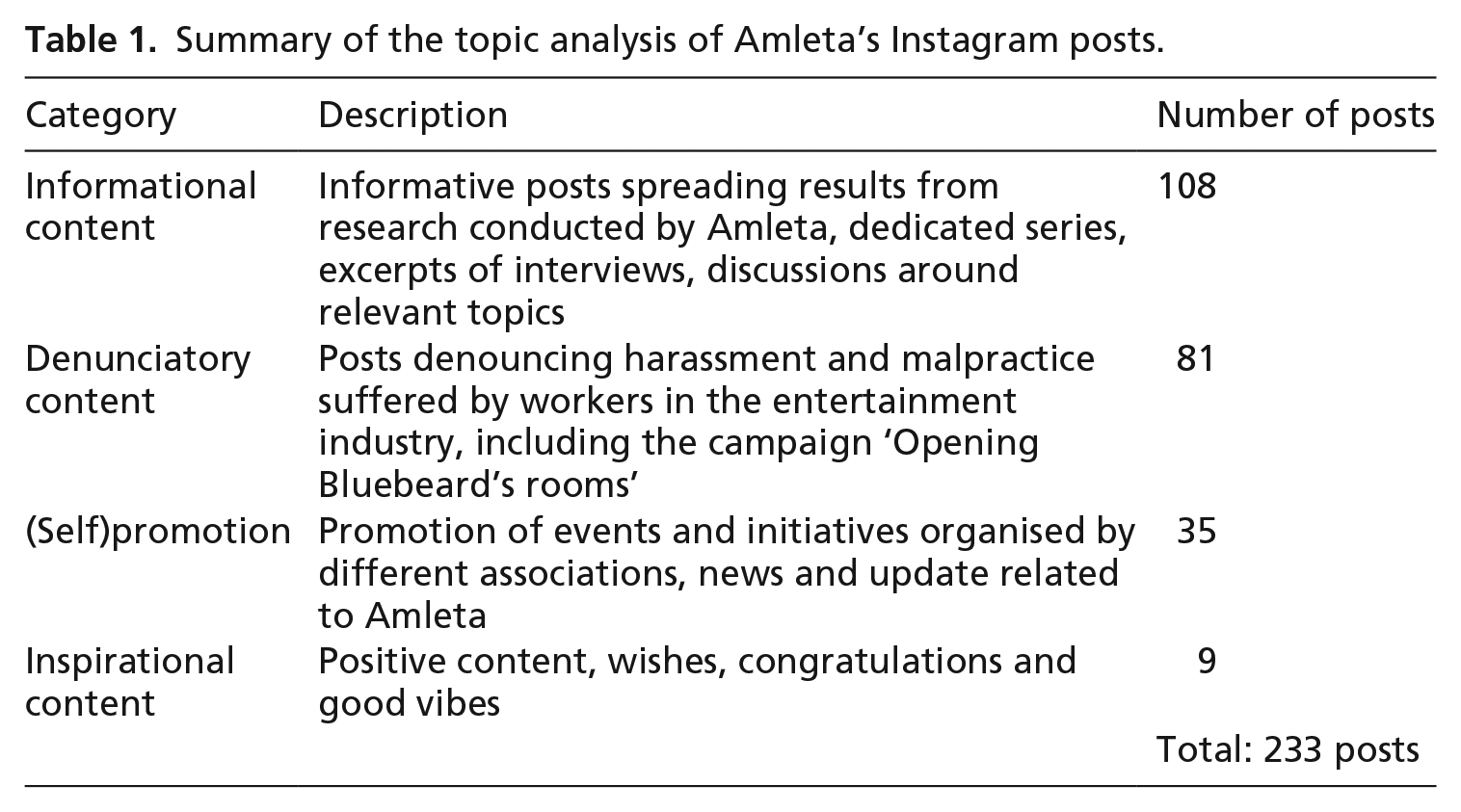
The manifesto also sets the agenda for Amleta’s online activities: as it emerges from the analysis of the posts, the content published on the page can be divided into four categories according to the main purpose: informational content, content denouncing harassment and malpractices, (self)promotion and inspirational content. ‘Informational content’, which is the most substantial category, includes posts related to diverse topics, such as the results of research conducted by the association, excerpts from events and different dedicated meetings organised by the group. Among the latter, one of the most representative series of events is ‘Mercoledì di genere’ (Gender Wednesday), a weekly event featuring video interviews with professionals coming from different fields (activists, philosophers and academic professors) to discuss issues related to women’s presence in the entertainment industry. The second most relevant category, based on the number of posts, contains posts denouncing malpractices: apart from some instances reporting specific events, posts refer to the campaign ‘Apriamo le stanze di Barbablù’ (Opening Bluebeard’s rooms), which was launched by Amleta to denounce harassment and sexual violence in the entertainment world. Offering a source of solidarity and advice that goes beyond work-related issues, through the medium of a dedicated email address, Amleta proposed a ‘safe space’ of discussion.
We will thoroughly analyse the campaign in the next section. Within this category, a small number of posts contain calls to action, where women are invited to stand against discrimination and harassment in the workplace. Another group of posts is dedicated to the promotion of events organised by Amleta and news around their activities or those of sister associations. Finally, ‘inspirational content’ is comprised of a handful of posts spreading positive vibes and news as well as promoting a culture of solidarity and attention towards women’s professional success in the entertainment world.
Table 1 summarises the findings of this part of the analysis, reporting the name of the category, their frequency in the data set and a brief description of their content.
Summary of the topic analysis of Amleta’s Instagram posts.
From the content shared on the Instagram pages, Amleta’s intent emerges, to both open a space of reflection around discrimination in the entertainment sector as well as its devotion to construct online spaces of solidarity. In this sense, the interviews conducted complement and enrich the digital data by pointing at the subjective experiences of members where solidarity and commitment have a central role. Born during a time of profound uncertainty and isolation like the lockdown, participating in Amleta’s activities provides unemployed actresses with a new meaning and newly found purposes.
Everyday I have new things to do for Amleta and I’m very happy about it. Everything started making more sense, especially during a time in my life in which I’ve been feeling lonely and isolated [. . .] I’ve spent 2019 completely lost at work level: I had none to guide me or provide me with the tools to make my way into this career. I wasn’t lucky enough to be one of the few who are taken under someone’s wing and offered jobs. That was not my case, and I was left on my ass. [. . .] Now I’ve found this solution, that is to build a network, because after so many failed attempts it is also difficult to try again, to scout for new opportunities [. . .] But I’ve found these people that give me that type of emotional professional security that I need, so now I’m trying not to desperately cling onto something but to positively embrace a series of possibilities for the future with them, because you can’t go anywhere on your own. (F.) Surely my experience with Amleta orients my journey and maybe it’s also a matter of an individual journey that becomes a collective one and therefore more effective on different levels. (M.)
The positive effects derived by participation in Amleta mentioned by the interviewees revolve around feelings of empowerment and a shared sense of community building. For instance, as F. puts it, becoming a member of the association helped her during a time where she was unsatisfied with her working life because of the scarce job opportunities and the lack of support. In this context, Amleta gave members the occasion to set up a network providing a type of security and solidarity much needed to face the difficulties of a precarious and competitive career path. Similarly, M. implies that the sense of empowerment derives from realising that they are not alone anymore facing workplace difficulties pointing at the positive affective role of communitarian belongings. As it emerges from these extracts, this sense of belonging goes beyond the professional environment towards investing in an existential dimension. Besides creating a professional network, Amleta enables the construction of a professional community around common interests and experiences. In this sense, how this digital experience managed to provide meaning and generating affective power in an historical disruptive moment such as Covid-19 pandemic emerges.
Forging digital narratives: ‘Opening Bluebeard’s rooms’ campaign
The campaign ‘Opening Bluebeard’s rooms’ (it. Apriamo le stanze di Barbablù) was launched by Amleta in November 2021. Counting 58 dedicated posts, which totalled over 13,000 likes, the content stemming from this initiative was particularly popular and features high engagement rates in terms of metrics. The campaign scope was national, as was the response that it generated: texts and hashtags were in Italian apart from #metoo and #metootheatre that aimed at connecting with international instances. In the following analysis, this digital action is regarded, on the one hand, in relation to the subjective experiences of Amleta’s activists and, on the other hand, with regard to the instances of international feminist issues in the digital environment like #metoo and #metootheatre.
Intending to shed light on issues related to sexual harassment in the entertainment industry, a post published on 9 November 2020 sets the scope of the initiative: the 25th of November is the International Day for the Elimination of Violence against Women, so Amleta decided to devote the entire month to ‘a phenomenon which to date is completely buried and tolerated, sexual violence against actresses’. Specifically, the association decided to publish a selection of different stories and testimonials, which had been collected for more than a year. In the same post, the connection with French protests against harassment in theatrical environments – #metoothéatre – is made explicit through the use of hashtags. The popularity of international protests is in this way recalled, with the intent of spreading awareness around despicable phenomena taking place in the workplace and generating a similar emotional response. Introducing the main assets of the initiative, F. reports that the path leading to the campaign launch began in the first days of November through a series of introductory posts anticipating the topic and contextualising the #metoothéatre protests in France.
The campaign on Instagram was planned through a series of steps. So a week before, we started posting questions every day like ‘audition or abuse?’, ‘genius or rapist?’, ‘ok violence against women, but what about violence against actresses?’. So, we laid the basis through these posts and, in the post previous to the one explaining the campaign, we provided an overview of #metootheatre in France. Let’s say that we leaned on this huge movement that is shaking the foundations of the French theatre and that came to the fore roughly at the same time as we did, so as to boost our resonance and somehow provide a national response to what our cousins beyond the Alps are doing. (F.)
Indeed, Amleta’s communicative strategy had the twofold objective of situating the campaign in a wider international context but without assuming the narrative framework of the #metoo movement. In fact, Amleta personalised the campaign by creating an original name, developing a metaphorical narrative and devising peculiar grassroots participation modalities. The name of the campaign explicitly recalls Perrault’s folktale ‘Bluebeard’ and, in the narrative construction, the theatrical sector can be viewed as Bluebeard’s castle, full of rooms, some of which often remain closed and unknown to the outside world.
In the original tale, it is a woman who revealed Bluebeard’s skeletons in the closet by opening a door. So, we took charge of opening these doors, uncovering the veil of hypocrisy and silence that characterises our working environment. (F.)
Following the trail of this metaphor, Bluebeard is described as ‘the audition we would rather not have, the words we wouldn’t want to hear, the message we wouldn’t want to receive’ (post published on 9 November 2022). In the context of the campaign, a call for action addressed to the Instagram page’s followers (and beyond) was launched, inviting them to take a photo of themselves holding a key and a sign featuring the official hashtag of the campaign: #apriamolestanzedibarbablù (Opening Bluebeard’s rooms). In parallel, followers were invited to share their personal experience of violence and abuse. At a visual level, the posts published during the campaign display Amleta’s distinctive layout and the yellow and violet colour combination. To further personalise this content, the denouncing posts employ a unique and recognisable graphic design, featuring a purple frame, Amleta’s logo and a key, which symbolises the key Opening Bluebeard’s rooms.
As reported by F., the initiative had considerable resonance and prominent figures of the entertainment sector supported the campaign. In particular, an affective contagion permeated social media regarding Italian showbusiness’ workers during November 2021, and spread solidarity with Bluebeard’s campaign.
We had a lot of resonance for sure. Many people thanked us for the work we’ve been doing and the effort we put in, someone even told us ‘I was scared, then Amleta came’ [. . .] Thanks to these testimonials we were able to take legal actions that are still ongoing, although slowed down by many obstacles, as it is always the case when dealing with cases of violence and sexual abuse. In any case, we were starting off with a proven experience related to this and are able to provide some support to the victims. (F.)
In generating emotional proximity and community feelings, F. explains how the stories collected during the campaign pushed Amleta to develop a partnership with a lawyers’ office to offer legal support to the victims of violence and harassment at work. Moreover, it emerges from the analysis of the amount of emotional and affective labour spent. During the interview, F., who was contributing to the collection of testimonies sent to Amleta, explained how she was deeply affected by reading and editing the stories of abuse.
For us it’s been a really enriching experience, despite the psychological burden, because I can’t deny that it’s been a hard month for all of us. As for me, I read all the testimonials because I was one of the few who was involved with Osservatoria [a part of the Amleta project involved with gender violence n.d.a]. So I kept on reading the stories and it’s been far from easy: it’s been emotionally demanding work and I was triggered by the content, also due to my personal experience. (F.)
In this sense, not only participants sharing their experiences of harassment perform an emotional effort but also the activists that are in charge of the campaign organisation, in a deeply engaging and emotional process (Mendes et al., 2018). Shouting episodes of violence out loud aims at provoking emotional and psychological reactions on social media with the intent of spreading awareness among the public opinion. However, the interviews shed light on how the affective consequences affect not only those reading the content, but also activists that produce and organise it. In this sense, the words of F. point to the, often hidden, work of care that takes place behind the screens of digital activisms and the emotional labour that activists perform every day (McKinney, 2020; Mendes et al., 2019).
Discussion
The analysis shows that Amleta’s feminist actions are structured around the creation of affect and inspiration through informational activism and communicative labour (McKinney, 2020). In this sense, on the one hand, the group auto-produces media contents on intersectional and gender matters in the entertainment industry and, on the other hand, it creates networking opportunities for organiser and users. During Covid-19 times, activists’ experiences of digital activism underline how active engagement provided personal meaning and a sense of belonging as well as emotional challenges to the activists that worked every day on the production of contents. Questioning the idea of ‘coolness’ attributed to work in the cultural and creative sectors (Gill, 2002), Amleta’s digital activities not only make room and give visibility to women’s voices in the entertainment industry but explicitly challenge sexist dynamics in the workplace. Disseminating awareness about malpractice becomes a communicative and political action challenging the status quo and allowing women to move their experiences from an individualised understanding towards a level of systemic awareness. Furthermore, Amleta’s actions have not been confined to the digital sphere but were followed up with several activities, such as the organisation of a festival with shows and debates in the city of Milan and the establishing of a dramaturgical prize for theatrical text. 2 The effort to end the sector’s tolerance of harassment practices was honoured with Amnesty International Italia’s prize ‘Arte e diritti umani 2021’. 3 In the past two years, events have been organised among industry bodies to discuss and prepare new guidelines preventing sexual harassment in procedures of casting selection 4 and unions have advocated the need to develop a code of conduct for both employers and employees. 5 Amleta’s mapping of the Italian theatre sector’s gender imbalances was the first developed in the Italian context and pointed not only at discrimination experienced by actresses and female directors, but also at the need to conduct future research on gender, work and violence in the arts and culture sector. The campaign ‘Opening Bluebeard’s rooms’, that was launched in November 2021, challenges practices of discrimination and harassment through the reinterpretation of the #metoo movement, creating an original narrative framework for the sharing of experiences, a distinctive visual aesthetic and a unique metaphorical imagery. In this sense, insights from the international #metoo movement are grasped, elaborated and inserted in a local narrative tied to the specific national context. The choice of the colours and the narratives mobilised during the campaign intersect, often provocatively, with the jargon of the theatrical environment. In this sense, it emerges how the actresses master and make use of narrative instruments characteristics of their working environment to talk about themselves and their experience. Consistent with what emerges from the interviews, Amleta created a digital space where a feminist ‘speaking in one’s own terms’ is possible, taking control of the discourse that is mobilised through the appropriation and the creative elaboration of keywords and narratives.
Most research on Instagram has shown how personalisation appears to be a key asset in the digital culture of Instagram and the stylistic hallmark of its cultural production (Lee et al., 2015; O’Donnell, 2018). In this framework, the communication analysed is to a certain extent de-personalised. On the Instagram page, Amleta presents itself as a homogeneous entity, using collective impersonal pronouns. Despite the opportunities that the display of a personalised activism could bring in terms of networking and self-promotion offered by the platform (Duffy and Hund, 2015; Soronen and Koivunen, 2022), individual biographies and personal motivations are sidestepped with the intent of giving space and voice to users’ testimonies. In this sense, Amleta’s digital communication can be inserted in an activist framework of action, but present modes of operation on the social media that are far from influencer activism as it has been characterised (Semenzin, 2022; Thomas and Fowler, 2023). In fact, rather than personalisation and marketisation, Amleta constructed its identity online through shared narratives and the reinterpretation of imaginaries and symbolism, able to provide meaning, to orient towards action, and to create a sense of community. In this sense, indeed, online opportunities of expression are shaped by the platform’s affordances, but users have an active work in their actualisation and reinterpretation (Papacharissi, 2010).
Conclusion
Exploring the Instagram activity of Amleta, this article sheds light on the use of digital spaces to protest against practices of violence and discrimination, which are taking place in the Italian entertainment industry. During the difficulties that the theatrical sector encountered because of Covid-19 lockdowns, spreading awareness about malpractice in the workplace became a communicative and political action, calling into question the status quo and allowing women to move their experiences from an individualised understanding towards a level of collective awareness. On the one hand, Amleta’s digital action offers an example of how actresses publicly challenge creative and cultural sectors’ narratives of equality, coolness and diversity (Gill, 2002; McRobbie, 2002), speaking up against inequality from their vulnerable conditions in the workplace (Gill, 2014). On the other hand, the analysis shines a light on digital, non-mainstream, practices on social media which are oriented towards community-building and social goals rather than commercial and self-promotional aims. In this sense, while scholars in feminist studies and digital media have often considered global trends, letting controversial aims around women’s activism emerge, our study, focusing on digital practices in a peripheral area, details and accounts for non-mainstream feminist practices able to promote social change beyond the borders of the platform.
Footnotes
Funding
The author(s) received no financial support for the research, authorship and/or publication of this article.
