




Abstract
This article examines the genesis and development of the Festival of Political Songs (Festival des Politischen Liedes) in East Berlin under the German Democratic Republic from 1970 to 1990, looking at it as one of the main engines of the German Democratic Republic-musical field in the last twenty years of its existence. In this regard, the analysis of the empirical material (in-depth interviews and video recordings) serves first to outline the main social and cultural processes which interested the Festival from its inception to its end, and second to reflect upon some specific features of the Festival as an ‘extraordinary event’ in light of Bourdieu’s concept of field. Departing from this perspective, I examine the genesis and development of the Festival, focusing especially on the contrasting effects produced by its institutionalization and internationalization and the ways these impacted both the Festival and the musical field: from the creation of music scenes, to the development of professional careers in different fields of cultural production and the mixing of mainstream and alternative musical trends. The final aim is to highlight the different understandings of publicness and openness associated with the Festival that defined its social, spatial and emotional structure during its twenty-year lifespan.
Introduction
The Festival of Political Songs was instituted in 1970 by the members of the most well-known singing club of the German Democratic Republic (GDR), East Berlin’s Oktoberklub, on its fourth anniversary. While mostly appropriating the attitudes and music practices of US folk singers/songwriters, they acted within the political frame of the youth organization ‘Freie deutsche Jugend’ (FDJ – Free German Youth). In the first three editions, the members of the Oktoberklub organized the Festival autonomously, 1 inviting international guests with whom they were personally in touch, though financially supported by the FDJ.
In 1973, the inclusion of the Festival within the World Festival of Youth (under the name ‘Politische Lieder zu den X’) marked its international success and political institutionalization, affecting its organization and the relationships between the musicians and politicians involved in the making of the Festival. The Festival also became a pivotal space where GDR participants and organizers (members of the singing clubs, Party and State representatives, artists, etc.) took a stand not only on musical questions, but also on questions regarding the social and youth politics of the GDR-State. This occurred through both the music performances and roundtable discussions, as well as through the spatial arrangement and choice of artists. In Geertz’s (1973) terms, the Festival provided its GDR participants the possibility to dramaturgically express the underlying conflicts among politicians, singing clubs, intellectuals and artists.
With the annexation of the East German regions by the German Federal Republic in 1990, the constraints, spaces of actions and meaning of the festivals that, until that moment, had been influenced by the cultural politics and political culture of the GDR-State no longer existed. Whereas other festivals, such as the Dixieland Jazz Festival in Dresden and the Folk Festival in Rudolstadt, took advantage of the new political context, gaining international notoriety, for the Festival of Political Songs this meant its end. After the last edition in 1990, some of the previous organizers built the association ‘Lied und Soziale Bewegungen e.V.’ with the goal of preserving the heritage of GDR-political songs by continuing to organize a festival (named the ‘Zwischenwelt-Festival’). Nevertheless, there were economic problems and, conceptually, the new festival was rather unfocused. In 1995, the association was dissolved because of financial liabilities (cf. Lied und soziale Bewegungen e.V., 2011).
The failure of the new festival was, however, also related to the crisis of the GDR song and rock scenes, 2 which had been strongly related to the genesis and development of the Festival and whose success was also due to the criticism toward GDR-State politics found in their song texts. In this perspective, the end of the Festival of the Political Songs is as equally interesting as its genesis for examining the interdependence between the GDR-musical and political fields (see Grüning, 2022).
On these grounds, in what follows, I will first illustrate my conceptual framework based on field theory and the international literature on festivals. After presenting the empirical material collected, I will show how the Festival represented one of the main engines of the GDR-musical field in the last twenty years of its existence: from the creation of music scenes to the development of professional careers, especially in different fields of cultural production (on this concept, see Bourdieu, 1993, 1998), and the parallel emergence of mainstream and alternative musical trends (Nagorsnik, 1999). In the last section, I will focus on how some features generally attributed to festivals were actually intended, spatialized and practiced in the Festival of Political Songs, according to its two levels of organization (by the singing clubs and the political youth organization).
Theoretical frame
The analysis of the Festival of Political Songs departs from two theoretical premises.
The first one concerns thinking of it as a peculiar time-space structure that, while resulting from the logics of the GDR musical field, generated meaningful changes in it at the same time. This perspective entails envisaging the two faces of the field together, as a configuration of objective relations between positions and a space of game. In this second connotation, the participants in the field act according to the capitals they possess, based on their original position and experiences accumulated over time, which may influence their initial set of dispositions, game strategies and capability to change the game’s rules for their own benefit. Two aspects are noteworthy here. First, those who participate in the field game possess the illusio ‘that the game is worth playing’ (Bourdieu and Wacquant, 1992: 98). This illusio is emotionally founded and shared among the participants independently from their positions and interests. Second, engaging in the field means having experience of it in concrete physical spaces (Bourdieu, 2000; cf. Savage and Silva, 2013).
With respect to the GDR-musical field, this first means that all the divisions and distinctions structuring the social space of the musical field were constructed by the artists, Party and State representatives through their practices and strategies in the physical spaces of music production and consumption. This practical understanding of the musical field, while mediated by bodily and sensory experiences in physical spaces, also depended on their structural position in the field. Not least, the material construction of social and symbolic boundaries within the musical field implied for the artists the creation of distinctive and located senses of belonging, for which occupying the same physical spaces while playing, discussing and listening to music also created the feeling of belonging to the ‘same scene’ (see Grüning, 2022).
In this regard, the Festival of Political Songs represented one of the more symbolic events, both because it was structured by the power relationships among actors participating in different fields of cultural production as well as in the political and the bureaucratic fields, and because the different material, cultural and aesthetic organizations of festival spaces enabled its participants to experience, practice and interpret the music and its relationship with politics differently.
The second premise concerns using some crucial categories adopted for studying festivals in ‘Western democratic’ contexts to analyze the Festival of Political Songs in the GDR. The few works devoted to festivals in the countries of the Soviet bloc either stress the centralized influence of the State on all aspects of festivals or the juxtaposition between a small group of festival organizers/artists and the political authorities. In the first case, festivals are seen as artistic events which confirmed and celebrated the State’s political culture, while in the second case they are understood as events which built a relative time-space frame where people could experience a sense of freedom and alternative art forms, not rarely related to alternative ways of understanding Socialism and real Socialism (cf. Jakelski, 2017; Kötzing, 2014; Moine, 2014; Nagorsnik, 1999; Tompkins, 2013).
However, with respect to the Festival of Political Songs, neither of the two narratives are able to account for its institutionalization and internationalization processes and the effects the Festival had on the production, dissemination and consumption of music in the GDR. Indeed, beyond enhancing the State’s intervention, the institutionalization of the Festival also impacted, in less obvious ways, its social structure and aesthetic forms. Furthermore, some State and Party representatives participated in the musical life of the GDR during and outside the time-space grid of the Festival. Thus, even though the trajectories and interests of artists and State and Party representatives differed, they shared at least a similar feeling of belonging due both to a common belief in Socialism and, sometimes, participation in the same musical physical spaces (i.e. they shared the same illusio).
In this regard, I will borrow some of the categories mostly used to analyze festivals in Western and/or ‘postmodern’ societies – such as those of social inclusion, public space and public sphere (cf. Collins, 2013; Costa, 2002; Laing and Mair, 2015; Quinn, 2005; Turner, 1969) – to show how they are not exclusive to ‘democratic liberal’ contexts. Rather, their understanding changes according to how they are (and were) concretized in specific social-cultural contexts. The question is, therefore, not so much whether the Festival of Political Songs was ‘democratic’ or ‘inclusive’ according to a supposed universalistic viewpoint, but to what extent the Festival organizers, the festivalgoers and the artists defined it as such according to their (cognitive, bodily and sensorial) experiences and their position in the broader musical field.
For the analysis, I will therefore first consider Collins’ (2013) understanding of festivals as producing a high ‘degree of collective effervescence’. Various authors have interpreted this aspect as a condition strengthening ‘community ties’ (Bennett et al., 2014) and/or providing ‘occasions of sociability’ which may, in turn, contribute to enhancing a sense of the ‘public sphere’ (Costa, 2002). Sharpe (2008) delineates the latter concept in terms of a sphere for struggle which enacts social changes. Thus, according to him, the leisure character of festivals creates the conditions for building networks and celebrating solidarity, as an emotional resource that favors cultural resistance. In addition, Quinn (2005) highlights the importance of the cultural dimension of festival spaces for reinforcing a sense of belonging and building a shared identity.
Nevertheless, some authors have also shed light on the ambivalent character of the ‘communities’ shaped by festivals. So, for instance, by distinguishing between bridging and bonding forms of social capital, Wilks (2011) observes how, in music festivals, ‘bridging-type social interactions between people who were previously unknown to each other were not common’ (p. 293). Laing and Mair (2015) argue that festivals may favor ‘social integration’, providing ‘opportunities for social advantage, identity, and improved self-esteem’ (p. 255), but they also point out that, to fully grasp the social impacts of festivals, it is important to focus on how communities are framed and by whom. However, following Turner (1969), they mostly stress how the liminal character of a festival’s time-space structure would encourage the building of (temporary) communitas ‘associated with an atmosphere of social equality, sharing, intimacy and togetherness’ (Stone, 2008: 215; quoted in Laing and Mair, 2015: 257). More challenging is the analysis of Fabiani (2003), who notes the stratified character festivals may assume, thus putting into question any understanding of them as purely public spheres.
Finally, new strands of research in the tourism and management disciplines highlight how festivals have been progressively subjected to commodification and ‘eventization’ processes (Maasø, 2016; Robinson, 2016; Sassatelli, 2011). It would be, however, misleading to look at these latter processes as if they only characterize festivals of the current neoliberal phase and as if they hinder the possibility of social inclusion, sociability and so on. Indeed, three aspects of the commodification and ‘eventization’ processes of festivals are noteworthy for the following discussion: the fact that they also gather communities of taste (Barrière and Finkel, 2022), that they are useful for urban re-generation (Shin and Stevens, 2013) and that, by returning the impression of an apparent lack of regulation, they make people think they are living ‘authentic’ experiences (Griffi et al., 2018). In the case of the Festival of Political Songs, the GDR State favored the eventization of the Festival to increase both its international prestige (with respect especially to Western countries) and a feeling of belonging to a (national) community. Nevertheless, in what follows, we will see how, beyond the role and intentions of the State, looking at these aspects from a field perspective means considering how these aspects were translated into practices and spatialized, and which understandings of social inclusion, solidarity or the public sphere were at stake and enacted during the Festival by different actors.
Empirical material
The empirical research was carried out between 2017 and 2020. The following analysis is mostly based on 1., video recordings (18) of the Festival produced by GDR-television 3 and 2., in-depth interviews (9).
The video recordings mirrored the State’s viewpoint on the Festival as they mostly showed the more institutionalized events of the Festival program, such as the opening and closing ceremonies, which took place in the more highly (politically and culturally) institutionalized places of East Berlin: initially at the House of Congress in Alexanderplatz (Kongresshalle), and later in the Palace of the Republic (Palast der Republik) which, besides hosting more cultural spaces, was also the seat of the GDR parliament (Volkskammer). In this regard, the video recordings shed light on some crucial aspects of the institutionalization process of the Festival, including the increasing importance of the aesthetic arrangement of the spaces, the increasing distance between artists and the public and the increasing professionalization of the festival organizers.
The interviews were carried out to provide crucial information on the history, organization and political boundaries of the Festival; grasp the different experiences of the interviewees in the Festival, according to their social trajectories and, on the other hand, understand what role the Festival played in orienting their careers.
The interviewees: an overview
The interviewees were selected on the basis of two criteria: their official or unofficial role(s) in the Festival as organizers (Kirchenwitz; Koerbel; Seichert), artists (Kirchenwitz; Koerbel; Pietsch; Andert; Leyn; Kempenddorf; Schwarz), music journalists (Koerbel; Schwarz) and music experts (Wicke) and their broader political, cultural and musical experiences. All the interviewees were born between the end of the 1940s and the end of the 1950s; thus, they belonged to the same GDR-generation, the ‘integrated’, that is, those who were socialized during the consolidation phase of Socialism (Schüle et al., 2006). While they all possessed similar academic cultural capital (they all had university qualifications in the humanities), they mostly differed with respect to their political capital (i.e. among them, for instance, Kirchenwitz and Pietsch were members of the Socialist Party, Seichert was a party representative, Kempenddorf was close to the protest movement in the 1980s), despite sharing a similar (critical and emotional) understanding of Socialism. More interesting, however, is that even their different musical experiences and practices (such as having belonged to the singing movement or having been close to specific musical subcultures) highlighted their different positioning toward the GDR State and the Socialist Party’s (cultural and youth) politics.
More specifically, Lutz Kirchenwitz, Gina Pietsch and Reinhold Andert belonged to the singing group Oktoberklub from the beginning and were co-founders of the Festival of Political Songs. After the institutionalization of the singing movement by the FDJ, they went their different ways. Kirchenwitz remained in Oktoberklub for a long time and was later hired to organize the Festival of Political Songs. Pietsch co-founded the professional singing group Jahrgang ‘49, also supported by the FDJ, which provided her the opportunity to go on tours within and outside the GDR, especially in other festivals and fairs close to the European communist parties, such as the Festa dell’Unità in Italy. After the singing group split up in 1979, Pietsch continued to participate in the Festival as a soloist, specializing in the chanson genre. Andert, refusing its politicization by the FDJ, left the singing movement and became a singer-songwriter. Nevertheless, he continued to be invited to the Festival until the 1980 edition, where he explicitly criticized the political apparatus. He was then banned from playing music in public venues and consequently isolated from the broader music life. In the 1960s, Stefan Koerbel belonged to the singing group Lyrik – Song-Klub (LSD). He participated for the first time in the Festival in 1971 with LSD, and again in 1973 with the singing group of the army. In the following years, he participated various times with the alternative singing group (Lied-Theater) Karls Enkel and, in 1989 and 1990, as a singer-songwriter. He was also an organizer of the Festival and its reporter for the radio channel DT64, devoted to the newest and youngest music genres. One of his songs, in which he criticized the Stasi, was censored. Petra Schwarz joined Oktoberklub as a second flutist at the end of the 1970s when she began to study in Berlin. She also moderated the Festival of Political Songs several times before starting to work as a music journalist for DT64. Wolfgang Leyn was one of the most representative artists of the GDR-folk scene which flourished at the end of the 1970s, not least thanks to the influence of Irish folk groups such as the Sands Family, who first performed in the GDR at the Festival of Political Songs in 1974. 4 He participated in the Festival both as an artist and as a moderator. Gerlinde Kempenddorf never participated in the singing movement. She became a singer-songwriter in a later phase with respect to the first generation, by following a professional track and dedicating herself to the chanson genre. In 1988, she had been invited to interpret Brecht and Tucholsky chansons, but she ‘improvized’ her performance by presenting an ‘actual song’ critical toward the GDR-State. According to her account, even though some Festival organizers publicly showed their dismay, the public was so enthusiastic that, in the end, the organizers were forced to invent a new prize specifically for her, thus rewarding her for the ‘most contentious music program’. Peter Wicke began to work in the early 1970s as a ‘private organizer’ of illegal rock concerts before accepting the Party’s proposal of a chair in Popular Music at Humboldt University. Thanks to his international academic relationships and experiences, he found many occasions for international artists to play at the Festival. Finally, from 1976 to 1980, Norbert Seichert as cultural secretary of the FDJ in Berlin was responsible for the organization of the Festival. After having attended the Party-school, not without critical confrontations with the Party leaders, he was tasked with following the artists of the Volksbühne theater. Thus, because of his direct participation in the places of cultural and musical production, he played an intermediary role between the political apparatus and the artists and, as is evident in his interview, he often felt closer to the latter.
The Festival of Political Songs as an engine of change in the GDR musical field
In this section, I will analyze the institutionalization and internationalization processes of the Festival of Political Songs and their social and spatial effects on the organization of the Festival and the GDR musical field.
To better grasp the main transformations over time, I will pinpoint four stages of the Festival’s history.
From its inception in 1970 to 1973, the Festival maintained an amateur character (interview with Kirchenwitz). Despite being officially sponsored by the FDJ of Berlin, Oktoberklub managed both the program planning and contacts with national and international artists and singing groups. In 1970, the main venues of the Festival were the International Kino (a cinema), Oktoberklub’s original location and the Kongresshalle in Alexanderplatz used for the inauguration and closing night of the Festival. In 1971, the International Kino was replaced with the Haus der jungen Talente, the central clubhouse of the FDJ.
In 1973, the Festival was included in the X. Festival Weltfestspiele. It was arranged in the Freilichtbühne and Volksbühne theaters, as well as the Werner-Seelenbinder-Halle sports facility. As my interview partners stressed (Kirchenwitz, Körbel, Andert, Seichert and Schwarz), the success of the event allowed the Festival to make a leap forward, convincing the State to reinforce its presence in the Festival for the following years, in terms of both economic support and bureaucratic organization. This also positively impacted the internal offer, even though initially it was in a more quantitative than qualitative way. Furthermore, the invitation of foreign artists began to function on a binary (interview with Kirchenwitz): whereas the political functionaries asked the youth organizations of the Soviet bloc and other communist countries (i.e. North Korea) to send delegate singing groups to the Festival, Oktoberklub used informal networks to keep contact with artists mostly in Western countries and South America. This also resulted in the Festival participants having different musical competences and being differently appreciated by the public. To not disregard the public’s expectations, the Festival organizers adopted as its main solution the mixing of ‘good’ and ‘bad’ performers, even though this strategy functioned only partially in the 1980s (interviews with Kirchenwitz and Körbel).
In 1980, a specific office dedicated to the Festival was established, further reducing the autonomy of the Oktoberklub group and strengthening controls on GDR-artists (interview with Kirchenwitz). On the other hand, the increasing economic support, as well as the cultural liberalization politics promoted by Honecker, led to the enlargement of the musical offer in terms of both genres (singer-songwriters, song-theater, rock and folk) and the presence of well-known international artists. Two further changes were notable in these years: the involvement of musicologists in the organization of the Festival program and the establishment of a tour across the GDR after the Festival, with national and international artists selected by the FDJ. Finally, the increasing institutionalization and success of the Festival had a threefold effect. First, being invited to the Festival was more and more a sign of prestige (interview with Körbel) and therefore an important step in one’s career and trajectory within the musical field. Second, moderating the Festival became a springboard for getting ahead in GDR media, that is, to be legitimated also in the media field. Third, the creation of exciting atmosphere(s) had an increasing relevance in defining the success of the Festival (interview with Schwarz).
The final years of the Festival were characterized by the State’s attempt to intensify its control over GDR artists by the Stasi, in contrast, however, with its increasing trend toward ‘eventization’ favored by the presence of international stars. Not least, the intensified control was mostly addressed to the (GDR) songs’ texts, also a sign of the difficulties of maintaining control over all the events included in the Festival and whose performances could not be preventively monitored (interviews with Seichert and Kempenddorf).
Summing up, the institutionalization of the Festival had several contrasting effects. While the establishment of a bureaucratic apparatus increased State control over the Festival, the economic support enhanced its internationalization and international success. In other words, the State had a direct return from the Festival in terms of prestige, but this was less and less based on political criteria. The need to compete in an international musical field entailed creating other standards for measuring the Festival’s success than ideological-political ones, as was evident in the creation of exciting atmospheres through innovative performance forms and spatial synesthetic arrangements. Furthermore, the more the number of performances and participants (as well as their musical differentiation) increased, the more it was difficult to directly control Festival performances, for which the political apparatus enhanced its control over the songs’ texts as a compensatory measure (Table 1; Figure 1).
The Festivals in numbers (1970-1990).
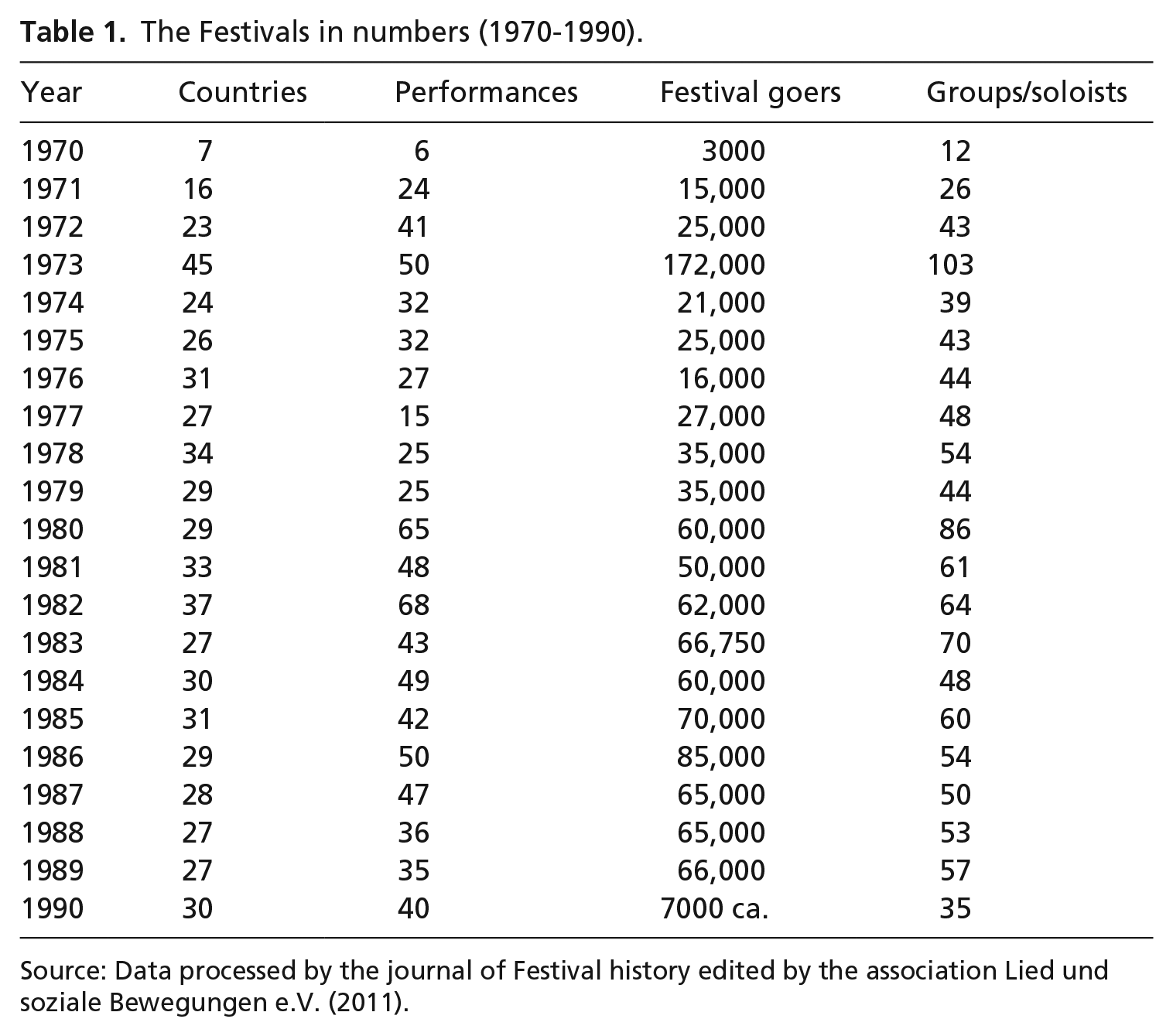
Source: Data processed by the journal of Festival history edited by the association Lied und soziale Bewegungen e.V. (2011).
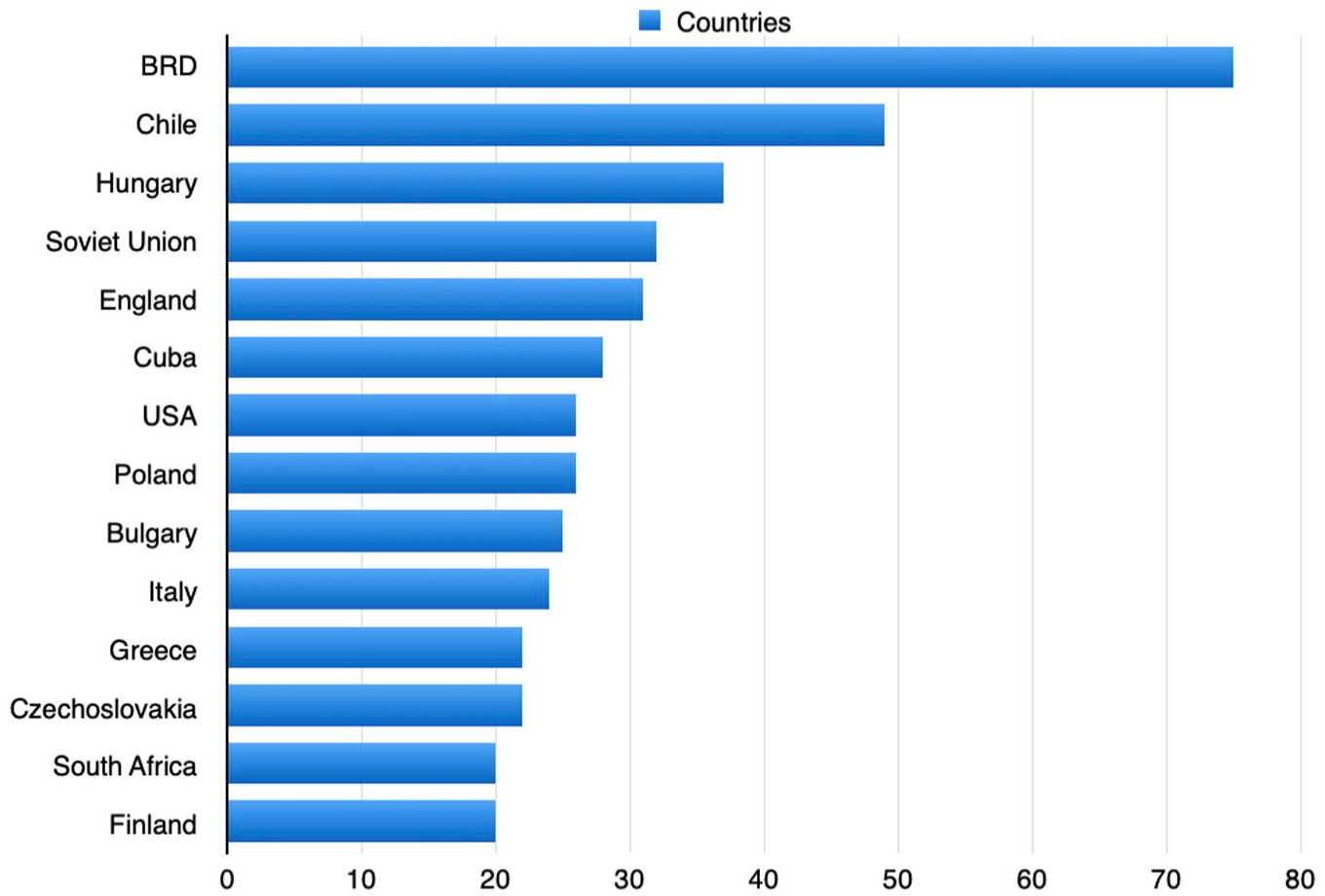
Music artists and groups by countries (1970-1990).
With respect to the effects of the Festival on the GDR musical field, the success of the Festival primarily persuaded the State to support the professionalization of artists in the subfield of entertainment music which, until that moment, had been disregarded by interpreters of classical music who dominated the GDR musical field (see Grüning, 2022). On the other hand, however, this kind of support also entailed a greater control over their careers. Furthermore, in front of the increasing institutionalization of the Festival as one of the main places for celebrating both the State and the singing movement, the space of actions of the former singing clubs was reduced and many of the former members decided to undertake different artistic careers, as singer-songwriters, chansons interpreters, theater musicians, folk musicians and so on, thus building new scenes within the GDR musical field (cf. Robb, 2000). By favoring the professionalization of entertainment musicians and the building of new scenes, the Festival also affected the symbolic and social structure of the GDR musical field, on the one hand, by fostering its internal differentiation and new evaluative criteria more related to the ‘tastes of the public’ and, on the other hand, by favoring the emergence of musical artists who possessed a different set and volume of musical and political capitals than the interpreters of classical music (see Grüning, 2022).
A further, crucial perspective through which to grasp the twofold character of the Festival of Political Songs and its effects on the GDR-musical field is spatial.
The performances were spatially allocated according to two criteria, ‘elite music versus popular music’ and ‘political celebration versus political criticism’, creating an internal hierarchy. The most successful (with respect to the public) and the most politically symbolic performances were hosted in the more important cultural and political institutional buildings, whereas the more elitist performances and more (potentially) critical performances were arranged in the more off-center cultural institutions of Berlin, offering the occasion for their organizers to work more autonomously (e.g. the programs ‘Hier um Elf’ and ‘Musik und Politik’). Furthermore, the spatialization of the Festival was also marked by its time division. Wicke identified three levels in this regard: (1) the formal time-space of the Festival corresponding to the public Festival performances; (2) the ‘half-official’ time-space corresponding to the arrangement of private performances and political roundtables in the House of Young Talent (Haus der jungen Talente) once the official Festival performances had ended, reserved for (national and international) participants, organizers, journalists and political functionaries (a participant pass was needed) and (3) an informal ‘time-space’ followed which was also extended to other urban venues (clubs).
In this regard, both the bureaucratic and spatial organizations of the Festival supported the flourishing of scene cultures in the urban life of Berlin, not least by favoring the dissemination of specific forms and models of ‘musical spatialization’ (on this concept, see Bennett and Roger, 2016). As especially stressed by Körbel and Kempendorff, thanks to these public venues which were partially controlled from the top, the State defined the spaces of possibility for their musical activities in a very contrasting way. While it materially supported their music and careers, at the same time it gave them reason to artistically express their criticisms, although within the boundaries of a specific political frame. In this regard, the censorship and the prohibition of performing, as well as the strategies to avoid them, were part of the rules governing the game of the musical field. As a result, the maintenance of the song scene as well as the rock scene within the State’s symbolic boundaries was possible because participating in the GDR musical field, that is, in music events and festivals supported by the State or political organizations, provided the chance both to pursue one’s own career and gain prestige, as well as to experience different forms of sociability (according to the three spatial levels) which, in turn, allowed them to build their own social networks and benefit from a relative degree of autonomy. In the end, these experiences allowed the accumulation of a specific form of emotional-political capital which preserved the illusio of the game, independently from their closeness to the State and the Party, and at the same time secured a consonance between the artists’ habitus and aspirations and the State epistemology:
And there was, of course, this feeling, that we were good people. We wanted progress for all, that everyone was equal, able to work, and had a home [. . .]. These were communist ideas, and when I reflect on these ideas nowadays, I say: ‘well, why not? They were good, but they didn’t have to happen’.
Did you discuss these ideas and feelings with the other artists after the concerts, for instance, in the House of Young Talent?
Yes, of course, after the concerts we discussed political matters. Of course, our knowledge was influenced by our socialist education [. . .] It is difficult to describe nowadays, it is as if you went to the Philharmonic today and you experienced a wonderful concert and then you went with friends to a coffee house and talked together about the wonderful concert, your musical experience, and your good feelings. (Kempendorff) 5
The twofold logic of the Festival of Political Songs
From its inception, the Festival of Political Songs followed a twofold logic depending on its two-level organization by the Oktoberklub and the FDJ, which generated different ways of experiencing and understanding it. In what follows I will illustrate this twofold logic by dealing with some of the aforementioned features characterizing festivals.
In the beginning, the ritualistic and celebratory character of the Festival was mostly related to the performances of socialist, antifascist and working-class songs as a shared cultural and political heritage among artists of different countries and through which the sense of belonging to an international community was founded. With the increasing institutionalization of the Festival, its perception as a space for consecrating an international socialist community took on an official meaning, that is, the political apparatus tended to use it also as a space for celebrating the GDR State and thus reinforcing social integration within its boundaries, between the GDR people (and especially young people) and the State. This suggests two interwoven processes of differentiation of the ritual practices, one diachronic, related to the evolution of the ritual forms of the Festival, and one synchronic, depending on their different spatialization. As especially emerged from the video recording analysis, during the closing ceremonies hosted in the more institutional Festival places, the ritual practices were repeated in the same form over time: they always concluded with the artists singing ‘Die Internationale’ together, positioned as if they were in a choir, within a setting which privileged symbols of the socialist tradition (i.e. scarlet carnations). Differently, more marginal places, especially in the 1980s, allowed rituals to be reframed by arranging other cultural elements closer to youth (sub)cultures. So, for instance, in 1984 for the opening day at the Metropole theater, the setting was constructed like that of a rock concert. While it began with greetings to the political authorities present in the room (Schabowsky and Honecker), it quickly switched to present in a very detailed and celebratory way the singing groups which would perform.
The spatial differentiation process of the Festival led, furthermore, to the building of different, but not necessarily self-enclosed, temporary communities which were distinguished from each other according to whether they were shaped in ‘formal’ (institutional public time-spaces), ‘half-formal’ (informal spaces created within an institutional political frame) or ‘informal’ spaces (interview with Wicke in 2020). Thus, they were distinguished according to who participated, the networks they constructed, the ways they interacted, their discourses and the material and symbolic specificity of the place:
Despite the passing of time, was the ritual structure of the Festival always the same?
Yes, at least during the official opening day, but then during the night we sat in the House of Young Talent where there were always singing clubs [. . .] and we always sang some songs, and it was not official, because radio and television were not there, and we also sang ‘L’Internationale’. 6 And sometimes the international artists also sang some critical songs that they could not sing in their public performances, but sometimes they also did it officially. (Schwarz)
It was the highlight of the year. There were people who organized their timetable going from one festival to another. There were a lot of imprinting events for them. For me too, I have to say.
And what did you do, beyond listening to music [. . .]?
[. . .] Well, it went on all night. It was something extraordinary for the GDR. Well, there was also a kind of night life [NA: outside the Festival] for the artists, but it was nothing special. During the Festival it was different. You could discuss, and drink, and dance. It was a great party, of course.
In the House of Young Talent?
Yes, it was the Festival club. Concerts were also in other places, but the club factory of the night life was always in the House of Young Talent, for all the East German people, it was very big, there was a big saloon, many rooms, many bars and cafés.
And did also the international artists take part?
Yes, of course, they were all there. Conversely, a Berliner who wanted to enter couldn’t do so easily. You had to have something to do with the Festival. (Körbel)
Different physical spaces characterized by different social networks and activities also conveyed a different sense of freedom and openness, depending on the different degree of control they ‘required’. This brings us to two considerations: (1) the control mechanisms were stronger in those Festival places and events where the State or Party’s image could be publicly damaged and (2) festival spaces were differentiated not only from the ordinary spaces outside the Festival period, but also from each other in terms of the feelings of freedom that could be experienced there, even though in an exclusive way.
The idea of social inclusion was instead embedded in the Festival of Political Songs from its inception in terms of ‘international solidarity’. The song group Oktoberklub as festival organizer attempted to intermingle the musical practices and styles of the civil right movements in Western countries with the socialist ideals with which they had grown up, addressing their attention to international political events.
And then we learned something about the American Peace and Protest movement against the Vietnam War, and [because of] these external influences in the GDR, we also declared our solidarity [. . .] and it was our youth, and there was nothing to complain about, and if we had a thought, it was a thought of solidarity [. . .] I don’t know, but young people found themselves in a situation where they wanted to enjoy music and sociability all the time, and in a specific, so to speak, ‘political form’ [. . .]. Nevertheless, this regarded not only the GDR people participating in the singing movement and Festival, but young people around the world (Seichert).
The highest point of the solidarity movement was related to South America [AN: after the coup in Chile ] and the decolonization of Africa, that gave a strong boost [AN: to the Festival]. This boost was later channeled into the International Peace Movement and it also played somewhat of a role in the Festival, but when the process of disillusionment began [AN: with Perestroika and Glasnost] in the real socialist countries, the trend, that is, the Left international solidarity movement, declined (Kirchenwitz).
Just as the State and Party progressively concentrated the organizational functions under their control, they also embraced the idea of ‘international solidarity’, trying to adapt it both to international and geopolitical developments (i.e. the protest movement against the arms race in the 1980s) and to the GDR core value of peace. The fact that the meanings the political apparatus attributed to the idea of international solidarity partially differed from those given by Festival artists and organizers did not mean that it was substituted. Rather, the entanglement of different understandings of ‘international solidarity’ produced the stratified cognitive emotional structure of the Festival community. While its core was defined by the atmosphere of sociability created in the half-formal Festival spaces by sharing musical tastes and practices and discussing (inter)national political events and social problems, specifically involving festival organizers and artists, its boundaries were defined by participation in the more formal Festival places attended by both festivalgoers and the political apparatus who ultimately shared common political ideals.
The idea of social change was also included from the beginning in the Festival through the idea of taking part to an international solidarity movement. However, this concept developed a twofold understanding by the GDR singing clubs and artists participating in the Festival: it was a key element of the socialist ideal of the GDR-State that they, however, reinterpreted in light of the Western protest movements of the 1960s and 1970s. Thus, they related the idea of social change both to socialist progress resulting from an international movement and to the need to ameliorate the present. In this second case, the music performances would contribute to critically understanding the material, cultural and social problems of everyday GDR life, leading the actors of the singing movement to invent the expression ‘DDR-Konkret’ (concrete GDR). While this expression was later exploited by the GDR State, it was also re-appropriated by artists of the different GDR music scenes (i.e. the song scene, rock scene and folk scene) to indicate a specific political attitude and way of making political music. As a result, DDR-Konkret became both a political criterion and an aesthetic criterion to evaluate the songs:
Do you think that the Festival changed in the 1980s? I mean, did the Festival acquire new meanings with the development of new music genres, such as rock music?
Yes, your impression is right. The singing movement influenced not only the folk movement or some singer-songwriters, but also entertainment music. And rock music texts became more concrete [. . .] and they were mostly political [. . .] and they absorbed this trend from the singing movement. (Andert)
Despite the intent of social inclusion, the participation of young people in the Festival was mostly restricted to students, mirroring in some ways the factual cultural ‘stratification’ of GDR society with respect to the different amounts of cultural capital and time intellectuals (students included) and workers had to invest in accumulating cultural goods.
How were these concerts in the factories?
Well, they had to be prepared and not everyone could go. Nevertheless, it was an attempt to promote acquaintance with everyday life, and at the same time to make the Festival known to a new public. Well, there was of course this singing movement [. . .] and there were those left intellectuals, artists, who went and took a look at the Festival, but not working-class people. (Leyn)
And those who participated in the singing movement, did they also construct social networks?
Well [. . .] they were all people of the intellectual class, which does not mean that they [AN: those who played music] were all university or high school students, but proportionally they were the majority. Also the factories had their singing groups, but of course the students were better and smarter . . .
[. . .]
And the youth clubs played a role, I mean, to create the possibility of meeting each other?
Yes. It was an essential element. And, we can say, it had only in part to do with politics, it was mostly sociability. (Andert)
Thus, though the Festival organizers tried to bring the Festival to a public of workers by organizing special concerts in the factories, as the excerpts highlight, festivalgoers and organizers belonged to the same social milieu and they felt culturally distant from workers. It can be, moreover, supposed that this social distance had both a cultural origin and a political origin: it was a question of musical tastes, but it was also a question of different interests in sharing the ‘international values’ of solidarity and peace. As a result, the specific atmosphere of sociability created by the Festival not only had specific symbolic and social boundaries but was also imbued with an elitist spirit.
Finally, especially in the last decade, the Festival of Political Songs was subject to a peculiar process of ‘eventization’, encouraged by the State and as a consequence of its institutionalization. This mostly suggests that the Festival answered to the need of the GDR State to be recognized at an international level (especially after its entry in the United Nations in 1974), which entailed aligning the Festival with the international criteria characterizing international cultural events. In the Festival of Political Songs, this became especially visible in the aesthetics of the Festival spaces, the way of moderating and the participation of well-known international artists and musicians who, through their performances and lifestyles, also created a feeling of freedom and openness within the Festival, from which, in turn, the GDR State’s image benefited.
Did you notice some changes over time at an aesthetic level?
Yes, it became more open overall . . . I think, for example, of new kinds of music. Of course, it was always expected that the singing group Quilapayun would attend the Festival, but later there was also Billy Bragg, who made entertainment music [. . .] and something very different was expected, pop punk, punk music and, in this regard, the aesthetic of the festival changed a lot. (Schwarz)
Summing up, while at a superficial glance it might seem that the Festival of Political Songs simply reflected the ‘legitimate culture’ of the GDR State, two aspects are sufficient to contrast this impression. First, although participation in the Festival depended, as a last resort, on political decisions, the cultural legitimation of music genres and political songs depended on the tastes of the festivalgoers and organizers. As a result, the control was less of the musical genres and performances (which were unpredictable), but rather more the content of the songs’ texts. Second, the Festival presented a double social, symbolic and cognitive structure, one ruled by the State based on its double needs of internal and external recognition, and another ruled by the first Festival organizers and artists, mirroring their tastes, lifestyles and understanding of political questions and matters. This was due not only to the need to create a successful event according to international (Western) criteria, but also to the fact that State and Party representatives did not possess sufficient musical and subcultural capital to construct attractive events, for which they needed to rely on artists and intellectuals.
Conclusions
This article aimed at analyzing the relevance of the Festival of Political Songs for the development of the GDR musical field from a Bourdieusian perspective. This has meant, first, paying attention to the interplay between the material, social and cultural levels structuring the field. Focusing on space as an analytic category, it has been possible to explore the interdependent logics between the spatialization processes of the Festival and those of the musical field. In particular, it has been shown how the Festival, by favoring the creation of music scenes and networks among artists, also impacted on the material, symbolic and social space of the GDR musical field. On a structural level, the Festival of Political Songs meaningfully contributed to modifying the evaluation criteria of music by politically legitimating ‘entertaining music genres’ and favoring, in turn, the professionalization of their interpreters.
Furthermore, looking at the Festival’s structure and organization has made it possible to highlight how they mirrored a twofold order of legitimation: one depending on the tastes of the public and on the State’s interest in enhancing its international prestige, and the other depending on a diplomatic logic and then on the State’s interest in preserving its political position within the Soviet bloc.
Finally, the reconstruction of the genesis and development of the Festival of Political Songs has highlighted how the changes occurring in the Festival resulted from the interactions among Festival organizers, Festival artists and the political elite. Furthermore, through their practices and according to their position in the musical field they experienced the festival time-spaces differently. As a result, they gave different meanings to the ideas of sociability, international solidarity, social changes and social inclusion they associated to the festival. Nevertheless, the participants shared a similar political-emotional capital, that is, a similar belief in Socialism which provided them the illusio to continue to participate in the Festival. On the other hand, this belief was reinforced by the ways the Festival was spatialized, materialized, performed and ritualized. In this regard, these processes together built over time its core emotional, cultural and social structure, which could therefore resist, until this form of capital was usable.
Footnotes
Funding
The author(s) disclosed receipt of the following financial support for the research, authorship, and/or publication of this article: The author would like to thank the Centre Marc Bloch – Humboldt Universität zu Berlin for supporting her research project in 2017.
