




Abstract
Twenty years on from its mainstream breakthrough, the popularity of emo music has resurged, offering new opportunities to appraise its cultural legacy. While acknowledging the creative and cathartic qualities of emo as fans, we reflect on how the intersections of race and gender have (not) been thoroughly engaged with in prior research on the genre. We also demonstrate how improvements concerning representation in emo are still constrained, with people of colour (POC) – particularly Black women – carrying heavy self-advocating responsibilities. Through a two-part case study – first, the marketing and booking of When We Were Young festival and second, a reflexive first-person analysis of music journalism surrounding emo’s ‘new wave’ acts – we explore how emo has been (re)branded for old(er) and new(er) generations in the 2020s, how musical belonging and expertise is negotiated within the culture, and how nostalgia narratives can serve to romanticize emo’s exclusionary past at the expense of its more inclusive future.
‘Nothing feels good’: emo’s past and present
Before taking the When We Were Young music festival stage in 2022, Hayley Williams (frontwoman of the band Paramore) shared an open letter to Instagram. Alongside an expression of her gratitude to be headlining such a talked-about, nostalgia-soaked celebration of rock music, Williams reflected on her own journey within the emo scene, and foreshadowed the rousing speech that she would later make on stage, acknowledging those whose labour, artistry and fandom has not always been appreciated: I’m celebrating the fact that, as a scene, we’ve come a long way. With much further to go . . . Young girls, queer kids, and anybody of any color . . . WE have shifted this scene together. Messily, angrily, heartbroken, and determined. (cited by Robinson, 2022)
Williams’ speech offered a timely provocation; to acknowledge the musical innovations and long-standing appeal of emo, but also to ground this appreciation in a clear-eyed and long overdue recognition of the (sub)genre’s inclusionary – or rather exclusionary – politics. Drawing on an analysis of the marketing and booking of the When We Were Young festival as well as the experiences of ‘new wave’ POC emo artists in the early 2020s, this paper questions the problematics of rose-tinted nostalgia, and the degree to which technical (or tactical) acts of diversity and inclusivity in the emo ‘revival’ actually resemble sincere attempts to address the genre’s historical pre-occupation with cisgender white ‘male supremacy’ (Sherman, 2020). In doing so, we challenge the scene’s ‘liberal tendency to elide questions of race’ (Fathallah, 2021a: 257), while also making suggestions as to how simple changes within the emo ecosystem – live music, journalism, scholarship – might allow the genre to become a more equitable and welcoming place for Black, brown, women, queer, non-binary and other marginalized participants.
In matters of representation, inclusion and identity, emo has a chequered history. Emerging from hardcore punk scenes in the mid-1980s in Washington, D.C. and connected to skateboarding culture (as indicated by the term ‘Emo-Core’ featured in a 1986 issue of Thrasher magazine), emo’s first wave departed from dominant ideas about (hyper)masculinity within hardcore, some of which were explicitly homophobic (Brannon, 2024). In the words of Norman Brannon (2023a) of the bands Texas Is The Reason, New End Original, and more recently, Thursday, ‘(h)ardcore is more diverse than ever, and more LGBTQ+ people are rightfully finding their homes here. But the idea that things were “always this way” is not only wrong, it’s erasure’. Considerably shaped by the often-overlooked impact of the all-women band Fire Party (1986–1990) amongst others (Brannon, 2023b), emo built upon hardcore by bringing a signature sense of emotion, self-disclosure and sentimentality to the lyrical fore. It also drew heavily from (post-)hardcore sounds, the spirit of speed-metal and bands such as Black punk group Bad Brains, whose music included resistant political messages but in some cases also reinforced oppressive ideas about masculinity and sexuality.
As emo moved into and beyond the Midwest during the 1990s, it became synonymous with music that embraced a sardonic yet sensitive spirit, including a wide range of (still mostly male) bands (e.g. American Football, Jimmy Eat World, Dashboard Confessional, My Chemical Romance and Sunny Day Real Estate). In the mid-noughties, certain strains of emo crossed over into the mainstream, embracing pop-adjacent sonics and a more visibly female, queer and teenage audience. This growing cultural profile (re)sparked modes of musical snobbery and gender/sexuality-based moral panic, earning emo a pejorative reputation due to ‘its stress on a particular discursive construction of emotional openness’ (de Boise, 2014: 225). But it is precisely this emotional openness that is the heart of emo culture; its ability to console and connect people through music which can be as intensely moving as it is melodically rich.
Up to this point in the genre’s history, there has been extensive and deeply valuable scholarly literature on the sociological, cultural and participatory politics of emo, relating to gender, sexuality and misogyny (de Boise, 2014; Fathallah, 2020, 2021b; Hill, 2011). Reflecting on the scene’s association with societally feminine-coded emotions (e.g. insecurity, sadness and romantic yearning), Fathallah (2020) explores ‘The problem of gender and genre’ and ‘Emo in masculine spaces’, while de Boise (2014) critically ‘locates emo within a broader strategy of male power, or more properly within a reconfigured continuation of gender inequality’ (p. 225). Other emo studies include Hill’s (2011) informative research on ‘Is emo metal? Gendered boundaries and new horizons in the metal community’, and de Boise (2020) on ‘Music and misogyny: a content analysis of misogynistic, antifeminist forums’. Fathallah (2021b) has also shared key research on emo’s ‘queerbaiting’ sensibilities and the complications that occur when the representation of non-conforming gender identities or sexualities is mediated in ways that ‘hold out a promise of progress or egalitarianism that they don’t really fulfil’ (p. 122).
However, and though the clear cultural merit of this emo scholarship and more recently published long-form oral history journalism should not be dismissed, 1 academia has so far only acknowledged emo’s pervasive whiteness in brief ways rather than actively seeking to better understand how people of colour or those impacted by intersecting oppressions (i.e. race, gender, sexuality, neurodiversity) might (have) experience(d) emo. In doing so, even the most well-meaning researchers have at times risked furthering forms of racial erasure, tying into a longer history of fan scholarship that assumes whiteness as the ‘default’ position (Pande, 2020). As such, much can be gleaned from reflecting on exactly who gets to be perceived as the authority on, if and when, emo has changed, or whether those changes have gone far enough as to be actively welcoming to all.
Today, a new (fourth)wave of enthusiasm for emo – and its more upbeat cousin pop-punk – has created space for millennial and Gen-Z audiences to explore the genre through a heavily stylized aesthetic, combining 2000s/2010s nostalgia with present-day digital culture, where audiences are more attuned to questions of equity, diversity and inclusion. In our social media-saturated society where music genres and their histories are often remixed as hashtags, soundbites, memes and GIFs, definitions as to where emo stops and other sub-genres (such as pop-punk) start can be fluid. 2 But in making determined space for the ‘young girls, queer kids, and anybody of any color’ that Hayley Williams mentioned in her WWWY speech, fan attempts to reckon with emo culture’s long-standing underappreciation of its non-white and/or non-male participants have been notable. In the wake of both the #MeToo and Black Lives Matter (BLM) movements, audiences and artists alike have rightfully called for more efforts to address accusations of sexual misconduct (see Jesse Lacey of Brand New, Chris Conley of Saves the Day or Jake McElfresh of Front Porch Step), or of racialized and transphobic right-wing rhetoric (see Ronnie Radke of Falling in Reverse). In the meantime, numerous first-person think-pieces have emerged, reflecting the experiences of people of colour who grew up emo in the 2000s and early 2010s (Chaudhry, 2021; Summan, 2022). While individual circumstances differ, these writers speak of unobtainable ‘pale’ (aka white) beauty standards and painfully exclusionary stereotypes about the kind of music that Black and brown people ‘should’ make or enjoy, but also of loving a lot of music produced within this era all the same.
Certainly, the attention afforded to emo’s revival has been contested by some who argue that emo never truly disappeared (Haukaas, 2024). But as fans who grew up with emo during its second and third wave, we argue that elements of the genre and its continued mainstreaming have undoubtedly shifted, including since the COVID-19 pandemic when much new music activity halted, demand for nostalgia intensified (Sobande, 2022a, 2022b, 2024, 2025) and it became clear that ‘what we return to [after COVID-19 lockdowns] cannot be the same’ (White, 2024: 5). Moulded by the work of Black music scholars Maureen Mahon (2020) and Laina Dawes (2013), by our music and scholarly experiences as Black/‘mixed’ women who are fans of emo, and by the desire to affirm the position of Tricia Rose (1994: xiii) who recognizes the benefit of doing work that draws on one’s ‘peculiarly situated identities’, we reflect on such changes here.
‘This is why’: methodologies and motivations
In analysing how (problematic) narratives of gender and race present themselves through emo’s ‘nostalgic’ revival, our research breaks down into two strands. First is an analysis of one of emo’s most apparent signs of revival; the branding and lineup of the Las Vegas-based When We Were Young (WWWY) festival, relaunched by Live Nation in 2022. Extensive research has highlighted the role of social media in the construction and communications of brands (Hund, 2023; Sligh and Abidin, 2023), including music festivals (Reynolds, 2022). Thus, we reviewed tweets and retweets on the @ WWWY Fest account on X (previously known as Twitter) between January 2022 and October 2024, capturing content and online sentiment surrounding three iterations of the festival. As the festival’s main communicative platform, such posts appear to constitute a significant part of the overall WWWY brand voice and image, meaning that it has the potential to illuminate some of the intricacies of the marketing of emo nostalgia festivals and emo in general.
The digital media analysis of WWWY’s X account was combined with observations by Sobande onsite at the 2022 festival event, establishing an ethnographic sense of the environment as it corresponded to WWWY’s online presentation. Inspired by prior studies of music festivals (Barrière and Finkel, 2020), Sobande made written and photographic notes (see Figure 1), documenting details of WWWY and sharing real-time observations with Williams. We also considered the lineups of WWWY events to date, and how they correspond with the way that the festival is produced, marketed and experienced.
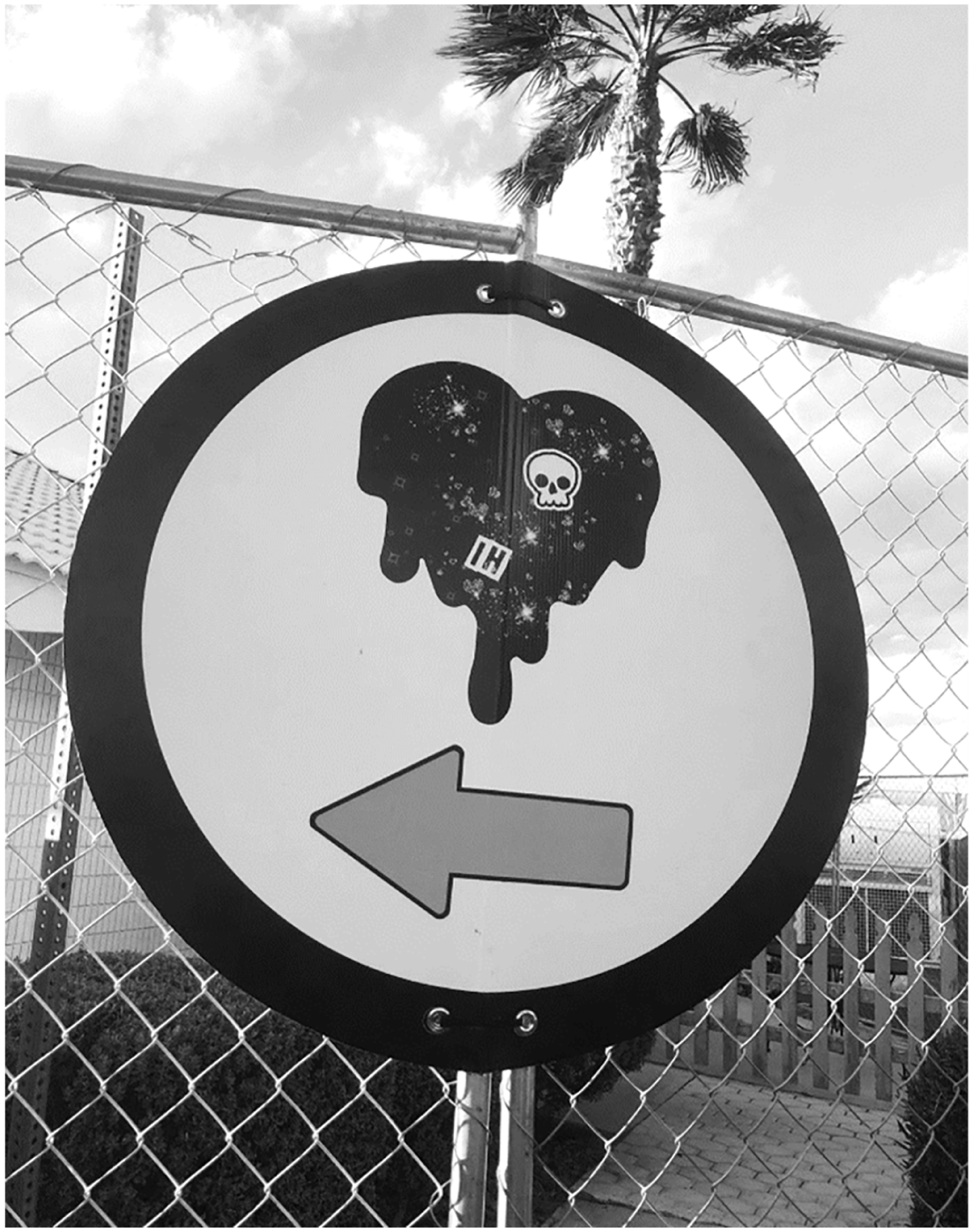
Signage at When We Were Young festival. (photo by Francesca Sobande)
Second, we study the significance of ‘new wave’ emo acts (KennyHoopla, Meet Me @ the Altar, WILLOW) and the narratives surrounding them, informed in part by Williams’s journalistic experience of interviewing them for the consumer music press. Drawing specifically on quotes which appeared in Williams’s published articles, we consider how these artists reflect publicly on their racialized positionality within a ‘new wave’ of emo, and how this framing, while often well-intended, made artists feel vulnerable to forms of tokenization and fetishization. While these interviews were not initially conducted for the purpose of academic study, Williams’s ability to reflect on her own lived experience as a Black and white British female media practitioner commissioned to write them brings additional insight to our overall argument about representation and inclusion in emo culture, in line with Tyra L Jackson’s (2022) autoethnographic research on racism in newsrooms as well as Yassir Morsi’s (2021) encouragement to embrace first-person methods as a powerful mode of decolonization and ‘epistemic disobedience’. Though the examples of music journalism and WWWY festival booking/marketing are just two industry-based avenues through which emo’s revival has been communicated, we position them as important case studies in the recognition of how women and people of colour’s standing in emo may be improving in terms of technical inclusion, but not necessarily in terms of substantial and sustained support.
‘A fever you can’t sweat out’: When We Were Young’s gendered and cute-ified aesthetics of erasure
On 18 January 2022, WWWY shared an image on what was then Twitter, announcing a festival lineup of some 66 (mostly all-male) acts. Described in Rolling Stone as ‘full of band names you either haven’t thought about in years or have thought about every single day since you hit puberty’ (Spanos, 2022), WWWY’s lineup offered a relatively exhaustive time capsule of US-centric acts who defined and popularized commercial emo in the mid-2000s; a veritable ‘throwback’ feast for anyone who grew up during emo’s third wave.
As its title suggests, the When We Were Young (WWWY) music festival is designed to evoke nostalgia; a term which has been understood in music scholarship as both a way of consecrating musical preference, and as a marketing tool which drives profit from the potent emotions of (sub)cultural memory (Garrido and Davidson, 2019). As Hesmondhalgh (2008: 329) affirms, music is embroiled in ‘the incorporation of authenticity and creativity into capitalism’. In the context of post-pandemic losses especially (White, 2024), events like WWWY are ostensibly ‘designed [by event producers Live Nation] to bait millennials’ (Spanos, 2022) into reliving their teenage listening habits, relying on the assurance of the familiar to drive profit.
As established by Hill (2011), emo has long benefitted from an overwhelming female and non-binary youth audience, despite most of its celebrated performers being cisgender men. To promote the event on Twitter/X, WWWY has shared many memes and text-based posts that may be interpreted as an intentional nod to girls and women. Much like the design features of the readers’ letters which Hill (2011: 300) analyses in a study of My Chemical Romance fandom and Kerrang! magazine, these scribble-style visuals of hearts, skulls and roses ‘create an air of scrapbook realism’ that is consistent with emo’s DIY aesthetics, and with school-age girlhood more broadly. As such, WWWY’s visual branding choices serve as a reminder of how thoroughly emo has contended with feminine, teenage aesthetics of romance and rebellion, particularly in a Y2K context (see Figures 2 and 3).
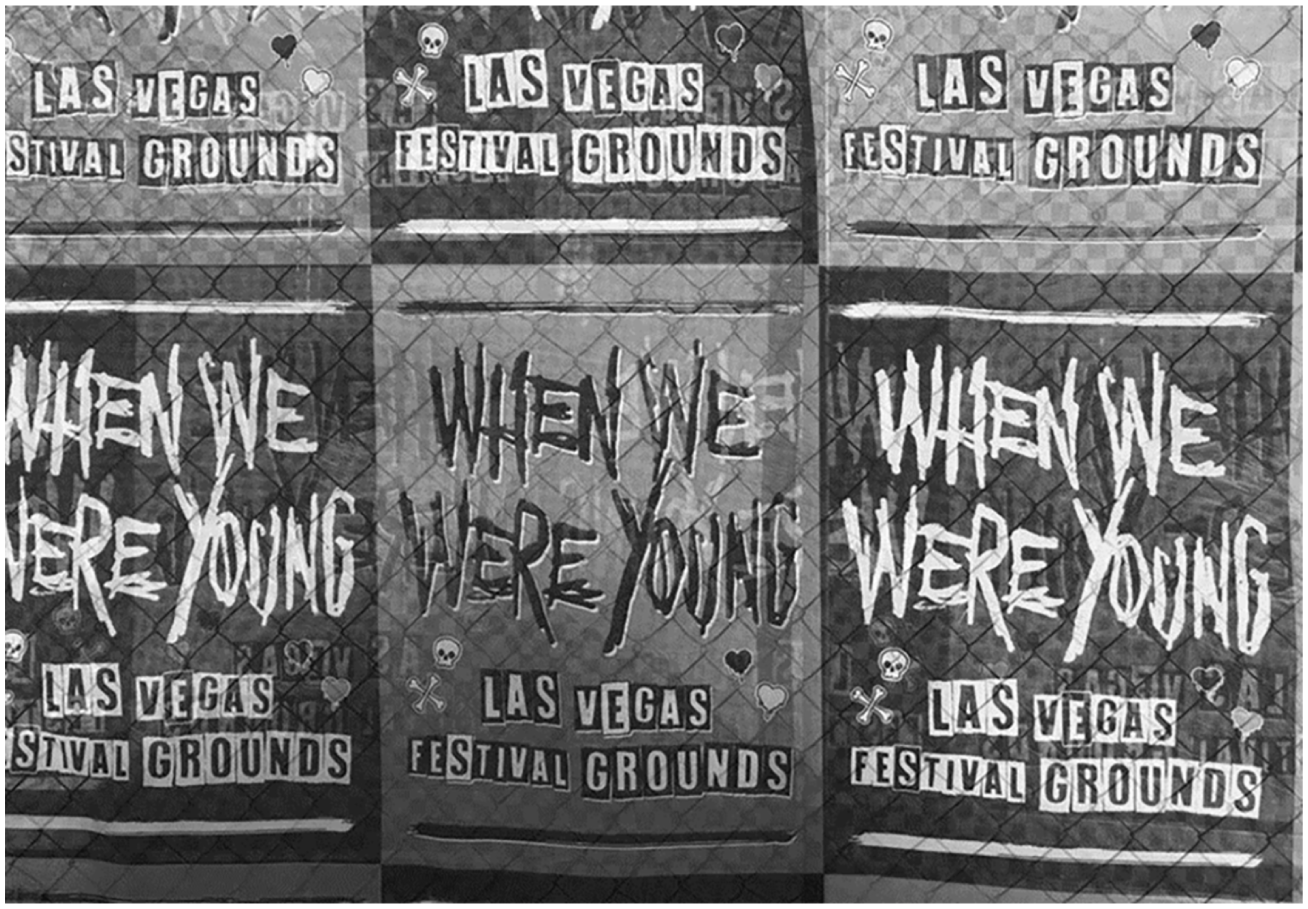
When We Were Young posters at Las Vegas festival grounds. (photo by Francesca Sobande)
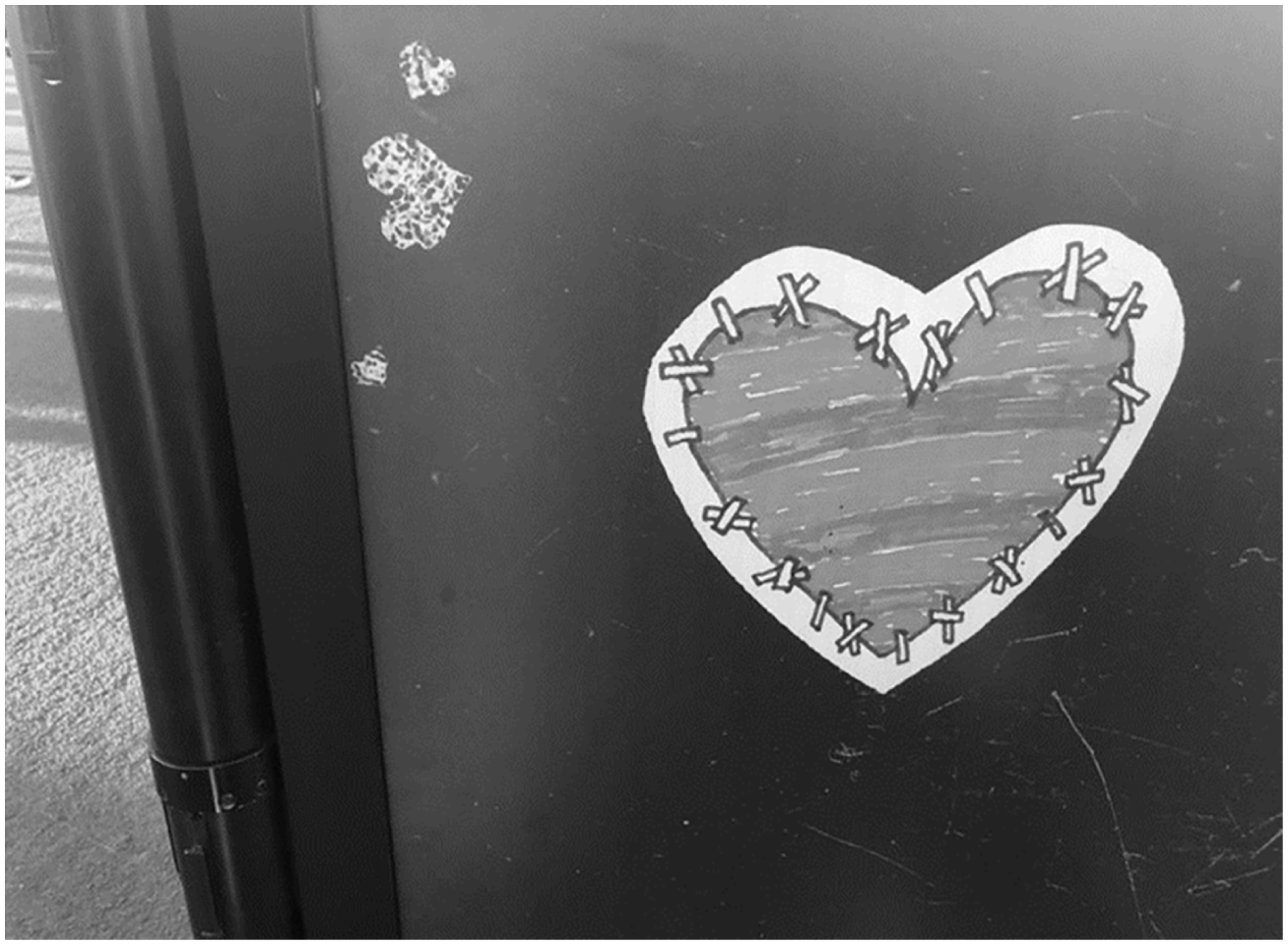
Patched heart sticker at When We Were Young festival. (photo by Francesca Sobande).
For example, WWWY X posts in 2022 include pink heart-shaped and lips-shaped graphics and visuals of Hello Kitty branded products (e.g. a CD player), semiotically alluding to feminized and marketized experiences of youth. In another X post (July 22, 2022), WWWY responded to an online trend which involved people creating humorous and personalized characters that resemble the Mr Men/Little Miss book series illustrations: ‘little miss this, little miss that, what about happy bunny?’ A relatively niche cartoon figure, Happy Bunny became popular circa 2001–2006 when US alternative fashion store Hot Topic began selling its sardonically-sloganized merchandise, mainly aimed at ‘alternative’ girls who identify as ‘cute, but psycho’ (Lakshmin, 2016). Noting that only those who lived through this timespan would likely remember the reference, the use of Happy Bunny is a classic example of the kind of niche intertextual reference that serves as a form of shared (sub)cultural capital. In favouring Happy Bunny over the more mainstream Little Miss, this kind of content also speaks to the inherent (and sometimes internally-misogynistic) excitement of being ‘not like other girls’ that is ingrained in alt-rock communities.
Such nostalgia is again semiotically invoked in the visual for the 2024 WWWY lineup announcement – an image of CDs, ballet shoes and vinyl records strewed across a large pink and fluffy rug – in tweets that forge connections between stereotypical ‘girl’ and ‘emo’ interests: e.g. an X post from 2022 stating ‘we need a disney princess that listens to glassjaw’, or in WWWY-created meme-posts that poke fun at the idea of unstable ‘fangirl’ mental health asking ‘who up crying to hold me down by motion city soundtrack (the answer is me)’.
Digital and consumer culture has included a popularization of certain forms of feminine ‘memetic shorthand’ in recent years, invoking archetypes associated with girlhood and youth, and often infantilizingly wide-eyed brand personas (Quicho, 2023). As Klein (2020) outlines in landmark work on Selling Out: Culture, Commerce and Popular Music, ‘digitalization has cast traditional sources of revenue for cultural producers into uncertainty’, re-emphasizing the need for creative marketing approaches. Accordingly, it could be argued that the adoption of this feminized brand voice/image is an active choice on WWWY’s part to move past the male dominance of the genre, while simultaneously benefitting from the fact that ‘girlhood has now become a central tenet of pop and internet culture’ (Kelly, 2023). However, the cute-ified brand voice/image of WWWY can also at times be seen to tie into the romanticization of 2000s/2010s emo and digital culture, where instances of mental ill health, self-loathing or problematic disdain towards other young women were often minimized via aestheticization of the moody and angsty teen girl. 3
Furthermore, WWWY’s use of a girlish brand voice/image can aid marketing and datafication processes that are passed off as playful and pastiche, such as the capturing of festival attendees’ data (e.g. the WWWY app), which is positioned as embracing emo’s ‘glory days’, or the pressure to engage with corporate sponsors such as Google to ‘Relive the vibes and recharge for the next set’. Therefore, we acknowledge attempts on WWWY’s part to legitimize and speak directly to its huge female audience, but also argue that feminized, meme-laden communication tactics can be a convenient vehicle for unassuming commerce, conjuring up disarming images of a friendly, youthful ‘fangirl’ rather than a corporate entity looking to profit from the mainstream commodification of a once decidedly DIY and, at times, anti-corporate genre. As WWWY’s allusions to femininity tend to draw on symbols that don’t depict actual people, arguably, there is a strategic use of ambiguity which may help them to evade critiques of appearing to allude to white femininity specifically.
Although WWWY’s social media presence appears to invoke ideas of girlhood and girlishness, the festival’s acknowledgement of people of colour – or more specifically, of Black people – is perhaps even more interesting to note. As of November 2024, the most recent images of Black people featured on the WWWY X account include the satirical TikToker MainlyMannie (5 March 2024) and rappers Future (10 September 2024 and 5 March 2024) and Flavour Flav (9 September 2024) – none of whom are strongly associated with emo. Recasting these ‘random’ celebrities into memetic punchlines, these inclusions can at best be perceived as a strange attempt at self-satirizing humour, and at worst be read through theories of memes as a form of ‘digital blackface’, a term popularized by scholar Lauren Michele Jackson in 2017 to describe how ‘White people co-opt online expressions of Black imagery, slang, catchphrases or culture to convey comic relief or express emotions’.
Through either reading, this decision to visualize such celebrities on WWWY’s feed (rather than more concerted or clear-cut efforts to highlight non-white emo fans or emo bands with non-white members), can perpetuate their erasure, maintaining the status quo of emo as a space which only engages with stereotypically ‘Black’ culture through the act of ridicule or parody. 4 When interpreted from a wider perspective on emo, WWWY’s incorporation of images, ideas and cultural references associated with youth and girlhood sit at odds with the reality of the historically dismissive societal treatment of teenage girls and women who were emo fans in the 2000s/2010s, and at even deeper odds with their determinedly white, male-centric lineup as it exists over 20 years later. Building on our reflections on the relationship between gender, race and emo, we now focus on the WWWY event itself.
‘Thnks fr the mmrs’: ‘classic’ lineups and Black alt absences
To properly contend with race and racial inclusivity in emo, we must consider the interplay between identity and ‘diverse’ representation, which means grappling with the specifics of identity politics within rock music’s history. As Mahon (2020) notes, rock music originally stemmed from R&B, which was reframed and marketed as rock to a mostly white mainstream audience in the 1950s. Put plainly, rock would not exist were it not for the creative work of Black R&B musicians. Regardless, rock is still often discussed and depicted in ways that whitewash its history and present-day landscape – overlooking Black people’s involvement as musicians and fans.
While focusing on the goth subculture, Hodkinson (2002: 70) suggests that ‘. . .traditional markers of social identity such as class, occupation, ethnicity and gender’ play a ‘secondary position of importance relative to subcultural affiliation’, essentially allowing the identity of ‘goth’ to supersede other forms of demographic label. However, Black people’s experiences of alt music spaces are often shaped by their racial identity and interconnected forms of oppression (e.g. racism, sexism, homophobia, classism; Williams, 2017; Sobande, 2025; Kerrang!, 2023). When reflecting on the politics of emo nostalgia, it is therefore crucial to pushback against potentially post-racial portrayals which frame emo as innately inclusive.
People of colour, women and queer acts have all featured on WWWY lineups, offering inclusion in its most literal sense. However, apart from previous headliners Paramore and Avril Lavigne, these artists are often placed at the bottom of the festival poster and are overlooked in favour of extensive marketing of the top-billing, white-centric male nostalgia-based acts. 5 When WWWY took place in 2022, long wait times to enter the venue meant that earlier performers faced perceptively diminished crowds; an issue that was repeated in 2023 when the Black-fronted Magnolia Park opened the festival, and where KennyHoopla, Jean Dawson and EkkStacy (three of the remaining four POC-fronted acts included in that year’s programme), were scheduled to perform at the same time as headliners Green Day, noticeably reducing their audience. While headliners and the order of festival billing are usually chosen in relation to economic imperatives of established popularity, this issue reveals the cyclical nature of music industry inequality, where artists from marginalized backgrounds cannot achieve preferential festival billing without demonstrating a sizable pre-existing audience, but also cannot build that audience without established gatekeepers – such as WWWY Live Nation, or indeed, as we shall find later in this article, music journalism publications – taking the occasional ‘risk’ of putting a lesser-known name in a position of high exposure from which they might grow their fanbase (Trendell, 2021).
As we previously pointed out in relation to the erasure of Black women in rock (Dawes, 2013; Mahon, 2020), racial discrimination can also play a significant role in the construction of music genres, the nostalgia surrounding them and the canonization of their history. Hence, WWWY’s limited engagement with the undeniable commercial growth in popularity of ‘emo rap’ – a hugely popular sub-genre that tends to integrate more POC artists – feels simultaneously surprising and depressing, symbolizing racialized, gendered and classed assumptions about who ‘belongs’ within emo and deserves to be booked. Specifically, WWWY misses an opportunity to engage with Black ‘working-class oppositional practices’ (Rose 1994: xiv) that might offer contrast to emo’s well-established roots in a more suburban/middle-class white experience. The implications here, notes Chaudhry (2023), are significant for emo’s future, serving to ‘narrow the ideas surrounding who is considered to be a rock artist, making it harder for these genres to be more inclusive’.
In 2024, WWWY leaned even more heavily into themes of nostalgia and throwback, introducing an initial lineup of artists who would be playing ‘classic’ 2000s albums in full. In opting for a strategy which sought to celebrate the work of predominantly white male artists who achieved success in a relatively timebound view of emo’s mainstream canonization, WWWY appeared to be limiting involvement from newer (and potentially more diverse) acts. Public criticism of how few women performers were included resulted in the festival adding on six additional female artists a day later, with female musicians such as Scene Queen and Cassadee Pope among those who had tweeted their disappointment. Over time, the full lineup was extended to include newer acts performing ‘regular’ sets. While some praised WWWY for listening to feedback and adapting quickly, this outcry demonstrates how often it is left to women to enact the labour of fighting for inclusion, linking back to our prior discussion of the ironies of WWWY’s ‘girlified’ branding. Meanwhile, and despite mounting criticism, WWWY has never publicly responded to critiques of their decision to book emo and pop-punk artists who have been credibly accused of sexual abuse, misogynistic lyrical content or inappropriate contact with minors, sending a very clear message as to the kind of behaviours that bookers and fans alike might be willing to overlook in the name of rose-tinted reminiscence and belonging. 6
Certainly, the under-representation of women and racially minoritized musicians is far from exclusive to this festival, as countless international studies can attest (Fileborn et al., 2020; Haynes and Mogilnicka, 2022; Raine, 2019). But in WWWY’s determined celebration of the supposed heyday of emo and uncomplicated youth, there are significant failures to address the complicated reality and entangled gender, racial and generational politics of a scene that has long struggled with sustainable modes of inclusion. As such, the uncritical notion of nostalgia that Live Nation promotes via WWWY can insulate bands and fans from the need to acknowledge that not everybody who engages with emo – women and POC in particular – shares a sense of cultural reminiscence that is wholly positive. If not handled with due care, this sets a precedent where ‘emphasizing the mid-2000’s also risks glorifying a problematic past’ (Chaudhry, 2023), reinforcing nostalgic narratives that perpetuate the erasure of emo music by POC.
‘Welcome to the Black parade’: the mantle of ‘new wave’ racial representation
While the artists that WWWY allows into its ‘hall of fame’ may at times feel off-puttingly limited, emo and rock fans of colour have nonetheless found ways to carry on. Within this very paper, we take cues from Black scholars’ illuminating research on Black women’s crucial contributions to rock music (Dawes, 2013; Mahon, 2020), as well as increasing recognition of the cultural footprints left behind by Black music journalists, such as NME’s late Dele Fadele, who frequently observed the influences and dynamics of gender and blackness throughout the 1980s and 1990s. Shaped by the insights of journalists such as Fadele – as well as the need for more writings on the specifics of race and emo – we turn our attention in this section to how narratives of race (and racial inclusion) have played out in music journalism, positioning POC artists amid a new wave of change.
During the dovetailing of the ‘thirdwave’ and ‘fourthwave’ of emo, there has been increasing press coverage of the experiences of Black and brown fans, musicians and journalists in rock music; often collectively referred to using the expression ‘Black Alt[ernative]’. Launched in 2021 by music journalists Sophie K, Alyx Holcombe and Yasmine Summan, the podcast On Wednesdays We Wear Black has seen success as a discussion space which unapologetically talks about ‘everything from sex, racism and gigs to myspace emo fashion’ (Apple Podcasts, 2024). Elsewhere, there have been onstage declarations of racial advocacy and allyship from some white artists (including Paramore and emo-pop artist YungBlud), as well as broader media coverage of initiatives such as Decolonise Fest – ‘[a] DIY event in London spotlighting punx of colour’ (Raza-Sheikh, 2024). In the words of Kerrang! (2023), change is happening: From the MOBOs now having a Best Alternative category to bands like Nova Twins getting a main stage slot at Download this year, Black alt. musicians are being championed and supported more than ever before across the media, festivals and beyond, but as you will see below, there is still more work to be done.
This ‘work’ has not occurred without significant sociopolitical prompt. Following George Floyd’s murder at the hands of police in Minneapolis on 25 May 2020, protests and reappraisals of racism erupted worldwide, filtering into numerous industries and sparking significant conversation. In music, pledges to ‘do better’ resulted in the dismantling of ‘urban’ divisions at record labels, pushes to champion more Black artists through themed streaming-service playlists (Spotify, 2020), and the advent of ‘BlackOutTuesday’, a 24-hour online activist-boycott initiative started by Black women music executives Jamila Thomas and Brianna Agyemang which invited people to post blank black squares under the hashtag #TheShowMustBePaused. Research during that time highlighted such issues in the industry, including a 2021 report by the organization Black Lives In Music, who found that ‘six in 10 black music creators have experienced racism, while 86% say they have faced barriers to their career because of their race’ (Savage, 2021).
As a result, industry pushes to hear from more Black people have been significant. In emo, the clubnight Emo Nite LA was one of the first to host ‘an open panel of black voices’ (Hernandez, 2024) while The Guardian published a feature on the US event BIPOC Emo Night, recognising how it provided audiences (particularly young and queer ones) with an opportunity to reclaim contributions that ‘are often erased from the history of emo’ (de Luna, 2023). More broadly, editorial calls for music pitches from people of colour have significantly increased (before, in some cases, dwindling again), in tandem with increasing coverage of the artists and industry figures who were ‘redefining’ a new era of diverse representation.
Williams, a freelance music journalist and academic, has been in the industry for over a decade, and experienced a significant increase in commissions and offers of commercial work during the summer of 2020, often relating to the coverage of POC acts. While the experience of being a recipient of such affirmative action at times felt uncomfortable (particularly as a ‘mixed-race’ Black-British woman with certain colourist and class-based privileges), it at least provided ample opportunities to pitch and profile a number of Black artists swept up in emo’s new guard, and, in the spirit of Fadele and journalists of colour who had gone before, to draw upon the experiential to spark conversations of nuance and kinship that may have been handled differently by a white writer.
Having met in the online comments section of YouTube emo videos, American trio Meet Me @ The Altar (MM@TA) were one of the bands whose public profile expanded rapidly during the summer of 2020. As three women of colour, MM@TA expressed notable pleasure in the idea of being a group that diverse audiences could look up to, particularly in the visibility of Black American lead singer, Edith Victoria (see Figure 4).
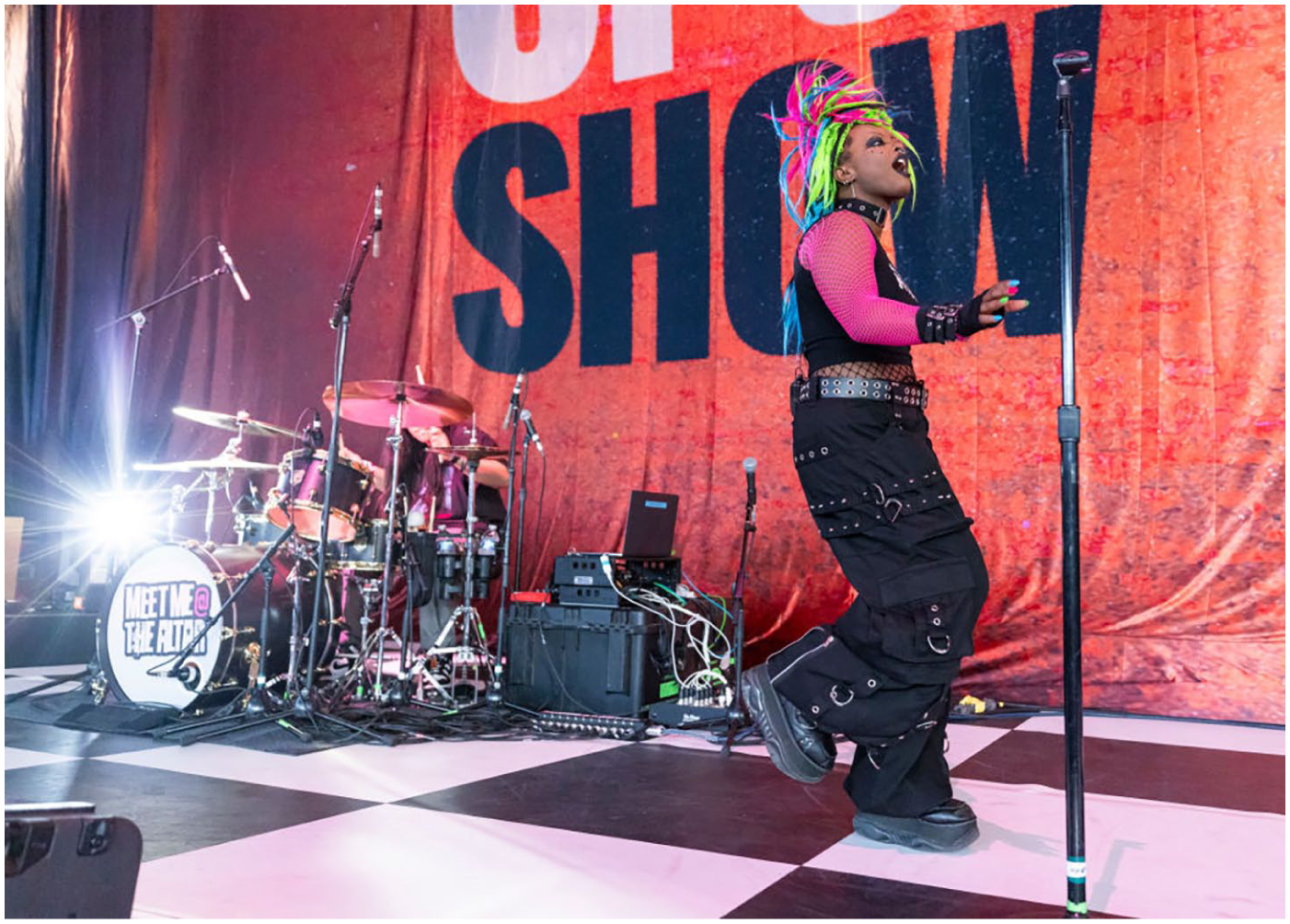
Edith Victoria of Meet Me at the Altar performs at Pine Knob Music Theatre on 16 August 2023 in Clarkston, Michigan. (photo by Scott Legato/Getty Images)
But in Williams’s interview (Williams 2021a), Meet Me @ The Altar were also open about the discomfort of being treated like a ‘new’ band that had suddenly emerged out of nowhere. ‘We’ve been playing together since 2017, but it was around the George Floyd murder [in May 2020] that we first started getting any momentum’, said Edith: times, anti-corporate genre. We had so many people reaching out and championing us . . . it’s been great, but it’s also really bittersweet and a little sad that it happened this way . . . It’s interesting, because I was angry at people posting black squares, and then I was angry at people not, so it’s like . . . I don’t know how to feel!
This uncertainty will be familiar to any person of colour who has experienced the ‘two way street of tokenism’ (Edith’s then-bandmate Téa’s words 7 ). On one hand, it is exciting to see Black artists receiving new (or more) attention, and difficult not to take a better-late-than-never approach to ‘allies’ or industry peers opening up conversations about racial justice. But while many of the artists and fans that publicly endorsed MM@TA in 2020 likely meant well, such narrativization can also position an artist’s success as being exclusive to a (deeply harrowing) timeframe in which ‘allies’ are desperate to signal their social goodness by latching on to ‘black anything’ rather than artists that they sincerely believe in and enjoy. This ‘bittersweet’ experience is simultaneously gratifying and galling, cast in a spectrum that can be understood as both overdue reparations, and the discomfort of ‘profiting’ from another Black person’s tragedy.
Similar concerns emerged in Williams’s conversation with KennyHoopla (Figure 5), whose innovative blend of indie, emo and EDM sounds make for an intriguing songwriting expression which, due to Kenny being Black, is often mischaracterized as ‘emo rap’ or exclusively compared to other non-white acts. ‘People aren’t giving me the space to be me . . . I’m aware that [when I speak about it] I sound like I’m really angry about it too, and I’m not – it’s just something I’ve been trying to think my way through’ (Williams, 2020).
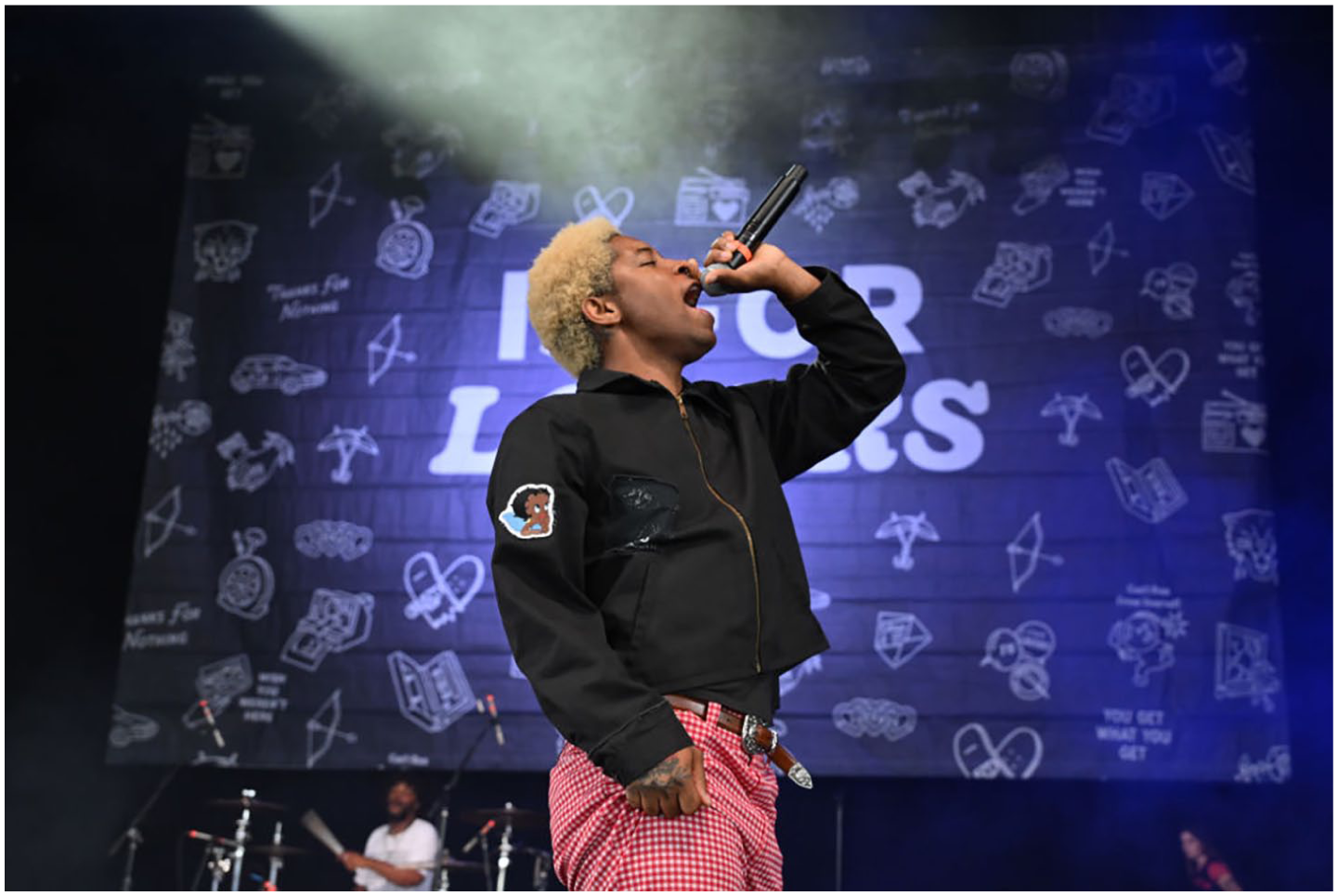
KennyHoopla performs during the 2023 Ohio is for lovers festival at Riverbend Music Center on 9 September 2023 in Cincinnati, Ohio. (Photo by Daniel Boczarski/Getty Images)
Certainly, there are hallmarks to KennyHoopla’s sound which might evoke the intonations of Kele Okereke (Figure 6), the Black frontman of British indie group Bloc Party (and a noted collaborator across emo and pop-punk). Hoopla acknowledged that he was a huge fan of Okereke’s, but also noted a host of other inspirations, while apologizing frequently for ‘talking so much’ or sounding ‘angry’ about the less favourable aspects of his new fame. While KennyHoopla has spoken in other interviews with white journalists about his feelings on race and belonging within the scene, his candour in this interview – and his self-awareness of how easily he might be pegged as an ‘angry’ Black man if he is seen to complain – seemed at least partially influenced by Williams’s own visible blackness, trusting that his words might be contextualized appropriately and with experiential understanding.
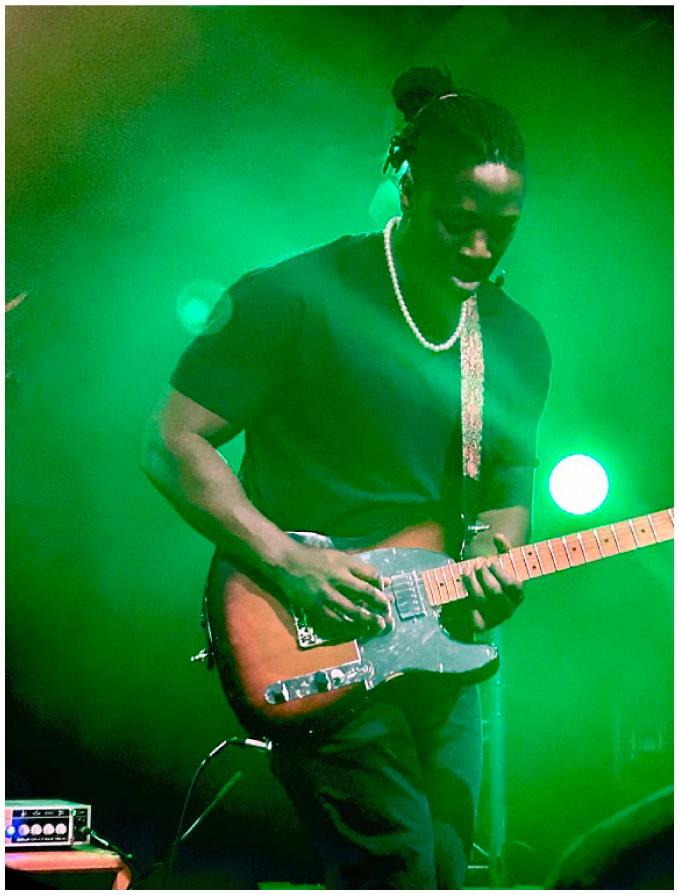
Kele at Thekla in Bristol on 20 February 2025. (photo by Francesca Sobande)
A third interview was with WILLOW (Figure 7), more commonly known as the daughter of Hollywood actors Will and Jada Pinkett Smith. Having experienced musical success as an 11-year-old with the viral single ‘Whip My Hair’, WILLOW had released four albums in the Neo-Soul tradition, before pivoting to a style of emo-pop which recalled the angsty 2000s stylings of Avril Lavigne, Ashlee Simpson and the often under-cited Black Canadian performer, Fefe Dobson. While WILLOW noted that she is ‘extremely privileged’ in terms of being protected from some of the everyday occurrences of racial discrimination, she also shared deeply relatable feelings of not being considered emo ‘enough’ in her school years, sparking her desire to reclaim the genre and follow in the footsteps of her mother’s time as the singer in nu-metal group Wicked Wisdom (see Figure 8): I remember [telling school friends] I wanted to perm my hair and do the classic emo swoop to the side and them just looking at me going, ‘I don’t think that that’s going to be a good look for you’ . . . There’s a barrier there, every single time. And that’s one of the reasons why I loved watching my mom on Ozzfest and touring metal . . . A lot of people felt offended and angry that a Black famous woman was in their community, doing something that they didn’t want her to be doing. She got so many death threats; [just people] being really, really racist and nasty and sexist . . . on top of the fact that I wanted to push back against that, I just love rock, and I always have for my whole life. Those are two big reasons why I decided to make this project. (Williams, 2021b)
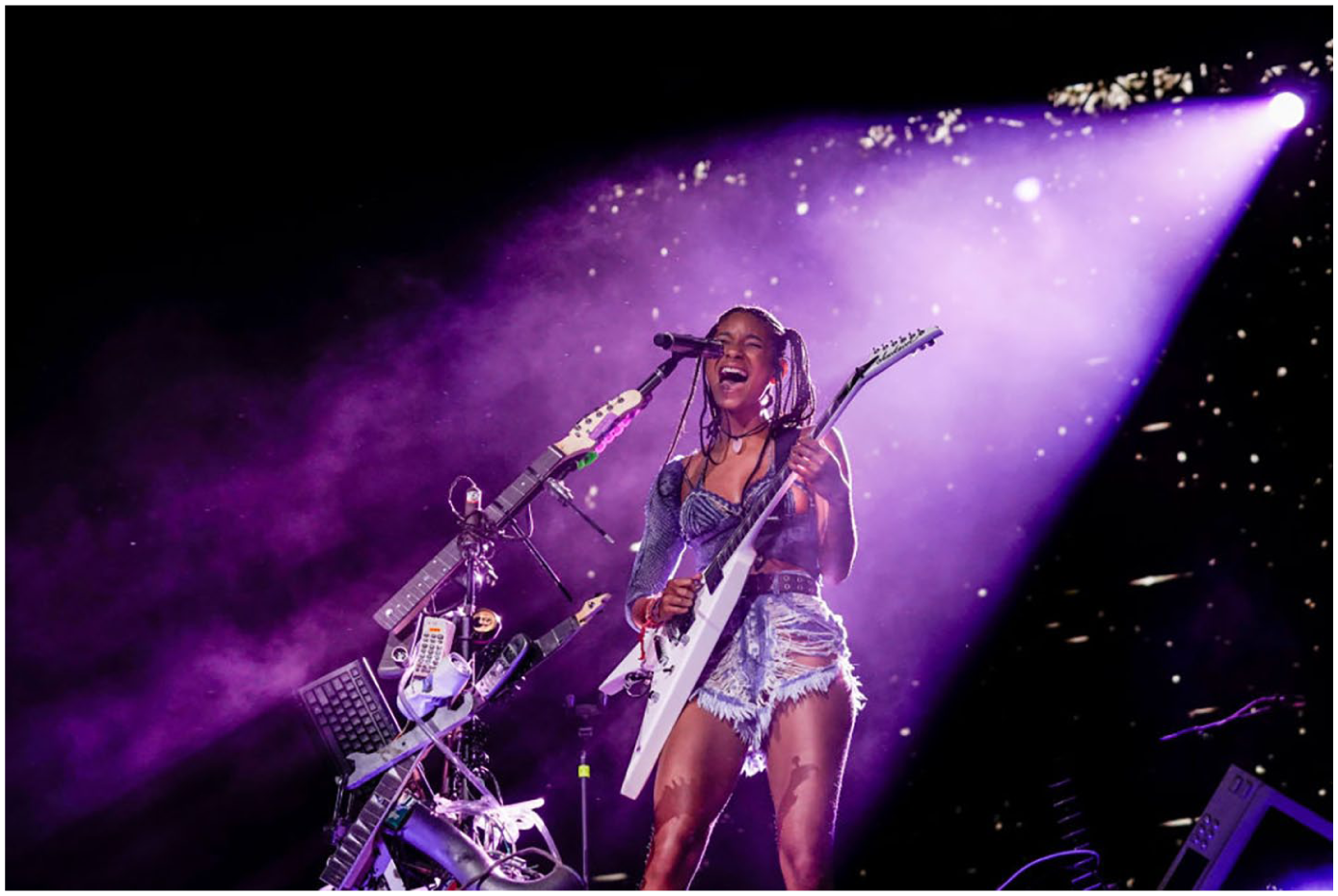
Willow Smith performs onstage at the 2023 Coachella Valley Music and Arts Festival on 23 April 2023 in Indio, California. (photo by Presley Ann/Getty Images for Coachella)
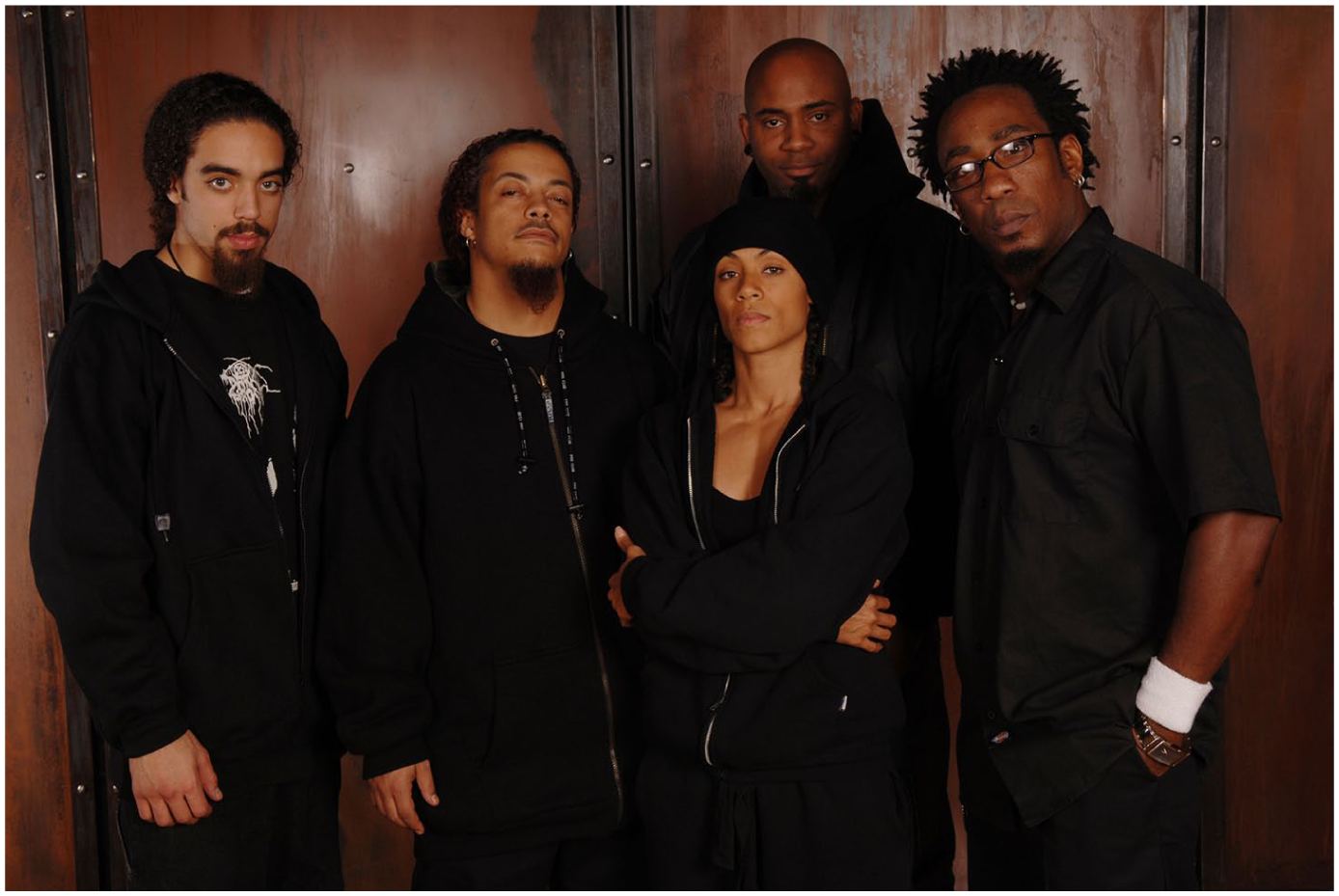
Jada Pinkett Smith and her band Wicked Wisdom pose for photos at Club Revolution 18 January 2006 in Ft Lauderdale, Florida. (photo by Larry Marano/Getty Images)
Contending with intersectional questions of race, class, gender, beauty standards and misogynoir (Bailey, 2010), WILLOW’s commitment to rock is presented as a form of rebellious defiance, but also a firm reminder that rock music is in her DNA. WILLOW continues her mother’s legacy on her own terms – including through a metal cover of Wicked Wisdom’s ‘Bleed All Over Me’ – pushing back against significant media scepticism that WILLOW was merely ‘trying on’ emo to cash in on the genre’s renewed pandemic-era popularity. In being so mistrustful of young Black people’s genuine interest in emo, such commentators and critics seem to have fundamentally misunderstood the fact that emo and pop-punk may not have a revival at all were it not for Gen-Z’s efforts: ‘a diverse group of women who have kept the genre’s sense of belligerence and fun, but are developing it to create something youthful that also has a quality that many of those older bands eschewed – emotional maturity’ (Ewens, 2021).
Meet Me @ The Altar’s ‘Fight Like A Girl’ – similar to Magnolia Park’s ‘Don’t Be Racist’ or The Linda Lindas ‘Racist Sexist Boy’ – marks a new crop of emo-infused torch anthems for audiences that are explicitly inclusive of girls, women and POC, while various other POC punk or emo-adjacent artists – Jean Dawson, Fever 333 (see Figure 10), Nova Twins, Bob Vylan (see Figure 9), Better Now, Pinkshift – have engaged themes of racism and global oppressions in both their music and interviews, boldly stepping up to the idea that unapologetic presence might enable the next generation to feel more confident in the space that they take up.
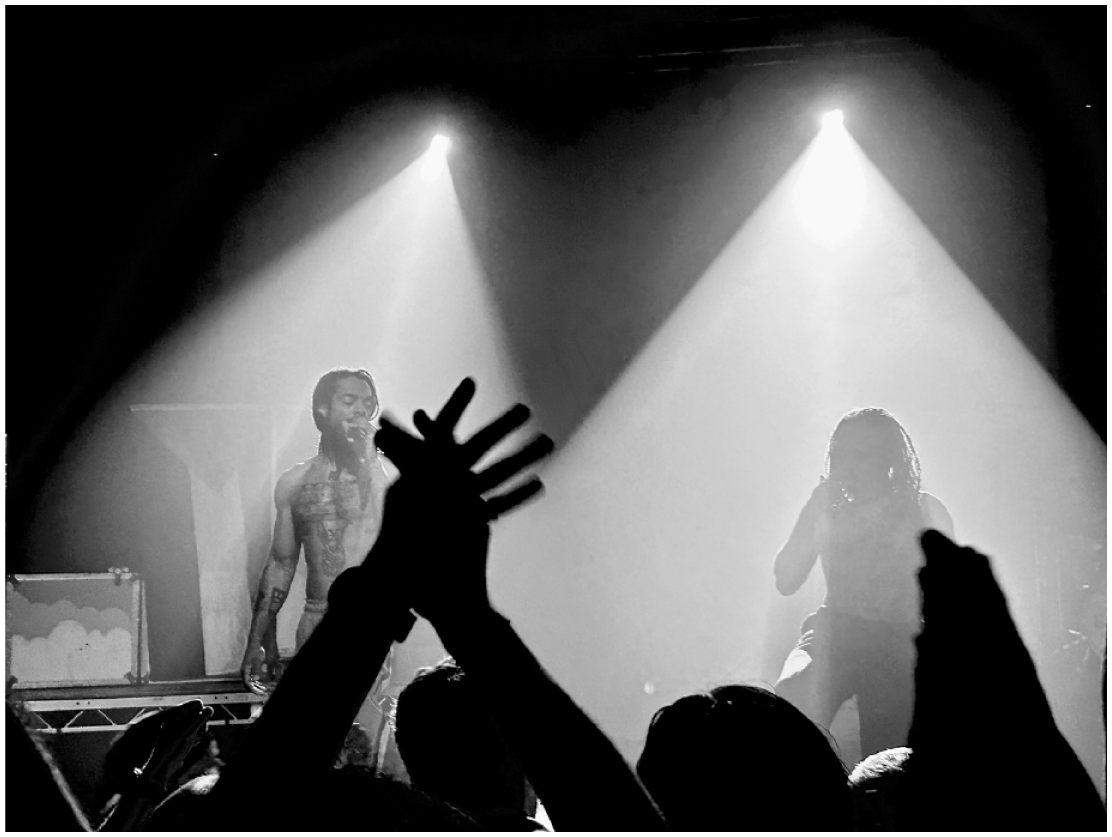
Bob Vylan at Cardiff Students’ Union on 27 October 2024. (photo by Francesca sobande)
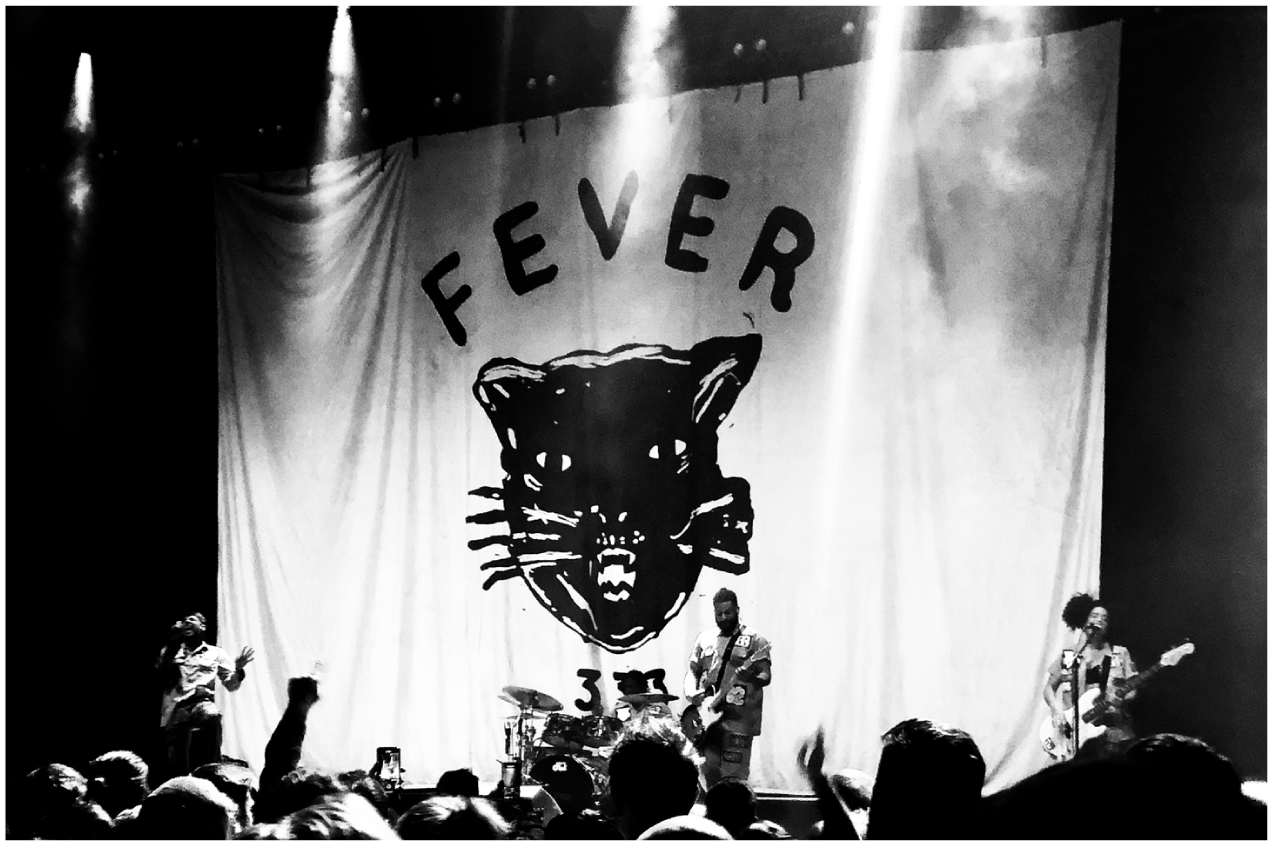
Fever 333 at Utilita Arena in Cardiff on 16 February 2024. (photo by Francesca sobande).
However, in being positioned as the brave new leaders of change, artists of colour are also vulnerable to having activism thrust upon them, required to carry a heavy burden of representation and resilience if they are to be noticed as a ‘worthy’ new name in the scene. In acknowledging that many POC acts who rose to prominence in 2020 seem concerned that they will be perceived as ungrateful or ‘angry’ if they express displeasure at the way that their race is focused upon, we recall work shaped by understandings of intersectionality (Crenshaw, 2017), such as Zoe Glatt’s (2024) notion of the ‘intimacy triple bind’ in which minoritized public figures have to work incredibly hard and offer up a significant amount of themselves if they wish to build an approving audience.
Acts like Meet Me @ The Altar, KennyHoopla and WILLOW are ‘already at higher risk of trolling and harassment, yet under increased pressure to perform relational labour, adversely opening them up to further harms in the form of weaponised intimacy’ (Glatt, 2024: 424). To take this point further (and in the ‘culture war’ climate of US and UK-based journalism especially), we might also refer to the notion of ‘trauma porn’, where minoritized creatives are frequently called upon to viscerally describe the challenges and vulnerabilities of racism/sexism/transphobia as a news hook, simply so that they might receive the same press attention that white artists are afforded for the quality of their music alone.
As Williams can attest, journalists of colour are often cast in a similarly bittersweet bind to the artist they cover. Unmistakably, it is encouraging to see that compassionate editors are making deeper efforts to match up writers and subjects on a matter of similar background, in the hope that it may yield more insightful interviews. There is also humorous catharsis to be found in the myriad think-pieces that have been commissioned from marginalized writers making similar confessions: ‘I Was a Weird Black Emo Teen in a Misery-Obsessed White Subculture’ (Martis, 2020). Broadly speaking, however, it can also be demoralizing to feel creatively confined to race-themed commissions, to be encouraged to pursue lines of race-based questioning that would not be considered appropriate for white artists, or to be asked to produce ‘POC bands to support’-type listicles which group otherwise dissimilar musical acts in well-meaning yet slapdash attempts to service the optics of diversity. As with all creative careers (and particularly within the precarity of freelance work), there is a constant tension for Black and brown writers between gratitude and scepticism, between welcomed representation and forced ambassadorship, and between satisfying time-poor readerships while also pushing for idiosyncratic approaches to music journalism and storytelling that resist the click-baiting urge to reduce individuals to homogeneous parodies of what it means to be emo, Black or both.
Returning to this article’s theme of nostalgia and temporality, these concerns become amplified through the editorial pressure to group these creatives as ‘new’ to the emo scene, rather than seen and appreciated as people who were there all along. By implying that these bands have emerged out of nowhere to ‘solve’ the BLM-era issue of racism in emo, even the most positively-intended journalism at times glosses over the lengthier stories of an artist’s rise to prominence, oversimplifying narratives which may be coaxed out by writers with more personal experiences of racial and gender-based oppression. In connecting this back to our analysis of WWWY and the live events space, we present music journalism as an environment that is caught in the dichotomy between tactical inclusion (aka superficial strategies) and active belonging (aka substantial change), needing to go further if it truly is to make both artists and journalists feel that they can articulate themselves as talented individuals who deserve their place in the scene without needing to take on the individualizing burden of being ‘the face’ of genre revolution.
‘A praise chorus’: conclusions and calls to arms
In the words of music journalist Taylor Markarian (2019: 15), ‘Emo is significant’. Post-pandemic especially, the revival of emo culture serves as an opportunity for community and catharsis, a space where one’s inner child – or, indeed, inner fan – can go to feel recognized and collectivized in a setting where bands who may have otherwise been forgotten could engage with new forms of cultural praise and recognition. In attending the WWWY festival firsthand, Sobande was able to enjoy the feeling of participating in international fandoms and connecting with like-minded listeners, even while thinking critically about the festival’s limitations. Williams, meanwhile, has enjoyed the personal and professional benefits of interviewing old and new bands within the emo guard, and learning about how they are allowing emo to inform their work without endorsing some of its more problematic elements. To quote Téa from Meet Me @ The Altar, ‘nobody else is going to go out of their way to welcome you in. You have to be in these spaces unapologetically, and then other people will be more likely to come through’ (Williams, 2021a).
However, as we have shown (and echoing the words of Hayley Williams at the beginning of this paper), the personal pleasures of millennial nostalgia and career opportunity should not preclude emo fans from reasonable critique. As Black/‘mixed’ women, we are experientially attuned to forms of erasure, whitewashing, tokenism, exploitation and exclusion that have long occurred within alt-rock cultures, as well as the numerous and ongoing allegations of gendered mistreatment and assault that have been highlighted within such spaces. We celebrate the important, pioneering work that musicians and artists of colour (often women and non-binary people) are doing to make themselves and emo heard, while acknowledging that they are frequently left to fight for themselves in an industry that sometimes appears only interested in platforming POC acts to evade critiques of racism rather than supporting such acts in substantial and sustained ways. In the case of When We Were Young, the festival’s limited inclusion of women and people of colour – as well as the continued platforming of abuse-accused figures – frames some of our scepticism as to whether something so preoccupied with replicating ‘the good old days’ should be considered so central to emo’s renewed mainstream visibility and appreciation.
By looking at music festivals and music journalism – whose notions of nostalgia and revival tend to dominate discourse on emo and its cultural significance – we have aimed to open a conversation about the potential that music festivals, artists and journalistic publications have, to harness nostalgia not just for its own sake but as fuel for new and more inclusive interactions. In Brannon’s (2023b: 140) words, ‘[e]very time emo is reduced to the trope of “the sad white boy crying over a girl,” countless scores of us are not only pushed to the margins, but quite literary pushed off the page’. There is extensive scope for further academic research and activist projects which explore the gender, generational and racial politics of emo’s past, present and future, as well as addressing the positionality, emotional labour and experiences of people of colour who engage with the music industry as artists, journalists, gig workers or plenty more besides.
For such work to really grapple with dynamics between social identity, structural inequalities and nostalgia, however, it must engage the genre in all its complexities, foregrounding contributions from those it has traditionally left out. Therefore, we close our article with a call not simply for more research on the role of festivals and the music press in positive genre development, but also a call for academia to critically reflect on and address how intersecting oppressions are implicated in who is (and is not) perceived as truly knowing this genre, its history and how it has been experienced, researched and remembered.
Footnotes

Funding
The authors received no financial support for the research, authorship and/or publication of this article.
Declaration of conflicting interests
The authors declared no potential conflicts of interest with respect to the research, authorship and/or publication of this article.
Data availability statement
Data sharing is not applicable to this article.